Antique Beside the Road

Living here in Uruguay is an every day surprise. Driving around even very known places can offer a sudden surprise. A few weeks ago, a rare rainy day, a saw an unusual machine near the La Floresta turnoff from Interbalenaria. I had to stop and made some pictures of this rarity. An old crane of a type I had never seen before.

Back home, a few days later looking at the pictures I took,  I discovered the manufacturer „MORRIS“, United Kingdom. My „discovery of history heart“ was awakened and I started searching what kind of crane we have in our Uruguayan town on display. Here the story.

Herbert Morris Co Ltd was established in 1897, manufacturing lifting gear and equipment for heavy goods, mostly cranes. The company has been overtaken at various points in its history. Today it is known as Morris Materials Handling, with fifty employees. At its height, it employed 2000 people.

This Morris company has no connections to the 1919 founded Morris Motor Company „WRM Motors Limited“ (producing bicycles and cars) of William R. Morris.

The Morris Crane Company is now a subsidiary of Konecranes, UK.  Morris’s remaining operations in Loughborough were moved to Scotland some years ago and they left the industrial site in Loughboruogh abandoned as shown below.

Herbert Morris and Bastert.

1884 Company founded by Herbert Morris and Frank Bastert to produce lifting pulley blocks at Attercliffe, Sheffield.

   That was before they moved to Loughborough.

1889 At this time the company employed 50 persons.

1889 Took on the agency for the pulley blocks of Schuchardt and Schütte of Berlin.

1891 Disagreement with the German firm who moved the sole agency to C. W. Burton.

   Click on pictures to supersize.

1897 Company moved to Empress Works, Moor Lane, Loughborough.

1900 Became a Public company, maker of electric cranes.

1911 Frank Bastert retires from the business.

1912 Name changed and the company becomes Herbert Morris.

This is a vehicle I have never seen before. A museum worthy machine, displayed, but rotting away, as so many valued things from the past, in Uruguay. In Europe they would have it restaurated and displayed in one of the historic technical museums.

Royce and Company.

1884 Company formed by Frederick Henry Royce.

1891 The company was registered on 4 June as F. H. Royce and Co, to take over the business of electrical and mechanical engineers of the firm of the same name.

   Royce Ltd. Manchester and Rolls Co. Lillie Hall London . Click on pics to size up.

1899 F H Royce and Company was put into voluntary liquidation and reconstructed with an enlarged capital, re-registration taking place under the title of Royce Ltd on 17 October.

1903 Listed as „Royce Limited. Electrical and mechanical engineers, makers of dynamos, meters, electrically driven cranes and hoists, arc lamps etc. Works – Cooke Street, Hulme. Branch works – Trafford Park“. What a naming !

1903 Began experiments with motor car manufacture and in the latter half of the year Royce began producing a 10 hp model with overhead valves. By the spring of 1904 had produced three cars.

  Sir Frederick Henry Royce (27 March 1863 – 22 April 1933) was an English engineer famous for his designs of car and aeroplane engines.

1904 Royce decided to manufacture a car of his own which he did in a corner of the workshop. Two more cars were made. Of the three, which were called Royces and had two-cylinder engines, one was given to Ernest A. Claremont and the other sold to one of the other directors, Henry Edmunds and ultimately to C. S. Rolls.

A Rolls with Panhard chassis from 1903.

1904 23rd December. Charles Stewart Rolls and Claude Goodman Johnson trading as C. S. Rolls and Co entered into an agreement to market the total output of the company, Rolls would make the bodywork. The cars ranged from a two-cylinder 10 hp chassis to a six-cylinder 30 hp model.

  Charles Stewart Rolls (27 August 1877 – 12 July 1910) was a Welsh motoring and aviation pioneer. With Royce, he co-founded the Rolls-Royce car manufacturing firm.

1906 March. Set up the Rolls-Royce company to produce cars, including acquiring the Cooke Street Works. Royce Ltd continued in business making cranes. In December a share issue funded the acquisition of C. S. Rolls and Co and enlargement of the works.

    1903 Rolls‘ advertising.

1909 Listed as Royce Limited. „Electrical and mechanical engineers, makers of dynamos, meters, electrically driven cranes, hoists, capstans and winches etc. Registered office and works – Trafford Park Road, Trafford Park, Manchester“.  Again – what a naming !

1909 Electric „monorail“ jib crane for Hawthorn, Leslie and Co., Forth Bank Works.

And this is the first Rolls Royce chassis from 1922.

1922 Manufactured electric cranes, electric capstans, electric winches, electric transporters, D.C. dynamos and motors, electric controllers and switch-gear.

1932 Company acquired by Herbert Morris of Loughborough.


Herbert Morris (1864-1931) rose from modest beginnings as a salesman of pulley-blocks in London. In 1889 he acquired an interest in the Sheffield company of Shardlows which manufactured lifting gear. Joined in partnership by Frank Bastert, a German engineer, he rapidly expanded the business which became known as the Sheffield Crane Works.

Herbert Morris .

Herbert Morris of Empress Works, Loughborough, formerly Herbert Morris and Bastert. Owned by Herbert Morris (1864-1931).

1912 Frank Bastert remained a partner until 1911 and his name disappeared from the title of the company in 1912. .

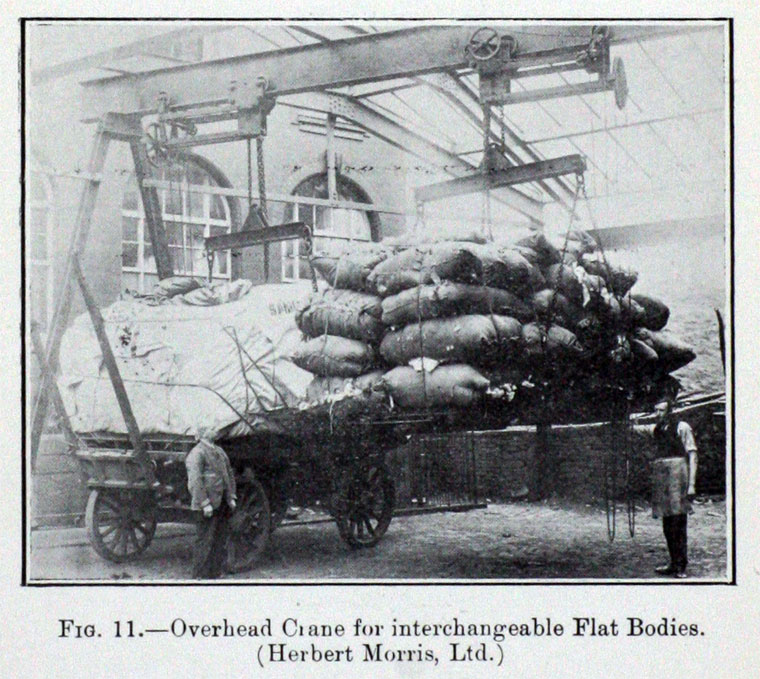
       Morris Crane advertising, from 1918 (left) and 1919 (right). Below an Morris Overhead Crane from 1922.

1914 Manufacturers of electric, pneumatic and hand overhead traveling cranes, pulley blocks, conveyors, overhead runways and lifting miscellanea.


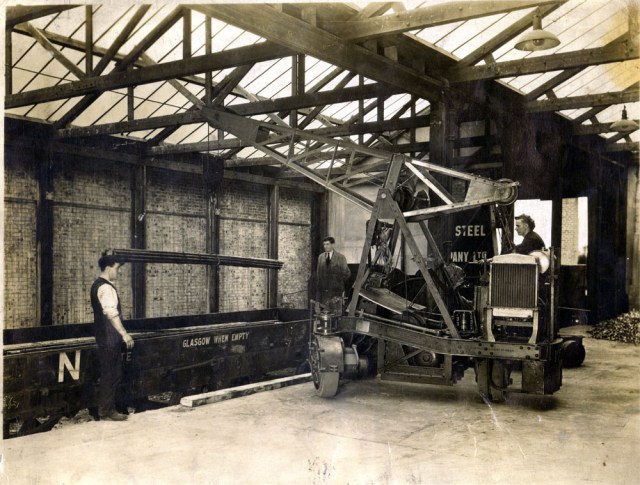
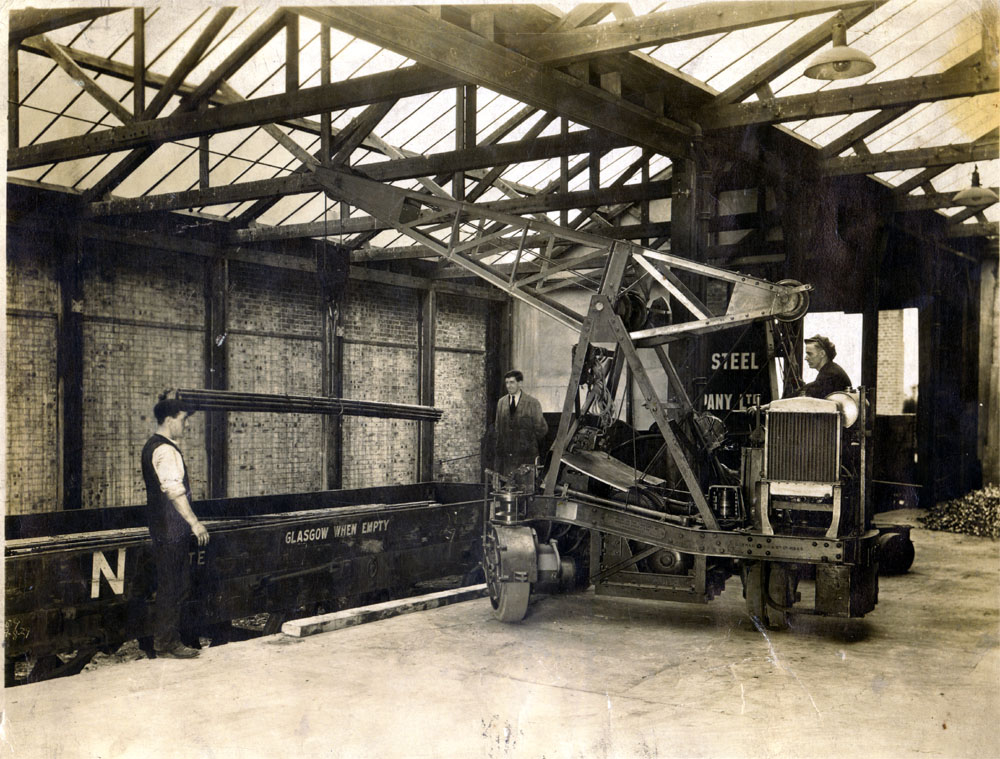
Christopher Bennett at the controls of a mobile crane at the Govan Steel Shafting Co’s works in the 1930s. The crane is a petrol-electric type manufactured in Loughborough by Herbert Morris, a company that specialized in the production of heavy lifting equipment. Pic. Glasgow Museums.
Little bit different then in the museum picture above, but it shows clearly, that this Morris Crane here in La Floresta is from around 1926-1928.  Have a look if you come along the Interbalenaria – Ludenor Maderas is located near the bridge on the south side.

1919 Public offer of shares.

1920 In 1920, the company expanded further by taking over the boiler works of H. Coltman and Son Ltd. off Meadow Lane in Loughborough. The North Works were then constructed besides the old Coltman factory.

1929 The company enjoyed a high reputation both at home and abroad. In 1929, it was executing orders from Argentina, Australia, Belgium, Brazil, Burma, Canada, Ceylon, Chile, China, Cuba, Denmark, Ecuador, Egypt, Finland, France, Holland India, Ireland, Italy, Japan, Mexico, New Zealand, Norway, Persia, Peru, Portugal, South Africa, Spain, U.S.A., Uruguay and Venezuela.

Out of these successful export years could have been survived the our „La Floresta Crane“.

             
Steam Crane and the Morris Steam Crane Boiler Advertising, both 1933.

1931 Herbert Morris himself died in 1931 and his son Frank Morris took over. He resigned the chairmanship in 1969. The business became a public limited company in 1939.

1931 Company employing 2.000 persons.

1930s Took over Alexander Chaplin and Co, Craven Brothers, Holt and Willetts and the Vaughan Crane Co.

1932 Acquired Royce Ltd.

Extremely rare Cigarette Collectors Card with a 1926 Morris Crane, used by the Royal Air Force on a United Kingdom airfield in 1937.  This Petrol-Electric-Crane looks like the one I discovered here in La Floresta, UY.

1937 Lifting machinery manufacturers.

1939 The business became a public limited company.

1959 Took over British MonoRail.

1961 Manufacturers of cranes, pulley-blocks, runways, telphers, conveyors, elevators, lifts and trucks. 1.900 employees.

1968 Built thirty Goliath cranes for British Railway Freight.

       The Goliath 80 ton crane, left. And right the Royce Goliath Crane ( here shown already in 1908) at the Glasgow Goods Yard.

1969 Frank Morris resigns as chairman.

1970 E. and H. P. Smith acquired 30 percent of the shares of the company.

1974 Assembled four 130-ton giant overhead cranes for the Cammell Laird’s shipyards.

By 1975 had about 2000 employees; trading subsidiaries were:
British MonoRail (stacker cranes and monorail systems)
Linear Motors (linear motors and crane control equipment)
Crane Aid Services (maintenance and repair of any make of lifting equipment).

1976 The holding in Herbert Morris was sold to Babcock and Wilcox.

1977 Davy International acquired the company.

In case you like this kind of industrial history, you will enjoy the book above!

Veröffentlicht unter Atlantida, History, Information, Uruguay | Verschlagwortet mit , | Hinterlasse einen Kommentar

Just a Birthday Lunch

Recently I could enjoy and healthy celebrate my 75th birthday. WOW – what a number. It is  unbelievable how quick years are gone and time is running. Especially if you feel (in your brain) like a youngster. So, what to do with a round celebration date like this ?

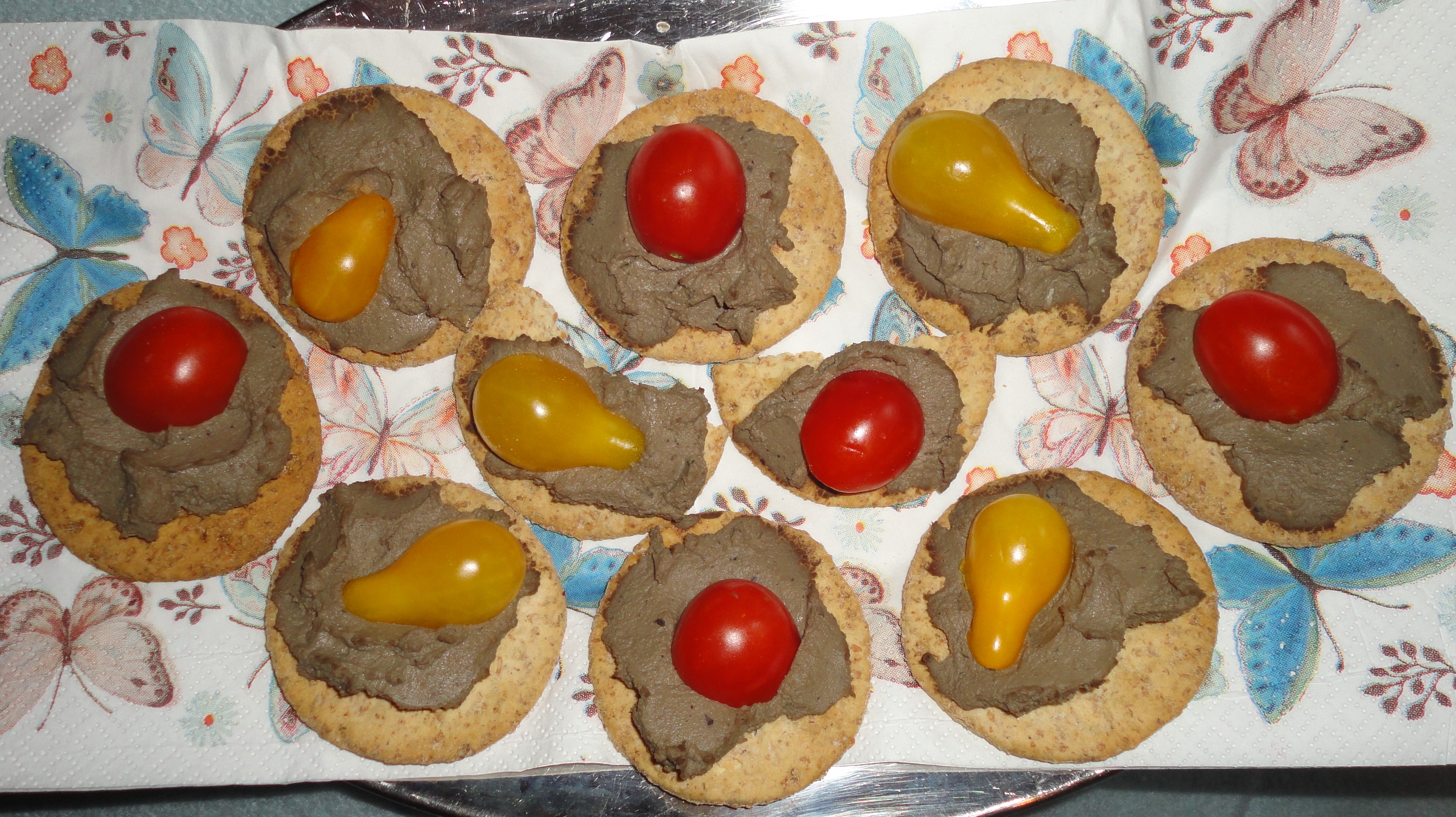
First the starters, 3 different ones made. The above one is a smooth spread of self-made Madeira and chicken liver pate with a cherry tomato.

My hobby, of course, COOKING. But what and for how many people. Decision was made very quick. Just a small group of friends who enjoy a decent meal and honor the lot of work if one has cooked several courses. I could have invited many more people which I love and who deserved also to be indulged, but this time „the lot hit others“. Sorry guys !

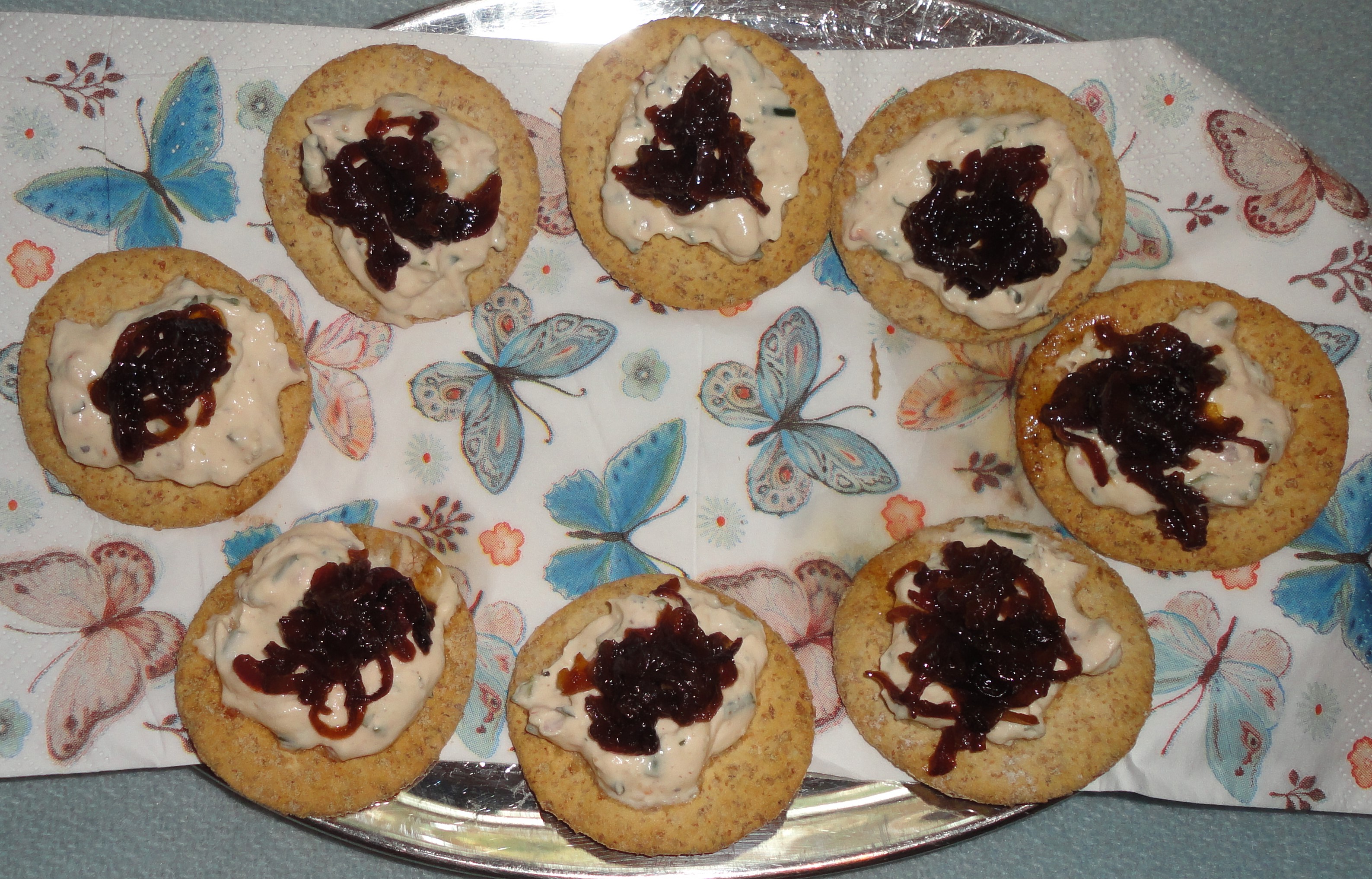
Next of the 3 starters was a spread of self-made spicy cream cheese topped with teriyaki caramelized red onions. I was lucky to get from my local German bakery these fantastic integral crackers.

A list of about 20 dishes was cut down to 12 and then planned the shopping of ingredients, which is a real challenge in Uruguay. Not everything is available and if – then not at the time I need it, and and and. Furthermore we face at the lunch party about 30 degree Celsius, its still summer time down here and the dishes have to go well together with a hot day and should not overwhelm the stomach.

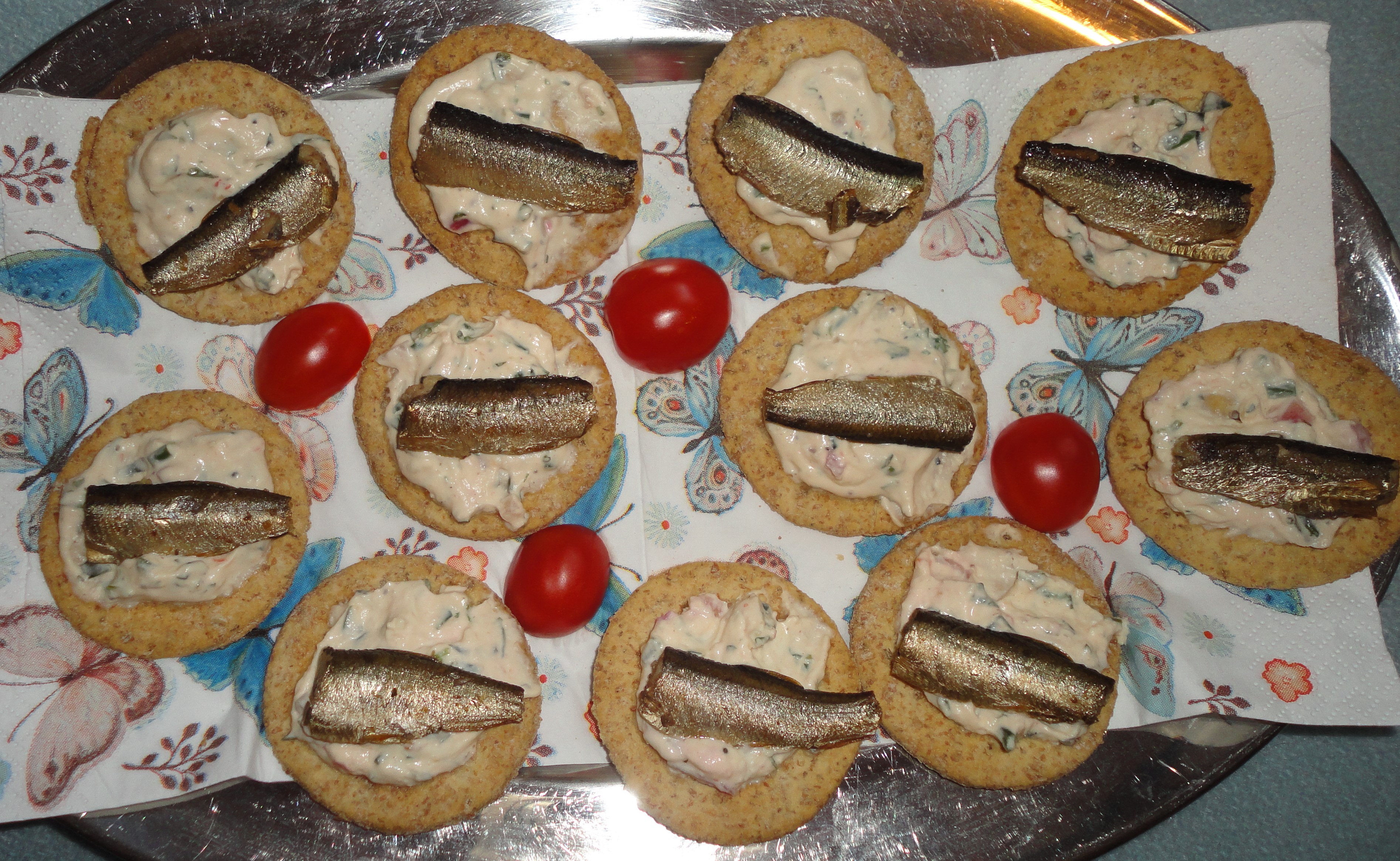
The 3rd of my starters were a spread of self-made herb-yogurt cream topped with miniature „Riga Gold Sprats“.  I found that rarity in Montevideo and I can tell you, they melt in your mouth, they are just fantastic.

The last part was precooking the dishes I’ve never made before and see how it goes and if there is a possibility to prepare as much as possible, that I can spend some time with my guests. As well I had to decide for the drinks, wines etc. During test-cooking I had to cancel about 5 dishes – too complicated for this time or not working out as I expected.

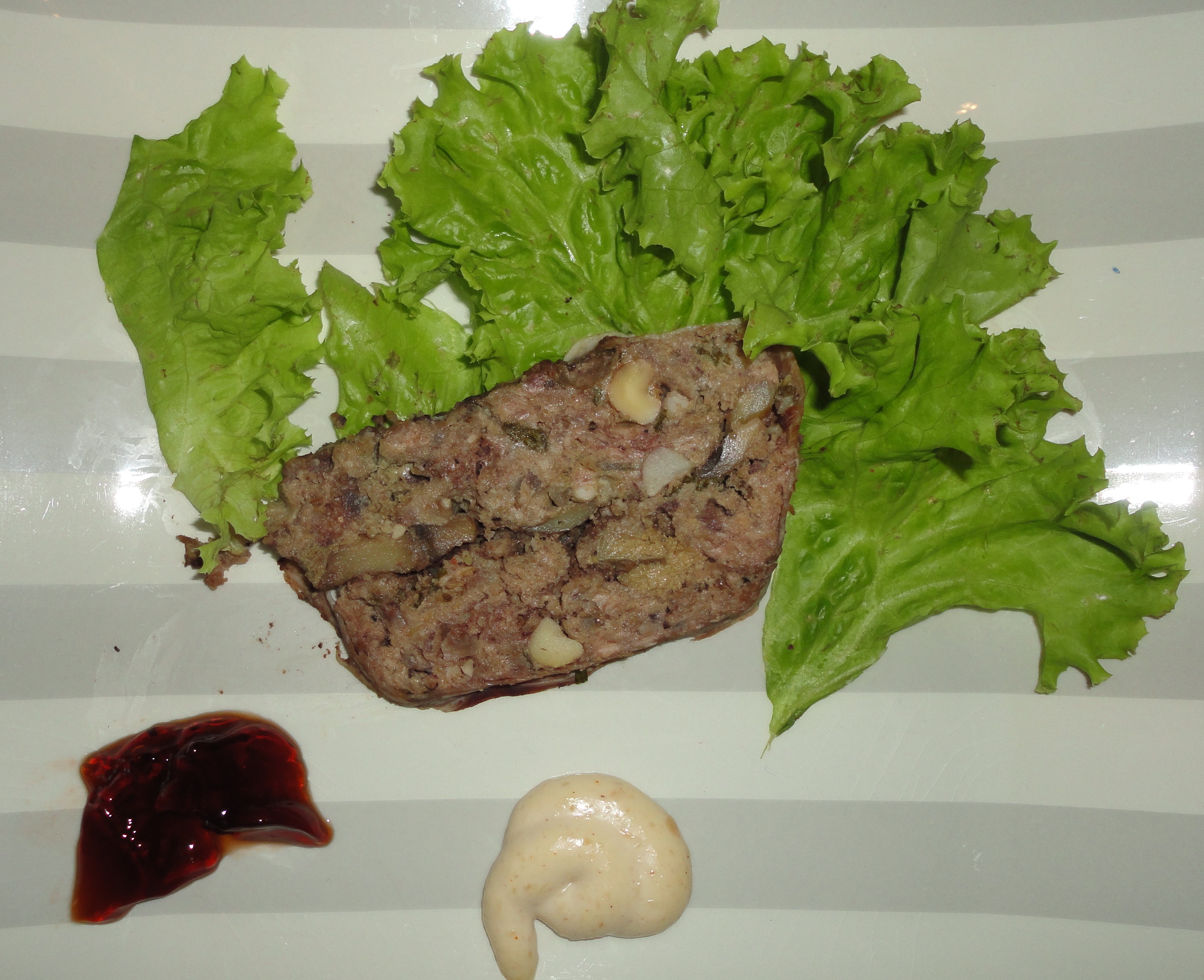
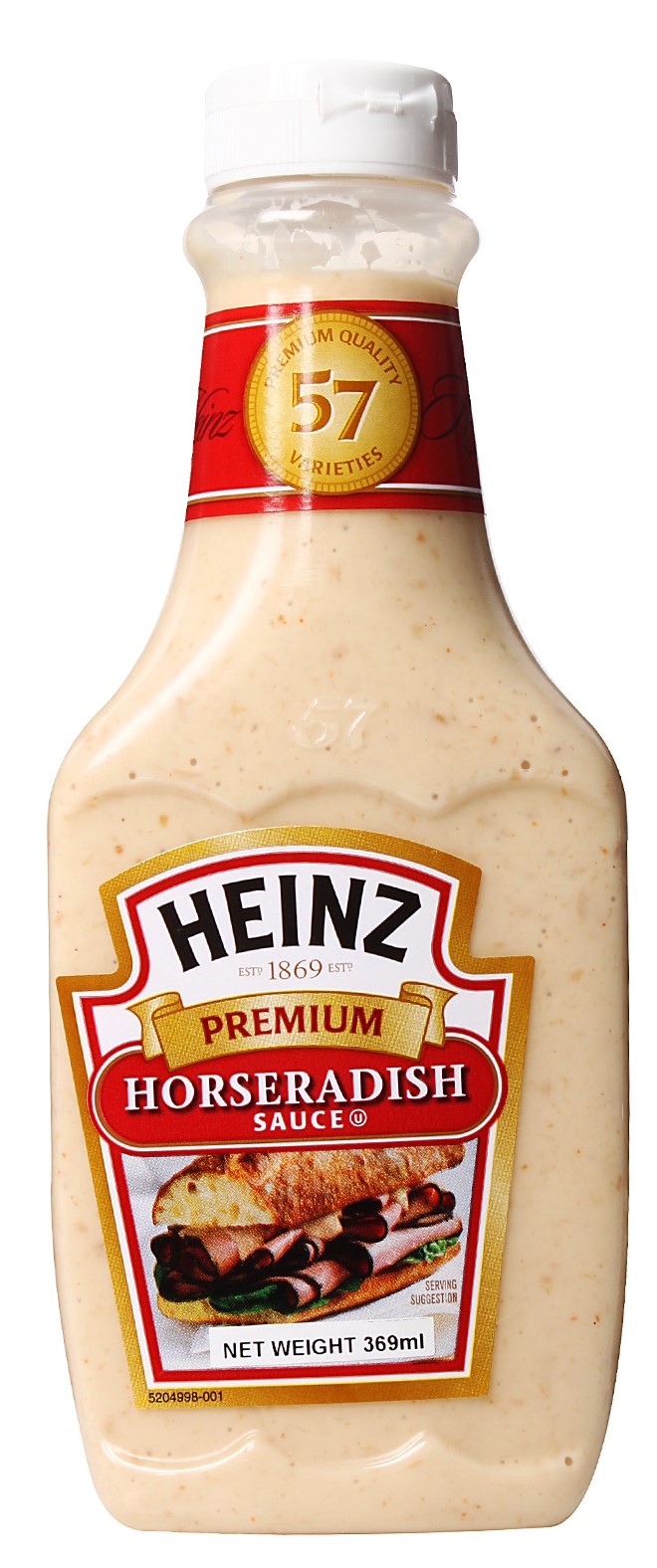
The pre-course was a slice of a self-made pork terrine with walnuts wrapped in prosciutto with sweet redcurrant jelly and spicy horseradish cream. It goes so well together.

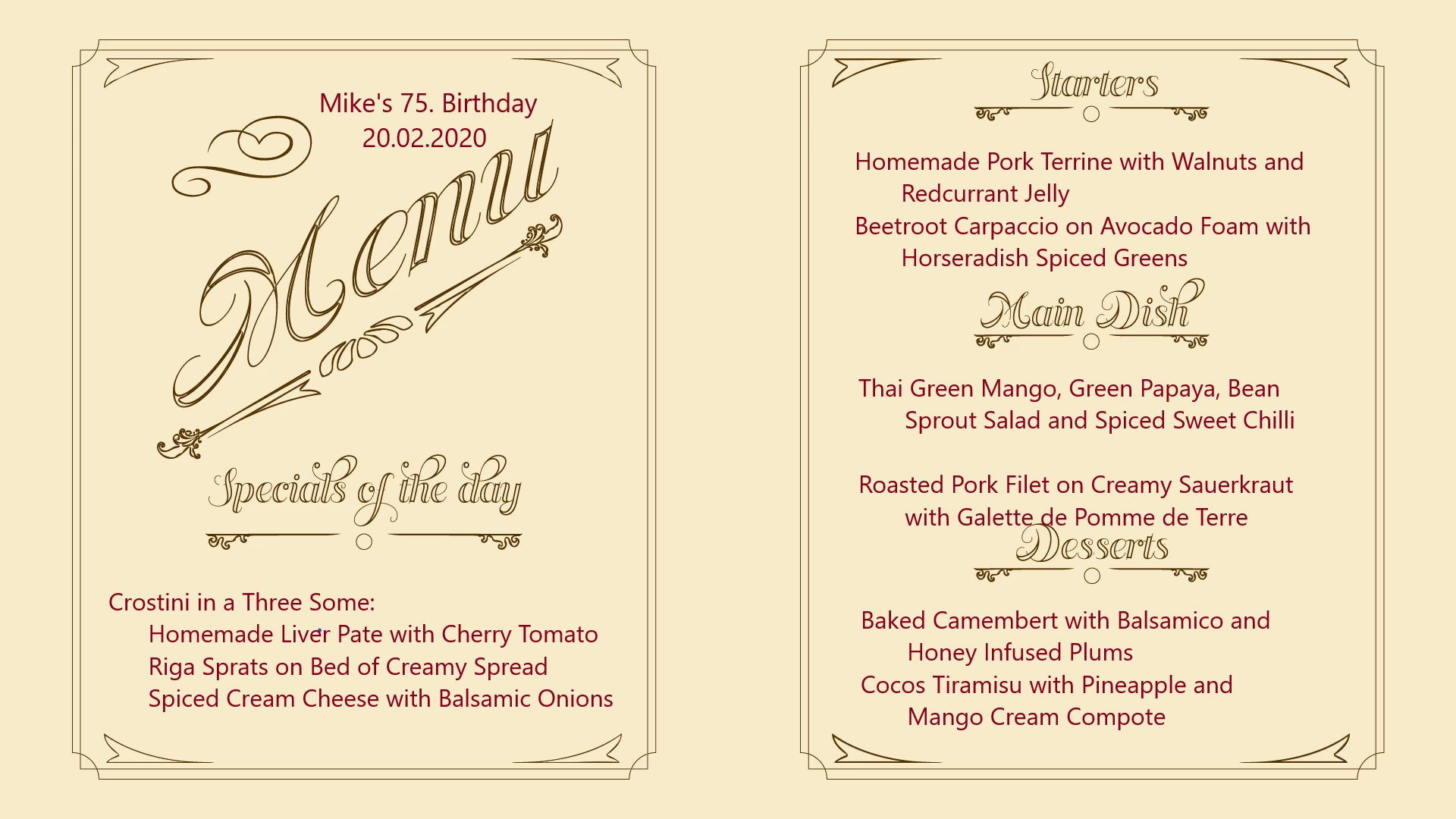
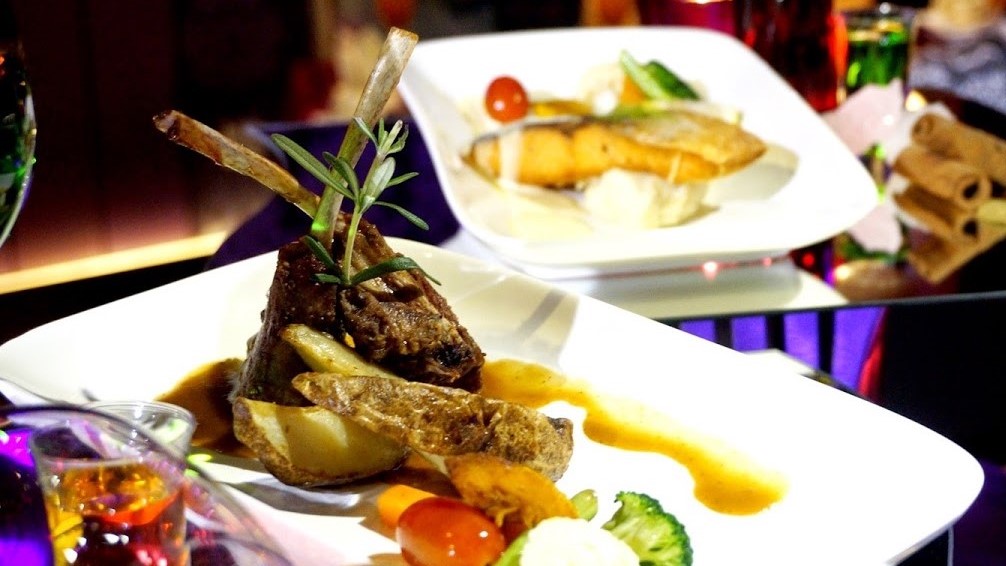
Finally I made a menu of 10 different dishes (see my little menu card, I printed out) which, I thought, they can make an impression and indulge all of us, without being over the top. Sadly, with all the preparation work and cooking I forgot to make sufficient pictures, that’s why I use a few similar ones from my stock. See the result further down.

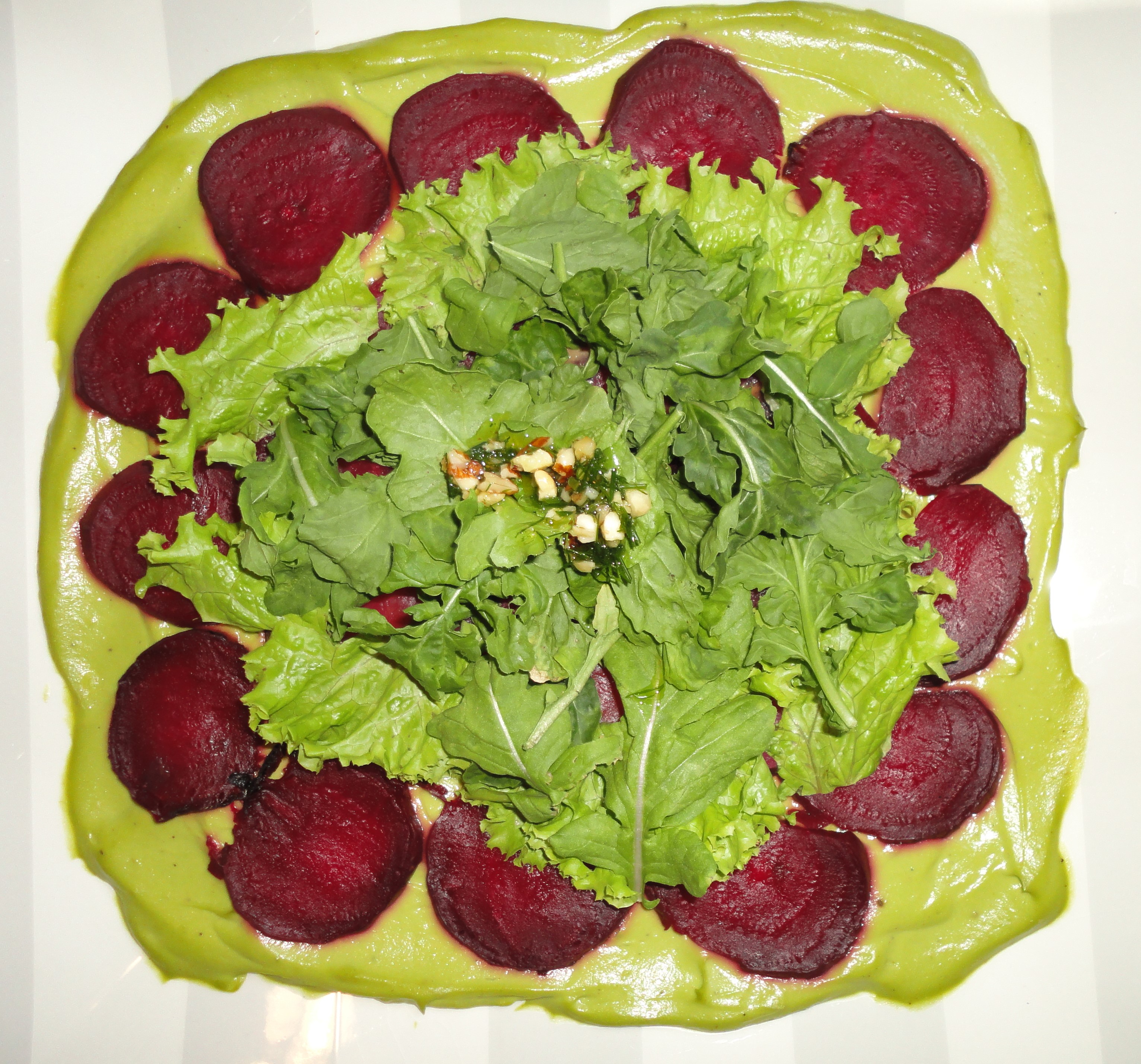
The next dish was a beetroot carpaccio on a bed of avocado foam with spicy horseradish greens. Here shown without the dressing. The dressing was a mixture of coconut-oil roasted nuts and an oil, lemon, dill, chive, poppy  salt and pepper combination.
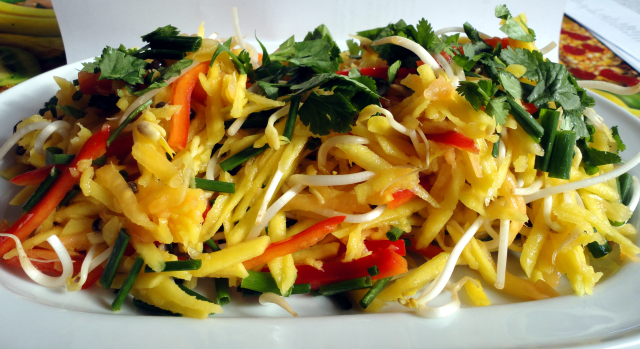
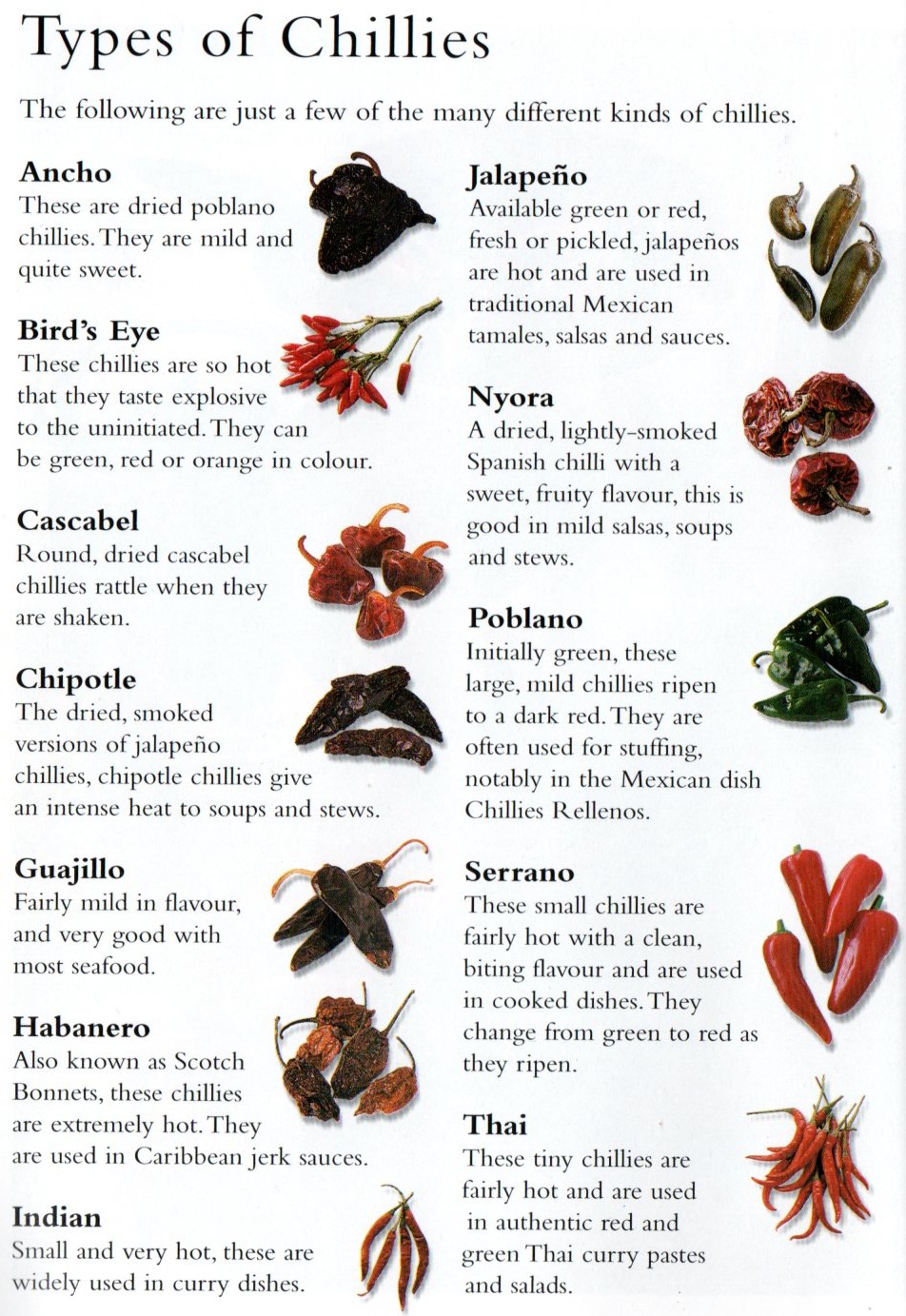
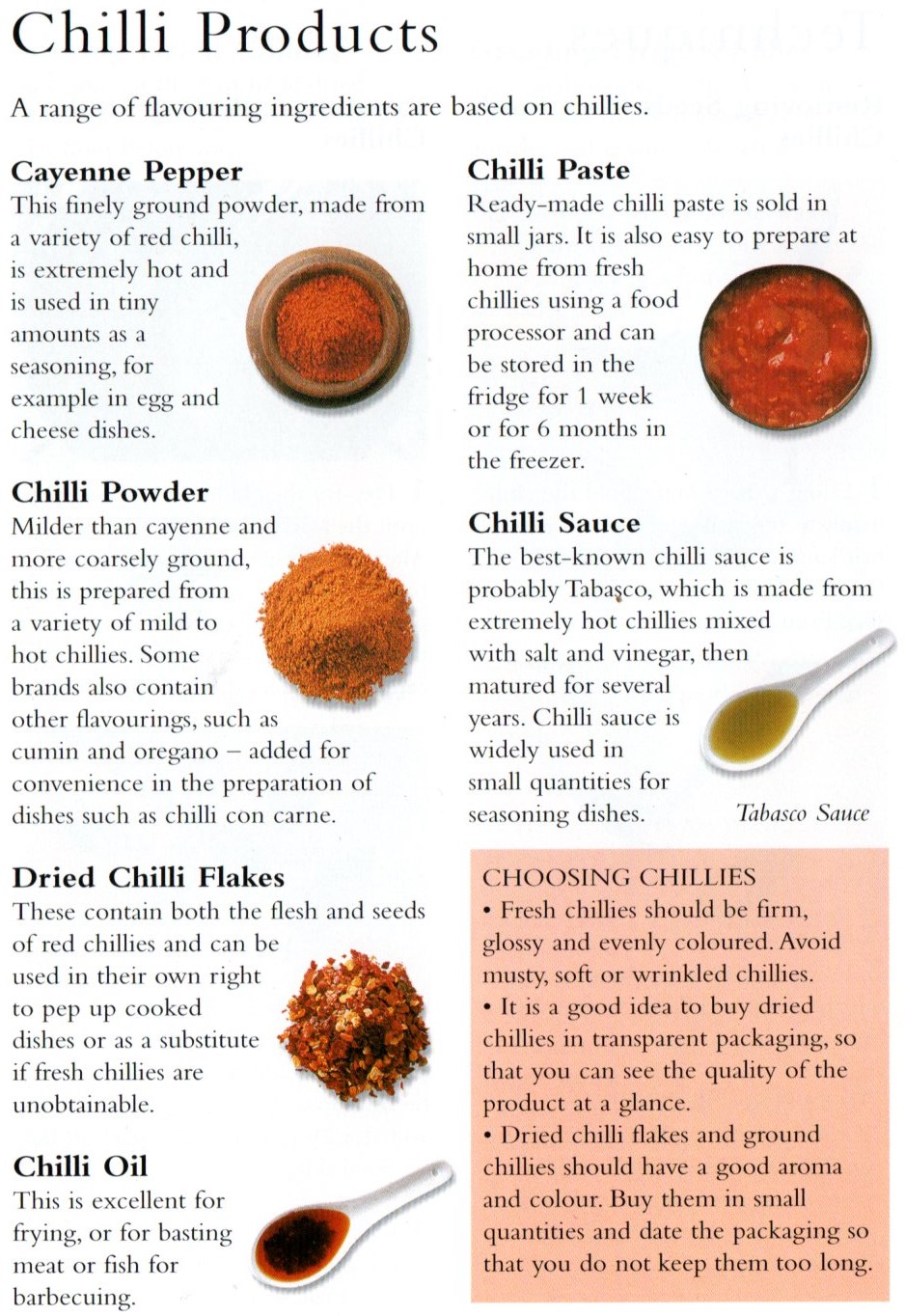
To refresh the palate I served a chilled Thai salad made from green papaya, green mango, bean sprouts, fresh red paprika, coriander, peanuts and an Umami-dressing (Umami means a balance of the 4 „s“) of lime juice (sour), dark soy sauce (salty), brown sugar (sweet) and chilli sauce (spicy).
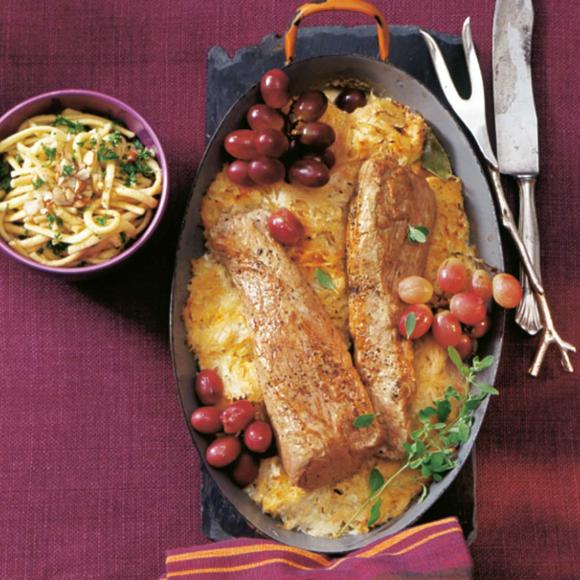
           What would be a nice lunch without a main course. I decided for a typical German one. Roasted pork filet on creamy Sauerkraut infused with Riesling champagne and smoked paprika powder, combined with hot cooked blue grapes. Sadly I forgot to make my own picture.
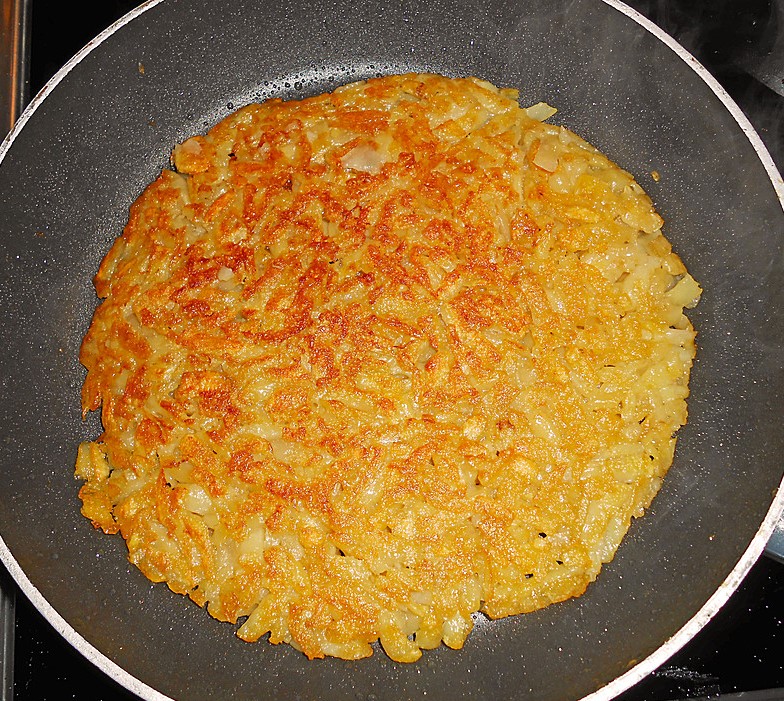
Accompanied was the Pork on Kraut from a big pan of Swiss Rösti, or as the french call this big pan full of roasted potato-onion mixture „Galette de Pomme de Terre“.
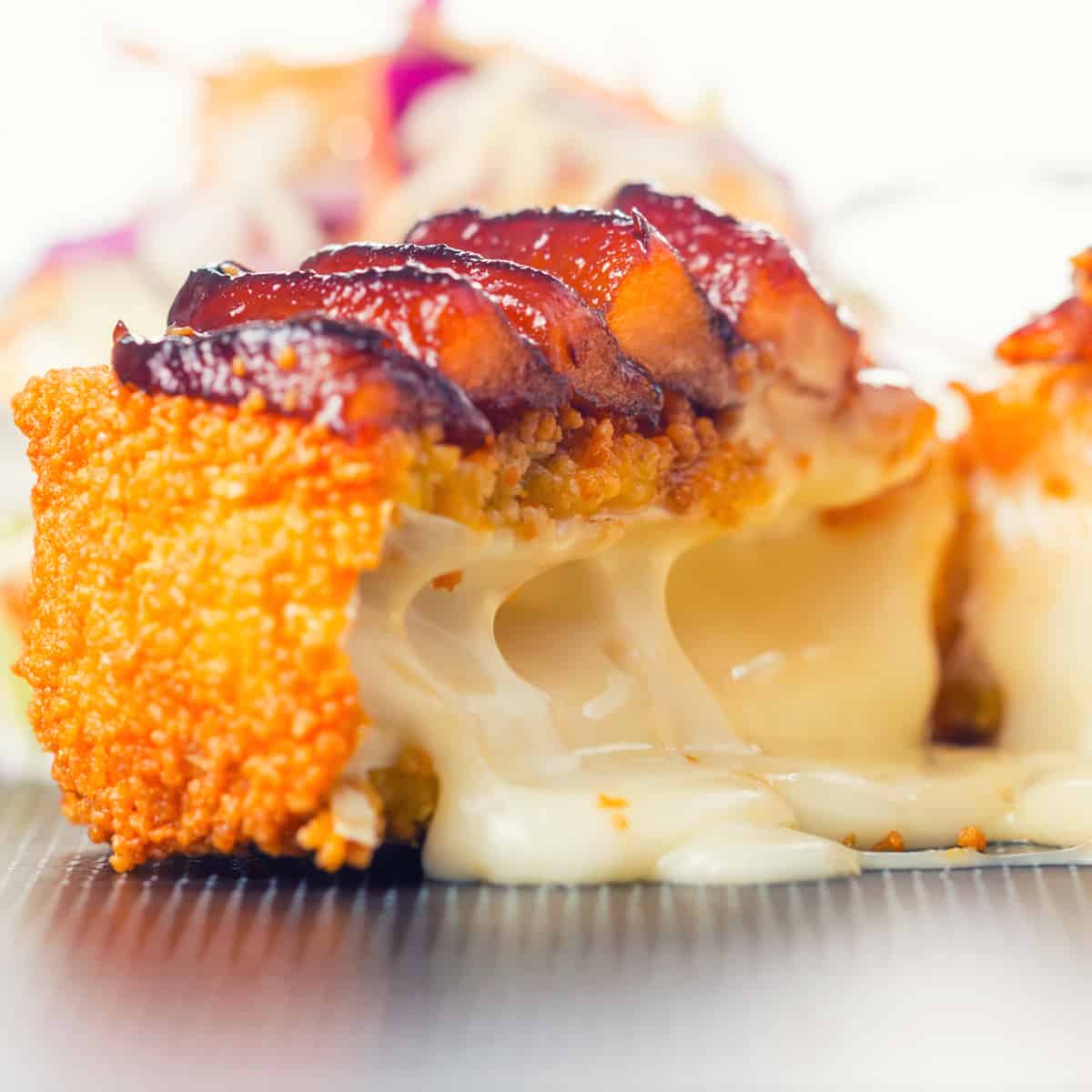
This desert course is so easy to make, but always soooo delicious. In Panko baked Camembert quarters with balsamic and honey caramelized plums, a sweet chilli sauce aside.
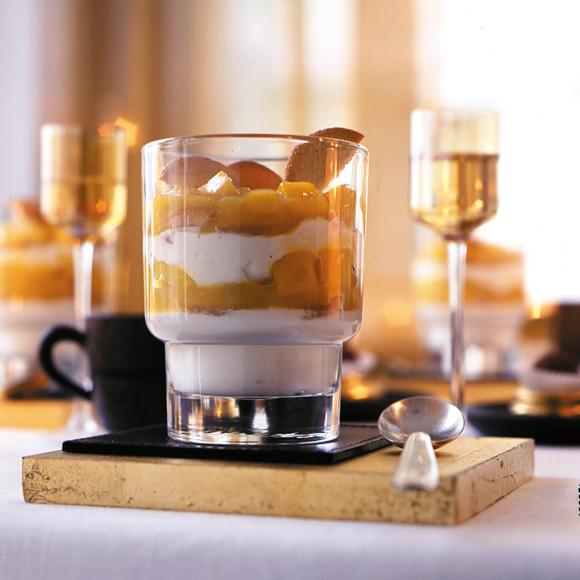
           Cocos tiramisu with in cocos-liqueur steered mango and pineapple compote, cocos biscuits and fresh whipped cream. Sadly I forgot to make my own picture.
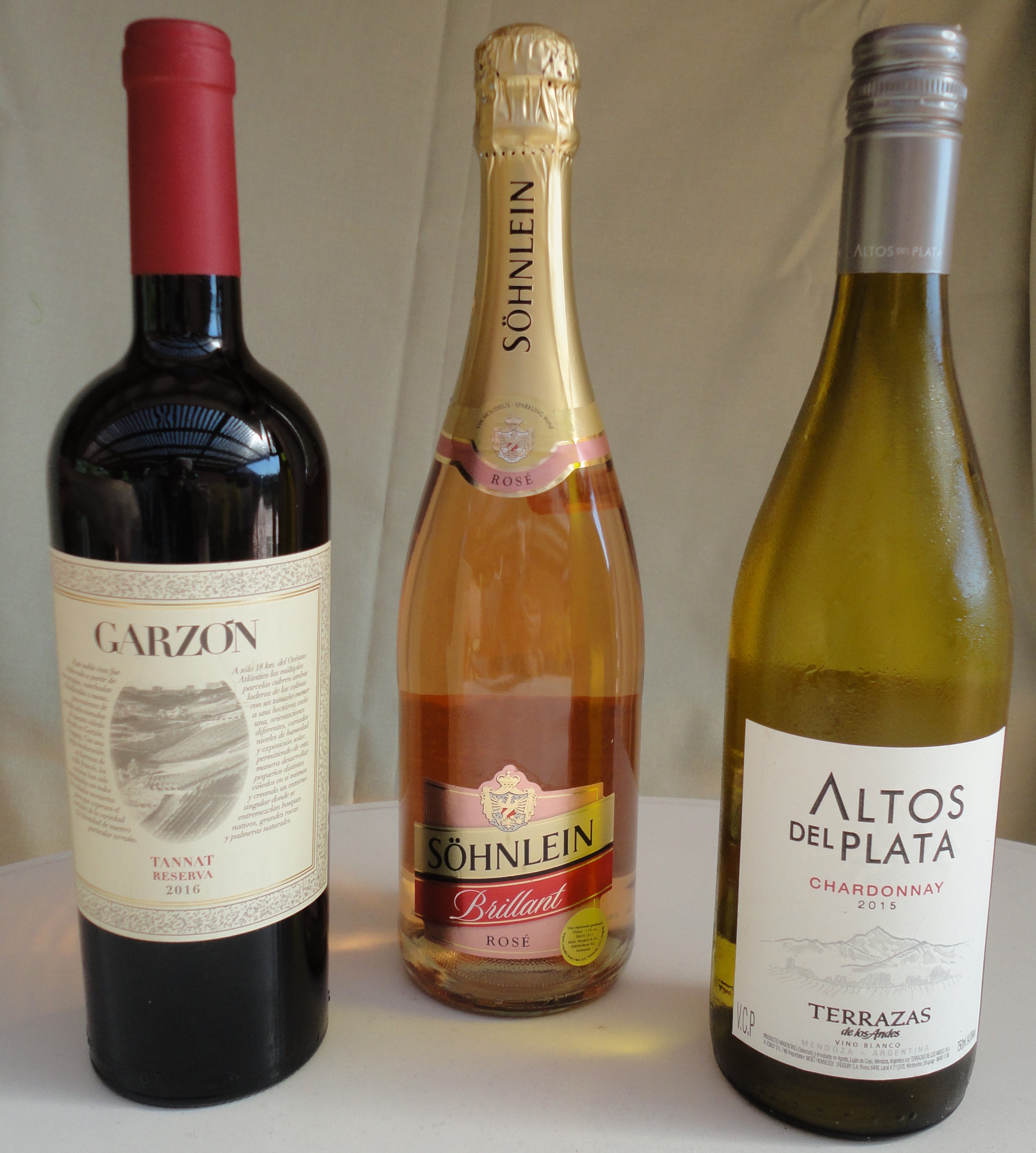
                Left pic: These are the drinks we had. A wonderful tasty Rose Sekt from Germany, a deep golden fruity Chardonnay from Terrazas, Argentina and one of the great Tannat’s from Uruguay. The Garzon winery was just elected to one of the best winemakers in the world !! Click on pictures to supersize.
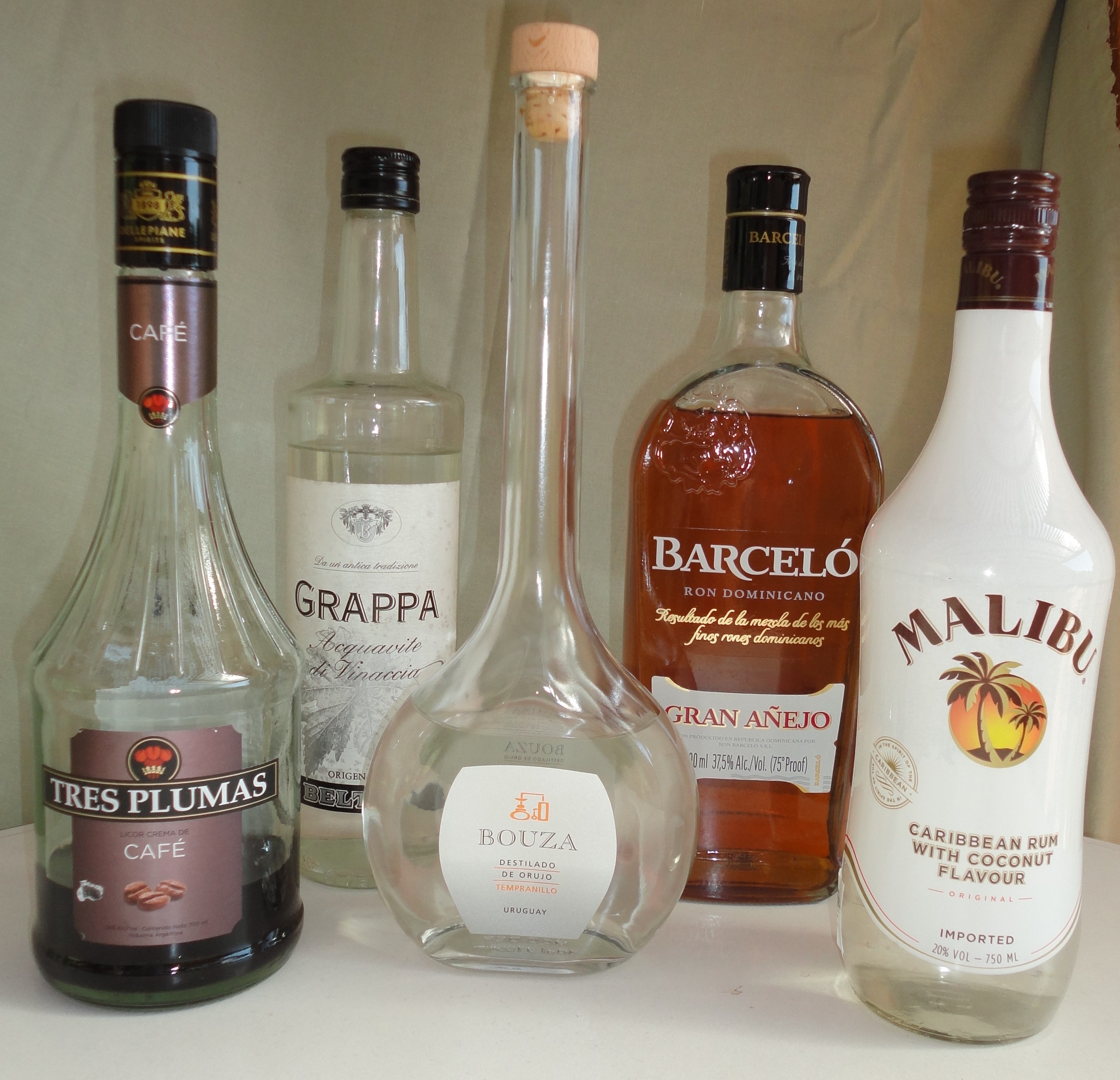
Right pic: These are the after lunch or/and going with coffee drinks we had. A great Italian Grappa and a very smooth, Cognac like, rum from Dominican Republic (rear row). At front a worth testing coffee liqueur and the most well known cocos liqueur in the world, Malibu, which I used for the desert. In the middle a fantastic tasting Destilado from our local winery Bouza, made from Tempranillo grapes. Click on pics to size up.

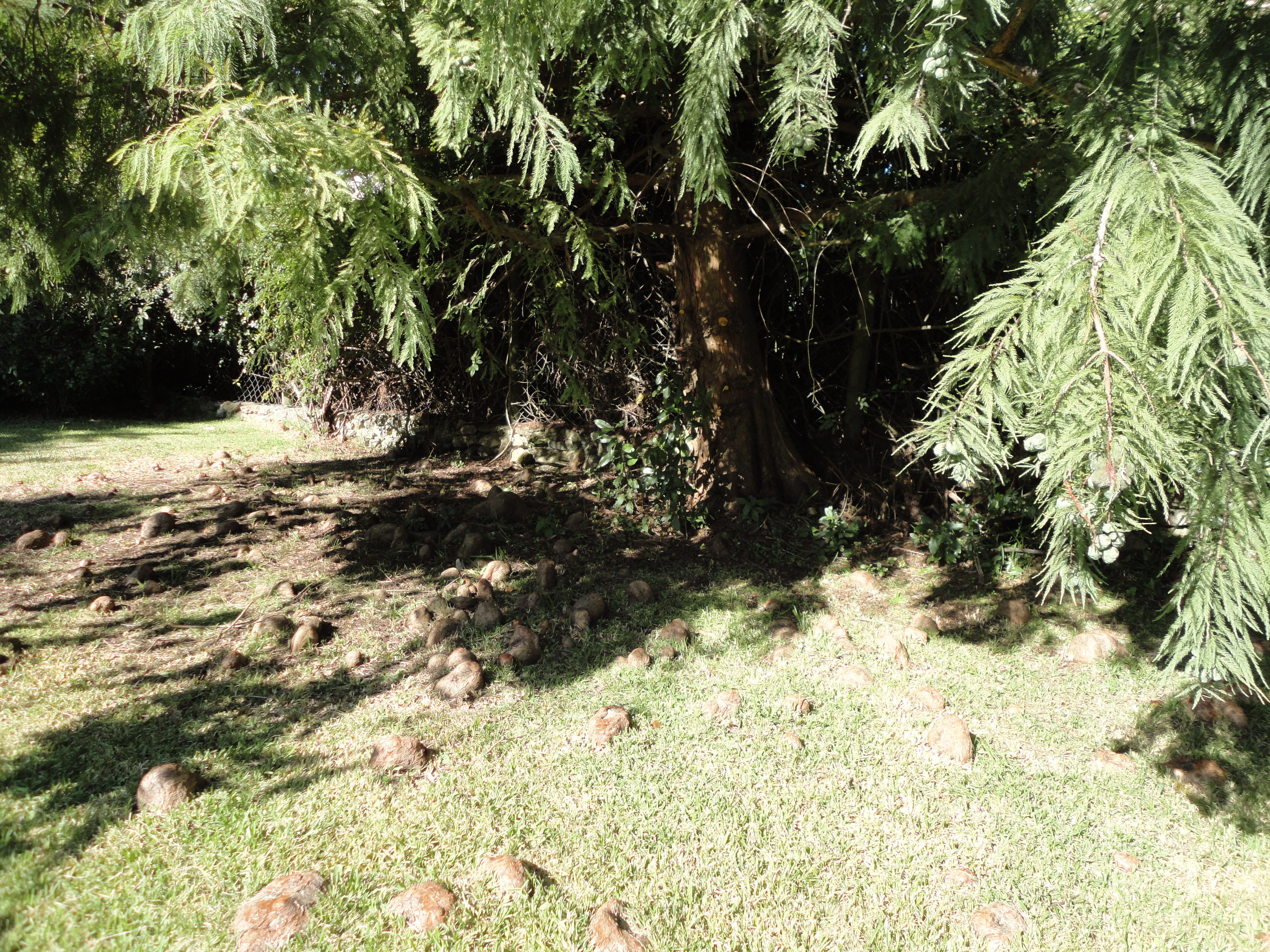
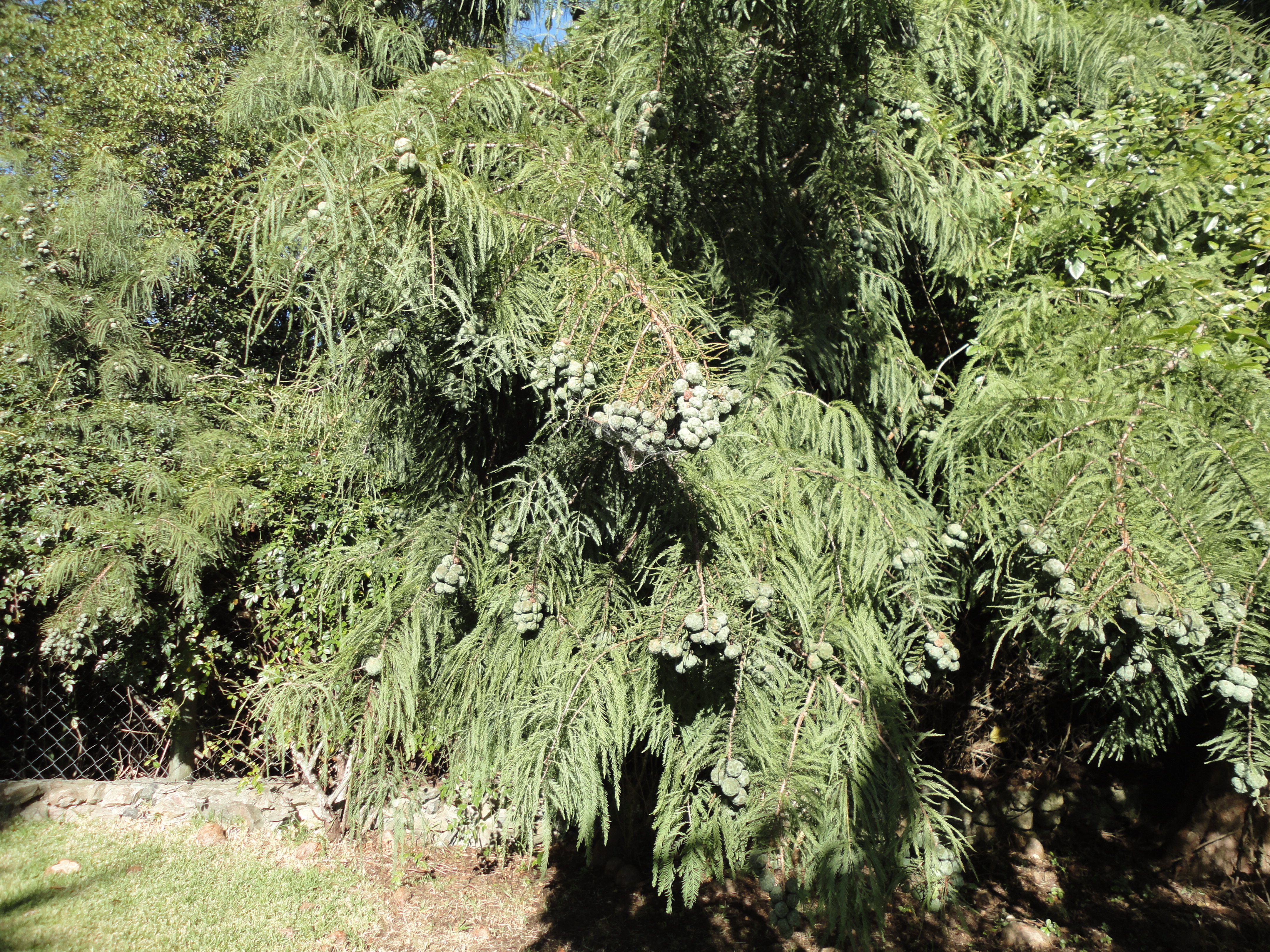
Marginally a little side story during a lunch break, when the ladies walked through our garden, they discovered the above seen tree. I never learned what kind of tree it is or any name or or …. pictures were taken and members of a garden club in Punta d. Este called.

       Because of the unusual feathery leaves and hard little fruit balls as well as the strange looking roots allover and around the tree, they discovered its a „Real Taxodium or Swamp Cypress“. Taxodium species grow pneumatophores, or cypress knees, when growing in or beside water. The function of these knees is currently a subject of ongoing research !!??

Never realized in 10 years living here, that we have such an interesting rarity (now about 15 meters tall)  in our garden, which is uncommon to Uruguay, normally at home in the swamps of Southern USA and Mexico. Wow, thanks guys for your great information. So much to read about this tree in Wikipedia or other internet sites.

O.K. guys, while writing this post, I have already so many ideas for a next „indulging get together“.  What ??

We all loved this get together, spending almost 6 hours chatting, eating, drinking, laughing and enjoying, to celebrate that afternoon and our friendship.
It’s not only cooking, its a lot and a lot more work around, all that I couldn’t have this day accomplished without the active assistance of my wife,   THANK YOU !
If you are interested in one or more of the recipe’s, just call in.
May be one of my last big meals I am able to offer my valued guests? No way!!!

Veröffentlicht unter Lifestyle | Verschlagwortet mit | 1 Kommentar

Best Chicken Ever

Recently my friend Mathis sent me a recipe where he thought it is French. But I can’t agree. I know this recipe over 30 years, when American friends in Australia made it for us during a dinner party. We made it so often since, that I thought it is so well known that I don’t have to write about. But when Mathis sent the recipe and all the pics I was convinced to post it – and here it is.

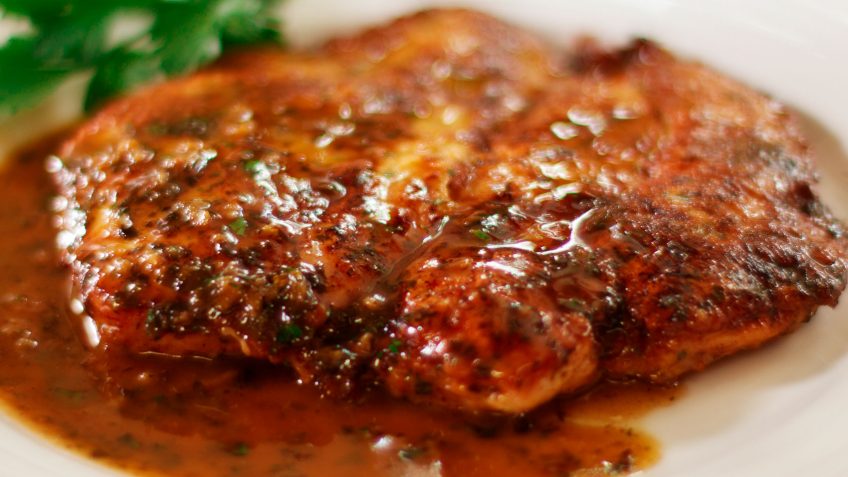
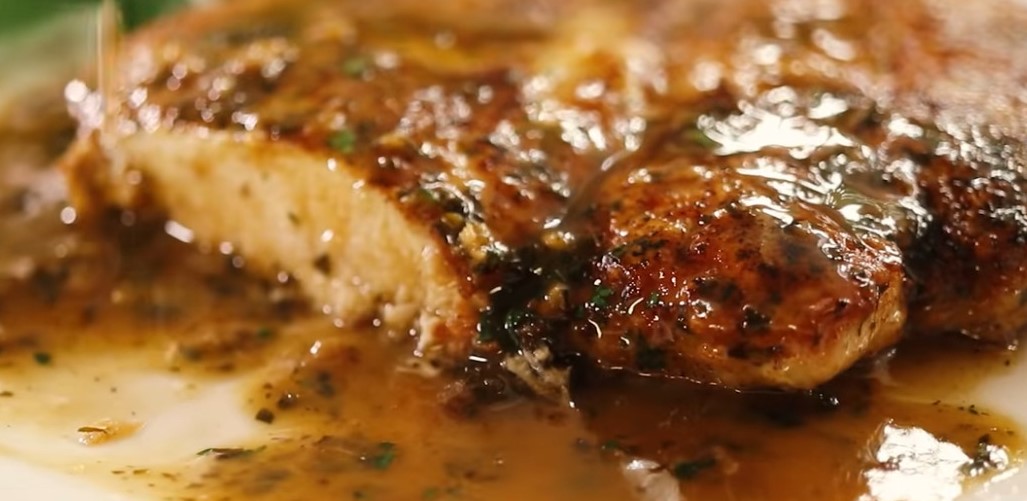
The Best Ever – Chicken Francaise.

Also known as „Chicken Francese“ egg dipped chicken breast in tangy buttery sauce. It’s simple to make, basic ingredients and tastes out of this world. Probably one of the best chicken dishes you can eat and worthy of a fine dining restaurant.

If you can make chicken cutlets, you can make this lemony, buttery recipe; the only difference is an easy pan sauce that brightens the whole plate. . Although the name suggests that it’s a French or Italian dish („Francese“ means French in Italian), it’s actually neither: Like spaghetti and meatballs, it’s a mostly Italian-American invention. Serve with something starchy to soak up every drop of the sauce, pasta would be traditional.

Also known as “Francese” egg dipped chicken breast in tangy buttery sauce. I believe this dish was created in America by Italian immigrants in the mid 1900’s. As with numerous Italian chicken dishes, they were originally intended for veal which was more expensive. Why an American Italian dish is called “French” ? Beats me, but one thing for sure, the flavors are incredible.

When buying your chicken breasts, try and find a good medium size, you don’t want them too big. But back to the name, why an American Italian dish is called “French”, maybe it’s because of all the butter, maybe the wine, but one thing for sure, the flavors are superb ! Enjoy it with a rich and dry white wine such as Sauvignon Blanc or Chardonnay, or even a light red such as Gamay or Pinot Noir. This chicken recipe has gone viral throughout the internet with amazing success.

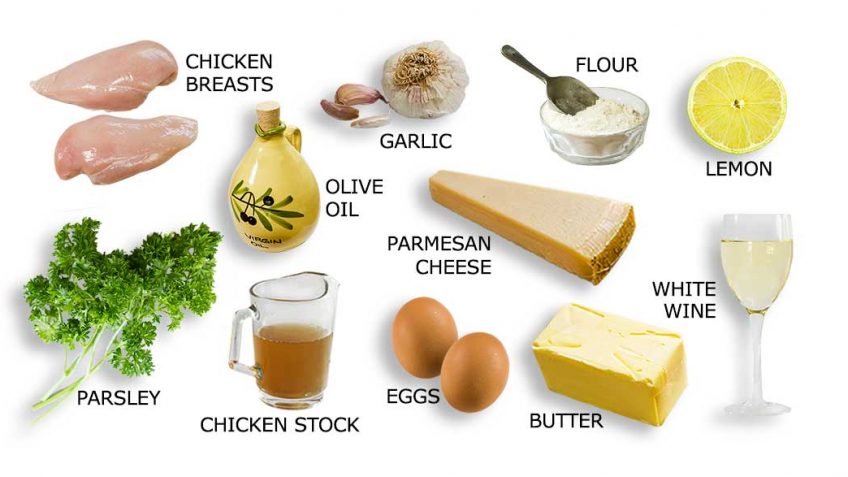
Ingredients.

Normally all my recipes are made for 4 people, this time for 2 only, because we use one pan and this takes 2 chicken breasts only. If you cook for 4 people, use 2 pans and double the amount of ingredients, easy to do.

2 chicken breasts
Half cup plain flour
2 eggs
1 handful of fresh parsley
50g (2 oz) Parmesan cheese
1 cup white wine (I like to use the wine I will drink to this dish, if cooking with friends
often a whole bottle is gone already while cooking this meal).
1 cup chicken stock
1 garlic clove
4 tablespoons olive oil
4 tablespoons butter
Half a lemon
Salt and pepper to season

How to do.

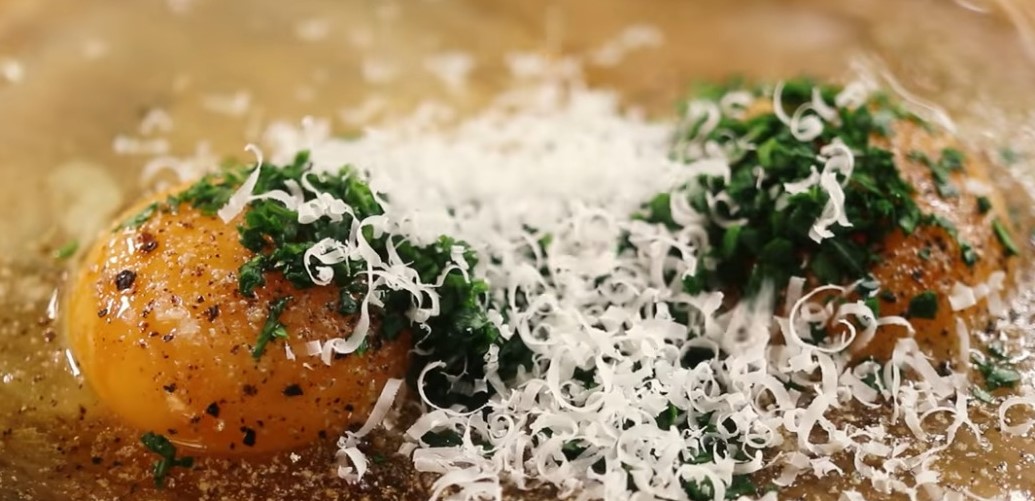
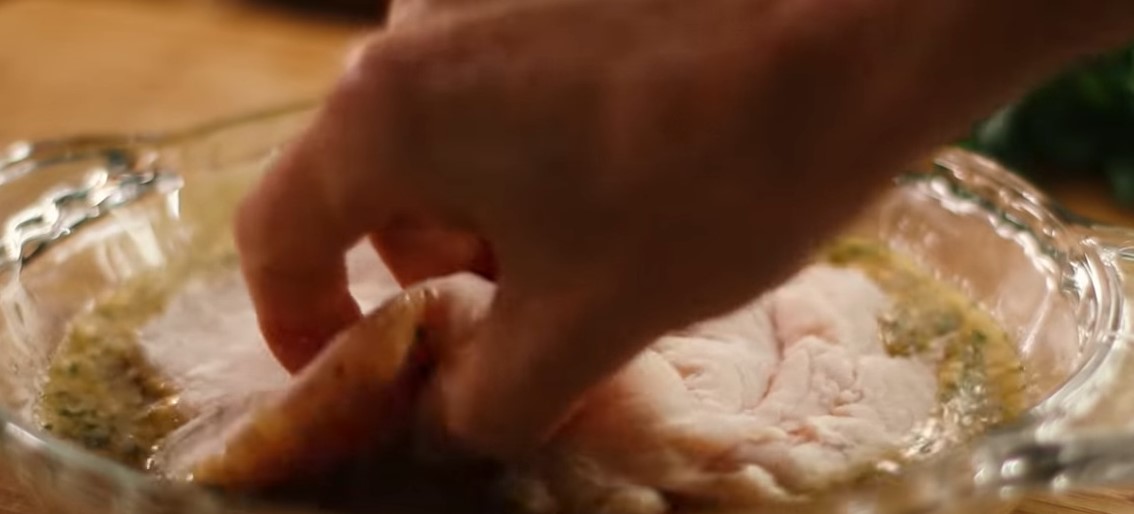
Crack the eggs into a large enough dish to fit chicken breast. Season eggs with salt and pepper, give them a light beat.

Chop the parsley finely (keep a few sprigs for garnish) and add half to egg mixture.

Grate all the Parmesan cheese finely and add to egg mixture, mix well. Set aside.

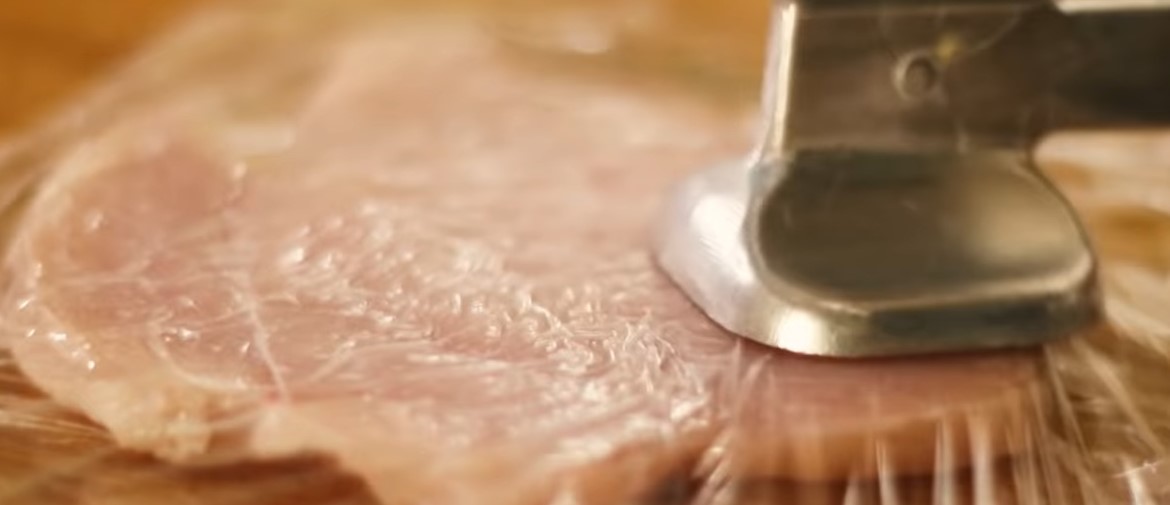
Remove chicken skin if any, then butterfly cut your breast. Hold a long sharp knife along the thicker part of the breast, place your hand on top and slice through the breast almost until the end. Cut parallel to your cutting board, and open the breast like a book. Place cling film on a board, add your breast spread open, sandwich it in cling film and flatten the thicker side using the flat side of a meat mallet or the underside of a saucepan.

Get your wine and chicken stock portions ready.

Add the plain flour to a plate, spread it out flat by shaking plate.

Peel the garlic and place in garlic press (or chop finely).

To a frying pan on moderate heat, add the olive oil and half the butter.

Coat the chicken in the flour, shake off any excess flour.

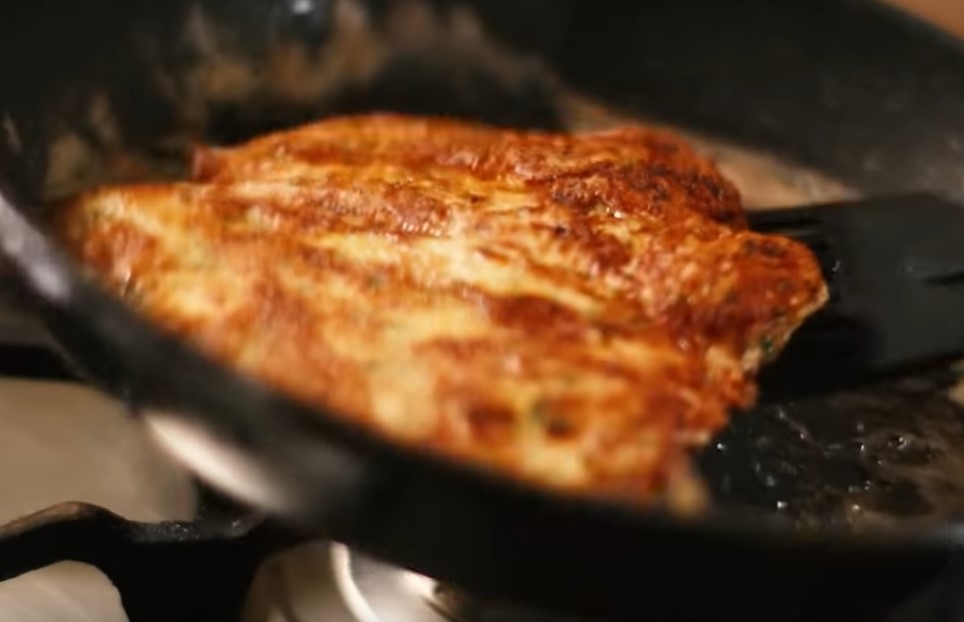
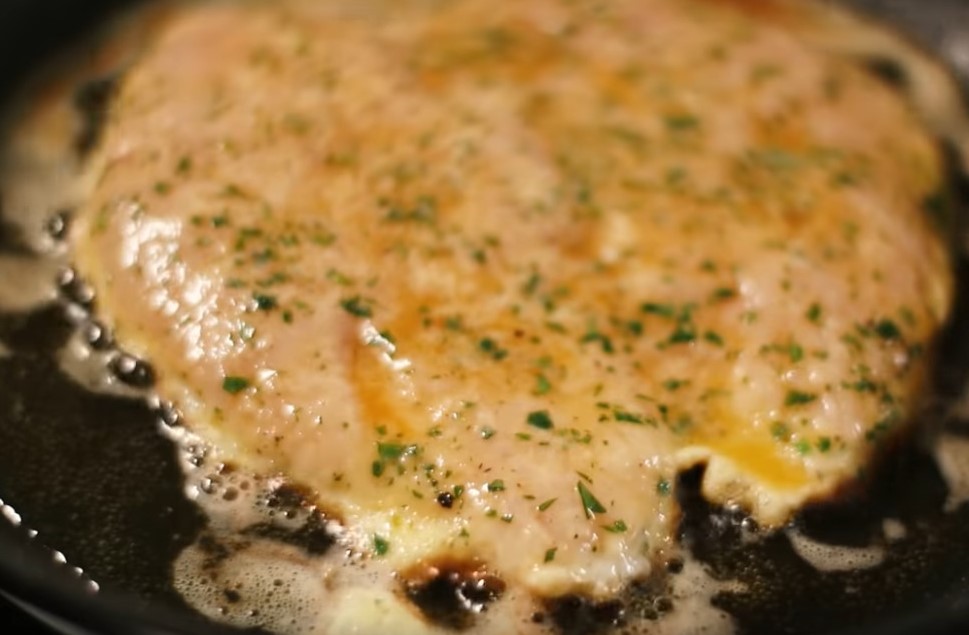
Dip the chicken in the egg wash, make sure it’s totally covered and place in hot oil.

Cook chicken for approx. 4 minutes each side (depending on thickness). Flip over once brown and cook the other side. Transfer chicken to a hot plate and rest.

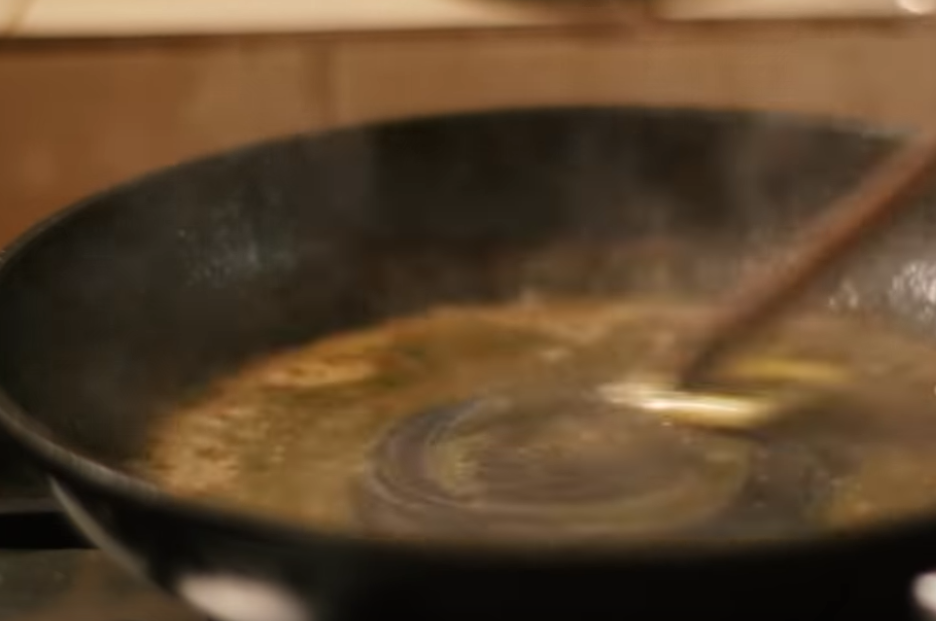
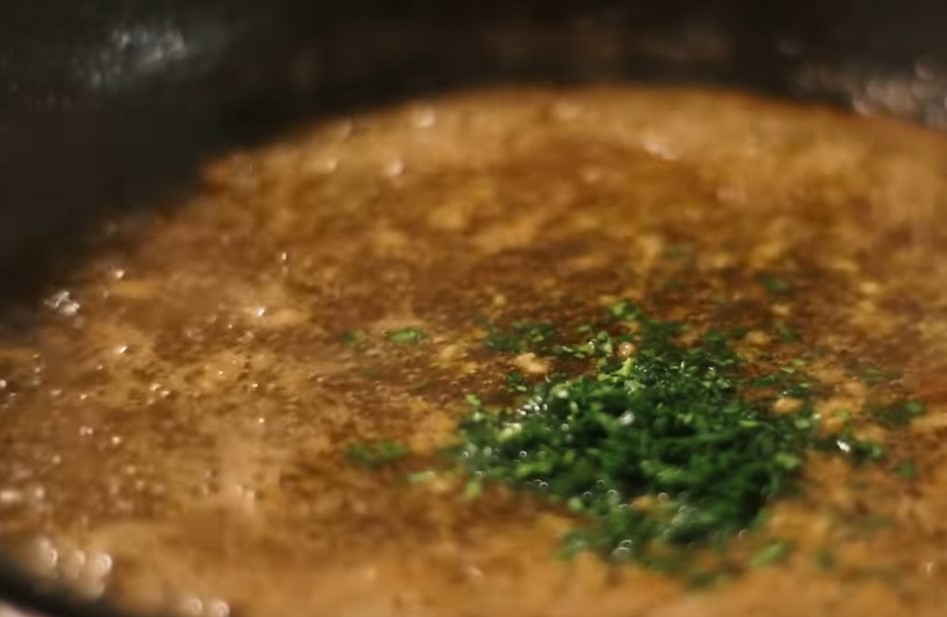
To the same frying pan on full heat, add the white wine (alcohol can catch fire so be careful, turn off heat first if unsure). Add the chicken stock. Add the crushed garlic. Add the squeeze of half a lemon. And leave to reduce 2 minutes on high heat.


Add the remaining half of chopped parsley. Add the remainder of butter and mix until butter is melted on very low heat.

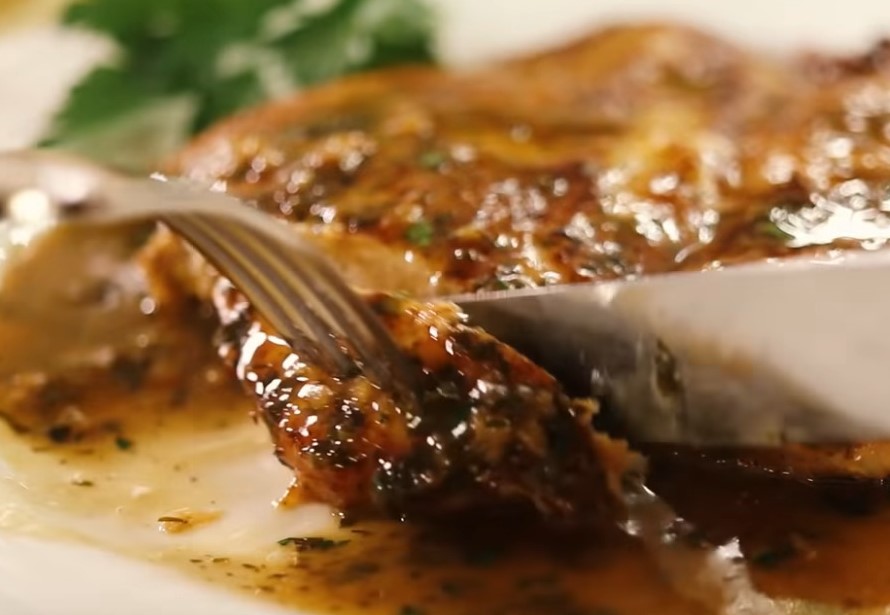
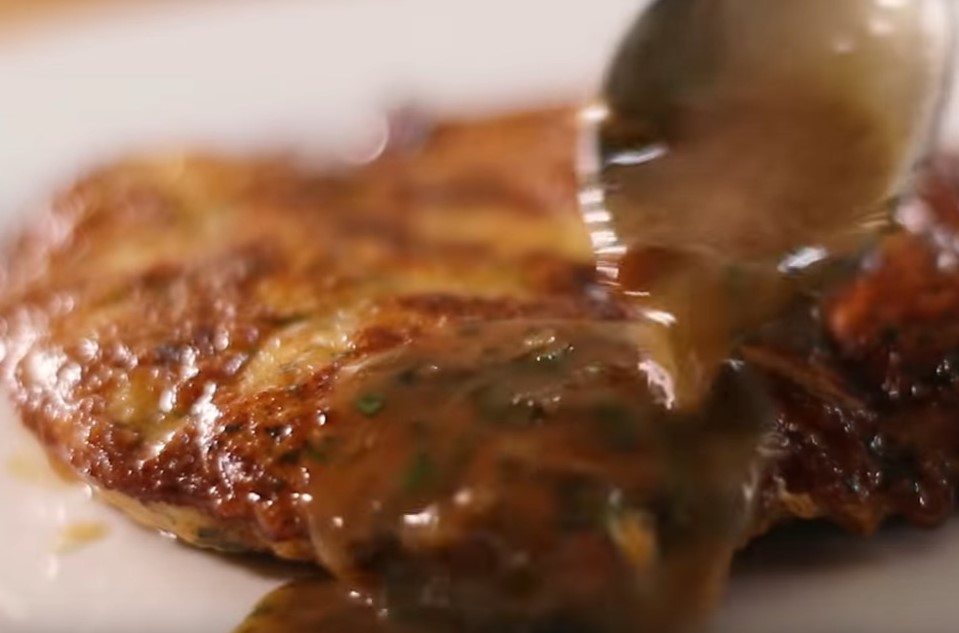
Return the chicken to the sauce and continue heating chicken on low heat no more than 30 seconds.

Serve the chicken on warm plates, garnished with freshly chopped parsley.

Tips.

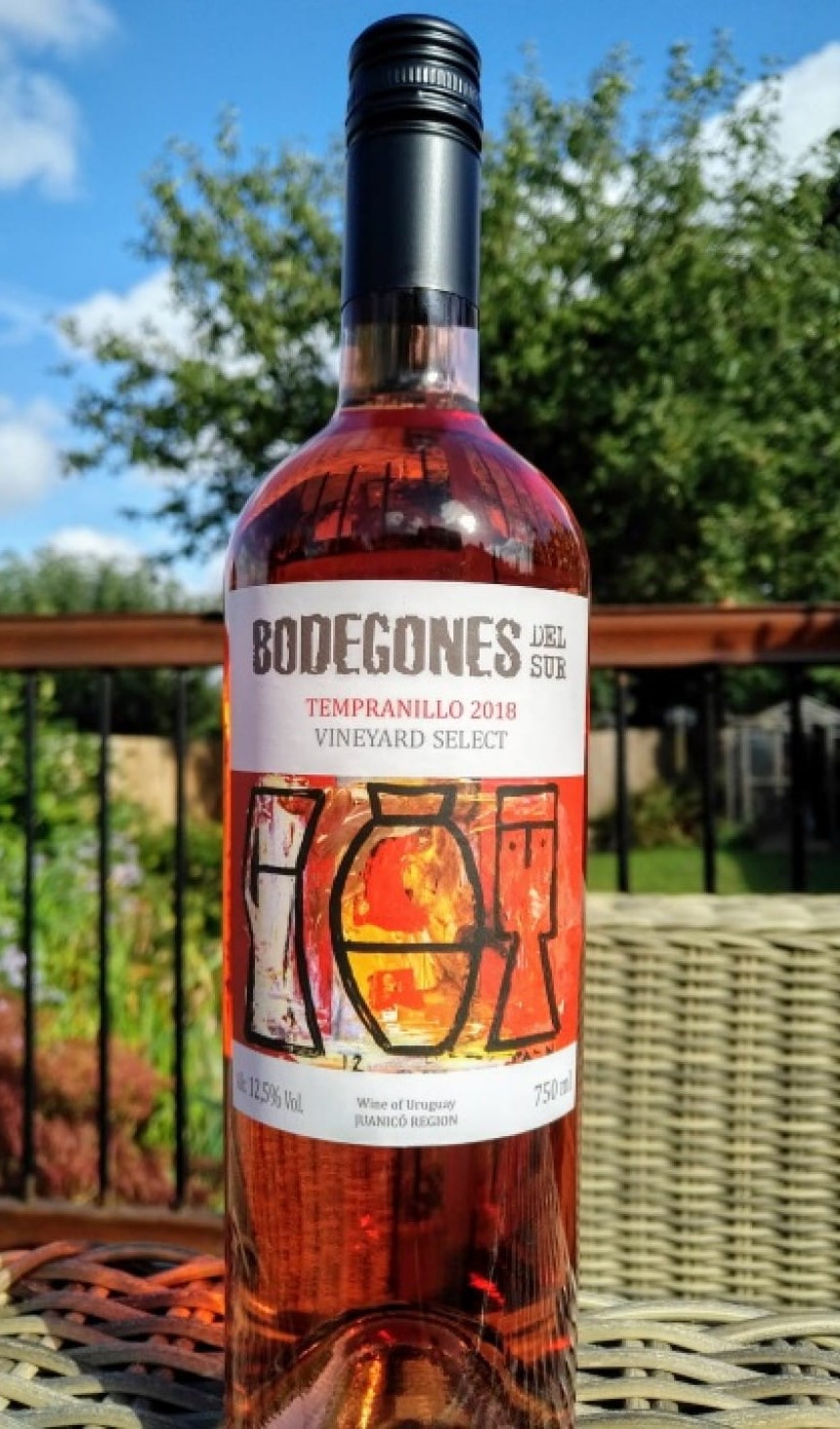
Enjoy the meal with a rich and dry white wine such as Chardonnay, Pinot Gris or Sauvignon Blanc, or even a light red such as Gamay or Pinot Noir. Here in Uruguay I like to use the Albarino or Tempranillo (a light Rosé). You also can use a sweeter wine or a dry sherry for that sweeter taste.

   The Tempranillo we buy here, a summer delight, nicely chilled.

Great served with angel hair pasta or sometimes we also used Quinoa and green vegetables such as spinach or asparagus. If cooking for four, use two large pans at once. If cooking for dinner parties, cook them first then place on sheet pan to reheat, finish in the oven. A good tip as a party dish is to cut the chicken breast in smaller pieces, about 10×10 centimeters and brown it in badges, its easier to warm up.

Believe me, this dish, served with some nice pasta ( Tagliatelle, Fusilli, Rotini or any other „sauce sucking“ one) is not as heavy as you might think, because of butter, cheese and wine. It is unusually light and well tolerated, easily digested, its just Italian rich in taste.   So, as always, try it yourself and enjoy !

Veröffentlicht unter Recipes | Verschlagwortet mit , | 1 Kommentar

Overaged Red Wine Use

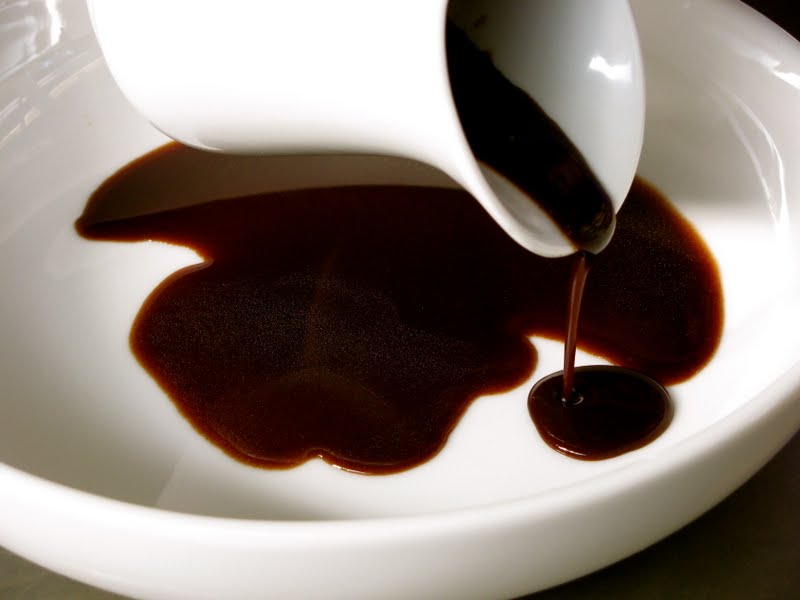
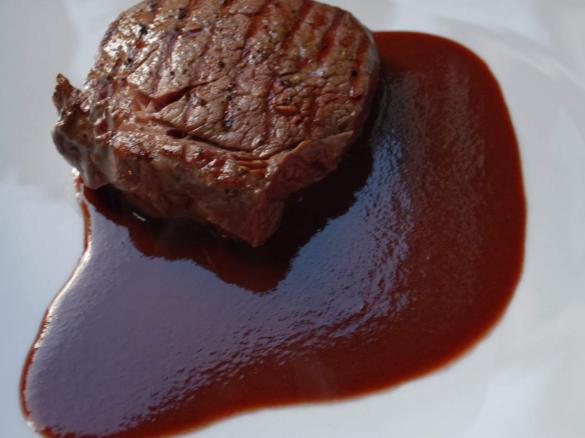
This is how a good red wine reduction should look like, see further down.

A very good friend asked me yesterday what to do with overaged wine, which has a bit of an ugly taste. If it would be the taste of cork I directly would have suggested to throw the wine in the bin. But this one seemed good enough to use it for a further purpose. Here my dear friend  „R.“ are some answers especially for you. Good luck !

In general we say, if something doesn’t taste good, whatever the reason is,
throw it away. With using spices and herbs you may be can save it.

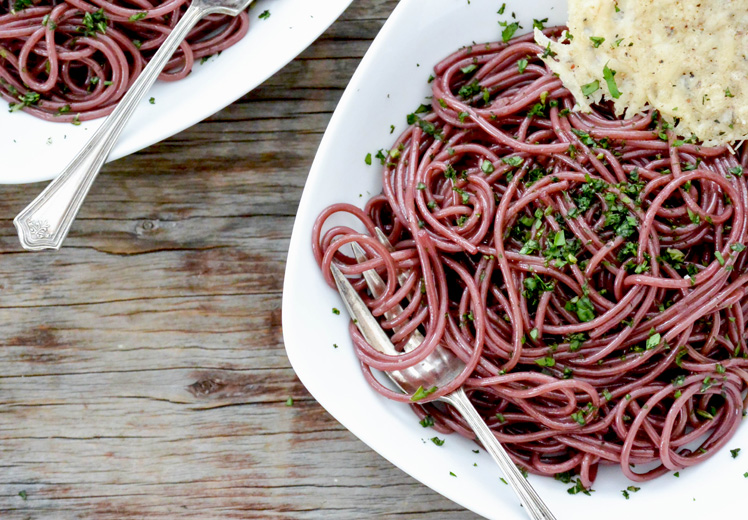
Superb red wine spaghetti, crushed pepper and Parmesan flakes.

With the following ideas it might work to use your wine. If still is some
strange taste around and you don’t like it throw away !!!

You also can resell the closed bottles as said or make a nice gift to someone
you don’t like !

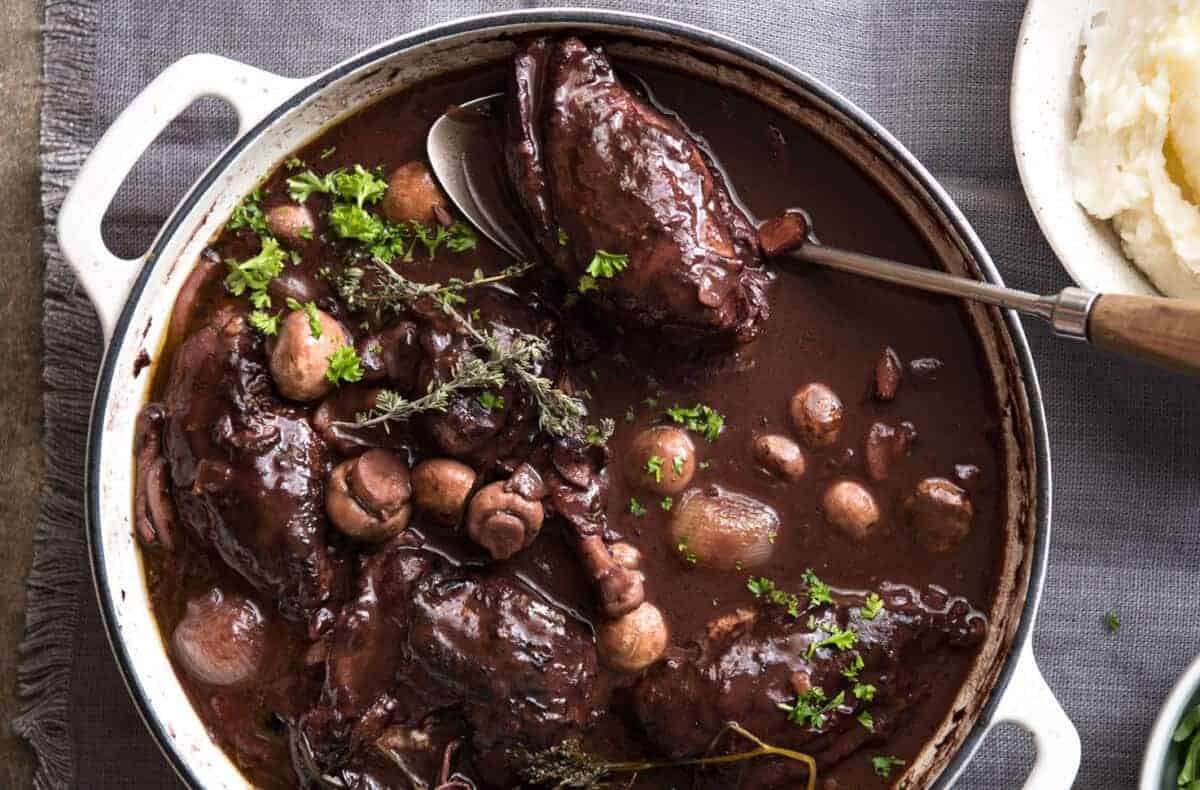
Red wine can be used to cook delicious Coq-au-Vin (chicken in red wine) or fine red wine pasta, for example.
Spicy red wine butter can also be made for longer storage.

Coc au Vin.

White wine can also be used in many ways in the kitchen: It can be used to make white wine soup, for example,
or to cook shredded meat, vegetables and pasta in a sauce of wine. White wine is also excellent for making wine jelly,
which goes particularly well with pork and liver.

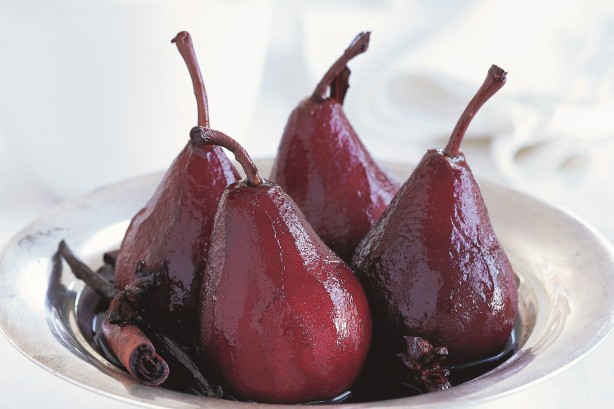
   Try pears in red wine, even strawberry’s are nice, and poor a bit reduction over it.

Somewhat more complex but also very, very good is homemade red wine syrup. Just 2 cups of red wine, which are
boiled together with sugar, cherries, aniseed and a vanilla pod, are enough. The result: Tastes similar to
Amarena Syrup – only much better! Served on pastries or ice cream, a real dream. Also ideal for cakes and slices.

And in case you need to make it very quickly and easily, you can simply freeze any remaining wine! Best in ice cube
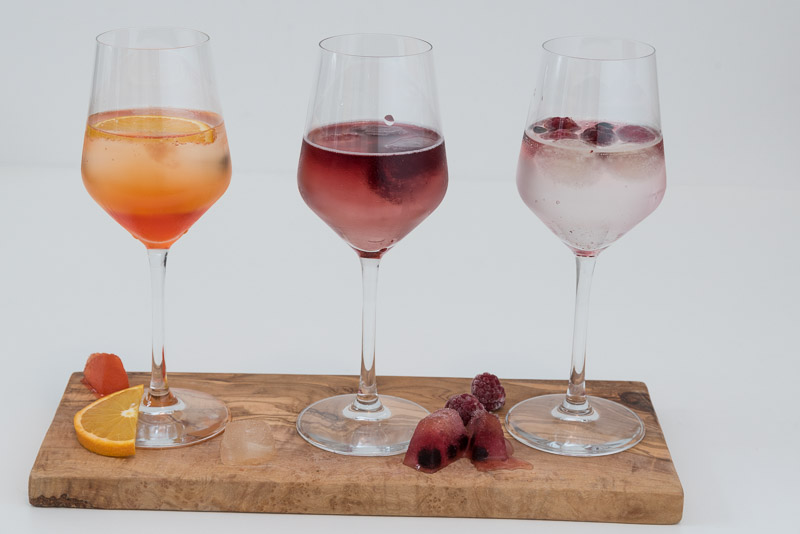
molds. The next splash is then creatively served with a glass of mineral and wine ice cubes.

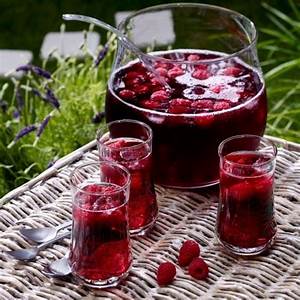
Last idea for a summer party, make a nice red wine bowl. The other alcohol and fruit in there should overwhelm the red wine taste. Or try a recipe for red wine sangria. Delicious.
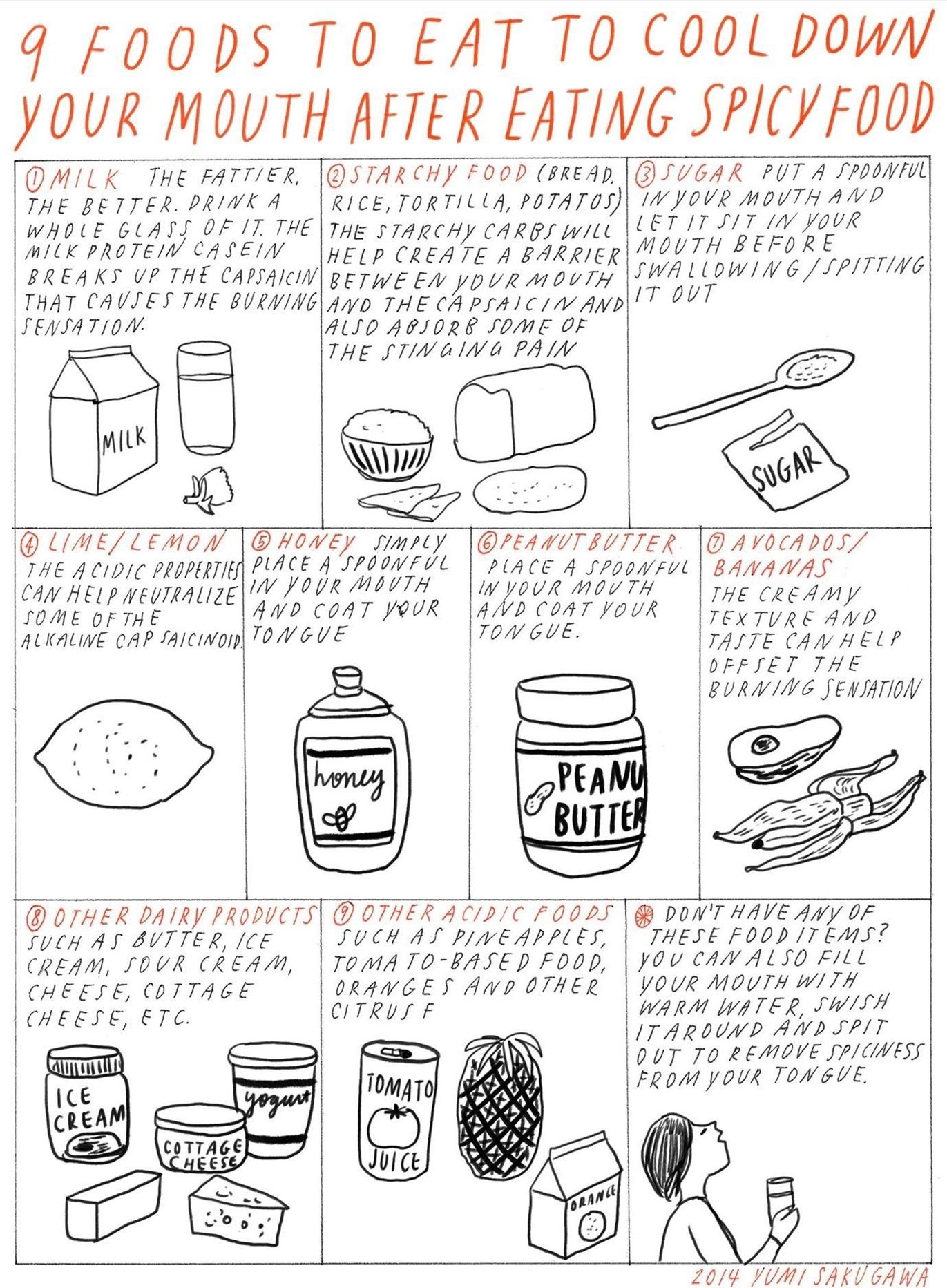
Especially if you use a bit cinnamon in there. Cinnamon or peppermint can be the ingredient to kill the bad taste. I like also some staranise or a pinch of chilli !

  Only use RED FRUITS and some Cognac.

Wine Reduction – reduction was the word I was looking for yesterday !!

A reduction is a concentrated sauce obtained by thickening a liquid over heat. As the liquid portion evaporates, the flavors concentrate and the sugars caramelize, resulting in a more intense taste and a thicker consistency.
But be careful not to overdo it: the sugars may burn, creating a bitter aftertaste. To thicken the reduction more,add a small amount of cornstarch or potato starch.
Reduced red wine is excellent paired with risottos and roasted meats.

Place the red wine of your choice in a saucepan and bring it over medium heat to the boil.
Let it boil at a moderate rate until it has reached the desired thickness.

Generally, the liquid should be heated until it has been reduced to one third of its initial volume. It’s considered ready once it has thickened enough that it slowly drizzles off a spoon when lifted out of the saucepan.

One idea for a red wine reduction. Recipe while cooking a steak.
CAN ALSO BE DONE WITH ANY OTHER MEAT. BEEF IS BEST.
But you need a good amount of burned meat leftovers on bottom of you pan.

4 Large Steaks
1/2 cup Dry Red Wine
1 tsp Balsamic Vinegar (I mostly use double amount of Balsamico)
1 tsp Honey
2 tsp Butter
2 tsp Olive Oil
Salt
Pepper

Another fine recipe, baked carrots and grapes in red wine reduction. Delicious !

If you multiply the ingredients you have a good leftover which is easy freezable for a later use.

Season steak with Olive Oil, Salt, and Pepper. Place 1 tsp. of butter in a hot pan, and as soon
as the butter starts to melt, add the steak to the pan.

Pan sear the steak for approximately 5-6 minutes on each side or until your desired doneness.
Remove from pan and let your steak rest as you prepare your sauce.

In the same pan you pan seared your steak in, add red wine, balsamic vinegar, and honey.
Bring the mixture to a boil for about 10 minutes, or until it reduces by half.

Remove from heat, or leave on low and add 1 tsp of butter and stir in.
That’s how your steak would look like ! Ready to serve ! Buen Provecho !


Veröffentlicht unter Information, Lifestyle | Verschlagwortet mit , | Hinterlasse einen Kommentar

The Health Nut

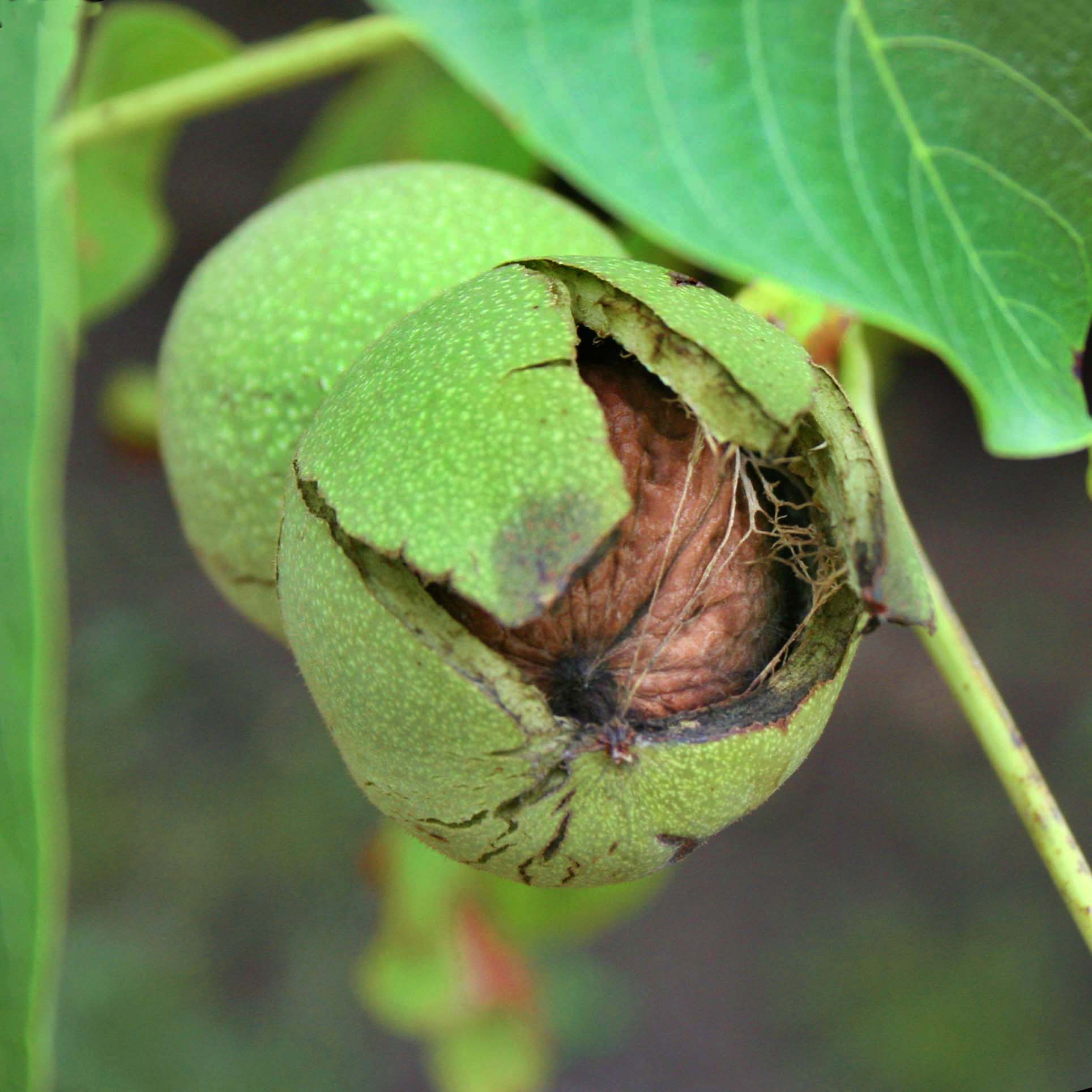
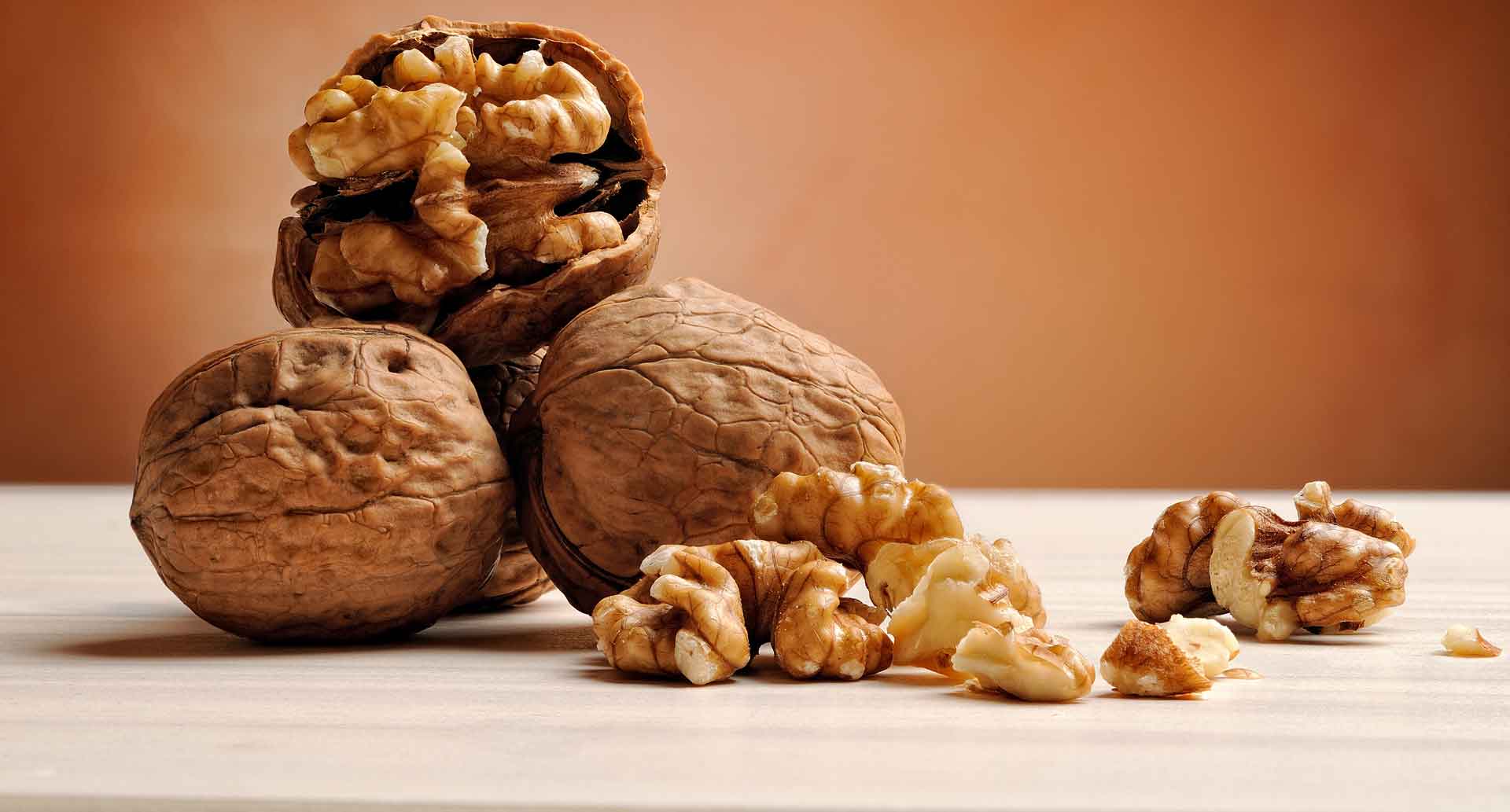
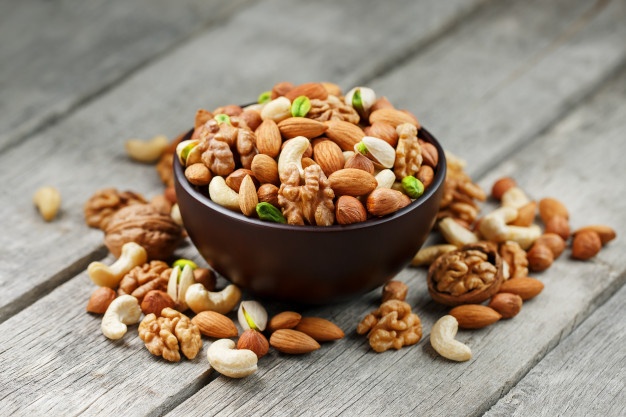
Hard shell, soft kernel: The Walnut is rich in important nutrients and has many uses in the kitchen. For baking, as a topping or simply pure, the walnut is a real treat. But why are the kernels so healthy in their thick shell?


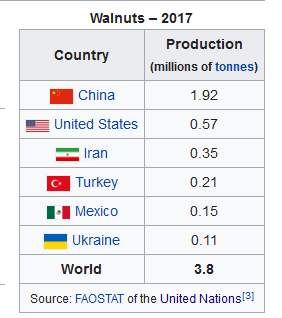
In 2017, world production of walnuts (in shell) was 3.8 million tonnes, with China contributing 51% of the total.

Where do walnuts come from?

Actually the walnut comes from Asia and even today the nuts are imported from China. Much more frequently, however, they come from California. Even in Germany there is a quite large cultivation area near Freiburg, because the climate is particularly mild there and the fruits thrive well.  I also discovered walnut farms in Australia and New Zealand.

     The two most commercially important species are J. regia for timber and nuts, and J. nigra for timber. Both species have similar cultivation requirements and are widely grown in temperate zones. Click on pics.
    Claimed to be the oldest walnut tree in the world, along the ‚Southern Silk Route‘ near Khotan in Xinjiang, China. The age is unknown.

In what forms are walnuts available?

In the supermarket you can buy walnuts whole, but also without shell. The already shelled kernels can be nibbled or sprinkled over muesli and salad without much effort. Walnut oil also gives the salad dressing a particularly fine flavor and an extra kick of unsaturated fatty acids and vitamins. Walnut is also available in many different forms, for example:

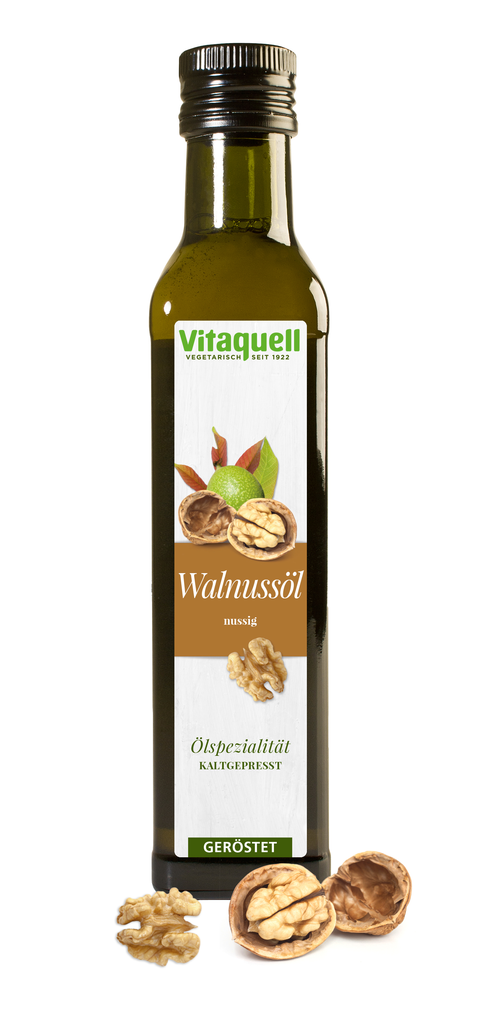
Left: Walnut oil for cooking, only use the best brands, means cold pressed from roasted nuts. It is fantastic, believe me and you only need a few drops. Right: Available in German pharmacy’s, walnut oil spray. One can use it as a cooking spray, but normally its used as a remedy. Always click on pics for a better view.

as walnut oil
as walnut bread or rolls
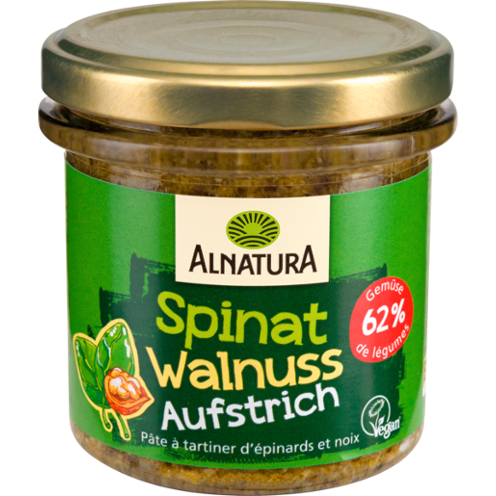
as walnut spread
as walnut pesto
as walnut macaroons or cookies, tarts and cakes
as cooking ingredient in many other forms, like casseroles, sauces, soups, terrines etc.
as healthy snack in nut-mixes or candy bars etc.
as walnut ice cream.


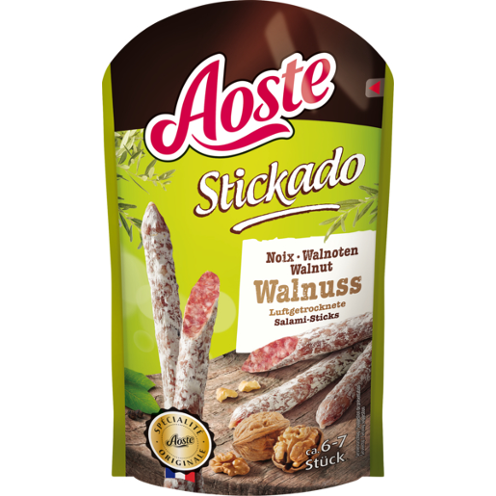
Left: Walnut Spinach Spread                                                                         Right: Walnut Salami Sticks


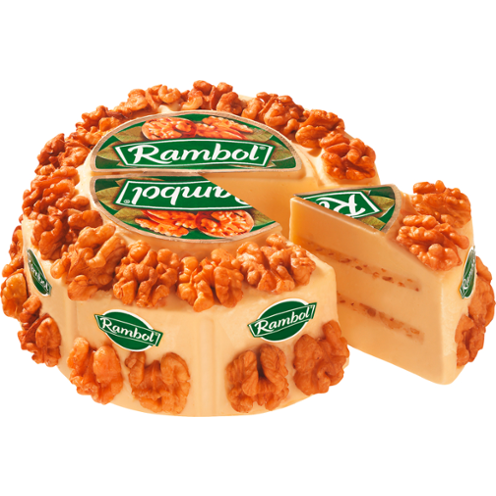
Left: Walnut Onion Creme                                                                              Right: Walnut Soft Cheese

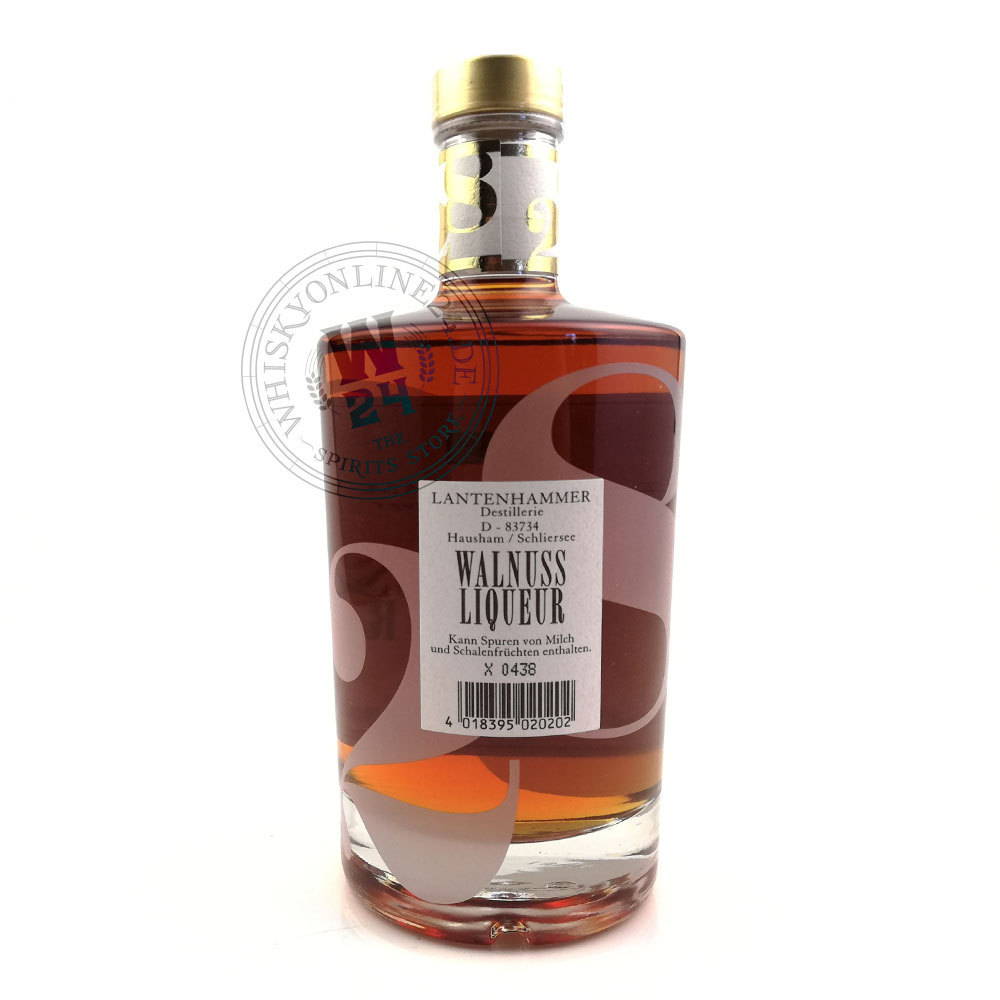
Some shops or delicatessen even offer walnut liqueur, which you can enjoy pure or pour over desserts.

Delicious German Walnut Liqueur.

Why are walnuts so healthy?

What is the health effect of walnuts? This is what many people who read again and again how healthy the walnut is ask themselves. Its reputation as a power package for memory and health is completely justified.

Although walnuts have a high fat content, they are rich in nutrients that we need for our blood vessels, skin, immune system and, last but not least, brain performance. In terms of nutritional information, this means that 100 grams of walnuts provide 662 kilocalories (kcal). That sounds a lot, so a handful of nuts is quite sufficient as a snack between meals. However, you should not reduce the walnut to the number of calories, because it has many valuable properties.

Walnuts have a high proportion of omega-3 fatty acids, even more than other nuts. Above all, the walnut is the only nut that contains alpha-linolenic acid, which for example has a positive effect on blood pressure.
The nuts contain valuable antioxidants that help the body to hunt down free radicals and protect against stress and disease.
A special feature of the walnut are the polyphenols which promote the regeneration of the body and counteract inflammation.
With 14 grams of protein, walnuts are healthy vegetable protein suppliers.

Among the ingredients of the walnut are:

Omega-3 fatty acids
vitamin A
vitamin B, several
vitamin C
vitamin E
Calcium
Magnesium
Potassium
Iron
Zinc

  That is so healthy, having fresh nuts every day. The best snack between.

But the walnut is good for this when consumed regularly:

It can reduce stress.
It strengthens skin, hair and nails.
It promotes brain performance and can even prevent Alzheimer’s disease.
It lowers LDL cholesterol.
It helps to regulate blood pressure.
It protects the blood vessels.
It can improve blood sugar levels in diabetes.
It can help against diarrhea.
It strengthens the immune system.
It can prevent cardiovascular diseases and cancer.

Whether you are studying, working or playing sports, walnuts are a real power snack to boost mental and physical performance. The walnut can also help you lose weight. Because if you nibble a few of the nuts every day, you can prevent ravenous appetite attacks and better control the feeling of hunger.

  We still have this one, a vintage Italian nut cracker from the 1960’s.

Characteristics of the walnut, what to consider ?

Cracking: To crack the rather hard shell of the walnut, a nutcracker is suitable. However, do not exert too much pressure so that you only open the shell and do not crumble the whole nut.

Store the cracked nuts: Walnuts without shell should be stored in an airtight bag or container. The whole nut with shell, on the other hand, is well protected and can be draped decoratively in a bowl or on a plate. Larger quantities are best stored dry, cool and dark in an air-permeable bag. Caution: If the nuts become moldy, aflatoxin is formed, a toxic substance that can be dangerous.

Shelf life: Walnuts can be kept in their shells for about one year. Without shell they only last about four weeks. You can tell when you should no longer eat walnuts by their smell and taste. Spoiled nuts smell a little rancid or taste very bitter. It is better to throw moldy nuts directly into the garbage.

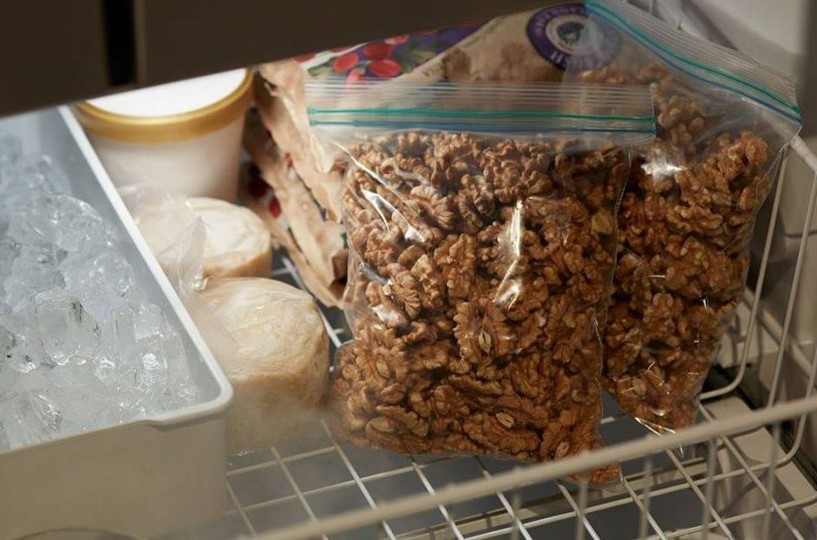
  Storing walnuts in different country’s. Normally we would keep them in a „Tupperware“ container in a dark place. Storage time six to twelve weeks. In Australia we learned everything to store in fridges or freezers. Tropical Panama the same. In the fridge, in bags as you see above, about 6-8 month. Storage of walnuts in a freezer over 12 month. Always the peeled version.

Cleaning: If you have a walnut tree in your garden, you can harvest the nuts in autumn. However, they should be cleaned before storage. Remove the green, soft outer skin and brush off the shell of the walnuts. It is best to wear gloves, as the tannic acid can turn your fingers brown. You should not use water to clean the nuts, otherwise the shell will mold faster due to the moisture. The nuts must then dry to keep them for longer.

Walnut allergy: Unfortunately, the walnut can also trigger an allergy. A walnut allergy is even one of the most common allergies worldwide. Caution is advised if you have already had an allergic reaction to other nuts. In the case of a walnut allergy, the tongue, mouth and throat swell, blisters form on the tongue, the throat scratches, the skin begins to itch and nausea and diarrhea can occur. In the worst case, allergy sufferers even suffer from shortness of breath and go into anaphylactic shock. What you can do in an emergency: Call the paramedics immediately or drive to the nearest hospital. The symptoms can usually be relieved well with medication.

Nut allergies symptoms usually begin straight after eating the nuts. Most symptoms are mild. They include a rash (hives or “nettle” rash), swelling of the lips or around the eyes, and itch. Some people have an itchy throat or burning tongue, others feel sick, vomit or have diarrhea.

Where can you buy walnuts?

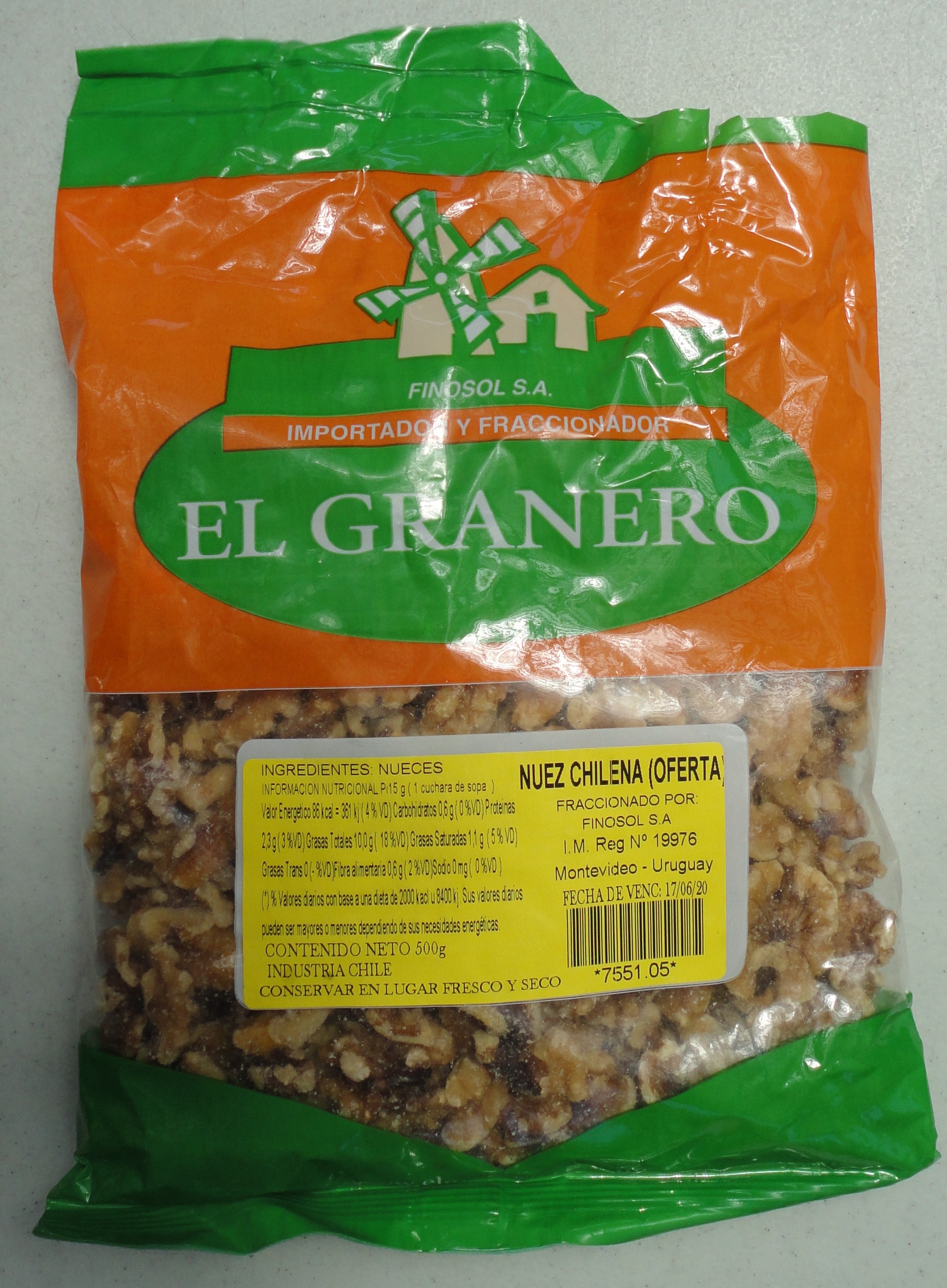
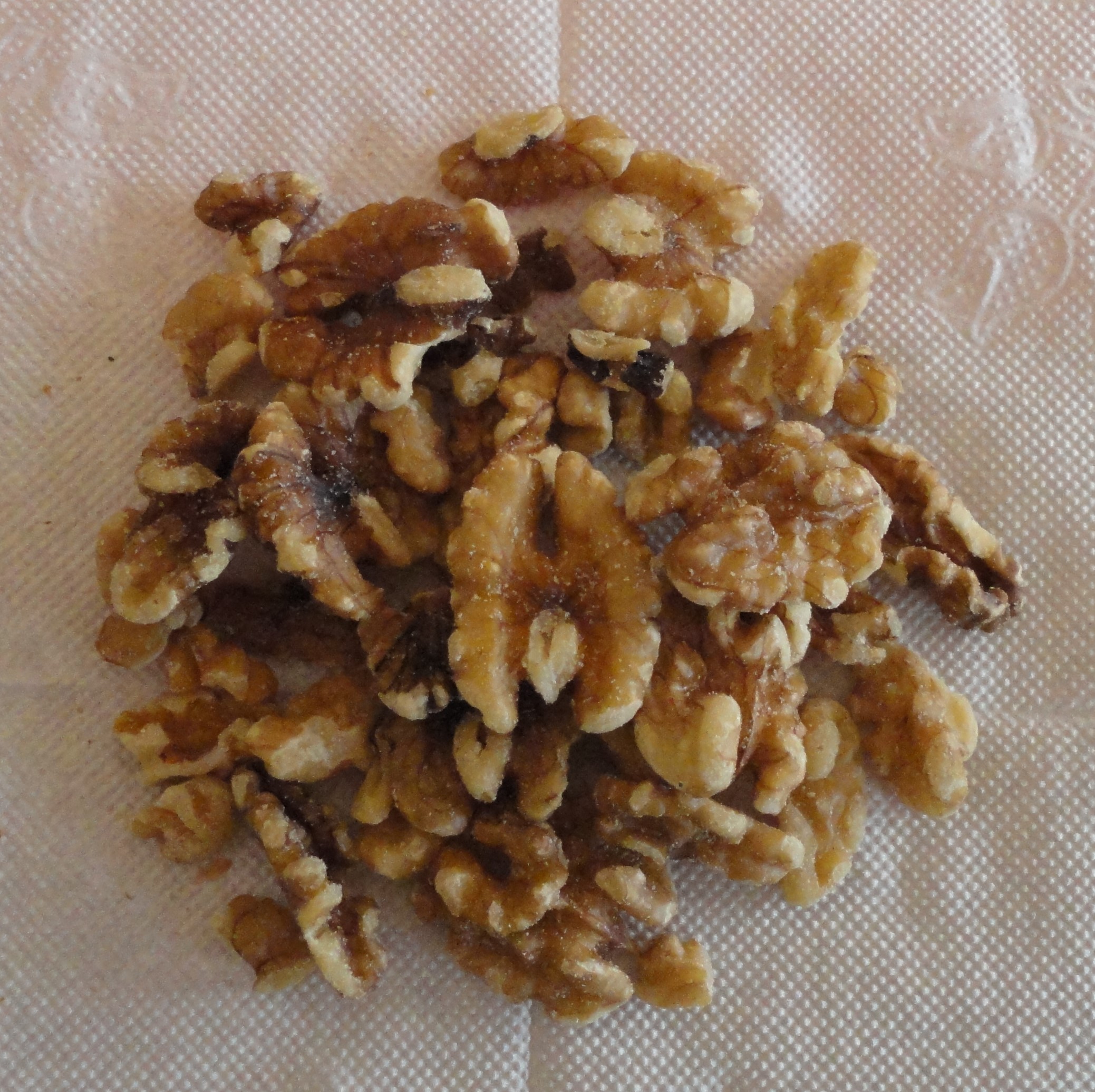
Walnuts are to buy almost everywhere. Here in Uruguay we find in season whole nuts in shell. Nuts in general are very expensive in Uruguay. But best is to buy at El Granero. They offer walnut peeled for about $630,–peso per 500gram. We like to buy the Chilenean offer, means broken nut parts, for $329,–peso per 500gram.

                
They are imported from Chile, as most nuts are, and pretty good quality. Click on pics to supersize.

Characteristics.


The Principality of Monaco brought this set of stamps in 1992, showing Spring (blossom), Summer (green fruit), Autumn (ripe nuts) and Winter (new sprouts).

The walnut tree grows to a height of 60m and can live up to 200 years.
There are up to 60 species known and the so called „real walnut“, about which I am writing here has up to 20 different varieties.
Only from an age of about 10-20 years of bearing fruit, the amount depends on the location of the tree and the climate. Not only humans like this healthy fruit, as one can see.

Black Cockatoo, also called Raven Cockatoo, seen in Australia.

Cooking.

The walnut is used in many dishes from cakes to walnut ice cream. In addition to whole nuts, walnut kernels and walnut oil freed from the shell are also sold, as well as brittle for decorating desserts. Walnuts are also used for Waldorf salad, tortelloni, skordalia, kozunak, lobio, nunt or as churtschchela.

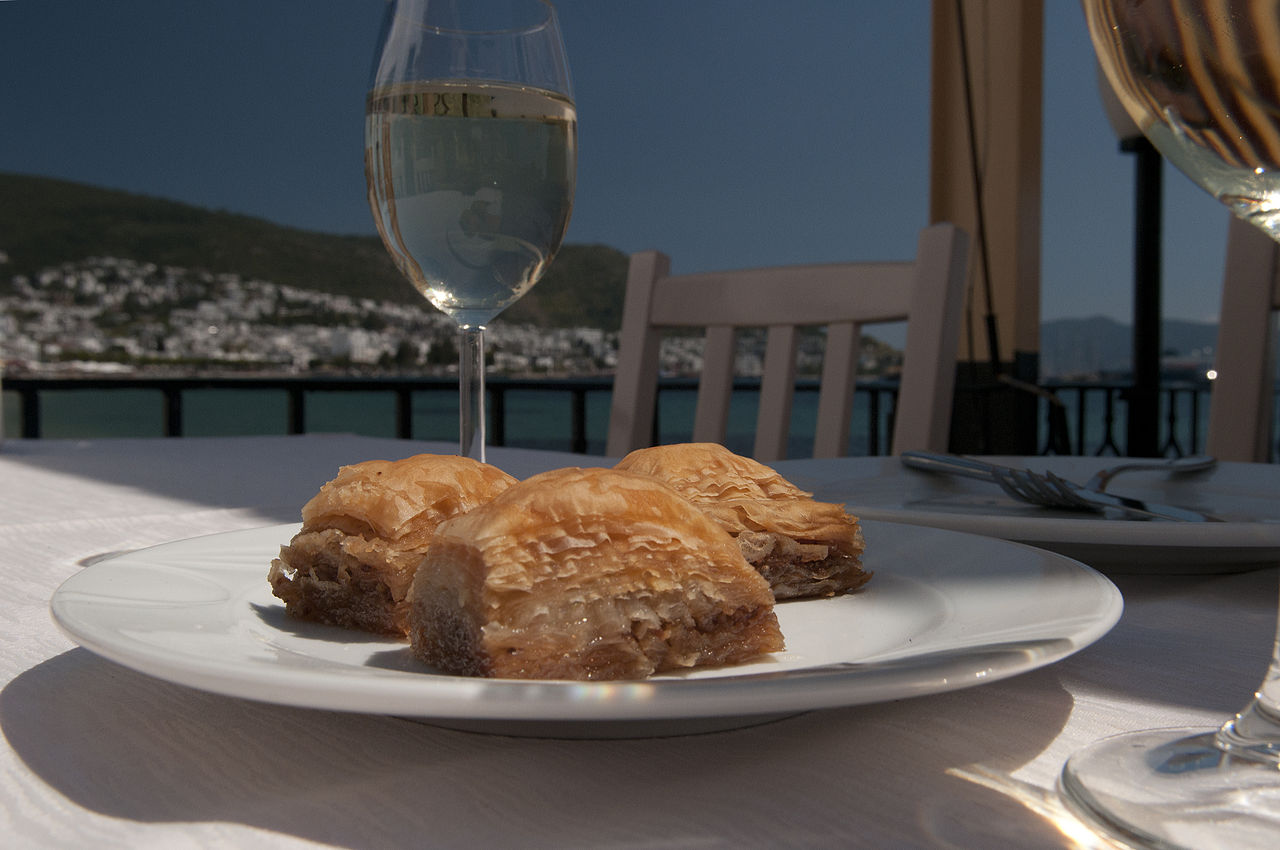
   Delicious Baklava made from phyllo dough, walnuts, honey, cinnamon and butter. A delight in Greece or Turkey.
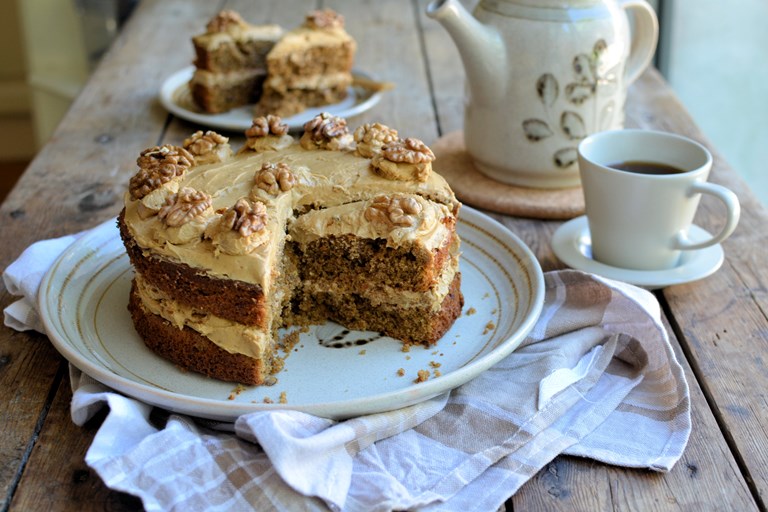
  Superb walnut cake we had in Australia. You should have the chance to taste this fantastic „walnut butter cream“. Click on pics to supersize.

Another possibility is the harvesting of half-ripe green nuts in June (St. John’s nuts). These can be used to make a preserving fruit with a high vitamin C content (candied nuts, also called black nuts, see further down) or a nut liqueur (nut spirit, nut brandy). In Italy, the still green nuts, which are traditionally harvested on St. John’s Day, are used to make a special liqueur called Nocino (see further down). Also in Serbia, Croatia and Bosnia and Herzegovina a liqueur is made from the still green nuts, the Orahovac.

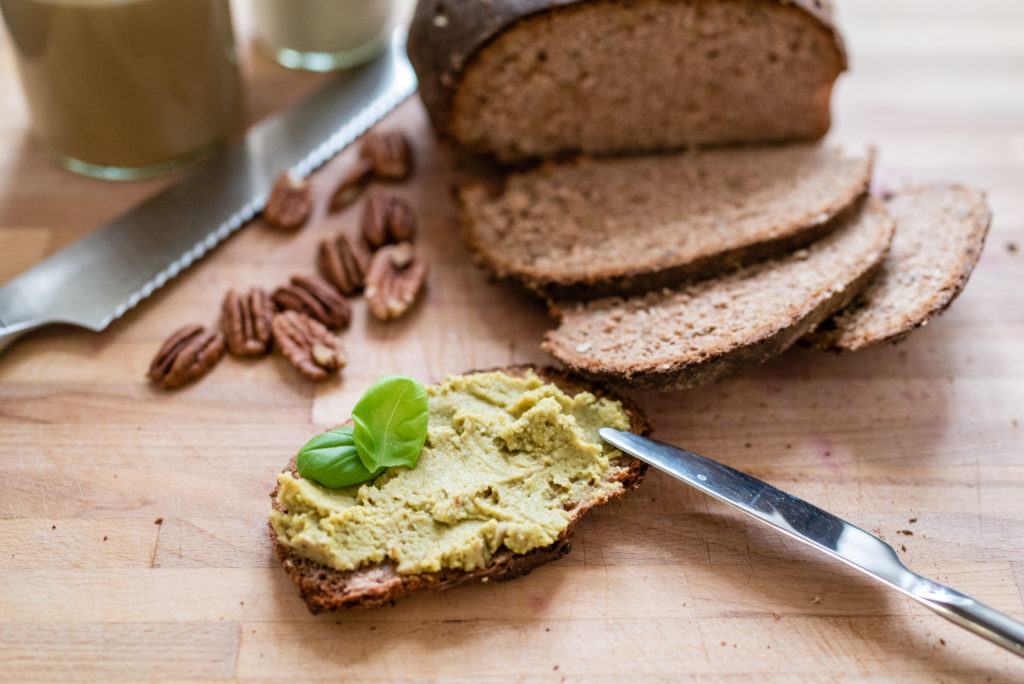
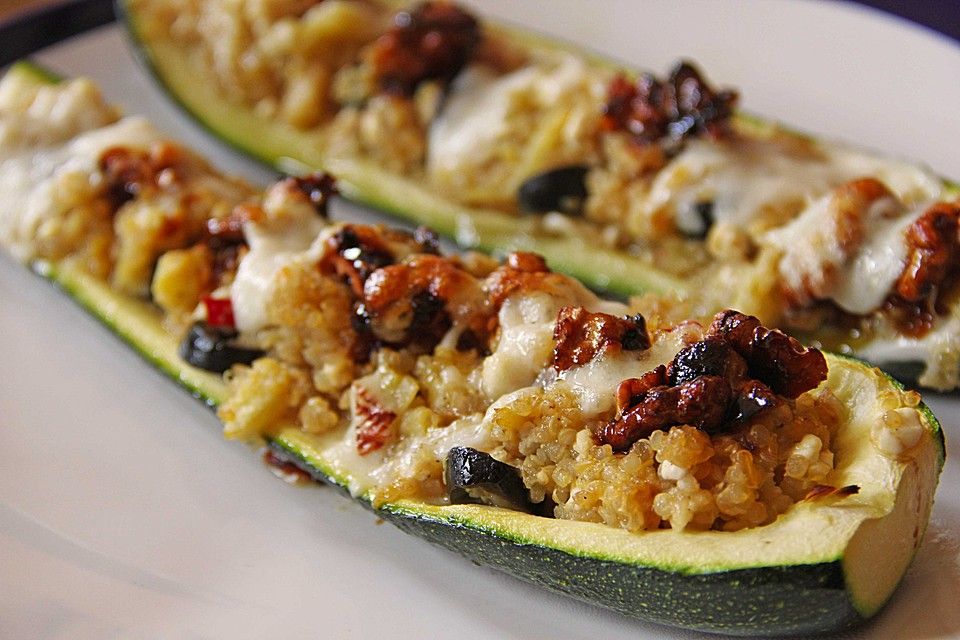
       Two recipes to dream of. Left a beetroot-walnut bread with wasabi-avocado spread. Right zucchini with quinoa, walnut and goat-cheese filling. If you are interested in the recipes, just call in.

One of the best dishes with walnuts I had once in Groningen, Netherlands. It was grilled Ostrich fillets with a spicy old Gouda sauce sprinkled with lots of pickled black walnuts. During writing this I still have this mouthwatering memory.

Miscellaneous.

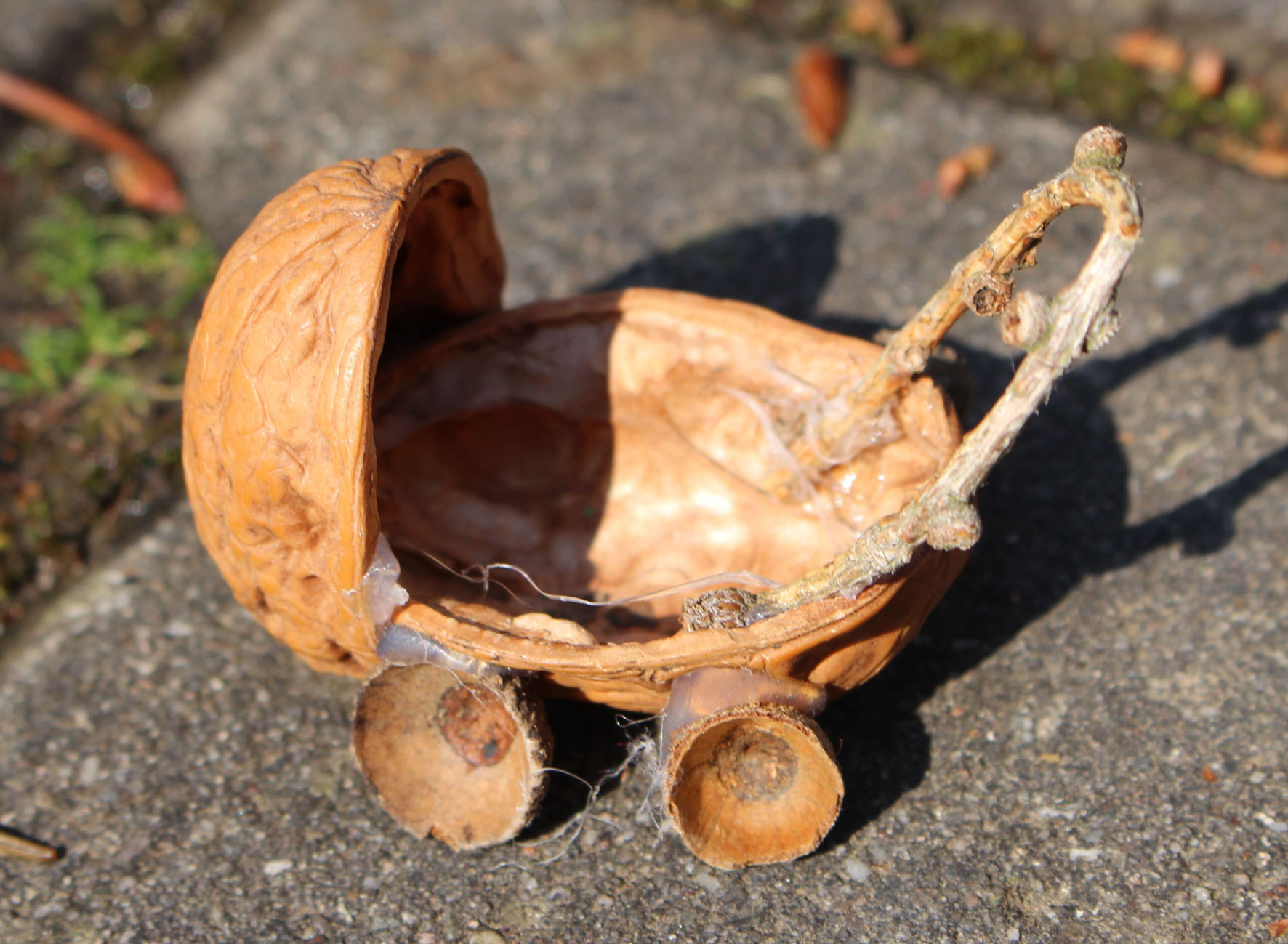
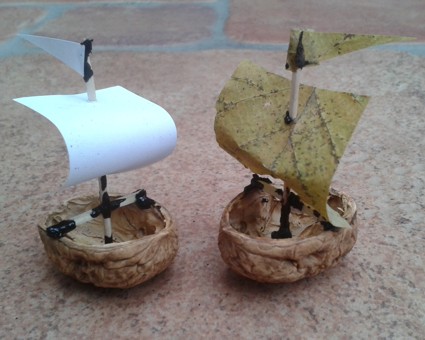
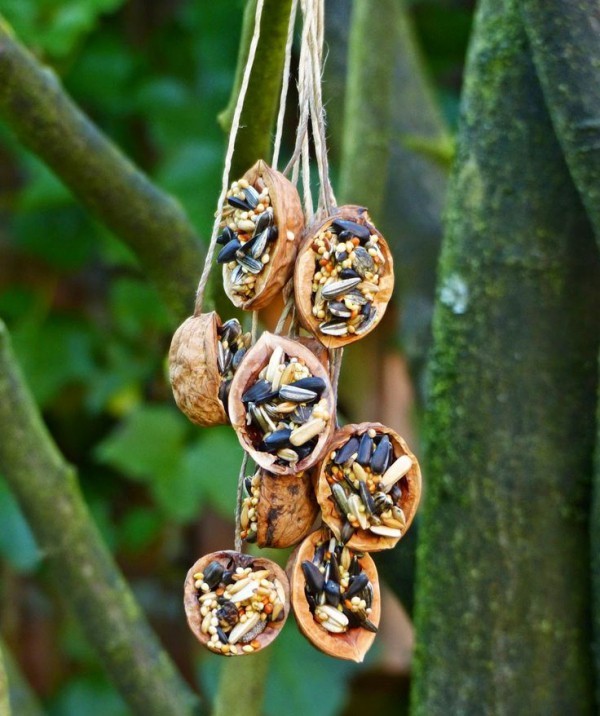
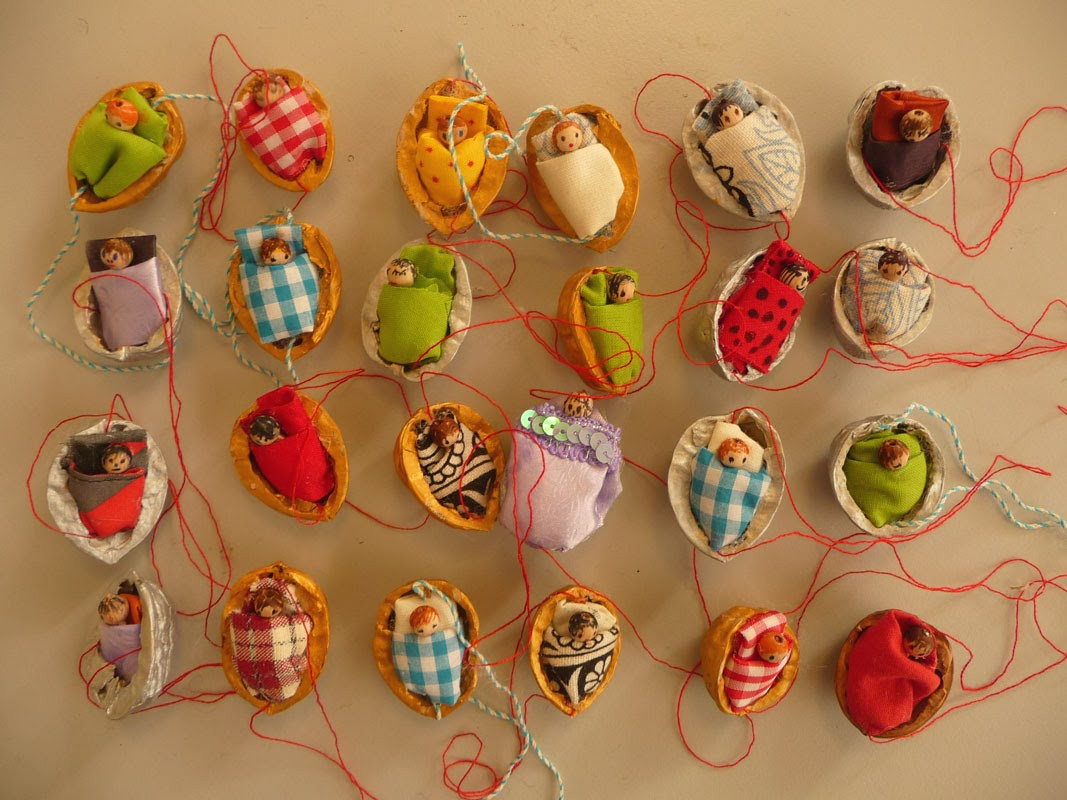
There are so many ways to use walnut shells. As kids we used them as much as we used chestnuts or acorns. Best of course was to tinker and play with all of them.


Toys we used to make. Or fillings with tallow and birds food hanging in the trees. When our daughter was little, my wife always used to make „Walnut Baby’s“ for the kids. They loved them. Click on pics to size up.

The walnut shell.

The walnut shell has a wide variety of uses. Eastern black walnut (J. nigra) shell is the hardest of the walnut shells, and therefore has the highest resistance to breakdown.

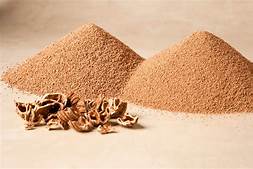
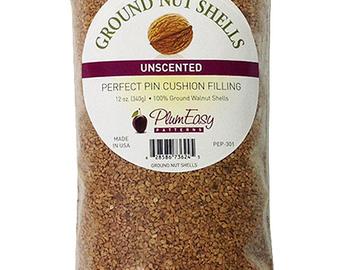
                  Walnut shells granulate on the left and sold in bags as „pin cushion“ filling, on the right.

Cleansing and polishing: Walnut shells are mostly used to clean soft metals, fiberglass, plastics, wood and stone. This environmentally friendly and recyclable soft grit abrasive is well suited for air blasting, debarring, descaling, and polishing operations because of its elasticity and resilience. Uses include cleaning automobile and jet engines, electronic circuit boards, and paint and graffiti removal. For example: In the early days of jet transportation, crushed walnut shells were used to scour the compressor airfoils clean, but when engines with air cooled vanes and blades in the turbine started being manufactured, this practice was stopped because the crushed shells tended to plug up the cooling passages to the turbine, resulting in turbine failures due to overheating.


Beautiful walnut tree as a solitaire.

Oil well drilling: The shell is used widely in oil well drilling for lost circulation material in making and maintaining seals in fracture zones and unconsolidated formations.
Flour made from walnut shells is widely used in the plastics industry.
Paint thickener: Walnut shells are added to paint to give it a thicker consistency for „plaster effect“ ranges.
Explosives: Used as a filler in dynamite.
Cosmetic cleaner: Occasionally used in soap and exfoliating cleansers.
The common walnut, and the black walnut and its allies, are important for their attractive timber, which is hard, dense, tight-grained and polishes to a very smooth finish. The color ranges from creamy white in the sapwood to a dark chocolate in the heartwood.

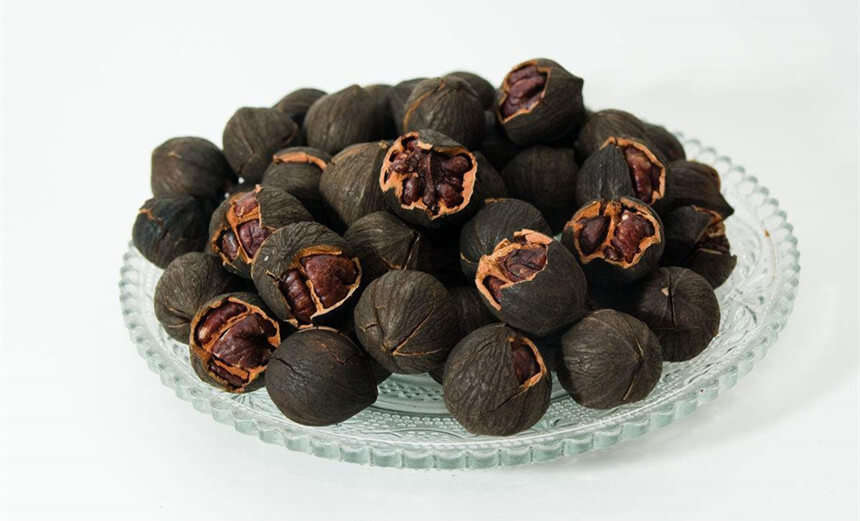
Don’t mix up these Californian „Black Walnuts“ with the blackened walnuts I show you in a recipe further down. Above is just a variety of the many different species one can find.

The green walnut.

the English walnut, Juglans regia, which is thought to have originated in Persia. Most historic documented uses of the English green walnut are from Europe, where cooks have used them through the centuries to make chutneys, pickles, liqueurs, and infusions. The recipes below both take time, but you wind up with a rich and luscious Italian liqueur and a pungent and sharp English-style pub pickle that are well worth the effort.

Be aware that green walnuts produce an inky stain, so wear black or old clothing while processing, and if you don’t want to show off inky fingers for a week as a badge of honor, be sure to use gloves.

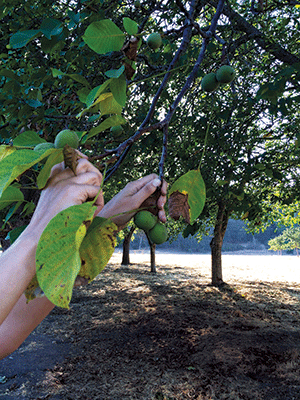
  Harvesting the green walnuts.

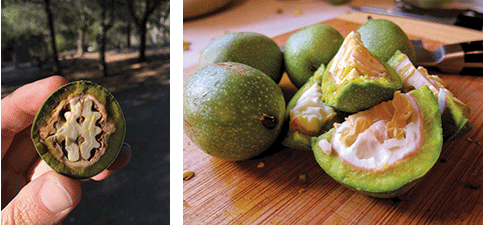
Preparing green walnuts.

By curing in a brine and sun-drying, green walnuts become something akin to fleshy, tart-flavored olives. Be sure to use walnuts harvested early enough that they are easy to cut through, otherwise the inner shell will not be edible.


On the left, harvested to late, already has a shell inside, but good for liqueur. On the right, perfect to pickle.

Pickled Green Walnuts.

30 green walnuts
¼ cup kosher salt
1 quart water
1 quart apple cider vinegar
½ cup granulated sugar
1 tablespoon dark molasses
1 tablespoon black peppercorns
1 tablespoon allspice berries
5 cloves

Wash a half-gallon jar well with hot soapy water, rinse, and air dry. Add salt and water to jar and stir to dissolve the salt. Stab each walnut with a fork a few times to help the brine penetrate the flesh, then submerge and let them ferment for 10 days at room temperature.
Remove walnuts from the brine, place them on a baking sheet or other tray, and let them sit in the sun for 24 to 48 hours, or until they turn completely black.

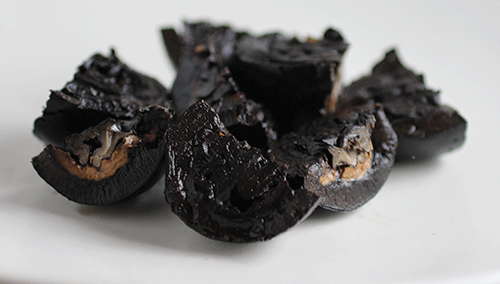
  The black treat !

Wash 2 quart jars well with hot soapy water, rinse, and air dry. Divide the walnuts evenly into these jars. Bring the vinegar, sugar, molasses, and spices to a boil then pour over the walnuts. Try to leave little headspace in the jars (if you need more liquid, add a bit more vinegar). Seal jars and let rest in a cool, dark place for at least a month.

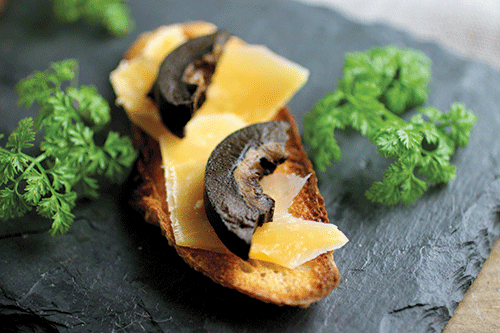
  Pickles can be eaten for up to 1 year. My favorite way to enjoy these pickles is on crostini with a sharp cheese, such as Parmigiano. Garnish with fresh herb, such as chervil, for a bit of brightness.

Nocino.

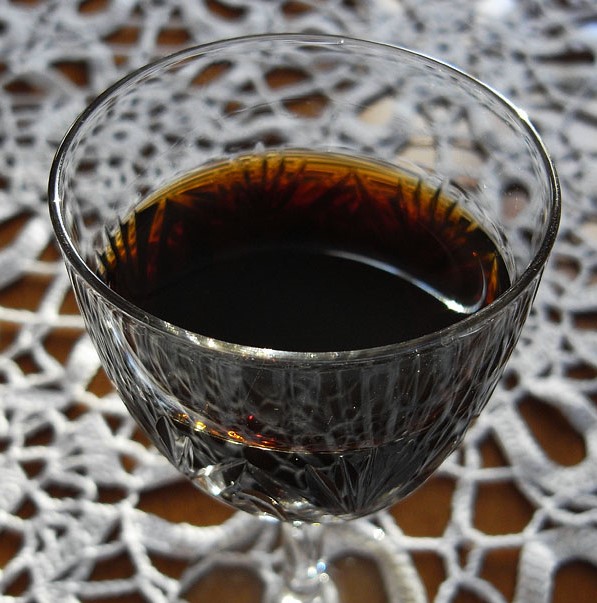
Anyone can magically transform incredibly tannic walnuts and clear, sugary alcohol into this “black gold” Italian liqueur. I like to keep my nocino pure so I can taste the walnut-y goodness but have successfully experimented with adding vanilla bean and cinnamon. Try pouring nocino over vanilla ice cream, using it in a Manhattan cocktail in place of vermouth, or drinking it on its own as a digestif.

Delicious drop, I tell you, especially if „homemade“.

This recipe makes about 2 liters, but you can multiply it as necessary according to the amount of walnuts that you have on hand.

4¼ cups granulated sugar
1.75 liters Vodka
50 green walnuts, cut in quarters

Optional flavorings: citrus peel, cinnamon sticks, black pepper, vanilla bean, etc.
4 half-gallon jars with lids, washed well with hot soapy water, rinsed, and air dried
Smaller bottles with lids.


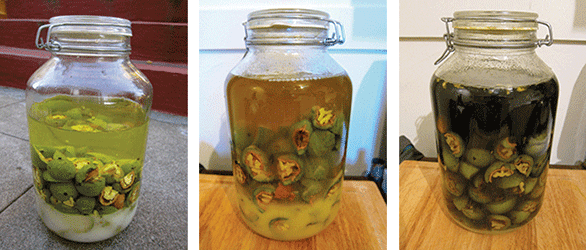
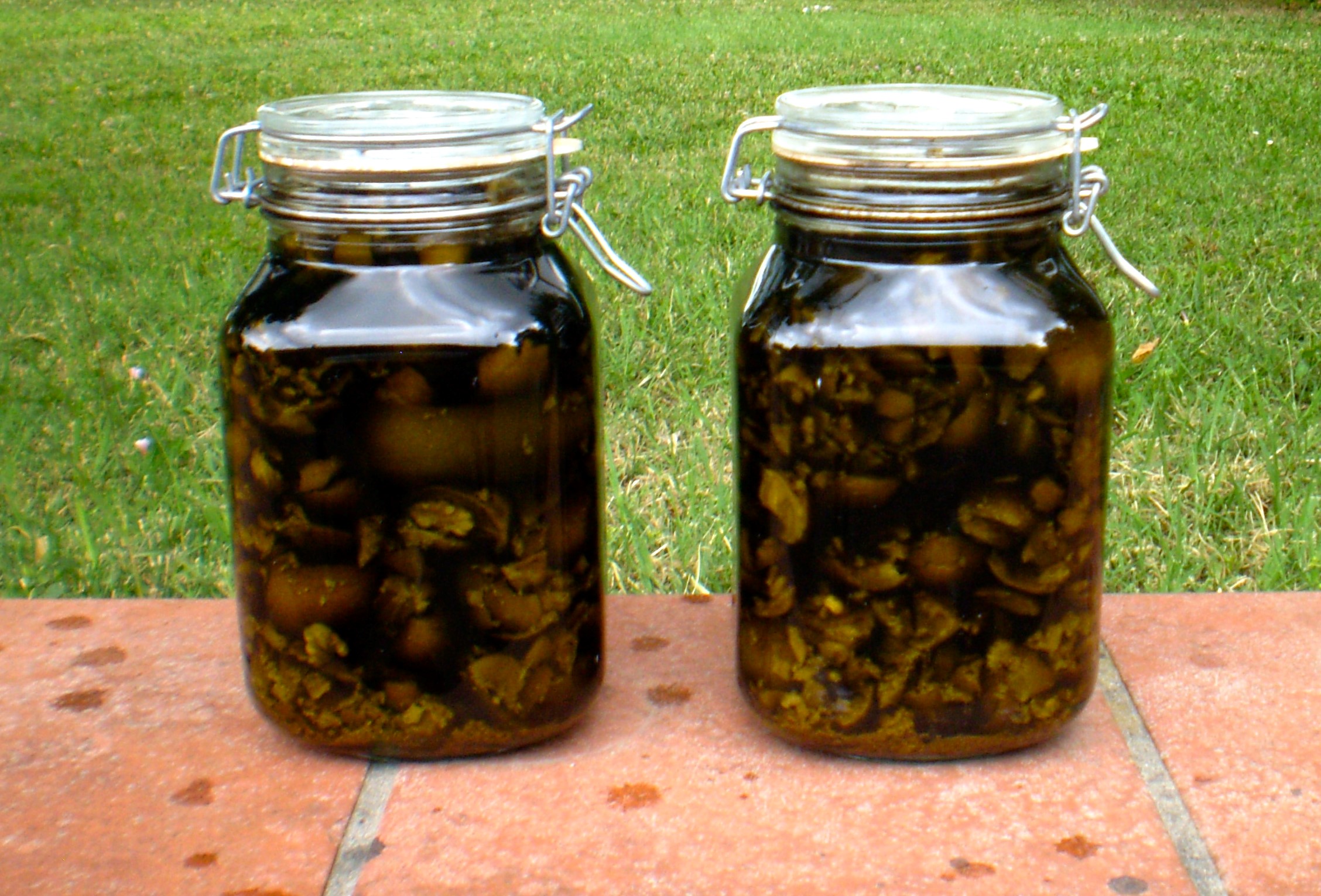
We lived many years near Feiburg in Germany and made all the time black walnuts, spread and liqueur. Above my 2 1/2 liter jars. If the nuts are in this stage it was hard to wait and not to taste direct away.

Divide the quartered walnuts and sugar evenly into the cleaned jars, then screw on the lids tightly and shake the jars vigorously. Over time the nocino liquid will darken. It happens quite fast and it’s pretty impressive! Allow jars to sit for 6 weeks in a cool dark place, shaking occasionally to dissolve sugar.

  The proud result of waiting. Best is to start and give time for a whole year till next harvest is possible. Then enjoy !

Using a cheesecloth or fine mesh strainer, strain the liquid and discard the walnuts. Add any optional ingredients (vanilla bean, orange peel, etc.) and pour nocino from the jars into smaller bottles with tops, which you have washed well with hot soapy water, rinsed, and air dried. Close bottles and allow the liqueur to mature for another 6 months to 1 year. Feel free to taste the nocino as it rests to learn about the flavor changes, then begin drinking once you find it to your liking.


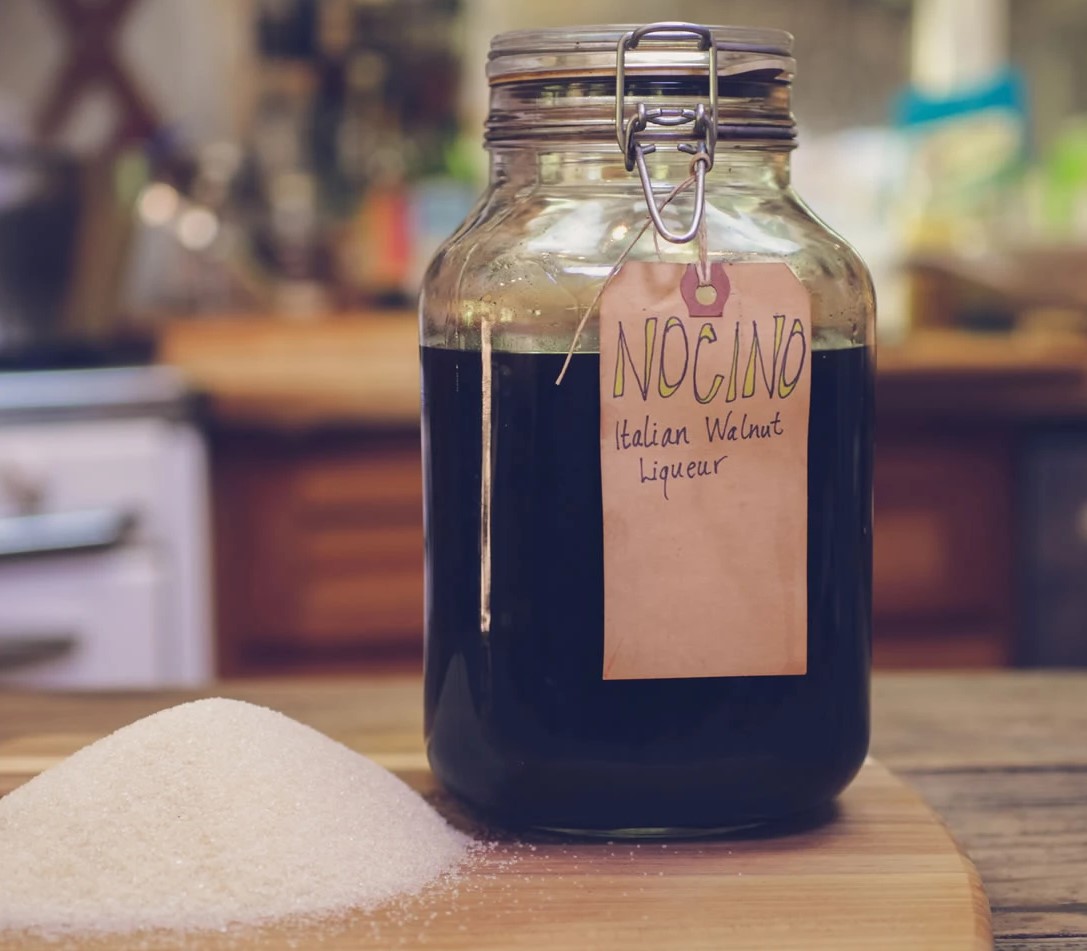
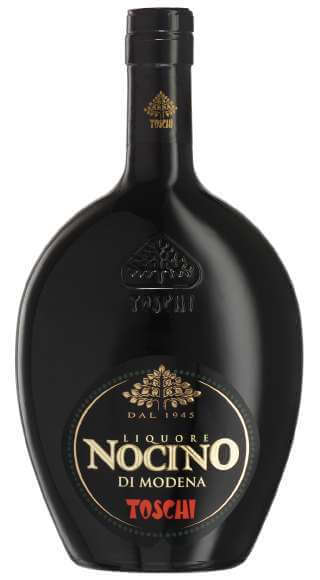
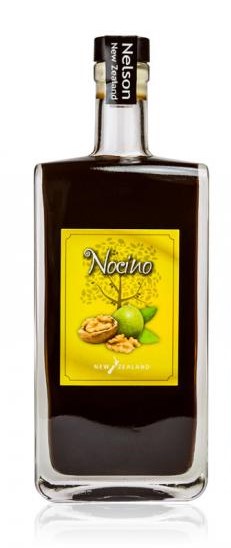
On the left the Nocino we could buy allover Europe where also we bought our Balsamico vinegar from Modena, Italy. Right is a bottle which I brought from Nelson in New Zealand as a souvenir. Sadly we can’t have such good drops here in Uruguay. Not even a nice Cognac or an Armagnac is available !!
Friends always enjoyed my homemade Nocino, when they heard about the production, work and time etc.,
Some asked me: „Are you nuts ?“  I only answered: „Yes – walnuts !“

Veröffentlicht unter Information, Lifestyle, Recipes | Verschlagwortet mit , , , | Hinterlasse einen Kommentar

Yummy Filet Pot

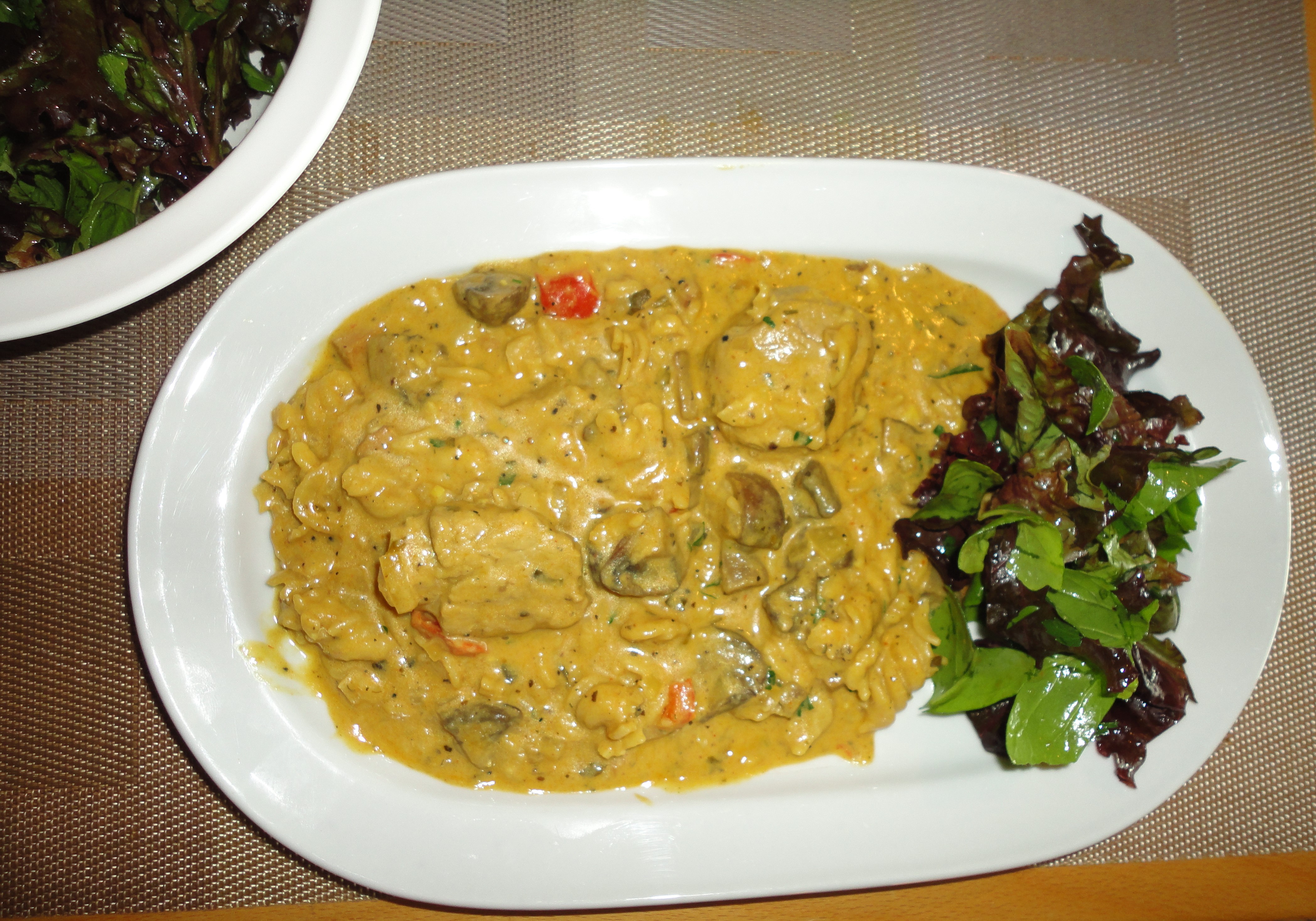
This is a fantastic recipe out of one pot. I like to prepare always 3-4 portions and have the rest frozen for a later day, when we are not in the mood to cook. The whole meal takes a bit preparation time, but its easy to do and absolute delicious. You can impress even your valued guests with it.

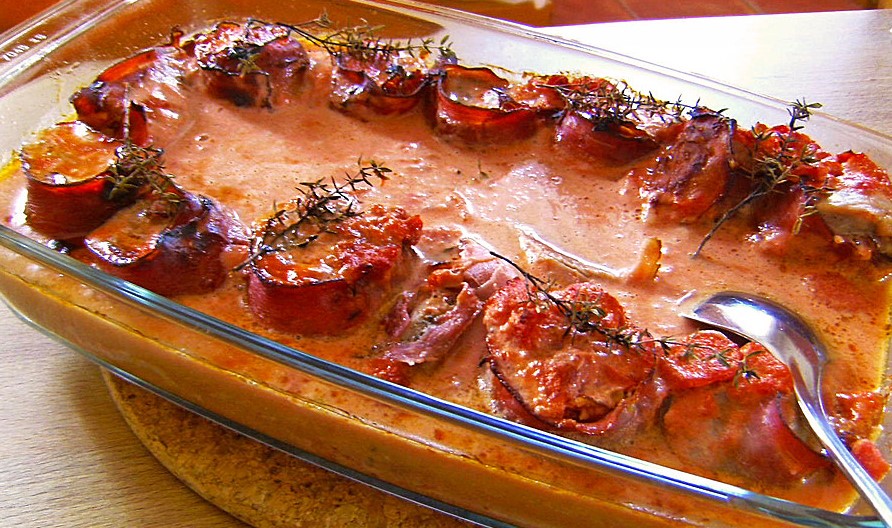
The following recipe is my version, how we like it at home. You can do it however you like, add whatever you like, by example tomato sauce like they do in the Tuscany, Italy or add cheese and gratinate or, or, or ! There are hundreds of possibilities.

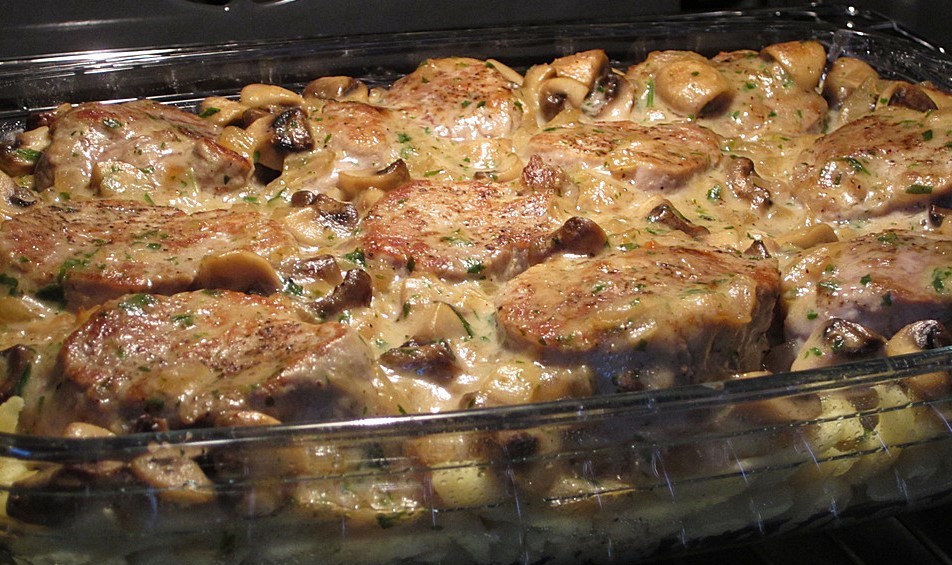
          Filet pot Tuscany (left) and filet gratin out the oven (right).

Ingredients.

1kg mushrooms, best button mushrooms, they have no strong own taste,
cut to your desired size, about 2×2 centimeters,
2 pork fillets, about 800 gram,
1 medium size red paprika, sliced into small cubes,
3 medium size white onions, sliced into small cubes,
300g pasta,
6 cloves of garlic, finely chopped,
175 gram bacon, sliced into small cubes or strips,
700ml beef broth,


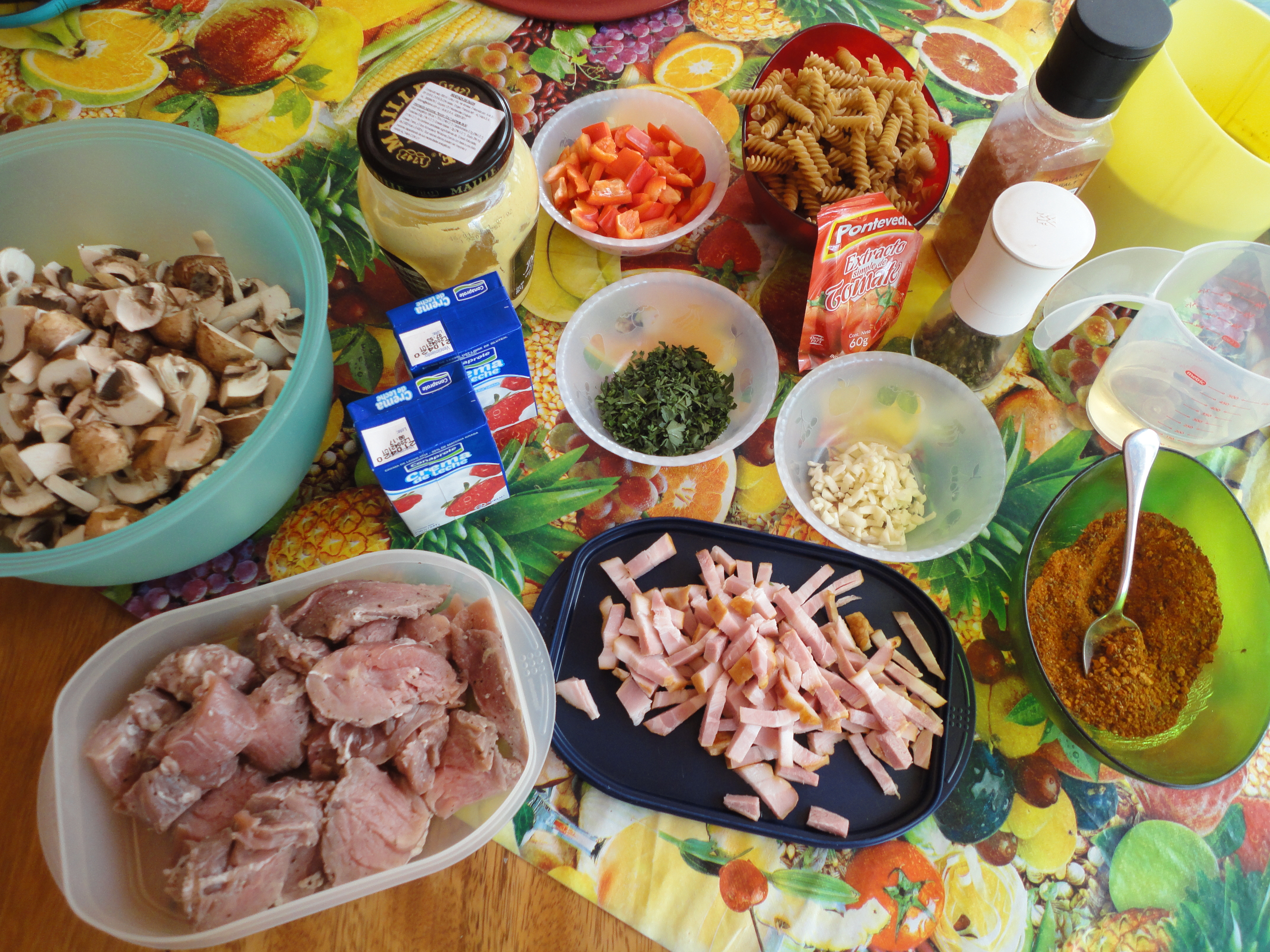
Most of my prepared ingredients. The pork has already a bit browned from the lemon marinade.

500ml double cream, (in Germany you can use cooking cream),
200g sour cream, (in Uruguay you can use queso blanco),
little oil,
150ml white wine,
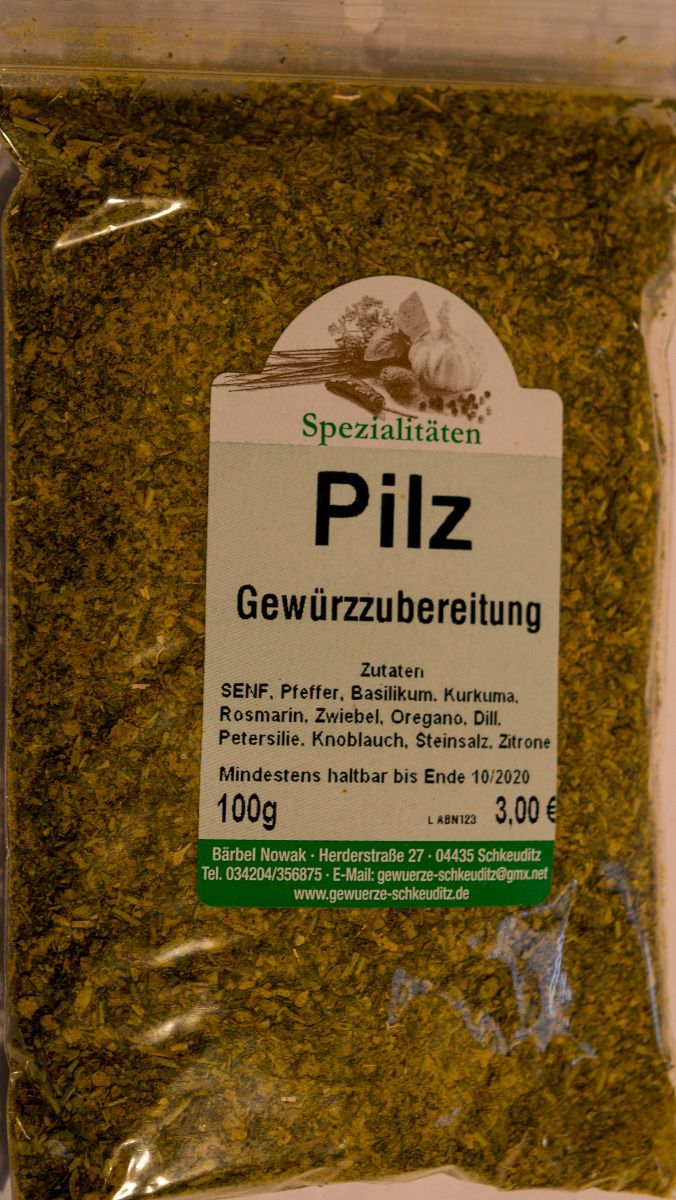
3 tablespoons mushroom spice mix, I made my own – see recipe down there,
60 gram (one sachet) tomato paste,
3 tablespoons Dijon mustard, or any other spicy mustard,
1 lime or 1 medium size lemon,
1/2 a cup of chopped parsley,
pepper and salt to season,

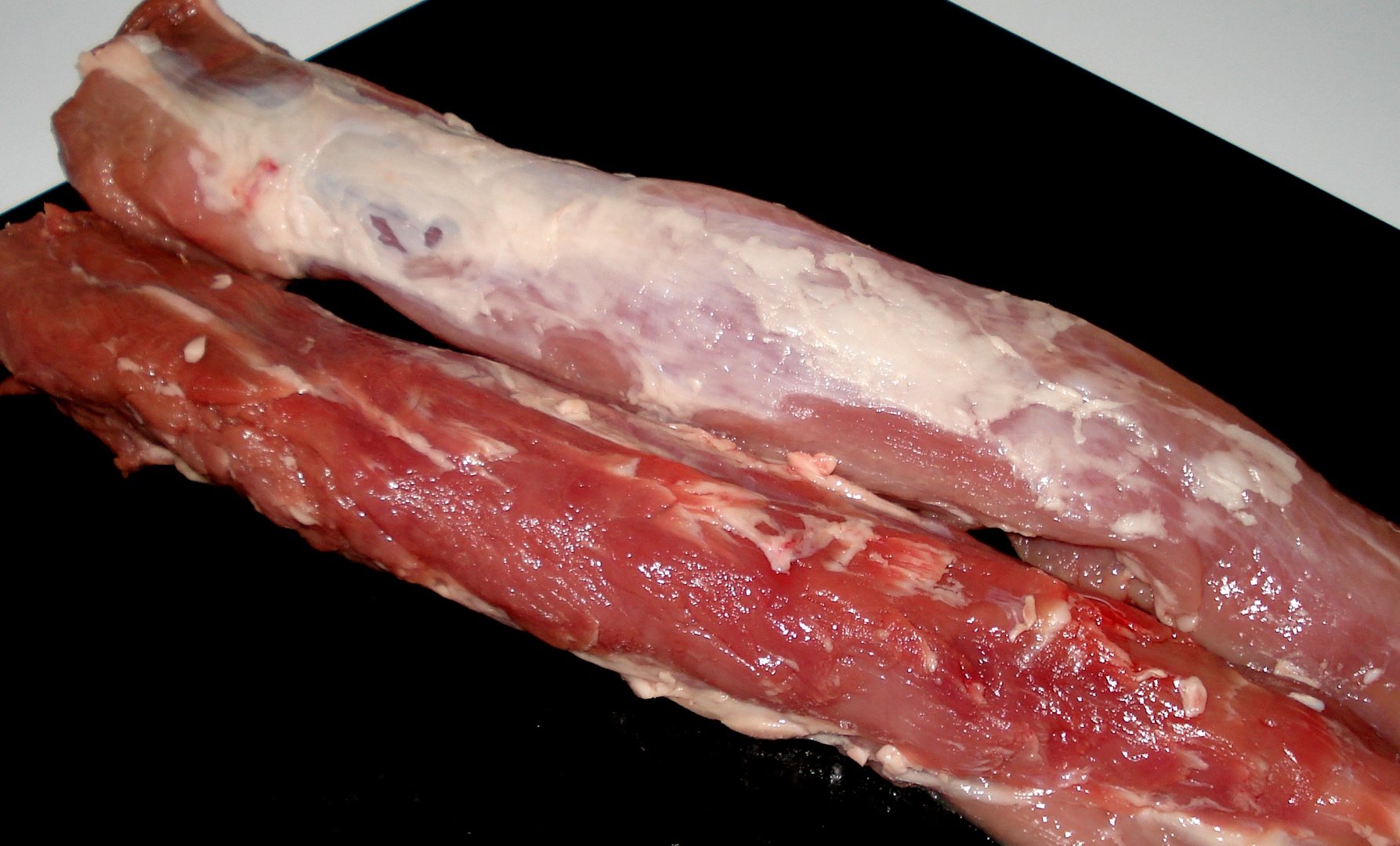
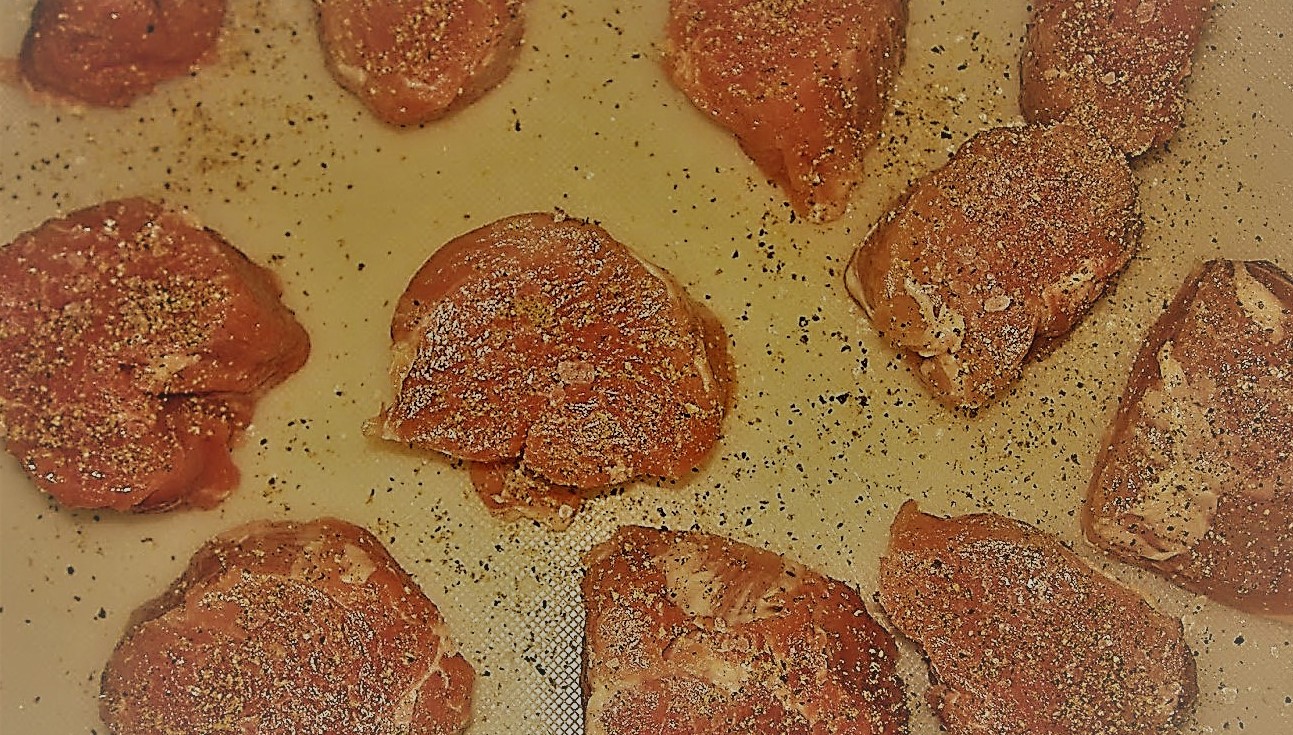
Two wonderful pork fillets. For this recipe they need to be trimmed from all fat and skins (as I did above, the top one still with skin/fat and the bottom one trimmed already), because we do not fry them (frying would burn the fat and skin off) before adding to the sauce.

How to do.

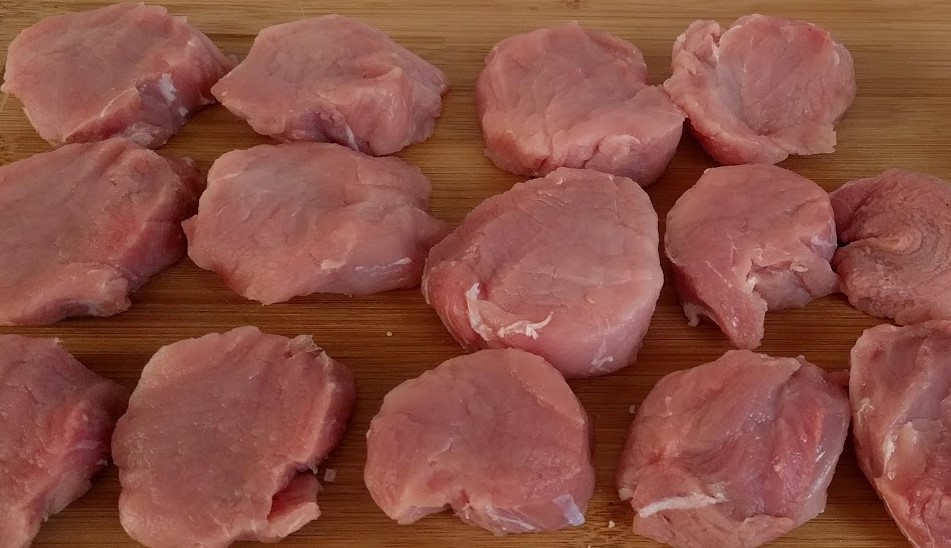
Cut the fillet into thumb-sized slices (little fillets), season with pepper and salt.
Pour the lime juice over the meat and mix well. Set aside.


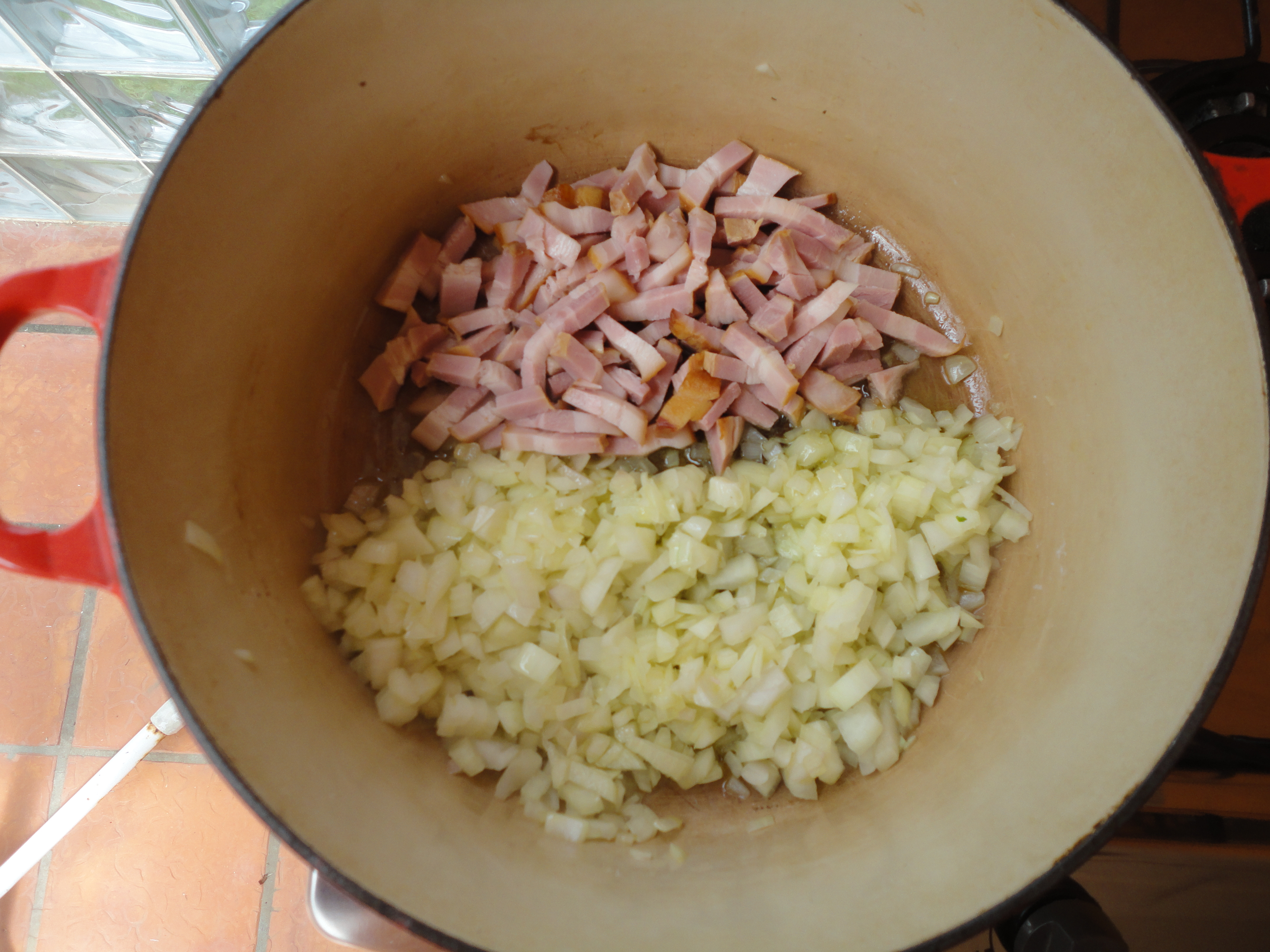
Fry the onions and bacon in a little oil.
Add the garlic and paprika a little later and fry.
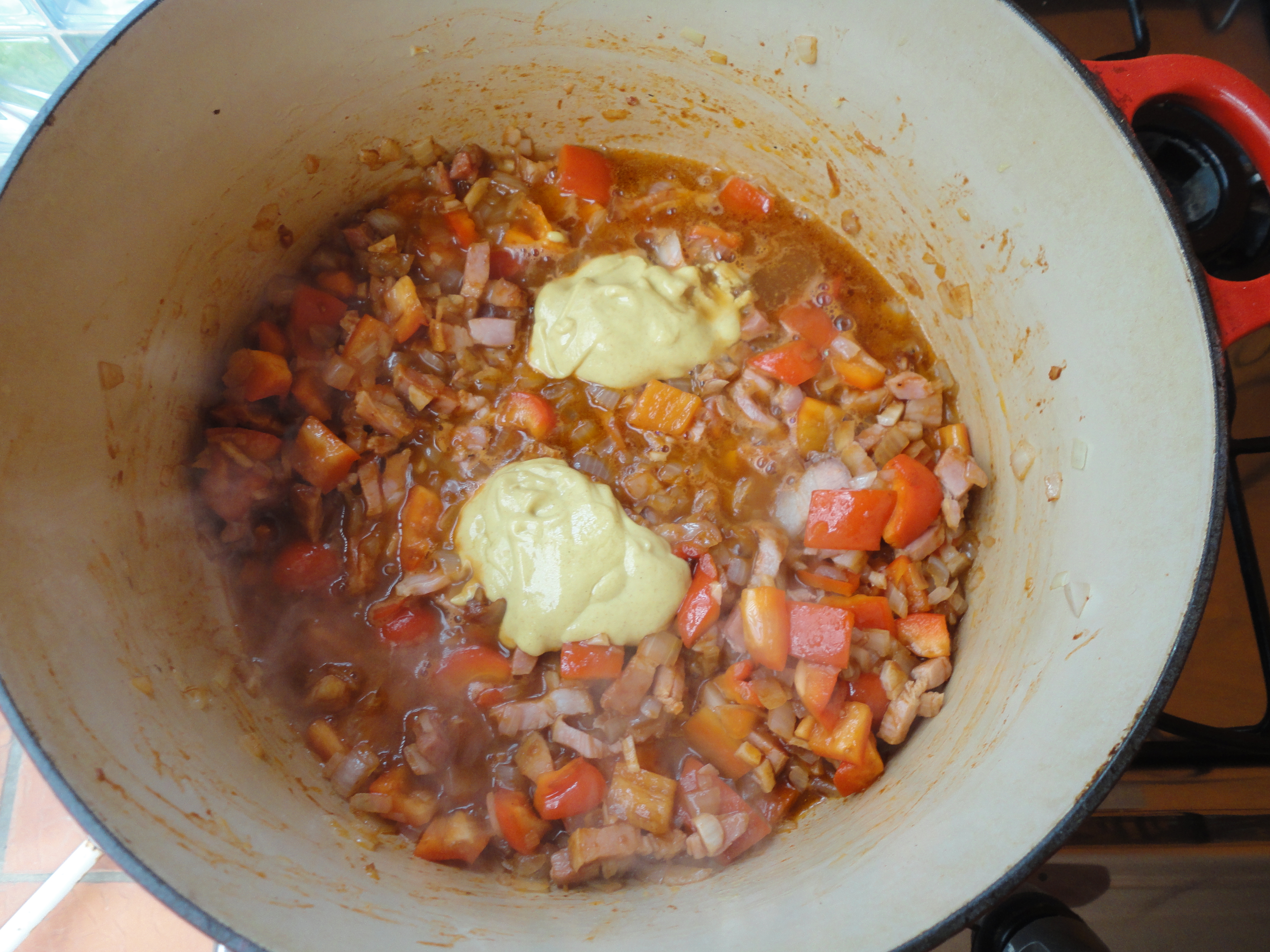
Deglaze your pot with the wine and stir in the tomato paste.
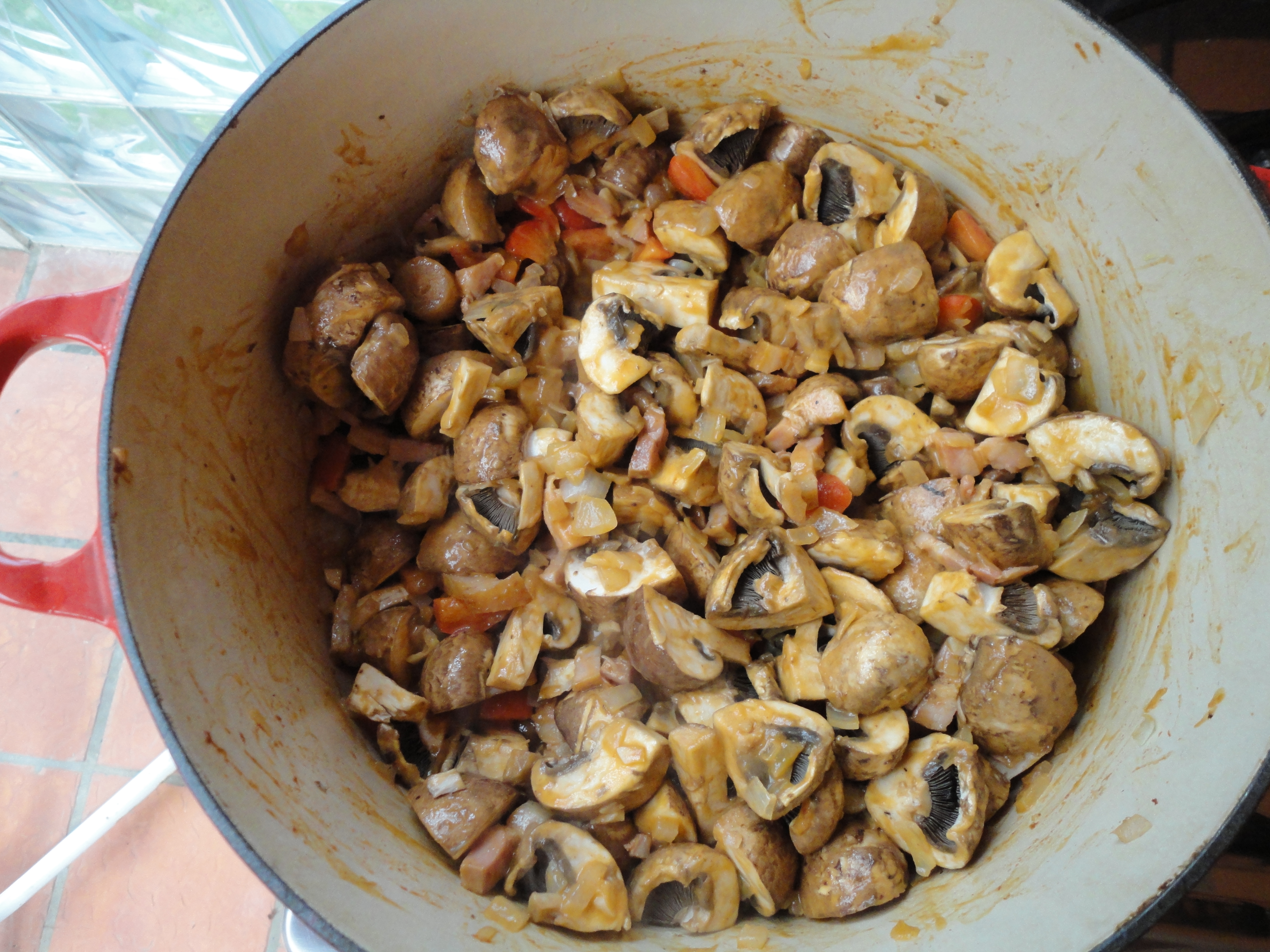
Add the mustard and mushrooms and cook on medium for 15-20 minutes, with lid on.

            I love cooking in my big Le Creuset pot. It’s like cooking in a Dutch Oven. Left frying the onions and the bacon. Right, deglazing and adding paprika and mustard.

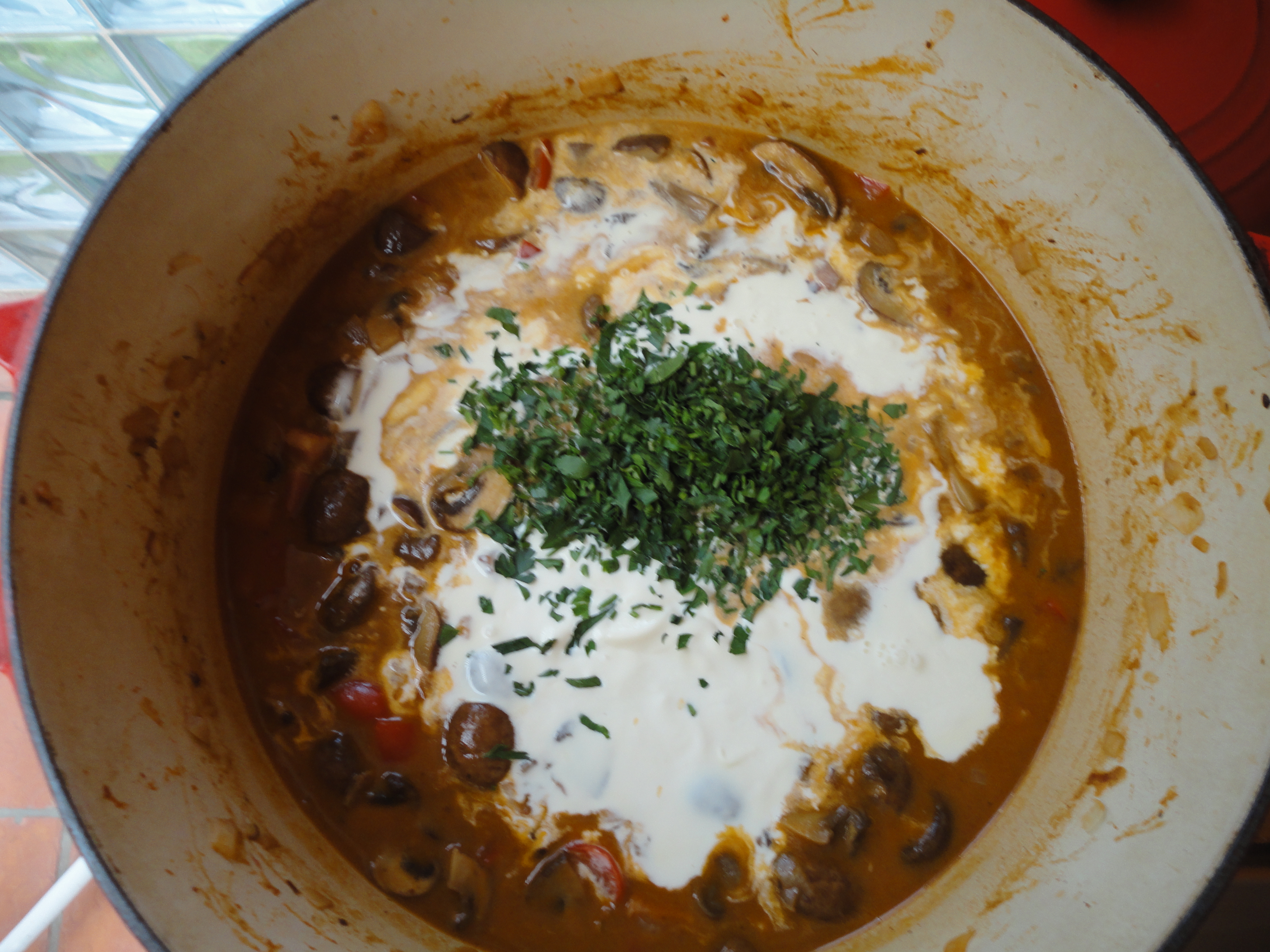
Now add the cream, about 2 full tablespoons of the mushroom spice and the parsley.
Add half of the beef broth, you can add later more, the pot should be always like a
saucy stew but not a soup, so please keep an eye on it.
Then add the pasta, I prefer Rotini, Fusili or Penne, some pasta which takes on
the sauce very well,
Lid on and cook for another 20-30 minutes, at least till pasta is done to your satisfaction.

           The broth, mushrooms are in and cooked down (left), now we add cream and parsley (right).

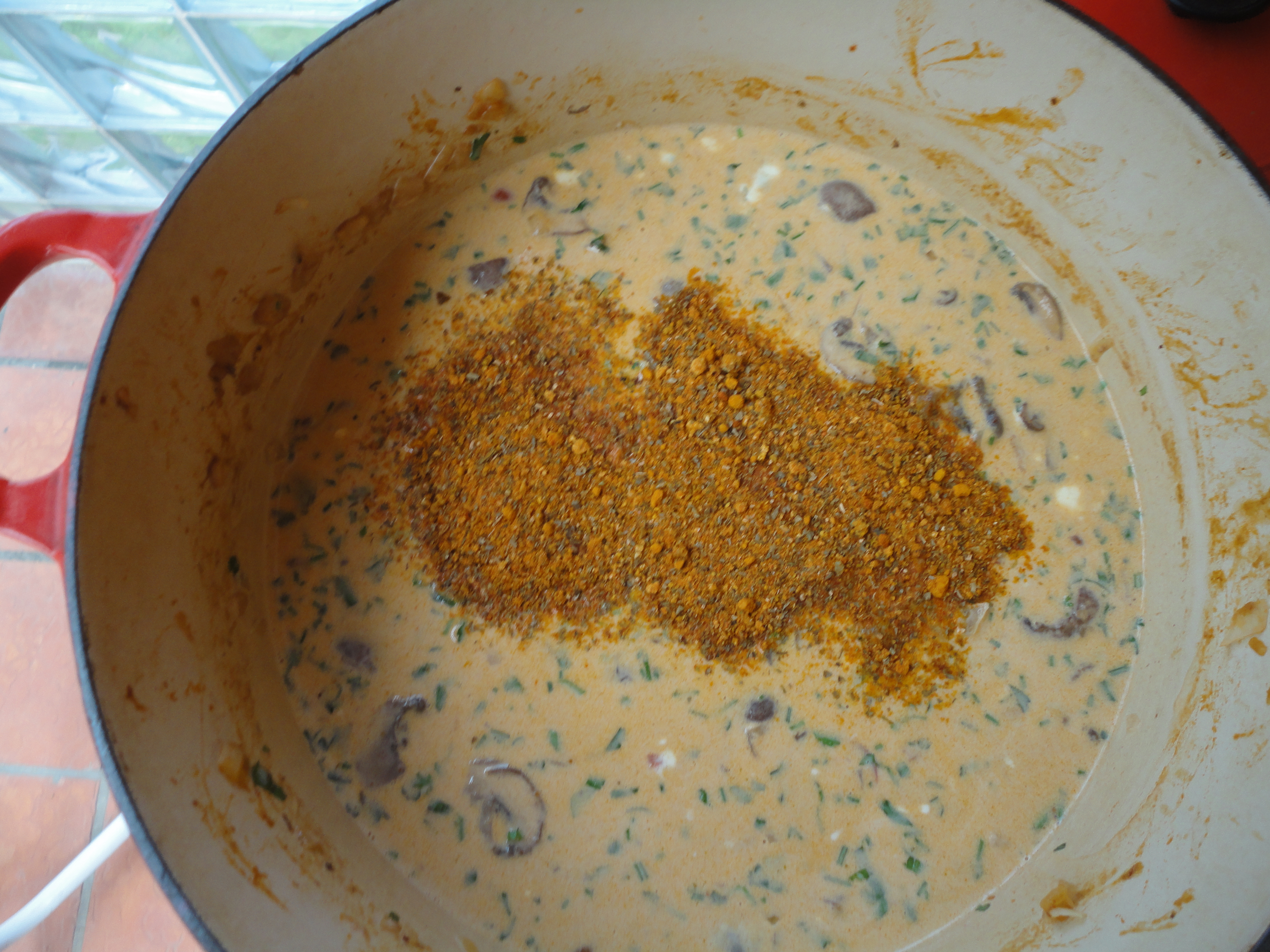
Check after 15 minutes and add more spice mix if necessary (I added 2 more tablespoons), season well with salt and pepper.
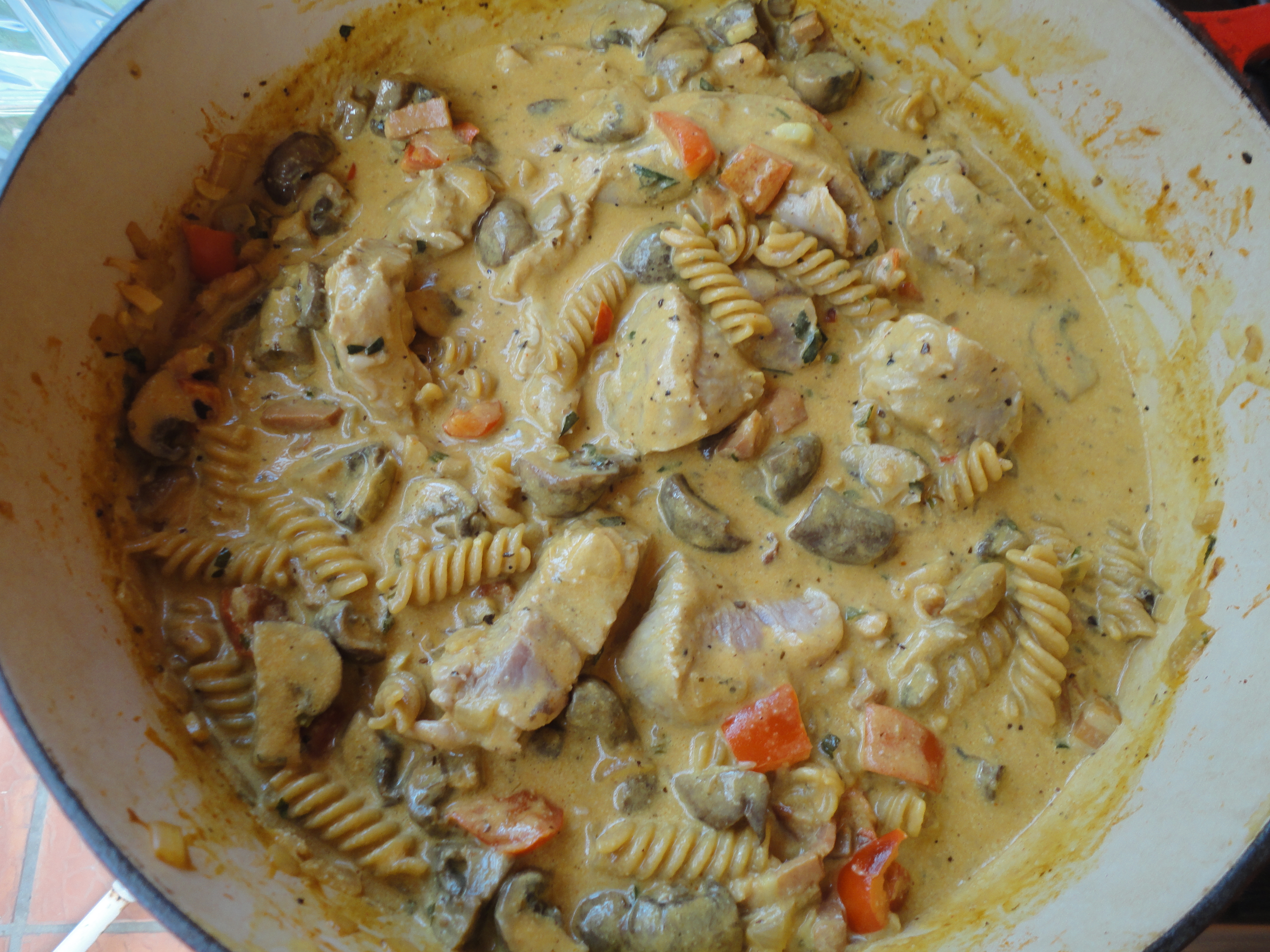
Now add the meat (may be a bit more broth) and cook for another 10-15 minutes. The meat should be cooked through (no pink pork please), but not overdone.

         More spice mix was added (left) and the sauce is well seasoned, the smell is incredible. Finally the meat is in (right) and we simmer till its done.

Tips.

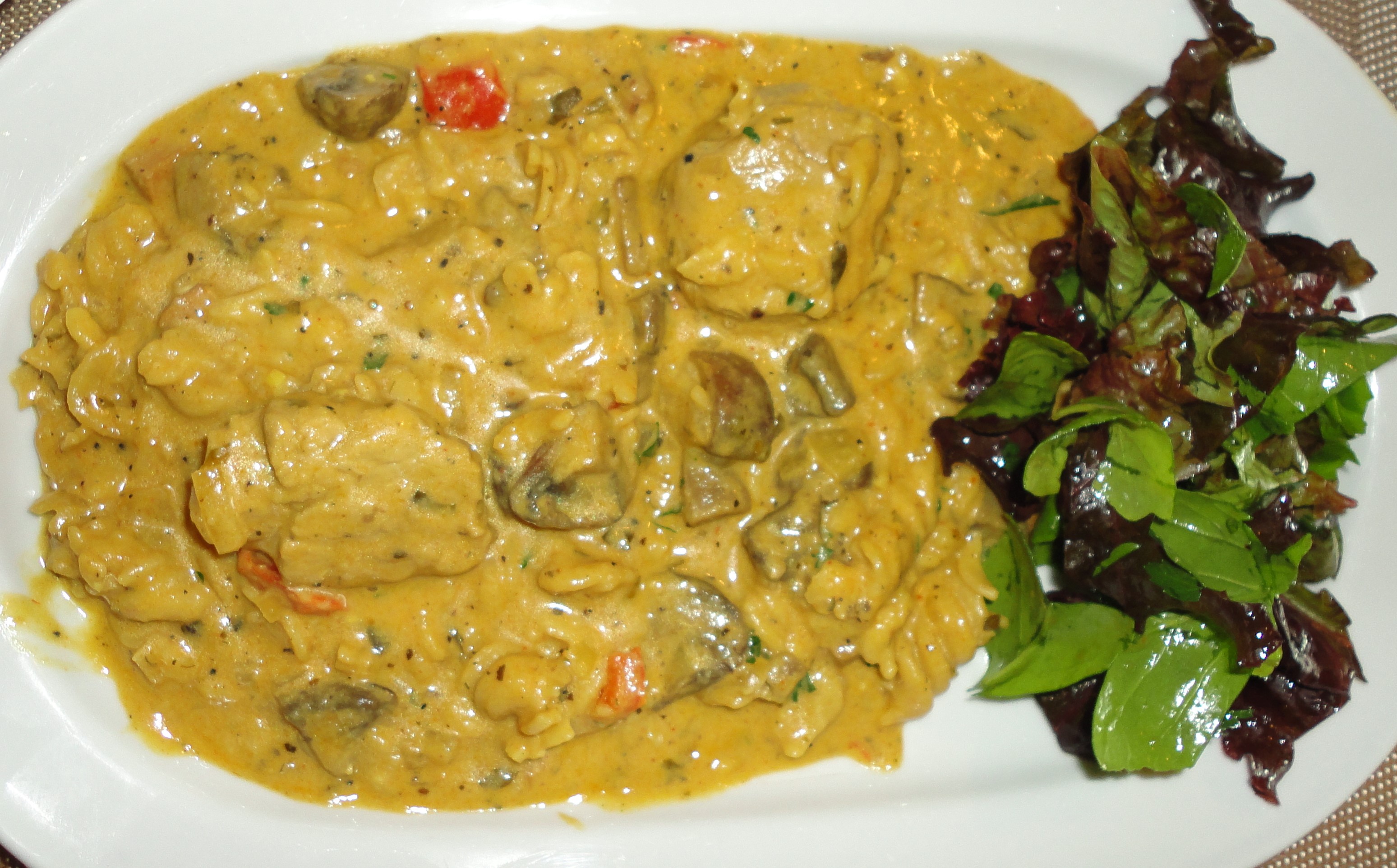
Serve, if you like, with a side salad and some fresh French Baguette.
Leftovers can be frozen well. When warmed up again, add a bit fresh cream for the sauce.

Done – ready to dig in and enjoy !

This dish goes well with a cool spicy dry white wine, like a nice Chenin Blanc, a well known Anjou wine from the Loire Valley, France. In Germany we would choose a strong Riesling and here in Uruguay I prefer the Albarino.


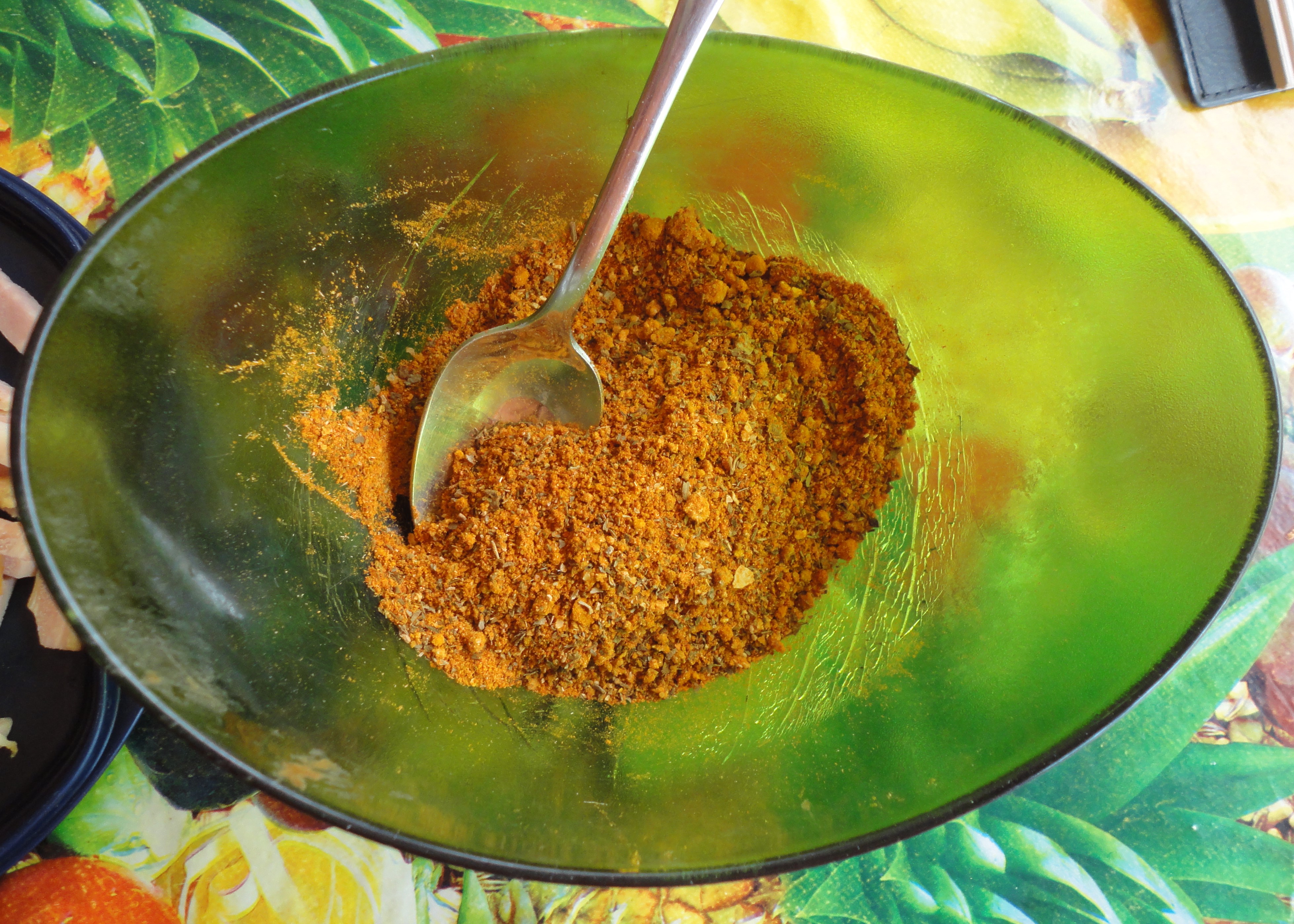
My own Mushroom Spicemix.

Some ingredients need to be finely sliced and then oven-dried or very well sun-dried, that you can grind them to a dry powder. These are:

Slices of carrot, celery, garlic, white onion and savory.
Savory is often to buy as powder already. Here in Uruguay Ajedrea.

  In Germany one can buy ready made mushroom spice mixture. Here one example of many different mixtures. Not even expensive 100 gram for 3,– euro’s.  Not available in UY.

For the complete mixture I used the following amount of powders:

1 tablespoon each of carrot, celery, garlic, onion, savory, curcuma, basil, oregano,
red smoked paprika, shiitake mushroom powder and strong ground coffee.
1 teaspoon each of ginger, caraway, coriander, hot chilli, cardamom and mustard,
1/2 a teaspoon of fresh ground nutmeg.

Mix it all well together and keep the leftovers in a dark, closed jar for up to 2 month. This spice mixture is fantastic to use with all kinds of mushroom recipes – and others as well.
Try it out, the spice mixture as well as the whole recipe above, you will love it.

Veröffentlicht unter Recipes | Verschlagwortet mit , | Hinterlasse einen Kommentar

Bush Fire Australia

The whole world is following story’s and news about the massive bush fires in Australia. So am I. It is well covered by the press, that I can’t do it better. But since we lived many many years at the coast in Australia I like to share with you some interesting information.

During all the weeks reading about the Australian fires I thought „what do they have to do with us in Europe or with us in South America“, but guess – they have !!  I think these articles down here, which I copy to you from the BBC, give a great overview to the current situation. Just click on the links further down.

First about the fire situation, click on:

https://www.bbc.com/news/world-australia-50951043

Second, what happens after fires are burned out, click on:

https://www.bbc.com/news/world-australia-51036608

Third, how will climate change impact the area where we live, click on.

https://www.bbc.co.uk/news/resources/idt-985b9374-596e-4ae6-aa04-7fbcae4cb7ee

Yes, we had some smoke from Australia already here in Uruguay. But our local weather situation cleaned the air with some thunderstorms and heavy rains pretty quick, luckily !

We have some large bush fires here in Uruguay too. Let’s hope that everywhere the nature recovers quick and that all harmed people will receive help and can look into a positive future !

Veröffentlicht unter Information, Lifestyle | Verschlagwortet mit , , | Hinterlasse einen Kommentar

The Marree Man – Update

The Marree Man

The Marree Man

As you can see above, in November 2016 I wrote an article about the „Marree Man“.
Have a look yourself.
Meantime, just about a week ago, the Marree Man geoglyph made press again. That information, in an article I found with CNN, I like to share with you.

NASA satellite shares a new image of Marree Man,
an Australian carving that has puzzled scientists for several decades.

It is unclear who created the giant geoglyph or why, but the large earthen figure has drawn attention to a remote part of South Australia for two decades. The latest NASA image, from June 2019, showing the restored Marree Man.

It is unclear who created the giant geoglyph or why, but the large earthen figure has drawn attention to a remote part of South Australia for two decades.

NASA (CNN) confirms one of the greatest modern art mysteries is still going strong in Australia.
A pilot discovered the mysterious 2.6-mile-long geoglyph of an aboriginal hunter in 1998, etched into the earth, and to this day no one knows how it got there.

The Marree Man gained new life in 2016 when a group from the figure’s namesake town of Marree plowed the lines to keep the man from fading due to erosion. Now, NASA is sharing an image (see above) , taken in June 2019,  showing the success of their efforts.

  Erosion almost faded the whole drawing away.

So far, the restoration team’s belief that their preservation will last longer than the original holds up. They created wind grooves, designed to trap water and encourage the growth of vegetation, according to NASA. They hope that eventually the man will turn green.
Many have tried to discover the origin of the Marree Man.

Another mystery.

Geoglyph “Marree Man” is the largest of the famous geoglyphs in the world. Figure depicting of the hunting Australian native, is located on a plateau near Finniss Springs, Callanna, SA about 60 kilometers west from the town of Marree in central Australia.

Precise pointing of the stick to Nan Madol ! Why ? By whom ?

The most interesting fact in this geoglyph is his “stick,” he points to Nan Madol (you can read about Nan Madol in two parts I posted in 10/2016 and 11/2016), the distance to which is 4602 km, or 41.4 degrees of arc of the circle.  If to draw a line through the sacred mountain of Uluru and Easter Island, it will pass exactly through the foot of the Marree hunter.

Nan Madol – Part 1

Nan Madol – Part 2

If this geoglyph was done by some locals, a local artist or Americans or whoever, what would they know about Nan Madol or precise degrees to other “holy and mystery” places and get it carved so precise in this remote area ? And ? And ? And ???


Richard Harold Smith (born 18 March 1944) is an Australian record-breaking aviator, philanthropist, political activist and serial entrepreneur. He holds a number of aviation world records and was the founder of Dick Smith Electronics, Dick Smith Foods and Australian Geographic.

Dick Smith, decided to tackle the mystery in 2016, and for two years his team pored over all the evidence to see what they could find.

He believed it was professionally done, so in 2018 he offered a reward of A$5,000,– Australian dollars (about US$3,700,–) for anyone with information regarding its existence. No one has come forward, but several believe it was made by an artist living in Alice Springs, though other clues suggest the creator may have been an American.
Regardless, the Marree Man mystery lives on.  See my article from November 2016.

Veröffentlicht unter History, Information, Travel | Verschlagwortet mit , , | Hinterlasse einen Kommentar

Mock Turtle Soup

Writing about FOOD and HISTORY can be as adventurous as reading a thrilling novel. With this post I like to lead you through the adventure of the „Mock Turtle Soup“. Mock turtle soup is an English soup that was created in the mid-18th century as a cheaper imitation of green turtle soup. So, follow me through history.

Charles Darwin.

Charles Darwin noted on 23rd of September 1835 about his visit to the Galapagos archipelago: „The inhabitants complain about their poverty, but they can easily provide for their livelihood. There are many wild boars and goats in the forests, but their main animal food is turtles. Of course their numbers have been greatly reduced on the island, but people still count on two days of hunting to provide them with food for the rest of the week. In the past, it is said that a single ship could catch up to seven hundred turtles, and years ago, the crew of a frigate is said to have brought two hundred turtles to the beach in one day“.

  Charles Darwin (12 February 1809 – 19 April 1882) was an English naturalist, geologist and biologist. Best known for his contributions to the science of evolution.

On 8th of October 1835 Darwin wrote: „As long as we were in this upper region, we lived exclusively on turtle meat: the breast plate with the meat roasted in it (as the Gauchos do with carna con cuero) tastes very good and the young turtles make an excellent soup; otherwise, however, the meat is moderate for my taste“.

Robinson Crusoe.

What Darwin said carelessly has a long tradition: For the coastal population, sea turtles have always been a high-quality and attractive food – and for sailors even more so. The literature of the seafaring peoples is filled with documents and evidence. Be it marginal notes in William Shakespeare, the travel notes of Sir Walter Raleigh from the 16th century or Daniel Defoe’s „The Life And Strange Surprizing Adventures Of Robinson Crusoe“ from 1719: „I had now arranged my meals as follows: For breakfast I enjoyed a few raisins, for lunch a piece of dried goat meat or a slightly roasted turtle (because, to my great regret, I lacked a suitable vessel for cooking). My dinner regularly consisted of some turtle eggs.“


                        Daniel Defoe  (c. 1660 – 24 April 1731), born Daniel Foe, was an English trader, writer, journalist, pamphleteer and spy. He is most famous for his novel Robinson Crusoe, which is second only to the Bible in its number of translations.

One might consider the eating of turtles an exotic component of the novel and thus owed to the taste of the English readers, but it was certainly not a breach of taboo.
And that is not all. Tortoises, especially their large species – whether in the Seychelles or the Galapagos Islands – were a much sought-after addition to the diet on the high seas. Taken on board, these animals were a living food depot: undemanding in feeding and care, they were kept on deck until the ship’s cook killed them. It could hardly have been simpler, and so it is not surprising that many ships on their routes around Africa made a stopover in the Seychelles to gather provisions. So did the Mexican sailors and pirates on the Galapagos Islands. The devastating consequences for the populations on the two groups of islands are well known.

  Hunting turtles in the Caribbean.

But it was not only about filling the stomachs of sailors. Even in ancient times, sea turtles were known to have a medicinal effect when they ate their meat, and the same reputation was held by the population in many subtropical and tropical coastal countries. And this idea has been carried over into the European Middle Ages. Christopher Columbus, for example, who anchored near the Azores in 1498, reported that people suffering from leprosy there washed themselves with turtle blood in the belief that they would find healing. Among seafarers, the rumor that turtle meat helps wonderfully against scurvy persisted for a long time.
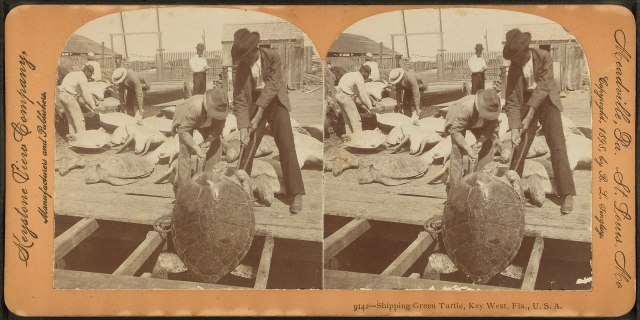
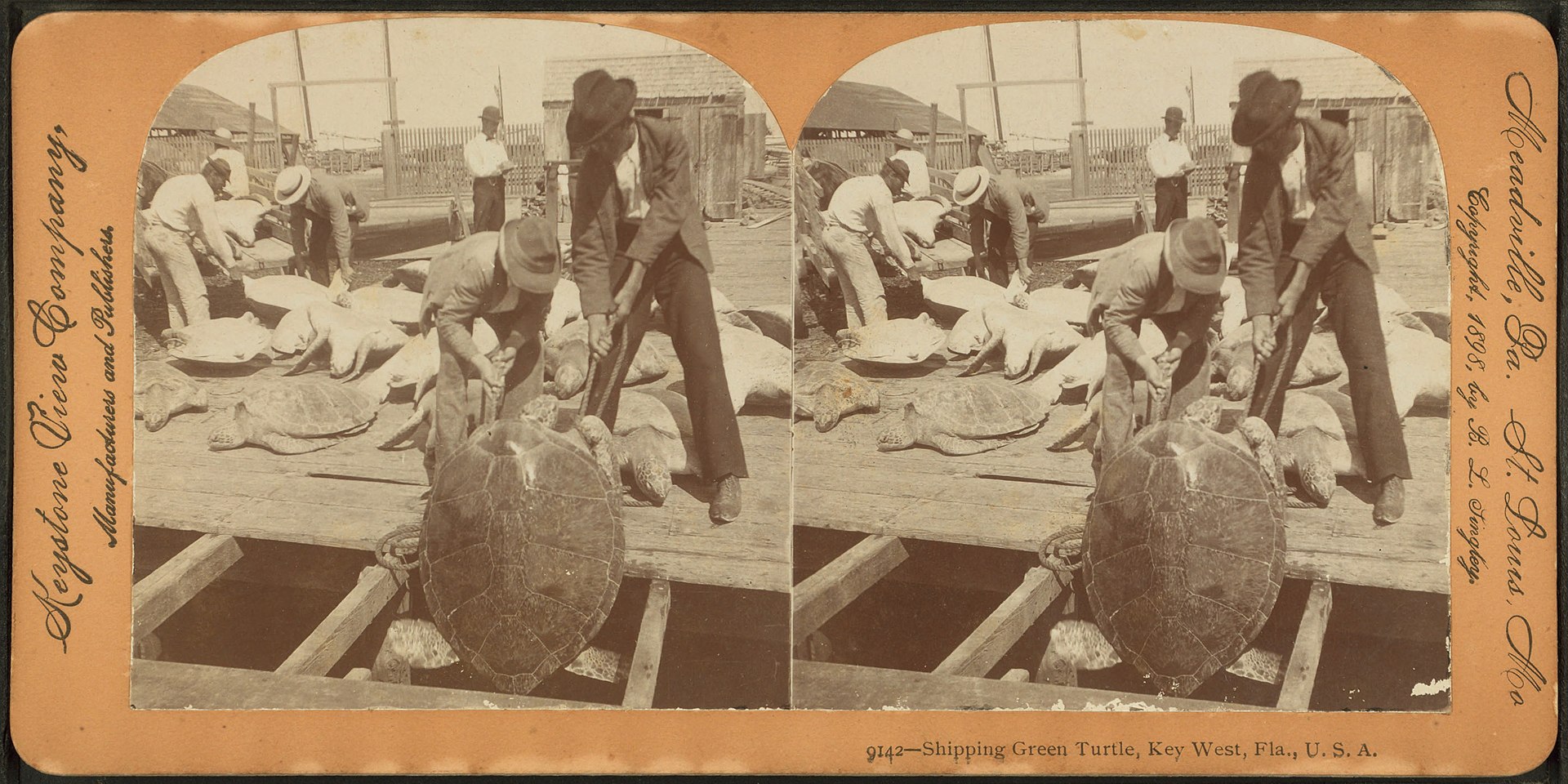
Shipping green sea turtle, Key West, Florida, 1898. Stereoscope view Wikipedia.

Felix Count Luckner.

That the consumption of turtles goes back to archaic times is proven by finds from an excavation site in northern Israel. Excavations of human relics about 12,000 years old have revealed the remains of numerous animals, a sign of a greater festivity. The occasion was most likely a ritual funeral: „The remains include the shells and bone parts of around 71 turtles and three cattle – an unusually high number of such legacies in one place for this period of time,“ reports Theresa Kübler in Bild der Wissenschaft. This indicates that the animals were slaughtered and cooked.“
The tradition of eating turtles is also widespread in the West, or at least it was until the early twentieth century.

  Felix Nikolaus Alexander Georg Graf von Luckner (9 June 1881 – 13 April 1966), sometimes called Count Luckner in English, was a German nobleman, naval officer, author, and sailor who earned the epithet „Der Seeteufel“ (the Sea Devil), and his crew that of „Die Piraten des Kaisers“ (the Emperor’s Pirates), for his exploits in command of the sailing commerce raider SMS Seeadler (Sea Eagle) between 1916 and 1917.

One of the causes lies in the fasting customs of the Catholic Church. For more than 1,500 years, believers have been forbidden to eat meat on high fasting days. „Good Friday is a day of fasting and abstinence. The abstinence and fasting rules apply. Faithful Catholics renounce meat dishes on this day and only eat once.

At the beginning of the 20th century, Felix Count Luckner noted that the crew of the „SMS Seeadler“ on the South Sea island of Mopelia, west of Tahiti, were recovering from the caper of war: „…with turtle meat, coconuts, fruit and extensive beach walks“. As he stated later in many interviews, his crew lived during the many month in the South Sea region of delicious turtle meat.

   The famous SMS Seeadler. By 1916 the Allies had blockaded German warships in the North Sea, and any commerce raiders that succeeded in breaking out lacked foreign or colonial bases for resupply of coal. This gave rise to the idea of equipping a sailing ship instead, since it would not require coaling.
The Seeadler was equipped with an auxiliary engine, hidden lounges, accommodation for additional crew and prisoners, two hidden 105 mm guns that could emerge from the deck, two hidden heavy machine guns, a pair of torpedo tubes for anti-cruiser purposes, and rifles for boarding parties. These weapons were rarely fired (the torpedo tubes never), and many of the 15 ships encountered by Seeadler were sunk with only one single accidental casualty on either side during the entire journey.

        Different turtles as shown in Meyer’s Lexikon around 1880.

Since the Middle Ages all mammals have been counted as „meat“, as well as poultry, but not fish. White meat is not „real“ meat, land creatures have „real meat“ – animal species living in water, however, do not. As a result, European pond turtles, crayfish, water birds and, significantly, beavers were classified as fish, caught and eaten during Lent.
In ascetic orders, such as that of the Carthusians, the consumption of meat was generally forbidden. Therefore the monks set up fish and turtle farms in order to have an attractive fasting food available. This is proven by archaeological investigations at the Lower Austrian monastery of Mauerbach.

  Kartause Mauerbach near Vienna, Austria.

Until the 19th century the catching and eating of European pond turtles is documented – mainly in the Catholic areas of Bavaria and Austria. For many decades, the pond turtles caught in the Danube floodplains were sold at the fish market in Vienna to end up in the cooking pots of the urban population.
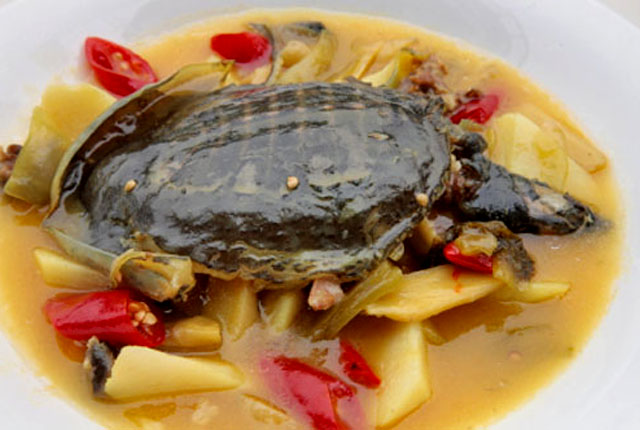
Turtle Soup served like that in Singapore.  Not more different then having a whole crab on your plate.

Sailer’s family cookbook.

The „Sailer’sche Familien-Kochbuch“, published in Munich in 1865, gathers some turtle recipes, cooked in blood (452), in lemon sauce (453) or baked (454). Although no species of turtle is given, but since the recipe book also describes the killing of the animals, the animals must have been acquired in a living state. This inevitably points to the native European pond turtles that were caught and sold at the markets.

Above the recipes out of Sailer’s cookbook from 1865. Interesting to read which killing skills were needed.

However, in the course of the 19th century, the capture, sale and hence consumption of native turtles declined rapidly. The reasons are the secularization as a result of the Napoleonic period and thus the loss of power and influence of the Catholic Church. This was followed by a freer approach to the church’s commandments and rules and thus to strict fasting. At the same time, massive upheavals in the social structure of society with the onset of industrialization led to the impoverishment of broad masses of the population and thus to a change in consumer behavior.

  Green Sea Turtle capturing.

Meat and fish had simply become too expensive for large sections of the urban population. The change in food production, the establishment of large-scale slaughterhouses in the cities also had an impact on eating habits. Meat could be offered more cheaply than fish and also pushed into butcher’s shops and inns in larger quantities.
This development was accompanied by over-fishing of the rivers and lakes and thus a reduction of the population. Turtle fishing was soon no longer a profitable business.

  The green sea turtle.

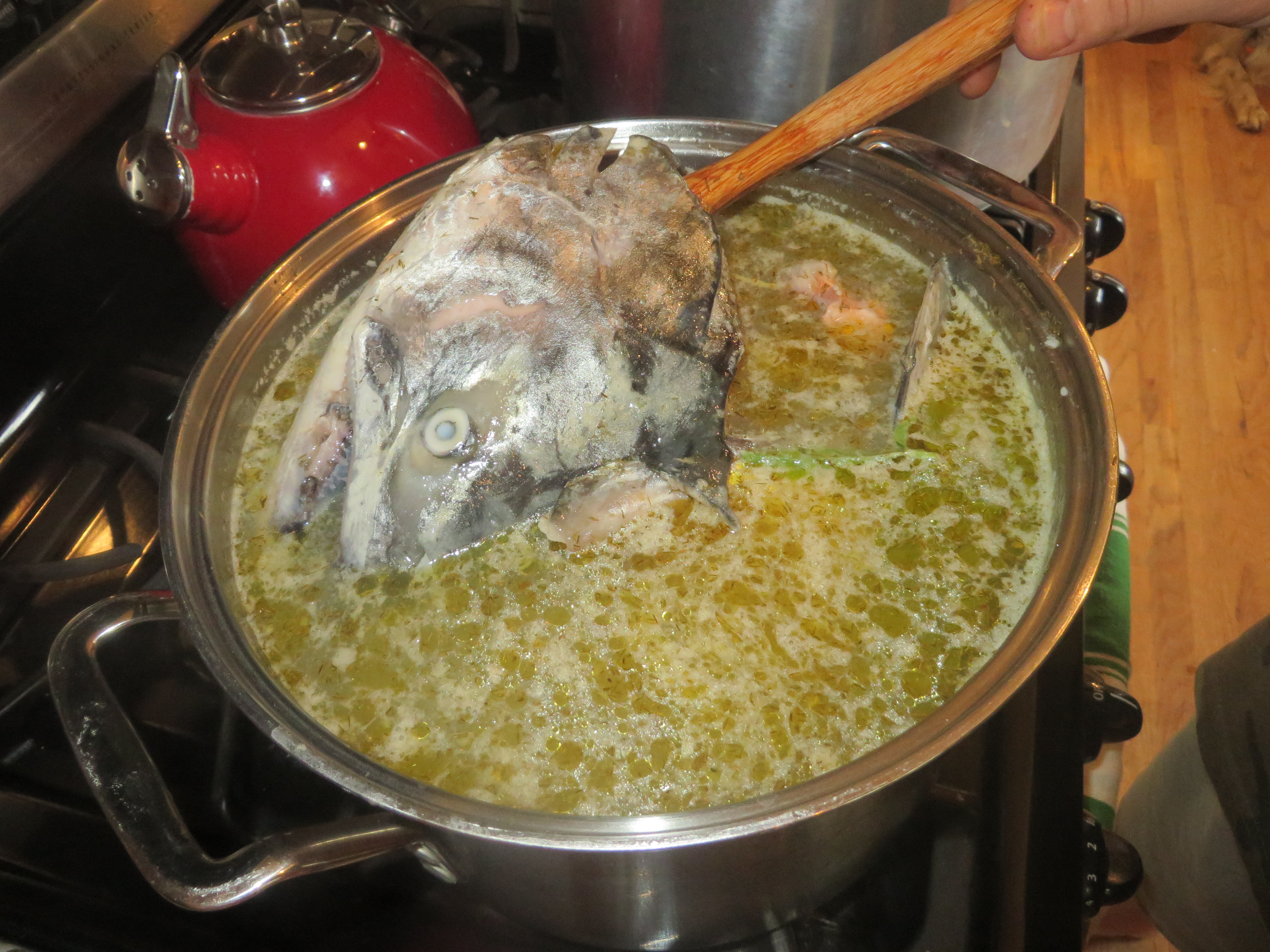
Green sea turtles were added to the North American endangered species list in 1970. It is illegal to harm them. In the Southern United States, turtle soup made from various turtles but especially the Alligator snapping turtle (Macrochelys temminckii), is enjoyed. They are the largest species of freshwater turtle, and can weight from 155 to 175 pounds. Although not an endangered species, their populations are declining due to the degradation of their habitat, and over-harvesting for their meat. This has some states to declare them vulnerable and to ban catching them. Therefore, meat from common snapping turtles, or even box turtles is sometimes substituted or passed off for Alligator snapping turtle. Even Alligator meat is sometimes used, which is legal to obtain, giving a new sense to the term “mock turtle.”
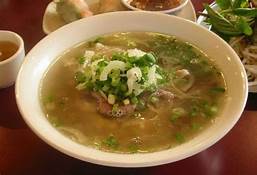
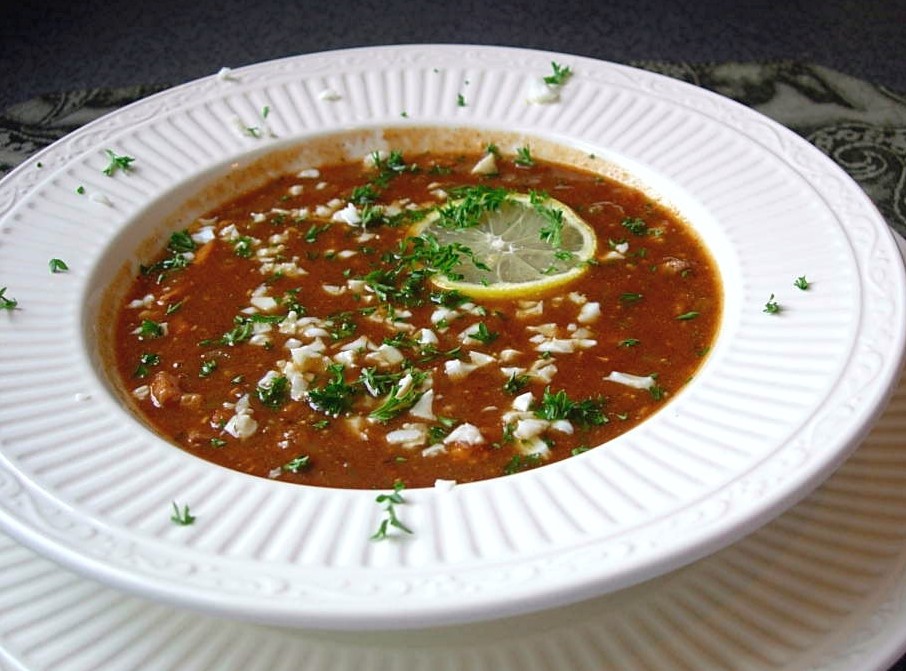
  The typical Green Turtle Soup.

Mary Victoria Curzon.

When the consumption of pond turtles declined, the consumption of another delicacy, the world-famous „Lady Curzon Turtle Soup“ in Europe, boomed at the same time. While 100 years earlier it was the aristocracy that „set the tone“, at the end of the 19th century the upper middle classes gained in importance as a socially influential class. In contrast to the preceding period, the bourgeoisie’s need for recognition no longer manifested itself in lavish and exuberant pomp and extravagance. The refinement, the love of detail, no matter how small, and the use of the finest materials characterized the art of the time, the ornamentation of the utensils – ultimately also the art in the kitchen. „Lady Curzon“ was soon to be found on the menus of the most distinguished addresses – from the Hotel Ritz to the Titanic.

  Mary Victoria Curzon, Baroness Curzon of Kedleston (27 May 1870 – 18 July 1906) was a British peeress of American background who was Vicereine of India, as the wife of Lord Curzon of Kedleston, Viceroy of India.

Lady Curzon Turtle Soup“ consists of a clear broth made from the meat of the green sea turtle (Chelonia mydas), beef and calf’s foot, spices and a dash of sherry, cognac or Madeira. The turtle meat is added finely diced before serving. At the end it is covered with whipped cream, seasoned with curry and briefly gratinated.
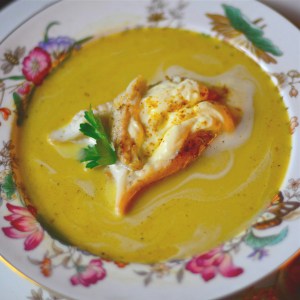
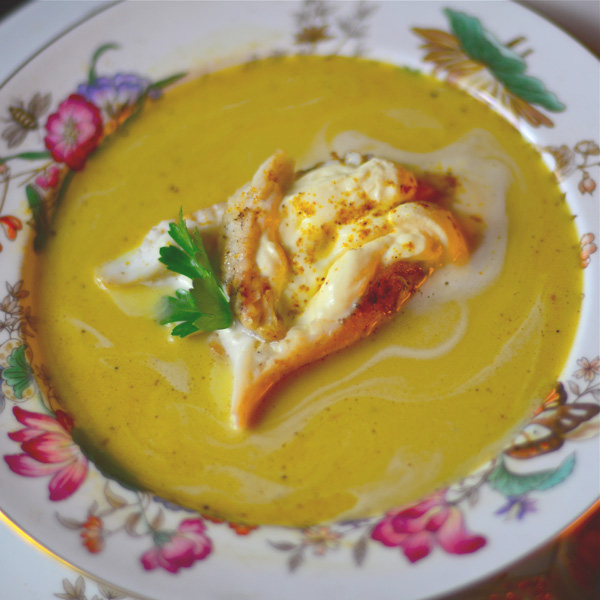
  A more modern version of the Curzon Soup, with large chunk of lobster and the cream stirred into the curry infused soup. Looks delicious.

At the end of the 19th century, as a counterpart for the simpler classes of the population who could not afford this delicacy, the „Mockturtle soup“ was created – made according to the same recipe, but with veal instead of turtle meat.
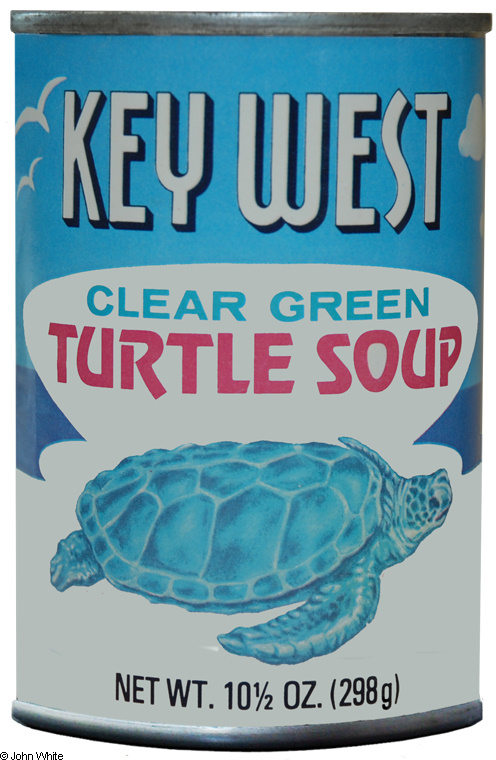
Industrialization did not stop at food production either. Soon the „Lady Curzon“ found its way into the can and thus onto the shelves of delicatessens, and later also the supermarkets of the world. The seas were fished on a large scale, the sea turtles caught were industrially processed into soup, tinned and sold worldwide.
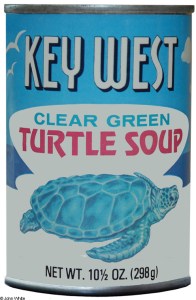
   Canned turtle soup from Key West.

When the consumption of turtles in Europe shifted to canned soup, the chefs of the New World began to eat, among other things, the diamond turtles (Malaclemys terrapin) that were native to the region. Until the 1930s, there were turtle farms in the USA where American diamond turtles were bred and industrially processed into canned food – for consumption and to supply the population with protein.

The black diamond turtle. Note the diamond shaped design on the back shell.

William Howard Taft.

Diamond turtles – originally a by-catch of the fishermen – were originally food for the American slaves. Gradually, however, these animals also became a coveted delicacy – especially appreciated by US President William Howard Taft and served almost daily at the White House during his term of office from 1909 to 1913. See also further down the White House Cookbook recipe’s.
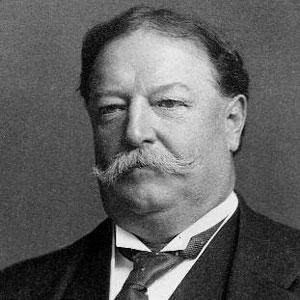
    William Howard Taft (September 15, 1857 – March 8, 1930) was the 27th president of the United States (1909–1913).

However, the labor-intensive preparation with the relatively low yield led to the fact that with the world economic crisis the animals gradually disappeared from the menus. There were hardly any domestic staff left who could have prepared the animals, and the focus shifted to easier to prepare meals.
The consumption of European tortoises in Europe remained a short episode, limited to the time of the First World War. Austrian troops collected tortoises in the Balkans during this period and had them transported to Vienna.

  Austrian soldier having „turtle lunch“, WWI 1917.

There the animals were processed into canned food and sent back to the front for the fighting troops.
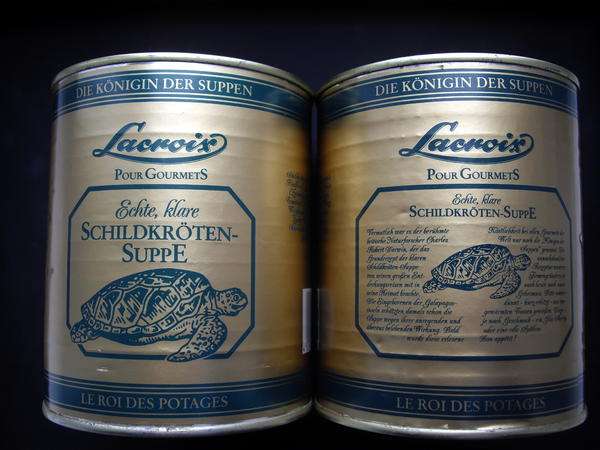
The worldwide consumption of canned turtle soup continued. The Lacroix company in particular supplied the supermarket chains, so the former delicacy of Haute Volee had become a mass product. However, its inherent image made it something very special, which now even the middle class of the population could afford to buy from time to time. This is precisely what made the product so attractive – and hence its success.
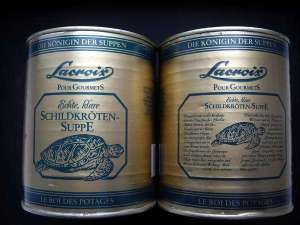
  Worldwide success of Lacroix turtle soup. Lacroix was once the world’s largest producer of turtle soup after the Second World War. The Eugen Lacroix company in Frankfurt-Niederrad processed in 1959 – 250 tons of turtle soup. After the Campbell Soup Company took over the company in 1979, the production of turtle soup was discontinued in 1984. The Frankfurt Lacroix factory was closed on 27 July 1996.

It was not until the 80s that society’s consciousness changed so radically that turtle soup was marginalized. The shift in values due to the ever-increasing influence of the ecology and peace movement and the resulting upheaval in society may have played their part. In 1984, the Tengelmann Group discontinued these products in Germany – as did frogs‘ legs. The Group was thus in line with the needs of the ecology and animal welfare movement, which was growing steadily stronger at the time.

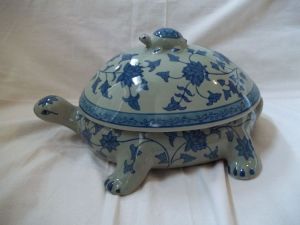
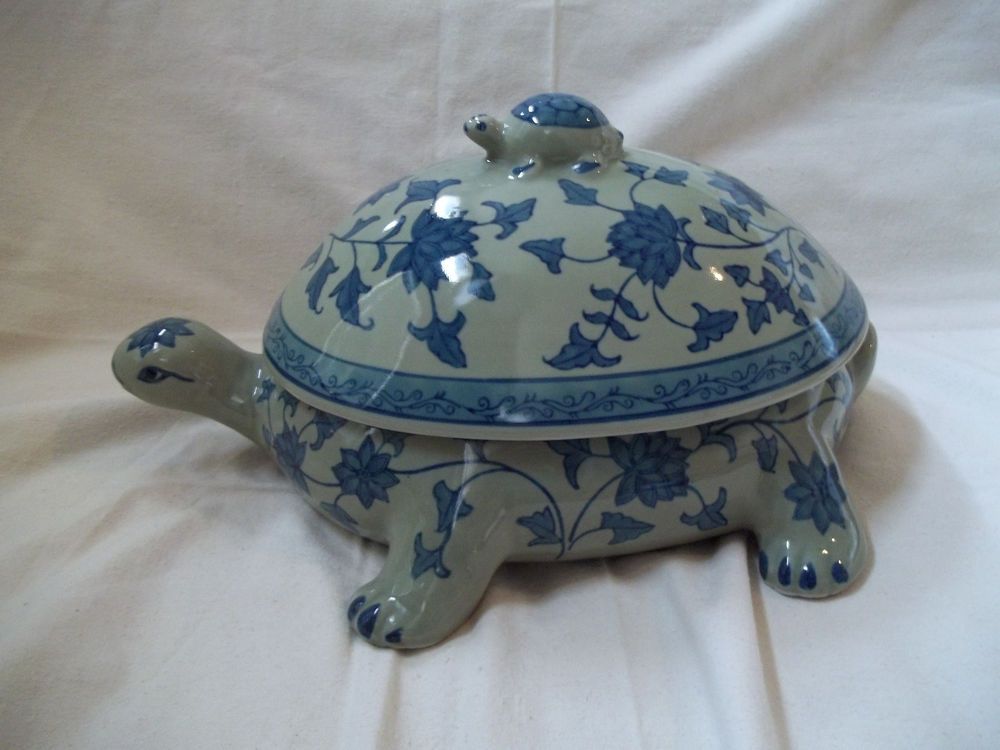
       Vintage pottery (left) and China casserole (right) for turtle soup. Haute Volee has to be.

WWF.

What now sounds bizarre in Europe or is judged with disgust is common practice in many other countries. And not only in other cultures, but also in those of western character.
In 2007 the WorldWildlifeFund addressed the public in a broad campaign. In a widely published press release at the time, it wrote: „Every year thousands of sea turtles die during Holy Week in Latin America. The fault lies in the old wives‘ tale that the endangered reptiles are to be assigned to fish because of their white flesh – and thus a food allowed during Lent“. Just by the way, those religious customs are brought from Europe to South America. It is not to be expected that this has changed significantly since then.

  No further comment needed.

All sea turtle species are under strict nature conservation, they are threatened with extinction. Therefore, fishing is prohibited on the American Pacific coast. Nevertheless, according to WWF estimates, 10,000 sea turtles land in pots every year in the week before Easter in Mexico alone. At the same time, numerous charcoal turtles suffer a similar fate in Brazil. „Freshly caught charcoal turtles are part of the traditional fasting diet in Latin America“.
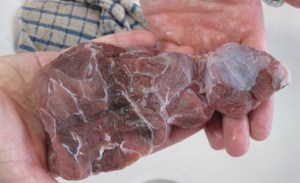
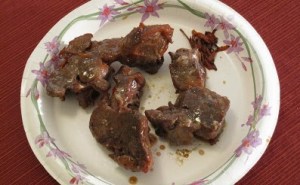
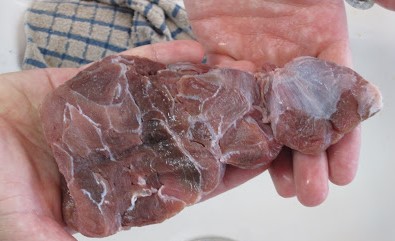
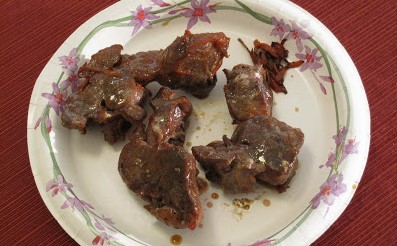
      Raw and cooked turtle steak in Mexico. Not a special taste and the meat not as white as I thought.

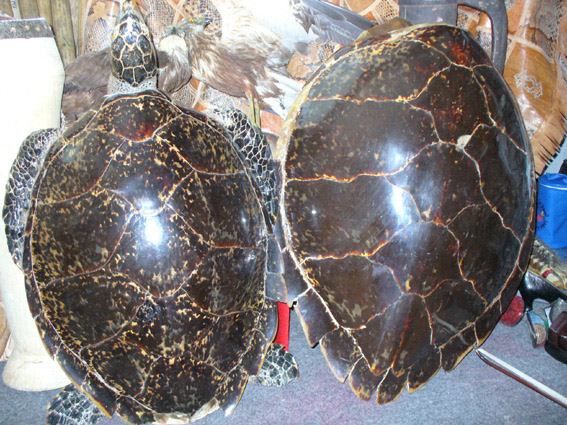
Especially in Mexico, turtle steak or soup is considered a culinary specialty. Who is surprised when the fishermen, who earn up to 260 euros per turtle, simply ignore fishing bans? After all, they also produce a highly lucrative waste product, the sale of which is also illegal: the back shell of sea turtles.
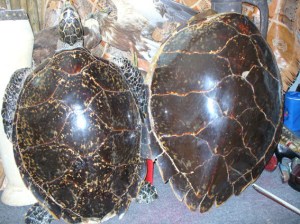
  Illegal souvenir confiscated at the airport, Munich.

The rise of the Mock Turtle Soup.

The mock turtle soup is an English soup that was created in the mid-18th century as a cheaper imitation of green turtle soup. It often uses brains and organ meats such as calf’s head or a calf’s foot to duplicate the texture and flavor of the original’s turtle meat. I like the following description.
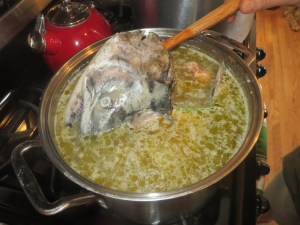
  Calf’s head soup cooking. Click on pic.

Mrs. Fowle’s Mock Turtle Soup:

„Take a large calf’s head. Scald off the hair. Boil it until the horn is tender, then cut it into slices about the size of your finger, with as little lean as possible. Have ready three pints of good mutton or veal broth, put in it half a pint of Madeira wine, half a teaspoon full of thyme, pepper, a large onion, and the peel of a lemon, chopped very small. A 1/4 of a pint of oysters chopped very small, and their liquor; a little salt, the juice of two large onions, some sweet herbs, and the brains chopped. Stand all these together for about an hour, and send it up to the table with the meat balls made small and the yolks of hard eggs“. Ha ha !!
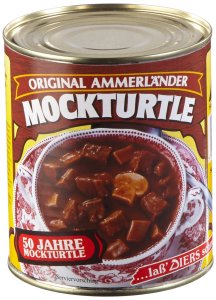

               

Germany.

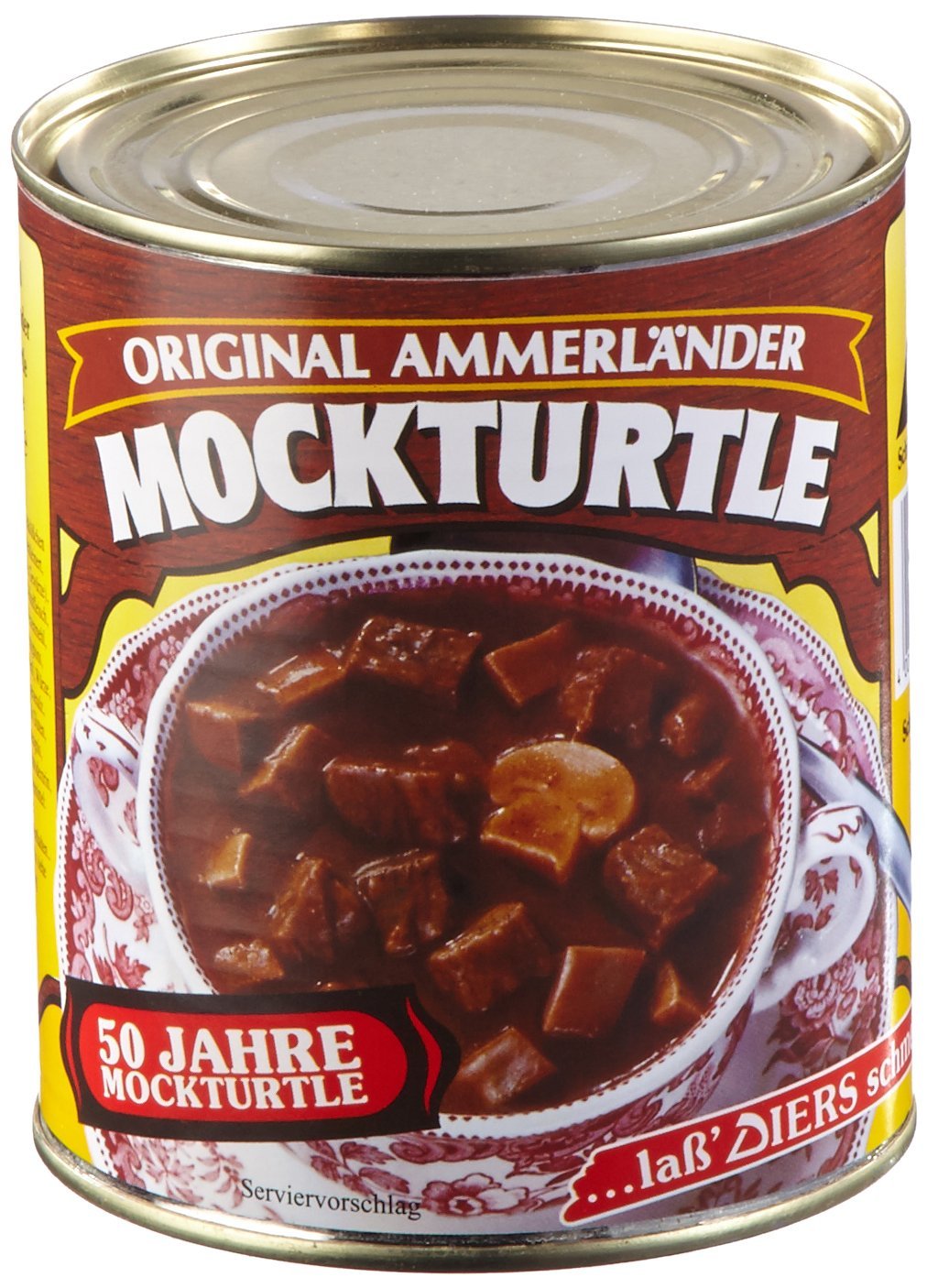
In the Oldenburg and Ammerland regions of Germany, Mockturtlesuppe – the English designation „mock turtle“ retained – is a traditional meal, dating from the time of the personal union between the Kingdom of Hannover and the Kingdom of Great Britain.

US.

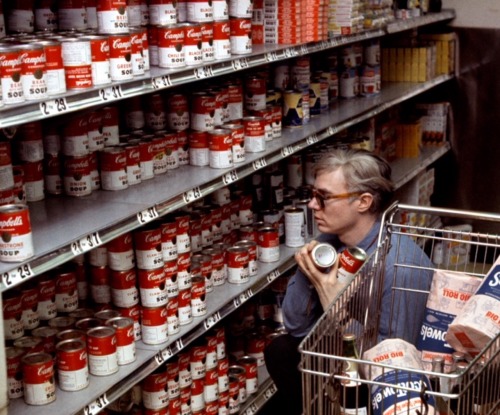
The Campbell Soup Company once produced canned mock turtle soup made of calf’s head. In a 1962 interview with David Bourdon – Andy Warhol, commenting on Campbell’s discontinued soups, said that Mock Turtle had once been his favorite.
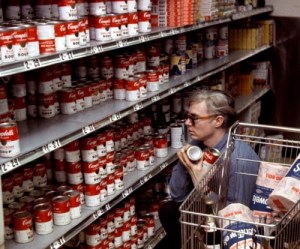
  Andy Warhol purchasing Campbell’s soup.

In popular culture.

Mock turtle soup is the basis for the character of the Mock Turtle in Lewis Carroll’s Alice’s Adventures in Wonderland“, the joke being that mock turtle soup is supposedly made from these creatures. Mock Turtle, who famously said, “Once I was a real turtle.”


  Alice was first told of Mock Turtle by the Queen of Hearts. The Queen asked Alice if she had seen Mock Turtle yet. “No,” said Alice. “I don’t even know what a Mock Turtle is.” “It’s the thing Mock Turtle Soup is made from,” said the Queen.

In season 4, episode 16 of Gilmore Girls, Richard Gilmore requests turtle neck soup while in mourning in the days after the death of his mother, the eldest Lorelai Gilmore, as it was „something his mother used to have made for him when he was a little boy.“ Nobody knows what turtle neck soup is, so Lorelai offers her father mock turtle soup.
In season 4, episode 8 of American Horror Story, Ethel Darling (Kathy Bates) serves mock turtle soup to Elsa Mars (Jessica Lange).
Or have an adventure at The Fat Duck in Berkshire, England.

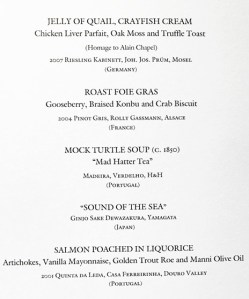
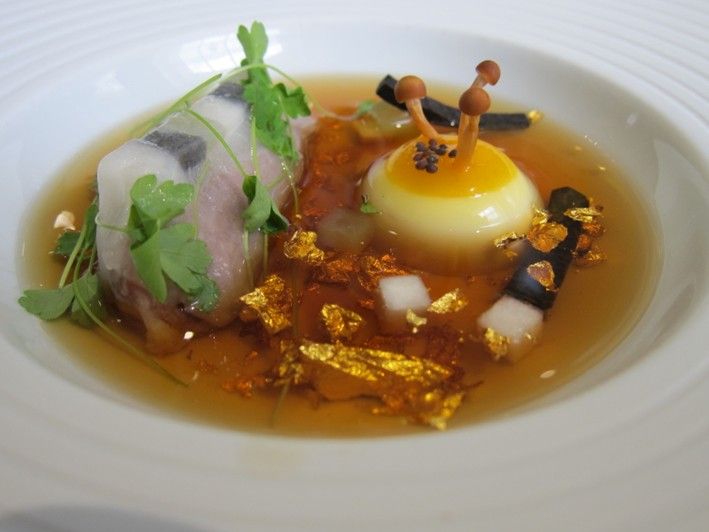
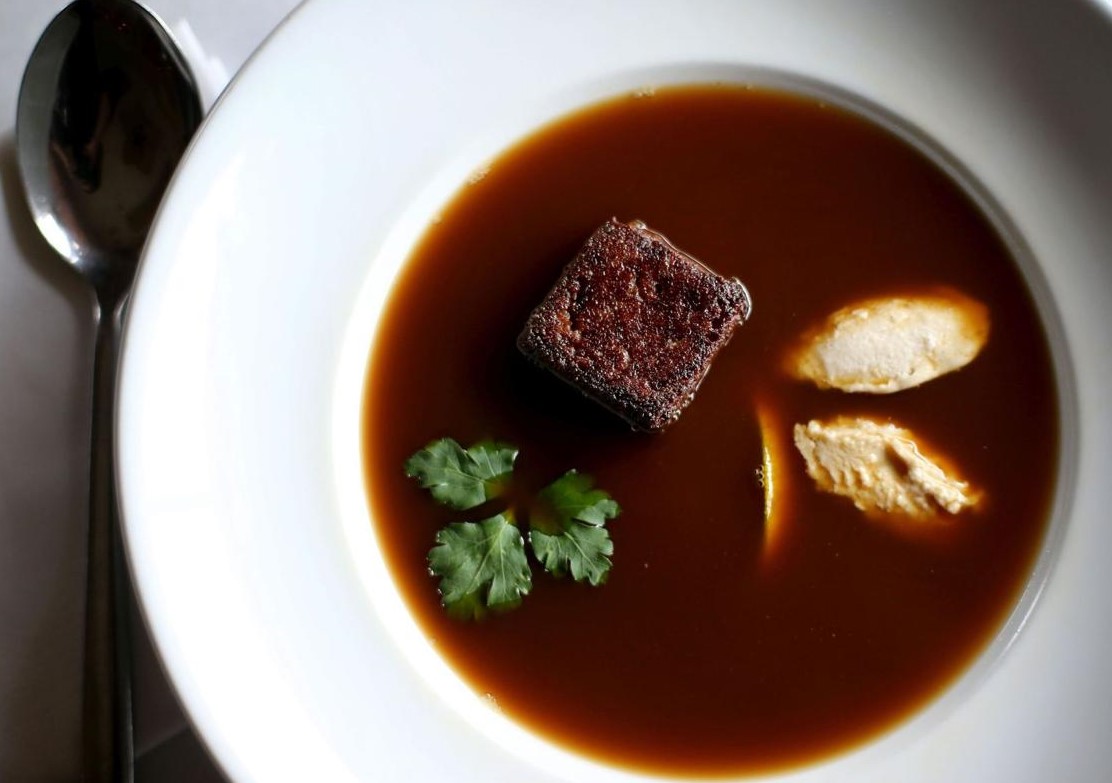
                       And at „The Fat Duck“ you can turn decadent with Mock Turtle Soup.

A visitor wrote: „We were so excited when we had our reservation at Blumenthal’s iconic restaurant The Fat Duck confirmed. The reservation line receives over 30,000 phone calls a day – the restaurant seats 42. It was so strange to be walking through the door months after making our reservation, having traveled thousands of kilometers from Australia to England to experience The Fat Duck first hand. Excited doesn’t begin to cover it“!
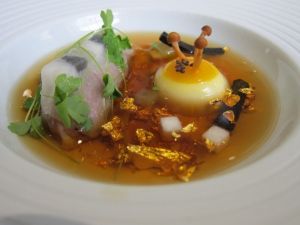

                        
Mock Turtle Soup garnished with real gold leaves.   Decadent at the end the bill too, but who cares.
Click on pics to supersize.

Queen  mother.
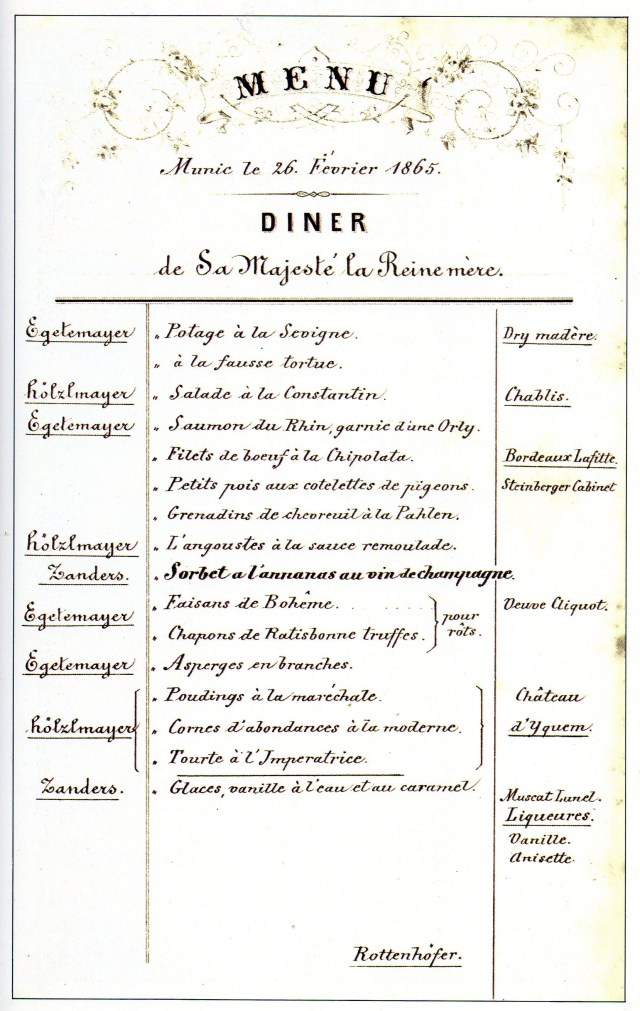
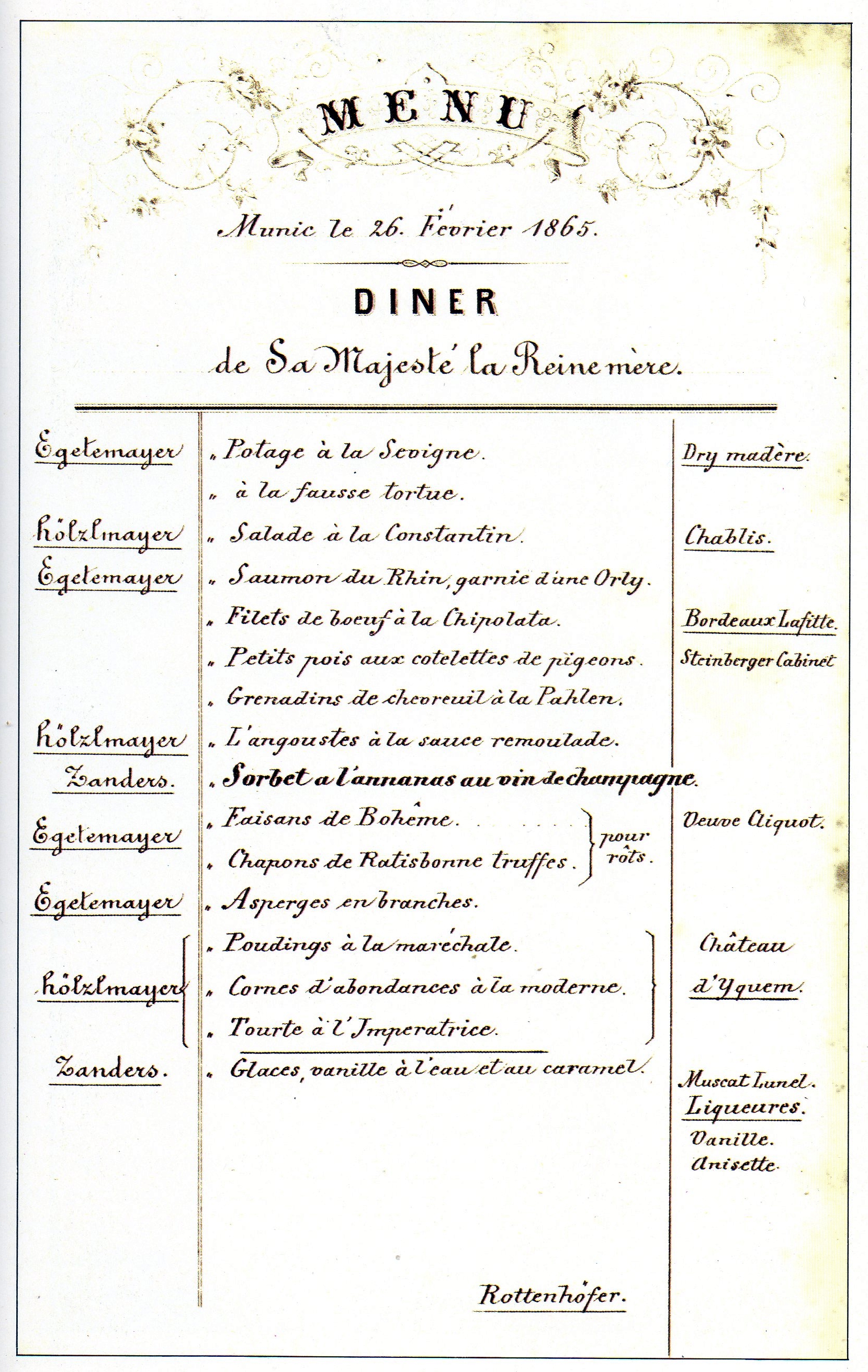
Menu card on the occasion of a dinner of Her Majesty the Queen Mother in Munich, Germany on 26th of February 1865.

The card shows as an entry the „Potage a la Sevigne – a la fausse tortue“. In English „Soup a la Sevigne – fake turtle soup“, or German „… Falsche Schildkrötensuppe“! A few month later, in 1865, was the „Sailer’sche Familien-Kochbuch“ published in Munich.
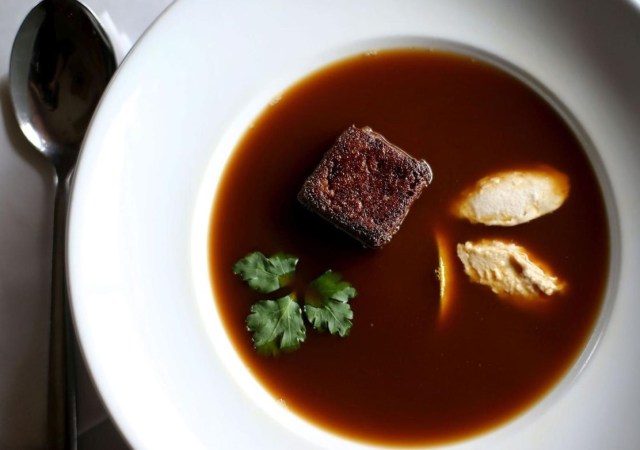
Finest Mock Turtle Soup.

The White House.

As we already know, in the „Lady Curzon“ variant, it is still covered with whipped cream, seasoned with curry and briefly gratinated. The turtle soup „Sir James“ is flavored with Cognac and Madeira. The equally classic variant with Sterlet (claire de tortue au sterlet) contains an insert of strips of Sterlet meat, Sterlet dumplings and eel liver.
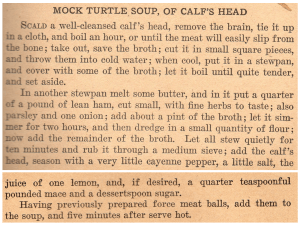
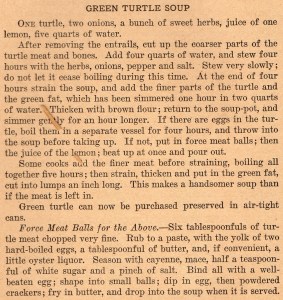
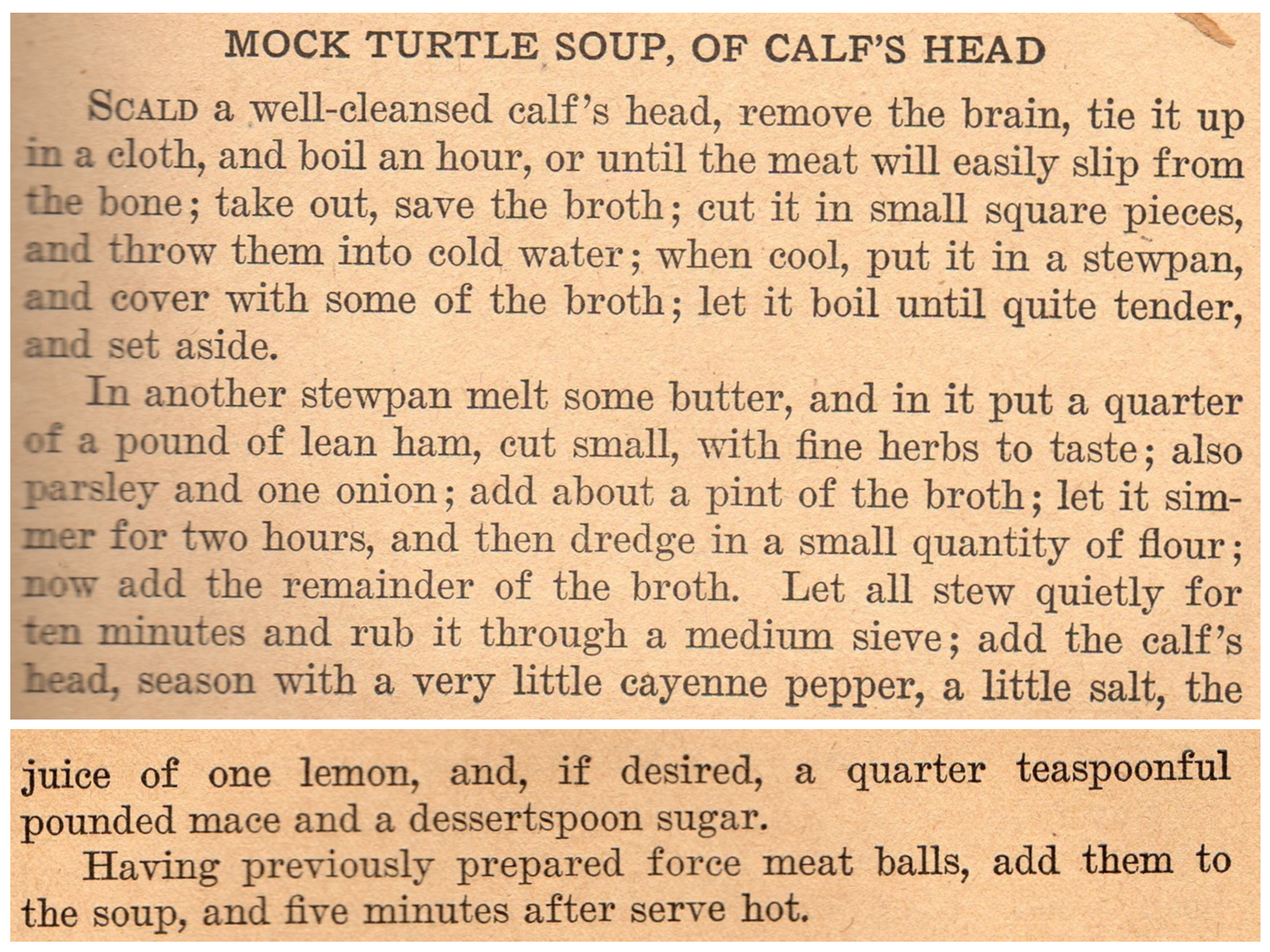
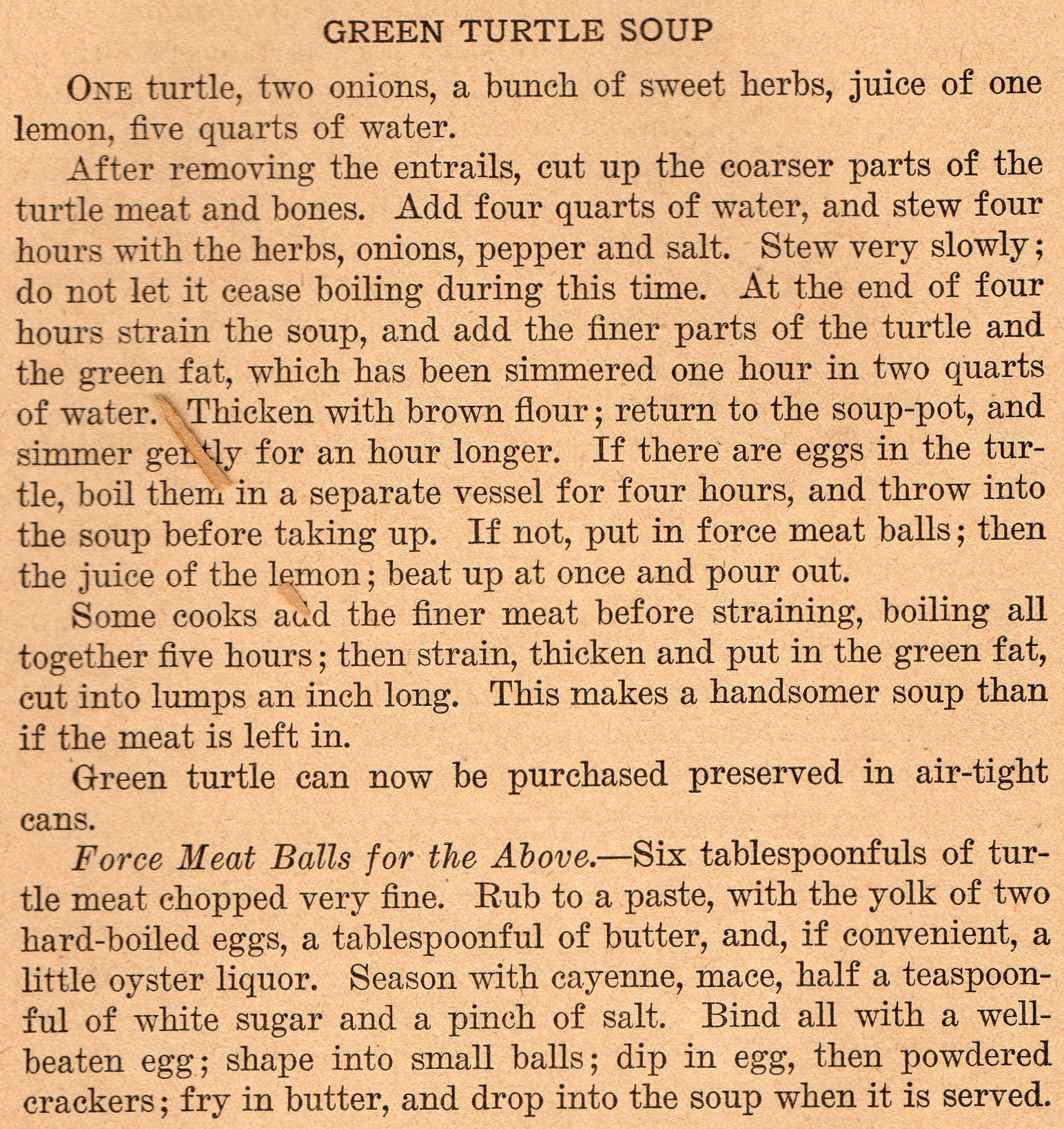
          Two recipes out of the White House Cookbook, Mock Turtle Soup (page 39) and Green Turtle Soup (page 40). This was the time when both soups were famous and requested.

My copy of the White House Cookbook, 652 pages from 1891. The time when Benjamin Harrison was president. I have one from 1912 as well, when William Taft was president.

These cookbooks offer a deep insight into the lifestyle, hospitality and impressive side of the presidents in the White House. Hundreds of local and international recipes, as well as rules and regulations within the White House, up to the organization of banquets, make this an amazing reference book of this epoch. Especially because these books both are equipped with lots and lots of drawings and photos.

Not every recipe must be like Mrs. Fowle’s or the ones above. But the previous explanations prove how established the „Mock Turtle Soup“ in most exclusive milieu’s already was. The classic/modern version is easy to make and a delicious main dish.

Mock Turtle Soup today.
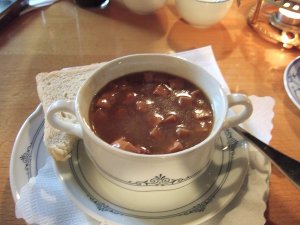
      Original Ammerlaender Mockturtle at restaurant „Spieker“, Bad Zwischenahn, Germany.

The recipe.
Ingredients.

500 g of veal bone, with meat
1 bunch of soup greens
80 g ham, raw
1 onion, finely chopped
1 piece of carrot
50 g butter or margarine
2 celery slices
30 g flour
2 cl Sherry
1 tablespoon lemon juice
200 g of button mushrooms, small
Salt and pepper
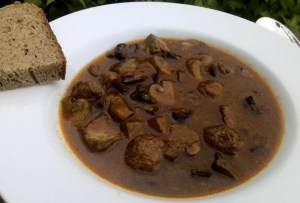
  Mock Turtle Soup Ammerland.

How to do.

Place the veal bones with cleaned and finely chopped soup greens in 1l of lightly salted water and cook until the meat comes off the bone.
Remove the bone from the broth, unwind the meat from the bone and cut into small cubes. Pour the stock through a sieve and keep it.
Fry the ham, cut into strips, chopped onion, the cleaned and sliced carrot and finely diced celery in fat, dust with flour and saute.
When the flour has taken on a little colour, gradually add the veal stock.
Simmer for about 25 minutes, then season with sherry, lemon juice, pepper and salt.
Add the meat and the halved mushrooms to the soup and let the soup simmer for another 5 minutes at low heat, at least till soup thickens.
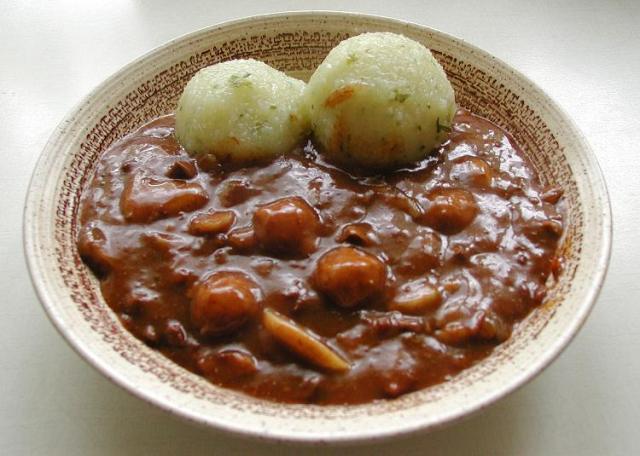
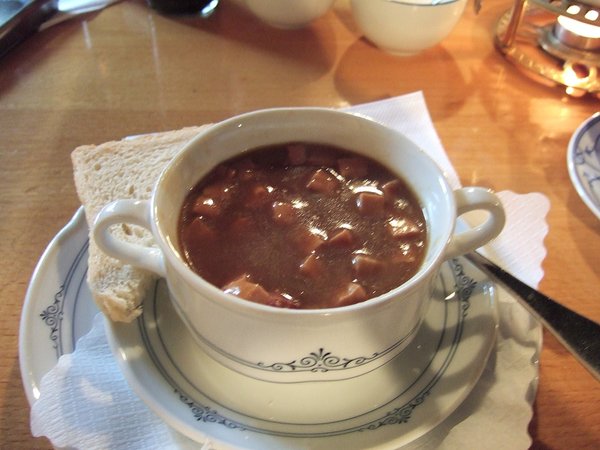
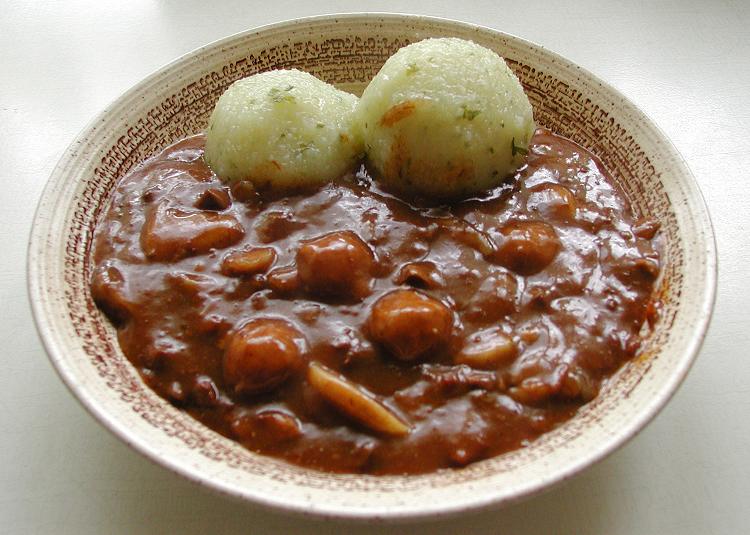
This Soup with potato dumplings is the version from Lower Saxony.  Try a cool German beer with it.

Tips.

In the original the broth is cooked from half a calf’s head. Since this ingredient is no longer up-to-date today, I have indicated as an alternative fleshy veal bone. I like the soup thick and fleshy, that means you have to test how much liquid you need to cook.

Serve in a soup bowl with bread. As a main meal you can add potatoes, rice or whatever you like. Also spice it if you like with Paprika or even Chilli. Enjoy cooking and eating !

Finally.

    Ship and Turtle Tavern, London.

Advertizing above: „It is worth a pilgrimage to the City to taste turtle soup and “fixings” at the “Ship and Turtle,” Leadenhall-street“.

This illustration of „Mock Turtle“ in Alice in Wonderland by John Tenniel depicts the turtle with a bovine legs and tail and a calf’s head.
The above is a quote from the Dickens Dictionary of London (1879) and it was a real place that was still popular in the 1890s.

  Ship and Turtle Tavern, London.

This pub was established by 1377 and was rebuilt in 1887 and again in 1969.  In its later years it was called Vino Veritas, but it closed and was demolished in 2008. For 465 years, from 1377 to 1835 it was run by a succession of widows. During the Victorian era, the Ship and Turtle Tavern even supplied several of the West-end clubhouses.
To ensure its patrons they were eating real turtle, turtles were kept on display in aquariums for everybody to see!




Veröffentlicht unter Collecting, History, Lifestyle, Recipes | Verschlagwortet mit , , | Hinterlasse einen Kommentar

Spicy Food and Health

There is often the „rumor“ that spicy food is unhealthy for the stomach and intestines, or even dangerous. Above all, too spicy food is said to have stomach problems, diarrhea and other side effects. Is spicy food healthy or unhealthy, what is the truth in these rumors?

I have taken the trouble to read many reports, studies and articles about it in the last few months. I’ll tell you about the positive results but also about warnings. Here is my summary in a form as short as possible.

  Click on the Tag „Spices“ – several posts there.

If we talk about spicy food, we talk about Garlic, Curry’s, Ginger, Horseradish and many more, but all comes down anyway to Chilli, that’s why Chilli takes so much room within spiced food. Is spicy food rather healthy or unhealthy for our body and our well-being? The answer depends, as always, on many factors. In summary, first of all, who likes it and is able to tolerate it, should eat hot food, then SPICY IS HEALTHY.

Nice hot and fiery but still edible and healthy, red paprika’s with hot green chilli pieces and an olive oil, garlic and herb marinade.

Spicy is healthy.

But at what level of spiciness can one really speak of „dangerous food“ and what is the hottest food in the world? A chili, a mustard, or perhaps a horseradish? Different levels of pungency are taken differently by each person, but above a certain level there is no one who does not feel pain when eating the hottest food in the world.

The positive properties of spicy food through natural spice makers.

First of all, an acceptable level of sharpness which of course depends on each person individually has many positive properties on health and is definitely not considered unhealthy. The following positive properties of spicy foods and dishes are known:

  Spicy food and a beer makes us happy, right?

They secrete endorphins (hormones that make you happy, see above).
Sharp works antibacterial.
Capsaicin (the pungency of chilli and pepperoni) is said to lower cholesterol levels.
Capsaicin is also said to have positive effects on the heart.
They are digestive (used in moderation!).
They stimulate the blood circulation.
Clears the nose and respiratory tract.
Help with a cold (For the very hard ones also with sore throat).
A Chinese study even attributes life-prolonging properties to spicy food.
Furthermore, pungency is said to function as a light natural aphrodisiac.

Spicy food par excellence – Thai-Pineapple-Shrimp-Curry – that’s healthy !!!

What makes food so spicy ?

Every spicy natural foodstuff has its very own „spice maker“ here are a few examples:

Pepper – Piperine.
Chillies, Pepperoni’s and Paprika’s – Capsaicin.
Garlic – Allicin.
Ginger – Gingerol.
Horseradish and mustard – by so-called mustard oils.

You probably know some people who cannot resist putting anything spicy – from chilli sauce to wasabi – into whatever that they are eating. You can see how much they love spice when you see the pain they would go through, as they chug down water and wipe away their sweat, just to eat spicy food.

On the other hand, you probably also know some other people who would always return their food to the kitchen or just leave it completely uneaten if their food is too spicy.

Sharp is more a pain reaction than a taste.

Besides the five flavors: Sweet, Bitter, Sour, Salty and Umami, many people also call „Hot“ as one flavor. However, this is wrong, because the reaction to spicy food is more a painful reaction than a sensation generated on the tongue by receptors that transmit a taste of the food to the brain. Therefore, each person is also individually focused on his or her personal level of spiciness of the food. While for one person a curry ketchup already represents an unbearable spiciness, for another it is only after some jalapenos or sometimes extreme piri piri. Extreme hot, the hottest I can get in UY, direct out of my garden, see below.


       My personal recommendation among the jalapenos for comfortable are those tinned ones from „La Costena“ (even available here in Uruguay), the quality is very good and they are already nicely cut.

How to measure sharpness ?

The international pungency of a food or individual food is measured in the Scoville measuring unit. Depending on the variety, normal chili sauces such as Tabasco have between 2000-9000 Scoville, pure cayenne pepper already reaches up to 50000 Scoville, Piri-piri over 100000 Scoville and the incredibly hot chili variety from Africa called „Trinidad Moruga Scorpion“ 2 million! That is about the power of a pepper spray for personal defense! In comparison, a normal vegetable pepper contains only a tiny, hardly remarkable value between zero and ten Scoville. The threshold at which a person in Scoville registers sharpness is about 16 Scoville.
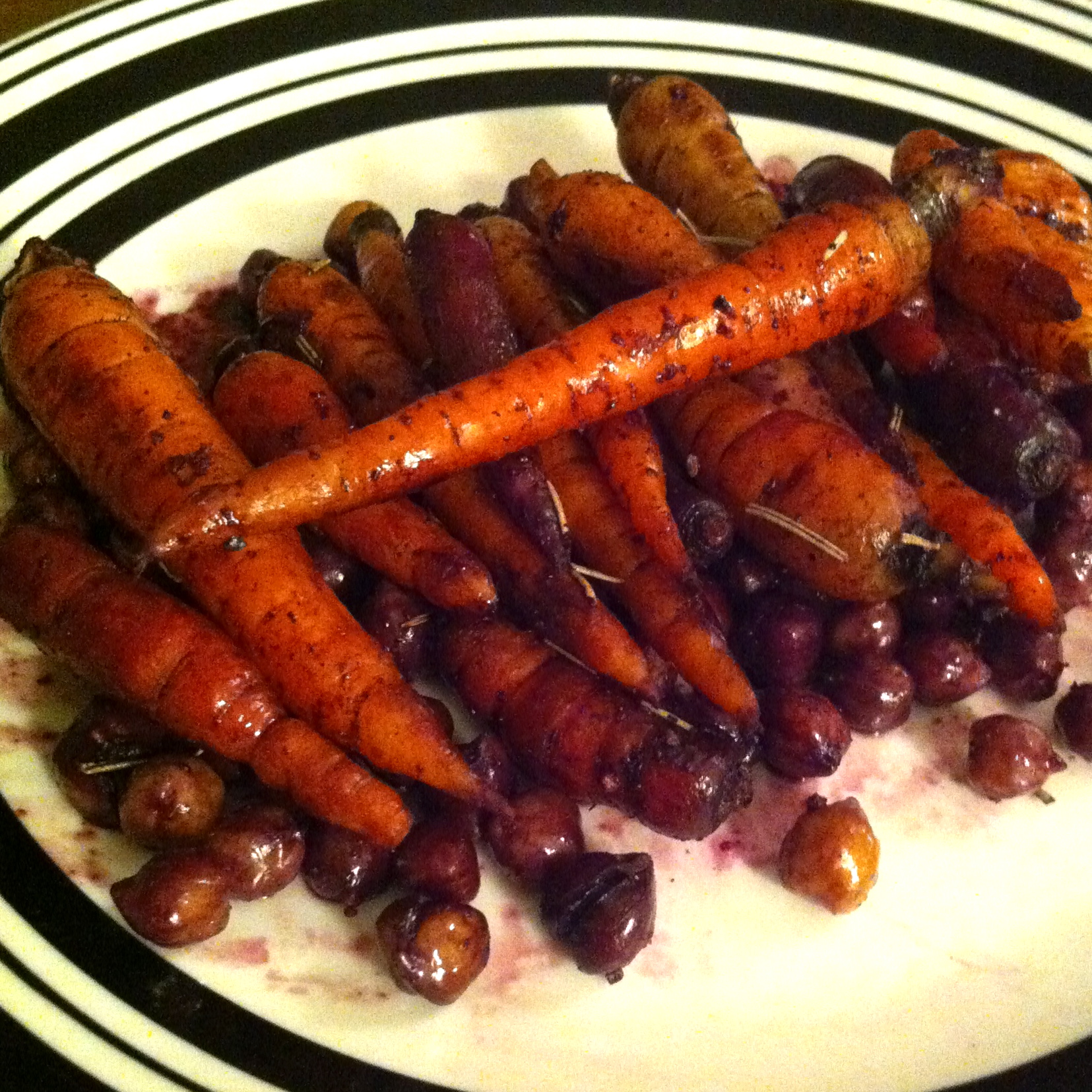
                  

Warnings to the Plutonium No. 9 :
This product is a food additive. This is not a sauce!
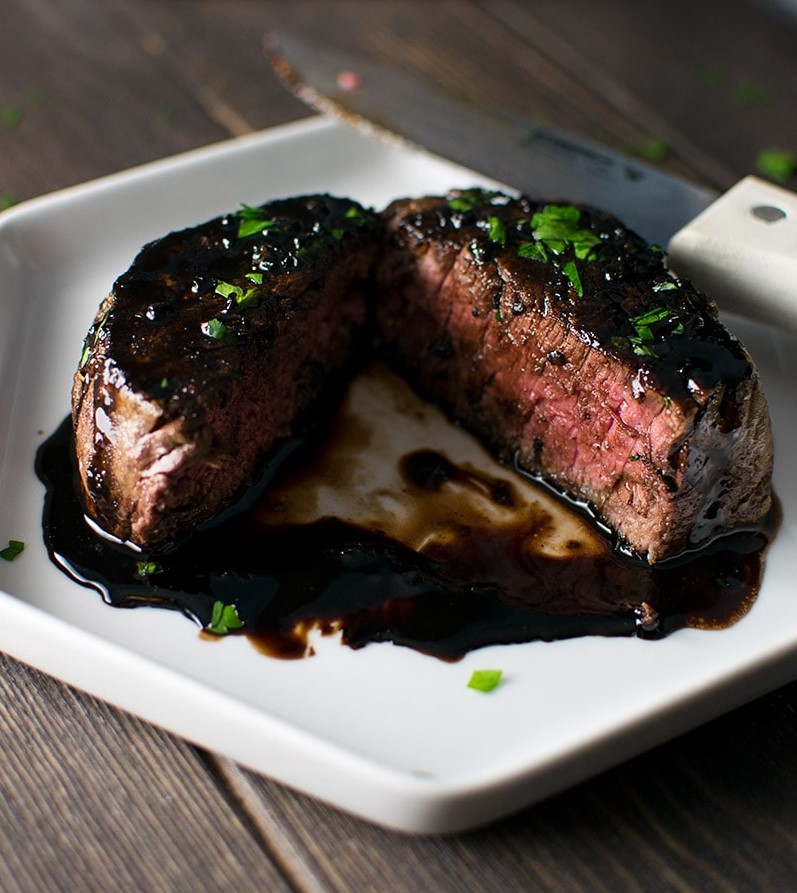
It may only be used in very diluted form.
Use gloves and safety glasses!
Keep away from children’s hands!

In the opposite direction it becomes totally sick with the „Mad Dog 357 No.9 Plutonium“ an incredibly hot and dangerous chili sauce with 9 million Scoville! See above on the left. There is the Mad Dog 357 Silver Edition Hot Sauce (for me absolutely unbearably hot) a joke against it. The „plutonium“ is only surpassed by pure Capsaicin in crystal form with up to 16 million Scoville, absolutely inedible and dangerous to life!
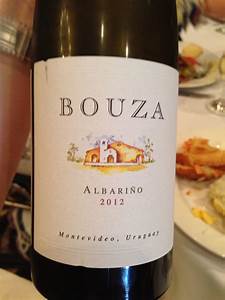
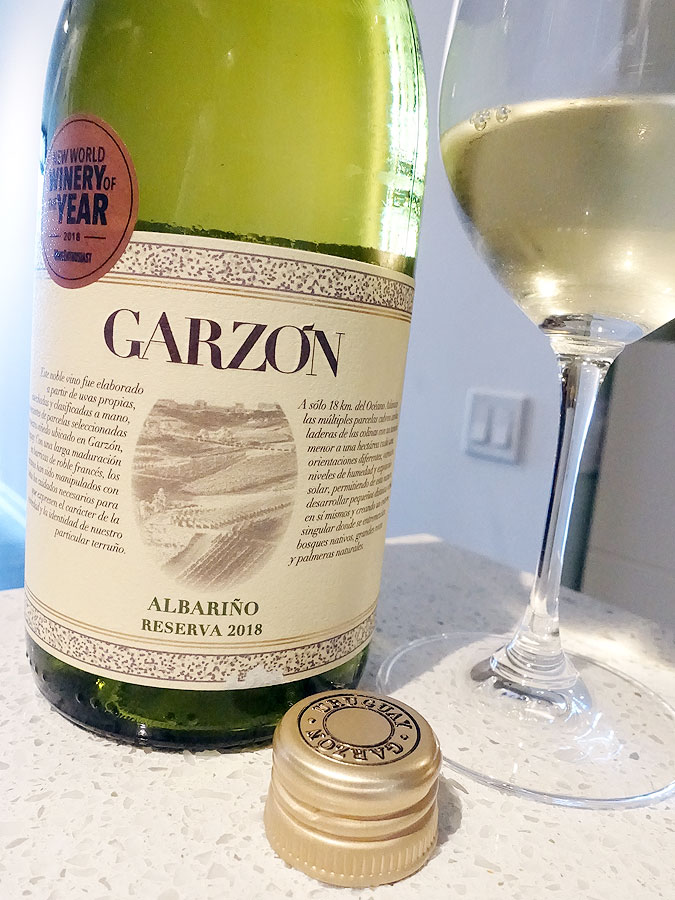
What negative effects can too spicy food have on health and well-being ?

Too fiery food, especially in the case of total exaggeration with too spicy food, such as spicy competition food and other more or less in my opinion senseless activities, there is actually a health impairment and it can even be life-threatening! The symptoms of much too spicy food are in ascending order of severity after eating:

So much fun, spicy Thai Food on buffet. Ready to dig in ?

Nausea
Heartburn
Vomiting
Diarrhea
Stomach and intestinal cramps
Shortness of breath
Circulatory collapse
Extreme inflammation of the stomach and intestinal mucous membranes
Total collapse to coma
Heart circulation failure
Death

One of my favorite spicy dishes, out of Thailand of course – Pad Kra Pao !
Pad Kra Pao can be found in every restaurant and cuisine and means „chopped and roasted pork with basil“.

In Thailand there are several types of basil and how could it be otherwise, the basil used here is of course a spicy one. But you can also order the dish not hot (mai pet) and the meat can also be varied. Depending on what you prefer, you can also have it with chicken, beef or seafood like shrimps and squid. Even a vegetarian variation is possible.

The preparation of Pad Kra Pao is very simple. First, chilli’s are fried with garlic. Then the meat and long green beans are added. The dish is refined with fish sauce, sugar, oyster sauce, soy sauce and finally spicy Thai basil. Rice is of course served with Pad Kra Pao.

       Pad Kra Pao preparation in Sukhumvit road, Bangkok. Very tasty, easy to cook at home and highly recommended. Often served with a fried egg on top. Click on pics to supersize.

Can too spicy food become really dangerous ?

The above mentioned symptoms such as coma, complete cardiovascular failure and finally death are of course rather rare, most consumers stop eating long before and under hellish pain or faint. You should never simply pour a bottle of extremely hot chili sauce into your mouth just to show how strong you are. From a certain sharpness, everybody goes down on his knees. Then it is surely not healthy anymore! And this is why the opponents of spicy food shout „Eating spicy is unhealthy“! Bullshit!

So good and makes Germans very happy, delicious Curry-Wurst. But beware, the right quality is important!

What is the hottest natural food in the world ?

As pure „natural“ food it is, according to my knowledge, the bred chili hybrid „Carolina Reaper“ with peak values of incredible 2.2 million Scoville. Simply unbelievable and just as unbelievably stupid who knowingly bites into it with pleasure! An absolutely brutal up to life-threatening pain hell!

 
Chinese people eat „Hot Pot“ at a restaurant in Chengdu of Sichuan Province, China. „Hot Pot“, a soup base and dipping sauce, is the most popular spicy food in Sichuan Province.

He who eats spicy food lives longer.

Is spicy food healthy? A study from China comes to the conclusion that people who often eat spicy food live longer.

Smaller studies suggest that capsaicin also has longer-lasting effects – and desirable ones at that. Researchers report that it is believed to prevent the development of cancer and help keep the cardiovascular and digestive systems healthy.

   Spicy food is also horseradish (Western version), or its Wasabi – the Eastern version of horseradish.

An international team of researchers has now investigated whether people who often eat spicy food live longer. In the „British Medical Journal“ (BMJ) they report that the friends of spicy food actually had a lower risk of dying during the course of the study, which lasted a good seven years. Their risk had decreased by about 14 percent, write Jun Lv from the University Hospital in Beijing and colleagues. This was also reflected in the individual deaths from cardiovascular diseases, cancer and respiratory diseases.

  If I can’t find fresh horseradish on our weekly BIO-market, I like to use this sauce. Its medium spicy, because the sauce is mixed with cream and ready to use – for all kinds of occasions.

Almost half a million people living in ten different cities or rural regions in China provided information on their diet, among other things

The connection between spicy food and the risk of death was equally pronounced in men and women, the researchers report. However, it was significantly weaker in those participants who regularly drank alcohol.

                                                   If it burns or if you don’t like spicy food, don’t eat it. If you cook spicy food don’t exaggerate it. Taste is much more important then heat. And in case you burned one or yourself, above are 9 nice ideas to cool it down.

Quick help when it burns in the mouth.
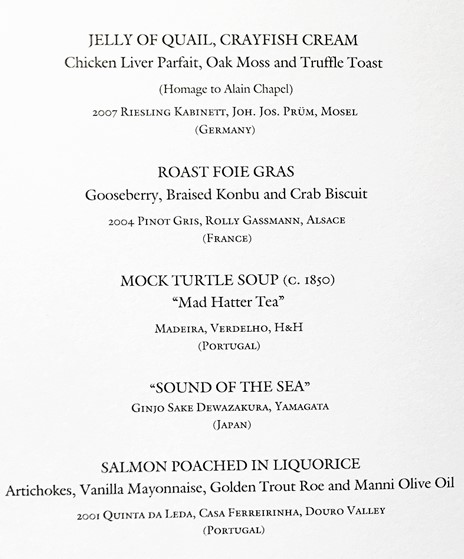
Above a certain sharpness level – about 1,000,000 Scoville – the body is no longer able to distinguish sharpness from sharpness. Here, water or beer does not help to extinguish the burning sensation in the mouth. Although drinks cause short-term cooling, they strengthen the distribution of capsaicin and thus the burning sensation. Drinking milk or eating yogurt or cheese have proven to be the best methods. The fat contained in these products dissolves the capsaicin and thus reduces our pain.

     One of the best (small and cheap) books about chilli, from history over health to cooking.

Spicy food makes you happy.

First things first: spicy dishes can actually influence your mood. In chilli it is capsaicin, in pepper piperine: the substances responsible for the pungent taste on the tongue. If you eat spicy food, these substances send a painful stimulus to the brain, whereupon endorphins are released. The happiness hormones relax our body. That is why chilli is also considered a kind of natural drug.


Yes, spicy food makes me happy – hot chili con carne with kidney beans and minced meat.

If you eat spicy food, you lose weight faster. Spicy food regulates the insulin level, which would promote weight gain if it increased sharply. In addition, we start to sweat from spicy food, for which our body needs a lot of energy and burns fat all by itself. Practical, isn’t it?

  One of the GREAT spice cookbooks I’ve ever had in my hands.

Conclusion:

Hot food and spicy foods are healthy, as long as you don’t overdo it. The only things that are harmful to the body are the extreme spiciness and food that does not give us „joy“ but only pain when we eat it. People with a sensitive stomach should eat less spicy food. Consumers with intestinal problems, irritable stomach and inflammation of the digestive organs should definitely talk to their specialist before consumption to see if it is okay. Those who do not overdo it and are physically healthy do themselves some good with spicy food as long as it still tastes individual.

  May be the first drawing of a chilli plant in the Western world. Out of the Badianus manuscript (Latin translation) from 1552. Click on pics to size up for a better view.

The Aztecs, for example, were expert herbalists. In 1552, during the early years of Spanish rule in Mexico, two Native American students at the College of Santa Cruz in Tlaltilulco, Martinus de la Cruz and Juannes Badianus, compiled a list of herbs that had been used as medicines for centuries by the Aztecs. Martinus wrote, and probably illustrated, the original Aztec text, and Badianus translated the work into Latin. Today their work (the original in Nahuatl language doesn’t exist anymore), „Libellus de Medicinalibus Indorum Herbis“ which is Latin for „Little Book of the Medicinal Herbs of the Indians“ is commonly called the Badianus Manuscript. Housed in the Vatican Library, The Badianus Manuscript is the oldest known written American herbal collection .

Eating regularly spicy food is often a matter of „training your taste buds“ and „dealing with the topic“. Try it, its sooo delicious and you increase your knowledge and lifestyle.


Veröffentlicht unter History, Lifestyle, Recipes | Verschlagwortet mit , , , | Hinterlasse einen Kommentar