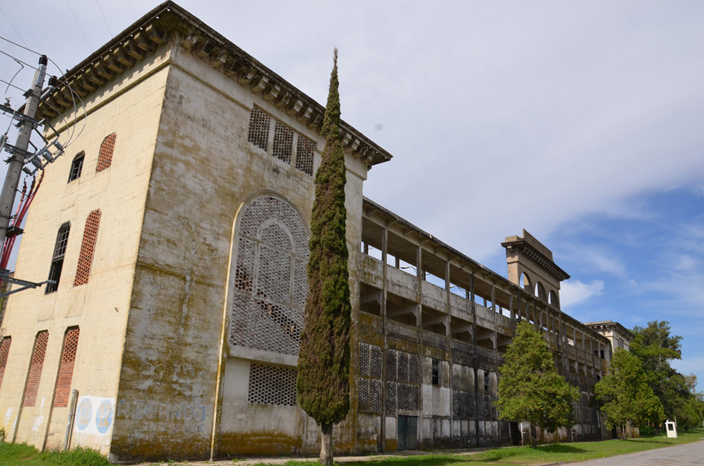
Must See – Colonia del Sacramento

The oldest city in Uruguay, Colonia del Sacramento is since 1995
a World Heritage Site. I have been there several times . This time
it was springtime,  27th of October and lovely 35 Celsius (95 F)
wow what a challenge, on a warm day, to walk around, ha ha.
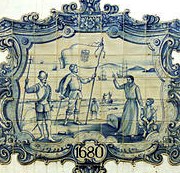
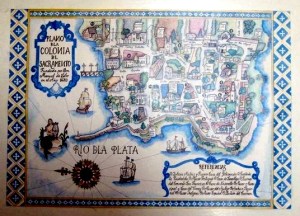
colonia 5    colonia 13
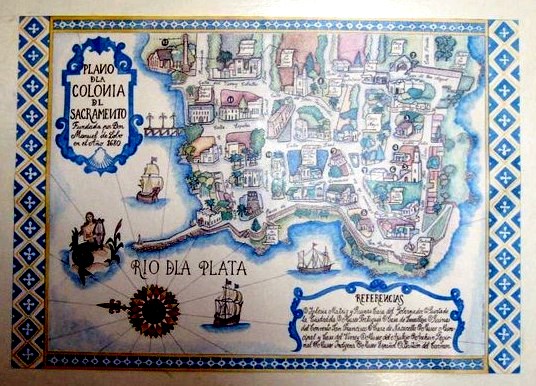
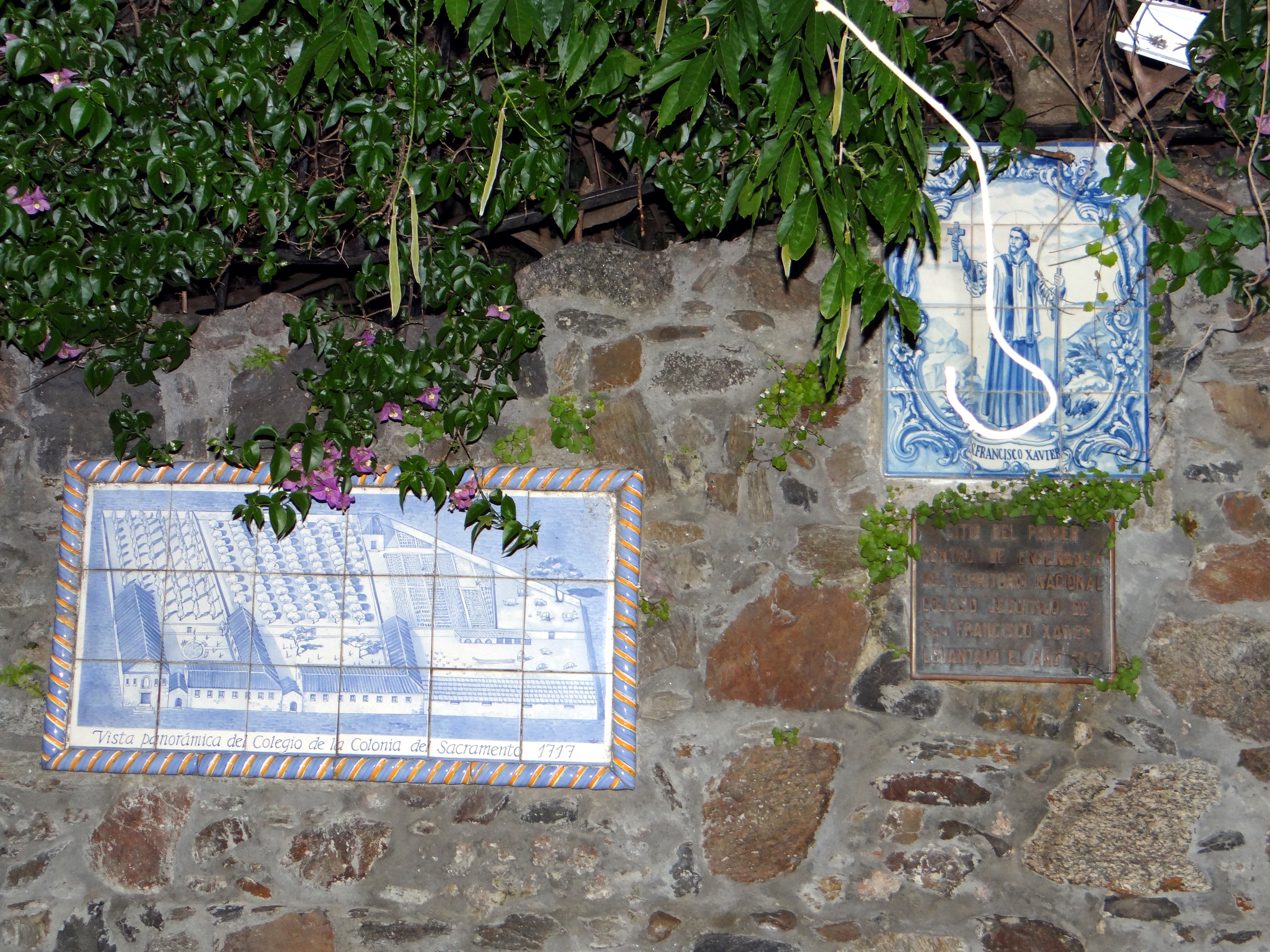
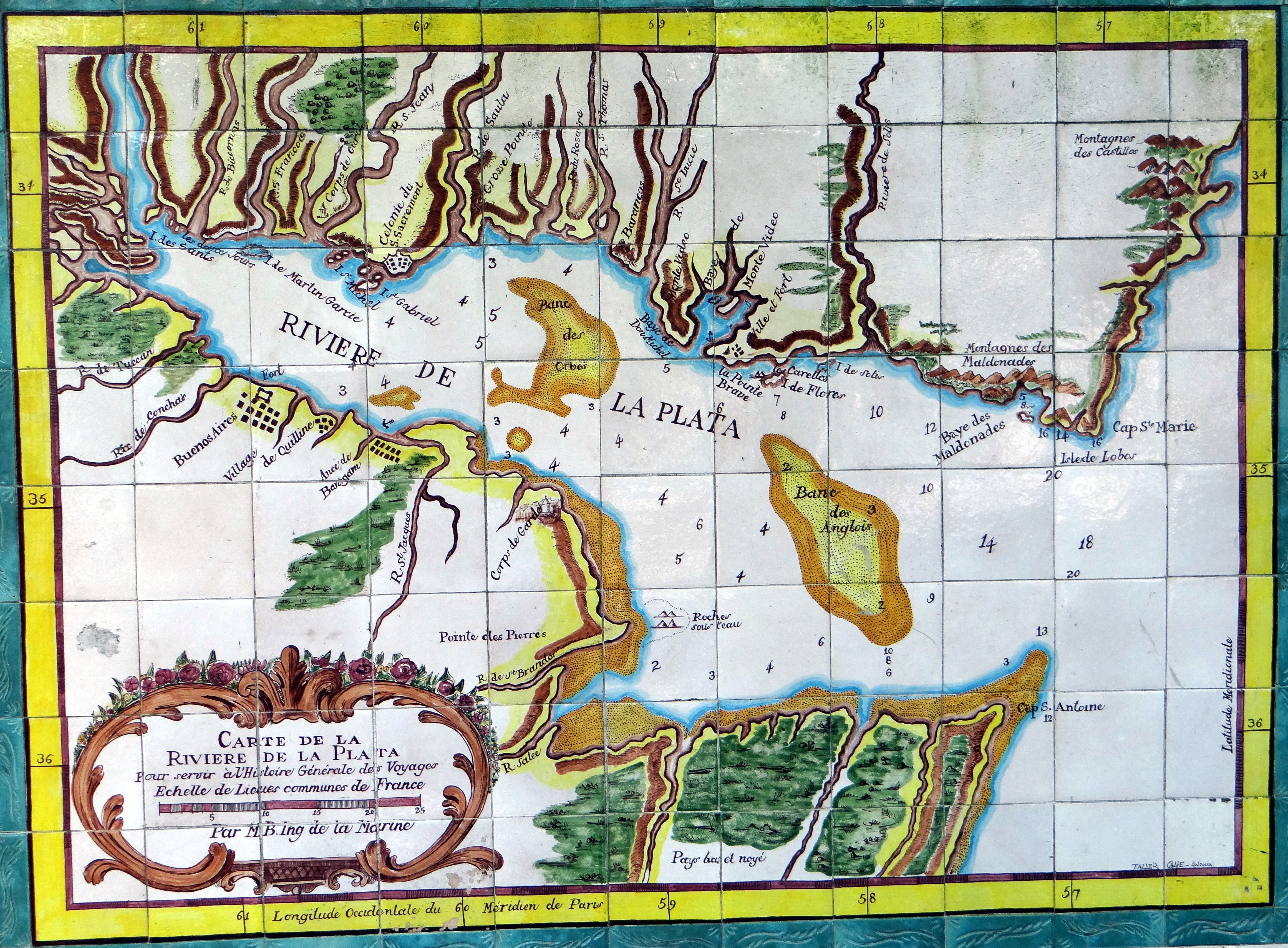
Wonderful tiles in the Portuguese museum. First settlement 1680  and first city plan.
The only nice places were, in some shade, under big palm trees,
venerable Platanes or under the Jacarandas with their beautiful lilac
colored flowers. Anyhow, the city is beautiful in springtime. Not many
tourists, all the restaurants are open and awaiting customers, still
friendly courteous waiters and the weather, usually, perfect.
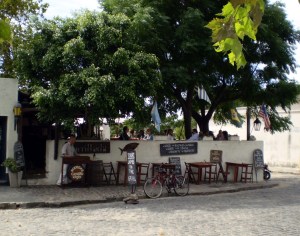
041_2
A cool beer in the shade.

The old city of Colonia measures only about 600 by 600 meters. At the
river side of the Rio de la Plata you have the Rambla San Gabriel
where many people come together enjoying the beautiful sunsets over
the river. The Jasmin fragrance is around everywhere and blows in
the evening breeze all over this historical old city.

It was Don Manuel Lobo, the Portuguese governor of Rio de Janeiro who
founded Colonia in January 1680 It was planned as a bastion against
the Spanish of Buenos Aires. The following 100 years Colonia faced a
permanent change between Portugal and Spain. We leave these turbulent
times of history to a further post. For now we will concentrate of
what to see in Colonia today.
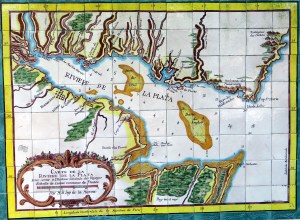
DSC00068_2
First settlements on the Rio de la Plata. Tiled map in Colonia.
First building work in Colonia began in 1680 and in 1690 with the Master
Church and the Franciscan convent. After a lightning strike the church
exploded, because of stored cannon Powder inside, and burned completely
down. She had to be build new and much bigger and was again consecrated
in 1723. Historic buildings are around the old city everywhere. Like the
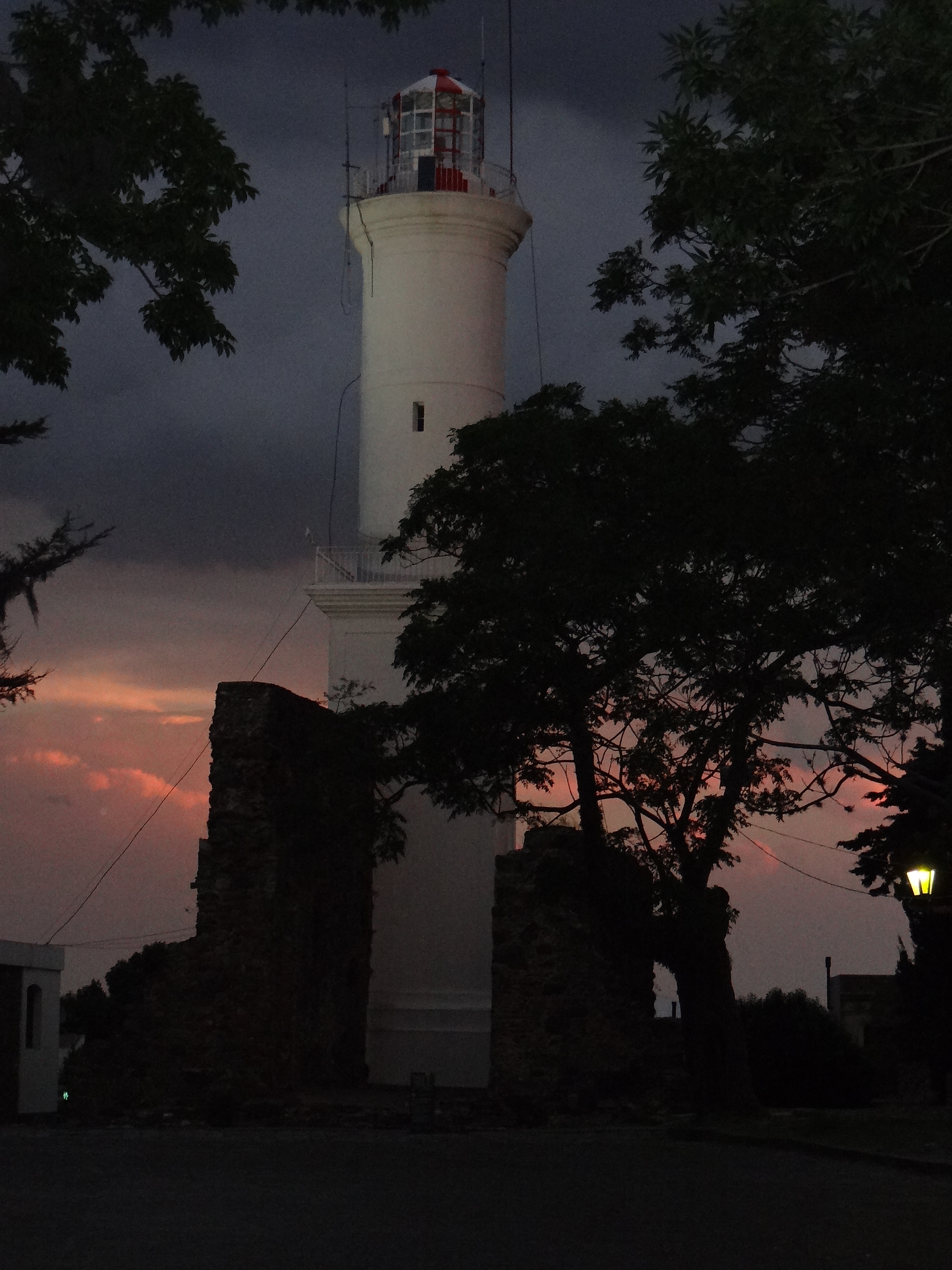
light tower, from where you have a great view over the city. It is just
behind the ruins of the San Francisco convent. Or the old city fortress.
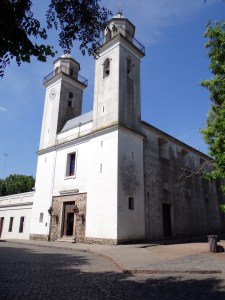
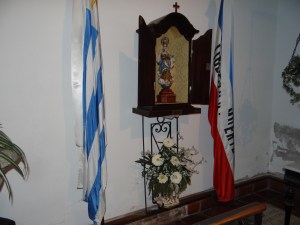
DSC00067    DSC00066
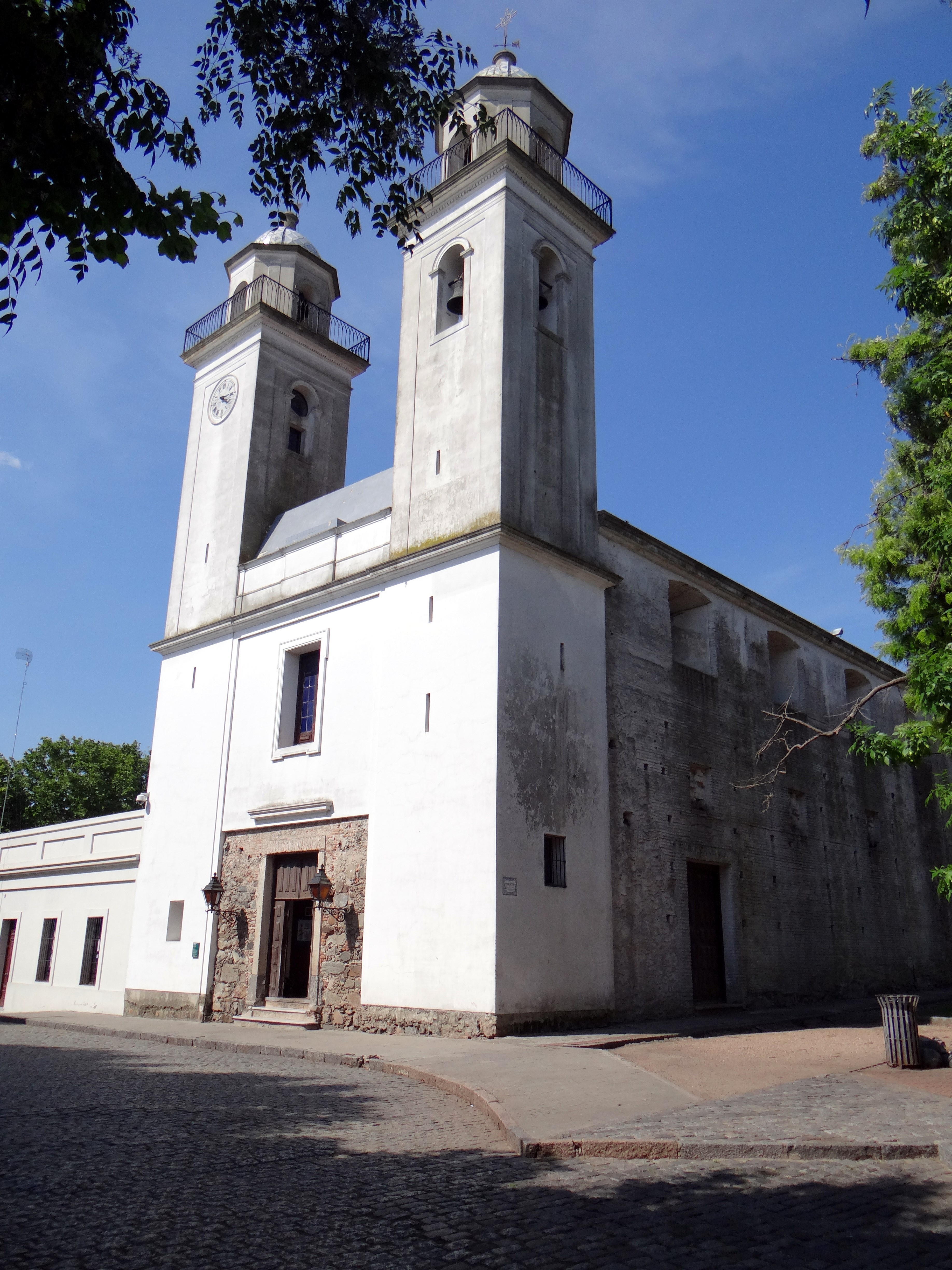
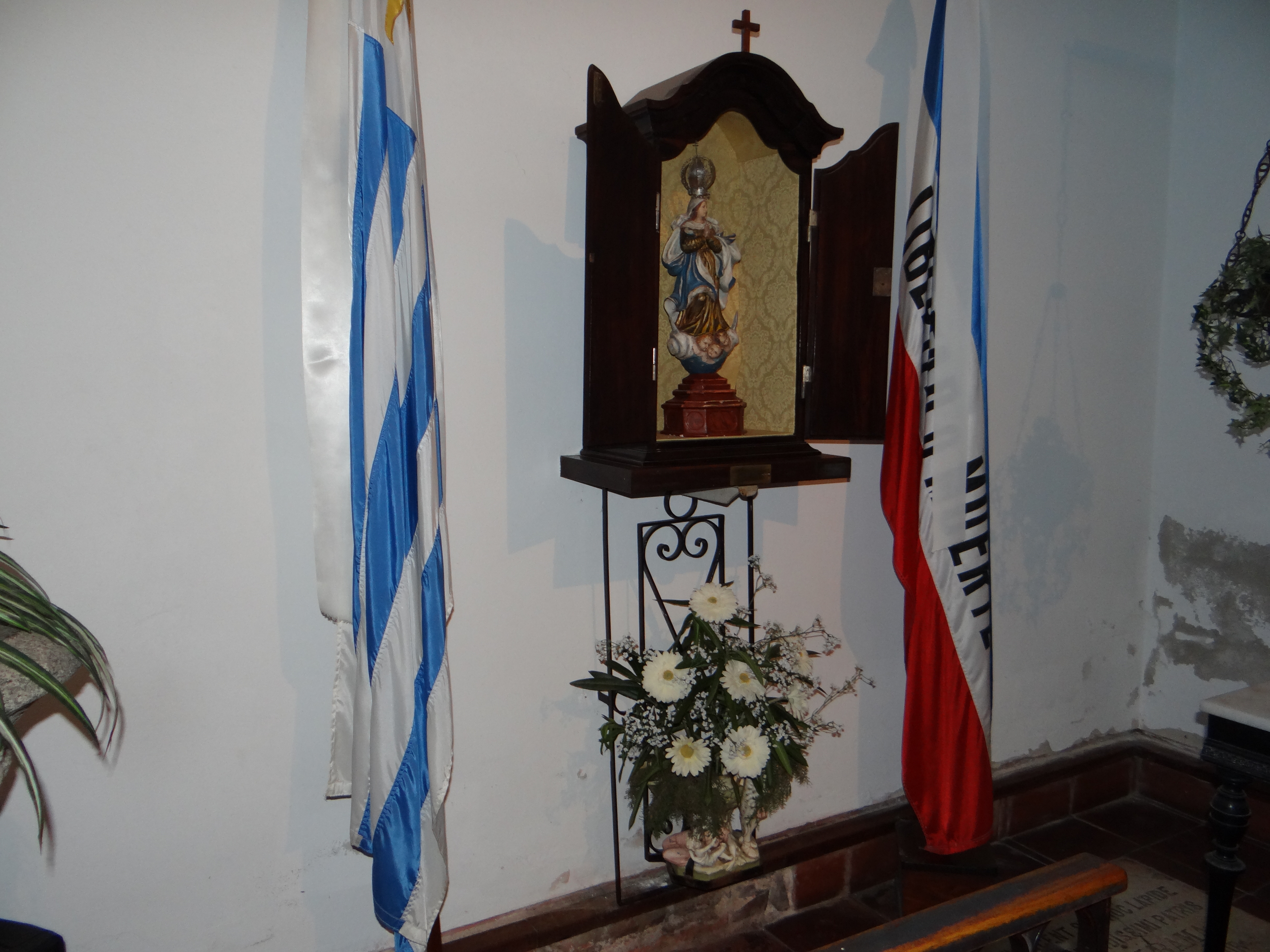
Basilica del Santisimo Sacramento. The parish was founded on 2. February 1680.
Also called in travel guides Iglesia Matriz. It is the oldest church in Uruguay.
We still can discover the different building styles of the Portuguese and
the Spanish. The Portuguese built the houses out of massive stone, the
Spanish used light walls and rendering. Portuguese build flexible and “wild”,
The Spanish had their “chess board” system with a main plaza in the center.
1397563733596-11_2
Old picture of a Portuguese street and Spanish houses, before restoration.
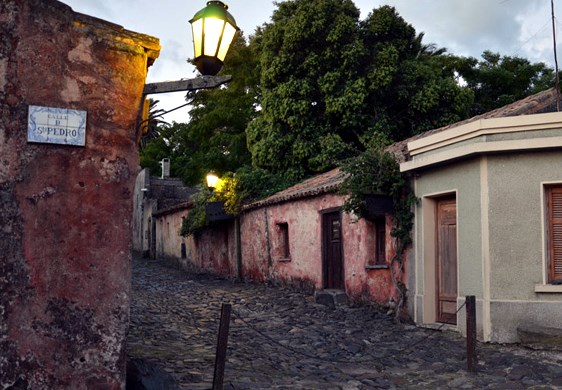
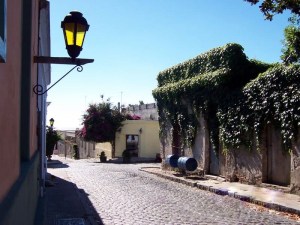
Especially the streets were totally different. Both from cobble stone, yes,
but the Portuguese had lowered the center of the streets, that rainwater
could drain off. The Spanish did the same, but lowered the streets on both
sides, next to the sidewalks and higher in the street center. Both historic
building styles can still be followed next to each other in
Colonia del Sacramento.
colonia 14_2   DSC00088
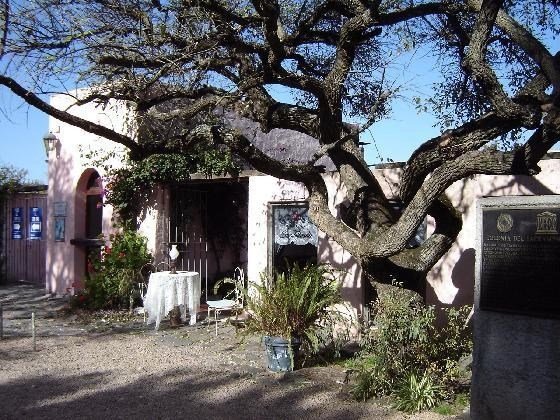
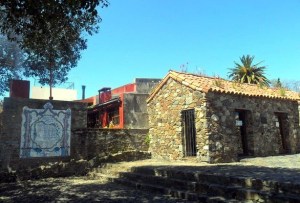
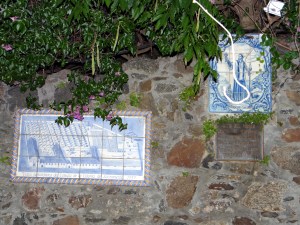
Historic Portuguese building. Picturesque tiled artwork is found all over the old city.
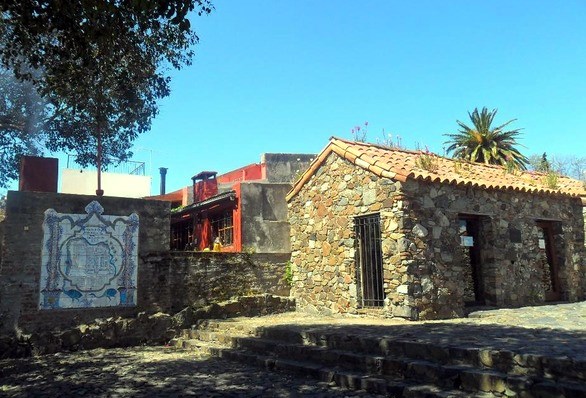
One can find many different building styles of, up to over 300 years old,
houses, build by the Portuguese or by the Spanish. Portuguese houses look
like mosaics, small nature rocks and clay fragments used together. The
Spanish used bricks only and then rendered the walls. That kind of plaster
was a mixture from lime with oxblood. That’s why you see very often red
colors. This mixture is very resistant against weather influences. The Spanish
used big windows, instead Portuguese small, and build big and very high doors.
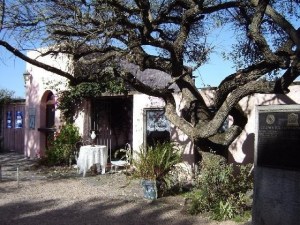
colonia 4_2  colonia 17
Street and building style impressions in Colonia. Notice the Spanish Street style.
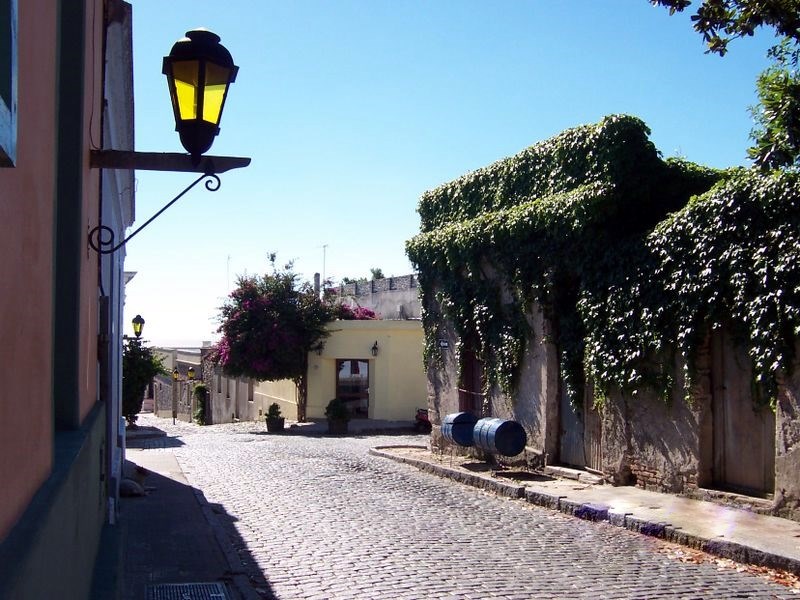
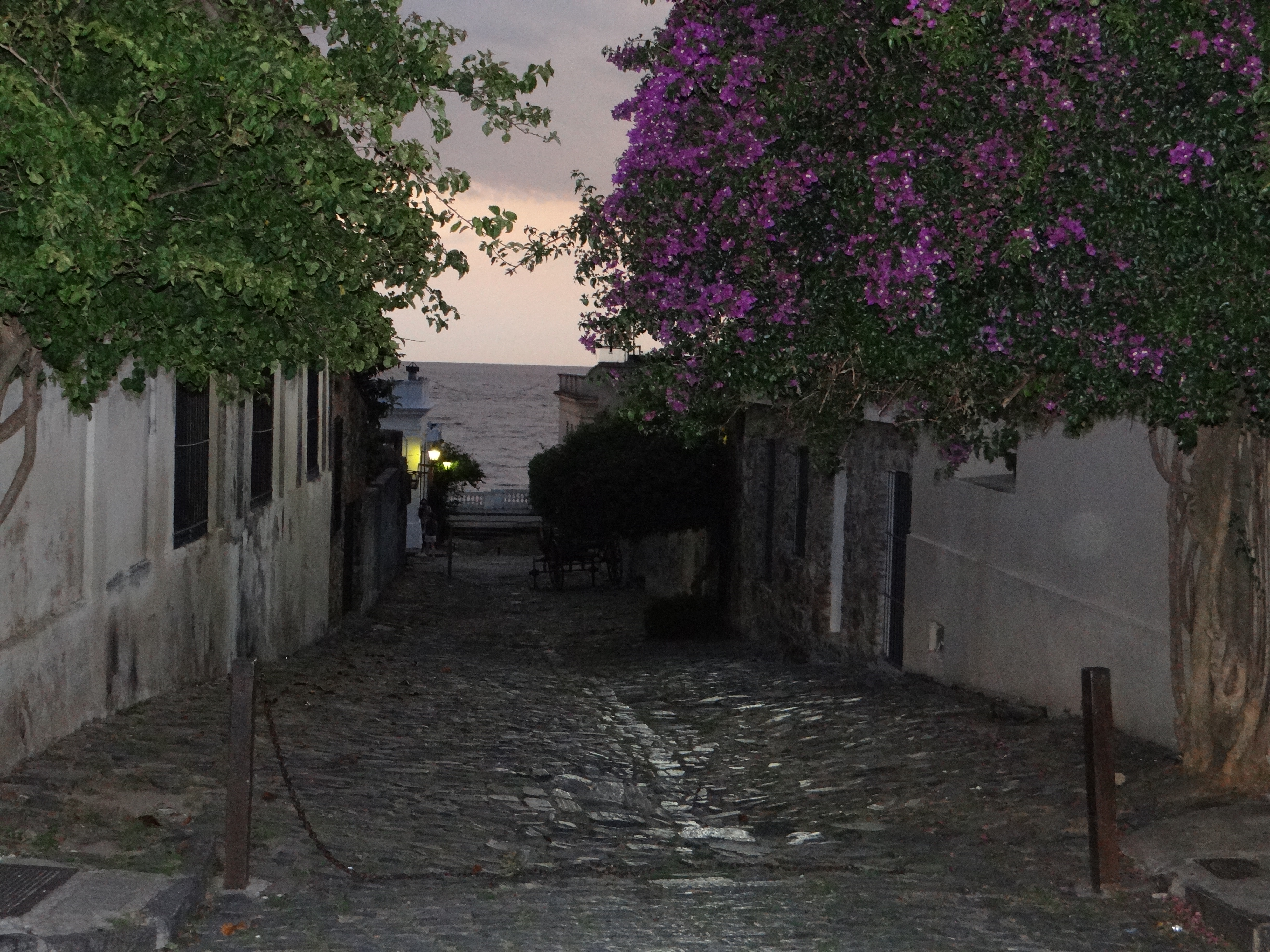
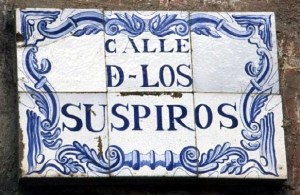
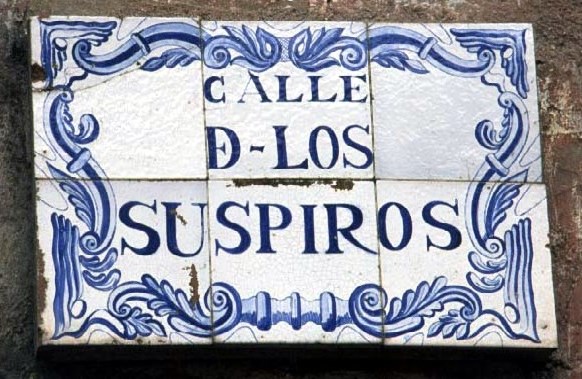
The best you can follow both styles together in “Calle de los Suspiros”,
the “street of sighs”. Today you’ll hear the sighs only when people humble
over the cobble stones. In early times the man sighs about the “beauties”
found in this street, or about the prices they asked for a lovely hour.
Calle de los Suspiros was the first one next to the barracks, where the
soldiers came to the bars with drinks and girls.
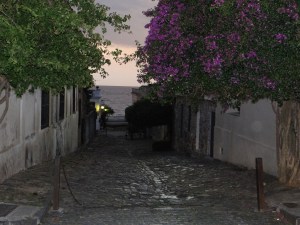
colonia 16.  DSC00080
Calle de los Suspiros. Idyllic view down to Rio de la Plata. Notice the Portuguese Street style.
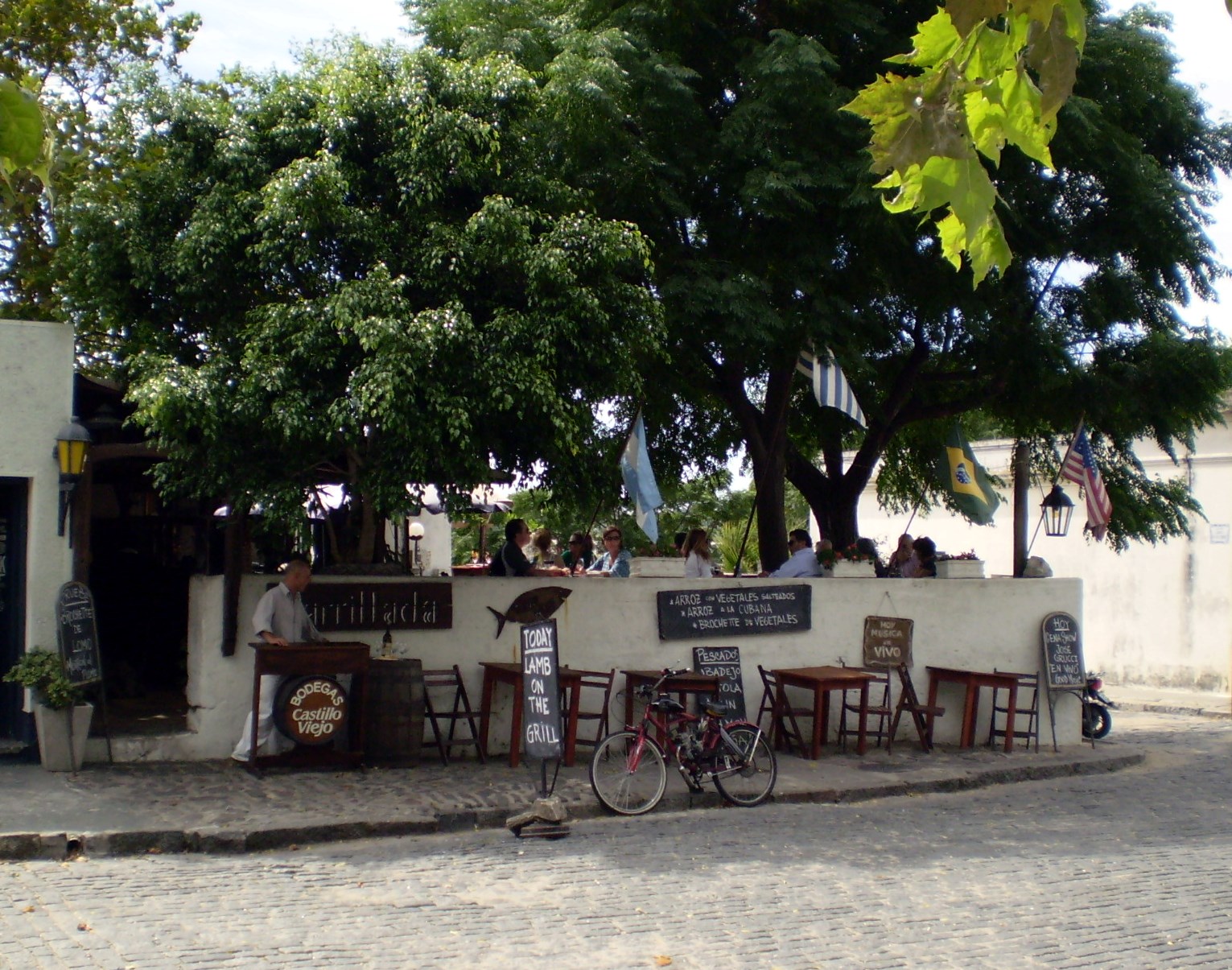
After a big walk through the city you find everywhere today cafes and bars
and restaurants for refreshments and excellent cuisine . Colonia lives
mainly on the “tourist”, especially since they lost 1000s of inhabitants
through the Argentine crisis and the closing of the biggest employer, a
textile manufacture. And tourists from any country in the world is today’s
main source of income.
DSC00072  DSC00078_2
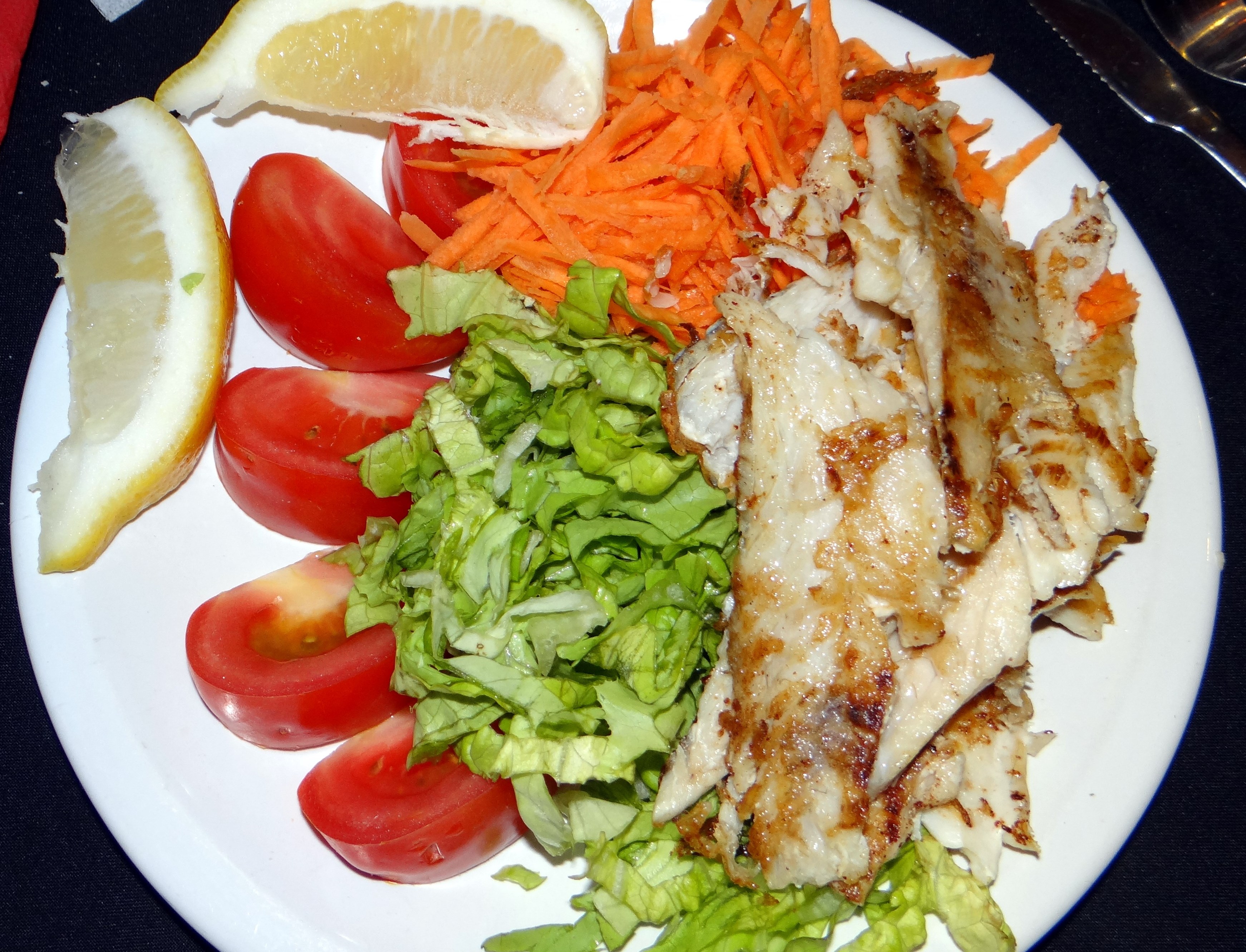
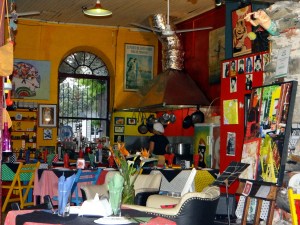
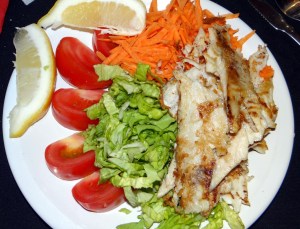
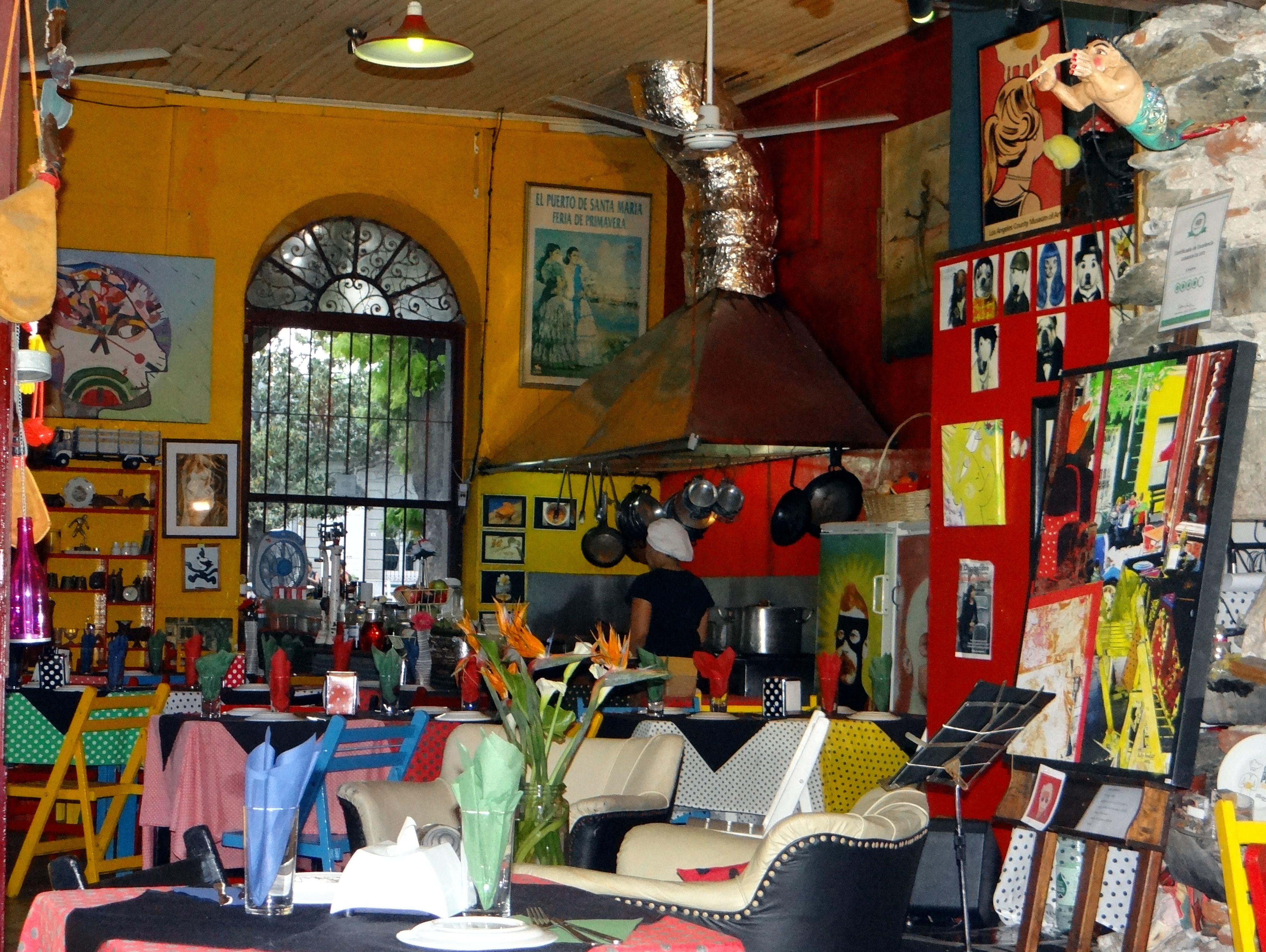
Restaurant „El Drugstore“,  a peace of colorful art. Direct across the church, one of the rare restaurants
which is open all day. Delicious corvina straight from the grill.  All needed dressings or sauces are available.
The work less rate is against zero ! Dozens of hotels , posadas (inns) and
hostels are offering their service. Even some 5 star hotels are on the list.
If you offer a 5 star service you have to have the right employees.
And these are hard to find in Colonia. During one visit I heard a “loud
speaker bike” within the city, offering a cleaning job for a hotel. And I
heard this is not just one time.
DSC00086                    DSC00069_2
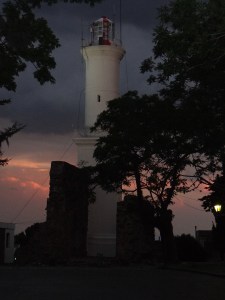
The historic light tower with the ruins of the San Franciscan convent in front.
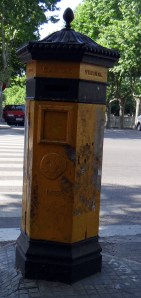
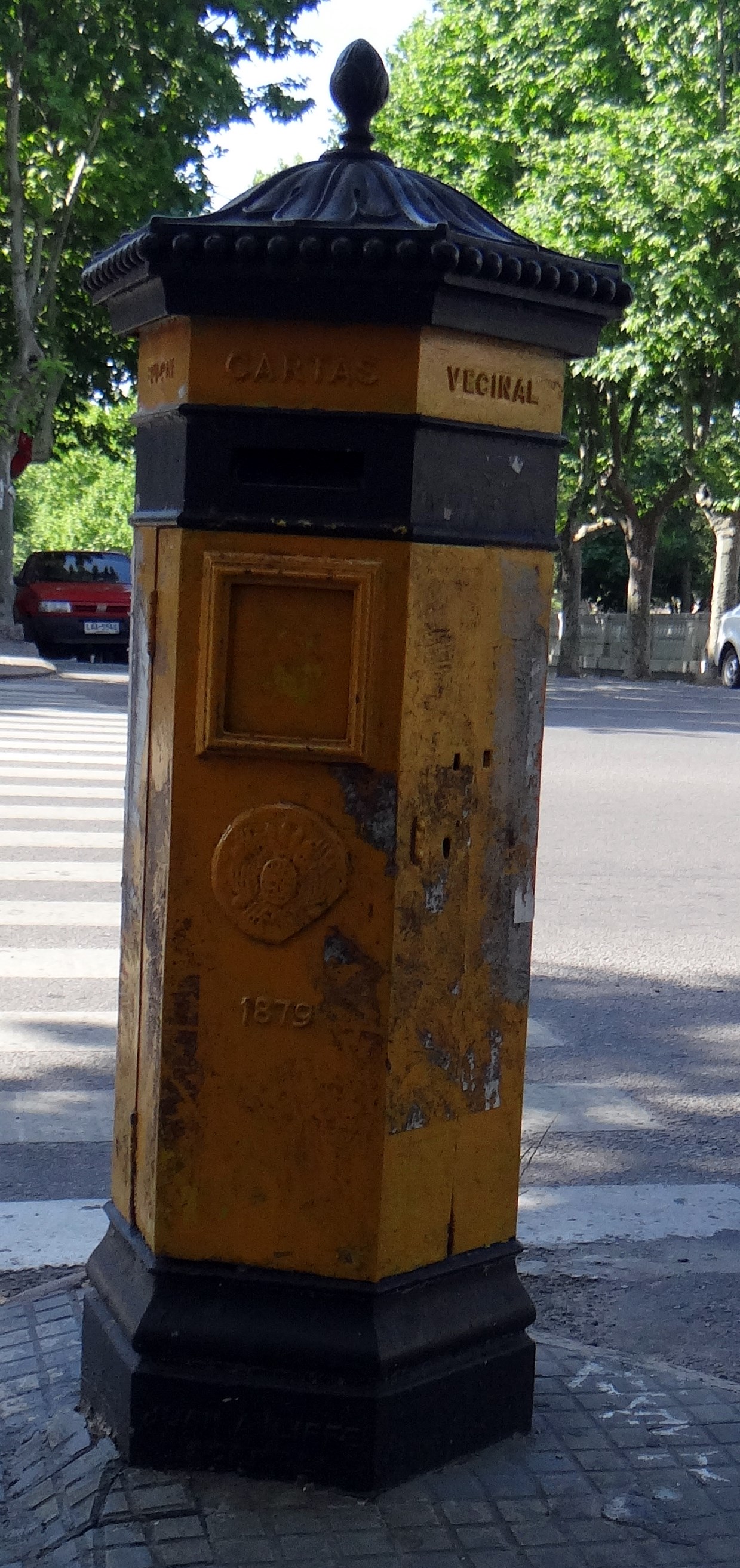
Wonderful cast iron post box from 1879. Why they just let it rot away ? Such an antique beauty !
What I like most is the sunset time, the twilight hour in Colonia, when
all the lights and lanterns are on and you still can see the orange/red sky.
I like to walk then, because most people are in their hotels for their
evening change. To mention is, that it is very safe to walk at evenings or
at night. And that there is a service in Colonia for the ones who don’t want
to walk , or can’t walk, a rental of golf carts . Easy and comfortable.
Like everywhere in Uruguay, most restaurants are open at 8.00 or even 9.00pm.
And you can choose from many, from cheap to expensive and from typical
parilla to French or Italian specialties.
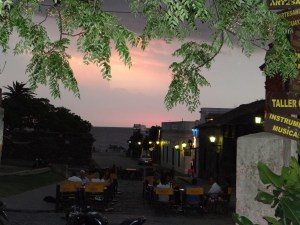
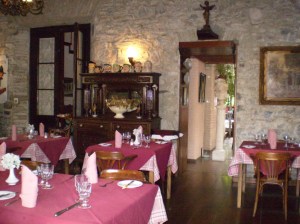
DSC00083  OLYMPUS DIGITAL CAMERA
Sit outside for an aperitif and enjoy the sunset. Later inside for a gourmet dinner, if you like.
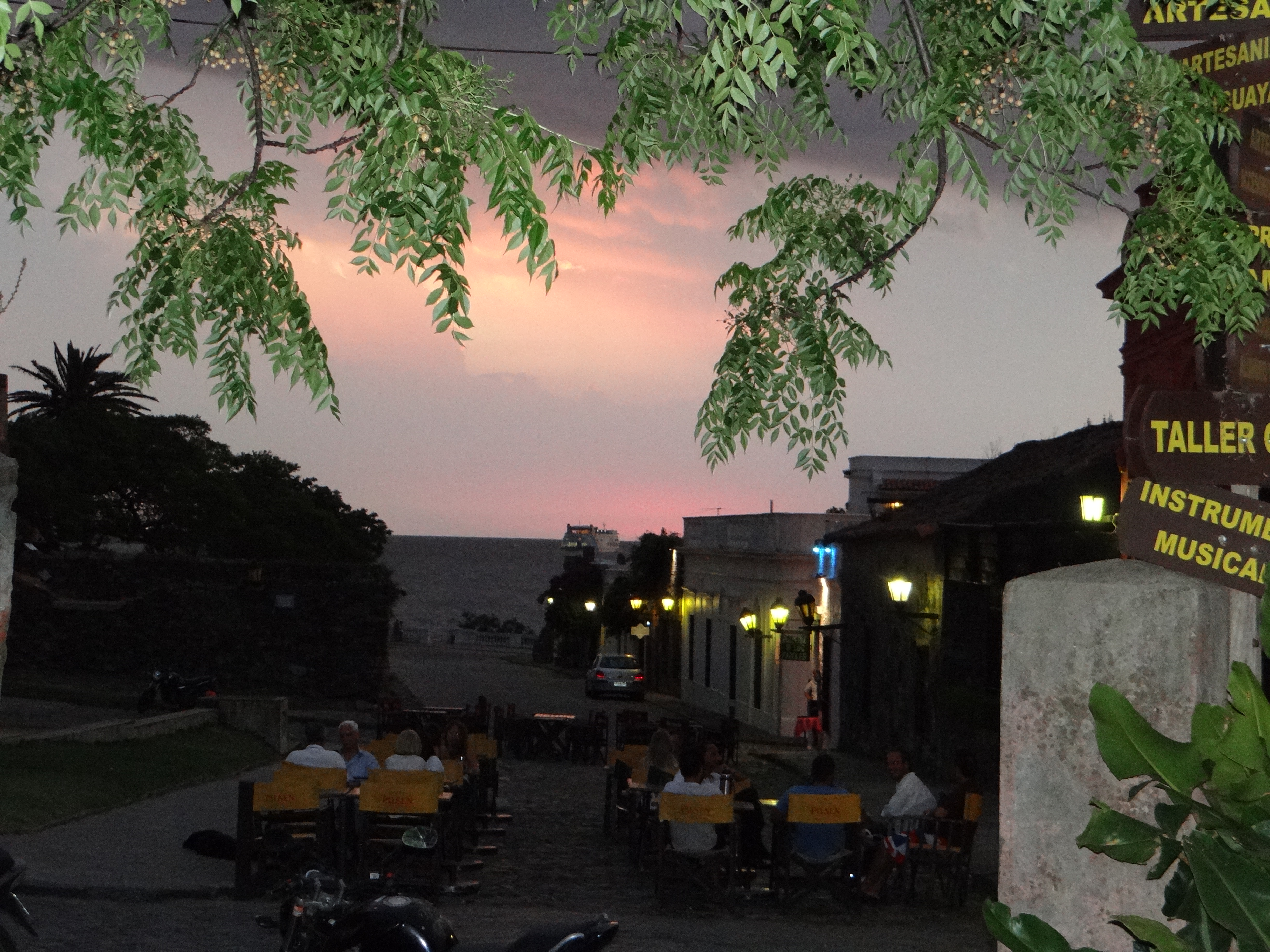
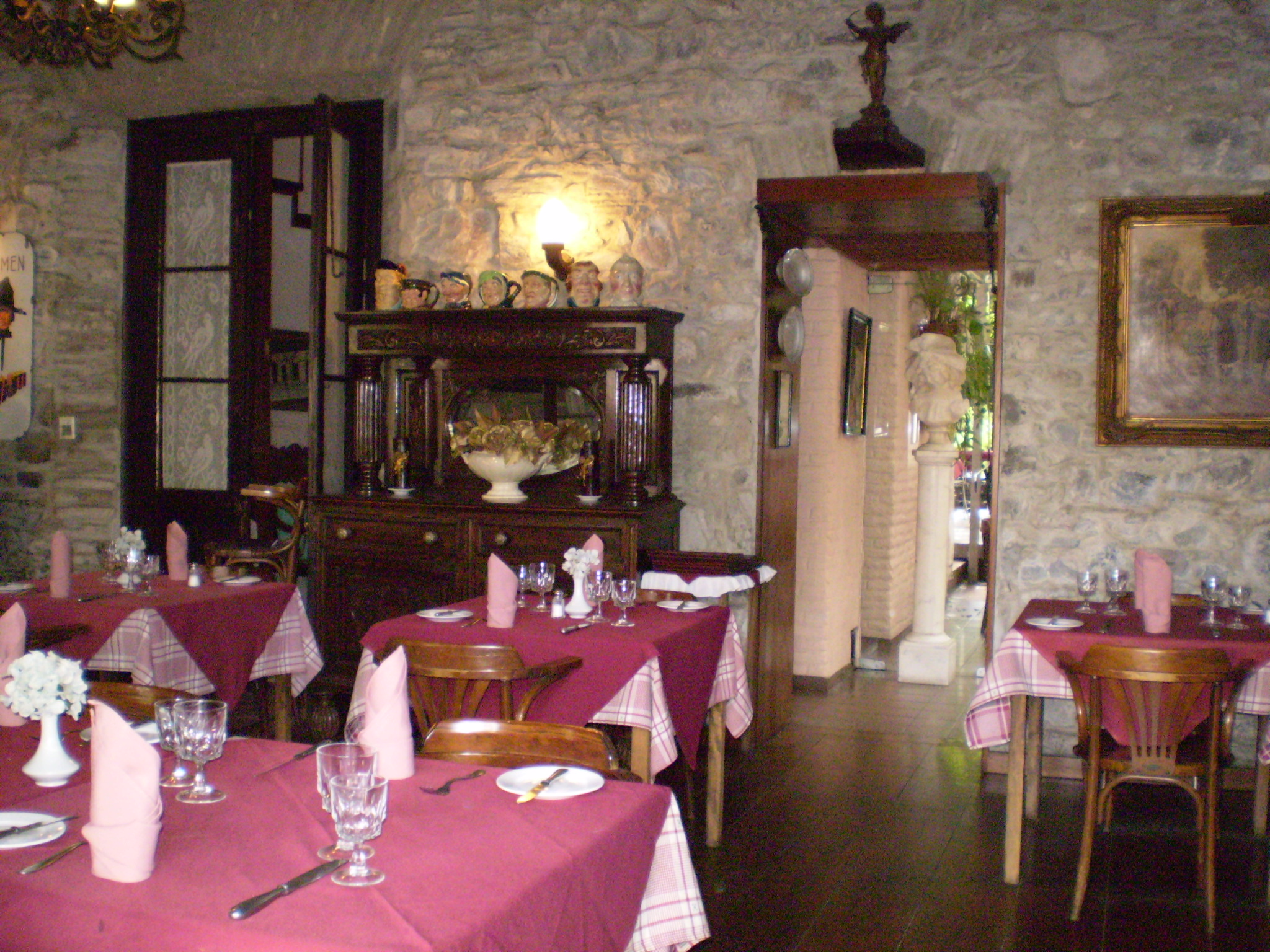
I will let follow down here a series of photographs with explanations and
can only hope that you will have such a great time, as I had, in Colonia del
Sacramento, Uruguay. The only place in the whole world, as I know, where you
still can find this kind of colonial style mixture.
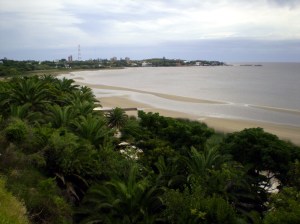
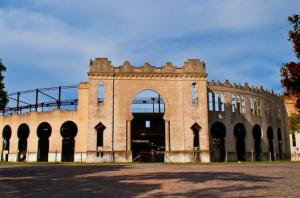
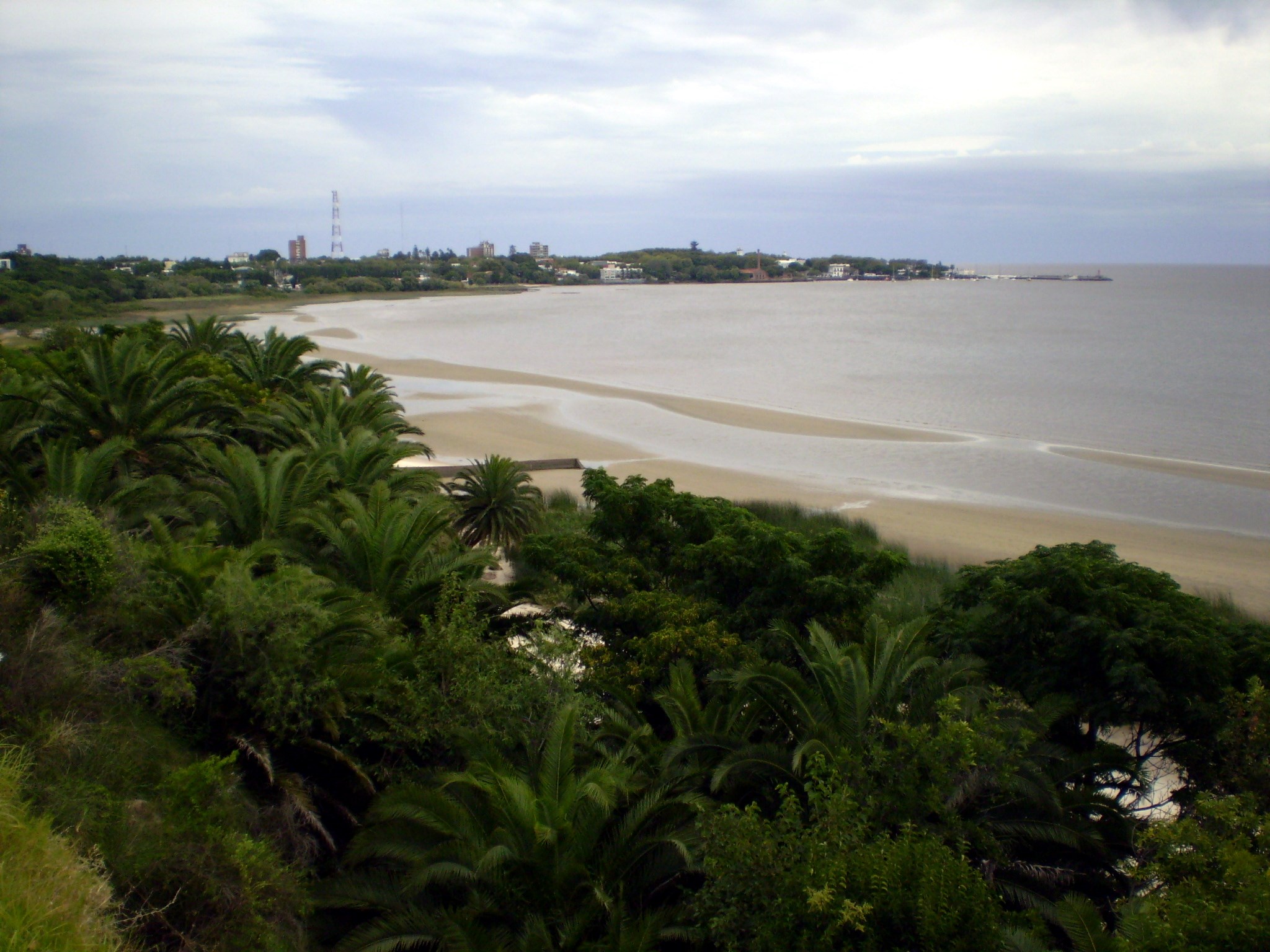
050  colonia 7
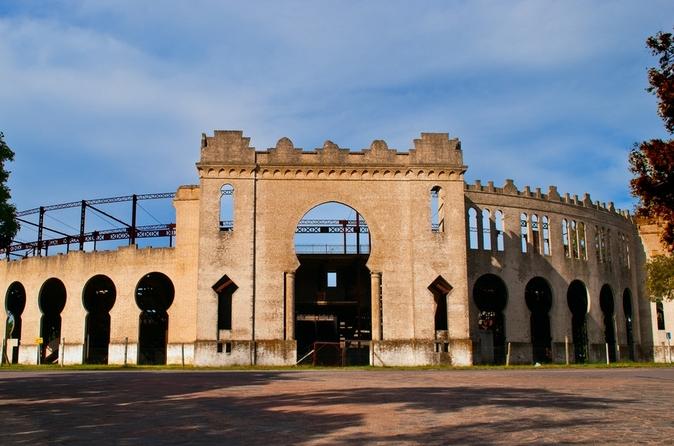
The northern beaches of Colonia. Main entrance of the old „Plaza de Toros Real de San Carlos“, Colonia.
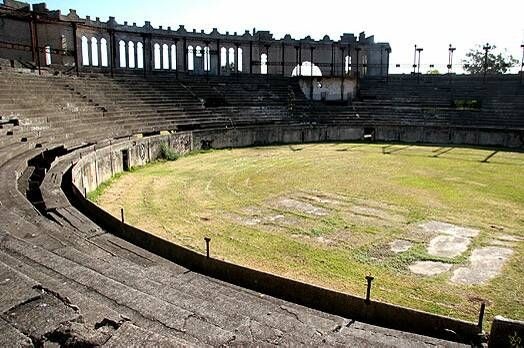
colonia 9                     colonia 19
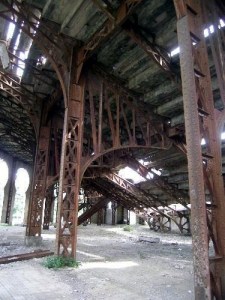
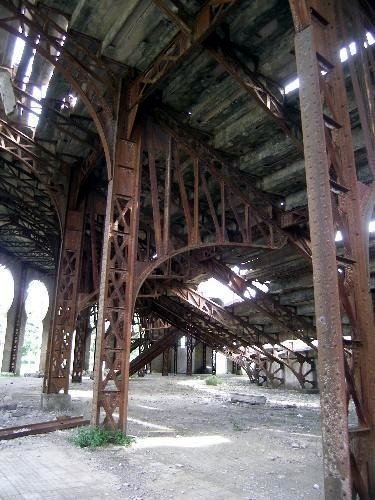
Inside the bull ring and underneath. Great iron work inside. Opened in 1910 it could host 10.000 spectators.
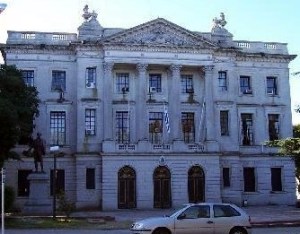
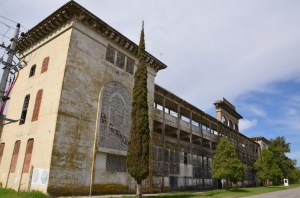
 colonia 18_2  colonia 11„Intendencia Municipal“ del Colonia.                           „Fronton del Real de San Carlos“, home of  „Jai Alai“.
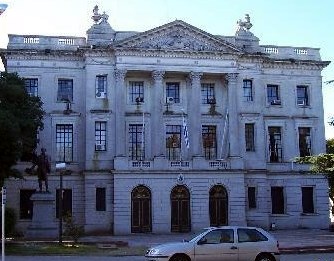
The Jai Alai arena in Colonia is almost unknown and rarely visited by tourists.
Jai Alai has a great tradition in Latin American countries. Jai Alai is promoted
as the fastest ball game of the world, because of it’s ball speed. The 130gramm
ball, covered with goat skin can reach far over 300 km/h (over 180 mph).
Jai Alai is an ancient Aztec game, brought by Cortez, around 1529 to Spain.
There it improved under the name of Pelota to a national sport. Then „exported“
again to „Spanish“ nations and now it is played around the whole world.

The name Jai Alai is Basques (North West Spain) dialect and means „Happy Game“.
Sadly is this wonderful Art Deco building in Colonia runned down. Except the
horse race track „Hippodrome Real de San Carlos“ hosts sometimes a race.

042  colonia 23
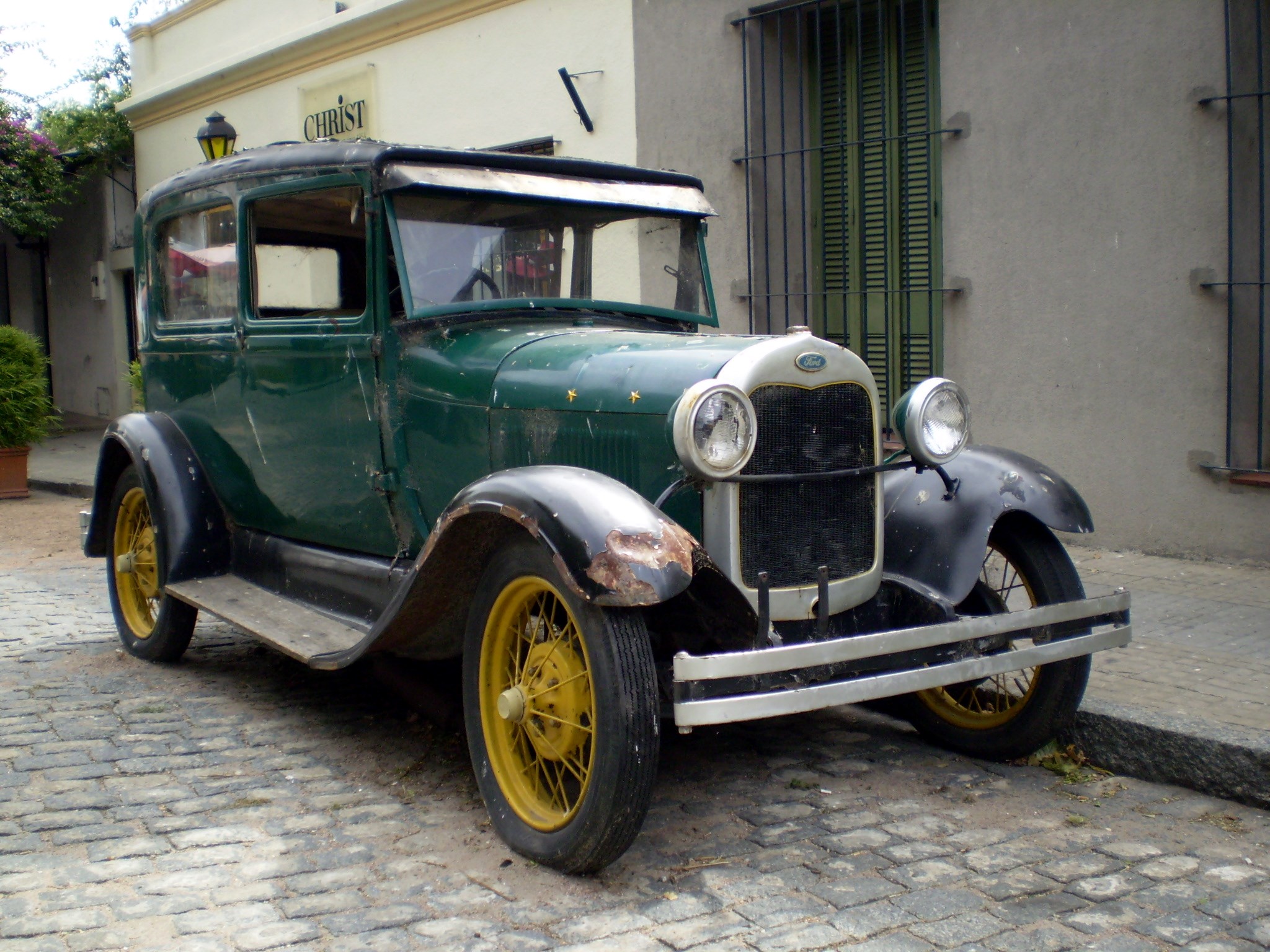
Typical for Colonia, vintage cars everywhere and the sunset behind the island
of „San Gabriel“. An idyllic end of a great trip.

Veröffentlicht unter History, Must See, Travel, Uruguay | Verschlagwortet mit , | Hinterlasse einen Kommentar

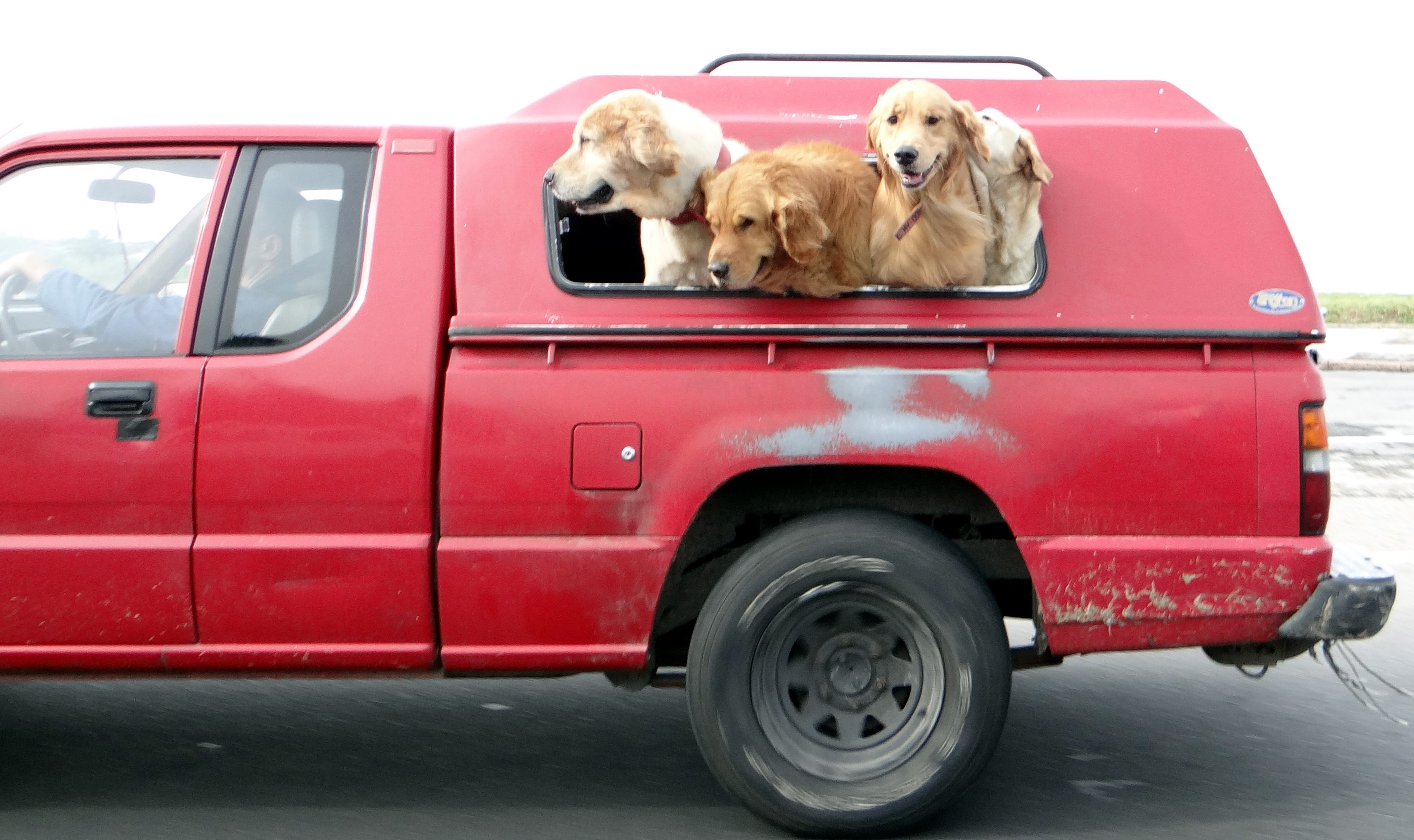
Dogs on a trip

DSC00176_2
Hello – 3 on the right hand side …

DSC00177_2
… and 4 on the left hand side !

Veröffentlicht unter Uncategorized | 3 Kommentare

Turducken

Only 3 weeks til Thanksgiving and 7 weeks until Christmas. Perfect
time for turkey meals. Turkeys are already for sale. Don’t wait to long.

A Turducken is a dish consisting of de-boned turkey, stuffed with a
de-boned duck, stuffed with a de-boned chicken. The word turducken is a
portmanteau of TURkey, DUCK and chickEN or hEN.

The thoracic cavity of the chicken or game hen and the rest of the gaps
are stuffed, sometimes with a highly seasoned mixture of different
ingredients. All different stuffing which are used for turkeys are also
used for the turducken stuffing.Although some versions have a different
stuffing for each bird, but I think that’s to much of different tastes.
The result is a fairly solid layered poultry dish, suitable for cooking
by braising, grilling, roasting or barbecuing. I prefer slow roasting .

cooking with mike 2 010
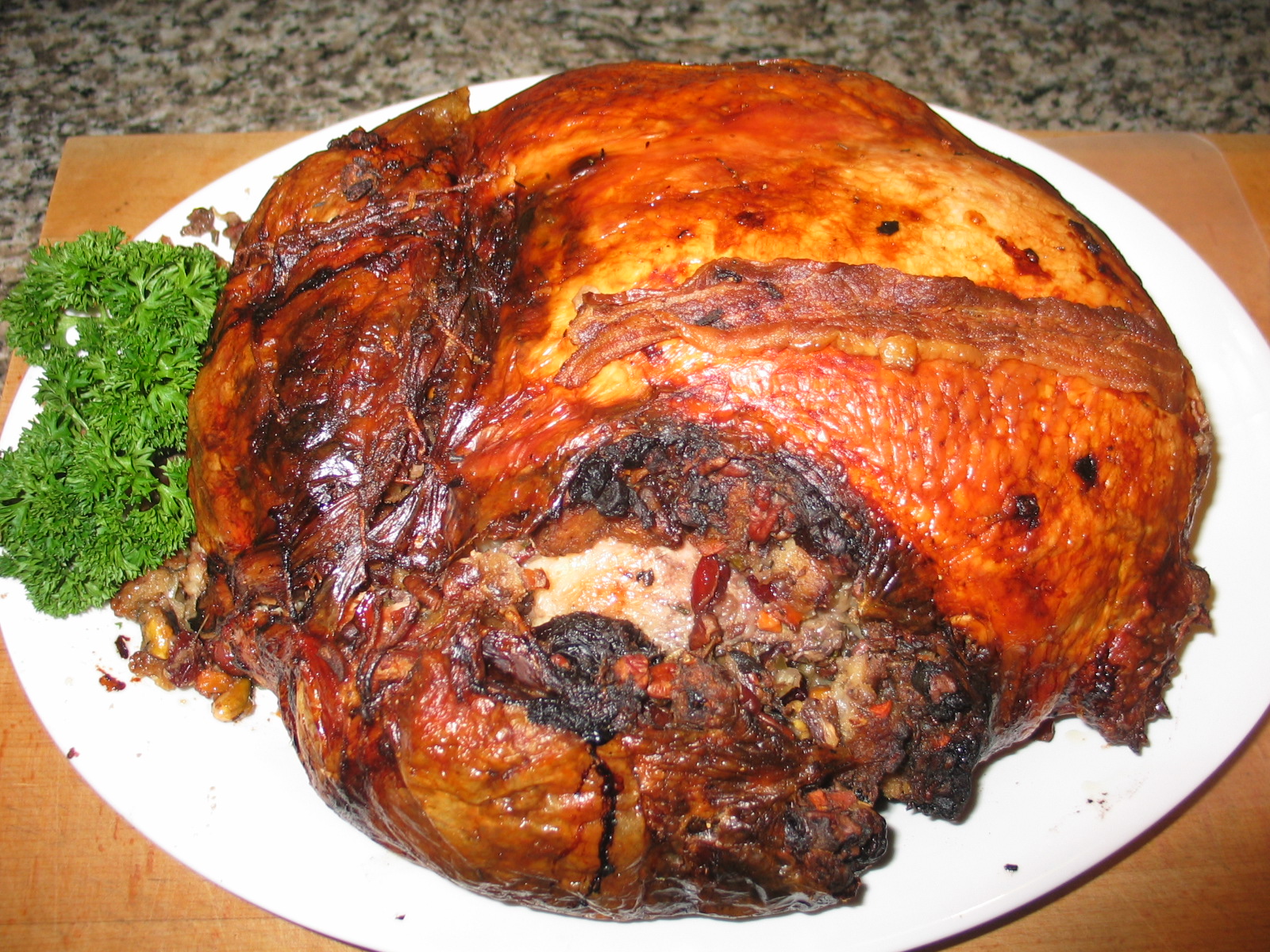
Mmmm.. a mouthwatering turducken.

Turducken is very common party hit, because most have a sausage stuffing.
A 30 pound turducken can feed a lot of people. Different turduckens are for
sale all over the US and especially via mail orders.

turducken 3
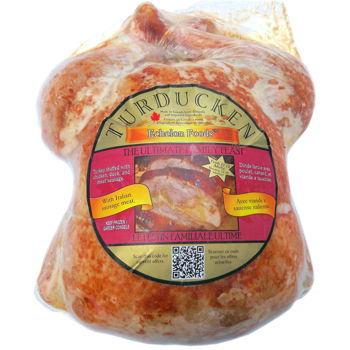
They claim: „Original Turducken with Spicy Italian Sausage“.
Sells by costco/US and features: 4kg (8,8lb.), Feeds 15 people,
Price US$ 129.99, 1 item, shipping and handling included !

Here in Uruguay is a turkey a rarity, imported and quiet expensive.
A duck, a rarity too ! May be – once a year – spoil yourself, its Lifestyle.

History :

Roasts of nested birds or other animals have been documented for centuries.
The Yorkshire Christmas Pie, an English dish served in the 1700s, consists
of five different birds, either layered or nested, and baked in a standing
crust. The pie was normally produced only by the wealthy.

First Thanksgiving
The First Thanksgiving in America, 1621. Smithonian.
Traditional Thanksgiving dinner includes turkey,
stuffing and mashed potatoes but the First Thanksgiving
likely included wildfowl, corn, porridge and venison.

In his 1807 „Almanach Des Gourmands“ (first edition 1803),
gastronomist Grimod de la Reyniere presents his „roti sans pareil“ (roast
without equal). Contents were, first a bustard stuffed with a turkey, a goose,
a pheasant, a chicken, a duck, a guinea fowl, a teal, a woodcock, a partridge,
a plover, a lapwing, a quail, a thrush, a lark, an ortolan bunting and a
garden warbler. WOW 16 birds !! Other sources write about „up to 18 birds“ !
They were then „stitched“ on a skewer, that the middle had all birds lined,
then it was possible to carve along the skewer and show at least one part (one
slice) with all meats (all birds) together. Fantastic, would like to see this!

Reyniere although states that, since similar roasts were produced by ancient
Romans, the „roti sans pareil“ was not entirely novel. The final bird is very
small but still large enough to hold an olive ! It also suggests that, unlike
modern multi-bird roasts, there was no stuffing or other packing placed
between the birds. Today it appears to be illegal to make such roasts as some
of the species are endangered.

How to do ?

Since in Uruguay the chicken are very big and the ducks small, one should pick
a small chicken and find a bigger duck. The reason is that we want to slice
through different meat colors, white-brown-white plus stuffing.The last one
I made had an additional pigeon inside. 4 meats, white-brown-white-brown.
Wonderful, and pigeons are available almost everywhere. Contact a hunter.
This recipe goes for the classic 3 bird variation.

cooking with mike 2 006
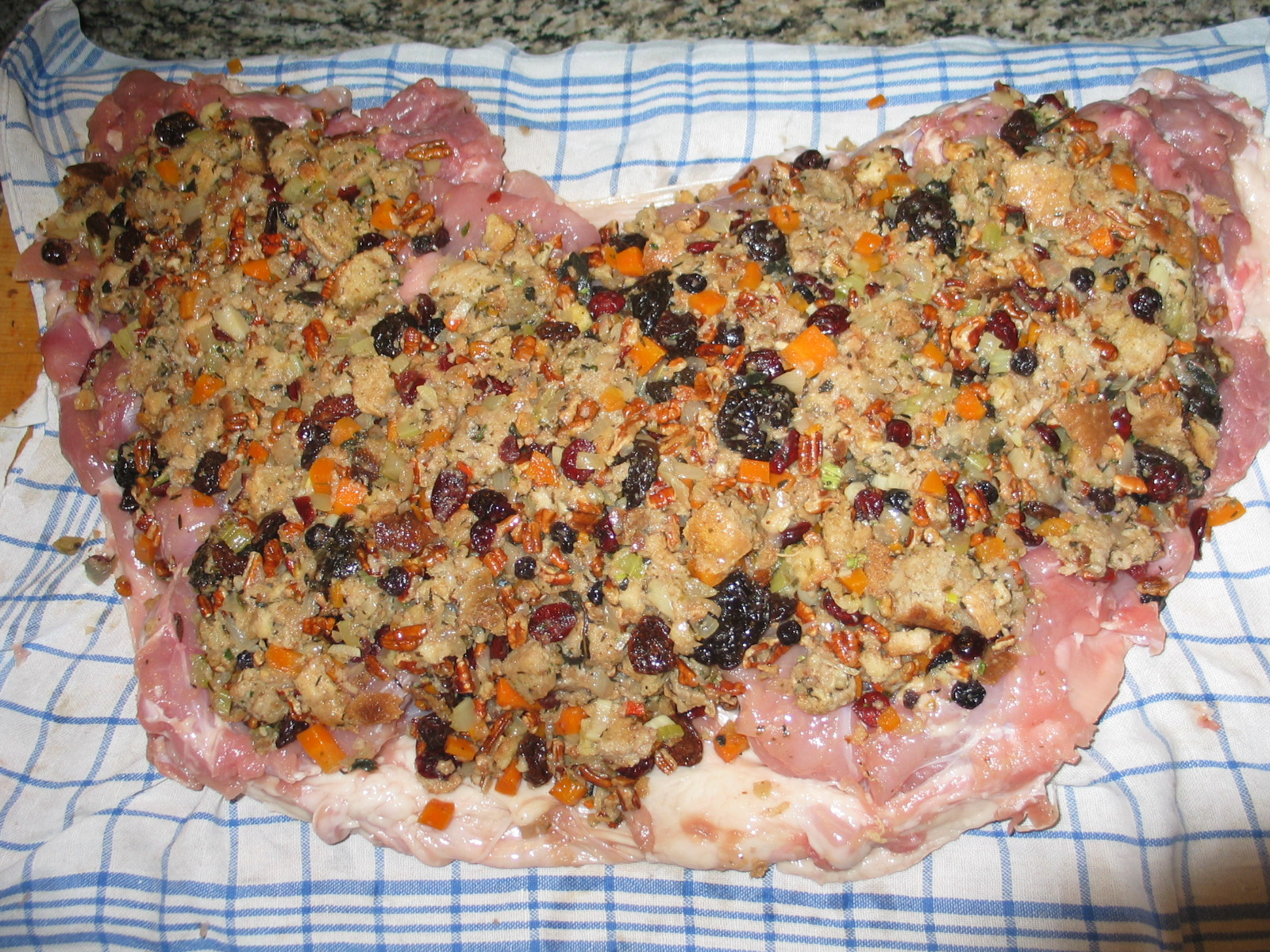
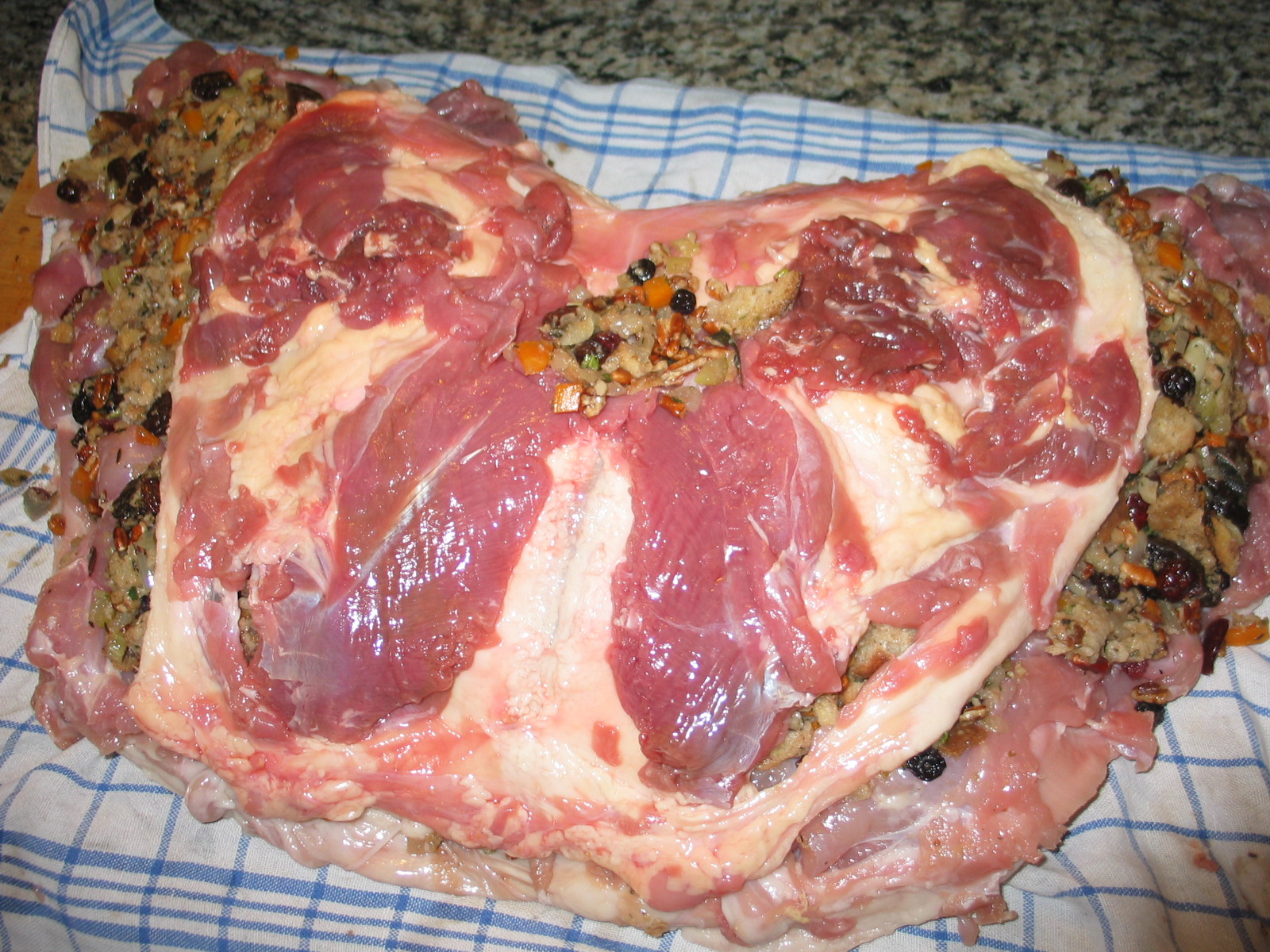
First layer, turkey with stuffing.

Turducken is not to difficult to make, it is just very time consuming.
Only more difficult part is, to de-bone the birds. I prefer to take out all
bones. If you want it easier, leave the leg bones and just remove the carcass
or – even better, let your butcher do it for you. Plan on adequate preparation
time. Best prepare a day before and cook on day of eating. The end result is
a worthy show stopper !

Ingredients :

* prepare 3 cups savory bread crumble stuffing at room temperature,
* prepare 2 cups cornbread stuffing at room temperature,
* 1/4 cup chopped pecans or walnuts,
* 1/2 cup whole berry cranberry sauce,
* 1 (10-12 pound) turkey, de-boned,
* 1 (4-5 pound) duck, de-boned,
* 1 (3-4 pound) chicken, de-boned,
* 5-6 tablespoons butter,
* 4 cloves garlic, cut into small quarters,
* 6 fresh sage leaves, dry ones will do also,
* 1 cup of sweet black raisins, or 1 cup of diced black olives,
* 2 tablespoons of fresh thyme leaves,
* 2 tablespoons of browning sauce, or sauce from your last roast,
(which i use to keep as „ice cubes“ in my freezer, like lemon juice),
* 2 tablespoons olive oil,
* kosher salt and fresh ground black pepper.

Preparation:

Keep all the poultry refrigerated until you are ready to use it. Do not assemble
the turducken til you are ready to roast it, to avoid contaminated stuffing.
Measure out 2 1/2 cups of bread stuffing and set aside. Place remaining 1/2 cup
in another bowl and add 1/2 cup of corn bread stuffing along with the whole
crawnberry sauce and pecans and 1/2 cup of the raisins. Toss gently to combine.
Combine remaining cornbread stuffing with remaining raisins and set aside.
You should have 3 differnt stuffing bowls now.

cooking with mike 2 007
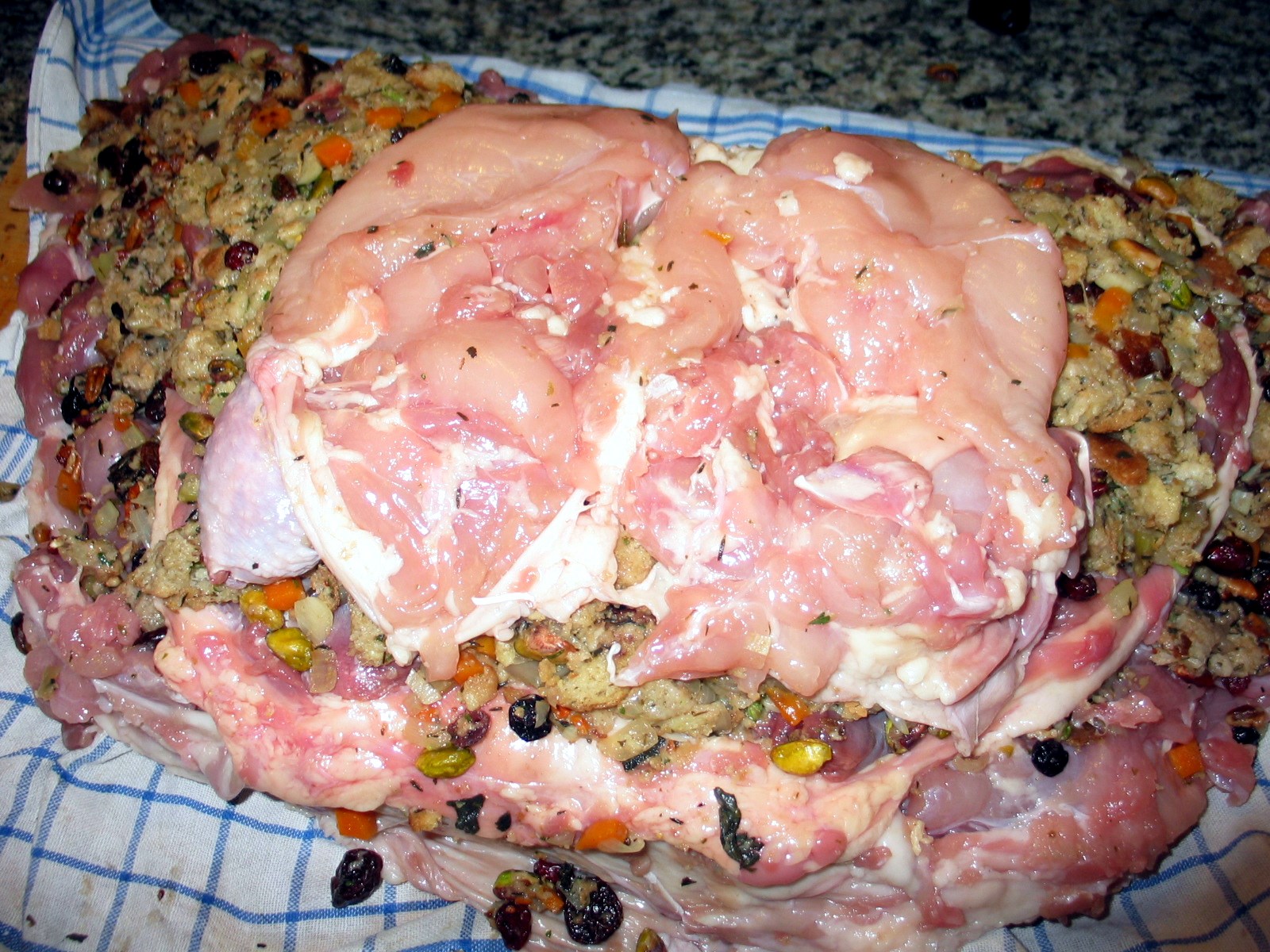
Second layer, duck on turkey.

In a food processor with metal blade, combine butter, garlic, sage and thyme until
herbs are finely chopped. Run your hand careful under the skin of the turkey and
make a pocket, but don’t separate the skin completely from the meat. Place the
butter and herb mixture evenly under the skin. Then rub the turkey with the
browning sauce and the olive oil and sprinkle generously with salt and pepper.

Now flip over the turkey, that you have it flat and skin side down. Sprinkle with
salt and pepper.

Preheat oven to 160grad Celsius (325 F)or moderate heat.

Spread bread stuffing evenly over turkey cavity. Place duck on top of turkey, skin
side down, and make sure all around is turkey to see. Spread cranberry nut
stuffing over the duck cavity. Top with the chicken, skin side down. Now spread
cornbread and raisin stuffing on top of the open chicken.

cooking with mike 2 009
Third layer, chicken on duck.

Skewer the back of the chicken closed. Bring up the sides of the duck to cover the
chicken. Skewer the back of the duck closed. Repeat process with the turkey. If the
last skewer is to slippery you can close the turkey with cooking thread.
Carefully turn over the turducken, so its seam side down and breast side up. Remove
all skewers except the last one holding the turkey together.
Place turducken in a heavy roaster, If needed sprinkle a bit more olive oil, salt
and pepper over the turducken. Roast 3 to 4 hours, until a meat thermometer, inserted
in the very center of the chicken stuffing, reaches 85-90grad Celsius (165 F). Baste
once per hour with pan juices. I always keep a cup of light red wine on the bottom of
the pan to keep the air inside the oven moist. If the turducken begins to get too
brown, tent loosely with heavy aluminium foil coated with cooking oil spray.

cooking with mike 2 011_2
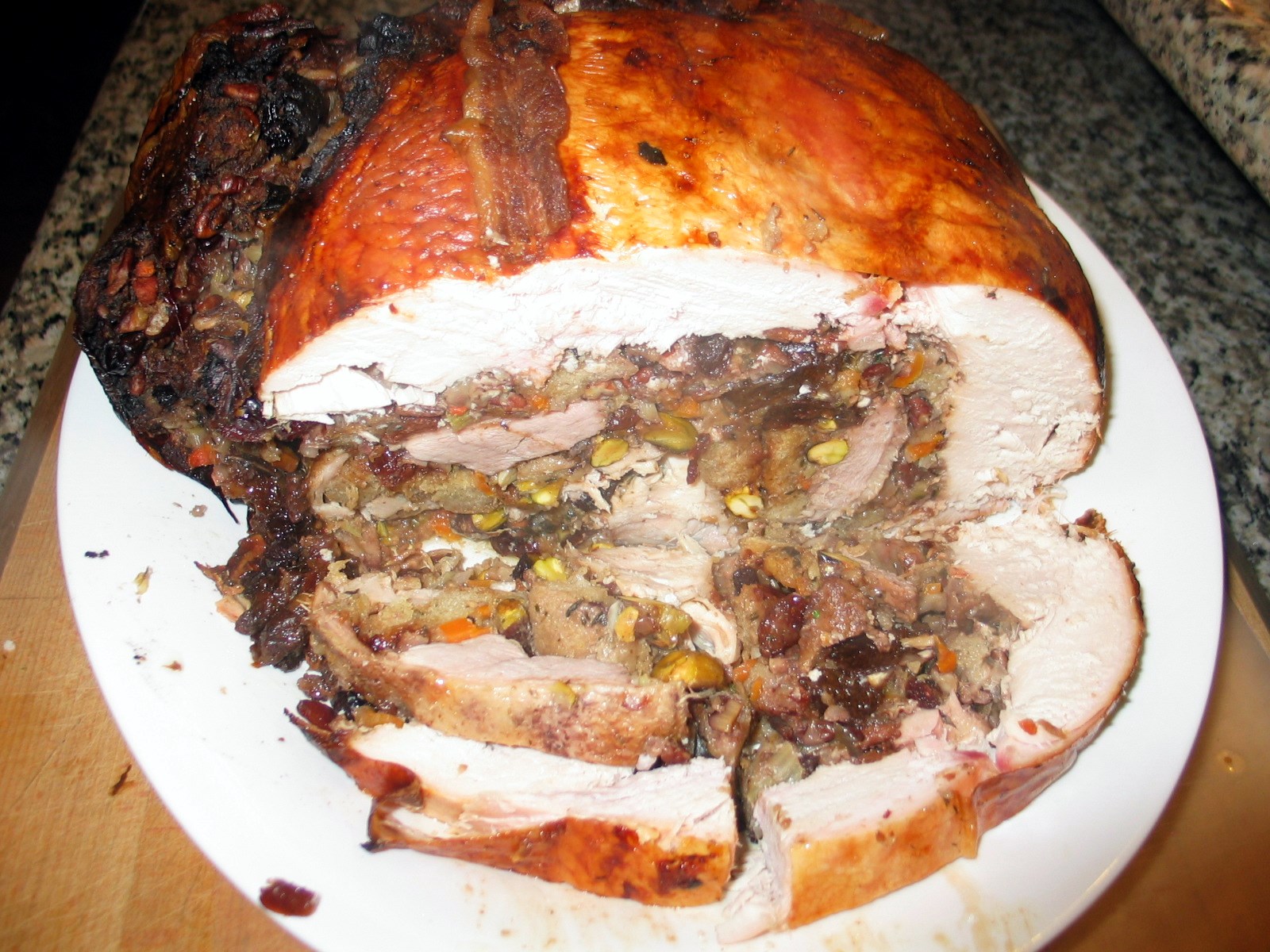
Fresh carved turducken.

Let the turducken rest for 30 minute, covered with foil, before carving. To serve,
slice turducken across the breast to show off each layer of this fine roast.
This meal goes well with all side dishes you like to serve with poultry. Also a
separate made gravy or poultry stock sauce is fine. Extra cranberry sauce or hot
applesauce with green pepper corns are delicious with turducken.

turbaconducken_2
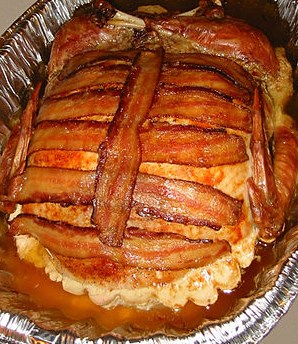
Interesting variety is the bacon covered turducken,
therefore its called „turbaconducken“.

With such a feast you should care for an excellent wine. A fruity Chardonnay or
Gewuerztraminer or a nice Cabernet Sauvignon will do. Tannat or Shyraz would
be to heavy in taste. E N J O Y !!

Veröffentlicht unter History, Lifestyle, Recipes | Verschlagwortet mit , | 2 Kommentare

Anaconda in Uruguay ?

A farm guy for lunch ?

Snake

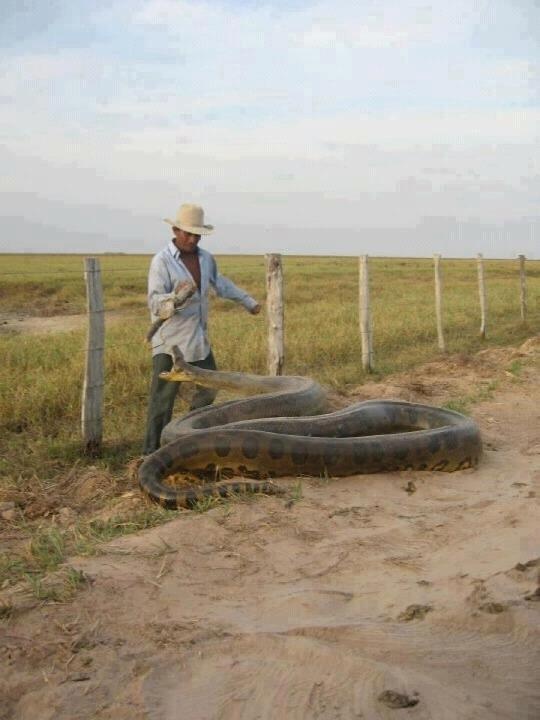
This is a YELLOW ANACONDA .
 
Only a few snakes have so much legend attached to them as the Anaconda, though stories of specimens reaching 20m (60 feet) in length wildly exaggerated. See the action movies they made, by example : Anaconda 1 and 2 and  ???  In fact the maximum length recorded is more in the region of 7m to 9m (20-27 feet), whilst these days the majority of „big“ anacondas encountered measure between 3-4m (9-12 feet).
Like other members of its family this one here is a constrictor, they are not poisonous, and though it is capable of delivering a nasty wound if it bites, the vast majority of individuals are non-aggressive and prefer to flee. This species is distributed mainly in western Paraguay. Mainly !!??   Can they also appear in Uruguay  ??
 If they hunt, they can stay up to 15 minutes under water, just the eyes are seen, and then they catch their loot, roll around it and they crush and squash it. They are able to sling down a whole pig or even a crocodile.
Same one down here, shows a length of about 7,50m (22,5 feet). I did not try to measure her !!!

FIGURE 1

Veröffentlicht unter Information, Uruguay | 2 Kommentare

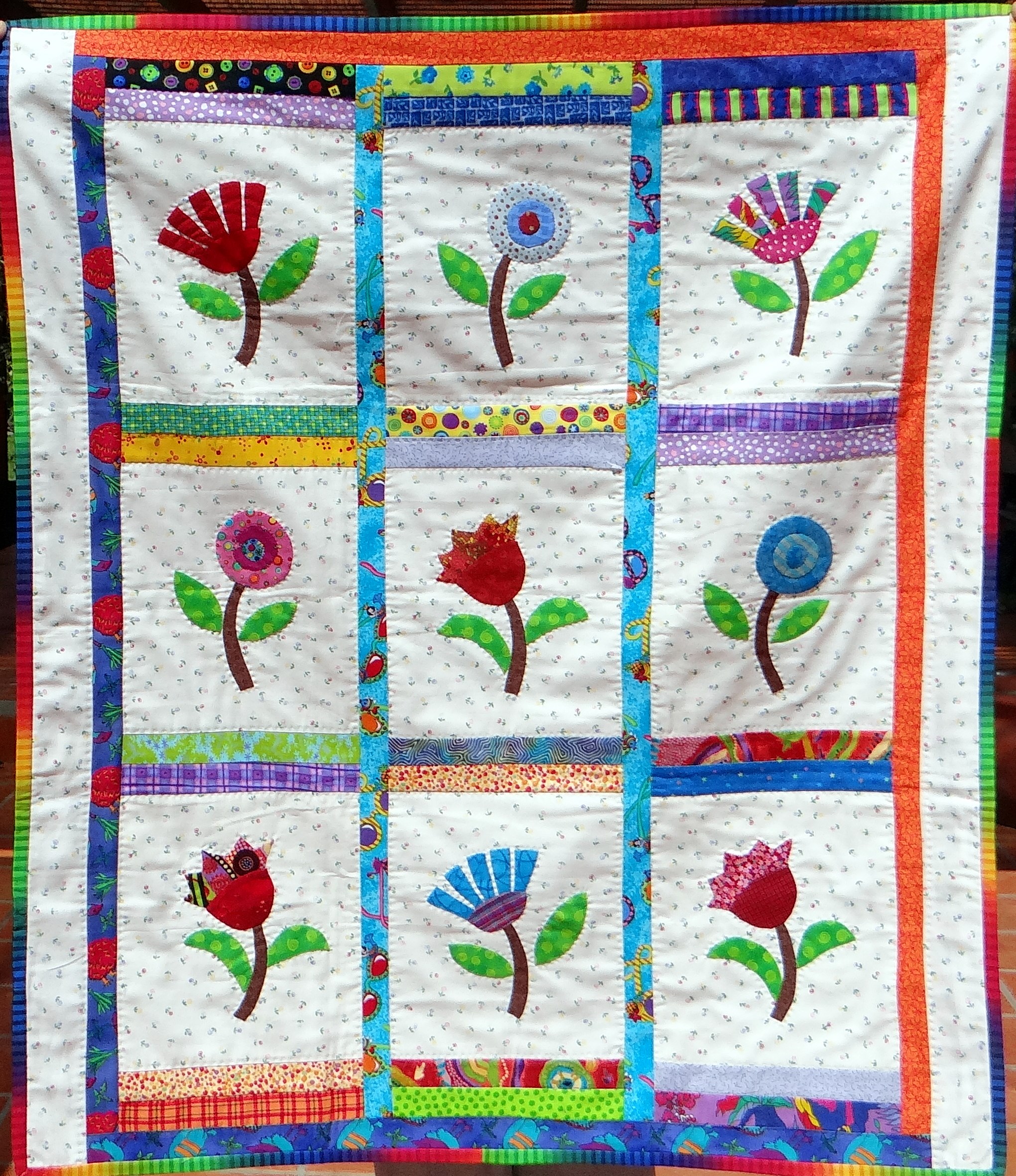
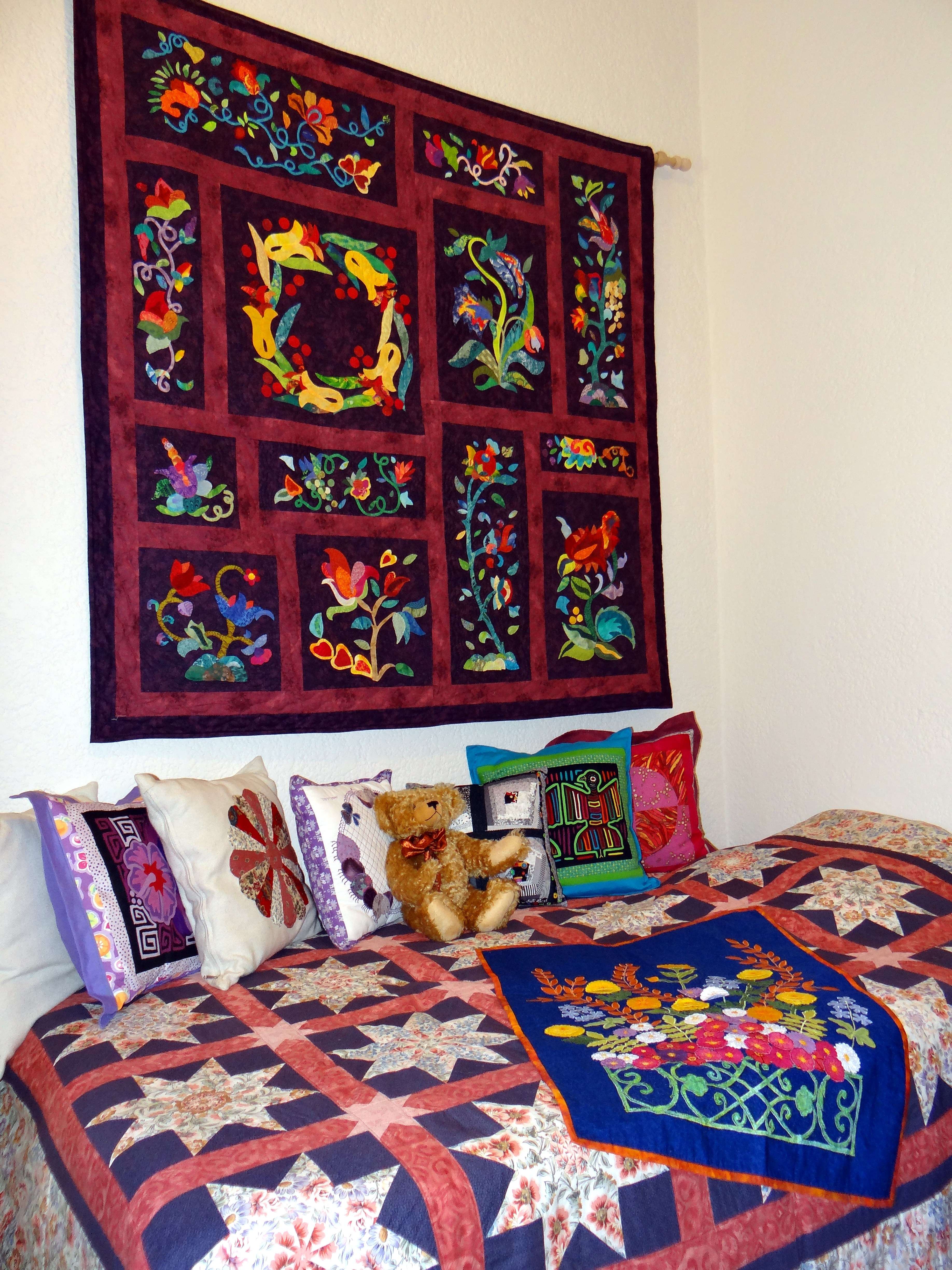
Rainbow Flower Quilt US$ 145,–///GONE///

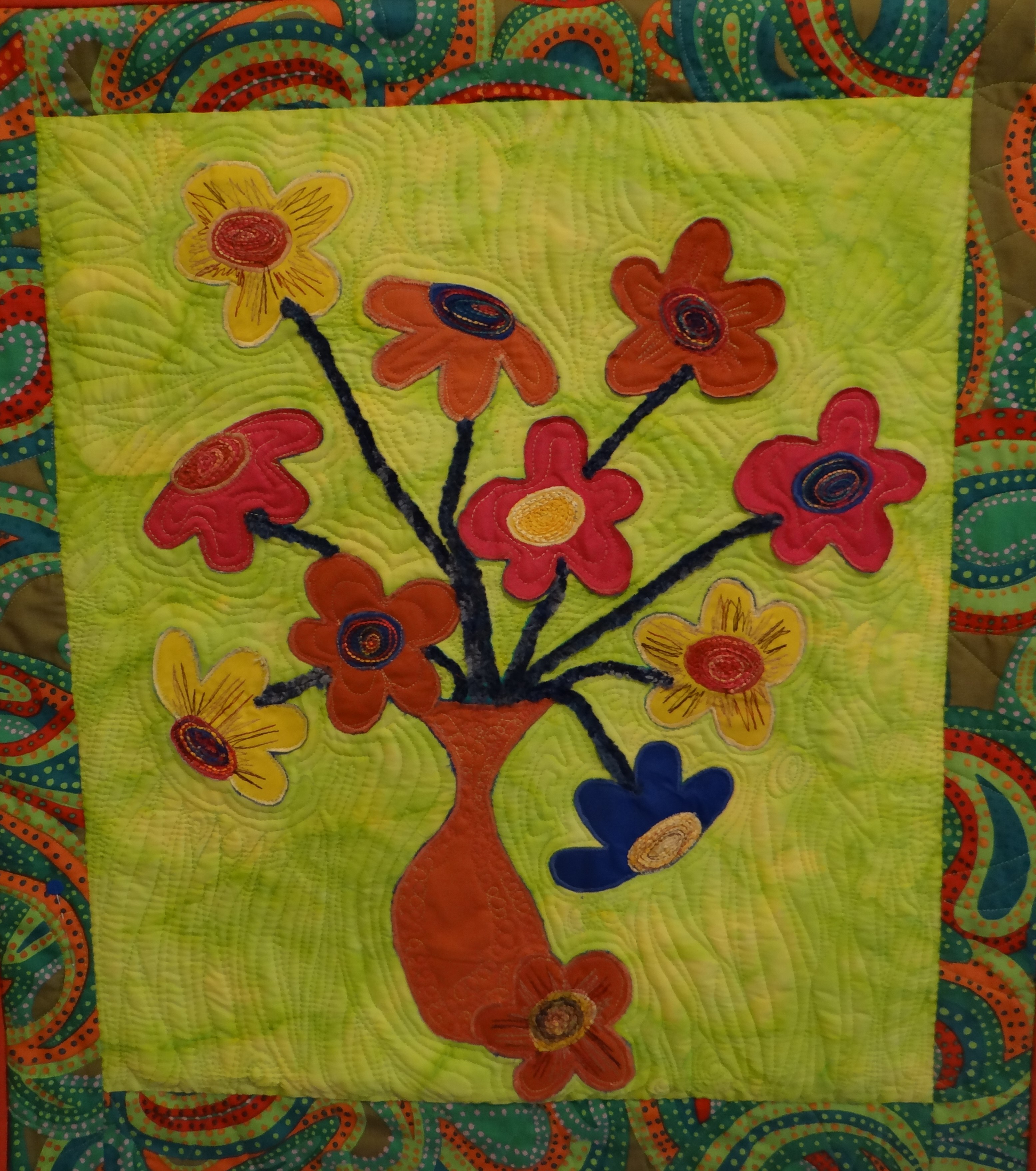
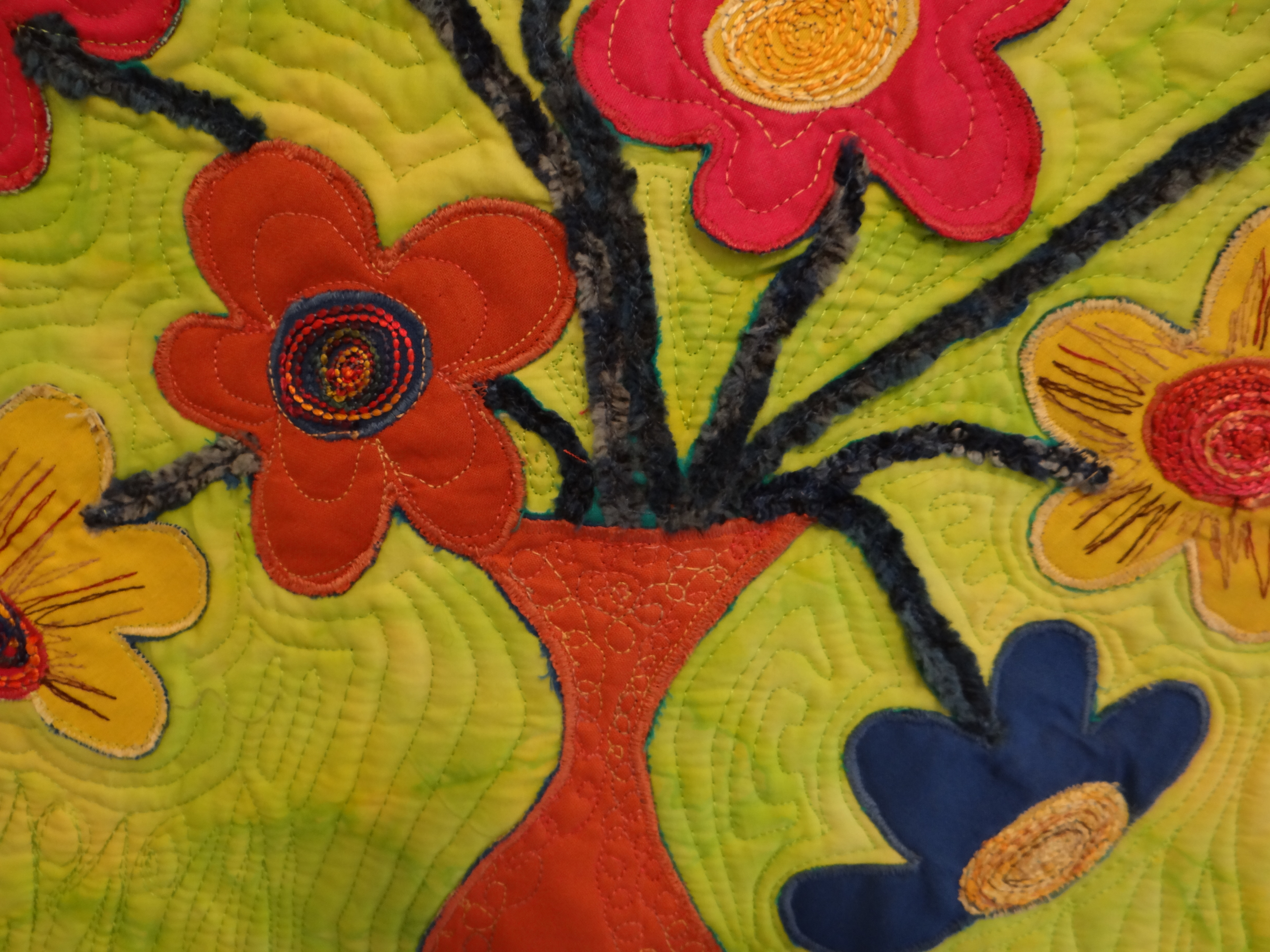
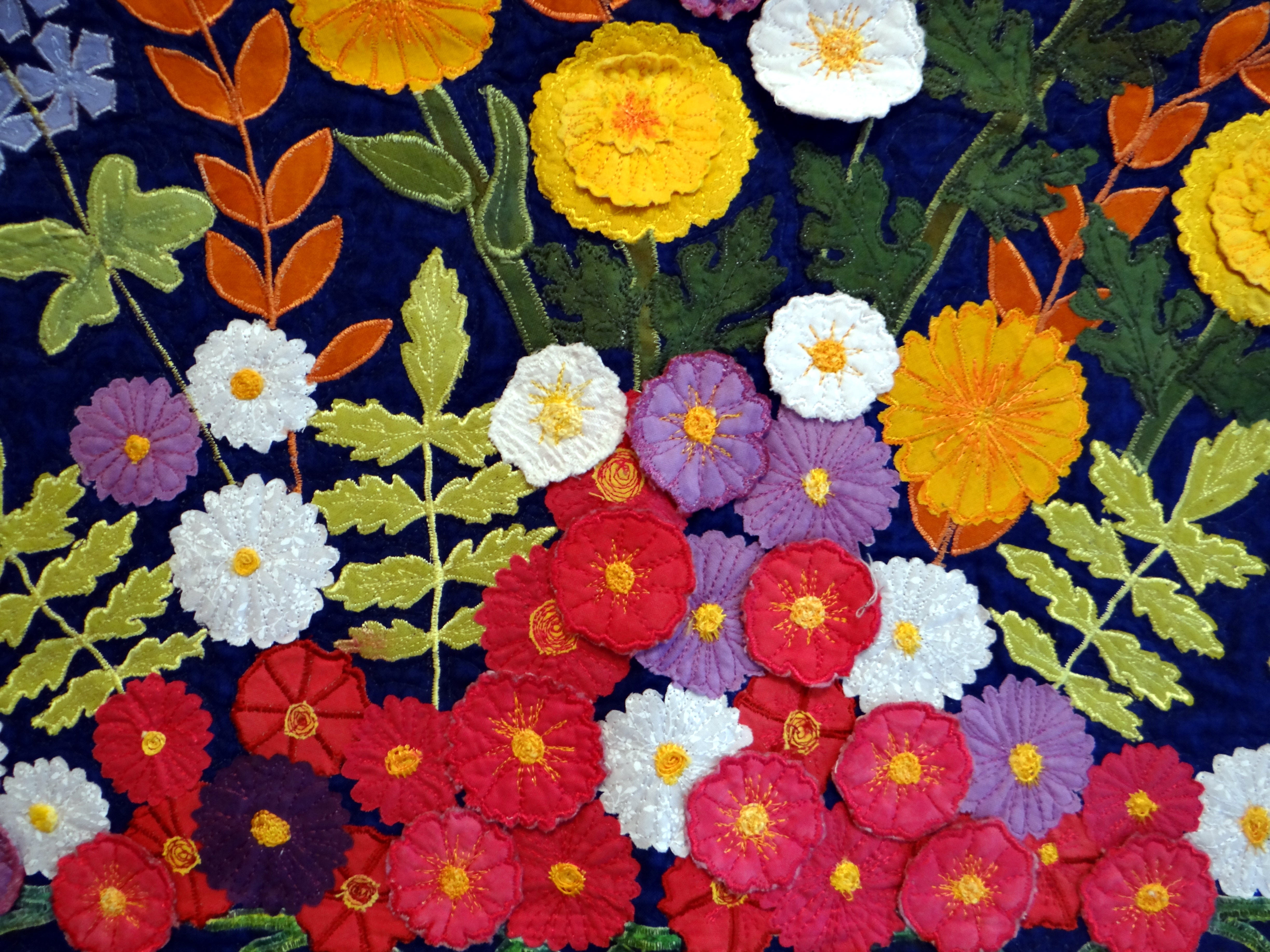
DSC00200_2 This quilt has very nice rainbow colors and hand applique flowers, size 100x82cm (c.40x33inch), very positive and fresh looking wallhanger.

Veröffentlicht unter For Sale | Verschlagwortet mit | 1 Kommentar

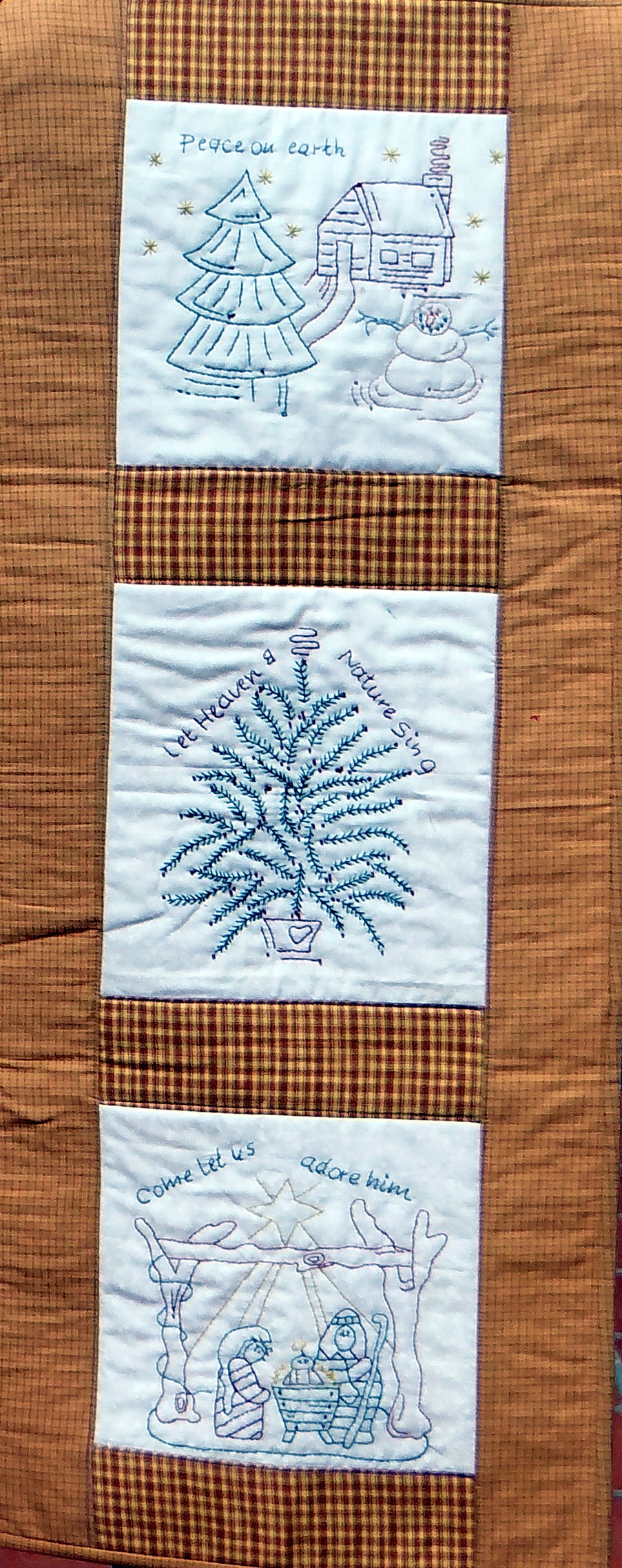
Peace on Earth Quilt US$ 60,–///GONE///

DSC00199_2

Wonderful hand embroidery, Christmas wall hanger,
size 108x44cm (c. 43x18inch), Christmas motives.

Veröffentlicht unter For Sale | Verschlagwortet mit , | 2 Kommentare

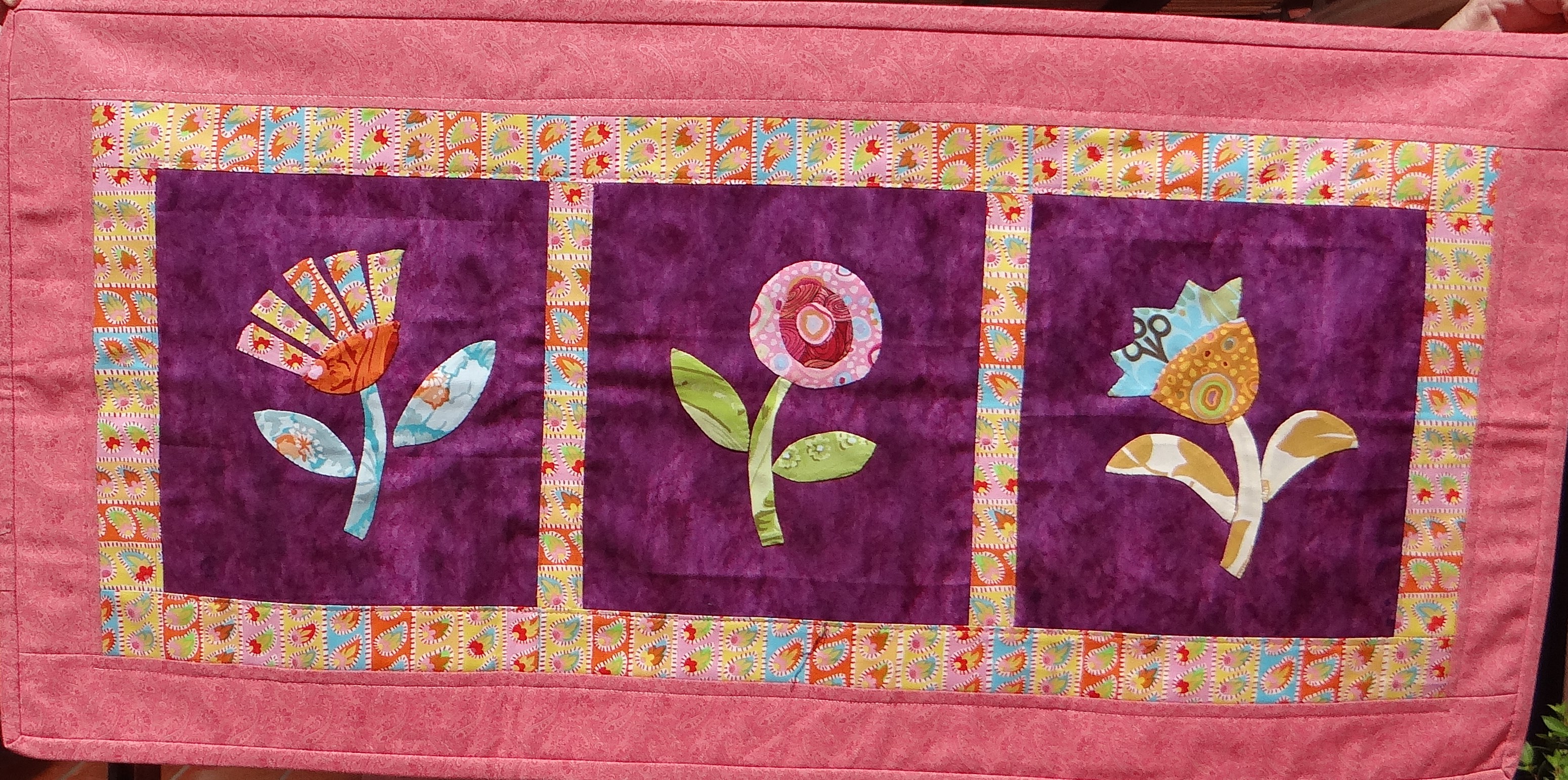
Flower Quilt US$ 60,–///GONE///

DSC00201_2

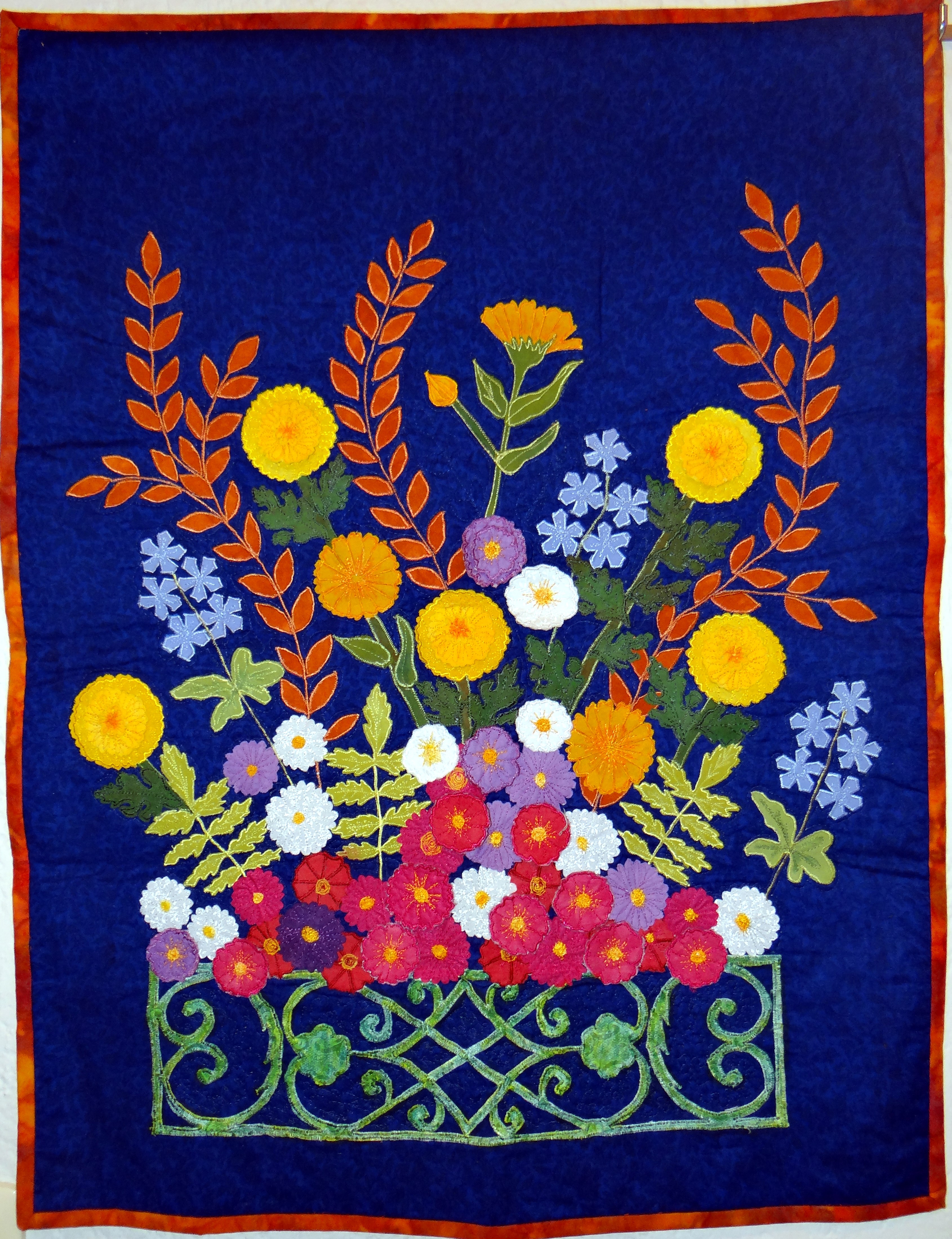
Very nice and colorful table runner, size 88x43cm (c. 35×17,5inch).

Veröffentlicht unter For Sale | Verschlagwortet mit | Hinterlasse einen Kommentar

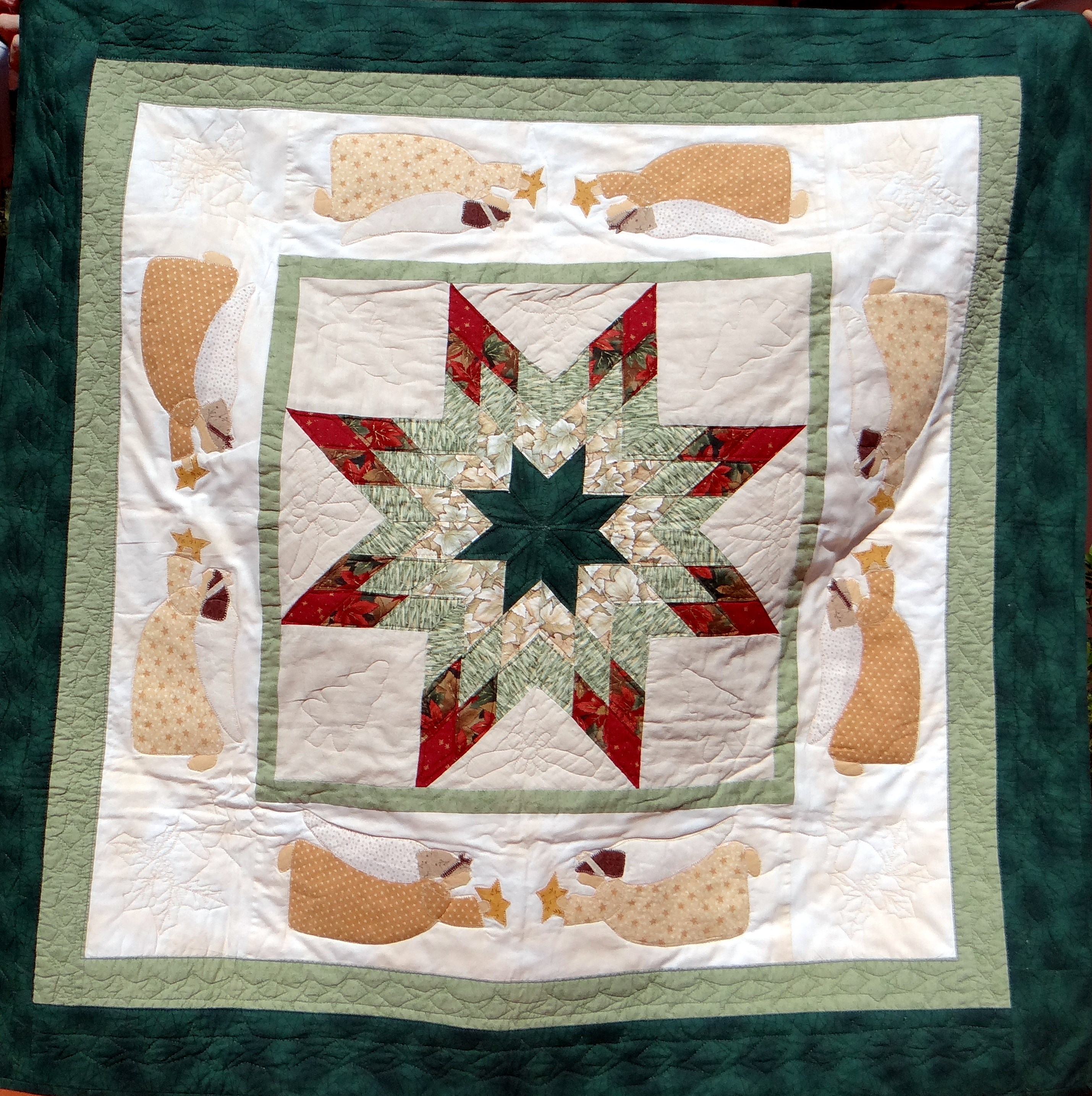
Wonderful Christmas Quilt US$ 125,–///GONE///

DSC00198_2

Look at this wonderful Christmas Quilt.
Table cloth, size 110x110cm (c.44x44inch), with machine applications.

Veröffentlicht unter For Sale | Verschlagwortet mit | Hinterlasse einen Kommentar

Patchwork and Quilting

Patchwork and  Quilting  are often mentioned together,
but they are two very different techniques.

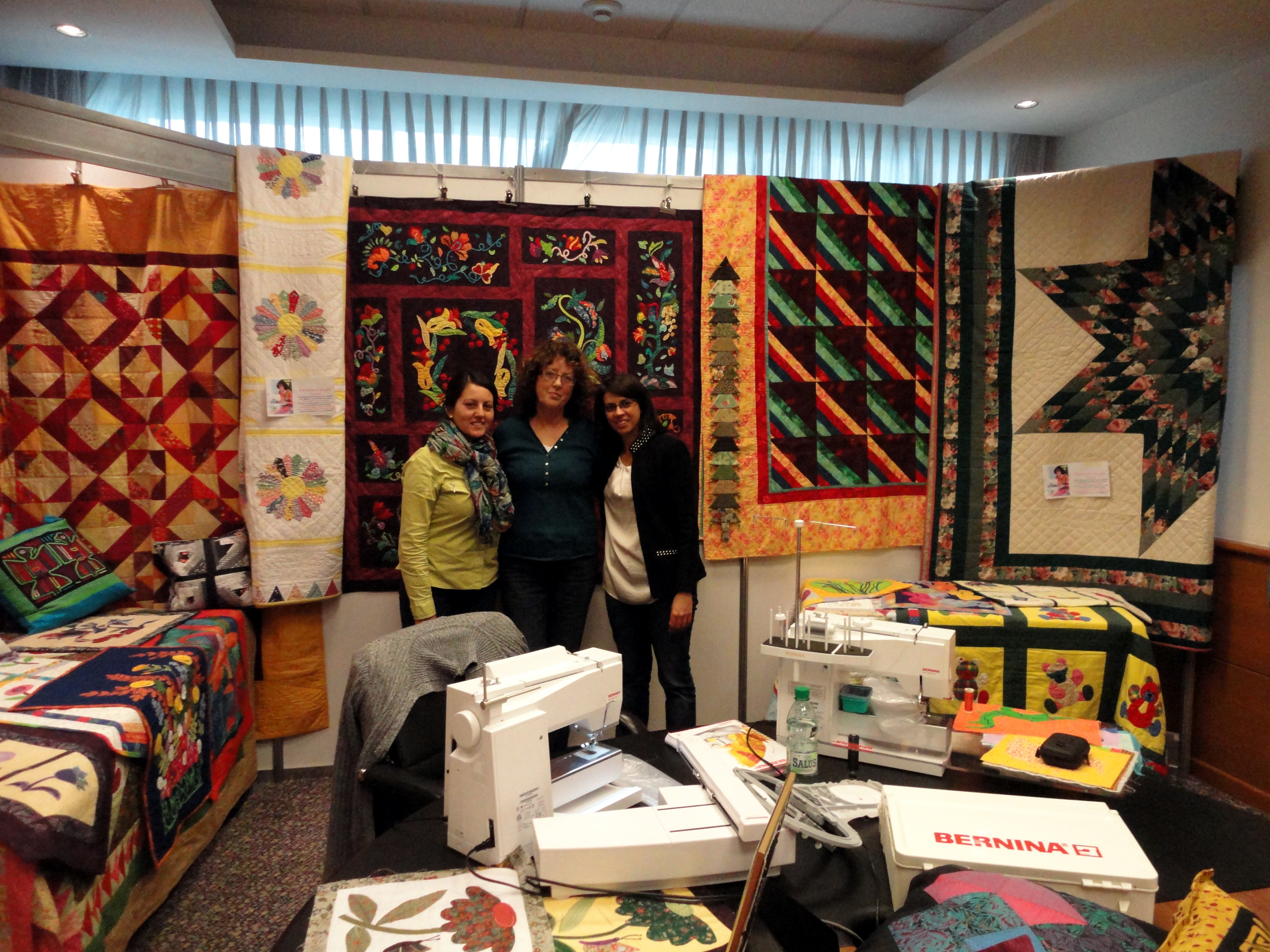
DSC01046
The ladies during a Patchwork and Quilting show.

Patchwork also called „pieced work“, is the art of sewing together pieces of fabric
to form a pattern or block. When enough blocks have been made, they can be sewn
together to form a larger design. This larger design improved to real artistic work
trough different fabrics, different shapes and colors. Patchwork is most often used
to make Quilts.But also for bags, wall hangings and all kind of clothing. Very often
is Patchwork combined with embroidery or other kinds of stitchery.

DSC00178       DSC00180_2
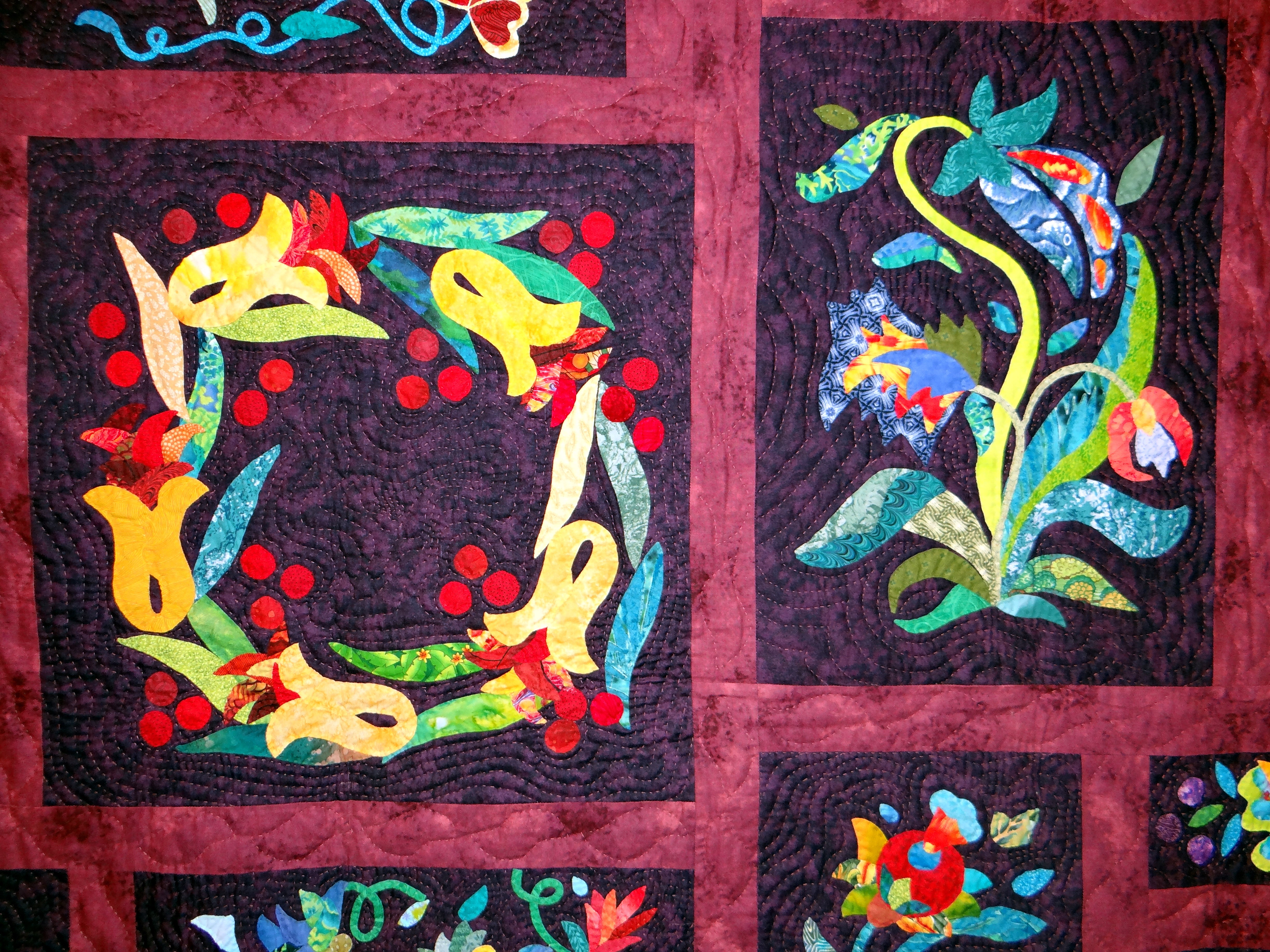
Patchwork and different Quilts. See how beautiful hand quilting looks, 1000’s of stitches.

Quilting is the sewing together of  two or more layers of material, to make a thicker padded material.Therefore it’s used three layers of fabrics to make up a quilt . First the top ( mostly patchwork),  second the central wadding or batting,  and third the backing. To keep the batting from shifting, a patchwork quilt is „quilted“ by hand or by machine.

DSC00181_2   DSC00182
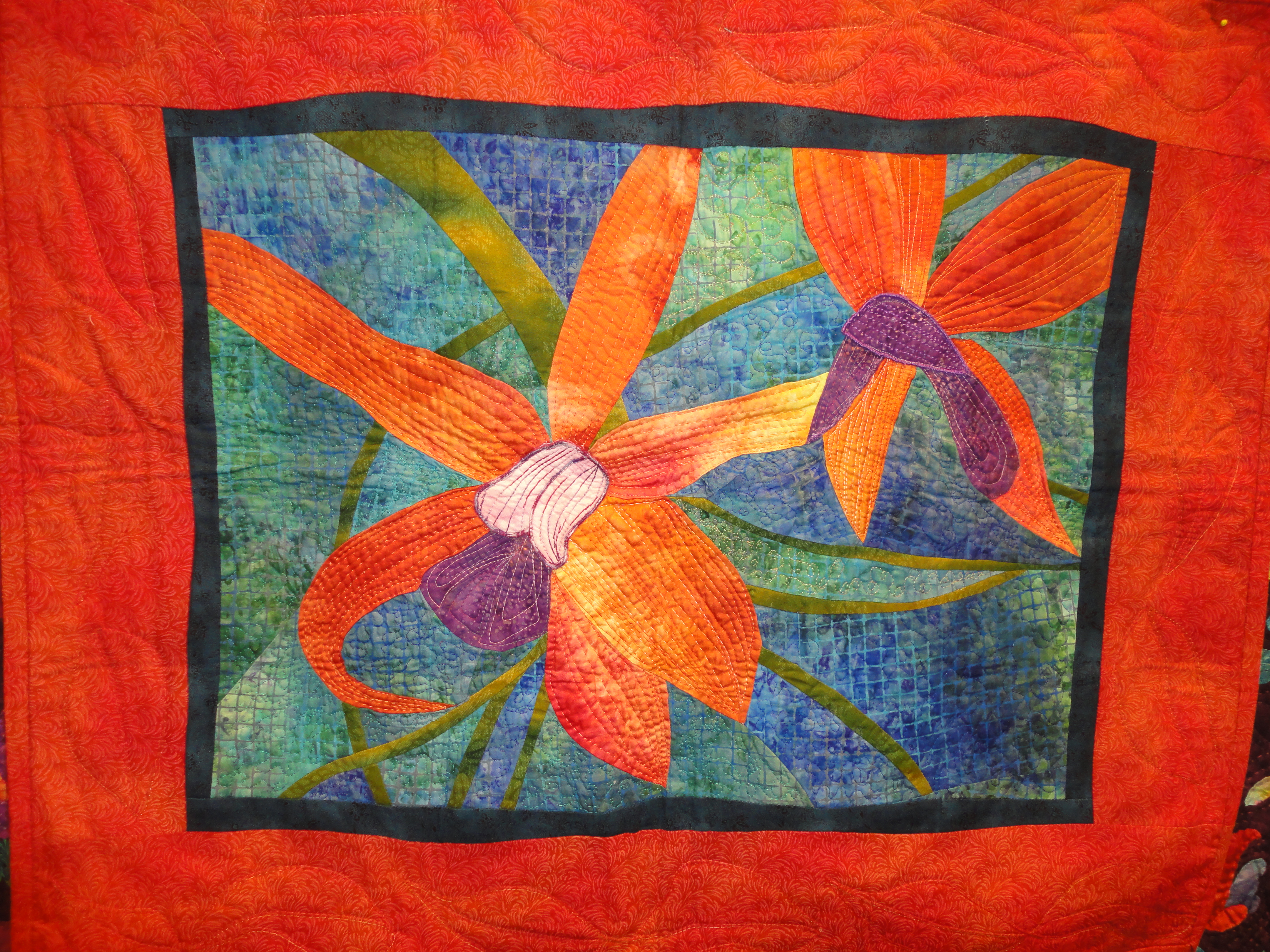
Handmade phantasies patchwork combined with free motion machine quilting.

This kind of stitching together the 3 layers (quilting) is again a special art of needle work.This process uses a needle and thread to join the layers together. The thread and the needle should be of special and high quality, the thread is often waxed, that it can glide smooth through the layers of fabric.

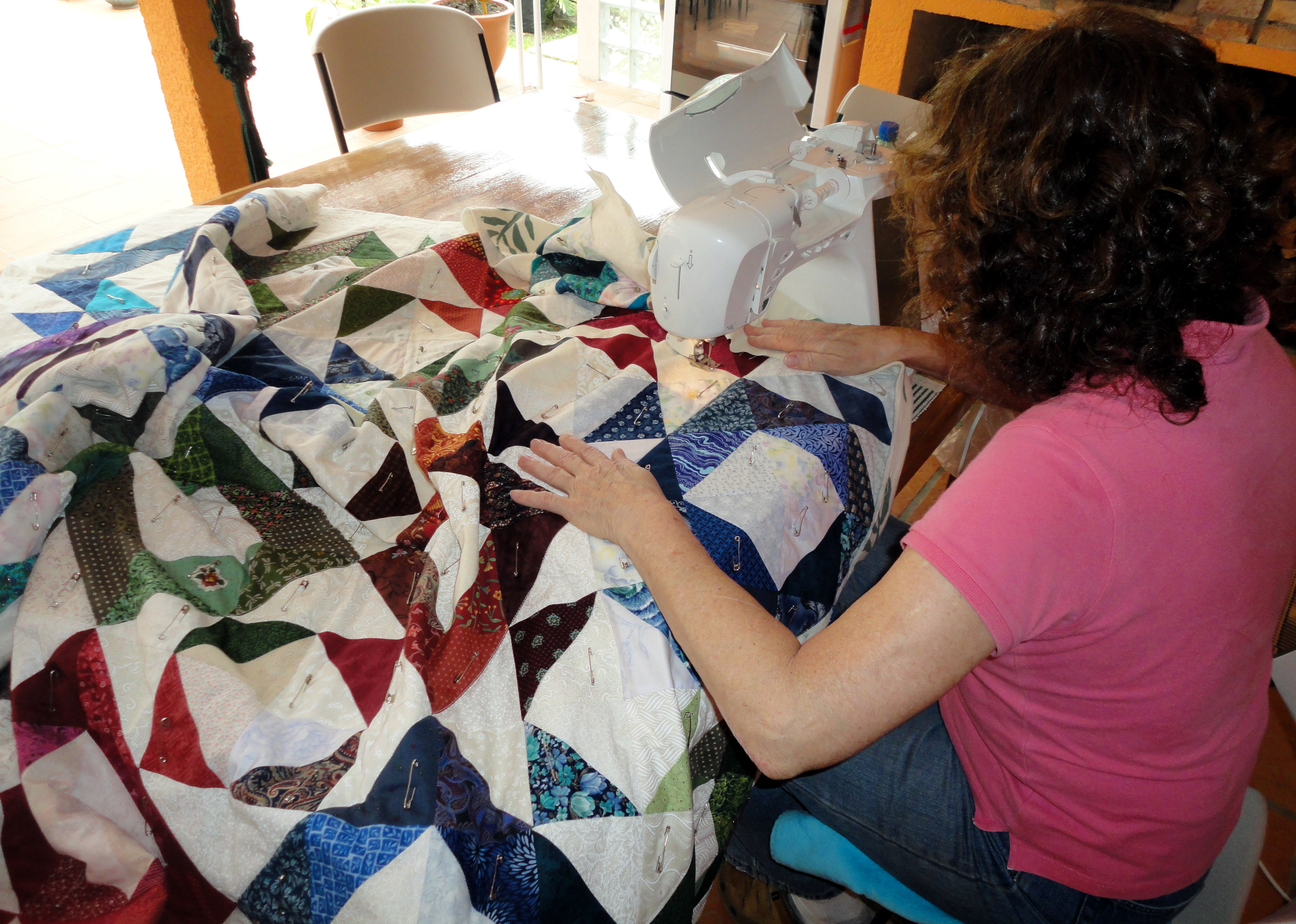
This quilting is very time intensive, especially by hand, stitch by stitch, through thick fabrics and a size of about 2×2 meters .Naturally one can use it’s sewing machine to do this kind of work. This is what most Quilting enthusiasts do, you can see the fun.

DSC01144_2
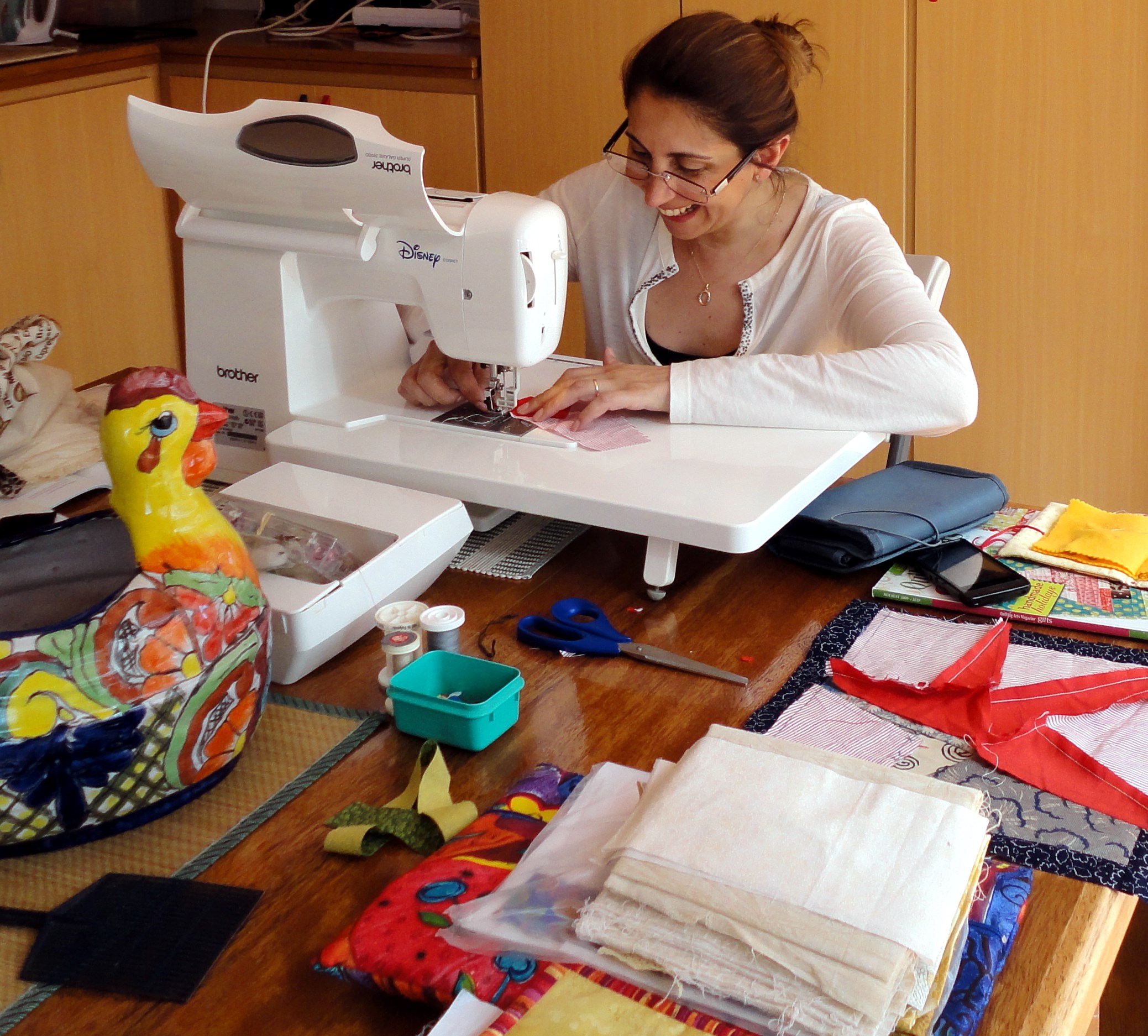
Patchworking or Quilting with a sewing machine.

Quilting often goes along with design, piecing, applique, binding and many more steps. In old times quilting was done in groups of 6, 8 or more ladies around the work. Everyone was quilting a part of the pattern. This kind of hard artistic work is the reason why some „patch workers“, I won’t call them quilters anymore, give their patched fabrics into a professional machine quilting service, a specialized long arm quilting system. These machines can do the job in an hour where some ladies need days or even weeks for the same work. All this is the reason, why handmade, artistic quilts are often expensive.

DSC00184_2   DSC00185
Another example of wonderful creative patch working. 3-D motifs and machine stitching.


What you need and how to do.

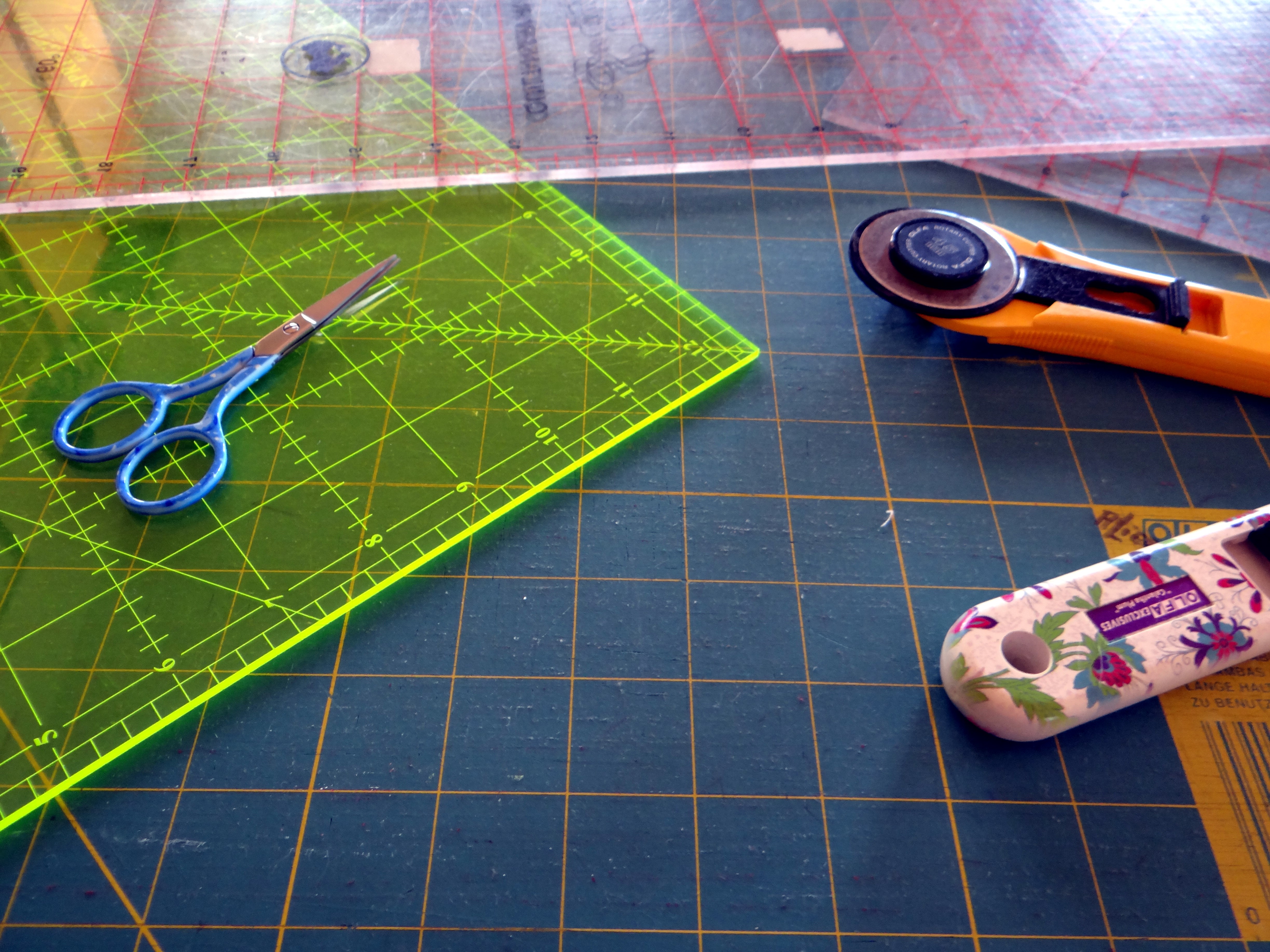
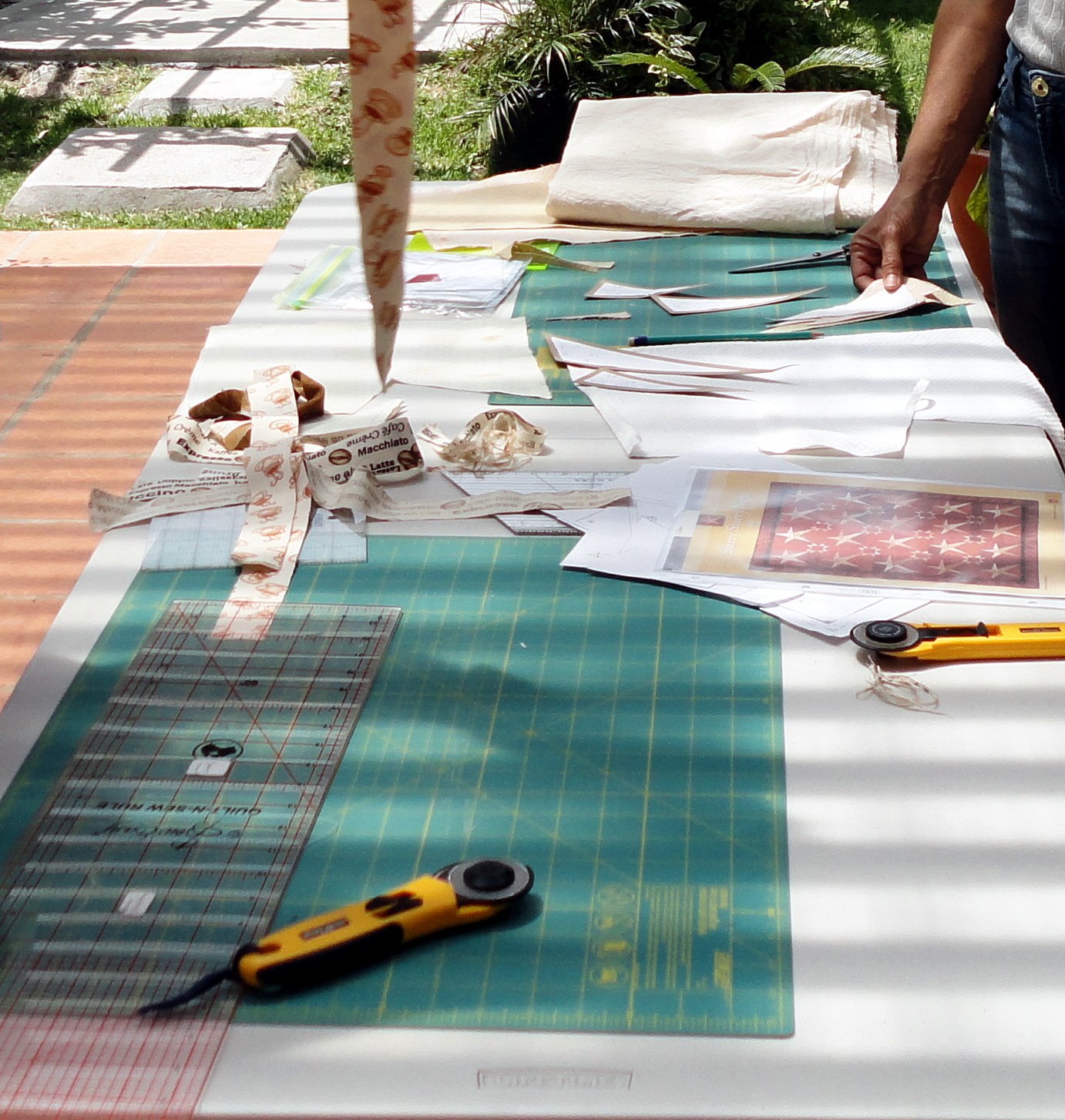
The basic kit is a rotary cutter, a self healing mat (rotary mat),  and a clear acrylic quilting ruler measuring 6,5 by 24 inch. These mats and rulers are available in all kinds of shapes and sizes. Modern rulers are made out of a „self shining“ material.

DSC00189
Notice the „self illuminating“ of the yellow ruler.

Fabric.

The beauty of patch working and quilting is that you can use up odds and ends of fabric, recycle your old clothes and create something beautiful  and unique ones in the process. As material, cotton is best as it washes and wears well. It should be fabric which won’t shrink after sewing. Many fabric shops sell ‘fat quarters‘, (a selection of fabrics cut into quarter meter squares), which are ideal for patchwork.

DSC01344_2 DSC01068
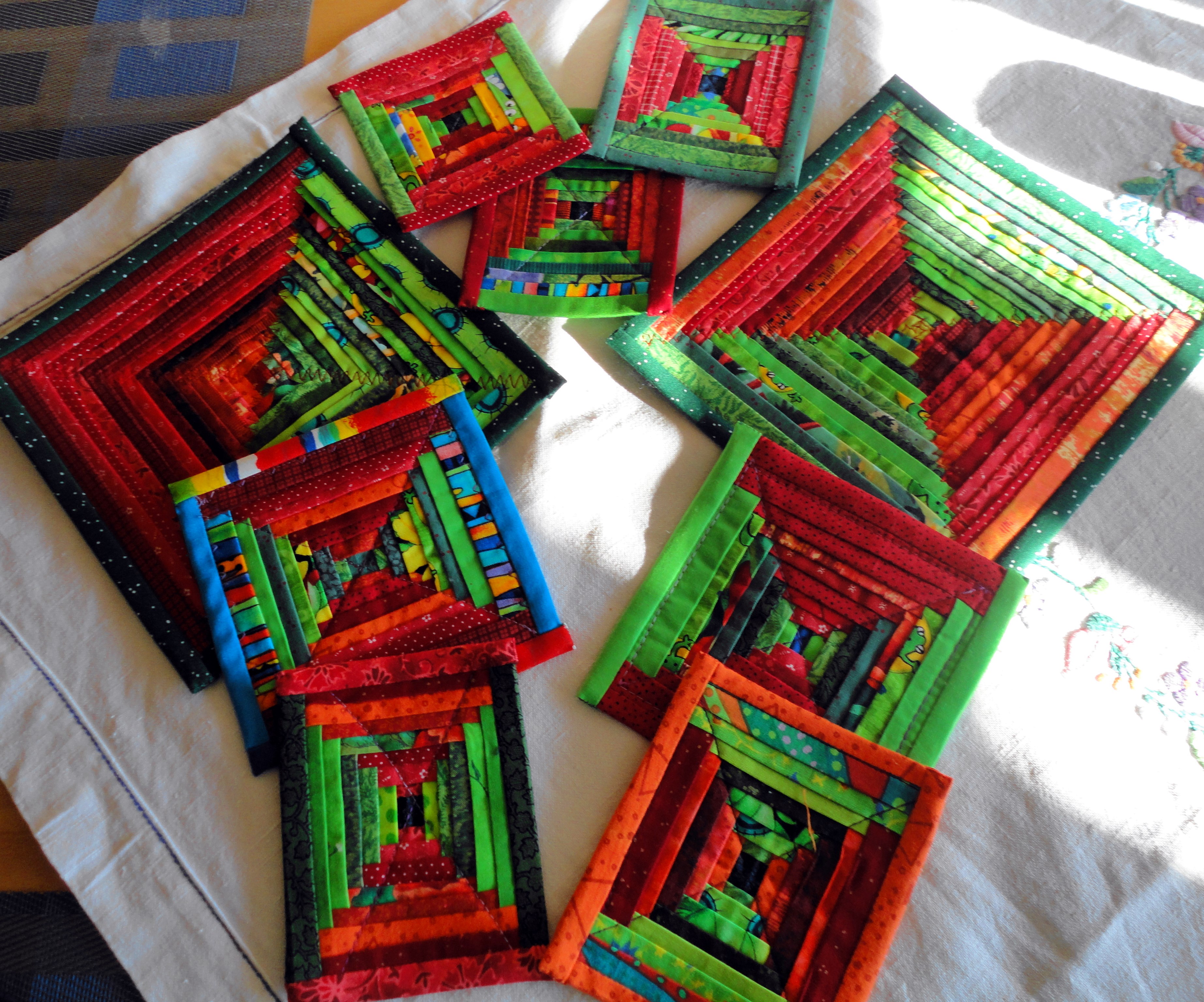
Imagine how many different fabrics,  cut’s and  colors you need, to design and make such „beauties“.

Using a rotary cutter.

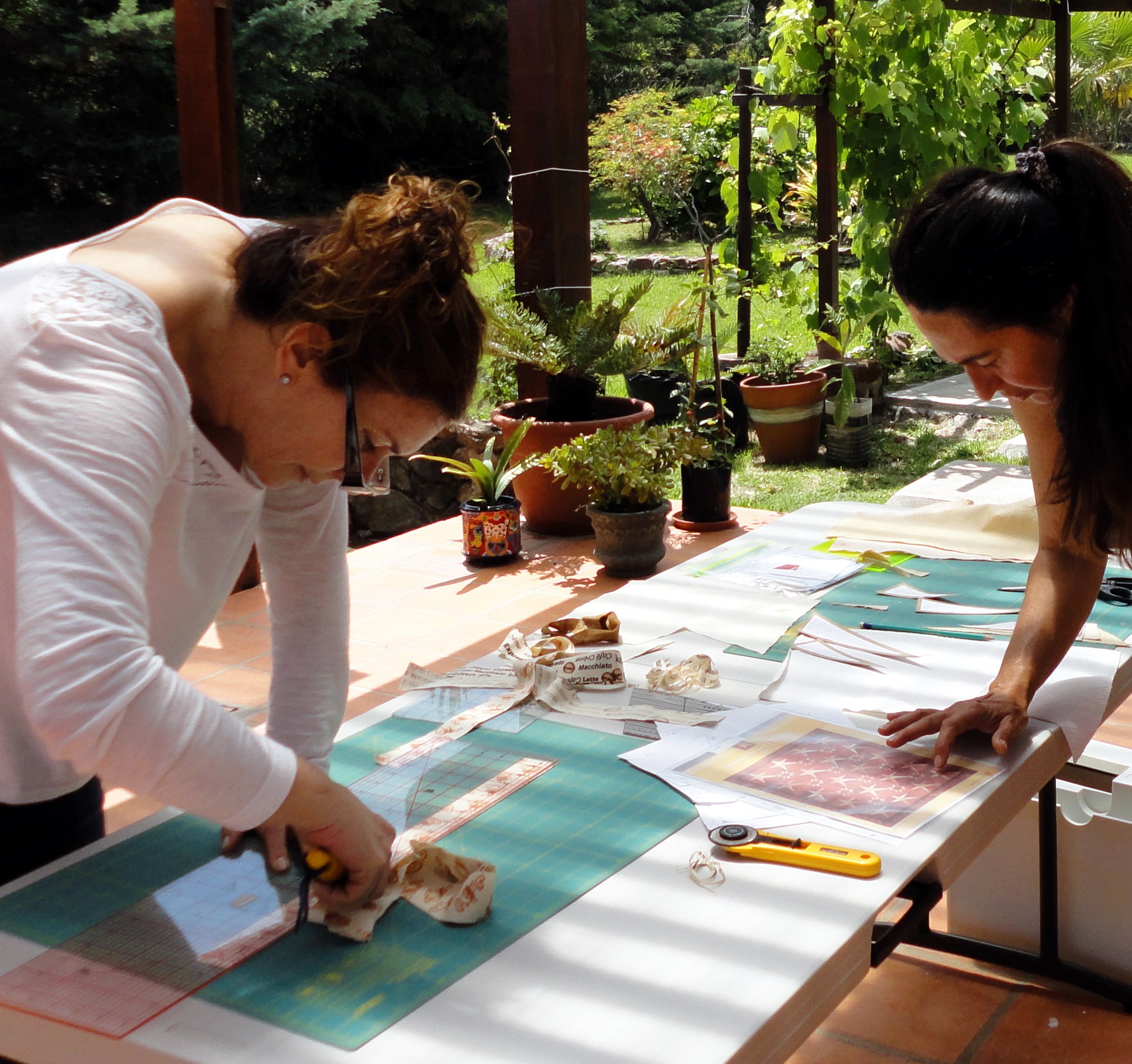
The key to successful patchwork lies in cutting your fabric accurately, and the best way to do this is with a rotary cutter. Fold your fabric, press it, and line up the pressed edge on your mat. Place your quilting ruler over the fabric, line it up on the mat and, holding it down firmly, move the rotary cutter away from you to trim the right hand edge.
Turn the board around without moving the fabric and cut your shape from left to right to avoid wastage. When you get more experienced, you’ll be able to cut through several layers of fabric at a time. Practice on calico to begin with and always press your fabric first.

  DSC01147_2  DSC01146_2
These are safety cutters, but still be careful ! These cutters are razor sharp !

Sewing together.

You can sew patchwork pieces together by hand or machine with a quarter inch seam allowance. Press the seams open. When sewing by machine, always use a new needle for each project , number 80 is a good size. Set the stitch length to 2.5 or 3. Sew with the two pieces of fabric right sides together, with the edges traveling just under the edge of the right hand side of the presser foot. Most good sewing machines now have a special quarter inch patchwork foot. Most patchwork measurements are in inch and users of the metric system have to transform.

DSC01138_2
Very concentrated sewing to avoid mistakes.

Quilting.

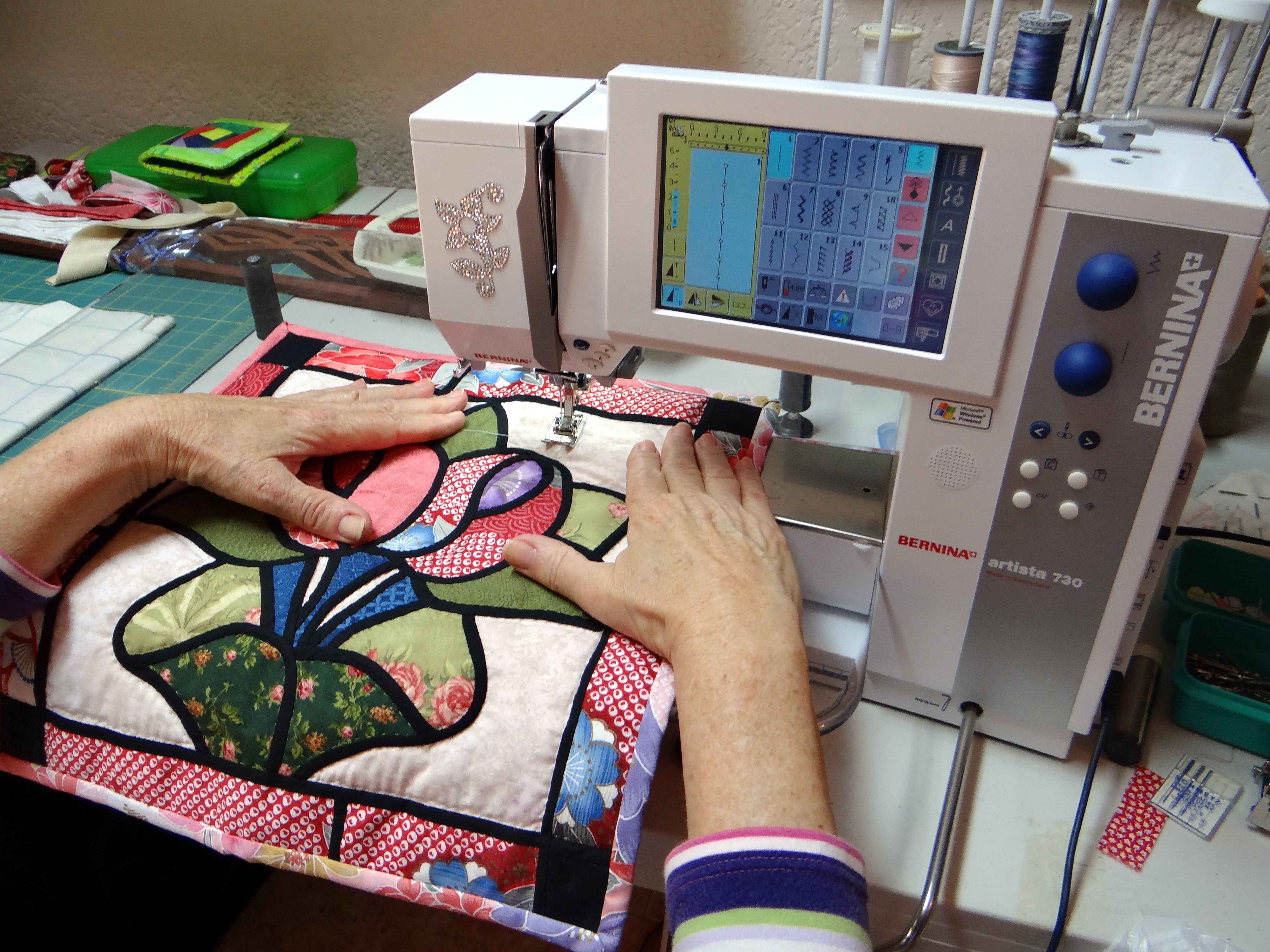
Quilting is usually done by hand. To get started, make a practice sandwich of your three layers. Place a piece of cotton fabric on a flat surface and stick down with masking tape so that the fabric is taut. Load some fine cotton wadding onto the top of the backing, and smooth out so there are no wrinkles or tucks. Put your top fabric, on which you have marked a quilt design, over the wadding.
Tack all three layers into place using rows of stitches, or special quilting safety pins.

DSC00186
Free motion quilting with a sewing machine.

When tacked, remove the masking tape and practice your quilt stitches . It doesn’t matter how large they are, as long as they are regular. You will find your own rhythm, whether it’s stitch by stitch or two or three at a time. It helps to use a thimble on the finger
underneath the work and one on the finger pushing the needle through. Use good quality quilting thread, which is coated with a finish that makes the thread glide through the fabric. Use short lengths of thread ( approx 15 inches )and a quilting needle , which has a round eye and is short and strong. Pull beginning and end knots through the top and bottom layers into the wadding.

DSC01350_2
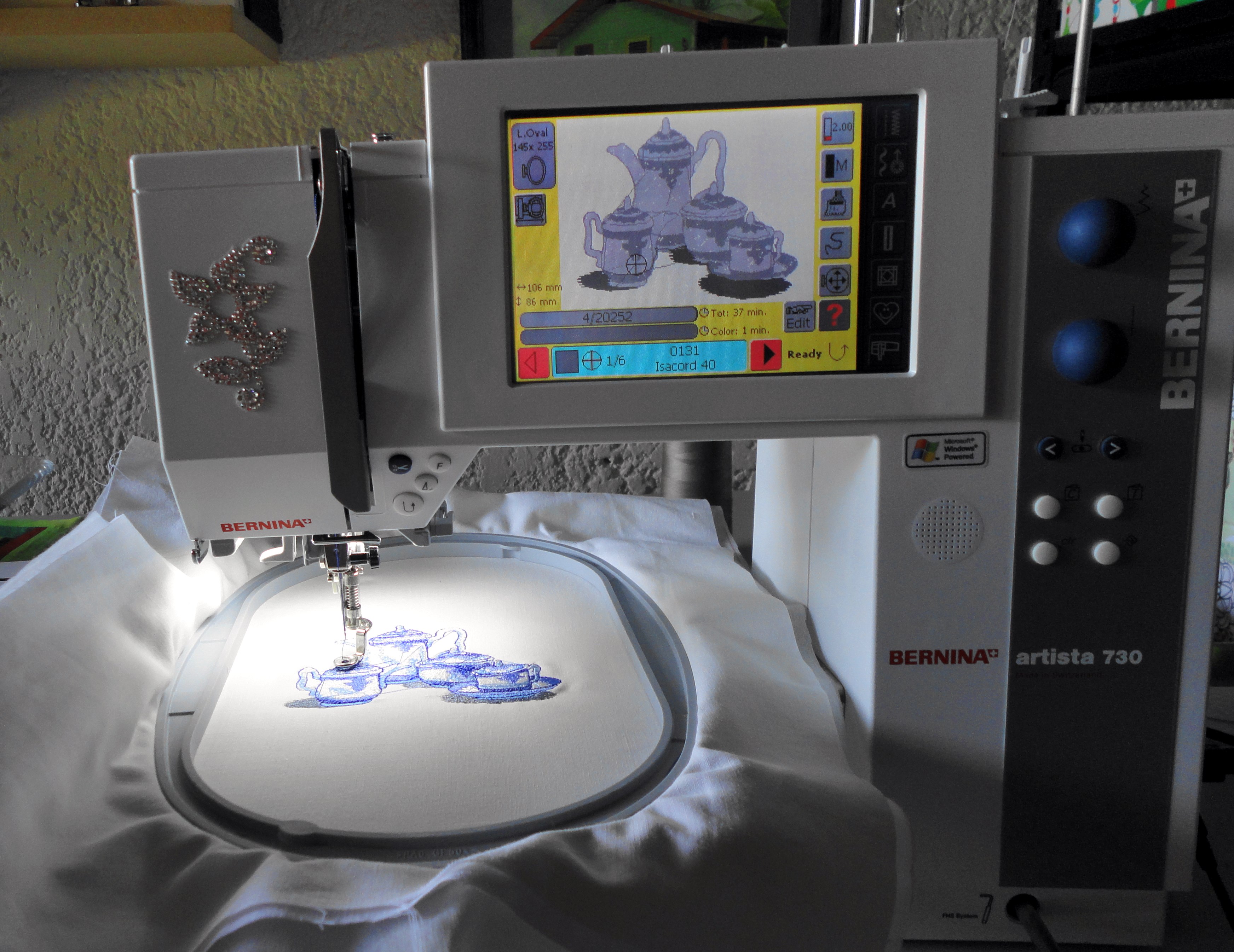
Embroidery with a, computer programmed, embroidery machine.

Like everything else, as more as you exercise, as more you learn and practice , as more experienced you will be and as more and more you will enjoy this fantastic hobby. In the begin it would be very wise to join together with a teacher or experienced person and learn step by step. Never agree to mistakes (everyone will make), eliminate them direct because they always will jump your eye and this won’t satisfy you.  And – never give up !


Veröffentlicht unter Hobbies | Verschlagwortet mit | 1 Kommentar

A quick introduction

A quick introduction

from name to river, from silver to settlement and from
freedom to retirement, that’s Uruguay. Much more will be posted in the future,
about the country, the people, the history and how life in Uruguay is today.

It is the second smallest country in South America, but with charm. And very
European. I won’t repeat what everyone can read in all the travel guides.
Just so much that this land has really no “own name“, just a location “East of
the River Uruguay”. And Uruguay is a word out of the Guarani language,
originally written Uraguay : Ura-gua-y = River of the painted birds !

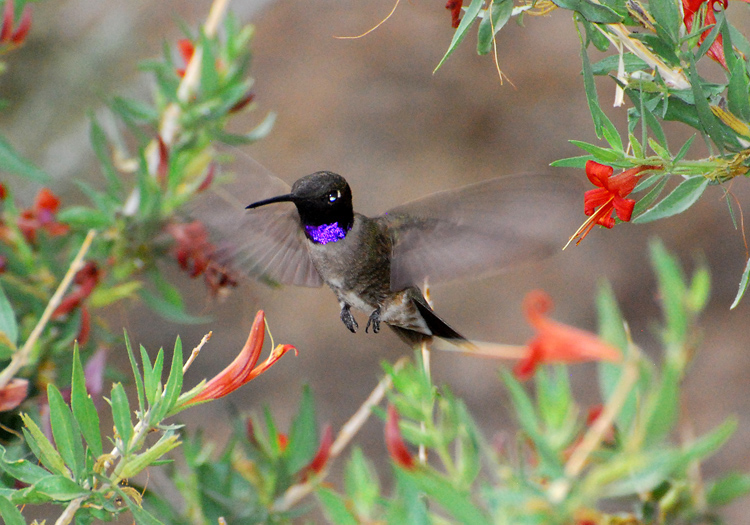
Male Black-chinned hummingbird  UY 6

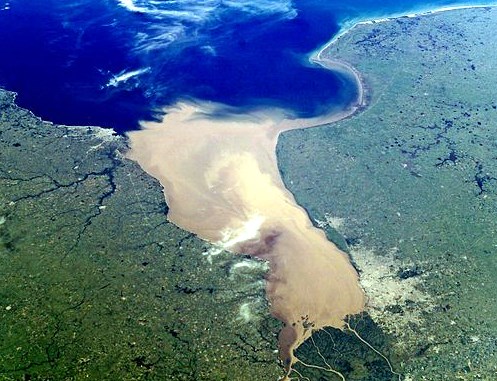
The river is not even “painted” here. It looks very “muddy brown” in color.
This is a sediment phenomenon (some clayey, loamy mud) and no “dirt“. When the
Uruguay meets the Parana, the combined river is called the “Rio de la Plata“,
English = River Plate, the Silver River.
Several theories are known why it became this name.

By example it’s said that the name came from the Silver shipments, digged in
Bolivia and shipped down the Paraguay and Parana to the Rio de la Plata. Most
common is the phantasie of a “Sierra de la Plata”, a mountain full of silver,
somewhere upstream . No one has found this silver mountain yet.

Rio Plata 5 The river Uruguay, Silver shine.

I like the explanation, that the surface of the water on bright and glisten
sunny days looks like pure silver. The first explorers coming with Juan Diaz
de Solis in 1516 might have seen this and baptized the river Rio de la Plata.

The funnel shaped river mouth is about 290 km long and up to 220 km wide.
The largest river mouth in the world. Sadly only up to 20 meters deep.

Rio Plata 1_2 Clayey Rio de la Plata from Space.

The Rio de la Plata area was first explored in 1512/1513 by the Portuguese.
3 years later the Spanish navigator Juan Diaz de Solis was searching for a
passage between the Atlantic and Pacific Oceans. In 1520 the Portuguese
Ferdinand Magellan briefly explored the estuary before he continued its
circumnavigation and discovered the  “Magellan Street”.

The first European settlements around the Rio de la Plata were Buenos Aires
in 1536 by the Spanish Pedro Mendoza . Quickly abandoned it was then refounded by,
Also a Spanish, Juan de Garay an 11th of June 1580. The same year Portugal founded
“Colonia do Sacramento” as a counterweight to the Spanish colonization. On 10th
of January 1809 , before the independence of Uruguay, the “town” was elevated to
“Ciudad” = city of “Colonia del Sacramento”. More about Colonia in a coming post.

uruguay 2  uruguay 1

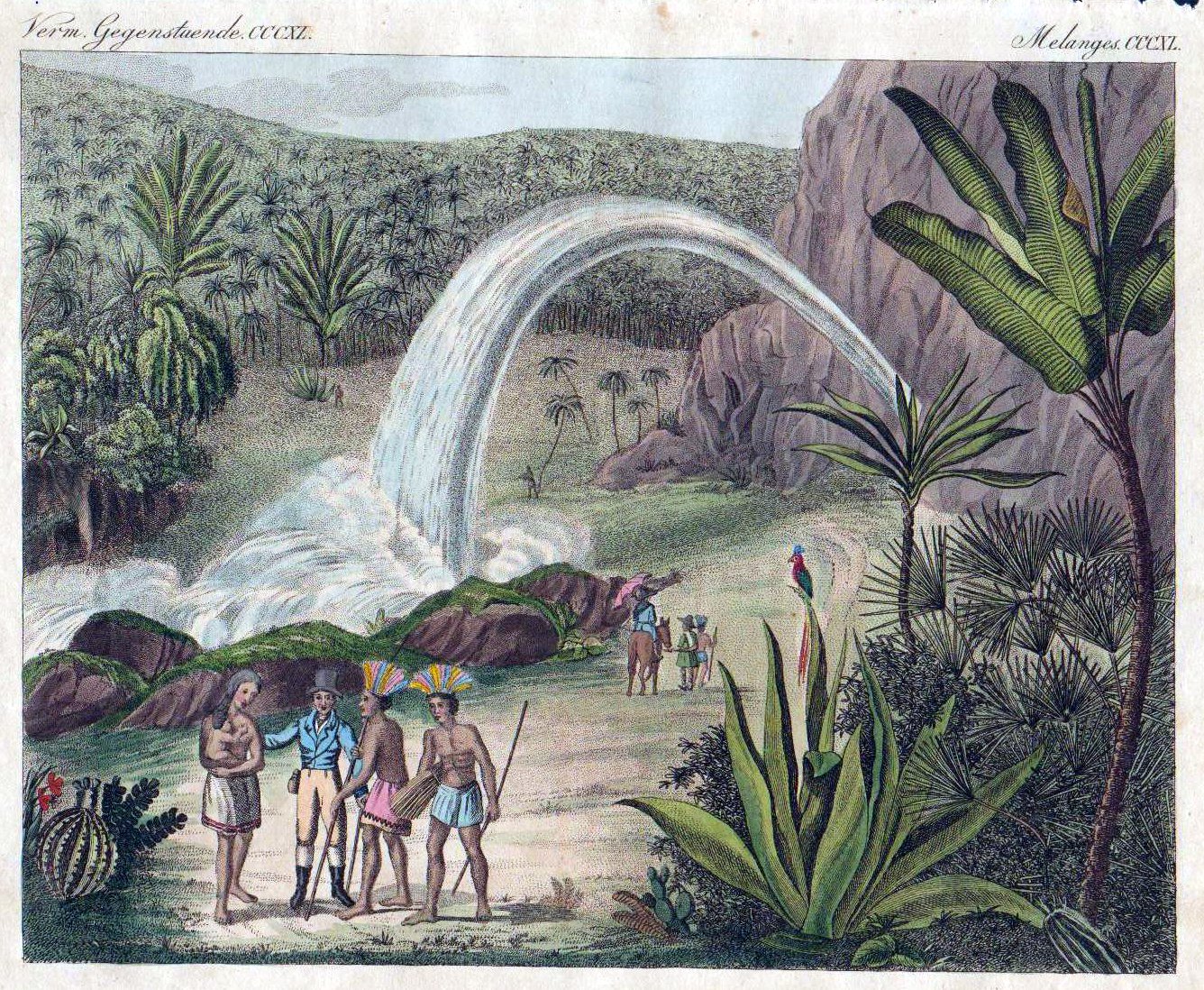
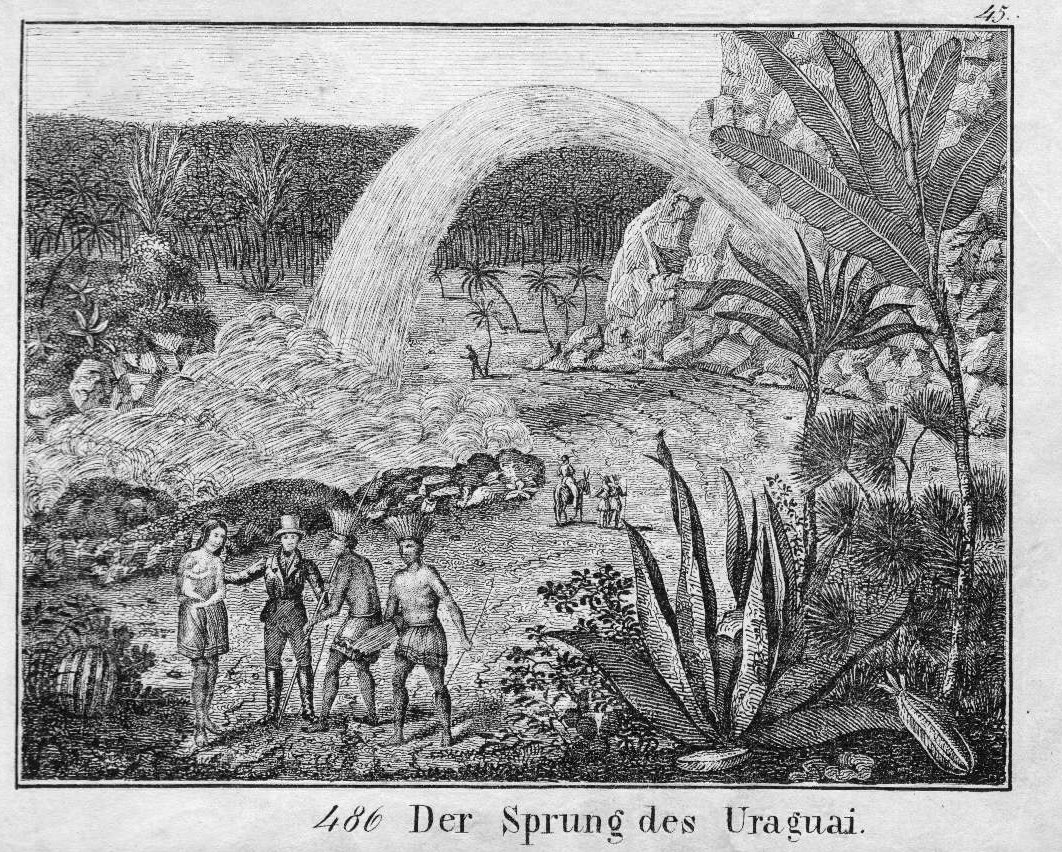
The „jump“ of the Ura-gua-y, or Uraguai. Lovely old wood engravings. The black
and white one from 1832, the handcolored one from 1835. Authors collection.

As you can see above, in early years people thought, that the river Uruguay
arises somewhere in the mountains, a fountain like.
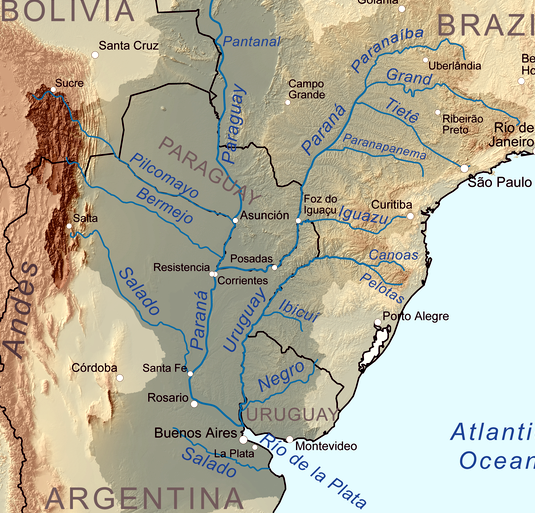
Today we know it better, the river starts in the Serra do Mar in Brazil, where
Canoas and Pelotas rivers join. See the map down here. He measures in total
length 1.838 kilometers and forms the western border of Uruguay.

Rio Plata 2_2 Rivers in and around Uruguay.

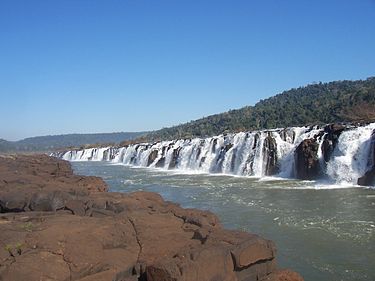
Very unusual for the Uruguay river is a submerged canyon, formed in the ice age.
Its depth is up to 100 meters below the river bottom and visible on only two places.
One is the Mocona Falls, or Yucuma Falls . The falls are parallel to the river not
perpendicular. Very unusual and only seen for about 140 days per year. They are
About 12 meters high and between 2000 and 3000 meters wide. The Mocona Falls
are the only “parallel falls” in the world. These falls are between Argentina and Brasil.

Rio Plata 4 The amazing Uruguay Parallel Fall.

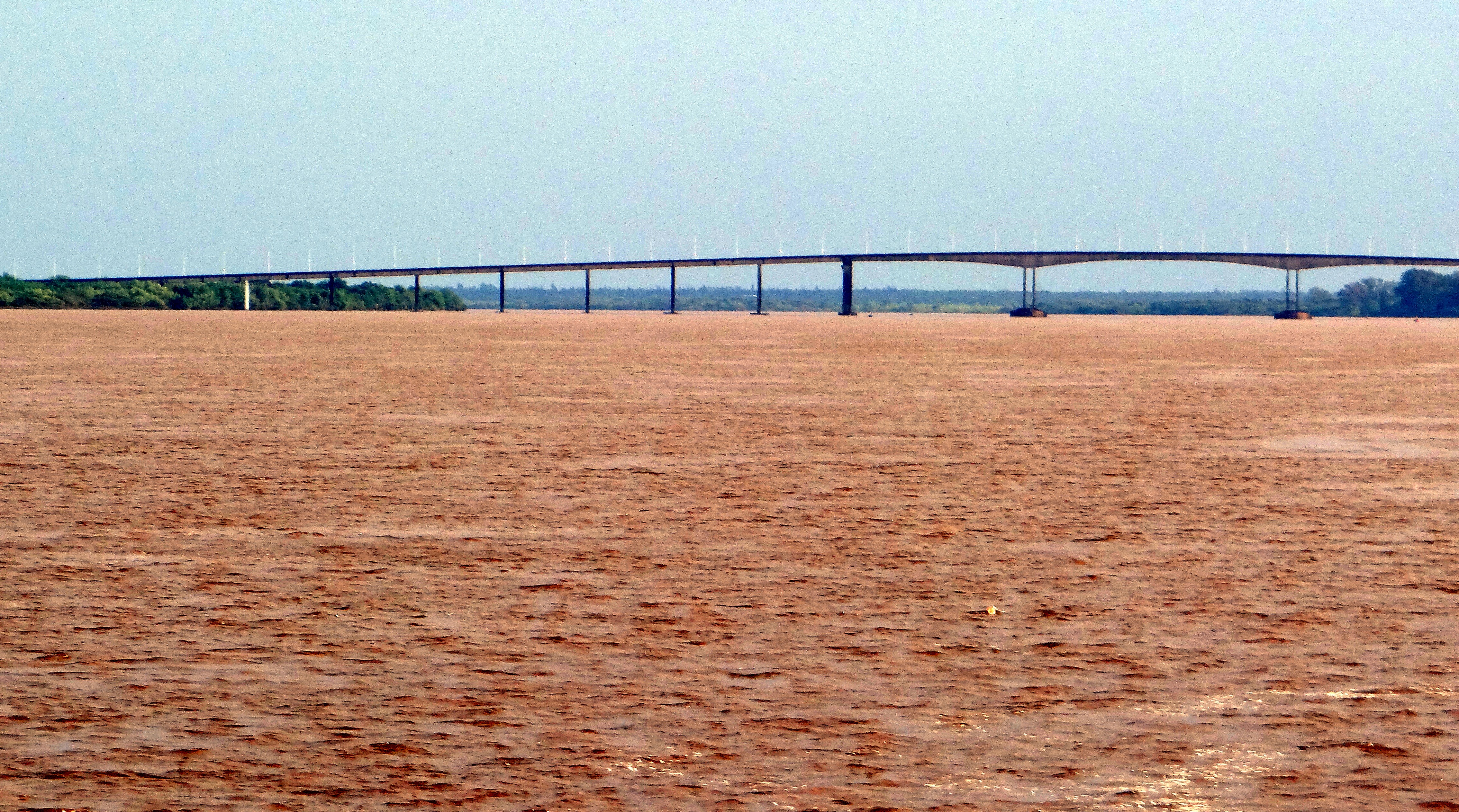
The Uruguay is navigable from around Salto Chico. It is crossed by five international
bridges, two between Brazil and Argentina and three between Argentina and Uruguay.
They are called , from north to south, Salto Grande Bridge, over the Salto Grande Dam.
The General Artigas Bridge, now named International Bridge in Paysandu and
Libertador General San Martin Bridge in Fray Bentos. For hydroelectric reasons
Uruguay has dammed the river with the Salto Grande Dam.

DSC00142_2  The International Bridge in Paysandu.

What we like and why we live here :
Statistics: Uruguay is a democratic constitutional republic, with a president who
is together “head of state” and “head of government”. Uruguay is, in all of Latin
America, ranked first in DEMOCRACY, PEACE, LACK OF CORRUPTION,
PRESS FREEDOM and QUALITY OF LIVING. Uruguay has a very low crime rate,
comparing to other countries, a highly ranked economic freedom and its,
very friendly, people are open to and tolerant with foreigners .

2013 Uruguay was ranked “country of the year”, No. 1 in the world.
And – it has the best beaches in whole South America and the best climate of the world.
One of the most liberal Nations in the world and often ranked one of the best
retirement country’s. Of course Uruguay is different and Uruguay is proud and not
comparable with big countries like the US/Canada or Europe, also it has it’s downsides.
Don’t complain about the differences, if you want you can take over my philosophie:
„Uruguay – love it, or leave it“ !

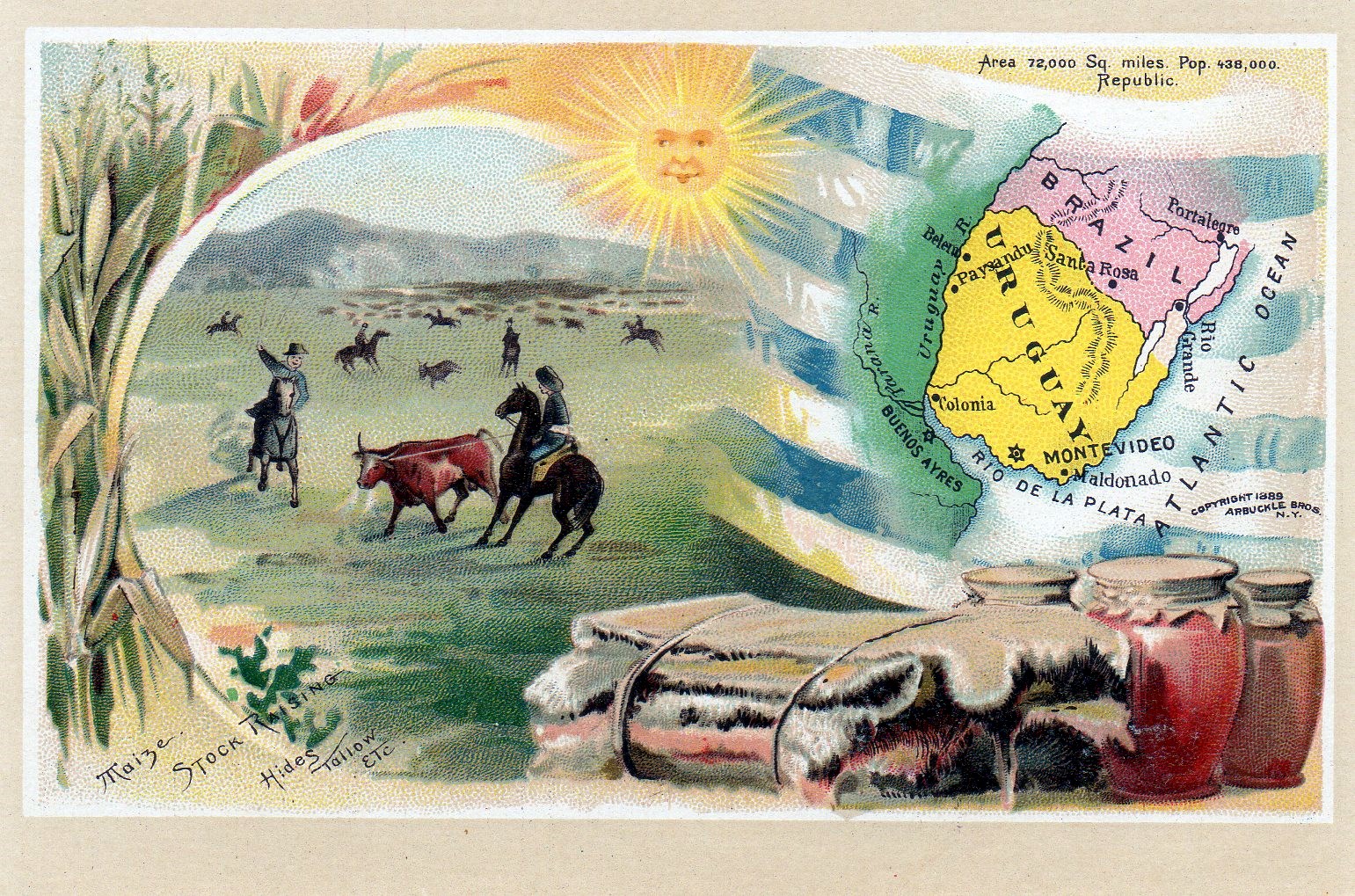
UY 8_2 Uruguay described in 1888.
This is a collectors card  and informs about Uruguay as follows:
Area 72.000 Sq.miles, Population 438.000, Republic,
Maize, Stock Raising, Hides Tallow etc.   Nice old document.

Veröffentlicht unter History, Uruguay | Verschlagwortet mit | 3 Kommentare