Christmas Stollen – DIY

Today is the 1.Advent in 2014. In this pre Christmas time (Advent) it
is a German custom to bake and celebrate with „Christmas Stollen“.

stollen 20
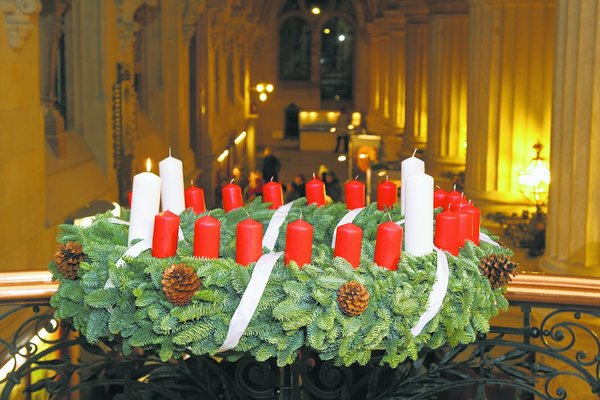
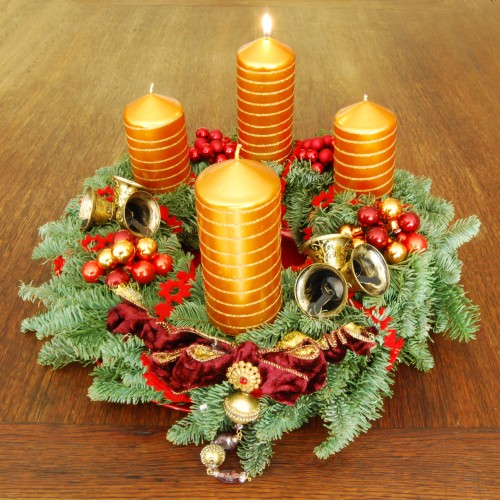
First candle lighting on the 1.Advent. Every Sunday one more.

Stollen

is a fruit cake containing dried fruit and often marzipan and
covered with sugar, powdered sugar or icing sugar. The cake is usually
made with chopped candied fruit and/or dried fruit, nuts and spices.
Stollen is a traditional German cake, usually eaten during the Christmas
season, when it is called Weihnachtsstollen or Christstollen.

stollen 21
The Council of Trent in the „Santa Maria Maggiore“ church of Trent.
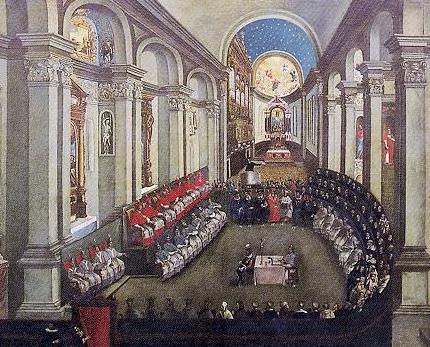
As a Christmas pastry, Stollen was baked for the first time at the
Council of Trent in 1545, and was made with flour, yeast, oil and water.
The Advent season was a time of fasting, and bakers were not allowed to
use butter, only oil, and the cake was tasteless and hard.
In the 15th century, in medieval Saxony (in central Germany), the Prince
Elector Ernst and his brother Duke Albrecht decided to remedy this by
writing to the Pope in Rome.

The Saxon bakers needed to use butter, as oil in Saxony was expensive,
hard to come by, and had to be made from turnips. Pope Nicholas V
(1397–1455), in 1450 denied the first appeal. Five popes died before
finally, Pope Innocent VIII, (1432–1492) in 1490 sent a letter to the
Prince, known as the „Butter-Letter“ which granted the use of butter
(without having to pay a fine), but only for the Prince-Elector and his
family and household.

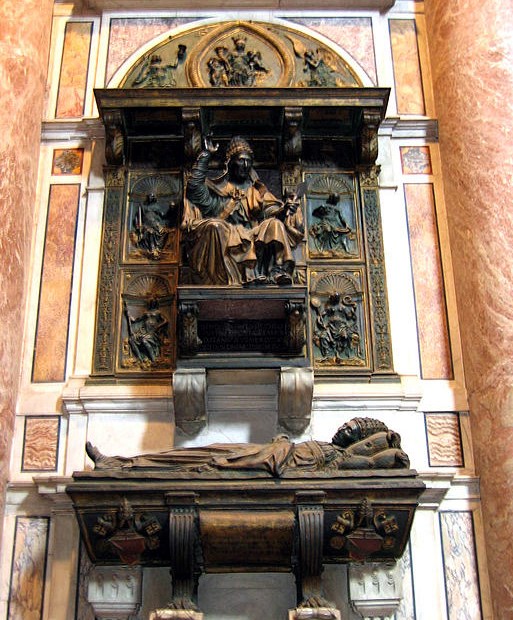
Monument_to_Innocentius_VIII_in_Saint_Peter's_Basilica_2
Monument to Innocentius VIII, Saint Peters Basilica Rome.
Others were also permitted to use butter, but on the condition of having
to pay annually 1/20th of a gold Gulden to support the building of the
Freiberg Minster. The ban on butter was removed when Saxony became
Protestant. Over the centuries, the cake changed from being a simple,
fairly tasteless „bread“ to a sweeter cake with richer ingredients, such
as marzipan, although traditional Stollen is not as sweet, light and airy
as the copies made around the world.

The „Stollenfest“

takes place every year in Dresden. This year for the 580th time. This
historical tradition ended only in 1918 with the fall of the German monarchy,
and started again in 1994, but the idea comes from Dresden’s history.
Dresden’s Christmas market was mentioned in the chronicles for the first time
in 1474.
stollen 22
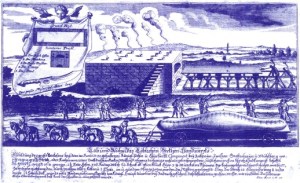
Copper engraving of the 1,8 tons stollen. 1730 Saxony.Behind you see the bakers oven.
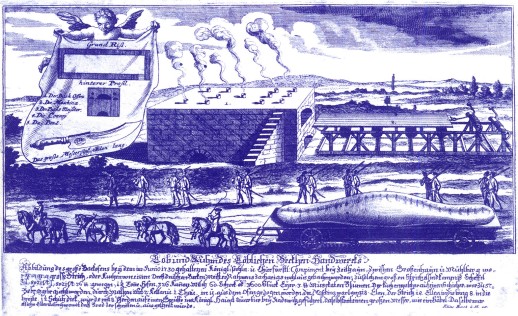
The tradition of baking Christmas Stollen in Dresden is very old.
Christmas Stollen in Dresden was already baked in the 15th century.
In 1560, the bakers of Dresden offered the rulers of Saxony Christmas Stollen
weighing 36 pounds each as gift, and the custom continued.

Today, the festival takes place on the Saturday before the second Sunday in
Advent, and the cake weighs between three and four tonnes. A carriage takes
the cake in a parade through the streets of Dresden to the Christmas market,
where it is ceremoniously cut into pieces and distributed among the crowd,
for a small sum which goes to charity. A special knife, the Grand Dresden
Stollen Knife, a silver-plated knife, 1.60 meters long weighing 12 kg, which
is a copy of the lost baroque original knife from 1730, is used to festively
cut the oversize Stollen at the Dresden Christmas fair.

stollen 15
Striezelmarkt, Christmas market in Dresden.
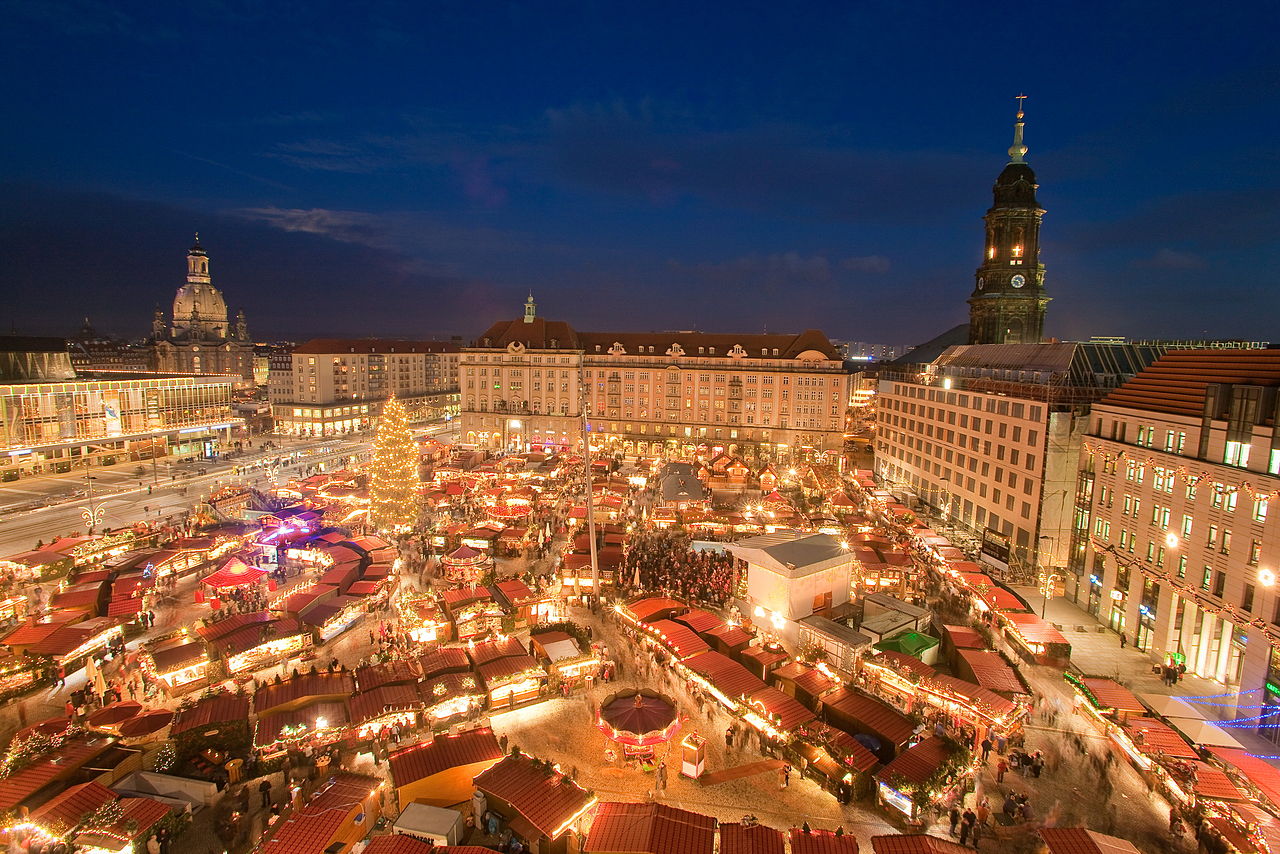
Dresden Striezelmarket

Since the early 15th Century the „Striezelmarket“, the oldest Christmas market
in the world, enchants the hearts of young and old with its fragrance and shine
the hearts of young and old during the christmas season.
Traditional products like the „Dresden Striezel Glühwine“, the Dresden Stollen,
„Pulsnitzer Pfefferkuchen“ and „Pflaumentoffel“ are popular Specialties from
the good old days, which we still can enjoy at the „Striezelmarkt“.
In addition to the tasty Specialties, there is a lot of traditional craftsmanship
from the nearby Erzgebirge to discover. A visible example is the pyramid
„Striezelmarkt Pyramid“. It has 42 different wood carvings and is with about
14 meters registered as the biggest step pyramid in the world in the Guinness book.
stollen 16
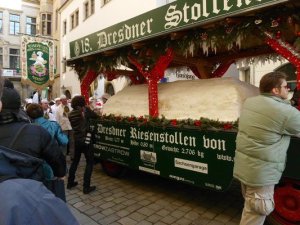
The Dresdner Riesenstollen (2,7 tons of stollen) during one festival.
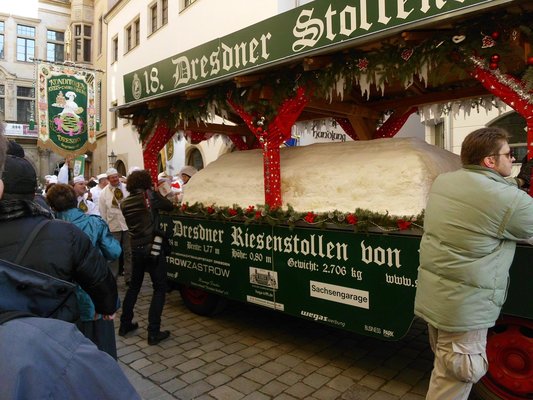
Dresden Stollen

is a very lean-back pastry for the Christian Advent abstinence. The form of the
Stollen remembers the Jesus Child in his linen cloth. This also explains the white
sugar coating on the outside. The traditional form is still unchanged.
Since the early days just „Original Dresden Stollen“ is allowed to be sold on the
„Striezelmarket“. The term „Dresdner Stollen“ may only be used for Stollen baked
in Dresden. About the quality and the term „Original Dresden Stollen“ watches the
„Dresdner Stollen Protection Association“.

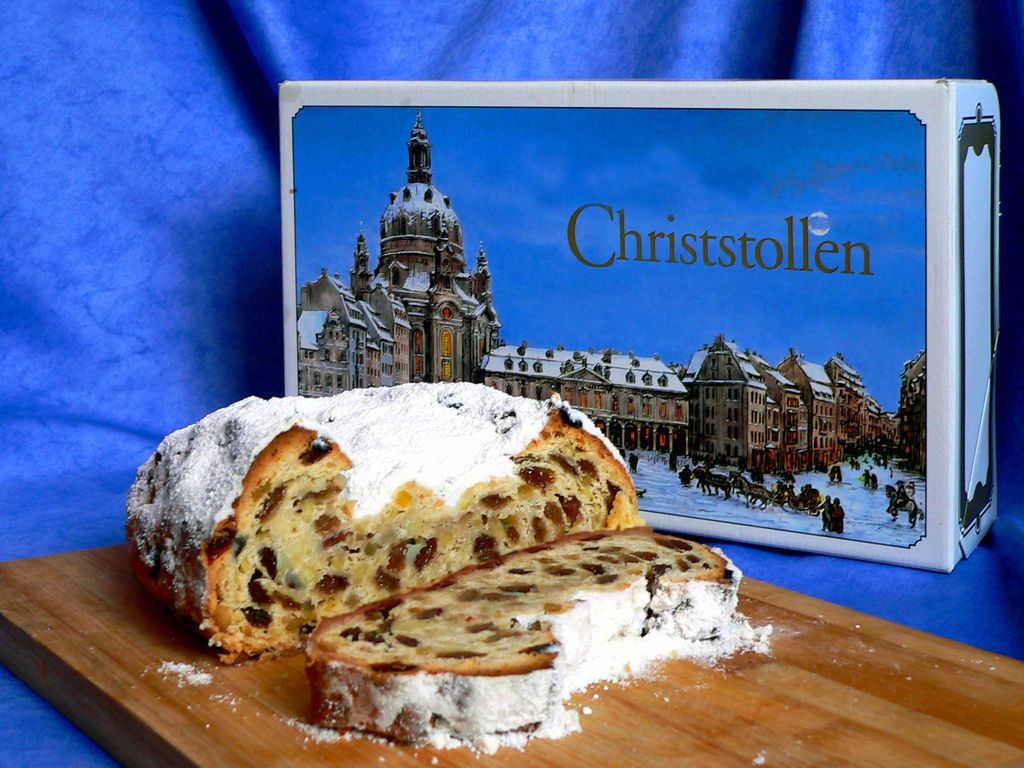
stollen 2  stollen 8
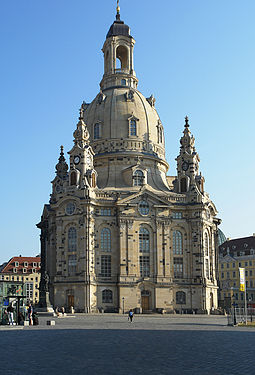
Original Dresden Stollen with carton packing, designed with the Dresden Frauenkirche.
Since 1560 the saxon bakers gave every year at the holy Night two Christmas Stollen
of 1.50 meters in length and weighing 36 pounds to the saxon ruler. 12 bakers had
to carry the Stollen to the castle. In 1730 August the Strong had a giant stollen
baking of 1.8 tonnes, which was divided in 24,000 servings. In the tradtition of
this event each year on the Saturday before the 2. Advent „Dresden Stollen Festival“
takes place on the Striezelmarket. At this festival an approximately 4-ton Stollen
is carried from the Zwinger to the Striezelmarket, where it is cut by a 1.6 meter
long knife and then portions get sold.

stollen 14
The modern Dresden at night. View over the river Elbe.

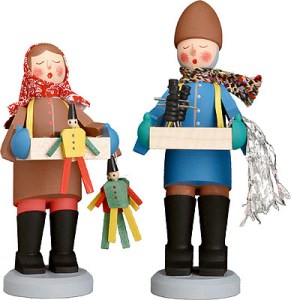
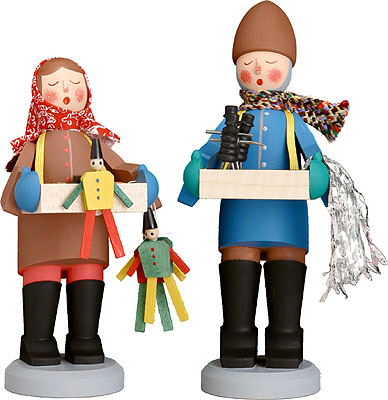
Die Striezelkinder (The Striezel Children)

Striezel is another name for the well-known German Christmas bread also called
„Stollen,“ and the Christmas Market in the German city of Dresden is called the
Striezelmarkt. The Striezelmarkt started in 1434. Since 1809 the Striezelmarkt has
been important for the toymakers in the village of Seiffen in the Ore Mountain
(Erzgebirge) region of eastern Germany. In that year the toymakers received
permission from the city authorities of Dresden to sell their toys and wood items
at the Striezelmarkt. Children often helped the toymakers sell their products,
in order to earn enough money to eat and make their existence at Christmastime a
bit easier to bear. The children offered puppets, Pflaumentoffel (little chimney
sweepers made from dried plums), tinsel, matches, and paper lanterns for sale,
and attempted to awaken the compassion and charity of the market visitors.
stollen 17
Wood engraving from Ludwig Richter of the „Striezelkinder“.
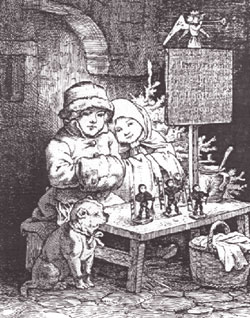
The talented hands of the children put together the little chimney sweepers out
of dried plums. In 1853 the Dresden artist Ludwig Richter  memorialized
the children in his woodblock cutting called „Clearance Sale Due to Going out of
Business.“ The children are huddled together against the freezing cold, patiently
waiting for buyers of the last chimney sweepers. This print became a symbol of the
Dresden Christmas Market. The wooden figures of the children, based on Richter’s
print, were designed in 1930 by Max Schanz and Max Auerbach. These wooden
figurines won a gold medal at the World´s Fair in Paris in 1937.
stollen 18
The Striezelkinder in modern design made by Erzgebirge toymakers.
DSC01424
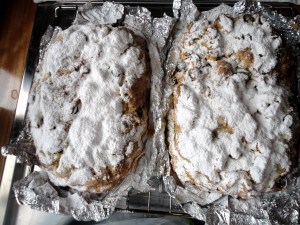
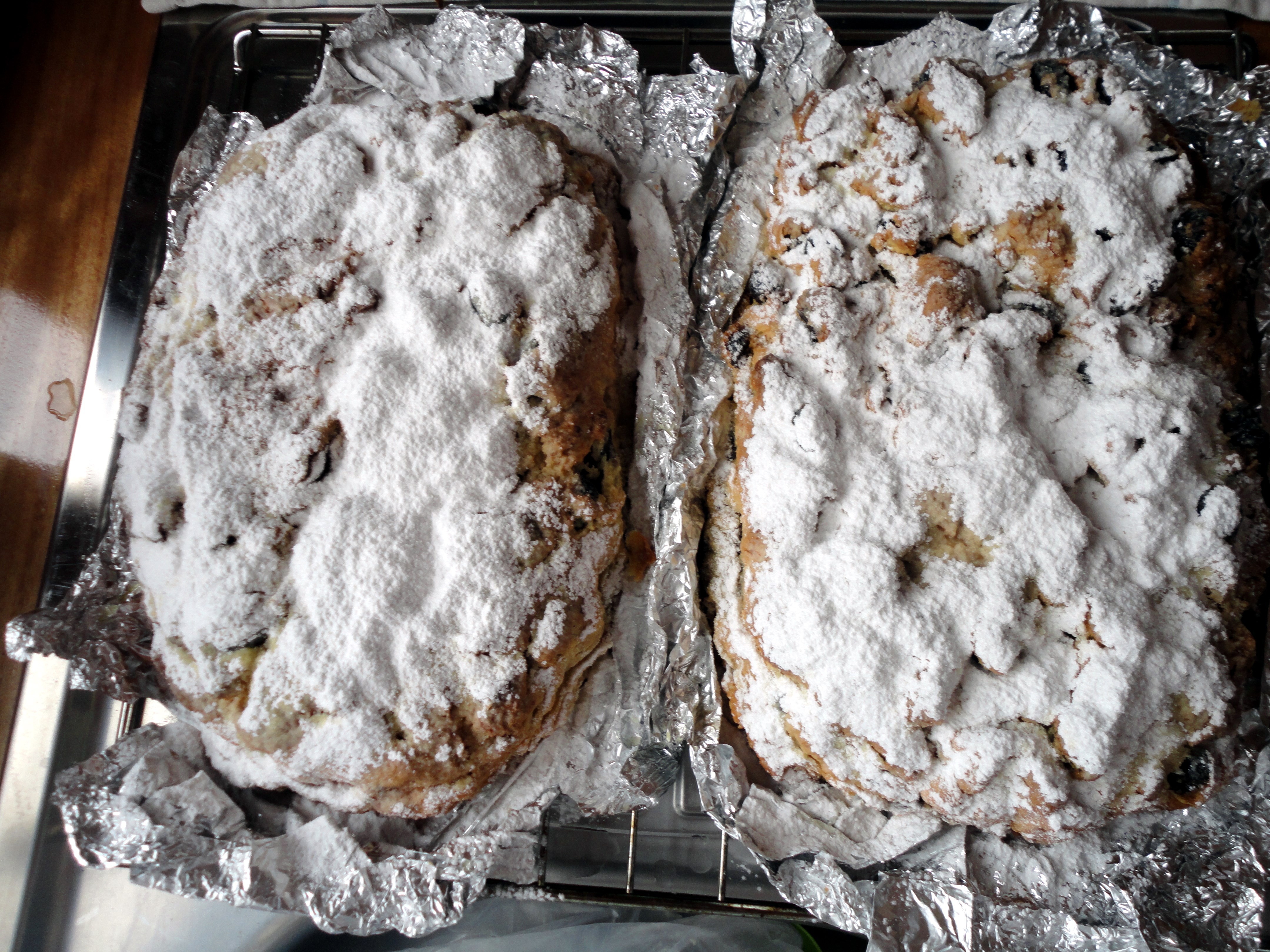
Two 12inch/30cm Stollen buttered and dusted with icing sugar.
How to make your own Stollen ?

Dresden has the most famous Christmas Stollen, but you can bake your own with little
trouble and a few hours time. Christmas Stollen or Christstollen is full of nuts, raisins
and candied fruit. If made a few weeks in advance of serving it mellows and softens
and is very good.

Ingredients:

1c. dark and golden raisins, 175 grams
1/4 cup candied lemon peel, 50 grams
1/8 cup candied orange peel, 25 grams
2 oz. dark rum, 50 ml.
1 block of yeast, 30 grams
1/2 cup milk, 125 ml
1/3 cup sugar, 50 grams
4 cup flour, bread or all-purpose
1 egg
1/2 vanilla bean or 1 tsp. vanilla paste or extract
Zest from 1 lemon
1/4 tsp salt
1/4 tsp. ground nutmeg
1/4 tsp. ground cardamom
7/8 cup sweet, unsalted butter, 200 grams
2/3 cup flour, 100 grams
1/3 cup whole almonds, blanched, peeled and chopped, 50 grams
1/2 cup melted butter
Powdered sugar for dusting
Makes one, about 18inch/45cm stollen, or two 9inch/22cm ones.

How to do:

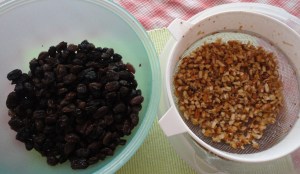
Soak raisins, candied fruit and almonds in rum overnight, stirring occasionally.
Dissolve yeast in warm milk and a pinch of sugar. Proof for 10 minutes, or until
bubbles form.
Mix flour, egg, yeast, sugar, lemon peel and salt with a spoon or in a stand
mixer using the dough hook for several minutes. Dough should just come together
and not be very smooth yet.
DSC01420
Rum soaked raisins and shredded almonds.
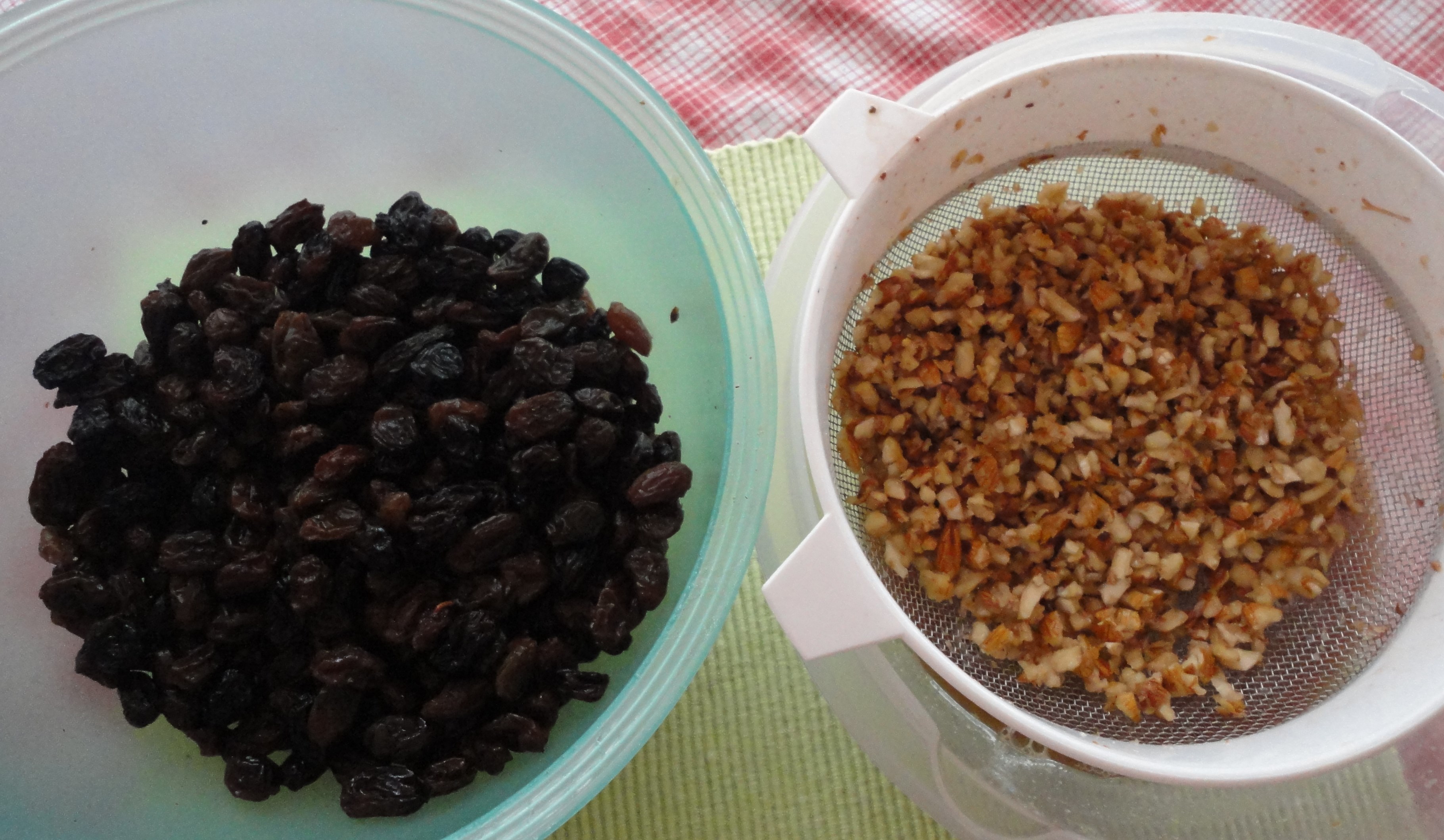
Remove from bowl and set aside while you do the next step.
Cream the butter and 2/3 cup flour with the nutmeg and cardamom until smooth.
Add the yeast dough back to the bowl and work the dough with a dough hook or by
hand until the butter and flour mixture is completely incorporated.
Let dough rest, covered, for 30 minutes.
DSC01418
Hard work, to knead almost 4 kilogram of dough.
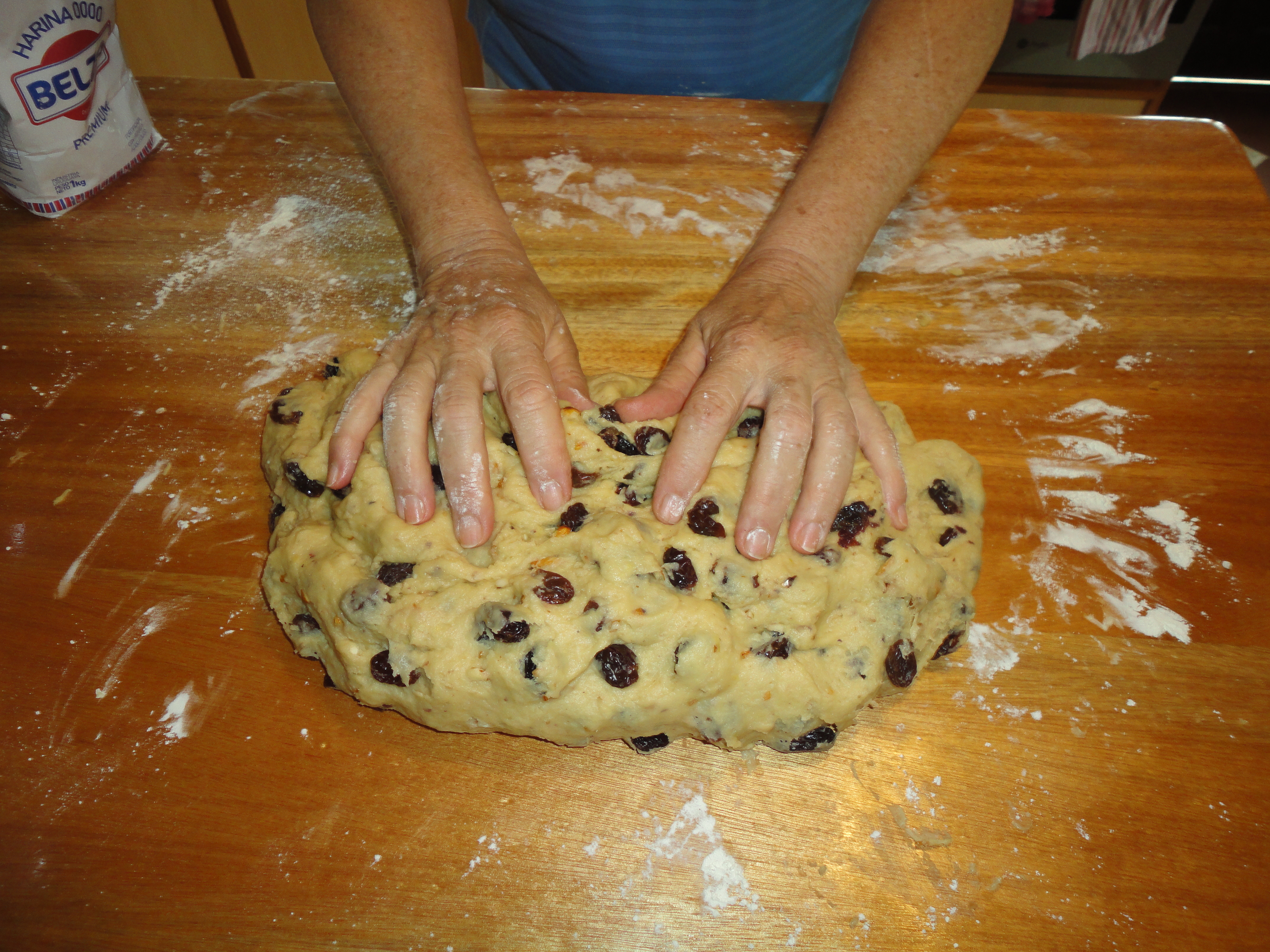
Turn dough out onto tabletop or lightly floured board. Knead in fruit and chopped
almonds. Let rest for 15 minutes.
Return dough to floured board and form into a rectangle with two high sides and a
dip in the middle. Fold 1/3 of the dough over to the middle, filling the dip. Pat
into a stollen shape.
DSC01421
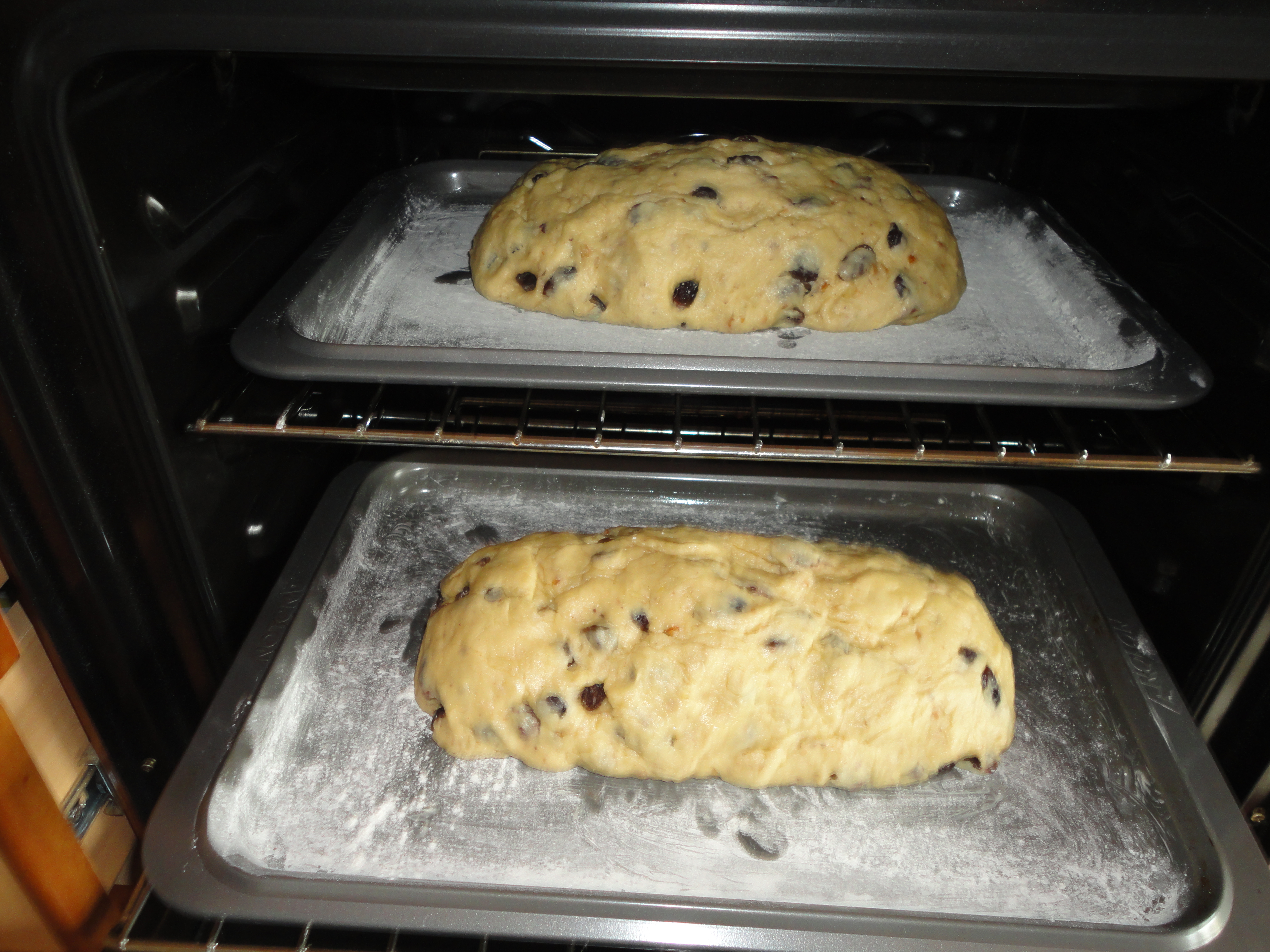
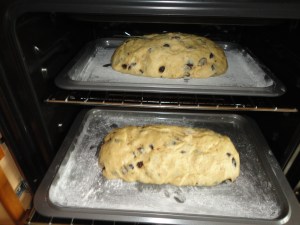
Two big Stollen loafs in the oven.

Fold a piece of aluminum foil several times on the two long ends to build walls for
your stollen, to help hold its shape while baking. You may also use a stollen pan if
you have one or a preformed aluminum bread form.
Let stollen rise for 30 minutes in a warm place.
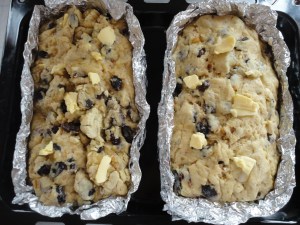
DSC01422
Stollen loafs in folded aluminium foil, buttered and ready to bake.
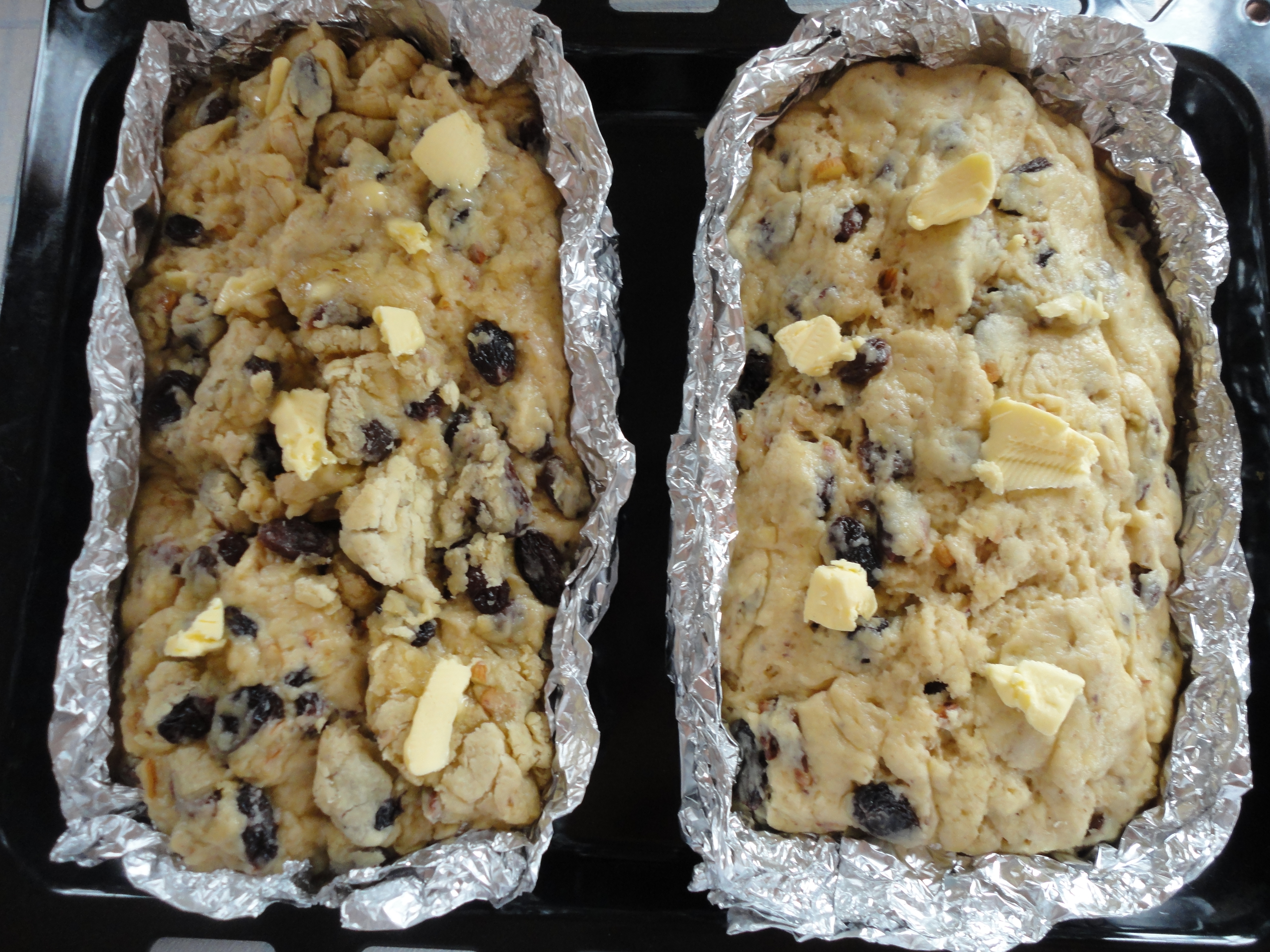
Preheat oven to 180dgC/350dgF. Dot top of stollen with butter flakes.
Bake loaves for 45 – 60 minutes, or until loaves are golden and done.
Cover with foil if it begins to brown too much.
Brush warm loaf with butter and dust thickly with powdered sugar.
You also can make yourself some icing and cover the loaf with it. Cool on rack.
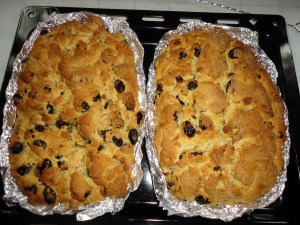
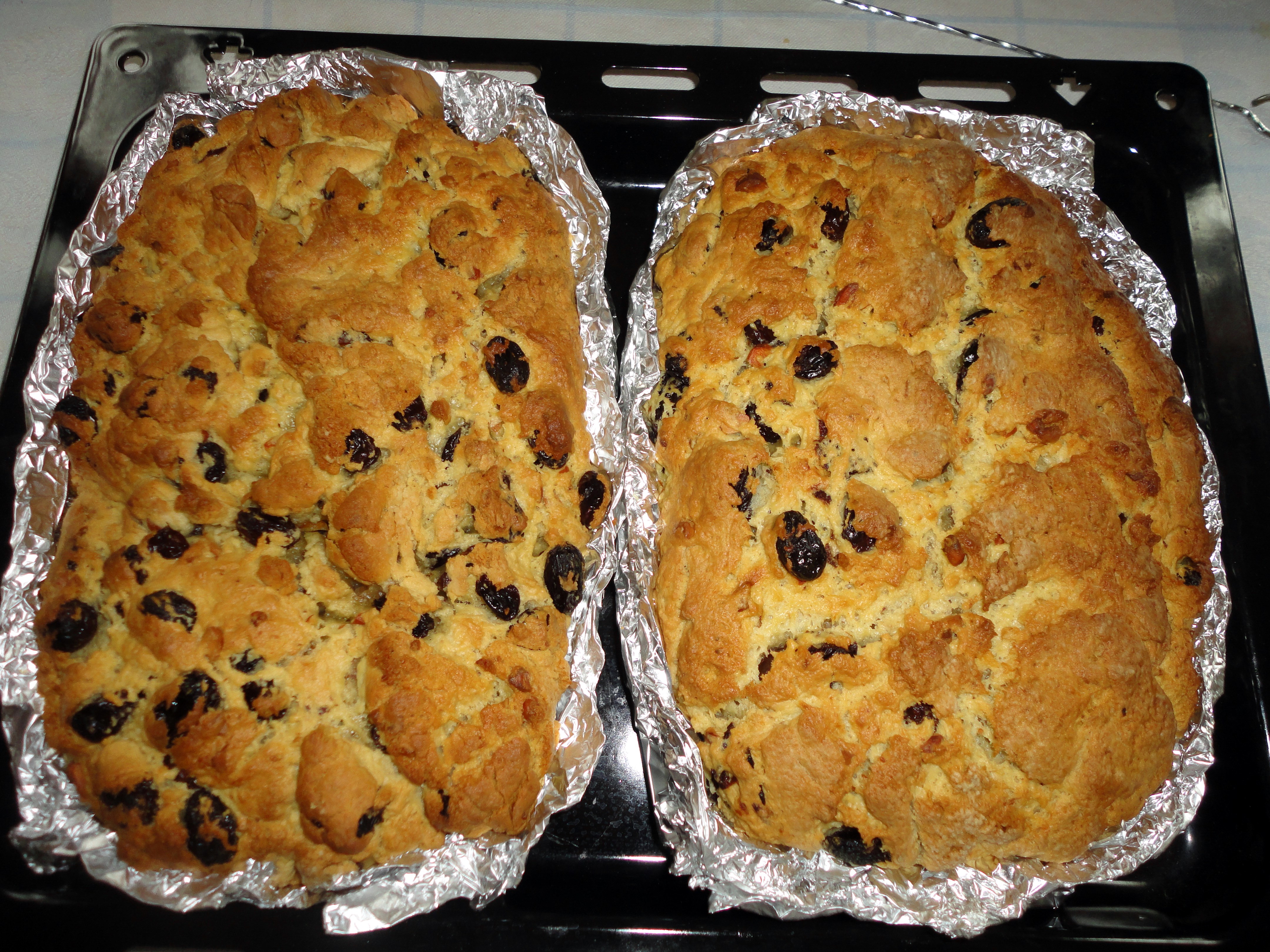
DSC01423
60 minutes later, golden brown and mouthwatering.
Tips:

Wrap tightly in foil and keep in a cool place for 2 to 3 weeks to ripen.
Don’t eat them fresh, they won’t taste as good as ripened.
Another great variation of the original stollen is the one with marzipan filling
or one with a chocolate topping instead icing.
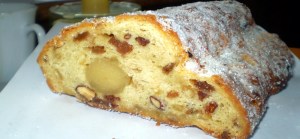
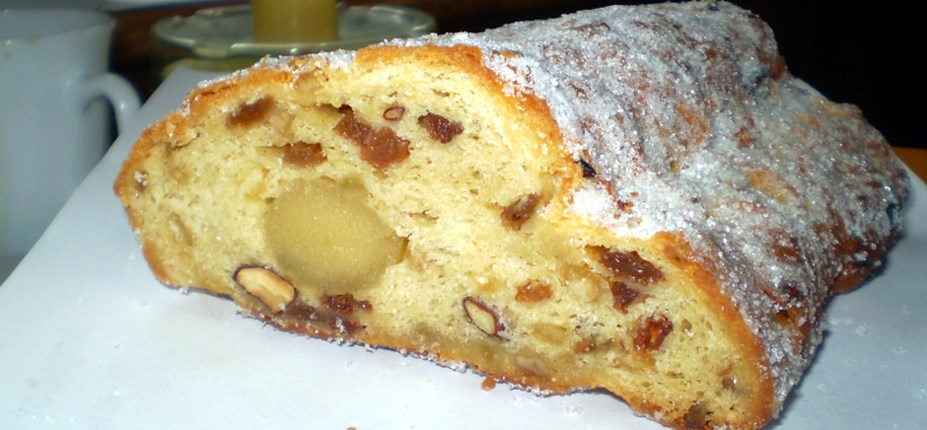
stollen 2
Butter stollen with a „heart“ of marzipan.
You can eat them like a cake or a bread, topped with all kinds of your favorites,
like cream or jam or apple mus, etc.
For an afternoon tea try with a sweet, heavy white wine, like a Sauterne. But also
with coffee, tea and a glass of cognac they taste delicious.   Merry Christmas.
Veröffentlicht unter History, Information, Lifestyle, Recipes, Travel | Verschlagwortet mit , | 2 Kommentare

The Advent Wreath

advent 5

The beginning of the Advent wreath

First – what does Advent mean?
Advent is a season observed in many Western Christian churches as a time
of expectant waiting and preparation for the celebration of the Nativity
of Jesus at Christmas. The term is an anglicized version of the Latin

word „adventus“, meaning „coming“. Adventus also means „arrival“.
Adventus Domini is Latin for „Arrival of the Lord“.

Johann Hinrich Wichern is considered the inventor of the Advent wreath.
Wichern was born on 21.4.1808. In 1826 Wichern is an education
assistant in a Christian boarding school of pupils. After years of study
in Hamburg university he became a teacher.
Wichern is now senior teacher at a Sunday school specifically for the
working-class children in the slums of Hamburg. The distress that he
had seen at his home visits, forces him to act. On 31st of October 1833
Wichern moves with his Mother and two siblings into an old farmhouse,
under the name of the old owners „Ruge’s house“ (= Rough House) .

advent 1
Johann Hinrich Wichern, Hamburg Germany.

With three boys Wichern begins his work!

Soon he took dozens of poor kids, boys first and then later also girls,
off the road and gave them a new and decent home.
Over time, there are at Wicherns house a carpentry shop, a shoemaker,
a bookbinding and they have their own agriculture farm. The children
get the opportunity to learn a trade. Soon Wichern couldn’t do this work
no longer alone. And so he brings numerous „Brothers“ in the house.
These rescuers should act like big brothers responsibility for the charges
take over and guide them and serve as a model to the kids.
1844 Wichern founded his „brothers institution“, which still exists today.
04.07.1881 Wichern dies after a long illness. His work lives on today in
the diakonia of Hamburg!

advent 2
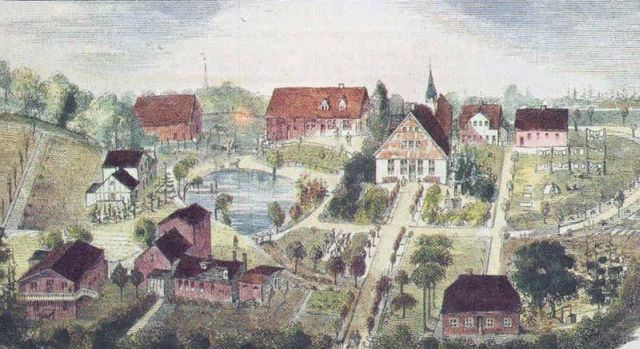
The Rough House in Hamburg, engraving of the 1840’s.

The origins of the Advent wreath.

Wichern celebrated in the rough house with his boys the Advent. But at
that time there were not as many Christmas symbols as we have today.
Wichern celebrated the advent first so, that they sang at the evening
Christmas carols, and reading the many biblical promises about the
coming of Jesus Christ.

In 1839, for the first time, Wichern mounted on a wooden wheel four
large white candles for each Sunday of Advent and 19 red candles for
each day of the week from the first Advent until Christmas Eve.
Only years later he began to decorate the wooden wheel with pine green.

Since there are different numbers of days from the first Advent to
Christmas Eve every year, so is the number different of red candles.
In average the first big Advent wreath’s, in churches or else, counted
4 white candles and 24 red candles.
During the years the candles reduced to 4, because of lack of enough
room (wagon wheel size) in private homes, and lit every Sunday of advent.

advent 4
Advent wreath with 4 white and 24 red candles.

What will tell us the Advent wreath?

The green of the pine branches pine branches is not only a sign of hope,
but also symbolizes life. Thus, the evergreen pine branches are a sign
of hope of eternal life that we get paid in Jesus Christ.

Wreaths apply since time immemorial and in many cultures as a sign of
victory. the Advent brings this trophy in our homes, especially in a
dark and dreary season in which nature „dies“.

Lights of the candles and lights of the Advent wreath. Jesus claims:
„I am the light of the world! Whoever follows me will no longer wander
in the darkness, but will have the light that leads him back to life“.
Red candles: The color red stands for love, especially for the love of
God in us, that He, Jesus Christ can give.
A candle is lit every day, of course, with the result: more and more
each day it gets lighter and warmer around the wreath up to the coming
of Jesus on Christmas Eve.

stollen 20
Today we light the first candle.

Veröffentlicht unter History, Information, Lifestyle, Uncategorized | Verschlagwortet mit | 3 Kommentare

10 plus 1 Halloumi Ideas

Halloumi 2
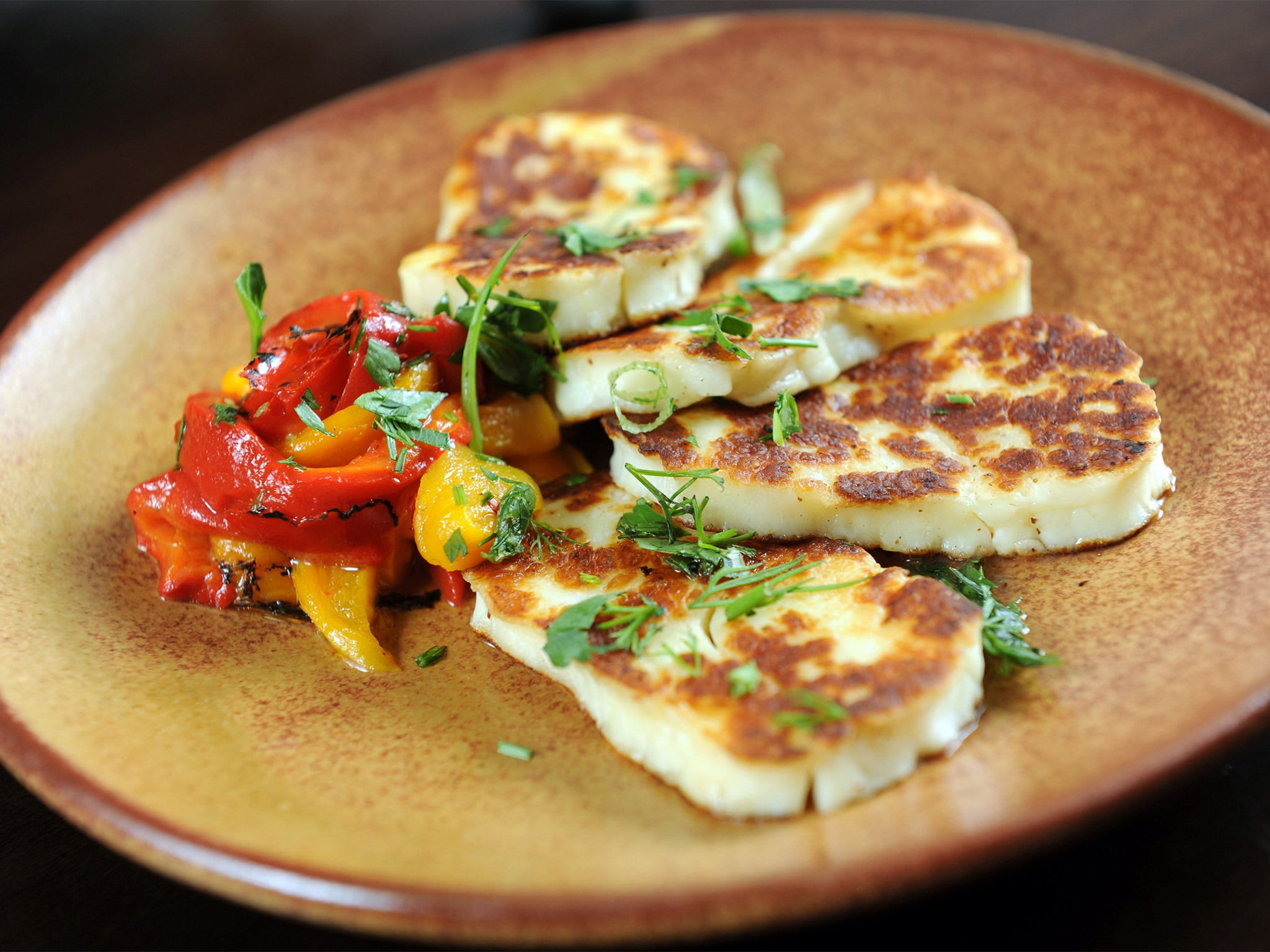
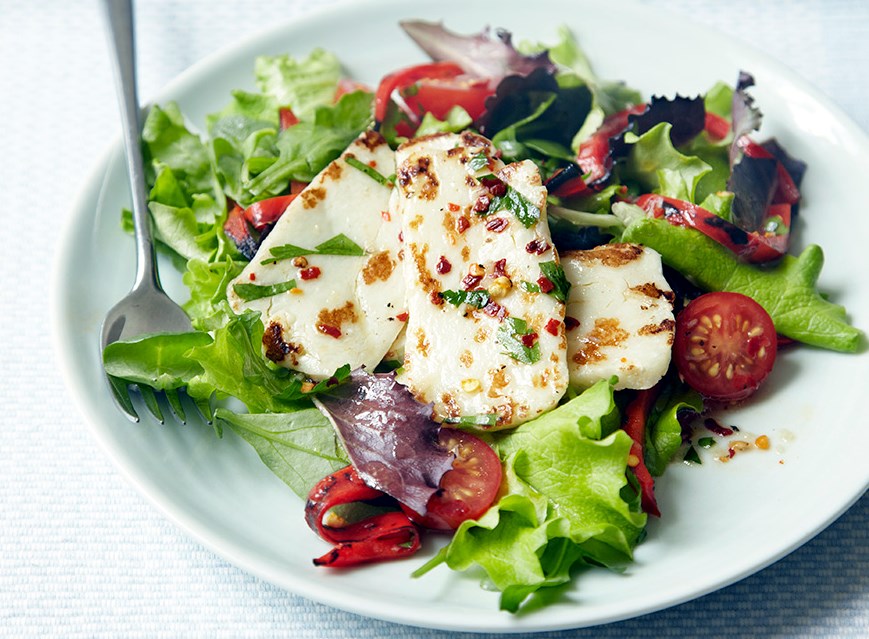
A plate of fresh grilled Halloumi and Peppers. Serve with French Baguette
and a nice cool beer or a local Chardonnay.

Summer is coming up and we like to eat a bit lighter and suitable to
the hot weather. The following Halloumi recipes are perfect for the
summer kitchen.

I like to dedicate this Halloumi recipe to my good friend and author of
the wonderful novel „The Lullaby Illusion“. We both have good memories
to Cyprus and the delicious servings of Halloumi dishes under shady trees
in great restaurants with a glass of Mavro or Xynisteri.

Halloumi
Halloumi is a Cypriot ( firm, brined, slightly springy )  white cheese,
traditionally made from a mixture of goat and sheep milk, although
these days cow’s milk is also used. Its texture is similar to that
of mozzarella or thick feta, except that it has a strong, salty
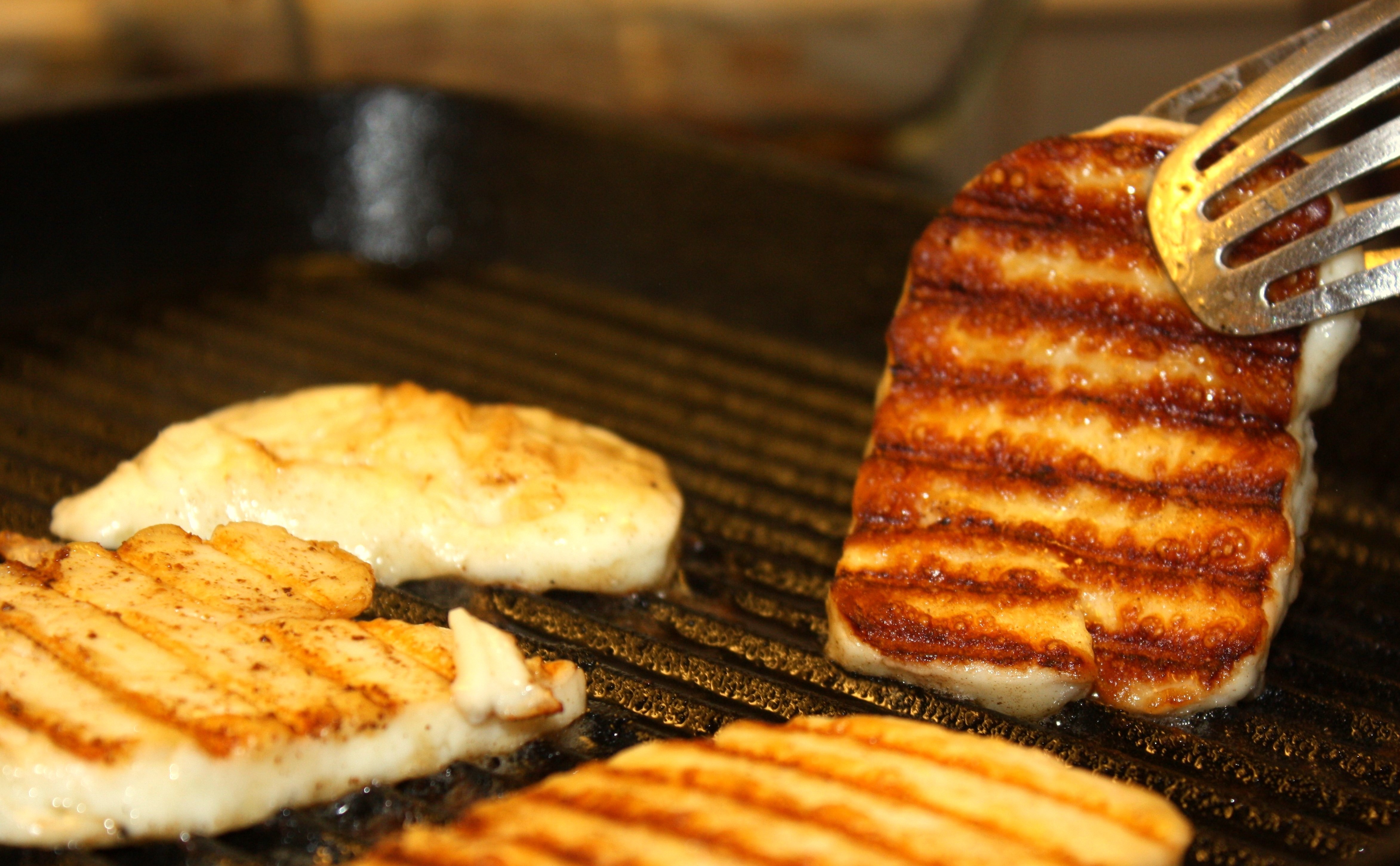
flavor imbibed from the brine preserve. Cooking the Halloumi
removes all its saltiness and empowers with a creamy texture.

Halloumi 10   Halloumi 9
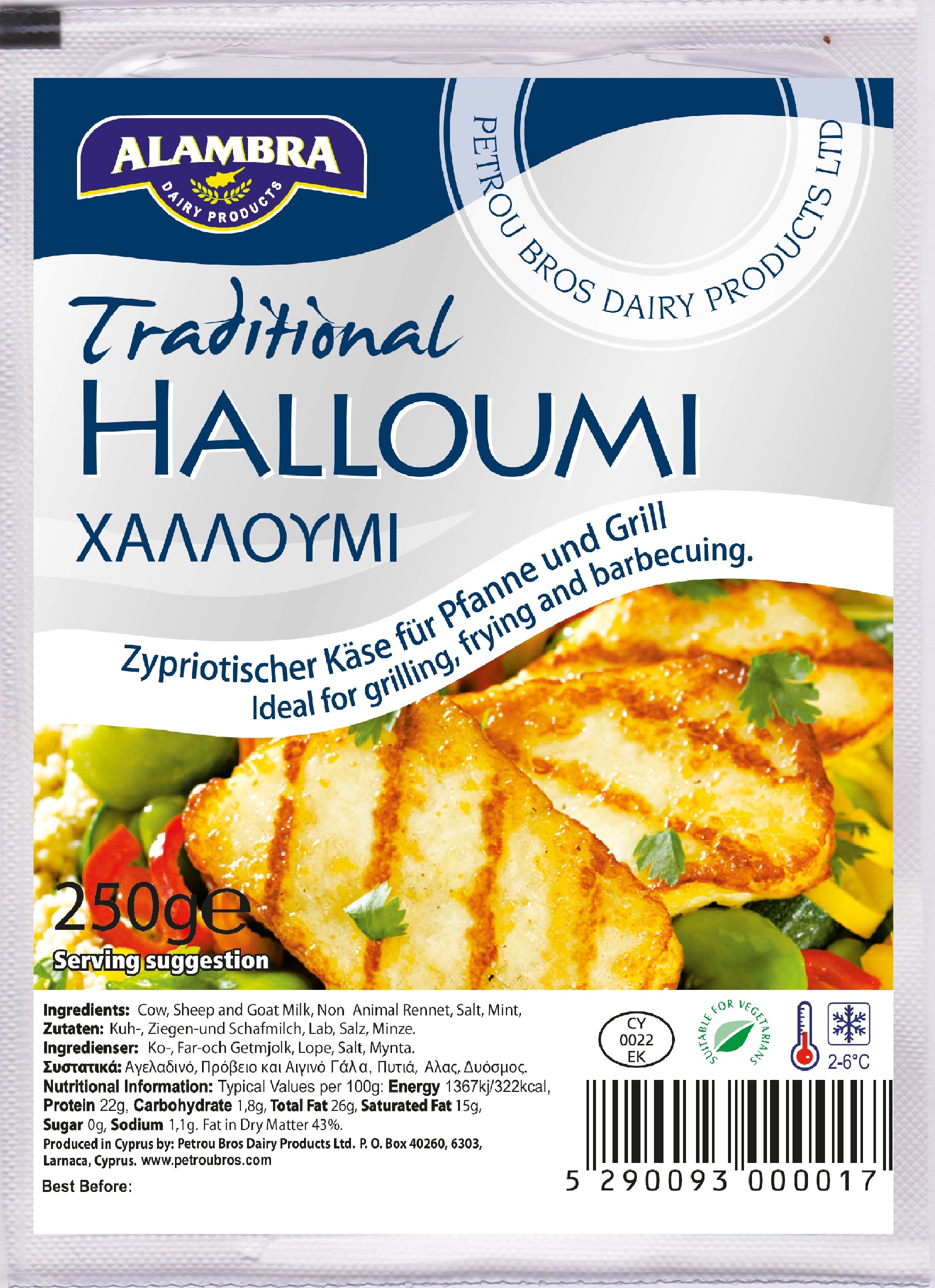
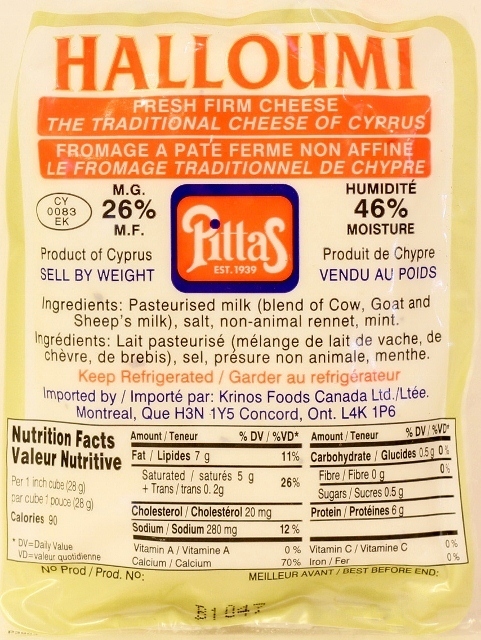
Two original Halloumi cheeses from Cyprus, you can buy around the world,
except in Uruguay. It’s a BBQ country, but they haven’t discovered it yet,
although all ingredients are available here.

Since the cheese has a high melting point, it can be easily fried
or grilled. Its unusualness lies in the preparation of the cheese
where no acid or acid-producing bacterium is required. Halloumi is
generally served during the warmer months with watermelon, due to
its refreshing qualities. It is an essential part of a Cyprus Meze
(means a „come together“, a social meeting, center of fun & friends)
and many times it is offered as an accompaniment with cold beer.
The cheese tastes lovely salty when grilled, pan-fried or thinly
sliced on a salad.

Marinated Halloumi with Fried Peppers. See first picture.

Ingredients:
400g haloumi cheese
250g cherry tomatoes (looks nice to have yellow and red ones.
Instead tomatoes I used this time yellow and red peppers, same
amount, finely sliced, as well as fresh green herbs).
1 clove garlic
2 tablespoons lemon juice
1 tablespoon balsamic vinegar
2 teaspoons lemon thyme ( you also can use a rolled lime leaf
extremely fine chopped, or a lemon myrtle leaf. If you have problems
with the leaves in UY, use 2 teaspoons of grated lime rind ).
1/4 cup (60ml) extra virgin olive oil
2 tablespoons olive oil
1 small loaf good-quality whole grain bread, cut into 8 thick slices.

How to do:
Place the Halloumi and tomatoes (cut in halves) in a none metallic dish.
Whisk together the garlic (crushed) lemon juice, balsamic vinegar, thyme
And extra virgin olive oil in a jug and pour over the Halloumi and tomatoes.
Cover and marinate for at least 3 hours or over night in fridge. I use a
Plastic bag and shake it from time to time.
Drain well and keep the marinade.

Heat the olive oil in a large, non stick, frying pan. Add the cheese and
cook in batches over medium heat for 1 minute each side or until
golden brown. Transfer to a plate and keep warm.

Halloumi 8
So much fun and so easy to fry/grill Halloumi. Perfect to celebrate with kids.
With kids you can use cheese blocks and BBQ like you do it with marsh mellows.

Add tomatoes to the pan and cook over medium heat for 5 minutes or until
Skin begins to burst. Transfer to a plate and keep warm.
Toast the bread until golden brown (I do it in the same pan as cheese and
Tomatoes were, but higher heat). Season with salt and pepper to your taste.

Serving:
Serve the hot Halloumi on top of the toasted bread (2 per person), piled high with
The tomatoes and drizzled with the reserved marinade. Serve immediately.

Tip:
If you can’t find Halloumi cheese, use Camembert (but a bit fresh, harder one)
Or feta. Don’t use mozzarella, too tasteless.
If you like it spicy use some fresh chilli combined with the garlic stage,
Or chilli powder as seasoning.
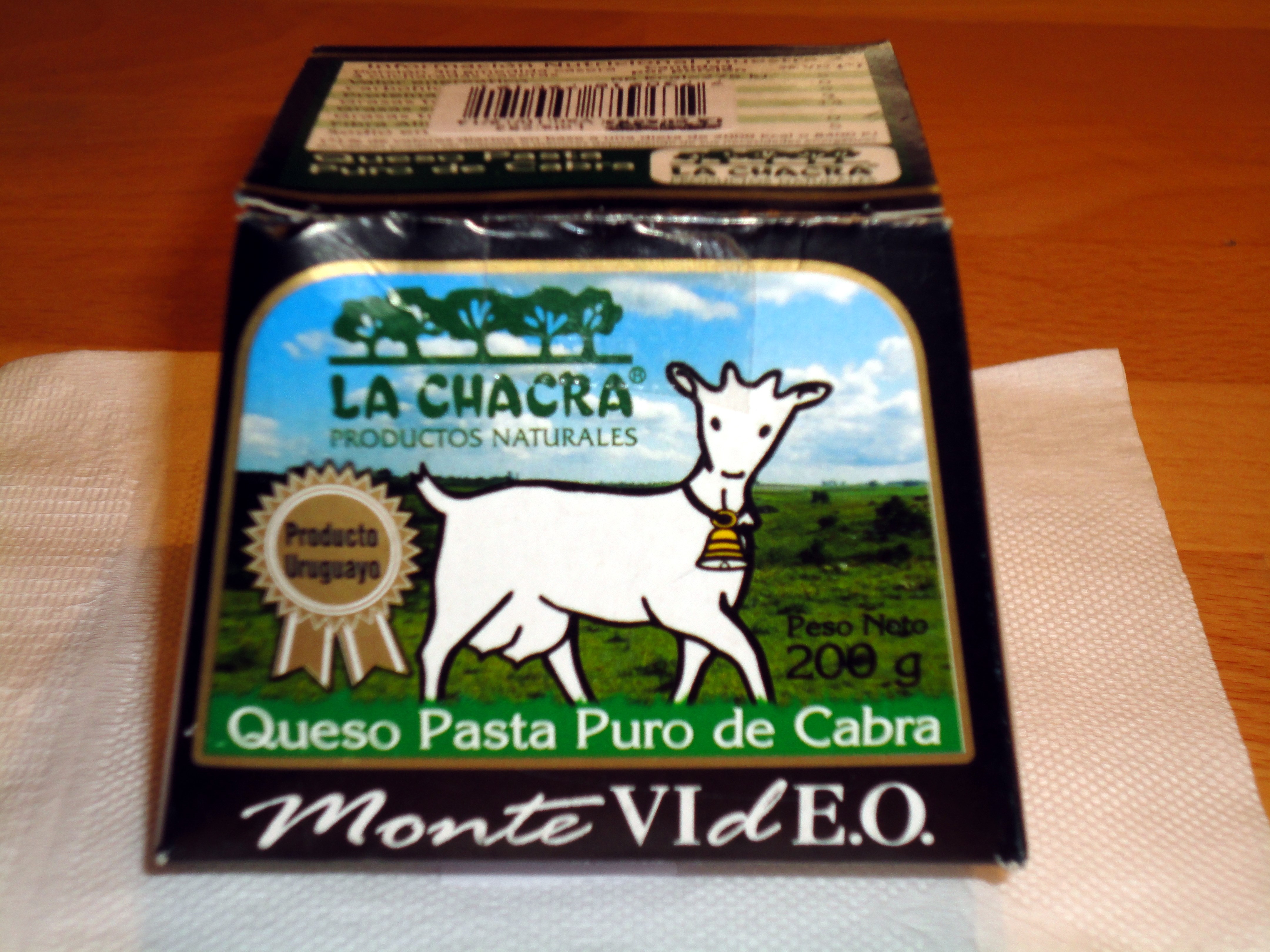
In Uruguay I have never seen Halloumi. But you can find very tasty goats cheese
from „La Chacra Montevideo“.

DSC01413
See a pic of the soft, creamy cheese. You will need and use the firm one
which comes in different sizes of blocks. Sadly not the cheapest cheese in Uruguay.

Halloumi for the whole summer:

Halloumi 5
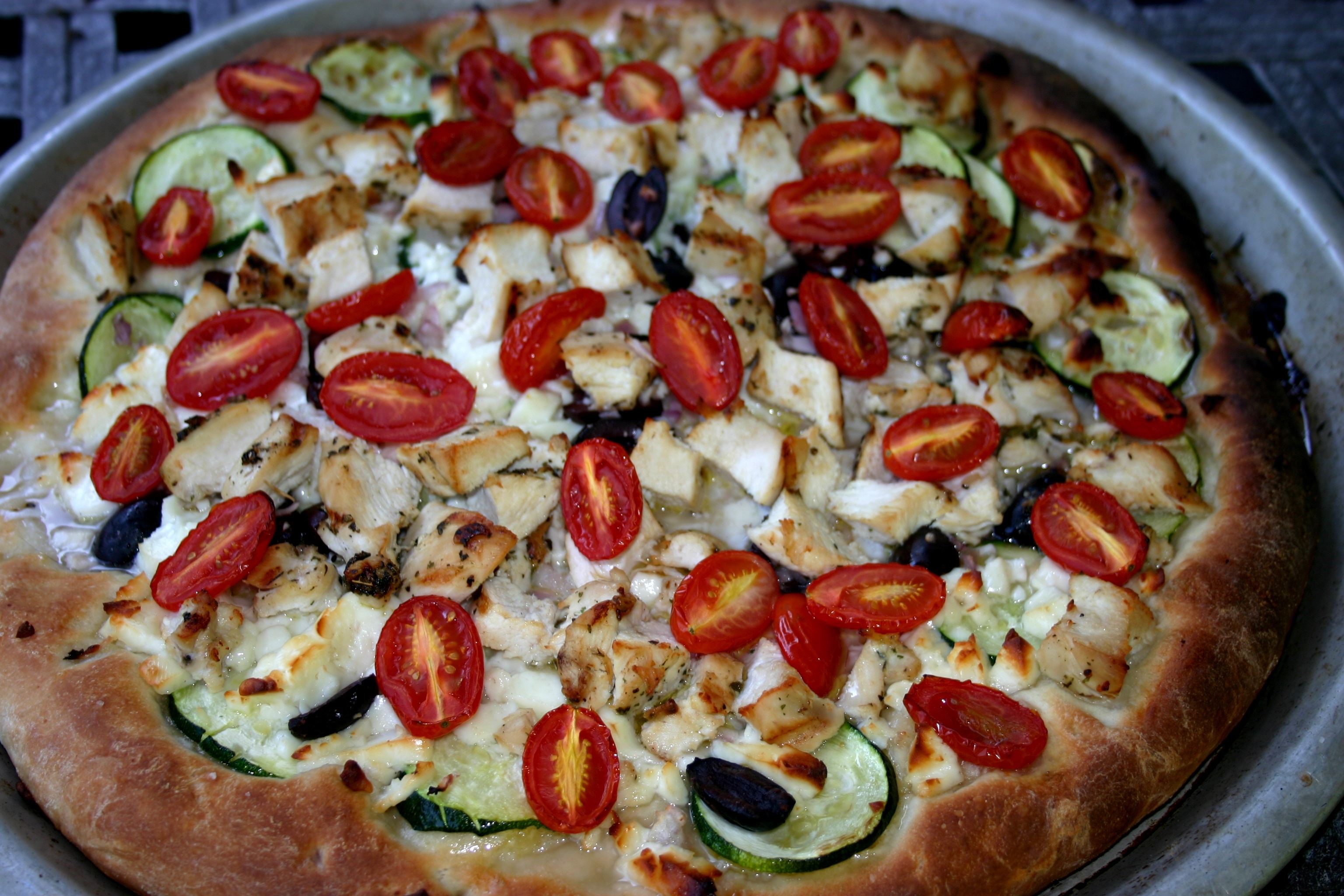
Make your own Pizza and decorate with slices or small blocks of Halloumi plus
thin slices of button mushrooms, thin slices of cucumber, quarters of cherry
tomatoes, slices of red olives and a few fine chopped pieces of red onion.

Halloumi 6
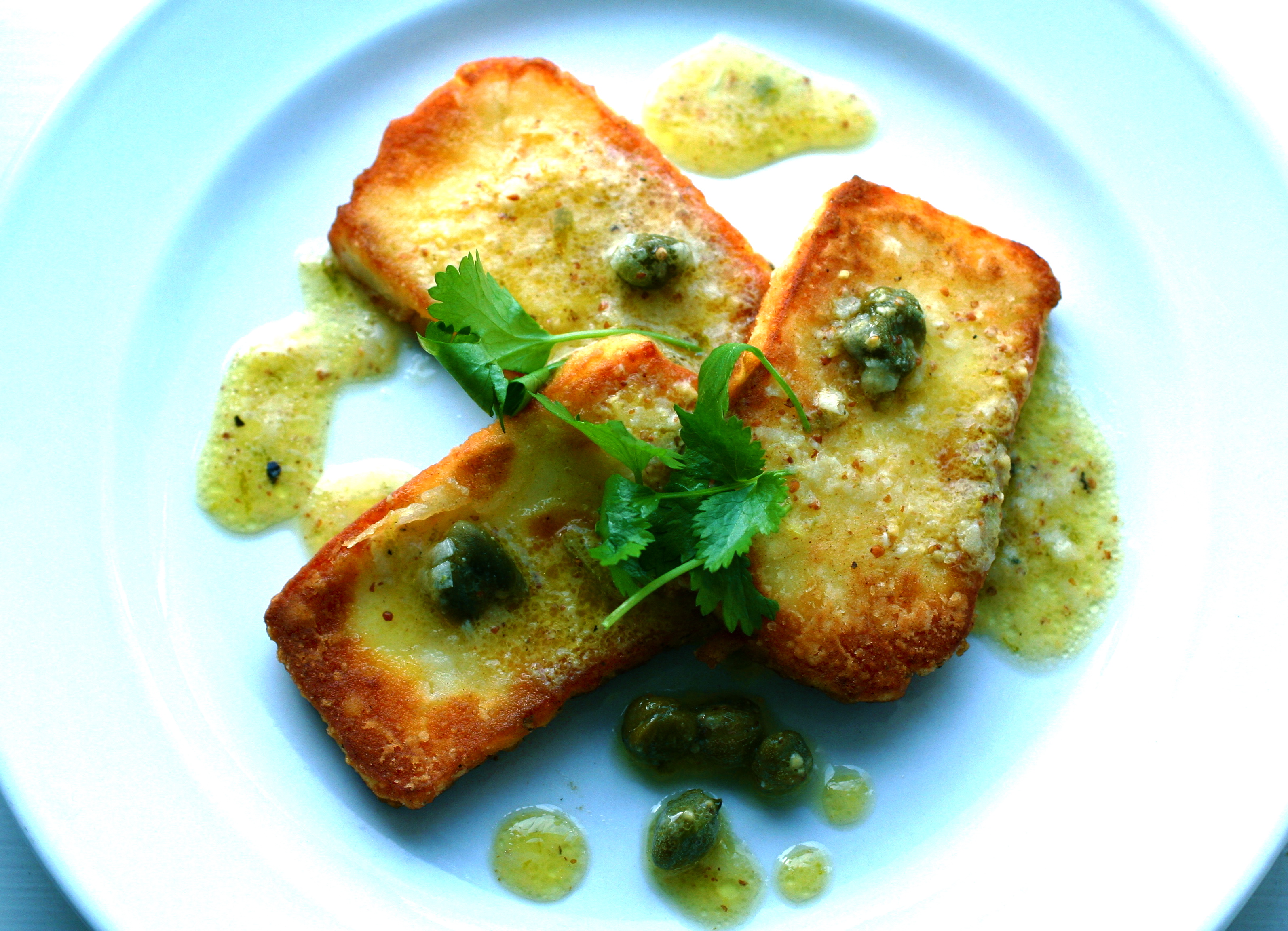
Deep fried Halloumi with an avocado foam ( made easy in a food processor with
avocado, bit chilli powder, bit curry powder, bit mixed herb powder ).
Mix into the foam a few capers and decorate with fresh coriander.
A typical Mediterranean feast.

Halloumi 7
What a sexy salad. Fresh Halloumi slices on green and red lettuce leaves with
halves of cherry tomatoes and grilled stripes of red pepper. The kick is a hot,
(hot means spicy hot and cooked hot) dressing of fresh coriander, fresh chilli,
brown sugar, salt and white wine vinegar. Dressing served warm over cold salad.

Halloumi 12
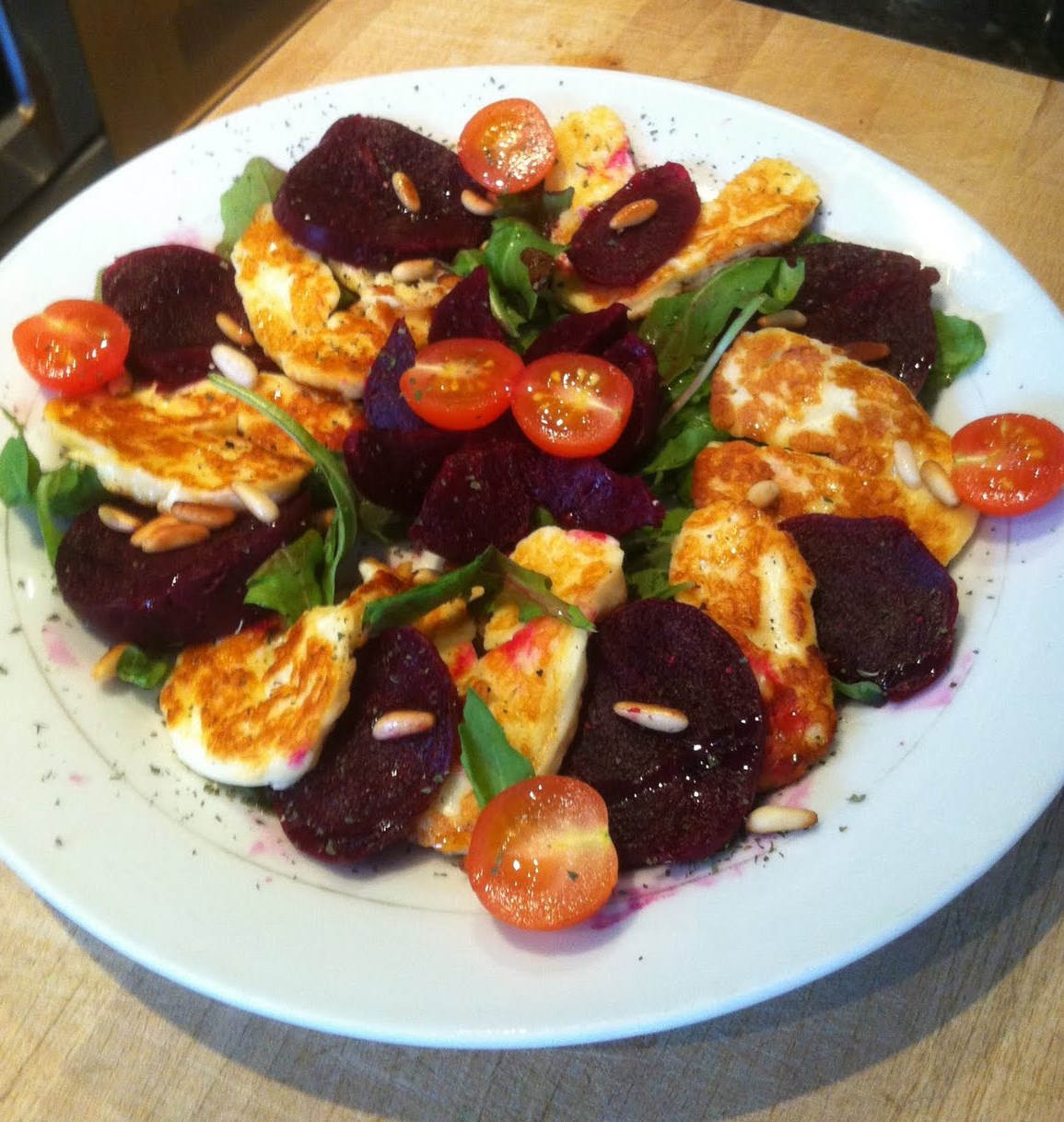
A wonderful dish is, fried Halloumi slices with slices of fresh or marinated
baby beetroot. Decorated with basil leaves, ground black pepper, cherry tomatoes
and roasted pine nuts. Instead basil you also can use rucola leaves.

Halloumi 13
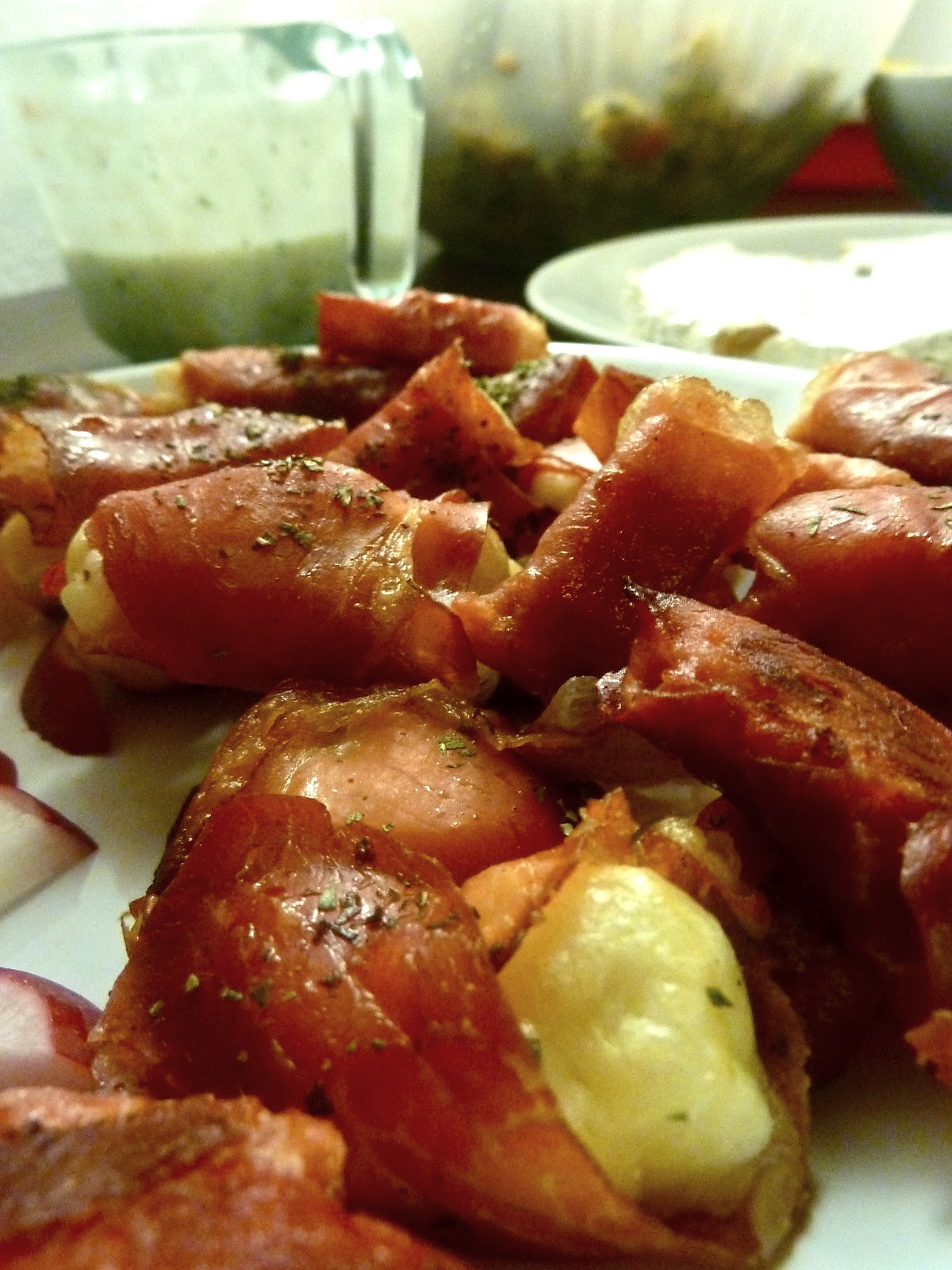
This is something real special. Parcels made of warmed Halloumi, wrapped in pieces
of red onion and slices of Parma ham. Then grilled again and sprinkled with a
mix of extra virgin olive oil and herbs de Provence.

Halloumi 15
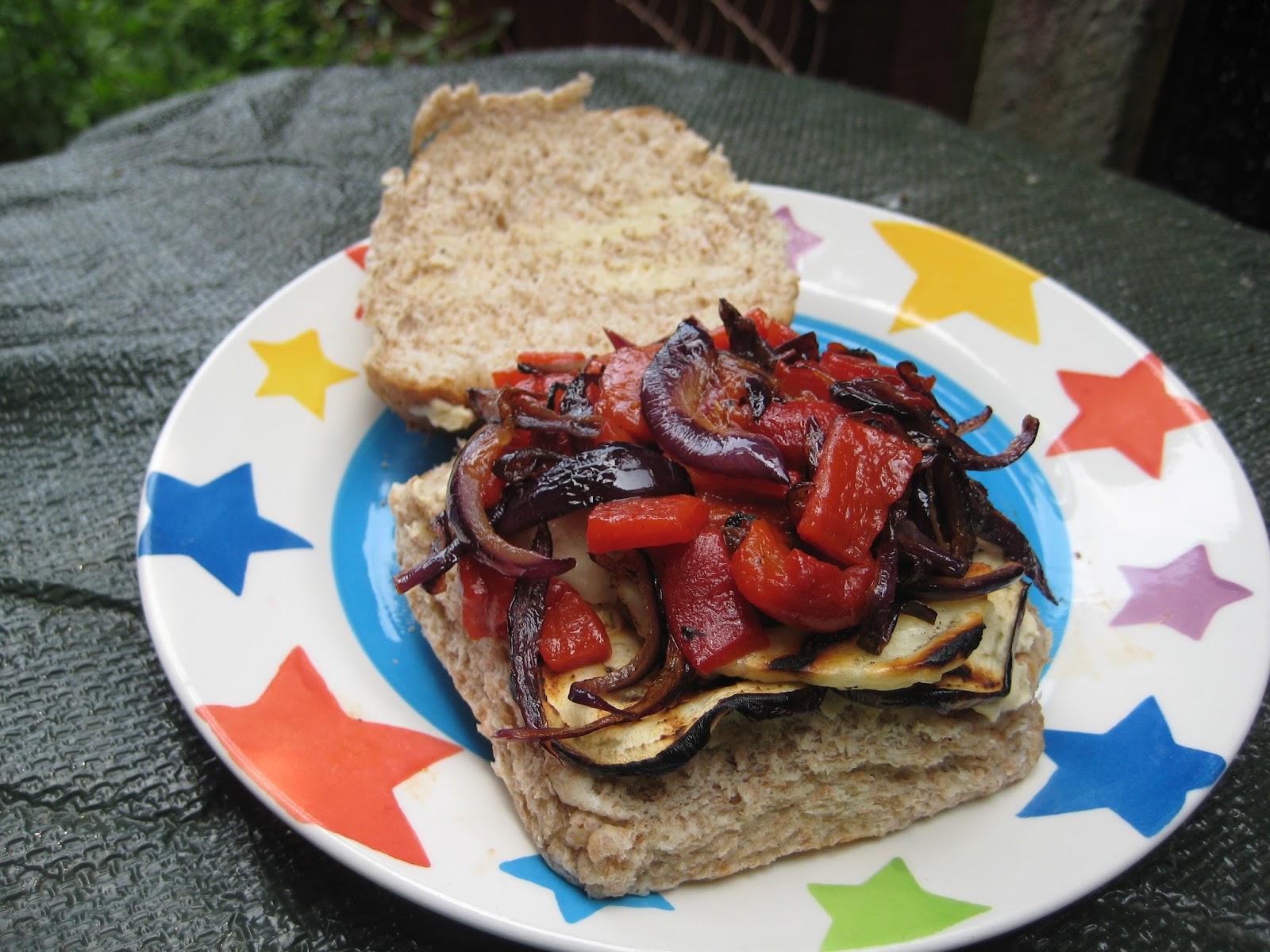
Delicious Halloumi burger. Smear a roll with (as much as you like) pesto , put 2or3
slices of grilled Halloumi and top everything with a lot of pan fried veggies, made
from red peppers, red onions, tomatoes and parsley or coriander. Serve very warm.

Halloumi 16
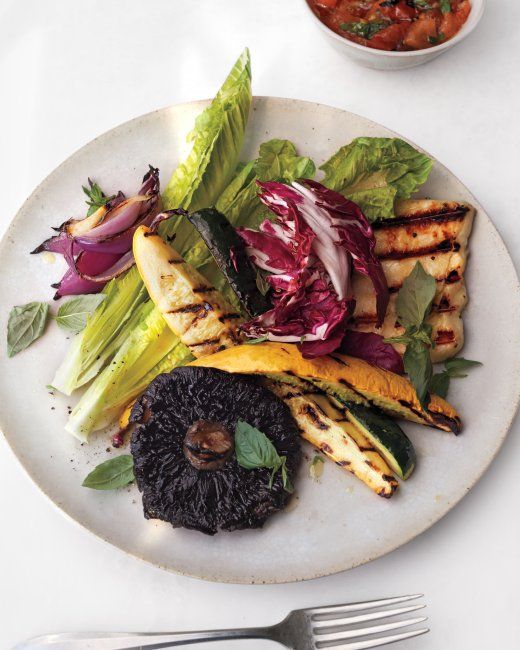
Warm salad from the BBQ. Grill a nice slice of Halloumi und decorate with different
grilled vegetables. I used here iceberg lettuce, radicchio, red onion, squash,
a lemon slice, a big mushroom head (or several button mushrooms), zucchini – all
fresh and hot from the BBQ, topped with a few mint leaves and a cold tomato
relish as side dish.

Halloumi 17
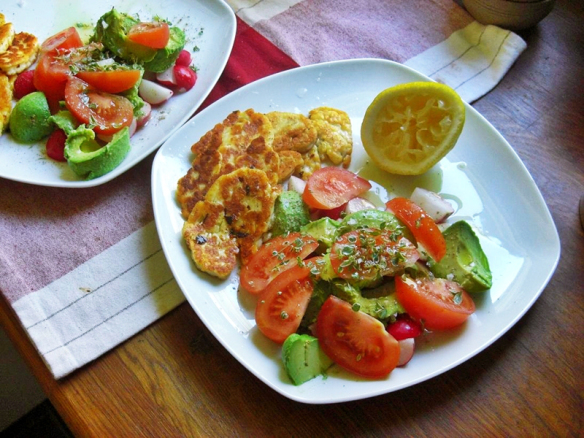
A full meal. Pan fried Halloumi slices next to a spicy summer salad. Salad made from
avocado slices, tomato quarters, pieces of radish and topped with a spicy green pesto.
Squeeze lemon juice over the cheese and serve all at room temperature with good wine.

Halloumi 19
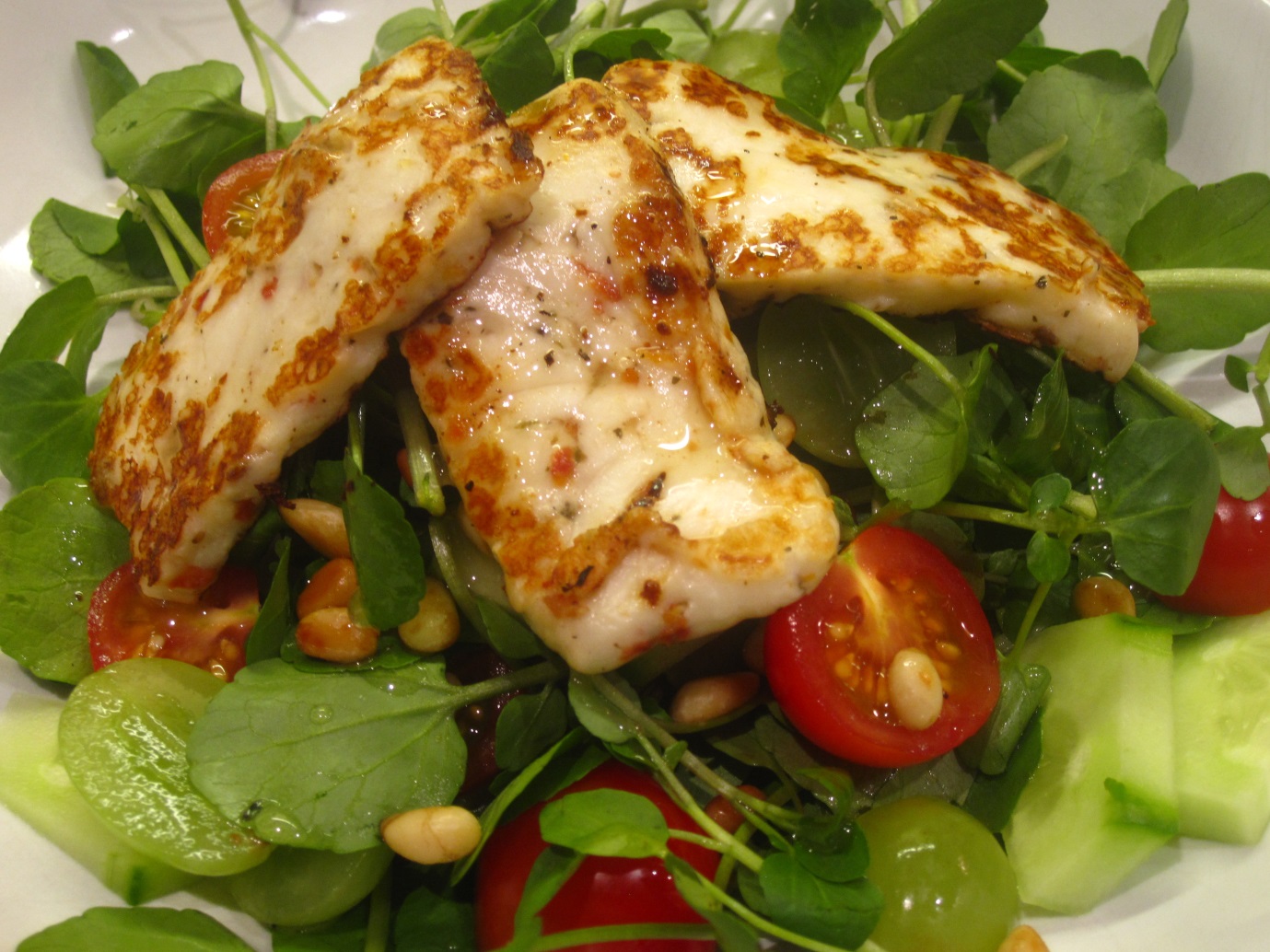
Spicy salad made from slices of Halloumi fried in chilli and garlic oil. Then piled
on watercress, halved cherry tomatoes, slices of cucumber and grapes and topped with
roasted pinenuts. The spicy chilly and garlic oil will then be sprinkled all over.

Halloumi 11
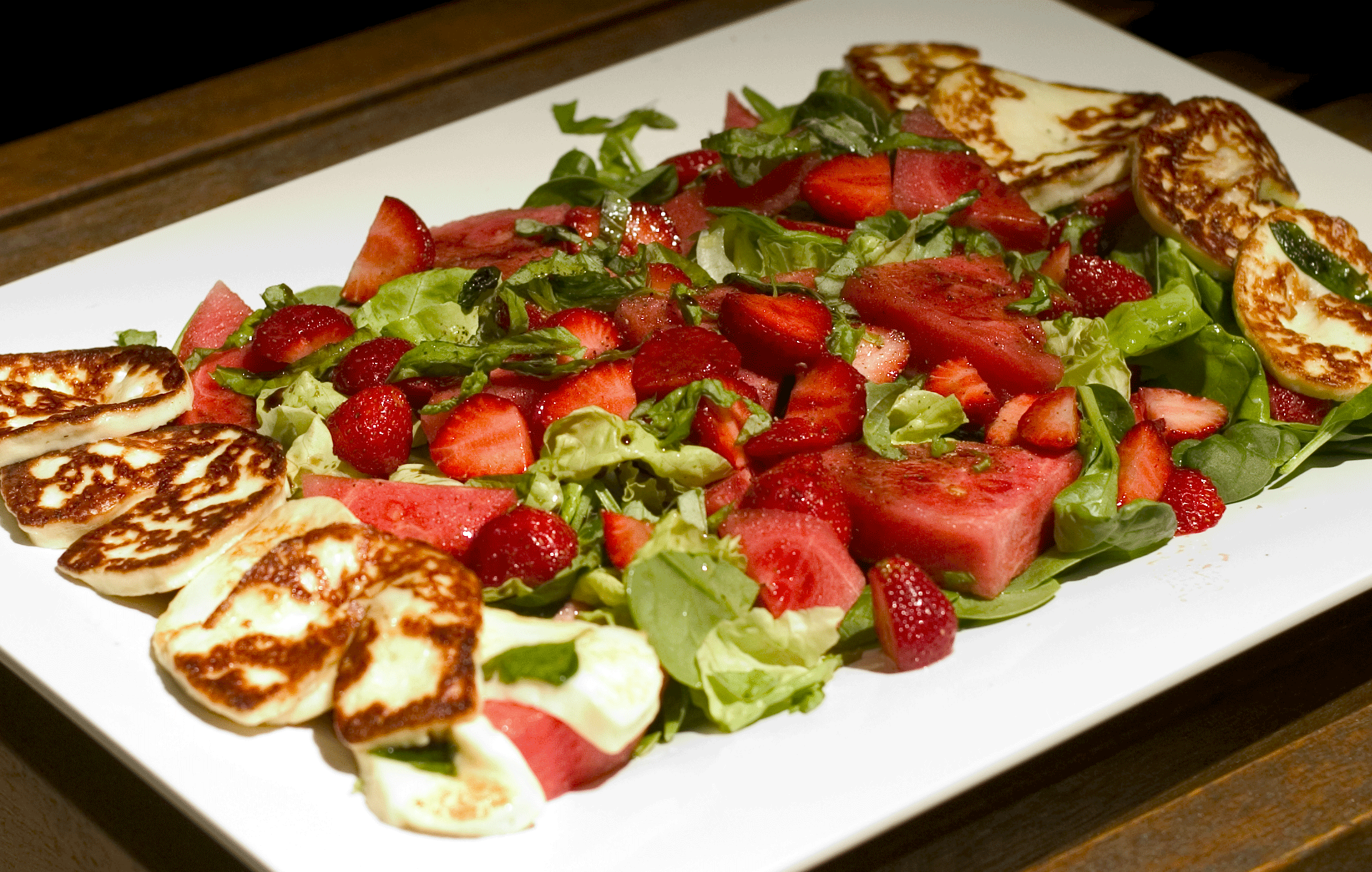
And finally some sweets. Grilled or fried Halloumi on a bed of mixed green leaves
from lettuce, basil, coriander and a few mint. On that fresh strawberrys and water
melon. all that topped with a mix of five spice and honey. ENJOY HALLOUMI AS I DO !

Veröffentlicht unter Lifestyle, Recipes, Travel | Verschlagwortet mit , , , | 2 Kommentare

Our backyard pets

DSC00011_2

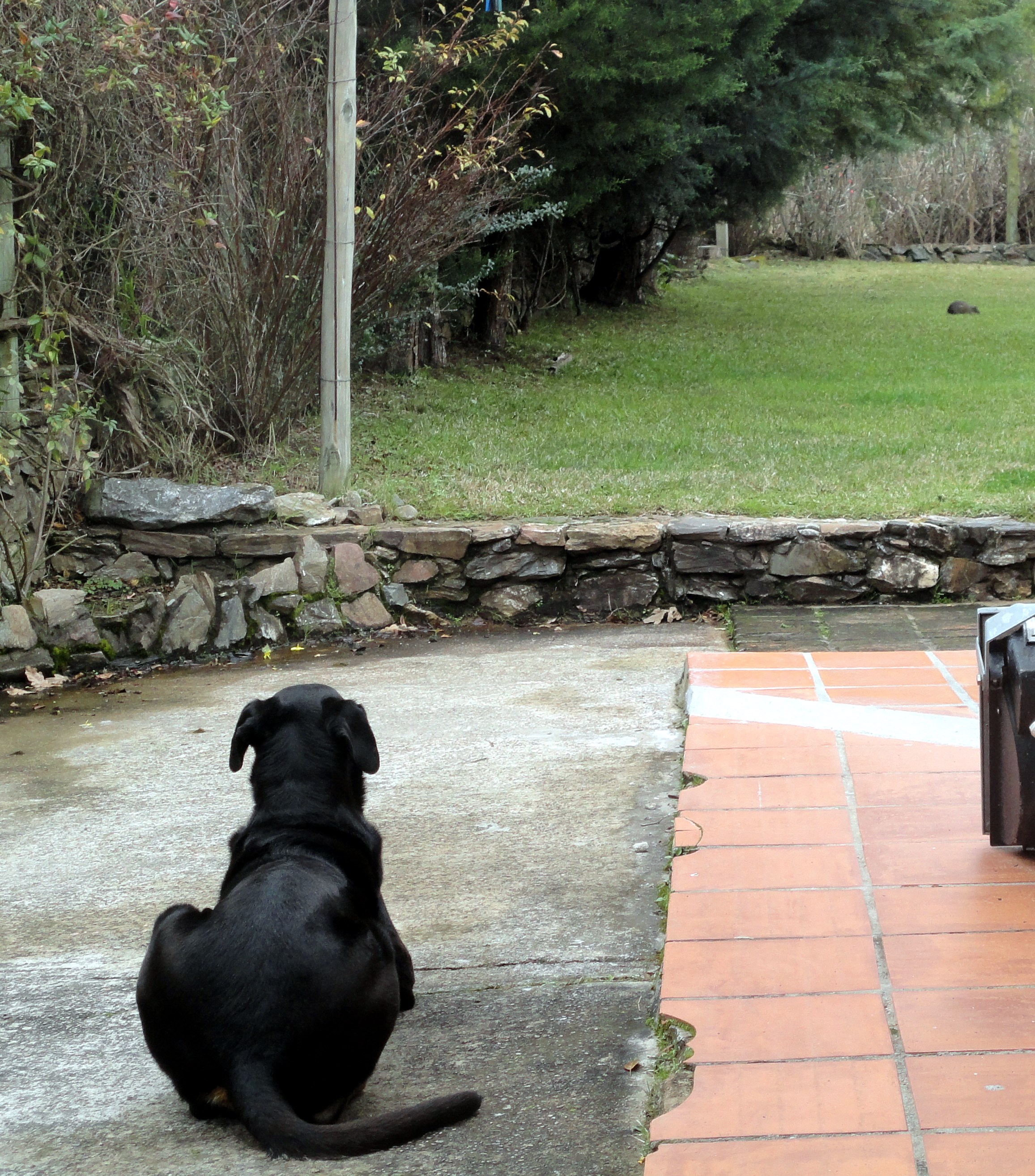
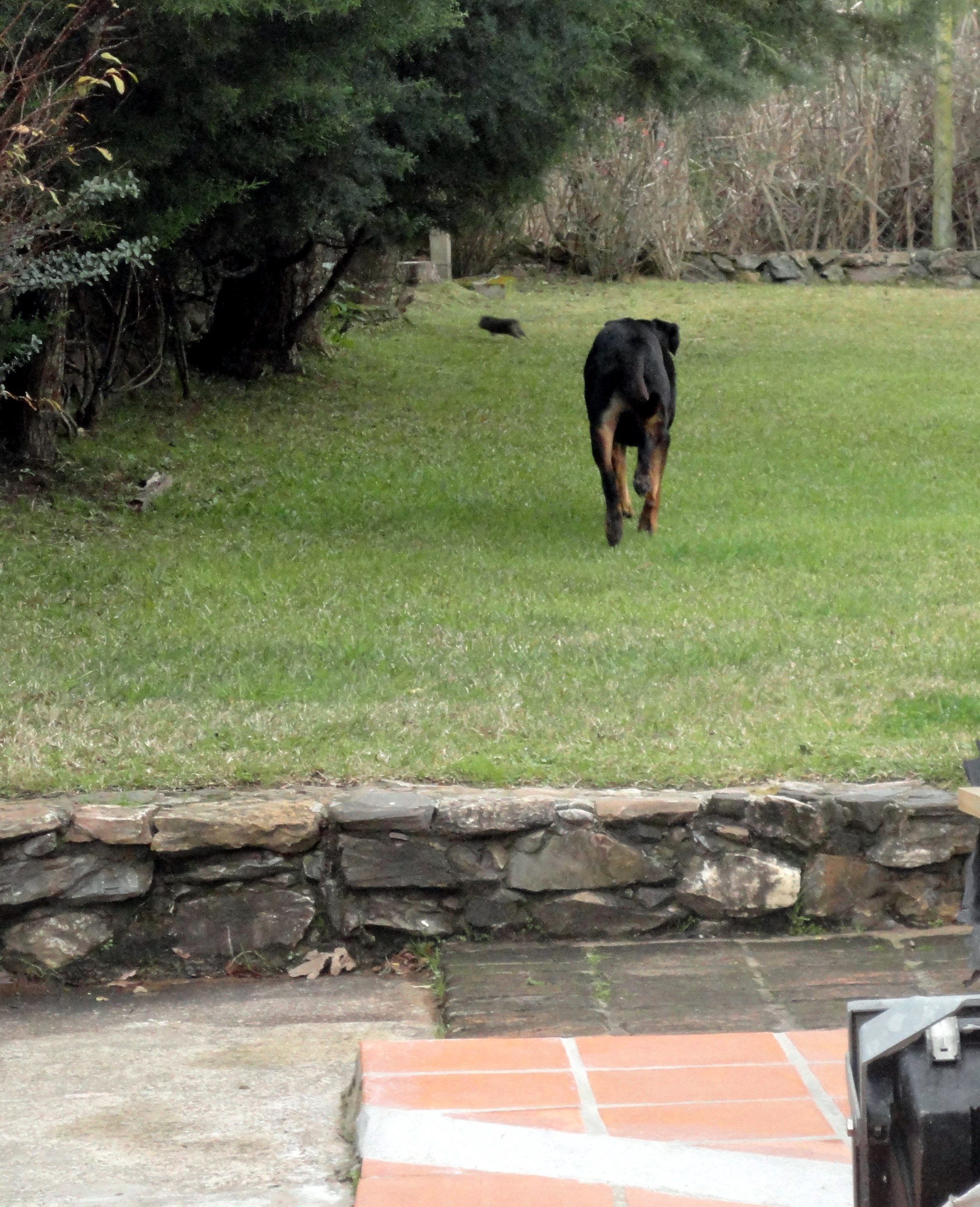
Often seen around the coastal area of Canelones. Pretty active little animals in our
backyard. Not harming anyone and not dangerous.
Just our dogs try to hunt them. Mostly they are to quick, but if they face 2 or more dogs,
they can be in bad luck.

DSC01096_2  DSC01098_2

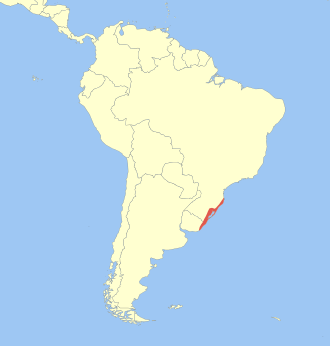
This species is the „greater guinea pig“, Cavia magna, is a guinea pig species from
South America. It is found only in a small part of southeastern Brazil and
eastern Uruguay. See map. No where else in the world.

Cavia 3

These wild living guinea pigs reach a body length of 20 to 40 centimeters and a weight
of 500 to 1500 grams. Her long and relatively coarse hair is colored greyish or brown.
The legs are short and strong, the front feet have four toes and the hind feet three,
all of which end in sharp claws.

Cavia 2

These animals inhabit a variety of habitats, including grasslands, forest edges, swamps
and even mountainous regions.
They are independent animals that prefer self-dug burrows as shelter or natural caves.
This directs to its scientific name, Cavia. They live in groups of five to ten animals
together, often join together to form larger super groups.

Cavia are herbivores, which, depending on the habitat of a variety of plants, mainly
grasses feed. Like people, they rely on vitamin C in their diet and develop vitamin C
deficiency scurvy. Another special feature is the vital seizure of caecum pellets.
This relatively soft fecal pellets are excreted and then immediately added, because
they contain important bacteria, which serve to maintain the intestinal flora.
In addition, the caecum pellets cover the entire vitamin B-demand and low portions
of the vitamin K requirement.

DSC00013

Guinea pigs were originally domesticated for their meat and to be kept still as
livestock for consumption in some South American Andean countries, such as Peru.
They apply there as a popular barbecue delicacy and taste like a combination of
rabbit and dark chicken meat. The nutritious meat has a protein content of about
21%, while only a fat content of 8%. Particularly in the Andean highlands they
are an important source of protein and has long been an integral part of
traditional medicine. The guinea pigs are so popular in those countries as
animals, because of their attitude in comparison to other meat-giving pets.
They require very little space and they multiply very fast also.
This fact is especially in an urban environment for the people a great advantage.

Cavia 1

In Peru, I learned that cuy (local name in Peru for guinea pig) was prepared in a
number of ways. You could make it stuffed and roasted, piquant and quartered,
or flattened whole and fried. Cuy is said to be widely consumed in Peru.
According to the author of „Unmentionable Cuisine“, veterinarian and food expert
Calvin Schwabe, cuy provides over 50 percent of Peru’s animal protein. Many people
raise guinea pigs at home, and others buy them in the meat section of their market.

cusco-cathedral-3  Cusco cathedral.

Just in Peru alone, about 65 million guinea pigs are eaten per year.
They are for centuries an integral part of the food culture.
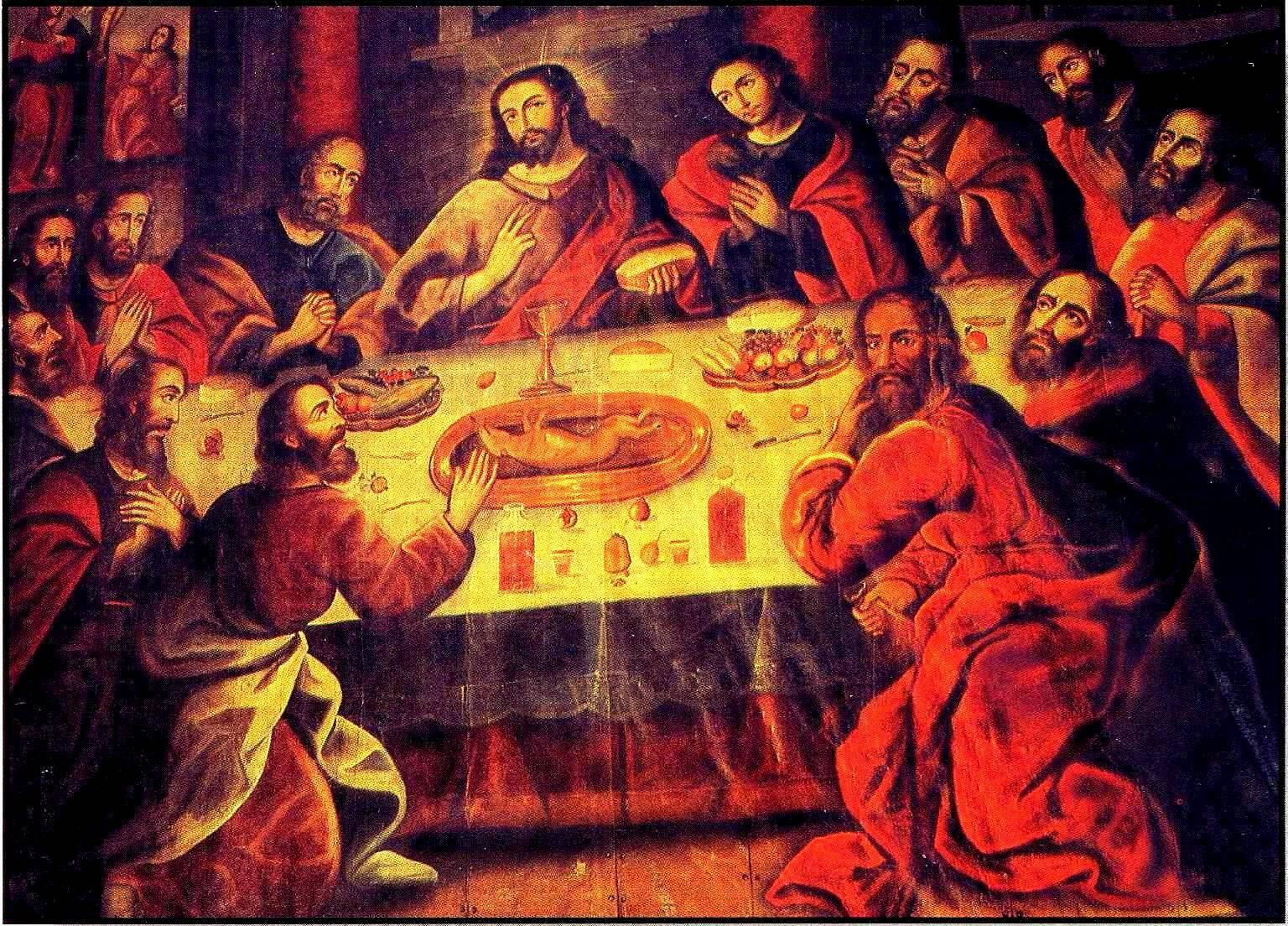
Thus, a famous painting of the „Last Supper“ in the main cathedral of Cusco
„Christ and the twelve apostles“ with the consumption of guinea pigs.

Last Supper

„The Last Supper“ by Marcos Zapata, 1753. A famous painting in the Cathedral of
Cusco. Marcos Zapata (1710-1773) showing Christ and the Apostles about to dine on
guinea pig washed down with a glass of Inca beer, called chicha.

Ask a Peruvian if he or she eats cuy, and you will hear that person wax
sentimental about the way his or her „mama“ prepared it, just the same way an
American will be crazy about Mom’s apple pie or fried chicken.

DSC00011

In Uruguay, no one likes to talk about, but I am confident that many people
use guinea pigs as they are used in Peru. I have seen several traps around the area.
If you are interested in further, the internet provides hundreds of recipes.
We will leave them, in our backyard as pets, helping to cut our lawn.

Veröffentlicht unter Information, Uncategorized, Uruguay | Hinterlasse einen Kommentar

Must See – An Innovative Brick Artist

Atlantida Church

Atlantida 1_2
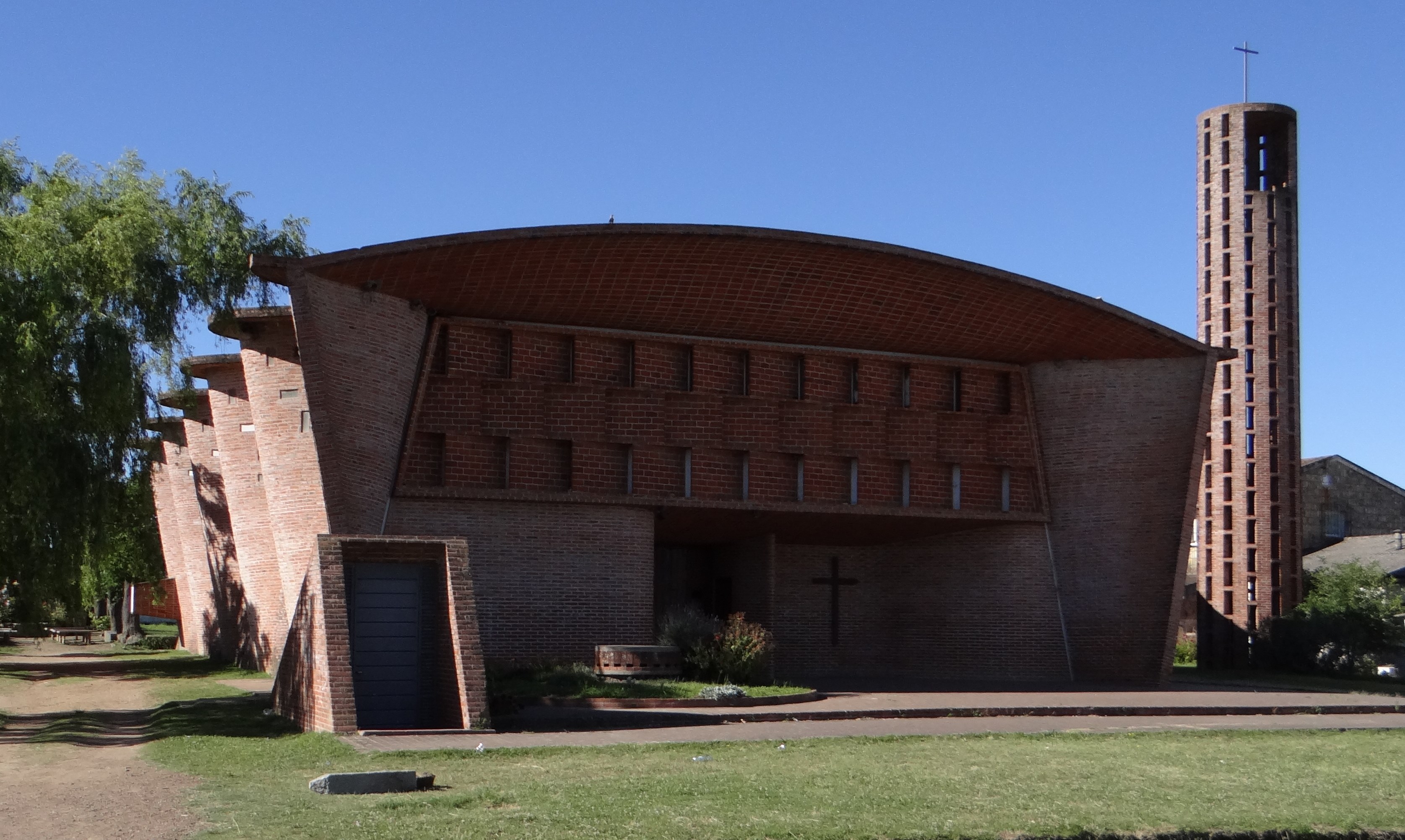
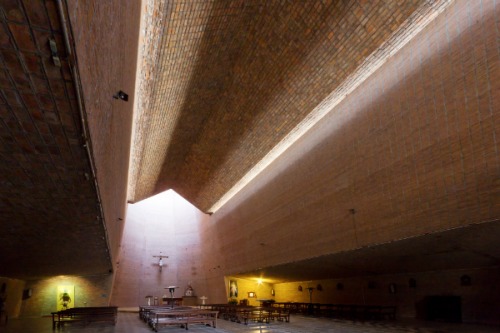
The so often overseen Atlantida church is an architectural and engineering jewel.

Eladio Dieste : I had never heard of this person before, but my research about the „Church of Atlantida“ brought up this information. Dieste was an Uruguayan engineer and architect, won several prizes, was Professor at the University of Montevideo – and was father of 11 (eleven) children. UNESCO called him as professor for several universities in South America.

Dieste 1
Eladio Dieste (Artigas, December 10, 1917 – Montevideo, July 29, 2000).

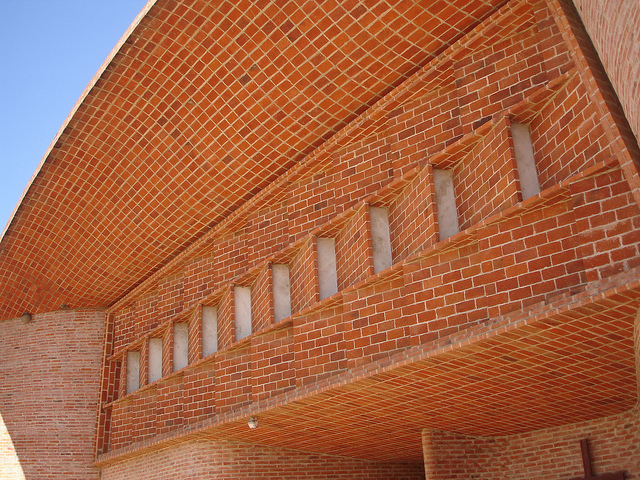
Eladio Dieste made his reputation by building a range of structures from grain silos, factory sheds, markets and churches, all in Uruguay and all of exceptional elegance. A particular innovation was his Gaussian vault, a thin-shell structure for roofs in single-thickness brick, that derives its stiffness and strength from a double curvature catenary arch form that resists buckling failure.

Dieste 3  Dieste 11
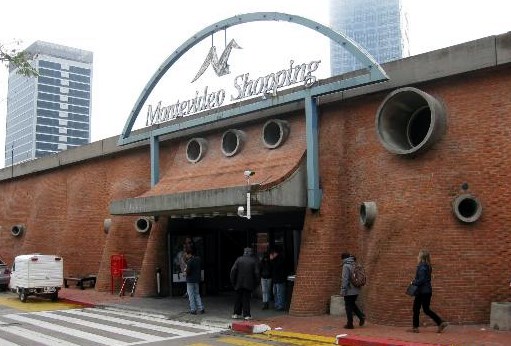
Opened in 1985, „Montevideo Shopping“ is the first Shopping Mall in Montevideo,
located next to the World Trade Center.

There were several architects in South and Latin America who were working in the modernist idiom, but Dieste, was one of the few to bring architecture and structural engineering into close proximity, especially in the service of sometimes humble commissions. His buildings were mostly roofed with thin shell vaults constructed of brick and ceramic tiles. These forms were cheaper than reinforced concrete, and didn’t require ribs and beams.

Dieste 2_2
Homage on Eladio Dieste, roof of an old gas station, a monument in Salto.
Oficially called „gate of wisdom“ . Locals just call it „La Gaviota“, the seagull.
Dieste 5_2
Old Salto bus terminal from 1974.

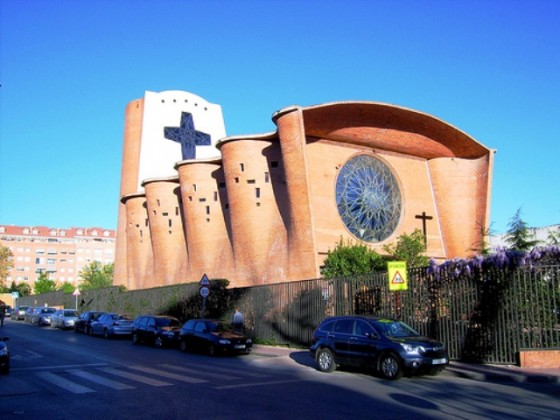
Gaussian vaults, meaning double curves. Dieste’s vaults were only 130mm thick, and the vaults spanned 50m, an astounding relationship using bricks and mortar and not achievable using heavy concrete. In developing this approach, even in comparison with modernists the world over, he was an innovator. One of the great innovators of Uruguay and well known and honored in the whole world. Dieste built also different objects in other countries. A big market place in Porto Alegre, Brazil or a church in Henarez, Spain.

Dieste 9 p.all. 1972 Espana 1 Impressive market hall, Porto Alegre,Brazil 1972.    „St. John of Avila“ church in Alcala de Henarez, Spain.
durazno 7 durazno 6
Iglesia de San Pedro, Durazno. Dieste took the task of rebuilding this 150 year old church that had been
damaged by a fire, only facade and original floor remained.  He designed this „simple“ brick structure
behind the remaining facade.  An eclectic addition of the 20th century to the original colonial one.

The most well known and earliest of his works is the „Atlantida Church“. Some people call
it a converted warehouse, but if one looks at the details of construction, then you’ll see
it, at a piece of architectural and engineering art, just around the corner. This hyperbolic
brick work is the „Iglesia de Cristo Obrero y Nuestra Señora de Lourdes“ from 1958.
The Church of „Christ the Worker“. Located in Estacion Atlantida, suburb Atlantida North.

Atlantida 7  Atlantida 19
Fantastic Atlantida church of „Christ the worker“ with the clock tower and rounded brick work.
Atlantida 11 Atlantida 18
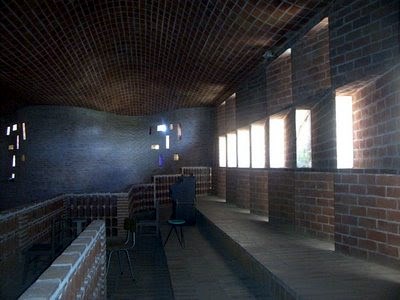
Inside images, notice the waved walls and ceiling as well as the natural lighting.
Atlantida 10  Atlantida 5_2
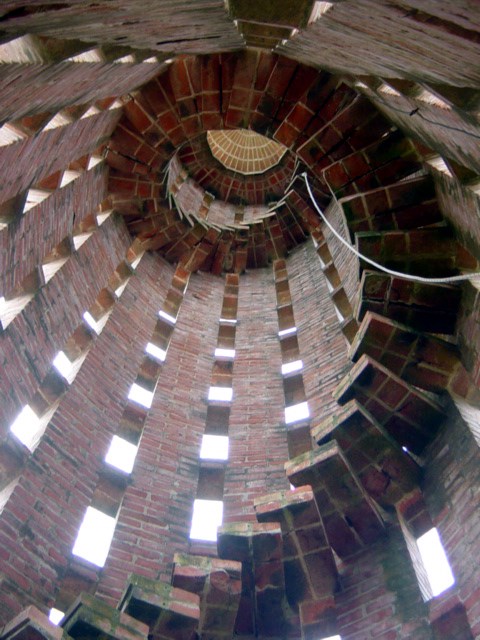
Inside the clock tower. Who want’s to climb up without banisters ?
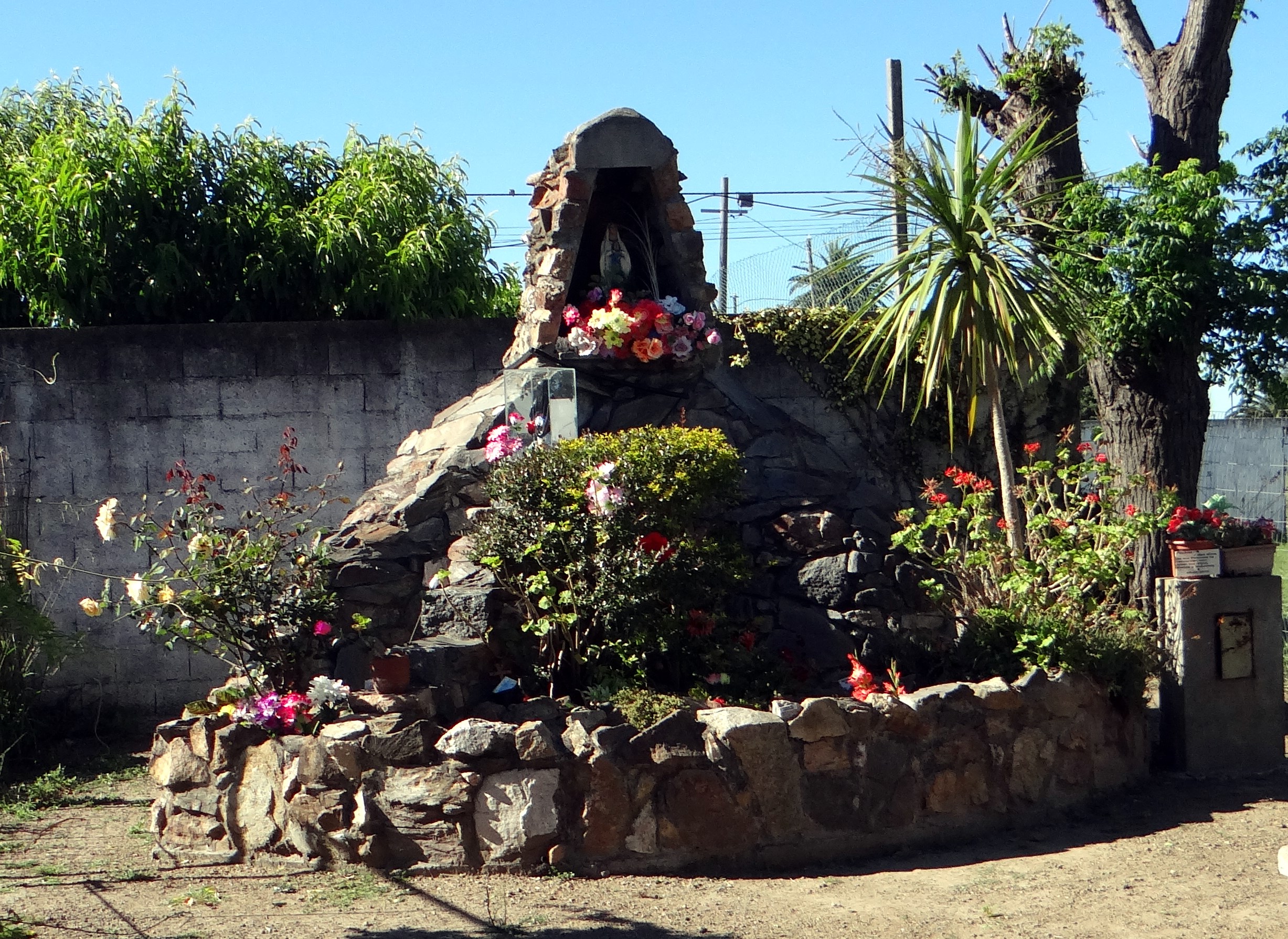
Outside an altar for „Nuestra Señora de Lourdes“

DSC00242_2     DSC00244
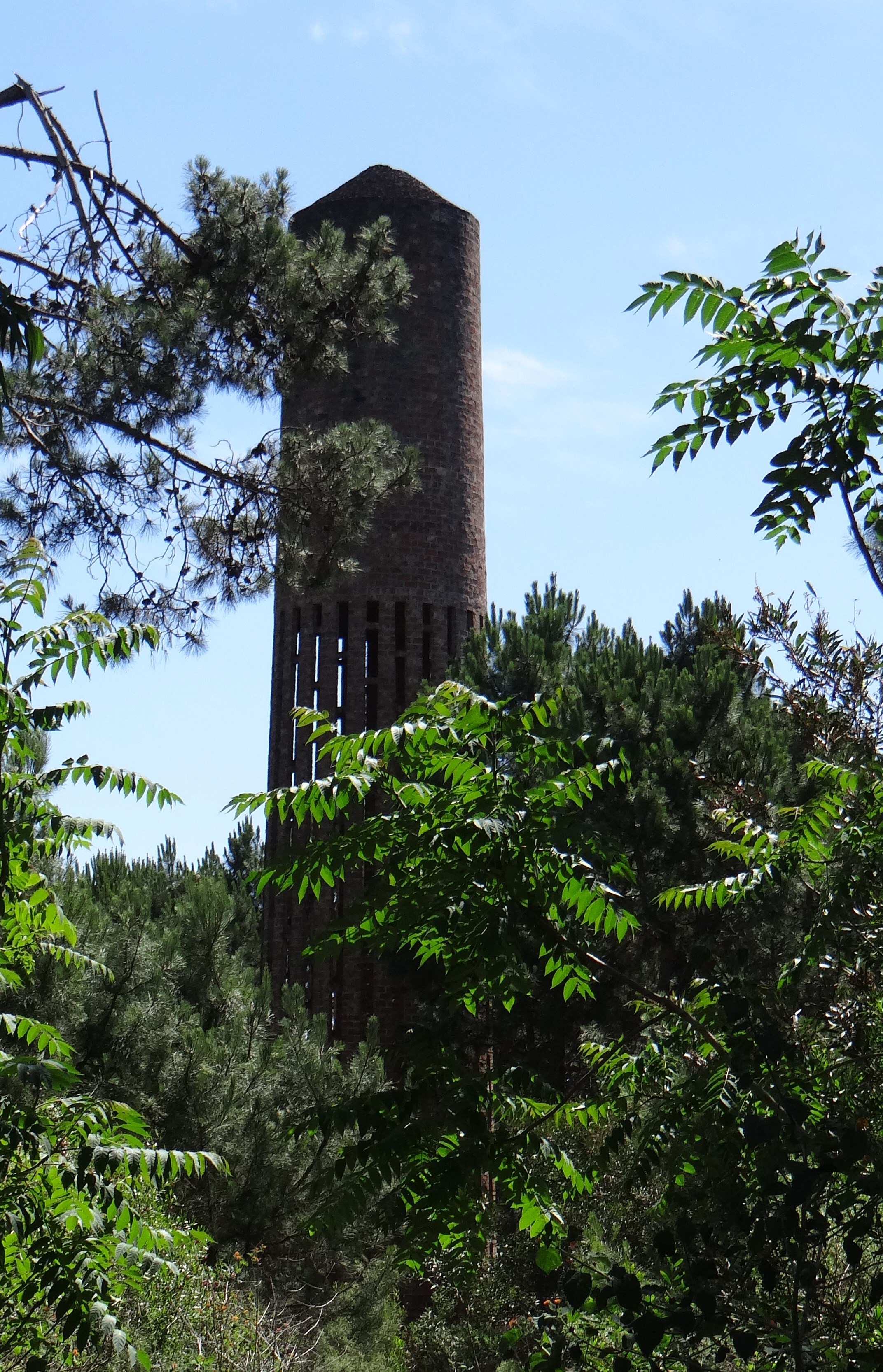
Just a few kilometers from Atlantida, another Dieste work, reinforced brick.
The water tower of Las Vegas, favored meeting point for the local community.
Build in the 60’s, capacity 120 cubic meters, height 27 meters.
Over 120.000 kilogram resting on about 60 bricks !!!

I hope you will recognize the wonderful work of Dieste in the future, like
I do. His work is all over Uruguay.

Veröffentlicht unter Atlantida, History, Information, Must See, Uruguay | Verschlagwortet mit , | Hinterlasse einen Kommentar

Are you a Gourmet ?

Gourmet

The word has different connotations from the similar word gourmand,
which emphasizes an individual with a highly refined discerning palate.
But in practice the two terms are closely linked, as both imply the
enjoyment of culinary arts, fine food and drinks and a good lifestyle.
A gourmet is “a connoisseur of good food and drink”.
More updated Wikipedia says a gourmet is “a person with defined or
discriminating taste or one who is knowledgeable in the art of food
and food preparation.” In ancient France where the word originated,
it was said that ” A gourmet makes a meal beautiful, tasteful and memorable“.

Let’s have a look at some examples .

gourmet 2  gourmet 7
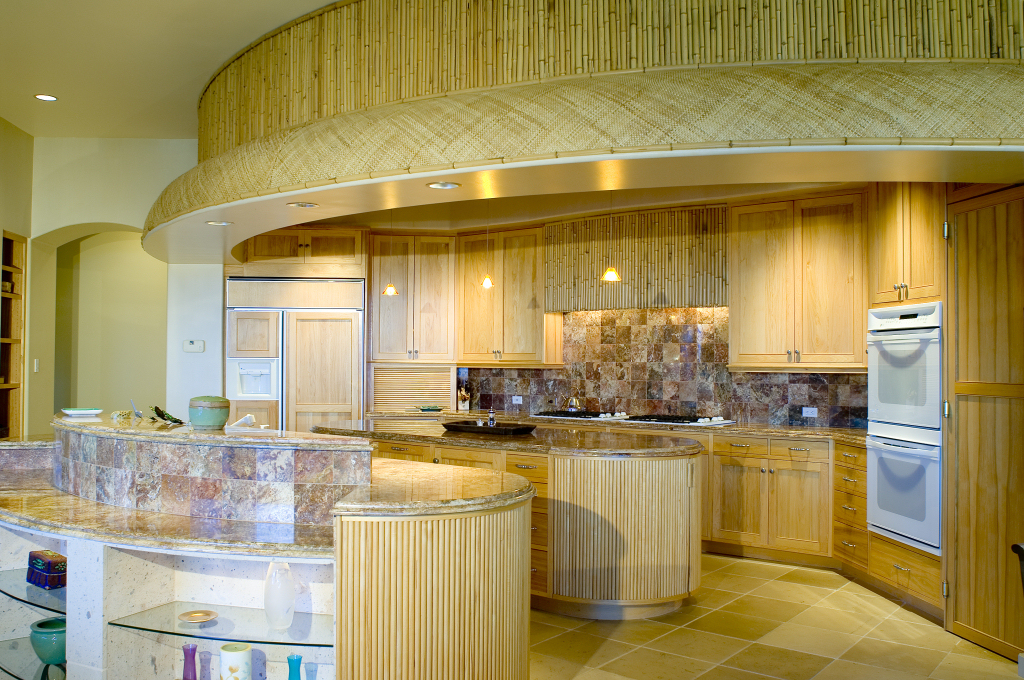
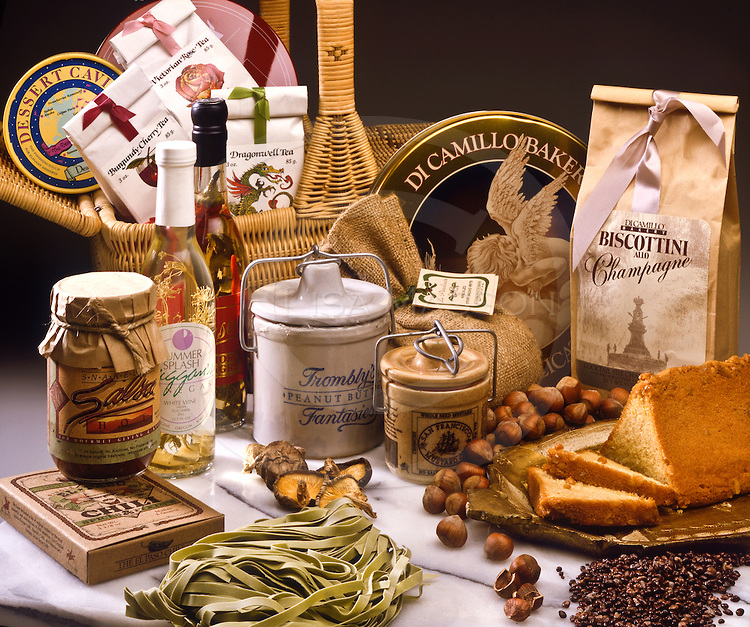
A modern Gourmet kitchen.                                                      Some Gourmet products.
gourmet 6_2         gourmet 4
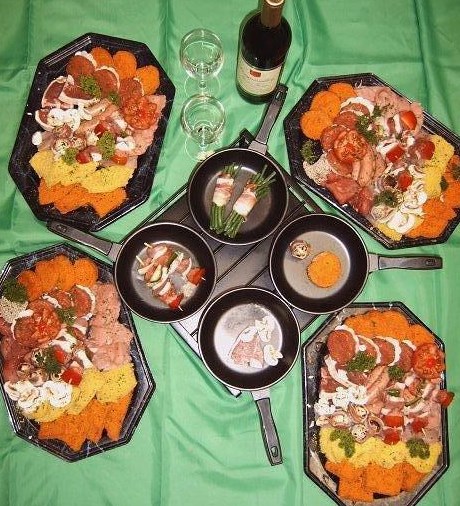
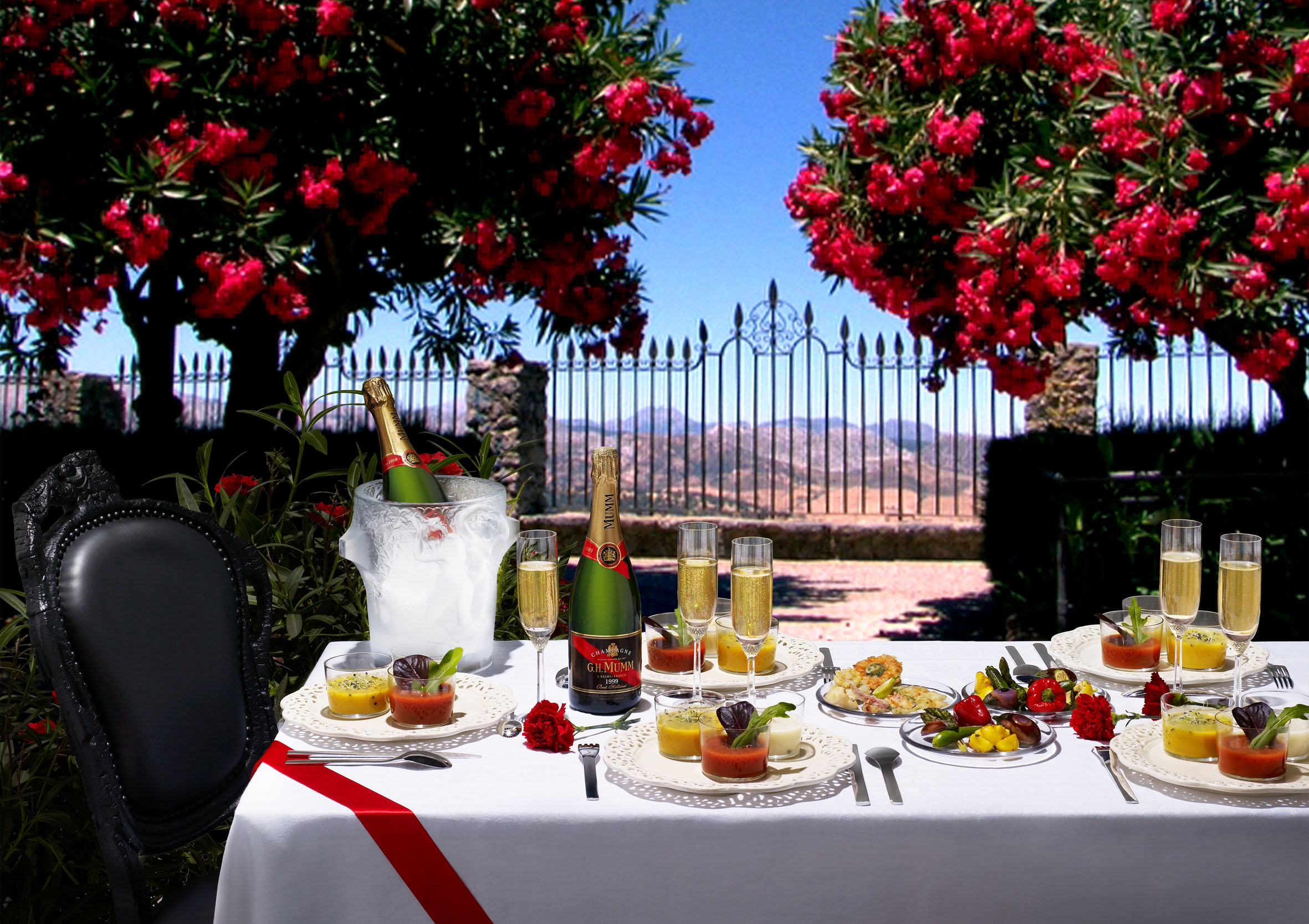
Delicious Gourmet food.                                                            High end Gourmet drinks, G.H.Mumm.
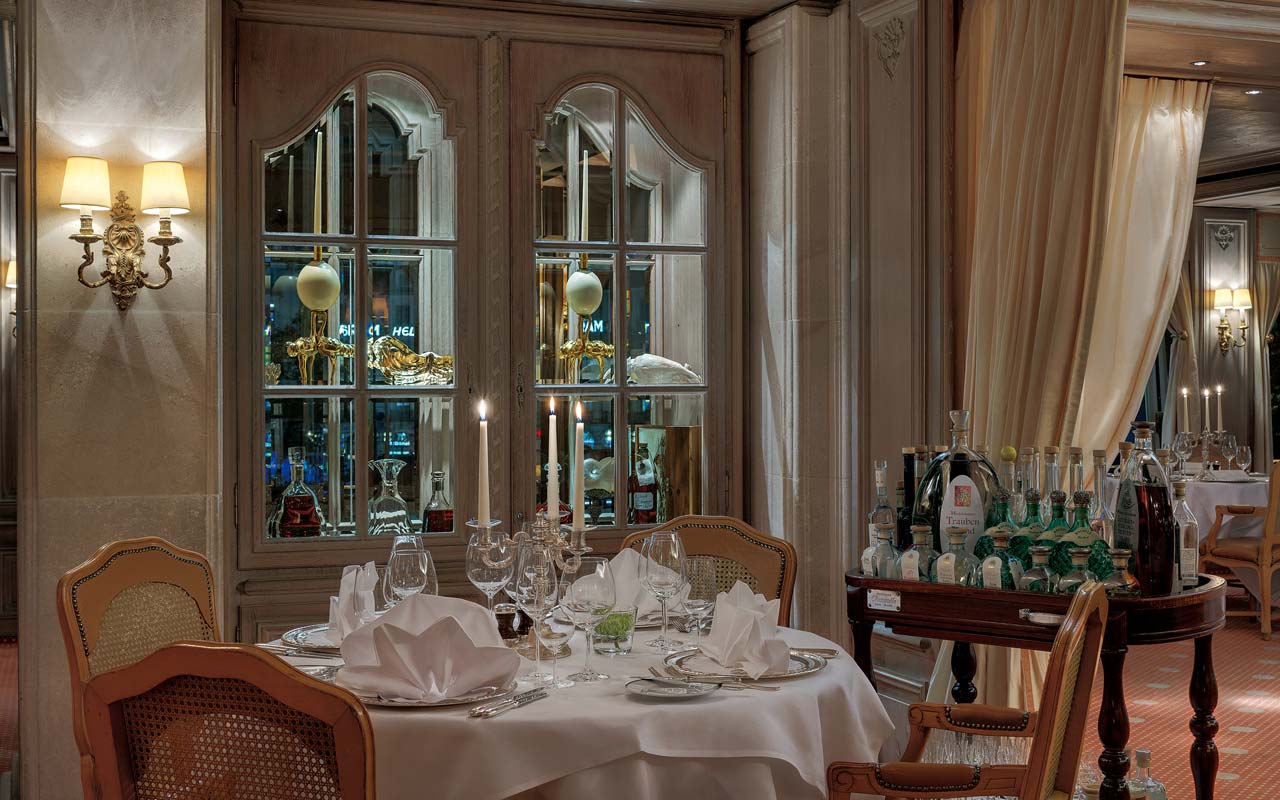
Gourmet 14 - Restaurant-Koenigshof-3_06 gourmet 19 riverside terrace oriental
Gourmet restaurants. „Hotel Koenigshof“, Munich.   Riverside terrace, „The Oriental Hotel“, Bangkok.
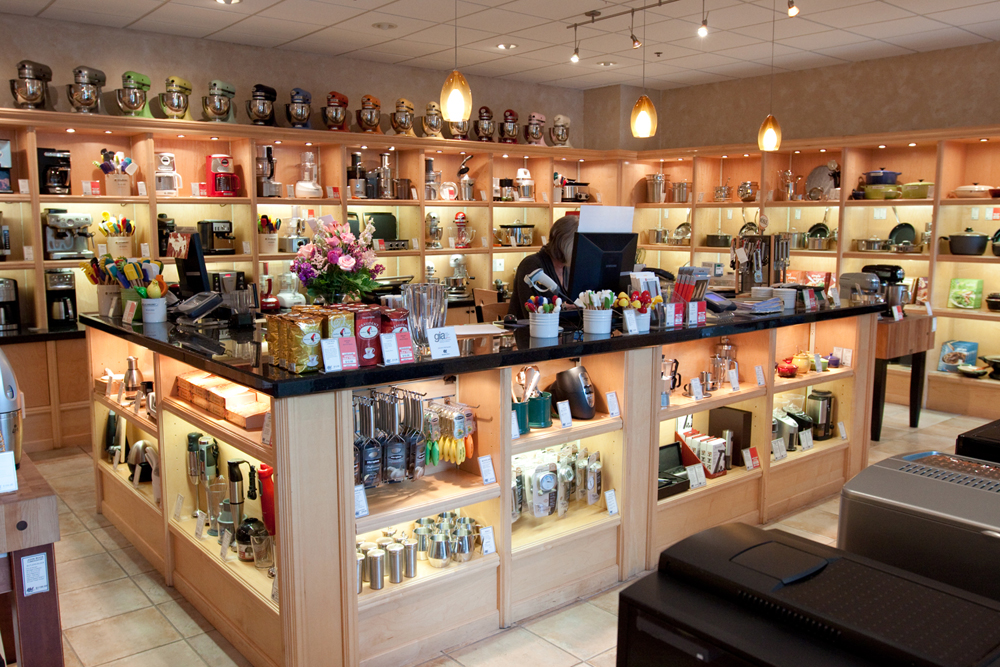
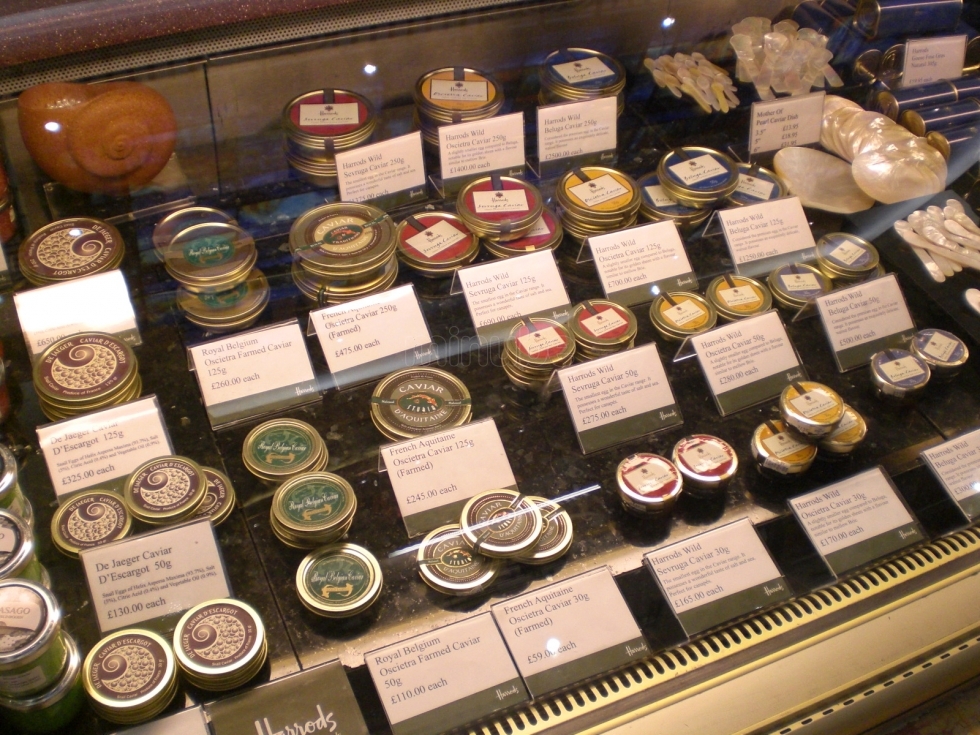
gourmet 9 gourmet 11
Gourmet shopping at a specialized store.                              Or at Harrods, the caviar section.

Are you a Gourmet ?

People ask frequently this question if I talk about my passion of cooking,
food and wine. Good question! Do people ask because they think I’m a snob
or is it that they don’t know the meaning of the word?
I have known the meaning of the word for many years, I know I’m a gourmet,
and I’ve been one as long as I can remember. But now, I’d better research
the word to make sure I wasn’t wrong about its meaning.

OK, I’ve got it. Take this test and if you can answer these questions with
“yes”, you are a gourmet too!

1. Do you know how to properly pronounce “gourmet”?
2. Do you prefer some wines over others?
3. Can you tell when your dinner has been prepared especially for you?
4. Are you impressed when your dinner looks as good as it tastes?
5. Can you remember where and when you had a really fine meal?
6. Can you taste and smell the difference in many herbs and spices?
7. Do you know how to prepare and serve a dish that receives compliments?
8. If you were dining in a fine restaurant,
would you ask what the house specialty is?
9. Do you collect cookbooks?
10. Do you know fine food or drinks, just by tasting?

If you answered “Yes” to 8 or 10 questions, you’re a “GOURMET”! Congratulations!

gourmet 1        gourmet 17 Il-Moretto-Gourmet-Restaurant
As a Gourmet you will have fun, to shop at special places, or dine at special restaurants,
like the „Il Moretto“ in Milan.
Veröffentlicht unter Information, Lifestyle | Verschlagwortet mit | Hinterlasse einen Kommentar

Parking

DSC00226_2

Plenty of parking space, either for your car or your horse.

Veröffentlicht unter Uncategorized | Hinterlasse einen Kommentar

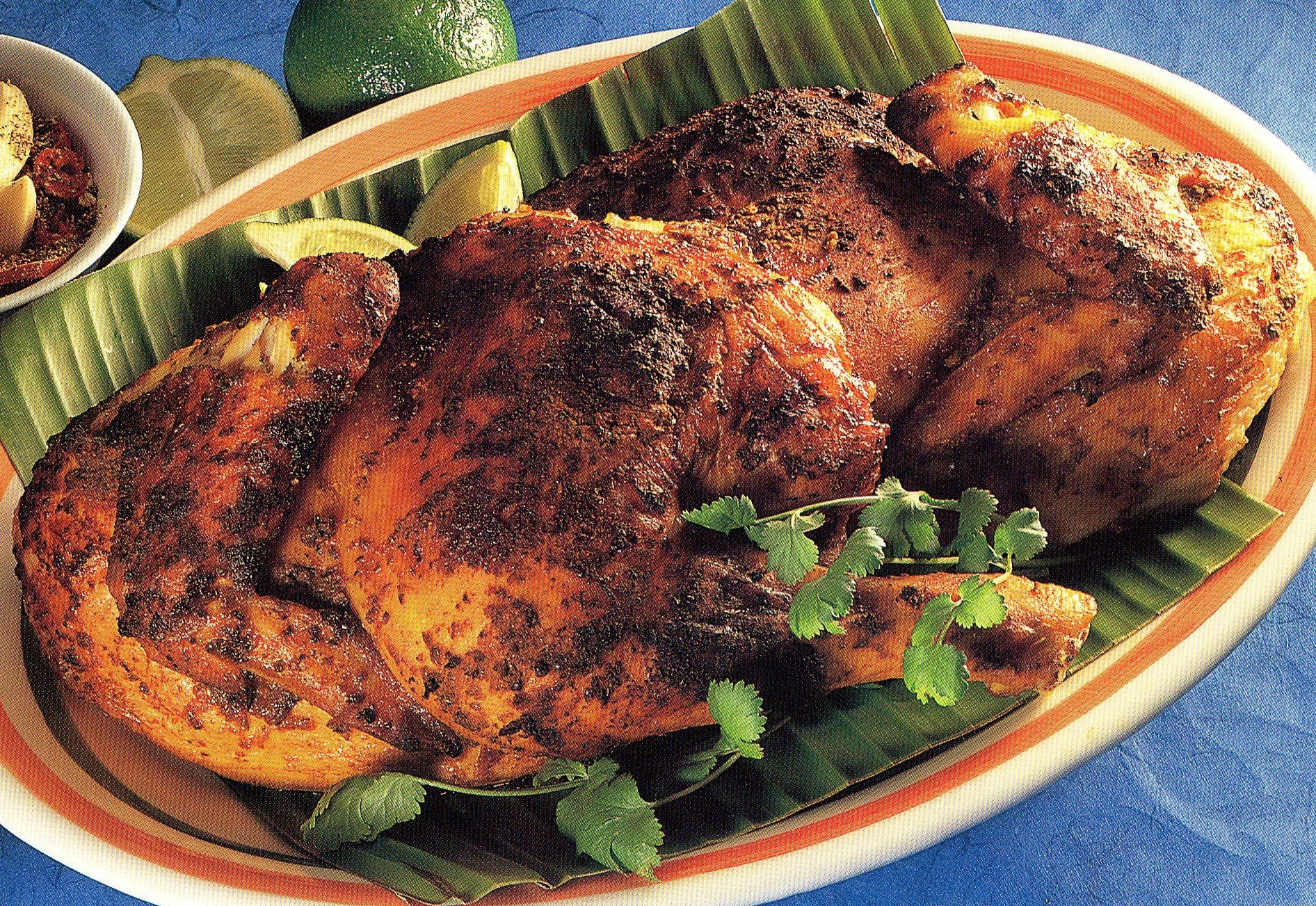
Vodka and Szechuan pepper glazed Chicken

img490

Hello BBQ fans,
here is something, from the Latvian influence of my mother.

Ingredients:

1/2 a cup (110g) sugar
1/2 a cup (125ml) lemon juice
1/4 cup (60 ml) TOP QUALITY Vodka
(as better the ingredients are as better the taste)
1 tablespoon water
1 and 1/2 teaspoon roasted crushed Szechuan peppercorns
1,6 kg chicken

Blini Ingredients:

3 large (about 900g) potatoes. Do not use sweet potatoes.
2 Tablespoons peanut oil
2 small (about 160g) white onions, chopped finely
3 cloves garlic, crushed
1 and 1/2 cups self raising flour
2 teaspoons sugar
2 eggs, beaten lightly
1 and 1/2 cups (375ml) milk

How to do:

Combine sugar, juice, vodka, water and pepper in small pan.
Boil uncovered, for about 5 minutes, or until slightly thickens,
Divide glaze into 2 similar portions.
Place chicken on roasting rack or basket,
Cook in covered BBQ, using indirect medium heat, for 1 hour .
Brush chicken with one half of the glaze,
Cook 20 minutes more or until chicken is nice browned all over.
Chicken must be very tender, test with skewer or meat fork.
Just before serving brush in/over the other half of the glaze.

How to do Blini:

Boil, steam or microwave potatoes until tender, drain, mash.
Heat oil in large pan, add onion and garlic,
Cook, stirring until onion is soft.
Combine mashed potatoes and onion mixture in large bowl
With flour, sugar, eggs and milk.
Cook, (1/4 cup measures, flattened like a burger) potato mixture
On hot oiled BBQ plate (not grill) until browned both sides
And cooked through.

How to Serve:

Serve hot blinis with hot chicken.
Lovely fresh mixed green salad and a good lager beer and an
Ice cold vodka goes well with it.

Tips:

If you like you can cut chicken into portions (about 10) before
Brushing in/over the second half of glaze. It’s a great party dish.

You can use blinis for 100’s of other occasions:
By example: Blinis with cream cheese and jam,
Blinis with smoked salmon and horseradish cream,
Blinis with Parma ham and melon,
Blinis with blue cheese, radicchio and walnuts,
Blinis with – o.k. – be creative by yourself.

blinis 1

Veröffentlicht unter Recipes | Verschlagwortet mit | 2 Kommentare

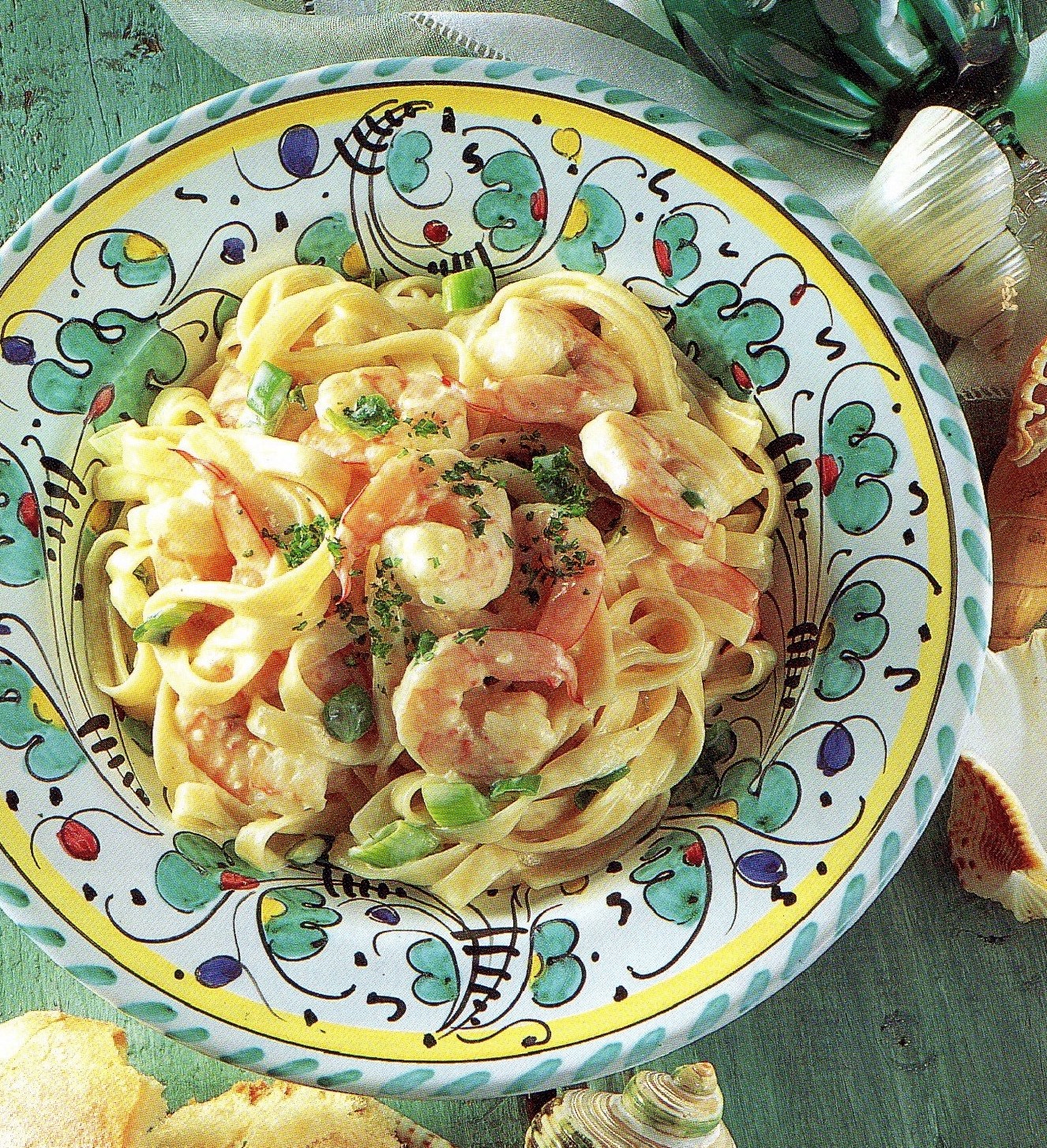
Creamy Prawns on Fettuccine

img493_2

Ingredients:

500g fettuccine
500g raw prawns (medium size, frozen ones are fine)
30g butter
1 Tablespoon olive oil
6 spring onions, medium size, chopped
1 clove garlic, crushed
1 cup (250ml) thickened cream
Salt and pepper to taste
2 tablespoons chopped fresh parsley, to decorate for serving
Grated Parmesan cheese.

How to do:

Add fettuccine to a large pan of rapidly boiling water and cook
Until just tender. Drain well, return to pan and drizzle a bit olive oil
That they don’t stick. Keep warm.

Peel and clean prawns.
Heat butter and olive oil in a frying pan.
Add onions and garlic and stir over low heat about one minute.
Add prawns, cook for 2-3 minutes until flesh changes color.
Remove prawns from pan and set aside.
Add cream to pan and bring to the boil.
Reduce heat and simmer, stirring, until sauce begins to thicken.
Return prawns to the pan, season with salt and pepper,
Simmer for one minute.
Add prawns and sauce to fettuccine and toss,
Sprinkle over some grated Parmesan and the parsley.

Serving:

Serve directly on preheated plates. To accomplish serve with
Some fresh, warm French bread and a nice glass of Chardonnay.

Tip:

Some variations:
Mix in with onions and garlic 1 medium size red
Capsicum (seeded and sliced) and 1 small leek (dark green section
Removed and white part nicely cleaned and sliced very finely.

Instead prawns you can also use scallops or a mixture of both.

If you add more veggies and leave the prawns/scallops you’ll have a
Lovely vegetarian dish.

Veröffentlicht unter Recipes | Verschlagwortet mit | 1 Kommentar

Pork with Shrimps

img496_2

Ingredients:

1 bunch spring onions
2-3 medium size red hot chilli’s
300g pork filet
150g pork liver (if one does not like liver add 150g filet)
150g bamboo sprouts (canned is fine, but then dry them in a towel)
3 tablespoons veggie- or peanut oil
250g small size shrimps (uncooked, completely pealed)
1 teaspoon salt
1/2 teaspoon pepper
2 medium size tomato’s (nice, fresh, dark red, tasty)
1/2 Tablespoon soy sauce
1/2 teaspoon oyster sauce
1 teaspoon shrimp paste
1 tablespoon chopped coriander (or parsley)
2 cloves garlic, finely chopped or pressed
1 teaspoon brown sugar
Juice of 1 fresh lime

How to do:

Chop the white of spring onions fine, the green we don’t use.
Chop very fine the chilli’s, or bash in a mortar.
The pork filet and the pork liver cut into thin stripes,
Also the bamboo sprouts. Stir well.
Heat the oil in wok or large (best non stick) pan.
Brown the onions, garlic and chilli shortly in the oil.
Add the pork, after 2 minutes add the bamboo and shrimps.
Season with salt and pepper, add then pealed and chopped
Tomatoes. Finely mix the other ingredients with 2 tablespoons
Of water and mix into the pan. Stir well.
Let everything once shortly cook through.
Total cooking time just that pork and shrimps are soft and ready.
Finally mix in/over the chopped coriander/parsley.

Serving:

If you like it rustic serve in the pan with oil/garlic bruschetta
And a cool beer.
Otherwise serve with fresh green salad, cooked baby potatoes
And a nice glass of Shiraz.

Tip:

If you like it Asian style ,mix in, before the final cooking, about
300ml of coconut milk and serve with rice.


Veröffentlicht unter Recipes | Verschlagwortet mit | 1 Kommentar