
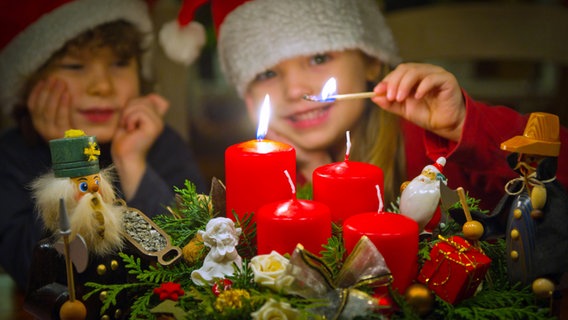
Today is the 1.Advent in 2014. In this pre Christmas time (Advent) it
is a German custom to bake and celebrate with „Christmas Stollen“.

First candle lighting on the 1.Advent. Every Sunday one more.
Stollen
is a fruit cake containing dried fruit and often marzipan and
covered with sugar, powdered sugar or icing sugar. The cake is usually
made with chopped candied fruit and/or dried fruit, nuts and spices.
Stollen is a traditional German cake, usually eaten during the Christmas
season, when it is called Weihnachtsstollen or Christstollen.
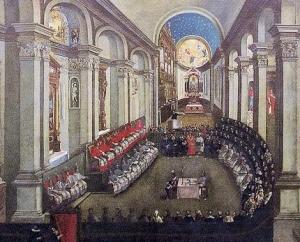
The Council of Trent in the „Santa Maria Maggiore“ church of Trent.
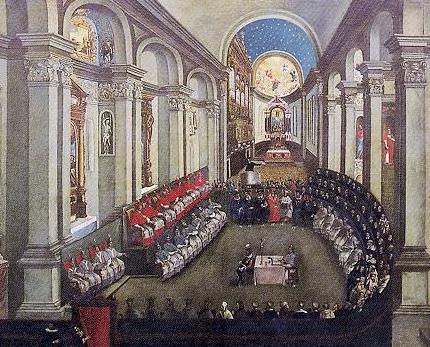
As a Christmas pastry, Stollen was baked for the first time at the
Council of Trent in 1545, and was made with flour, yeast, oil and water.
The Advent season was a time of fasting, and bakers were not allowed to
use butter, only oil, and the cake was tasteless and hard.
In the 15th century, in medieval Saxony (in central Germany), the Prince
Elector Ernst and his brother Duke Albrecht decided to remedy this by
writing to the Pope in Rome.
The Saxon bakers needed to use butter, as oil in Saxony was expensive,
hard to come by, and had to be made from turnips. Pope Nicholas V
(1397–1455), in 1450 denied the first appeal. Five popes died before
finally, Pope Innocent VIII, (1432–1492) in 1490 sent a letter to the
Prince, known as the „Butter-Letter“ which granted the use of butter
(without having to pay a fine), but only for the Prince-Elector and his
family and household.

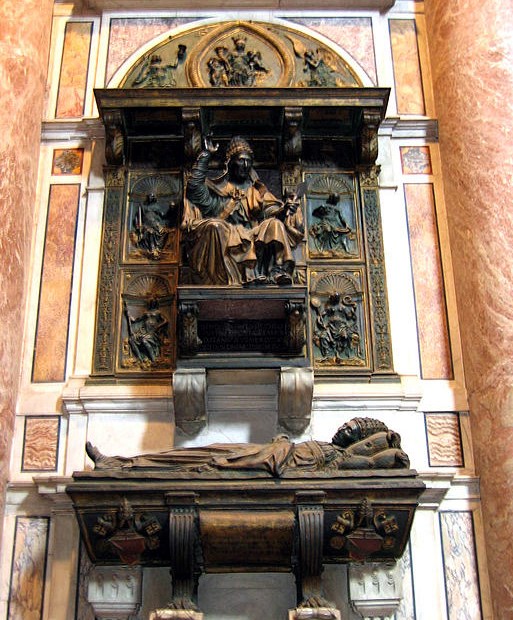
Monument to Innocentius VIII, Saint Peters Basilica Rome.
Others were also permitted to use butter, but on the condition of having
to pay annually 1/20th of a gold Gulden to support the building of the
Freiberg Minster. The ban on butter was removed when Saxony became
Protestant. Over the centuries, the cake changed from being a simple,
fairly tasteless „bread“ to a sweeter cake with richer ingredients, such
as marzipan, although traditional Stollen is not as sweet, light and airy
as the copies made around the world.
The „Stollenfest“
takes place every year in Dresden. This year for the 580th time. This
historical tradition ended only in 1918 with the fall of the German monarchy,
and started again in 1994, but the idea comes from Dresden’s history.
Dresden’s Christmas market was mentioned in the chronicles for the first time
in 1474.
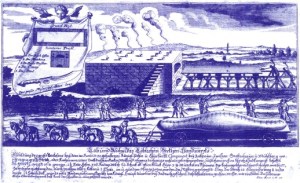
Copper engraving of the 1,8 tons stollen. 1730 Saxony.Behind you see the bakers oven.
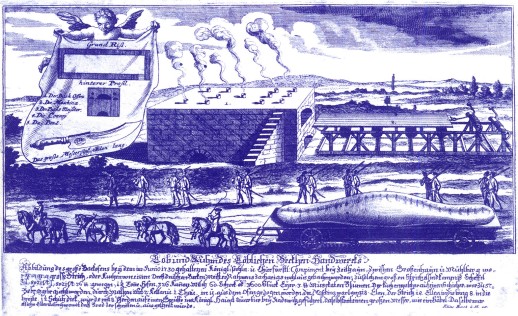
The tradition of baking Christmas Stollen in Dresden is very old.
Christmas Stollen in Dresden was already baked in the 15th century.
In 1560, the bakers of Dresden offered the rulers of Saxony Christmas Stollen
weighing 36 pounds each as gift, and the custom continued.
Today, the festival takes place on the Saturday before the second Sunday in
Advent, and the cake weighs between three and four tonnes. A carriage takes
the cake in a parade through the streets of Dresden to the Christmas market,
where it is ceremoniously cut into pieces and distributed among the crowd,
for a small sum which goes to charity. A special knife, the Grand Dresden
Stollen Knife, a silver-plated knife, 1.60 meters long weighing 12 kg, which
is a copy of the lost baroque original knife from 1730, is used to festively
cut the oversize Stollen at the Dresden Christmas fair.
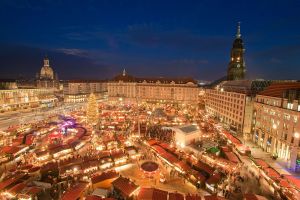
Striezelmarkt, Christmas market in Dresden.
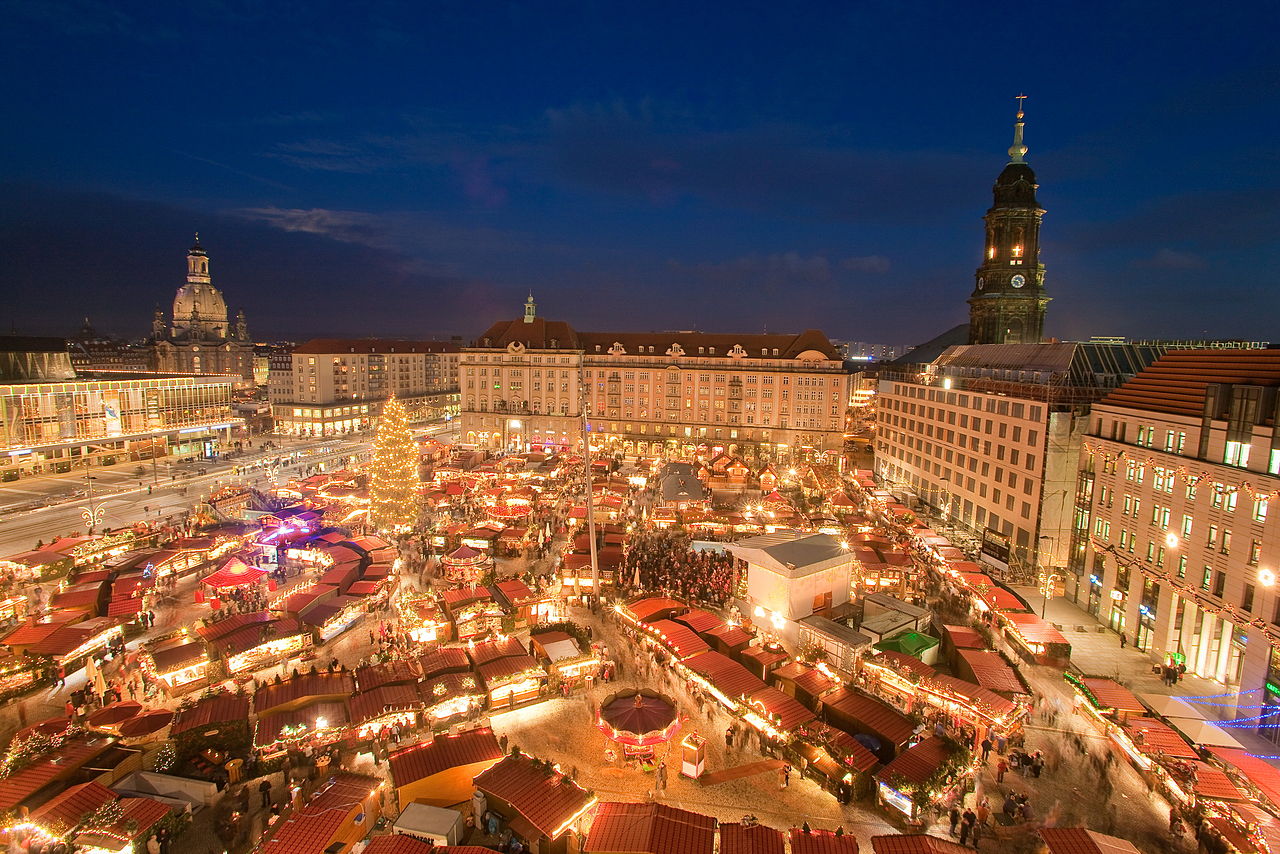
Dresden Striezelmarket
Since the early 15th Century the „Striezelmarket“, the oldest Christmas market
in the world, enchants the hearts of young and old with its fragrance and shine
the hearts of young and old during the christmas season.
Traditional products like the „Dresden Striezel Glühwine“, the Dresden Stollen,
„Pulsnitzer Pfefferkuchen“ and „Pflaumentoffel“ are popular Specialties from
the good old days, which we still can enjoy at the „Striezelmarkt“.
In addition to the tasty Specialties, there is a lot of traditional craftsmanship
from the nearby Erzgebirge to discover. A visible example is the pyramid
„Striezelmarkt Pyramid“. It has 42 different wood carvings and is with about
14 meters registered as the biggest step pyramid in the world in the Guinness book.
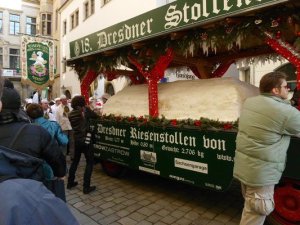
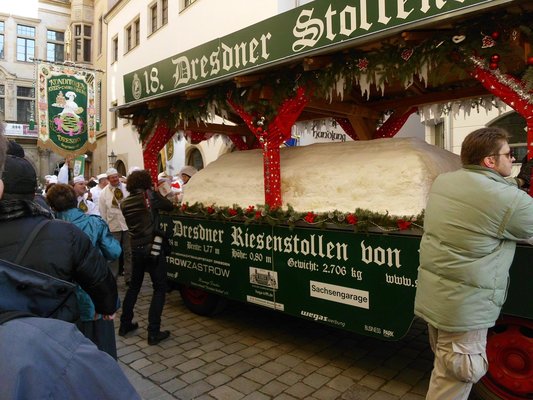
The Dresdner Riesenstollen (2,7 tons of stollen) during one festival.
Dresden Stollen
is a very lean-back pastry for the Christian Advent abstinence. The form of the
Stollen remembers the Jesus Child in his linen cloth. This also explains the white
sugar coating on the outside. The traditional form is still unchanged.
Since the early days just „Original Dresden Stollen“ is allowed to be sold on the
„Striezelmarket“. The term „Dresdner Stollen“ may only be used for Stollen baked
in Dresden. About the quality and the term „Original Dresden Stollen“ watches the
„Dresdner Stollen Protection Association“.
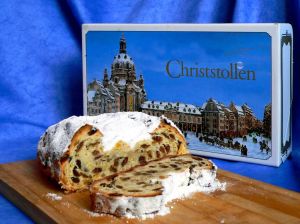
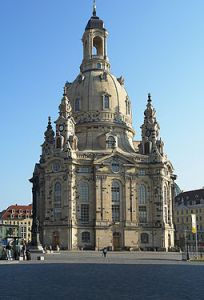
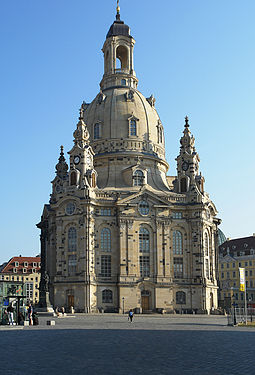
Original Dresden Stollen with carton packing, designed with the Dresden Frauenkirche.
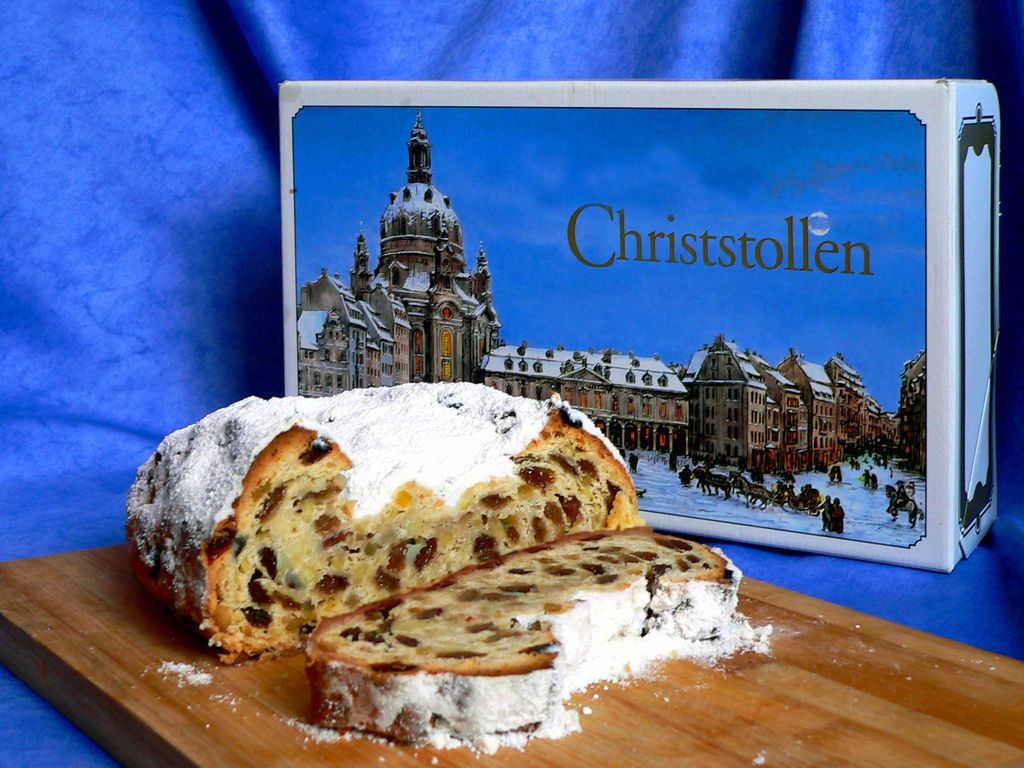
Since 1560 the saxon bakers gave every year at the holy Night two Christmas Stollen
of 1.50 meters in length and weighing 36 pounds to the saxon ruler. 12 bakers had
to carry the Stollen to the castle. In 1730 August the Strong had a giant stollen
baking of 1.8 tonnes, which was divided in 24,000 servings. In the tradtition of
this event each year on the Saturday before the 2. Advent „Dresden Stollen Festival“
takes place on the Striezelmarket. At this festival an approximately 4-ton Stollen
is carried from the Zwinger to the Striezelmarket, where it is cut by a 1.6 meter
long knife and then portions get sold.

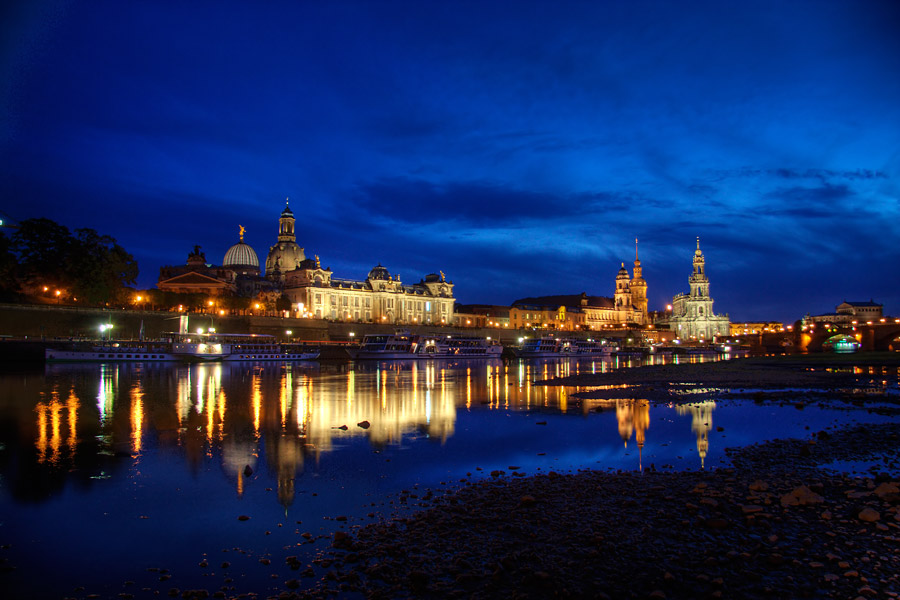
The modern Dresden at night. View over the river Elbe.
Die Striezelkinder (The Striezel Children)
Striezel is another name for the well-known German Christmas bread also called
„Stollen,“ and the Christmas Market in the German city of Dresden is called the
Striezelmarkt. The Striezelmarkt started in 1434. Since 1809 the Striezelmarkt has
been important for the toymakers in the village of Seiffen in the Ore Mountain
(Erzgebirge) region of eastern Germany. In that year the toymakers received
permission from the city authorities of Dresden to sell their toys and wood items
at the Striezelmarkt. Children often helped the toymakers sell their products,
in order to earn enough money to eat and make their existence at Christmastime a
bit easier to bear. The children offered puppets, Pflaumentoffel (little chimney
sweepers made from dried plums), tinsel, matches, and paper lanterns for sale,
and attempted to awaken the compassion and charity of the market visitors.
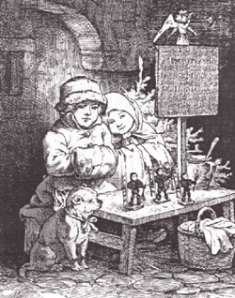
Wood engraving from Ludwig Richter of the „Striezelkinder“.
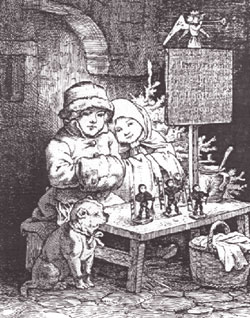
The talented hands of the children put together the little chimney sweepers out
of dried plums. In 1853 the Dresden artist Ludwig Richter memorialized
the children in his woodblock cutting called „Clearance Sale Due to Going out of
Business.“ The children are huddled together against the freezing cold, patiently
waiting for buyers of the last chimney sweepers. This print became a symbol of the
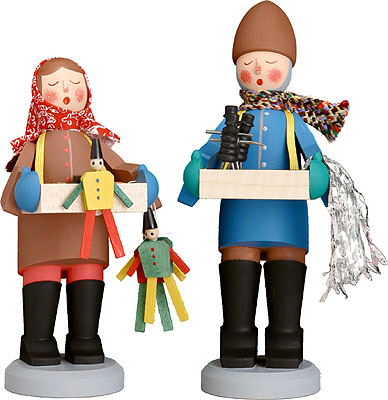
Dresden Christmas Market. The wooden figures of the children, based on Richter’s
print, were designed in 1930 by Max Schanz and Max Auerbach. These wooden
figurines won a gold medal at the World´s Fair in Paris in 1937.
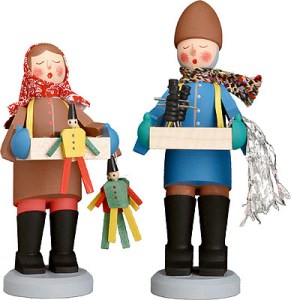
The Striezelkinder in modern design made by Erzgebirge toymakers.
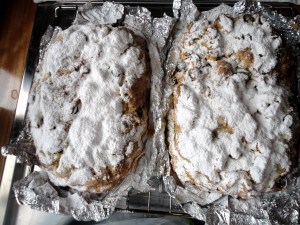
Two 12inch/30cm Stollen buttered and dusted with icing sugar.
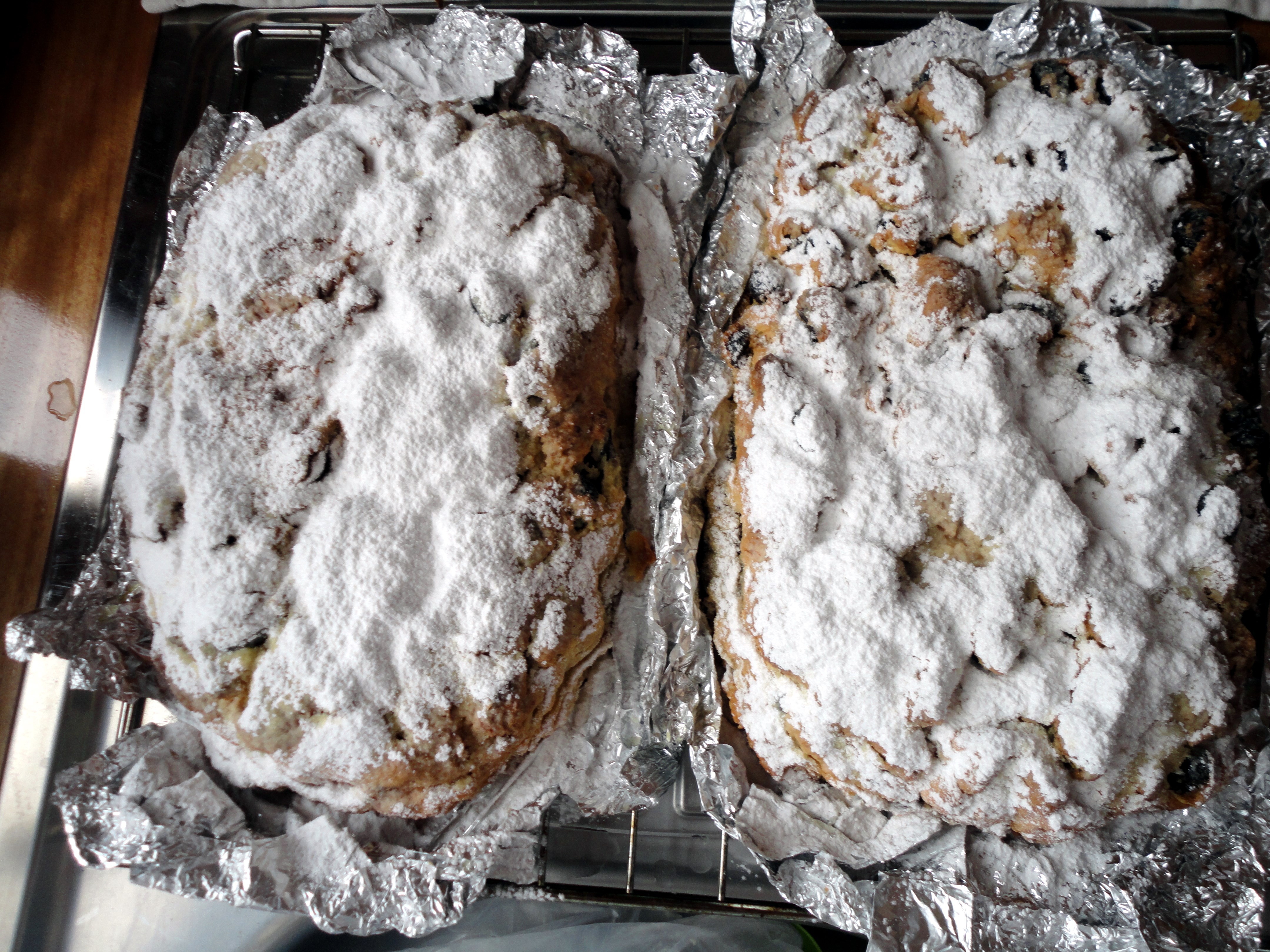
How to make your own Stollen ?
Dresden has the most famous Christmas Stollen, but you can bake your own with little
trouble and a few hours time. Christmas Stollen or Christstollen is full of nuts, raisins
and candied fruit. If made a few weeks in advance of serving it mellows and softens
and is very good.
Ingredients:
1c. dark and golden raisins, 175 grams
1/4 cup candied lemon peel, 50 grams
1/8 cup candied orange peel, 25 grams
2 oz. dark rum, 50 ml.
1 block of yeast, 30 grams
1/2 cup milk, 125 ml
1/3 cup sugar, 50 grams
4 cup flour, bread or all-purpose
1 egg
1/2 vanilla bean or 1 tsp. vanilla paste or extract
Zest from 1 lemon
1/4 tsp salt
1/4 tsp. ground nutmeg
1/4 tsp. ground cardamom
7/8 cup sweet, unsalted butter, 200 grams
2/3 cup flour, 100 grams
1/3 cup whole almonds, blanched, peeled and chopped, 50 grams
1/2 cup melted butter
Powdered sugar for dusting
Makes one, about 18inch/45cm stollen, or two 9inch/22cm ones.
How to do:
Soak raisins, candied fruit and almonds in rum overnight, stirring occasionally.
Dissolve yeast in warm milk and a pinch of sugar. Proof for 10 minutes, or until
bubbles form.
Mix flour, egg, yeast, sugar, lemon peel and salt with a spoon or in a stand
mixer using the dough hook for several minutes. Dough should just come together
and not be very smooth yet.
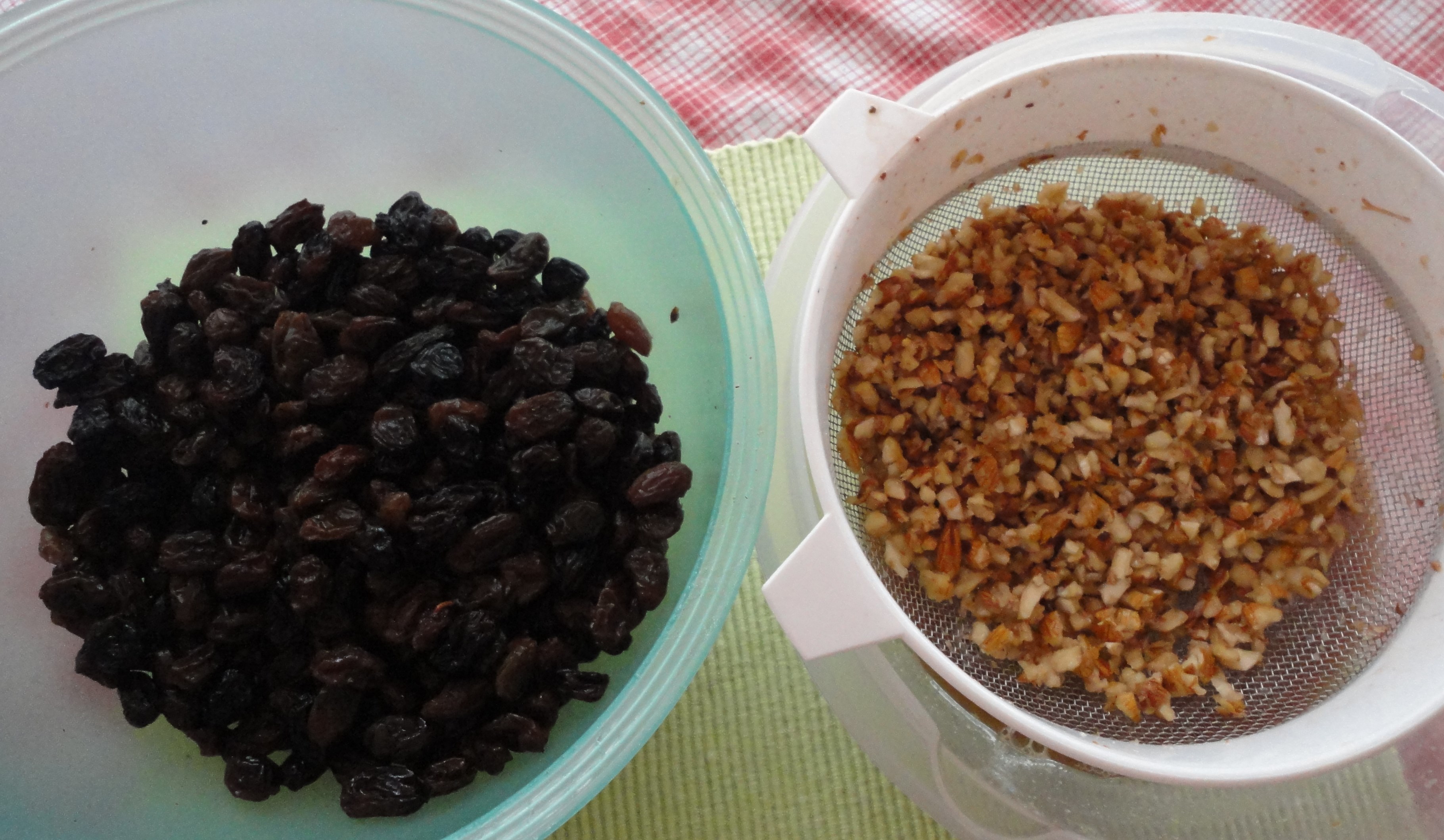
Rum soaked raisins and shredded almonds.
Remove from bowl and set aside while you do the next step.
Cream the butter and 2/3 cup flour with the nutmeg and cardamom until smooth.
Add the yeast dough back to the bowl and work the dough with a dough hook or by
hand until the butter and flour mixture is completely incorporated.
Let dough rest, covered, for 30 minutes.
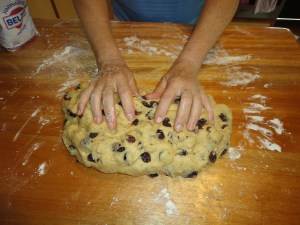
Hard work, to knead almost 4 kilogram of dough.
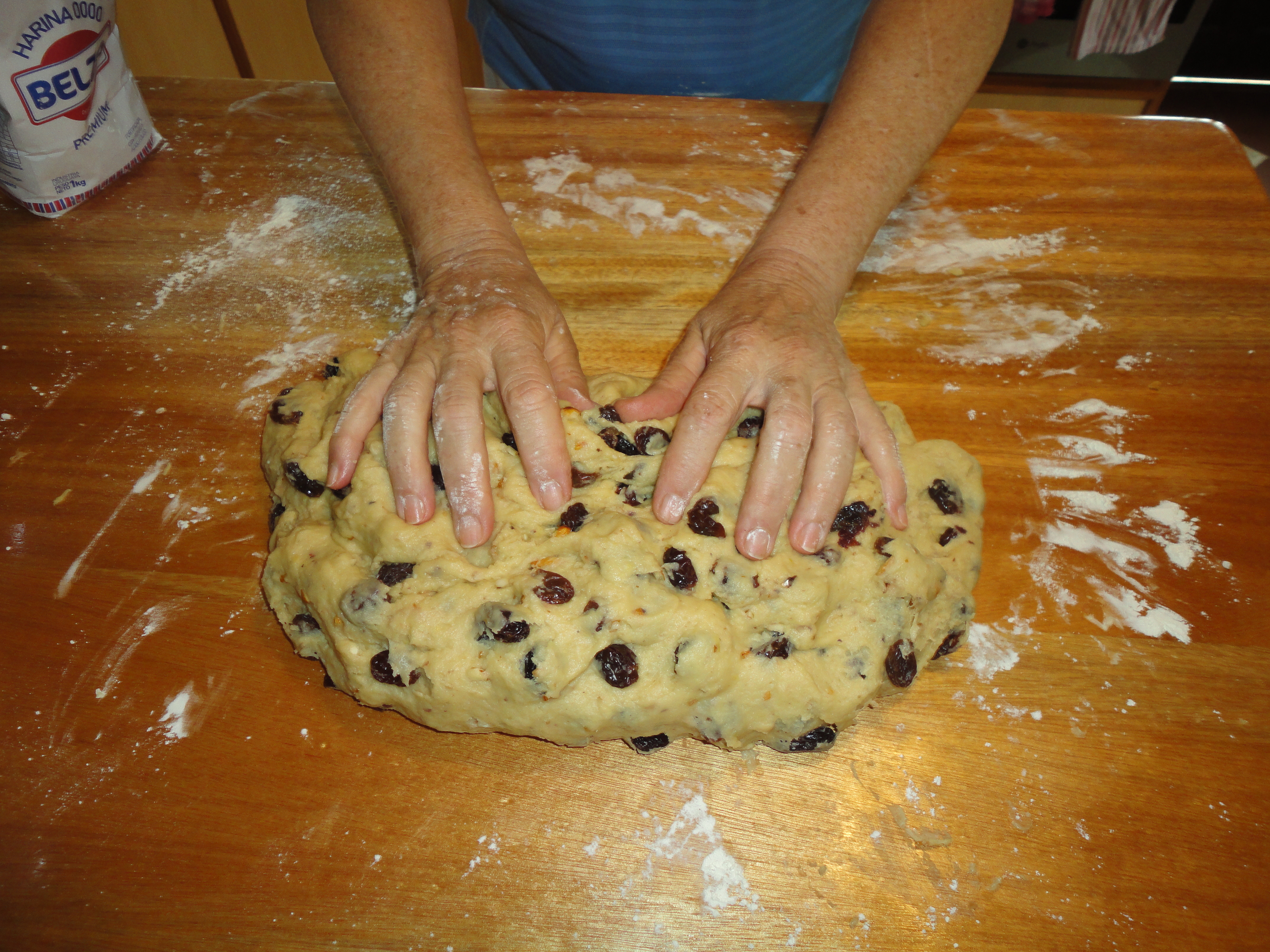
Turn dough out onto tabletop or lightly floured board. Knead in fruit and chopped
almonds. Let rest for 15 minutes.
Return dough to floured board and form into a rectangle with two high sides and a
dip in the middle. Fold 1/3 of the dough over to the middle, filling the dip. Pat
into a stollen shape.
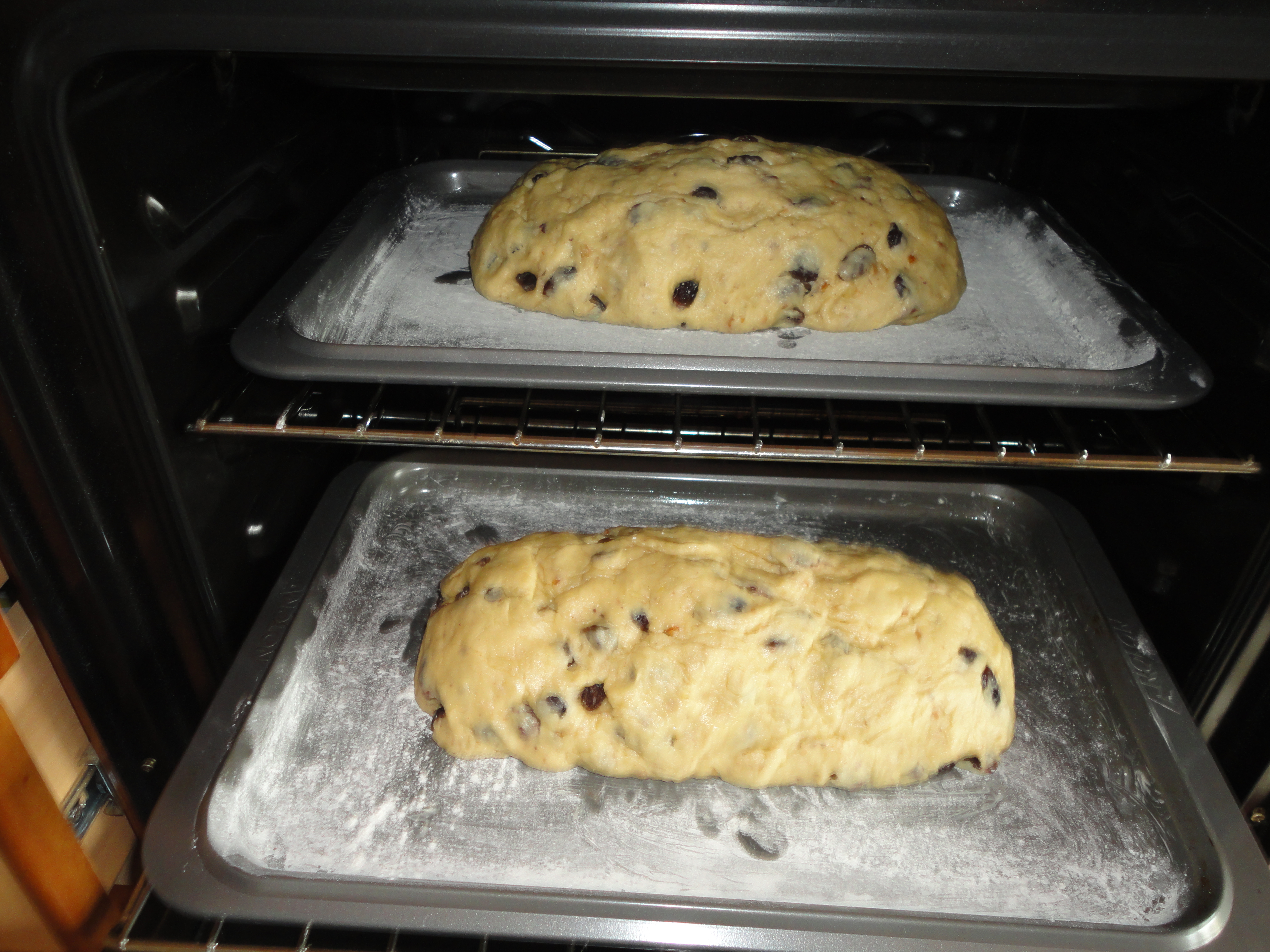
Two big Stollen loafs in the oven.
Fold a piece of aluminum foil several times on the two long ends to build walls for
your stollen, to help hold its shape while baking. You may also use a stollen pan if
you have one or a preformed aluminum bread form.
Let stollen rise for 30 minutes in a warm place.
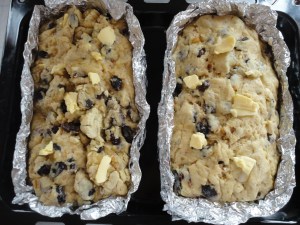
Stollen loafs in folded aluminium foil, buttered and ready to bake.
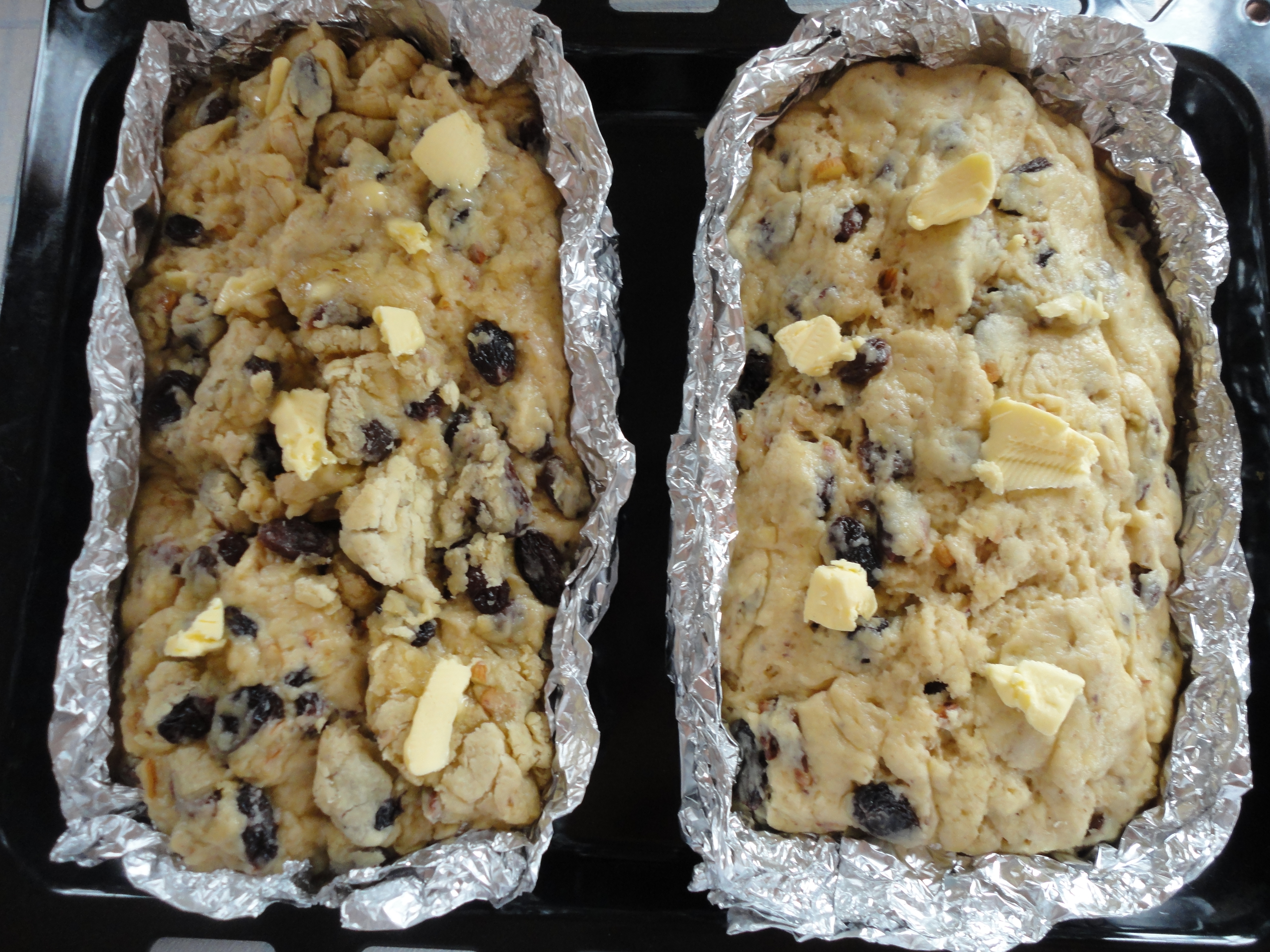
Preheat oven to 180dgC/350dgF. Dot top of stollen with butter flakes.
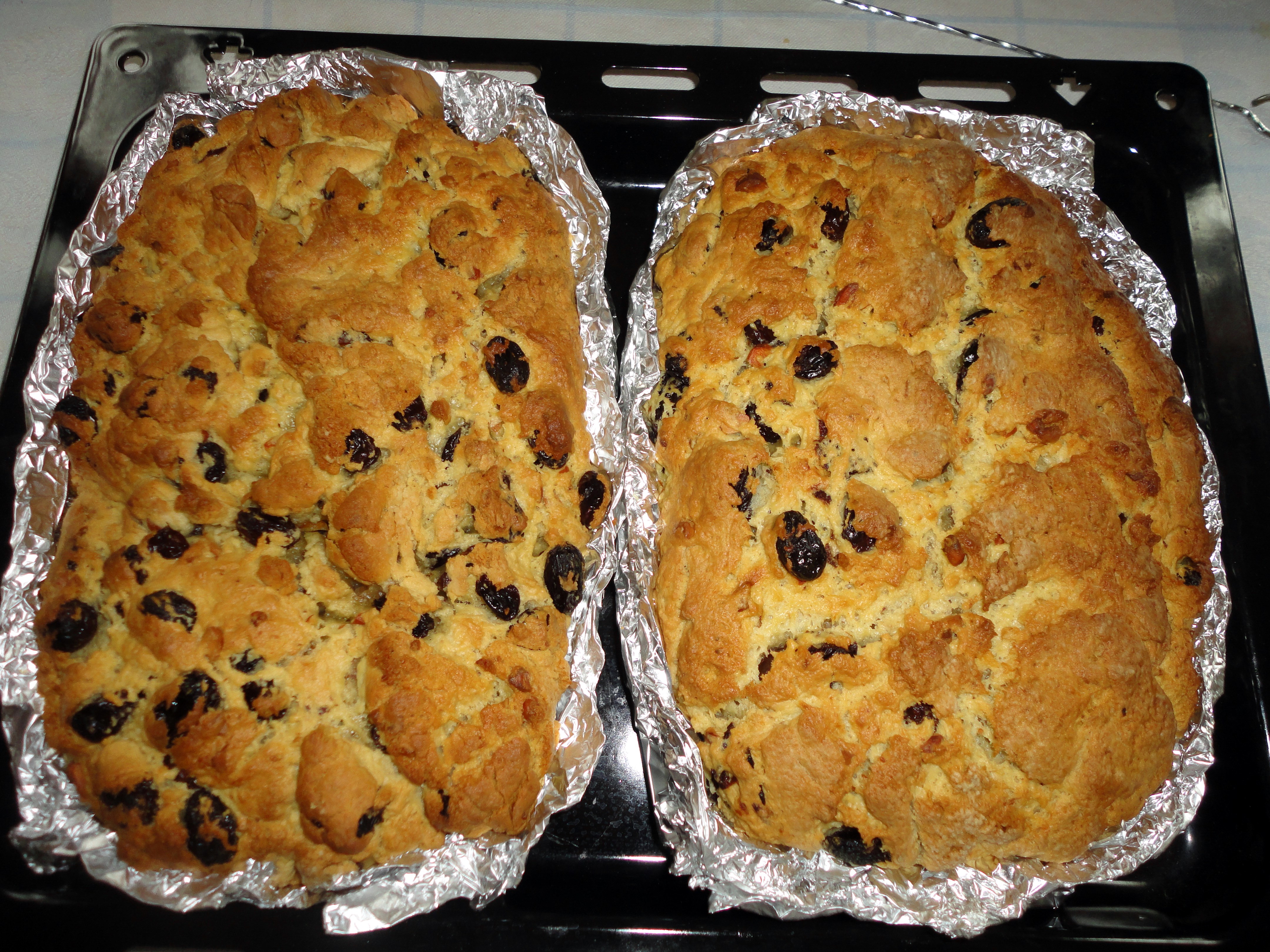
Bake loaves for 45 – 60 minutes, or until loaves are golden and done.
Cover with foil if it begins to brown too much.
Brush warm loaf with butter and dust thickly with powdered sugar.
You also can make yourself some icing and cover the loaf with it. Cool on rack.
60 minutes later, golden brown and mouthwatering.
Tips:
Wrap tightly in foil and keep in a cool place for 2 to 3 weeks to ripen.
Don’t eat them fresh, they won’t taste as good as ripened.
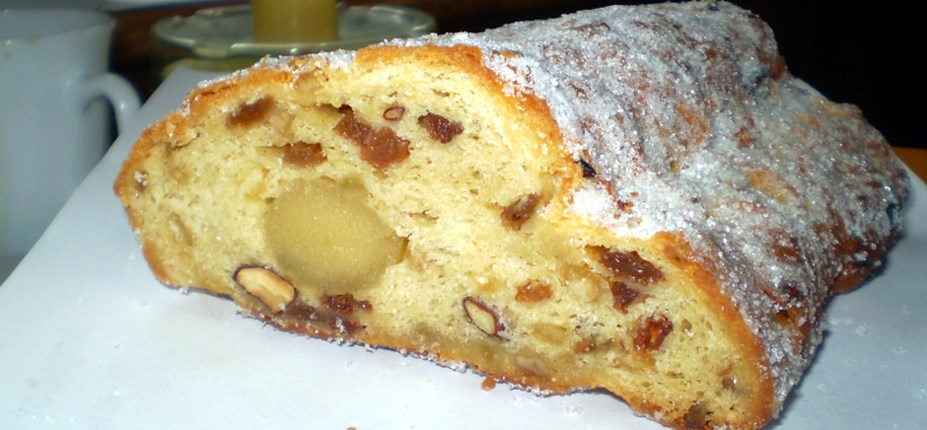
Another great variation of the original stollen is the one with marzipan filling
or one with a chocolate topping instead icing.
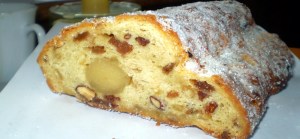
Butter stollen with a „heart“ of marzipan.
You can eat them like a cake or a bread, topped with all kinds of your favorites,
like cream or jam or apple mus, etc.
For an afternoon tea try with a sweet, heavy white wine, like a Sauterne. But also
with coffee, tea and a glass of cognac they taste delicious. Merry Christmas.


Heerlijk. Ziet er erg lekker uit.
LikeLike
Pingback: A Crazy Long Weekend | my uy tips