Hobo Soup


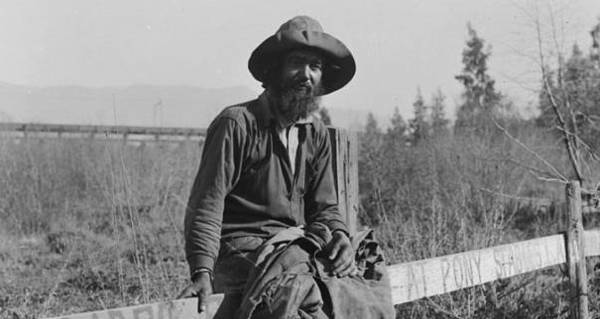
Above, a fantastic book, examines the life of Blackie, a hobo for sixty years, as he chooses to defend his life on the banks of the Sacramento and fight America’s changing attitude toward the homeless.

Last weekend we were sitting together with friends on an ugly rainy winter day here in Uruguay. We enjoyed a heartwarming German pea-soup with original „Frankfurters“ and some Spanish spicy chorizos. The discussion came up about different soups and recipes’s, I mentioned the „American Hobo Soup“. No one heard about that one. Since we all were not American’s but German, English, French and Canadian nationalities we realized it might be a special US-American dish. I promised a recipe and some explanation which I will take into a post here.

The Hobo History.

As always let me shortly introduce you to a bit of history. Just to find out about the name „Hobo“ can fill a separate book. And that’s fact, there are many many books written about the Hobo life in history. Some of my following information’s are from the webpage „In search of the American Hobo“ and articles from Karen Hill as well as from Lisa Hix.

  Happy Hobo Life !!??
Where does the word “Hobo” come from and what does Hobo mean?

Little more may be done with the word “Hobo” than to repeat the several theories that have been advanced to explain its origin. Any one of them might be true, but there is no proof as yet.

Slightly less than four centuries ago the French musical instrument, the hautbois, came into English use. Its name was literal, from haut = high, and bois = wood, for the instrument was made of wood and its tone was high.

Later, from Italian spelling, it came to be called, as at present, the “oboe”.  The English, as they frequently did with French words, corrupted the spelling into hautboy or, often, into hoboy, giving it the latter pronunciation in either case.

  Riding the rails, Hobos during the American Great Depression and Prohibition years.

There are, therefore, many people who think that our term Hobo, which is of American origin, came somehow into use through itinerant players of the hoboy. Jack London, who had a lot of firsthand experience among tramps and vagabonds and who wrote much about them at the turn of the century, gave this theory the stamp of his approval.

Another explanation credited the source to the lumber camp. French-Canadians, they say, when felling a tree, instead of giving the shout, “Timber-r-r!” would cry, “Haut bois!”, literally, “high timber.” From this cry, which might be rendered “ho bo” in English, it has been suggested, the itinerant Canadian lumberjack came to be called a Hobo by his English-speaking fellow workers.

  Click on pics, most will supersize.
Another theory, advanced by a recent authority, is that the word may be derived from an ironic use of the word “beau,” together with the word of greeting, “Ho.” Thus, “Ho, beau!”, just as, in present popular speech, we hear, “Hi, fella!”

It is our own thought that the source might go back three hundred years. There is record of a slang term in use about that time applied to a man engaged in the most menial of all labor, one whose work it was to go about London at night and clean latrines. Such a man was called a hoboy. Possibly the name was of gypsy origin, as was much of the underworld slang of that period and some that is still alive.

It is therefore possible that hoboy persisted among gypsies, changing to Hobo through the years, and applied either to a tramp or to a migratory worker.

  Some Hobo’s were just on foot, with a companion.
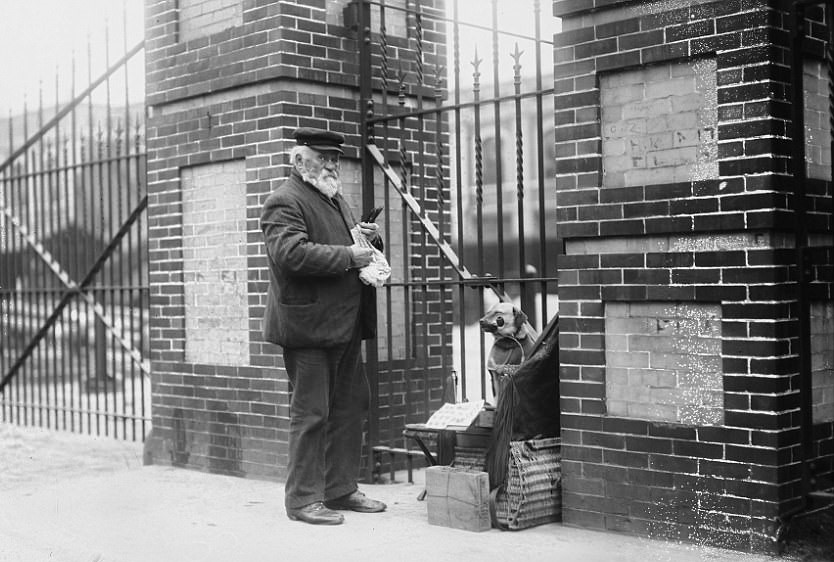
Don’t Call Them Bums:
The Unsung History of America’s Hard-Working Hoboes.

Despite the ever-widening wealth gap, most of us continue to grasp at the American Dream, which promises financial security in exchange for hard work. In fact, for many workers in today’s economy, attaining middle-class status is exactly that—a dream—while digital technologies have pushed enormous numbers of steady-paycheck employees into the unpredictable “gig economy”, where contracts are the norm.
  If you broke the Hobo code you would be punished by other Hobo’s for it.

Roughly 140 years ago, American workers faced a different set of economic uncertainties, as machines began to replace able-bodied men in factories and on farms. But back then, a safety net existed in the form of the newly laid railroad, which promised hope to workers willing to trade the comforts of hearth and home for a chance at gainful employment. All one had to do was hop a train to a new town and declare himself a hobo.
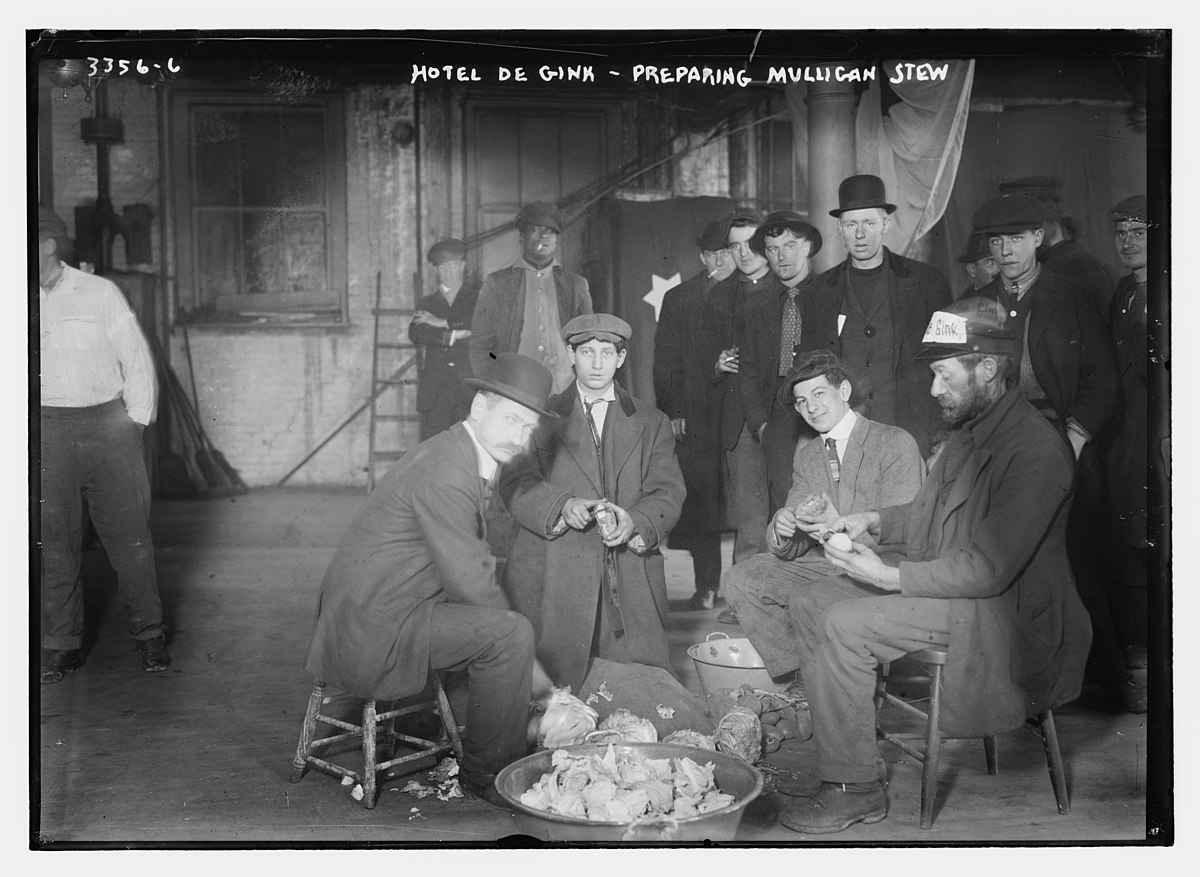
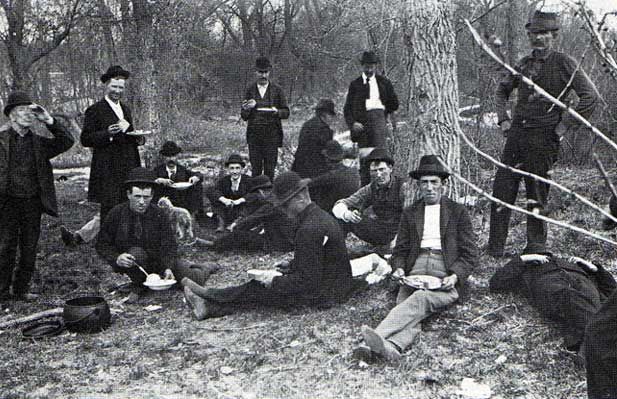
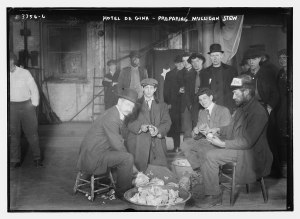
  Hobo’s during their Soup-time, ingredients from all, soup for all.  In one article I read that one Hobo brought a whole turkey. His part to the soup was that he left the turkey for one and a half hour to cook in the soup (great flavor), then took it out and kept it for a later use. The later use was a fantastic roast over open camp fire and the bones were kept again and used in another soup cooking.  Great Hobo story, right ?
The first and foremost thing to understand about hoboes is that hoboes are not bums. Got that? Hoboes are not bums. Hoboes fully embrace the Protestant work ethic, bouncing from place to place, looking for short-term jobs to earn their keep, while bums and tramps want to just bum everything—money, food, or cigarettes. But free-loading tramps and hard-working hoboes have one thing in common: Both have traveled the rails, starting in the 19th century, much to the chagrin of the railroad owners. So-called bums, who might be too old, disabled, or ill to work, tend to stay in one place.
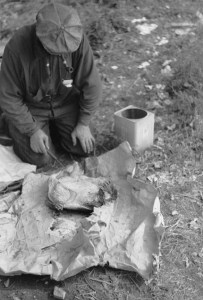
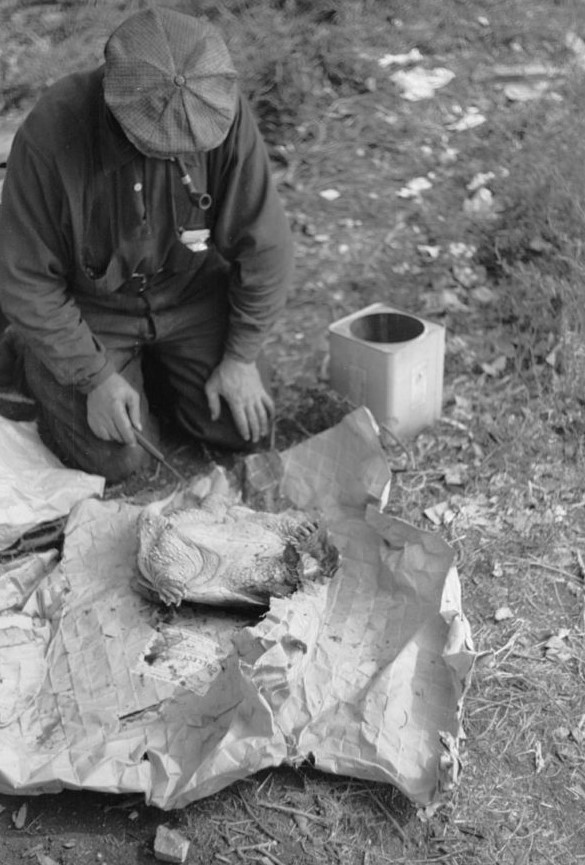
  Hobo preparing a turtle for the soup. Hobo-Turtle-Soup.
Today, the word “hobo” tends to call up one of two caricatures deeply ingrained in our collective imagination: One is a sad sack with saggy pants, five-o’-clock shadow, and a bindle stick, probably passed out in some alley with a bottle of whiskey—an image that’s interchangeable with that of a bum.

  Hobo life in songs and movies with Johnny Cash.

The other is a fantasy about living free on the fringes society: jumping boxcars despite the danger, wandering from town to town with no roots or commitments, sleeping under the stars with fellow hoboes who trade banjo tunes and wild stories. Woody Guthrie, Jack London, Ernest Hemingway, James Michener, Louis L’Amour, Clark Gable, Johnny Cash and multi-millionaire Winthrop Rockefeller were all drawn to this untethered lifestyle and told stories about their time on the rails, burnishing the legend.
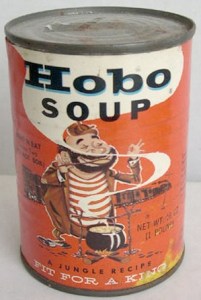
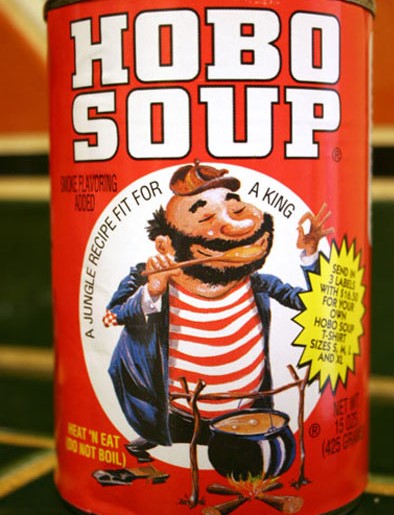
  Hobo Soup Can from the 1950’s-1960’s.
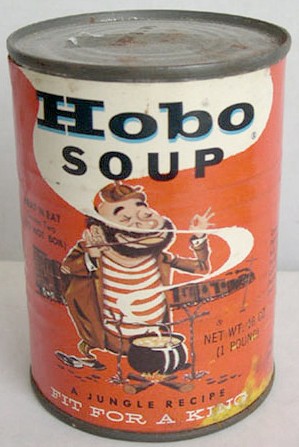
This soup was the brainchild of a small-town newspaperman from Ortonville, Minn., who in 1953 went into the local hobo camps in search of a feature story. As a result he was treated to old-fashioned homemade hobo soup and felt the world should share in this down-to-earth cuisine. Made with beans, potatoes, carrots, tomatoes, celery, onions, and turnips, and flavored with bacon to give it a satisfying smoky taste, this thick and hearty vegetable soup is literally a meal in itself. Simply heat and eat.

  Same soup still available today.
The Hobo Soup.

A classic soup that was made in the Hobo camps across the U.S.  as those who rode the rails became a part of the history of America. Hobo Soup was typically made with a random array of ingredients provided from those gathering around the soup caldron, which may have consisted of whatever was found in gardens and was given to the Hobo from kitchens as they came upon those willing to provide food for the camp. Today, some of the commercially produced Hobo Soups contain ingredients that were commonly a part of the traditional soups when they were made in Hobo camps. Ingredients such as navy beans, carrots, celery, onions, potatoes, sweet peppers, tomatoes, turnips, and herbs were all common elements cooked into the legendary Hobo Soup.
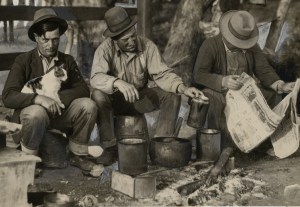
  A hard life during great depression and prohibition.
Ingredients.

1 liter (32 fluid ounce) container beef broth, or more if needed
500gr (1 pound)  ground beef
500ml (16 ounce) can whole kernel corn, drained
500ml 1 (16 ounce) can green beans, drained
500ml 1 (16 ounce) can peas, drained
500ml 1 (16 ounce) can tomato sauce
3 large carrots, cut into bite-size pieces
2 large potatoes, peeled and cut into bite-size pieces
1 large onion, chopped
1 large stalk celery, cut into bite-size pieces
3 cloves garlic, minced
1 1/2 tablespoons chopped fresh parsley
1/2 teaspoon celery seed
2 bay leaves
salt and ground black pepper to season


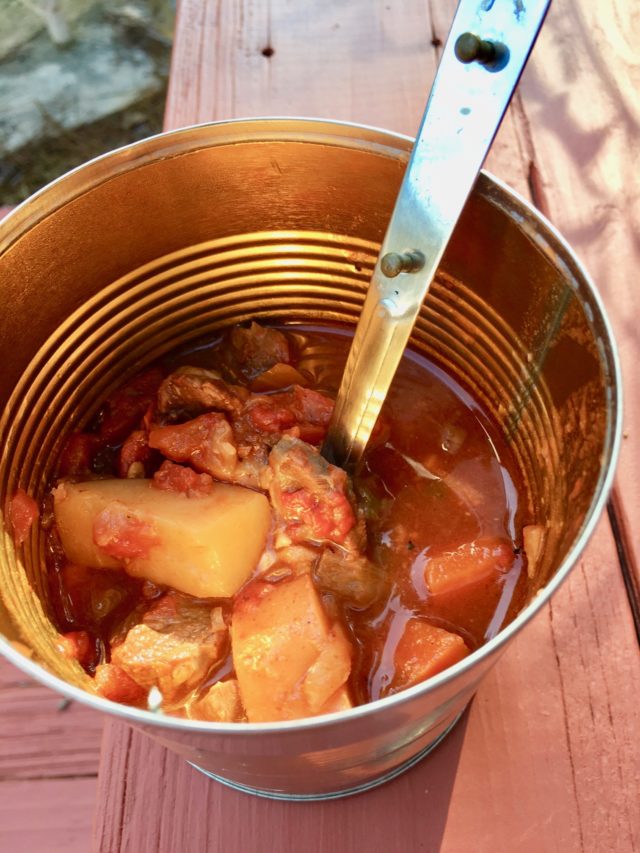
  Without the beef its a wonderful vegetable soup.

How to do.

Stir beef broth, ground sirloin, corn, green beans, peas, tomato sauce, carrots, potatoes, onion, celery, garlic, parsley, celery seed, and bay leaves together in a slow cooker.
Cook on Low for 4 hours. Check for moisture and add broth as needed. Continue cooking another 4 hours. Season with salt and black pepper. If you cook this soup in a normal pot it will take about one hour or till potatoes and carrots are soft.

  Hobo Soup cans in American supermarkets.

The Hobo Stew.

  Stew ingredients.
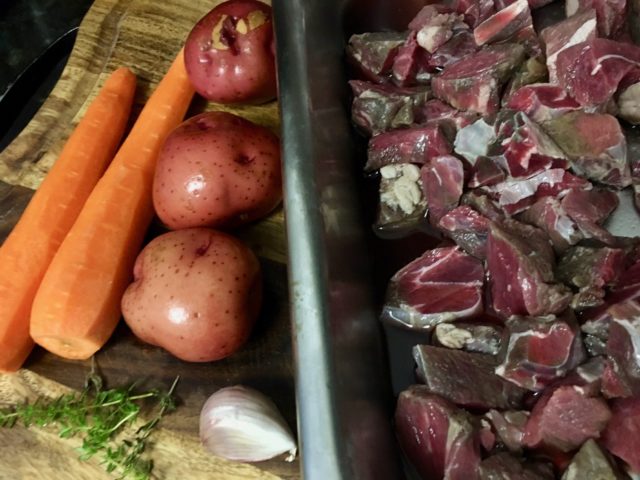
Ingredients.

1 pound stewing beef, cubed
2 tablespoons flour
2-3 tablespoons olive oil
2 onions, chopped
2 garlic cloves, minced
2 medium carrots, chopped
1 pound small potatoes or larger ones chopped
2 sprigs thyme or 1/2 teaspoon dried
1 cup red wine or 1 bottle of dark beer
450gr  (14.5 ounces) diced tomatoes canned
1 teaspoon white or brown sugar
salt and pepper to season
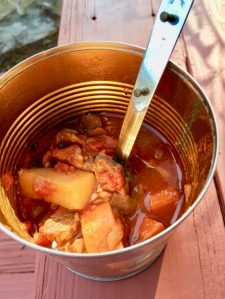
  The Hobo Stew. 
How to do.

Take cubed beef and marinate in balsamic vinegar for 3 hours or longer. Best is over night. This is helpful for slighter tougher cuts of beef.
In heavy pan over medium heat, heat olive oil. Drain and reserve liquid. Add cubed beef and sprinkle flour over the beef.
Stir to combine. Cook about 3-4 minutes, or until beef cubes are browned. Remove and set aside.
Add onions, garlic, carrots, potatoes and thyme sauteing gently for about 10 minutes. Add more oil if necessary.
Add back beef cubes and reserved liquid to vegetables, along with canned tomatoes, wine or beer, sugar, salt and pepper.
Bring all to a boil and then lower heat to a simmer.
Cover and cook for 1 1/2 to 2 hours or until beef is tender. Correct seasoning.

  Hearty food for hard workers.
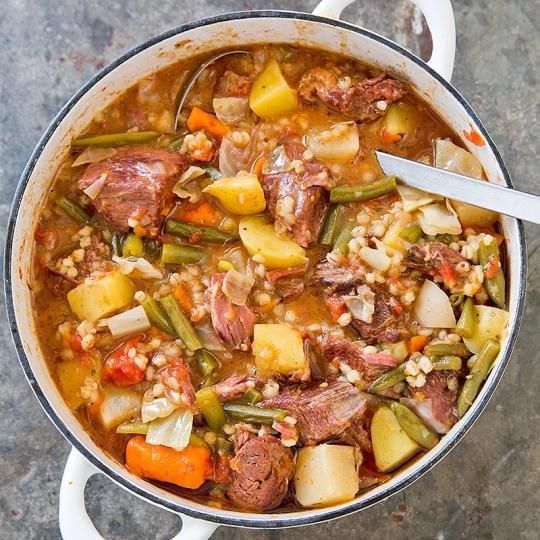
Tips.

As this is an improvised stew, feel free to add vegetables on hand—turnips, parsnips, mushrooms, peas and so on. While fresh is always better, use canned or frozen when needed. Use in total about 1500gr (3 pounds) of vegetables.
If you do not use or have wine or beer, marinate the beef in 2 -3 tablespoons balsamic vinegar. Drain before sautéing and do not add back into mixture.
You also may cook the stew in a 160 C  (325 F) oven for 2 hours or until beef is tender.

  Advertising Hobo Stew in the 1930’s.

Some readers might be interested in life, history and backgrounds of the American Hobo Time. Just have a good look in the internet, you will find lots of articles, books, movie’s and much more. Here are two very interesting sites, with lots of pictures (I took the chance to use some of them in this article), which can give you a deeper insight of this part of American history.  Enjoy it with some soup or stew !

https://www.smithsonianmag.com/arts-culture/last-great-american-hobos-180971913/
https://erroluys.com/greatdepression.html

Veröffentlicht unter History, Lifestyle, Recipes | Verschlagwortet mit , | Hinterlasse einen Kommentar

Miracle Lemon

All what you can do with lemon.

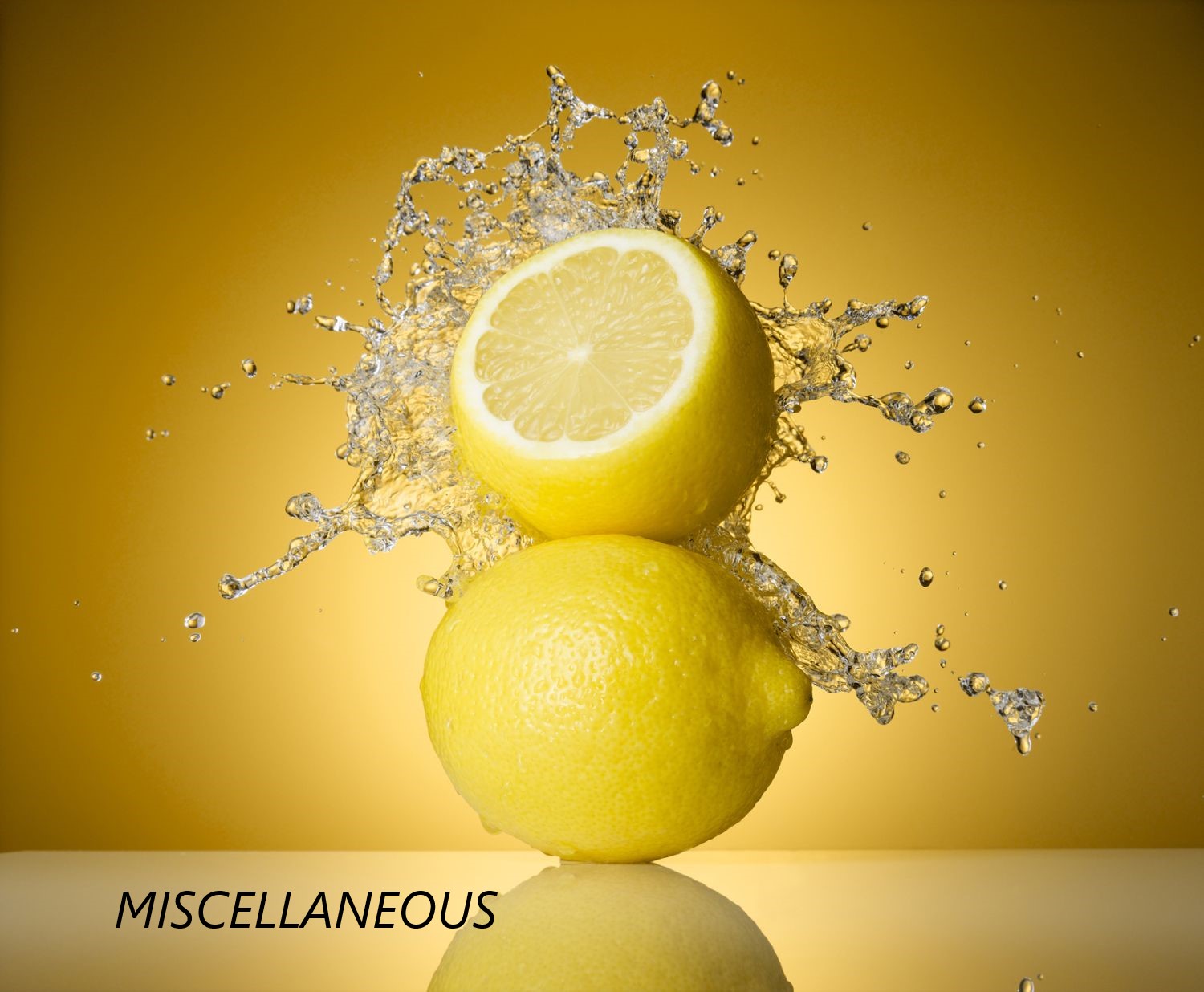
This time of the year my lemons are ripening on the tree. That means time is coming to use the lemons daily. During the last few years I collected all the fine tips and ideas what we can do with a lemon and/or what to use lemons for. Now I love to share with you.

Of course most of you will know this or that or have it already in use, but may be you’ll find some new tips and useful ideas. There are dozens more, just be creative. Enjoy the tips.

HEALTH

Start your day with lemon water:
Drinking lemon water will give you a dose of Vitamin C, potassium, and will aid digestion and give your immune system a boost.
Soothe a sore throat:
Lemon juice has anti-inflammatory and antibacterial properties which can help a sore throat. It also has lots of Vitamin C to help boost your immune system.
Treat canker sores:
Because lemon is both anti-fungal and antibacterial, it will speed up the recovery time of a canker sore. Simply add lemon juice to a cup of hot water. Let steep, and then gargle with the solution. It will sting, but that means it’s working.
Soothe skin rashes:
Soak a cotton ball in lemon juice and apply to the rash. This works especially well with poison ivy.
Stop itchy insect bites:
Rubbing a bit of lemon juice on insect bites will relieve the swelling and itching. Just make sure not to go outside with it on since you might attract more bugs.
Reduces phlegm and soothes a cough:
Adding a little lemon juice with honey to hot water will reduce mucous build up, which can help you get better faster.
Remove warts:
If you don’t want to go to the doctor to treat your wart, try lemon juice as a do-it-yourself option. Dabbing lemon juice on the wart will break it down and it should disappear in two weeks.

CLEANING

Polish furniture:
Make a homemade furniture polish that will smell better and cost less than typical polishes out of lemon oil, squeezed lemon juice, and olive or jojoba oil. Combine the ingredients and buff with a cloth.
Remove food build up from a microwave:
Place a bowl of water, lemon juice, and slices of lemon into the microwave. Heat on high for three minutes and remove the bowl. Any leftover food that used to be caked on will wipe right off and your microwave will smell amazingly clean.
Clean windows:
Because it’s acidic, lemon juice is great at cutting through grease or grime build up on windows and glass. You can also mix it with cornstarch, vinegar, and water for an even better window cleaning treatment.
Remove hard water stains from faucets:
Hard water can make your tub dingy and leave you with unsightly stains on faucets and shower heads. Remove build up by taking a cut lemon and rubbing it on your shower fixtures — they’ll look shiny and new when you’re done.
Clean cutting boards:
Freshen your dirty, greasy cutting boards with a handful of coarse salt and a cut lemon. Sprinkle salt on the cutting board and then rub it in with the cut side of a lemon. Wipe off the salt or rinse the board in the sink — easy. You can do the same thing with rolling pins and wooden salad bowls.
Revive your old coffee maker:
Run your coffee maker through a full water-only cycle. Then, mix a solution of lemon juice and water together and pour it into your coffee maker water tank. Allow it to sit before turning it on and letting it run through the cycle. Make a fresh solution and repeat the process. Run another water cycle and soak the carafe, filter, and coffee reservoir in dish soap and water to remove any lemon taste.
Clean marble:
To remove rust stains from marble, sprinkle baking soda on the stain and add some lemon juice. Scrub and add more lemon juice and baking soda as needed. Wipe immediately with a clean, wet rag.
Polish brass and copper:
Combine equal parts lemon juice and vinegar and then wipe the mixture on the metal with a paper towel. Polish with a soft cloth until dry. You can also combine lemon juice and baking soda to make a paste and have a similar effect to remove tarnish.
Polish silverware:
Mix a tablespoon of lemon juice with 1 1/2 cups of water and 1/2 cup instant dry milk. Let the silverware sit overnight and then rinse and dry. If you’re in a hurry, simply pour some lemon juice on tarnished pieces of silverware and buff with a clean cloth.
Make your dish soap more effective:
Add a teaspoon of lemon juice to dish soap to cut through grease on dishes and make your soap even more effective.
Bleach plastic Tupperware:
If your Tupperware is soaking up colors from your favorite spaghetti or tomato soup, rub with some lemon juice and let it dry in the sun to bleach away the stains.
Clean the toilet:
Pouring in 1/2 cup of lemon juice and letting it sit will make toilet stains easy to tackle with a brush (and make the bathroom smell citrusy). You can also add 1/2 cup of borax for extra stain fighting powers.
Unclog a drain:
Pour boiling water down the drain and then half a box of baking soda followed by 8-12 ounces of lemon juice. The lemon juice will react with the baking soda causing it to turn into a foam. Pour more boiling water down the drain to rinse away the foam and clog.
Remove water stains on shower doors:
Cut a lemon in half and dip one half into baking soda. Rub onto the glass and then rinse and dry.
Create an all-purpose cleaner:
Combining water, baking soda, vinegar, lemon, and lemon essential oil will create an amazing all-purpose cleaner for the kitchen or the bathroom. Get directions here.
Clean cheese graters:
Instead of ruining your sponge, clean your cheese graters using a half of a lemon instead. It won’t matter if it gets grated a little and the acid in the lemon will cut through the cheese easily.
Polish hardwood floors:
Make your own lemon-vinegar floor cleaner to fight mold, bacteria, and germs. It also has the added benefit of being non-toxic and will make your floors look great.

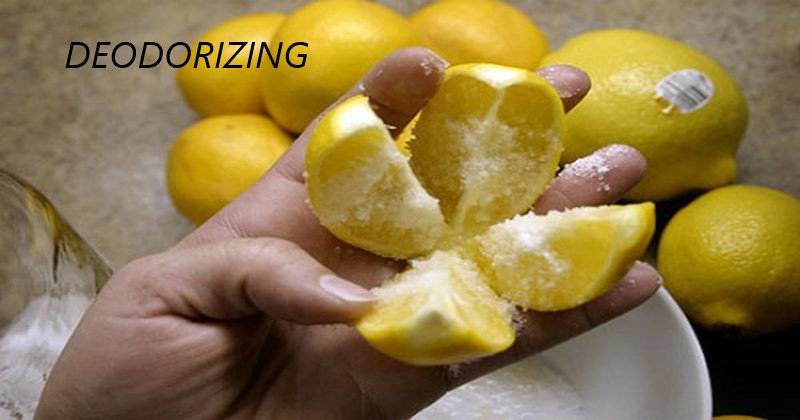
DEODORIZING

Clean the garbage disposal:
Freeze lemon slices in plastic ice cube trays with vinegar. Once frozen, you can place a few cubes down the disposal, turn on the water, and run it for 30 seconds to clean and deodorize.
Freshen your fridge:
Soak a cotton ball or sponge in lemon juice and leave it in the fridge for a few hours — your fridge will smell so much better, and it works even better than baking soda.
Make a room freshener:
Throw lemon peels, cloves, and cinnamon sticks into a pot of simmering water. It will make your whole house smell amazing, get rid of odors, and humidify the air, too.
Deodorize the humidifier:
Pour in lemon juice with the humidifier water. Turn it on and let it run — the lemon juice will naturally deodorize the machine plus make the room smell fantastic.
Make your breath smell better:
Drinking lemon water and combat the bacteria in your mouth. Just make sure to rinse with water afterwards since lemon juice can erode your teeth.
Deodorize trash cans:
Throw a few peels into the trash can to keep everything smelling as fresh as possible. It’s evem more effective if you use a handful of salt on the lemon.
Make the fireplace smell amazing:
Use dried citrus peels like lemon and orange as kindling — to prepare, let them sit out on the counter for a few days so they can fully dry. They’ll act as a flame starter and will make the fire extremely aromatic.
Remove odors from hands:
Whether it’s garlic or fish, cooking can make your hands smell horrible. Wash them with lemon juice and some soap to eliminate unwanted odors.
Neutralize cat-box smells:
Make your home smell better by neutralizing the acidic smell of your cat box with a few lemon slices placed nearby in a bowl. It will have the same effect as store-bought air fresheners.

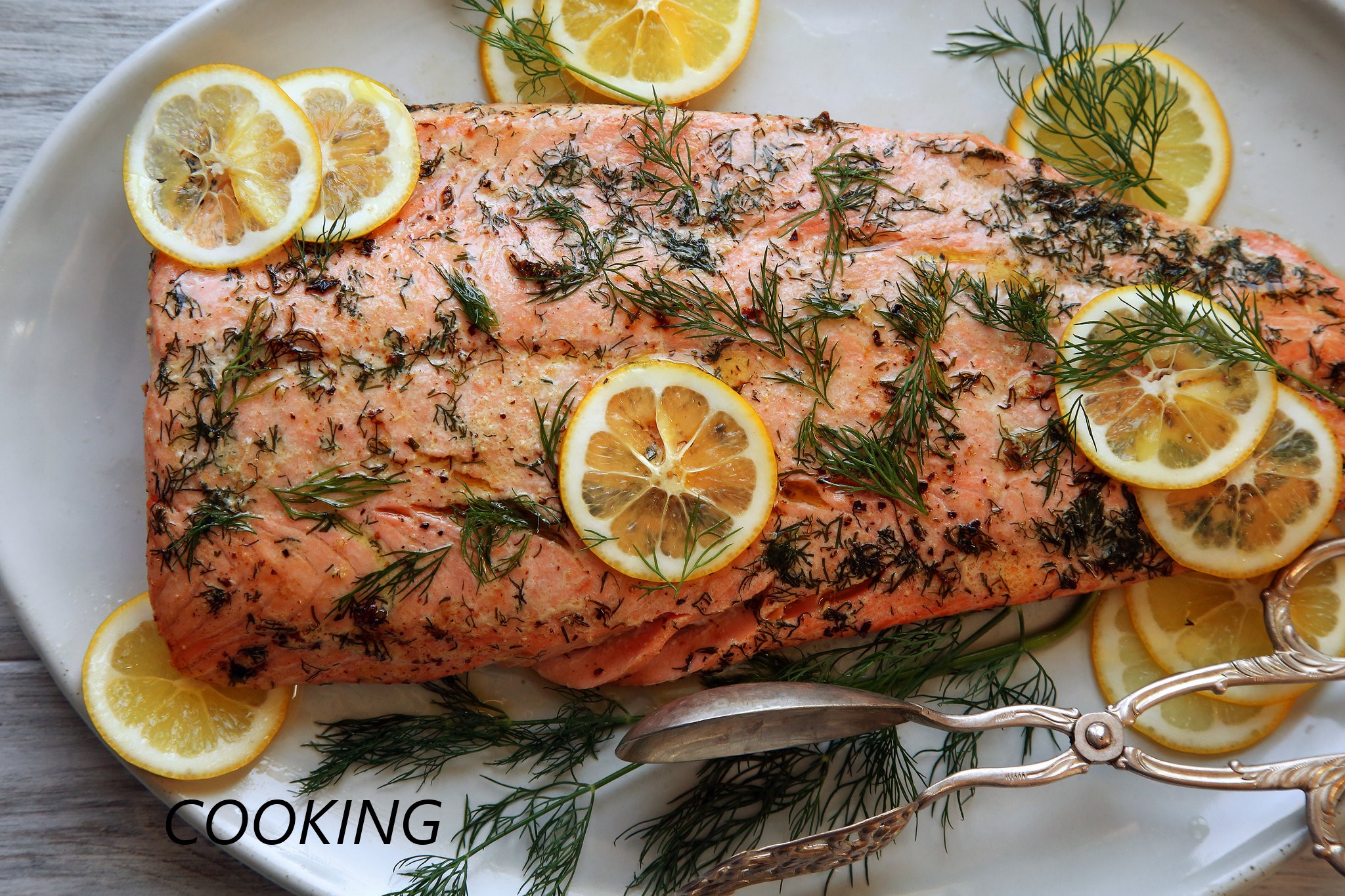
COOKING

Soak fruits and veggies in lemon water to prevent browning:
After slicing up your fruit, keep it from oxidizing and turning brown by soaking in a cold bowl of water with lemon juice. Take out produce and pat dry. This works with apples, cauliflower, bananas, pears, potatoes, and avocados.
Revive limp lettuce:
When lettuce starts to get soggy, you can soak the leaves in a bowl of cold water with the juice from half a lemon. Refrigerate for an hour and then dry leaves before adding to salads or sandwiches.
Keep rice from clumping:
Add a spoonful of lemon juice while rice is cooking so it doesn’t stick together at the end. Let it cool when it’s done and then fluff with a fork.
Upgrade your ice cubes:
Freeze lemon slices in ice cube trays (or cupcake trays if you want bigger ice cubes) and use them to add some zest to a standard glass or pitcher of water.
Marinate meats:
Lemon juice is a brilliant marinade when added with oils and herbs. The acid in the lemon juice will break down the meat so that the oil and spices can flavor it even better.
Make candied lemon peels:
Instead of throwing away your lemon rind, you can make candy out of it that you can put on cakes, into cookies, or just eat as a snack. All you need to do is boil the peels a few times with sugar and coat in sugar.
Keep brown sugar soft:
Adding a lemon slice to brown sugar will keep it soft. The moisture from the lemon will keep the sugar from becoming rock hard and unusable.
Boost flavor and reduce salt intake:
Studies have shown that if you use lemon juice and lemon zest, you’ll use less salt to boost the flavor of your dishes. It’s a healthier alternative instead of constantly reaching for salt and pepper.
Make a buttermilk substitute:
If you don’t have buttermilk, add two tablespoons of lemon juice to a 1% or 2% cup of milk. Let it sit so the acid sours the milk for 15 minutes and then add it to the recipe.
Make a sour cream substitute:
Similar to the buttermilk tip above, lemon juice will sour whipped cream if you let it sit for 30 minutes or so. It will also cut your calories if you’re used to adding a dollop of sour cream to a baked potato.
Make lemonade:
You know what they say about life giving you lemons. Add some gin if you want a grown up lemonade.  Or search for recipe to make your own limoncello.

LAUNDRY

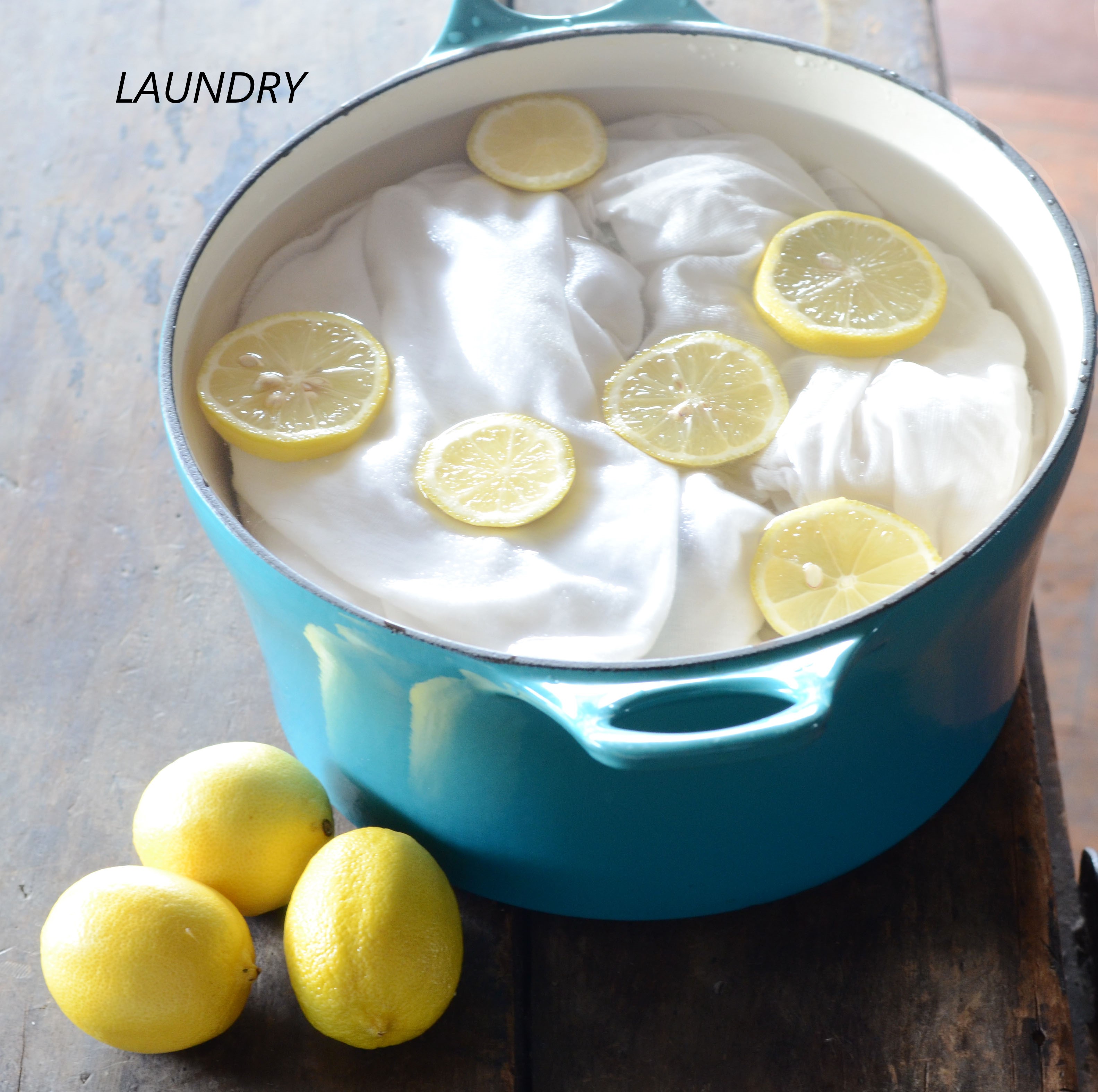
Gently bleach fabrics:
Add lemon juice to hot water and soak your white linens. Then rinse and wash as normal. You can also add 1/2 cup of lemon juice to your cycle instead of bleach for similar results.
Spot treat your shirts:
Pour lemon juice on the stain and add some table salt. Rub the stain between your fingers and then rinse. This is especially helpful with dark underarm stains, and will be even more effective if you let the clothing dry in the sun.
Get mildew stains out of clothes:
Make a paste with lemon juice and salt and rub it into the infected area. Let it dry in the sun, and repeat until the stain is gone.
Remove grease stains:
Mix lemon juice with vinegar and apply to the stain. Let it sit and then rinse off.
Whiten tennis shoes:
Spray lemon juice on white athletic shoes and let them dry in the sun. It will bleach the fabric and even make them smell better.

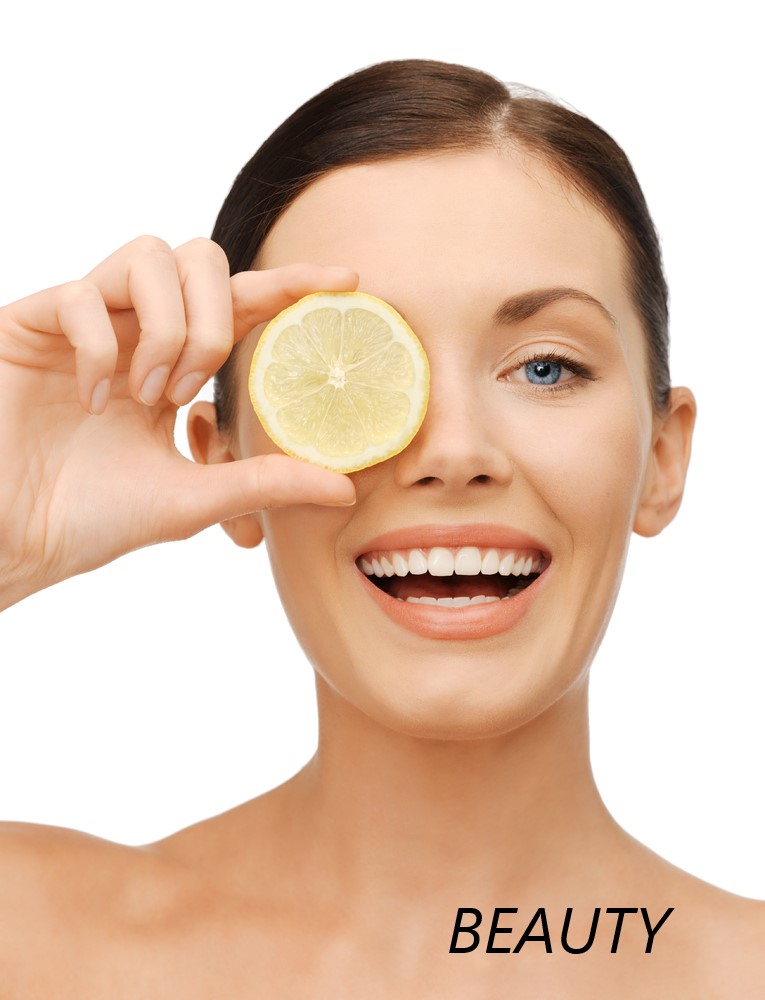
BEAUTY

Lighten your hair:
Lemon juice will bleach your hair in the sun. Create your own leave-in hair brightener by combining almond or coconut oil, cinnamon, and chamomile tea with lemon juice. Mix together and spray on your hair before heading outside into the sun. The lemon will lighten strands while the oil will make sure hair doesn’t get too dried out. (Simple lemon juice will also do the trick.)
Fade age spots or freckles:
Lemon juice will lighten and brighten skin by reducing freckles as well as fading age spots. Wash you face, pat dry, and then apply lemon juice with a cotton swab.
Make a brightening moisturizer:
Mix coconut oil with a few drops of lemon juice to hydrate skin and brighten it at the same time. Since both are anti-fungal, the mixture will also help prevent acne.
Whiten and strengthen nails:
Mix lemon juice with olive oil and soak your nails. The lemon juice will brighten the nail while the olive oil will strengthen it.
Fight dandruff:
Massage two tablespoons of lemon juice into your scalp and then rinse with lemon water. Repeat until dandruff is gone.
Fight acne:
Lemon juice is a natural astringent which will fight the oil and clogged pores that can cause acne. After cleaning your face and patting dry, apply lemon juice to your face. After 10 minutes, rinse off with cool water. Repeat twice daily.
Exfoliate your skin:
Combine lemon juice, sugar, olive oil, and honey to create a nourishing scrub for your skin. Apply to your body and face before rinsing off.

MISCELLANEOUS

Polish leather shoes:
Make your own shoe polish with olive oil and lemon. Combine one part lemon juice with two parts olive oil and let it sink into the leather of your shoes. Wait for 10-15 minutes and then buff with a cloth.
Make invisible ink:
Squeeze lemon juice into a bowl of water and then dip a cotton swab into it. Write a message on white paper and then wait for it to dry before heating the paper close to a lamp or light bulb to see the message.
Sanitize jewelry:
Add a tablespoon of lemon juice to 1 1/2 cups of water. This is especially good for sanitizing earrings, but should not be used on pearls or gold.
Repel bugs from your home:
Mop your floors with lemon juice and water to ward off roaches and flees, and spray concentrated lemon juice on any areas you think bugs like ants may be getting in. Bonus points if you throw some lemon peels outside of entryways.
Remove pet stains from fur:
Pinkish-red stains can sometimes form around your pet’s eyes and mouth. To remove these stains, combine baking soda and lemon juice and rub it onto fur. Keep it away from your pet’s eyes and wait for about 10 minutes before rinsing off. Always check with a vet first to make sure it’s safe.
Remove berry stains from your hands:
Berries can dye your hands red if you’re not careful, especially if you’re slicing, rinsing, or cooking with them. To get rid of them, make a paste of cornmeal and lemon juice and rub onto hands, let sit, and rinse off.
Kill weeds:
Lemon juice will kill any weeds you don’t want growing in your yard or driveway. Fill a spray bottle with the juice and douse the offending plants.
Make your own dog and cat repellent:
If neighborhood cats and dogs are using your lawn as a litterbox, combine lemon peels with coffee grounds and place them where the pets usually ‘go’ — they hate the smell and will soon head to other yards.
Save hardened paintbrushes:
If your paintbrushes look like there’s no saving them, bring lemon juice and a little water to a boil and throw in the brushes to sit for 15 minutes. Wash them with soap and water afterwards and let dry. Bristles should feel soft again.

  My last tip:

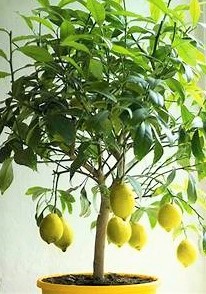
If you don’t like to buy lemons all the time and may be have no garden or live in a climate where lemons hardly grow – just raise your own lemon tree in a flowerpot. It will grow almost everywhere, on balcony’s, in wintertime inside your home etc.   !!  Enjoy !!

Veröffentlicht unter Information, Lifestyle | Hinterlasse einen Kommentar

El Negro Timoteo

Today I want to introduce you to an Uruguayan periodical which is considered the best exponent of Uruguayan satirical journalism of its time.

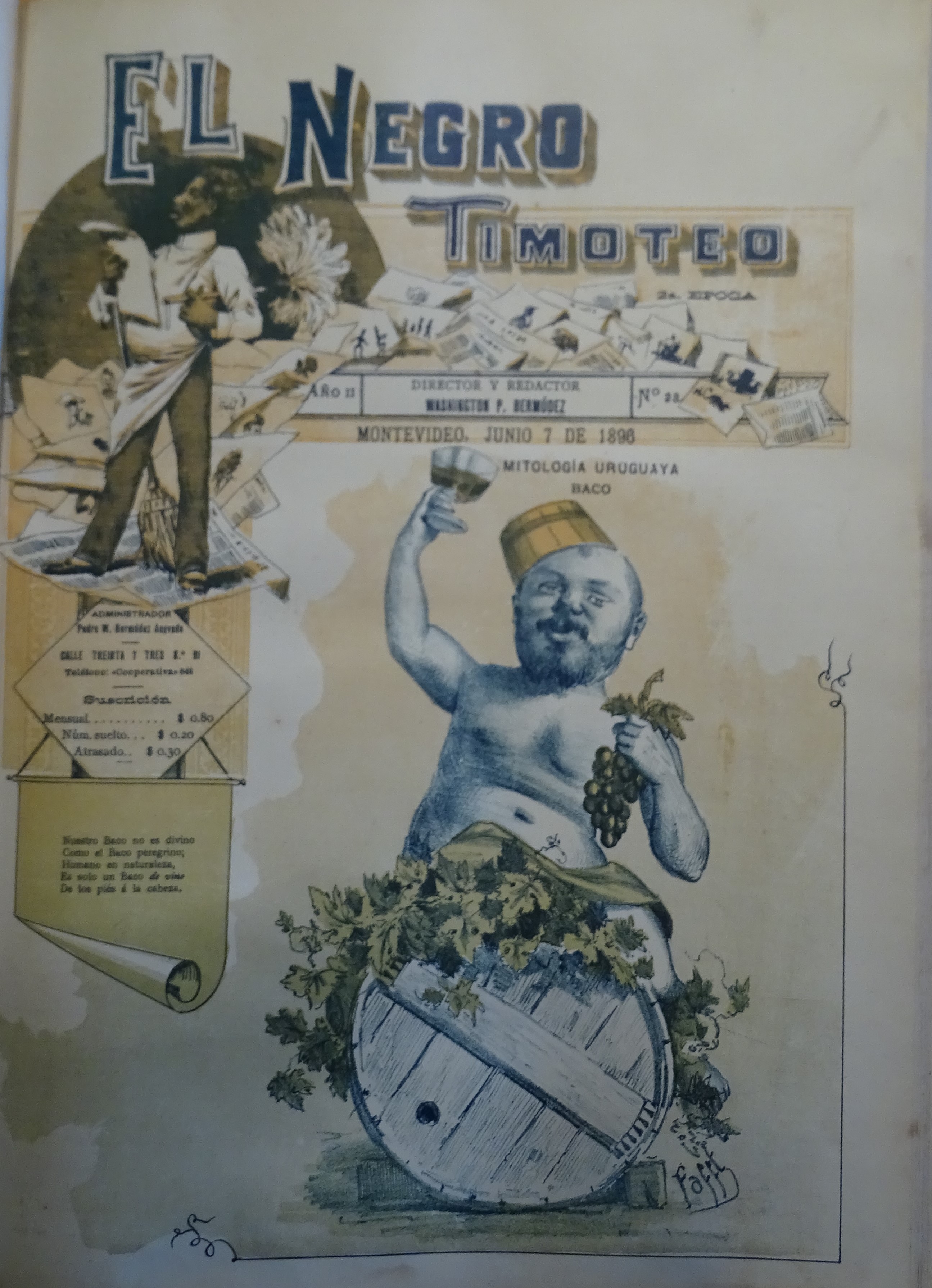
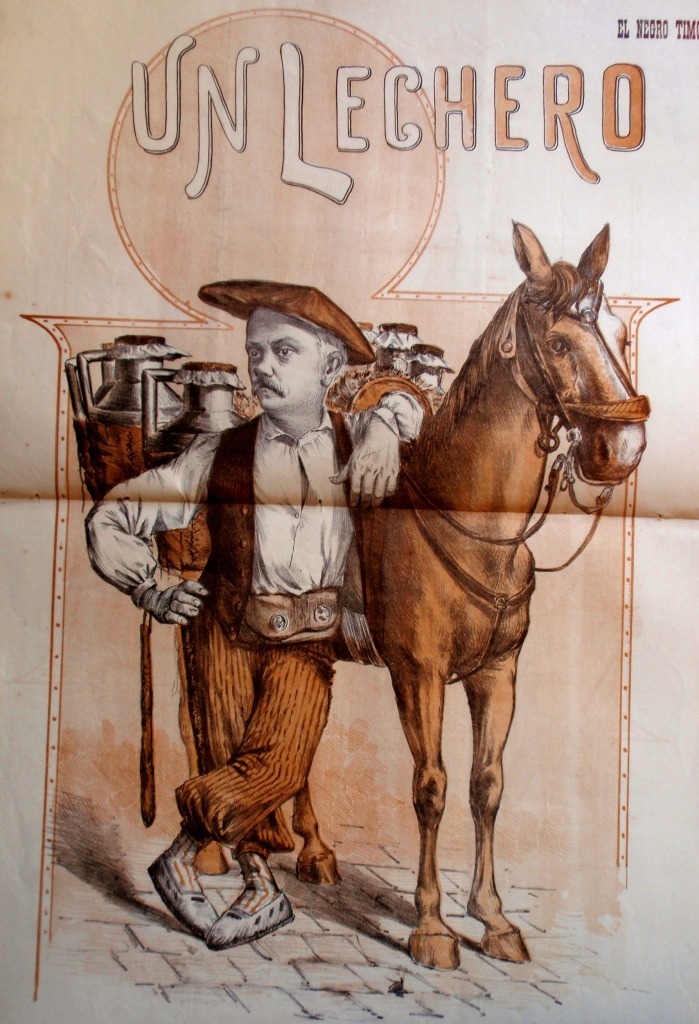
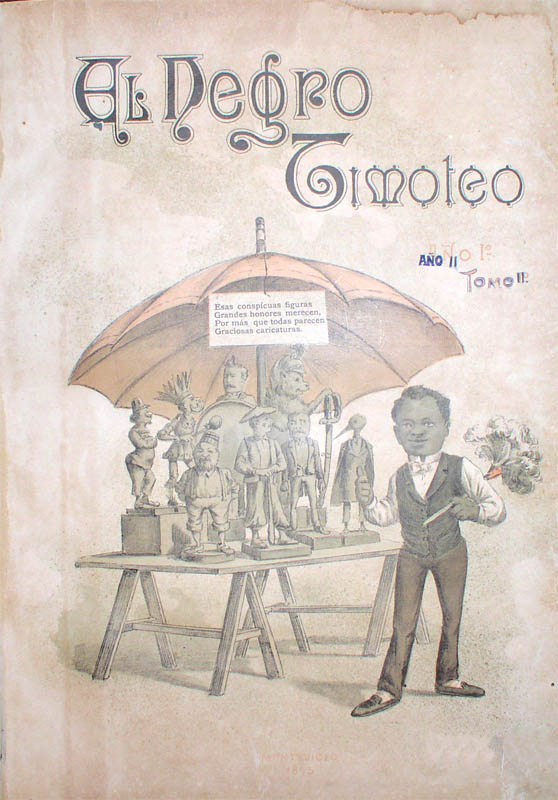
It is „El Negro Timoteo“ and  was a Uruguayan publication that was published between 1876 and 1901.  I like to show you some satirical pictures out of my collection of the year 1896. These pics don’t need further explanation, they speak for themselves. Most of them supersize if you click onto the picture. Have fun !


El Negro Timoteo was founded by Washington P. Bermudez, who was also its director and editor, in 1876 and published with certain difficulties until 1901.

  W. P. Bermudez  drawn by Schütz.

Washington P. Bermudez (Montevideo, May 7, 1847 – November 16, 1913) was a Uruguayan writer and journalist. Bermudez was born in Montevideo and his parents were Pedro Pablo Bermudez and Josefa Estavillo Rojas. He took part in the white revolution of Colonel Timoteo Aparicio and in other contests that took place at the time.

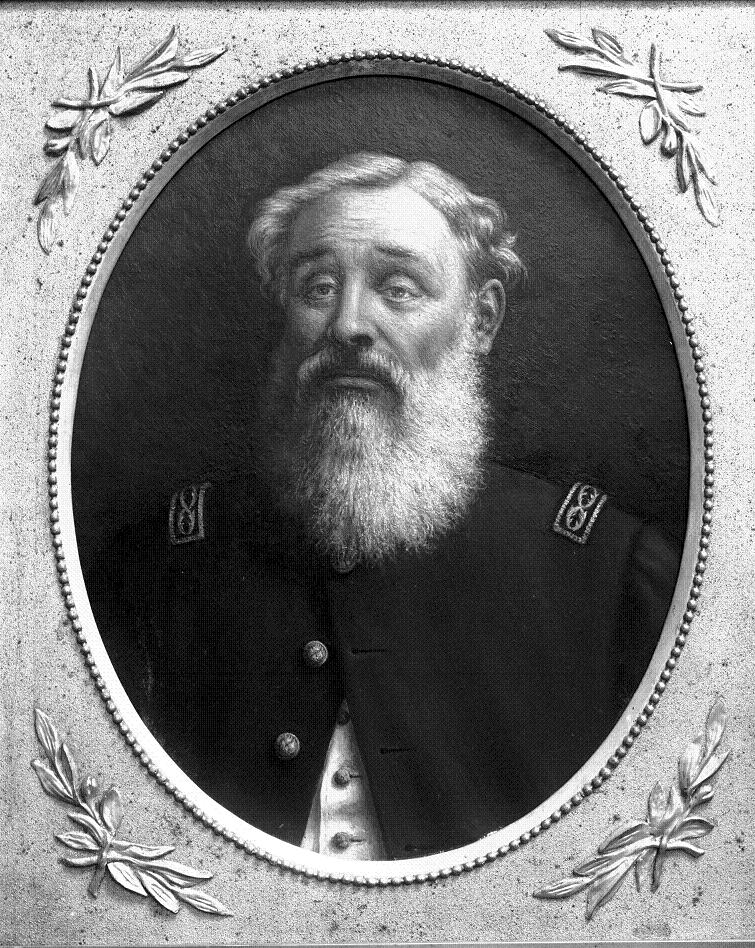
  Colonel Timoteo Aparicio, 1814 – 1882. The Revolution of the Spears 1870-1872). „Aparicio never loaded another weapon than his powerful spear, General Muniz entered the fight with no more weapons than a whip, Colonel Pampillon used the facon and the bolas …“.  To read in the book „The Revolution of the Spears“ from Abdon Arozteguy.

The Revolution of the Spears was an armed movement led by Timoteo Aparicio – leader of the National Party and former army officer – that developed in Uruguay between 1870 and 1872 and culminated with the first agreement of coparticipation in the power of the traditional parties. Its name is due to the fact that it was the last military conflict in Uruguay in which this weapon was used, the spear of tacuara, as a fundamental weapon to fight battles.

  Revolution of the Spears, Colonia 1871. Notice the spears. Click on pic to size up !

On July 17, 1871, during the course of the Revolution of the Spears, there was one of the bloodiest battles of the civil wars in the Banda Oriental. In this action between the Colorado government forces led by Enrique Castro and the white revolutionaries of Timoteo Aparicio, nearly eight thousand men clashed at the end of a spear and rifle in a fierce battle that culminated in a complete victory for the National Army.

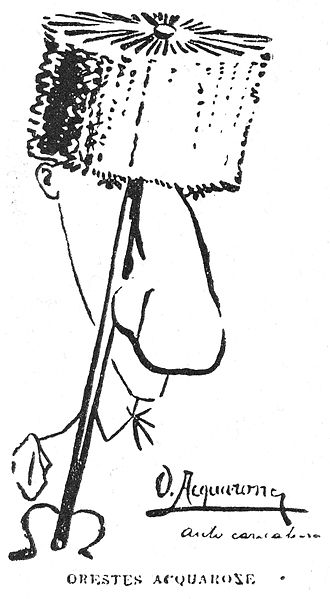
Orestes Acquarone Salaberry (April 27, 1875 – Montevideo, November 9, 1952) was a Uruguayan lithographer, draftsman, painter, caricaturist, watercolourist, sculptor and poet.

  Autocaricatura by Acquerone published 1900 in the magazine „Rojo y Blanco“.
  Red and White, satirical magazin 1900-1903. Anaforas.edu.uy

In 1876 he founded the satirical magazine El Negro Timoteo, expressing in mockery his frank opposition to the Lorenzo Latorre regime. He also published in El Heraldo in 1881 a work under the pseudonym Timoteo. Other pseudonyms he used were Un Aficionado and Yapeyu.  Another of his most famous pseudonyms was Vinagrillo, under which he published satirical articles about the events of his time.

  That’s a Vinagrillo in South America.

He founded and directed a magazine called El Pobrecito Hablador. In it he used the pseudonyms Figarin, Figarito and Figaruelo. It was included in several poetry anthologies of Uruguay. For the artistic direction of the magazine passed several authors such as Orestes Acquarone and Antonio Perez. Among his collaborators was also the Spanish cartoonist and caricaturist Juan Sanuy, who is among the founders of this magazine.

             I love these El negro Timoteo pages. Lots and lots of fantastic cartoons drawn by some extraordinary caricaturists.


Bermudez came from a family of literary and political tradition in the ranks of the Blanco Party. From the pages of „El Negro Timoteo“ he criticized the government of Lorenzo Latorre, being the only newspaper that made active opposition to his military dictatorship, registered in the period of successive military governments known as „Militarism“.

  Lorenzo Latorre, 1875. Wikipedia.

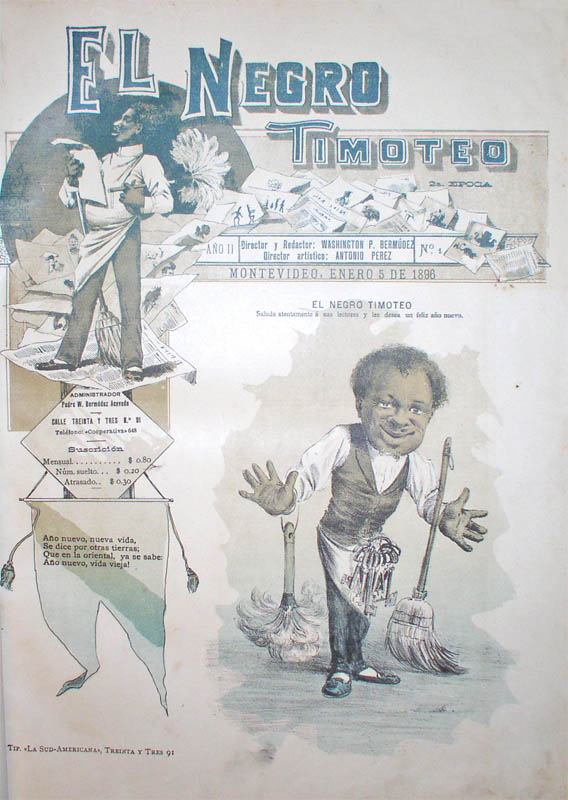
In later years he questioned the government of the collectivism of Juan Idiarte Borda and the swings of Juan Lindolfo Cuestas, as well as the nationalist directorate and political referents of the white collaborationist minority. From its first issue, published on 5th of January 1876, until 1901 the newspaper had several eras. At the end of its existence it was published as a newspaper.

  The first issue, 5th of January 1876.

Around the 1870’s to the the 1900’s, there were many satirical magazines in Uruguay. Through the connection of the authors and artists, who worked mostly for several periodicals at the same time, we are able to find a colorful overview of different magazines of the market that are briefly touched below.

Juan Sanuy (Barcelona, 1856 – 1908), pseudonym of Octavio Juan Bellver, was a Spanish draftsman and editor with a great performance in the Rio de la Plata area.

Beautiful front page of Caras y Caretas magazine, No.24 – year 1 – Montevideo 1890, drawn by Charles Schütz often printed under the pseudonym d’Arsviller.

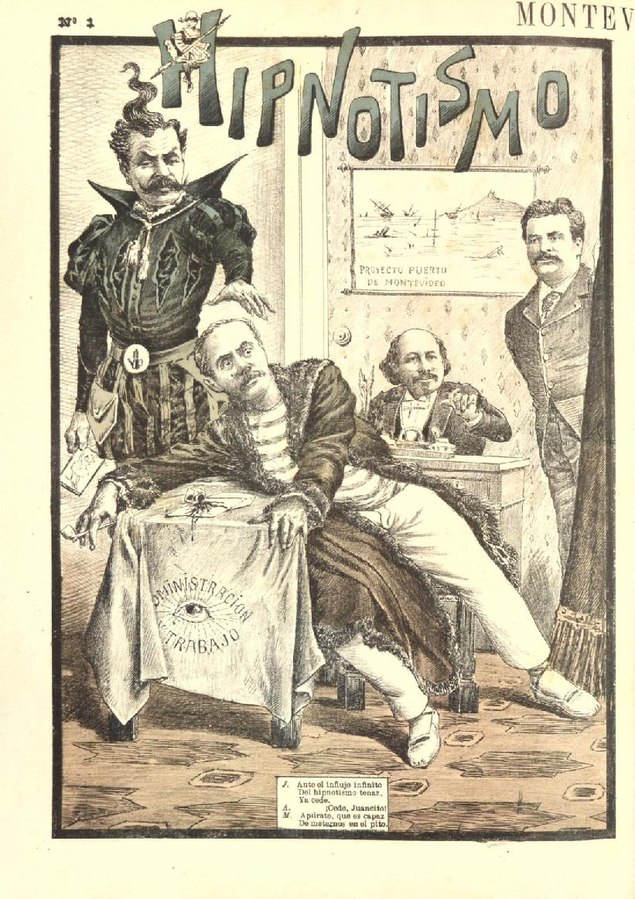
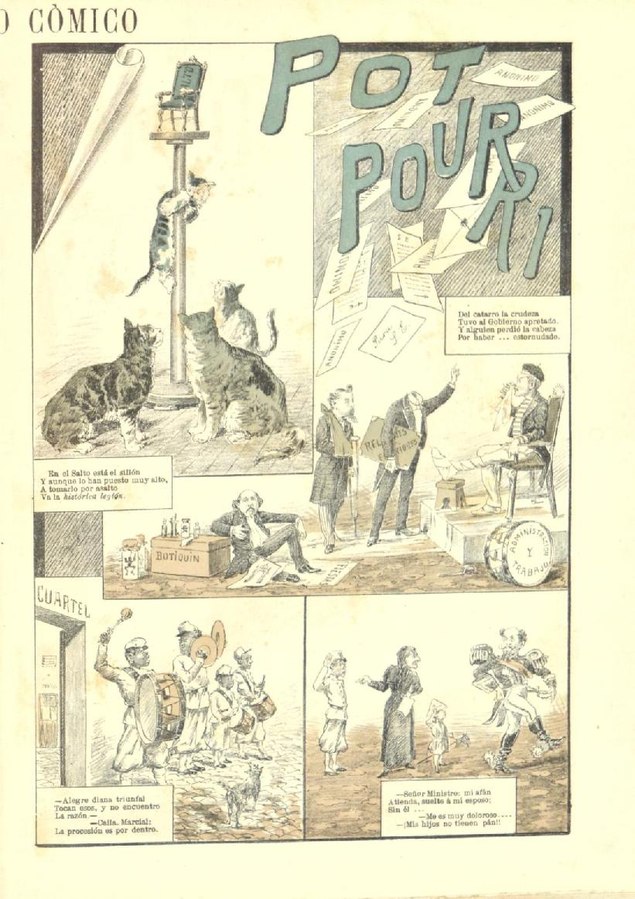
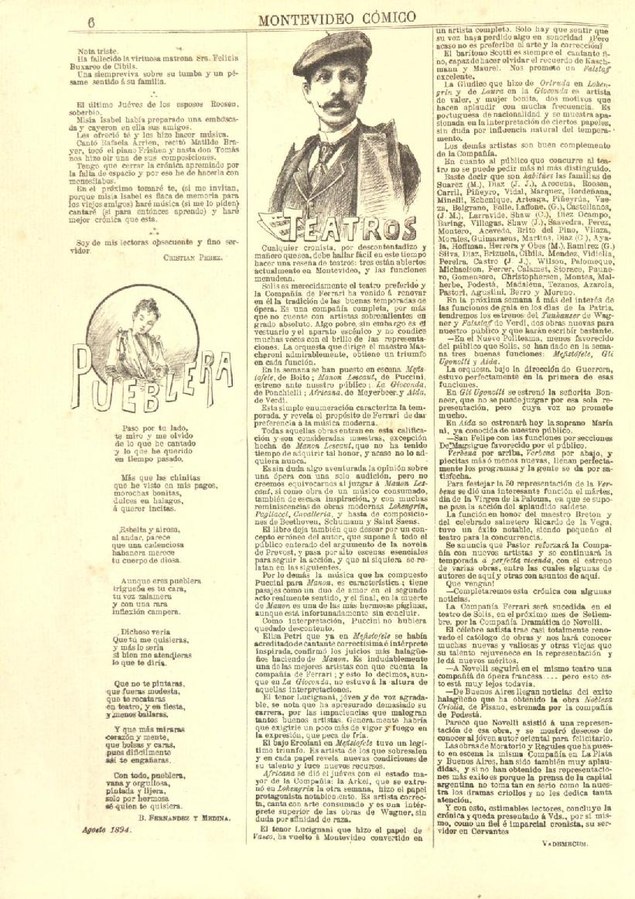
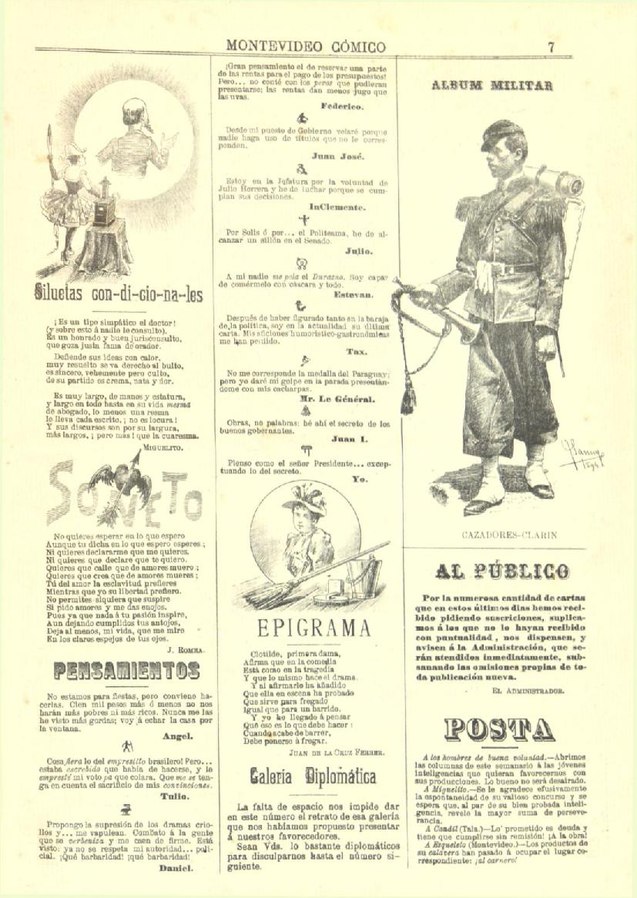
He was a training doctor but devoted himself to the drawing and illustration of magazines and advertisements. His works are sometimes signed as „Juan Sanuy“ and others as „Juan B. Sanuy.“ He was a contributor to the Uruguayan magazine Caras y Caretas and edited, together with Alfredo Varzi, the satirical magazine Montevideo Comico.

  One complete edition of the satirical magazine „Montevideo Comico“. 8 pages from the First year – number 1 – of 1891.

Caras y Caretas is a weekly magazine of Argentina published from 1898 to 1941 in its first period of existence. There was a previous version published in Uruguay between 1890 and 1897. Caras y Caretas was relaunched in 2005 under the direction of historian Felipe Pigna, having been published since then.

  Magazine front page from 1890, drawn by Charles Schütz.

The weekly magazine Caras y Caretas was founded in Montevideo in 1890. Its main features were political satire, humor and topical issues, visually displayed through cartoons and photographs. Eustaquio Pellicer, associated with French artist Charles Schütz, was the director since its first number (dated 20 July 1890) until No.144.  At the invitation of Argentine journalist Bartolome Mitre Vedia, Pellicer moved to Buenos Aires, establishing the Argentine edition of the magazine there. The first number was released the 19th of August 1898 and had 24 pages.

Ja ja, „two seasons“ or „the two sides of a medal“. That’s still Uruguay today !

Veröffentlicht unter History, Uruguay | Verschlagwortet mit , | 3 Kommentare

H E A L T H


Hello everyone,

health issues forced me to make a pause in posting new articles.

I hope to be on „stage“ in about a week again !

Meantime read all the earlier posts where you never had time for.

S O R R Y !


Veröffentlicht unter Information | Hinterlasse einen Kommentar

Beware of this Dictator – Update

Hello everyone.  It is essential that you read and watch all the comments to the post „Beware of this Dictator“. Stay tuned, til soon.


Veröffentlicht unter Information | Hinterlasse einen Kommentar

Beware of this Dictator

Today I like to post two articles from Robert Reich. As usual I filled up the articles with some pictures I found in the net. Normally I do not like to discuss religion or politics throughout my blog. In case of Trump I can’t help myself to inform people about this menace, if I can. Who is Robert Reich ?

Robert B. Reich, a co-founder of The American Prospect, is a Professor of Public Policy at the Goldman School of Public Policy at the University of California at Berkeley.


The threat to American democracy has
never been more pronounced.

The shadow of President Donald Trump is cast on the wall as he speaks in the East Room of the White House.
AP photo by Susan Walsh.

A president who claims he has an absolute right to declare a national emergency and spend government funds that Congress has explicitly refused to appropriate for the ends he seeks, is assuming the role of a dictator.

A president who shuts down government in order to get his way on a controversial issue, such as building a wall along the border with Mexico, and offers to reopen it as a concession when and if his opponents give in, is treating the government of the United States as a bargaining chip. This, too, is the behavior of a dictator.

As is spouting lies over what Trump terms an “undeniable crisis” at the southern U.S. border, which is in fact no crisis at all.

Donald Trump using government as his own personal piggy bank. Whether it’s costing taxpayers millions to golf or having his own State Department promote Mar-a-Lago for financial gain, this is how this corrupt administration functions.

Donald Trump is violating the Constitution. He is negating our system of government based on the rule of law. He is violating a president’s core responsibility to protect American democracy.

But the threat to American democracy is not just from Trump’s dictatorial moves. And the real threat to American sovereignty is not coming from Trump’s fantasized hordes seeking to cross the Mexican border.

MCALLEN, TX – JUNE 12: A two-year-old Honduran asylum seeker cries as her mother is searched and detained near the U.S.-Mexico border on June 12, 2018 in McAllen, Texas. The asylum seekers had rafted across the Rio Grande from Mexico and were detained by U.S. Border Patrol agents before being sent to a processing center for possible separation. Customs and Border Protection (CBP) is executing the Trump administration’s „zero tolerance“ policy towards undocumented immigrants. U.S. Attorney General Jeff Sessions also said that domestic and gang violence in immigrants‘ country of origin would no longer qualify them for political asylum status. (Photo by John Moore/Getty Images)

It is coming from a foreign government intent on undermining our democracy by propagating lies, turning Americans against each other, and electing a puppet president.

We do not know yet whether Trump colluded with Vladimir Putin to win the 2016 election. What we do know so far is that Trump’s aides and campaign manager worked with Putin’s emissaries during the 2016 election, and that Putin sought to swing the election in favor of Trump.

We also know that since he was elected, Trump has done little or nothing to stop Putin from continuing to try to undermine our democracy. To the contrary, Trump has obstructed inquiries into Russian meddling, and gone out of his way to keep his communications with Putin secret, even from his own White House.

He has also done exactly what Putin has wanted him to do—threaten to pull out of NATO, pull out of Syria, and accept Russia’s presence in Ukraine.

Perhaps Trump’s current attack on American democracy through his assertion of a fake national emergency is intended as to distract from this larger attack on America. No matter. Both threaten the essence of the nation.

There is only one answer: Donald Trump must be removed from office. Impeachment should start immediately.


Heil Trump !!!

Trump’s immigration moves are
straight from the dictator’s playbook.

Demonising the ‘other’, confecting a crisis to entrench power and using cruelty to spread fear are all part of an assault on democracy

The first rule in the dictator’s playbook is to fuel public anger against the “other” – people said to be dangerous outsiders.

From the start of his campaign for president, Donald Trump has sought to make immigrants from Mexico and Latin America the nation’s nemesis.

The second rule in the playbook is to conjure up a so-called “crisis” of containing the outsiders.

Undocumented immigration into the United States dropped in 2017, but began to rise last year. March brought more than 92,000 apprehensions at the southwest border, the highest number reported in one month in a decade, according to the Department of Homeland Security.

But this is no crisis. It’s not a threat to national security. (Last November, a federal judge blocked the Trump administration’s attempts to ban Central Americans from seeking asylum on national security grounds.)

America is hardly “full”, as Trump has said. In fact, our aging population needs young immigrants to take up the slack.

Whatever problem this surge of migrants poses isn’t nearly the magnitude of threats like climate change, nuclear proliferation, or the undermining of democratic institutions – all of which, not incidentally, Trump has worsened.

The immediate problem is humanitarian. The surge is largely asylum-seeking families from Central America who have a right to have their claims heard by an immigration judge.

But because America doesn’t have enough immigration judges to make such decisions, families are being detained at the border. Even the Republican senator Ted Cruz proposes adding hundreds more such judges to clear the backlog.

Yet Trump has no intention of remedying the humanitarian problem. He wants a crisis to stir up his base and show how tough he is.

Which brings us to the third rule in the dictator’s playbook: use the trumped-up crisis to enlarge and entrench power.

When he’s not accusing Democrats of being socialists, Trump is rallying his followers around the supposed mob at the gates. At a campaign rally in Grand Rapids, Michigan, he claimed migrants are coached by lawyers to say “I’m very afraid for my life” although they look as strong as “the heavyweight champion of the world”.

This flies in the face of the recent warning by the former Homeland Security chief Kirstjen Nielsen that migrants – including children, two of whom have died in federal custody – are arriving “sicker than ever before”.

Which raises the fourth rule: use cruelty to spread fear.

Even though Nielsen committed every cruel act Trump wanted her to – putting migrant kids in cages, separating them from their parents, locking up both for long periods of time – he fired her anyway, apparently because she refused to employ even crueler illegal measures such as detaining children for more than the 20 days allowed by law.

Reportedly, Trump is considering forcing migrant families to choose between letting their children go, or spending months or perhaps years with them in jail.

All of which sets up the fifth rule: take power, unilaterally.

Trump’s “national emergency” to fund his border wall isn’t just an unconstitutional power grab. It’s a grab that shatters previous norms about how far a president can go in testing the limits of his power.

Trump has no intention of remedying the humanitarian problem. He wants a crisis to stir up his base and show how tough he is

So too with shuttering parts of federal government for 35 days to get funding, threatening to close the border with Mexico, and stopping foreign aid to Guatemala, Honduras and El Salvador (a move likely to fuel even more migration by further destabilizing those nations).
Trump is now exploring ways to deny migrants a chance to seek asylum in the first place – a clear violation of American and international law. He has also toyed with shipping detained immigrants to sanctuary cities in order to retaliate and pressure them, according to the Washington Post.

For a president to behave as if he is above the law, or can unilaterally make it, violates the cardinal precept of democracy.

Which may be the real point of all of this for Trump. He seeks total control.

There are now 18 vacancies at the top of the Department of Homeland Security – including the secretary, deputy secretary, chief financial officer, two undersecretaries, the assistant secretary for policy, the director of the Secret Service, the director of the Federal Emergency Management Agency, and assistant secretary for Immigration and Customs Enforcement (who is now acting secretary).

Reportedly, Trump also intends to fire the longtime head of US Citizenship and Immigration Services. This past week Trump rescinded the nomination of Ron Vitiello to lead Immigration and Customs Enforcement, saying, “We’re going in a tougher direction.”

How to explain this purge? Merely a change in policy?

Trump is also keeping vacant the top positions at every other department with any responsibility for border security, including defense and interior.

It’s about total control. “I like acting secretaries and directors,” Trump said in January. “It gives me more flexibility.”

It also gives him more power to do as he pleases.

Unconfirmed appointees will be loyal to him personally. Their authority is not dependent on Congress.

The final rule:  Destroy Democracy.

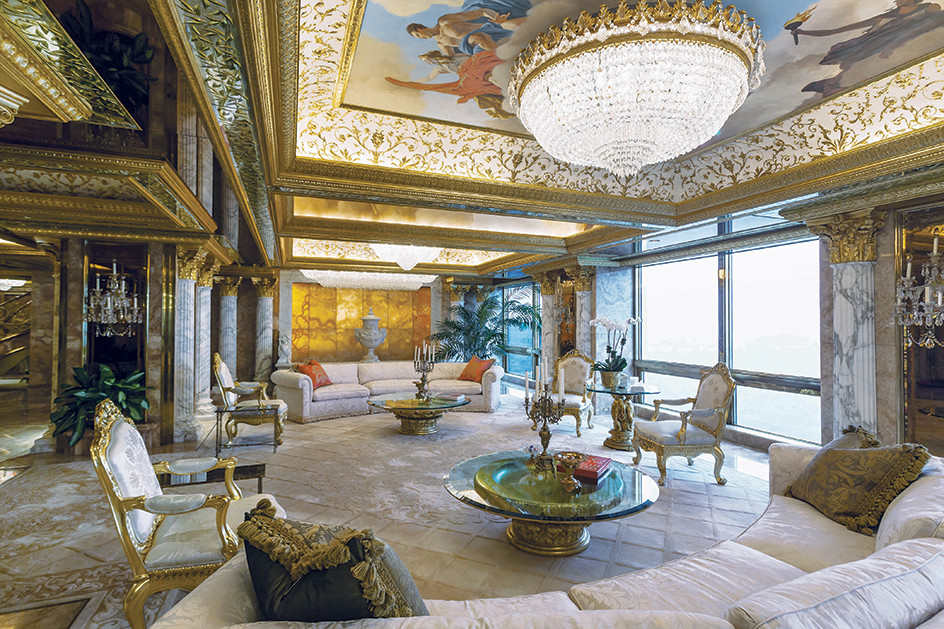
In 2006, British author Peter York wrote a book, Dictator Chic, in which he identified all the design characteristics that autocrats’ homes have in common: gaudy gold-detailing, faux 18th-century French furniture, buildings of ludicrous scale and more. As York writes, President Donald Trump’s Manhattan penthouse would fit right in. Here’s a closer look at the aesthetic style of dictator’s past—the glass and the marble, the mirrors and the self-portraits—and how Trump’s own style compares.

The main sitting room at Trump’s Manhattan apartment follows almost every rule of “dictator style”: marble pillars set against marble walls, low-hanging glass chandeliers and over-sized period furniture—so far apart, it would be hard to have a conversation.

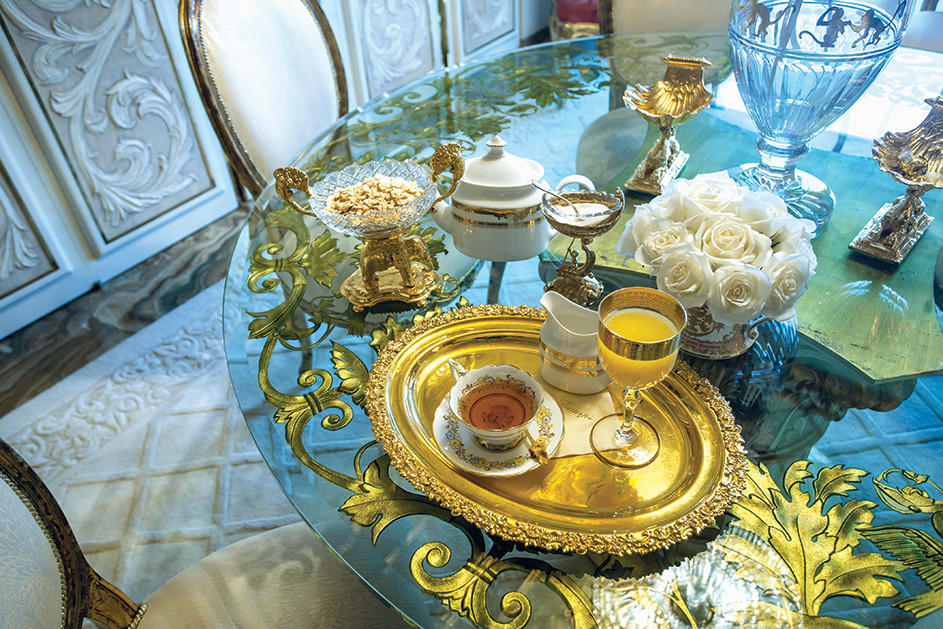
Excessive gold detailing is another feature of dictator style. Here, a gilded glass dining table at Trump’s apartment is set for tea—with glasses and other serving items that are also gilded. And, if you like, look up what color his curtains in the White House have ! Or look at all the GOLDEN memorabilia he sells in his golf clubs.  A golden lunatic !

Republican Senator Mitt Romney of Utah.


Picture: Washingtonpress.

Sen. Mitt Romney of Utah, the former GOP presidential nominee, condemned President Donald Trump after reading the special counsel Robert Mueller’s Russia investigation report on Friday, 19th of April 2019.
„I am sickened at the extent and pervasiveness of dishonesty and misdirection by individuals in the highest office of the land, including the President.
I am also appalled that, among other things, fellow citizens working in a campaign for president welcomed help from Russia, including information that had been illegally obtained; that none of them acted to inform American law enforcement
”.

Now, my dear friends, make up your own mind about this „Trump Menace“ ! Many many Americans deserve better then living under his dictatorship !

Veröffentlicht unter Information | Verschlagwortet mit | 8 Kommentare

Happy Easter

Veröffentlicht unter Uncategorized | Verschlagwortet mit | Hinterlasse einen Kommentar

Wine and Dine

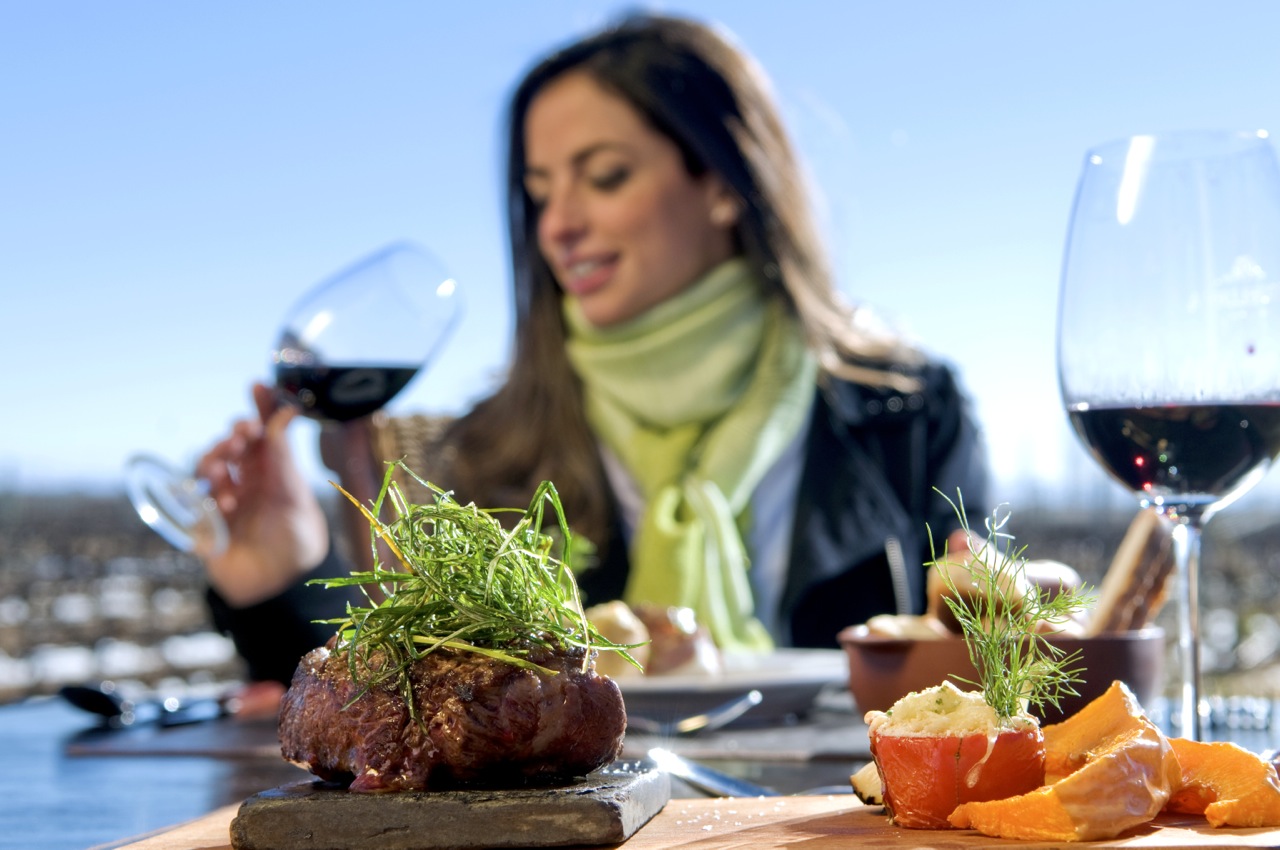
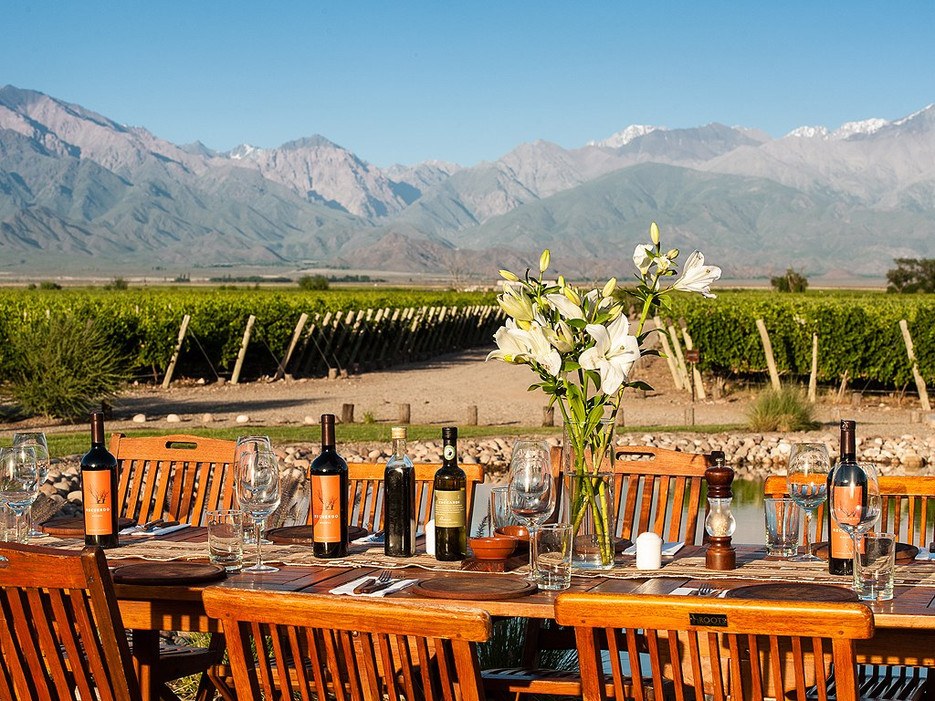
Above: Wine and Dine in Mendoza, Argentine.  In the past 5 years I posted so many recipes and foodie ideas as well as dozens of restaurant tips and where to dine, as you can see. But a good foodie always talks about „Wine and Dine“. That’s why many people asked in the past about the right wine with food. I’ll try to post a few answers.

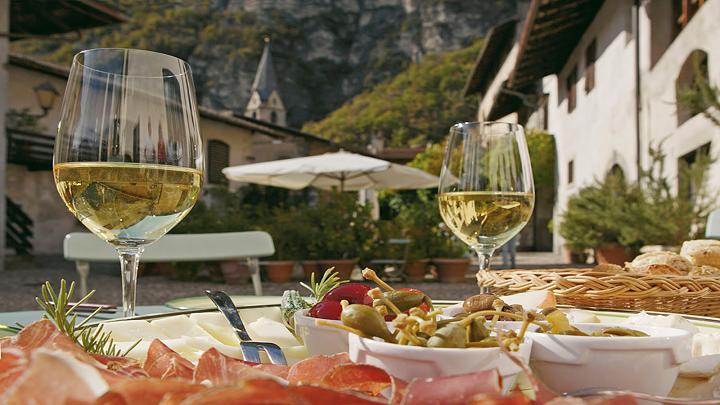
It doesn’t matter what kind of food, what kind of wine, the right pairing with your company, in fantastic surrounding (here wine experience in Suedtirol/South Tirol) will give you the atmosphere for an unforgettable time.

One Question – A Thousand Answers.

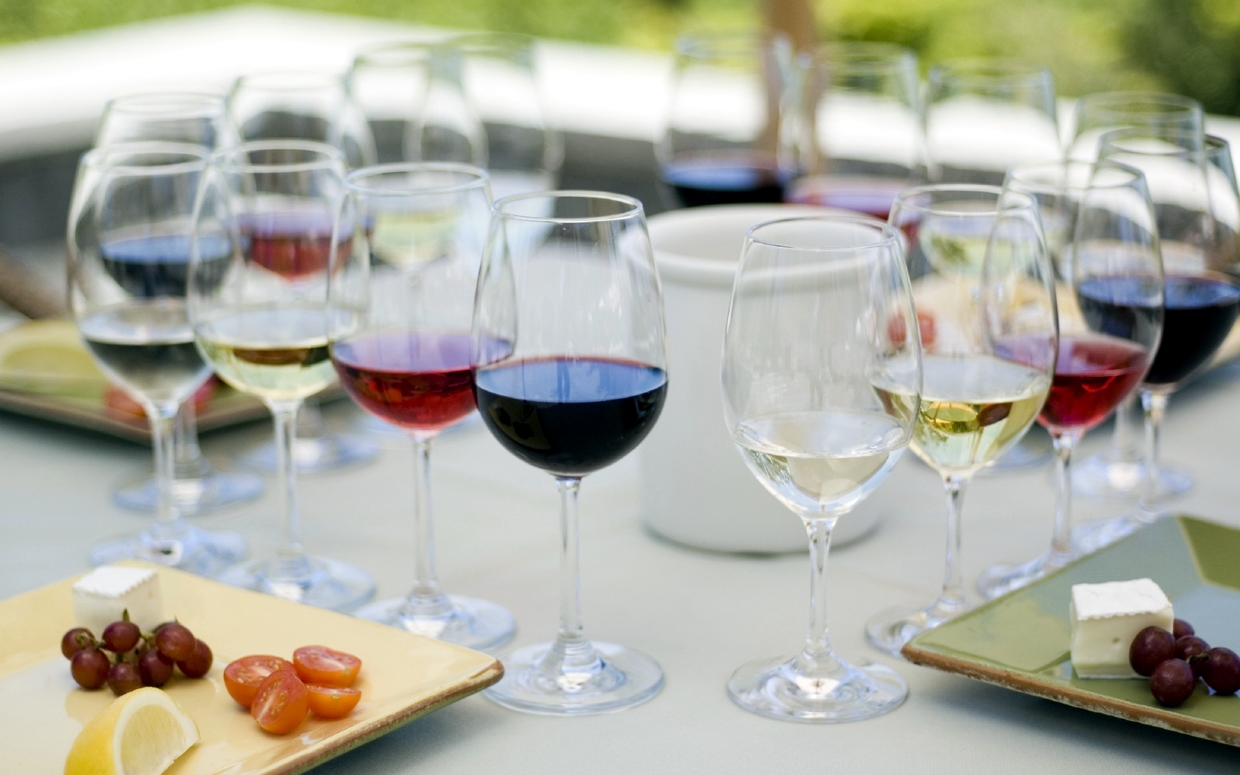
The guests are there, the table is set and the food smells, everything could be perfect. If there was not one open question: „Which wine fits which food?“ The following simple rules can help you to hit the jackpot in terms of taste. And this would be the most honest and shortest answer:  „Wine and Dine – Its all about your personal taste !“

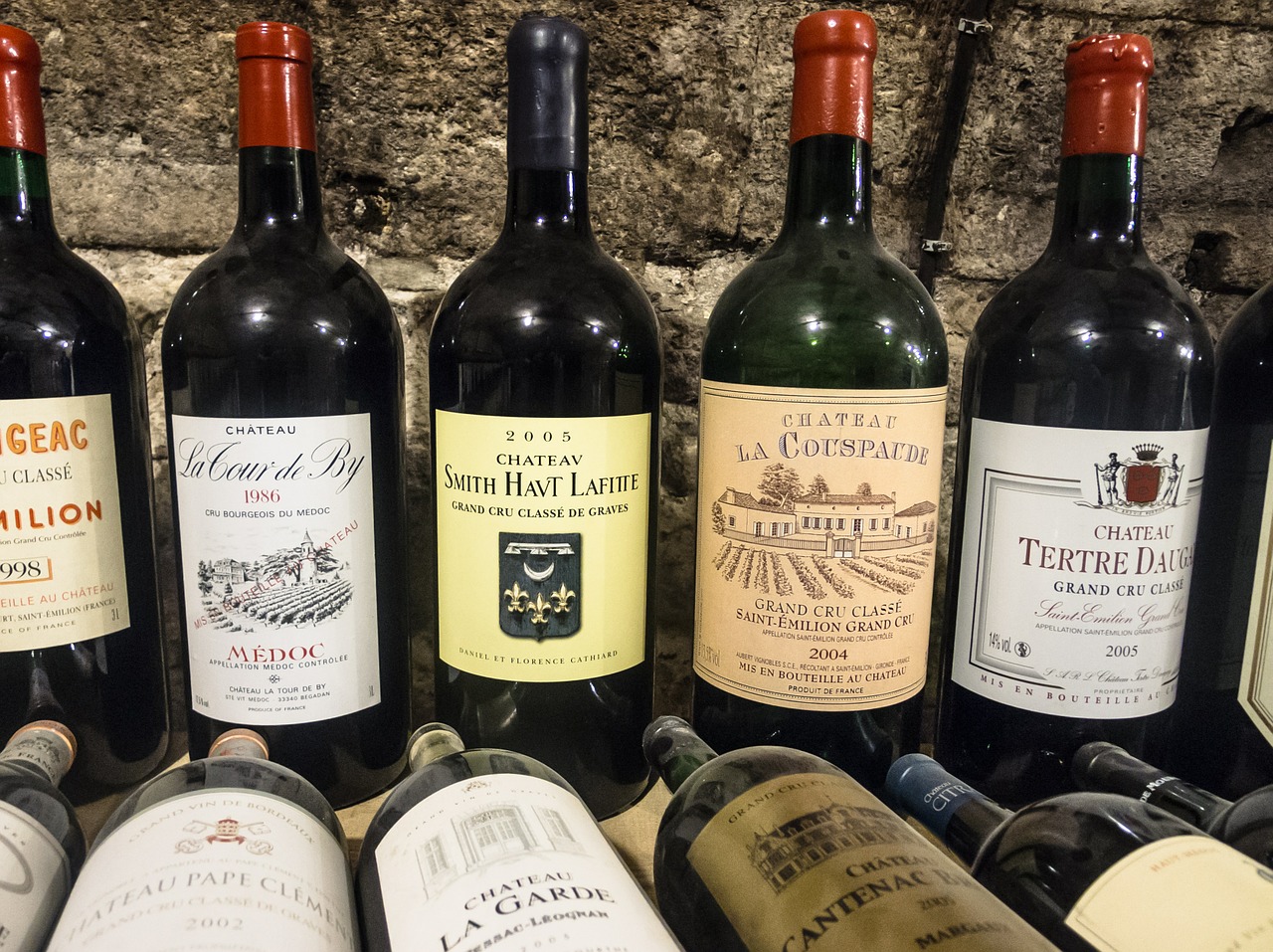
Some fantastic French Grand Cru’s.

Often you can find very detailed recommendations on which wine is best served to which dish, like: „This 2009 Pinot Blanc goes well with duck pie with sweet spiced oranges.“ Apart from the fact that you probably just wanted to serve no duck pie, such a special recommendation actually only be hit if you know the dish and the wine in detail and at best have a several-year sommelier training behind yourself.

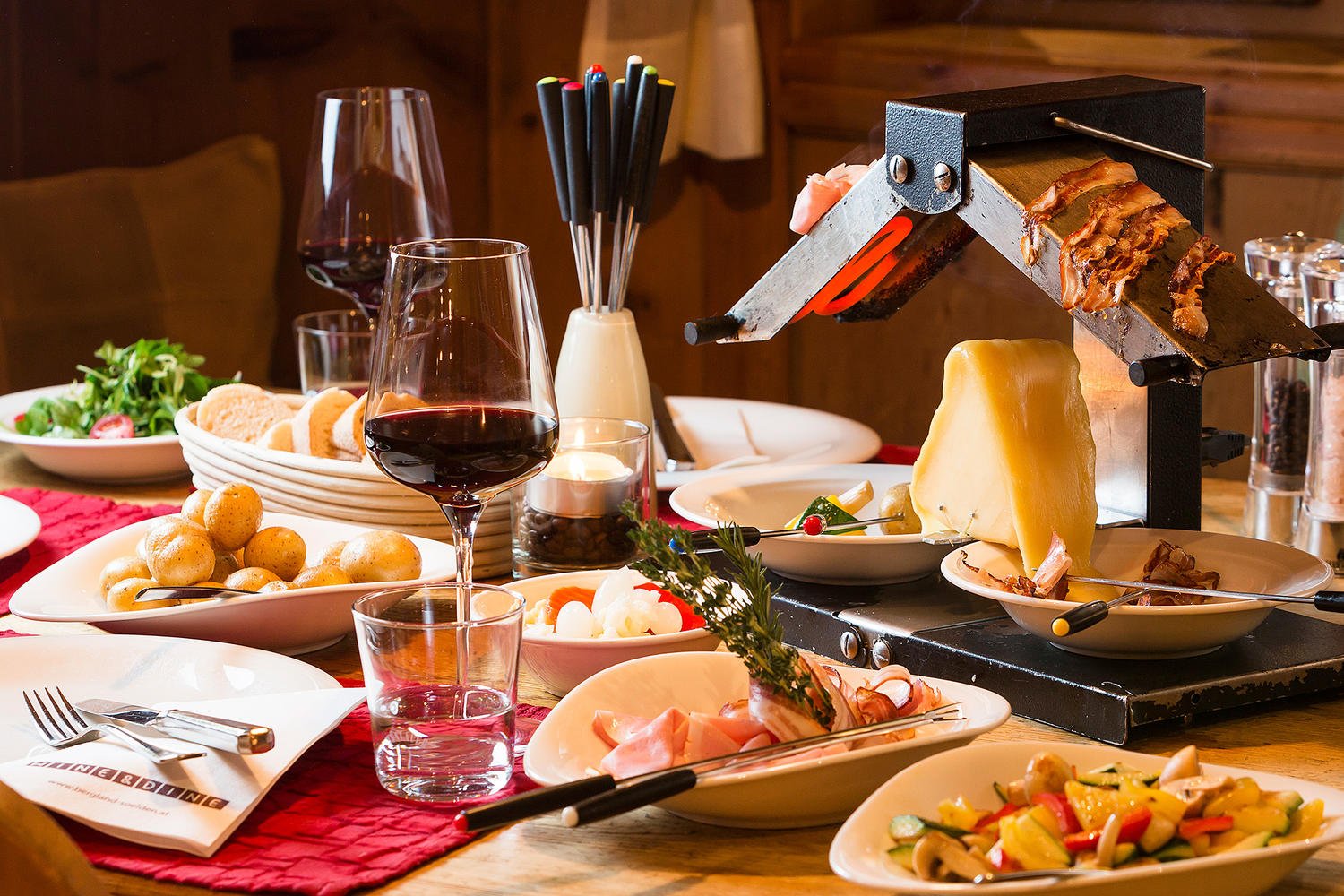
Right Pairing of food and wine – by Bergland-Soelden.

What now? You’re in the store or you want to order your wine online, so you do not have the opportunity to try it out or find out about the right choice for a long time. Uncertainty is spreading. But it’s true that you can not go wrong by following a few basic things. That’s why I want to give you a few rules that aim to create a harmony between food and wine, so you do not end up completely wrong.

12 Answers to Wine and Dine.

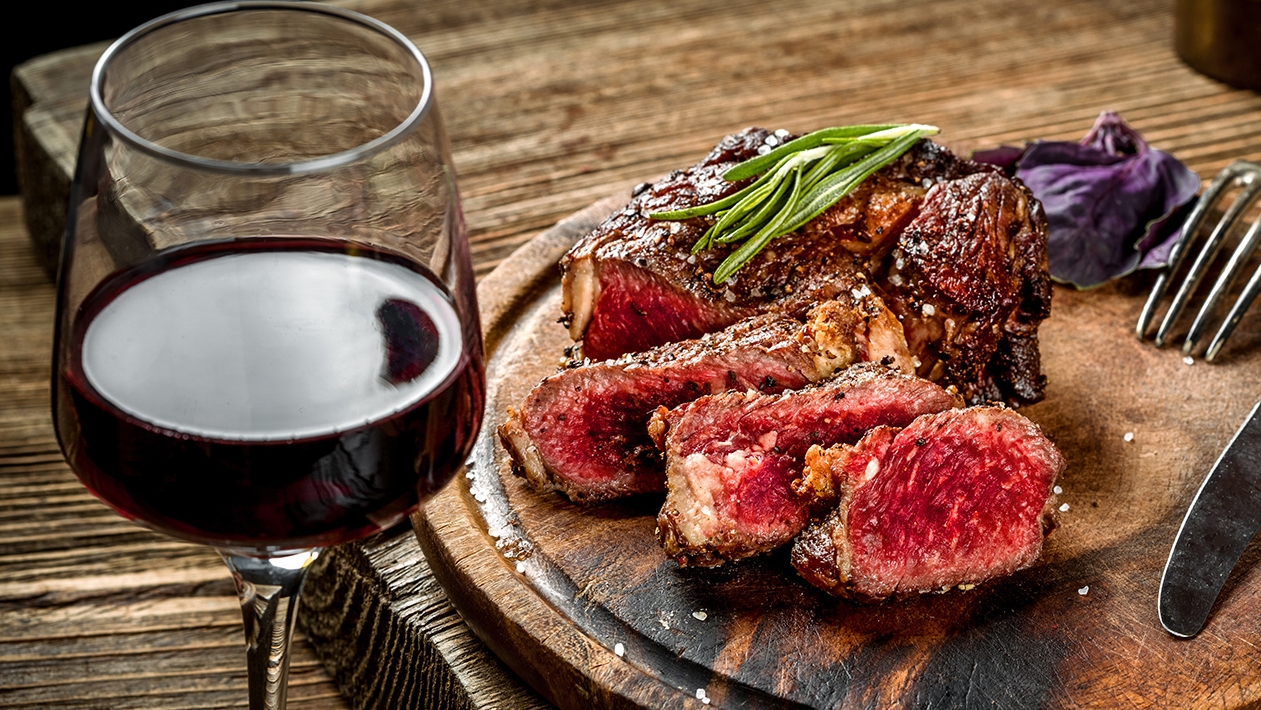
Wine and Meat – by butcherbox.

1 – Wine and Meat.

Almost everything is allowed here. To red meat and roast rather red wine, to light meat like poultry rather white wine. The spicier the meat, the spicier and stronger the wine should be.

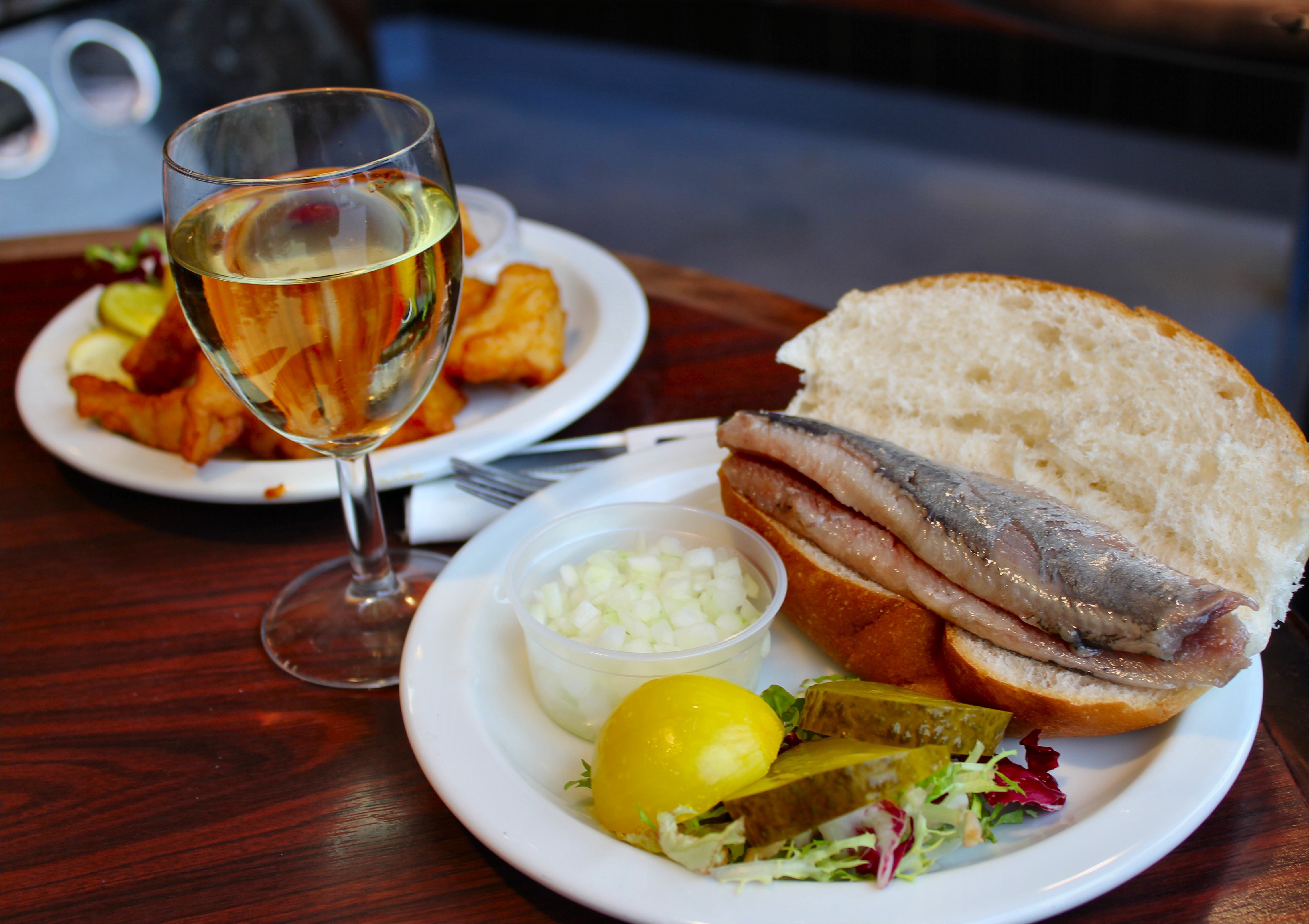
Wine and Fish – by breadshead.

2 – Wine and Fish.

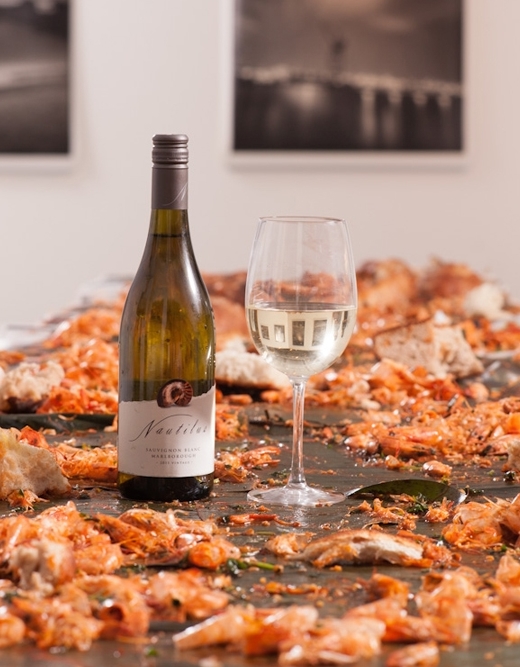
A Pinot Blanc or a light Riesling with a citrus aroma harmonizes with this.

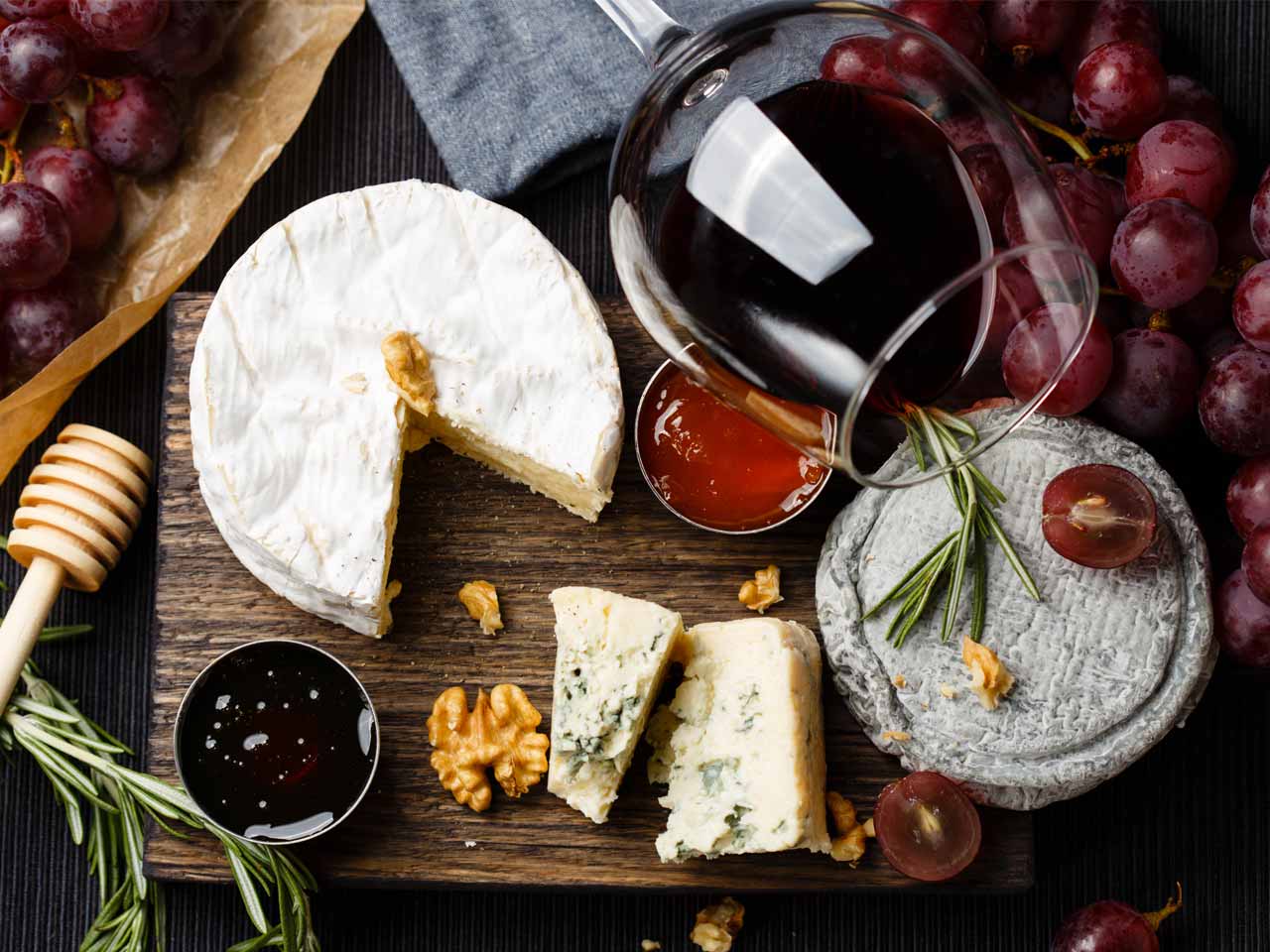
Wine and Cheese – by sagauk.

3 – Wine and Cheese.

A mild cheese needs a light wine. On the other hand, a strong cheese is best served with a strong wine. Light white wines are e.g. a fruity cabinet or a fine late harvest. In contrast, Beerenauslese and Eiswein are strong. For red wines, the same applies first.

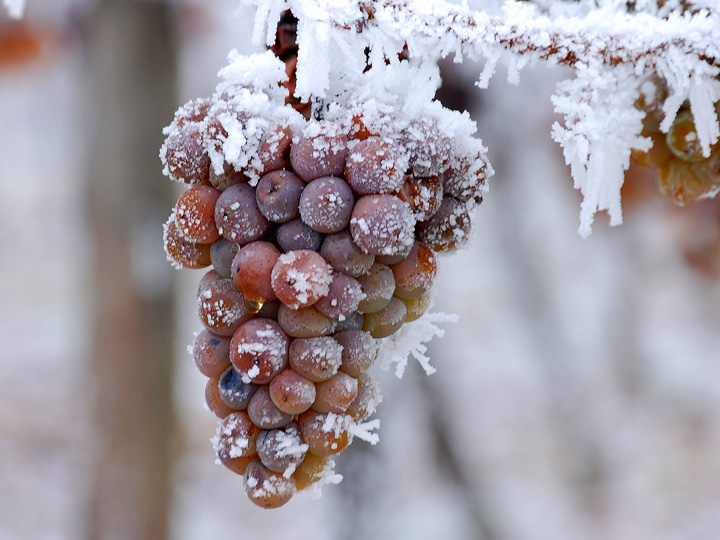
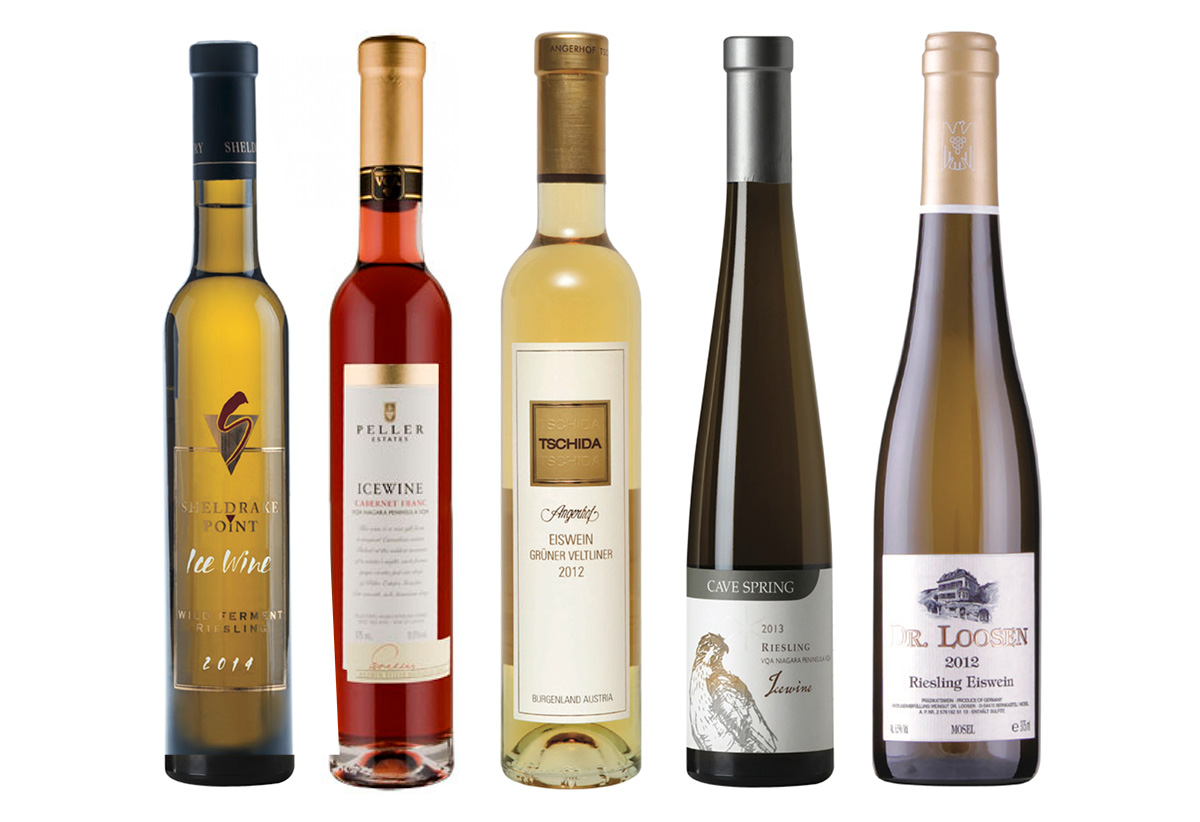
German Ice-wines, an expensive rarity to your tongue. Latest harvest with at least minus 6 degree Celsius. Ice-wines are produced all over the world now. If interested read along with Wikipedia.

For a hearty cheese is therefore recommended a strong, full-bodied Shiraz. Note: The red wine to the cheese should be low in acidity, like a Pinot Noir or a Malbec. And – too dry white wines overlay the cheese taste, sweet wines reinforce the hearty-salty note. Sweet wine and cheese is always possible.

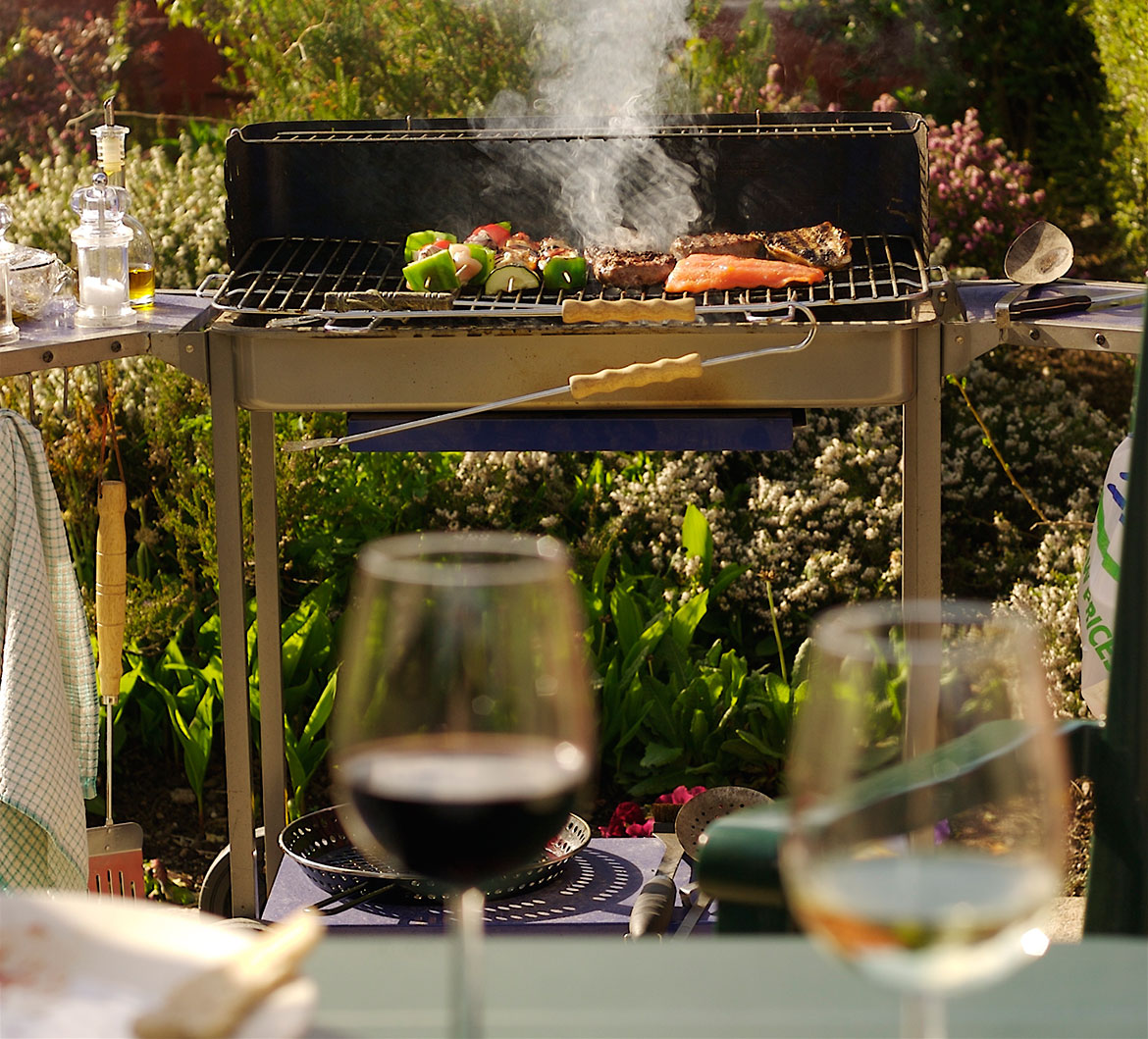
Wine and BBQ – by yorkmix.

4 – Wine and Barbecues.

The right wine for grilling needs structure to withstand the strong roasted aromas of often heavily marinated meat, such as a strong, dry Chardonnay from the Barrique or even a slightly chilled Shiraz or Tannat here in Uruguay. For mild grilled vegetables, however, recommends a fruity summer wine, by example a medium sweet Rose.

Wine and Wok – by adcglobal.

Rule 5 – Wine and Wok.

Here is the case: The sharpness of chilli and ginger can be mitigated by a fruity Riesling. For less spicy Asian dishes choose a light white wine with exotic nuances such as mango, passion fruit or melon, by example a dry Sauvignon Blanc.

Pear poached in spices and red wine – by bangers&mash.

6 – Wine and Spices.

More often than not, it’s the herbs and spices in a dish that makes a wine pairing taste so good. Pairing with herbs and spices is easy to do when you know how to pick out individual flavors in wine. For example, one of the dominant aromas in Barbera (a medium-bodied red wine) is anise. And, when you pair Barbera with a star anise and soy-glazed chicken you find it to be surprisingly delicious!

                                
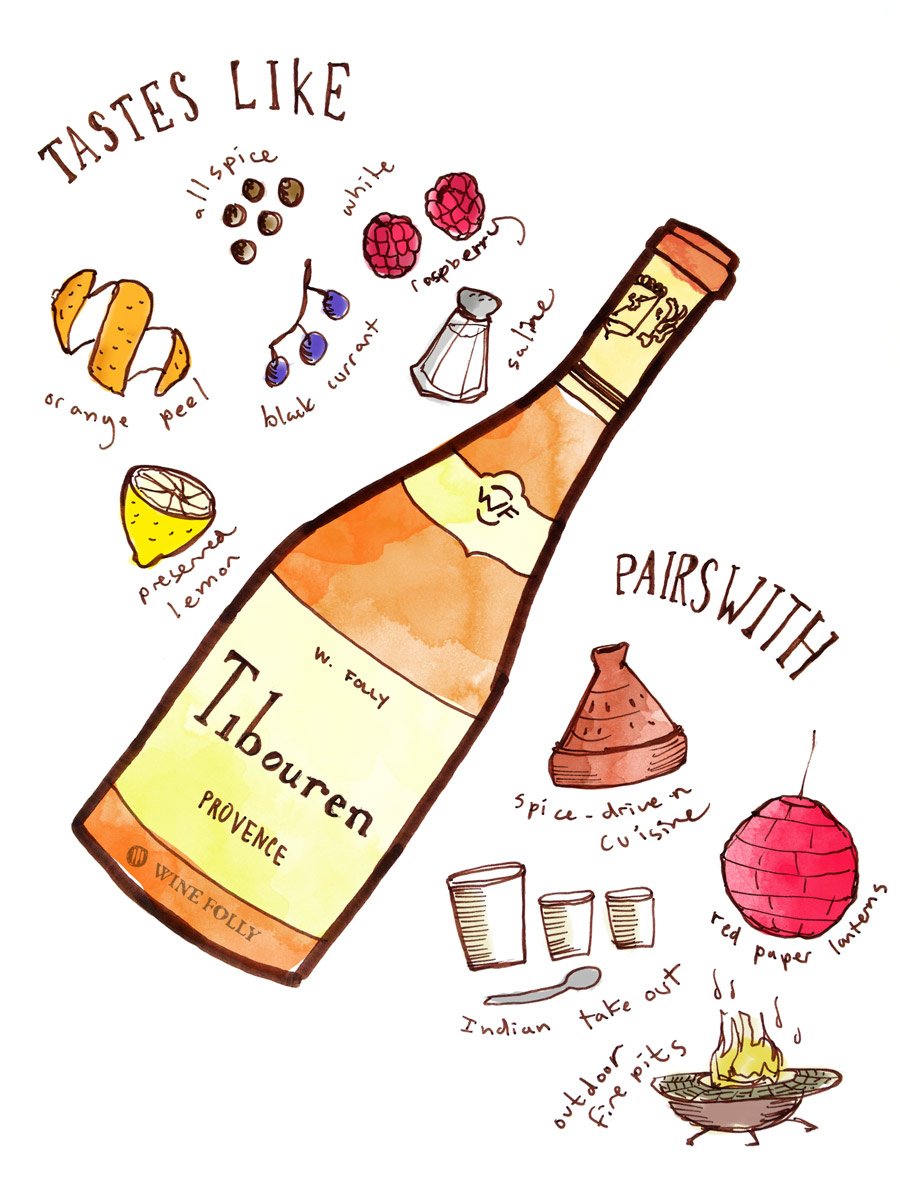
One of the best charts of „Spice and Wine Pairing“ I found on UK site „Wine Folly“.
Click on picture to supersize and then click on pic again to size up fully.

The magic behind pairing wines with herbs and spices starts with aroma compounds found in both spices and wine. Not surprisingly, many herbs and spices share the same aroma compounds as wine. A real-world example is matching a black pepper dish with Shiraz or Syrah – both wine and spice contain the spicy-but-floral compound called Rotundone. When you match like flavors together they magnify each other. This type of pairing is called a congruent pairing and it’s the theory behind matching wine with spices and herbs. Could be a separate „wine science“ for you.

Wine for Cooking – by sodelicious.

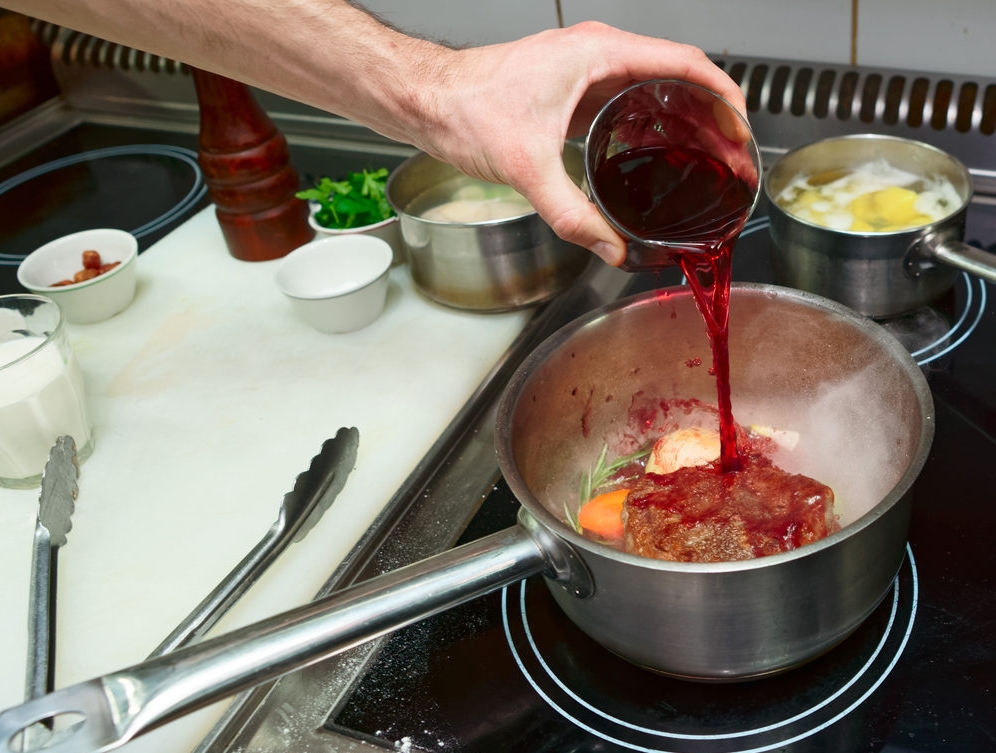
7 – Wine for Cooking.

What is better for a wine than it is better? The quality that comes later on the table should also be used for cooking – that’s saying of many star chefs. But does it make sense to evaporate the 300,– Dollar/Euro Bordeaux in the pot? Everyone should decide that for themselves, right? At least, if you plan to drink a Shiraz, use a Shiraz for cooking.

Wine and Sour (dressing) – by hamptons.

8 – Wine and Sour.

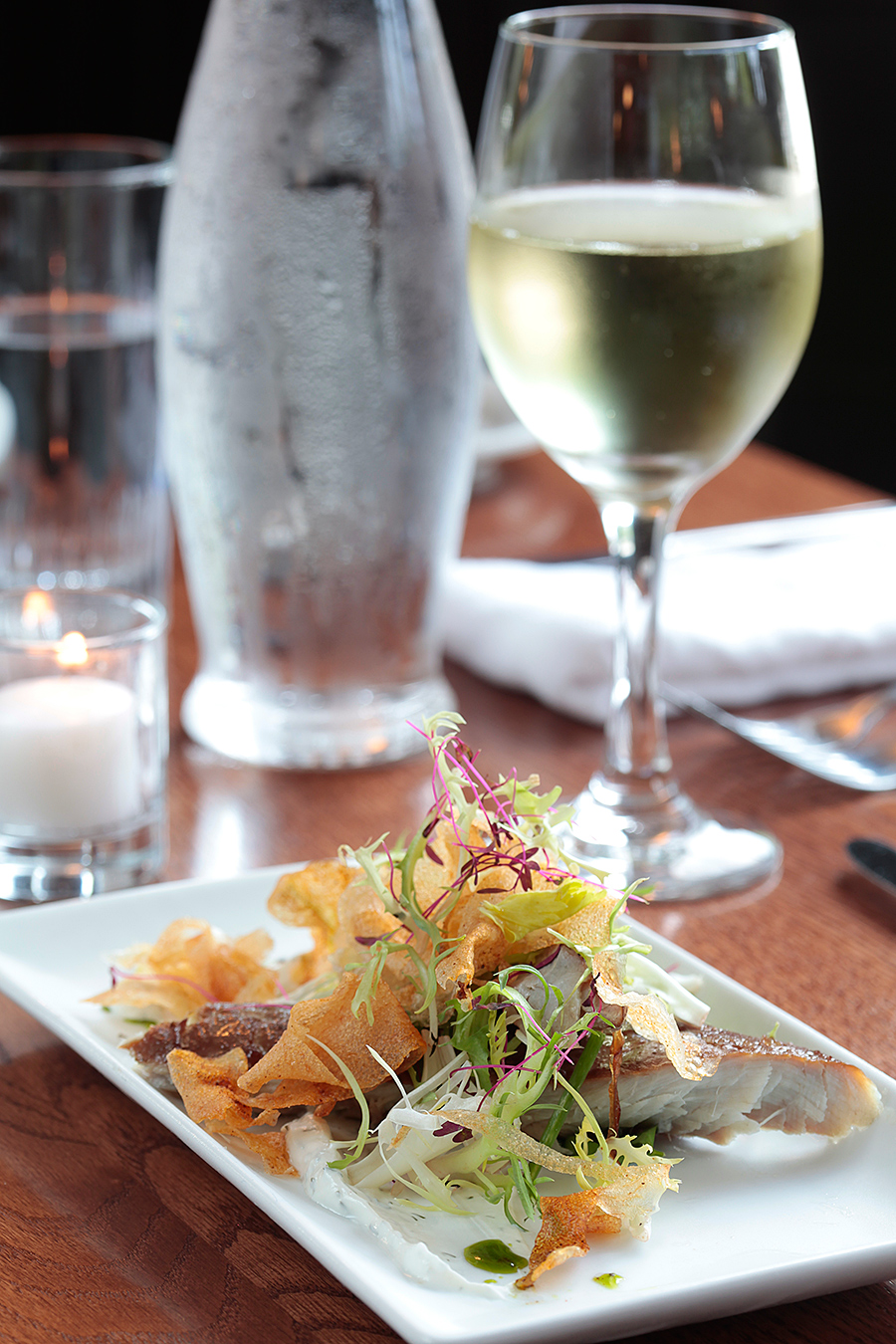
There are three simple principles of acidity and sweetness: the acidity of the dish and wine is multiplied, the sweetness between the food and the wine is pleasantly balanced and the acidity combined with the sweetness harmonize very well. A salad with an acidic dressing therefore needs a wine with less acid, e.g. a fruity Silvaner or Pinot Gris. A sweet dessert, on the other hand, is served with a sweet berry selection or an ice wine, with the dessert being sweeter than the wine.

Wine and Sweets – by worldtruth.

9 – Wine and Sweets.

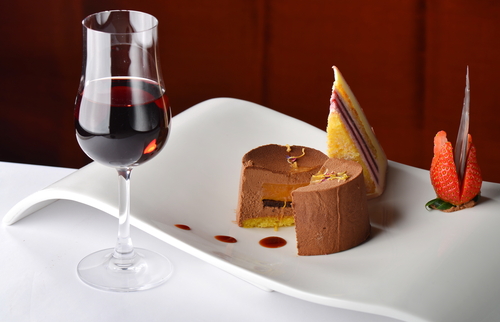
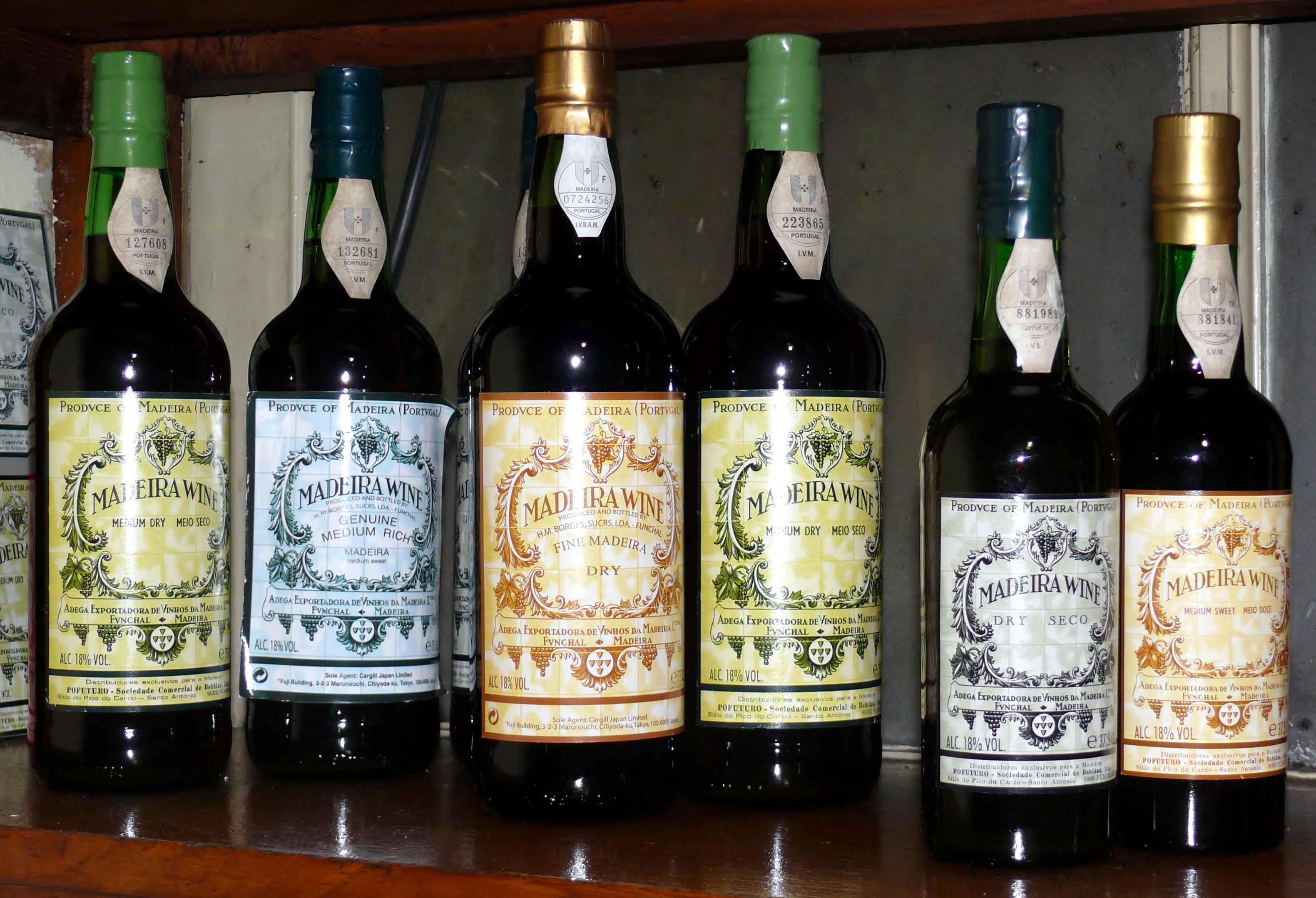
Dark chocolate (bitter chocolate) is hard to combine with sweet wine. Better is a Port or a Sherry Oloroso, which has more alcohol and so better copes with the „strong“ chocolate. With Port you do not go wrong with chocolate. Even a strong red wine with low acidity (like a Madeira) can absorb it with a dark chocolate.

Fine selection of Madeira’s. Click on pic to size up.

Because of the high cocoa content but better not to use very dry, harsh wines, as the bitterness is otherwise reinforced. Sweet and delicately melting milk chocolate, on the other hand, blends well with sweet white wines, like a Muscadet or a Gewürztraminer.

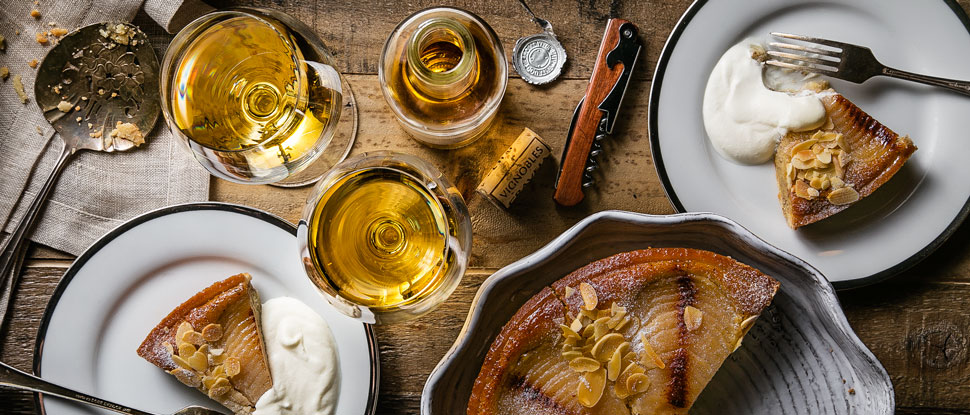
Sweet and sweet, Cake and a Sauterne – by tastetable.

Similar rules be meant for sweet dessert’s or cakes. Otherwise, once I tried a sweet creamy Strawberry cake with a dry Riesling. Wasn’t so bad. Not recommended, but you can see, your personal taste is always a good answer.

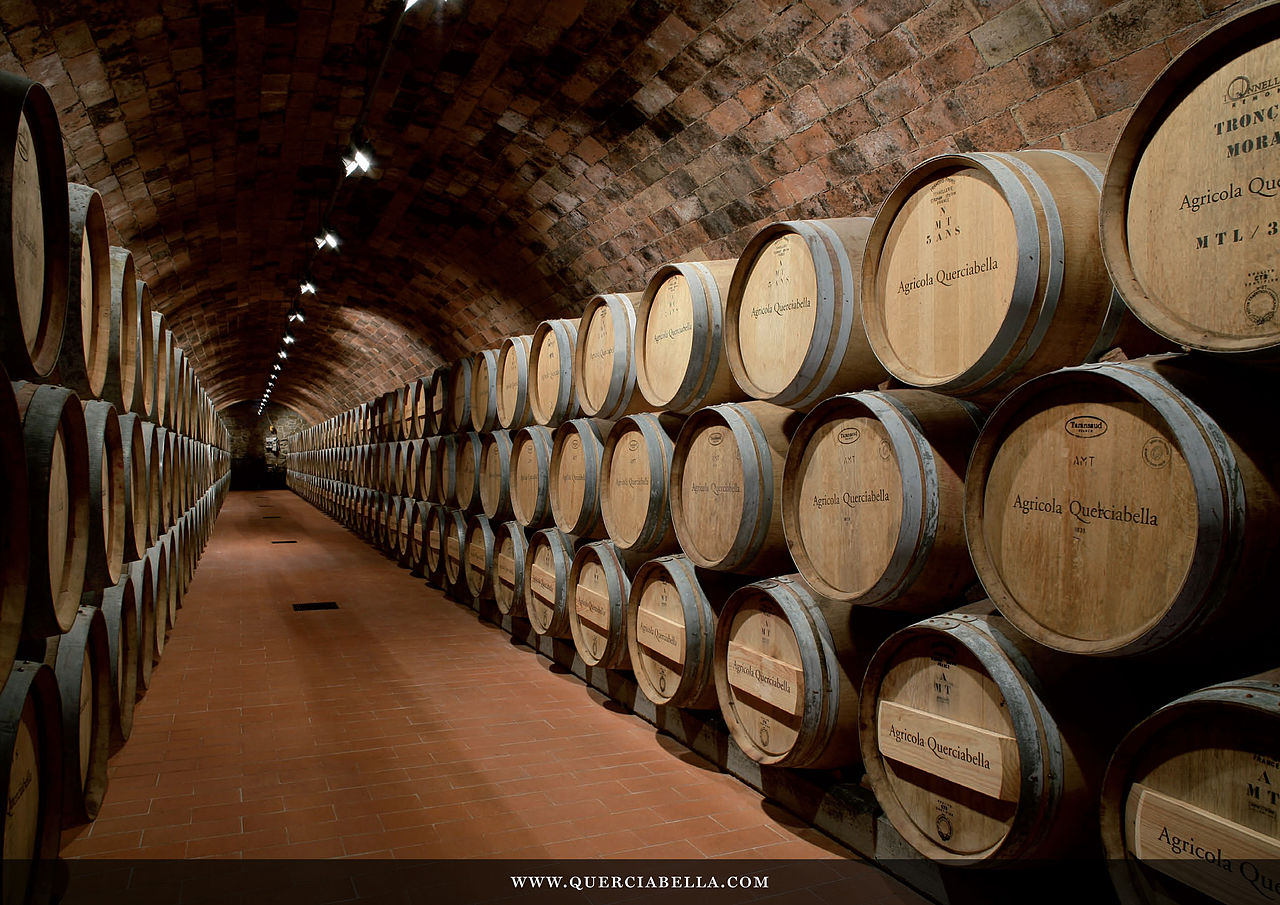
Barrique storage – by Querciabella.

10 -Tannin-rich Wines.

These are by example Cabernet Sauvignon’s (often called left bank Bordeaux’s, the birthplace of the Cabernet Sauvignon) and those that – white as red – matured and stored in the Barrique. Best not to combine with very sour, bitter or spicy dishes, as the tannin’s can taste even more bitter and astringent.

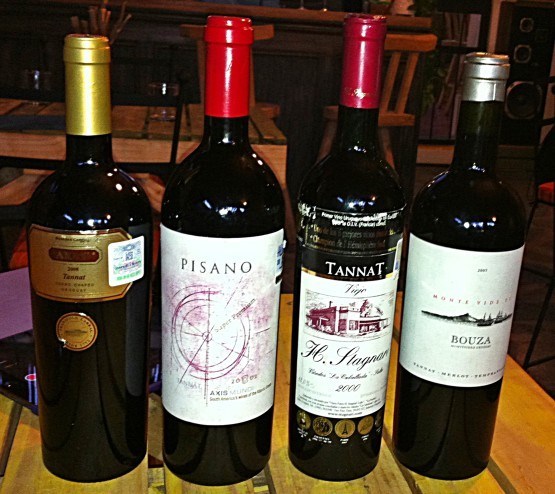
Tannat’s from South America – by donday.

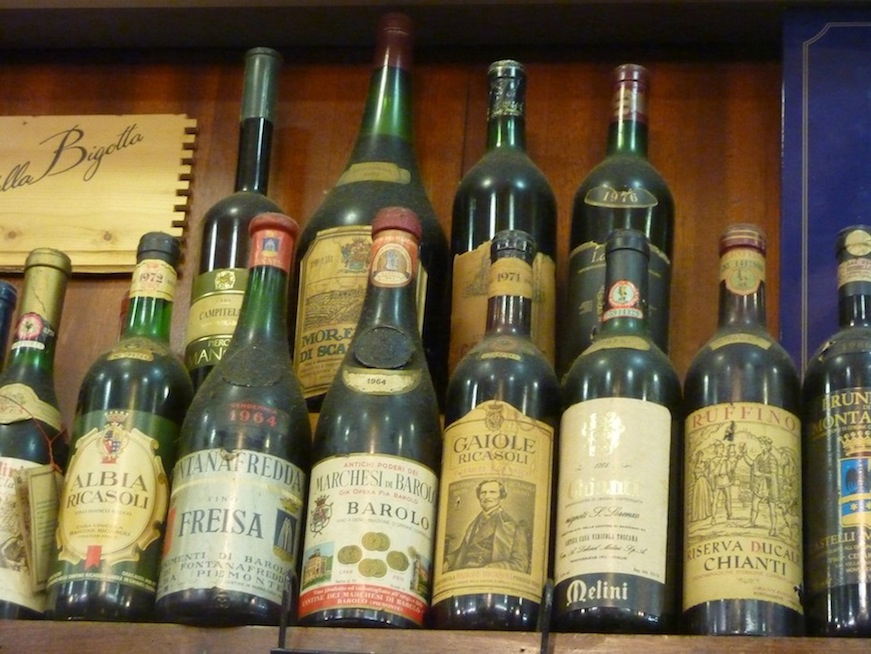
Heavy, tannin-rich reds (like a Tannat – name says it all), on the other hand, go well with rich and high-fat dishes, making the tannin’s appear softer overall. Heavy Tannin wines are also Tempranillo (found in Rioja’s), Nebbiolo (found in Barolo’s) or Sangiovese (found in Chianti’s and Brunello’s).

Great old Italian wines – by italianallure.

11 – Storage, Temperature, Serving.

During the years many old rules have changed, because the wine making has changed, the wine philosophy has changed and the whole handling of wine changed. Meantime we have screw-tops instead of natural cork and we have much shorter maturing times and a total different consumption behavior. Nothing against screw tops, they have conquered their legitimacy in our today’s wine market.

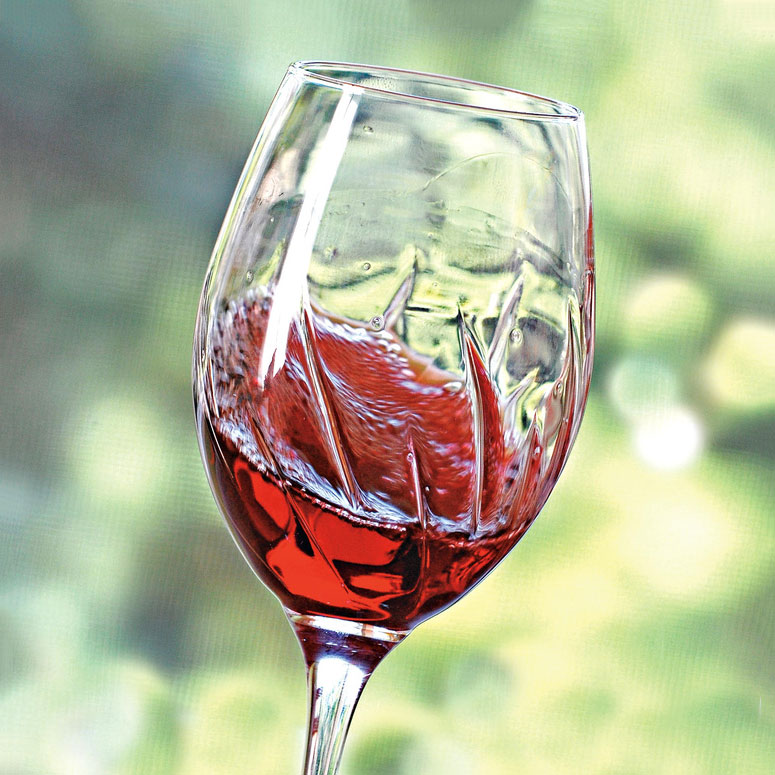
If it was milk one can earn butter with swirling.

But why not talking a bit about „good old Style“?
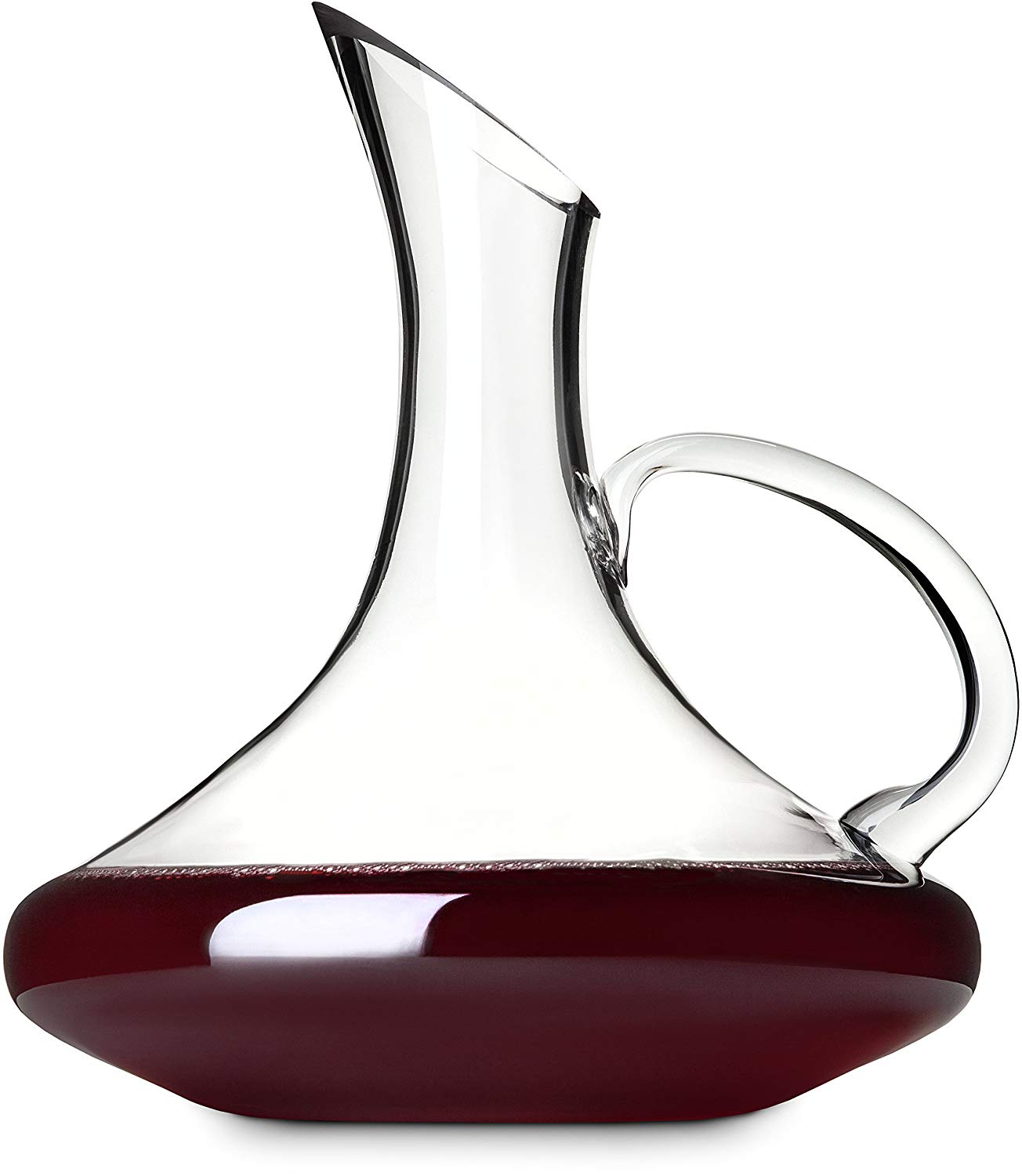
Good old times are gone and the celebration around a good glass of wine is no longer wanted. There are still a few rules I like to follow. So as: If I have an expensive, old and great grape and year in my bottle, I like to decant it and give the wine time to breathe. Then to pick the right glass and carefully pore it in. Take a nose full of flavor and have a mouth full of taste. Just enjoying the result of craftsmanship and  natural produce.

Nice decanter, storing the wine at the widest surface.

I really hate the modern style, if in restaurants the waiter plops the „nice and often expensive“ wine into the glass and then asks „how is it?“. I always answer „very foamy“ !! The new world is full of ignorance, full of „faith that ignorance is style or fashion“, full of disrespect and full of the lack of decency, decorum, grace, modesty and manners.

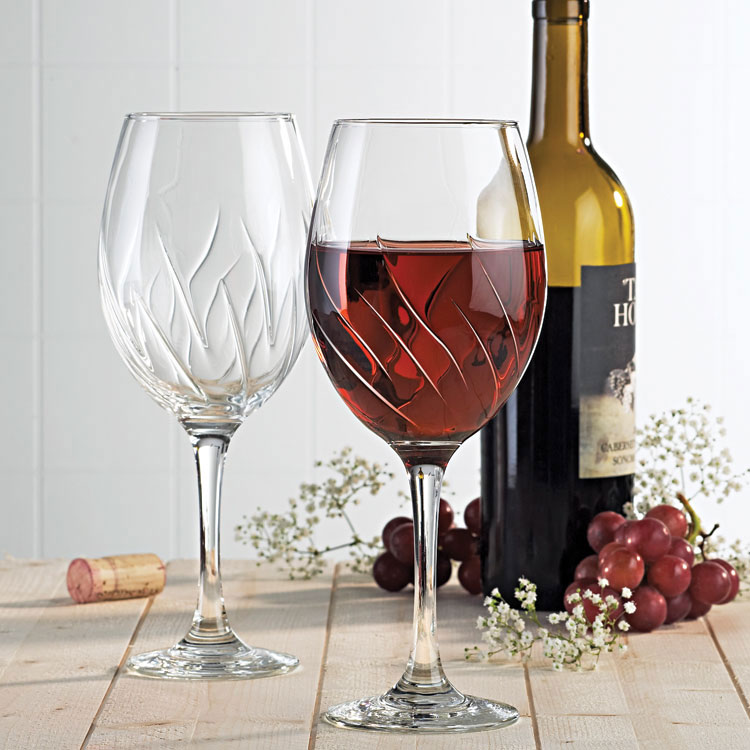
Very nice glasses, but filled to much. Wine should be filled to the widest diameter in the glass, that will give the wine the largest surface to breathe.

Next step often is that people sit, without concentration on the wine, talking a lot of bullshit and swirling minutes the glass content around as if they want to win a price in balance. Yeah, very foamy – right ! Its sometimes already a passion to keep the hands busy.

Yes, very foamy. If I see people doing this, I always hope that the sensitive rim of the glass breaks and they can through it away. Spitefulness, I know.

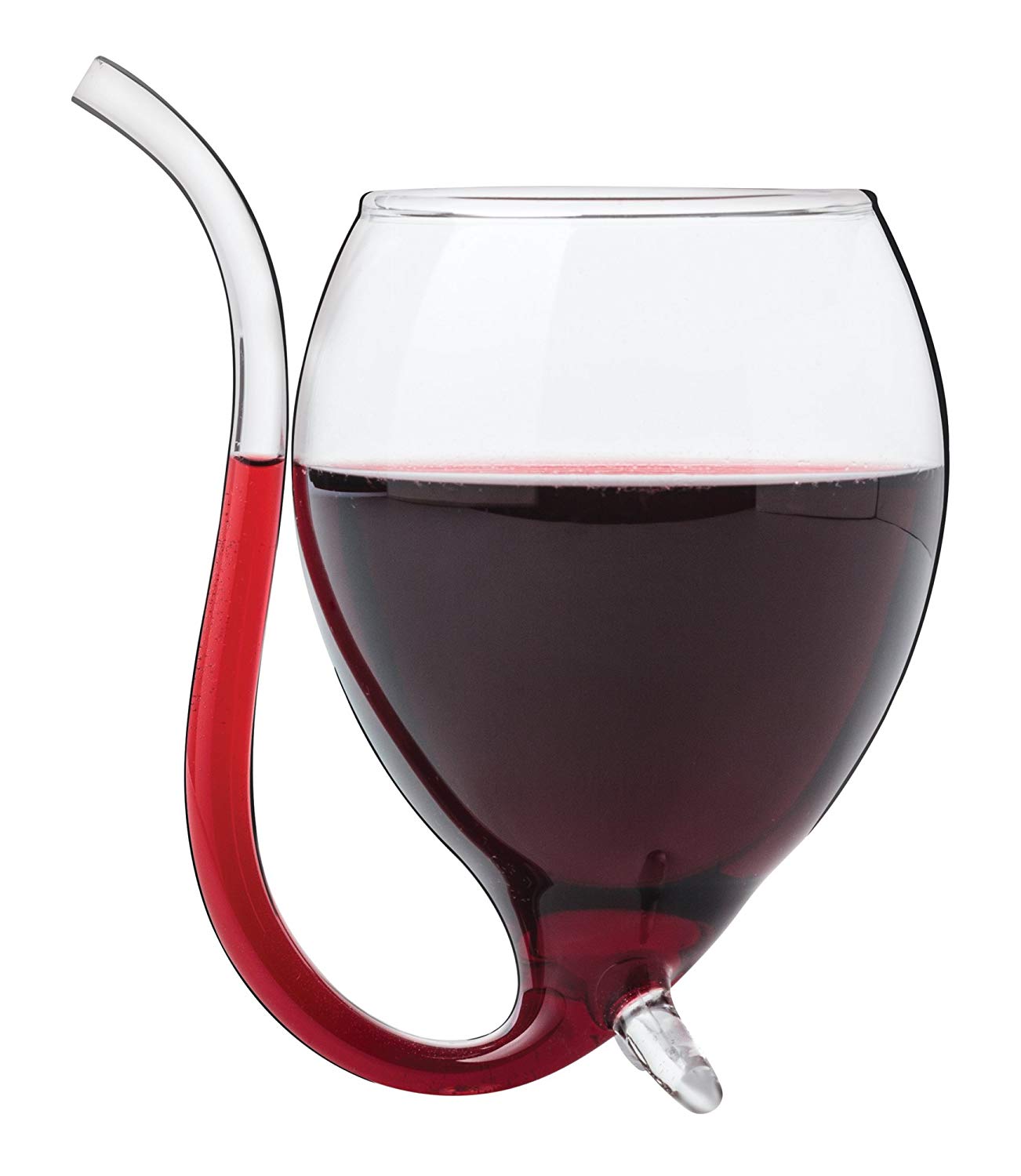
I know the excuse why people like swirling wine around in a glass before drinking – it helps to add flavor and aroma enhancing oxygen, which makes these cool new „Aerating Wine  Handling“ sort of an ingenious idea. Forget decanting, just pour it in and swirl it around.  If one likes to behave without style, why not use the newly invented „straw glasses“, there you can blow air into the wine and also sip it through a „glass straw“.

Ugggg – SORRY guys – not my style !!

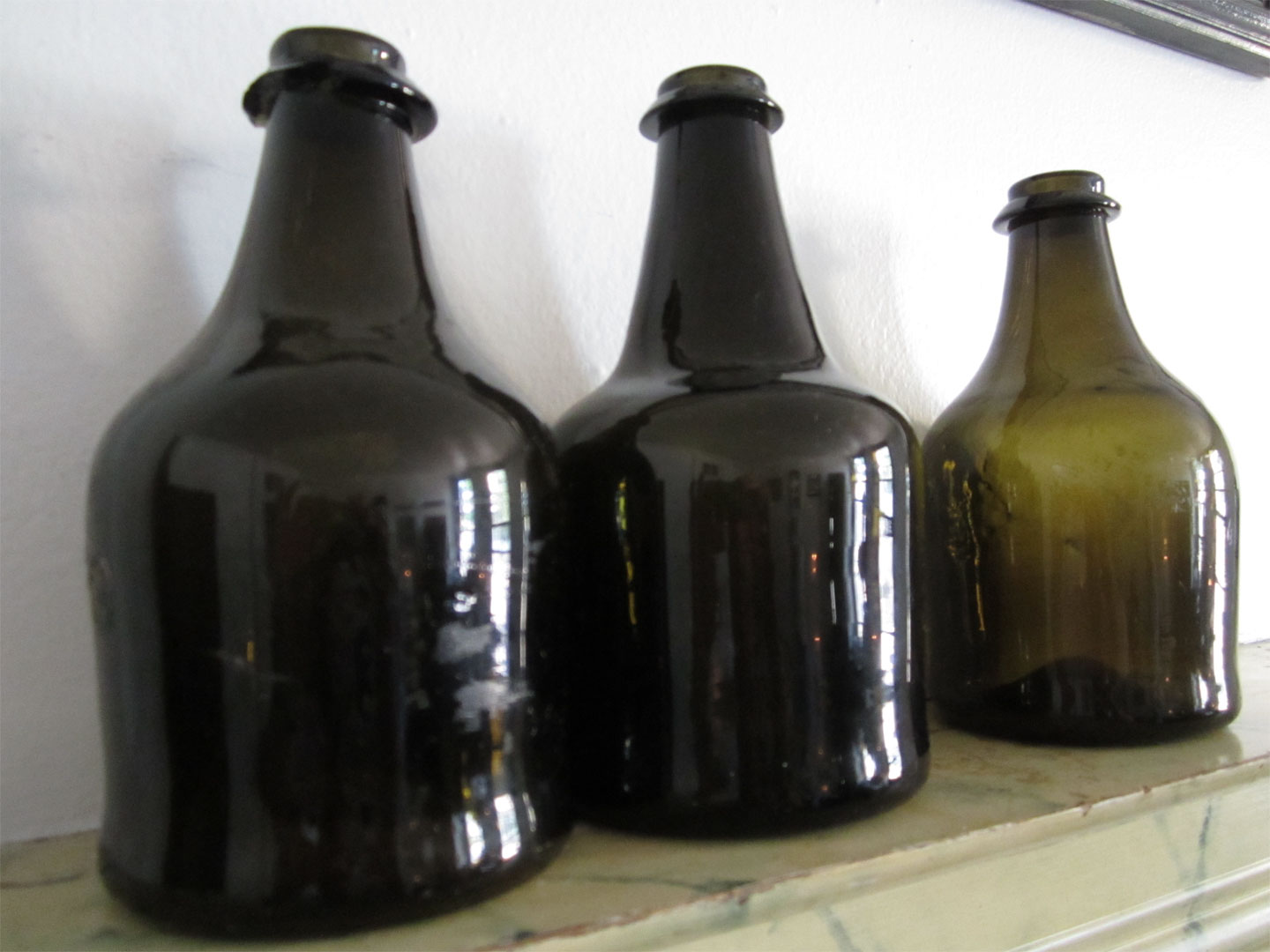
O.k. folks, enough ! If you have a good bottle of wine and you want to store it right, then follow two easy rules. Try to lay the bottle down, that a cork (I am talking about the better qualities) still is wet from inside. The natural seal (the cork) still gives the wine a chance to breathe. And secondly try to store your bottles in a dark place. Light is more dangerous to good wines then anything else. Have you ever asked yourself why they make, more expensive, colored (green) glass bottles instead of easy white ?

Our forefathers knew why to use colored wine bottles.

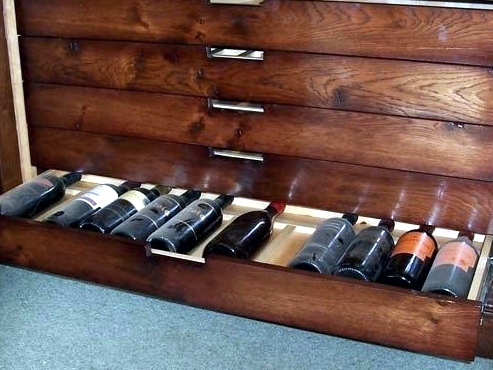
Regarding temperature its not so important if you store in a cool or more warmer place. When I was younger and had no money, best place for my wine bottles where under my bed !! Mostly the coolest and darkest place in my apartment and no bottle moving.

Even your drawer can be a better place to store wine bottles then open in your kitchen or living room.

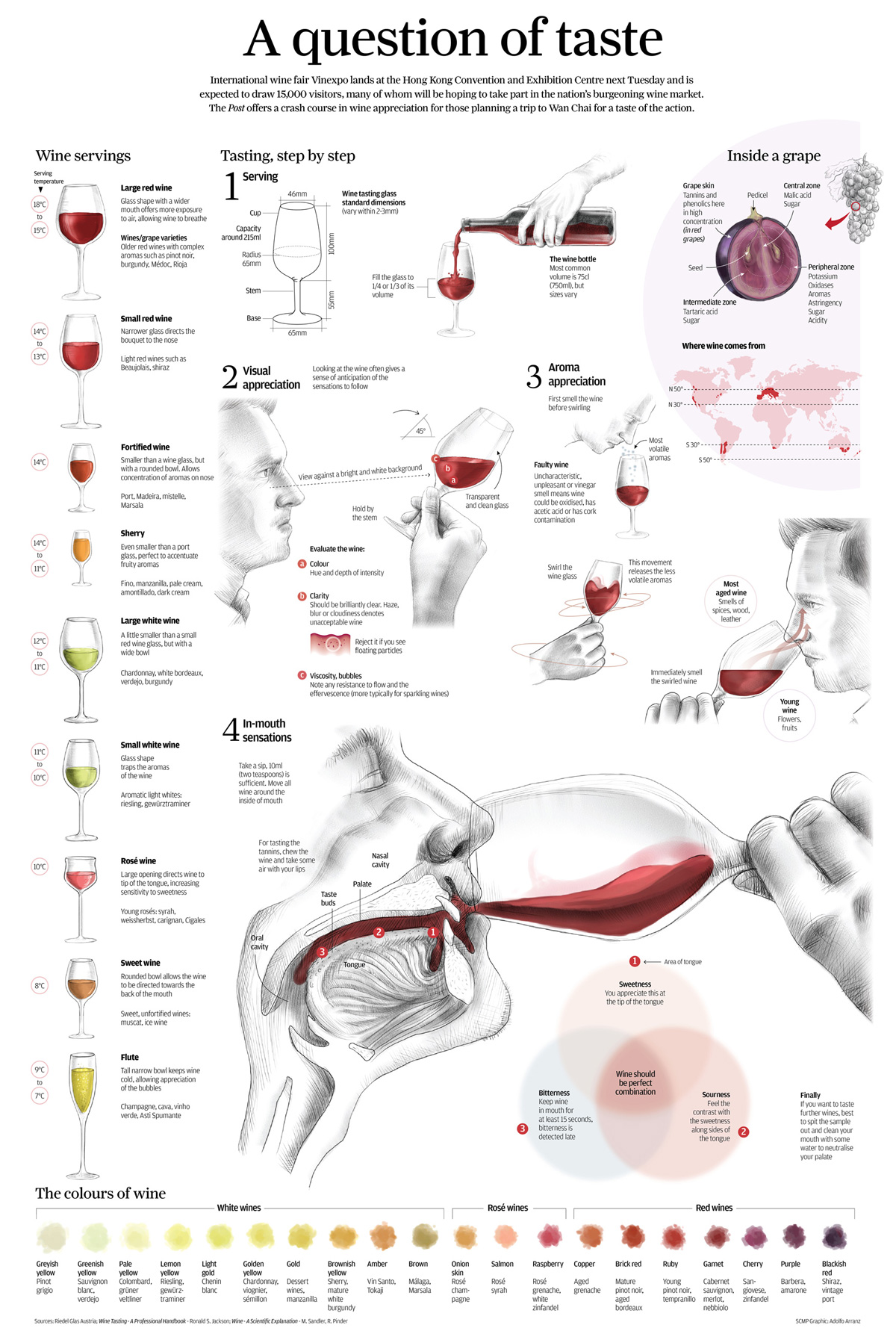
And finally a bit about serving temperature. An old rule said „serve red wine at room temperature“. O.k., right that was at the time (around the 1800’s) when rooms had a temperature around 18 degree Celsius. Today almost all is possible. Good restaurants have a wine fridge and you will get the red wine around 15-18 Celsius and your white wine around 8-12 Celsius. Americans like to put ice cubes into their wines – no manners, no style, etc. etc. – just full of ignorance. Excuse is, what you don’t learn, you can’t know !

No Rule Wine-tasting – by communtable.

12 – No Rule.

Those who have already developed their own preferences can throw these rules overboard. Most important is the individual enjoyment. There is no magic recipe – the trend is towards experimentation. If you have guests, you should not just rely on your own taste buds. Go and offer a wine they like. Why not having 2 or 3 different ones on the table ?

Wine and Dine in Uco Valley Mendoza, Argentina.

Don’t be shy to open a bottle of wine for individual tastes. Like a strong red one for yourself and may be a light Rose for your wife. It doesn’t matter if you won’t consume the whole bottle at once. Any normal modern wine can be kept open at least for a week or two. If you have a bit left only, open a new bottle and mix new with old wine. You won’t taste a difference and temperature will compensate.

Tips.

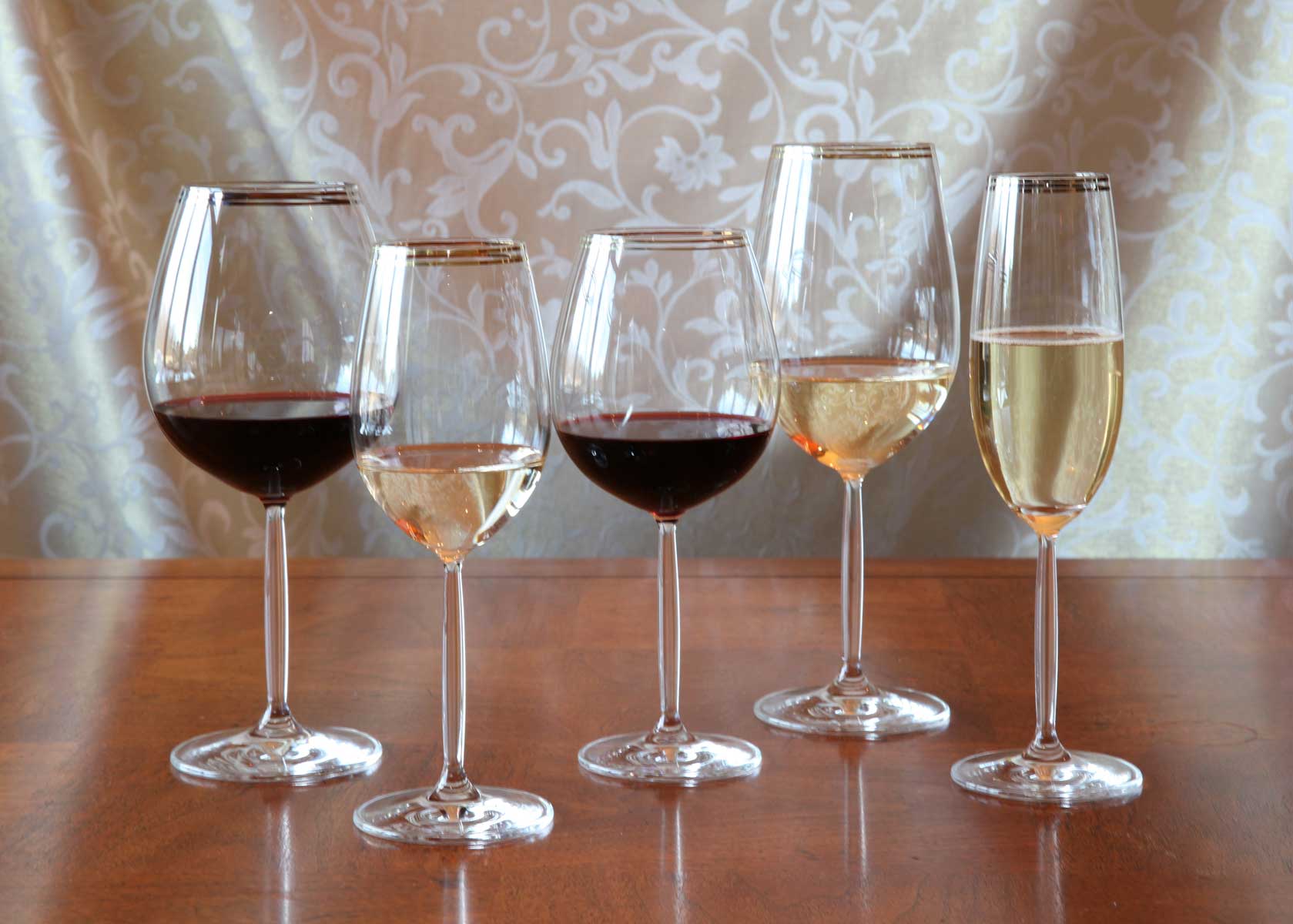
The discussion about wine glasses can fill another whole article. Here I like to say only, don’t use colored glasses. Have 2 whites and 2 reds (smaller ones for light wines) plus one for sparkling wine, that would be enough. I mostly use 1+1+1 only but as big as possible. Please note to use glasses where you can have 1/3 of the content-room for wine and about 2/3 content-room for the development of the aroma.

Above a short Wine Taste Lesson.   Hope you enjoyed it !    Stay tuned !

Veröffentlicht unter Information, Lifestyle | Verschlagwortet mit | 7 Kommentare

My Soul is in A Hurry

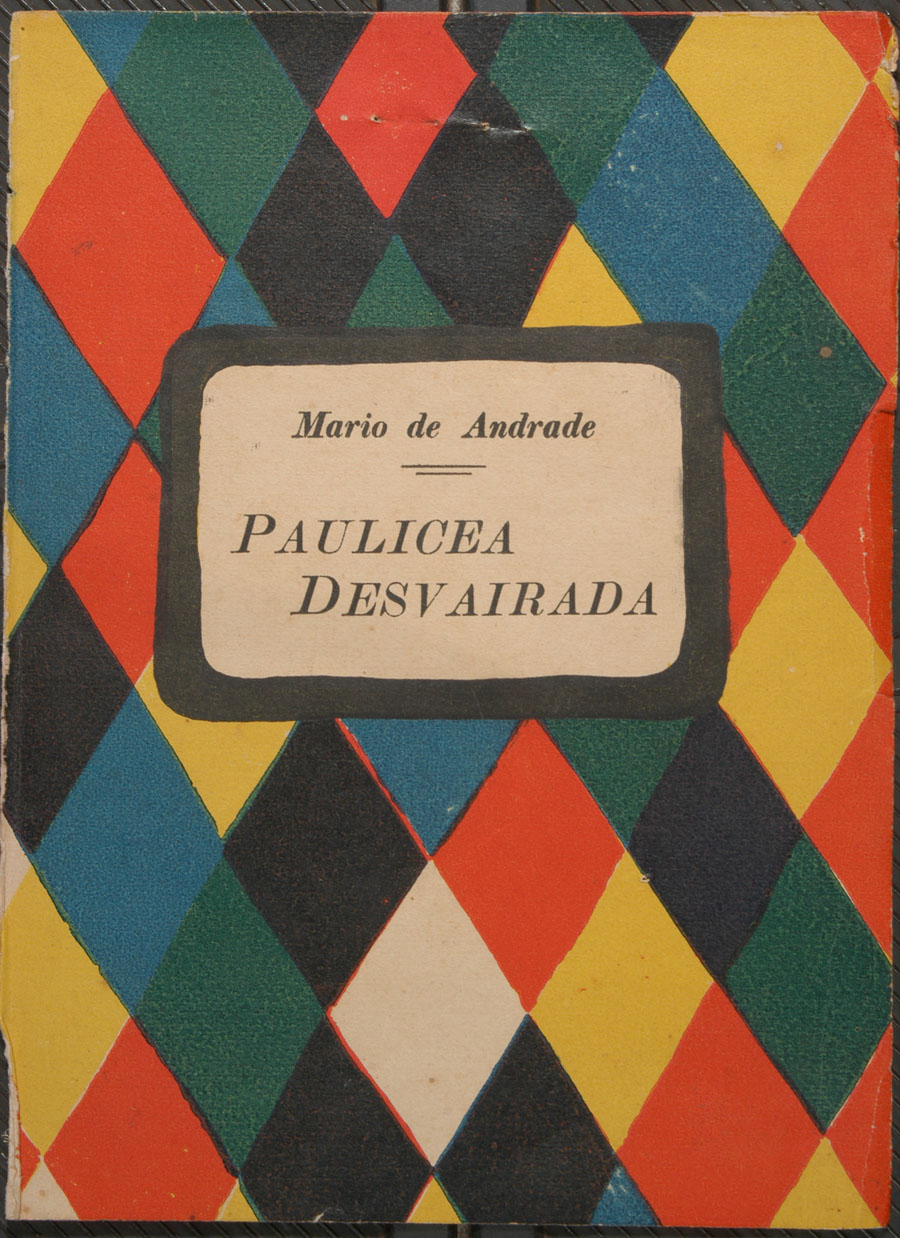
Yesterday my dear friend Bernd sent a poem of Mario de Andrade (see the German text further down). I like this poem very much and have it as one of my life philosophies for many many years. You might know it or heard about it too. If not, I am going to share it with you down here in German and English (original is in Portuguese).

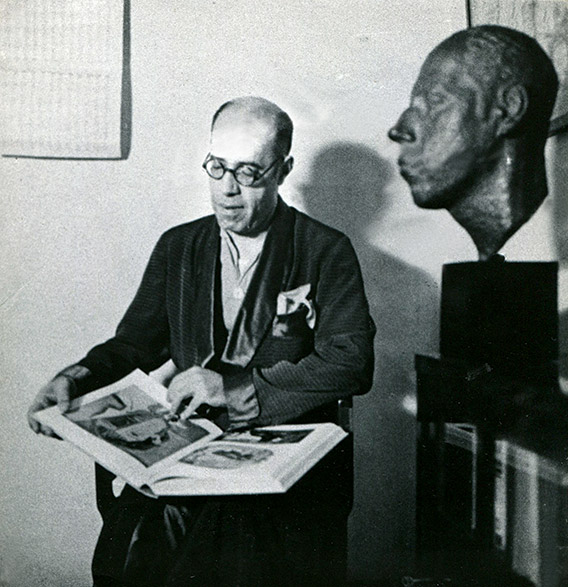
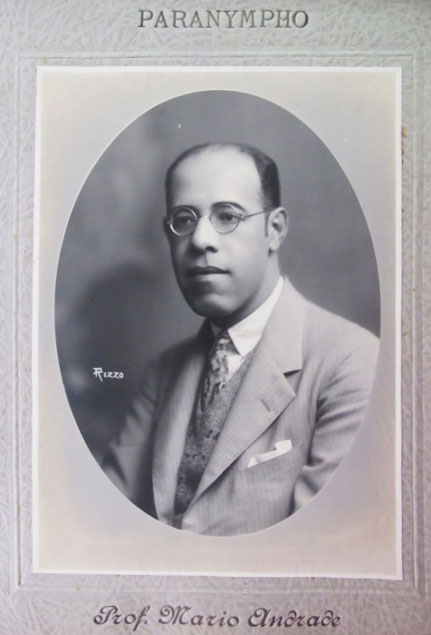
Brazilian author and lecturer Mario de Andrade.

Die wertvolle Zeit der Reife.

„Meine Seele hat es eilig.
Ich habe meine Jahre gezählt und festgestellt, dass ich weniger Zeit habe, zu leben, als ich bisher gelebt habe.

Ich fühle mich wie dieses Kind, das eine Schachtel Bonbons gewonnen hat: Die ersten isst es mit Vergnügen, aber als es merkt, dass nur noch wenige übrig waren, begann es, sie wirklich zu genießen.

Ich habe keine Zeit für endlose Konferenzen, bei denen die Statuten, Regeln, Verfahren und internen Vorschriften besprochen werden, in dem Wissen, dass nichts erreicht wird.
Ich habe keine Zeit mehr, absurde Menschen zu ertragen, die ungeachtet ihres Alters nicht gewachsen sind.

Ich habe keine Zeit mehr, mit Mittelmäßigkeit zu kämpfen.
Ich will nicht in Besprechungen sein, in denen aufgeblasene Egos aufmarschieren.
Ich vertrage keine Manipulierer und Opportunisten.

Mich stören die Neider, die versuchen, Fähigere in Verruf zu bringen um sich ihrer Positionen, Talente und Erfolge zu bemächtigen.
Meine Zeit ist zu kurz um Überschriften zu diskutieren. Ich will das Wesentliche, denn meine Seele ist in Eile. Ohne viele Süßigkeiten in der Packung.

Ich möchte mit Menschen leben, die sehr menschlich sind. Menschen, die über ihre Fehler lachen können, die sich nichts auf ihre Erfolge einbilden. Die sich nicht vorzeitig berufen fühlen und die nicht vor ihrer Verantwortung fliehen. Die die menschliche Würde verteidigen und die nur an der Seite der Wahrheit und Rechtschaffenheit gehen möchten. Es ist das, was das Leben lebenswert macht.

Ich möchte mich mit Menschen umgeben, die es verstehen, die Herzen anderer zu berühren. Menschen, die durch die harten Schläge des Lebens lernten, durch sanfte Berührungen der Seele zu wachsen.

Ja, ich habe es eilig, ich habe es eilig, mit der Intensität zu leben, die nur die Reife geben kann.
Ich versuche, keine der Süßigkeiten, die mir noch bleiben, zu verschwenden. Ich bin mir sicher, dass sie köstlicher sein werden, als die, die ich bereits gegessen habe.

Mein Ziel ist es, das Ende zufrieden zu erreichen, in Frieden mit mir, meinen Lieben und meinem Gewissen.

Wir haben zwei Leben und das zweite beginnt, wenn du erkennst, dass du nur eins hast.“

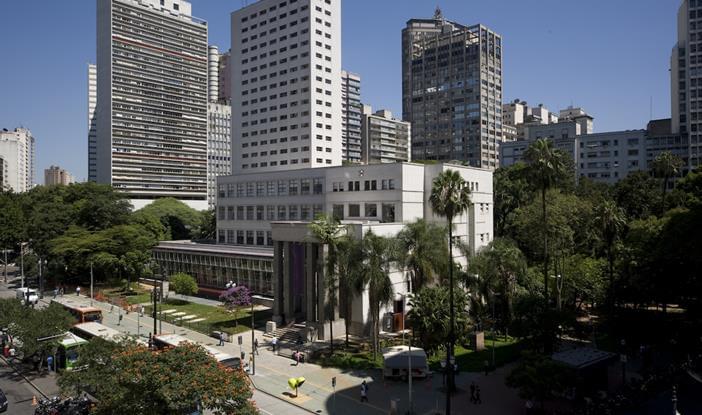
Bibliotheca Mario de Andrade in Sao Paulo, Brazil.
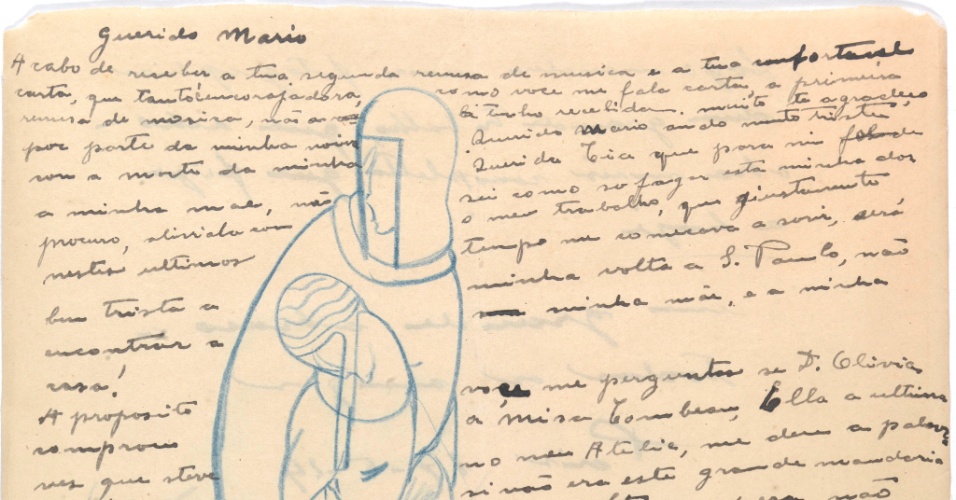
Notesheet of „cartas de modernismo“ , as well as the entry picture far above, by  Mario de Andrade. Pics by bol.uol.br.

The Valuable Time of Maturity.

„I counted my years and discovered that I have
less time to live going forward than I have lived until now.
I have more past than future.

I feel like the boy who received a bowl of candies.
The first ones, he ate ungracious,
but when he realized there were only a few left,
he began to taste them deeply.

I do not have time to deal with mediocrity.
I do not want to be in meetings where parade inflamed egos.
I am bothered by the envious, who seek to discredit
the most able, to usurp their places,
coveting their seats, talent, achievements and luck.

I do not have time for endless conversations,
useless to discuss about the lives of others
who are not part of mine.

I do not have time to manage sensitivities of people
who despite their chronological age, are immature.
I cannot stand the result that generates
from those struggling for power.

People do not discuss content, only the labels.
My time has become scarce to discuss labels,
I want the essence, my soul is in a hurry…
Not many candies in the bowl…

I want to live close to human people,
very human, who laugh of their own stumbles,
and away from those turned smug and overconfident
with their triumphs,
Away from those filled with self-importance,
who does not run away from their responsibilities ..
who defends human dignity.
And who only want to walk on the side of truth
and honesty.
The essential is what makes life worthwhile.

I want to surround myself with people,
who knows how to touch the hearts of people ….
People to whom the hard knocks of life,
taught them to grow with softness in their soul.

Yes …. I am in a hurry … to live with intensity,
that only maturity can bring.
I intend not to waste any part of the goodies
I have left, I’m sure they will be more exquisite,
that most of which so far I’ve eaten.

My goal is to arrive to the end satisfied and in peace
with my loved ones and my conscience.
I hope that your goal is the same,
because either way you will get there too .“

Who was Mario de Andrade ?

Born: October 09, 1893
Died: February 25, 1945
Genre: Romance, Literature, Fiction, Music

Mario Raul de Morais Andrade was a Brazilian poet, novelist, musicologist, art historian and critic, and photographer. One of the founders of Brazilian modernism, he virtually created modern Brazilian poetry with the publication of his „Pauliceia Desvairada“ (Hallucinated City) in 1922.


He has had an enormous influence on Brazilian literature in the 20th and 21st centuries, and as a scholar and essayist. He was a pioneer of the field of ethnomusicology. His influence has reached far beyond Brazil.

Andrade was the central figure in the avant-garde movement of Sao Paulo for twenty years. Trained as a musician and best known as a poet and novelist, Andrade was personally involved in virtually every discipline that was connected with Sao Paulo modernism, and became Brazil’s national polymath.

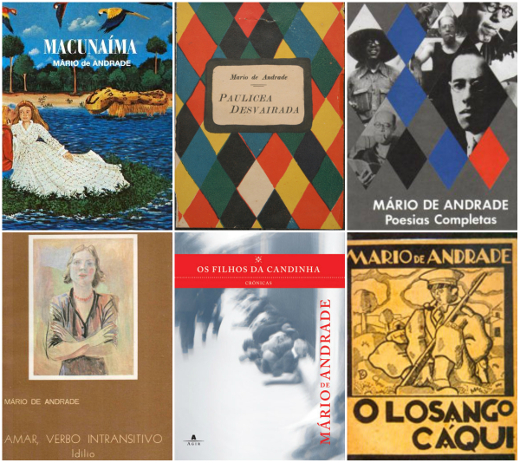
A phantastic novel, world literature, a must read.

He was the driving force behind the Week of Modern Art, the 1922 event that reshaped both literature and the visual arts in Brazil. After working as a music professor and newspaper columnist he published his great novel, Macunaima, in 1928. At the end of his life, he became the founding director of Sao Paulo’s Department of Culture, formalizing a role he had long held as the catalyst of the city’s, and the nation’s, entry into artistic modernity.

Macunaima was 1969 presented as a 108 minute movie.

Some of Mario de Andrade Poems:

The Valuable Time of Maturity
The Mountains of Rolling-Girl
Variation On The Bad Friend
Mother My life is one to-day
Mother Mothers have existed
The Girl And The Goat
From Poemas Of The Woman

Some books and Andrade on a Brazilian banknote.

My personal conclusion:  Time is Life, don’t let anyone steal parts of your life !

Veröffentlicht unter History, Lifestyle | Verschlagwortet mit | 3 Kommentare

Amazing Fruit Tree

Living in foreign country’s is a challenge and of course some instructive time too. During our years in Panama we had to learn a lot. A lot of unaccustomed culture, strange habits and lots of facts we never faced in our home country. I could write a book about all this.

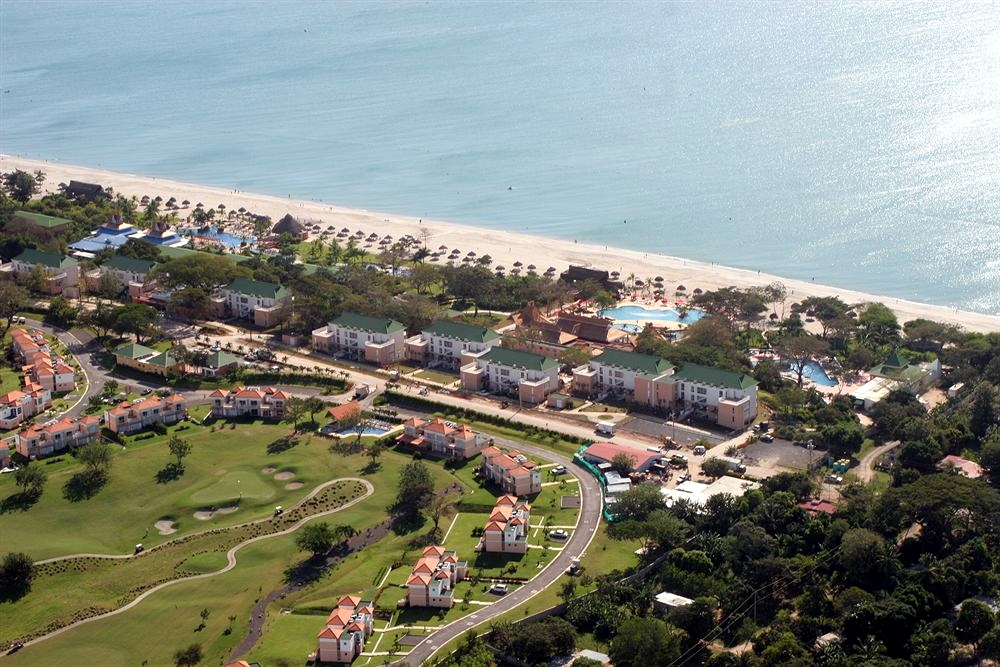
My life in Panama was filled with learning, facing the different lifestyle, but also having a lot of fun. Especially, I was very active in golf, even not so bad with a handicap of 11. My home golfclub was Coronado, but we also played very often neighboring clubs. One day we played Mantarraya Golf Club near Rio Hato.

Royal de Cameron Resort Rio Hato.

Very interesting place connected to Royal Decameron Resort and an own Airport. The airstrip is crossing the 4 lane Pan-American highway. I heard now the highway uses a tunnel underneath the reinstalled „Scarlett Martinez International Airport“. Funny time when we lived there and  they closed the highway for upcoming air traffic.

      The new tunnel of Pan-American highway under the International airport Rio Hato, Panama.

Our golf day, I am referring too was a busy and very hot Saturday. We had just over 38 grade Celsius ( about 100 grade Fahrenheit) that day and had to wait on tee’s some time till flights in front of us cleared the fairway’s. That gave us time to chat, to relax and to sip a lot of cool cervezas.

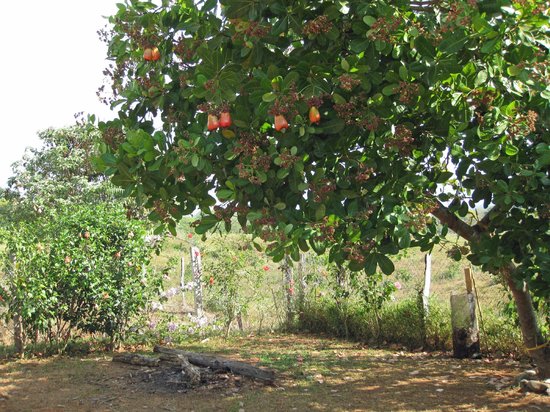
   Mantarraya Golf Club Rio Hato and the big shady „cashew trees“.

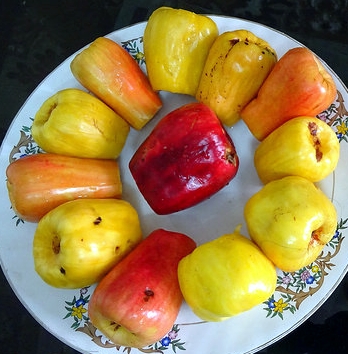
During one stop, we always tried to park our carts under shady trees, I faced some trees I had never seen before. Big ones, with lots of strange fruits in green, yellow, red colors on the same tree. They were hanging down like bells on a Christmas tree.

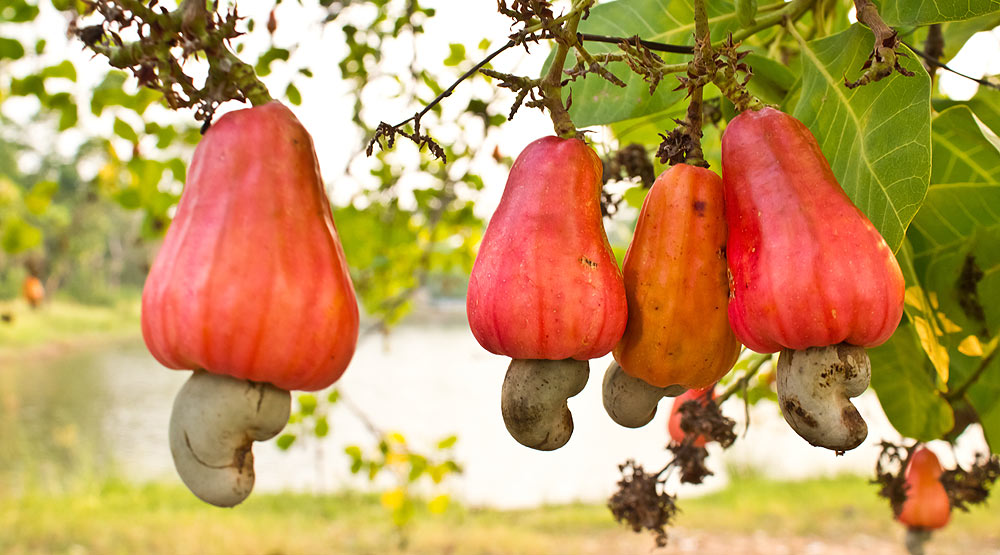
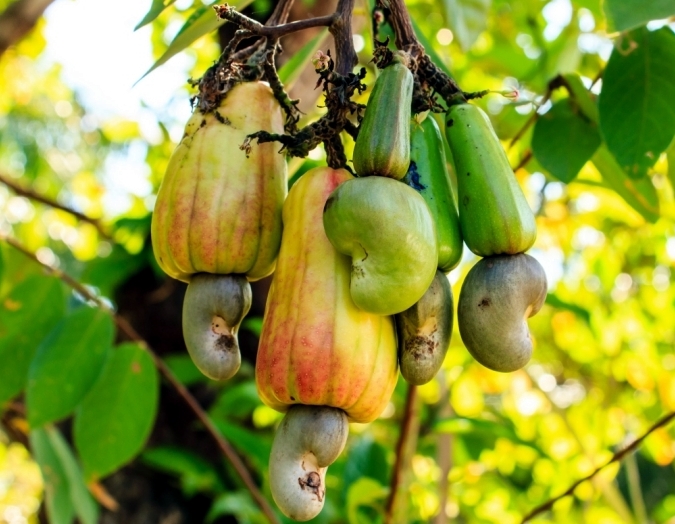
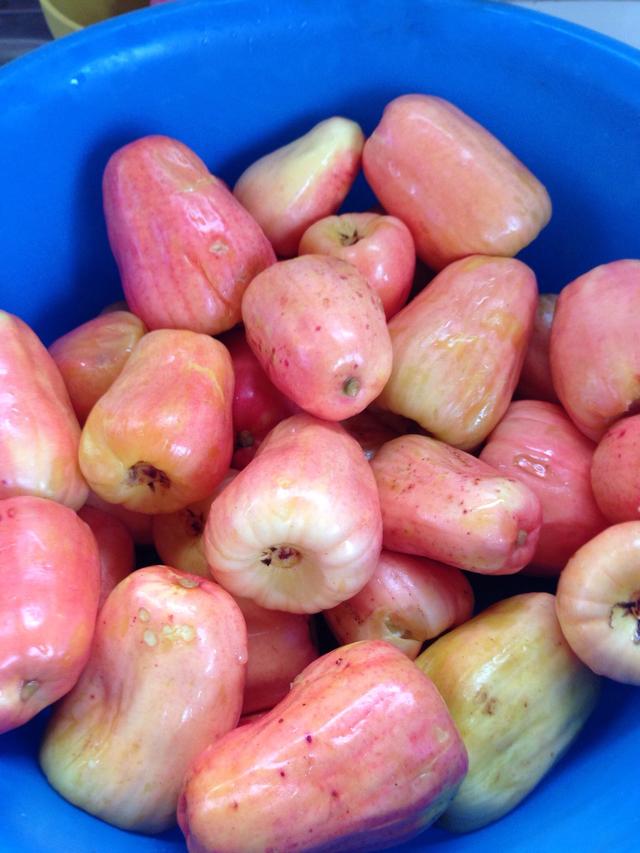
Cashew apples in all colors.

Lucky we were with a Panamanian friend in our flight, laughing about our/my lack of knowledge. These are cashew trees he said. Went to the tree and gabbed some dark red fruits, handing over to us and saying „you can eat them, very nice and quench your thirst“.

Of course he had to show us how to use and enjoy them. Wow, what an experience, what a strange astringent taste. This is the story.

The cashew apple.

The delicately flavored cashew nut is a favorite between meal snack that can be readily found in your local market year round. It also makes wonderful nut butter and a special addition to salads and stir-fry dishes. Cashew nuts are actually the kidney-shaped seeds that adhere to the bottom of the cashew apple, the fruit of the cashew tree, which is native to the coastal areas of northeastern Brazil.

Cashew apples in different degrees of maturity

While cashew apples are not appreciated in most other country’s like the US or Europe, they are regarded as delicacies in Brazil and the Caribbean. You have probably noticed that cashews in the shell are not available in stores. This is because these nuts are always sold pre-shelled since the interior of their shells contains a caustic resin, known as cashew balm, which must be carefully removed before they are fit for consumption.

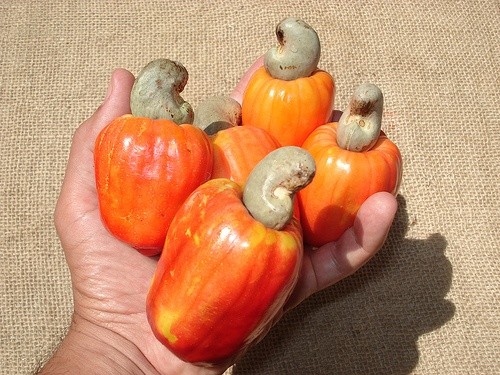
Cashew apple with the attached cashew nut.

This caustic resin is actually used in industry to make varnishes and insecticides. Cashew nuts grow out of a “strange apple”. I had never seen it before, t’s amazing. You have eaten these nuts hundreds of times but never thought about how they actually “come to our world“. The cashew apple is rich in nutrients and contains five times more vitamin C than an Orange.

Cashew trees in peoples backyard.

It is eaten fresh, cooked in curries, or fermented into vinegar as well as an alcoholic drink. In parts of South America, natives regard the cashew apple as the delicacy, rather than the nut kernel popular elsewhere. Cashew apple is also used to make preserves, chutneys and jams in some countries such as India and Brazil.

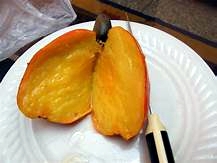
Inside of the cashew apple, light stringy flesh.

Cashew apples are not popular, in part because of highly astringent taste. This has been traced to the waxy layer on the skin that causes tongue and throat irritation after eating the cashew apple. In cultures that consume cashew apple, this astringent property of the cashew apple is typically removed by steaming the fruit for five minutes before washing it in cold water.

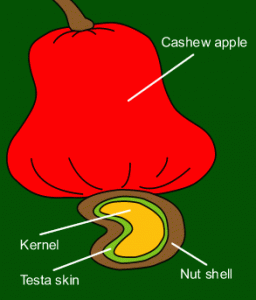
The cashew fruit in drawing.

The true fruit of the cashew tree is a kidney or boxing-glove shaped drupe that grows at the end of the cashew apple. The drupe develops first on the tree, and then the pedicel expands to become the cashew apple. Within the true fruit is a single seed, the cashew nut. Properly roasting cashews destroys the toxin, but it must be done outdoors as the smoke contains urushiol droplets which can cause severe, sometimes life-threatening, reactions by irritating the lungs. Some people are allergic to cashew nuts, but cashews are a less frequent allergen than other treenuts or peanuts.

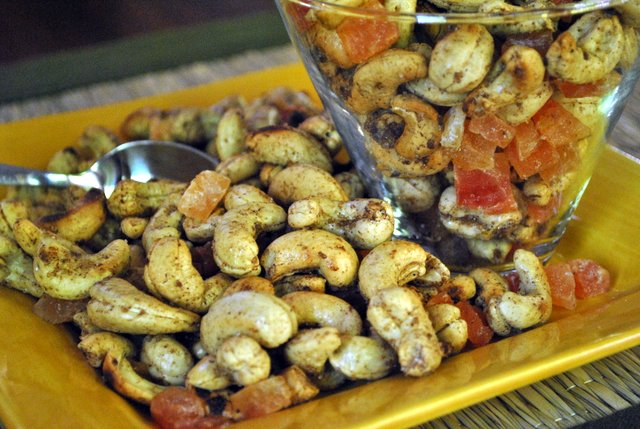
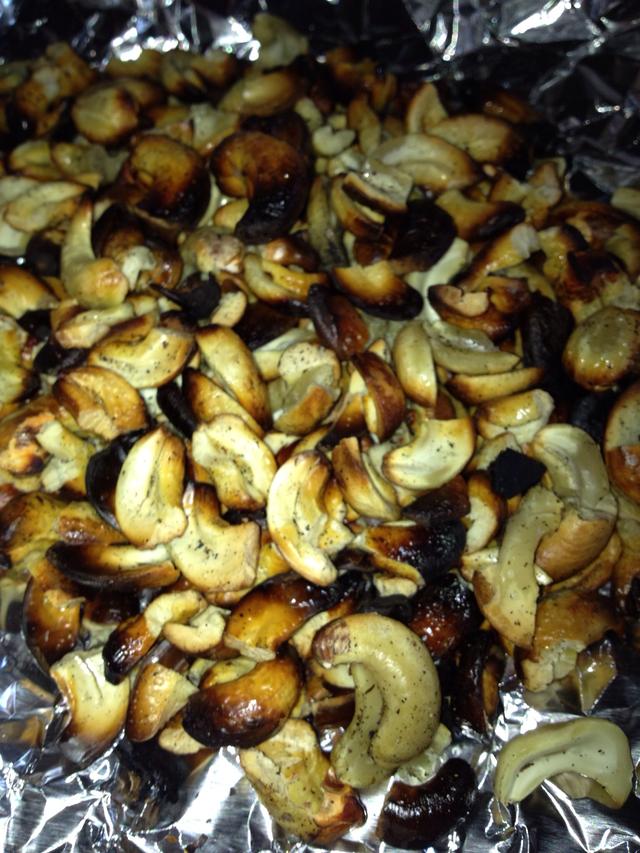
Delicious fresh „honey roasted, pepper, candied cashew nuts“, still warm. Served in Royal Cameron Resort as a happy hour snack.

The cashew history.

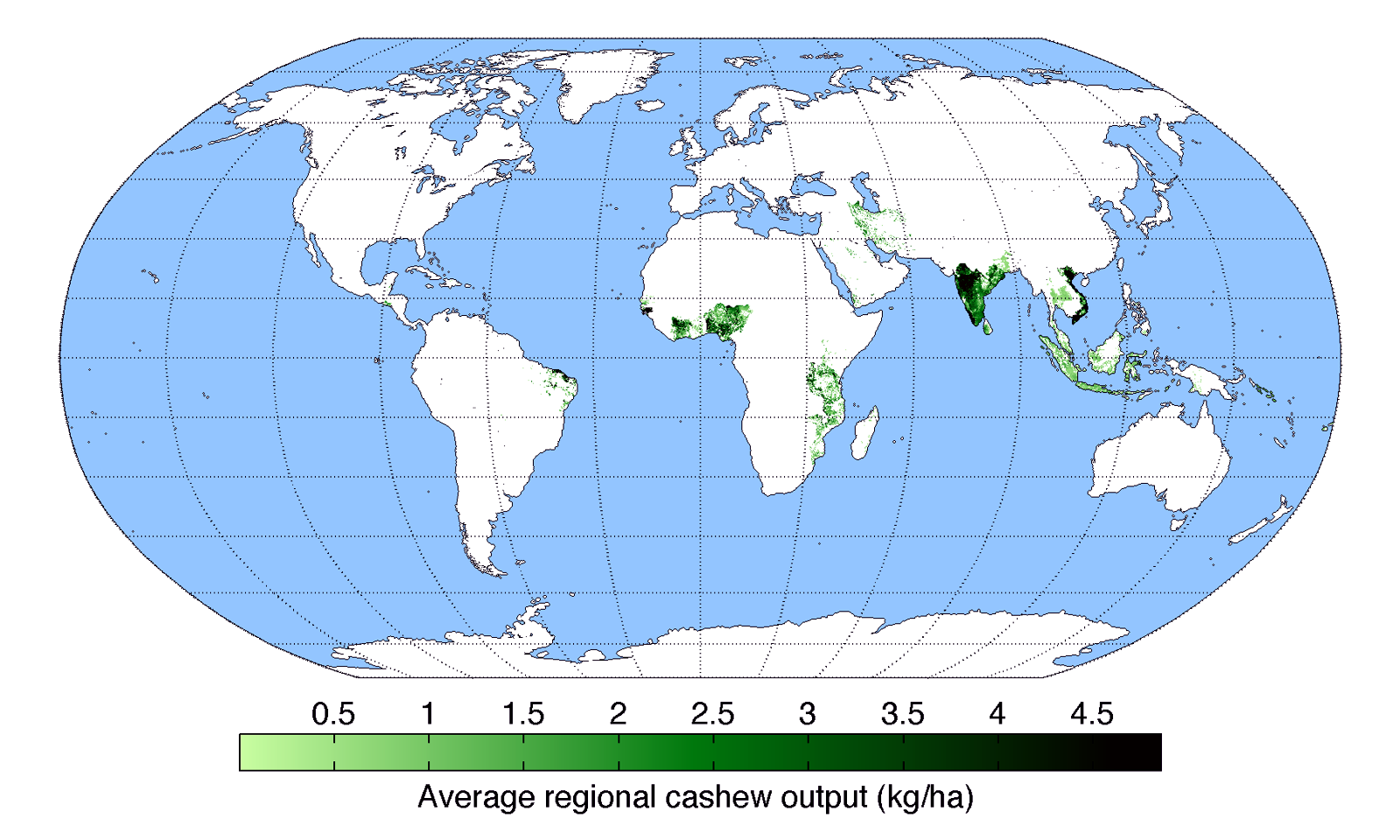
The cashew tree is native to coastal areas of Brazil. In the 16th century, Portuguese explorers took cashew trees from this South American country and introduced them into other tropical regions such as India and some African countries, where they are now also cultivated. The cashew tree has always been a prized resource owing to its precious wood, cashew balm and cashew apple, but the cashew nut itself did not gain popularity until the beginning of the 20th century. Today, the leading commercial producers of cashews are India, Brazil, Mozambique, Tanzania and Nigeria.

Click on pics to supersize.

How to enjoy cashews ?

Combining cashews with other nuts and dried fruits makes a healthy snack.
Right before taking off the heat, add cashews to sauteed vegetables.
Saute cashews with shrimp, basil, some red chilli flakes and green beans for a delightful Thai inspired dish.
Cashews with a little bit of maple syrup make a great topping for hot cereals.
Add cashew butter to breakfast soy or rice milk shakes to up their protein content (a quarter-cup of cashews provides over 5 grams of protein) and give them a creamy nutty taste.

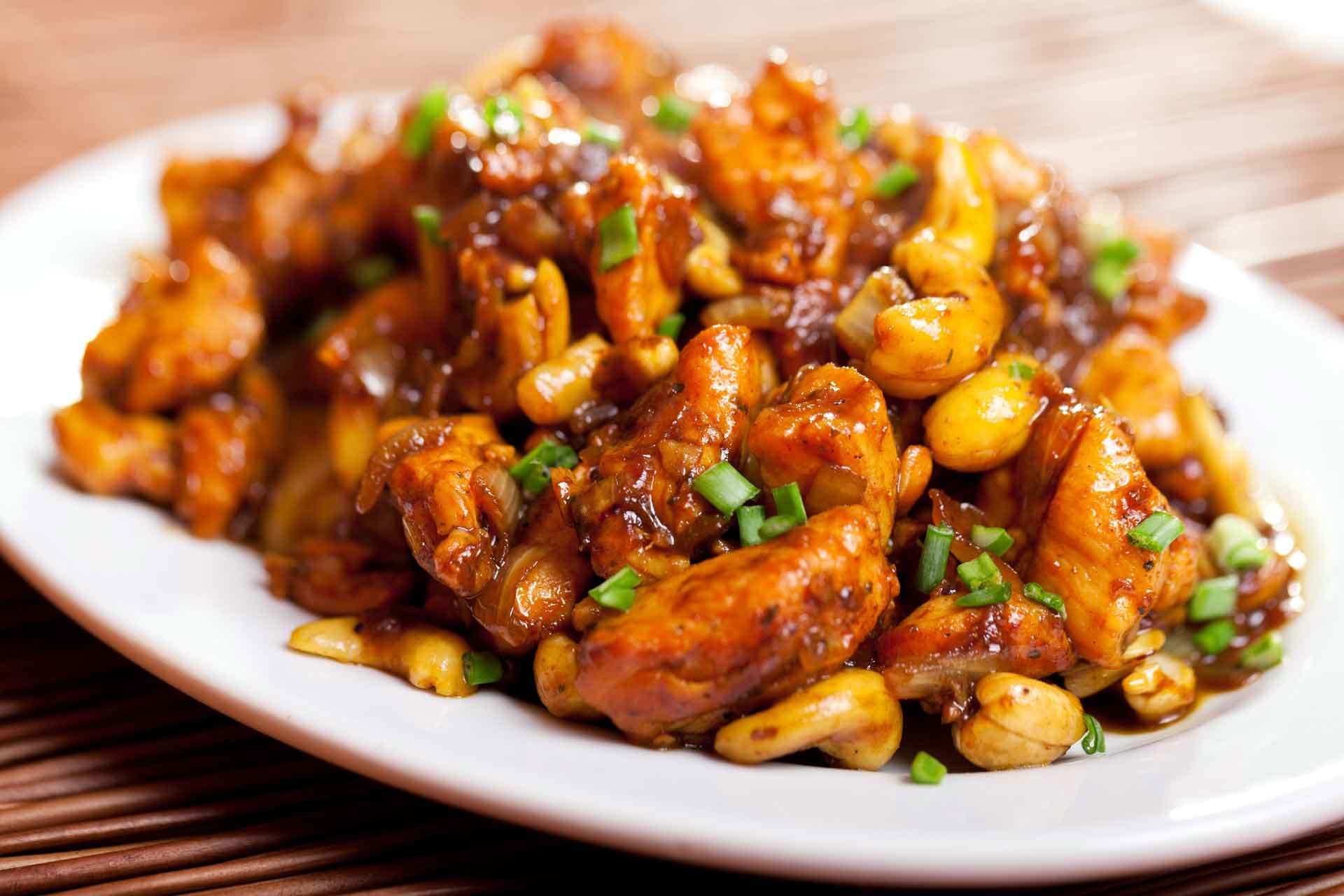
Fantastic. Thai inspired, sweet-spicy cashew chicken.

In a saucepan over low-medium heat, mix cashew butter with some soy sauce, cayenne pepper, garlic, ginger and water to make a wonderful sauce for fish, vegetables, tofu or rice.
To roast cashews at home, meant here a second roasting, do so gently—in a 160-170 grade F (about 75 grade C) oven for 15-20 minutes—to preserve the healthy oils.

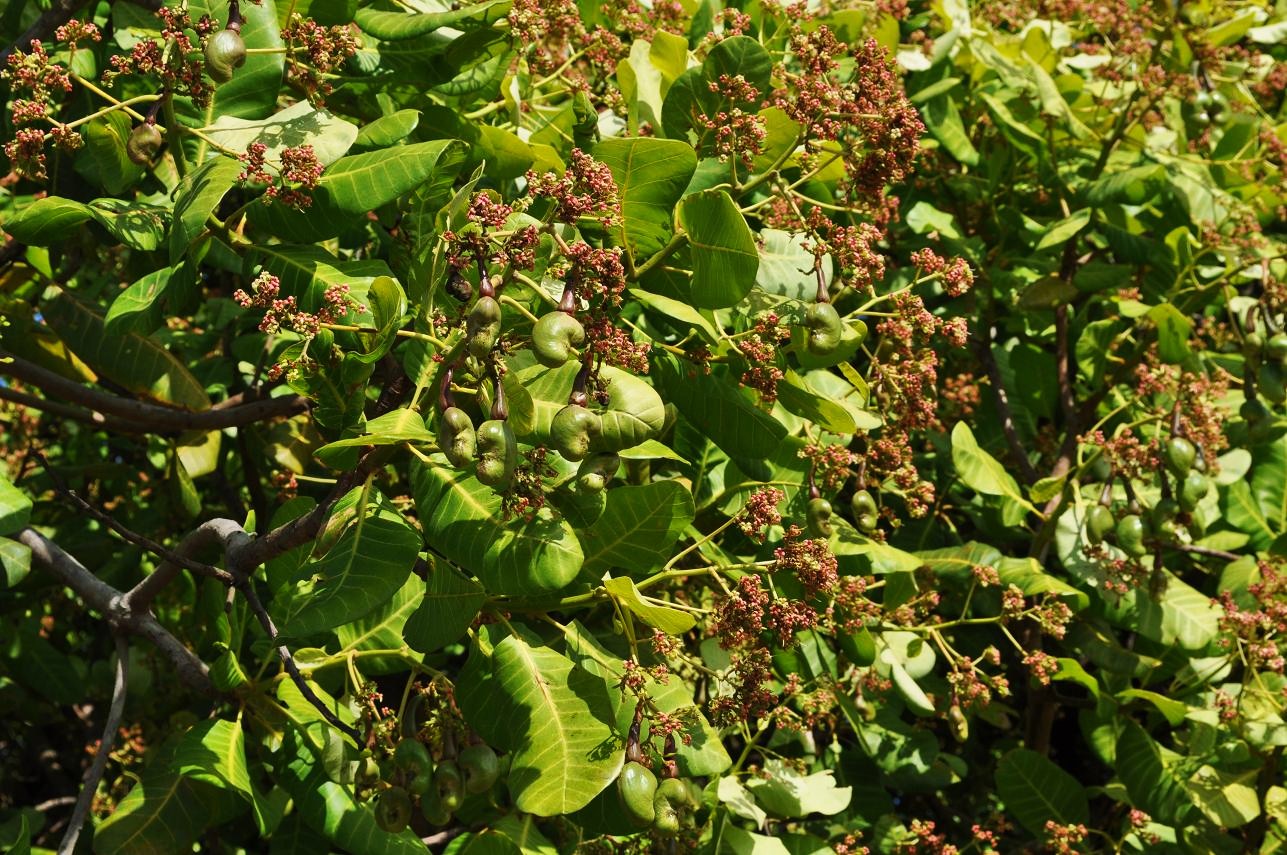
This is how it starts on a cashew tree. First the flowers, out of it the seed/nut and then it grows the apple. One tree has hundreds and hundreds of them.

A cashew description.

The seed we know as the kidney-shaped cashew „nut“ is delicate in flavor and firm, but slightly spongy, in texture.  The actual fruit is used for juices and is a bit astringent, which means that cottony feeling as if you’ve sucked a lemon afterwards, with teeth and gums feeling dry and pasty. Cashews, known scientifically as Anacardium occidentale, belong to the same family as the mango and pistachio nut. In Latin America its called the Maranon Tree, Maranon fruit, Maranon juice and so on.

Next stage in growing. The nut is fully established, now the apples can appear.

From fruit to nut.

First time I noticed cashew nuts in Panama, during a special time of the year (cashew season from March to June), that along the highways in front many houses little tables with small plastic bags were „for sale“. Stopping and finding out.

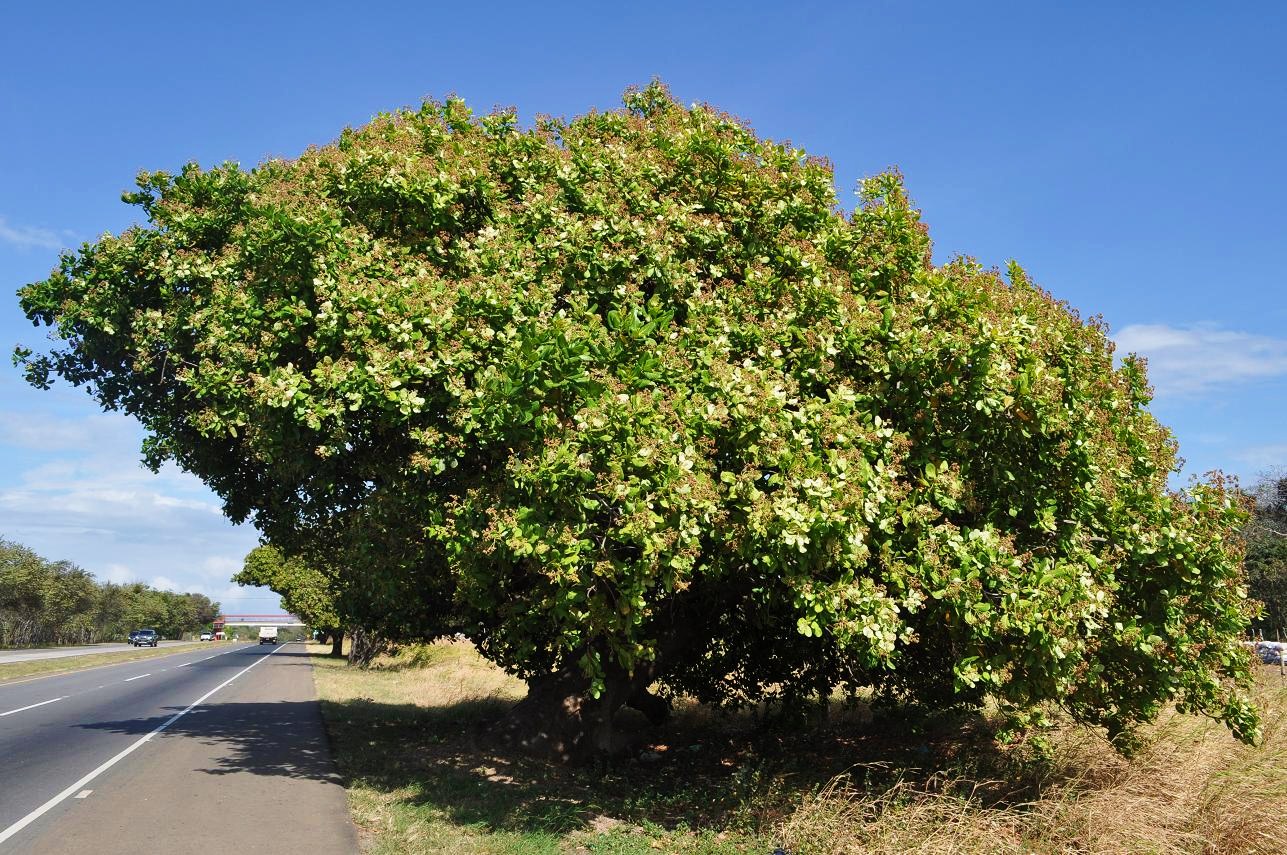
Cashew trees next to Pan-American Hwy. Panama.

One will find freshly roasted cashews being sold by these street vendors for „ONE US$“ per small bag. Cashews are one of my favorite treats. Once odd thing I noticed is that the cashews are sold unsalted. I also noticed that each fruit only has one cashew. This means that tin of cashews in your cupboard took a ton of work!

Final stage. Cashew apple fully grown and ripe.

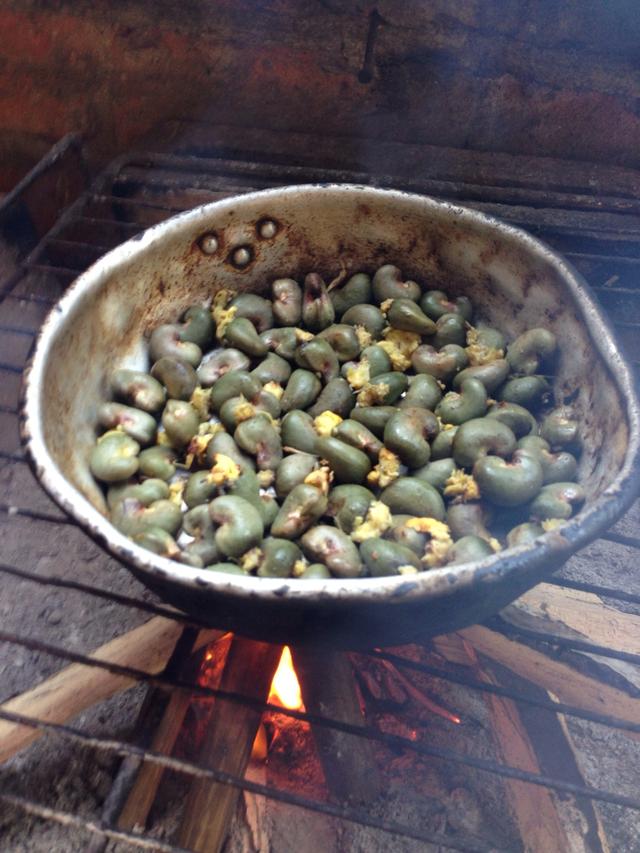
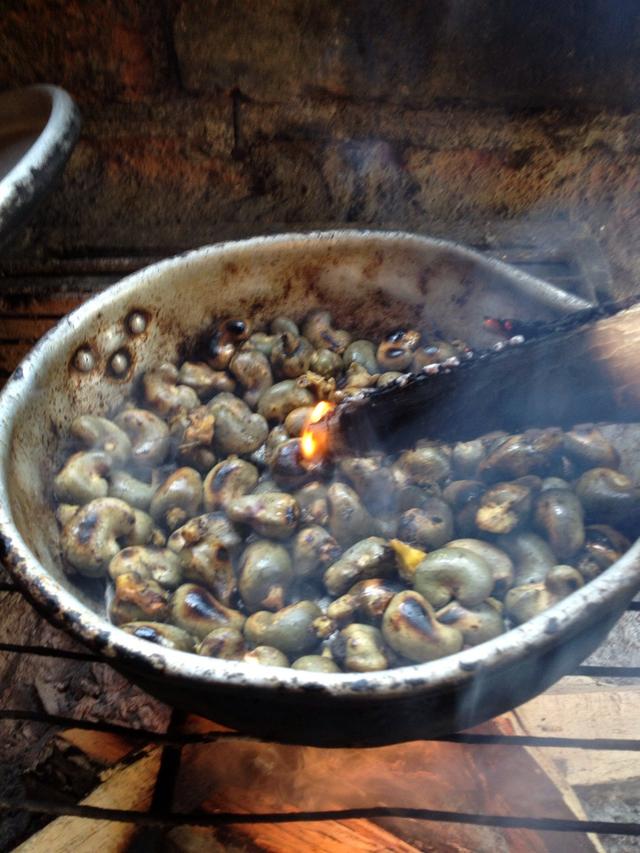
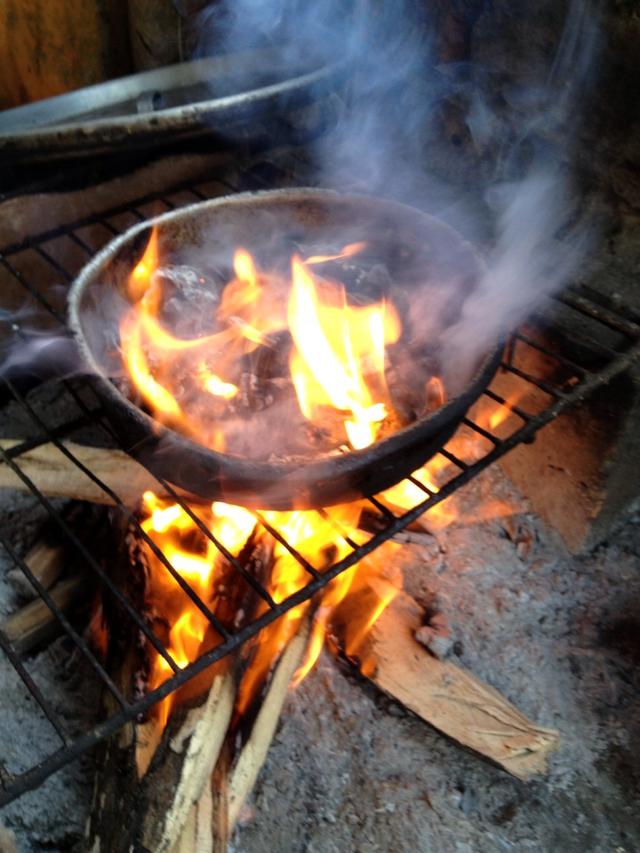
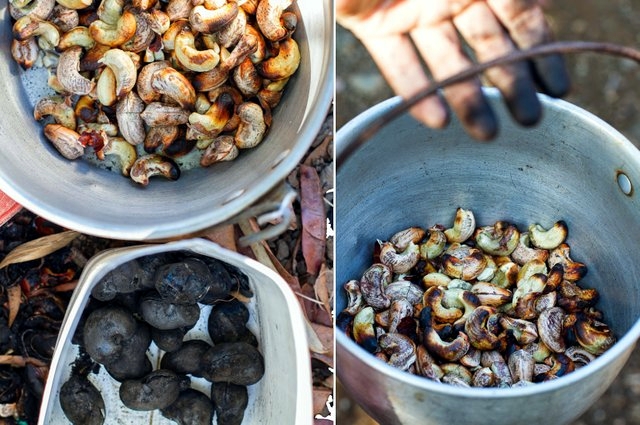
Producing the tasty cashew nut starts with cleaning and separating the nut from the apple. I suggest gloves to do so, its a messy job. Next stage is to put the nuts over fire to roast and if they are hot one will lit the biofuel on the nuts. Can take a while if they are fresh and wet. This procedure I will call „first roasting“.


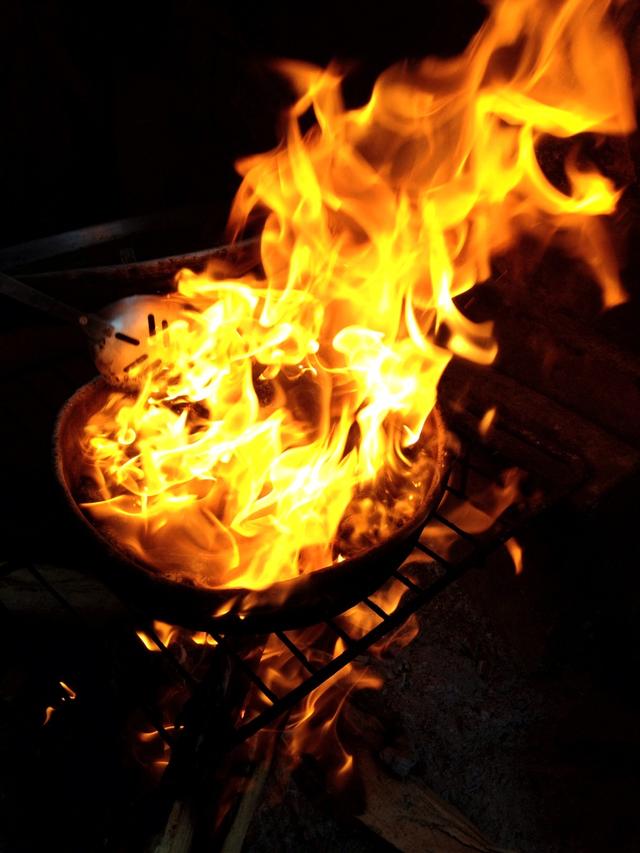
Be very careful, if they start burning it will be a hell of a fire as you can see in the pictures. Because of this massive flame and the toxic fumes you should do it outside only, like the locals do. Roasting of the nuts releases toxic fumes from an acid contained in the skins, which is why you never find cashew nuts in the shell.


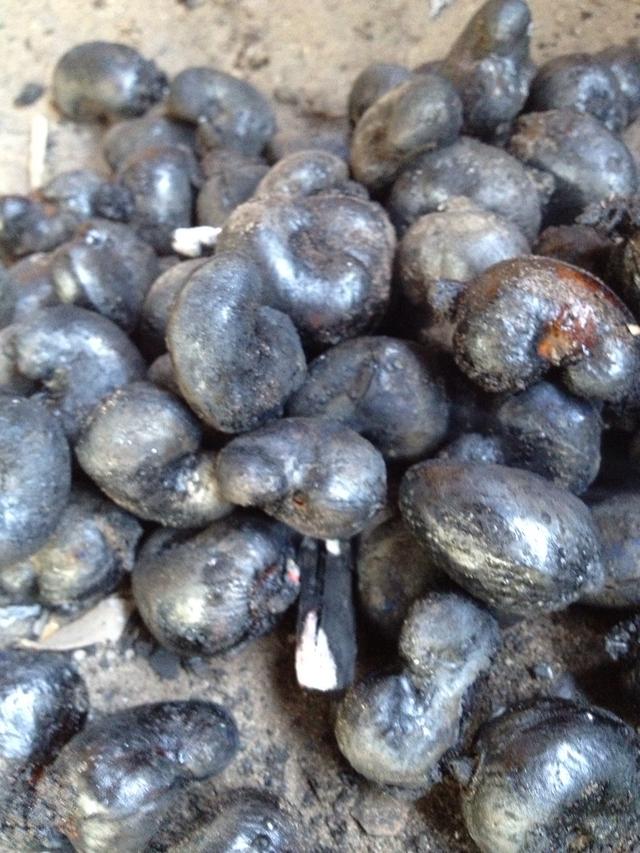
It needs some experience to find out the right roasting time, you want them well done but not burned to ashes. After cooling off its easy to crack the shell and take out the nut. Use gloves again, its a messy messy work. Lot of work at all, but the result is amazing. I never ever had a fresh warm nut tasting that good. Indescribably !


To extinguish the fire locals throw sand over the burning nuts. One can crack them with a mallet or between some rocks, beware they are still hard. This whole process will be done industrial by machines. However it is a long hard working and expensive procedure to get to these delicious nuts. I will never complain about cashew prices anymore.


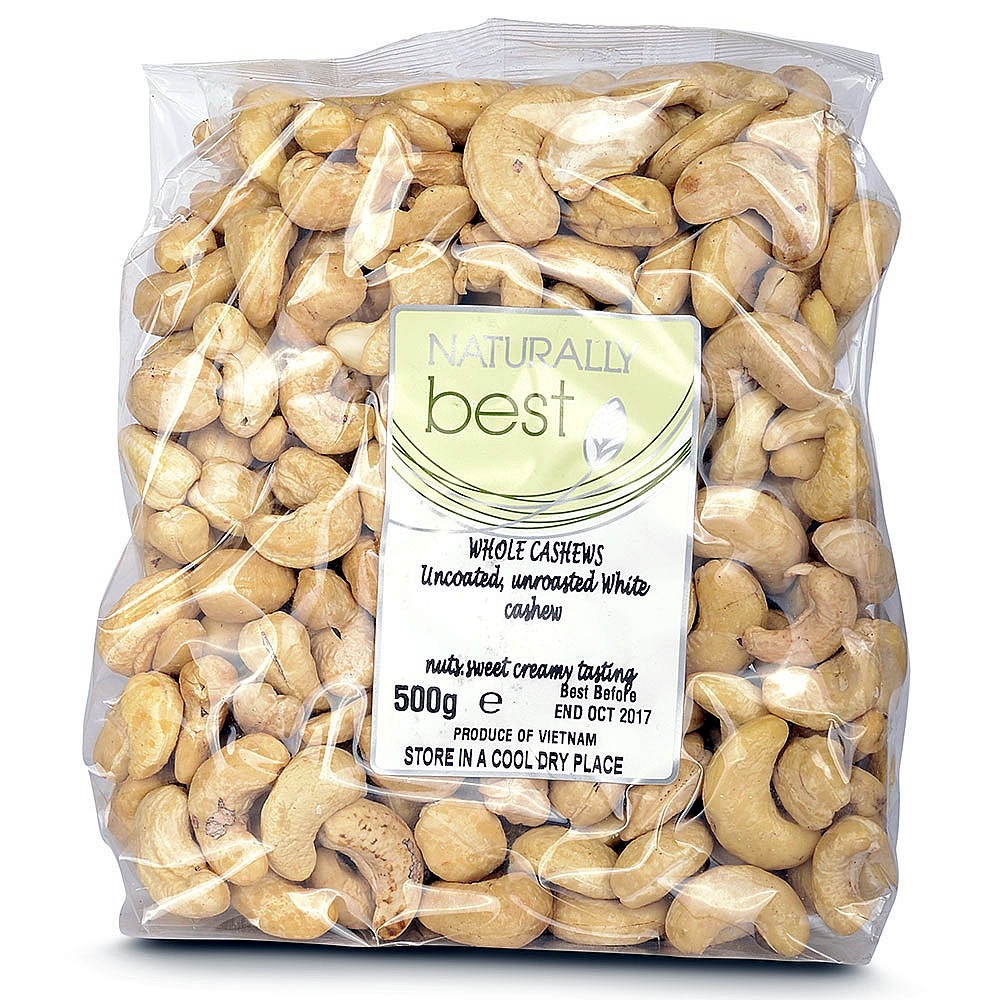
Industrial produce often comes white and shiny. These nuts were brushed and cleaned. Unroasted here means, not roasted a „second“ time. I would rather like to have the natural, slightly burned and fresh tasty ones, but where to get them ?

From fruit to juice.

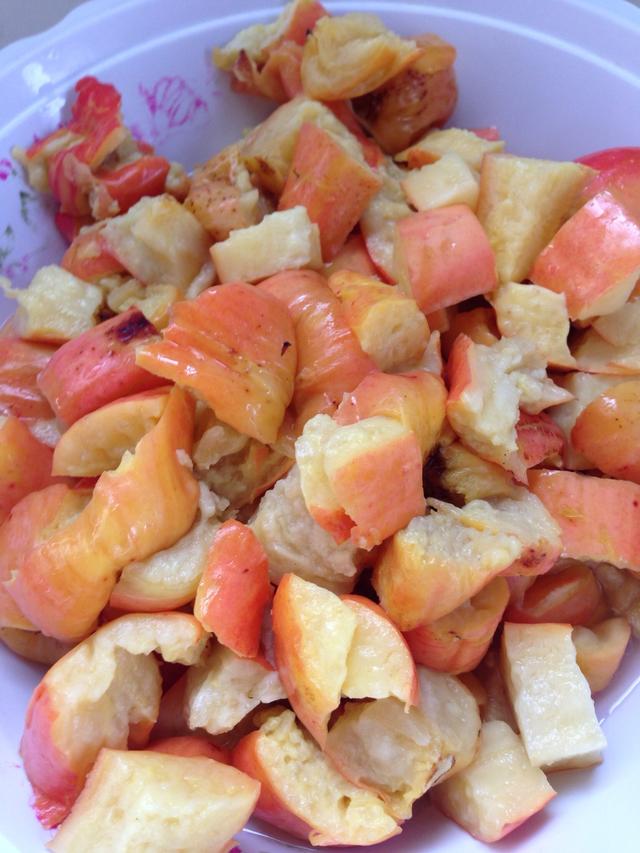
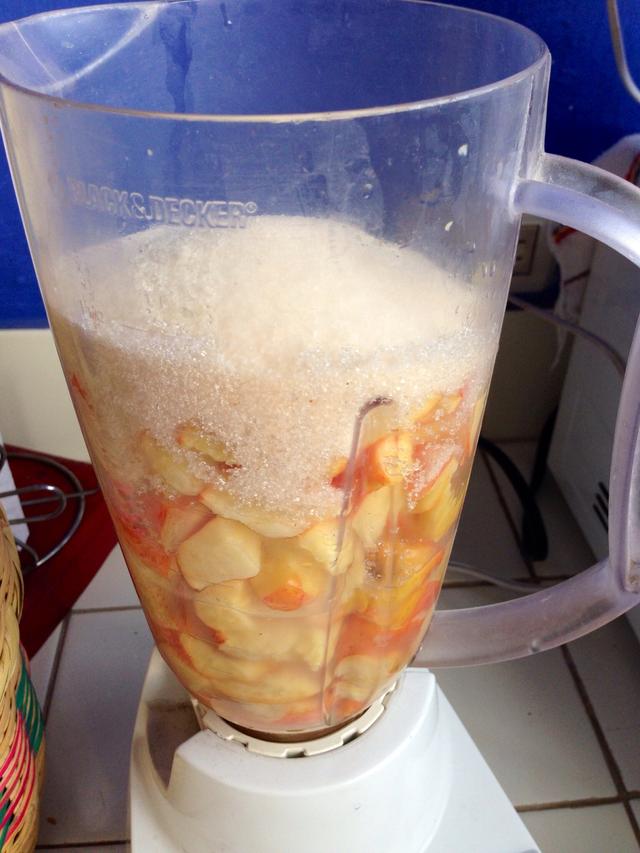
The making of a delicious juice out of the apples is much easier then roasting the nuts. Just slightly wash and cut them into pieces with skin and everything. Throw the fruits into a blender and add sugar and some good quality water.


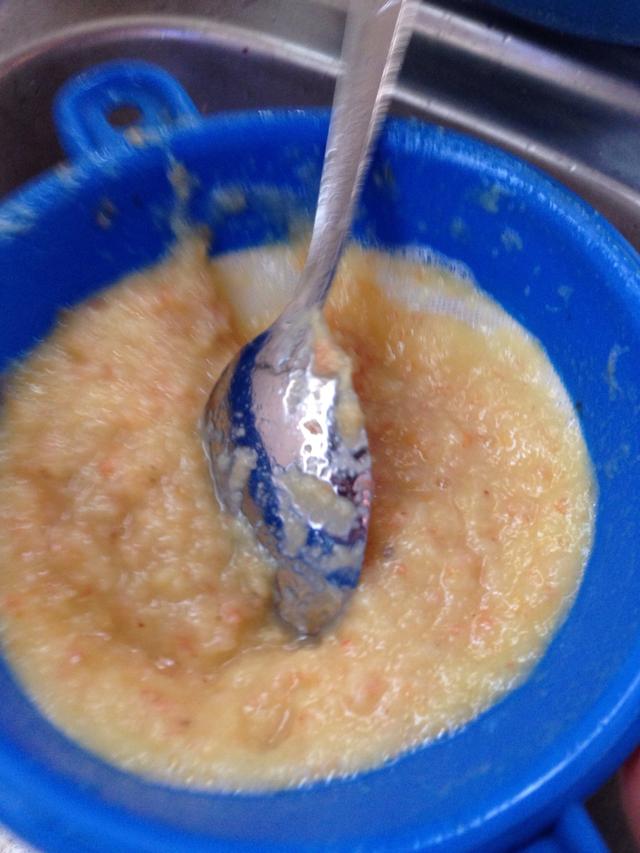
Next step is to push the puree through a fine strainer. Add some blocks of ice and you have a delicious drink. Instead sugar one can use honey, or add some paprika or even chilli powder. The variety of drinks is result of your imagination.

Maranon juice, also called chicha, served in a most exclusive way. At Royal Cameron a glass full – not to complain, very very delicious – of this chicha was priced at US$ 14,– !!

What else ? 

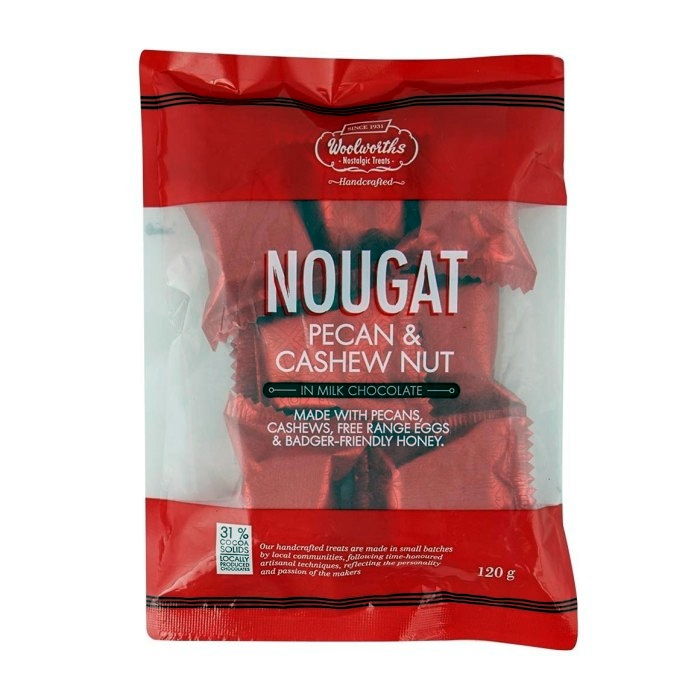
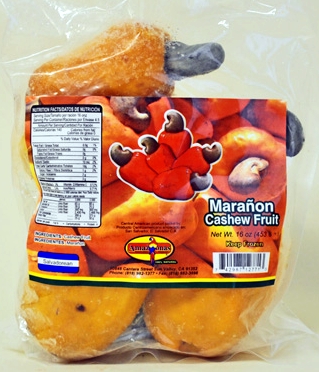
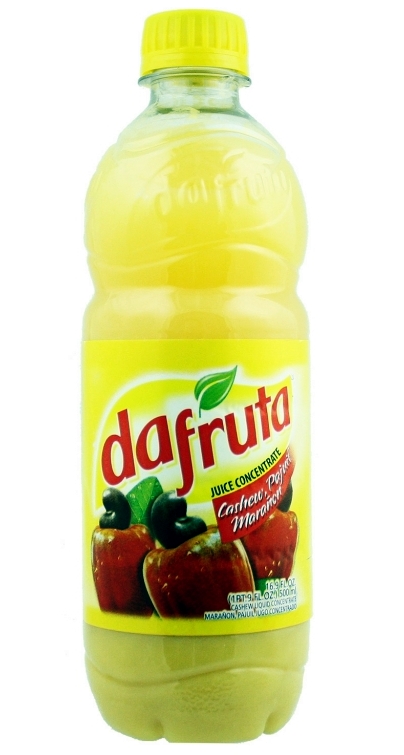
They even make delicious Nougat out of cashews. Notice the recipe on the bag. Bought at „Woolie’s“ in Australia. Or in Brazil you can find the cashew apples frozen in a bag. Four of them for about US$ 4,– !!  Pricy snack. Also in Brazil available Maranon juice in bottles.


Finally – travel tips.


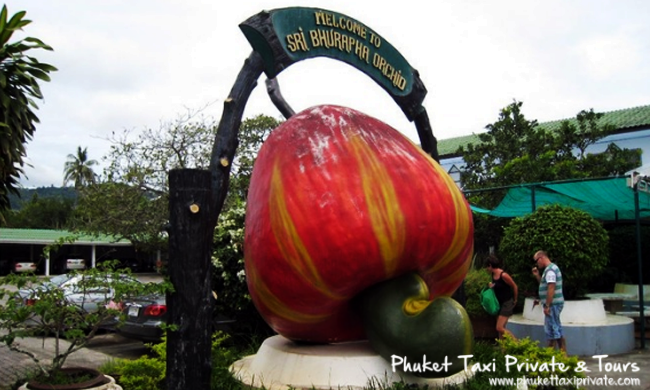
When you travel the world and hit country’s where they harvest cashews, take the chance and have a look how they do it. Above the „Cashewnut Factory Phuket“ on Phuket island in Thailand. Worth to visit, may be by „Phuket Taxi Tours“. Above left the „entry sign“ and above right a fountain inside.

Canopy Family Lodge in El Valle, Panama. Great outdoor relaxing in tropical surroundings.

In Panama its a MUST to visit the „Canopy Family Lodge“ resort and hotel. Its location is in El Valle where most tourists of Panama end up anyway. But many don’t see the Canopy tower and don’t realize its in a wild cashew tree.

This amazing tree house is located in the Canopy Lodge area. This wild cashew tree is over 60 meters high, the trunk over 3 meters in diameter and the tree over 150 years old. Still produces every year masses of cashew apples and nuts.   Enjoy the tree climb !

Veröffentlicht unter Information, Lifestyle, Travel | Verschlagwortet mit , | 2 Kommentare