
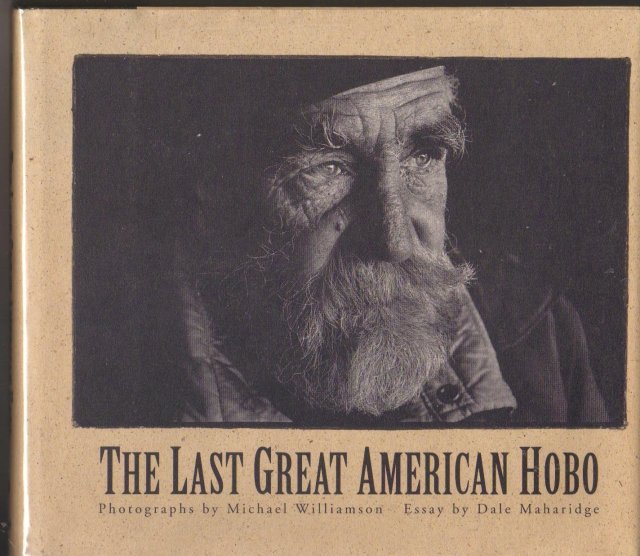
Above, a fantastic book, examines the life of Blackie, a hobo for sixty years, as he chooses to defend his life on the banks of the Sacramento and fight America’s changing attitude toward the homeless.
Last weekend we were sitting together with friends on an ugly rainy winter day here in Uruguay. We enjoyed a heartwarming German pea-soup with original „Frankfurters“ and some Spanish spicy chorizos. The discussion came up about different soups and recipes’s, I mentioned the „American Hobo Soup“. No one heard about that one. Since we all were not American’s but German, English, French and Canadian nationalities we realized it might be a special US-American dish. I promised a recipe and some explanation which I will take into a post here.
The Hobo History.
As always let me shortly introduce you to a bit of history. Just to find out about the name „Hobo“ can fill a separate book. And that’s fact, there are many many books written about the Hobo life in history. Some of my following information’s are from the webpage „In search of the American Hobo“ and articles from Karen Hill as well as from Lisa Hix.
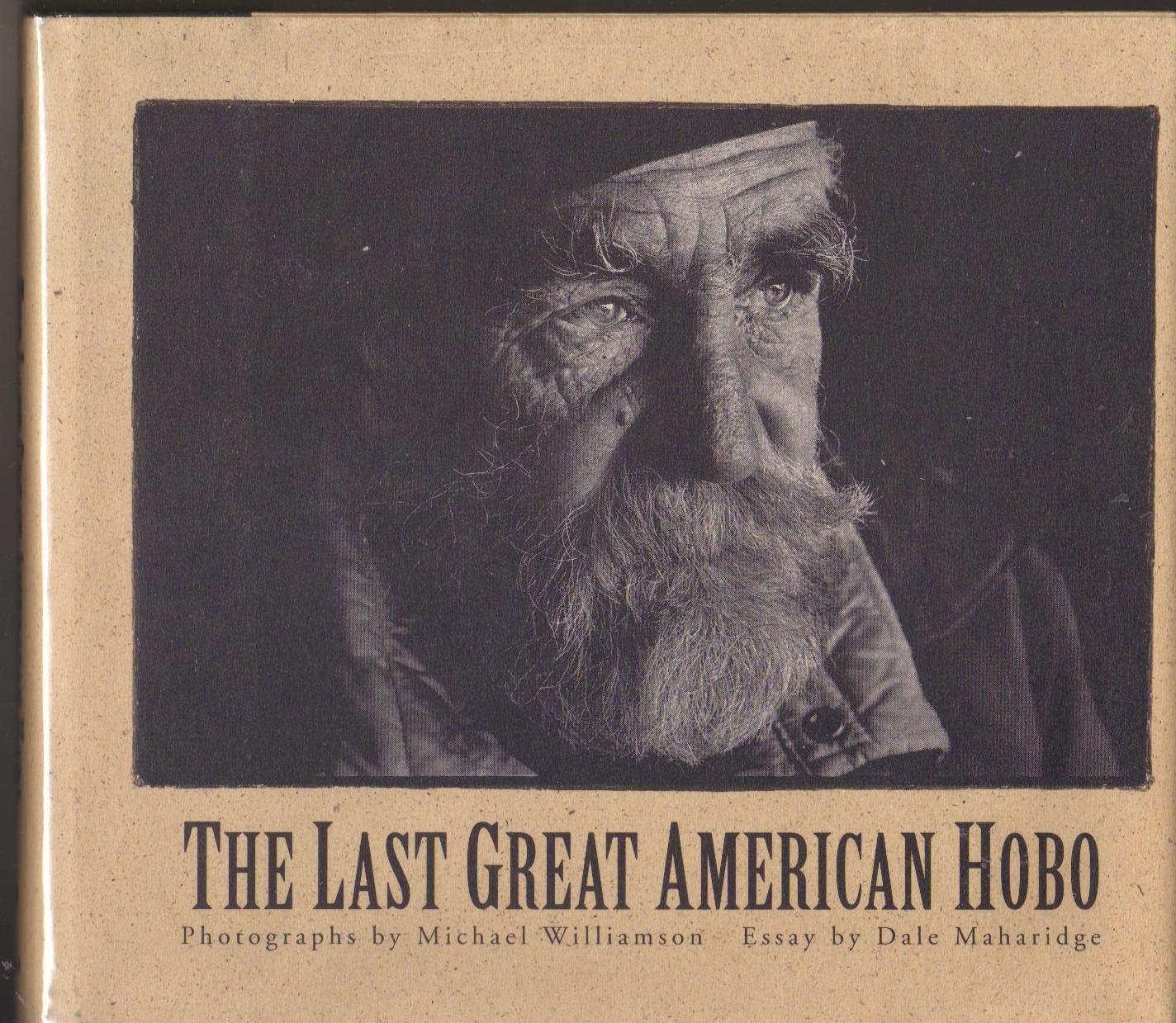
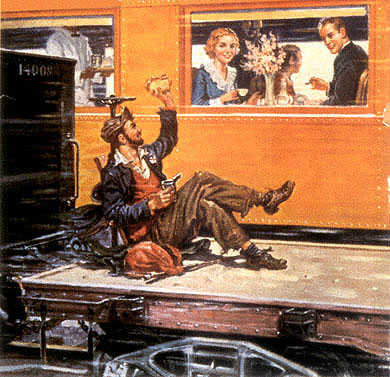 Happy Hobo Life !!??
Where does the word “Hobo” come from and what does Hobo mean?
Little more may be done with the word “Hobo” than to repeat the several theories that have been advanced to explain its origin. Any one of them might be true, but there is no proof as yet.
Slightly less than four centuries ago the French musical instrument, the hautbois, came into English use. Its name was literal, from haut = high, and bois = wood, for the instrument was made of wood and its tone was high.
Later, from Italian spelling, it came to be called, as at present, the “oboe”. The English, as they frequently did with French words, corrupted the spelling into hautboy or, often, into hoboy, giving it the latter pronunciation in either case.
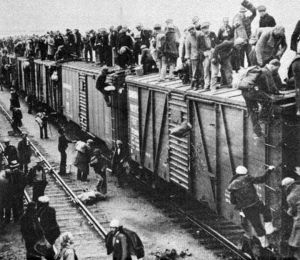 Riding the rails, Hobos during the American Great Depression and Prohibition years.
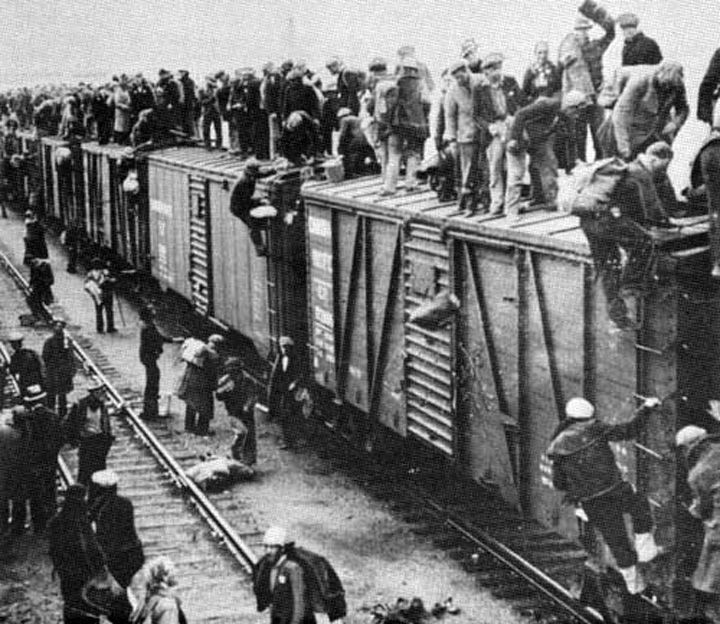
There are, therefore, many people who think that our term Hobo, which is of American origin, came somehow into use through itinerant players of the hoboy. Jack London, who had a lot of firsthand experience among tramps and vagabonds and who wrote much about them at the turn of the century, gave this theory the stamp of his approval.
Another explanation credited the source to the lumber camp. French-Canadians, they say, when felling a tree, instead of giving the shout, “Timber-r-r!” would cry, “Haut bois!”, literally, “high timber.” From this cry, which might be rendered “ho bo” in English, it has been suggested, the itinerant Canadian lumberjack came to be called a Hobo by his English-speaking fellow workers.
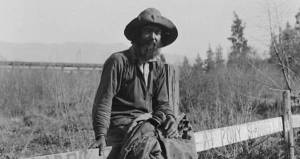 Click on pics, most will supersize.
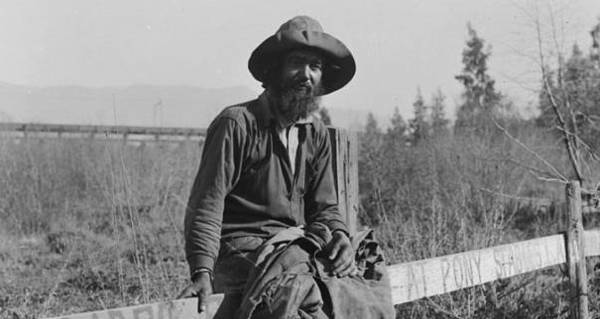
Another theory, advanced by a recent authority, is that the word may be derived from an ironic use of the word “beau,” together with the word of greeting, “Ho.” Thus, “Ho, beau!”, just as, in present popular speech, we hear, “Hi, fella!”
It is our own thought that the source might go back three hundred years. There is record of a slang term in use about that time applied to a man engaged in the most menial of all labor, one whose work it was to go about London at night and clean latrines. Such a man was called a hoboy. Possibly the name was of gypsy origin, as was much of the underworld slang of that period and some that is still alive.
It is therefore possible that hoboy persisted among gypsies, changing to Hobo through the years, and applied either to a tramp or to a migratory worker.
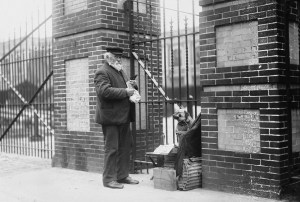 Some Hobo’s were just on foot, with a companion.
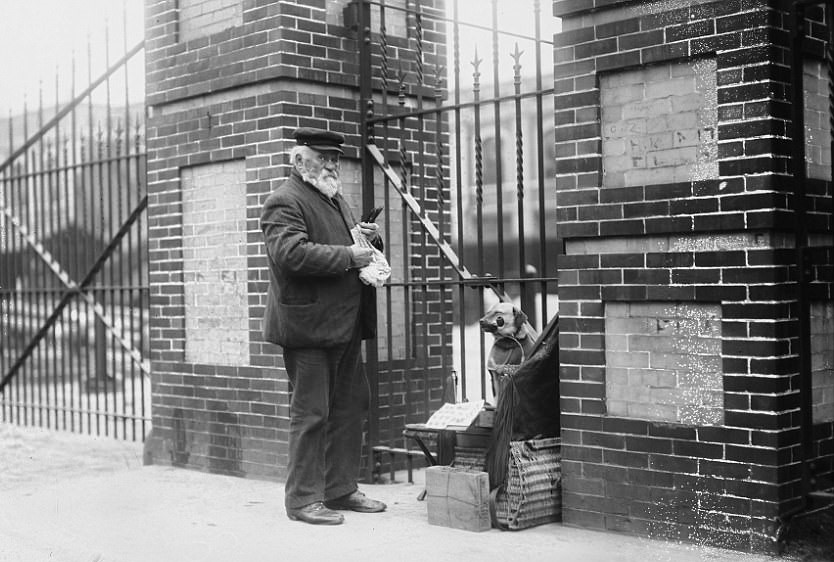
Don’t Call Them Bums:
The Unsung History of America’s Hard-Working Hoboes.
Despite the ever-widening wealth gap, most of us continue to grasp at the American Dream, which promises financial security in exchange for hard work. In fact, for many workers in today’s economy, attaining middle-class status is exactly that—a dream—while digital technologies have pushed enormous numbers of steady-paycheck employees into the unpredictable “gig economy”, where contracts are the norm.
 If you broke the Hobo code you would be punished by other Hobo’s for it.
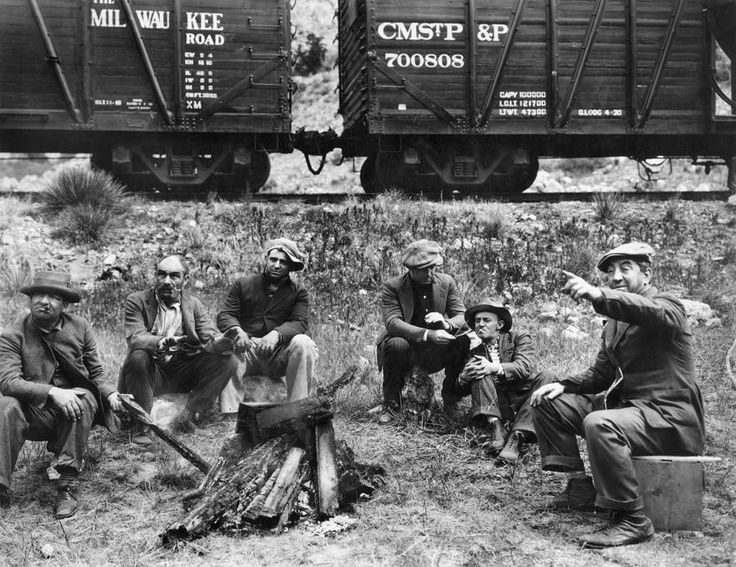
Roughly 140 years ago, American workers faced a different set of economic uncertainties, as machines began to replace able-bodied men in factories and on farms. But back then, a safety net existed in the form of the newly laid railroad, which promised hope to workers willing to trade the comforts of hearth and home for a chance at gainful employment. All one had to do was hop a train to a new town and declare himself a hobo.
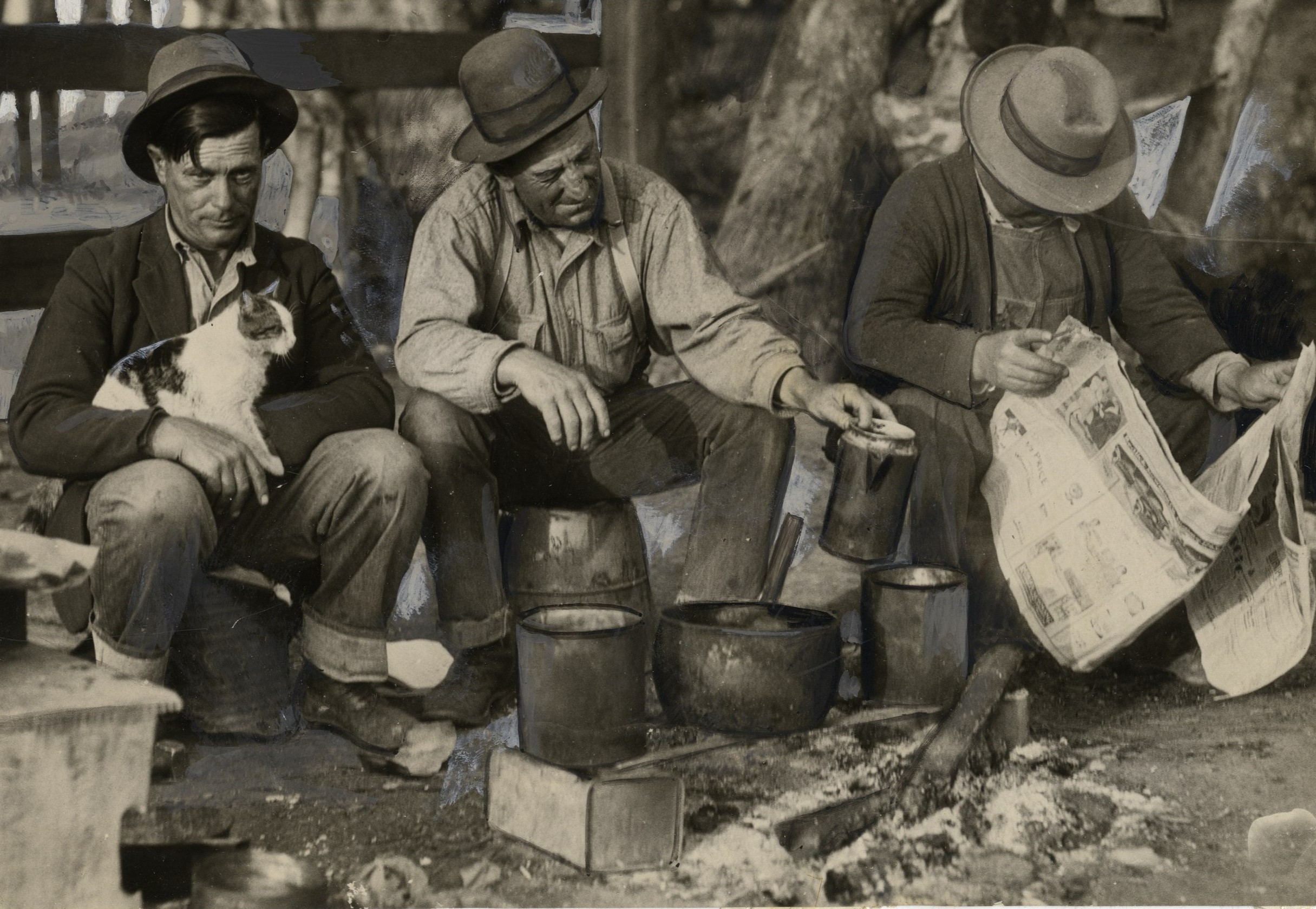
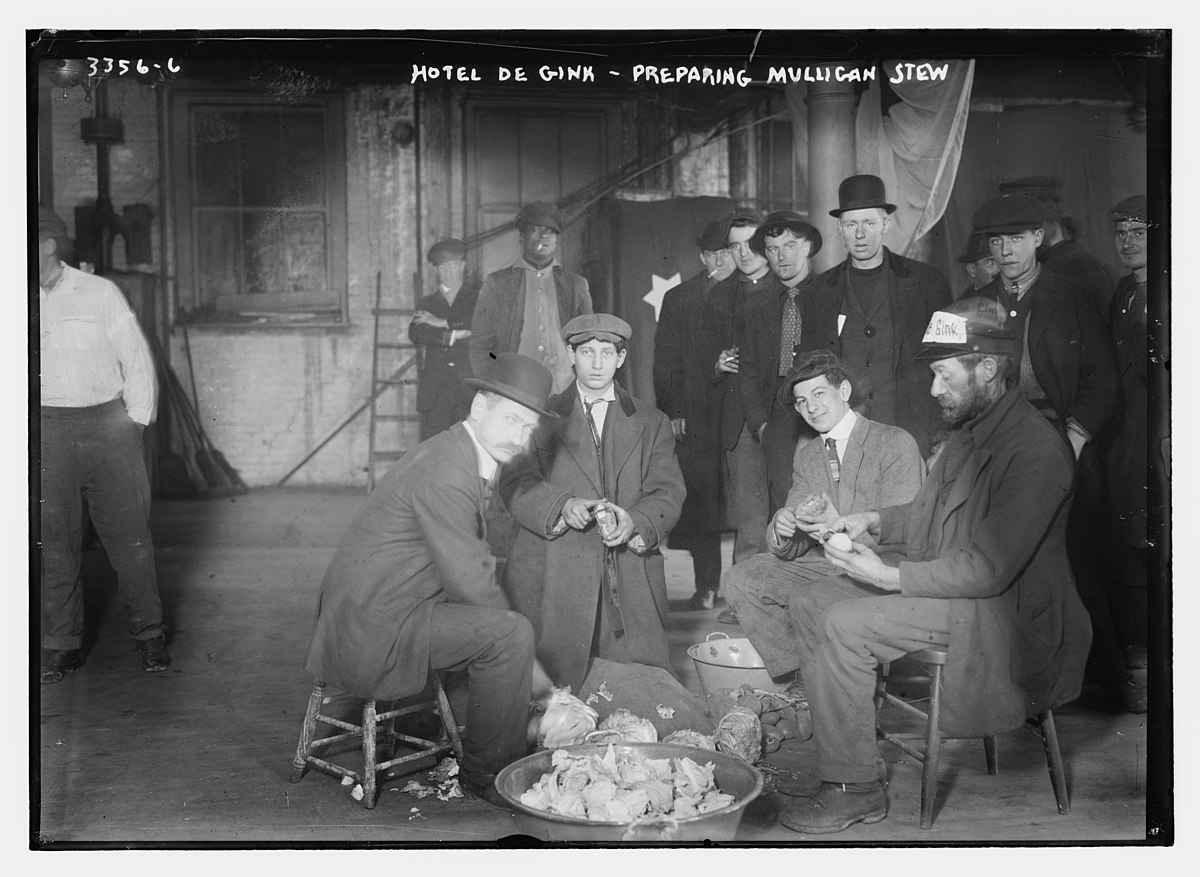
 Hobo’s during their Soup-time, ingredients from all, soup for all. In one article I read that one Hobo brought a whole turkey. His part to the soup was that he left the turkey for one and a half hour to cook in the soup (great flavor), then took it out and kept it for a later use. The later use was a fantastic roast over open camp fire and the bones were kept again and used in another soup cooking. Great Hobo story, right ?
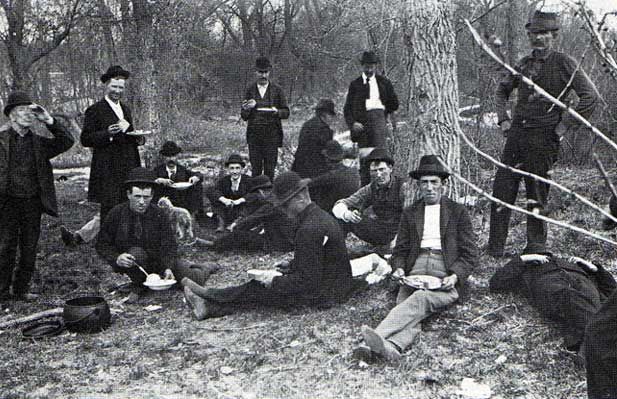
The first and foremost thing to understand about hoboes is that hoboes are not bums. Got that? Hoboes are not bums. Hoboes fully embrace the Protestant work ethic, bouncing from place to place, looking for short-term jobs to earn their keep, while bums and tramps want to just bum everything—money, food, or cigarettes. But free-loading tramps and hard-working hoboes have one thing in common: Both have traveled the rails, starting in the 19th century, much to the chagrin of the railroad owners. So-called bums, who might be too old, disabled, or ill to work, tend to stay in one place.
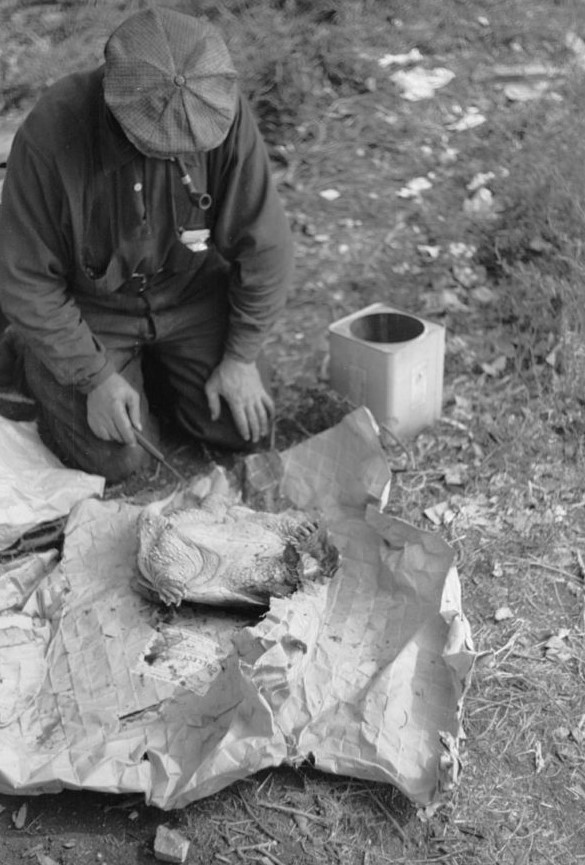
 Hobo preparing a turtle for the soup. Hobo-Turtle-Soup.
Today, the word “hobo” tends to call up one of two caricatures deeply ingrained in our collective imagination: One is a sad sack with saggy pants, five-o’-clock shadow, and a bindle stick, probably passed out in some alley with a bottle of whiskey—an image that’s interchangeable with that of a bum.
 Hobo life in songs and movies with Johnny Cash.

The other is a fantasy about living free on the fringes society: jumping boxcars despite the danger, wandering from town to town with no roots or commitments, sleeping under the stars with fellow hoboes who trade banjo tunes and wild stories. Woody Guthrie, Jack London, Ernest Hemingway, James Michener, Louis L’Amour, Clark Gable, Johnny Cash and multi-millionaire Winthrop Rockefeller were all drawn to this untethered lifestyle and told stories about their time on the rails, burnishing the legend.
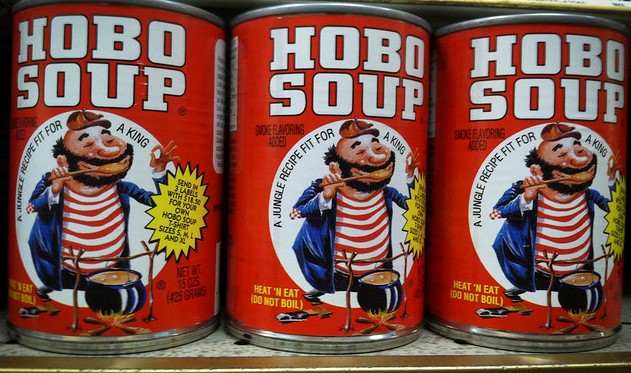
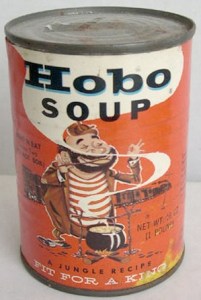 Hobo Soup Can from the 1950’s-1960’s.
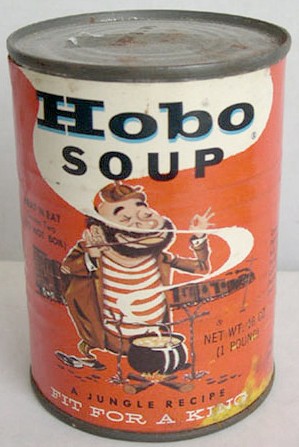
This soup was the brainchild of a small-town newspaperman from Ortonville, Minn., who in 1953 went into the local hobo camps in search of a feature story. As a result he was treated to old-fashioned homemade hobo soup and felt the world should share in this down-to-earth cuisine. Made with beans, potatoes, carrots, tomatoes, celery, onions, and turnips, and flavored with bacon to give it a satisfying smoky taste, this thick and hearty vegetable soup is literally a meal in itself. Simply heat and eat.
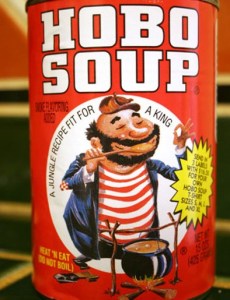 Same soup still available today.
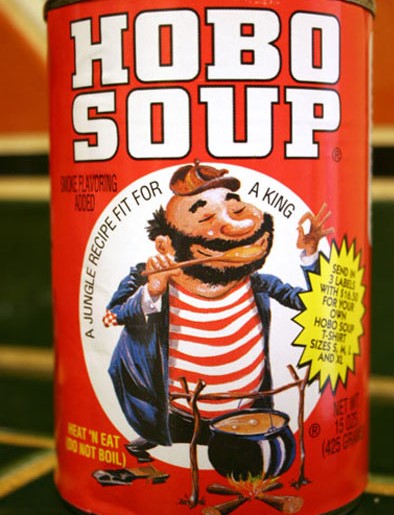
The Hobo Soup.
A classic soup that was made in the Hobo camps across the U.S. as those who rode the rails became a part of the history of America. Hobo Soup was typically made with a random array of ingredients provided from those gathering around the soup caldron, which may have consisted of whatever was found in gardens and was given to the Hobo from kitchens as they came upon those willing to provide food for the camp. Today, some of the commercially produced Hobo Soups contain ingredients that were commonly a part of the traditional soups when they were made in Hobo camps. Ingredients such as navy beans, carrots, celery, onions, potatoes, sweet peppers, tomatoes, turnips, and herbs were all common elements cooked into the legendary Hobo Soup.
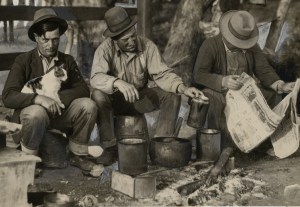 A hard life during great depression and prohibition.
Ingredients.
1 liter (32 fluid ounce) container beef broth, or more if needed
500gr (1 pound) ground beef
500ml (16 ounce) can whole kernel corn, drained
500ml 1 (16 ounce) can green beans, drained
500ml 1 (16 ounce) can peas, drained
500ml 1 (16 ounce) can tomato sauce
3 large carrots, cut into bite-size pieces
2 large potatoes, peeled and cut into bite-size pieces
1 large onion, chopped
1 large stalk celery, cut into bite-size pieces
3 cloves garlic, minced
1 1/2 tablespoons chopped fresh parsley
1/2 teaspoon celery seed
2 bay leaves
salt and ground black pepper to season

 Without the beef its a wonderful vegetable soup.
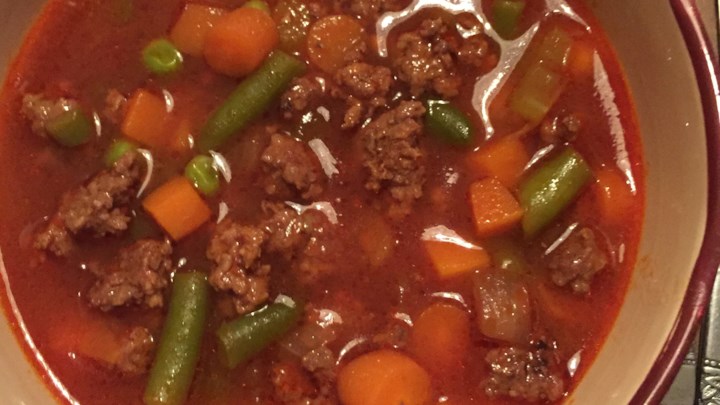

How to do.
Stir beef broth, ground sirloin, corn, green beans, peas, tomato sauce, carrots, potatoes, onion, celery, garlic, parsley, celery seed, and bay leaves together in a slow cooker.
Cook on Low for 4 hours. Check for moisture and add broth as needed. Continue cooking another 4 hours. Season with salt and black pepper. If you cook this soup in a normal pot it will take about one hour or till potatoes and carrots are soft.
 Hobo Soup cans in American supermarkets.
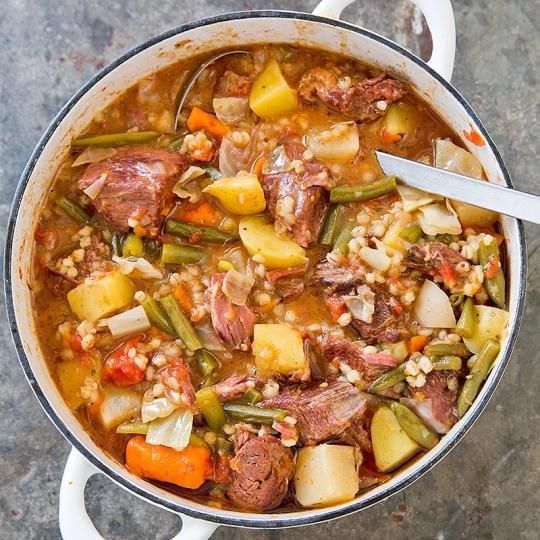
The Hobo Stew.
 Stew ingredients.
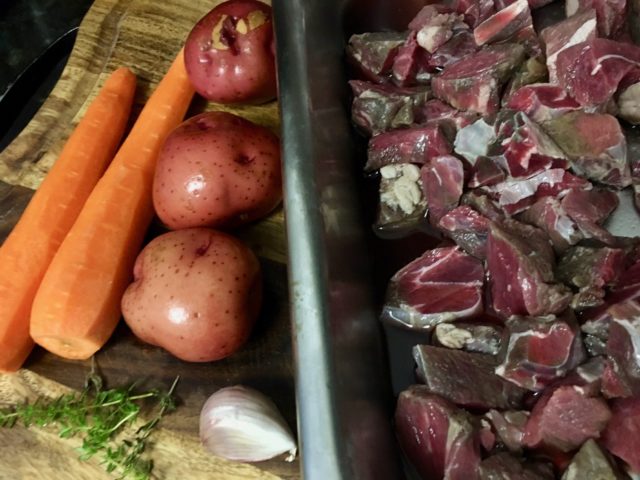
Ingredients.
1 pound stewing beef, cubed
2 tablespoons flour
2-3 tablespoons olive oil
2 onions, chopped
2 garlic cloves, minced
2 medium carrots, chopped
1 pound small potatoes or larger ones chopped
2 sprigs thyme or 1/2 teaspoon dried
1 cup red wine or 1 bottle of dark beer
450gr (14.5 ounces) diced tomatoes canned
1 teaspoon white or brown sugar
salt and pepper to season
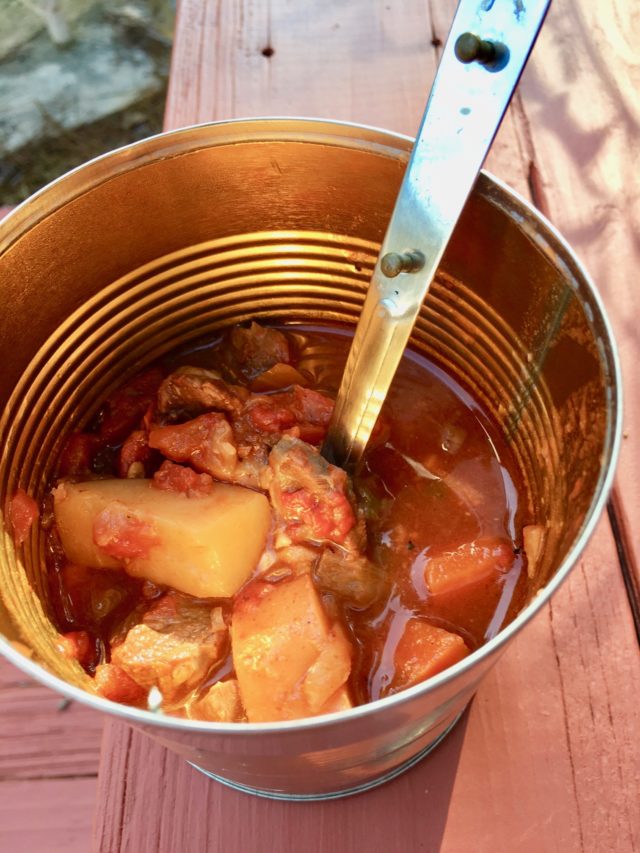
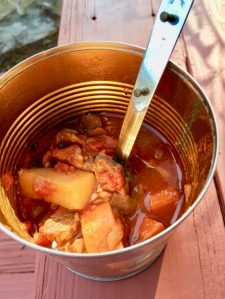 The Hobo Stew.
How to do.
Take cubed beef and marinate in balsamic vinegar for 3 hours or longer. Best is over night. This is helpful for slighter tougher cuts of beef.
In heavy pan over medium heat, heat olive oil. Drain and reserve liquid. Add cubed beef and sprinkle flour over the beef.
Stir to combine. Cook about 3-4 minutes, or until beef cubes are browned. Remove and set aside.
Add onions, garlic, carrots, potatoes and thyme sauteing gently for about 10 minutes. Add more oil if necessary.
Add back beef cubes and reserved liquid to vegetables, along with canned tomatoes, wine or beer, sugar, salt and pepper.
Bring all to a boil and then lower heat to a simmer.
Cover and cook for 1 1/2 to 2 hours or until beef is tender. Correct seasoning.
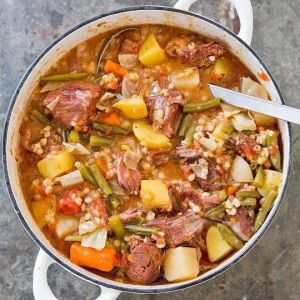 Hearty food for hard workers.
Tips.
As this is an improvised stew, feel free to add vegetables on hand—turnips, parsnips, mushrooms, peas and so on. While fresh is always better, use canned or frozen when needed. Use in total about 1500gr (3 pounds) of vegetables.
If you do not use or have wine or beer, marinate the beef in 2 -3 tablespoons balsamic vinegar. Drain before sautéing and do not add back into mixture.
You also may cook the stew in a 160 C (325 F) oven for 2 hours or until beef is tender.
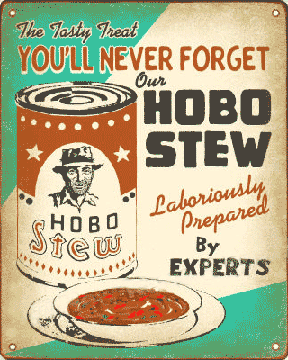
 Advertising Hobo Stew in the 1930’s.
Some readers might be interested in life, history and backgrounds of the American Hobo Time. Just have a good look in the internet, you will find lots of articles, books, movie’s and much more. Here are two very interesting sites, with lots of pictures (I took the chance to use some of them in this article), which can give you a deeper insight of this part of American history. Enjoy it with some soup or stew !
https://www.smithsonianmag.com/arts-culture/last-great-american-hobos-180971913/

