A Christmas Story

These Season Greetings I like to wish all of you. This year I like to publish a little story about Christmas for the youngsters in your family.
Take the chance to read it to your kids, all of you will enjoy it. I know the  translation, in case you need it, is not perfect, but it will help. Just click on „Google Translate“ to your right. Sadly they do not offer translation into English, not even into „American“. Can you believe it ?  Poor poor people our American friends.  Have fun !

Der kleine Tannenbaum.

Es war einmal ein kleiner Tannenbaum im tiefen Tannenwalde, der wollte so gerne ein Weihnachtsbaum sein. Aber das ist gar nicht so leicht, als man das meistens in der Tannengesellschaft annimmt, denn der heilige Nikolaus ist in der Beziehung sehr streng und erlaubt nur den Tannen als Weihnachtsbaum in Dorf und Stadt zu spazieren, die dafür ganz ordnungsmäßig in seinem Buch aufgeschrieben sind.

   Das grosse Buch des Nikolaus.

Das Buch ist ganz erschrecklich groß und dick, so wie sich das für einen guten alten Heiligen geziemt, und damit geht er im Walde herum in den klaren kalten Winternächten und sagt es allen den Tannen, die zum Weihnachtsfeste bestimmt sind.

  So geht der Nikolaus im Tannenwald herum.

Und dann erschauern die Tannen, die zur Weihnacht erwählt sind, vor Freude und neigen sich dankend und dazu leuchtet des Heiligen Heiligenschein und das ist sehr schön und sehr feierlich.

Und der kleine Tannenbaum im tiefen Tannenwalde, der wollte so gerne ein Weihnachtsbaum sein.

  Der kleine Tannenbaum im tiefen Wald.

Aber manches Jahr schon ist der heilige Nikolaus in den klaren kalten Winternächten an dem kleinen Tannenbaum vorbeigegangen und hat wohl ernst und geschäftig in sein erschrecklich großes Buch geguckt, aber auch nichts und gar nichts dazu gesagt. Der arme kleine Tannenbaum war eben nicht ordnungsmäßig vermerkt – und da ist er sehr, sehr traurig geworden und hat ganz schrecklich geweint, so dass es ordentlich tropfte von allen Zweigen.

  So schlimm weint der kleine Tannenbaum.

Wenn jemand so weint, dass es tropft, so hört man das natürlich, und diesmal hörte das ein kleiner Wicht, der ein grünes Moosröcklein trug, einen grauen Bart und eine feuerrote Nase hatte und in einem dunklen Erdloch wohnte. Das Männchen aß Haselnüsse, am liebsten hohle, und las Bücher, am liebsten dicke, und war ein ganz boshaftes kleines Geschöpf.

Aber den Tannenbaum mochte es gerne leiden, weil es oft von ihm ein paar grüne Nadeln geschenkt bekam für sein gläsernes Pfeifchen, aus dem es immer blaue ringelnde Rauchwolken in die goldene Sonne blies – und darum ist der Wicht auch gleich herausgekommen, als er den Tannenbaum so jämmerlich weinen hörte und hat gefragt: „Warum weinst du denn so erschrecklich, dass es tropft?“

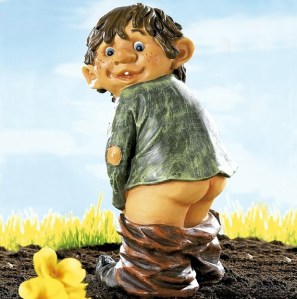
  Die kleinen Wichte die im Walde leben machen Musik, treiben Unsinn oder rauchen ihr Pfeifchen.

Da hörte der kleine Tannenbaum etwas auf zu tropfen und erzählte dem Männchen sein Herzeleid. Der Wicht wurde ganz ernst und seine glühende Nase glühte so sehr, dass man befürchten konnte, das Moosröcklein finge Feuer, aber es war ja nur die Begeisterung und das ist nicht gefährlich.

Der Wichtelmann war also begeistert davon, dass der kleine Tannenbaum im tiefen Tannenwalde so gerne ein Weihnachtsbaum sein wollte, und sagte bedächtig, indem er sich aufrichtete und ein paar Mal bedeutsam schluckte:
„Mein lieber kleiner Tannenbaum, es ist zwar unmöglich, dir zu helfen, aber ich bin eben ich und mir ist es vielleicht doch nicht unmöglich, dir zu helfen. Ich bin nämlich mit einigen Wachslichtern, darunter mit einem ganz bunten, befreundet, und die will ich bitten zu dir zu kommen. Auch kenne ich ein großes Pfefferkuchenherz, das allerdings nur flüchtig – aber jedenfalls will ich sehen, was sich machen lässt. Vor allem aber weine nicht mehr so erschrecklich, dass es tropft.“

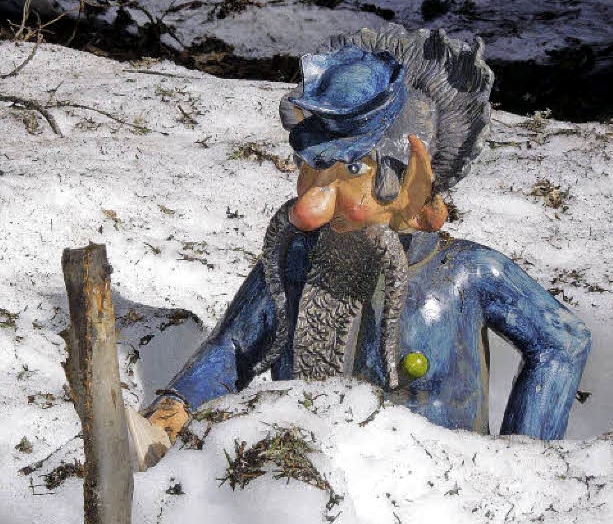
  Also los Wichtel, raus aus dem Schneebett.

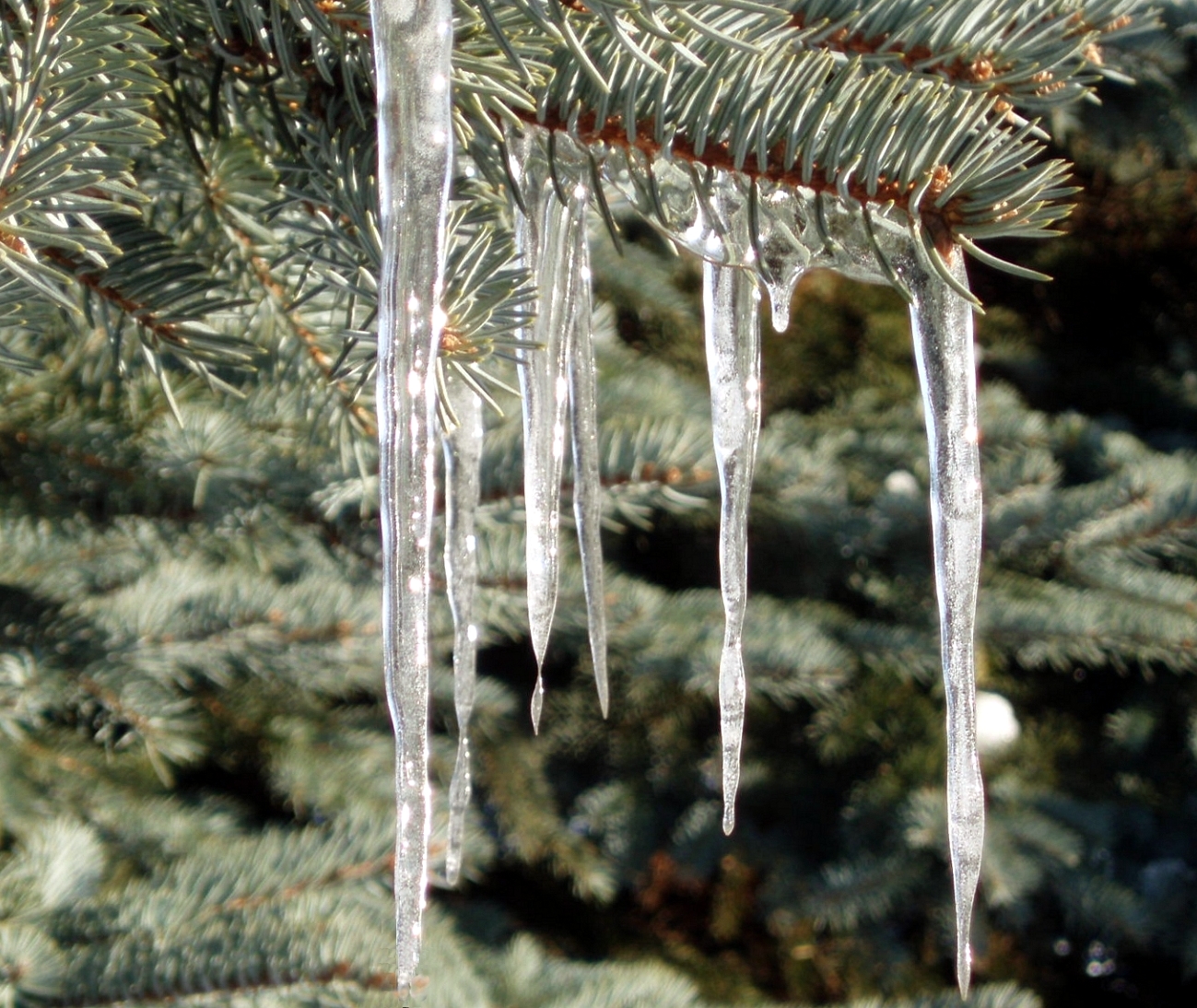
Damit nahm der kleine Wicht einen Eiszapfen in die Hand als Spazierstock und wanderte los durch den tiefen weißverschneiten Wald, der fernen Stadt zu.

Es dauerte sehr, sehr lange, und am Himmel schauten schon die ersten Sterne der heiligen Nacht durchs winterliche Dämmergrau auf die Erde hinab und der kleine Tannenbaum war schon wieder ganz traurig geworden und dachte, dass er nun doch wieder kein Weihnachtsbaum sein würde.

  So ein schoener Weihnachtsbaum, geschmueckt und mit vielen Lichtern,  waere auch unser kleiner Tannenbaum gern.

Aber da kam’s auch schon ganz eilig und aufgeregt durch den Schnee gestapft, eine ganze kleine Gesellschaft: der Wicht mit dem Eiszapfen in der Hand und hinter ihm sieben Lichtlein – und auch eine Zündholzschachtel war dabei, auf der sogar was draufgedruckt war und die so kurze Beinchen hatte, dass sie nur mühsam durch den Schnee wackeln konnte.

   Da kommen die ganzen Lichtlein anmaschiert.

Wie sie nun alle vor dem kleinen Tannenbaum standen, da räusperte sich der kleine Wicht im Moosröcklein vernehmlich, schluckte ein paar Mal gar bedeutsam und sagte:
„Ich bin eben ich – und darum sind auch alle meine Bekannten mitgekommen. Es sind sieben Lichtlein aus allervornehmstem Wachs, darunter sogar ein buntes, und auch die Zündholzschachtel ist aus einer ganz besonders guten Familie, denn sie zündet nur an der braunen Reibfläche.

   Das grosse Pfefferkuchenherz.

Und jetzt wirst du also ein Weihnachtsbaum werden. Was aber das große Pfefferkuchenherz betrifft, das ich nur flüchtig kenne, so hat es auch versprochen zu kommen, es wollte sich nur noch ein Paar warme Filzschuhe kaufen, weil es gar so kalt ist draußen im Walde.

Eine Bedingung hat es freilich gemacht: es muss gegessen werden, denn das müssen alle Pfefferkuchenherzen, das ist nun mal so.

  Ein dicker Dachs kommt aus seiner Hoehle.

Ich habe schon einen Dachs benachrichtigt, den ich sehr gut kenne und dem ich einmal in einer Familienangelegenheit einen guten Rat gegeben habe. Er liegt jetzt im Winterschlaf, doch versprach er, als ich ihn weckte, das Pfefferkuchenherz zu speisen. Hoffentlich verschläft er’s nicht!“

Als das Männchen das alles gesagt hatte, räusperte es sich wieder vernehmlich und schluckte ein paar Mal gar bedeutsam und dann verschwand es im Erdloch. Die Lichtlein aber sprangen auf den kleinen Tannenbaum hinauf und die Zündholzschachtel, die aus so guter Familie war, zog sich ein Zündholz nach dem anderen aus dem Magen, strich es an der braunen Reibfläche und steckte alle die Lichtlein der Reihe nach an.

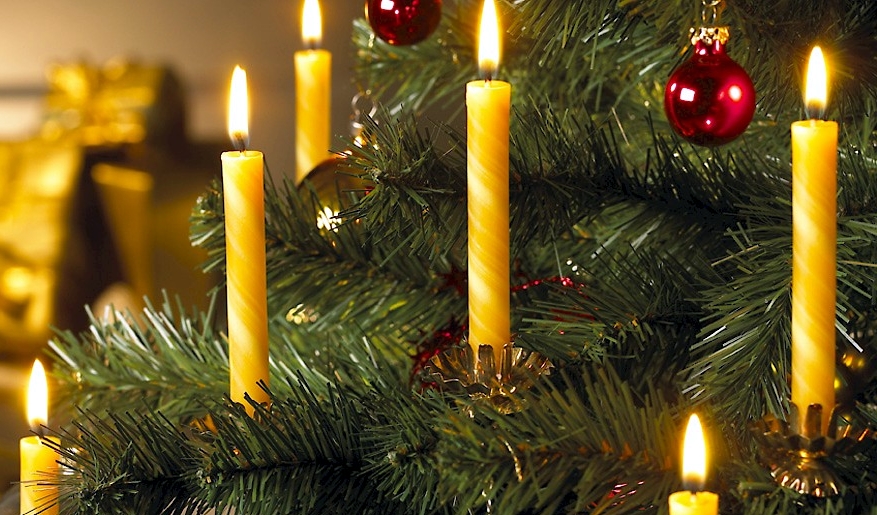
  Nun brennen die Lichter am kleinen Baum.

Und wie die Lichtlein brannten und leuchteten im tiefverschneiten Walde, da ist auch noch keuchend und atemlos vom eiligen Laufen das Pfefferkuchenherz angekommen und hängte sich sehr freundlich und verbindlich mitten in den grünen Tannenbaum, trotzdem es nun doch die warmen Filzschuhe unterwegs verloren hatte und arg erkältet war.

Der kleine Tannenbaum aber, der so gerne ein Weihnachtsbaum sein wollte, der wusste gar nicht, wie ihm geschah, dass er nun doch ein Weihnachtsbaum war.

Am anderen Morgen aber ist der Dachs aus seiner Höhle gekrochen, um sich das Pfefferkuchenherz zu holen. Und wie er ankam, da hatten es die kleinen Englein schon gegessen, die ja in der heiligen Nacht auf die Erde dürfen und die so gerne die Pfefferkuchenherzen speisen.

   So ein Frechdachs !

Da ist der Dachs sehr böse geworden und hat sich bitter beklagt und ganz furchtbar auf den kleinen Tannenbaum geschimpft.

Dem aber war das ganz einerlei, denn wer einmal in seinem Leben seine heilige Weihnacht gefeiert hat, den stört auch der frechste Frechdachs nicht mehr.

Veröffentlicht unter Uncategorized | Verschlagwortet mit | Hinterlasse einen Kommentar

Best Steak Ever


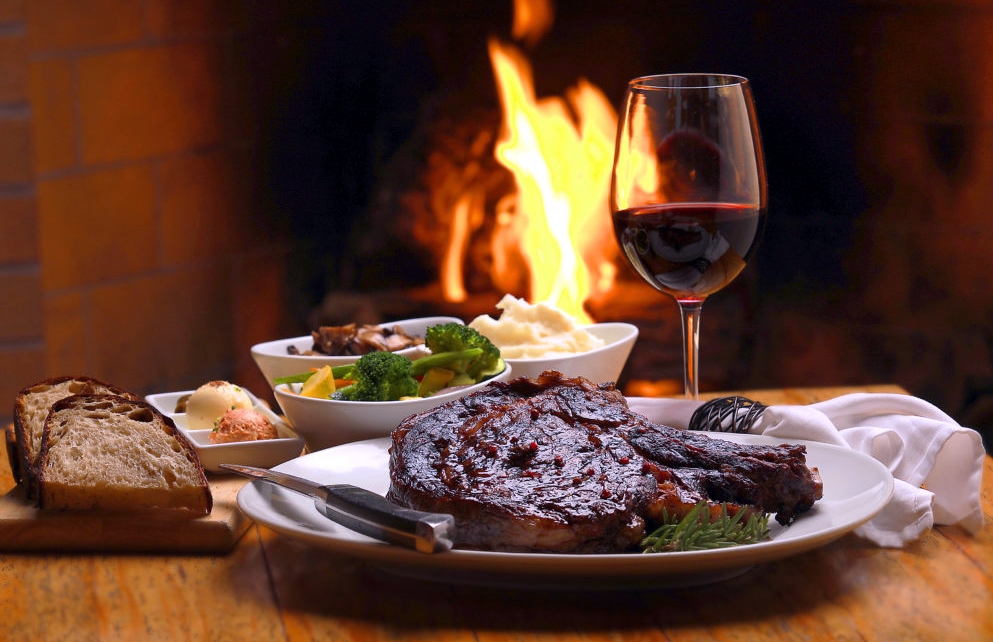
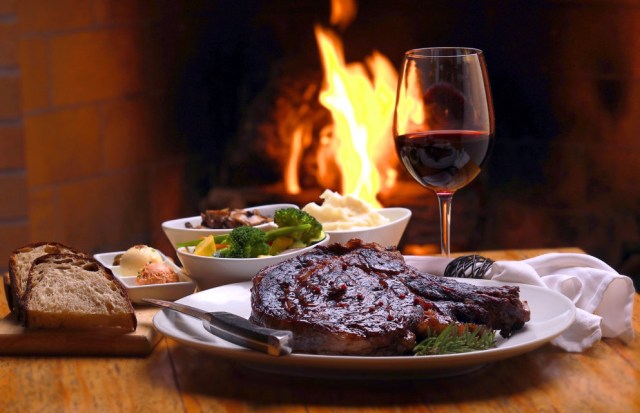
What a feast, a wonderful Angus steak (450g – 14oz, bone-in ribeye), fresh vegetables, garlic mash, wild mushrooms and three kinds of steak butter. Accomplished with German bread and a strong red wine as well as the atmosphere in front of a crackling open fire . Picture from Saddles Steakhouse at Sonoma. This delicious meal was US$68,–pp incl. wine.  WOW !

Last week we had a small „boy’s party“ with fantastic „German potato salad“ and „40-day dry-aged steak“ from the grill. It was delicious as above, but much cheaper. Of course we had a discussion about steaks. What kind, how they are named and what’s the best way to grill it, in a pan or on the „barbie“.
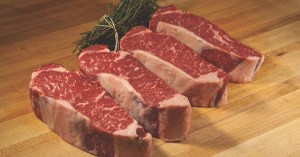
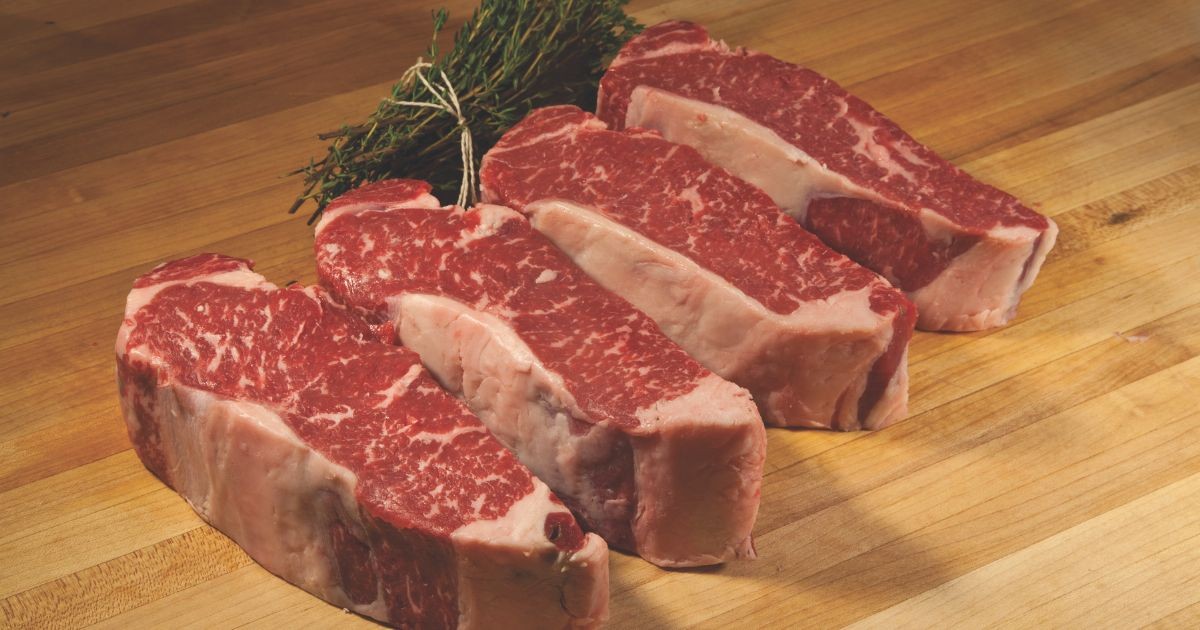
  Our dry aged sirloins. In Uruguay I paid US$ 17,50 per kilogram. In the US they charge for the above 4 sirloins, 16 oz each, 40 days aged (same as we had) around US$ 256,– (that’s US$ 128,– per kilo), seen at „Goldbelly’s“.   Unbelievable !  Don’t worry, their delivery is included !

It direct inspired me to write a few basics down, especially because the BBQ season in our southern hemisphere just started.  It is so much written about the perfect steak and so many information’s are available that I will concentrate on some basic knowledge only. Still – during my research I came along almost 200 different designations of steak. And that did not include all the steak recipe names.  have a look at the following:

https://www.chefs-resources.com/types-of-meat/beef/cuts-of-beef/cuts-of-steak-and-alternate-steak-names/
There are hundreds of different names for steaks sold at restaurants and supermarkets, just in the US.

What’s a steak ?

A steak is a meat generally sliced across the muscle fibers, potentially including a bone.   In a larger sense, there are also fish steaks, ground meat steaks, pork steaks and many other varieties of steak.
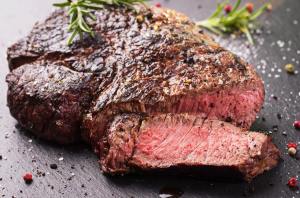
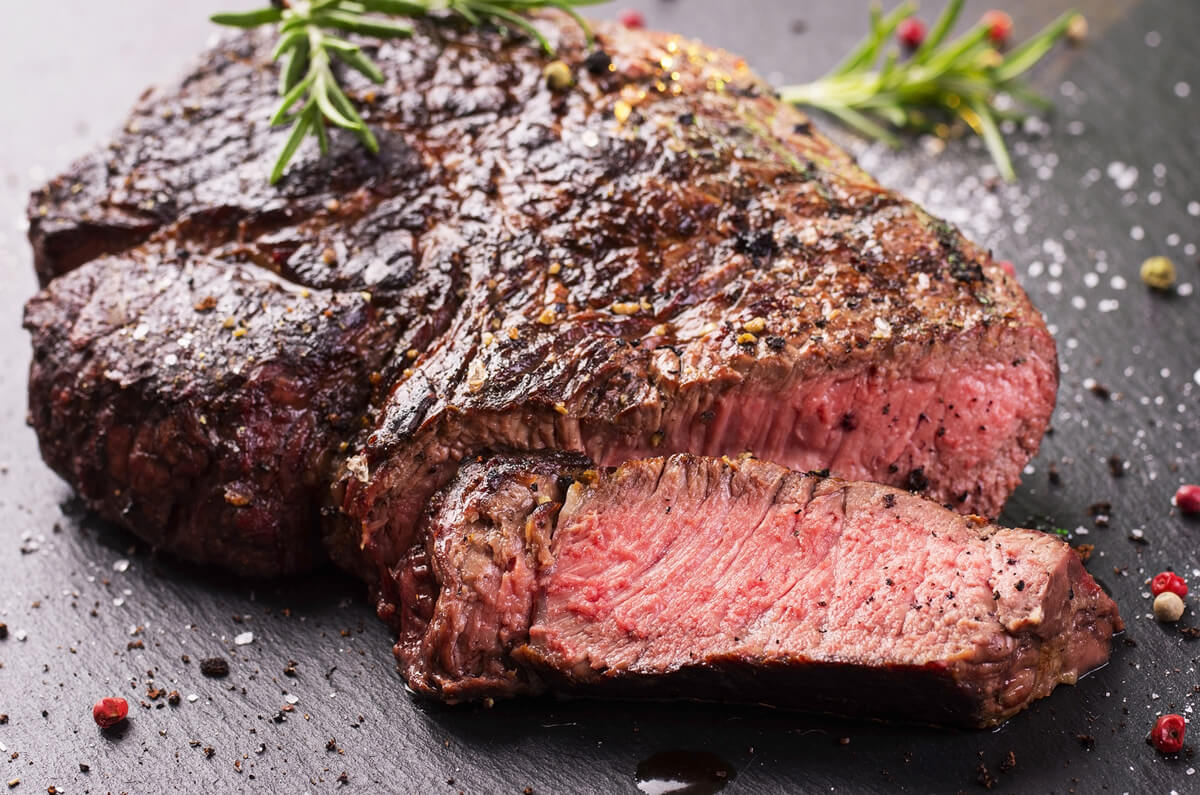
       That’s a steak I like ! A 1-pounder, means about 500 gram (16 oz) of finest sirloin, cooked to perfection. Crusty brown outside, juicy and soft rose inside.

Steak is usually grilled, but can be pan-fried or broiled in the oven.  Steak can also be cooked in sauce, such as in steak and kidney pie, or minced and formed into patties, such as hamburgers.

Steaks are often cut from grazing animals, usually farmed, other than cattle, including chicken, bison, camel, goat, horse, kangaroo, sheep, ostrich, pigs, reindeer, turkey, deer and zebu as well as various types of fish, especially salmon and large pelagic fish such as swordfish, tuna, shark and marlin.

In this article we will concentrate on „beef steak“ in our usual form of usage.
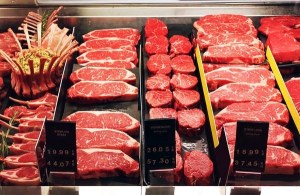
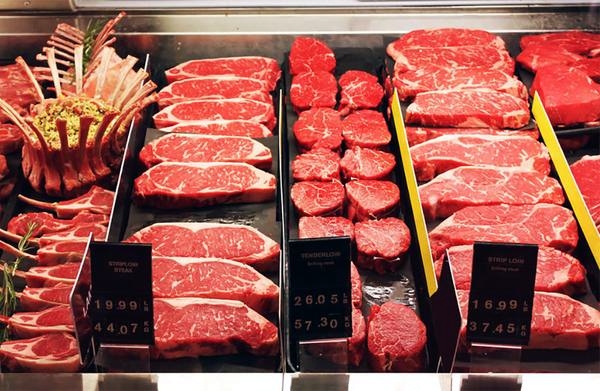
  Every butcher should have the chance to offer his cuts like this. But sadly the reality is different.

Four cuts of Steak one should know about.

Let’s talk steak – a big, beautiful slab of beef. in my early years I used to only eat steak when I was treated to an old-school steakhouse, while visiting the US or Australia. And while I relished every minute of those meals, the menu always intimidated me. What was the difference between a New York steak and a ribeye ? Why was filet mignon so freakin‘ expensive ? And why we could’nt have restaurants like that in Germany – now we have !

Whether you cook steak at home or save it for a special occasion out like we did, it’s important to know your high-end steak cuts. Here are the four most popular ones, and we’ll cover where they’re cut from, what they taste like, and how best to cook them.
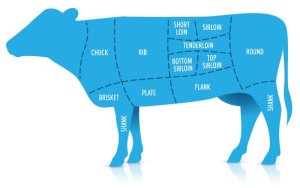
       These cut descriptions are US-American and can differ throughout the rest of the world, especially in beef countries like Australia or Argentina and Uruguay. The American cut names are the most well known.

Where Are They From?

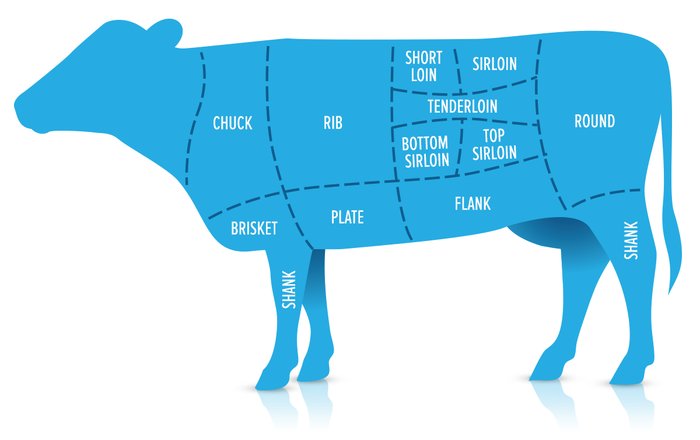
Let’s take a look at the cow diagram above. All four of these steaks come from a few muscles in the same general area toward the top of the steer: the short loin, tenderloin, and the ribs. These muscles aren’t exercised very much or contain a lot of connective tissues that need to be cooked for a long time to be broken down. As contrary we know the shank ( osso bucco or haxn etc.) which needs hours of cooking.
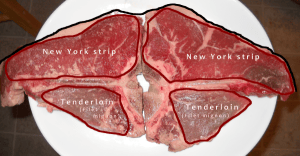
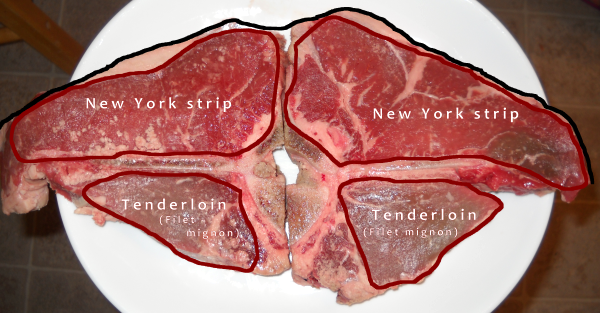
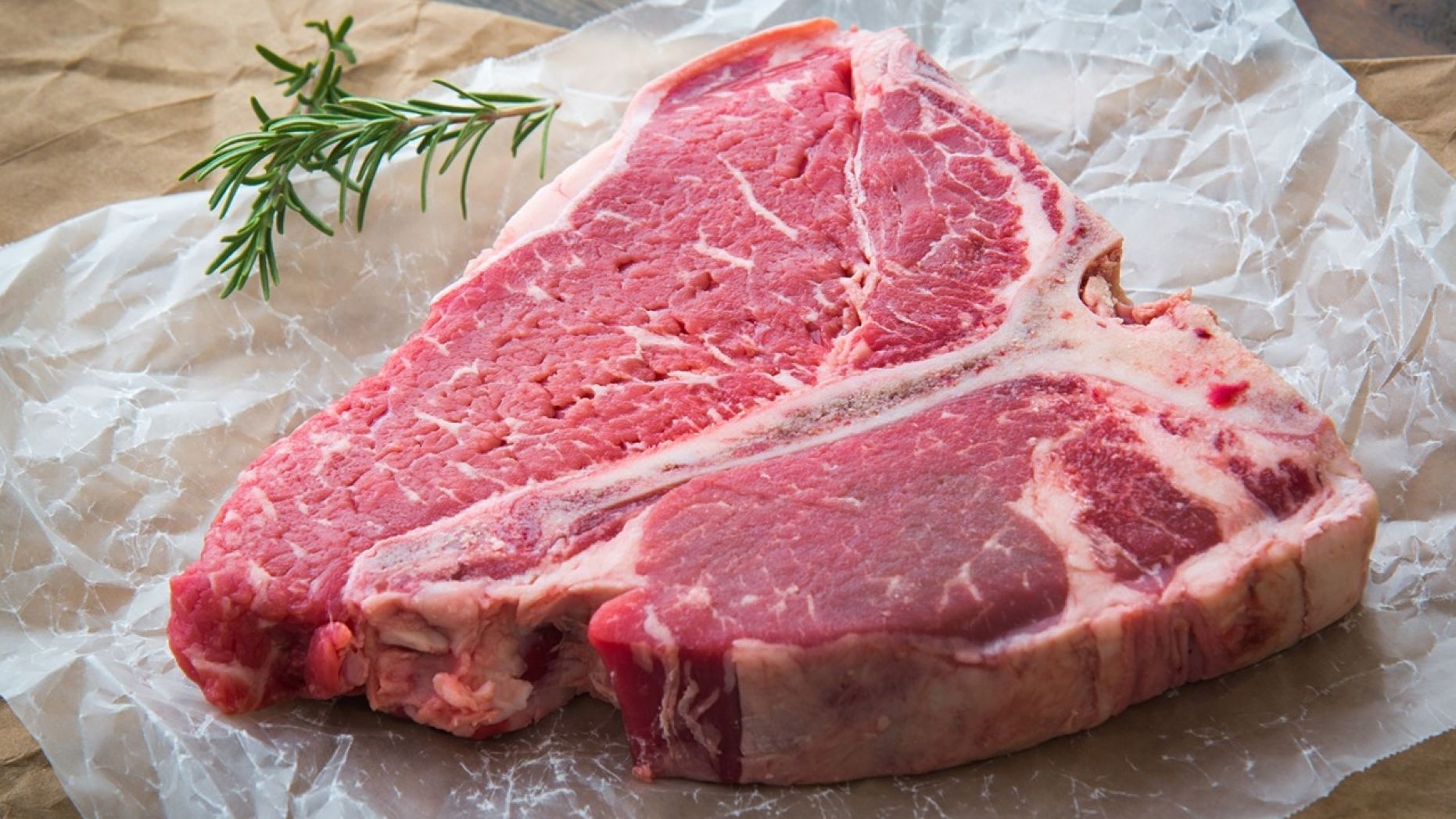
  Before cutting into T-bone’s.

As a result, these steaks are much more tender than other cuts of beef, and fast cooking and intense heat are all that’s needed to char and brown the outside of these meats while the inside can be eaten as rare as you like.

Why Are These Steaks So Expensive?

Relative to the size of the steer, these premium cuts are only a small percentage, which contribute to their premium prices.
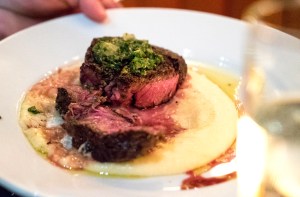
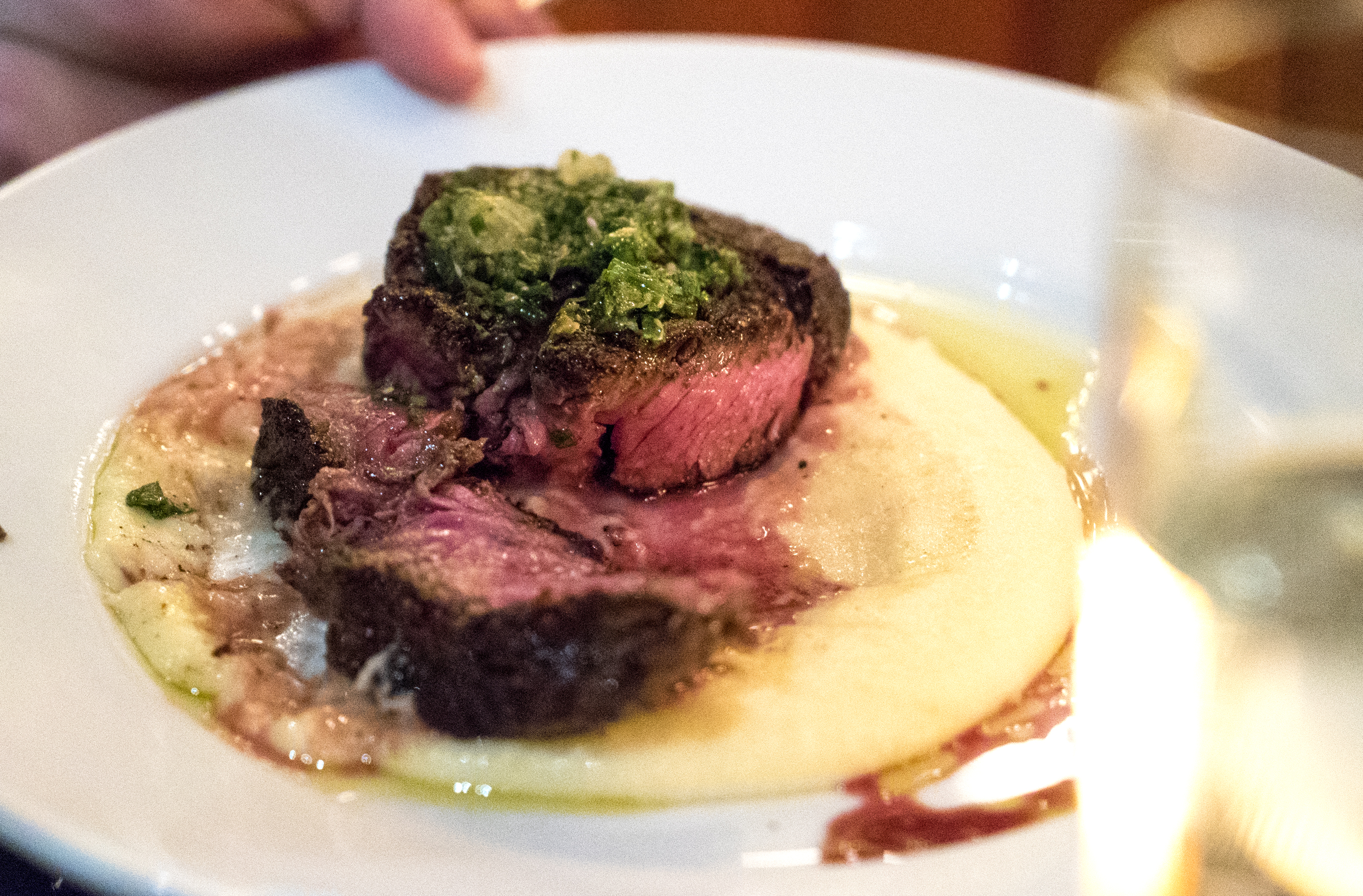
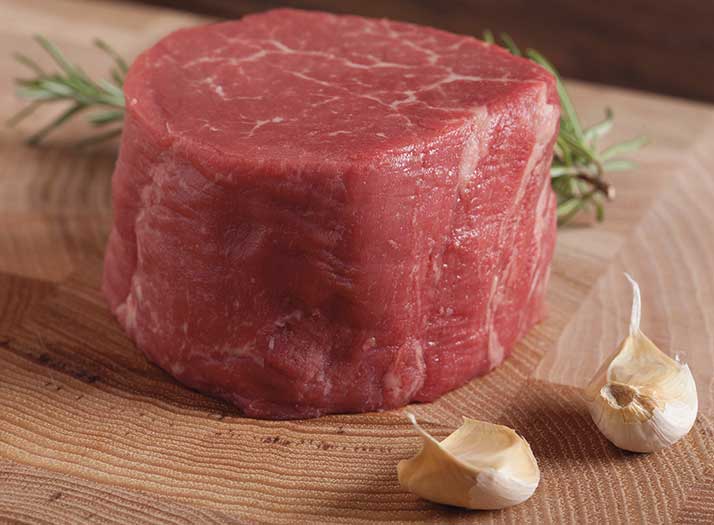
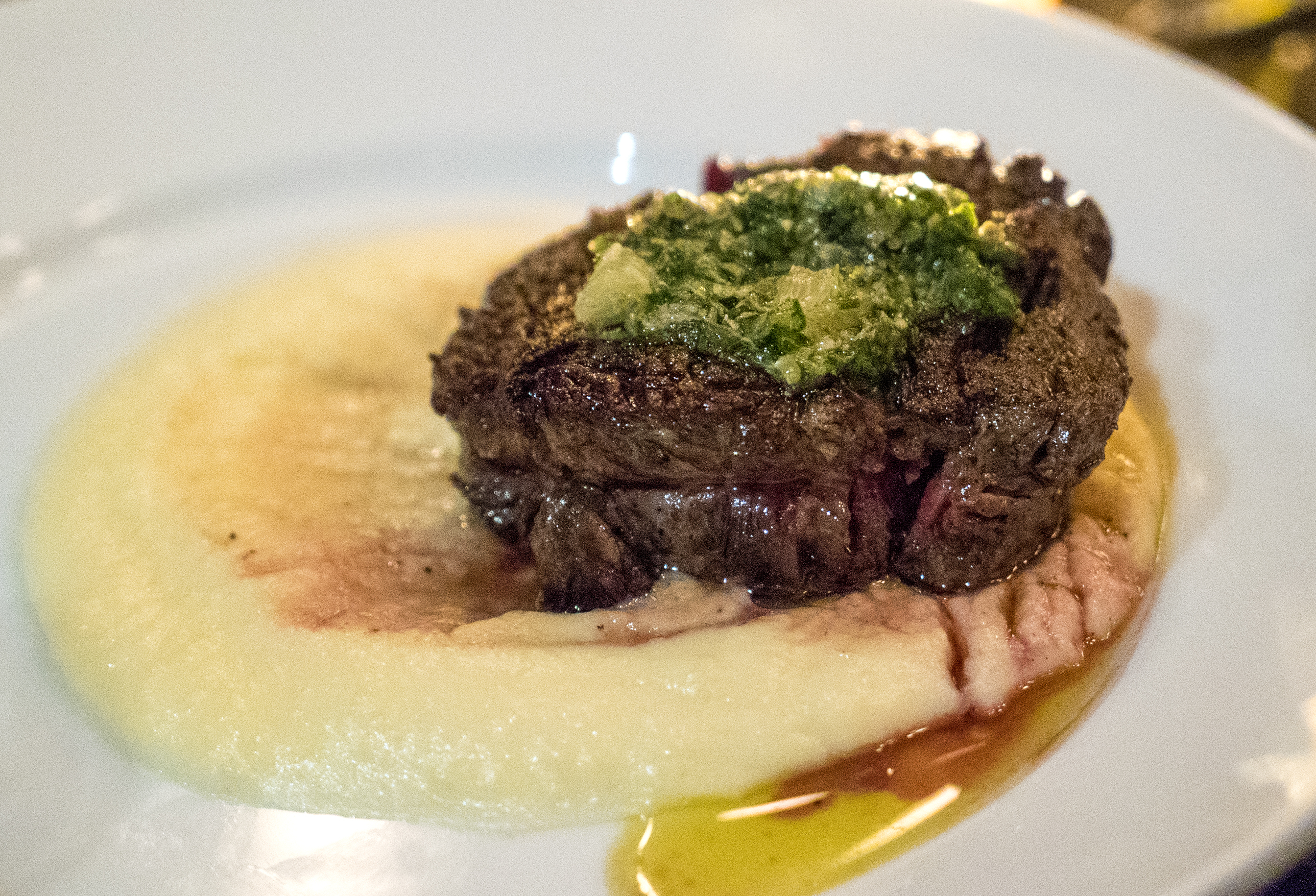
  Filet Mignon on garlic mash, cooked medium rare.

Since they’re expensive, it’s really worth knowing how each one is different so you buy the one that you like the best! Do you like big beefy flavor, or is the tenderest cut your favorite? Here’s everything you need to know about each important cut so that you make a wise choice.  But don’t try in Uruguay, these cuts are widely unknown and almost not available. The broad mass of Uruguayans eat what’s cheap and often crap to my taste. Real good meat (and expensive) is exported and very hard to get here.

1. Tenderloin.
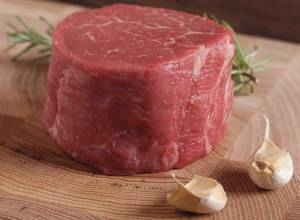
   A Tenderloin or filet steak. In French, the word filet means ribbon, and the filets, two per animal, run like ribbons down the base of the spine. These two muscles on the animal move very little and, consequently, remain tender, hence, the tenderloin.

Other names: Filet Mignon, Chateaubriand, fillet, filet.
How it’s sold: Mostly boneless; the most expensive cut of steak.
Where it’s from: Short loin and sirloin, under the ribs. A whole tenderloin starts out wide and then tapers at the other end (the „tail“). Filet Mignon is from the smaller end; Chateaubriand the thicker end.
What it looks like: When trimmed of silver skin, gristle, and fat, tenderloin is small and compact. The meat is lean and very fine-grained in texture. Because of its smaller shape, tenderloin steaks are cut thicker than most other steaks.
What it tastes like:The tenderest of all the steaks and lean, tenderloin is buttery and mild in flavor.
How to cook it: Because cuts of tenderloin tend to be thick, the best way to cook it is to sear the outside until browned, then finish the cooking in the gentle, even heat of an oven.
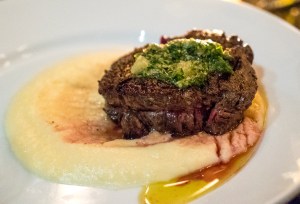
  Small/dainty and no bone, that’s Filet Mignon.

Filet, in culinary terminology, means boneless. Mignon, in French, means dainty or small. As such, this is a steak ideally suited for „chicks“: small/dainty, and with no bone.

2. New York Strip.
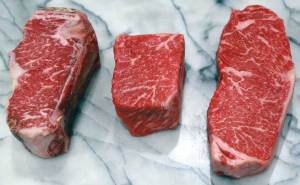
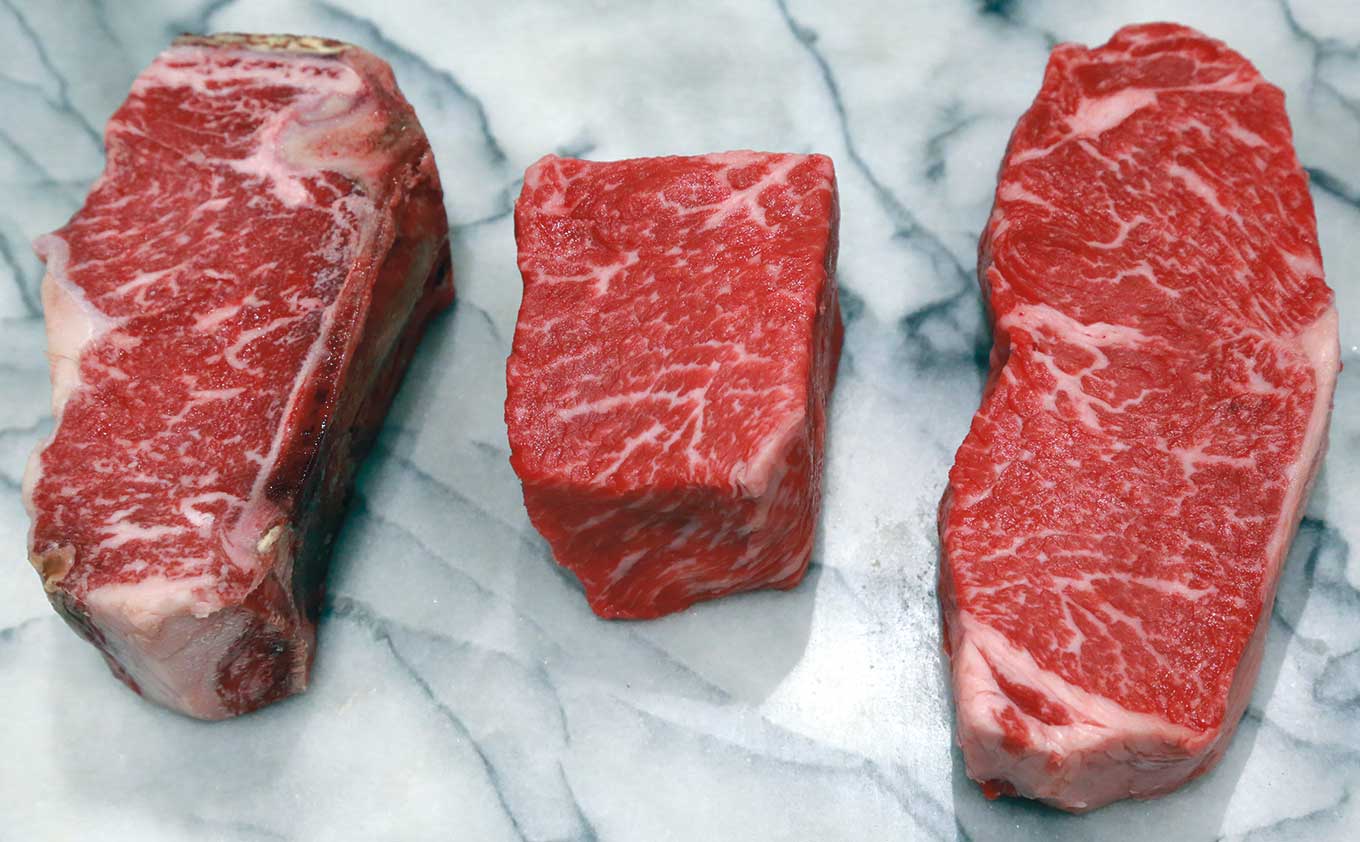
  Some New York cuts, with bone or no bone.

The New York is a strip steak from the short loin, located next to the top of the tenderloin. Speculation is that the Kansas City strip steak changed its label to New York through the cut’s association with Delmonico’s restaurant in the Big Apple. The strip steak popularized near the stockyards of Kansas City traditionally is a bone-in cut. New York strips often are boneless.
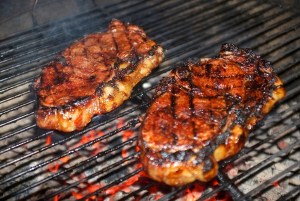
  Grilled New York Top Sirloin.

Other names: Strip, Manhattan, Kansas City strip, top sirloin, top loin, contre-filet.
How it’s sold: Usually boneless.
Where it’s from: Short loin behind the ribs.
What it looks like: Fat on one edge of the steak. While there is some fat marbling throughout, there are no large pockets of fat. The meat is fine-grained in texture.
What it tastes like: With medium fat content, New York strips are tender, but not as tender as tenderloins or ribeyes, and have good, beefy flavor.
How to cook it: Cook over high heat – pan-sear, broil, or grill.

3. T-Bone.
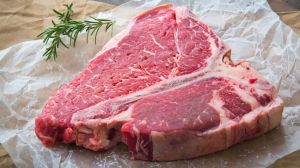
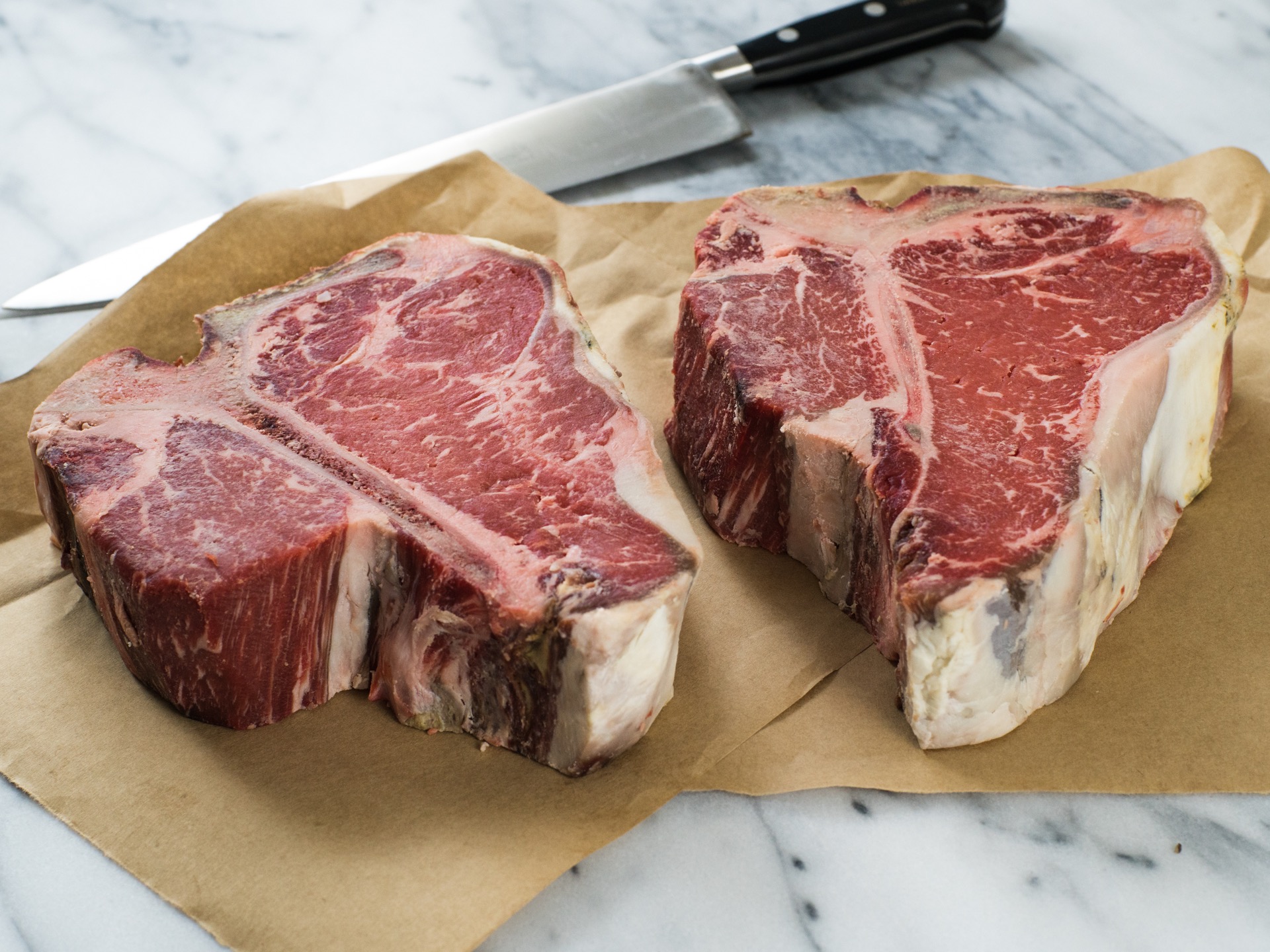
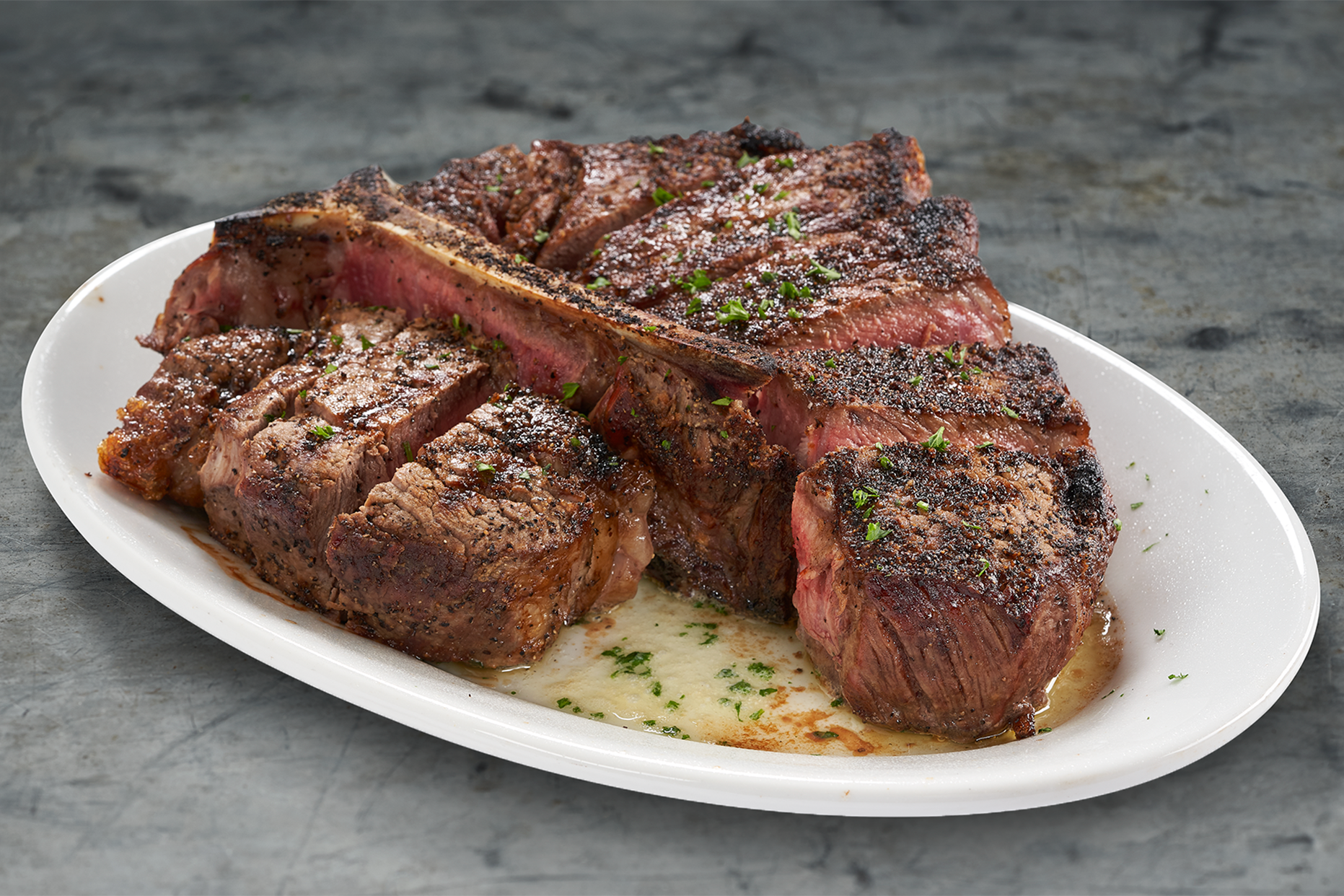
  The typical T-bone steak.

Other names: Porterhouse.
How it’s sold: Bone in.  Usually the Porterhouse has a thicker part of tenderloin.
Where it’s from: A cross section of the unfilleted short loin.
What it looks like: The name says it all; there is a T-shaped bone with meat on both sides of the longer portion of the bone. On one side is a piece of the tenderloin (smaller part), and the other side is New York strip (bigger part). Generous fat marbling throughout.
What it tastes like: You get the best of both worlds with this cut: super-tender, buttery tenderloin, and beefy, juicy strip steak.
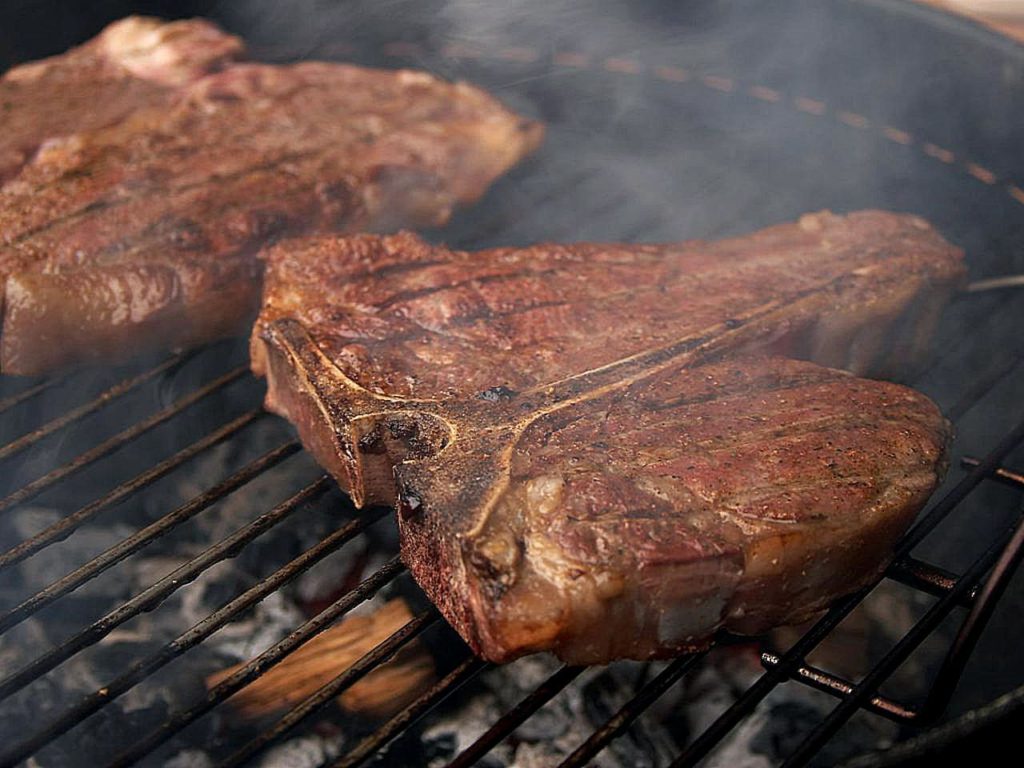
How to cook it: Because there are basically two different kinds of steak in one cut, you have to be careful when cooking since the tenderloin will cook more quickly than the strip side. Try to keep the tenderloin further away from the heat source. Use a two-level fire when grilling or position it away from the heating element if broiling.
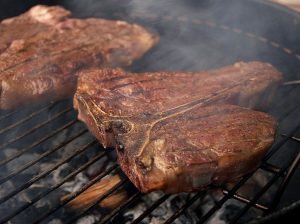
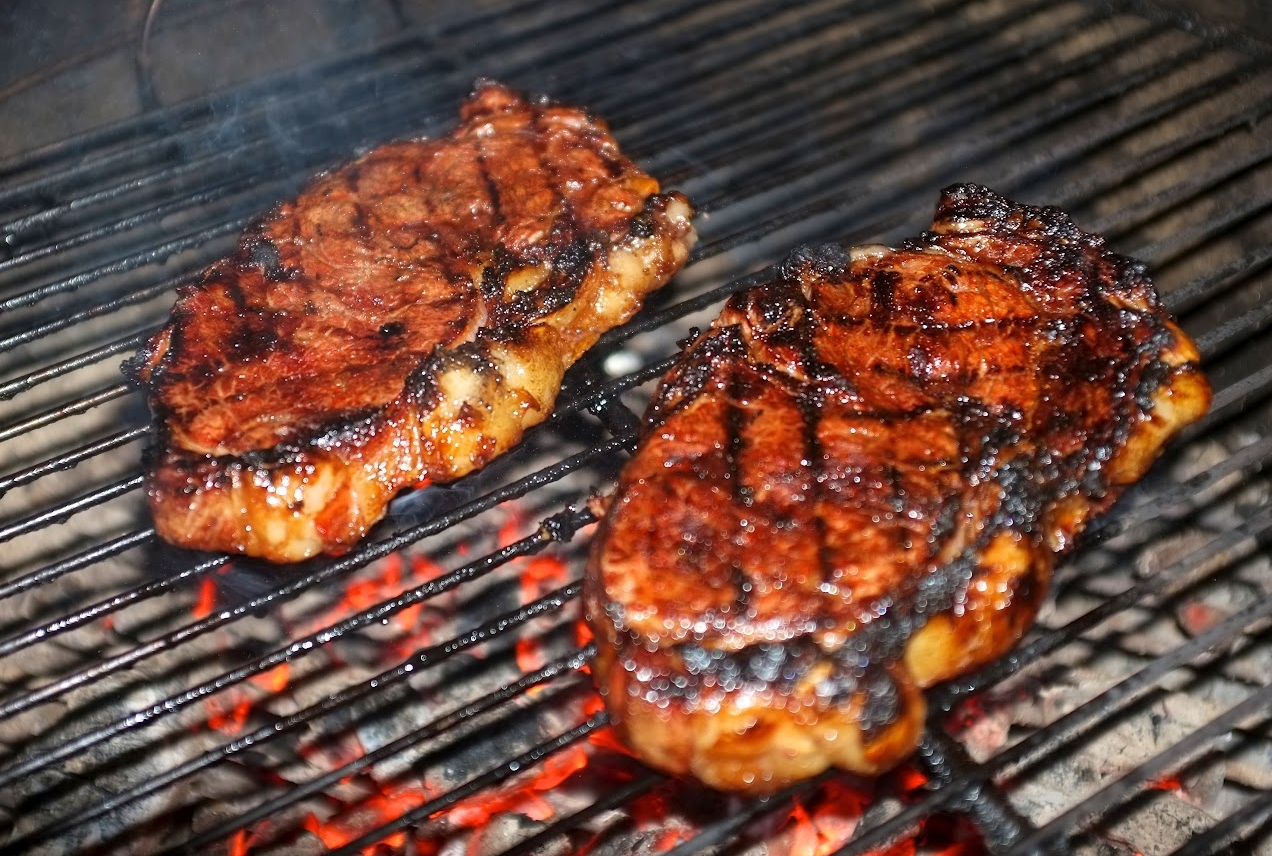
     Typical T-bone on the grill.

T-bones and porterhouse steaks sit next to each other on the muscles and contain both the New York and the filet. The porterhouse comes from the section further back than the T-bone, so the tenderloin is larger. Both have a distinctive T-shaped bone. As for the name porterhouse, food historians don’t seem to agree. Some attribute it to a New York tavern that served porter and steak, others to a Cambridge, Massachusetts, hotelier named Zachariah Porter. Most claims date back to the early nineteenth century, which tells us this steak will not go out of popularity any time soon.
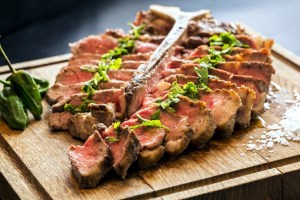
  Is it a T-bone or a Porterhouse ? Very confusing.

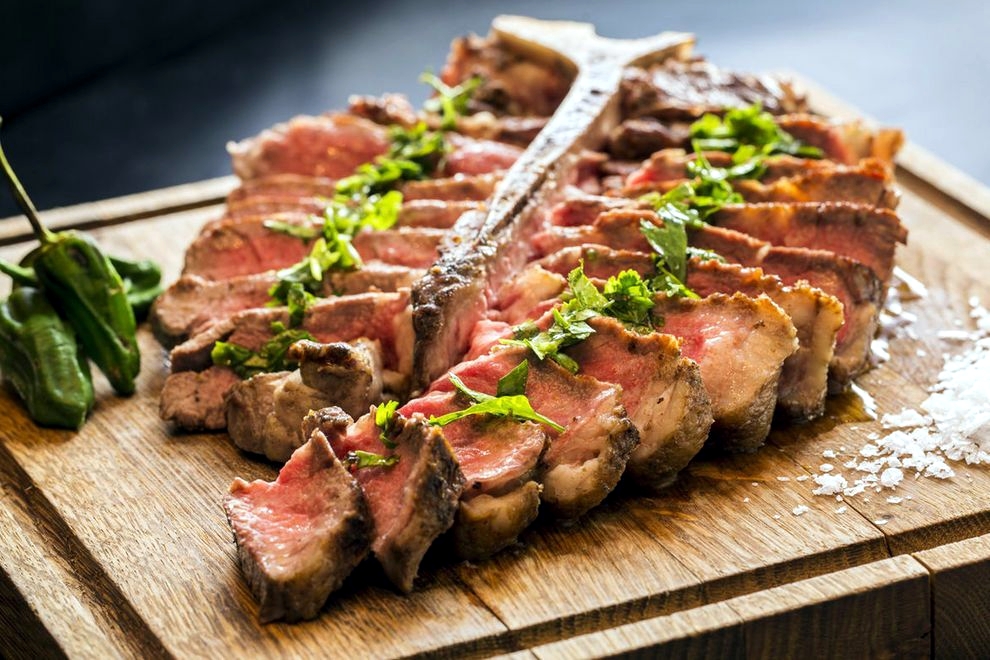
While, T-bones are cut from the short loin like the Porterhouse, according to the USDA, only steaks cut at least 1.25” thick can wear the Porterhouse name. Some people think this is the thickness of the cut when it’s served on your plate, but it’s actually 1.25” from the bone to the widest part of the Filet. To achieve this, the chop is taken from the rear end of the short loin, the thickest part of the tenderloin. T-bones, on the other hand, include a smaller cut of filet.

4. Ribeye.
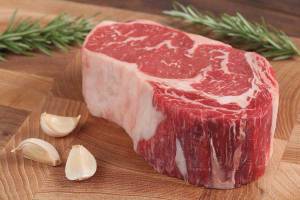
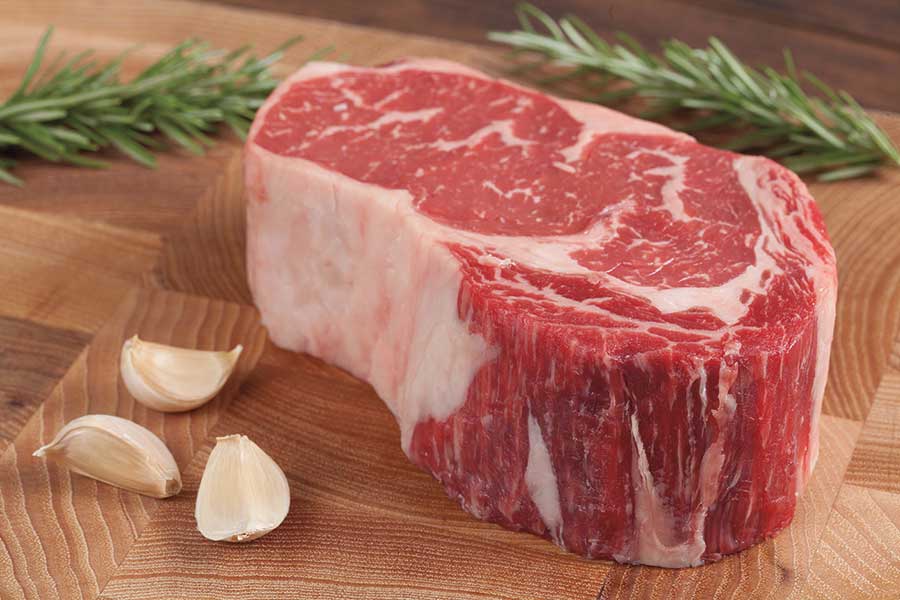
  Beautiful 2 inch Ribeye steak.

Other names: Entrecote, Delmonico, Scotch fillet, Spencer, market etc.
How it’s sold: Bone in or boneless.
Where it’s from: Upper rib-cage. Ribeyes are basically a prime rib or standing rib roast cut down into individual steaks.
What it looks like: Lots of fat marbling the meat and large pockets of fat interspersed throughout. The middle (central eye) has a finer grain while the outer section is looser and fattier.
What it tastes like: Super beefy, juicy, and flavorful.
How to cook it: Cook over high heat — pan sear, broil, or grill. With the high fat content, though, you need to be careful about flareups.
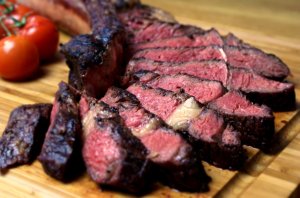
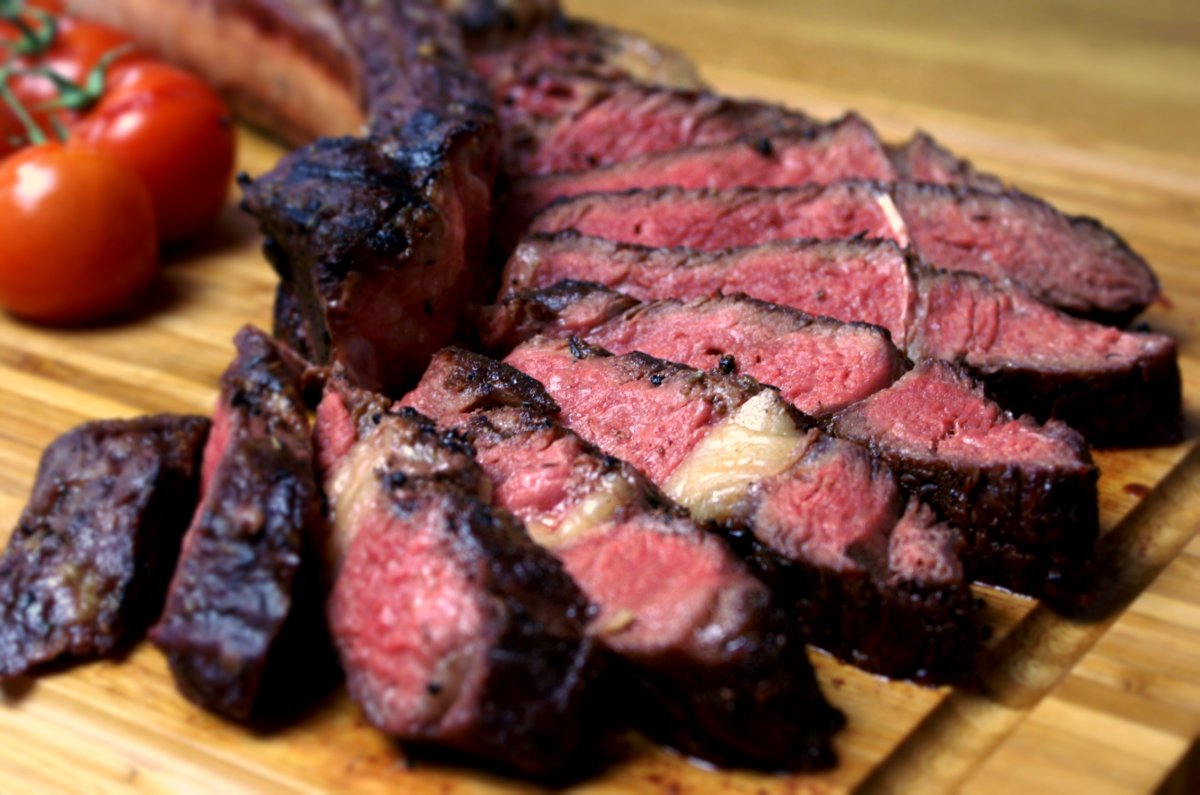
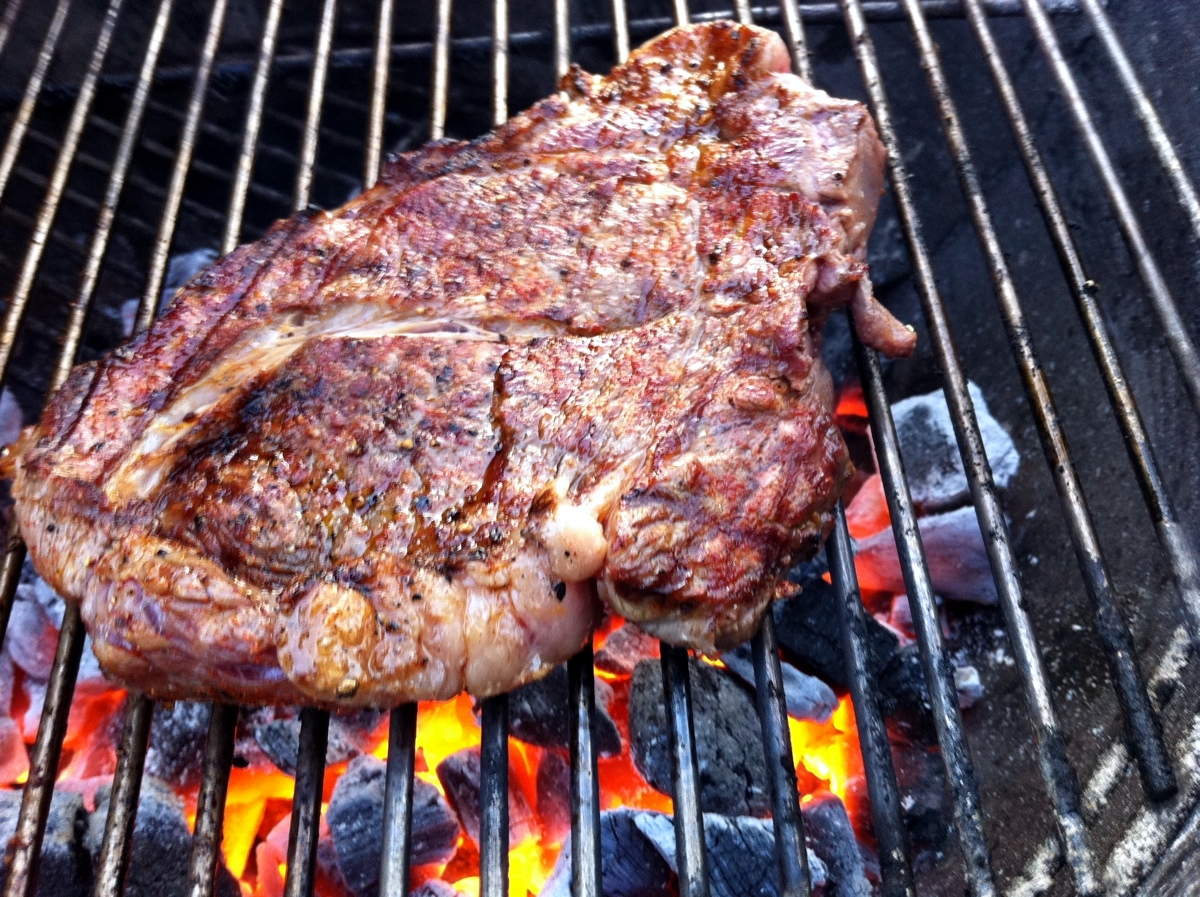
  Ribeye grilled to perfection. One can still see the fat-eye after cutting. It melts in your mouth.

Not so much of a labeling mystery when you look at the cut, the ribeye is one of the most flavorful of all steaks, bone-in or boneless. The loin has an eye-shaped piece of meat surrounded by a fat cap. This part of the long loin muscle sits further forward than the short loin and may not be as tender as the New York or the filet but is the cut used to grade the animal, based on the fat marbling.
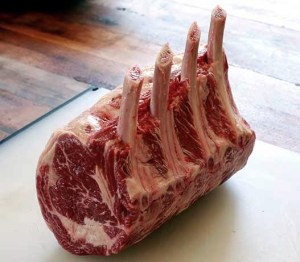
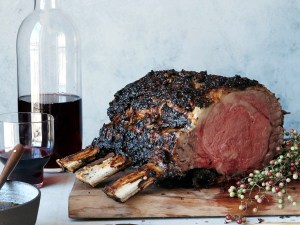
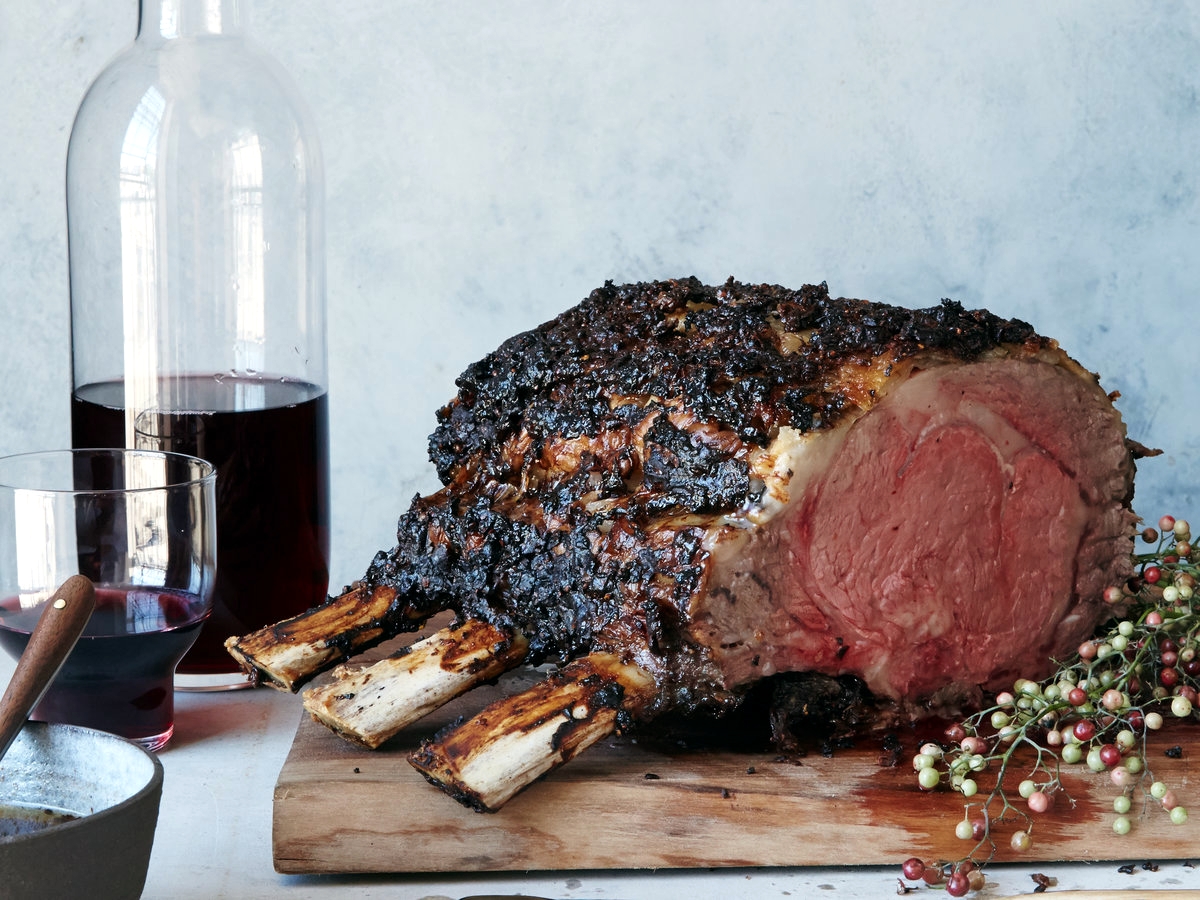
       Beautiful rack of prime-rib. cooked as a pepper crusted roast. The definition „prime“ does not certify a quality, it just tells the position where the cut came from.

General advice on grilling steak.

1. A quality steak does not need to be marinated. Successive chemical reactions gradually form aromatic composites and brown pigments. This process is optimal at 150 C (300 F). This reaction is very important as it optimizes the taste.

2.  Avoid adding spices during or after cooking. Salt will dry the surface of the meat and pepper might burn the steak. Let your guests season their steak to their own taste, AFTER serving. Good service is offering salt, pepper, steak-butter and/or different sauces.

3.  Do not cook meat immediately after taking it out of the refrigerator. Keep your steak at room temperature for 30 to 60 minutes before cooking to prevent thermal shock and avoid that the steak only cooks on the exterior. This mistake is made very often and people end up with „burned meat outside“ and „raw, under-cooked meat inside“.
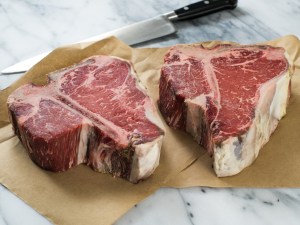
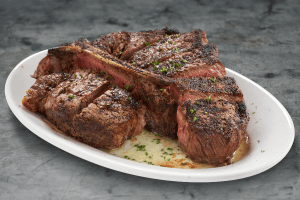
    Fantastic porterhouse steaks. Bone-in grilling needs a bit experience, because one can burn the meat far from the bone and still leave the meat direct on the bone under cooked.

4.  Cook the meat on a pre-heated surface. It has to sizzle. If you do not hear any sizzling, the temperature is too low. Remove it and wait until the temperature rises. Sear the steak and do not move it. Let the heat do its job. Turn the steak only once. Do not puncture the meat, that only allows the juices and the flavor to escape. Use claws instead. Do not cut a piece of meat to check if it is cooked. Simply press down on the steak. If meat is firm, it is well done; less firm, less done.

5.  Do not use butter, it burns at 120-130 C (250 F). It will give a bad taste to the meat and is also unhealthy. Use a higher temperature cooking oil such as sunflower oil.

6.  After cooking, let the meat stand for one minute under indirect heat. Remove from heat and let stand for another 3 to 5 minutes depending on thickness. This enables the redistribution of juice throughout the entire piece giving it a uniform color and a more easy to chew texture.

7.  Finally, don’t be afraid of thick cuts, between 3 and 5 centimeters (around 2 inch). Those cuts will give you good „meat room“ for a delicious crust and a soft, juicy inside.
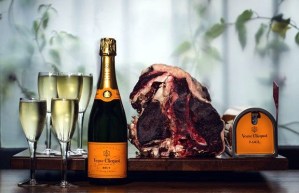
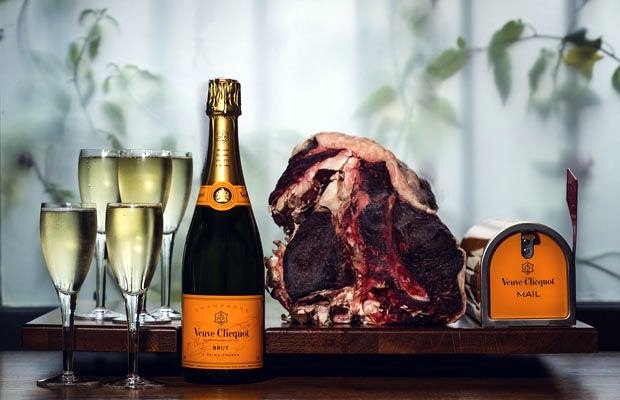
  Advertising of Veuve Clicquot. Shown with a 70 day dry aged T-bone rack. Isn’t that some kind of decadence ?

Specific advice on cooking dry-aged beef.

The aged rib steak, unique in itself, requires a slightly different cooking method than that of the traditional beef. You must make sure that your cooking oil (if you use oil) can withstand high temperatures. You must also make sure that the oil is very hot or that the grill is at maximum.

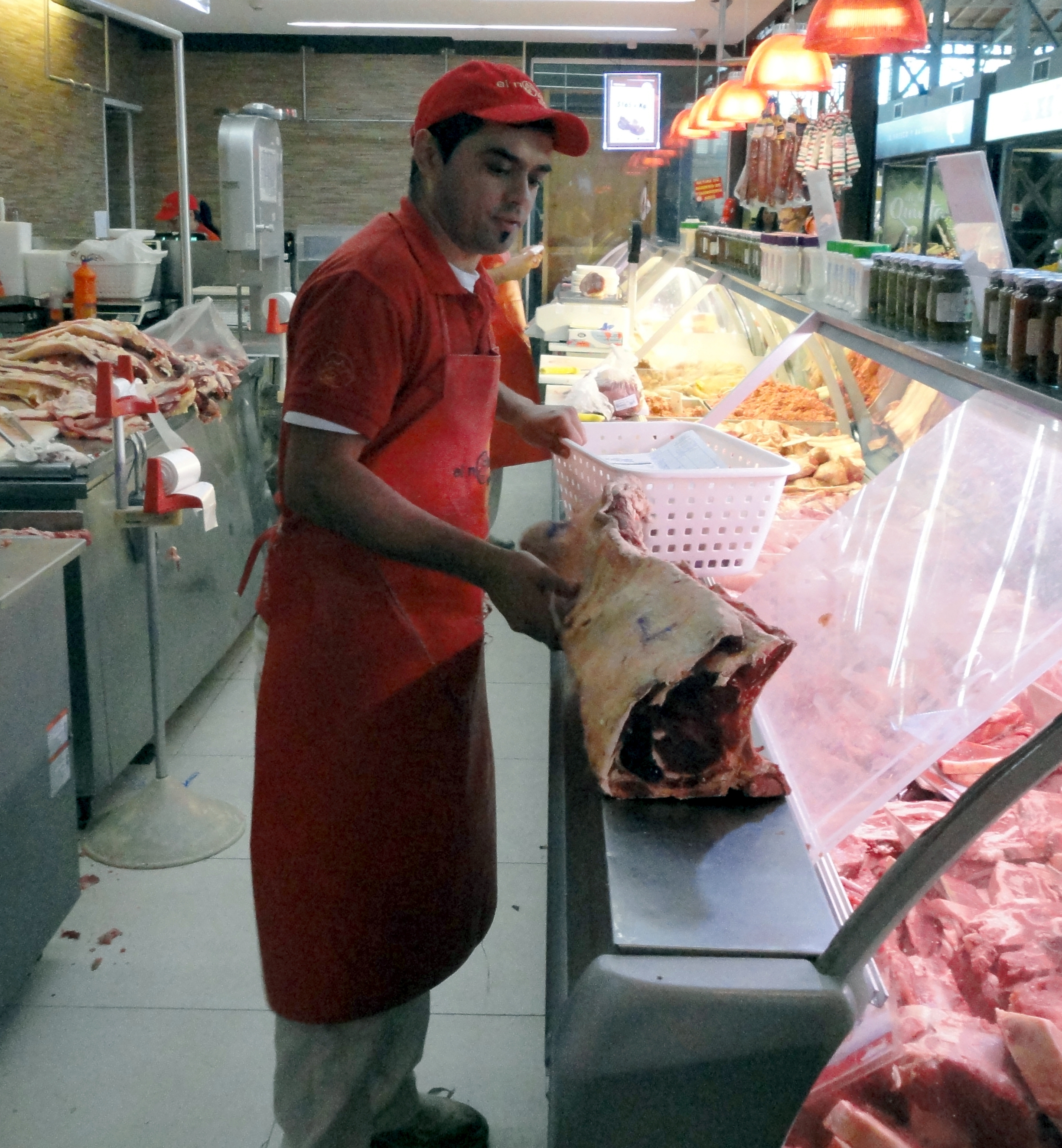
Here in Uruguay is one butchery able to sell dry aged meat. The offer is usually between 25 and 30 days aged and they sell „bone in ribeye“ as a standing rib roast. Price is around $580,–pesos per kilogram (c. US$18,–dollars). Different cuts or longer aging is available on preorder. One has to buy the whole roast. See my post „MAM Montevideo“, May 2017.
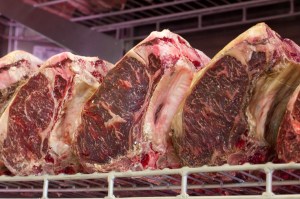
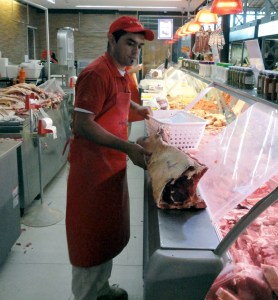
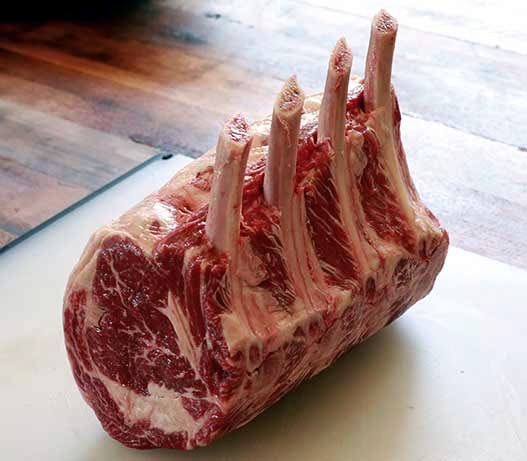
                 My Rack of dry-aged ribeye at MAM, Montevideo. Purchased for our „little steak party“, around 6 1/2 kilogram. It was a preorder for 40 days aging, absolute fantastic. The unused piece is frozen till our Christmas Chateaubriand.

How to do.

* Place the steak on a pre-heated (very hot) surface, do not puncture or move it. You can brush a bit oil on the grill, nothing else. No seasoning, nothing on the meat – please ! When you put your meat on the hot surface it MUST SIZZLE !

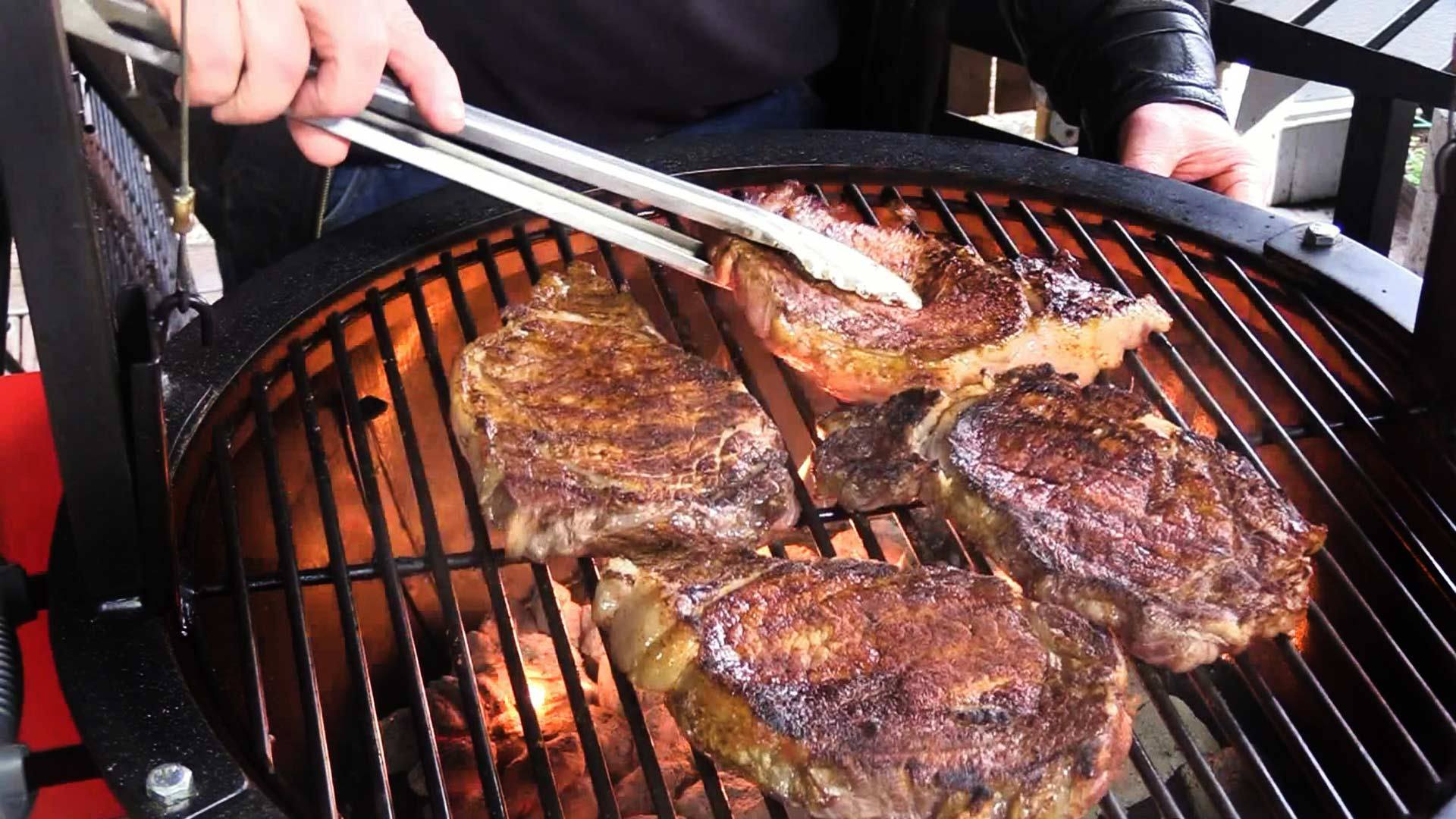
* When you reach half the cooking time (see below), turn the steak. But, please, not with a fork, use tongs and turn carefully. Just one turn – that’s it !
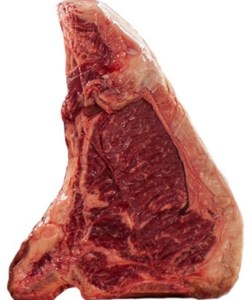
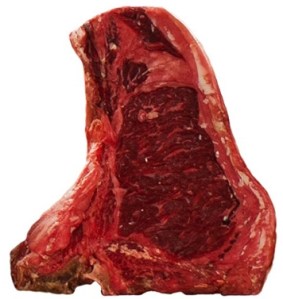
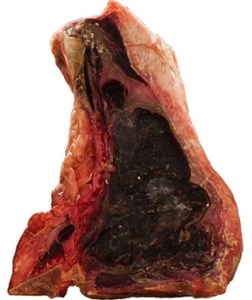
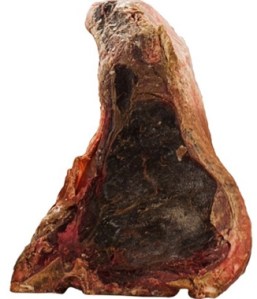
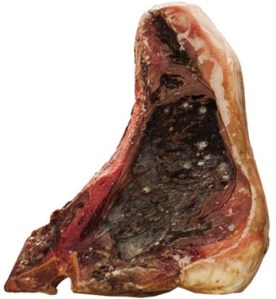
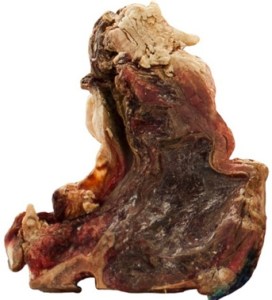
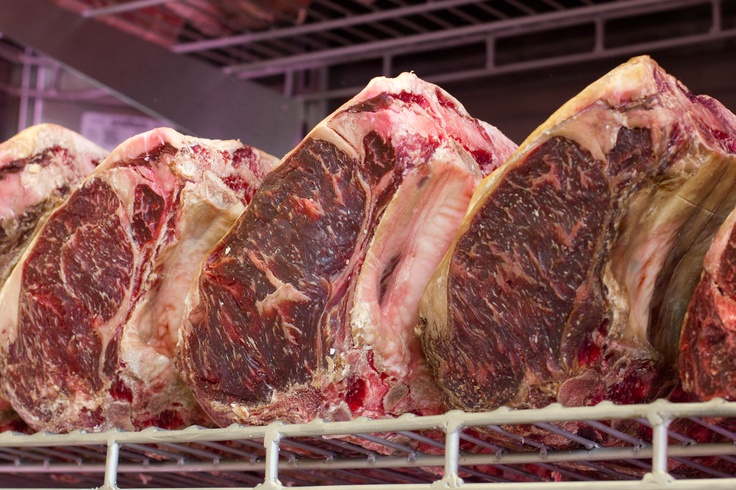
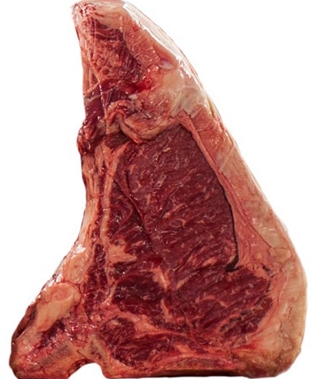
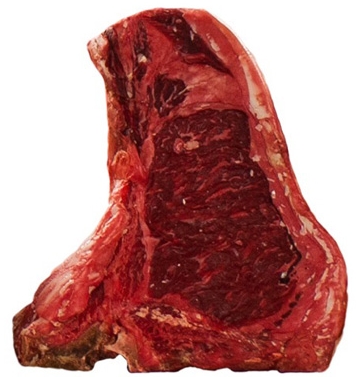
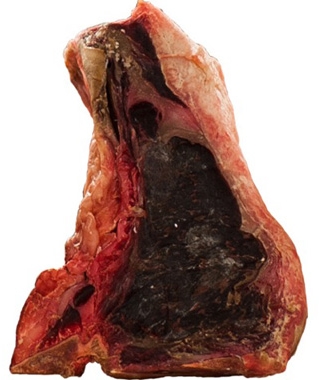
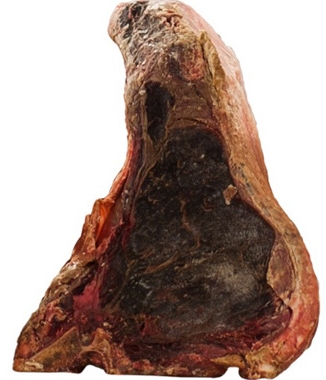
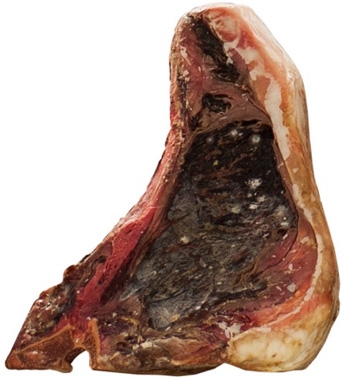
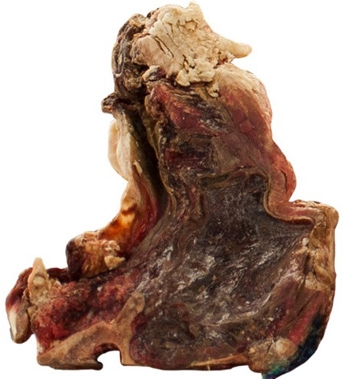
                        The above 6 pictures show the dry aging process between 20 and 100 days.  If you buy dry aged beef then your butcher will always cut off the moldy front side, don’t worry.

* Do not exceed the suggested cooking time. This cooking time delivers a wonderful crust and inside „juicy rose = medium“, in Uruguay we would say „al punto“. In general you’ll find out your own best cooking time, but dry aged meat needs a shorter cooking time.

* Remove the steak and place in a pre-heated oven at 160 C (325 F) for 2 minutes. I like to skip this part and let the steak rest under a foil for 2-5 minutes. Be patient and wait !
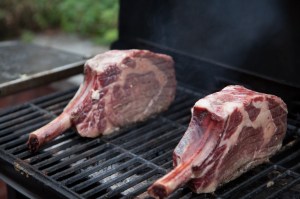
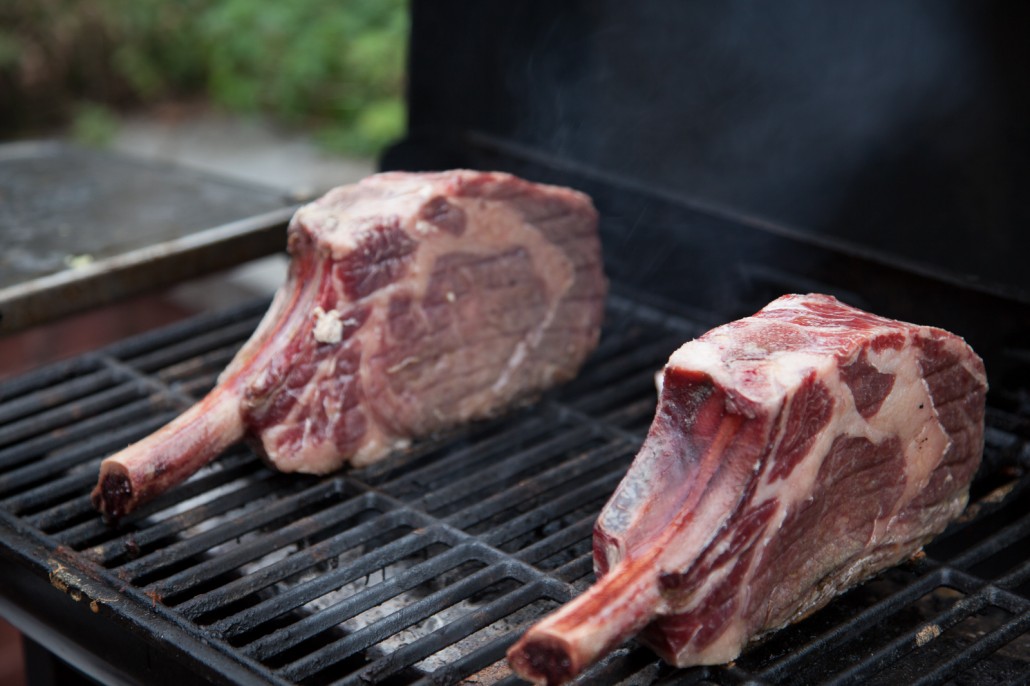
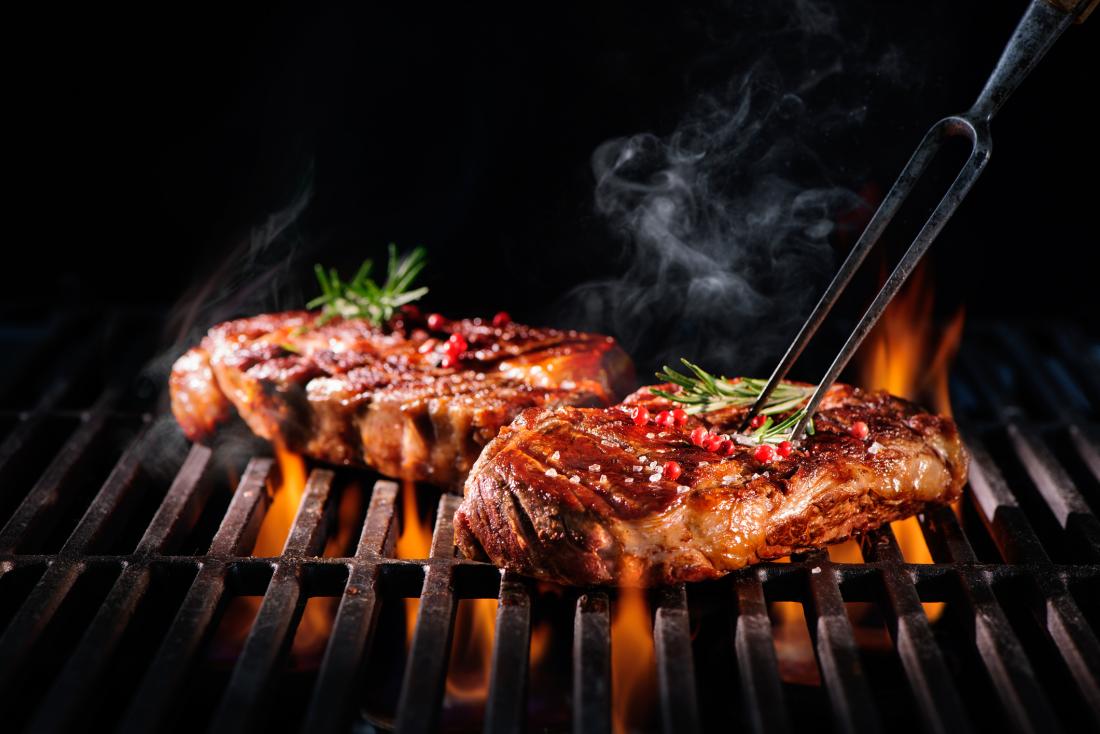
  Standing steaks, for grilling or resting. Perfect as you can see on white covered coal, smoke from sizzling hot iron and no flame ! Flames are on many pictures to see, but that’s made for the pic – we don’t want it during grilling, except sometimes a bit when juice is dripping down.

* On a grill, let the steak stand ( on the bone or fatty side) on the upper grill for 1 minute.

* The steak must be rare, but room temperature.
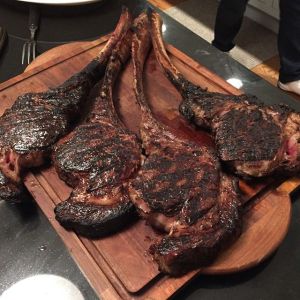
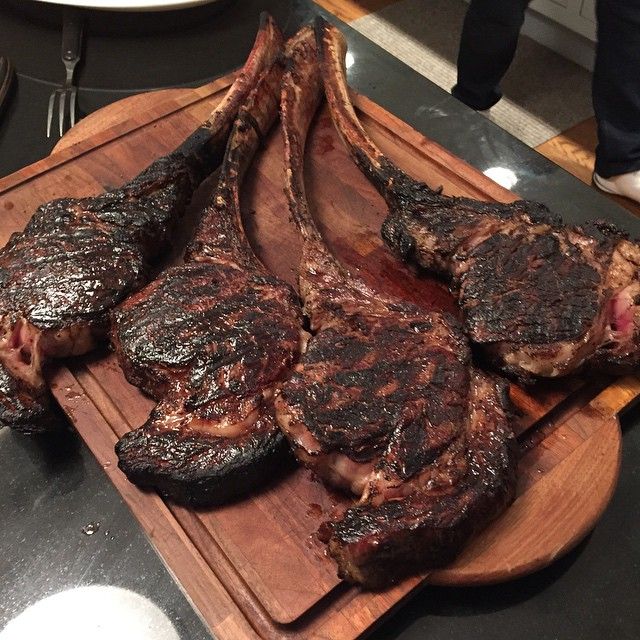
  30 day aged „tomahawk“ rib steak. They leave the rib bone uncut, that it looks like a tomahawk. Made to show off in restaurants. I did that once for friends, to show off, as said. We had great fun to hold it in our hand and chew it from the bone.

Cooking times:

Dry aged rib steak (25 – 40 days) cooking must be rare.
Cooking time, in the heavy cast iron pan or on the grill:

Cut 1 1/4 inch – 6 min; 4 min
Cut 1 1/2 inch – 7 min; 5 min
Cut 2  inches – 10 min; 7 min

These times will result in a medium-rare, juicy steak. DO NOT EXCEED THE COOKING TIMES ! In case you like to grill thicker pieces of meat, then I suggest the cooking method like a Chateaubriand. But that’s a different story, may be in an upcoming post.
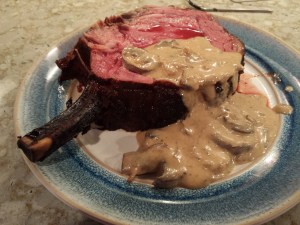
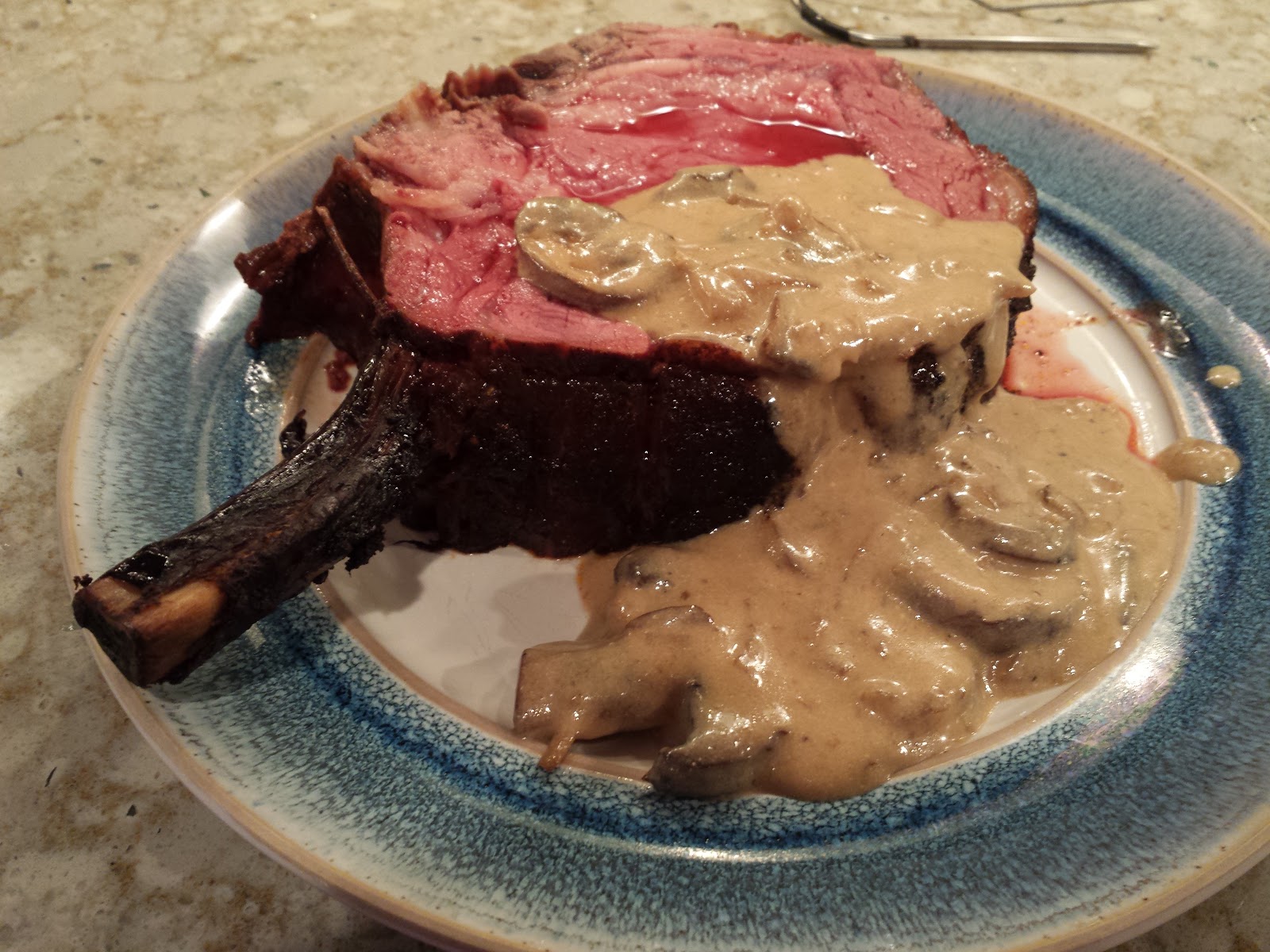
  Absolute mouthwatering, a coffee roasted rib on the bone, cooked medium rare (the 1 1/2 inch cut, see above). Served with a creamy mushroom gravy. In Germany they call this recipe „Jaegersteak“ (hunters steak). I love to make this kind of accompanying sauce with fresh button mushrooms, double cream and a few shots of good Cognac.

Tips.

Germans like to marinate steaks before grilling. Since everything depends on personal taste we should accept that style. But then I suggest to take cheaper parts of the steer, by example chuck steaks (in German Nackensteaks).
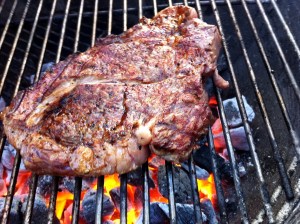
    German „Nackensteak“. Mostly marinated already.

Other ways to grill a steak is to use from begin on BBQ-sauce and burn the sauce into the meat. I like that sometimes, but …  My way with lamb, throwing some sprigs of rosemary on the fire and let the smoke raise into the meat, possible with beef too. Another way is to use beer throughout the grilling, mostly strong dark-beer, flavoring the meat.

A quick reminder.

Prepare the grill ! Be sure your grate is cleaned after every use. Dirty grills not only spread bacteria, they also create burnt flavors into your meat. After cleaning, lightly rub the grate portion with oil and set aside until the coals are ready.
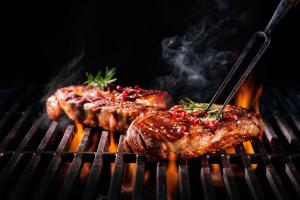
   WRONG !!  Never use forks to „prick“ your steak. Juices will run out of the „wound“.

Watch your coals ! Coals should be arranged in the bottom of your grill on a circular pile, slightly higher in the middle. Avoid using any flammable liquids or lighter fluids as these can impart a chemical taste to your gourmet BBQ steaks. Light with the use of newspaper or small pieces of hardwood. Once aflame, cover until coals are 200-240 C (400-500 F) degrees. An infrared thermometer can help out here.

The right grill time ! A quality gourmet steak of about 2 1/2 cm (1 inch) thickness should need a total of about 6-8 minutes of cooking time to reach medium rare BBQ steak perfection. A meat thermometer is your friend here. Just remember the internal temperature should be around 70-80 C (135-140 F) degree. Want to get extra fancy with those grill marks? Try rotating your steak 90 degrees once on each side in between flips to create hash-mark perfection.
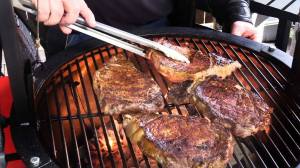
  RIGHT !! Use tongs for your steak to save damage.

Rest is always the best ! Just because you’re grilling your steaks on the BBQ doesn’t mean you can skip the vital rest stage. Remove the steaks to a platter and allow to rest for at least five minutes before serving. I suggest using this opportunity to finish one of your favorite BBQ sides, or enjoy a drink with friends.

Final Tip – about Knives.

Steak knives – serrated or non?
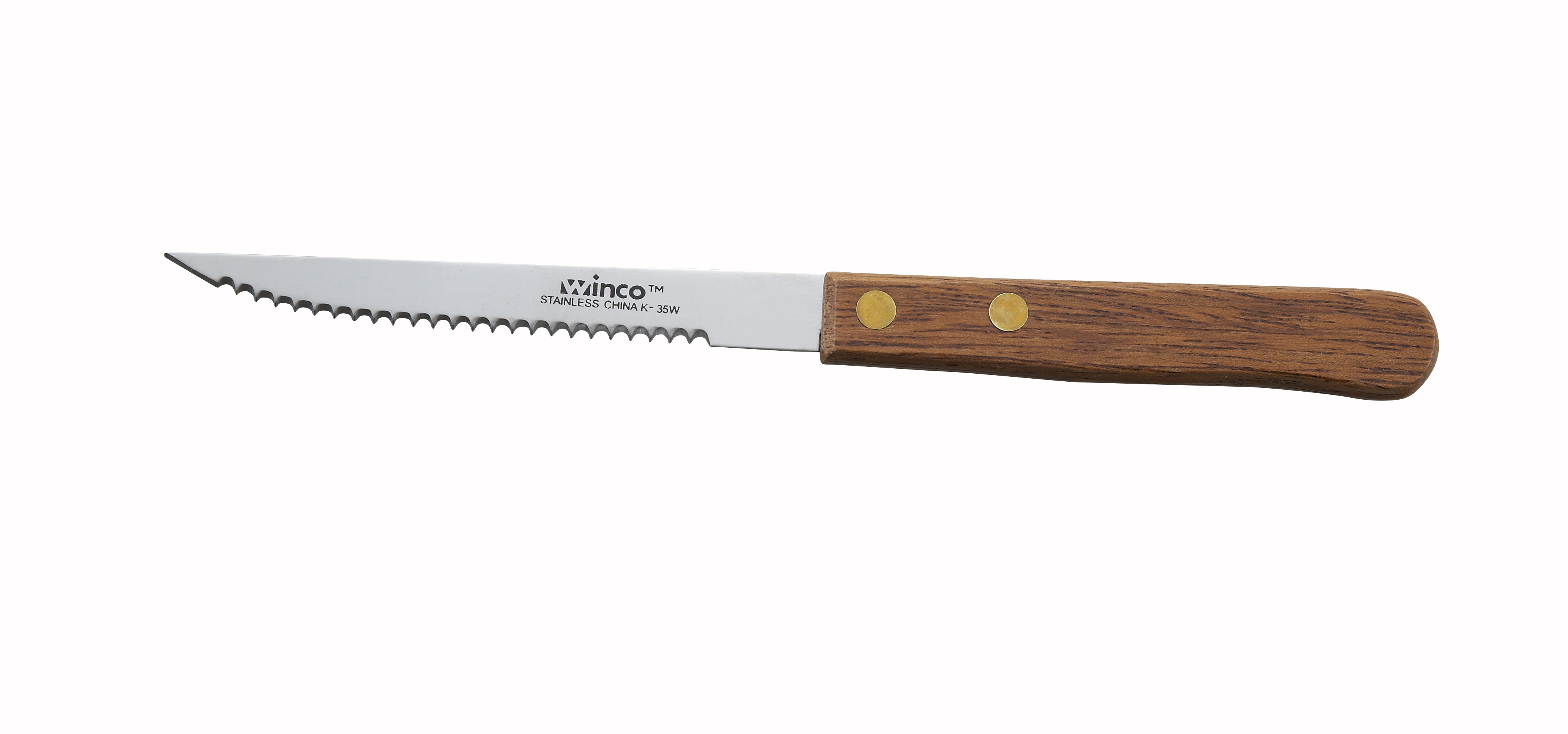
I am not a knife snob, but I’ve got decent knives that I take good care of for cooking. For eating, eh, not so much.  I’m not a big fan of serrated blades, except as bread knife. I strongly suggest that you click on the knife pictures to have a good view.
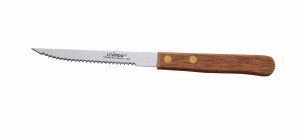
  The knife I do not like – it will tear your meat.

Straight-edge knives cut far better (assuming your steak isn’t so tough you literally have to saw through it), but they’ll need constant maintenance since they dull quickly when cutting on hard ceramic plates. You’d have to sharpen them fairly regularly. Serrated knives are worse at cutting, but since the „valleys“ of the knife don’t contact the plate, they don’t dull. That makes serrated knives far less hassle-some to maintain.
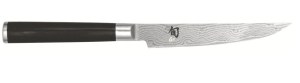

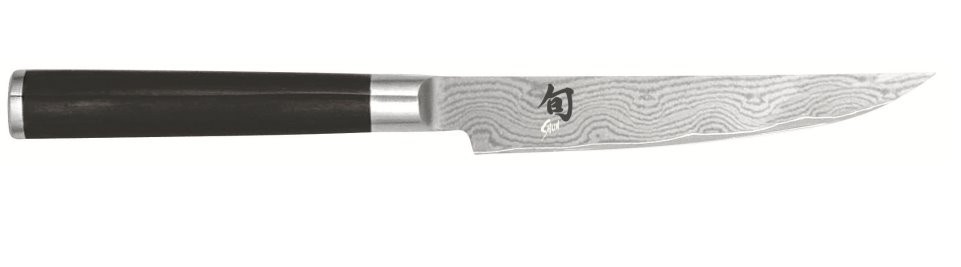
          Left, a very expensive „Kai Shun Damast Steak Knife“. Right the high quality German steak knife I use. It’s fun to hold it in your hand and feel the blade gliding through the meat like through butter. Those knives add a lot of fun to your delicious steak meal.  As usual click on pics to supersize.

Personally I don’t care for a serrated blade at all other than a bread knife. Serrated does too much damage. Eating a piece of steak that has been cut with a sharp blade has a better mouth feel to me. The only place for serrated steak knives is a restaurant where, I understand that, it’s far to expensive to maintain. At home, go with the good stuff.
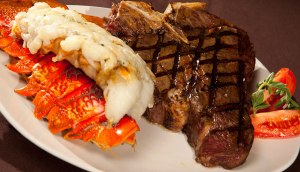
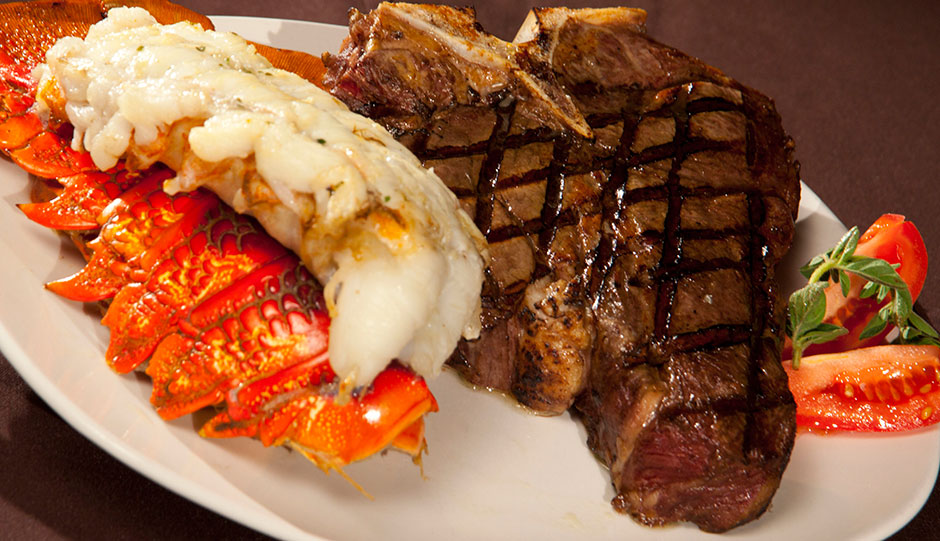
   The Australian way to enjoy a steak is called „Surf and Turf“ (free translation: water and land = seafood and meat). The combination can be as different as the cook decides, here LOBSTER and T-BONE.  Enjoy!  Enjoy!

Veröffentlicht unter Information, Lifestyle, Recipes | Verschlagwortet mit | 2 Kommentare

Collecting – Ephemera

Share certificate, De Volharding, s’Gravenhage 1870. For sale US$ 9.500,–.
The only known certificate of this company in the world, ultra-rare. If you are interested, just ask for detailed information, it will not be published.

Ephemera.

Ephemera, singular = ephemeron, are any transitory written or printed matter not meant to be retained or preserved. The word derives from the Greek ephemeros, meaning „lasting only one day, short-lived“.

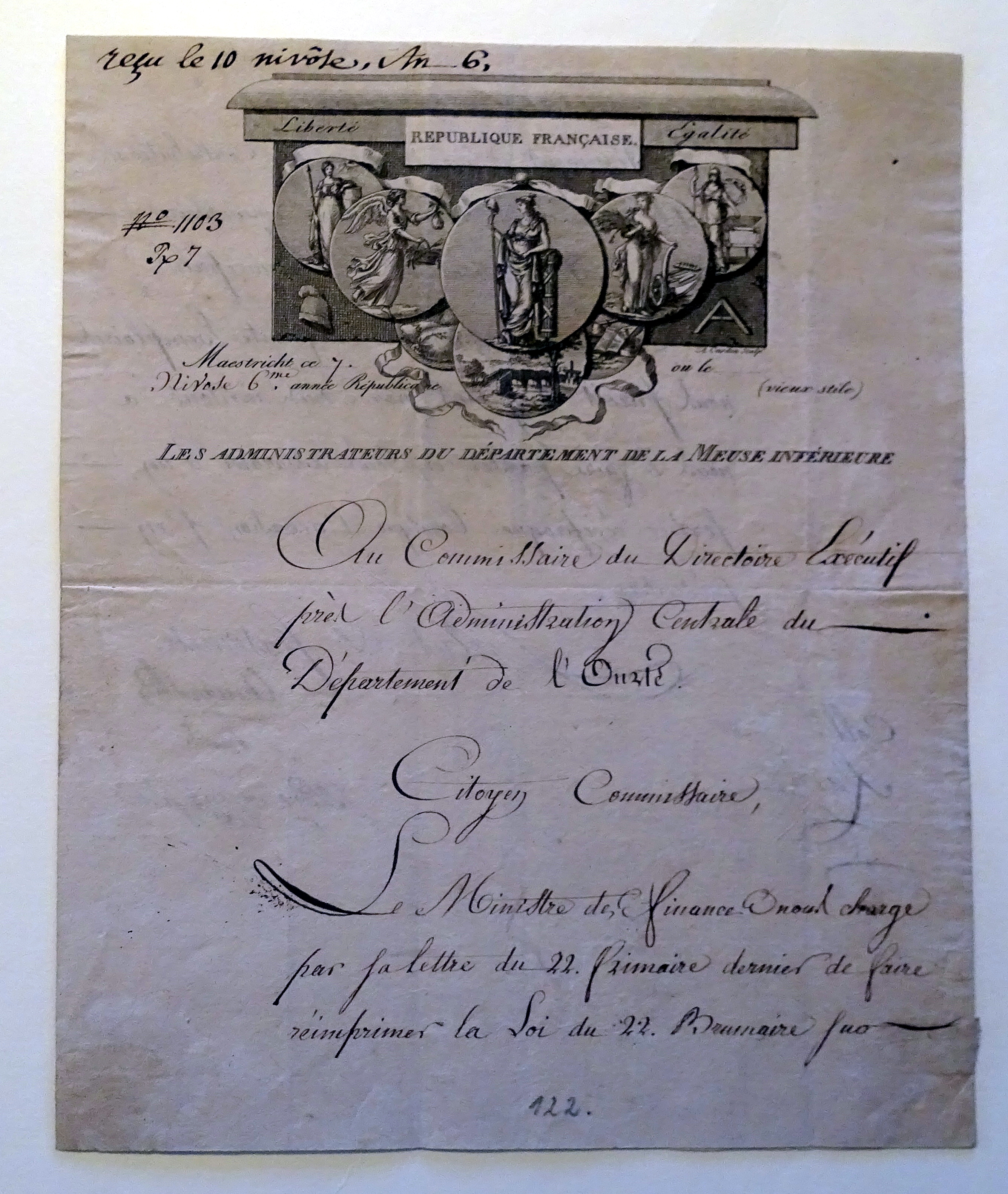
   Letter 1797. See post „Collecting – Historic letter“, March 2018.

Origin.

As a singular noun the word originally denoted a plant said by ancient writers (16th century) to last only one day, or an insect with a short lifespan (a fly), and hence was applied (late 18th century) to a person or thing of short-lived interest. Current use has been influenced by plurals such as trivia and memorabilia.

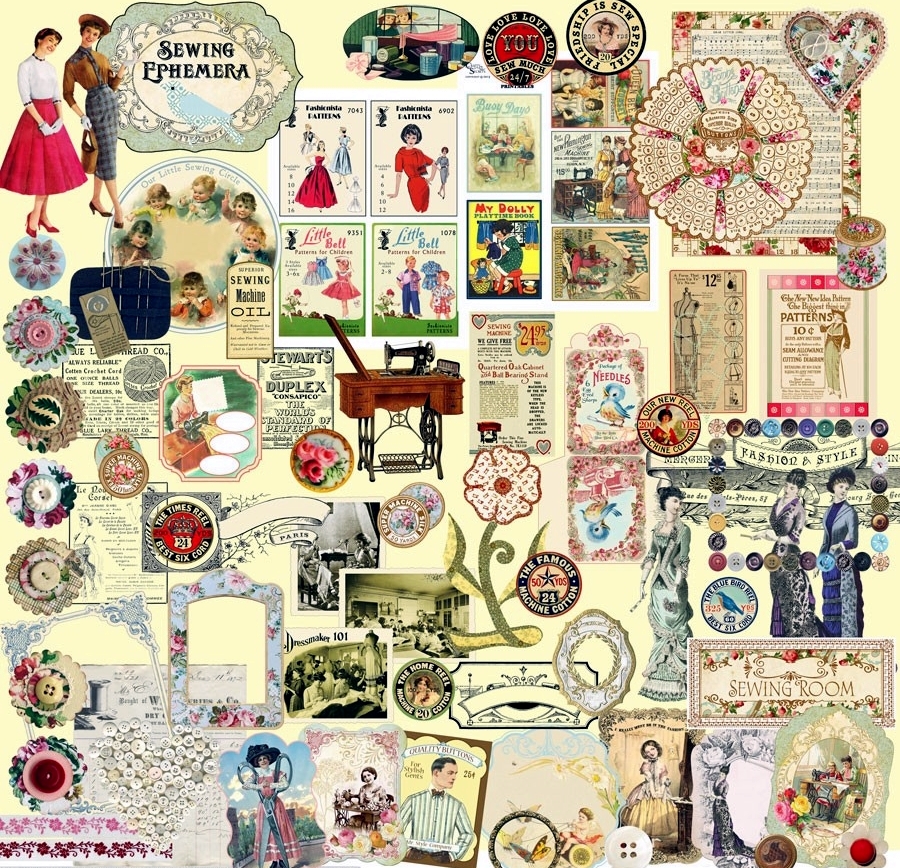
  Vintage ephemera collection about sewing.

Definition of Ephemera

Ephemera is generally defined as collectible memorabilia that is was for a short term purpose. Ephemera is almost always paper-based and is often written or printed items that were expected to have short term popularity or usefulness. Ephemera is not normally considered something to collect, save, cherish or keep. But often times, we do keep and cherish ephemera items – especially vintage ones and we often put them in scrapbooks.

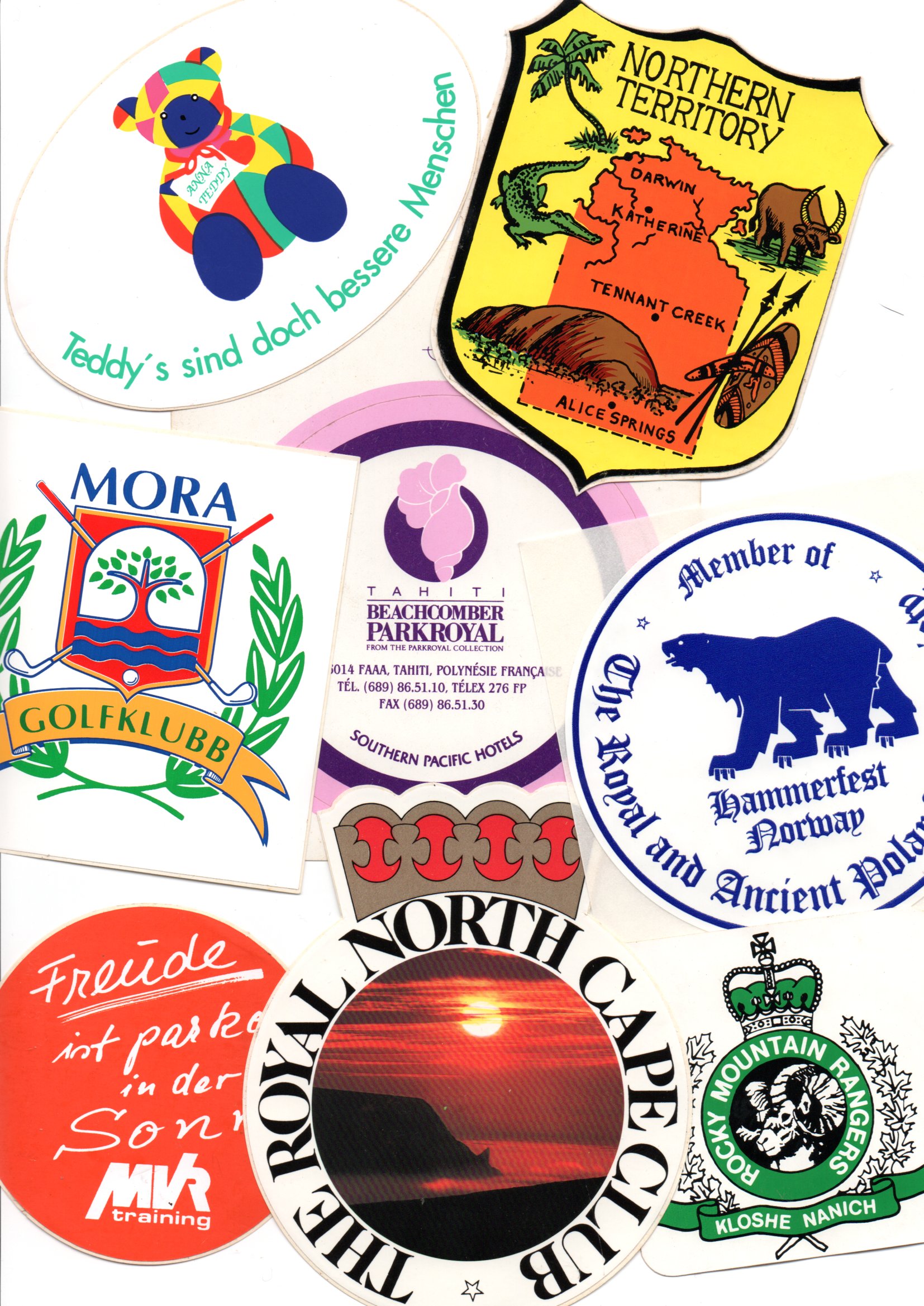
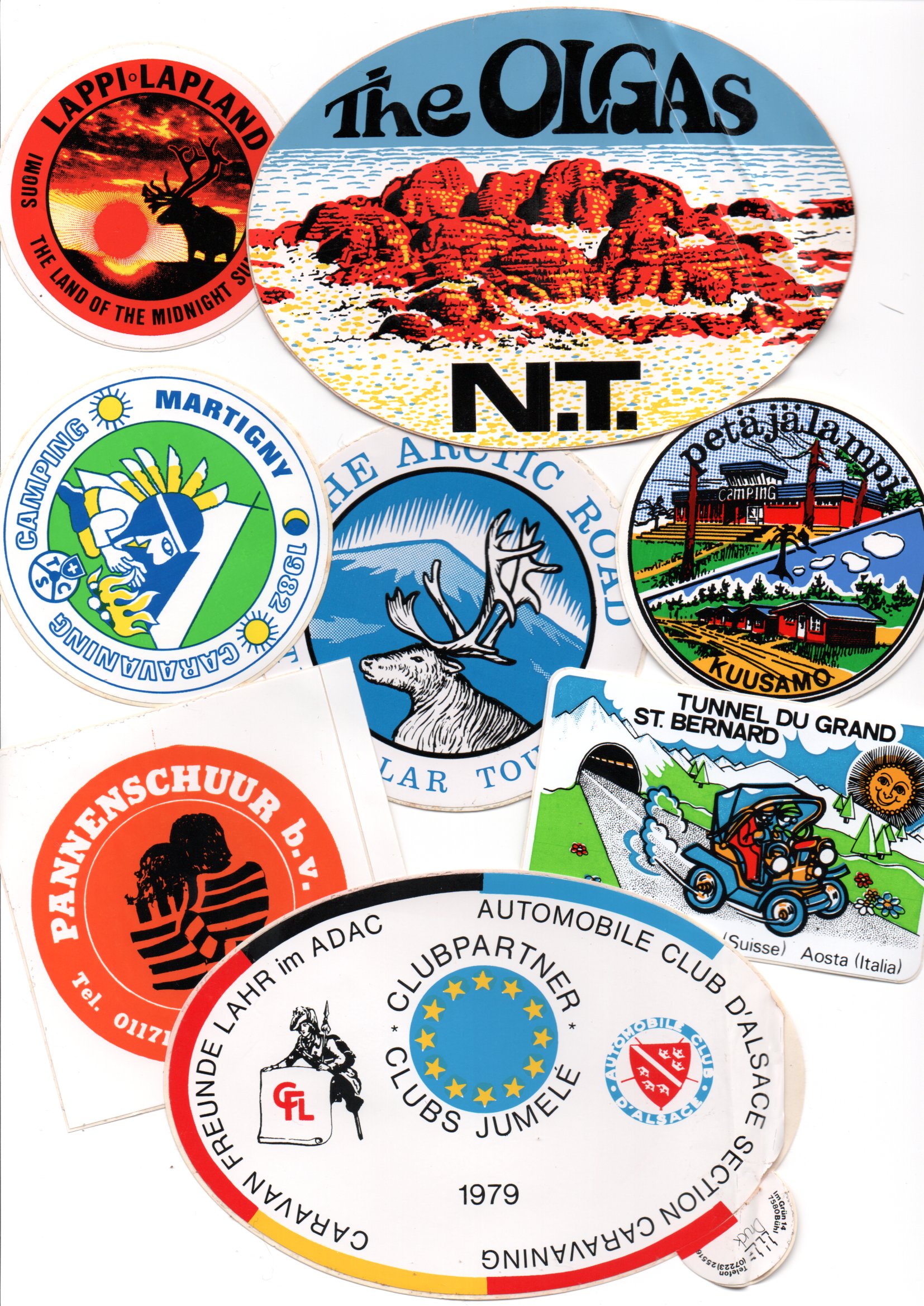
           A very popular ephemera area is the collecting of stickers. Hotels, camping, travel, golf, or anything what one likes or gets the hand on. There is no limit.

Examples of Ephemera.

Below is a non-comprehensive list of some items that might be considered ephemera. This is a small list, and there are no hard and fast rules of categorization, but this will help you get an idea.

playing cards
postcards
paper money
event-, movie-, lottery tickets
office objects like post its, Rolodex cards
old maps
certificates for any kind of profession
stocks and bonds (example see above – De Volharding)
miniature items such as those found in doll house stores
magazine ads

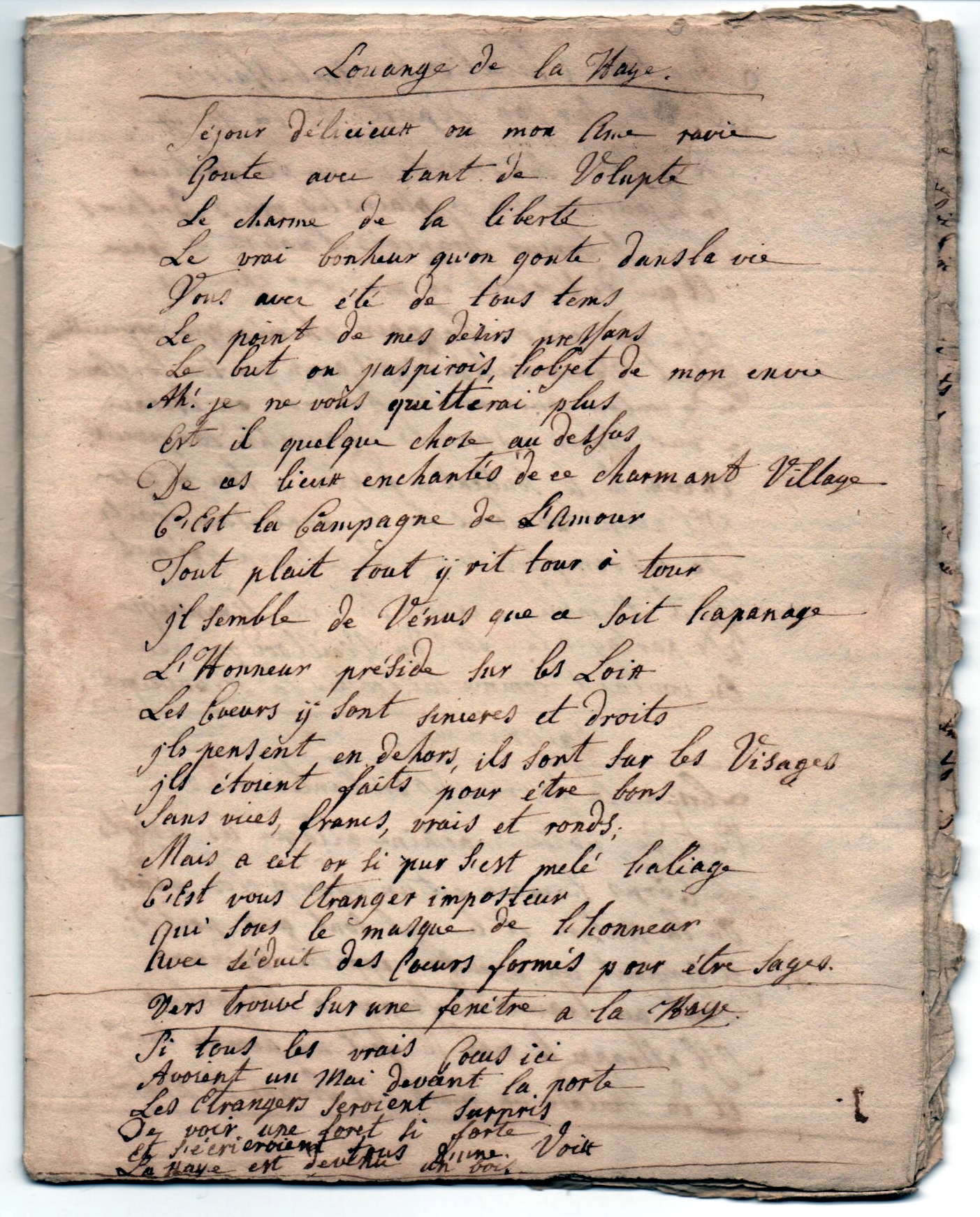
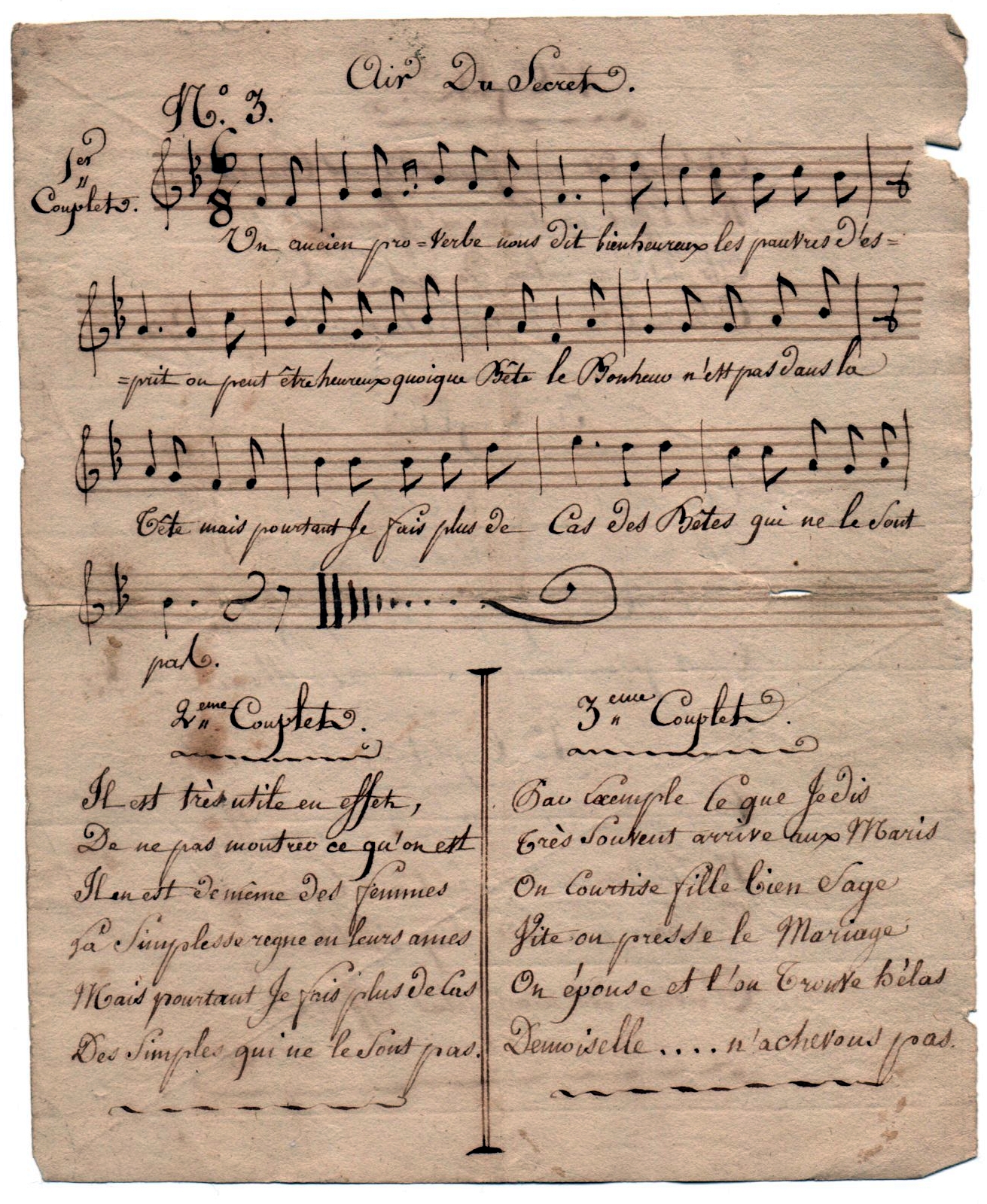
           Old scrapbook from around 1770.  Handwritten in French and Dutch with lots of poetry and songs. Left: „Louange de la Haye“ means „Praise of  The Hague (Den Haag)“. Right: „Oir Du Secret“ means „About the Mystery“.

comics and comic book titles
old book pages
old flyers
old newspaper clippings
political cards
old ledgers
feathers, leaves etc.
music sheets
old scrapbooks
and much much more – whatever one likes to collect and has in its mind.

Ephemera Society of America notes:

         Old music records or/and covers are a famous collecting area.

Printed ephemera gave way to audio and video ephemera in the twentieth century. These present even more of a preservation problem than printed materials. Although seldom made available for libraries, when videotapes are acquired for archival preservation they are found to be made on low quality tape, poorly processed, and very often damaged from abuse by users.

Collecting Ephemera.
Some ephemera for sale.    The delivery will be free of charge – worldwide !
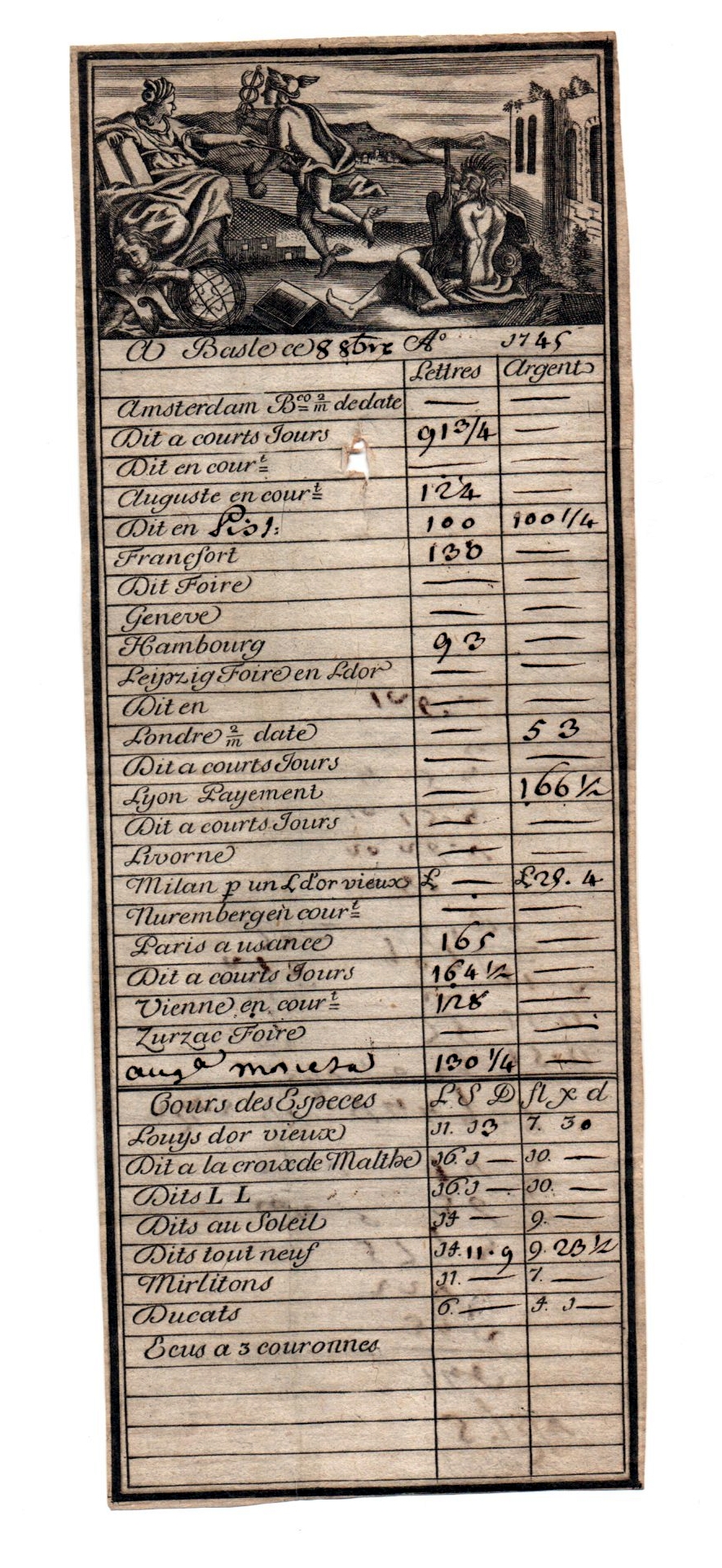
Leaflet of the Basle stock exchange, 1745.  For sale US$ 300,–.

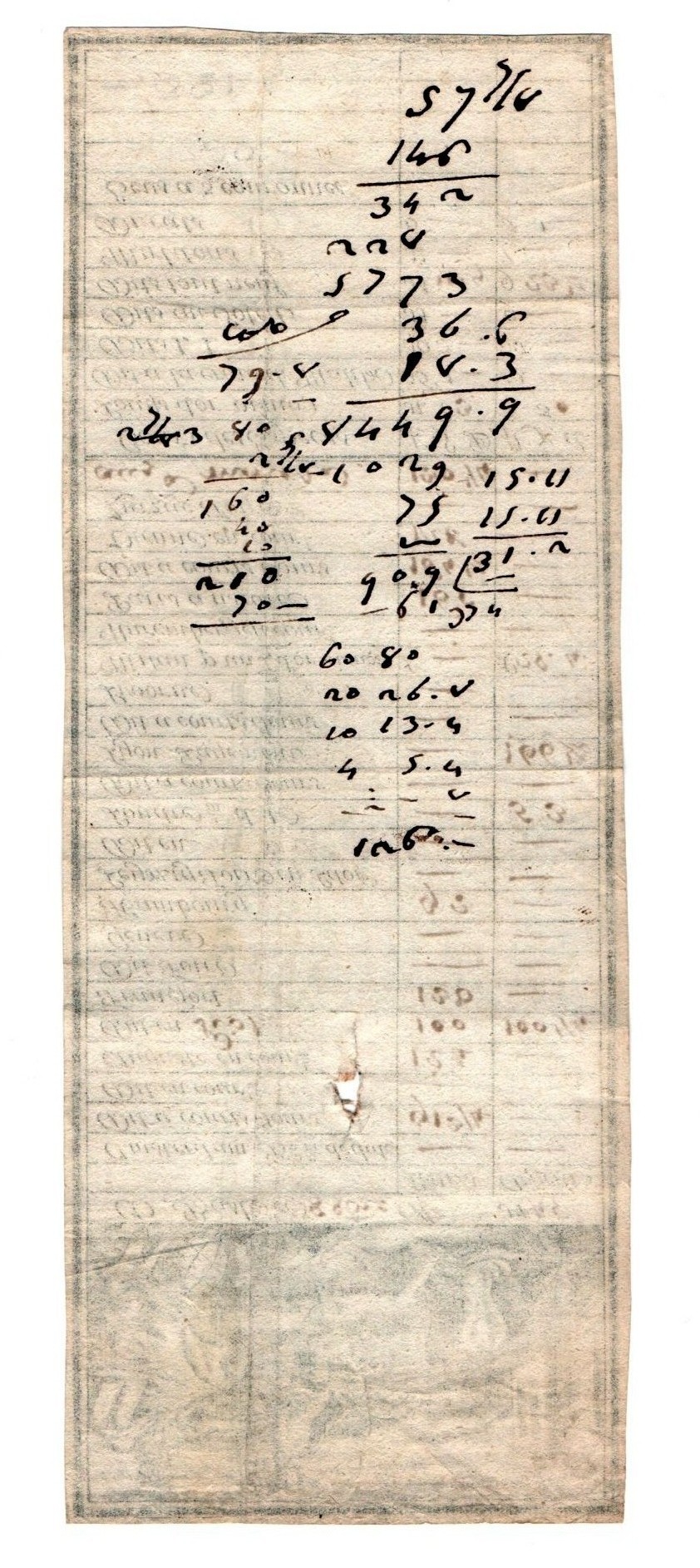
       Leaflet front and rear view.

This leaflet was used by the stock exchange of Basel, Switzerland and  is extremely rare. It dates from 1745 and is in perfect condition. The seen hole comes from an office desk  notice pin. Courses are shown from other European stock exchanges and in paper as well as money. The size is 23×8,5 centimeters. It is an ultra rare sought after part of financial history with a beautiful copper engraving vignette.

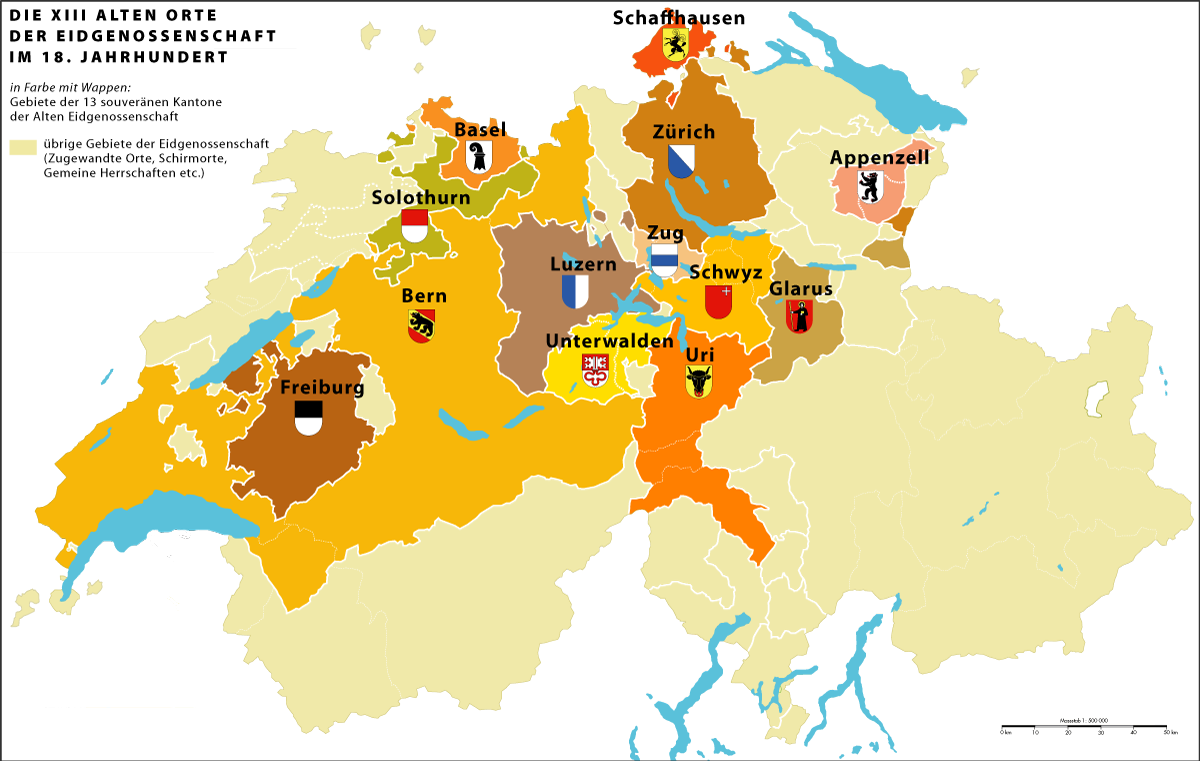
   The 13 sovereign cantons of the old Helvetic Confederation. Map origin by Marco Zanoli.

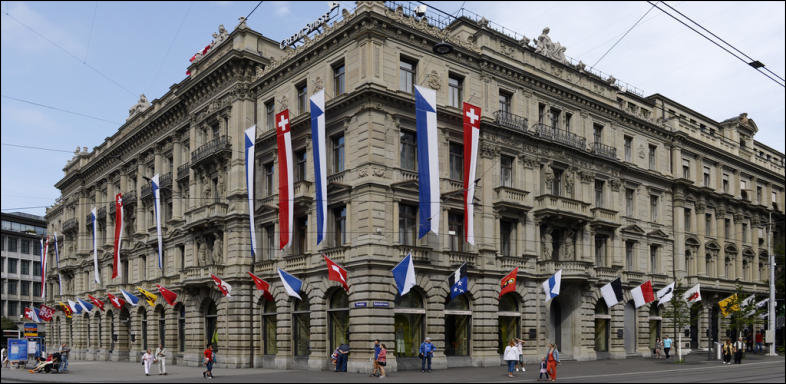
The company that run this exchange was founded in 1866, they were originally located near the town hall in the city center. This place also still exists and is called the Old Exchange, but sometimes it is not clear which of the two locations is referred to by this name. They must have moved to the new location in the mid-20th century. In 1993 the exchanges of Basel, Geneva and Zürich merged to create the „Swiss Exchange“. In 1998 the activities were concentrated in Zürich and the Basel location was closed.

   That was the stock exchange till 1998.

But – we have here a paper of the Basle Stock Exchange, more then a hundred years earlier then the above described 1866 founding !!!

               Daniel Bernoulli,
(8 February 1700 – 17 March 1782) published his Hydrodynamica in 1738.

It was the time when in Basel Daniel Bernoulli published his HYDRODYNAMICA (1738). Daniel studied medicine at Basel, Heidelberg, and Strasbourg, and earned a PhD in anatomy and botany in 1721. After some years in St. Petersburg he returned to the University of Basel, where he successively held the chairs of medicine, metaphysics, and natural philosophy until his death.

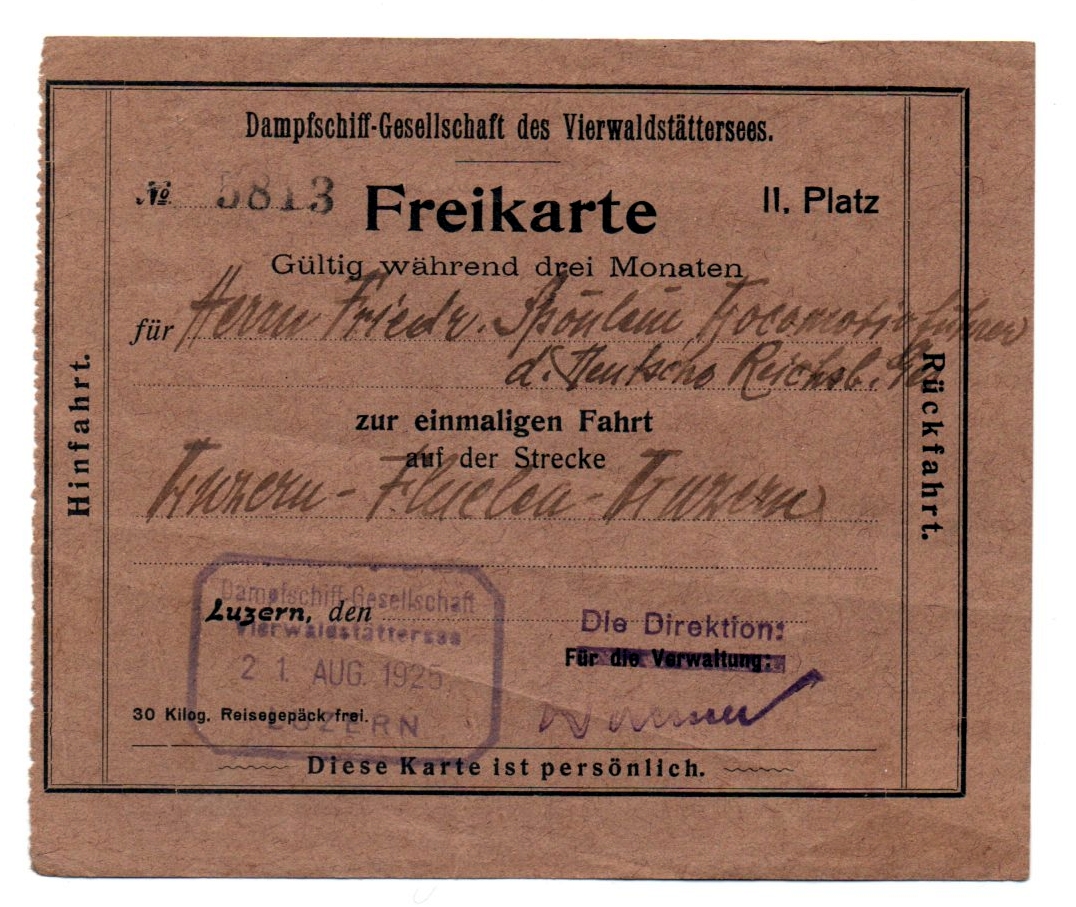
Freikarte Dampfschiff Gesellschaft Vierwaldstaettersee.  For sale US$ 40,–.

This „Free Ticket“ from the famous „Schifffahrtsgesellschaft des Vierwaldstättersees (SGV)“ is in very good condition and measures 13×10,5 centimeters. Presumably it was never used, because there are no devaluations to see at this card. She is printed on brown paper and issued on 21st of August 1925.

        The first statutes of the SVG from 1836 on left and the route plan of the company on the right.

This ticket was valid for 3 month and issued to „Friedrich Spoenlein, Lokomotivfuehrer (engine driver) der Deutschen Reichsbahn Gesellschaft“. The ride was the longest possible, from Luzern to Flueelen and back to Luzern.

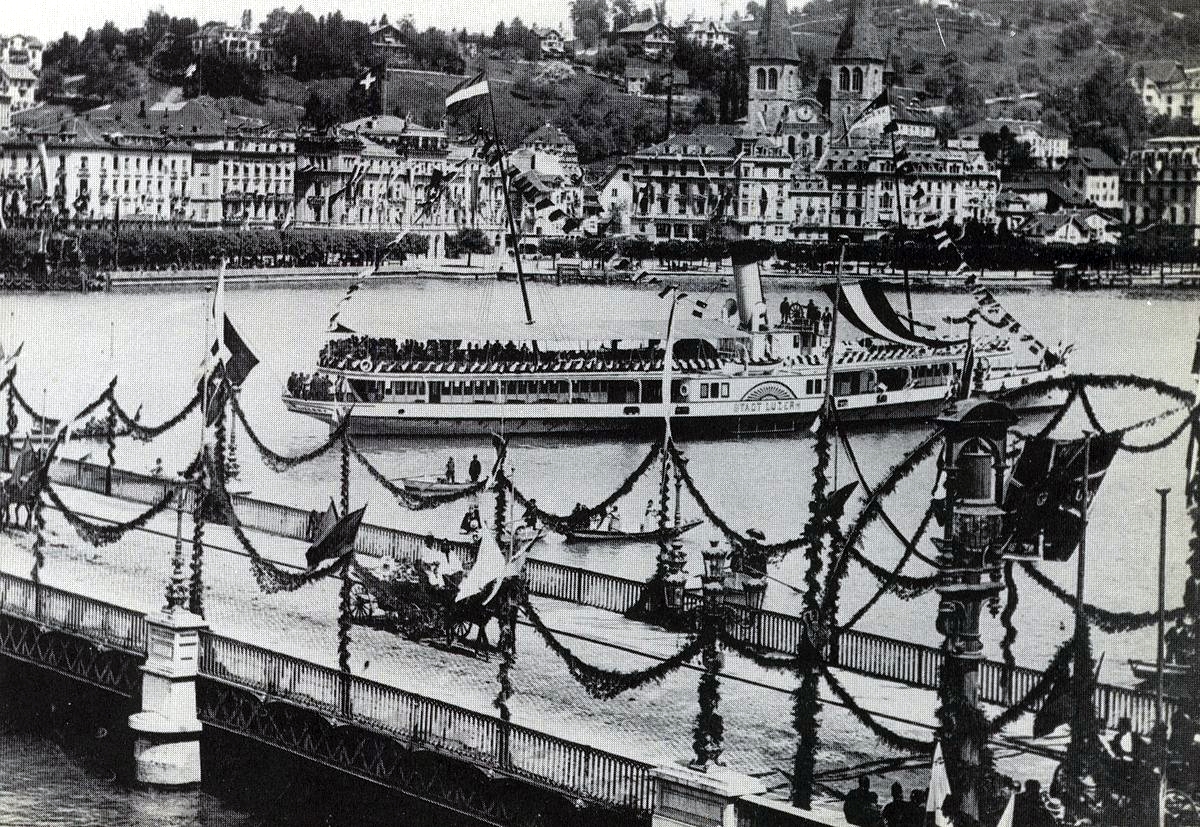
       The second Steamship „Stadt Luzern“ (City of Lucerne) 1887 – and the third „Stadt Luzern“ c. 1925.

On 17th of December 1835, the Grand Council of the Canton of Lucerne approved the establishment of a public limited company on shares for the construction of a steamboat on Lake Lucerne. The first steamship, namely the „City of Lucerne“, was built in Zurich and put into operation in 1837. The so-called „New Company on shares“ was established 1870 and still exists today. The four pictures of the SVG are from Wikipedia.

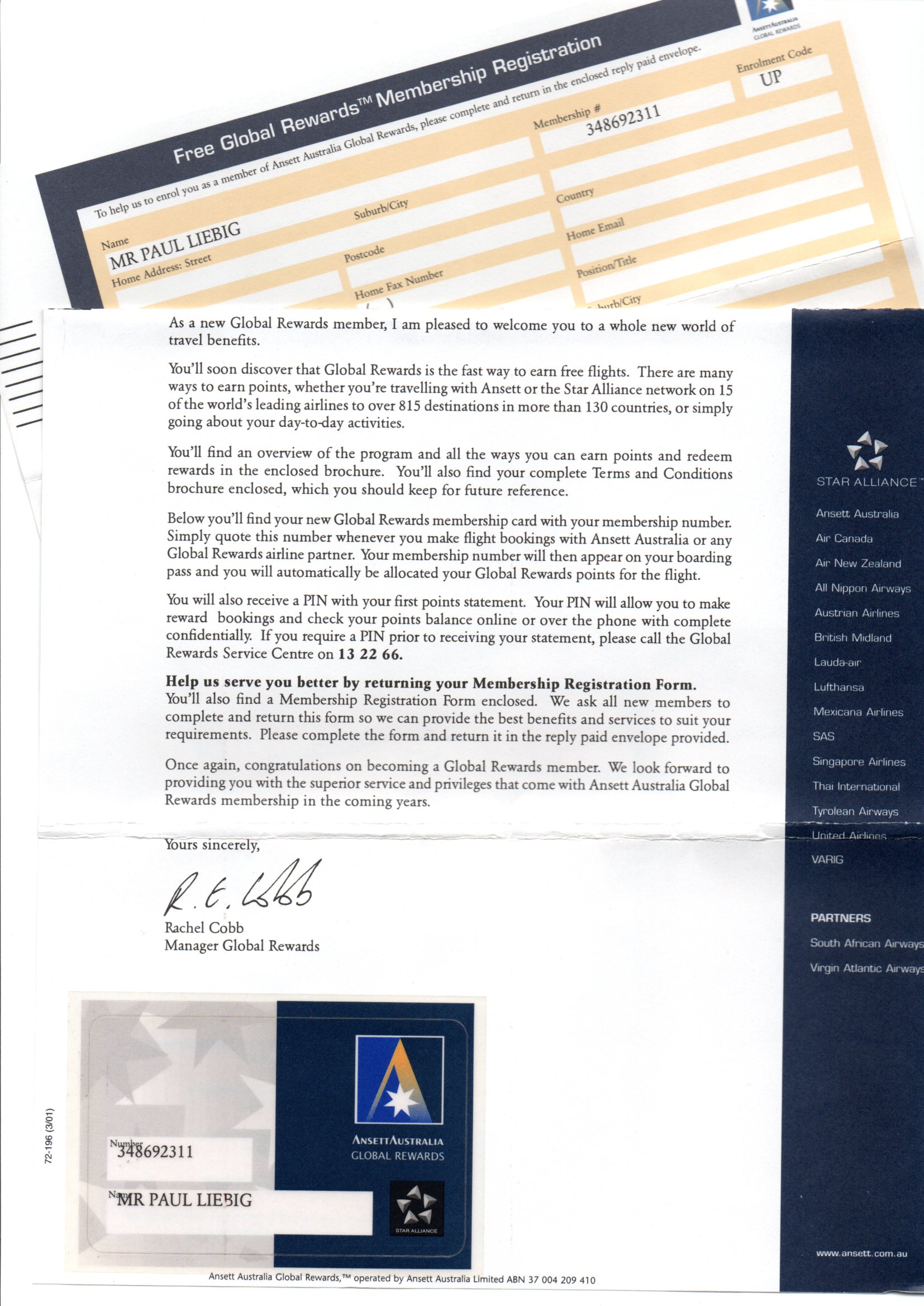
Reward Welcome Set from Ansett Australia. Ebay auction, call US$ 1,–.

      Ansett Global Rewards.

As said before, ephemera collectors collect everything they like. This is a global welcome set from one of the most well known airlines in Australia – ANSETT ! The set was mailed to me 1st of September 2001. It contains all the papers, including brochures and the, still sealed, original member card. I could never use that set and all the points I’ve earned, because Ansett collapsed just a few days later.
          The contents.
A rare opportunity for airline ephemera collectors.

Ansett Australia was a major Australian airline group, based in Melbourne. Founded on 17th of February 1936 by Reg Ansett and Peter Abeles as ANSETT AIRWAYS. The airline flew domestically within Australia and from the 1990s to destinations in Asia. After operating for 66 years, the airline was placed into administration in 2001 following a financial collapse, and subsequent organised liquidation in 2002, subject to deed of company arrangement.

     How it all began in 1936.  Two Lockheed model 10 Electra aircrafts on the airfield of Mildura.  Courtesy Victoria Museum Collection. Click on pics to supersize.

Global Rewards was Ansett Australia’s Frequent Flyer Program from 1991 to 2001. It was formerly known as „Ansett Frequent Flyer“. Points could be used for services from Ansett Australia and their partners including flights, upgrades, holidays, hotel stays and car rentals. Diners Club was a significant financial services partner in Global Rewards.[23] Points held at the time of the airline’s collapse lost their value as no other airline took over the program as had taken place with the collapse of some other airlines.

    How it all ended.    Boeing 747-400 advertising the Olympics 2000 in Sydney, Australia.

They had over 130 planes in the fleet, among others 20 brand new Airbus A320-200, branded as „Ansett Skystar“, as well as 12 Boeing 747 300 and 400, branded as „Ansett Spaceship“.

In February 2000 Air New Zealand acquired full ownership of Ansett, buying out News Corporation’s stake for A$680 million, surpassing Singapore Airlines’s A$500 million bid.

    Only 1 year – did they really do it ???

Competition from Qantas and a succession of start-up airlines (Impulse Airlines and Virgin Blue), top-heavy and substantially overpaid staff, an aging fleet and grounding of the Boeing 767 fleet due to maintenance irregularities left Ansett seriously short of cash, losing $1.3 million a day. Many employees expressed anger at what they believed was Air New Zealand’s culpability in Ansett’s financial collapse.

Netherlands Memorial Card. For sale US$ 18,–.

Commemorative card for the wedding of princess Beatrix and prince Claus of the Netherlands, dated 10th of March 1966. The card measures 15×10,5 centimeters and is in perfect condition.

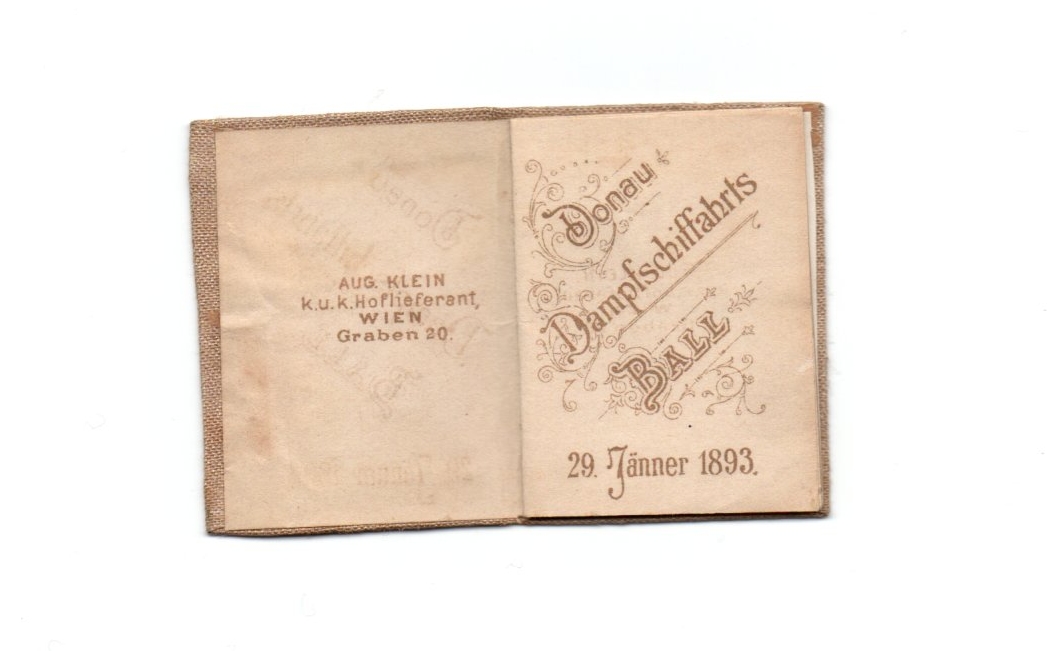
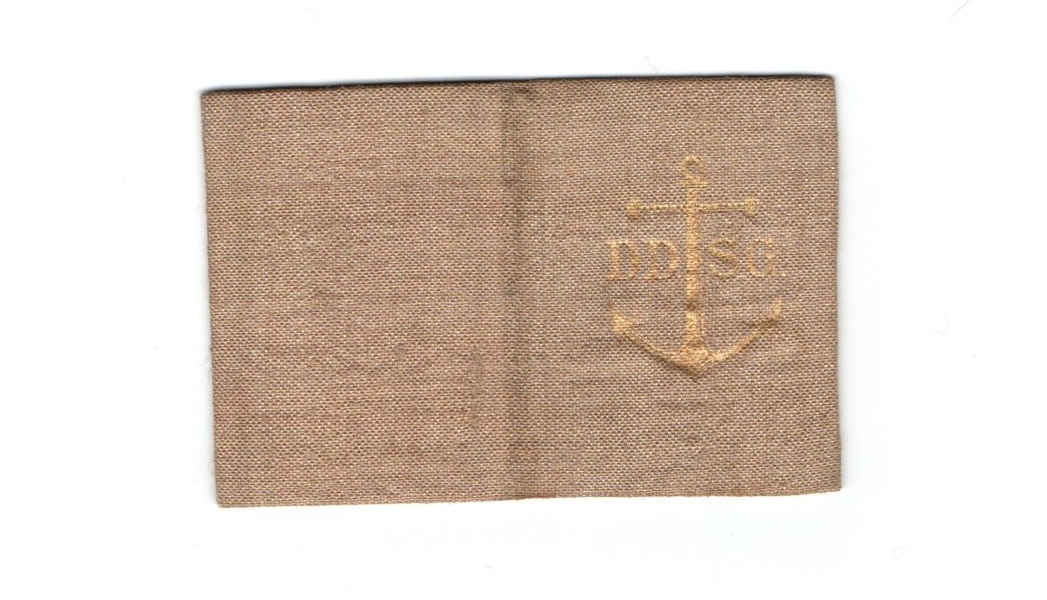
Dance Booklet of the DDSG. For sale US$ 95,–.

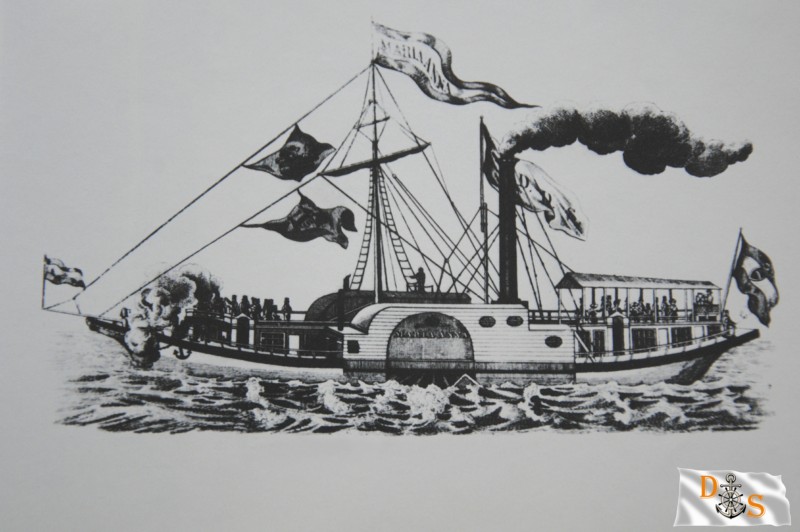
The shipping company (DDSG) was founded in Vienna on 13 March 1829. The steamer “Franz I.” ran between Wien and Budapest in 1830. The company became the largest inland shipping company of the world within the following years. It transported 1.6 million passengers in 1889. The fleet consisted of 200 steamers and 1,000 barge-loads at that time.

         The first DDSG steamer „Franz I“. Picture DDSG.  The postal stamp is from 1979, 150 years of DDSG.

The name of the company is well known in German-speaking countries as a starter to humorously construct even longer compound words. Donaudampfschiffahrtsgesellschaftskapitänsmütze is such a word. Even better is
Donaudampfschifffahrtselektrizitätenhauptbetriebswerkbauunterbeamtengesellschaft. Good exercise to learn and pronounce German.

  Vienna, 1 March 1838, founder’s share of 500 Gulden, #4113, 25.2 x 39.7 cm, black, beige, original signatures, issued to and signed by Anton Taulow Ritter von Rosenthal. This rare certificate is a nice collectors item and is sold in auctions around US$ 1.800,–.

In 1812 the first Danube steamship was put into operation in Vienna. A short time later, in 1829, the first Danube Steamship Company was launched. Thus, the ships were faster, for example, drove the first steamboat „Franz I“ in 1830, the descent from Vienna to Budapest in 14 hours 15 minutes. For the ascent from Budapest to Vienna it took 48 hours 20 minutes.

   This dance booklet is, handed out for the lady’s on the occasion of the DDSG Yearly Dance, for its age of 125 years, in excellent condition. It is hand bound with 9 inner pages and covered by linen. The measurement is just 5,5×4 centimeters. The inside and outside printing is done in golden letters. An extremely rare collectors item for the serious DDSG collector – I have it for about 40 years and never seen a similar one.

     This is how the steamships looked like at the end of the 19th century. Click on pics to supersize your view. The right one is a rare wood engraving printed on the occasion of the opening of the Danube regulation. The dance booklet is a wonderful part of DDSG history.

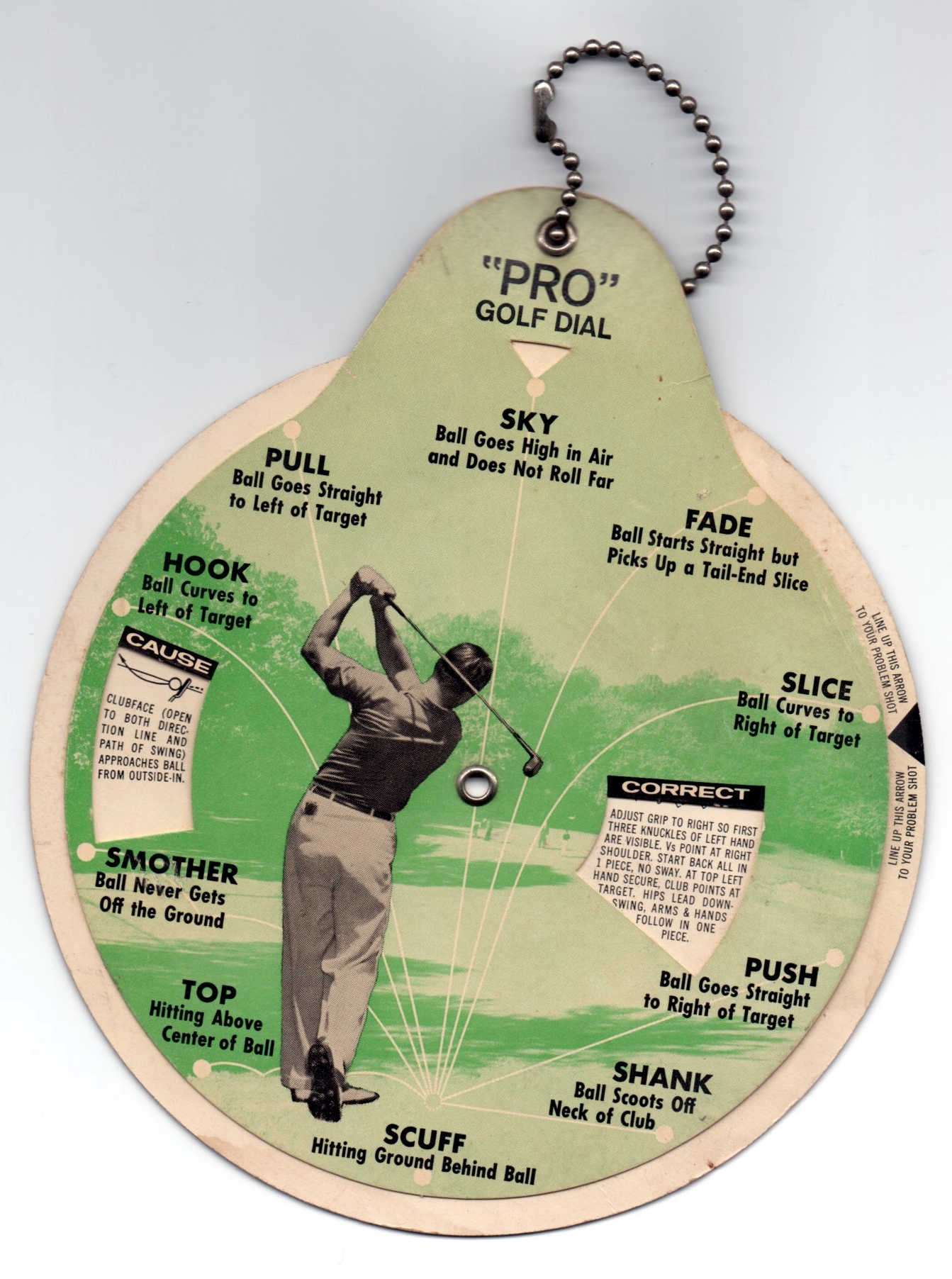
Professional Golf Dial from 1962. For sale US$ 70,–.

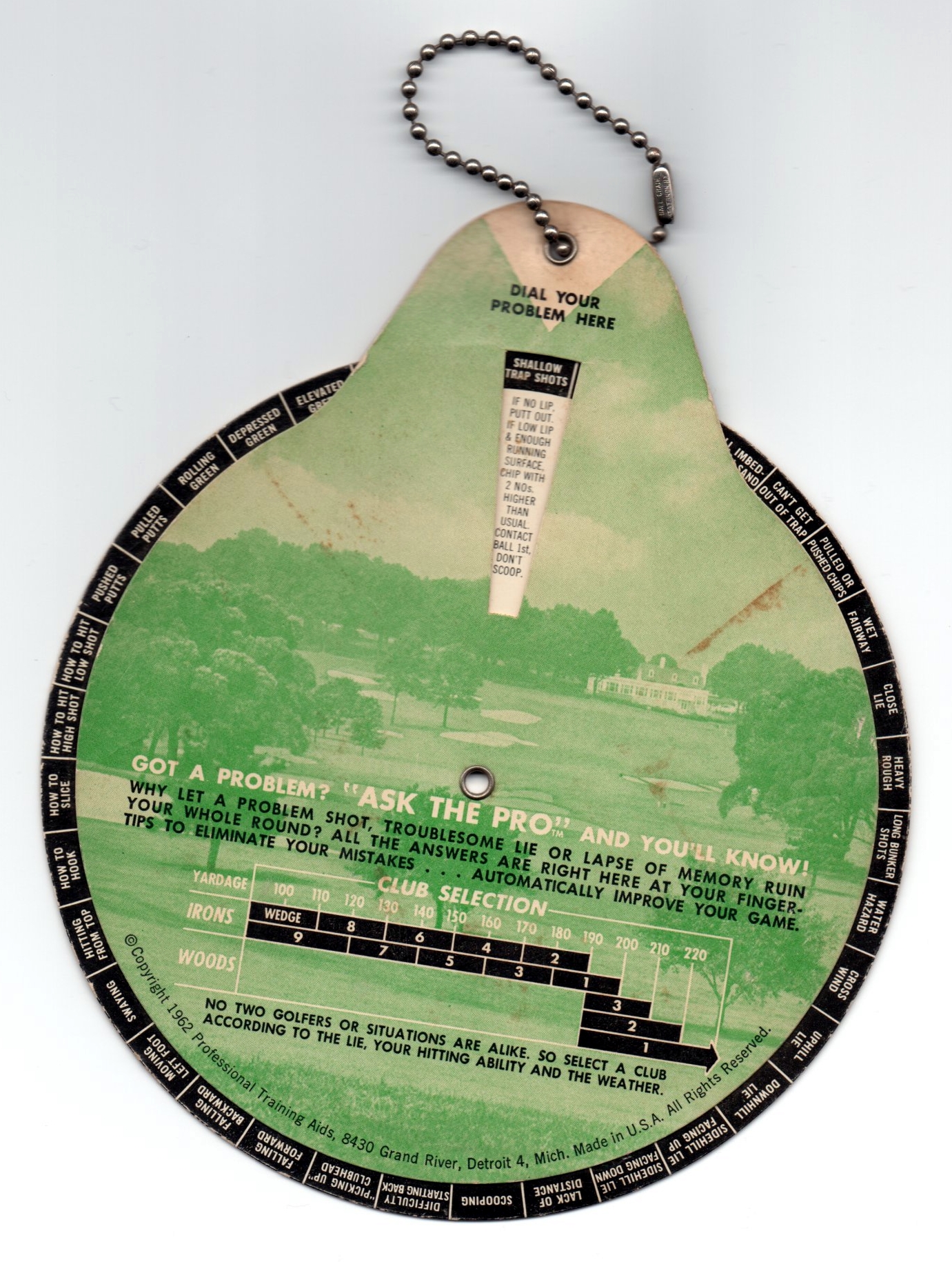
This golf dial is a professional evolution of master golfers . Dozens of tips trough an easy to use dial, printed on card board. This golf dial is still in very good usable condition and the tips are as current as they were over 50 years ago.

       Rear side of the dial.

Diameter is about 16 centimeters and a chain is attached. A great and rare item for enthusiastic golfers or golf ephemera collectors. I am a golfer myself and I asked good friends, which are professional, about some of the printed on dial problems. Not one could give all answers. This little dial is a whole professional golf lesson in itself.

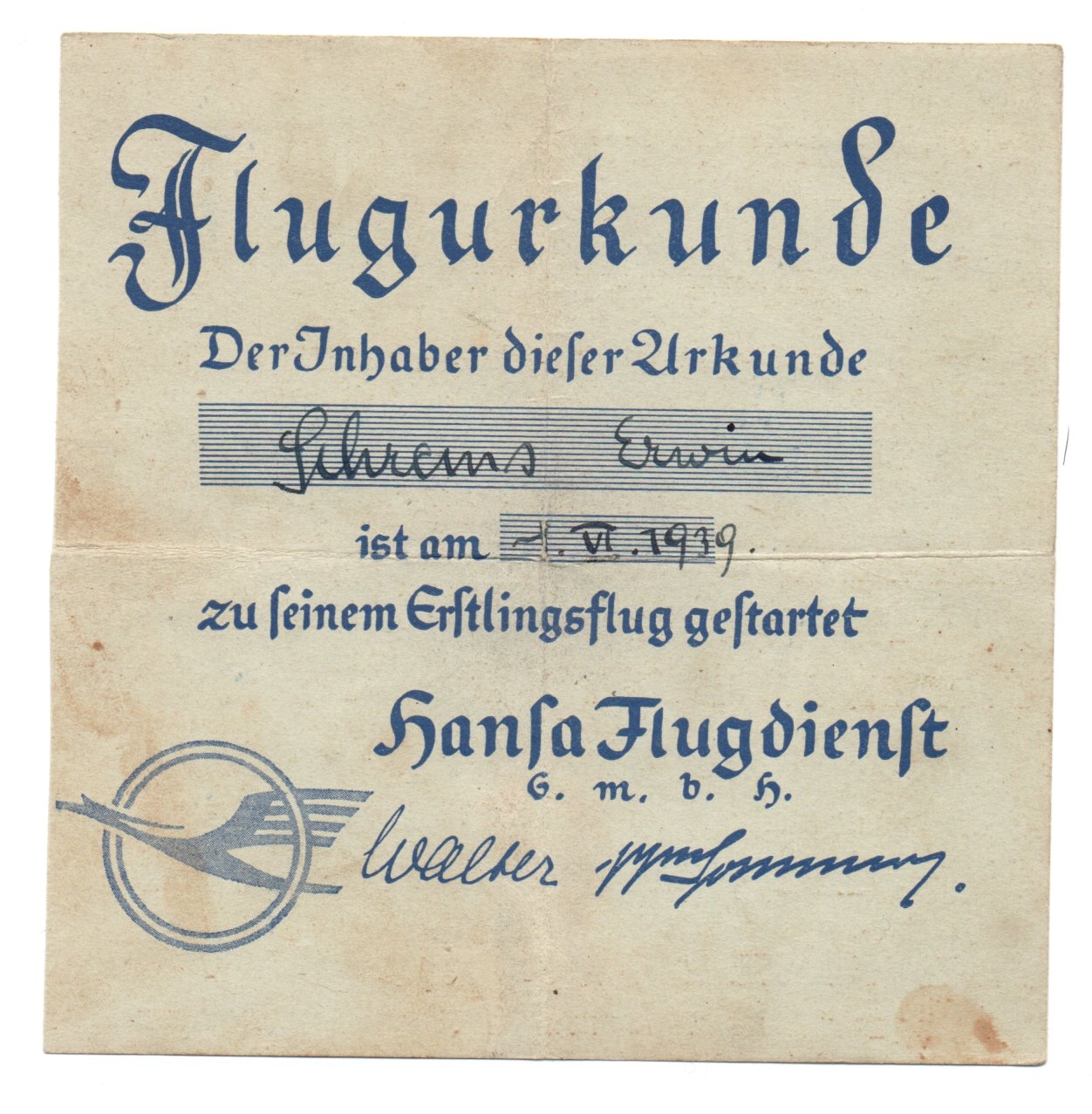
First Flight Certificate „Hansa Flugdienst“, 1939. For sale US$ 180,–.

Flight certificate of Hansa Flugdienst GmbH in Berlin, issued to Mr. Erwin Schrems, on the occasion of his first flight on 1st of June 1939. The color is light blue and dark blue printed on card paper. Condition overall is fine, but used, it measures 15×15 centimeters. This very rare certificate was issued just 3 month before WWII started.

     Airplanes of Hansa Flugdienst in the 1930’s.
  Group of a stewardess class, left and right the Bremen already with the Nazi-symbol, 1939 at the Woertersee.

The establishment of Hansa Flugdienst took place in the year 1926 by the union of the German Air Hansa, the German Aero Lloyd and the Junkers Air Traffic. The crane as the Lufthansa logo, was taken over by the introduction of the German airline in this merger. With the end of the Second World War, the service had to be discontinued.

Rear side of the certificate, showing some advertising for the „Air Force Magazine – Der Adler – The Eagle“.

In 1953, the Air AG was founded as a new company, but only with the regaining of the German Air sovereignty in 1955 it became possible to resume domestic air traffic, now under the name of traditional German Lufthansa. Hansa Flugdienst GmbH, headquartered in Berlin, was a subsidiary of Lufthansa, which mainly undertook sightseeing flights, children’s flights and a flight-school for stewardesses and pilots.

Collecting ephemera and history is an interesting hobby. Did you enjoy it ?
Stay tuned for some more to come in future articles about this theme.

Veröffentlicht unter Collecting, For Sale, History, Hobbies | Verschlagwortet mit | Hinterlasse einen Kommentar

Spanish Cuisine – Update

Last week I posted the „Tapas Test“. Some of you wanted to hear more about some Tapas bars in Barcelona, where to go. I’ll try to answer this, but my last visit to Barcelona was about 3 years ago and some can have changed meantime. The question often comes up for „what is a good Tapas Bar in Barcelona? Answer: all are good, or all are bad. It depends on your own personal demand and standard of lifestyle. Tapas is philosophy and lifestyle !
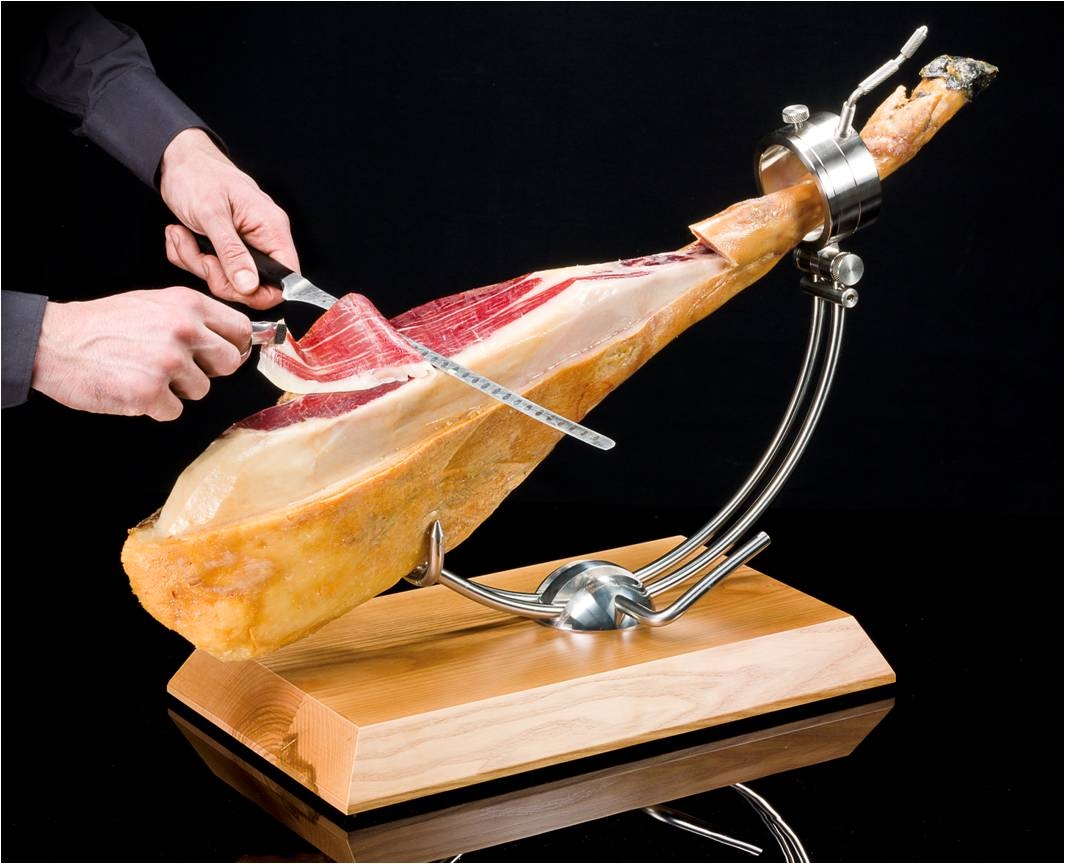
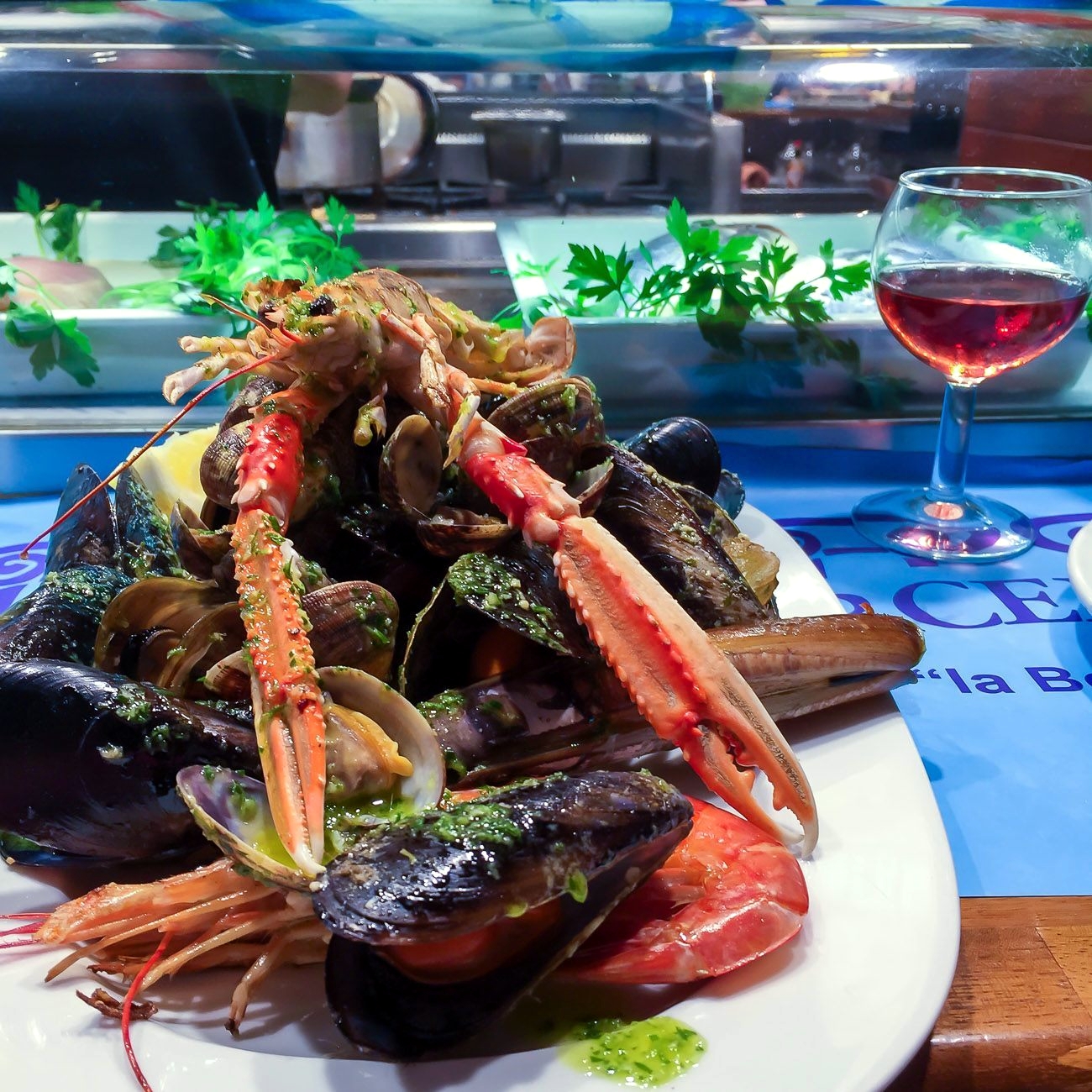
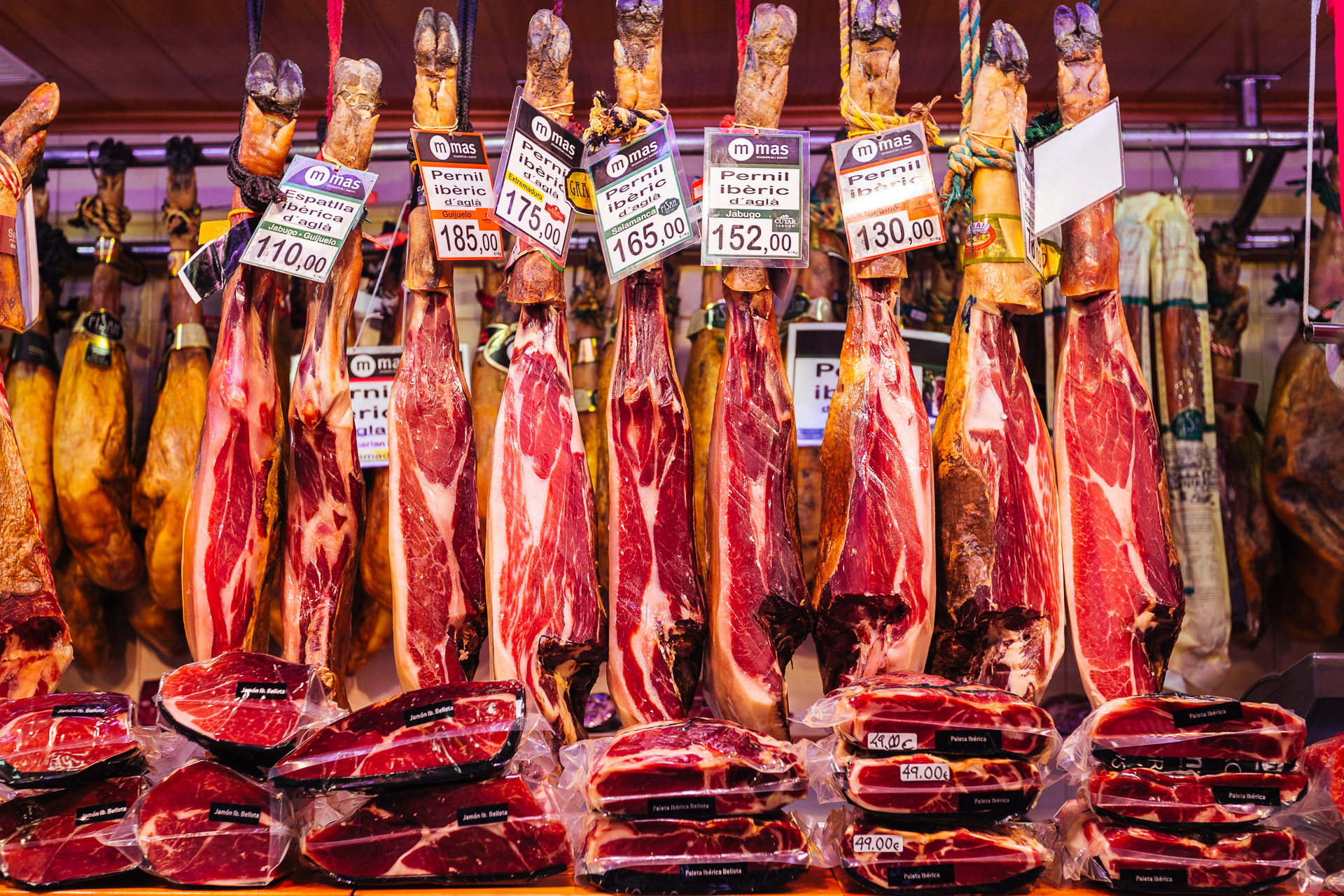
      Left: Seafood plate at Barcentral in Barcelonas La Boqueria market. Right: Just in case one doesn’t like seafood – then have some Jamon Iberico.  No further comments needed, right ?

Barcelona.

The culinary scene in Barcelona is dominated by contemporary Catalan cuisine. The city has a huge variety of high end restaurants where food is treated as a combination of science and art. The city’s restaurants are at the cutting edge of world cuisine, discovering new culinary techniques and creating new dishes every day.

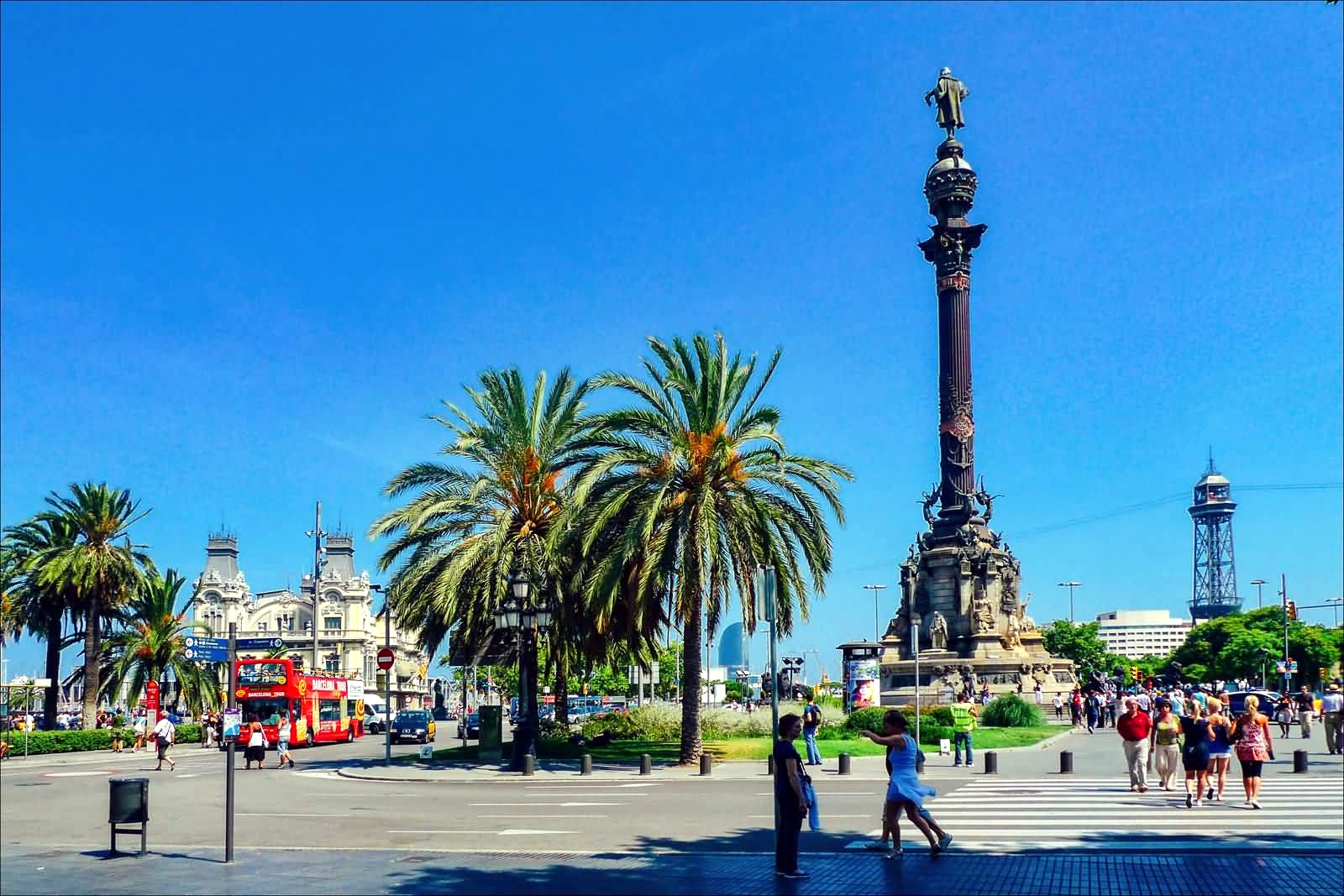
  The Christopher Columbus monument in Barcelona. At harbor side and only a few blocks from the Hotel Barcelona Universal.  Everything in easy walking distance.

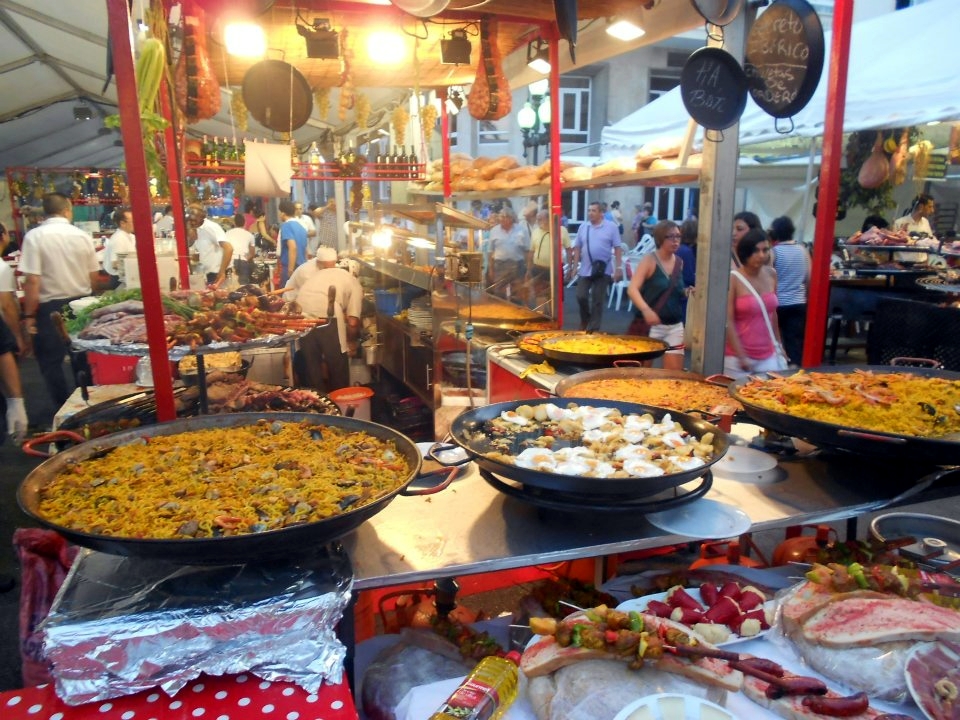
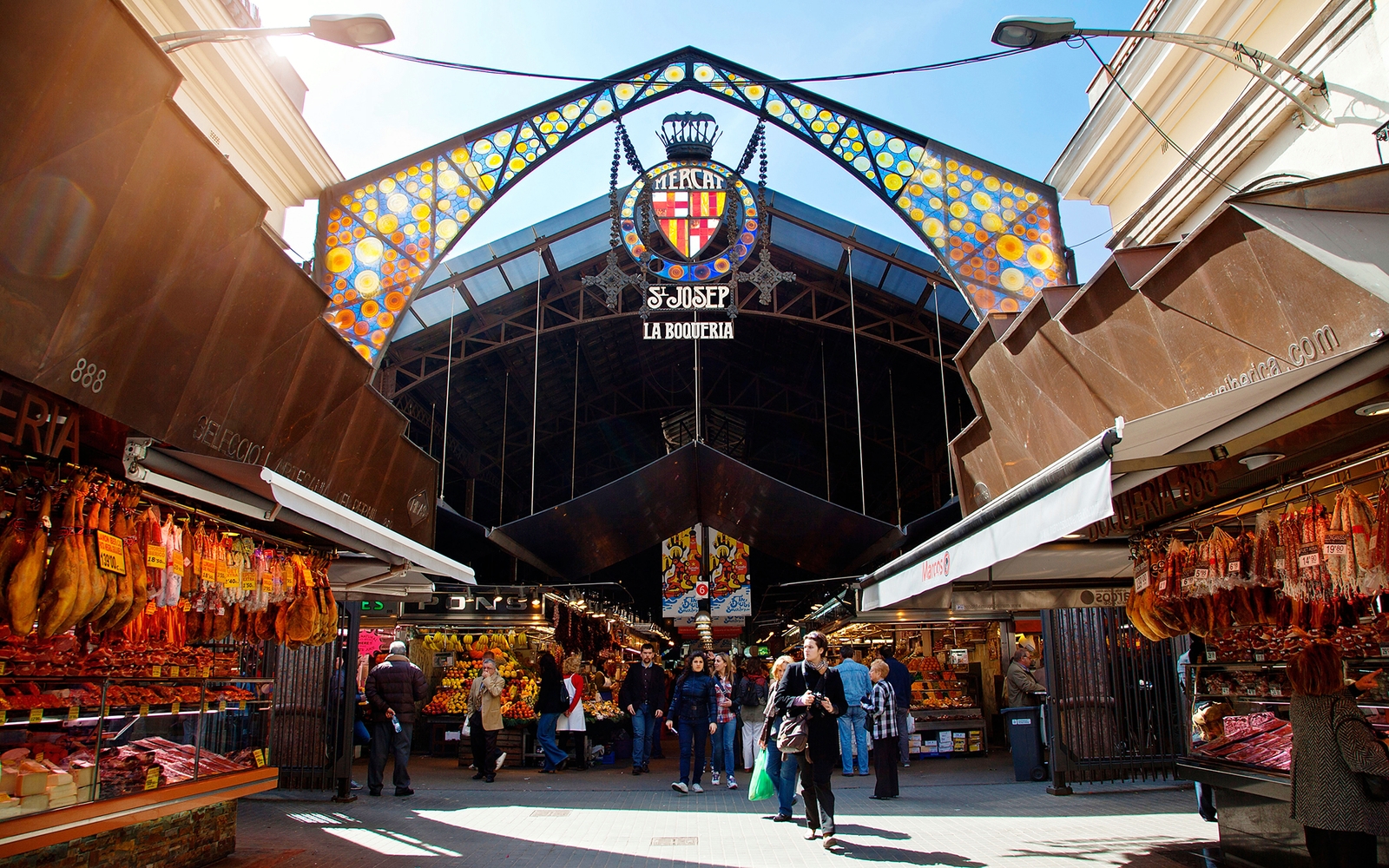
Barcelona also has classic restaurants that serve more traditional Spanish dishes like Paella and Pisto, a Spanish ratatouille. The best slice of Spanish cuisine is however not found in fancy restaurants, but in the local markets and Tapas bars of Barcelona. The local La Boqueria market is arguably one of the best fresh food markets in the world.

           La Boqueria Barcelona. Click on pics to supersize.

You can find anything from sheep’s head to lobster in this market. Of course, the Tapas bars are the real culinary attractions of Barcelona. Each bar has their own specialties that they serve up to patrons, who sit sipping on cold beers, chatting about the day’s events. Fresh fish, fried potatoes and cured meats are what Spanish food is all about.

Some of my favorite Tapas Bars in Barcelona. Wish we had some in Uruguay !

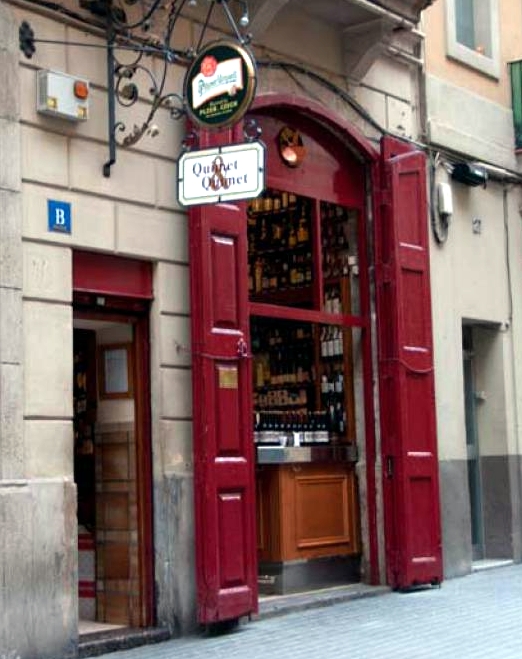
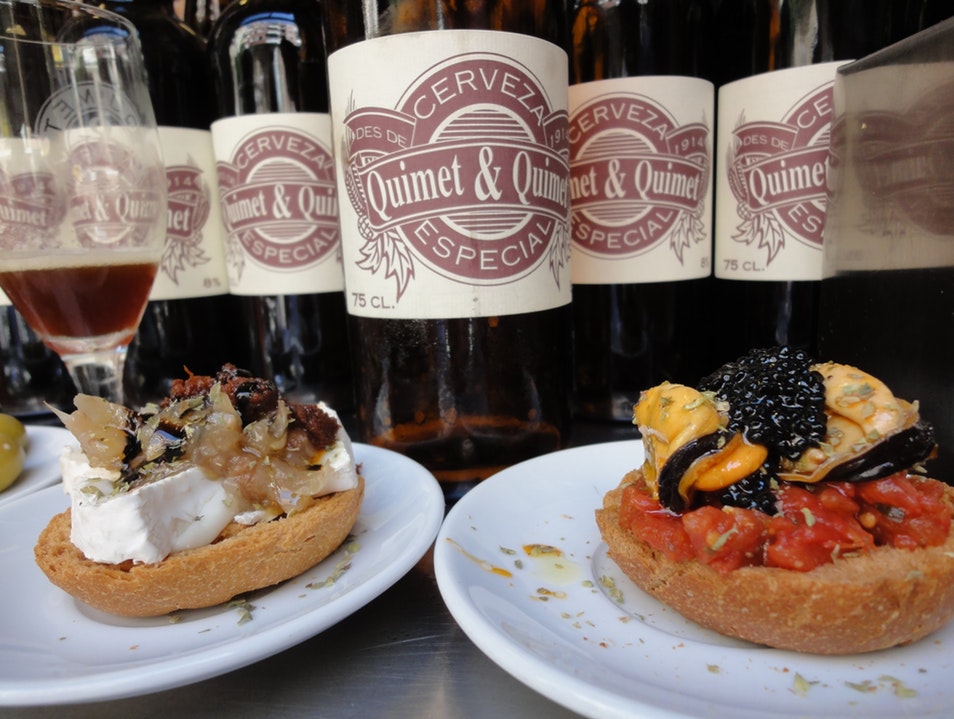
Quimet y Quimet.

  Over 100 years a Tapas Bar in Barcelona.

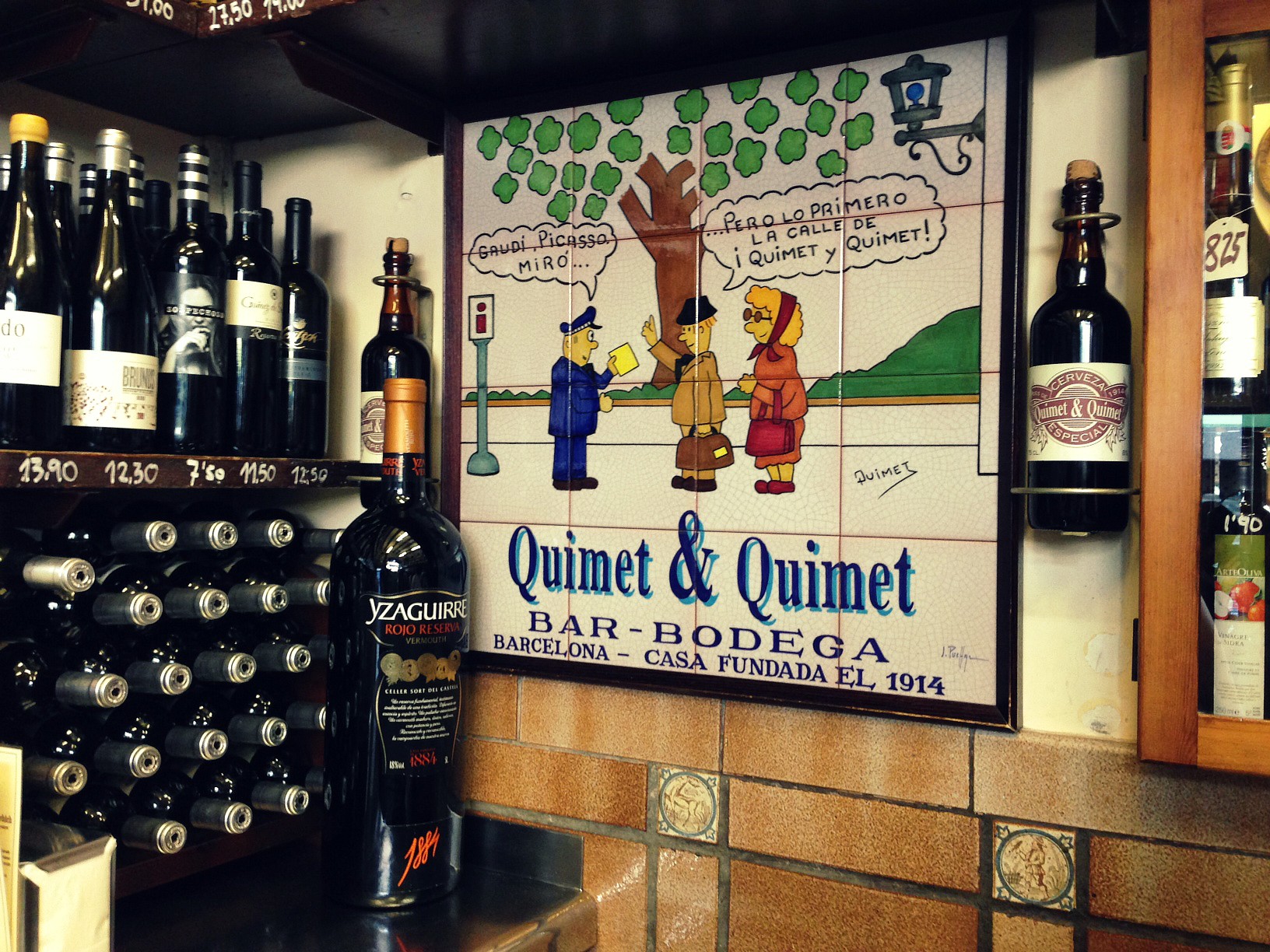
This quaint tapas spot should be a MUST SEE. This bar is loved by locals and tourists equally. Located in the quirky El Poble-Sec neighborhood of Barcelona, is renowned for its scrumptious montaditos – bite-sized, baguette-style snacks filled with the tastiest ingredients from Spain. If you’re not sure what to order, the chef can even choose for you based on your drink order. With a standing room only, Quimet is a great place to grab a drink, some great tapas and catch up with friends.

  
Quimet pics are courtesy of Quimet.

First time I visited Quimet y Quimet, I stayed at the Hotel Barcelona Universal. A hotel I also can recommend, because it is around 80, –euro a night for a 4 1/2 star quality right in the center of the city, about 4 blocks from the Columbus monument and harbor . And the Quimet is just a walking block across the road, the Boqueria market about 5 blocks away. Plus dozens and dozens of others.

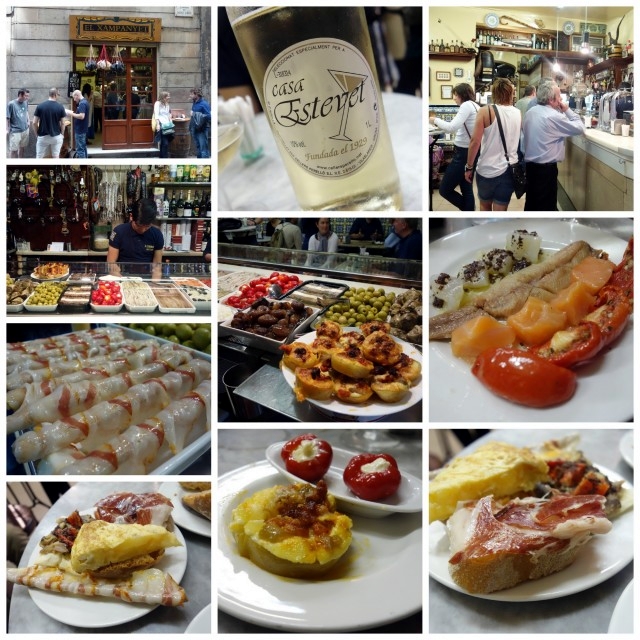
El Xampanyet.

                           Pictures by Xampanyet.

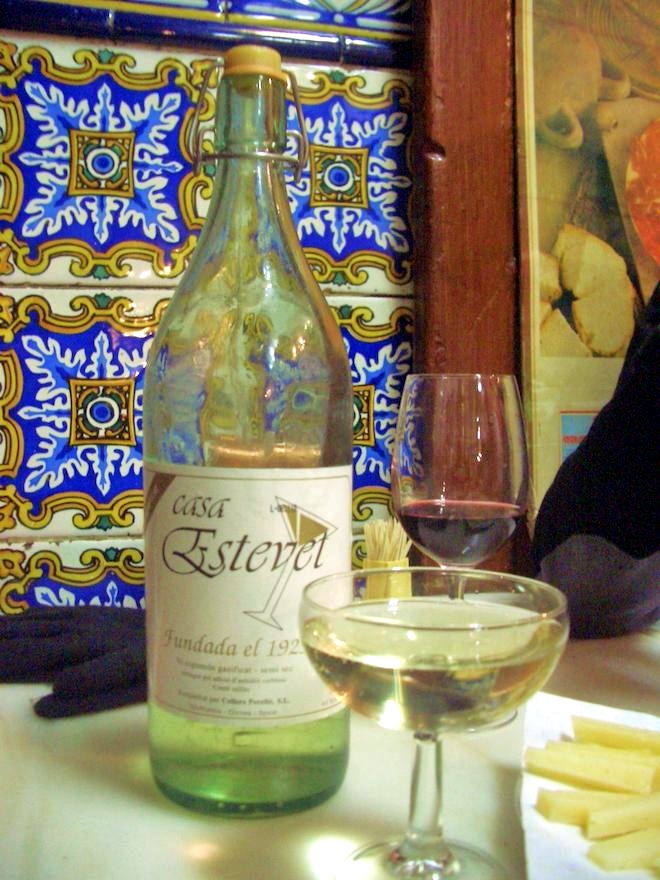
Located near the Picasso Museum, this tapas bar is very popular with the locals of Barcelona due to its sensational food and exceptional house cava. This old-school, authentic Catalan joint is renowned for its fantastic service . It’s a very casual family run tapas spot popular with tourist and locals. Xampanyet is the homemade sparkling white wine (cava) they serve, which has become the restaurant signature.

El Quim de la Boqueria.

     Quim Marquez on the left. He started with a 3meter bar and 5 stools. Pictures by El Quim.

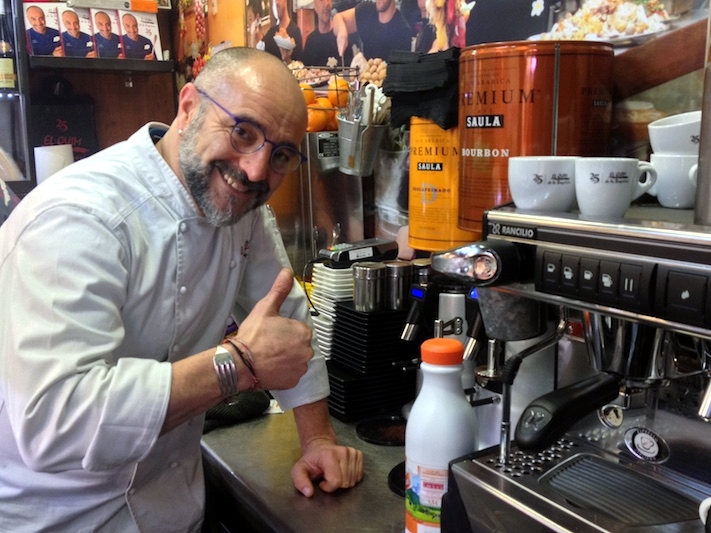
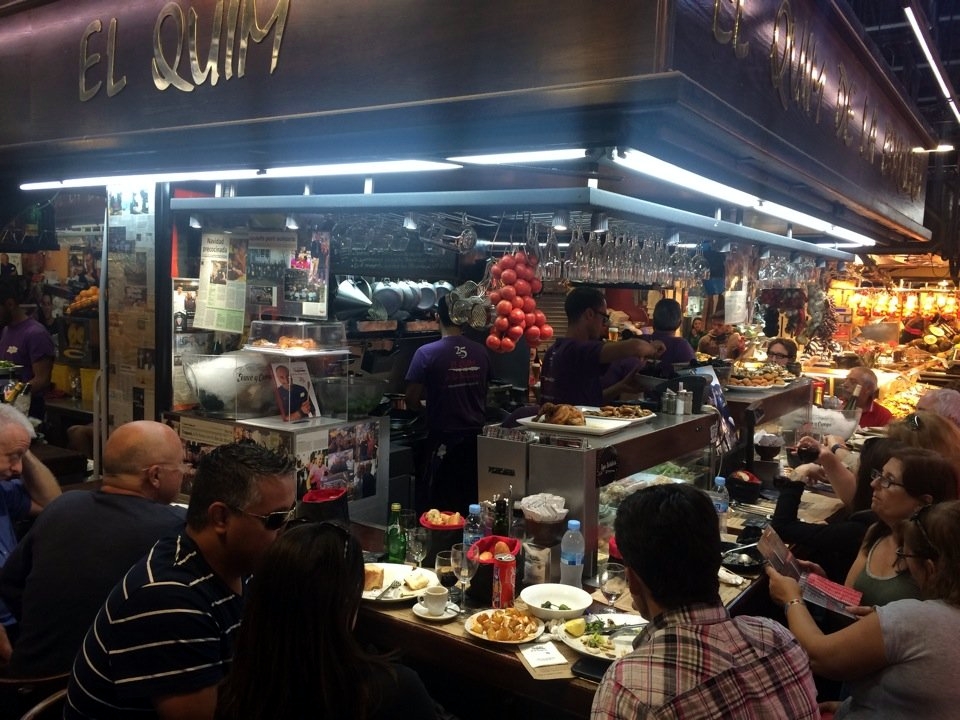
My third tip to you will be the tapas Bar aEl Quim at the famous Barcelona food market. El Quim is the perfect pit stop during a trip to La Boqueria – the world renowned and Barcelona’s most famous food market. Absorb the market’s unique atmosphere from your bar stool while the chef, Quim, whips-up some authentic, Catalan tapas as he has been doing in the same market since 1987. Quim Marquez has created a small culinary paradise ranging from varied gambas, foie gras, xipirons to a fantastic variety of wines. A perfect place to chill out for a few hours and enjoy life.

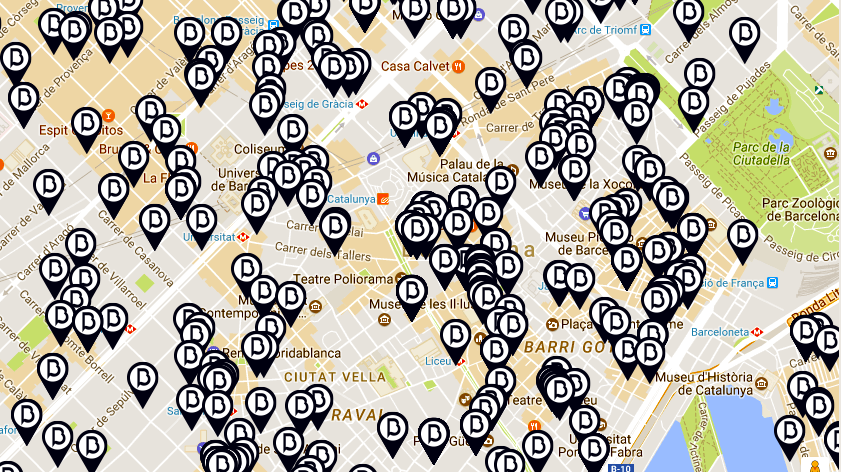
  This is an idea about how many Tapas Bars one can find in Barcelona. Reality – to many – there is one on every corner and you have to make your own choice. If you ask a local, which is the best one, everyone will give you a different answer.

Hi everyone, I hope that will give a small introduction of what to find in Barcelona.  Good luck with searching and culinary fun with working through thousands of dishes. Enjoy ! Down here (the guardian) not the very newest article, but a nice and short overview of Barcelona Tapas Bars – and at the end of the article a lot of additional tips to Barcelona:

https://www.theguardian.com/travel/2011/jun/08/top-10-tapas-bars-barcelona

Veröffentlicht unter Information, Lifestyle, Travel | Verschlagwortet mit , | 2 Kommentare

Spanish Cuisine

Many people like to travel, enjoy the country and its people and, of course, the regional foreign cuisine. Therefore it would be good to know what local specialties are or what the dishes mean one can find in the local menu. Especially Spanish food lovers know that Spain has much to offer on culinary side. By example the hundreds of tapas variety’s.

Likewise, such knowledge is certainly important and helpful at home in foreign restaurants. For this purpose and a little personal training, I have put together the most important terms in a small test. Today is Spain’s turn, the last one. France and Italy was posted already. First the question and further down a short explanation with a picture. As an example paella.

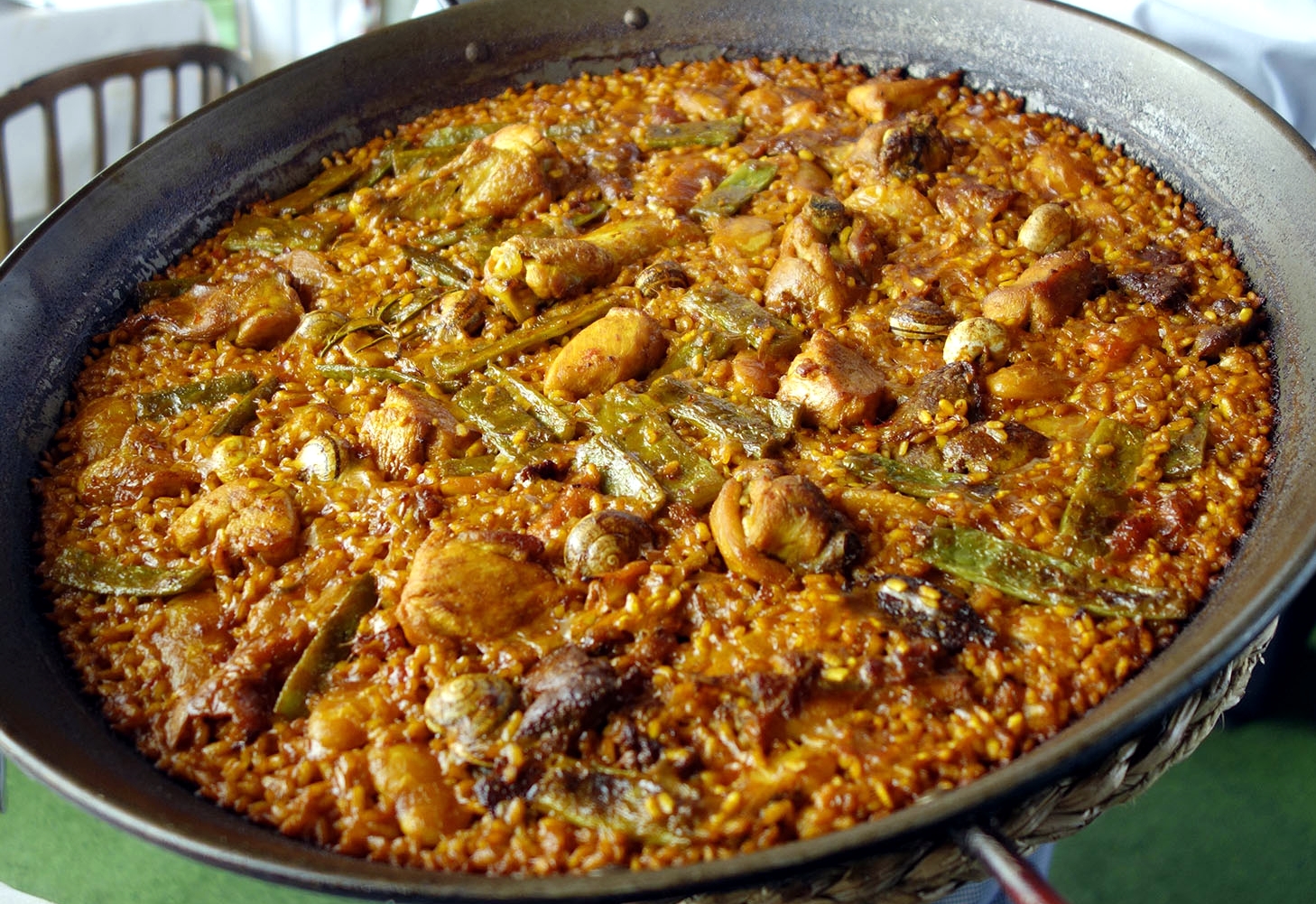
  Typical Paella Valenciana, locals like to eat right out of the pan. We do at home the same.

Paella is a Valencian word which derives from the old French word „paelle“ for pan, which in turn comes from the Latin word „patella“ for pan.

Paella is a Valencian rice dish that has ancient roots but its modern form originated in the mid-19th century in the area around Albufera lagoon on the east coast of Spain adjacent to the city of Valencia. Many non-Spaniards view paella as Spain’s national dish.

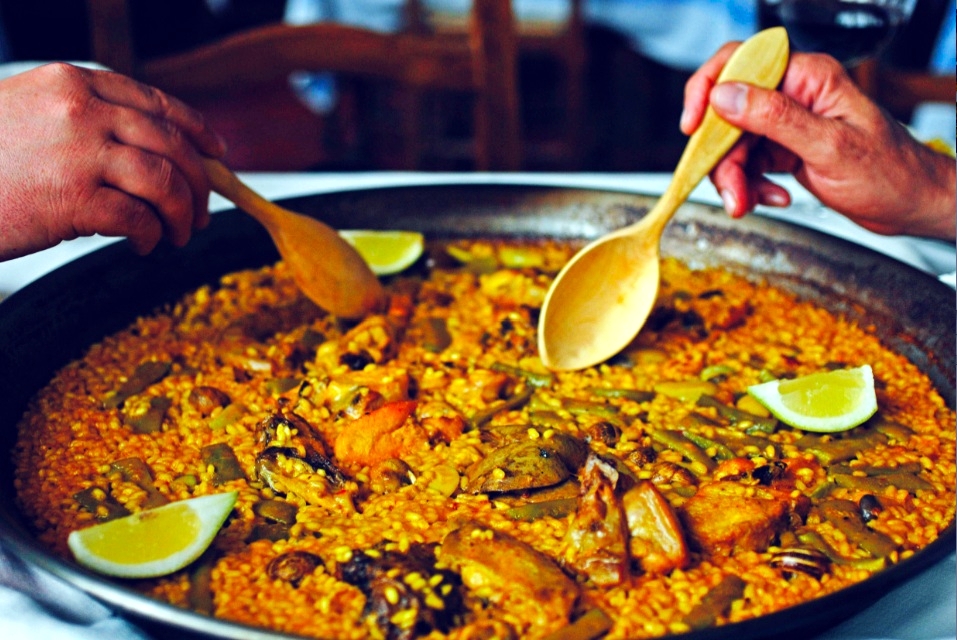
Types of paella include Valencian paella, vegetable paella (paella de verduras), seafood paella (paella de mariscos), and mixed paella (paella mixta), among many others.

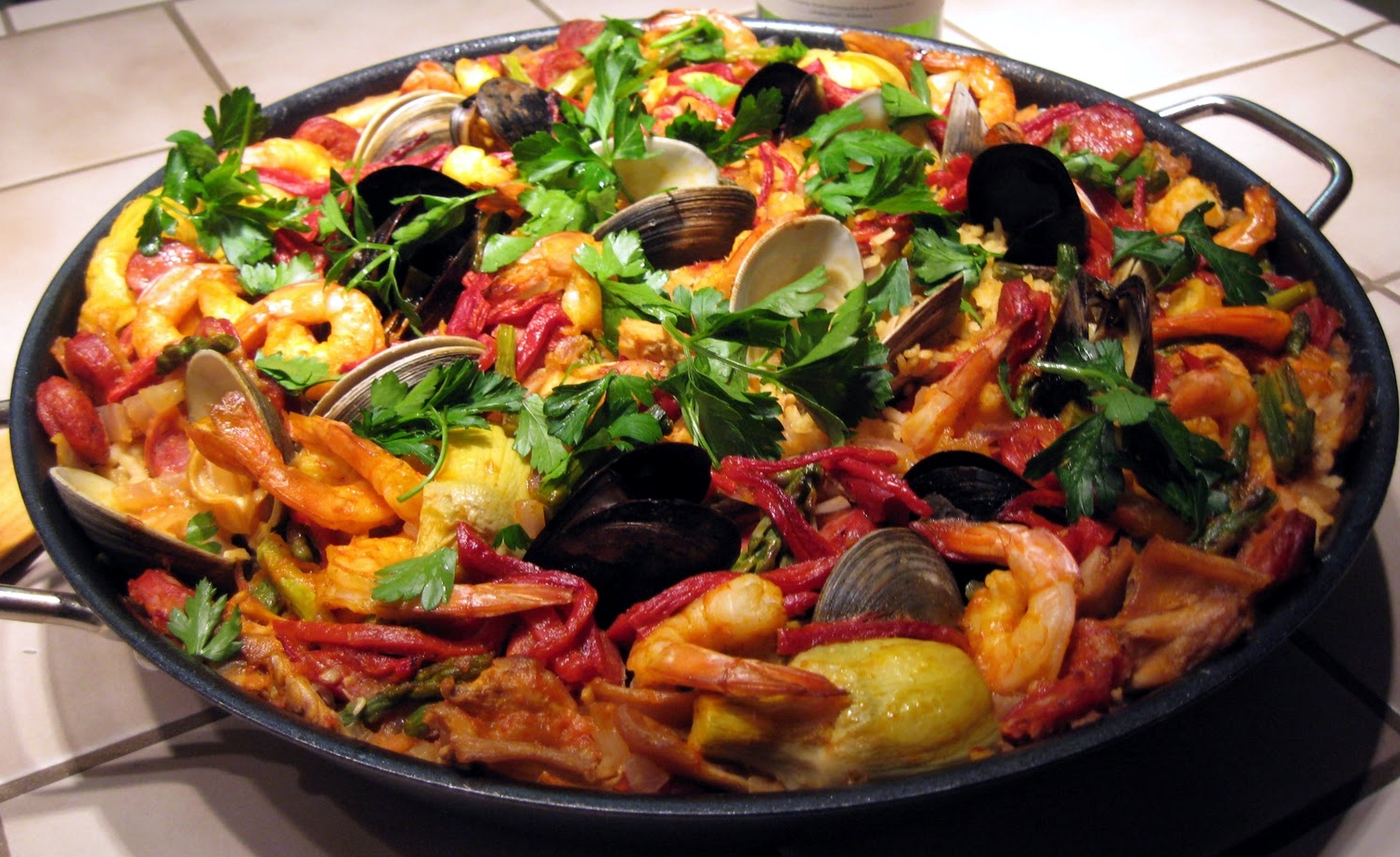
  Mouthwatering seafood paella.

Valencian paella is believed to be the original recipe and consists of white rice (which must be round grain), green beans, meat (chicken and rabbit, sometimes duck), sometimes snails, and seasoning such as saffron and rosemary. Another very common but seasonal ingredient is artichokes.

Seafood paella replaces meat with seafood and omits beans and green vegetables. Mixed paella is a free-style combination of meat from land animals, seafood, vegetables, and sometimes beans. Most paella chefs use bomba rice due to it being less likely to overcook, but Valencians tend to use a slightly stickier (and thus more susceptible to overcooking) variety known as Senia. All types of paellas use olive oil.

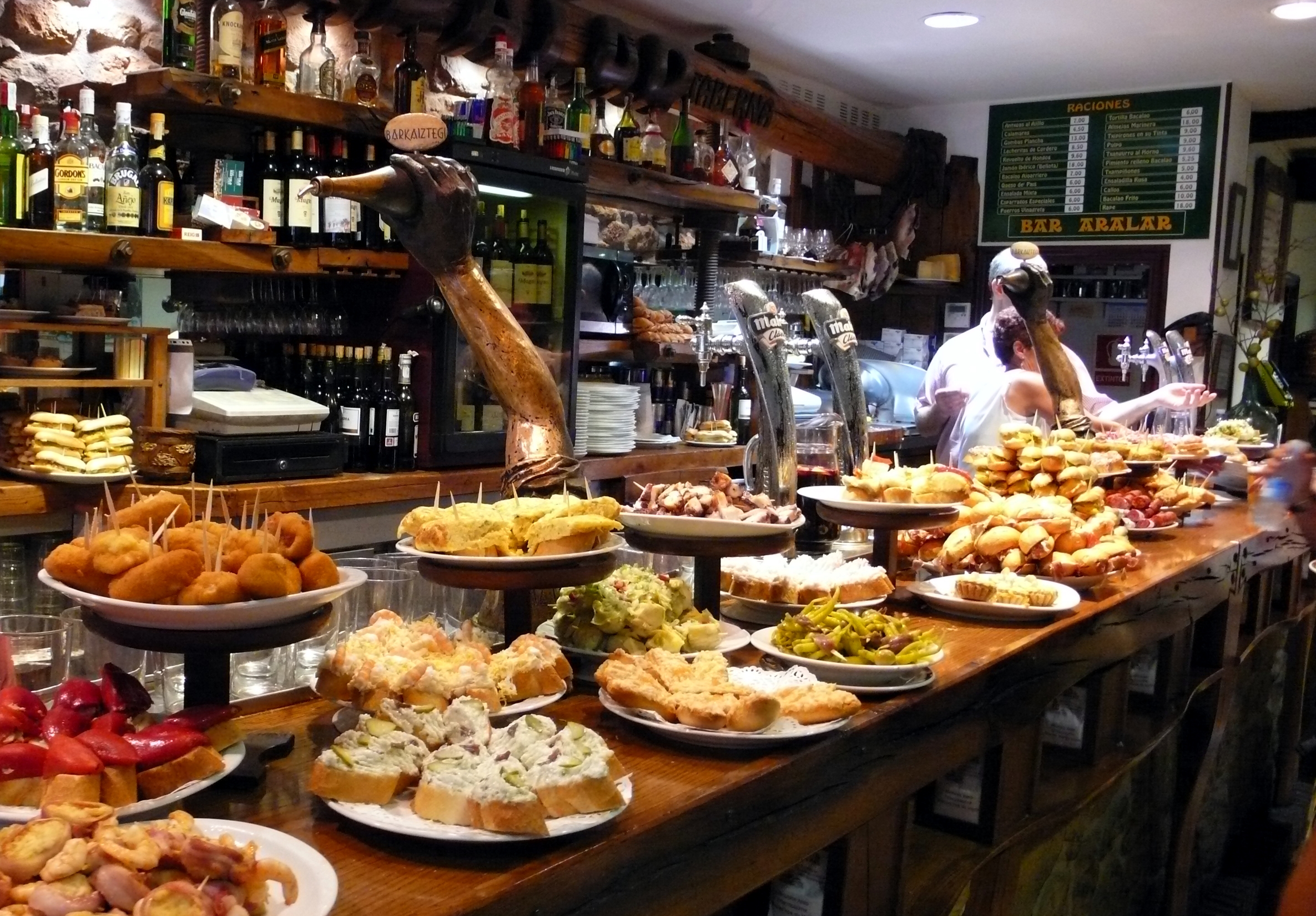
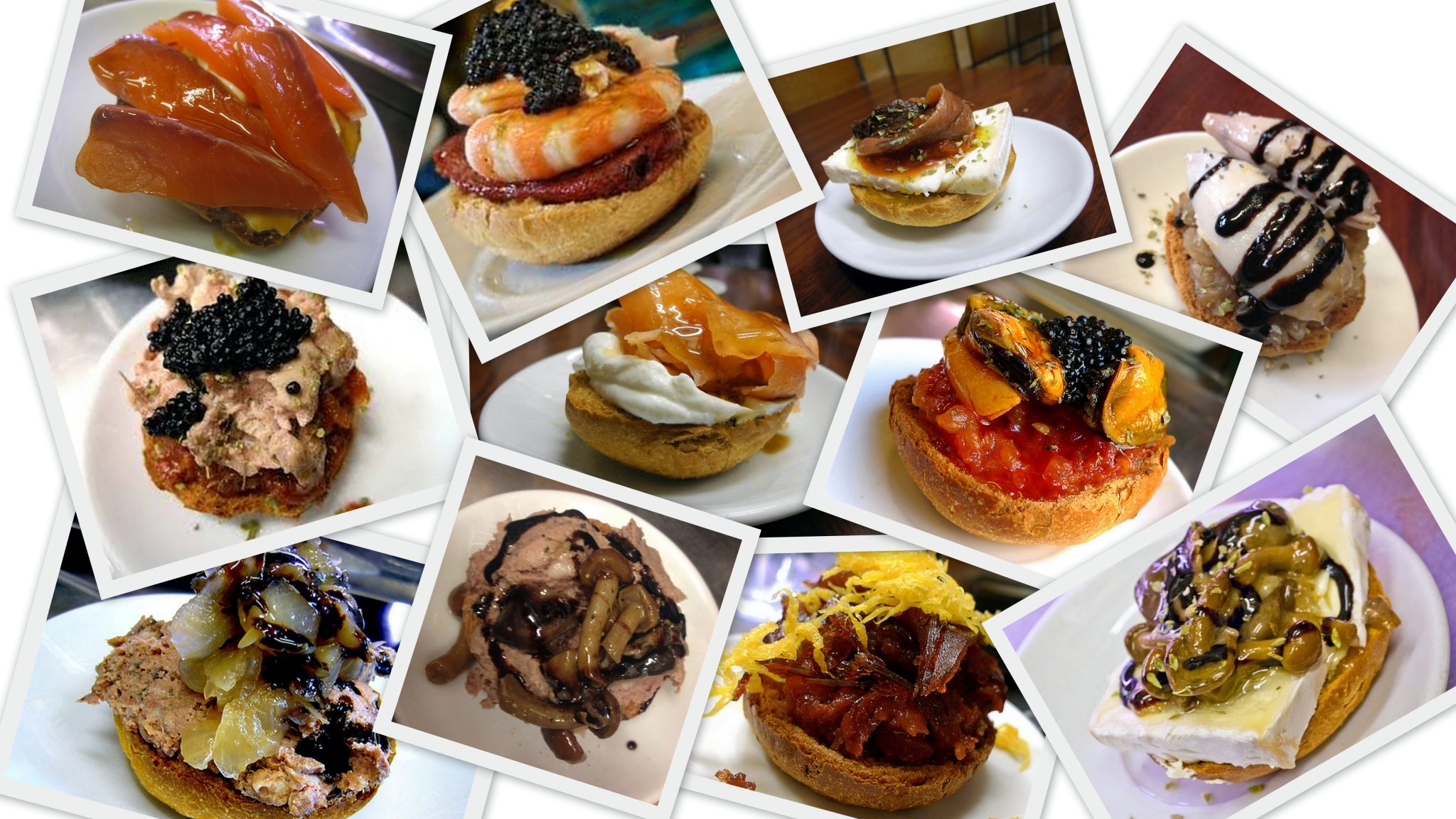
  Tapas selection from one of the most renowned tapas bars in Barcelona – Quimet y Quimet.  You should visit it if you have the chance. And click on pics to supersize for a better view.

Do you understand the tapas menu ?

In this post I only will concentrate on tapas during the test. Meatballs, deep-fried anchovies, olives: you’ve probably tasted some of the Spanish appetizers. But do you also know all the names of the little delicacies?  Take the test!

1.  Let’s start with a light question. The Jamon Iberico is :
A dark, spicy meat pie.
A spicy pepper sausage.
An air-dried ham.
A raw bratwurst.

2. You also know what Manchego is.
A Spanish hard cheese made from sheep’s milk.
A Spanish cut cheese made from goat’s milk.
A Spanish soft cheese made from sheep’s or goat’s milk.
A Spanish cream cheese made from cow’s milk.

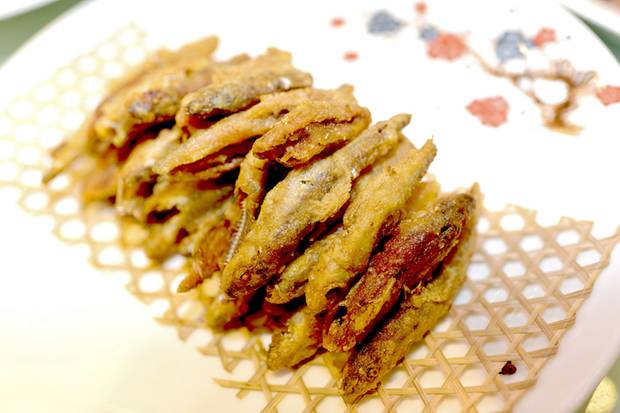
3. If you order Boquerones Fritos, what do you get?
Deep fried anchovies.
Fried squid rings.
Deep fried cod.
Deep fried mixed small fish.

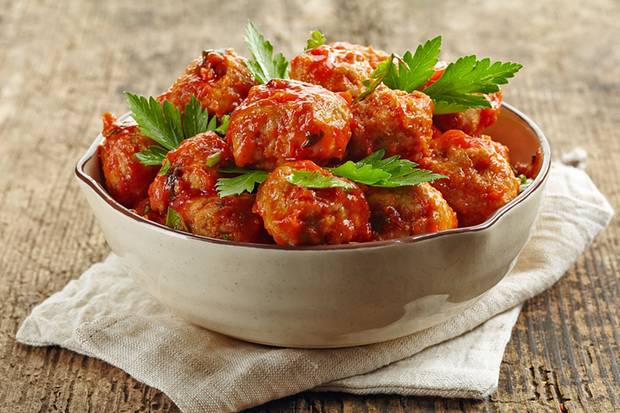
4. And what awaits you with the term Albondigas?
Marinated olives.
Pickle skewers.
Meatballs in spicy tomato sauce.
Filled dumplings.

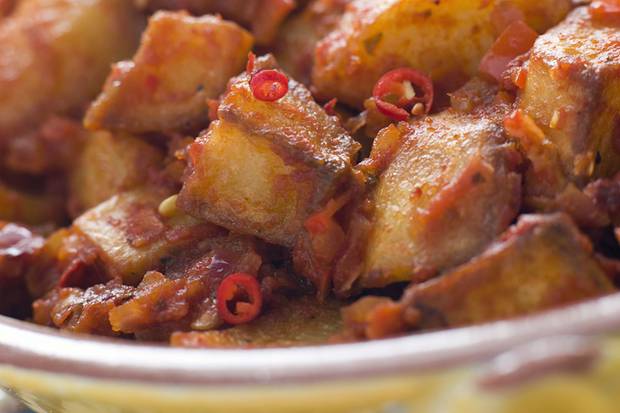
5. Spaniards also love potato dishes. Patatas Bravas, for example, can be found on almost every tapas card. What exactly is behind it?
Homemade potato chips.
Wrinkly sweet potato.
Spanish fries.
Fried potato cubes in hot sauce.

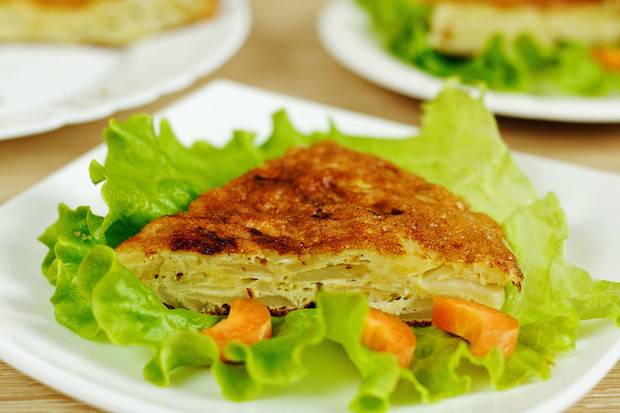
6. Potatoes are also common in the Tortilla. In addition, however, other vegetables can be accommodated. To what?
To a flatbread.
To make an omelet.
To a savory tart.
To a casserole.

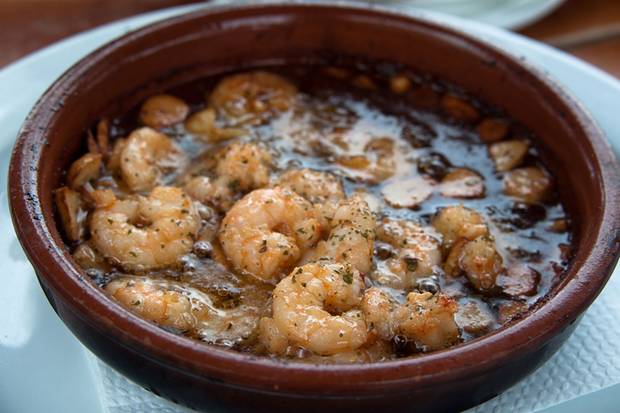
7. Fish and seafood are common in Spain. If Gambas al Ajillo is offered on the menu, what can you expect?
Prawns in batter.
Garlic prawns.
Grilled shrimp.
Marinated shrimp.

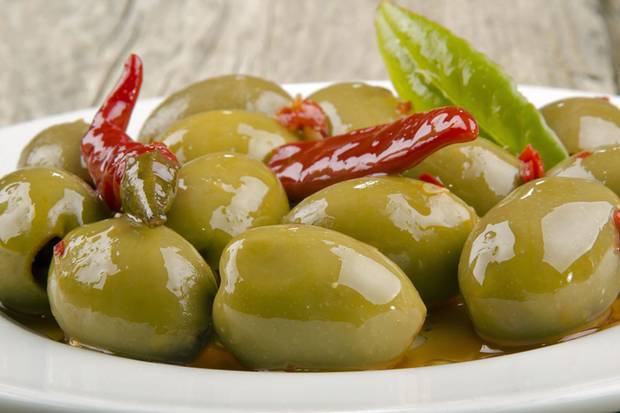
8. Aceitunas Marinadas are also on almost every tapas table. What’s this?
Marinated goat cheese cubes.
Marinated olives.
Marinated tuna pieces.
Marinated artichokes.

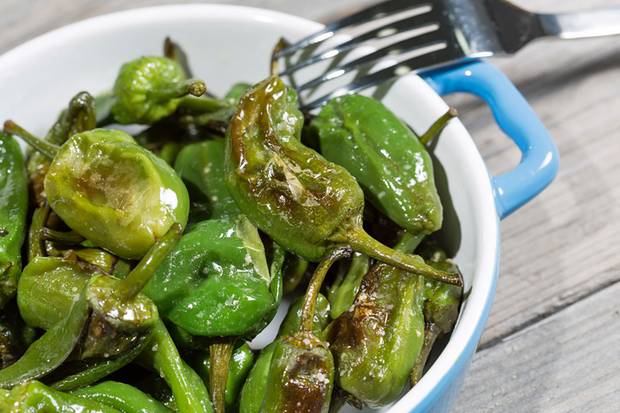
9. Pimientos de Padron are not only popular all over Spain, they are now also with us.
Plums wrapped in bacon.
Pickled garlic.
Stuffed eggs.
Small, green and roasted paprika’s.

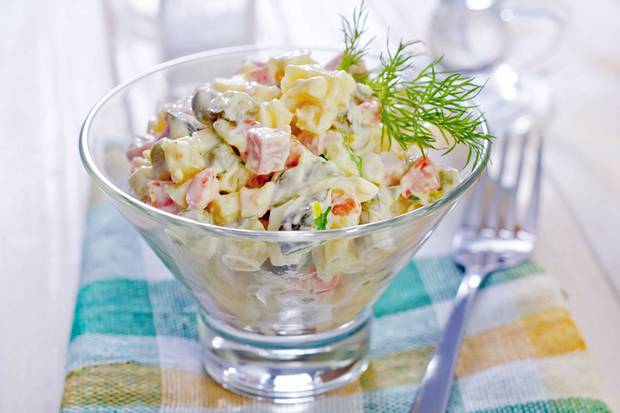
10. Ensalada or Ensaladilla Rusa means Russian salad, that much is clear. Behind it can only hide one thing, and that is:
A pasta salad.
A sausage salad.
A rice salad.
A potato salad.

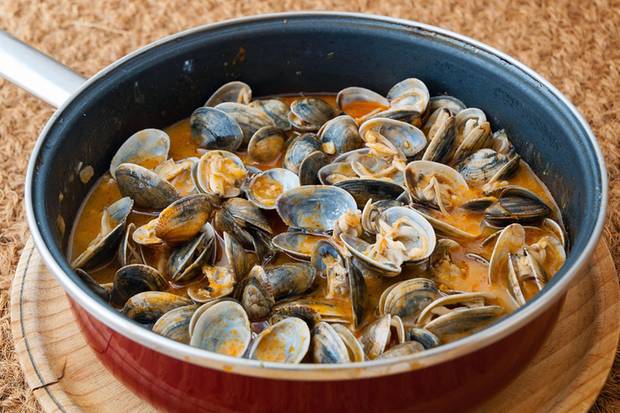
11. Often you can also find Almejas a la Marinera on the tapas menu. What is this?
Clams in white wine sauce.
Marinated baby ink fish.
Snail soup.
Cooked mussels.

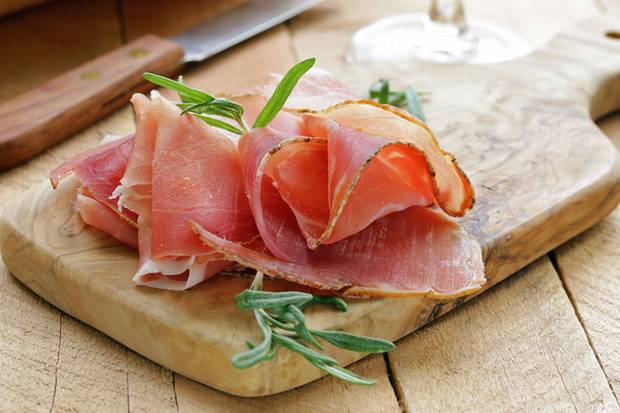
   Jamon Iberico.

1. Jamon Iberico is an expensive ham made from a special breed of pig, Iberico pig. The ham is often served as tapa. The Iberico pig is usually darker than the domestic pig and is therefore also called black pig. The animals often have black claws, which is why the ham was also called Jamon de pata negra, which means as much as black pork ham. However, this is no longer allowed, because not all Iberico pigs are black or have black claws.

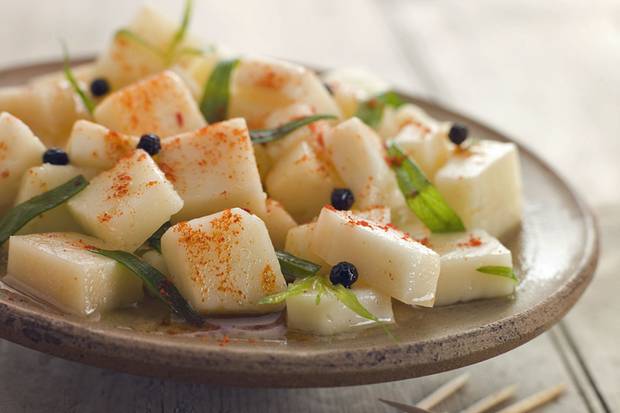
   Manchego.

2. Manchego is a Spanish hard cheese made from sheep’s milk. He comes from the region of Castilla-La Mancha and is under the designation of origin D.O. Queso Manchego protected.

   Boquerones Fritos.

3. With a haps they are in the mouth: Boquerones Fritos are fried anchovies, one of the most popular tapas classics, easy to make and cheap. The small fish are gutted, turned into flour and fried and salted. In Spain, lemon is often enough.

   Albondingas.

4. Albondigas are small meatballs in a spicy tomato sauce. There is no single recipe for this – everyone makes them a little bit different. What they all have in common is that the sauce is spicy and must be spicy.

   Patatas Bravas.

5. Patatas Bravas are spicy fried potato cubes, served with or in a spicy sauce. They taste good with grilled or roasted meat.

   Tortilla.

6. In Spain, Tortilla is an omelet that can be prepared with a variety of vegetables. Particularly popular is the Tortilla Espanola, also called tortilla de patatas, a circular omelette with potatoes and onions. It is often offered as tapa. The Mexican tortilla is something completely different: a flat flatbread made from corn or wheat.

   Gambas Ajillo.

7. „Ajo“ means garlic in Spanish. „Al Ajillo“ means „garlic sauce“, and Gambas are a bit larger shrimps. Garlic shrimps, which are also spicy, because chilli’s are cooked with. This tapa is also one of the most popular classics and is usually prepared and served in a small clay bowl. Sometimes the oil is so hot that it bubbles, so be careful! In Uruguay they like to serve this dish as a main course.

    Aceitunas Marinadas.

8. Aceitunas are olives, Marinada means marinated. Often the olives are preserved in oil and flavored with herbs and garlic and/or chilli.

    Pimientos de Padron.

9. Pimientos de Padron are typical small, unripe pods of a variety of paprika’s grown in Galicia in the area of ​​Padron. As Tapa they are usually only fried and sprinkled with coarse salt. Their degree of severity varies from pod to pod. Pimientos de Padron (which are not spicy at all) are about the size of Mexican Jalapenos, which are considered very spicy.

    Insalada Rusa.

10. It’s a bit complicated with the Russian Salad. In fact, no Russian invented it, but a French chef who ran a top restaurant around 1860 in Moscow, Lucien Olivier. The salad is therefore also called Olivier salad, but as a „Russian salad“ he has become known in Europe. Originally it was a delicacy, which included meat, caviar, lettuce, capers and gherkins. Today there are many variants. The Spanish Ensalada Rusa is a potato salad with mayonnaise, tuna, hard-boiled eggs and vegetables such as carrots and peas. It tastes not only as tapas, but also to meatballs or sausages. I think it tastes a bit flat.

   Almejas a la Marinera.

11. Almejas a la Marinera stands for a popular, traditional shellfish dish that is eaten all over Spain: clams in spicy white wine sauce. „A la marinera“ means as much as „by sailor style“. One can find it with just one sort of clams or mixed clams, whatever, it is one of the most delicious tapas you can have. Enjoy with a strong and dry white wine.

Veröffentlicht unter Information, Lifestyle | Verschlagwortet mit | 2 Kommentare

Italian Cuisine

Many people like to travel, enjoy the country and its people and, of course, the regional foreign cuisine. Therefore it would be good to know what local specialties are or what the dishes mean one can find in the local menu. Especially Italian food lovers know that Italy has much more to offer then Pizza and Pasta, so as fantastic meat and seafood dishes.

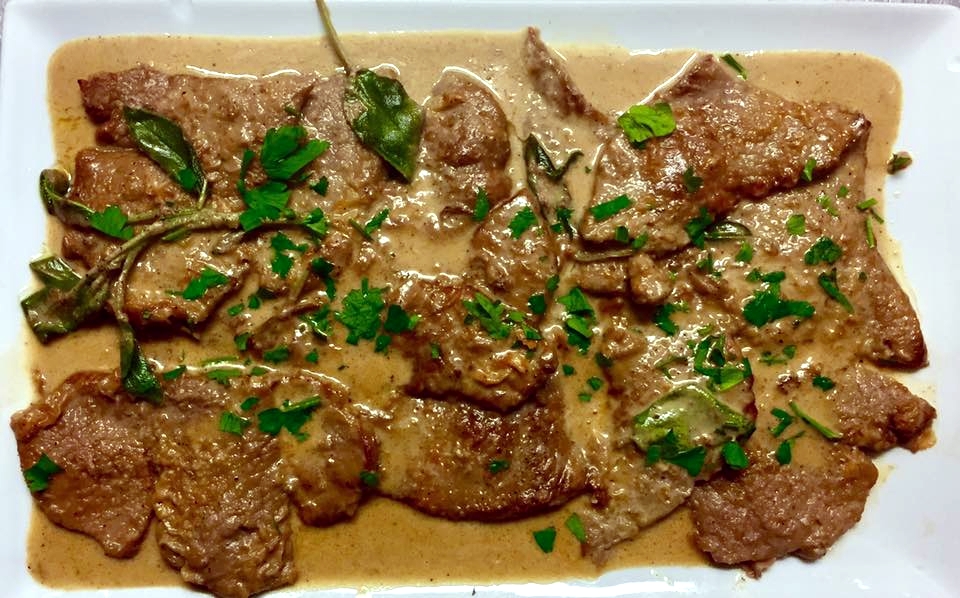
Likewise, such knowledge is certainly important and helpful at home in foreign restaurants. For this purpose and a little personal training, I have put together the most important terms in a small test. Today is Italy’s turn and soon followed by Spain. France was posted last week already.  First the question and further down a short explanation with a picture. As an example scalopini in Marsala.

    Scallopine alla Marsala.
Sometimes called veal Marsala, this is the classic Italian dish made with thinly sliced veal scalopini.
Scallopine is the Italian plural of scalloppa. In English we use scallopini (one p or pp).
A recipe typical of Sicily, where the best Marsala comes from – in my opinion.
Served with a Truffle Risotto – it’s one of my all time favorites (on the sweeter side) of Italy.
And of course serve with plenty of bread to mop up the sauce.
If this dish is made right, sometimes with mushrooms, it all melts in your mouth – FANTASTIC.
Click on the pic to enjoy the mouthwatering scallopini.

Which Italian classic is this?

You will find three to five of the most important ingredients of a recipe and one or the other hint. How well do you know the Italian cuisine ?  Guess the particular dish ?

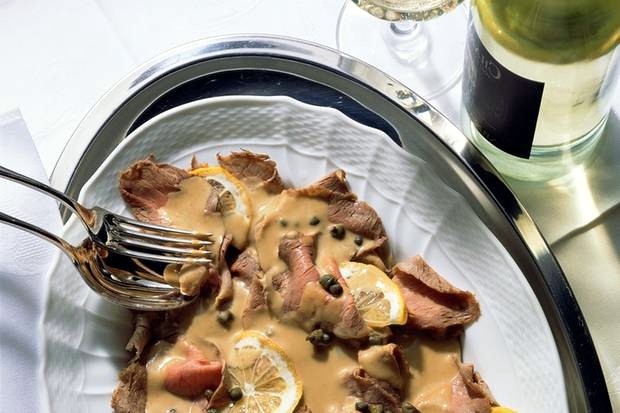
1. A starter to start with. For this you need: veal, tuna and capers. The food is served cold. What could that be?
Carpaccio
Salsiccia
Vitello tonnato
Brasato

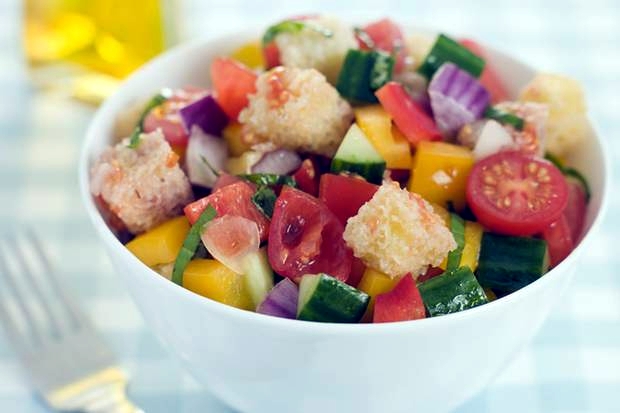
2. A salad. This dish was originally a kind of leftover meal because there is not a second chance for all fresh bread. In addition to bread you need ripe tomatoes, onions, vinegar and olive oil. What’s the name of this salad?
Caprese
Panzanella
Bruschetta
Insalata mista

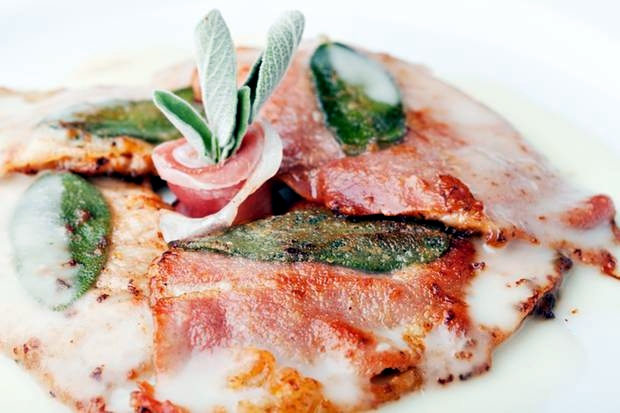
3. A main course. For this main course you need veal schnitzel, as well as prosciutto and sage. What is the talk about?
Saltimbocca
Focaccia
Ossobuco
Orecchiette

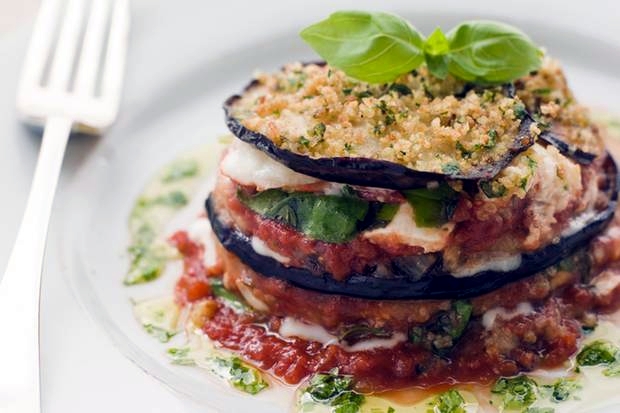
4. A vegetable classic. This dish belongs to the vegetable classics of the Italian cuisine. You need eggplant, tomato sauce, mozzarella and Parmesan. What is it’s name?
Caponata
Involtini
Parmigiana di Melanzana
Ciambotta

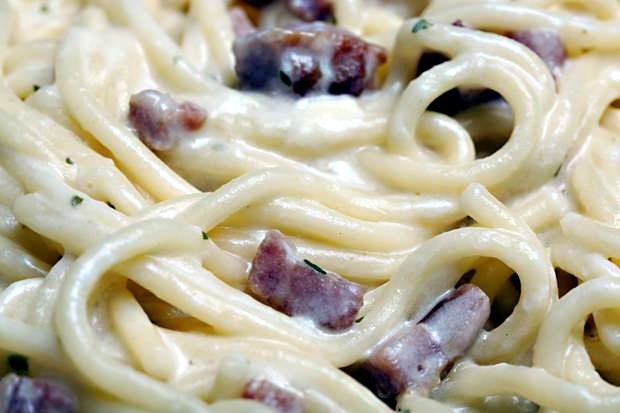
5. A pasta dish. There are many Italian pasta dishes. But one thing many people around the world really love. You need bacon, egg and cheese for the sauce. What could that be?
Pasta alla Carbonara
Penne al forno
Pasta alla panna
Arrabbiata sauce

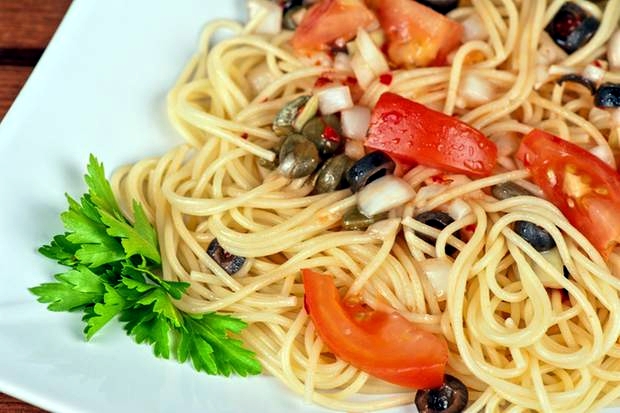
6. Pasta again. For this dish you need except noodles especially anchovies, tomatoes, peperoncini, olives and capers. Which recipe is it?
Pasta alla norma
Arrabbiata sauce
Spaghetti alla Puttanesca
Spaghetti all Bygole

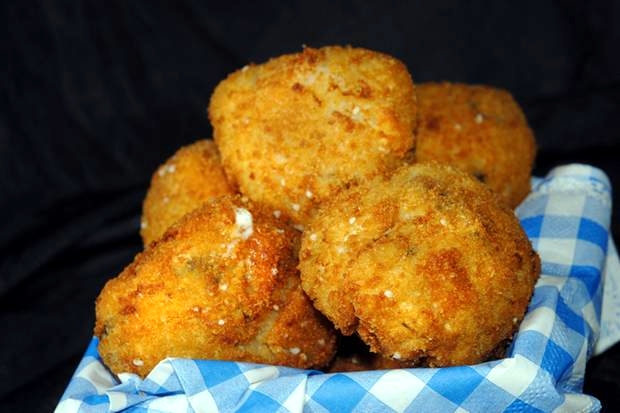
7. From Sicily. A well-known recipe from Sicily can be prepared with these ingredients: rice, peas, minced meat, breadcrumbs. What is it’s name?
Arancini
Uovini
Melini
Pallini

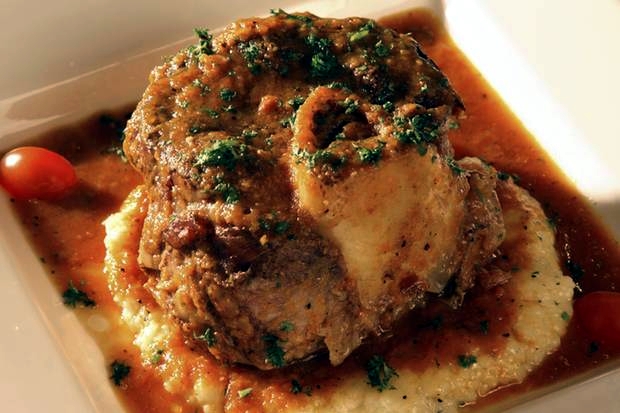
8. A braised dish, not to be missed. For this you need, inter alia, veal shank (slices of veal leg), casserole vegetables, wine, tomatoes from the tin. What can it only be?
Bistecca
Ossobuco
Involtini
Brasato

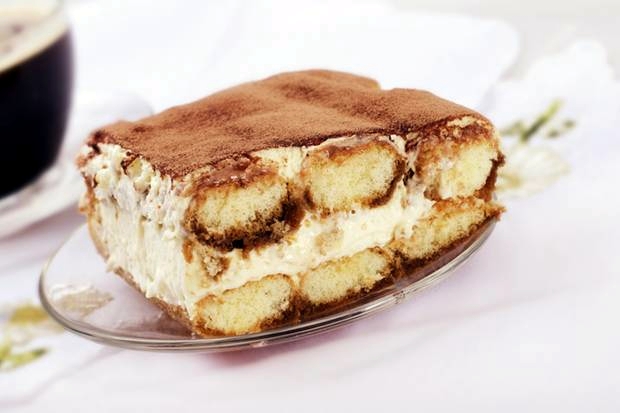
9. Something sweet. The ingredients for this classic are: Sponge biscuit, Mascarpone, coffee, Amaretto, cocoa powder. Do you recognize it?
Cassatelle
Zabaglione
Zuppa Inglese
Tiramisu

10. A cake. Yes, the Italians can also bake. And their cakes not only sound good, they also taste good. For which of the following classics do you need shortcrust pastry, lots of yolk, vanilla and pine nuts?
Torta di Mandorle
Torta della Nonna
Torta mimosa
Torta al limone

  Vitello Tonnato.

1. This can only be the famous Vitello Tonnato: poached, cooked or oven-cooked veal, thinly sliced ​​and covered with a tuna sauce containing, among other things, capers and anchovies – the recipes vary widely. The dish comes from Piedmont and is served cold as an appetizer.

   Panzanella.

2. The Tuscan tomato and bread salad is called Panzanella and tastes especially in the summer very well. The recipes vary a lot. Some add peppers or cucumbers, others leave one or the other, or both, and love it as simply as possible. Often basil is added.

    Saltimbocca.

3. Saltimbocca is a specialty of Roman cuisine and is literally translated as „jumping in the mouth“: small, thin veal escalopes, topped with a slice of parma ham and a sage leaf, fried in butter and blotted with wine.

    Parmigiana di Melanzane.

4. A Parmigiana di Melanzane can be prepared with zucchini, artichokes or other vegetables, but the Parmigiana di Melanzane, so with eggplant, is the best known variant. That dish is mainly distributed in southern Italy.

   Spaghetti alla Carbonara.

5. Even if they are often made with cream outside of Italy. The real Spaghetti alla Carbonara get along without them. This simple dish comes from Lazio, the region in the middle of the „boot“ where Rome is located. According to legend, it is said to go back to the charcoal burner, who should have prepared in their break penne with fried bacon and hard sheep’s cheese.

   Spaghetti alla Putanesca.

6. Olives and capers provide the crucial clue, otherwise it could also be the penne all’arrabbiata – it’s the Spaghetti alla Puttanesca. By the way, that translates spaghetti of whores (Huren spaghetti). However, what the easy ladies have to do with the recipe and where the name actually came from is not known.

   Arancini.

7. The dumplings filled with minced meat and peas from Sicily are called Arancini. They’re called that because their shape reminds of oranges. The rice balls are filled, then breaded and deep-fried.

   Ossobucco.

8. Literally translated Ossobuco means „bone with hole“. The veal shanks are turned into flour, fried in butter and then slowly stewed with vegetables in wine or broth.

   Tiramisu.

9. Literally translated Tiramisu means „pull me up“. No wonder with these ingredients – sponge biscuits are drizzled with coffee and alcohol, usually Amaretto, sometimes Marsala or brandy before being covered with a Mascarpone cream. The dessert comes from Veneto.

   Torta della Nonna.

10. There are countless recipes for the Torta della Nonna, probably as many as there are grandmothers. Because „Nonna“ is the Italian word for grandma. Common to all Tartes is the delicious vanilla cream on short crust pastry – and the pine nuts.

In case you like to have one of the above recipes, just call in. Enjoy the Italian Cuisine.

Veröffentlicht unter Information, Lifestyle | Verschlagwortet mit | 2 Kommentare

French Cuisine

Many people like to travel, enjoy the country and its people and, of course, the regional foreign cuisine. Therefore it would be good to know what local specialties are or what the dishes mean one can find in the local menu.

Likewise, such knowledge is certainly important and helpful at home in foreign restaurants. For this purpose and a little personal training, I have put together the most important terms in a small test. Today is France’s turn and soon followed by Italy and Spain. Here an example (Foie gras) how I put the test together . First the question and further down a short explanation with a picture.

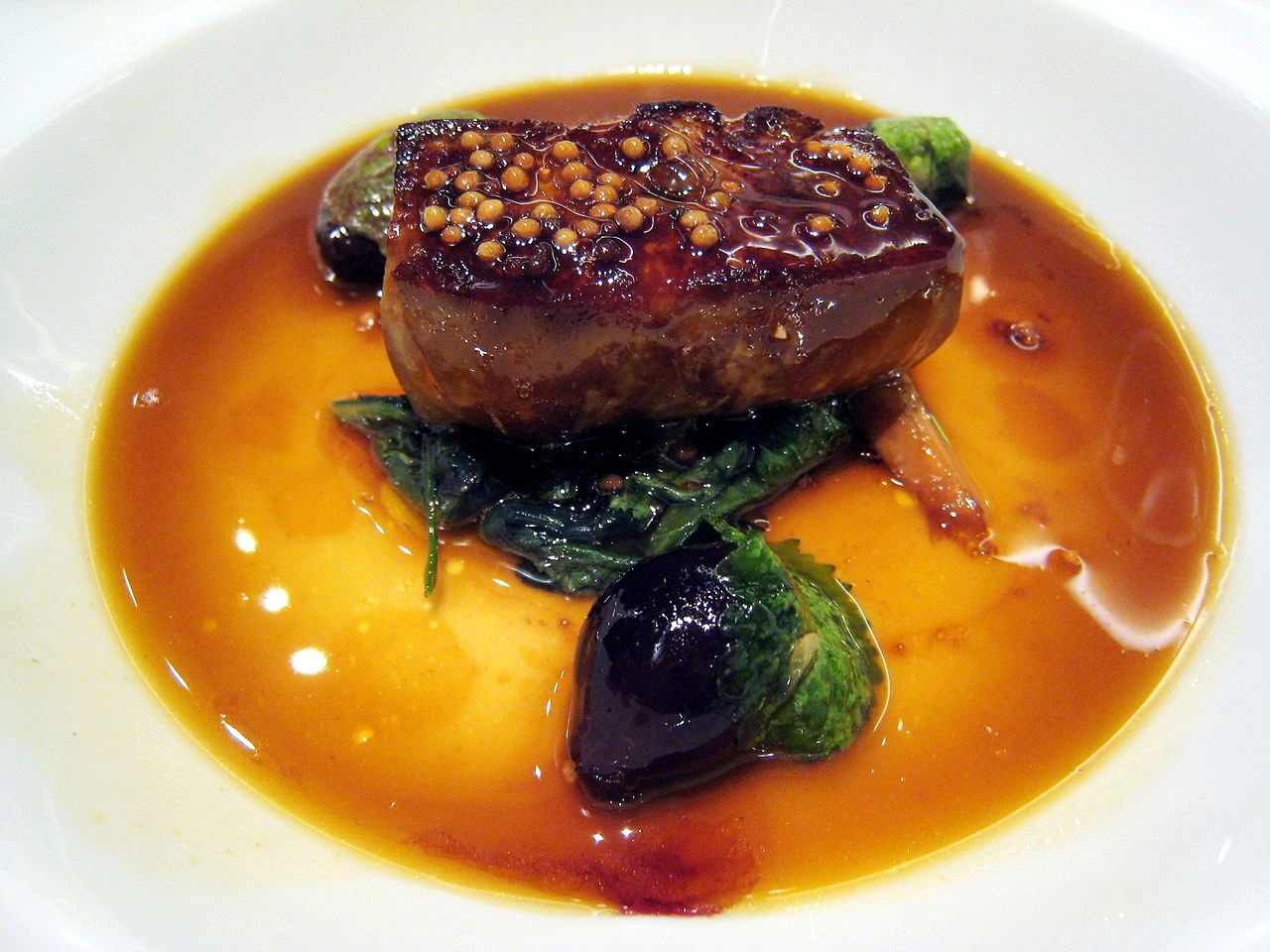
      Foie gras en cocotte.
Foie gras with mustard seeds and green onions in duck jus.
Foie gras is considered a luxury food product made of the liver of a duck or goose that has been especially fattened.
Foie gras is a popular and well-known delicacy in French cuisine. Its flavor is described as rich, buttery, and delicate.
Foie gras is sold whole, or is prepared into mousse, parfait, or pate, and may also be served as an accompaniment to another food item, such as steak.   Click always on pics to supersize -PLEASE !

How well do you know French cuisine?

The French cuisine has brought us many delicacies: Quiche, Coq au Vin, Mousse au Chocolat. But do you know what a Pissaladiere is? Or a Clafoutis? Have fun, take the test!

The questions:

1. Let’s start relaxed. Ratatouille should be known to almost everyone. What is this?
Stewed vegetables.
A light vegetable soup.
A stew with chicken.
Or a rich salad.

2. The Bouillabaisse comes from the same region. What was that?
A fish casserole.
A fish sauce.
A fish soup.
A fish jelly.

3. The bouillabaisse is often eaten together with a certain sauce. With which?
With Aioli.
With Pistou.
With Rouille.
With Tapenade.

4. What do you get when you order Pissaladiere?
A kind of onion cake with anchovies, a specialty from Nice.
A salad-like, cold appetizer, which is in vogue in Paris.
A Breton casserole with potatoes and garlic.
A Normandy drink with tomato juice and cucumber.

5. What is a Cassoulet ?
A rich vegetable soup.
A hearty stew with beans and meat.
A  beef roast braised in red wine.
A dessert with currant sauce.

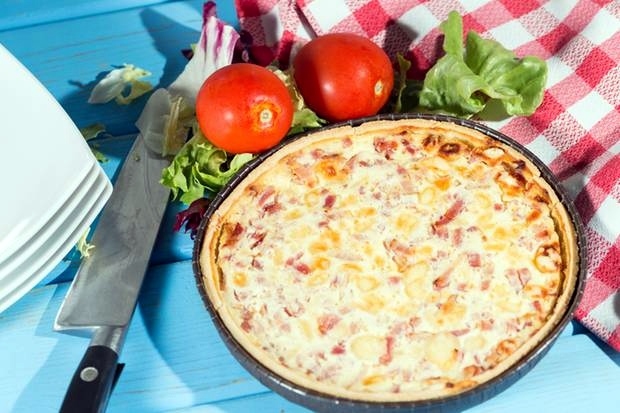
6. Quiches are widespread in France. This hearty cake is available in a variety of flavors. He has a bottom of short crust pastry, is spicy and watered with egg milk. Which of the following ingredients are typical of the famous Quiche Lorraine?
Tomatoes, peppers and onions.
Apple, potatoes and cheese.
Ham, leek and goat cheese.
Bacon, onions and cheese.

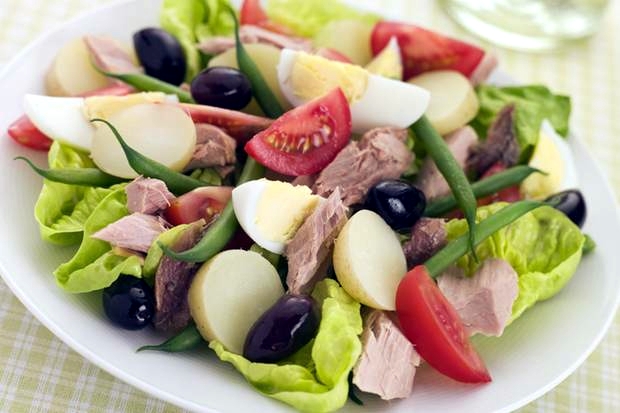
7. Probably the best-known French salad, in addition to vegetables such as tomato and peppers, usually contains hard-boiled eggs, tuna, anchovies, green beans and black olives. What’s his name?
Salade Bretone.
Salade Niçoise.
Salade Normande.
Salade Lyonnaise.

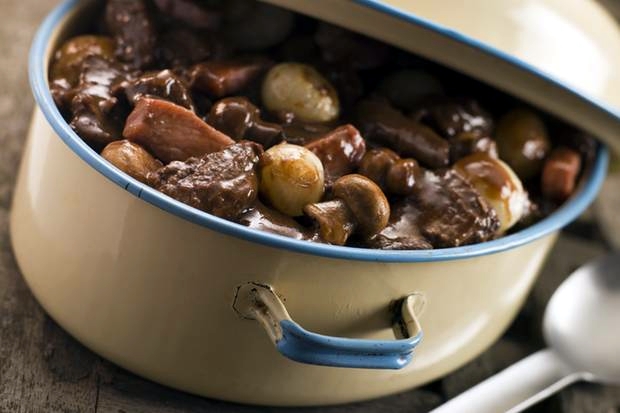
8. The meat dish Boeuf Bourguignon owes its name to its two skin ingredients. These main ingredients are:
Lamb and red wine.
Game meat and red wine.
Pork and red wine.
Beef and red wine.

9. The French understand themselves well on sweet dishes. A classic is the Tarte Tatin. What is special about the preparation of this cake?
He does not have to be baked at all.
He is baked upside down.
It is covered with chocolate after baking.
He is doused after baking with syrup.

10. What is a Clafoutis?
A cheesecake muffin.
An oblong biscuit with cream filling.
A kind of casserole with pancake-like dough and fruit.
A small chocolate cake with a liquid core.

The answers:

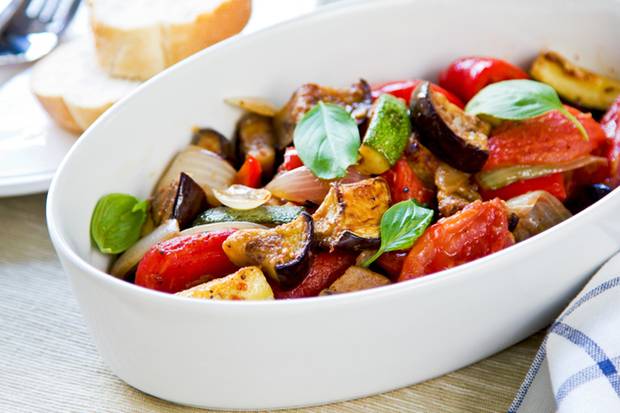
  Ratatouille.

1. Ratatouille is a stew with vegetables. It comes from Nice in the Provence. The main ingredients are eggplant, zucchini, peppers, tomatoes, onions and garlic. Also fresh herbs, often the typical herbs of Provence are included.

  Bouillabaisse.

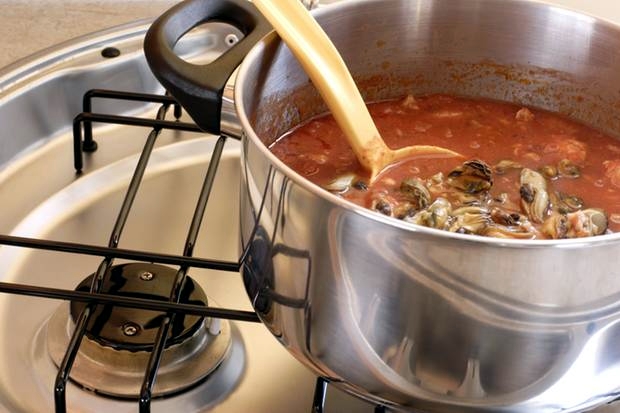
2. Bouillabaisse is a famous, rich fish soup – a specialty from Marseille, which in addition to vegetables contains various Mediterranean fish and seafood. For the special taste, at least seven types of fish are traditionally used. See my post about Bouillabaisse.

  Rouille.

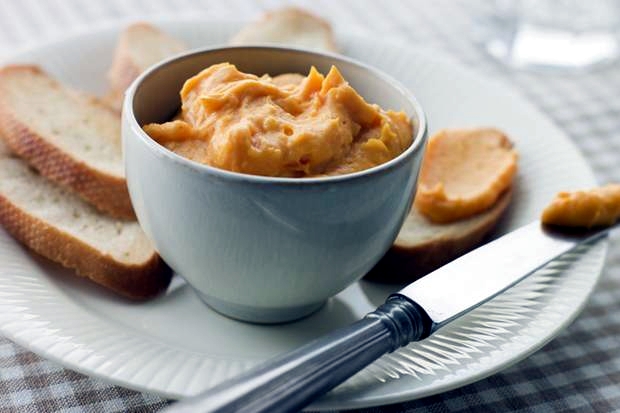
3. Rouille is the traditionally sauce served with Bouillabaisse. This reddish sauce also accompanies other southern French fish dishes. It consists of garlic, which is crushed with small red peppers in a mortar. Other ingredients include a soft-boiled and crushed potato. Sometimes saffron, olive oil and fish liver come in, and some fish broth for the smooth consistency. Some varieties contain egg yolk, which is more of an aioli flavored with saffron and cayenne pepper.

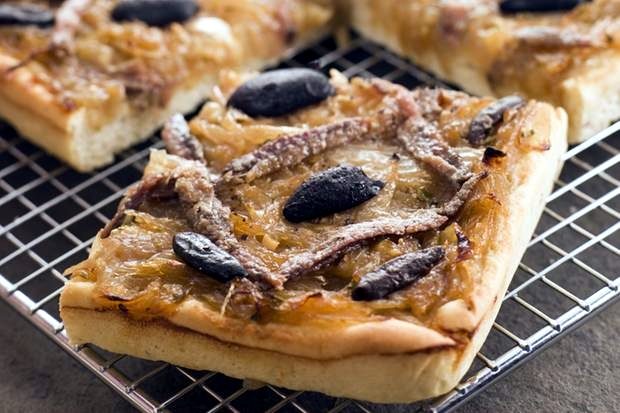
  Pissaladiere.

4. Pissalat stands for fine-tasted anchovies. These are next to the sliced ​​onions and large, black olives the topping on this pizza-like dough. Onion cake is therefore most likely to hit it. This specialty from the Cote d’Azur is spread beyond the city limits in southern France and even in Italy.

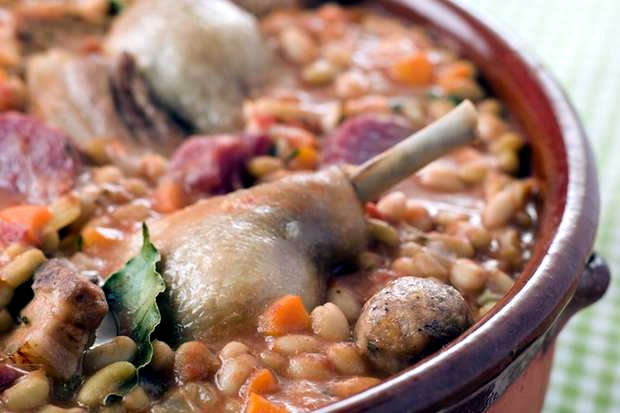
  Cassoulet.

5. Cassoulet is a meat-rich stew of white beans, bacon, cured pork and sausage. It comes from the region Languedoc in Southern France. Depending on the region, goose, duck or lamb can also land in the pot. The dish is cooked at low temperature first on the stove, then in the oven and takes hours. These recipes are great for slow cooker fans.

  Quiche Lorraine.

6. Quiche Lorraine, classic style, comes from Lorraine and therefore also called Lorraine Specktorte. So it’s clear: bacon, onions and cheese are the ingredients that make the difference. In the past, a quiche was a poor people’s meal made from bread dough. Meanwhile, the spicy cake has long been socially accepted, with shortcrust pastry as a base and many different toppings.

  Salade Nicoise.

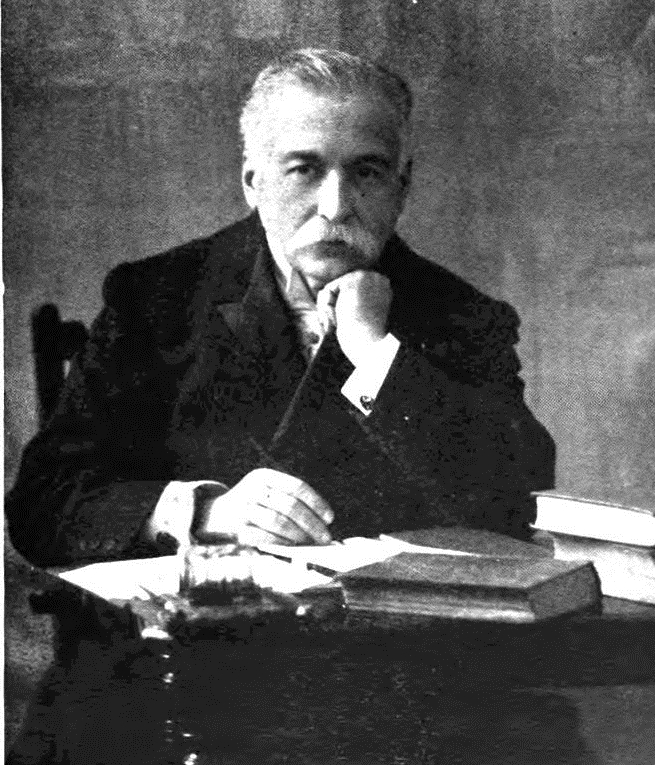
7. Salade Nicoise or Nice Salad comes from Provence, more specifically from the region around Nice. A binding recipe for this does not exist, but even the world famous chef Auguste Escoffier, who had strongly influenced French Haute Cuisine, prepared it. He is known for one of the oldest known recipes.

  Auguste Escoffier (1846 – 1935).
  Boeuf Bourguignon.

8. Boeuf Bourguignon is the classic of French cuisine, a pot roast with beef, in French „boeuf“, which is braised in red wine. But not in any red wine, but in Burgundy wine, in French „vin bourguignon“. The dish combines two things the Burgundy region is famous for: cattle breeding and viticulture.

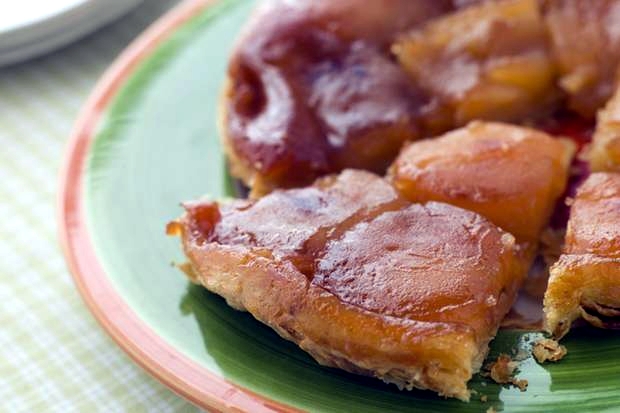
  Tarte Tatin.

9. Tarte Tatin. The special thing about this cake is that it is baked upside down. First the butter is cut out, sugar is sprinkled in and caramelized to make the whole caramel – this is how the typical caramel layer on the apples is made. Then the fruits, then the leaves or shortcrust pastry in the form. Traditionally, Tarte Tatin is prepared with apples and the cake is served as a dessert. But you can also take apricots, pears or other solid fruit.

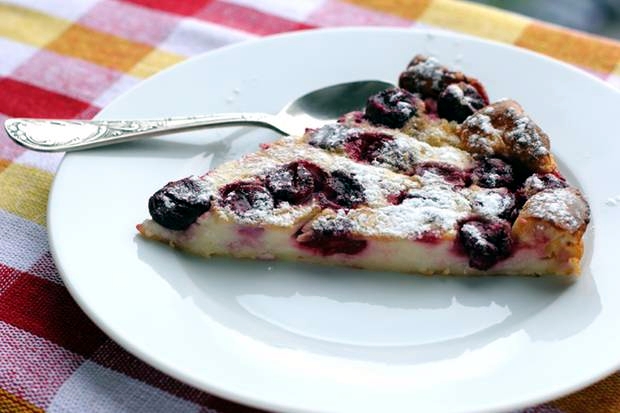
  Clafoutis.

10. Clafoutis is a pancake-like dessert, usually a sweet dessert that can be placed between casserole and cake. First the fruits are put into a greased form, then the dough is poured on it. Traditionally it is made with cherries, but it is also available with other fruits.

Tips.

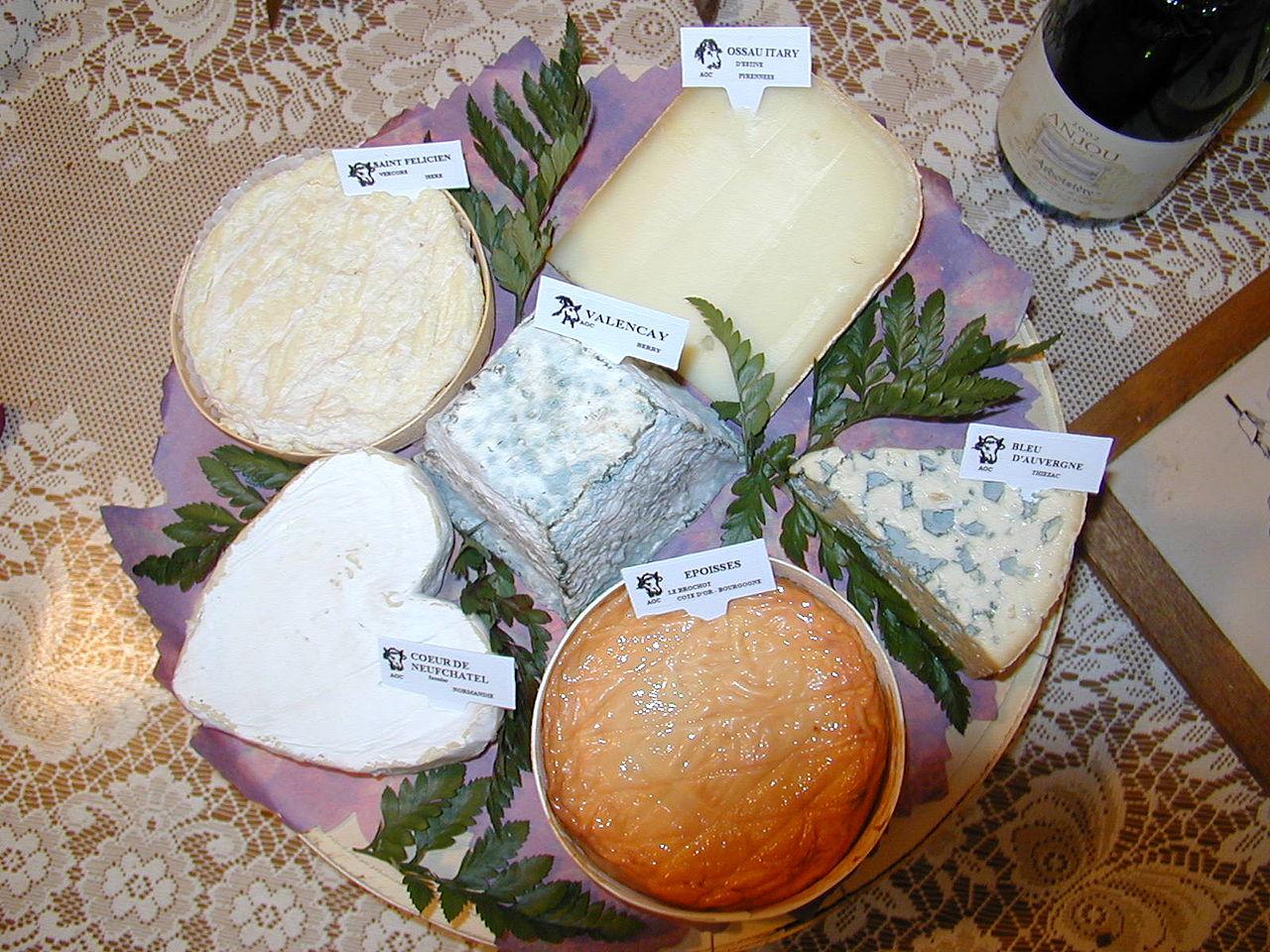
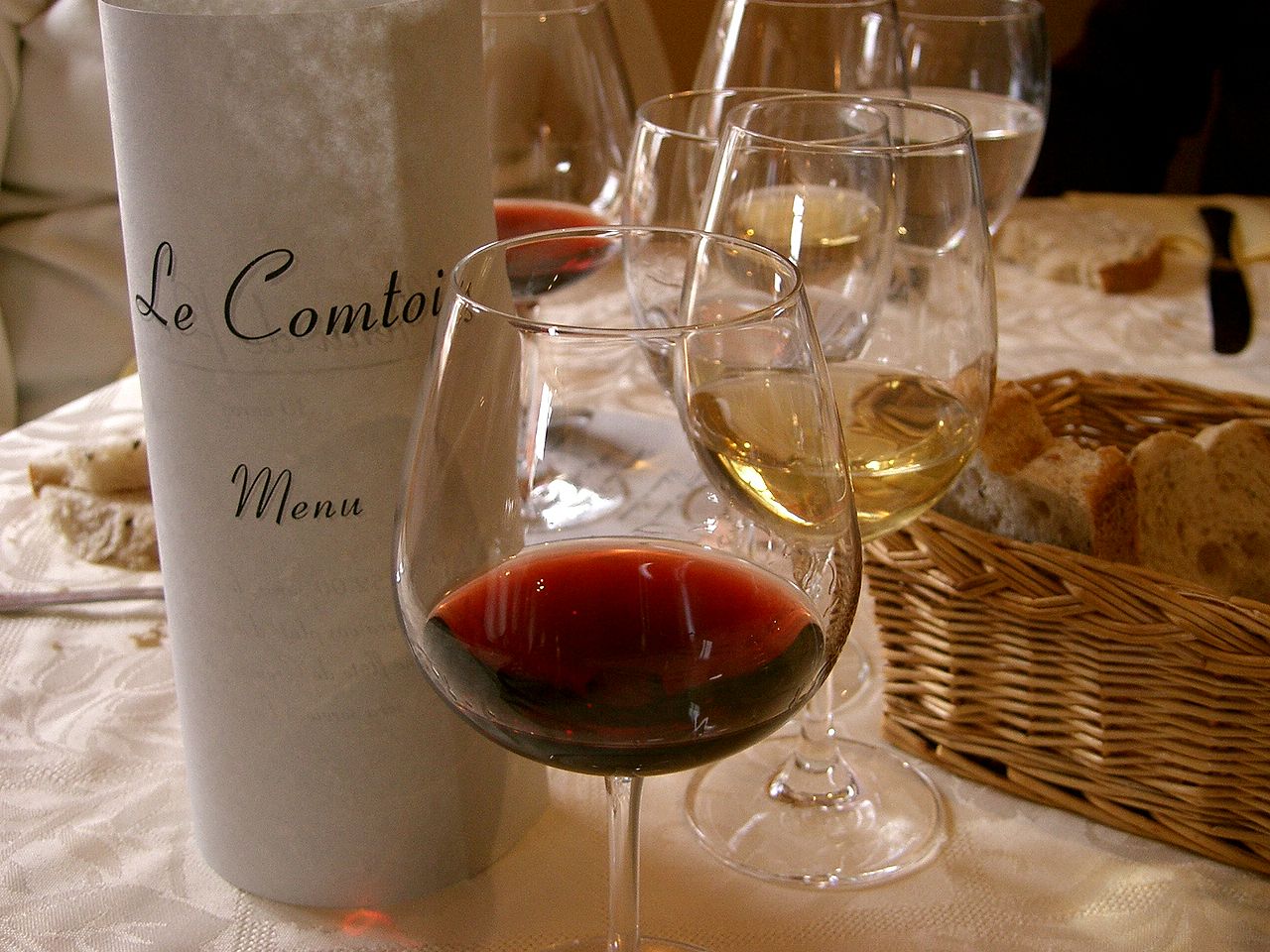
Almost no good meal in France is celebrated without some cheeses and a good wine. In case you like to have one of the above recipes, just call in. Enjoy the French Cuisine.


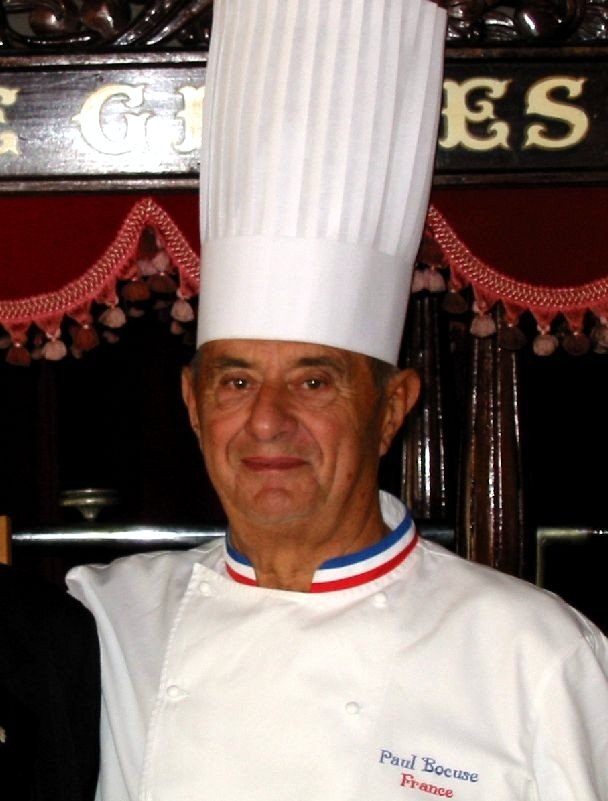
In honor to one of the greatest chefs in France, Paul Bocuse.
He sadly passed away this year at age of 92. Paul Bocuse, based in Lyon, was known for the high quality of his restaurants and his innovative approaches to french and world wide cuisine. (11 February 1926 – 20 January 2018).

                   
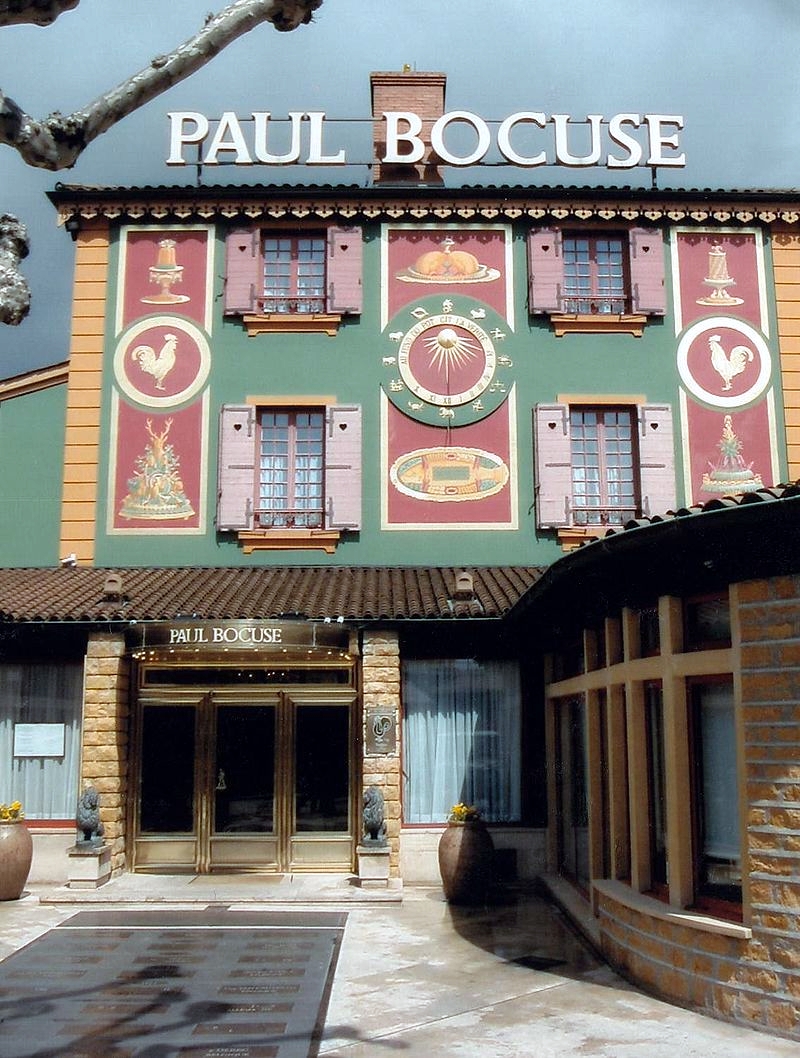
Paul Bocuse and L’Auberge du Pont de Collonges, Bocuse’s main restaurant in „Collonges au Mont d’Or“, the place of both his birth and death.

Veröffentlicht unter Information, Lifestyle | Verschlagwortet mit | Hinterlasse einen Kommentar

CANCER

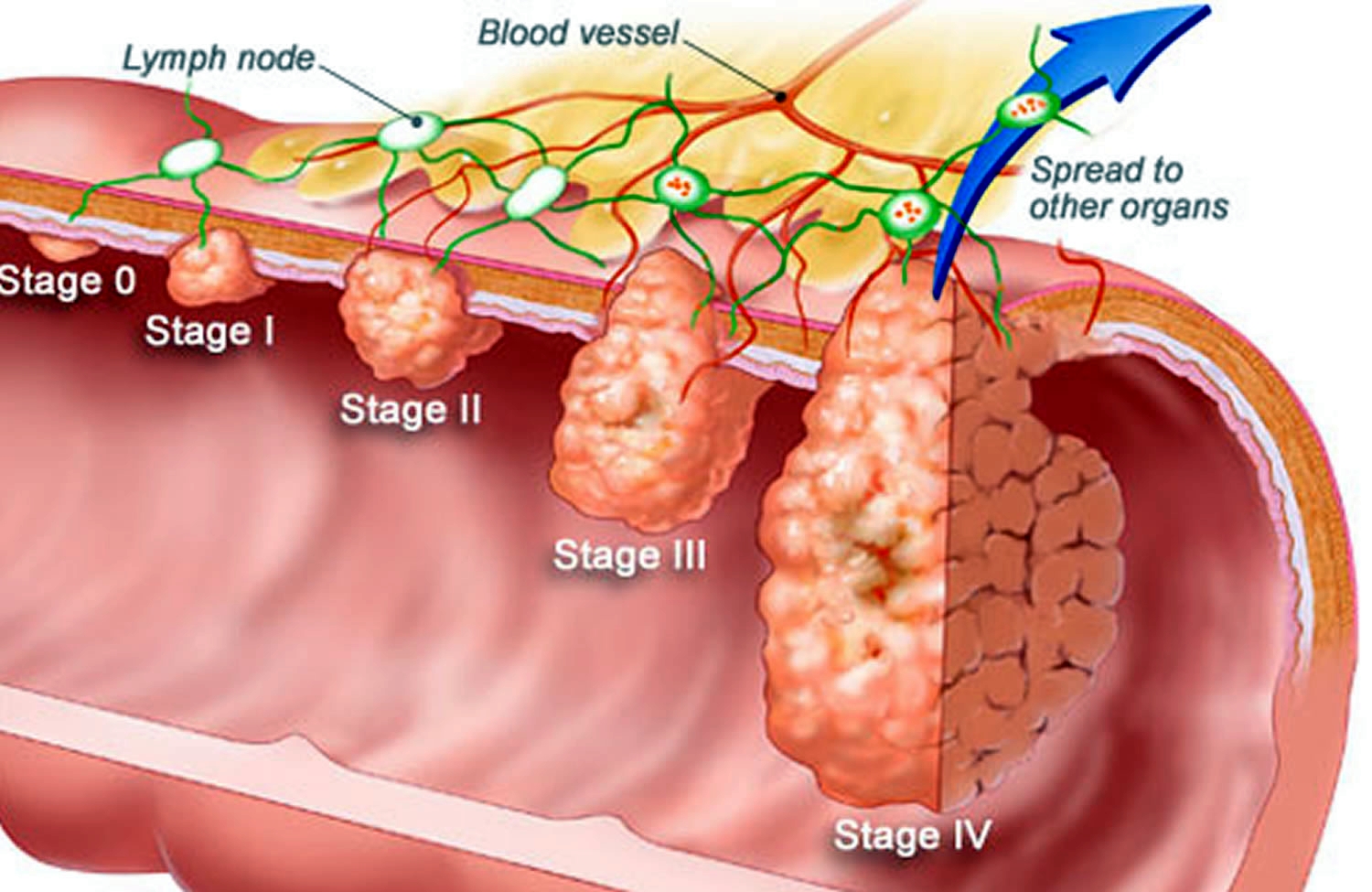
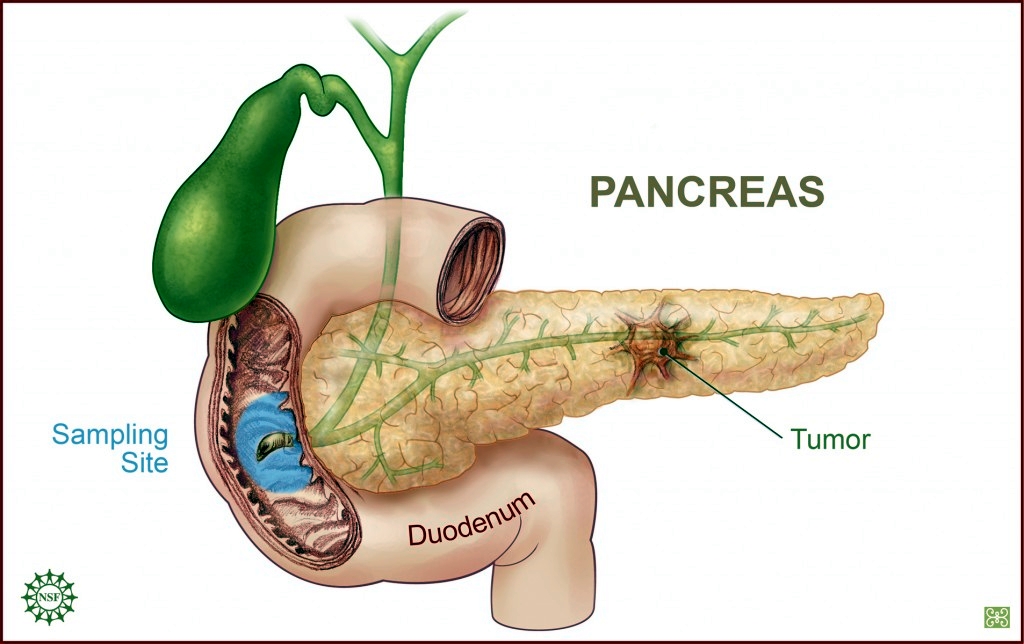
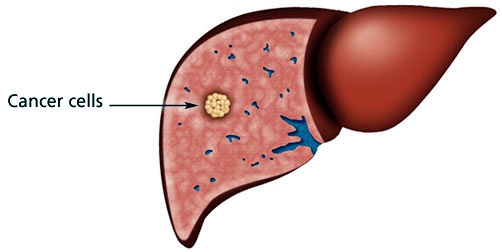
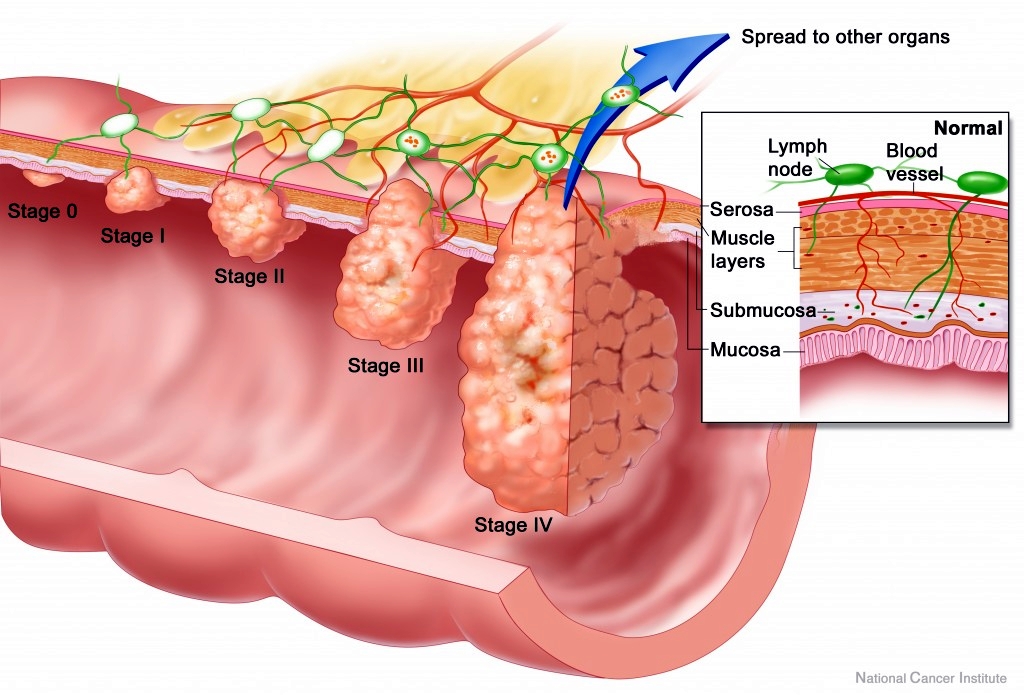
Cancer is a group of diseases involving abnormal cell growth with the potential to invade or spread to other parts of the body. These contrast with benign tumors, which do not spread to other parts of the body. Possible signs and symptoms include a lump, abnormal bleeding, prolonged cough, unexplained weight loss and a change in bowel movements.  Over 100 types of cancers affect humans.

You know the seriousness of cancer. You know the toll it takes mentally, emotionally, financially, spiritually, and physically. It causes stress in your own mind and body as well as in your relationships with friends and family. Cancer treatments can make it hard to do the things you’ve always done as a human being, a parent, or an employee.

There’s nothing in your daily existence that cancer doesn’t touch. It’s an exhausting villain to fight and it wipes you out in so many ways that are hard to explain to people who haven’t felt the impact of this horrific disease in their own lives.

What if one told you there was something you could do right now to cut your cancer risk in half?  That’s right, in half!

If you knew there was a way to prevent cancer from ever invading your life and turning it upside down… would you do it ?

People talk a lot about “cures” in the health industry but there’s a saying you probably heard from your grandparents that makes a lot more sense…

“An ounce of prevention is worth a pound of cure.”

At the truth about cancer we talk a lot about what causes cancer, and the foods that fight cancer and lower your cancer risk. Now I’m going to talk to you about known, scientifically proven, cancer causing foods that actively increase the chance that you’ll be diagnosed with cancer in your lifetime.

There are cases where it strikes quickly but it is more common when cancerous tumors manifest after years of specific habits. Good examples of this are smoking, exposure to radiation (i.e. from cellphones), and overexposure to ultraviolet rays, which result in lung cancer, brain cancer, and skin cancer, respectively.

Experts estimate that more than half the cases of cancer are preventable with lifestyle changes.

In 2014, the World Health Organization (WHO) reported more than 14 million new cases of cancer… which resulted in more than 8.2 million deaths worldwide. They expect these numbers to skyrocket over the next twenty years by a whopping 70% globally!


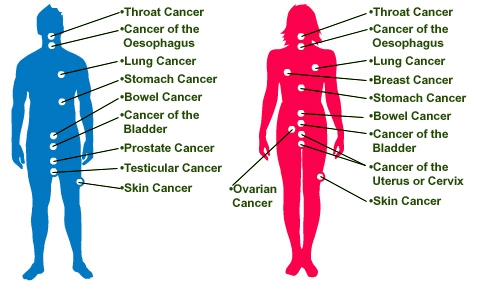
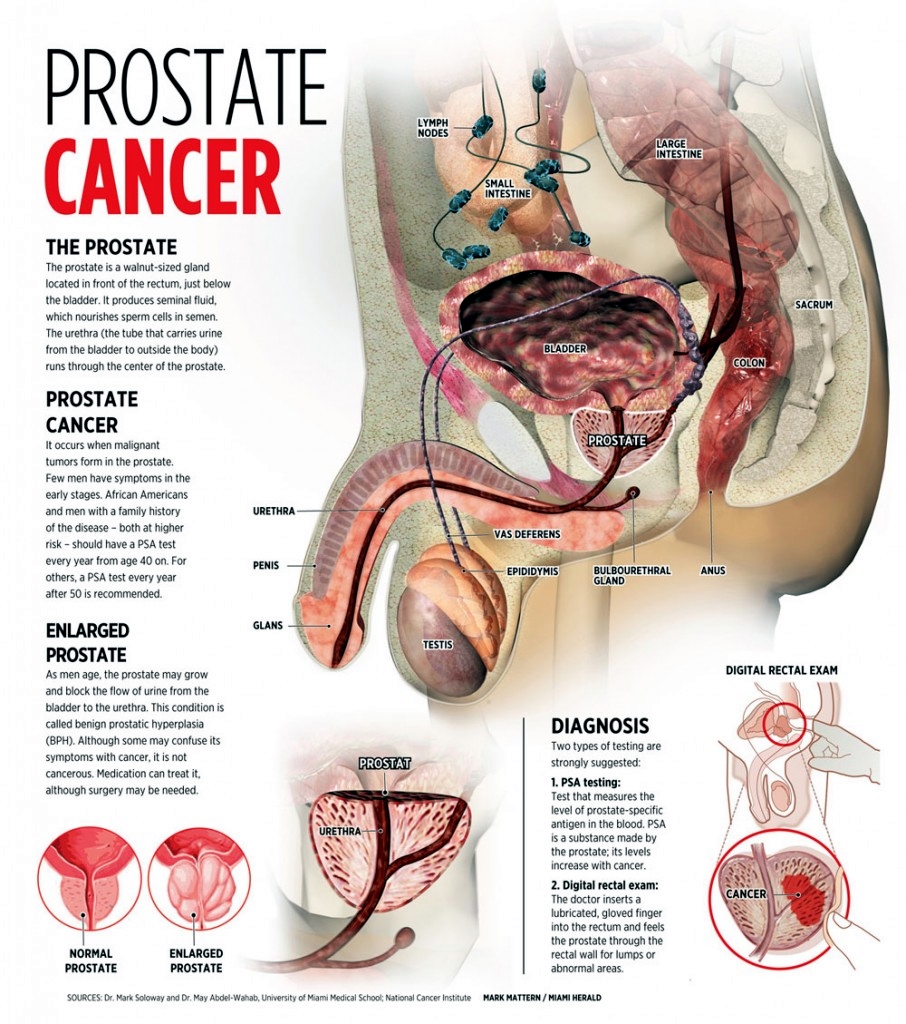
The top 5 most-diagnosed cancers in men: lung, prostate, colon/colorectal, stomach, and liver.


The top 5 most-diagnosed cancers in women: breast, colon/colorectal, lung, cervix, and stomach.


What cancer symptoms disregard most people ?

Cancers are diverse and extremely different. Many people do not take potential warning signals seriously. This is because the symptoms of cancer also often suggest harmless conditions. Early and regular examinations could significantly increase the chance of recovery.

Cancers are diverse, their symptoms are extremely different. Many people are unaware of the signs or are not serious about potential alerts. This is mainly due to the fact that the symptoms of cancer often lead to more harmless clinical pictures. But regular examinations at the doctor and an early start of treatment could significantly increase the chances of recovery. Therefore, you should not ignore these 5 signs of cancer:

1. Persistent cough.
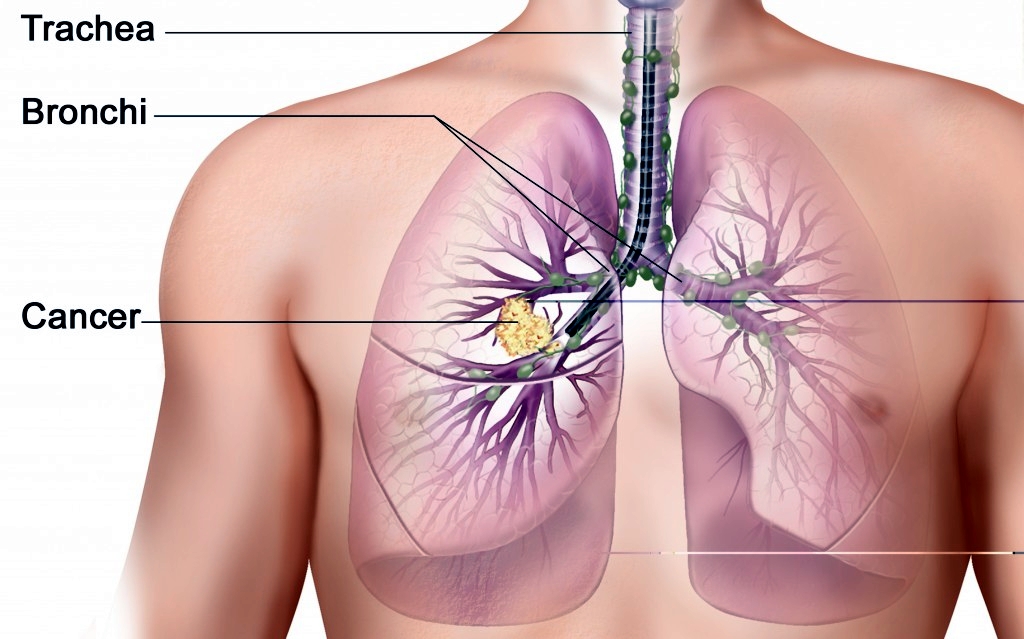
Coughing is usually associated with a cold or a flu effect and is not a cause for concern. But if you have a persistent cough, you should undergo a more detailed examination – to advise specialist: „Mostly, cough does not mean cancer. But a persistent cough must be investigated to see if it could be lung cancer“, said Therese Bartholomew of the Cancer Prevention Center.

2. Persistent heartburn.
Heartburn can have many causes: for example, excessive stress or too fatty and sweet diet. If the symptoms are only occasional, it is not a cause for concern. But consistent heartburn can be an indication of throat and throat cancer.

3. Itchy skin.
The risk of birthmarks is often underestimated: a birthmark can develop into a malignant melanoma – that is, black skin cancer. There are signs of this: persistent itching or burning at the relevant spot of the painting. If a person notices such symptoms, doctors recommend a visit to the dermatologist.

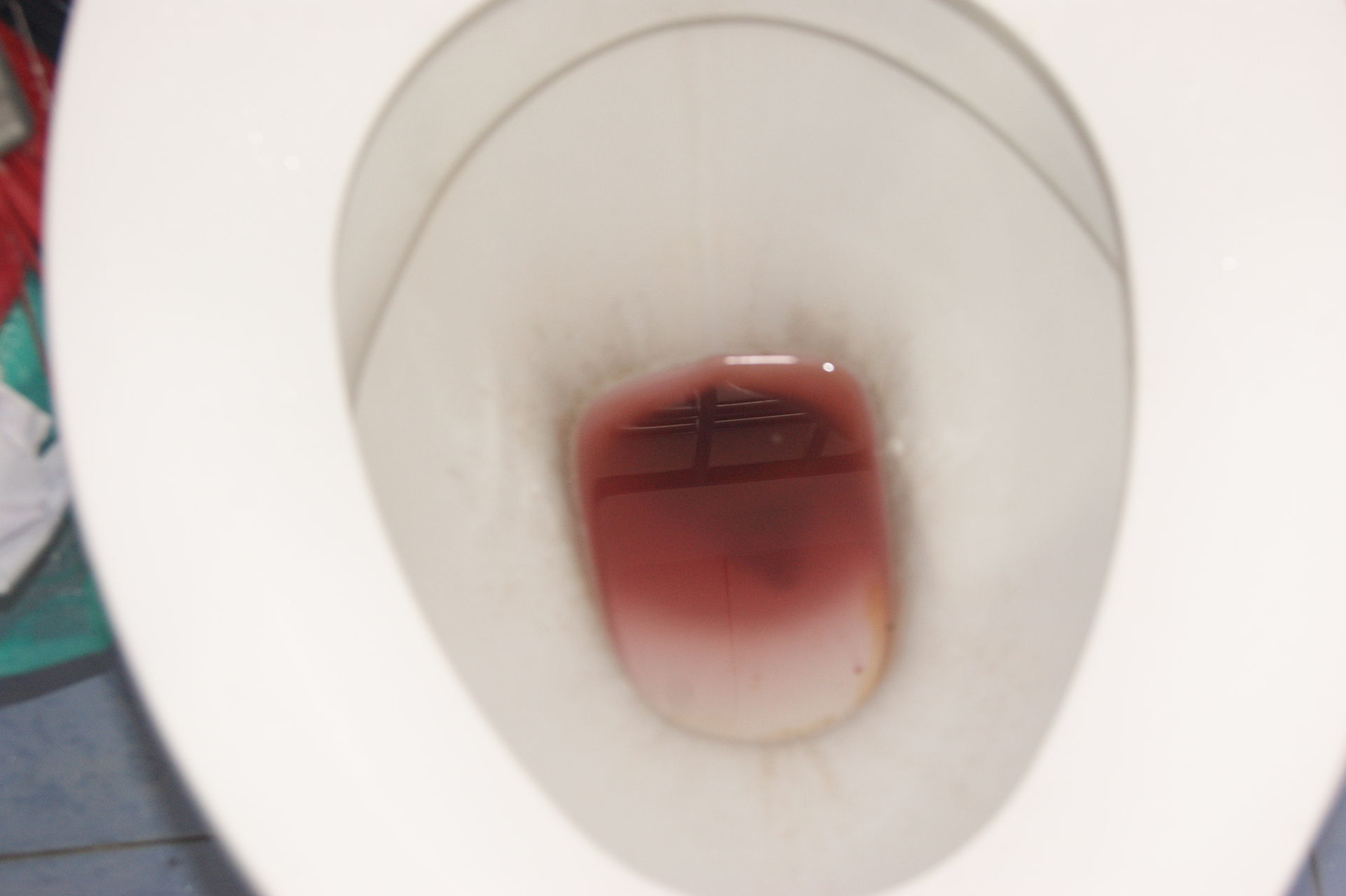
4. Blood in the stool.
Blood in the stool can have many causes – and most of them suggest more harmless conditions than cancer: some of the major causes are hemorrhoids or minor mucosal tears. Specialists strongly recommend an annual examination of the chair from the age of about 50 years.
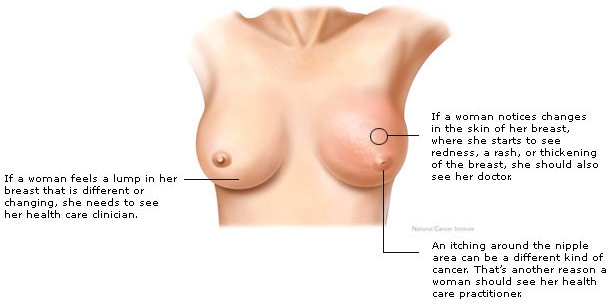
Persistent swollen lymph nodes that do not hurt can be an indication of lymph node cancer. Especially if this painless swelling persists for a long time and does not regress. A medical examination is therefore recommended.

Half of all cancer deaths could easily be prevented.

A healthy lifestyle can prevent cancer. These include four things:

1. Keep a healthy weight, with a checked BMI (Body Mass Index).

2. Stay in motion and exercise regularly.

3. Drink only a little alcohol.

4. Do not smoke.

If all people adhered to these tips, according to a large study, 40 to 70 percent of all cancer cases and about half of the deaths from cancer could be prevented.

For their research, researchers compared health data from nearly 140,000 Americans who are already relatively healthy. The findings of researchers from Mingyang Song of the Massachusetts General Hospital and Edward Giovannucci, a professor at Harvard Medical School were published in the journal „Jama Oncology“.

The shocking result.

The male subjects of the high-risk group, who did not stick to the tips, had a 33 percent higher risk of developing cancer. In addition, her risk of death from a tumor was 44 percent higher than in the control group.

Among the women, the difference was not so serious: the high-risk group had a 25 percent higher risk of getting sick and 48 percent more likely to die of a tumor.

The researchers report: Extrapolated to the average American society, the difference was even more dramatic.   There is only one way :   Fight Cancer !!!

Much much more can be said and written. I only wanted to ignite your interest to this VERY HOT subject. Lots and lots of articles and other medias are written and shown. It is worth to go deeper into information. Start with the following sites.

https://www.quantumbooks.com/health/top-10-common-types-cancer
https://www.organicfacts.net
https://thetruthaboutcancer.com

Veröffentlicht unter Information, Lifestyle | Verschlagwortet mit | 2 Kommentare

4 Years – MyUyTips

The baby is growing older.
When I started this blog 4 years ago, in my wildest dreams I couldn’t imagine how successful this blog would be and how many ideas, facts, information’s and more I can bring to screen. If you have some ideas or tips how to increase the quality of this blog, PLEASE tell me.

Some statistics over the 4 years.

Far over 300 posts were published.
I’ve written over 360.000 words, that’s equal to
more then 4 books with an average of 300 pages.
Thousands of comments came in.
I published over 5500 pictures within the posts.
Readers are from over 40 different country’s.

Thank you ALL very much for your loyalty ! I will try to keep the interest level for you as high as possible and hope you will stay also with me in the future !


Veröffentlicht unter Hobbies, Home, Information | Hinterlasse einen Kommentar

Salmon – My Answer

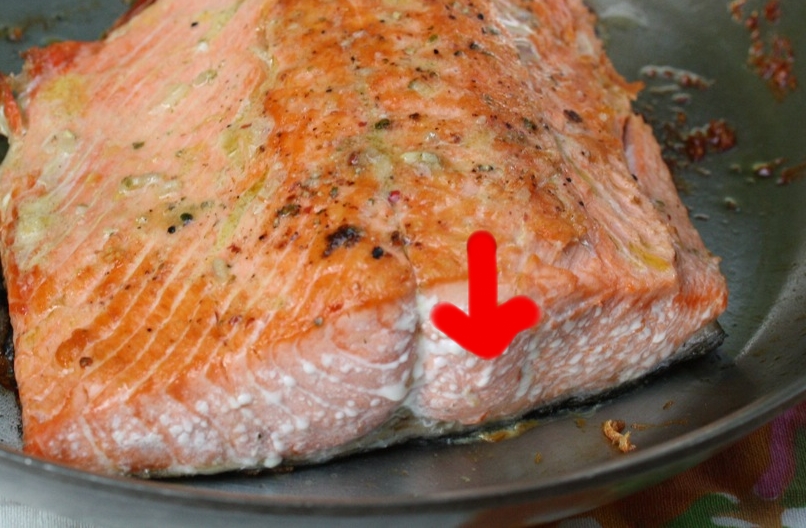
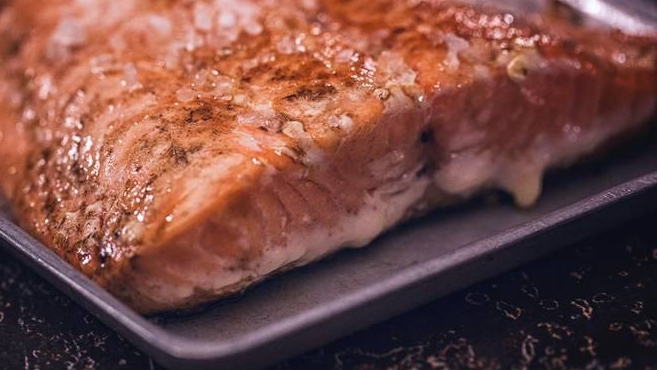
A few weeks ago one comment included the question what that white stuff is if we cook salmon. I promised an answer. Here it is.

The white on the salmon does not look nice, but is it safe ?

Anyone who indulges in a nice salmon fillet or other fish, probably knows this mystery: As soon as the salmon sizzles in the pan, a white liquid comes out of the fish meat. Sometimes it is thick, sometimes frothy. But what is it ?  Is it fat or dangerous ?

  Perfect salmon filet, but the „white stuff“ ?

Neither. The white fluid is a protein called albumin. When the muscle fibers of the fish are heated, they contract and push the liquid albumin to the surface of the fish meat. When the protein reaches a temperature of about 60 degrees, the protein solidifies and turns white. This is not dangerous, but the cheesy deposit looks unsightly and of course, the fish loses its juiciness.

  Many chefs and restaurants recommend the salmon still glassy inside. To me its like sushi ( too raw). I only can guess why they recommend in restaurants this style: No chance to overcook it, so better leave it undercooked and tell people “ that has to be eaten like this “ !!! Bull…. !!!  I like it when the fillet is just cooked through, but still juicy inside. Up here a well cooked fillet of salmon on Swiss Roesti with a honey mustard sauce. Mouthwatering !

When is the salmon cooked?

Who fries fish in the pan and is not sure when the fish is cooked, should not wait until the albumin leaves. Better with a knife stab determine the state of the food. An example: If the salmon is glassy in the core, normally a good sign. But if it is opaque through and through, you have overcooked the fish. The perfect solution is, like often, in the middle.

  My little trick is to seal the sides of the filet also. Takes off the „not well looking“ white foam and keeps the moisture inside. Note the right fillet of the four, this is already turned and well cooked. The skin – which we love also – is crisp and delicious. And the fillet is still well cooked and juicy inside.

How to prevent the cheesy deposit?

If you find the white deposits troublesome, simply wipe off the liquid with kitchen paper. But there is another trick: Put the salmon in a salt bath for a few minutes before cooking the fish. The salt separates the muscle fibers on the surface. Although these become firm in cooking, but without the protein albumin secreting. The salt bath also spices the fish, so you do not have to salt the salmon before cooking. I never do this, tastes too salty for me, especially if I like to use other sauces with the recipe.

Roasted salmon with sauce Hollandaise.

It is also easy and quick to prepare. The most important ingredients are: calm and concentration.  We like it with young potatoes and asparagus, one of our favorites. Sadly we can’t get fresh white asparagus in Uruguay, just the green one. One farmer told me the truth: They are to lazy in UY to go through the hard work for good white parts – and later no one would like to pay the price. Right he was, an asado country – not for gourmands.

Ingredients.

4 salmon fillets (equal size and thickness)
2 tablespoons olive oil
60 g (2 oz) butter For the Hollandaise:
about 300 g (10 oz) butter
4 egg yolks
salt and pepper for seasoning
lemon juice

  I never use the salmon cut into „steaks“. Makes to me the wonderful salmon look like „cheap fish“. Except one occasion, if I roast salmon on the BBQ plate. Then the fish has from thin to thick allover the same thickness to heat through.
  This kind of cut looks much more elegant then the steak one. And see the difference of meat richness and dark color against the salmon above. The above steaks are Chilean Farm Salmon, the sliced one here is a Norwegian Fjord Salmon. The best one to make graved salmon. May be the Alaskan salmon too !?! In Uruguay just Chilean Farm Salmon available.

How to do.

Slightly salt the salmon fillets (skinless). Froth the olive oil and butter in a pan over medium heat. Roast the salmon on one side for 2-3 minutes. I always let it roast till I see the white(cooked) color reaches about half of the salmon thickness. Then turn the fillets and turn off the stove. Cook the fish on the increasingly weaker stove.

           Left: The salmon is well baked on all sides and inside still juicy. With the green asparagus (sadly we can’t get fresh white one in Uruguay) and the Hollandaise on soft cooked potato slices its a fantastic meal. Even your guests will honor it. Right: Same idea, except served with new potatoes – skin on !

For the Hollandaise, melt the butter. Mix the 2 egg yolks with the whisk in a cold saucepan, salt and pepper it. Put the pot on the stove, raise the heat moderately and wait until the yolk starts thickening. Immediately set the heat to low and immediately add the melted butter – first in drops, then in a thin stream – while whisking to the egg mass until completely absorbed. Season the thick-creamy sauce with lemon juice and salt.

  One other favorite recipe. Cooked salmon with potatoes and a spicy horseradish sauce. A very light summer dish. And – whatever kind of sauce you make – make lots of it !!

Tips.

If you make Hollandaise by yourself it can happen that it turns out in perfect thickness (see the pic above right) or sometimes its a bit to thin (see the pic above left). Thick one you can poor over your salmon, the thin one you leave better underneath.

A whole salmon side steamed in a fish steamer with fresh bay leaves, dill and lemon slices. Side dish a fresh Tzatziki salad. The fish can be served warm or cold. Its a great party hit. We serve baguette or German brown bread with it.  Never forget a fruity cool white wine with your salmon.
We can post here hundreds of nice salmon recipes. Just one more idea. Slow cooked salmon with a spicy honey BBQ glaze and sesame sprinkle. Side dish is a vegetable jambalaya. My vegetarian friends love it.

That’s all for today folks. Hope you enjoyed it. Stay tuned for more to come.

Veröffentlicht unter Information, Recipes | Verschlagwortet mit , | 3 Kommentare