
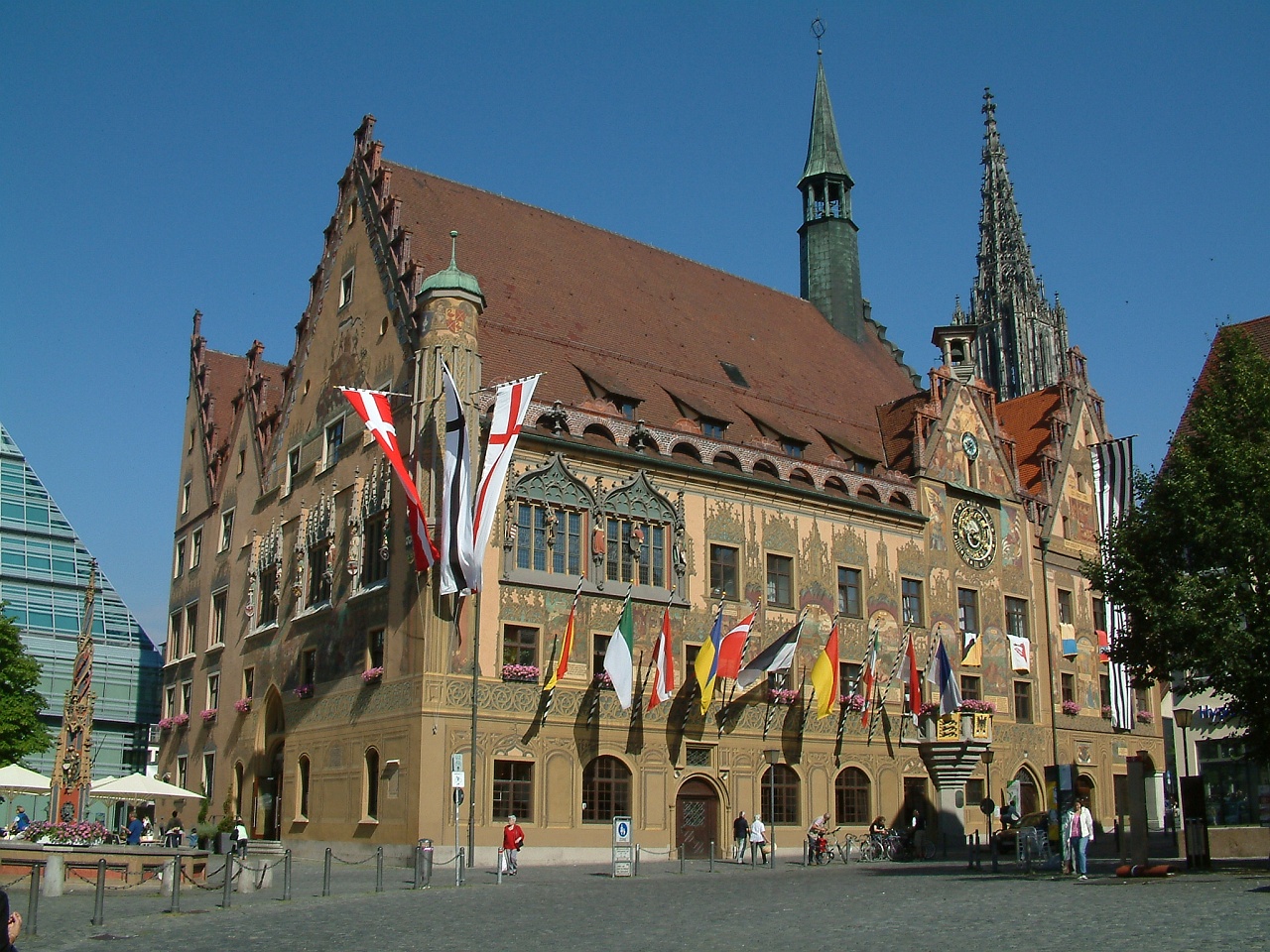
Ulm on the Danube.
To my opinion Ulm is a completely underestimated city. Lets start with some statistics: Ulm has the crookedest house (as listed in Guinness World Records, see part Fischer’s Quarters) and one of the narrowest (4.5m wide), the world’s oldest zoomorphic sculpture (aged 35.000 – 40.000 years), the tallest cathedral steeple (161.5m high), and is the birthplace of the physicist, Albert Einstein.
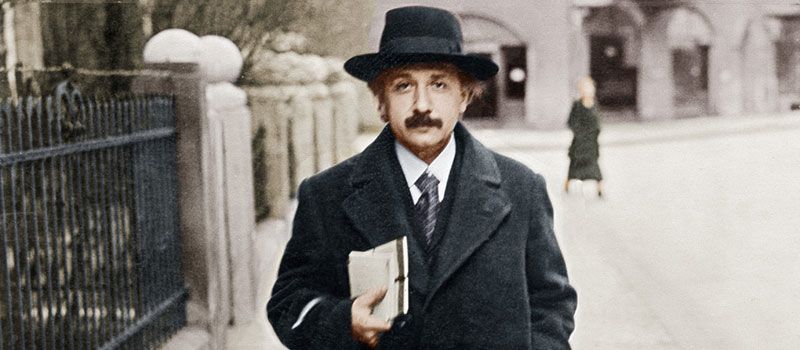
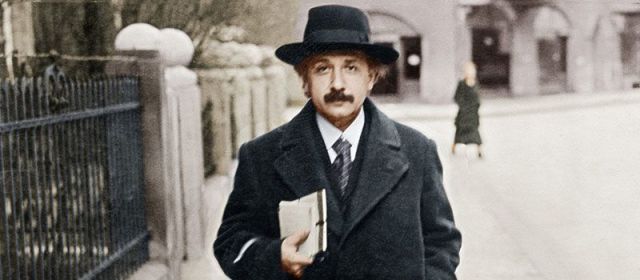 On the morning of August 5, 1923, a Sunday, Albert Einstein climbed the steps of the Ulm Minster Tower. How do you know that? Because he told his wife Elsa in a letter about it. And the letter is visible in his estate.
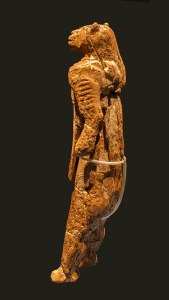
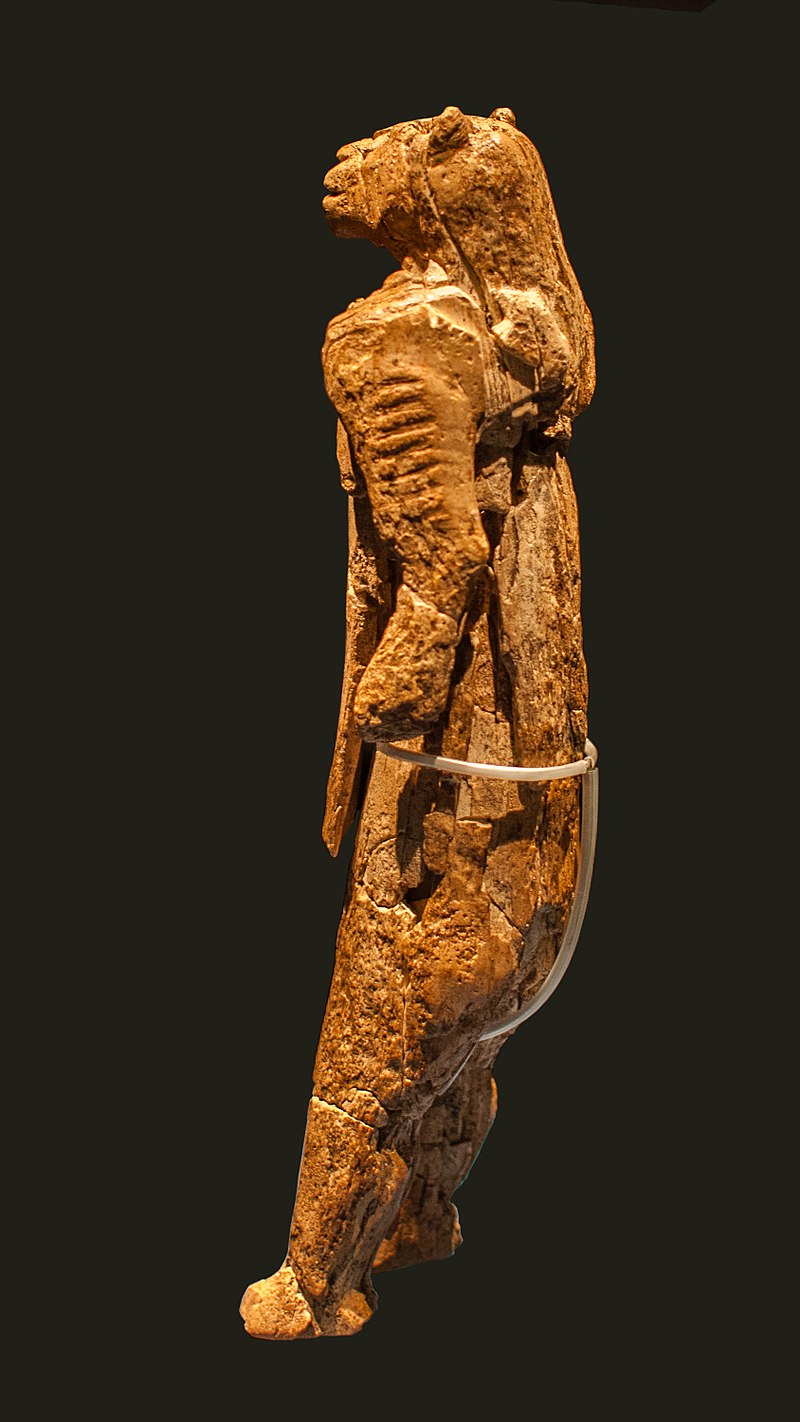
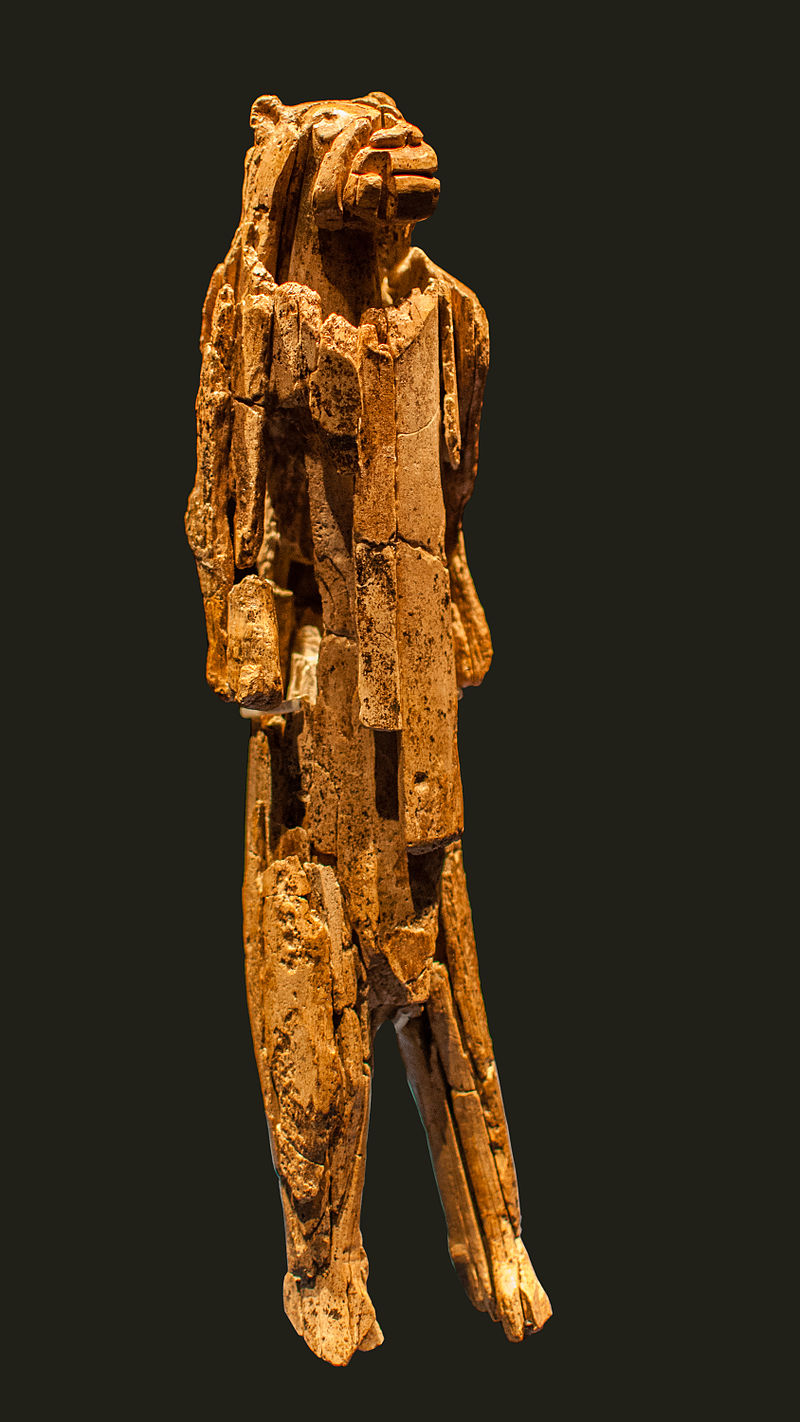
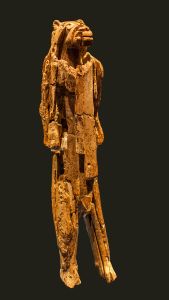 The Lion-Human (Löwenmensch).
The lion-headed figurine is the oldest-known zoomorphic (animal-shaped) sculpture in the world, and the oldest-known uncontested example of figurative art. It has been determined by carbon dating of the layer in which it was found to be between 35,000 and 40,000 years old, and therefore is associated with the archaeological Aurignacian culture of the Upper Paleolithic. It was carved out of mammoth ivory using a flint stone knife. Seven parallel, transverse, carved gouges are on the left arm. The figurine currently is displayed in the Ulm Museum, Germany.

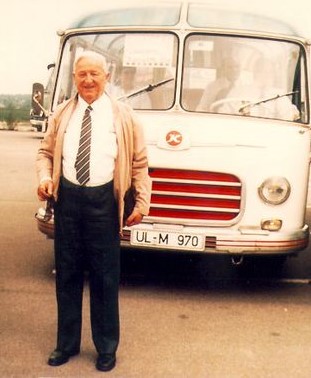


Other famous Ulm born people are, amongst others, (from top left to right bottom) Mike Krüger, Otto Kässbohrer (the SETRA bus builder), Hildegard Knef, Uli Hoeness.

This idiosyncratic city will win your affection with everyday encounters, particularly in summer as you pedal along the Danube and the Fischerviertel’s beer gardens hum with animated chatter. One Helles (pale lager) too many and you may decide to impress the locals by attempting the tongue twister: „In Ulm, um Ulm, und um Ulm herum“ („In Ulm, around Ulm and all around Ulm“).
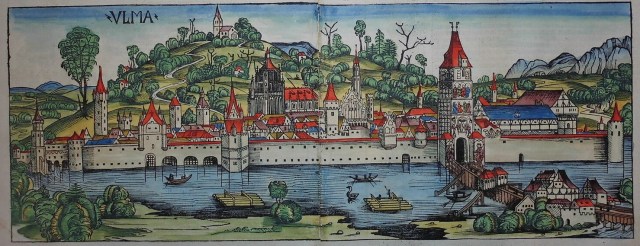 Ulm on the Danube, impression from the „weltchronic“ 1493.
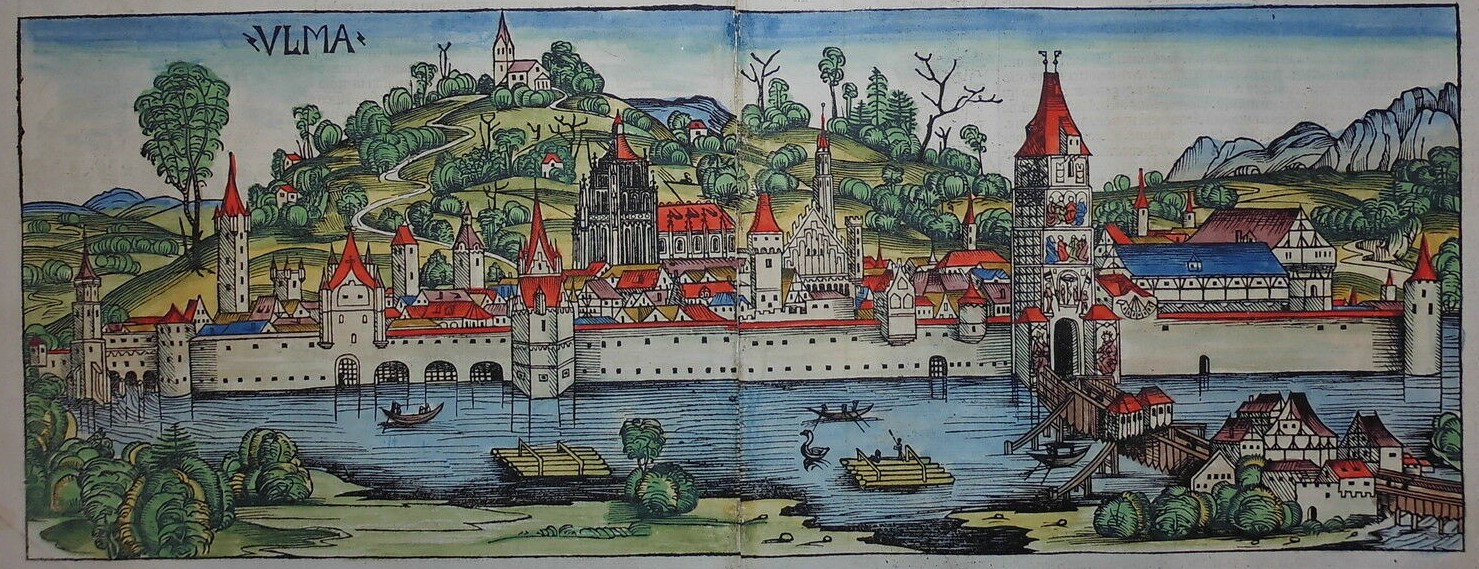
The oldest traceable settlement of the Ulm area began in the early Neolithic period, around 5000 BC. Settlements of this time have been identified at the villages of Eggingen and Lehr, today districts of the city. In the city area of Ulm proper, the oldest find dates from the late Neolithic period. The earliest written mention of Ulm is dated 22 July 854 AD, when King Louis the German signed a document in the King’s palace of „Hulma“ in the Duchy of Swabia. The city was declared an Imperial City (German: Reichsstadt) by Friedrich Barbarossa in 1181.
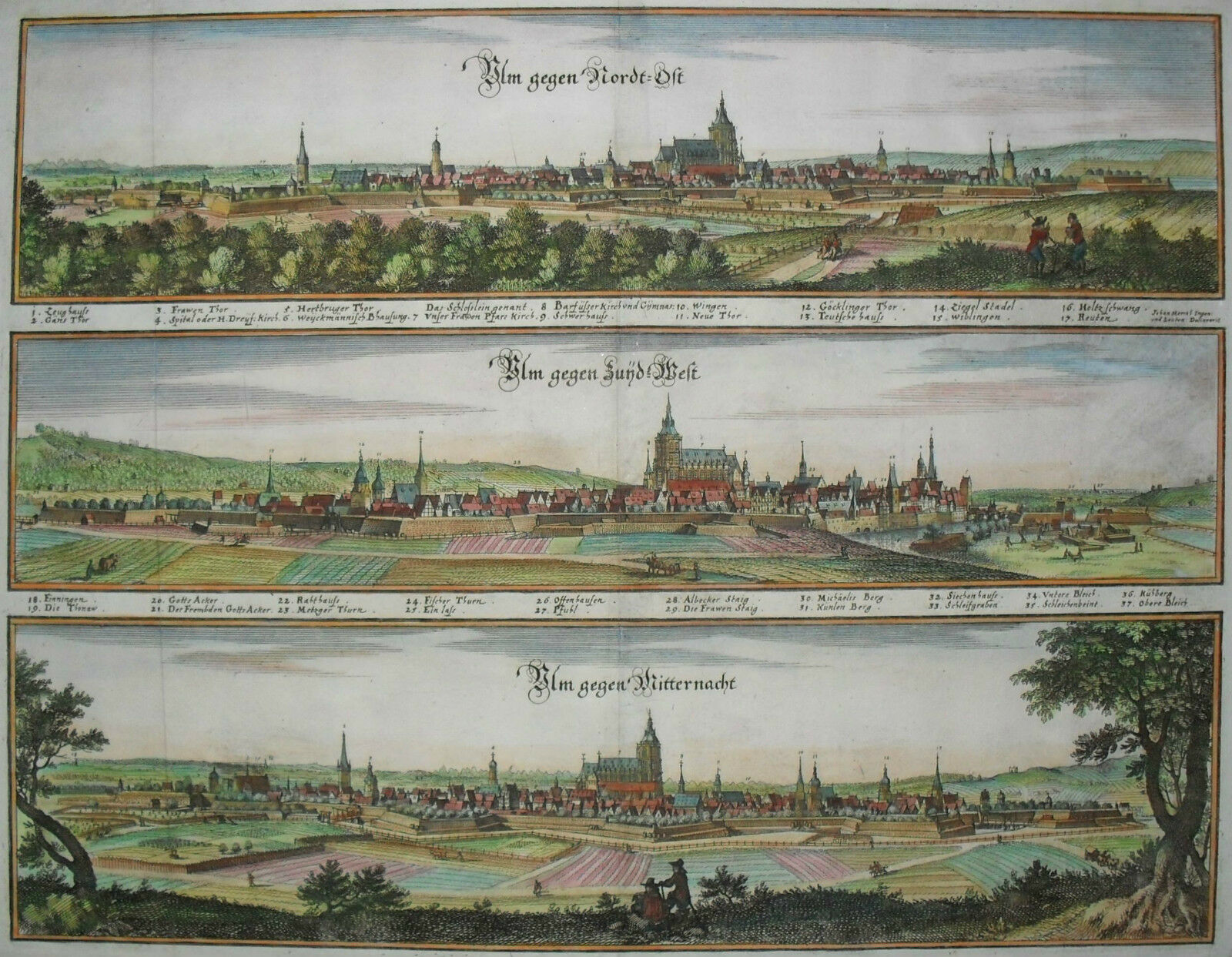
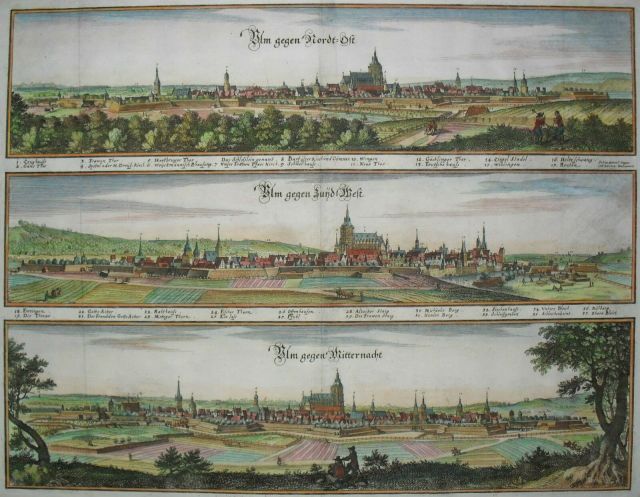 Ulm from „Merian“, 1640. Interesting are the titles of those 3 views.
The Ulm sparrow.
The sparrow is the unofficial heraldic animal of Ulm and ubiquitous in the city. This does not just apply to the real birds chirping in the trees or hoping for breadcrumbs in the sidewalk cafes. In the form of giant sculptures, the sparrow perched on a life-sized scale in various squares and streets. He is named after clubs, a figure in traditional city festivals, imprinted logos and souvenirs. The most prominent position is the sparrow of copper, which stands on the roof of the Ulm Minster.
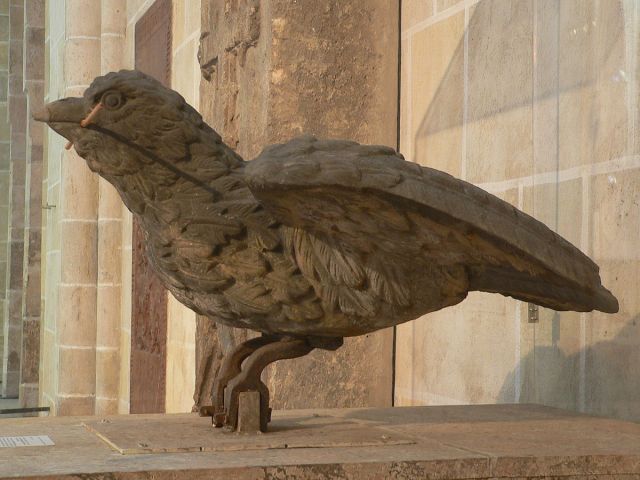 The original „Spatz“(sparrow) from 1858.
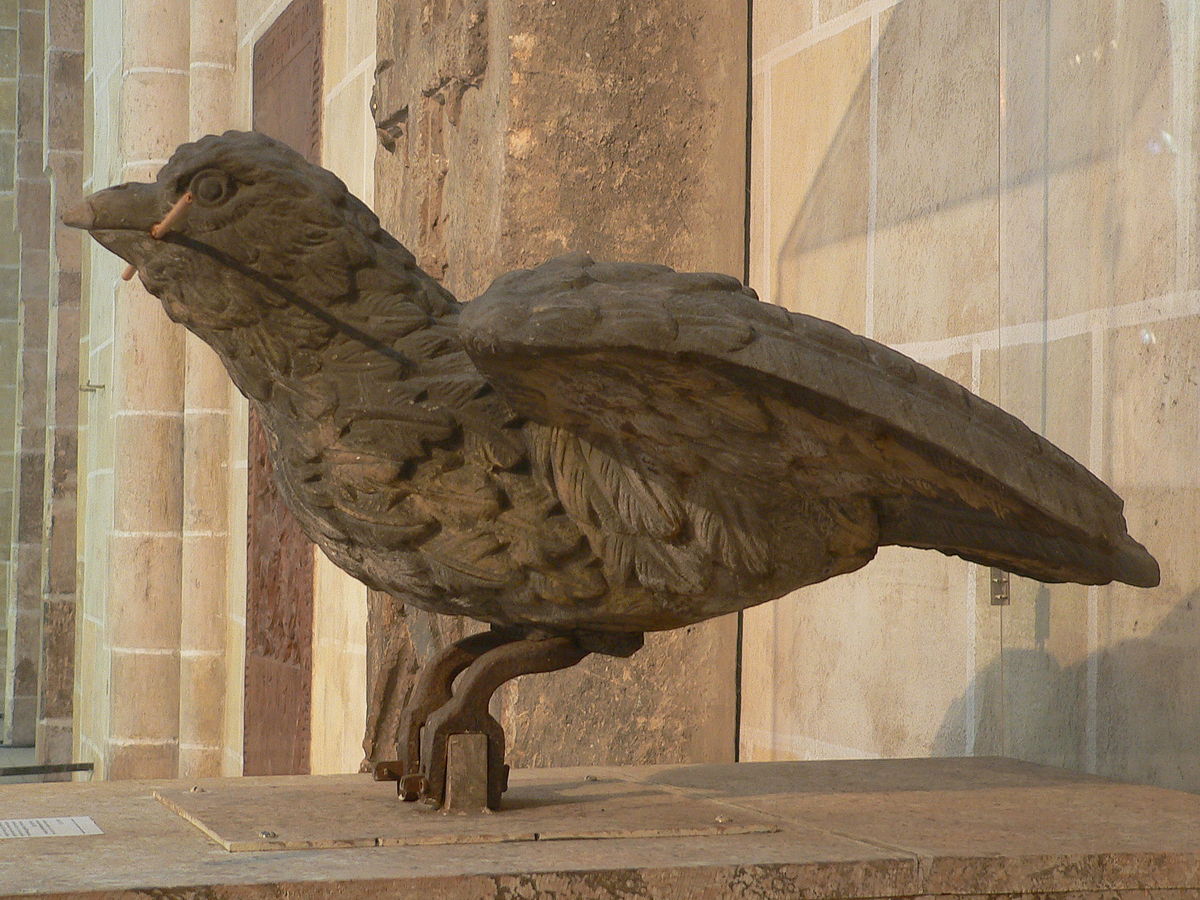
But how did the cult become about the little creature? In the following you will find out the legend that I have retold freely from ancient traditions. By the way, the first hint can be found in a work by the historian Rudolf Max Biedermann from 1826. According to this, the story was already widespread at this time.
 The sparrows in Ulm.

Once upon a time there was a proud citizenship in the free imperial city of Ulm, which was in the process of building a gigantic cathedral. For the roof, the builder needed long logs. He sent his assistants to fetch strong wood. And so they set off. But as the men tried to get the beams into the city from outside, they encountered an insurmountable obstacle: the city wall with its much too small gate.
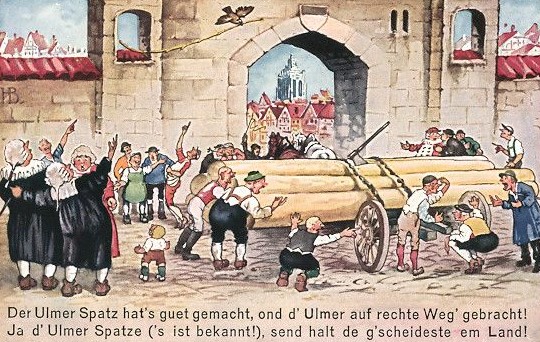 Old postcard of Ulm, telling the story of the sparrow.
The master builder fell into deep despair. His men had considered carefully, the beams stacked tightly and loaded across the car. But if they wanted to move the car through the narrow gate, the wood was left and right over. The gate was too narrow for the long beams. How should they ever get in?
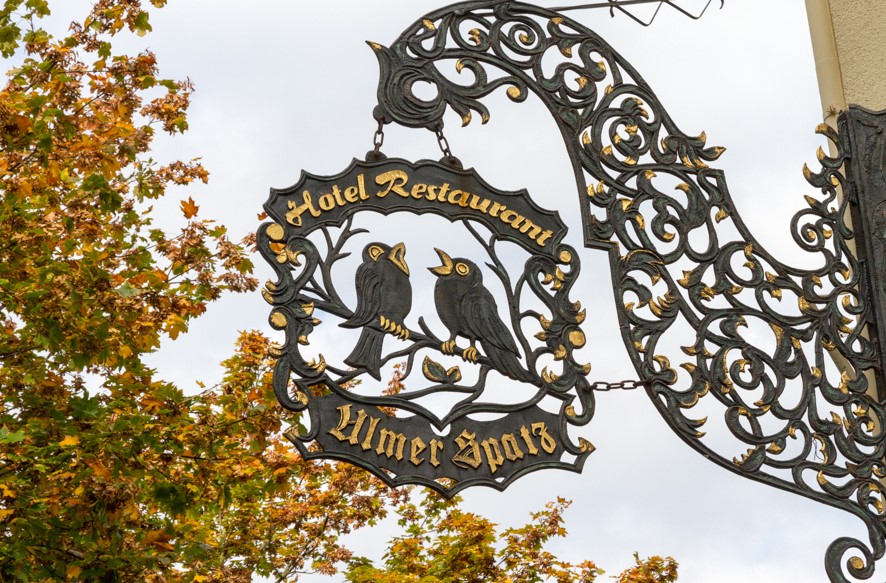
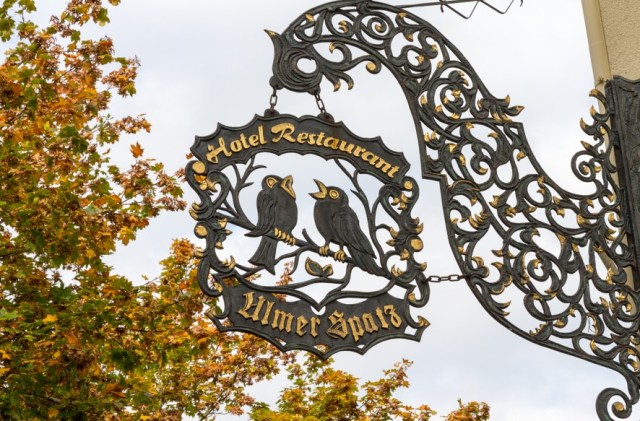 Many occasions in Ulm to use the sparrow. Well known the hotel and restaurant „Ulmer Spatz“.
The whole city was in turmoil about it. Not only the assistants, but also the citizens, the scholars and even the mayor – who actually knew everything about an answer – were looking for a solution. But something similar had never happened to anyone. Even in the smart books, there was no advice. When the confusion was greatest, a small sparrow flew over the crowd. In his beak he wore a golden shimmering straw. With this he fluttered up to the tower, which rose above the city wall and provided space for a nest in a narrow gap. The resourceful sparrow turned the straw to push it lengthwise into the niche. Then the Ulmers opened a light.
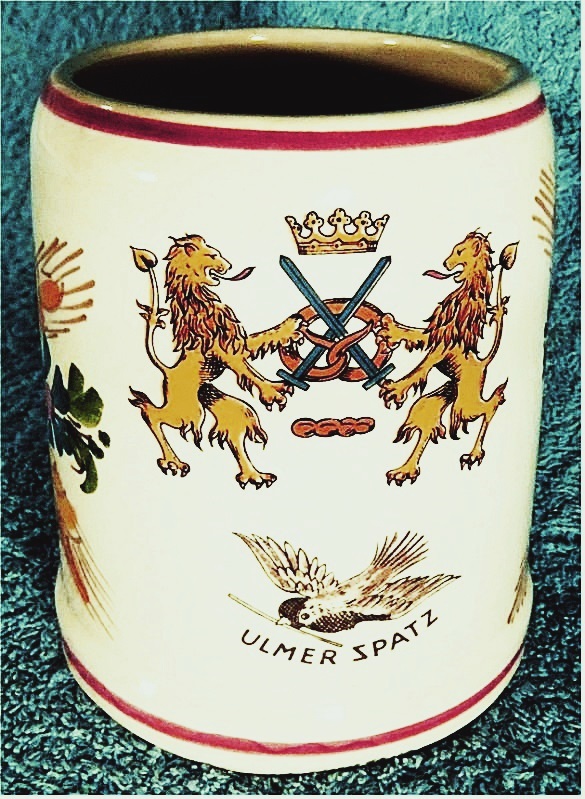 Beautiful antique beer stein from Ulm with the sparrow next to royal insignia.
In no time, they grabbed the wooden beams, turned them, and placed them lengthwise on the wagon. With zeal, they set the vehicle in motion. The master builder held his breath and barely trusted his eyes. Elle after Elle, piece by piece, the car rolled smoothly through the gate. The crowds cheered. The people applauded the sparrow and closed it deep in their hearts.
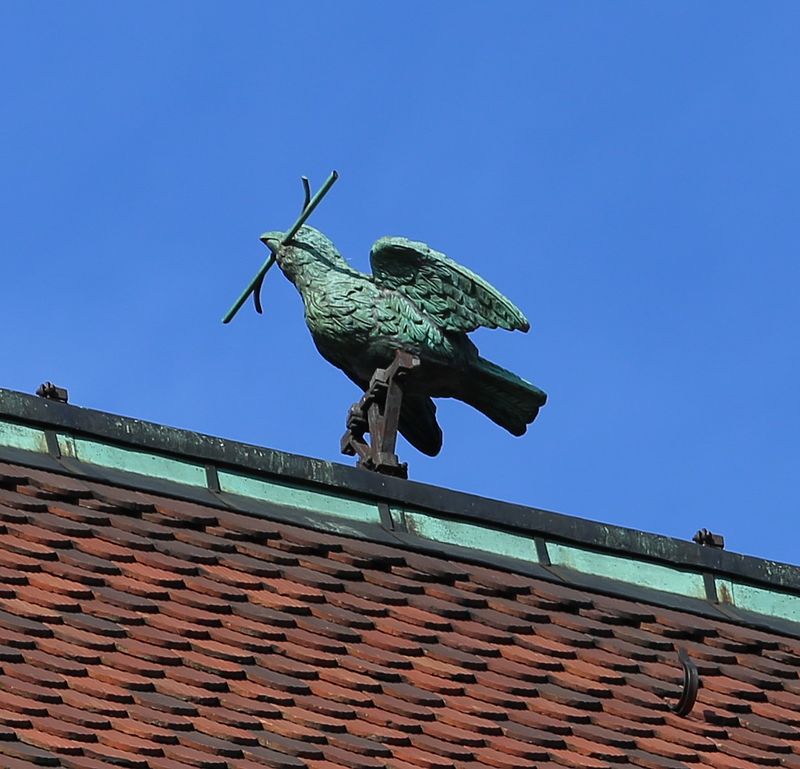
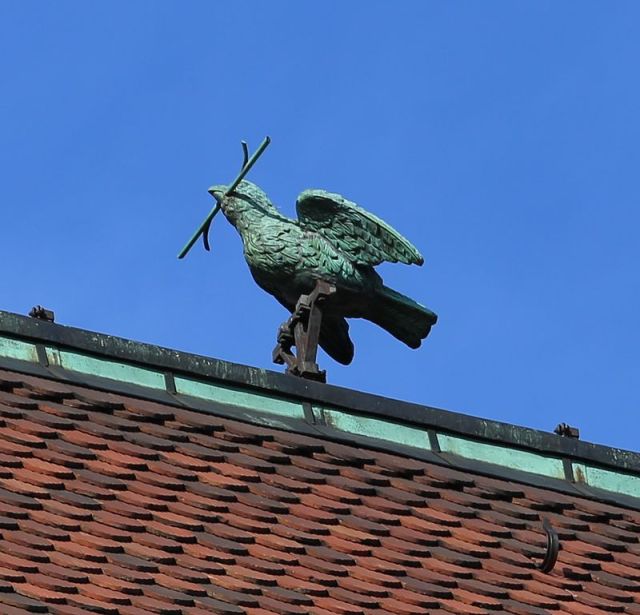 To thank the citizens erected a monument to the bird on the cathedral roof: The figure of a sparrow (since 2013) with a straw in his beak. And so the sparrow became the unofficial, but all the more beloved heraldic animal of the city of Ulm.
The Ulm Schachtel.
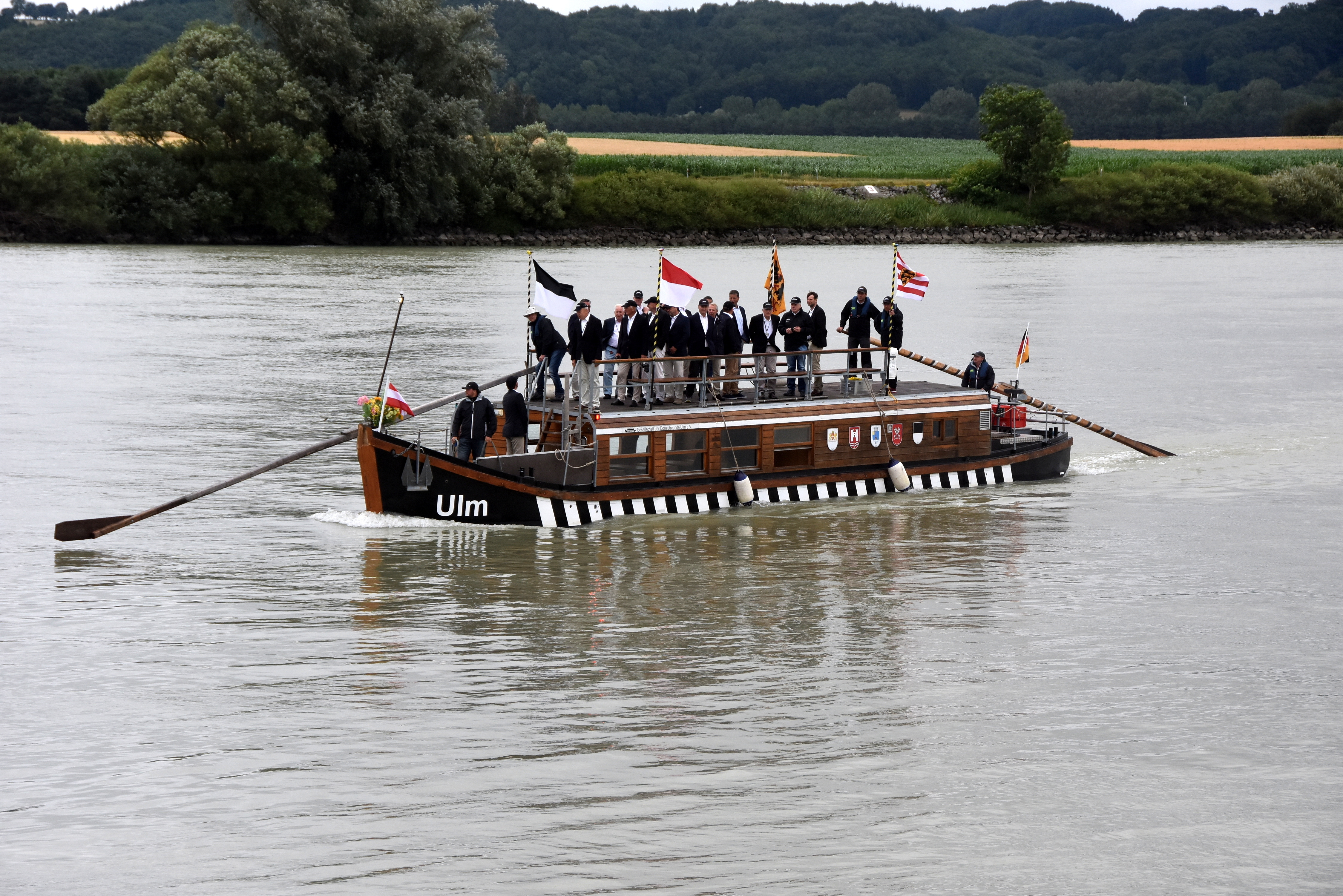
Alongside Ulm Minster and the sparrow, the Ulmer Schachtel is one of the symbols of the city. If the term means nothing to you: it denotes a flat-bottomed river boat that was widely used for trade by the People of Ulm. Nowadays, the remaining examples of this vessel are used on Ulm‘s public holiday, Schwörmontag (Oath Monday), to transport a few dozen dignitaries from Fischerplätzle to Friedrichsau.
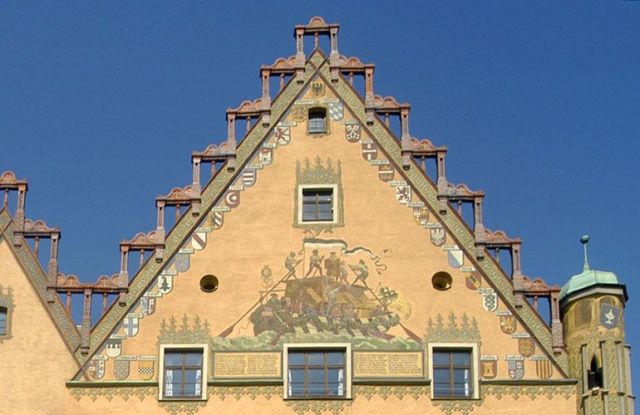 Ulmer Schachtel – painting at the old city hall of Ulm.
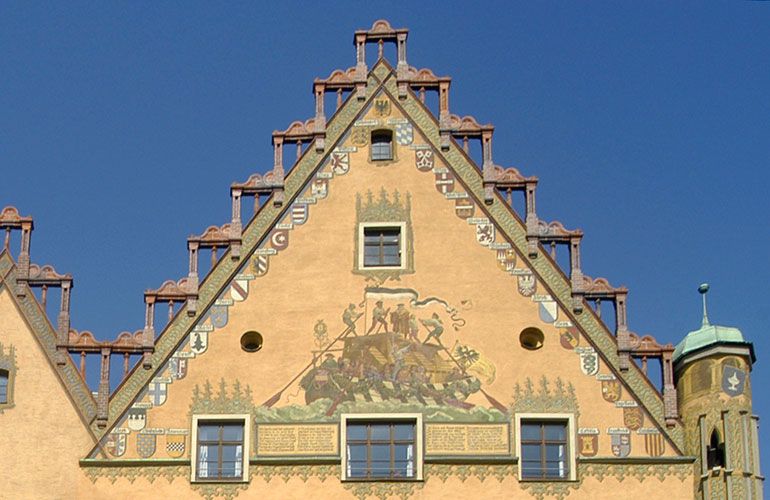
Every year, five Ulmer Schachtel boats – one large and four somewhat smaller vessels – also cover the route from Ulm to Vienna or beyond, helping to maintain the traditional contact between the countries along the Danube. This merry ritual is a reminder of the once flourishing industry, Ulm’s Danube shipping. Transported on the Danube at that time: Cloth from Europe’s north-west, skins, pelts and wax from Russia.
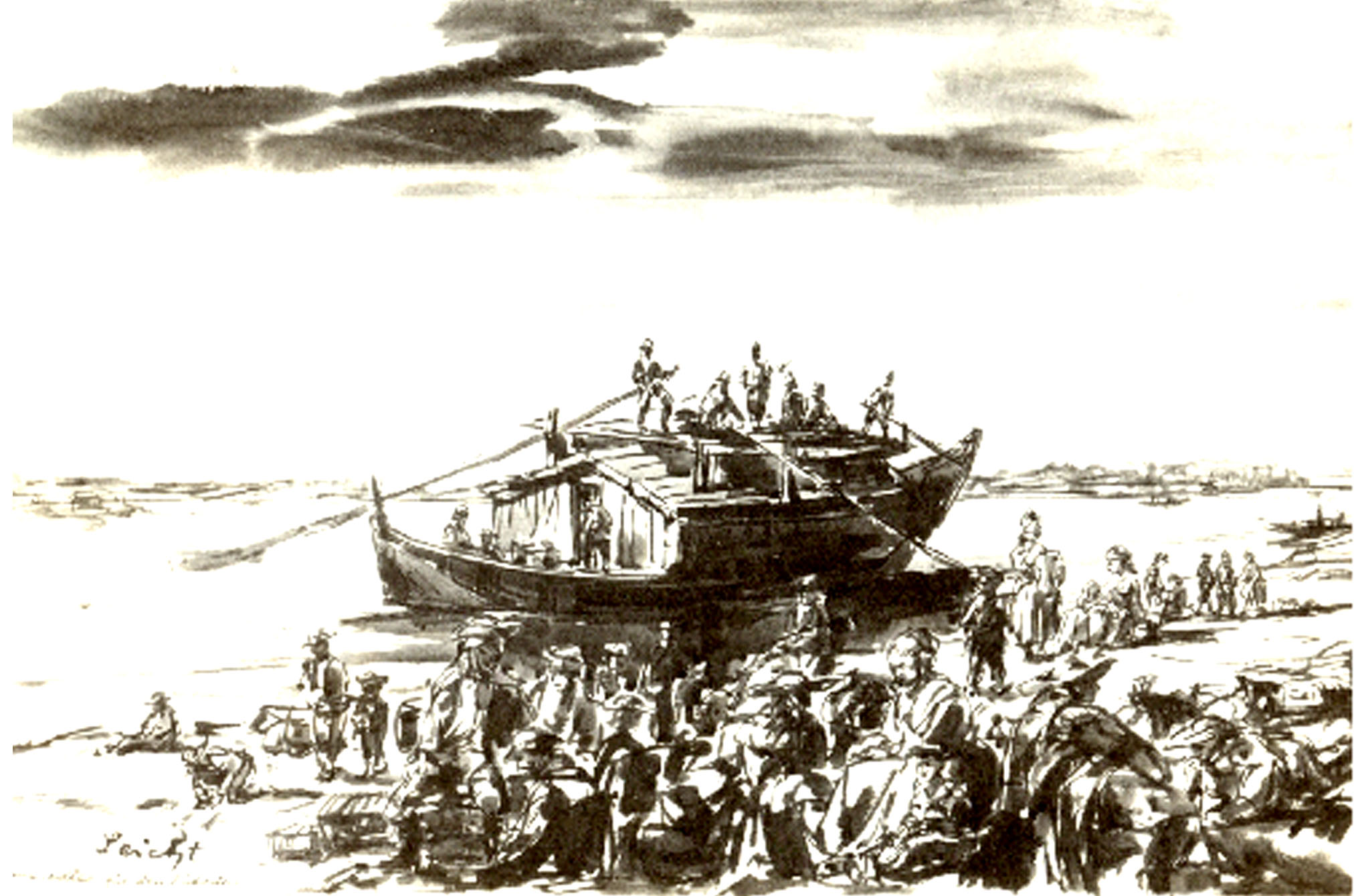
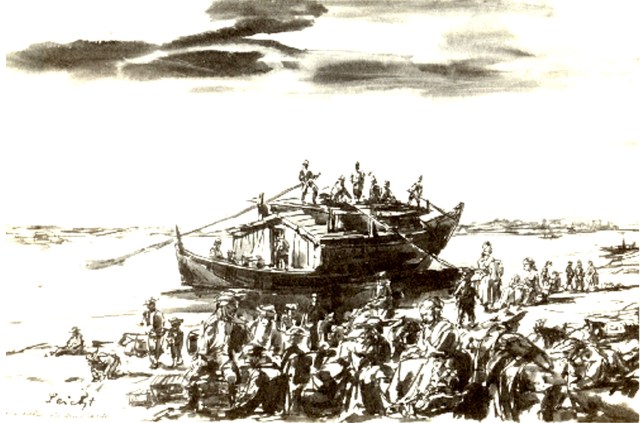 Ulmer Schachtel transport on the Danube.
Chronicler Felix Fabri also mentioned the waterways in 1488. This was still done by raft at that time. Ships from Bavaria did also sail upstream to Ulm, but the people of Ulm had no ships of their own at that point.
This changed in the 16th century because of a timbershortage, which caused people, including those in Ulm, to seek an economical alternative to rafts. Wine Traders from the fishermen’s guild brought “Schopper” – theDanube ship builders – from Ingolstadt, Deggendorf and Windorf in what is now the district of Passau, to Ulm where, in 1570, they built the first large transport barges. The vessels they built were 26 metres long and 4 metres wide.
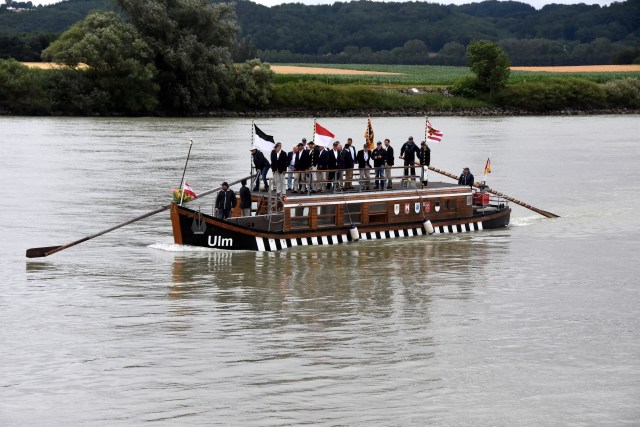 A decent size boat – then and now. The modern ones have 2 rudders only.
The ship building yards (Schopperplätze) were situated on what is now the Neu-Ulm side of the river. a sign there gives the distance to the mouth of the Danube on the Black Sea: 2,586 kilometres. In Ulm these vessels were called “Zillen” (barges); the largest examples were known as “Wiener Zillen” in a nod to their destination of Vienna.
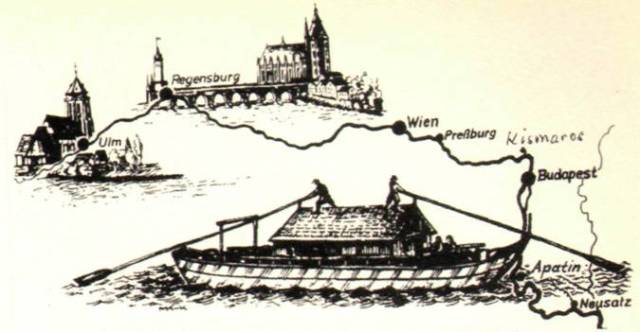 Old drawing of the long trip along the Danube.
The most widespread term though was “Ordinari-Schiff”, which referred to the schedule: these barges departed ordinarily, i.e. regularly, for Vienna on a set day of the week and using precisely defined tariffs. The journey lasted 8 to 14 days depending on the water level. This “Ordinari Wiener Schiff” had a good reputation.
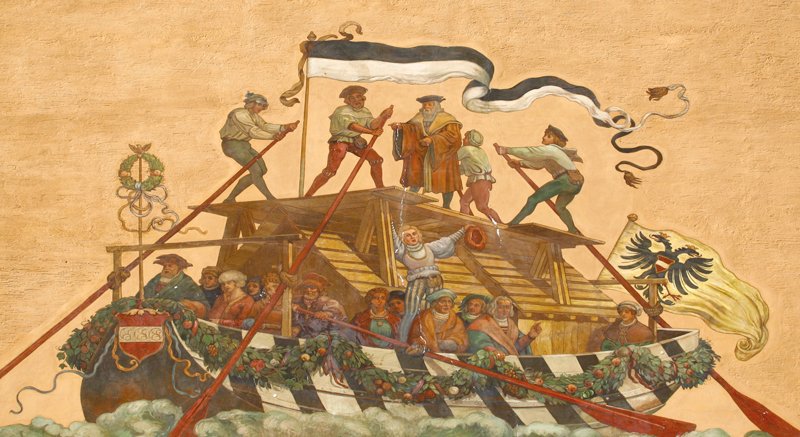
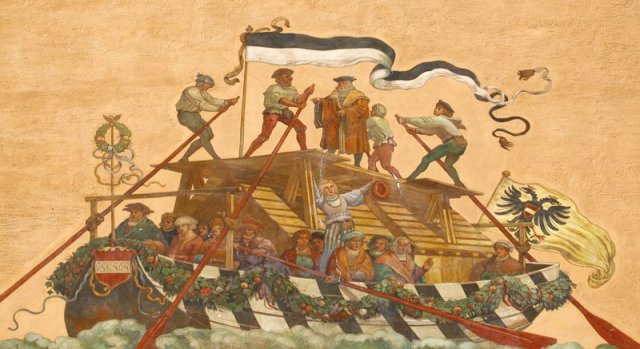 The old painting on the Ulmer City Hall shows very well how they had to move and steer the old boats. Always a skipper/master, four cox to steer and at least 2 or 4 rudders on each side. No traveller aloud on top of the roof.
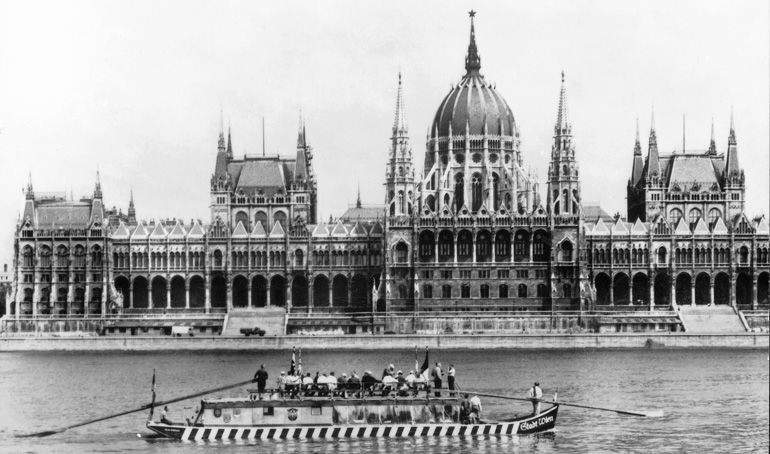
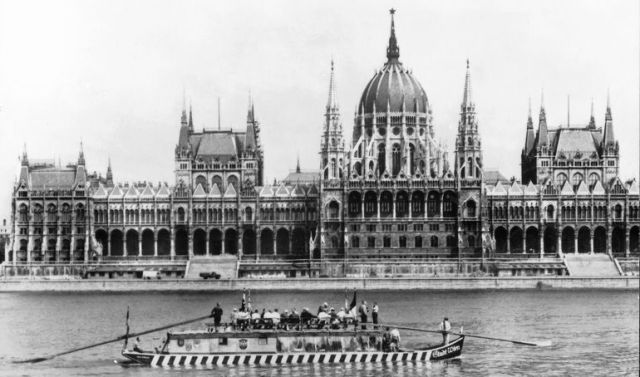 An Ulmer Schachtel infront of the parlament of Budapest, Hungary.
A traveller from 1769 explains why:
1.) As the ship tied up each evening, I was able to sleep
leisurely at night, which would not have been possible
on the mail coach.
2.) The risk was not great, as the Ulm bargemen are so
cautious that when they anticipate a risk they continue
on to the next landing or stop for whole days rather
than exposing themselves to some misfortune; as I have
experienced several times.
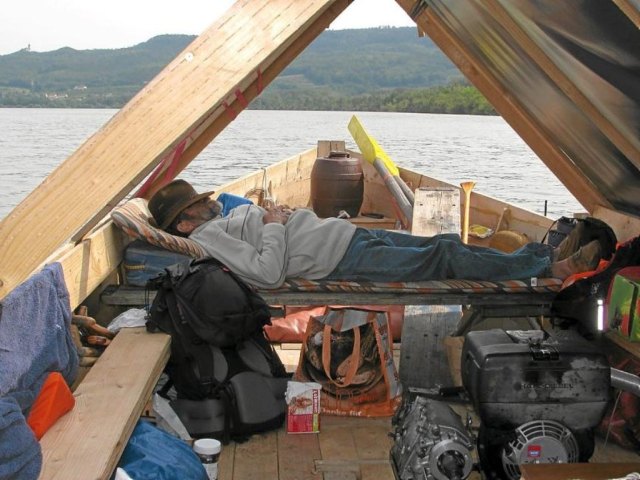
Could have looked like that inside the Schachtel, couldn’t it ?
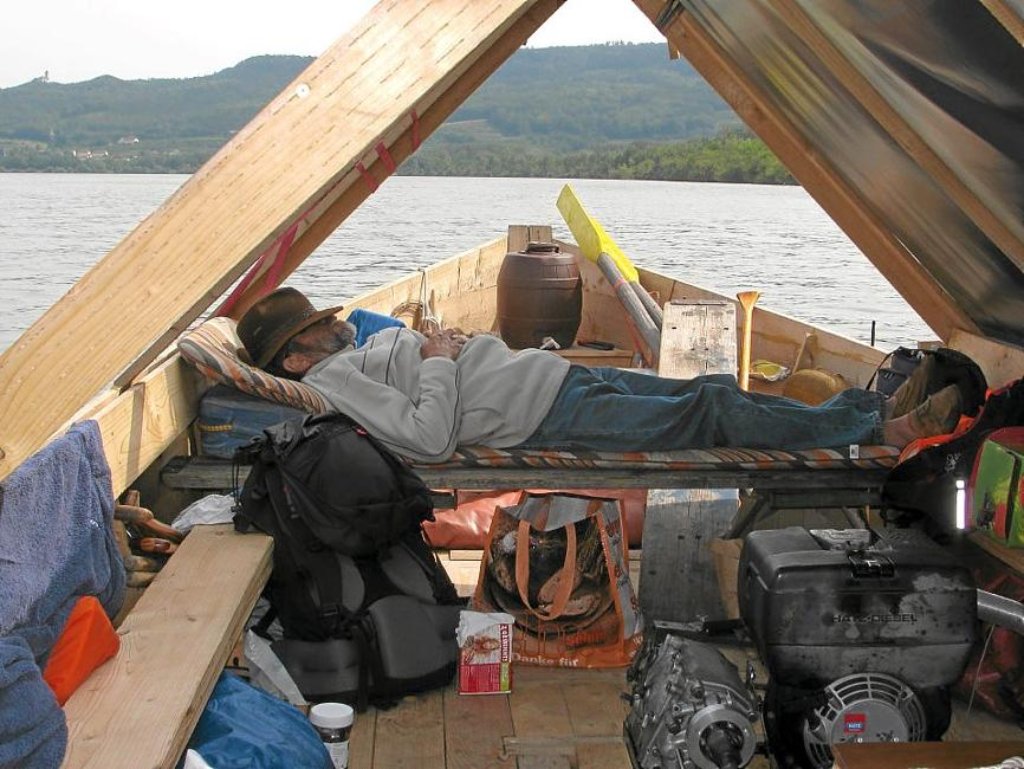
This tourist describes the design of the passenger barges as follows:
A small structure stands at the centre of the Ordinari-
Schiffe, which is thrown together from planks and covered
with planks. This small structure usually consists of two
rooms. The room at the front is used by travellers of some
distinction. In winter there is normally a small stove, which
is heated from outside. There is a small window on each
side of the room, so that the people can see out. Planks
are used all around the room to make seating. You find
the baggage of the persons who are travelling in the room
under these benches. If there is any space left, the bargemen
also store other packages here that cannot be exposed
to the rain or snow. The bargemen also use these benches
as a dining table during the day, where they eat what they
have cooked on the small stove, and as a place to sleep
at night. The common folk are housed in the back room.
It has neither stove nor window, nor many benches
though; but most of those within sit or lie about on the
boxes and packages that the bargemen have put inside.
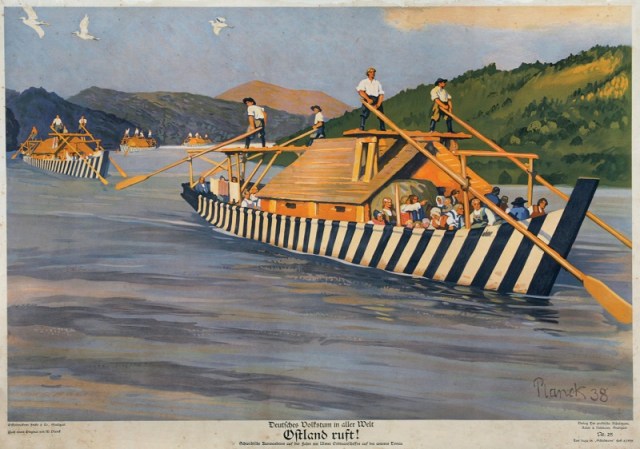 Painting from 1938, printed on postcards. Notice how they had to steer the boat with 4 people.
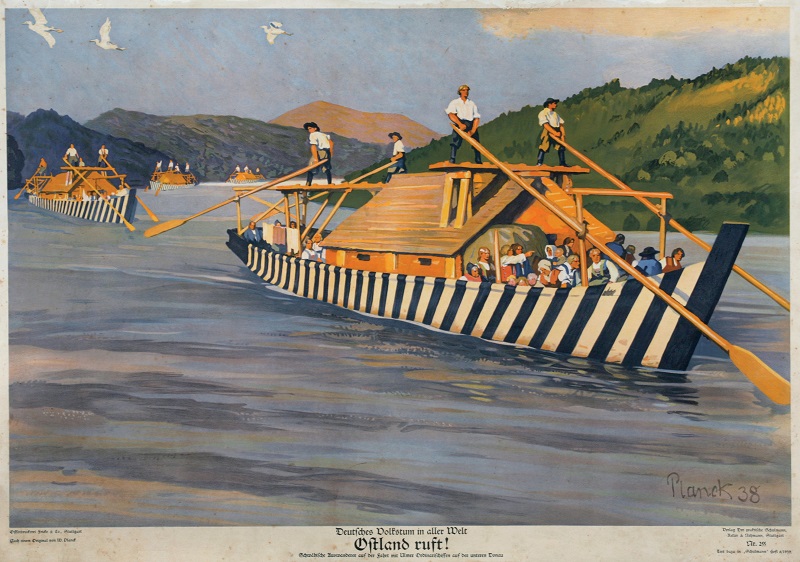
The Danube is used predominantly for goods destined for Bavaria and Austria, which are brought to Ulm by waggoners from France via Strasbourg, from Italy via Augsburg and for other onward transport. The house of Kindervatter had the largest shipping company for goods and monies, which came to Vienna from the Netherlands on behalf of the emperor.
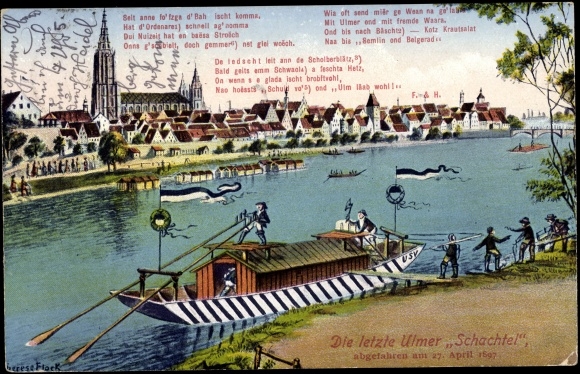 Old postcard showing the last regular „Ulmer Schachtel“ service on 27th of April 1897.
The Ulm Tailor.
„The Ulm Tailor attempted to fly on a whim, but the devil lead him into the Danube to swim“. This is the most popular rhyme mocking the man whose plain name was Albrecht Ludwig Berblinger. When dealing with him we discover a schizophrenic attitude unique to Ulm: As Tailor of Ulm he is a figure of local folklore. As such he was never treated as a hero of aviation but rather considered to be a burn-out, a crackpot and comic figure.
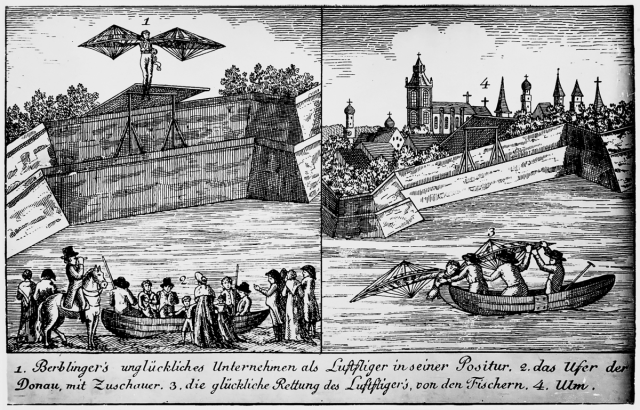 Historic drawing of the flight test of the tailor of Ulm.
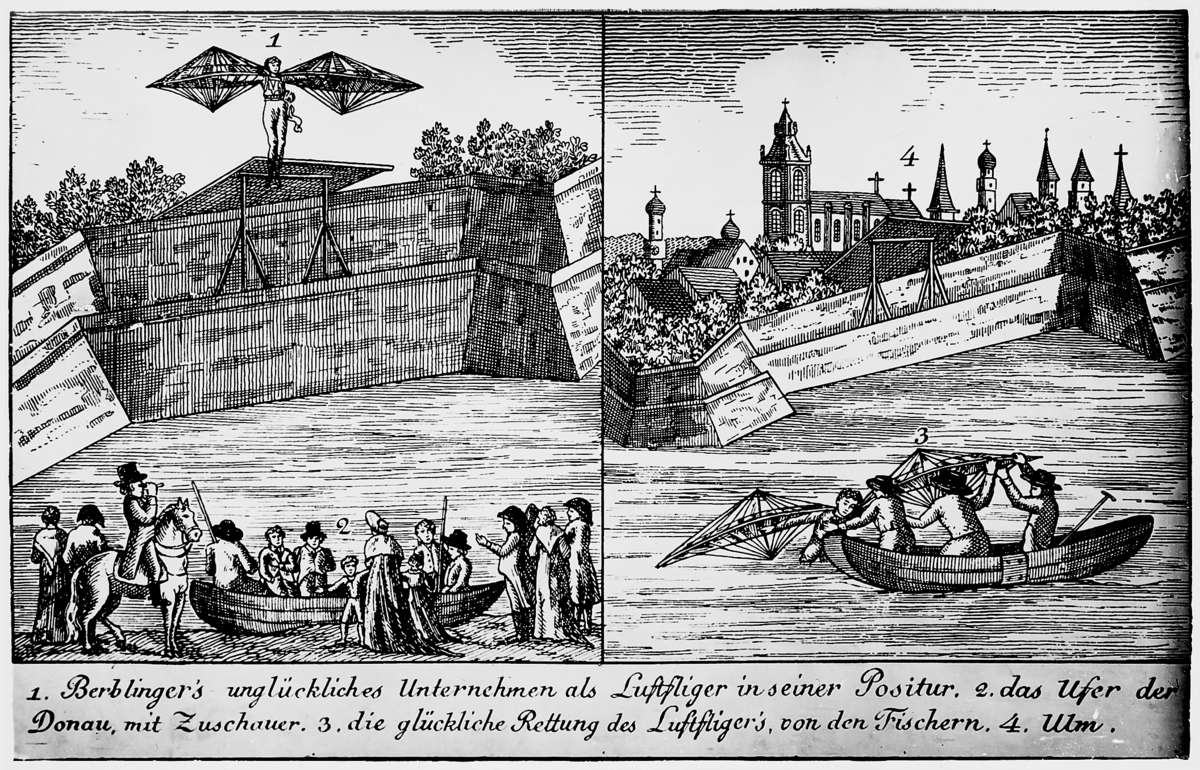
Today however the inventor and design engineer Albrecht Ludwig Berblinger is rehabilitated. The Ulm Science City offers an award every two years since 1988 to commemorate the man who made aviation history with the first glide through the air. The „Berblinger Award“ is designed to motivate the world’s airplane constructors to channel their creativity toward the improvement of safety, ecological compatibility, aero dynamics, design and economics.
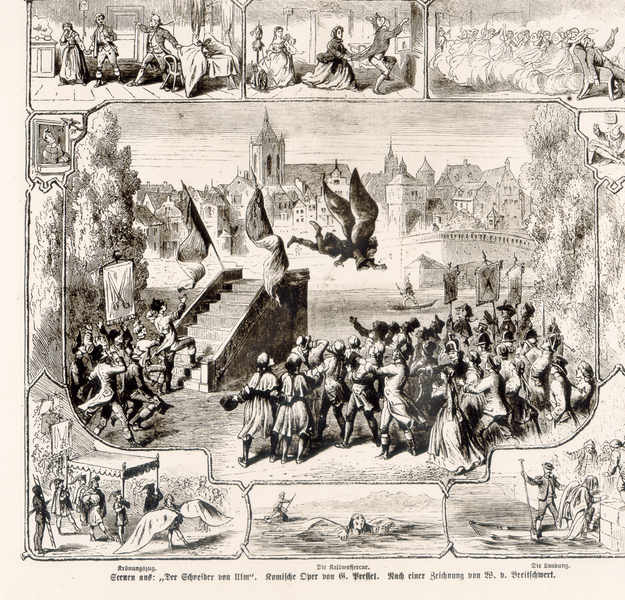 Not very lucky this first flight experiment.
Who was this man, Albrecht Ludwig Berblinger? He was a tailor by trade but not by calling. He was born as seventh child to his parents on 24th of June 1770. His father died when Albrecht Ludwig was 13 years old. The boy was sent to an orphanage. It was the foster father who had the idea to apprentice him to a tailor. Berblinger himself felt no such desire. He tended much more toward mechanics.
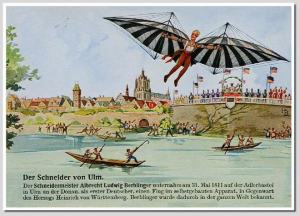
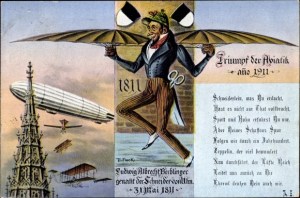 Postcards telling the story.
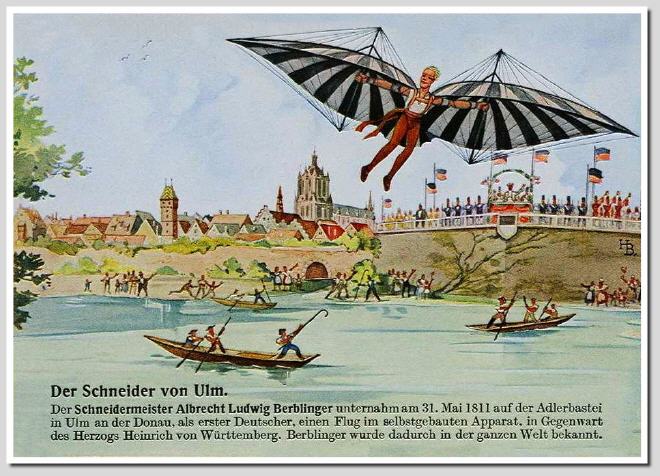
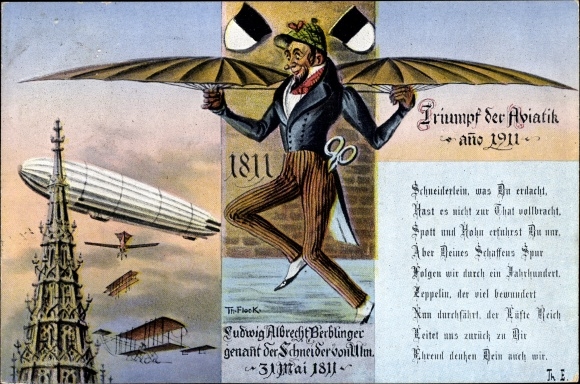
Berblinger had discovered and adopted the dream of flying, not without success if different sources can be trusted: The master tailor and his self-built flying machine are said to have glided from one summer house to the next on the Michelsberg.
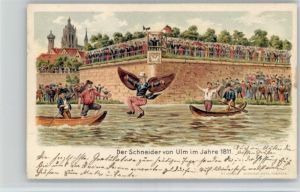
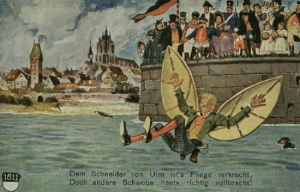
More postcards about the flying Ulm tailor.
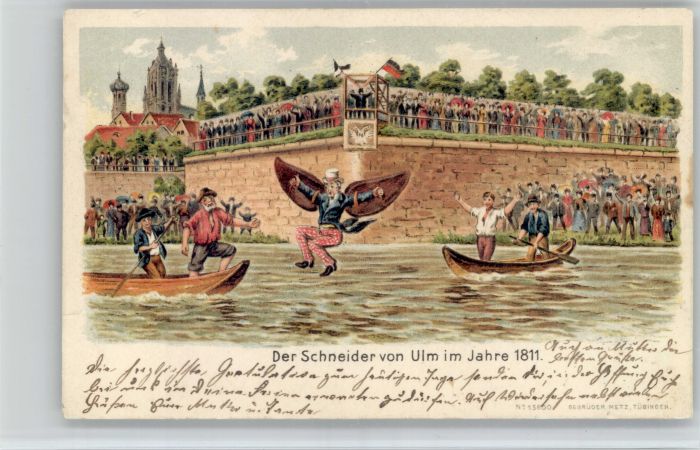
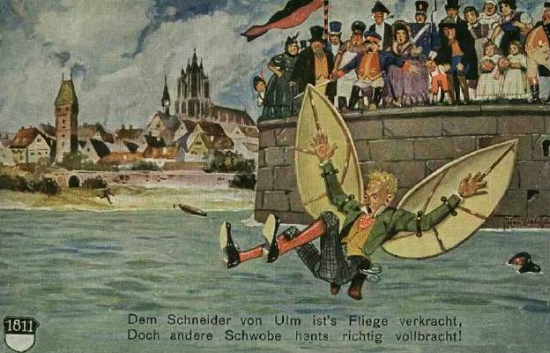
Contrary to the test-grounds on the Michelsberg the air above the Danube was lacking thermal currents. Lucky in misfortune had Albrecht Ludwig Berblinger, the tailor of Ulm. In 1810 and 1811 he constructed a flying machine with which he wanted to glide through the air like a bird. In 1811 he started from a bridge over the Danube – also the Bavarian king stayed among the spectators. Unfortunately, Berblinger had not considered that there are no updrafts above the cold river, which kept him in the air long enough in his previous attempts. The planned river crossing was therefore not successful, he crashed and had to be rescued from the floods.
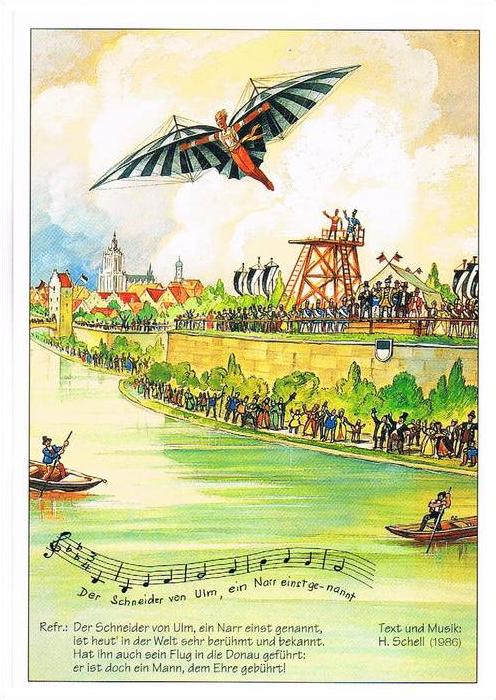 Even a song was written as a rehabilitation about the flying tests of Berblinger, Ulm history.
One month after his failed attempt this paper wrote about Berblinger: „ Indeed, he seems to possess neither theoretical knowledge nor mechanical genius“. They added on to this: „He is scourged with a flood of mockery“. Berblinger’s crash was not only physical but social as well. His reputation in his hometown was shattered.
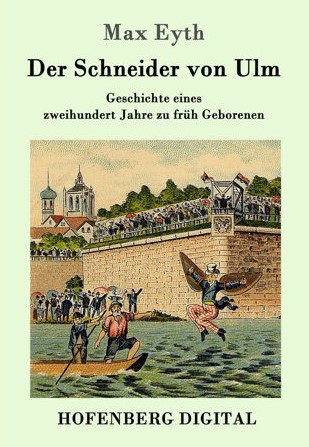
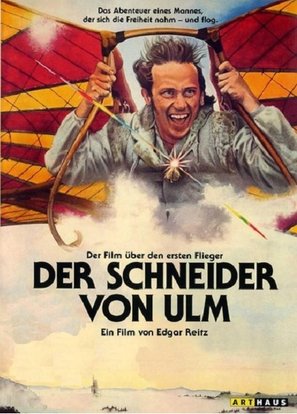 Engineer and author Max Eyth finally laid a foundation to Berblinger’s memorial with his two-volume novel „The Ulm Tailor“ in 1906. The under title reads: „ The story of a man born 200 years ahead of his time“. Even a movie was made in 1978 and can in full length seen through YouTube.
Ulm Fishermans and Tanners Quarter.
No guest is allowed to leave Ulm without visiting Fishermen’s Quarter. The experience is absolute idyll. A concentrated sequel of small lanes, tiny bridges and plazas, an abundance of half timbering and an endless selection of quaint restaurants and cafes.
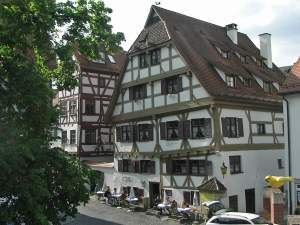
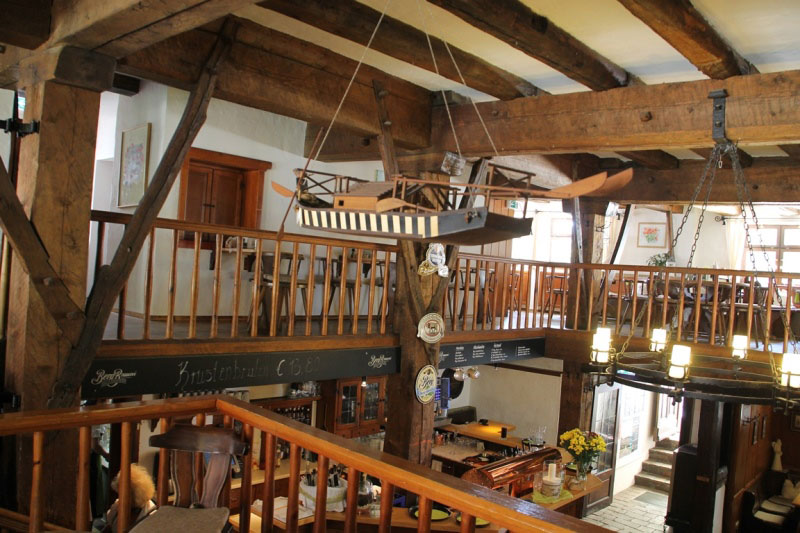
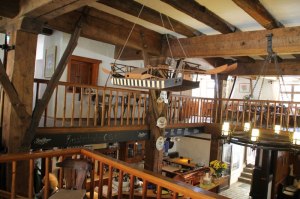 Zunfthaus der Schiffsleute (guild house of skippers). Top food in top surrounding. Next to the Zunfthaus (on the left front view) is „Das Schmale Haus“( the narrow house), a beautiful and affordable B&B.
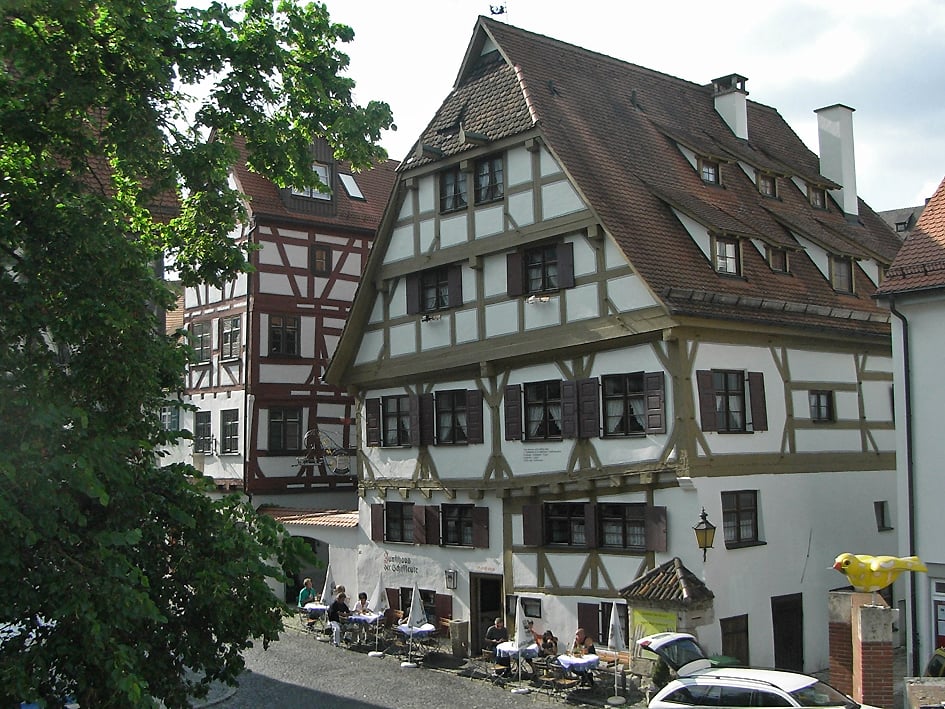
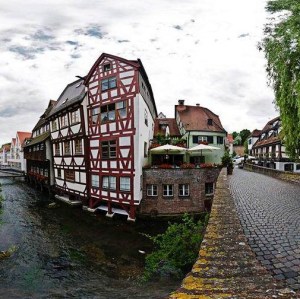 The „Schmales Haus“ – riverside view.
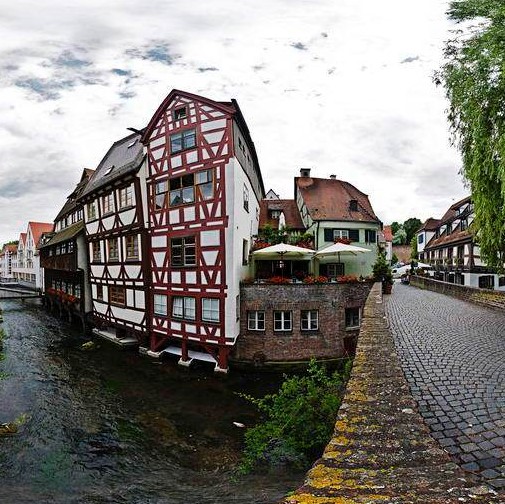
During the times of the palatinate donkeys carried sacks of flour and other food stuffs from the mills and depots at the Blau river up to the palace on the Weinhof (= wine court). On the way down we pass the square stones of the Staufen wall, defending the palace and part of the city in the 13th century.
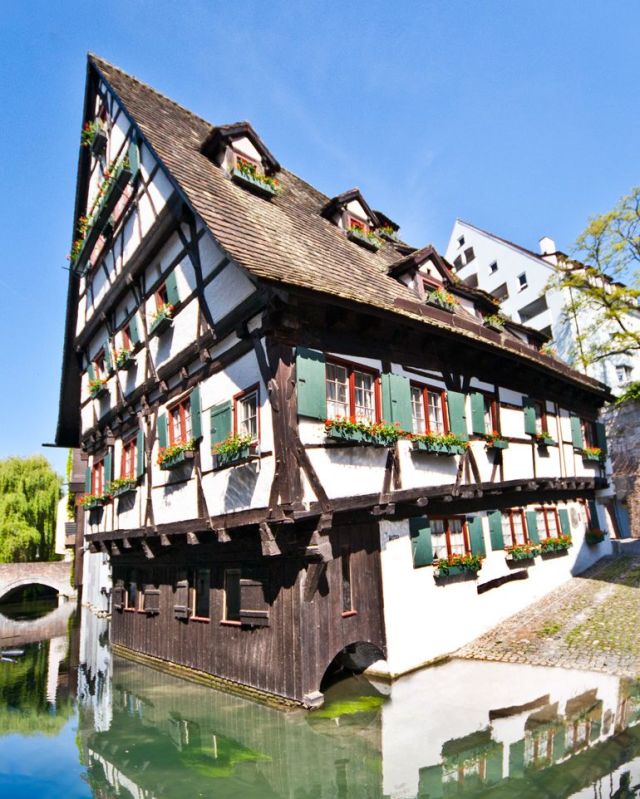 Right in front of this wall the “Schiefes Haus” (leaning house) hovers above the Blau river. The history of this most popular Ulm residence and its inhabitants reflects the history of fishermen’s quarter. Originally fishermen did indeed live here.
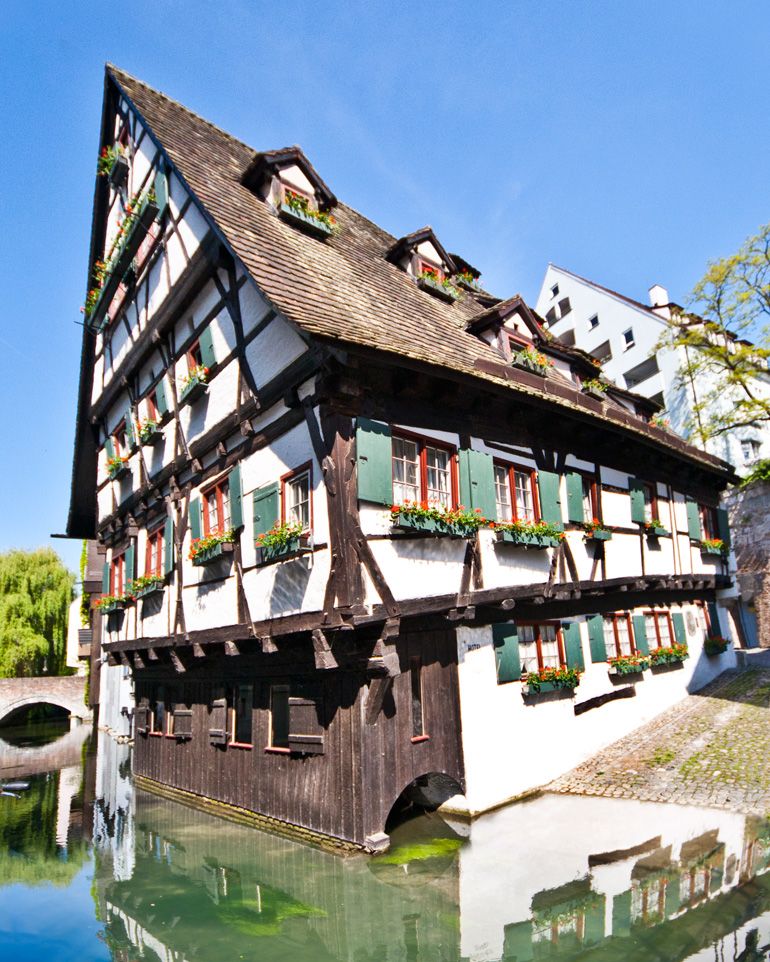
The house finds itself in this legendary leaning position because the southern side actually sits in the Blau river. The river bottom gave way to the weight of the building, which kept on leaning, the residents trying to counteract with dumping raises inside. This did nothing but increase the weight on the south side – thus increasing the lean even more until the restoration in 1995 stopped the ruinous process and the framework literally breathed in relief. When the Leaning House was enlarged in 1443 from its former small size into today’s dimensions, it was still located outside the protective city walls.
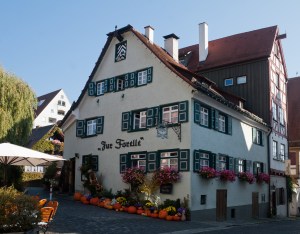
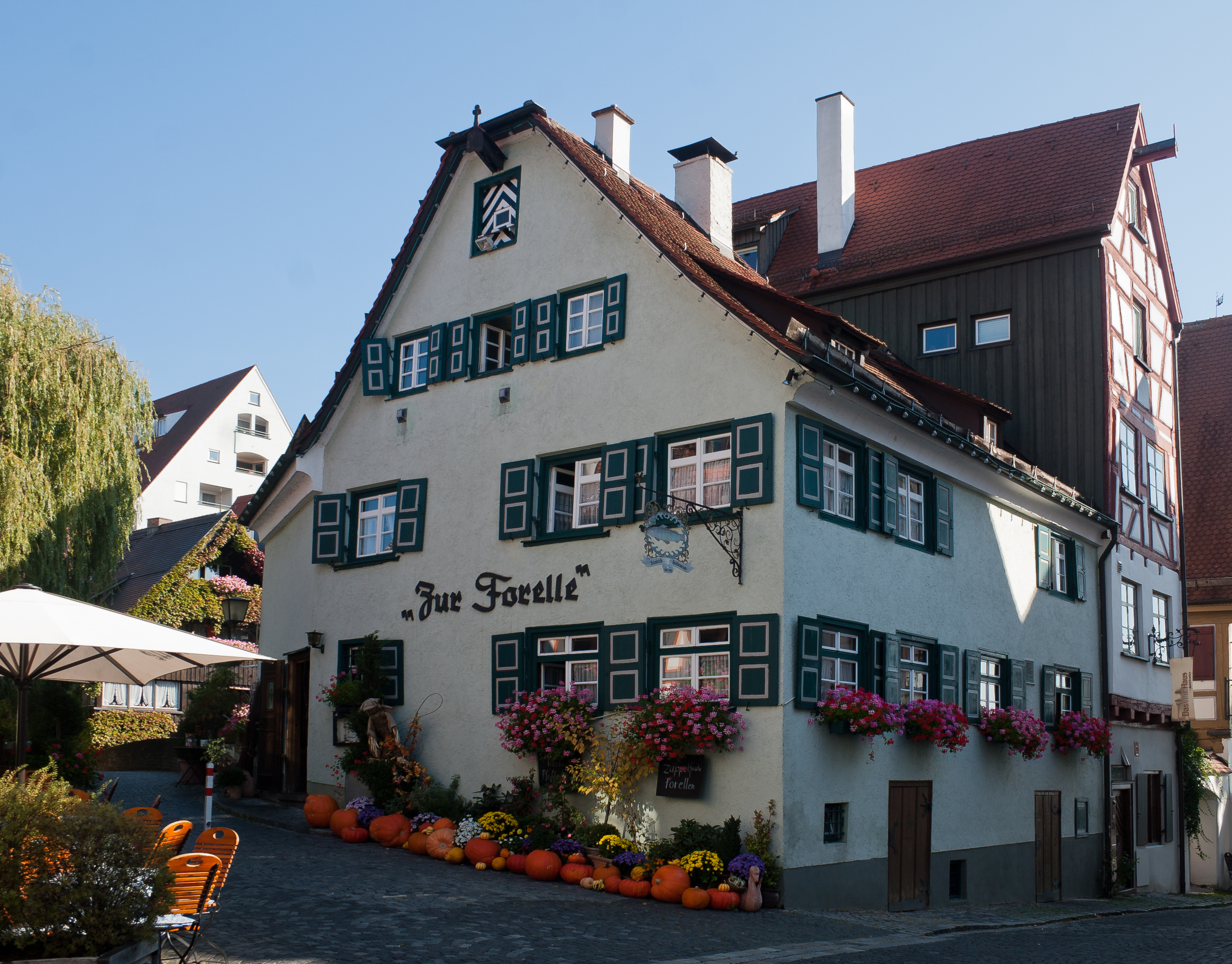
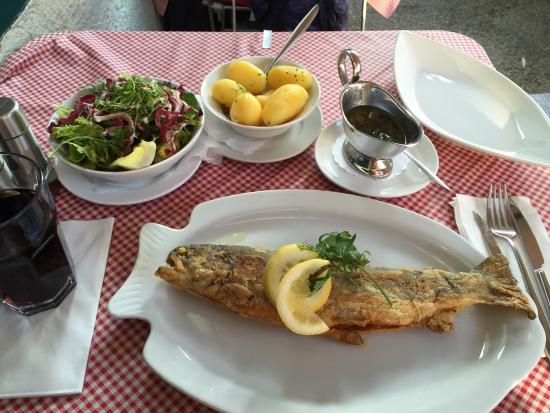
 Fantastic atmosphere and a great cuisine, like fresh trout in the restaurant „Zur Forelle“.
However, the strongest characteristic of the Fishermens Quarter was contributed by the tanners. The correct name for the area along the Blau river arms south of Neue Straße should actually be Fishermen’s and Tanners’ Quarter. This strongly aromatic craft – separation of meat and fat from the hide of dead cattle utilizing an artificial process of decay – requires lots of water.
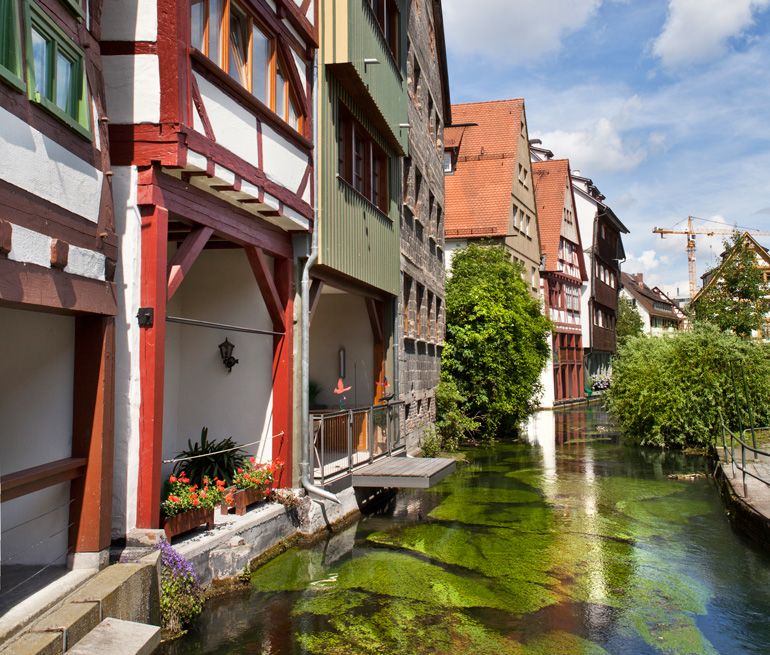
Therefore the tanners, their guild still counting 22 masters in 1786, built their houses on the Blau river. They added platforms to wash the hides and put wooden panels on the outer façade to protect the walls from the acidic brew dripping from the skins hung to dry from the upper floors’ galleries.
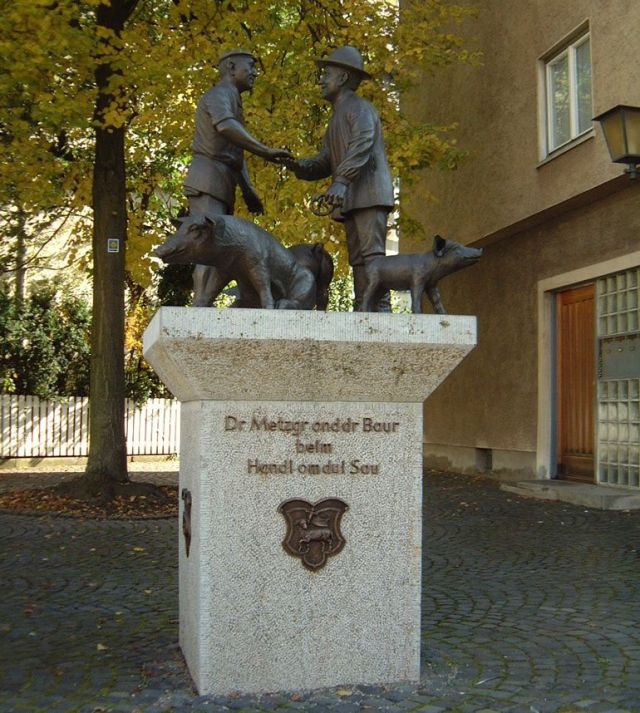 The heart of Fishermen’s Quarter is the “Saumarkt” (sow market). Officially it is called Schweinmarkt (pigs market), however, this is usually rejected as an unnecessary affability to written German.
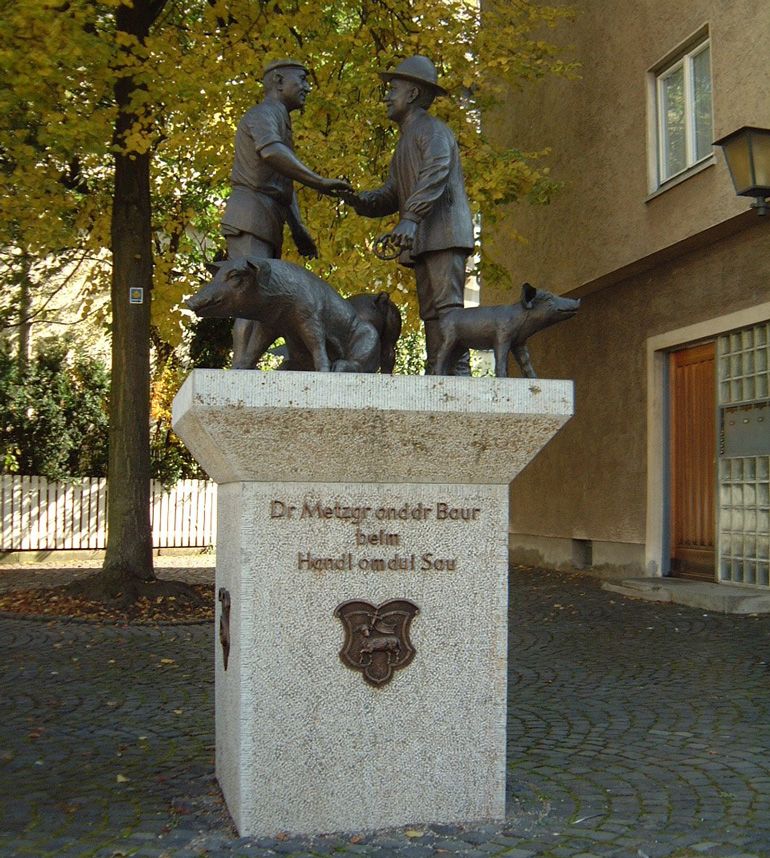
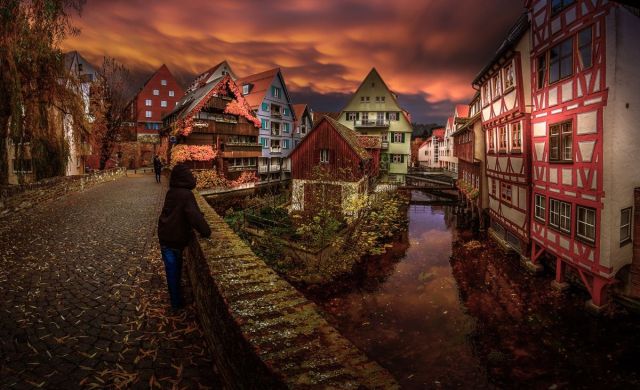
An incredible mood in the fishing quarter during a thunderstorm at sunset in autumn.
The Schwörmontag.
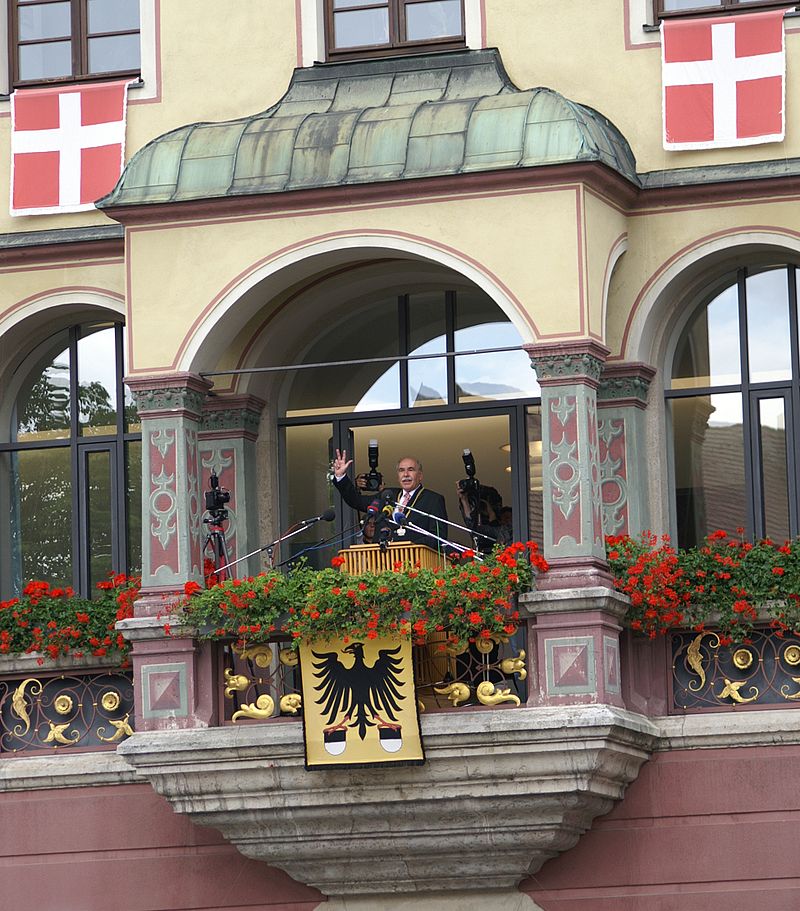
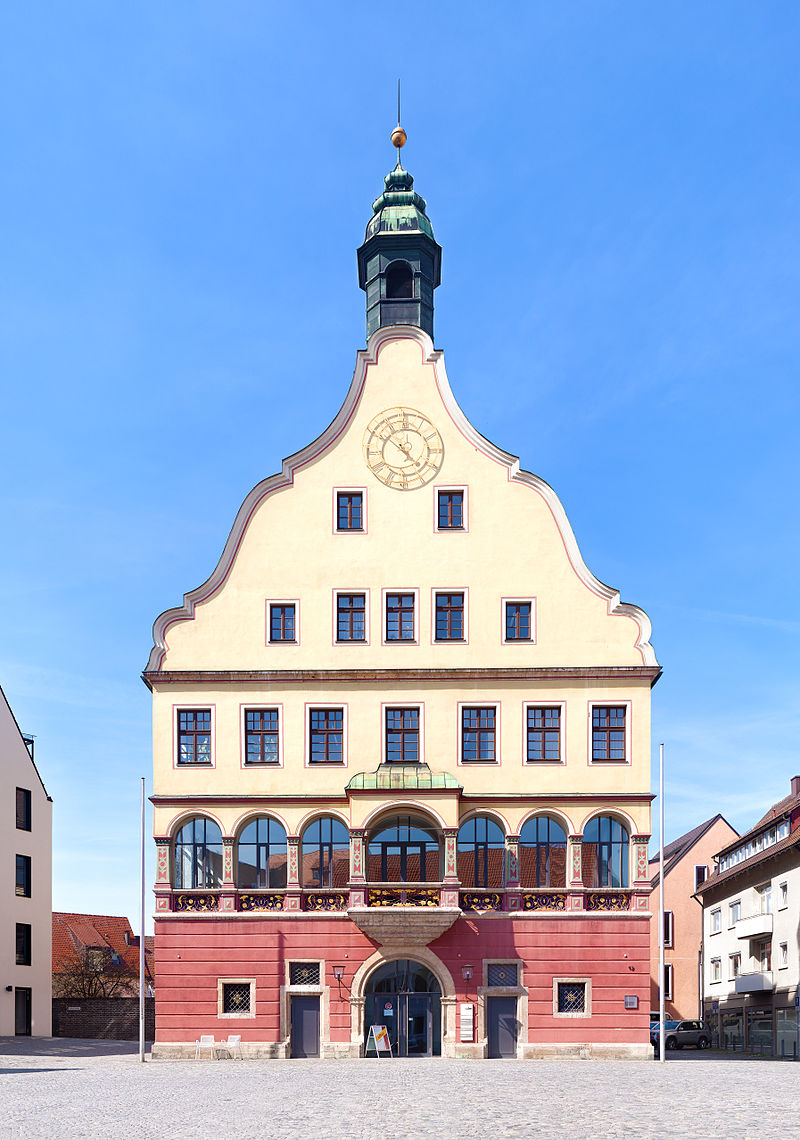
The Schwörmontag is an Ulm holiday, celebrated every year on the penultimate Monday in July. The holiday goes back to the 14th century. At that time, a dispute between the patricians and the guilds about the power relations smouldered in the city parliament of the free imperial city Ulm. Only in the year 1397 the differences with the so-called large Schwörbrief were settled. It guaranteed equal voting rights to all Members of Parliament and obliged the mayor to render an annual report. The mutual allegiance of citizenship and city council from the Schwörbalkon of the Ulmer Schwörhaus was maintained with interruptions until the 19th century.
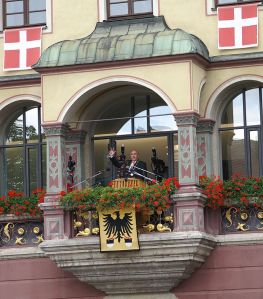
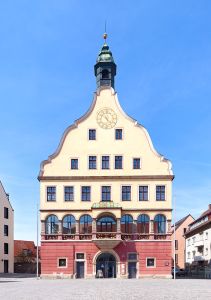 The Schwörhaus. The Schwör-balcony (pic on the left) is directly above the main entry. Click on pics to supersize.
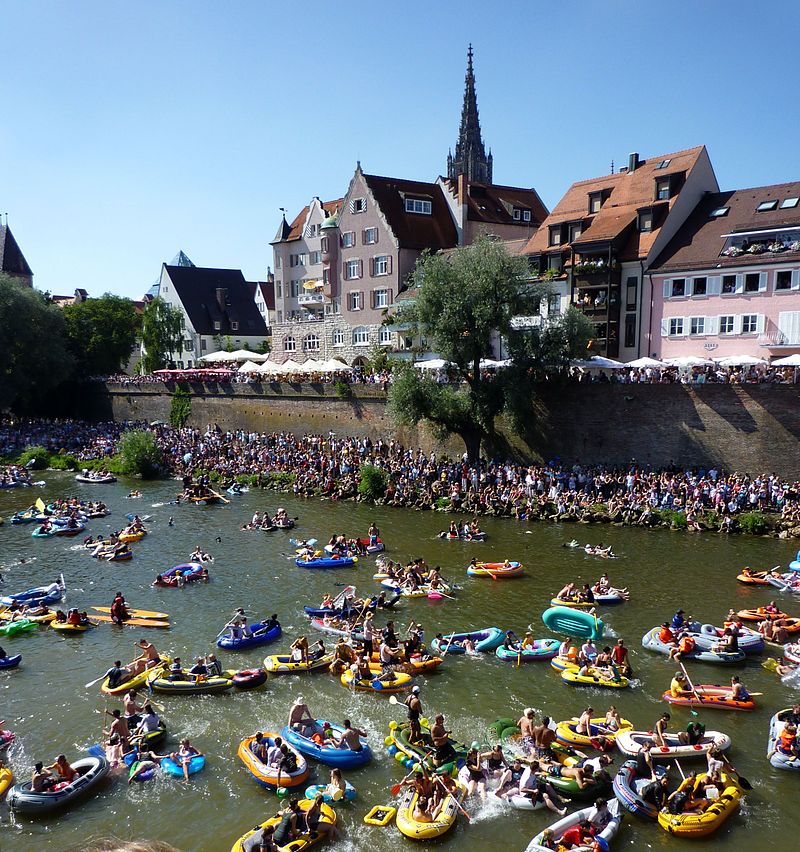
The Nabada is based on several old events: Already around 1800 it was mentioned that the youth bathed the Danube down to the tourist restaurants and carried their clothes in Zubern. An old Kirchweihbrauch described driving down the Bäuerles. Here, on boards laid over two coves, the farming couple were driven down the Danube and pushed into the river by swings.
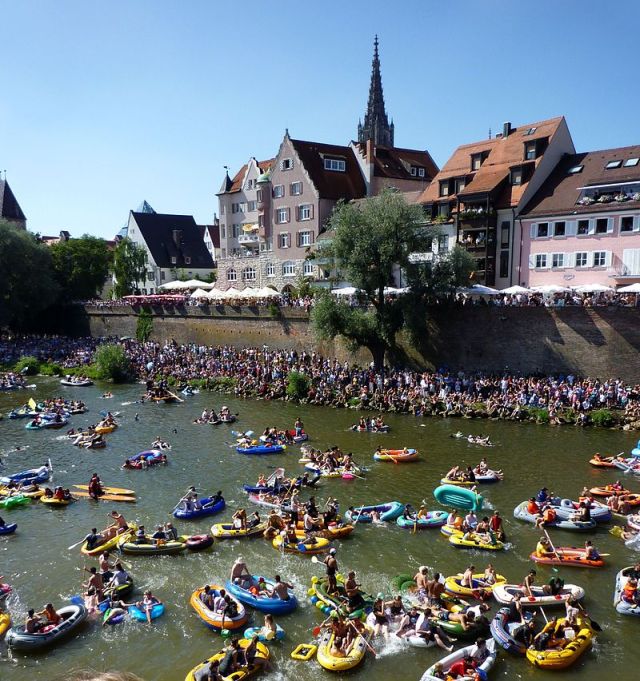 The first official Nabada in Ulm on the Danube took place in 1927.
Ulm Rathaus (city hall).
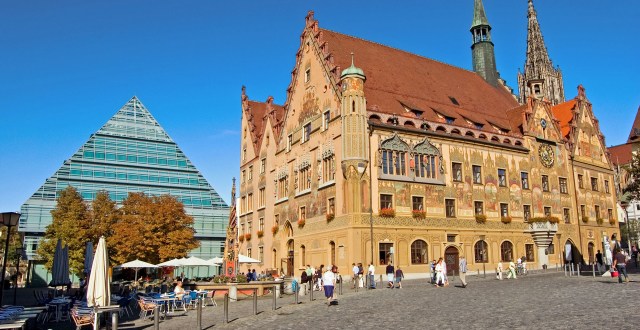 The Ulmer Rathaus (city hall) with the new public library (glas pyramide) on the left.
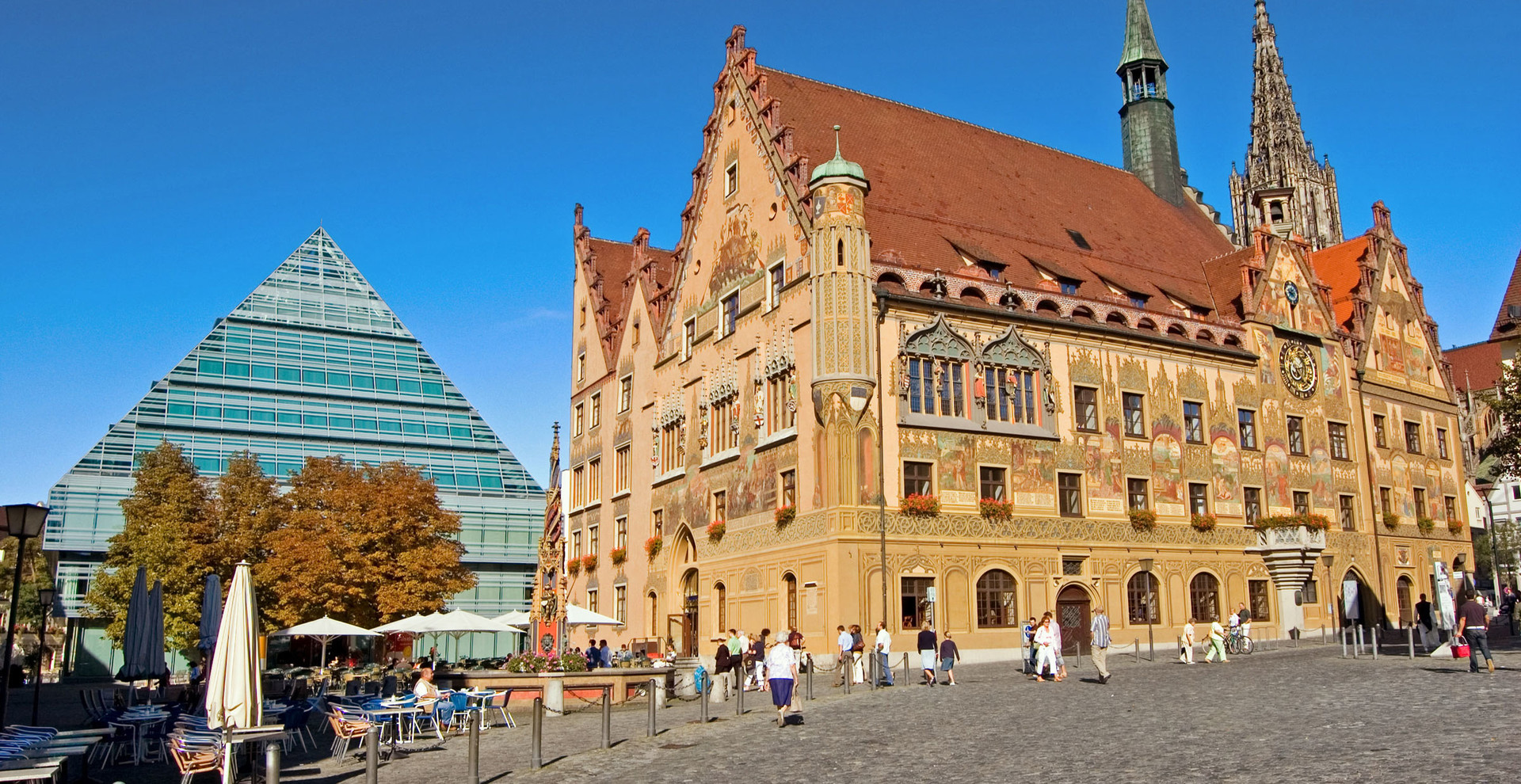
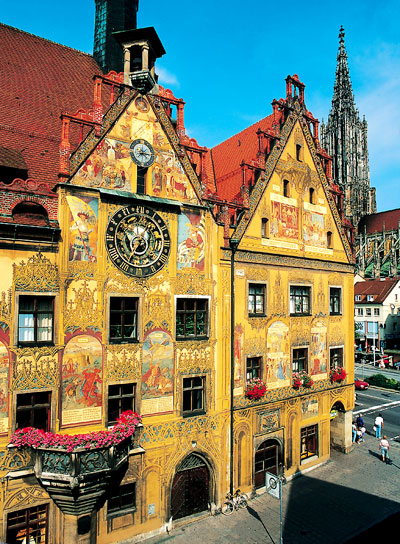
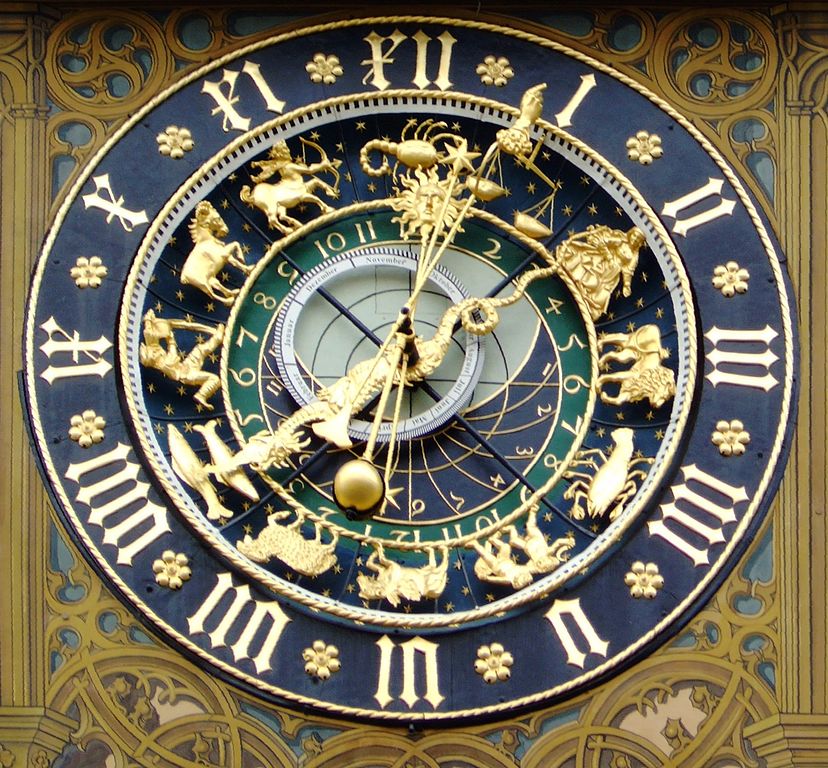
The city hall with the astronomical clock, dating from 1520, at the side wall.
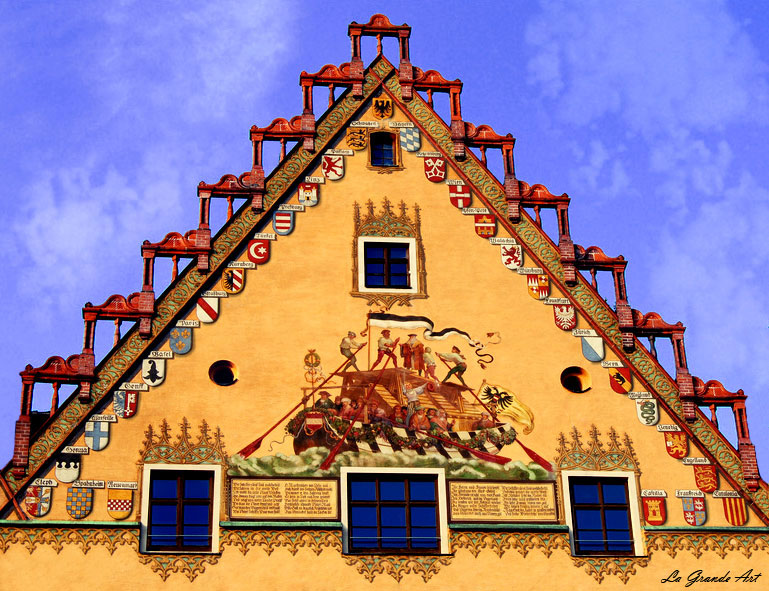
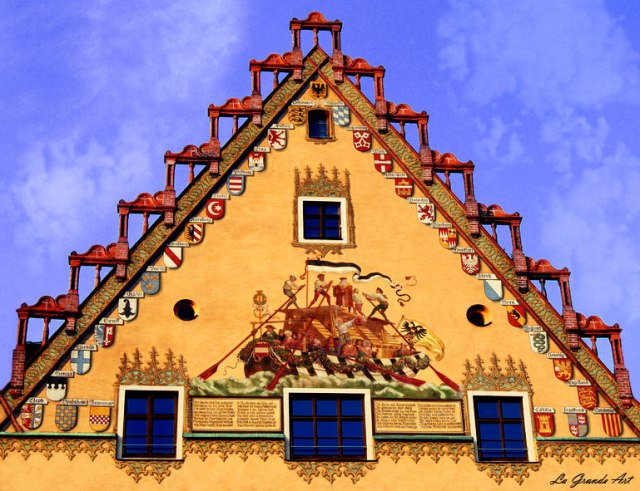 The front gable with the famous „Ulmer Schachtel“painting.
More to see in Ulm.
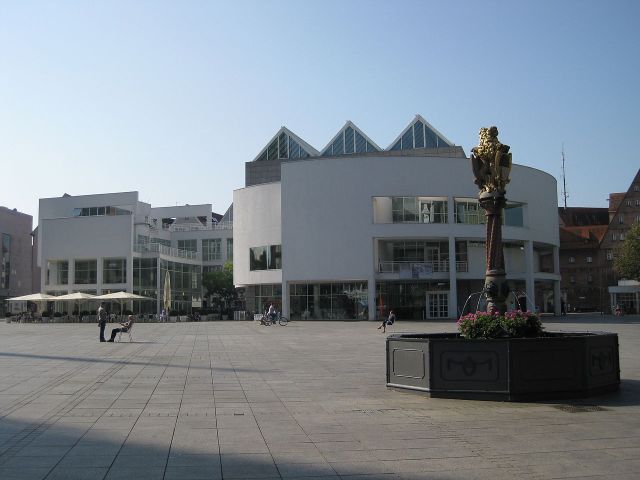
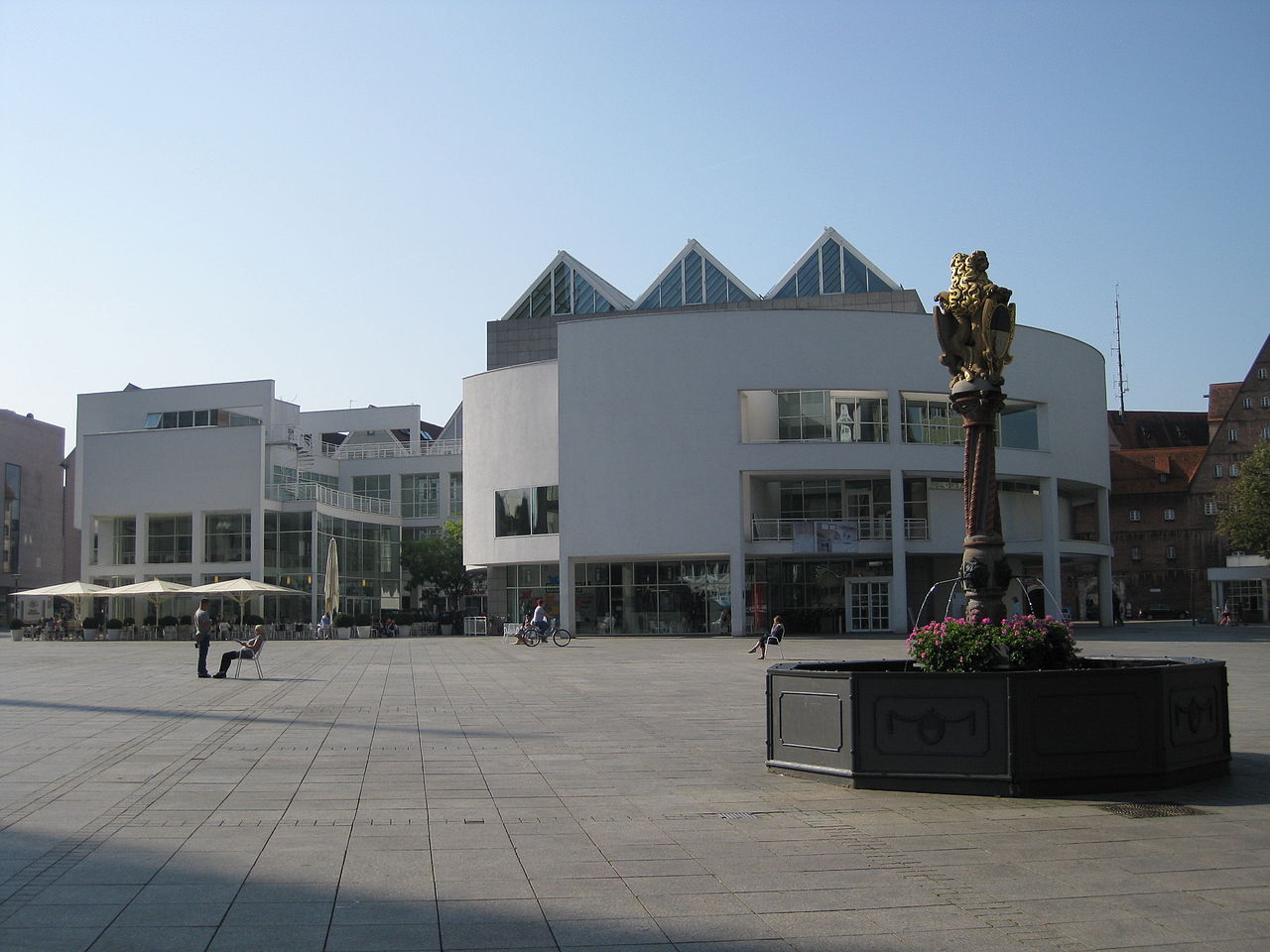
At the Ulmer Münsterplatz the new Stadthaus (city house) with the Löwenbrunnen (lion fountain).
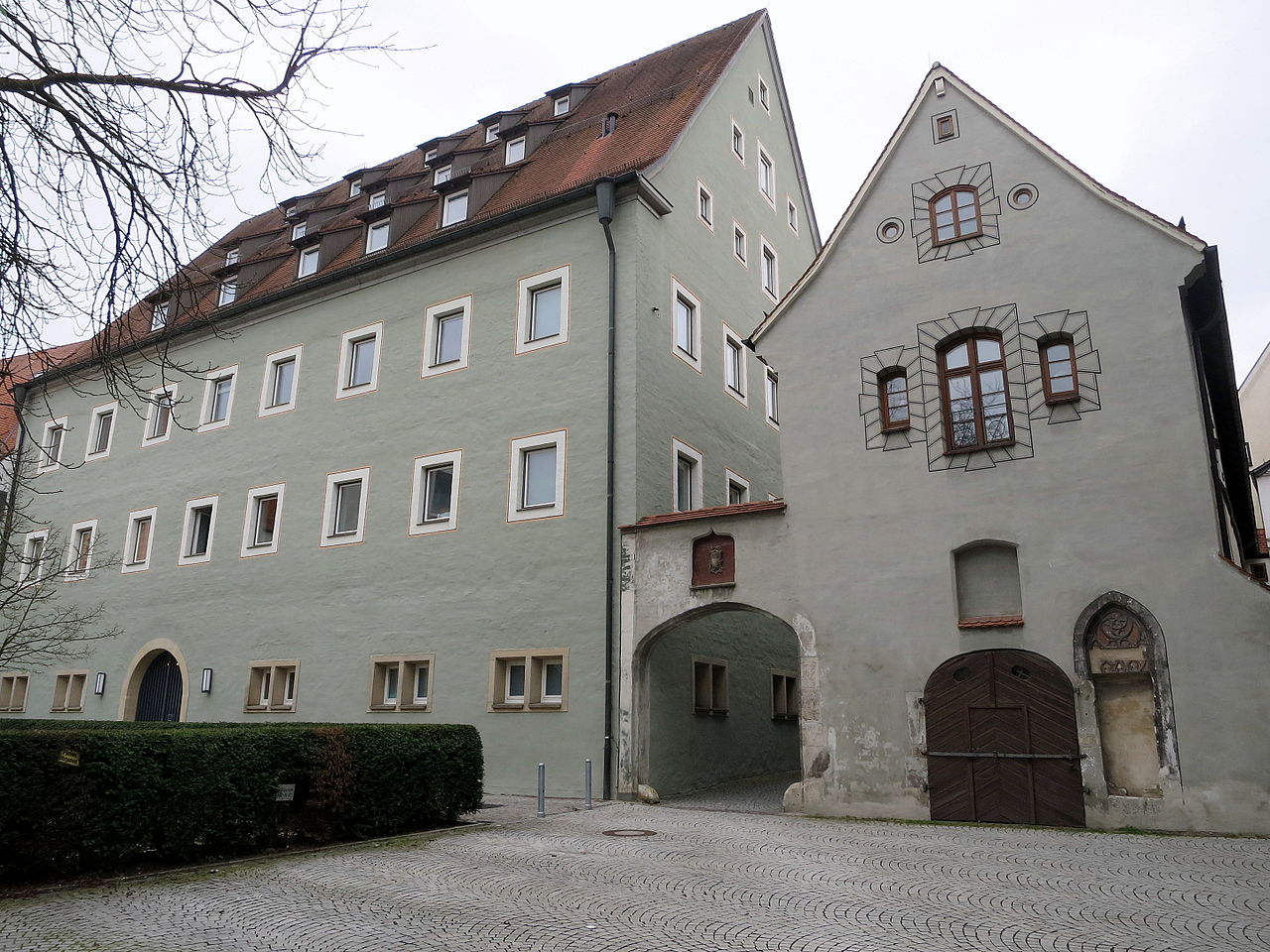
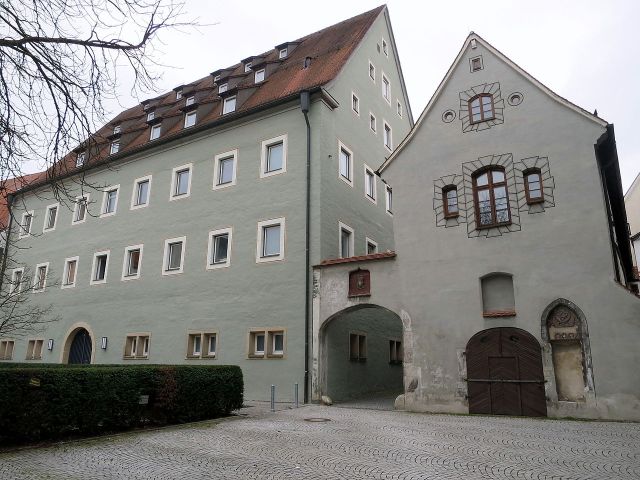 The Nikolaus Chapel and the Stone House. They are the oldest preserved buildings in Ulm. At least parts of the building date back to the Romanesque period, the Hohenstaufen period, mid of 12th century.
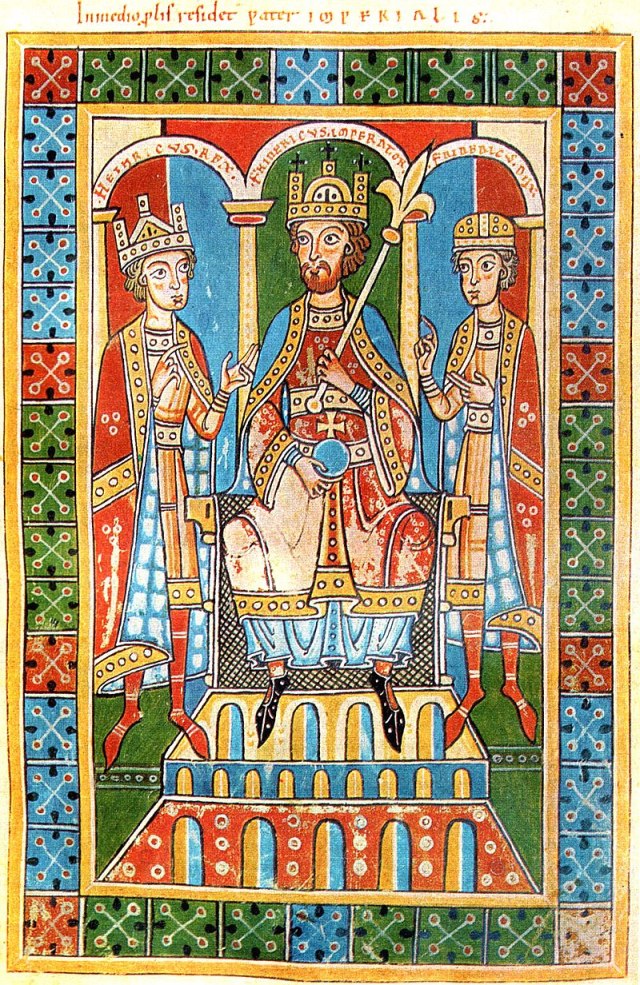
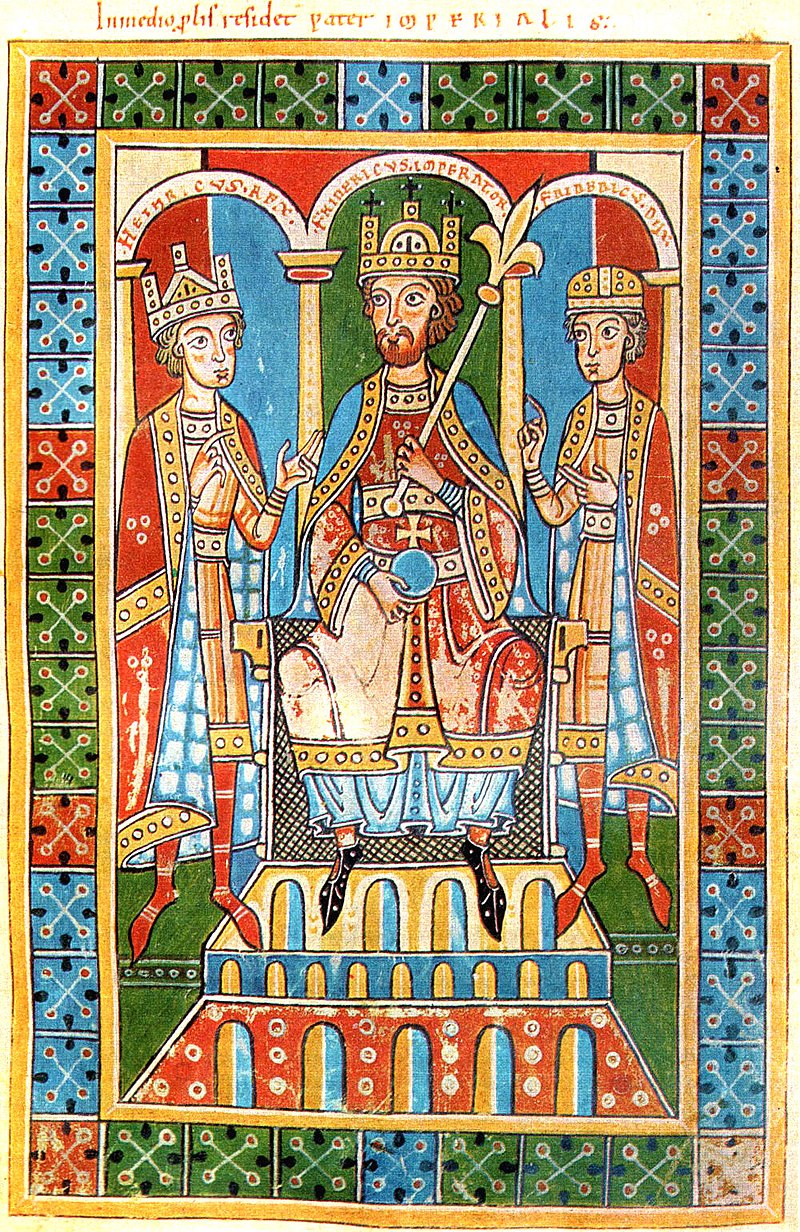
The Hohen-Staufen – Emperor Friedrich Barbarossa, left his son King Heinrich the VI and right his son Friedrich Duke of Swabia. Out of the Welfenchronic from 1179. This is history pur in Ulm.
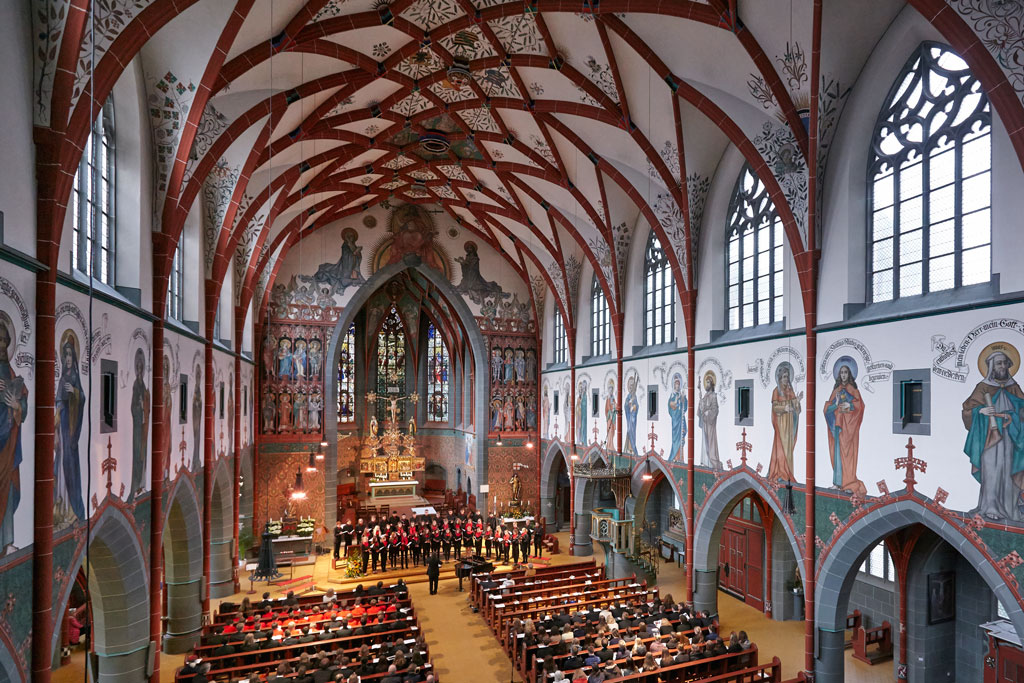
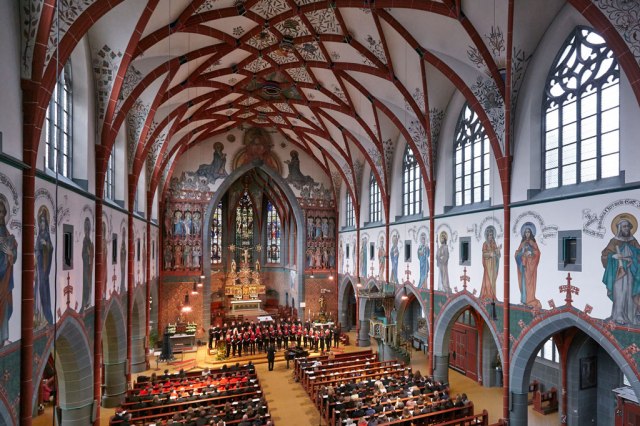 Well worth seeing, the catholic Georgskirche (church of St. George), since 1904.
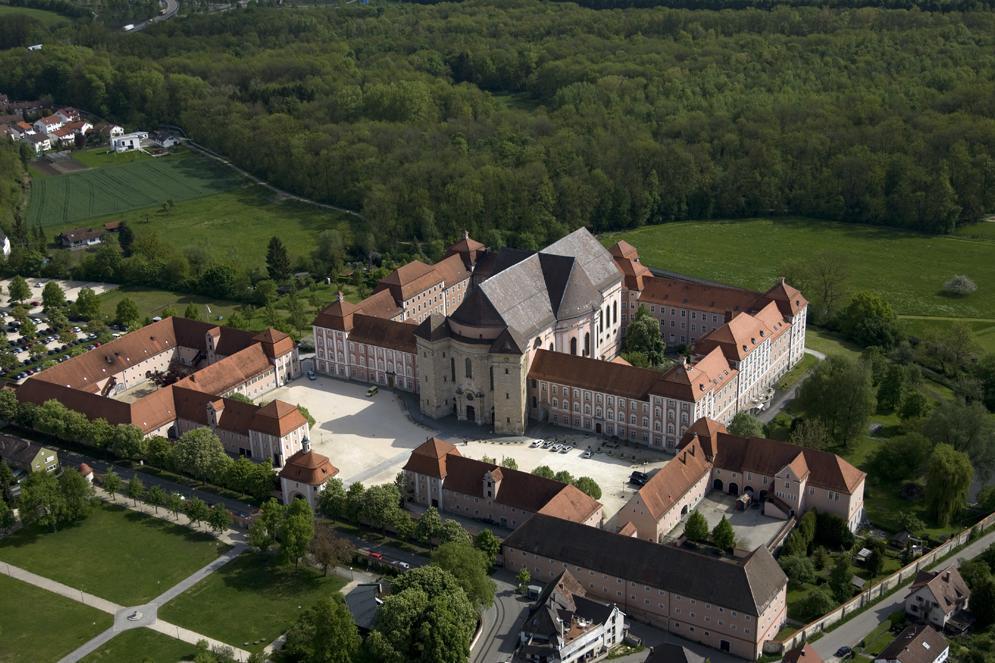
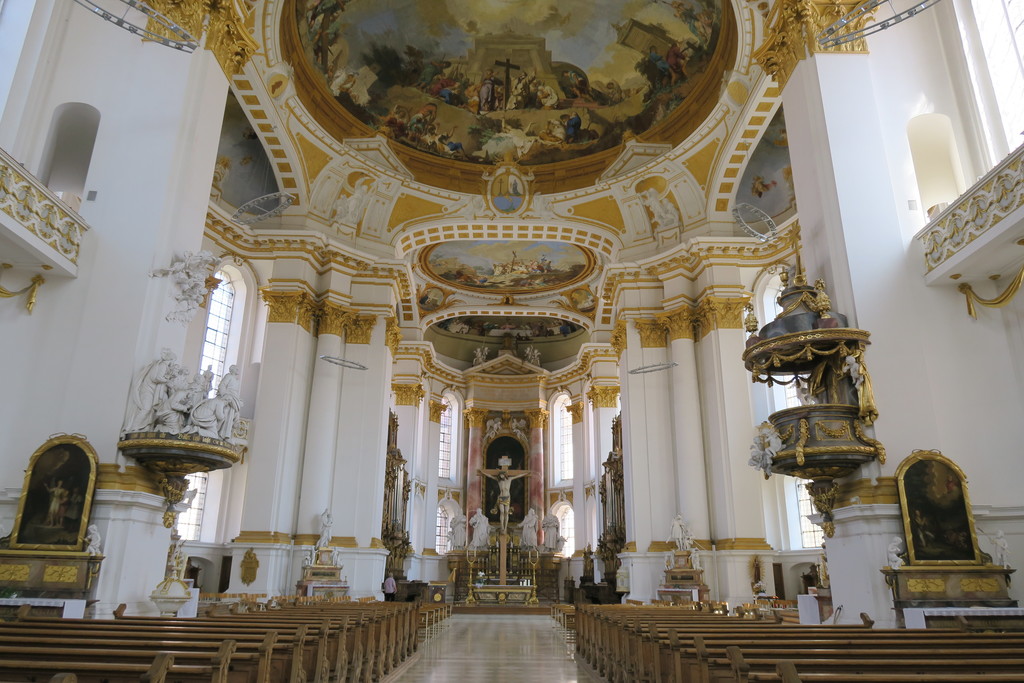
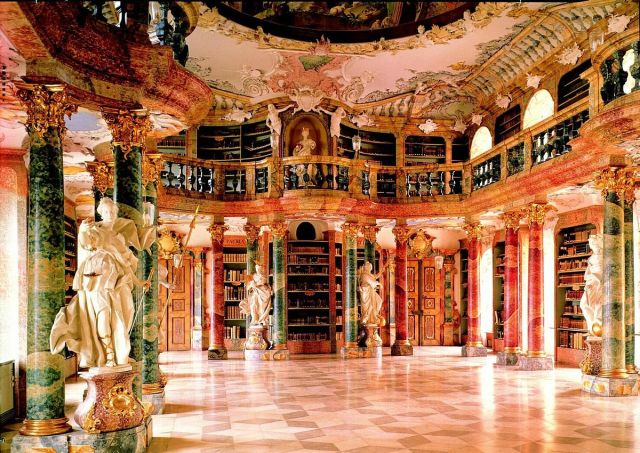 One of my personal favorites is the Klosterbibliothek (monastery library) in the city part Wiblingen.
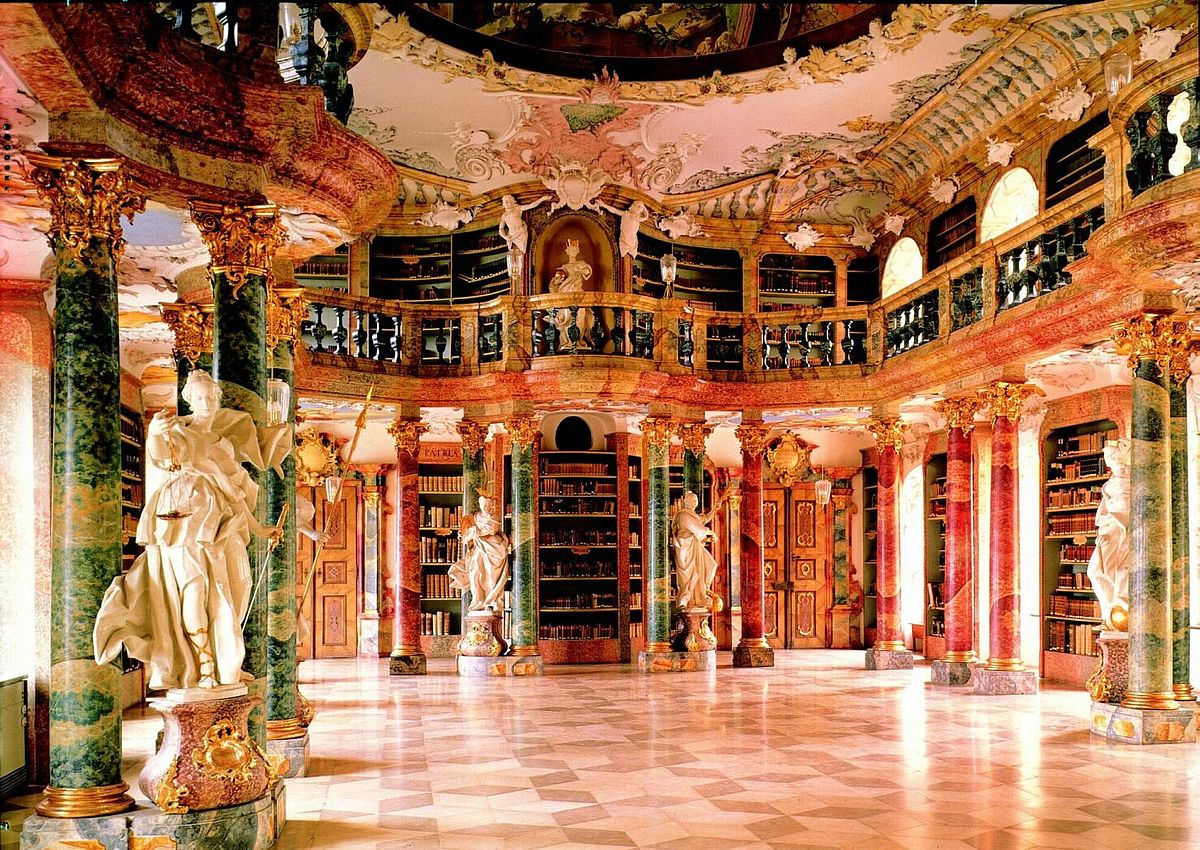
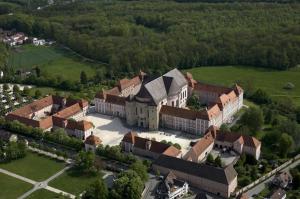
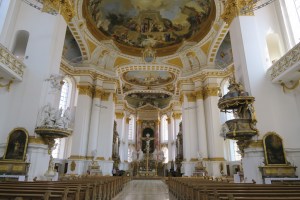 A must see, the abbey in Wiblingen, Ulm. Church, buildings, library etc. Click on pics.
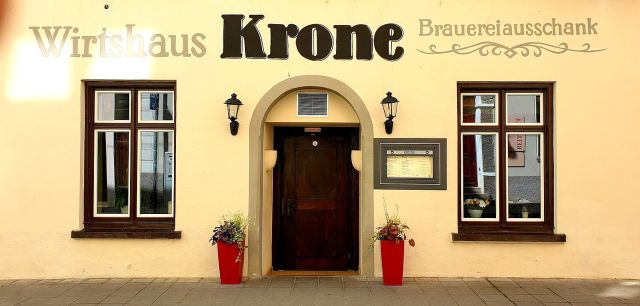 The „Krone“ (Crown) inn, the oldest guesthouse in Ulm. A medieval complex of several houses, where German kings and emperors were accommodated during their travels.
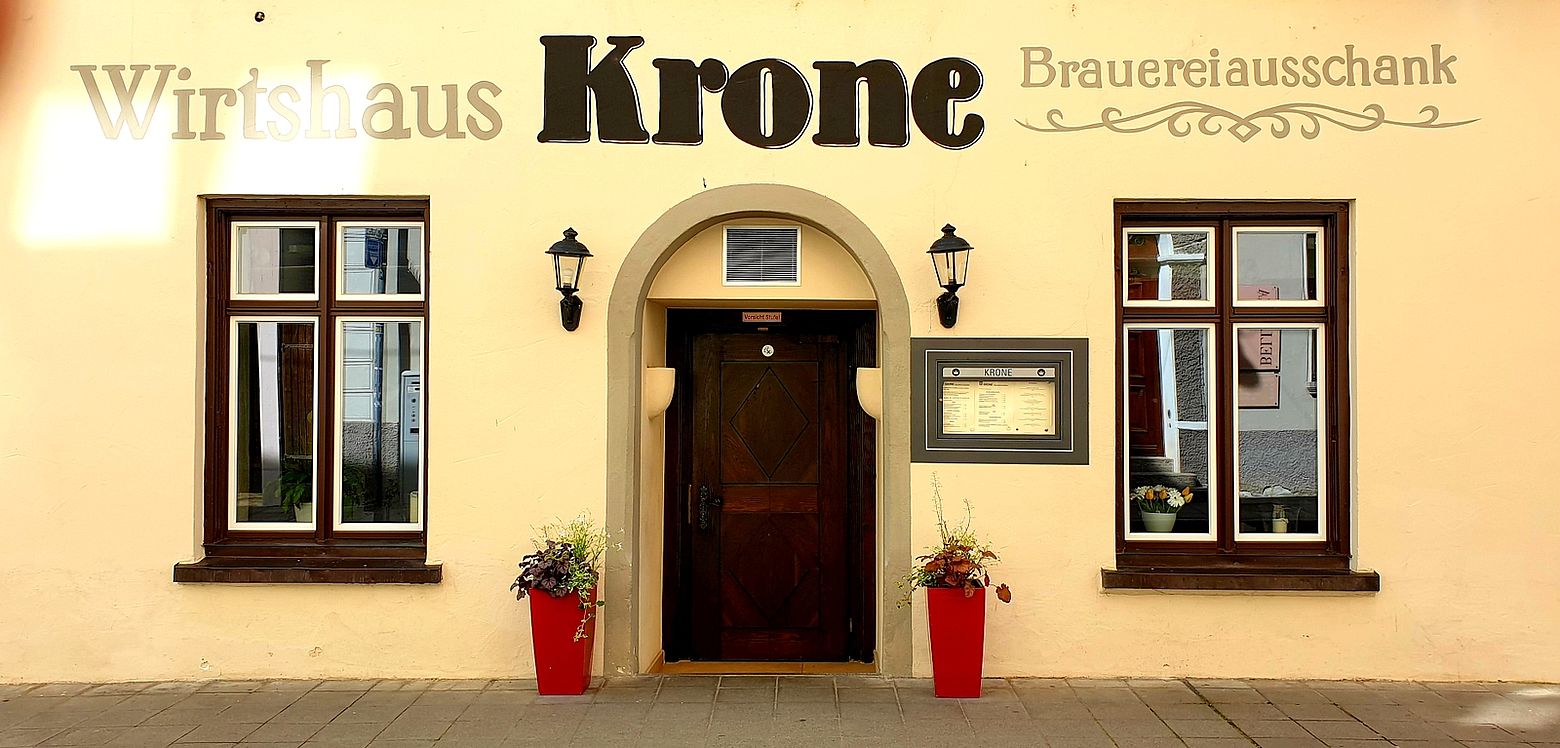
Krone, situated in the Kronengasse, is the oldest restaurant in Ulm. It was first referred to in 1320, when it was a lodging house. The Krone was a princely lodging house for famous men like Emperor Ruprecht, or the Reformer Johannes Hus.
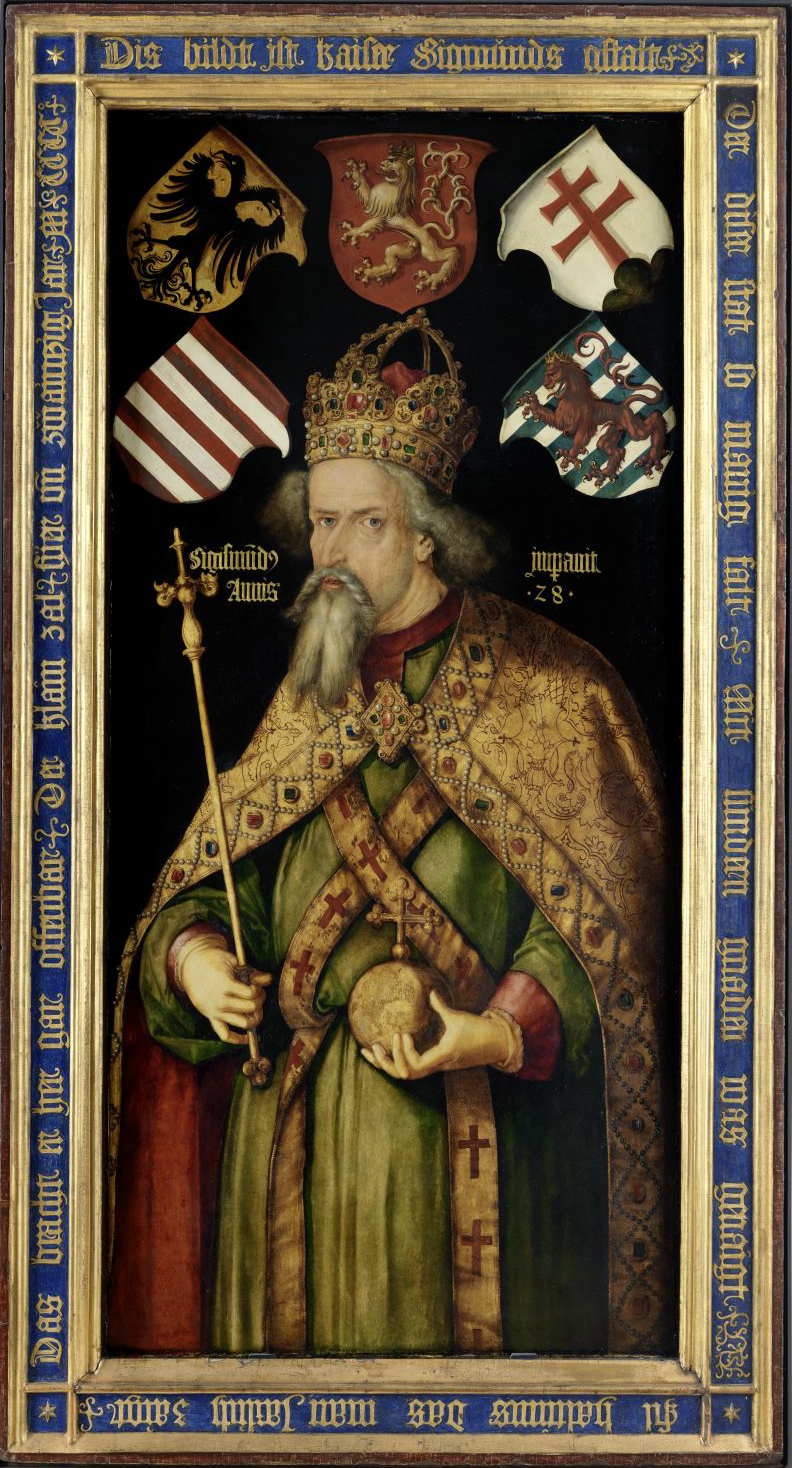
Emperor Sigismund, painted by Albrecht Dürer after the emperors death.
In 1430, Emperor Sigismund took the royal retinue to be accommodated in Ulm. Famous personalities stayed at the Krone even during the Thirty Year War. In total, 30 different kings and emperors were guests at the Krone. Most of them sat at the wall that remains unplastered even today – the oldest visible exterior house wall in the city – and received homages and gifts from the residents of Ulm.
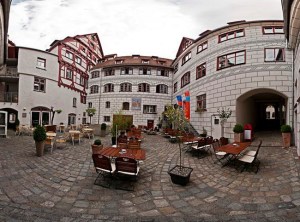
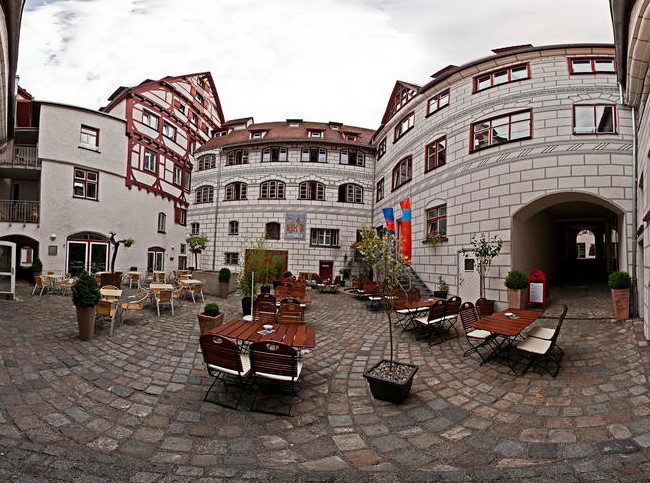
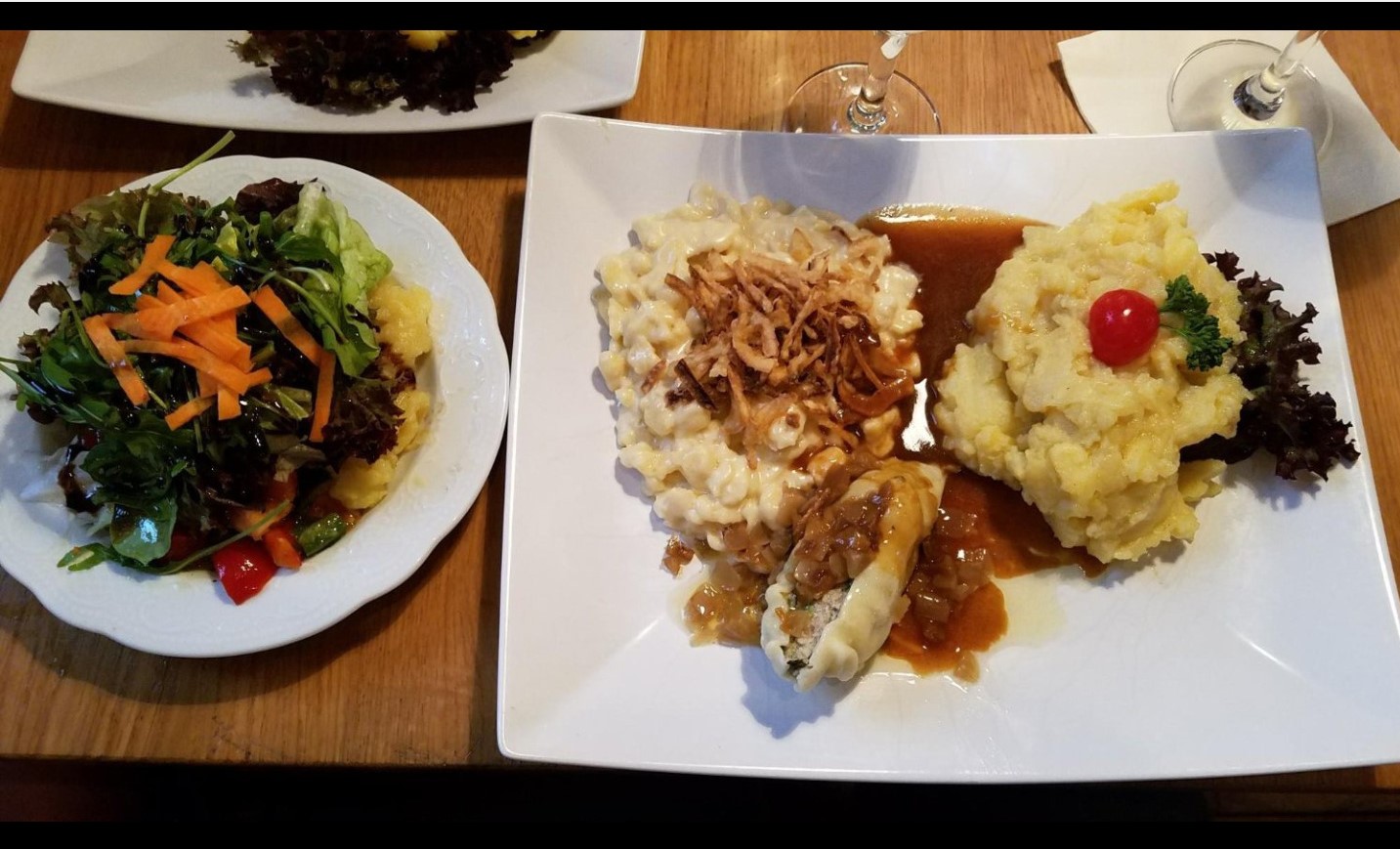
 Courtyard of guesthouse Krone in Ulm. „Schwäbische Genüsse“ with a side salad on the menu.
The Wilhelmsburg Ulm.
The “Wilhelmsburg” was built from 1842 to 1849 as the Citadel’s reduit. The Citadel was the largest of the town-wall fortifications. In contrast to all the other works, the “Wilhelmsburg” had no ramparts and consisted only of four re-inforced bunkers in the three towers. Over the decades, different regiments and units were stationed here.
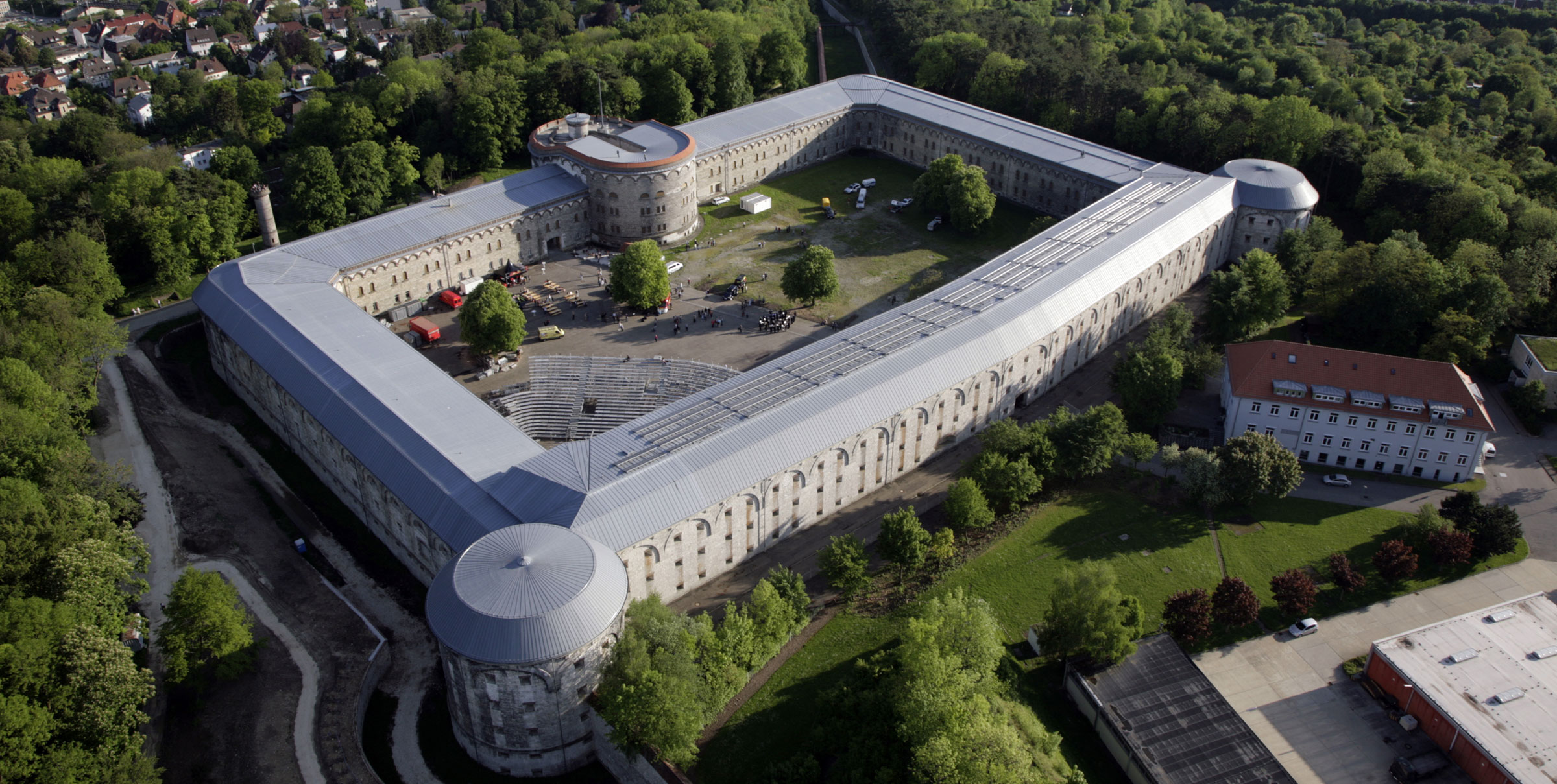
At any one time, a total of almost 3,000 people lived in the “Wilhelmsburg”, which had its own shop, post office and school. In 1956, the newly formed German army moved in and up until 1970, soldiers were still stationed in the bunkers of the “Wilhelmsburg”. Since then, the more than 570 rooms have been empty, apart from a few that have been rented out to companies.
Magirus Deutz Ulm.
Magirus GmbH is a truck manufacturer based in Ulm, Germany, founded by Conrad Dietrich Magirus (1824–1895). The parent company was Klöckner Humboldt Deutz AG, maker of the well-known Deutz engines, so the brand commonly used was Magirus Deutz. The logo of Magirus Deutz was a stylised M with a sharp, long centre point to represent the spire of Ulm Münster. See the front of 3 fire trucks down here. Click on pics to supersize.
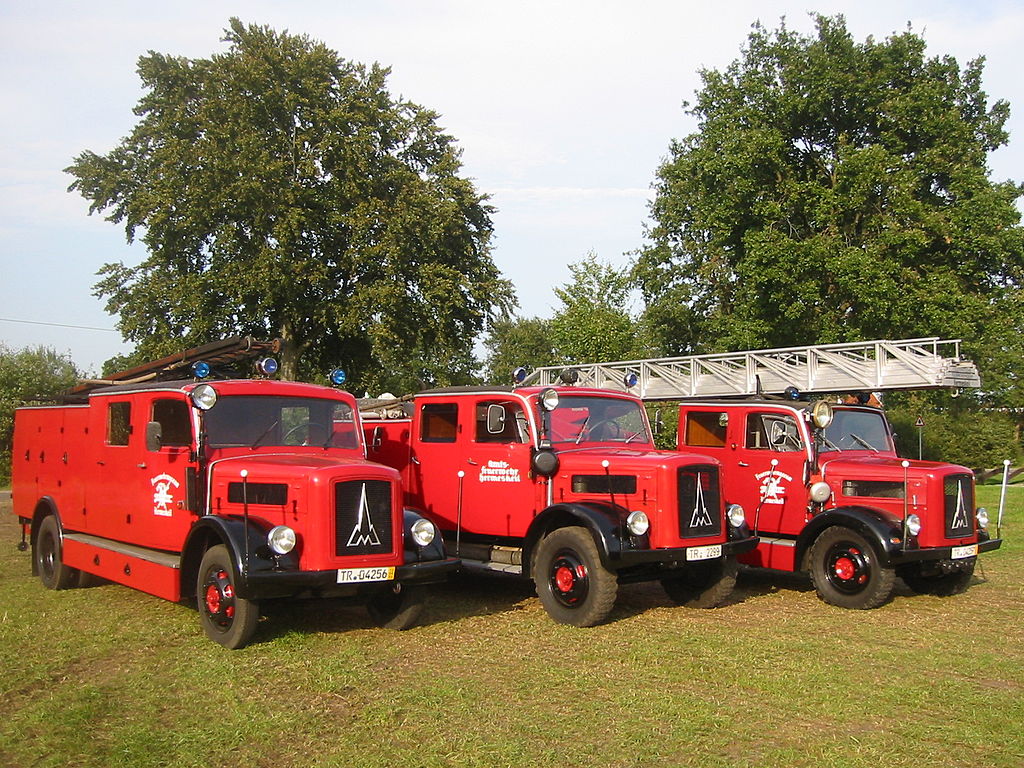
The company began manufacturing fire-fighting vehicles in 1866. In the late 1910s, it started the production of trucks and buses. These vehicles developed a reputation for high engineering standards, able to operate under the most arduous conditions. The company also invented the turntable ladder, as Magirus Leiter, which quickly became an essential item of fire brigade equipment worldwide.
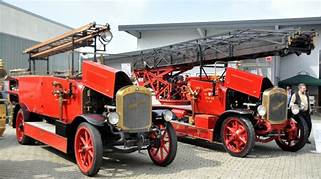
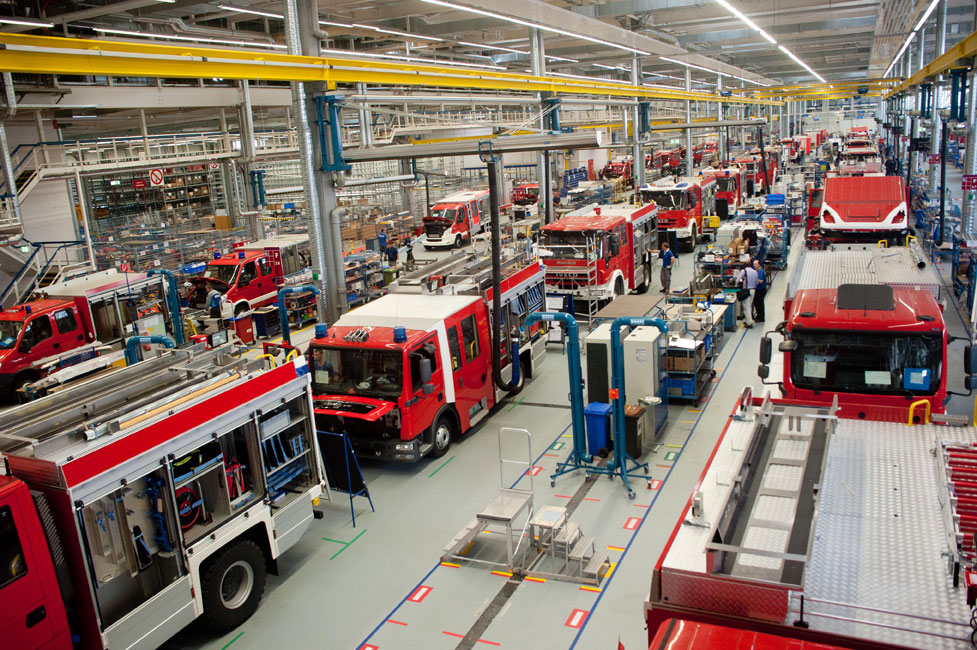

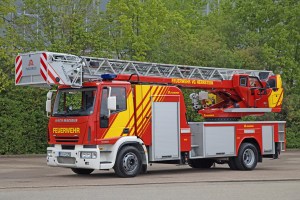 If one is interested, it is possible to have a tour inside the worlds largest fire fighting truck manufacture.
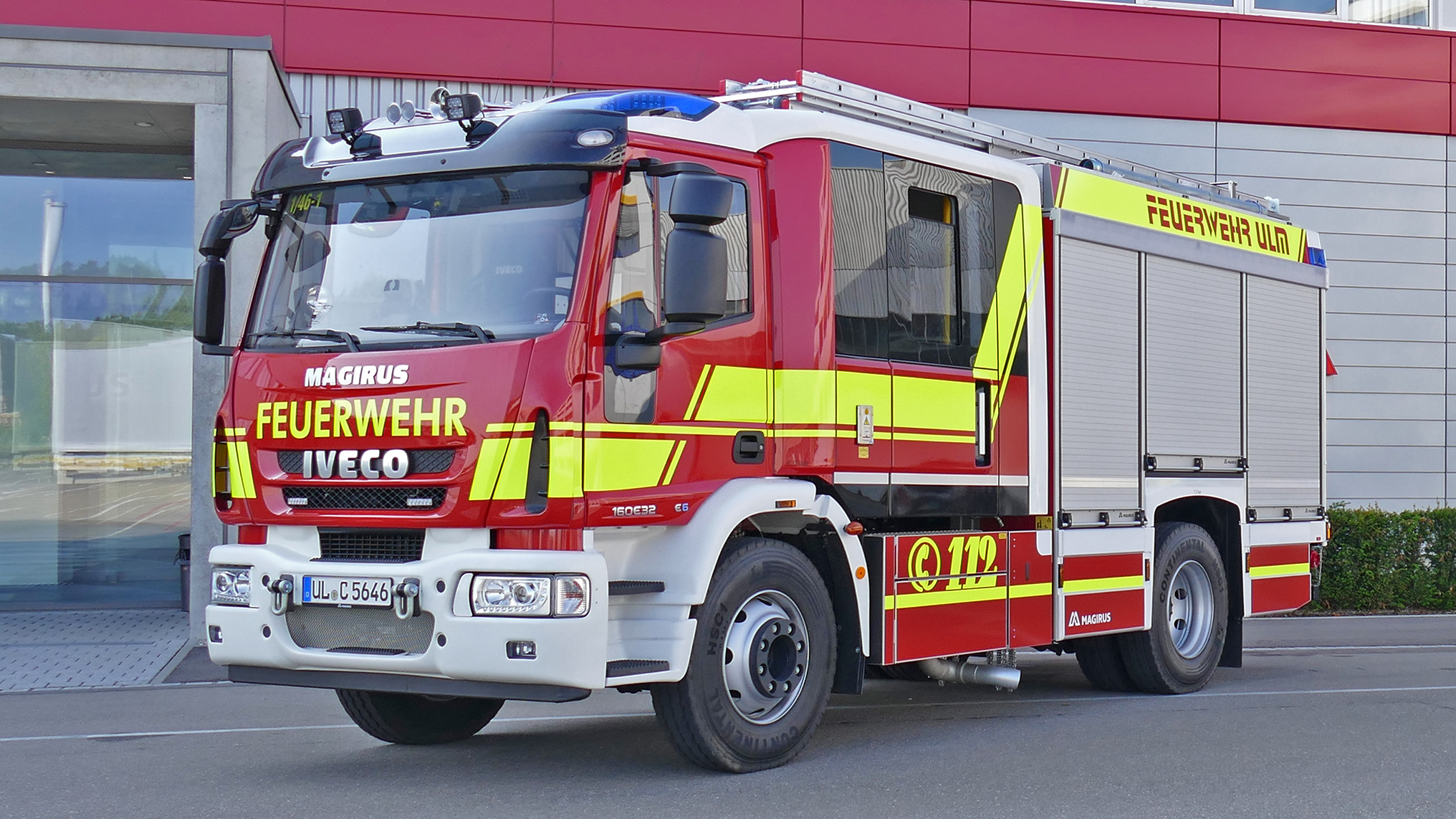
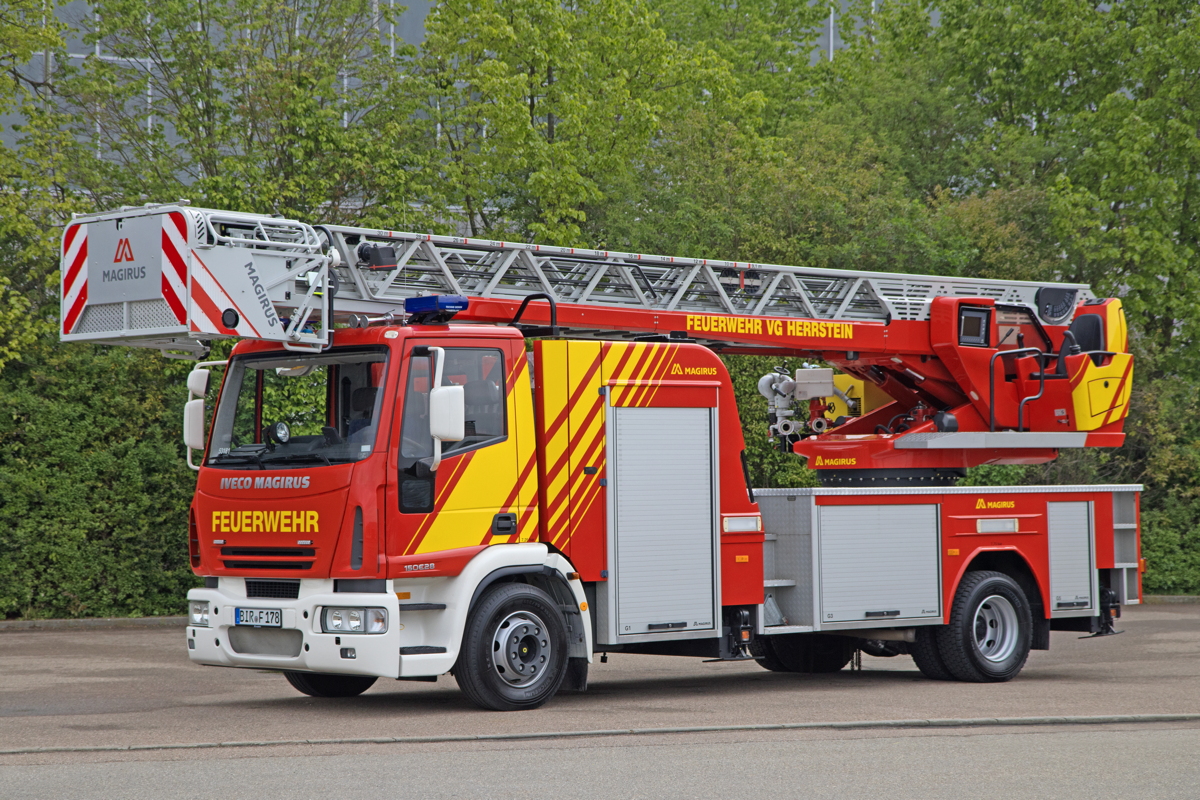
Today Iveco Magirus is one of the leading manufacturers of fire fighting equipment worldwide. The underpinnings for the line of fire fighting trucks are primarily Magirus’s own chassis designs and engines, but occasionally platforms from other truck manufacturers serve as the base for specialized or customized fire-fighting equipment layouts. With its Magirus brand turntable ladder, Iveco Magirus is the unrivaled global market leader by sales.
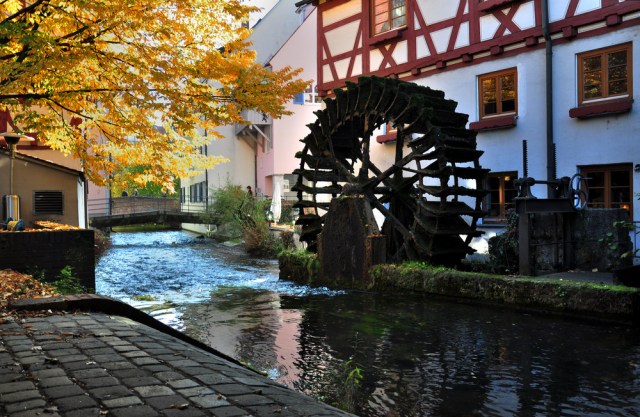 Back to the loveliness of this fine city. One more impression of Ulm’s Fishermans Quarter.
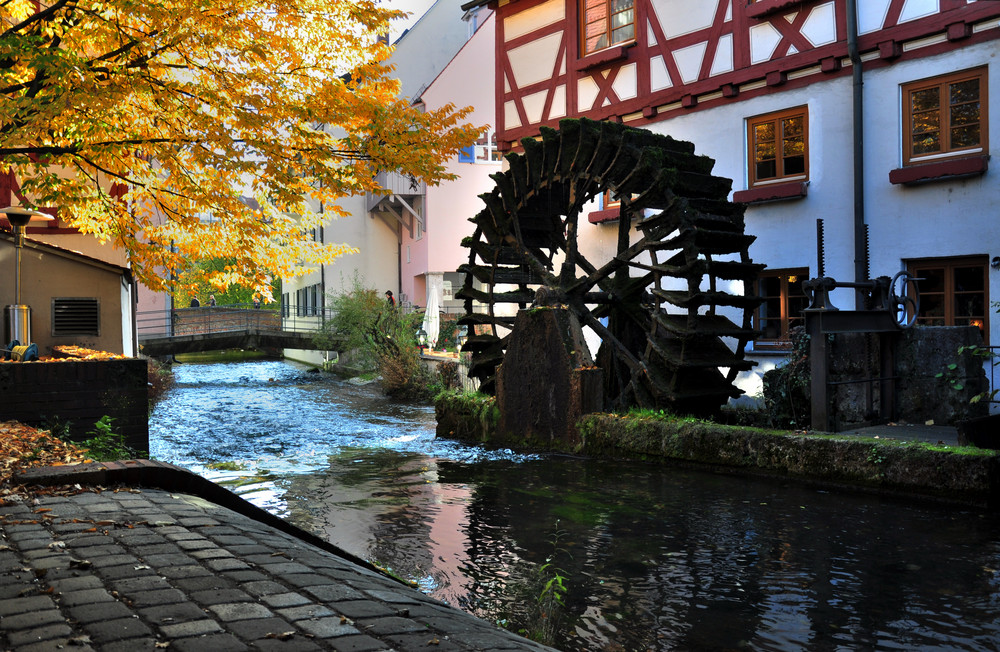
Finally.
If you come once to Ulm, there is much more to see and to discover. Ununderstandable that it is so rare on tourists to do lists. About food I gave some tips already, there are dozens and dozens of good restaurants around. Same is with accommodation, the best hotel in town is the Maritim. It has fantastic river views along the Danube and it is in walking distance to almost everything.
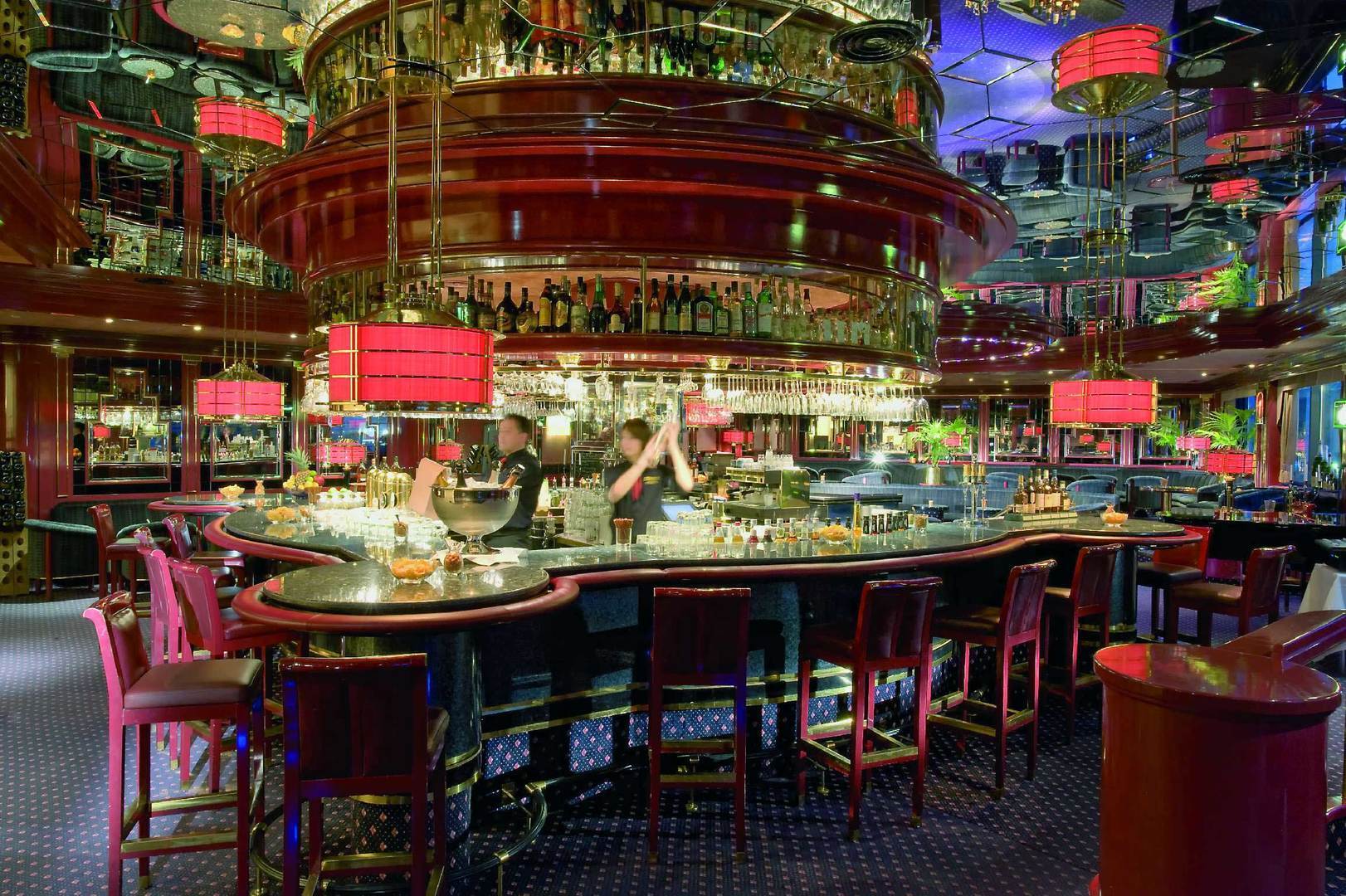
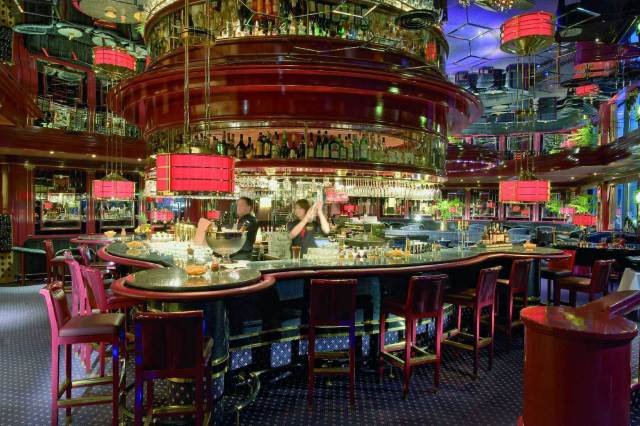 Featuring great views of Ulm, the Maritim’s Panorama Restaurant (on 16th floor) serves German and international food. The Piano Bar offers live music from international artists, exotic cocktails and draught beers. This bar has an over the top atmosphere, I love it there. See the picture above.
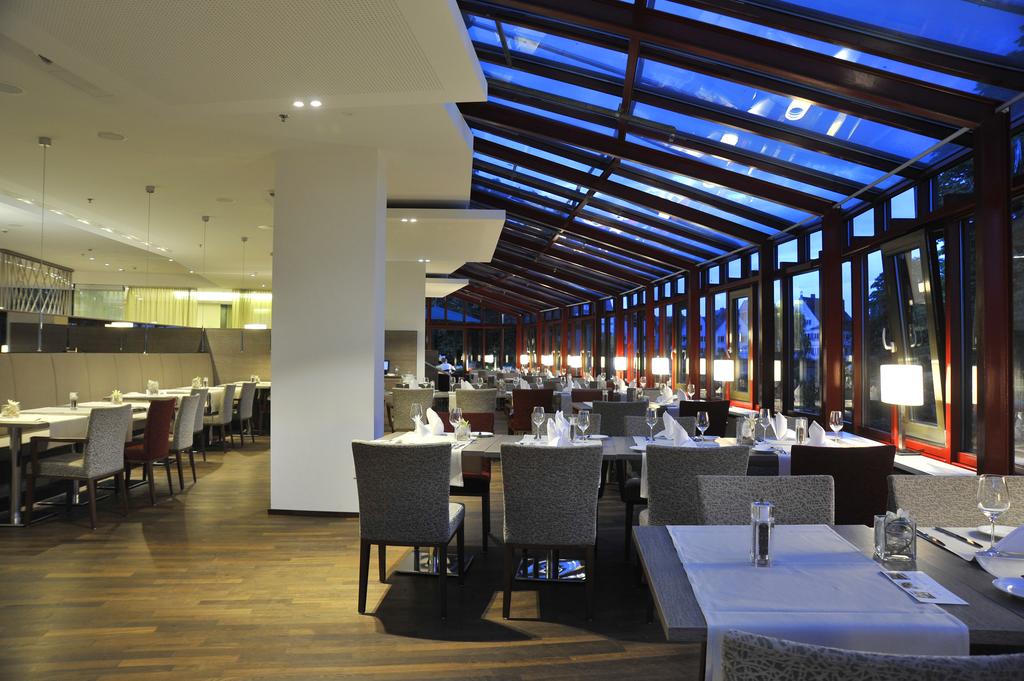
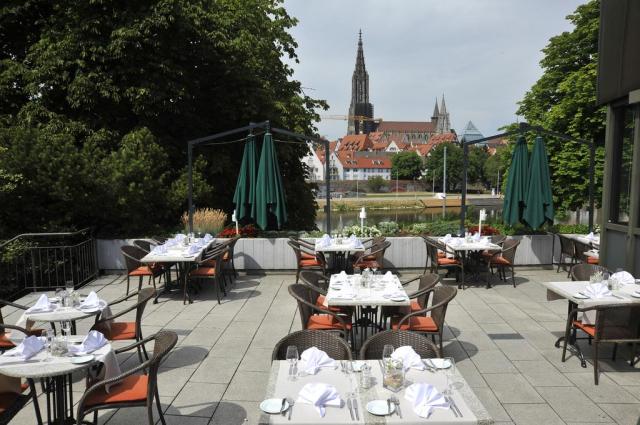
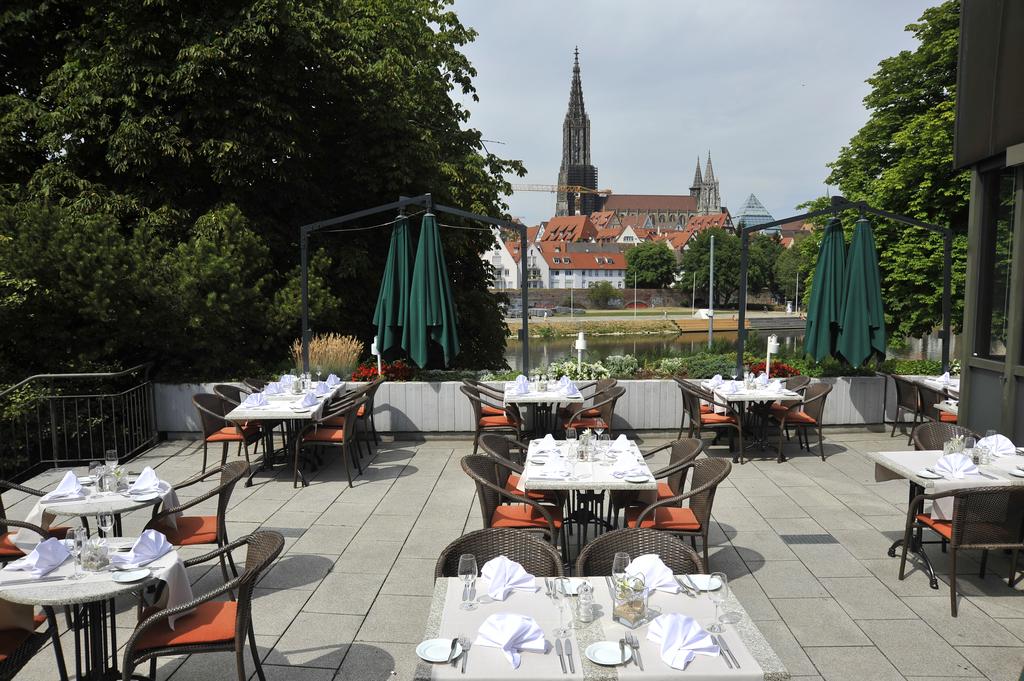
However, my favorite hotel in Ulm is on the riverside Neu-Ulm, its the Golden Tulip Parkhotel. For many many years it was the fantastic Mövenpick Parkhotel Neu-Ulm. This hotel is set in a park close to the banks of the River Danube, with a magnificent view over Ulm’s Old Town and the famous Ulm Minster cathedral.
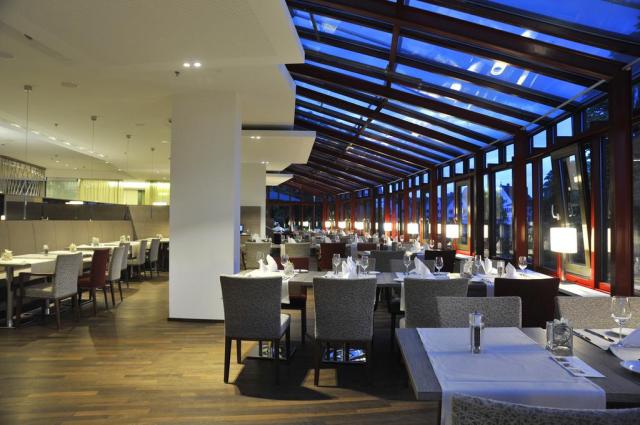 The restaurant overlooking the Danube and old city of Ulm. See the following terrace view.
 This hotel is close to everything, not as expensive as the Maritim and even better rated as the Maritim. Just a stroll over the Danube bridge and you are in the old city of Ulm.
During many many years I had the chance to stay very very often in Ulm and enjoyed all the amenities this fantastic city has to offer. May be you have the chance too once in your lifetime. Believe me, Ulm is a MUST SEE destination in Germany !!

