
 Its a BIG BIG country. Click on pics to size up.
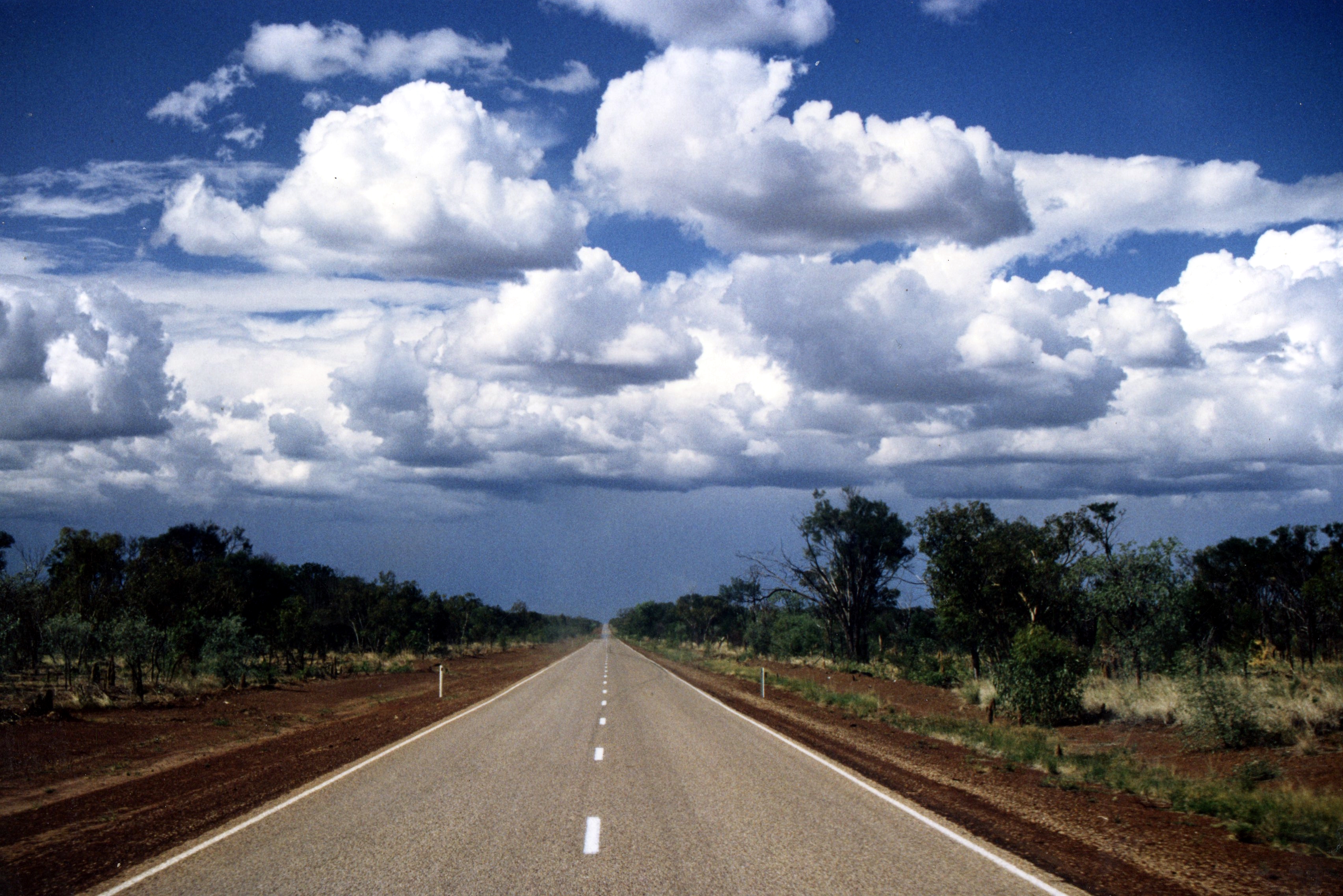
With this article I like to start a new series of posts about Australia. A country which I visited very often for over 50 years and lived there permanently for almost 12 years. During all those years I traveled hundreds of thousands of kilometers through Australia, seeing almost every corner of this amazing continent. Now, take part of my memories.
WARNING:
This article can contain images of and reference to both living and deceased Indigenous people from diverse cultural backgrounds and communities in Australia. This warning is written out of respect to the Aboriginal culture.
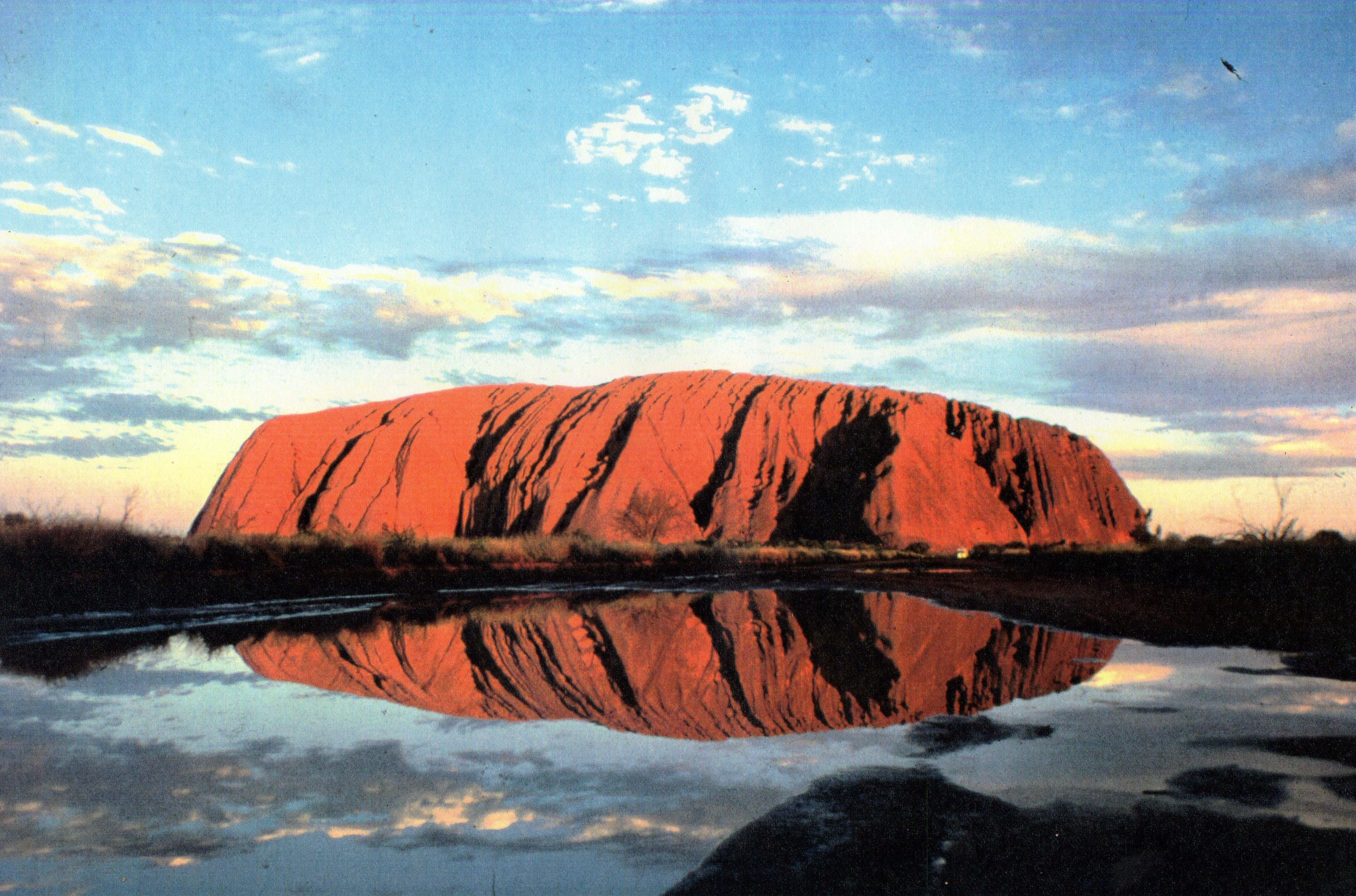
 Uluru or Ayers Rock, the largest monolith on earth.
AUSTRALIA.
Many years ago I was privileged to catch a glimpse of real aboriginal art history when visiting a sacred site with aboriginal friends from Papunya community in the Northern Territory of Australia.
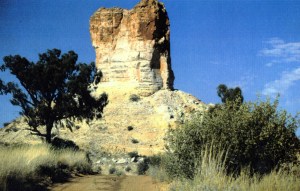 The secret meeting site near Chambers Pillar.
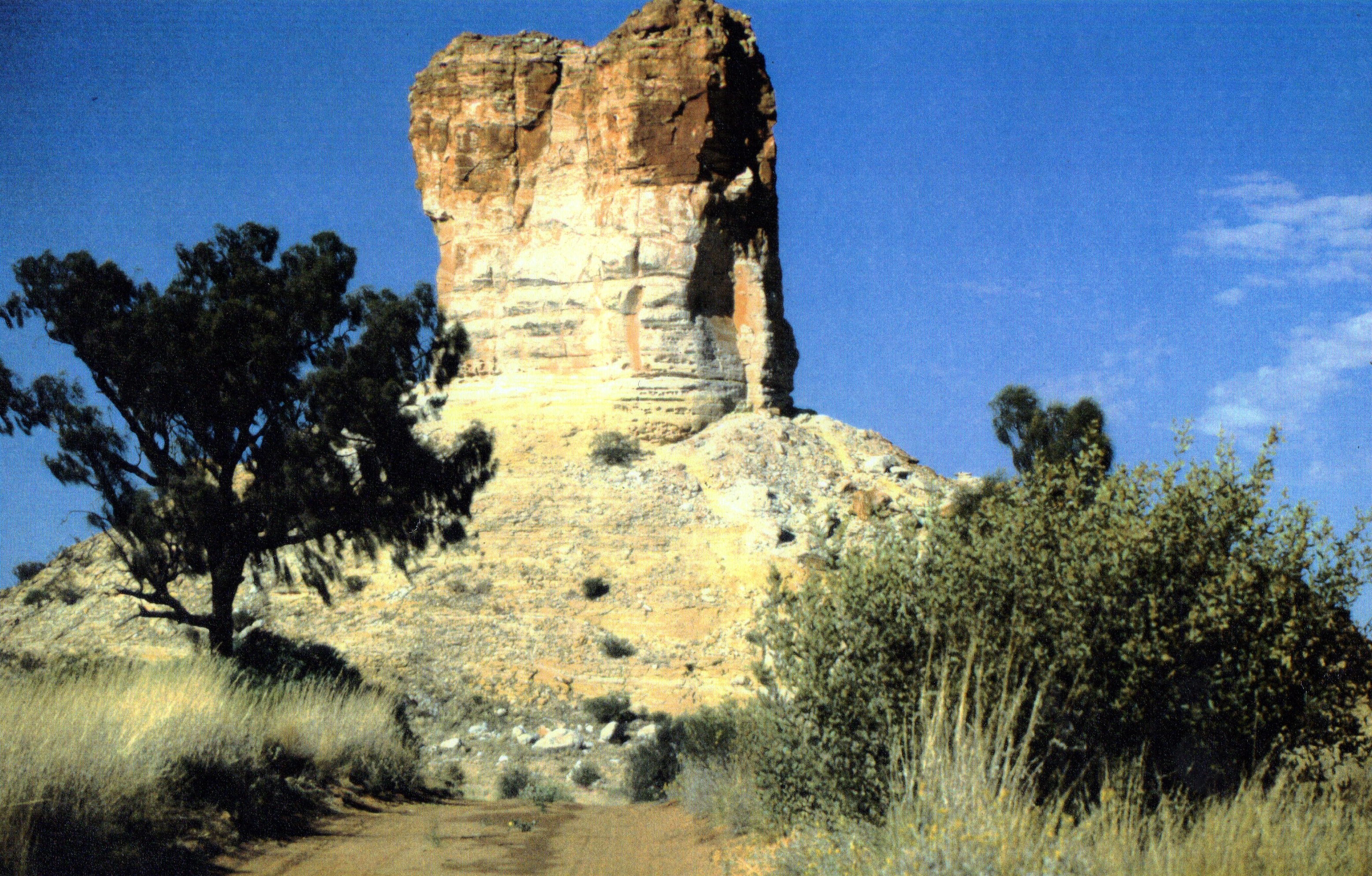
I made some journeys to the country and the Red Center before, but this trip ignited a lifelong interest into Aborigine culture and Aborigine Art. Cultural experience from thousands of years ago combined with the excursion of a hunting trip for Kangaroo and Goanna. Afterwards enjoying a typical picnic with a Wallaby on the fire .
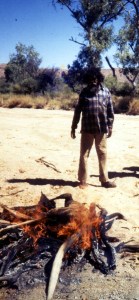
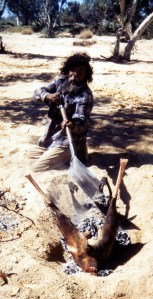
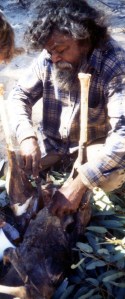
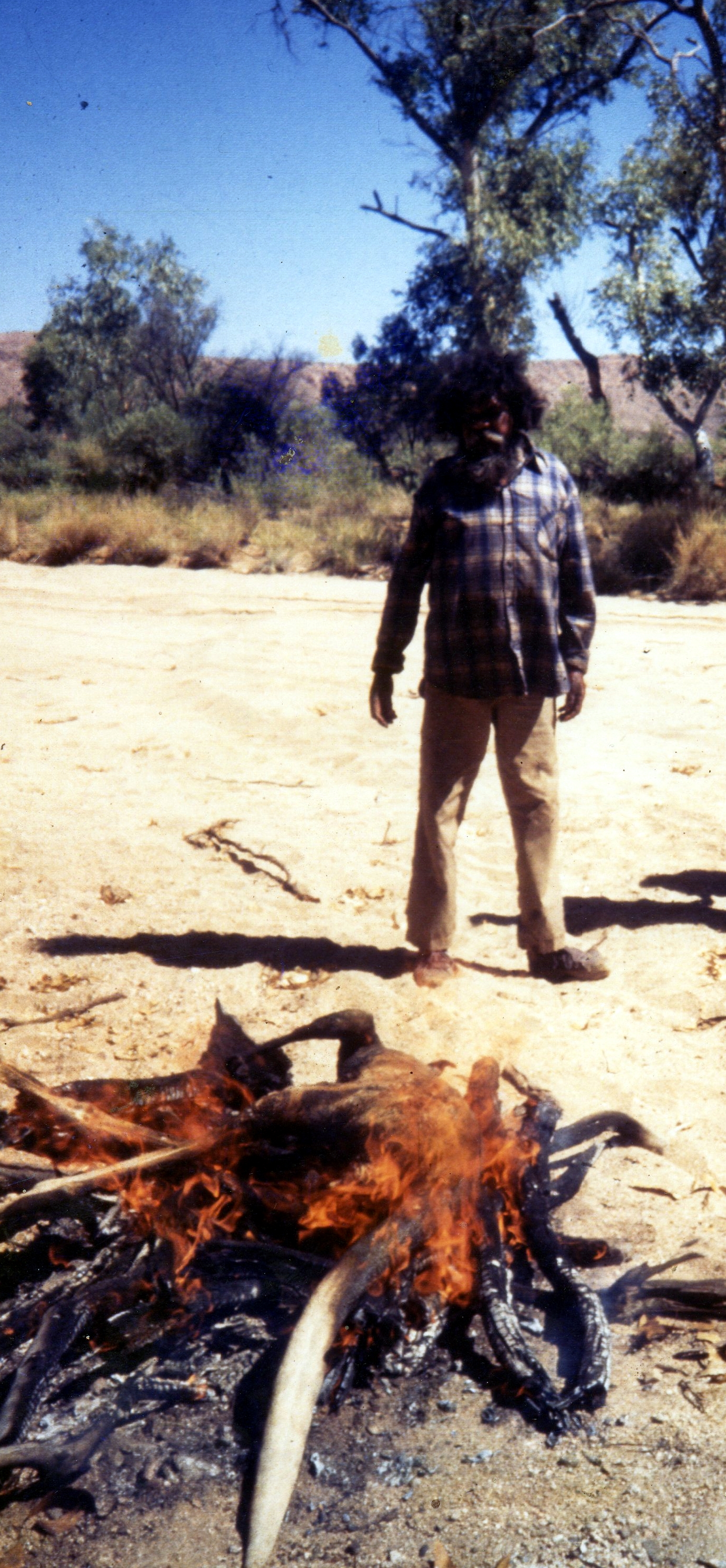
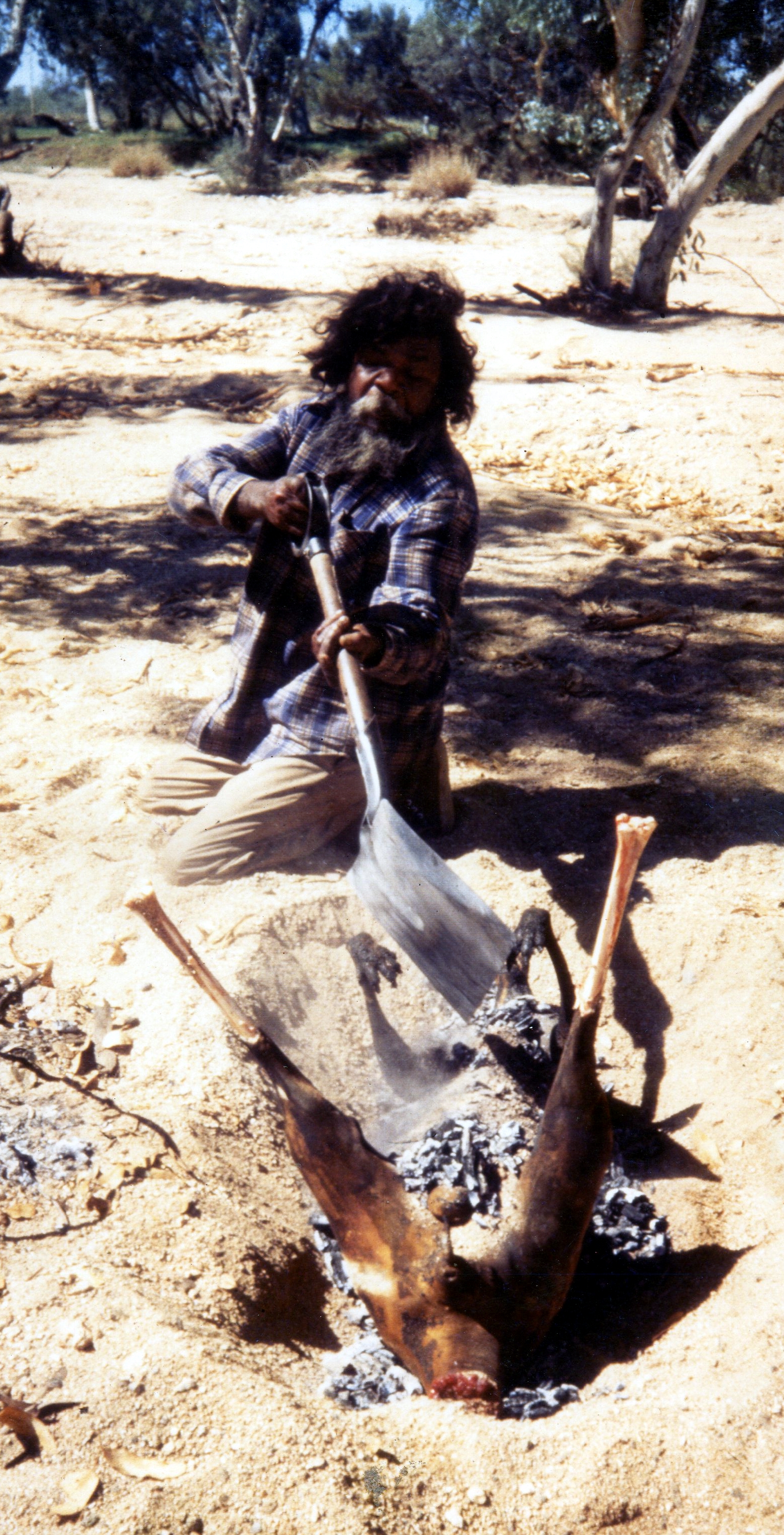
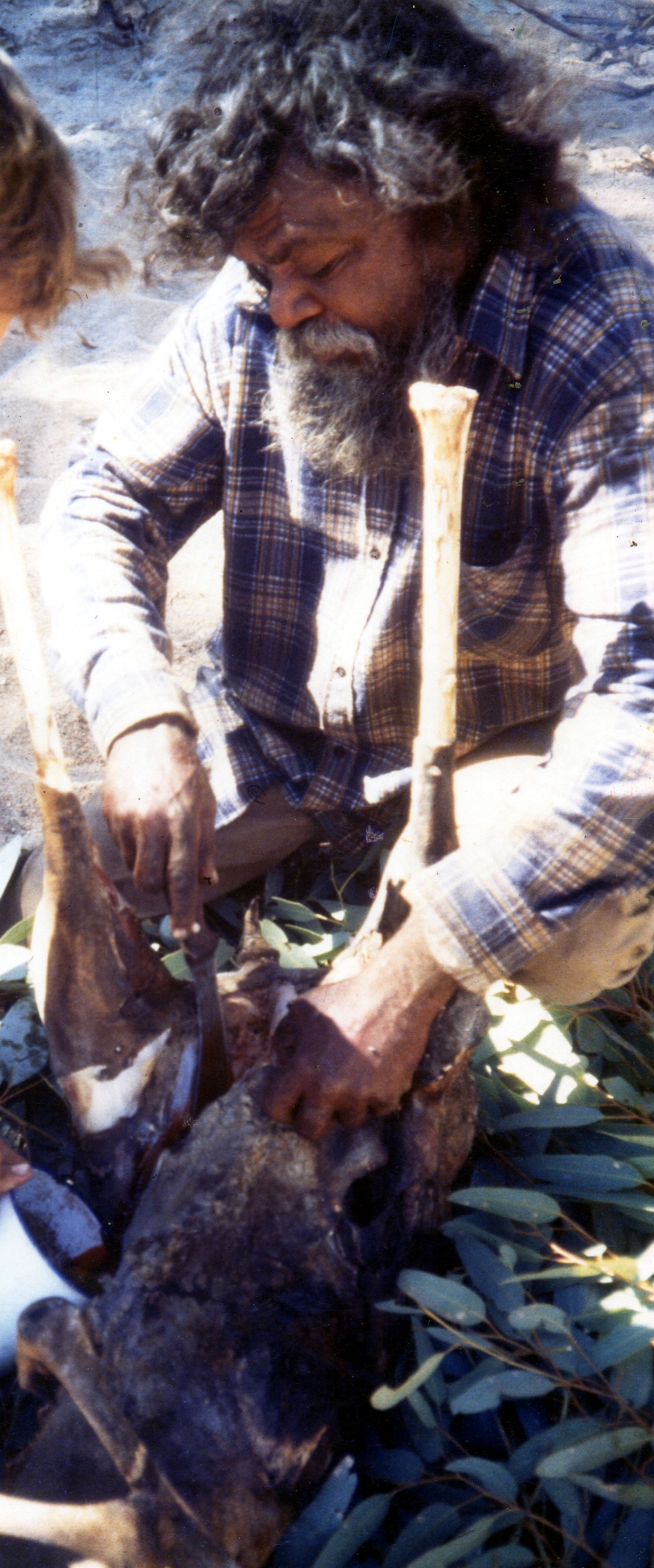
BBQ-ing a Kangaroo Aborigine style with Clifford Possum, one of the most well known and successful Aborigine artists. They through the whole animal into the fire and wait till it’s cooked really well, it’s cooking in it’s own body juices. From time to time it needs some hot coal allover it and finally done, ready to cut. The body juices will be drained and kept, then they eat it from outside in, delicious meal I tell you.
Aborigine or Origin ?
Aborigine people have been living in Australia at least 60,000 years. The English invaders christened the „Origin“ population of Australia „Aborigines“, because they did not look like English people. That means, the true Aborigines in Australia are the English !! Whatever, we leave it like it is known.

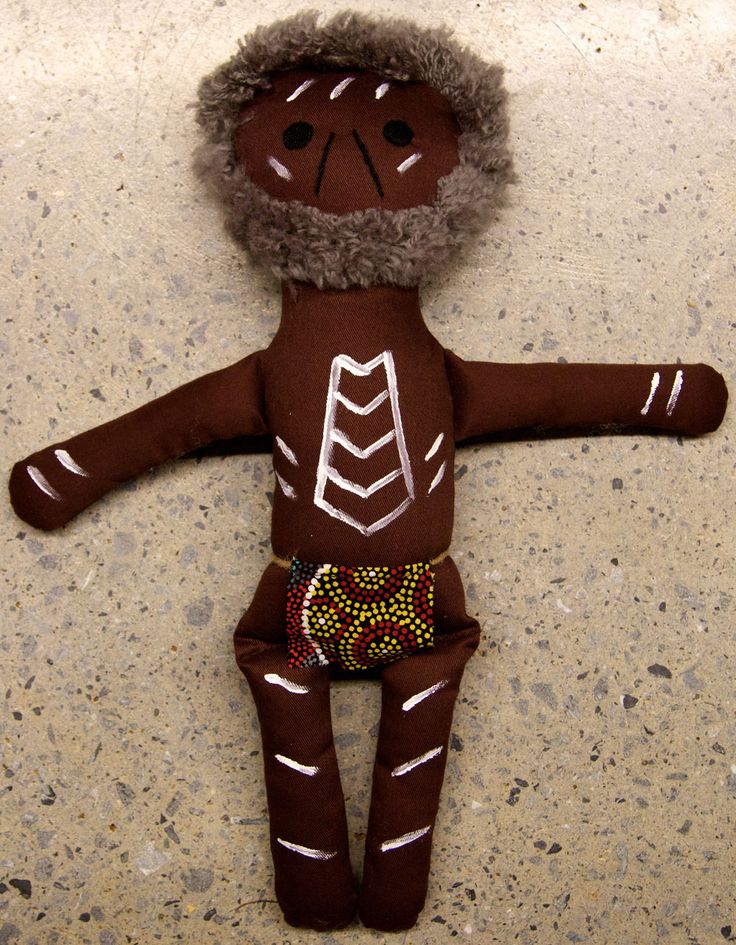
 Who is the aboriginal one in Australia??

Let’s talk about art. The oldest rock paintings in Australia are up to 60.000 years old. That’s not the oldest art in the world, but it’s the world’s oldest continuous tradition of art.
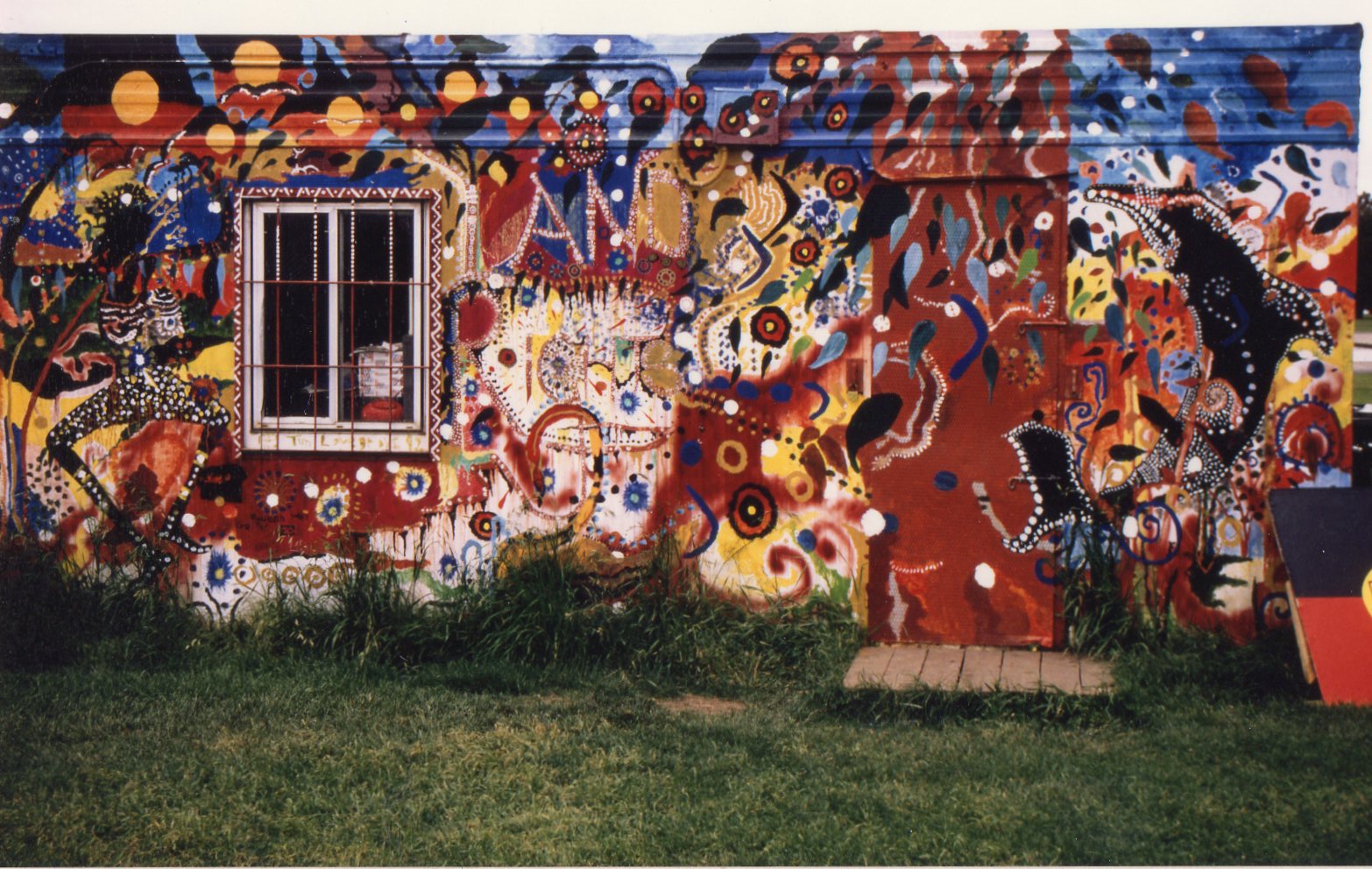
 Aboriginal painted home.
Indigenous Australian art has a history which covers more than 30,000 years, and a wide range of native traditions and styles. These have been studied in recent decades and their complexity has gained increased international recognition.
 Painted wall at an industrial site.
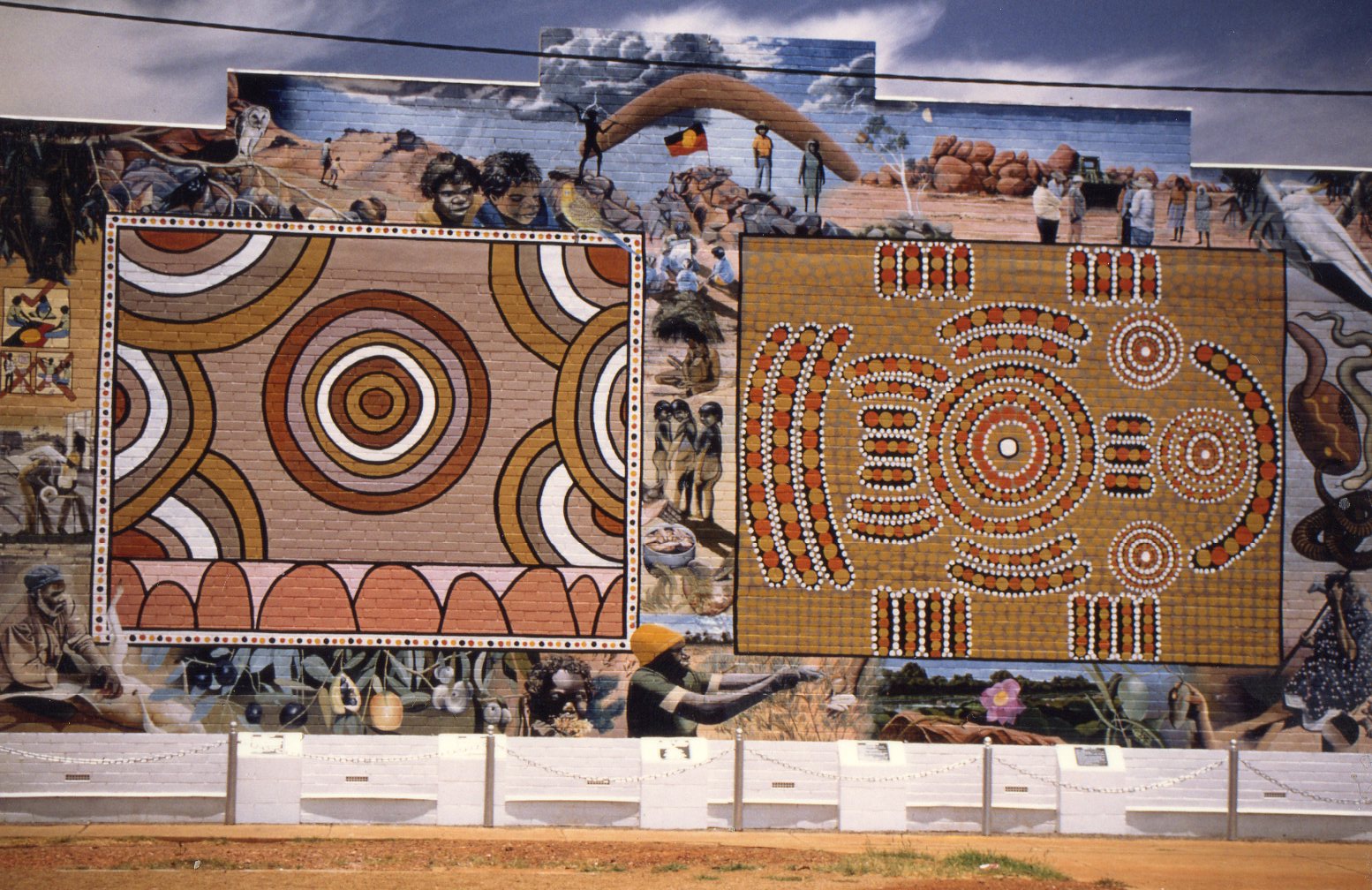
Aboriginal Art covers a wide variety of media, including sand painting, painting on leaves, wood carving, rock carving, sculpture, body painting and ceremonial clothing, as well as artistic embellishments found on weaponry and also tools. Art is one of the key rituals of Aboriginal culture. It was and still is, used to mark territory, record history, and tell stories about „The Dreaming“.
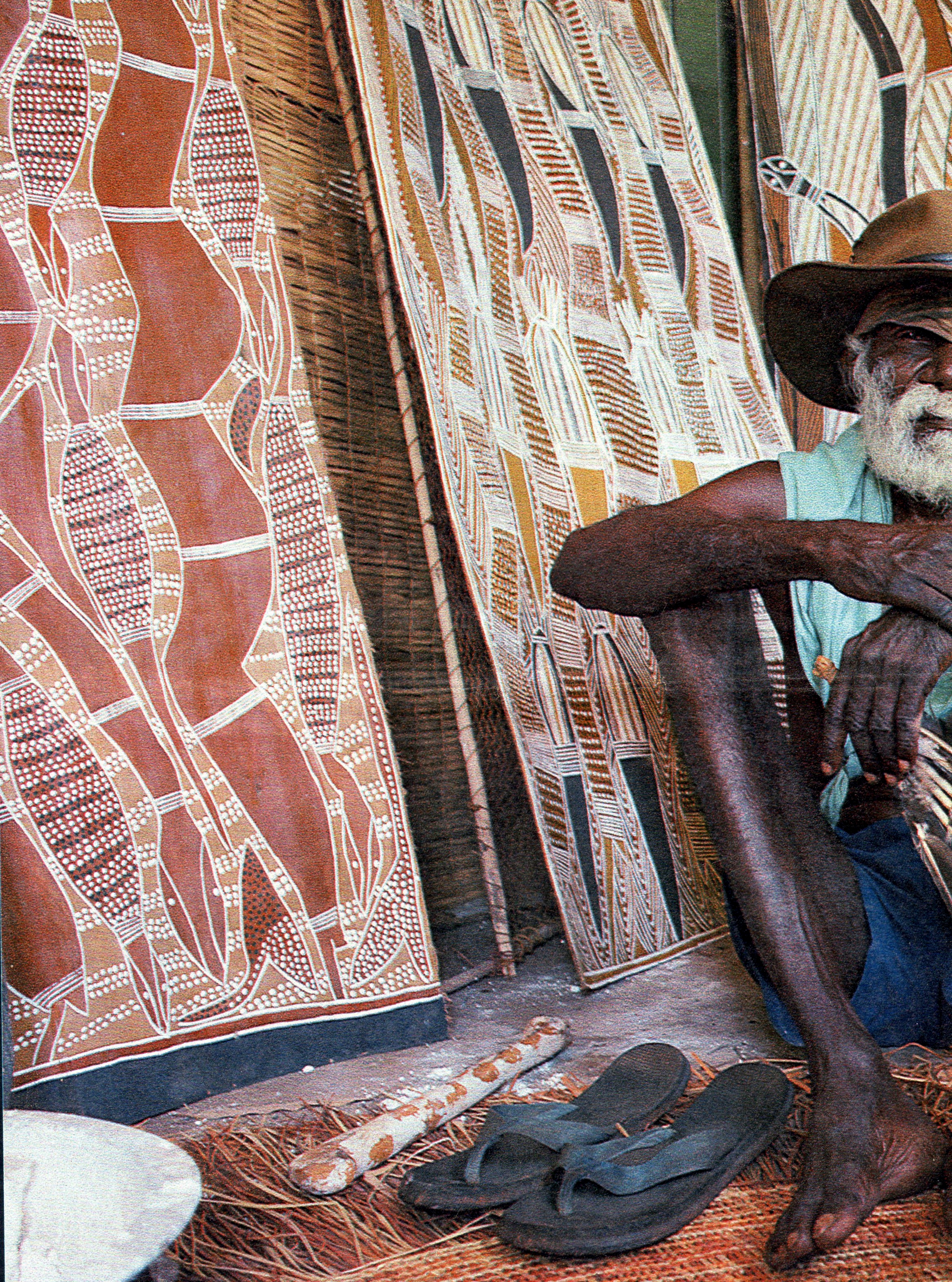
 Bark painting art, on all kinds of wooden artifacts.
Aboriginal people believe in a creation time, or Dreamtime, when ancestral beings emerged from beneath the earth. They resembled plants and animals, but were part human. The ancestors created everything that formed the world. They were the law makers and from their deeds the Aboriginal people learnt the correct way to behave and to live with each other.
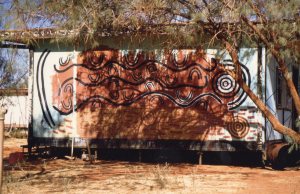
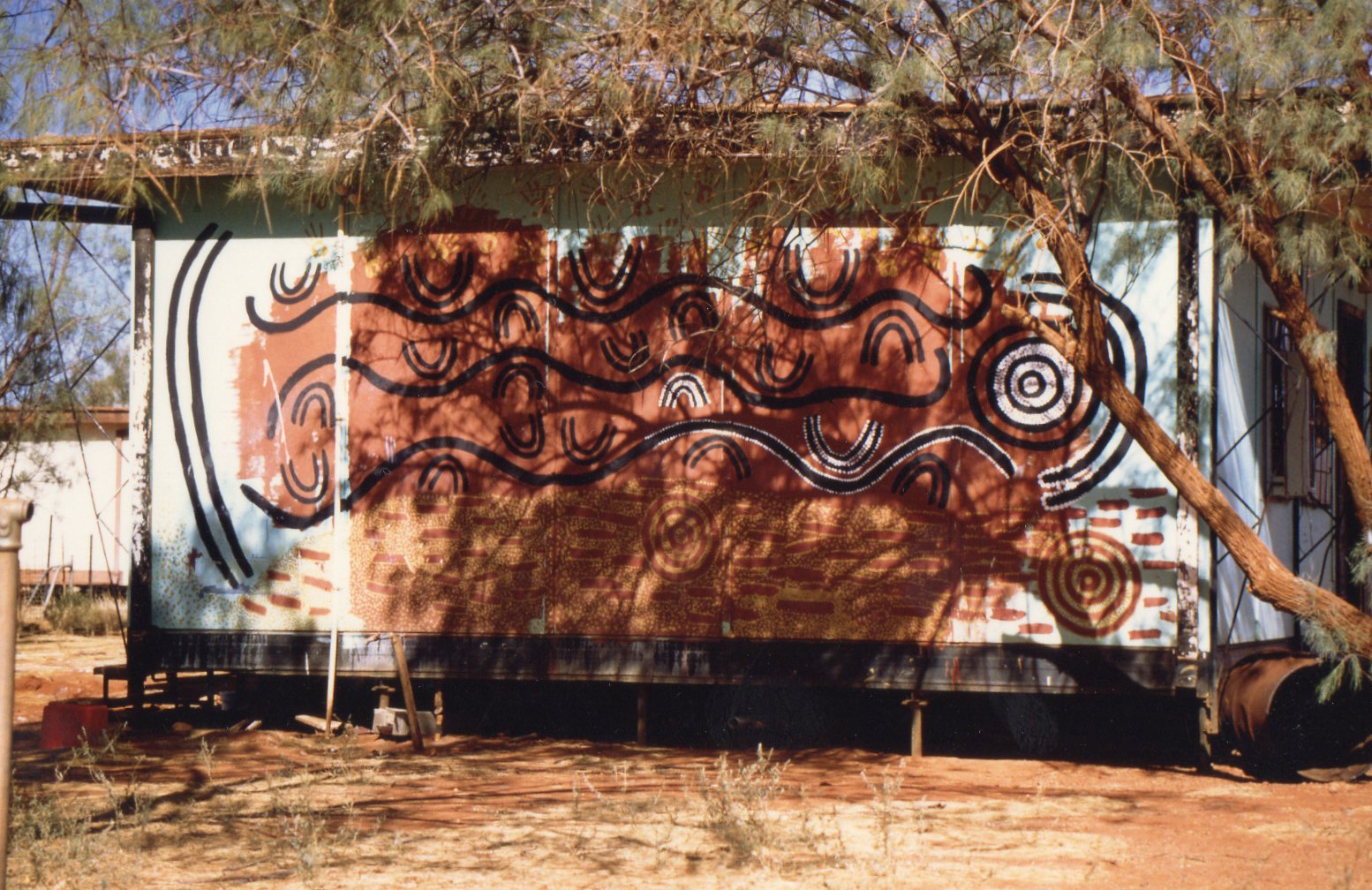
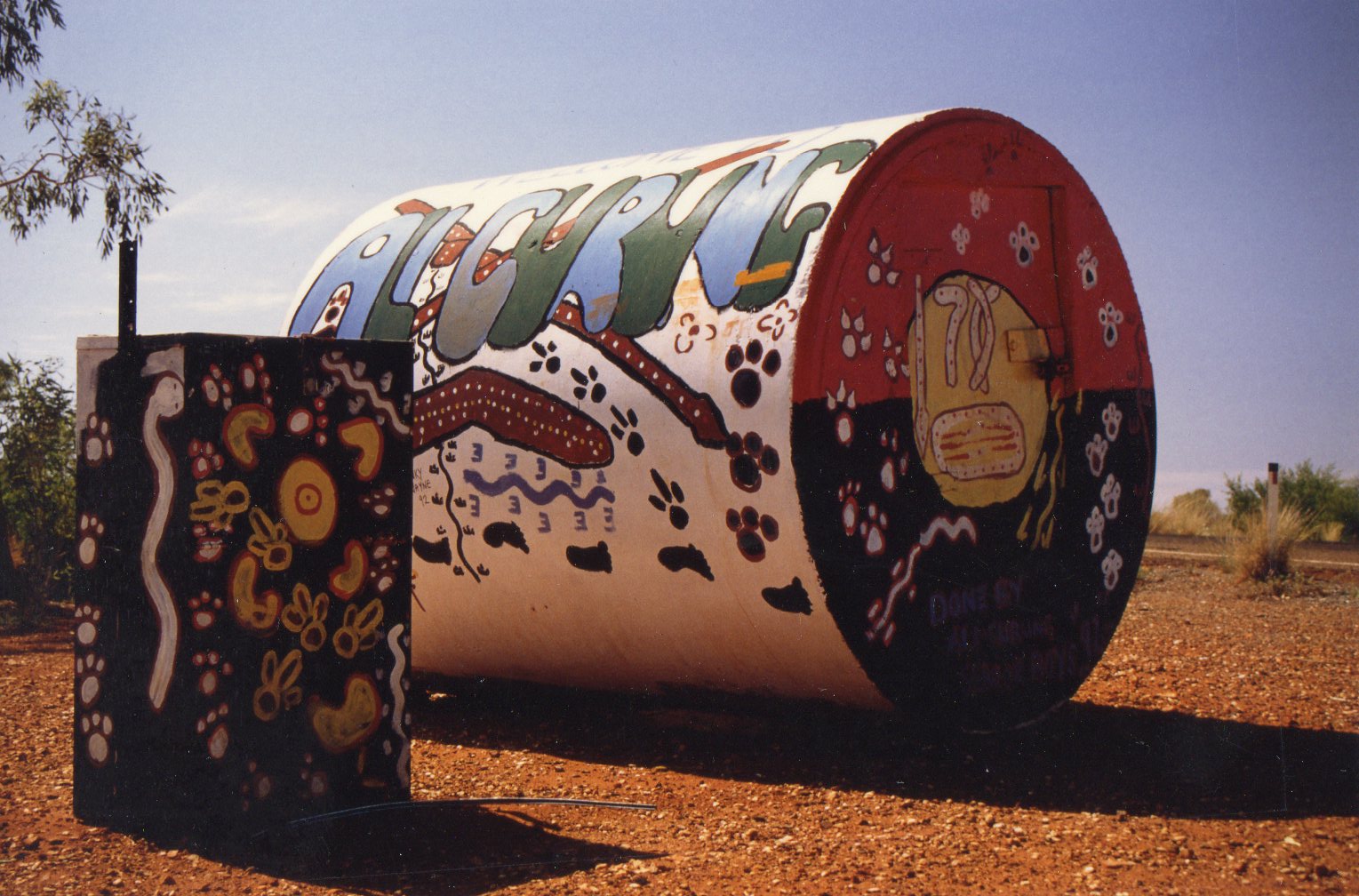
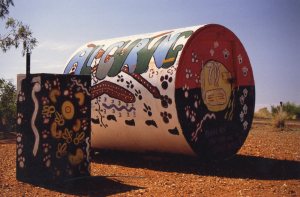 Aboriginal desert art, primitive – but origin desert art. And the modern version around Yuendumu.
Tjukurrpa is the Aboriginal word which we interpret as Dreamtime. To Aborigines, the Tjukurrpa means existence in the past, present and future.
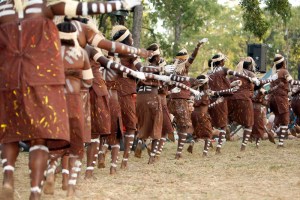 Dreamtime – dancing festival and body painting.
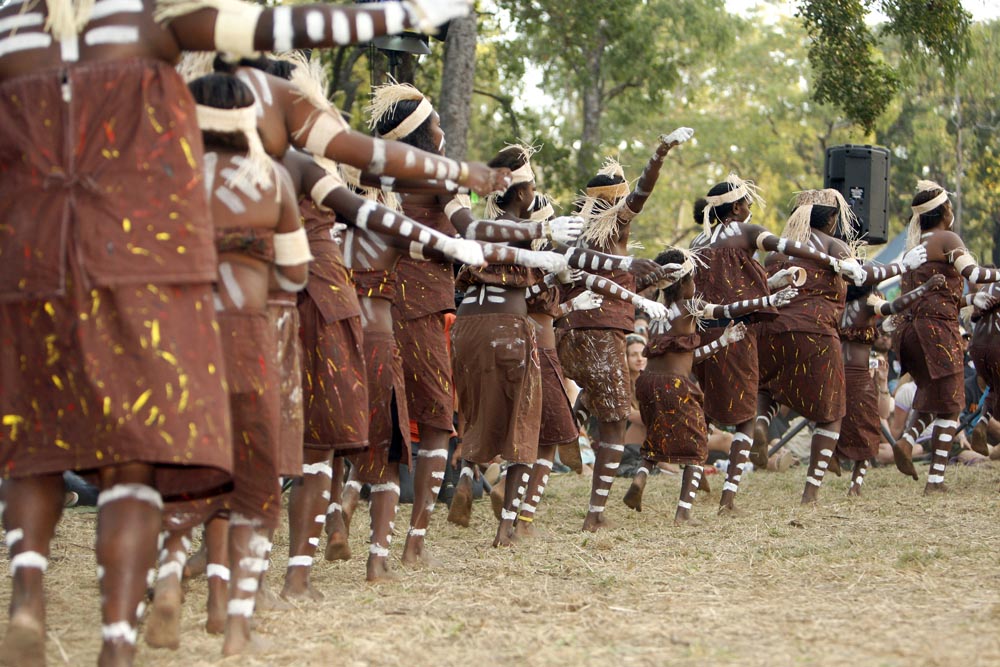
Ancient aboriginal art history.
It is now thought that aboriginal history began longer ago than previously believed, although a seven million year old hominid-like skull found at Bega in New South Wales in 2005 suggests that previous races, perhaps homo erectus, pre-dated aboriginal settlement.
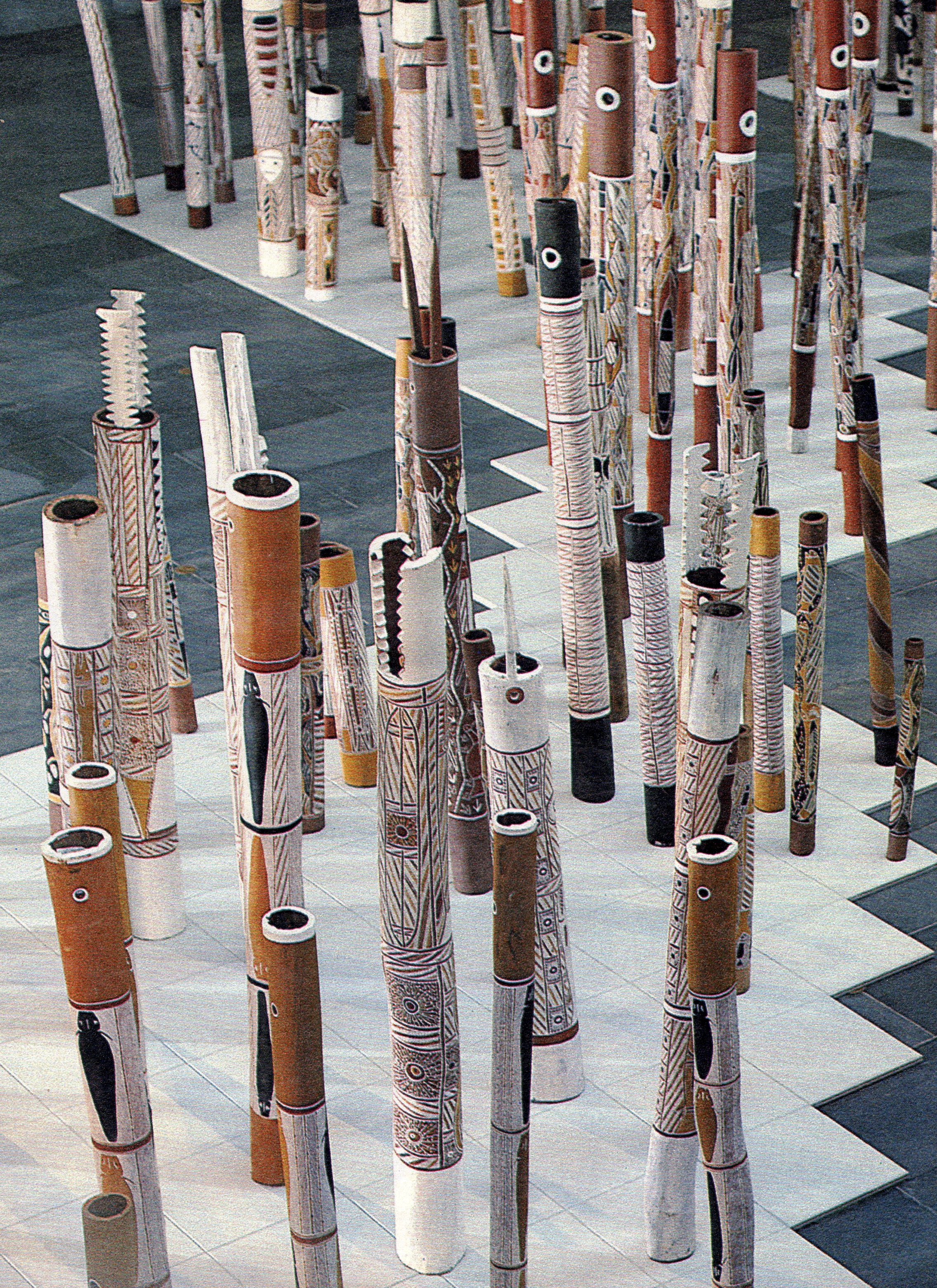
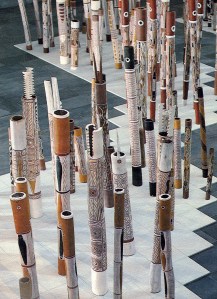 As a memorial, during the 200 year celebration of Australia, the Aborigines build 200 bone coffins out of trees. To see at the National Art Gallery in Canberra, Australia.
When we lived near Bega, on the far South Coast of New South Wales in Australia, one day in May 2005, the “Bega News” published the following information:
“THE endocast of a primitive hominid-like skull was recovered from among the rubble of a volcanic plug in the Bega district in May 2005.
The fossil was discovered by noted prehistory researcher Rex Gilroy of Katoomba NSW, where he operates the „Australian-Pacific Archaeological Research Centre“.
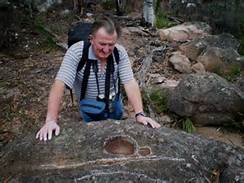 Rex Gilroy.
He discovered the fossil projecting from the base of a volcanic deposit while researching volcanic sites on the NSW far south coast.
As geologists have lately dated the volcanoes of the Bega region as having last erupted around 7 million years ago, this makes the „Bega Man“ the oldest known hominid skull found in the Australasian region.
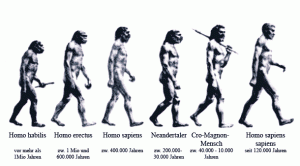 Imagine where the scull will fit in – 7 million years old.
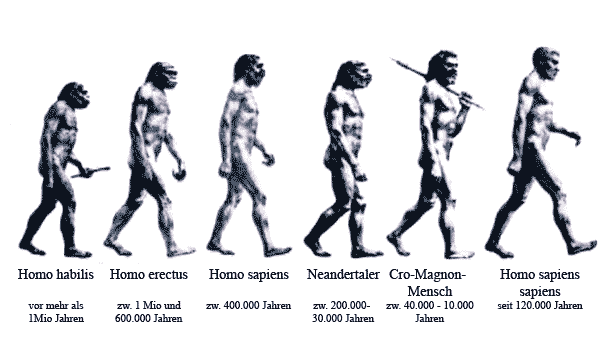
The remaining fossil has lost a portion of the underside and a shallow section of the skull dome is also gone, giving it a flattish appearance. The remaining endocast measures 15.7cm in length by 9cm in width across the facial section by 10cm in depth. The height of the individual would have been hobbit size, around one meter, says Mr Gilroy.”
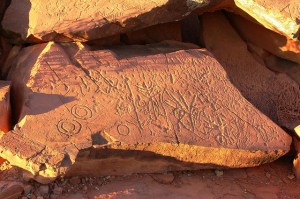 Ancient rock carving Ewaninga, North.Territory.
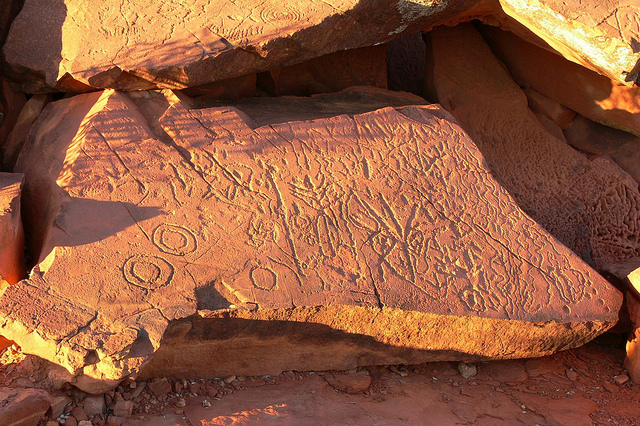
Of course, Aboriginal Australians themselves believe that they have occupied this land since the beginning of time, so the discovery may have come as a surprise to them.
Aboriginal art history is famously displayed in rock carvings such as the ancient examples at Dampier in the Pilbara region of Western Australia, the wonderful Mimi paintings from Kakadu and the Bradshaw and Wandjina figures, scattered throughout the Kimberley region. To my opinion, the Kimberley’s are the most beautiful region in whole Australia.
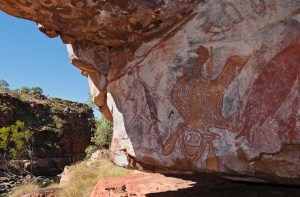 Rock painting at Charnley river, West Kimberley.
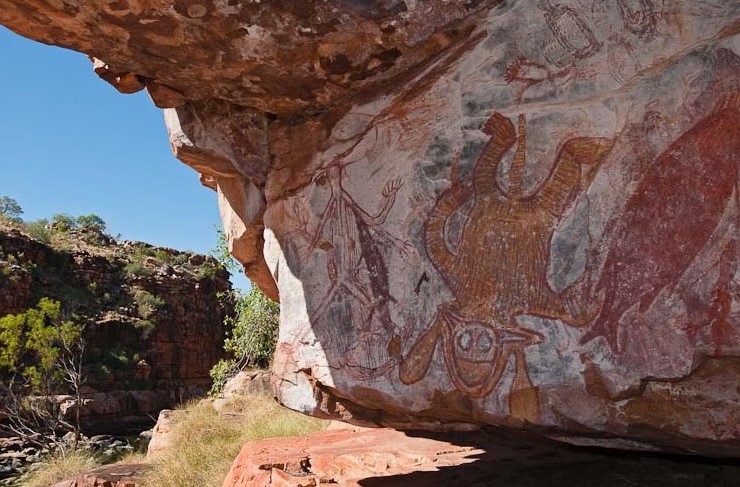
Symbols and motifs, which appear on durable rock faces, sometimes become part of the rock structure itself but others are seasonably “touched up” as part of the on-going nature and cultural importance of their spiritual meaning. Although used on rock faces and under rock overhangs, similar symbols are also used on bark paintings and, more recently, on canvas acrylic paintings.
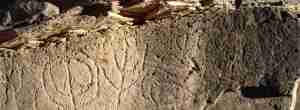 Ten-thousands of years old rock carving.
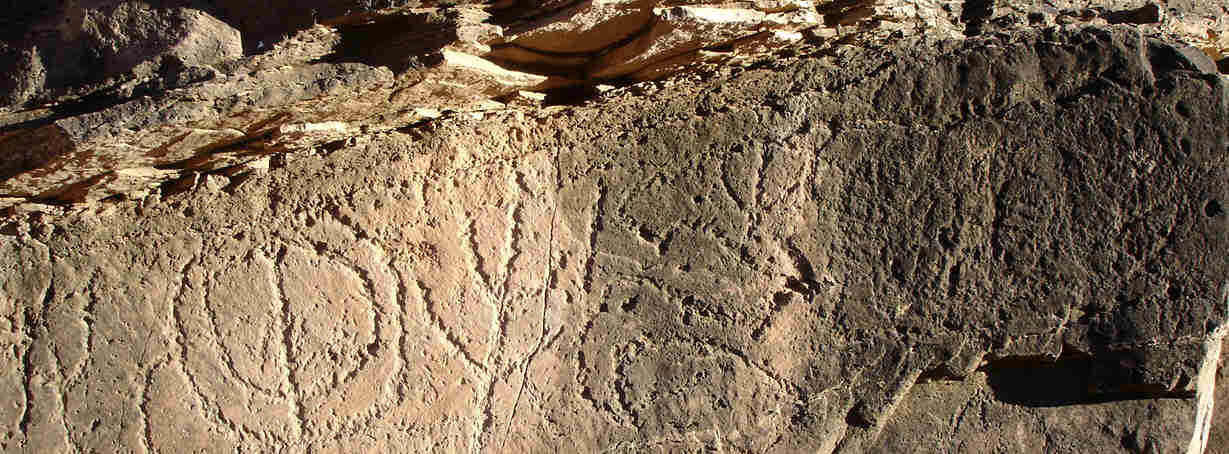
Rock Painting.
The oldest art examples we see today are the rock paintings. That’s not because Aboriginal people in the old days would only paint rocks. It’s because rock is more durable than other materials and those paintings have therefore been preserved until today.
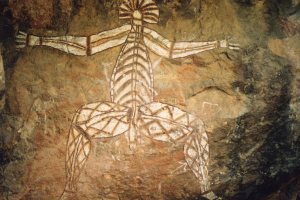 X-Ray figure as Aboriginal rock painting.
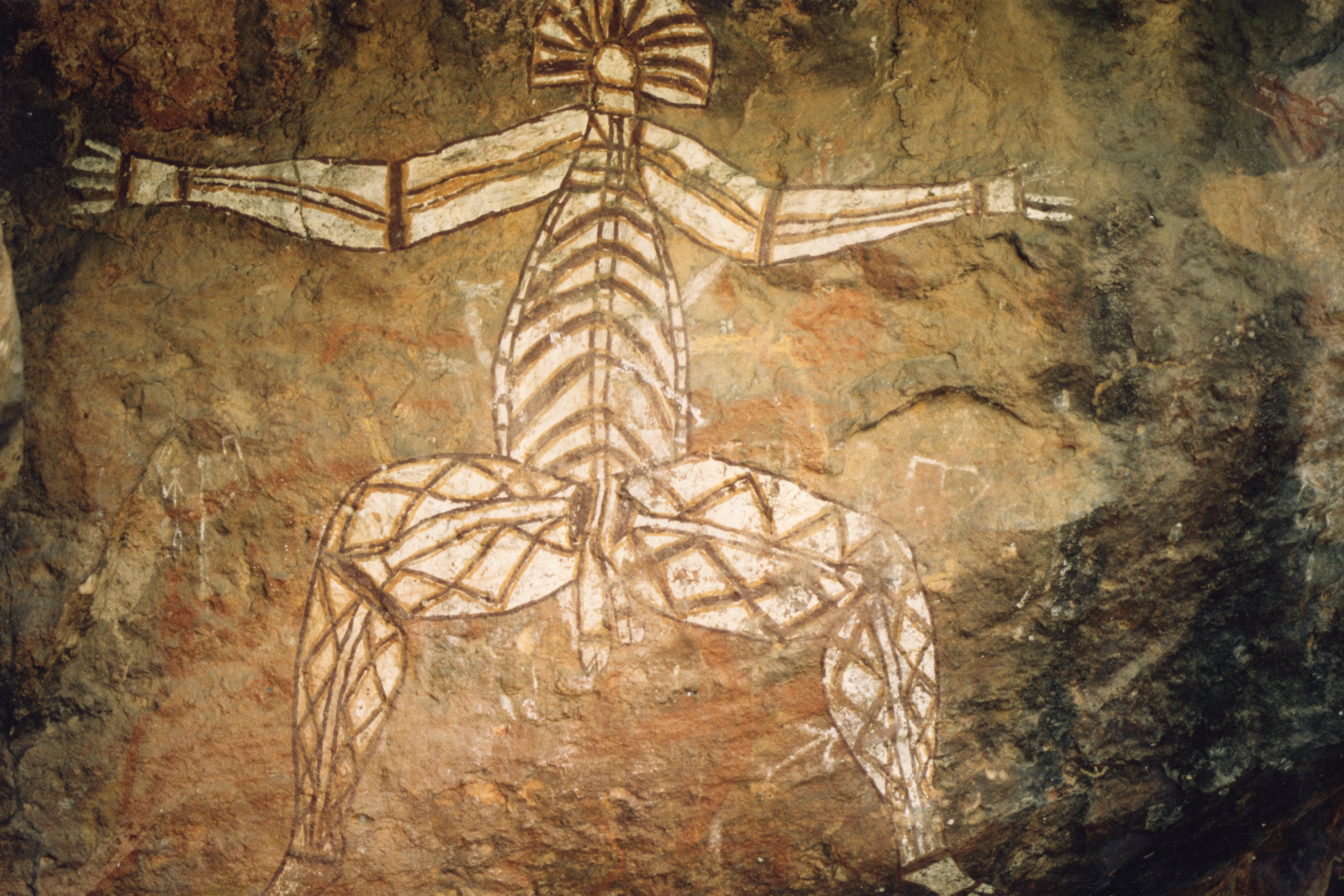
Even on the rocks, most of the paintings have been preserved inside caves, where they have been protected from weather, while the paintings on outside rock surfaces have often been washed away.
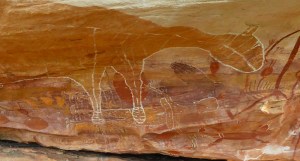 Rock painting (ochre) „The Giant Horse“ near Laura.
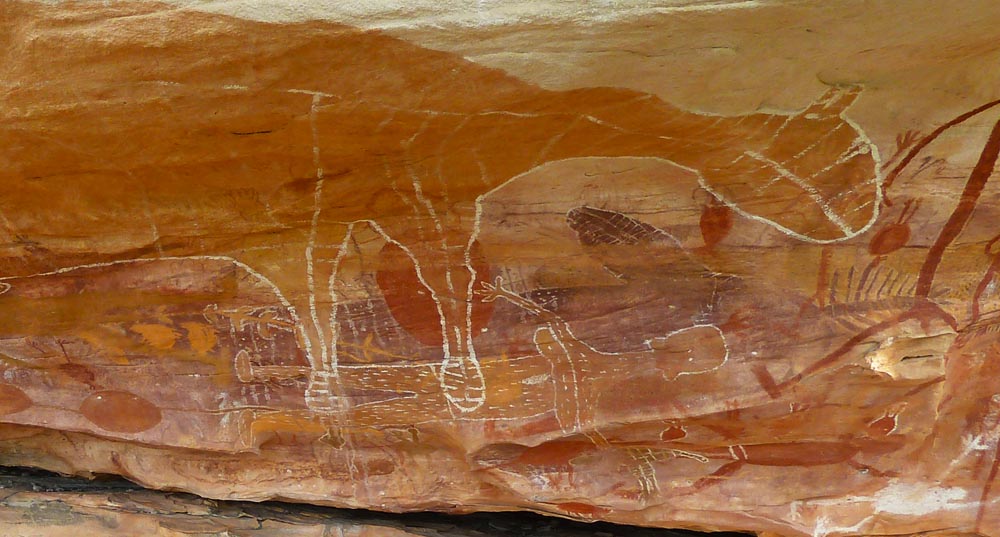
There is an enormous variation in the styles of Aboriginal rock art, depending on their age and location. Both the abstract dot paintings and naturalistic art, including X-ray style has been found in rock art of various ages.
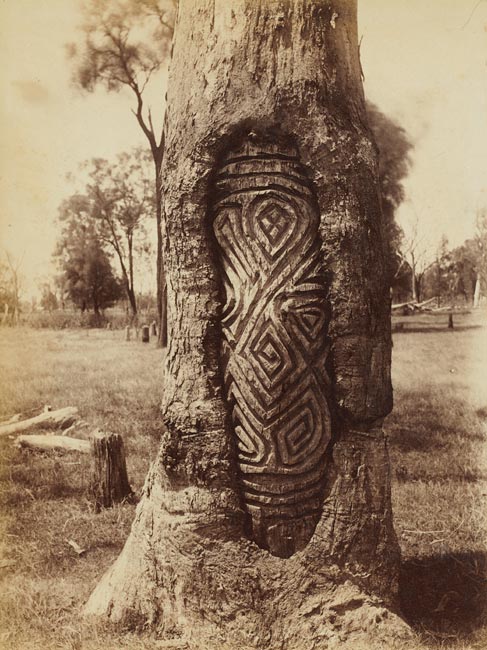
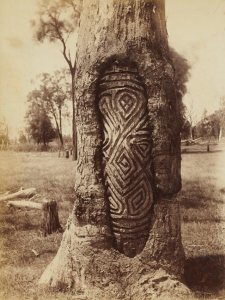 Tree carving near Dubbo, NSW library, King collection.
Traditional Methods in Aboriginal Art History.
Whether they were painting rocks, bark, tools, weapons or anything else, traditionally Aboriginal people all over Australia used Ochre to make paint. Ochre is a name given to different iron oxide minerals that were used as pigments. Having been weathered from iron deposits, these oxides all have reddish color. It’s the same mineral that makes Australian outback soils and many famous rocks like Uluru (see pic far above) red.
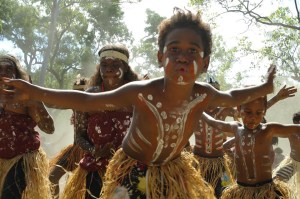
 Body painting with ochre colors and ceremony dancing at the Laura festival, Queensland.
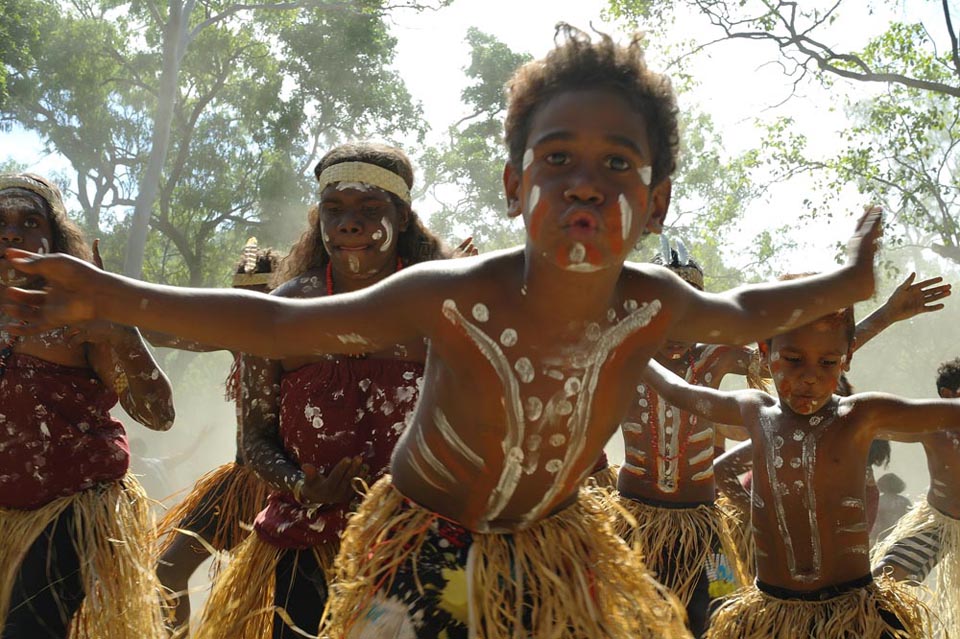

Ochre Colors.
Depending on the exact conditions under which those minerals formed, their color can be anything from yellow to orange, red, purple and dark brown. That gave a whole range of different colors to mix and play with. Black pigment was made from charcoal, and white from calcite, ash or different clay minerals. Mixing black or white with other colors made them darker or brighter and further increased the amount of variations. White and black were mixed to make grey, often used with body painting.
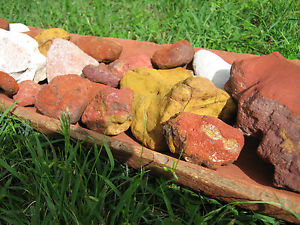 Collection of raw Ochre.
Preparing Ochre paint.
Preparing Ochre paints was a time-consuming work. First the rocks containing iron oxide minerals had to be found and collected. Then the rock had to be powdered by grinding, and then that powder had to be mixed with some sort of fluid – a so-called binder – to become paint. Nowadays you can buy binders, but in the old days Aboriginal people used animal fat, plant sap, reptile egg yolks, bush honey, kangaroo blood and others. Water or saliva isn’t good enough, they do get the paint on the rock or a piece of bark, but they won’t hold it there for thousands of years.
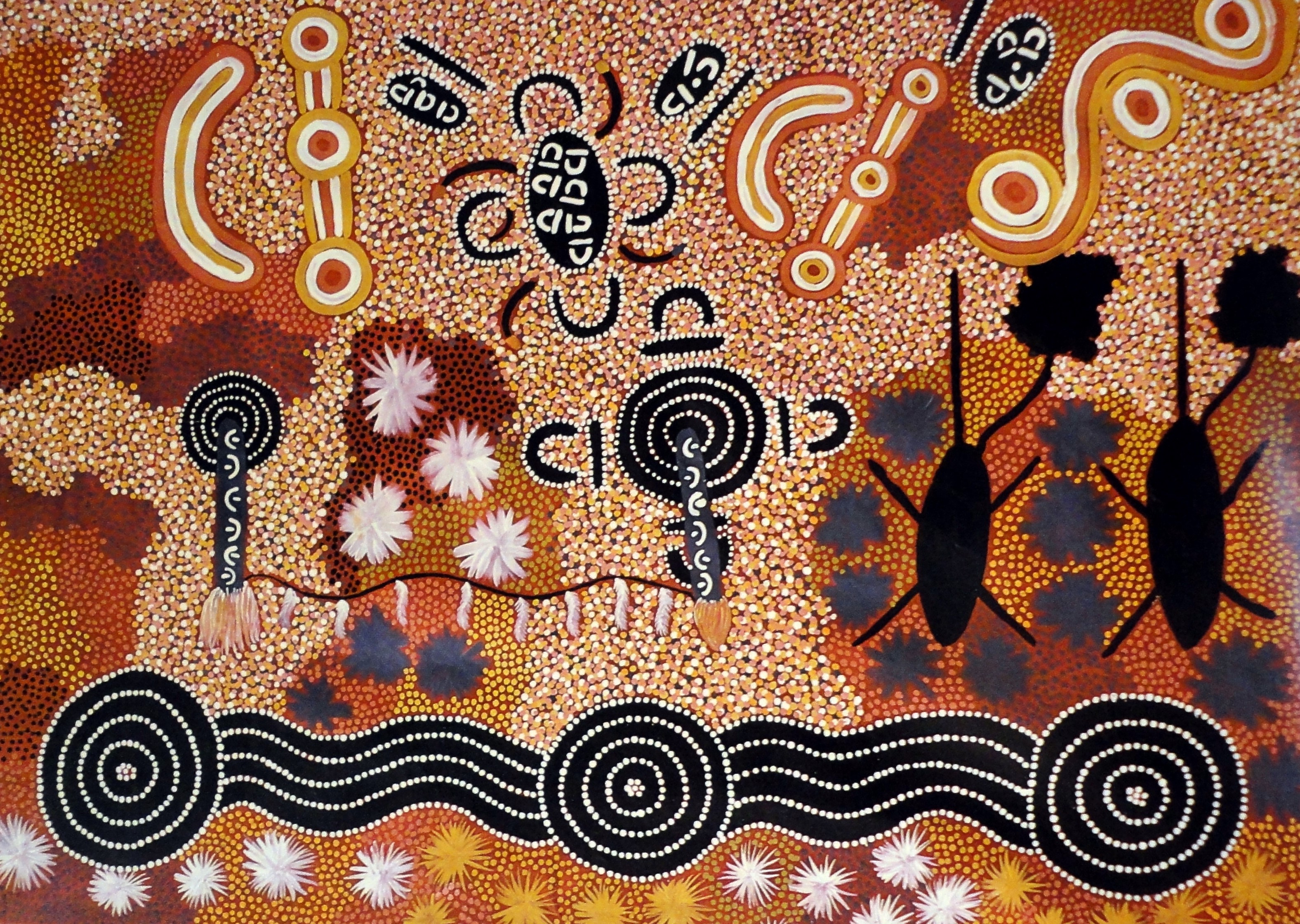
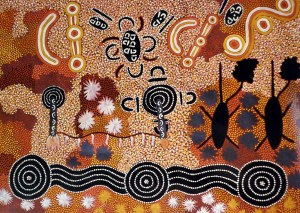 Beautiful „acryl on canvas“ painting titled „Women’s Fire Ceremony“, made by Sonda Turner Nampitjinpa. It is also used as a book cover of Jennifer Isaacs book „Australian Aboriginal Paintings“ from 1989. Notice the colors used, made in typical Ochre style.
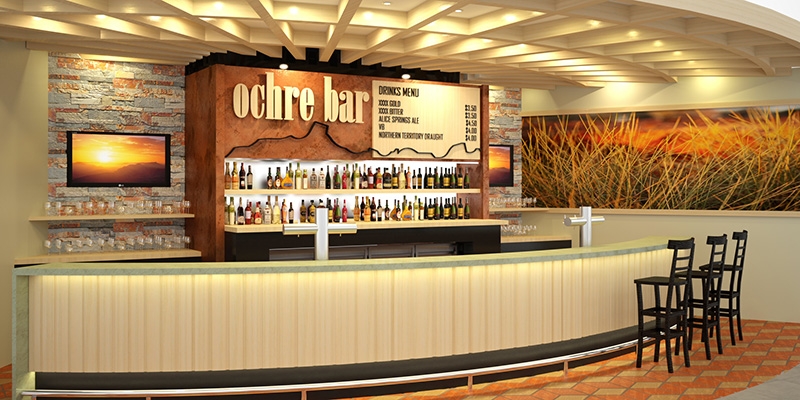
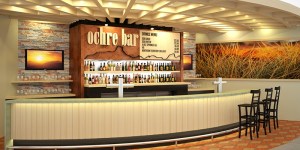 Now you know and won’t be surprised anymore why a bar in Alice Springs International Airport has such a strange name.
The aboriginal sand art.
Aboriginal sand art is considered a ritual in the traditional aboriginal culture. It is used to signify territorial landmarks and tells the history as well as the origin of the aborigines. More specifically, it showcases the aborigines’ creation myth known as “The Dreamtime”. The Dreamtime is re-enacted today to remind people of the sacred creation ritual.
 Mystic Bora Ceremony using sand art.
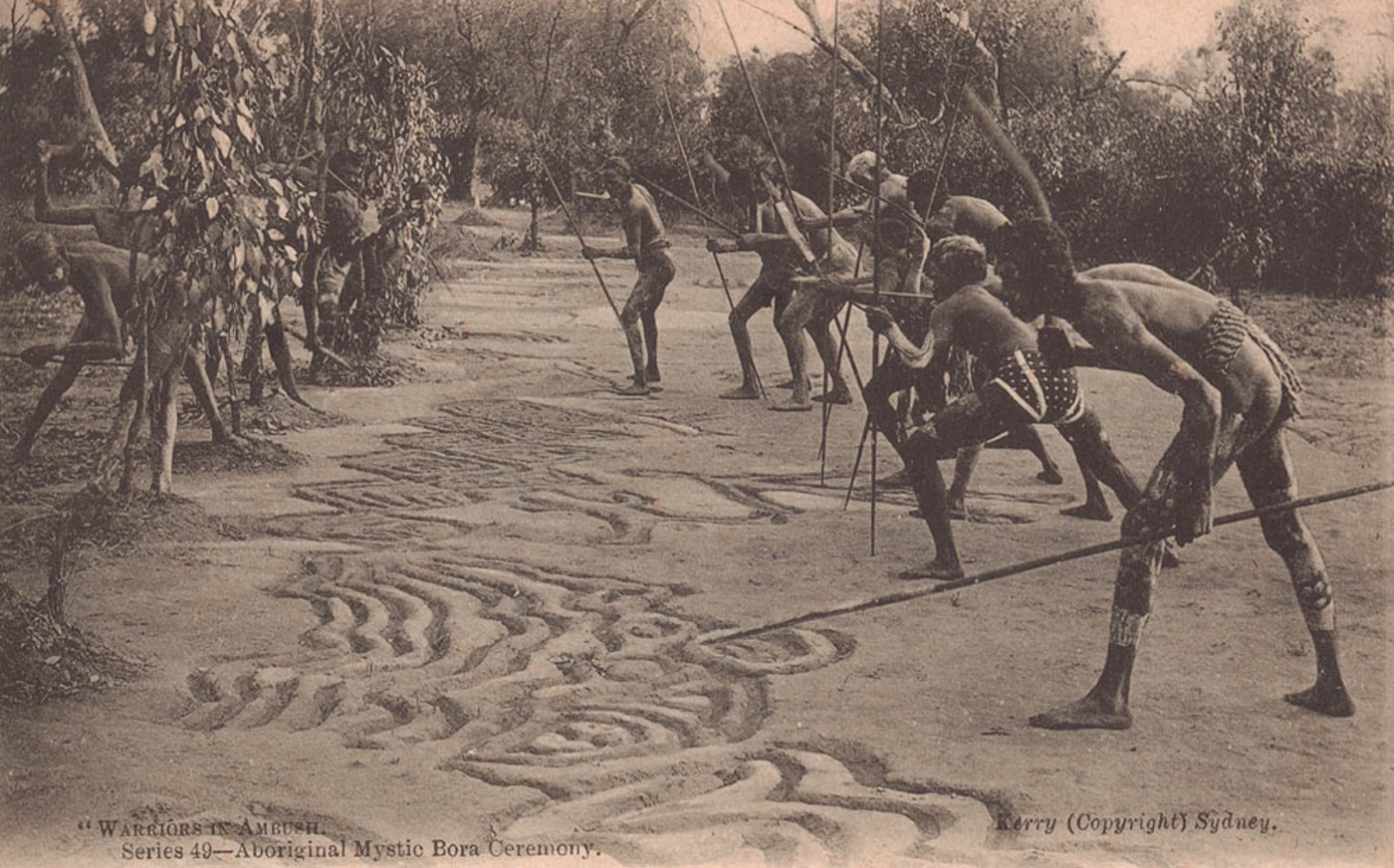
Any art form that includes sand art is made by two people, specifically, a man and a woman. It is every person’s responsibility to ensure the continuity of the sacredness of “The Dreamtime” myth, thus, making sure that the order of creation is passed on to the next pair of man and woman.
 Sand painting, dotting with two fingers.
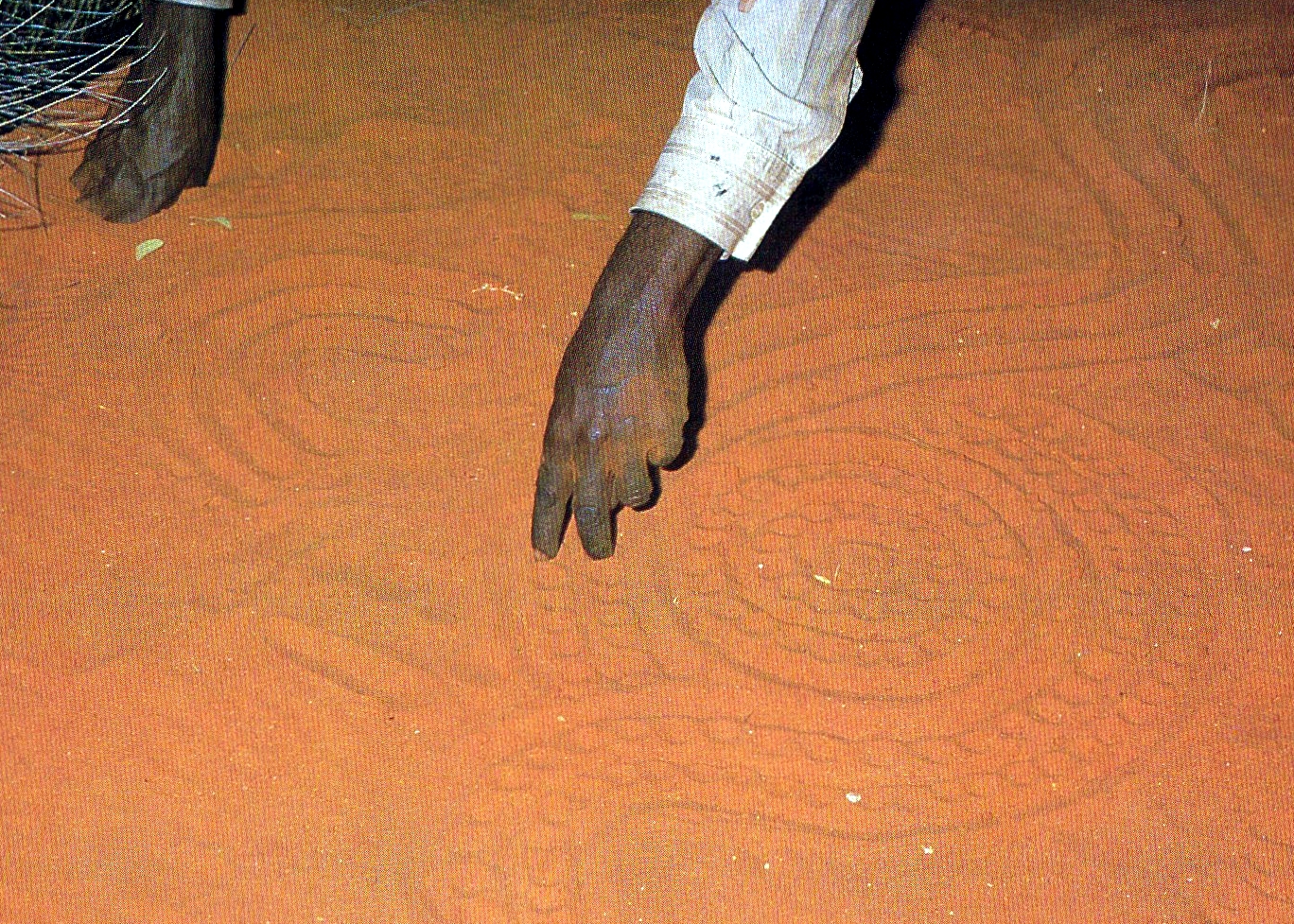
These traditional aboriginal art forms also show elements of nature such as fire and waves of energy. The designs transcend time and show the past, present and future with the characterization of concentric circles and interconnection of energies emitted by the ancestors’ spirit.
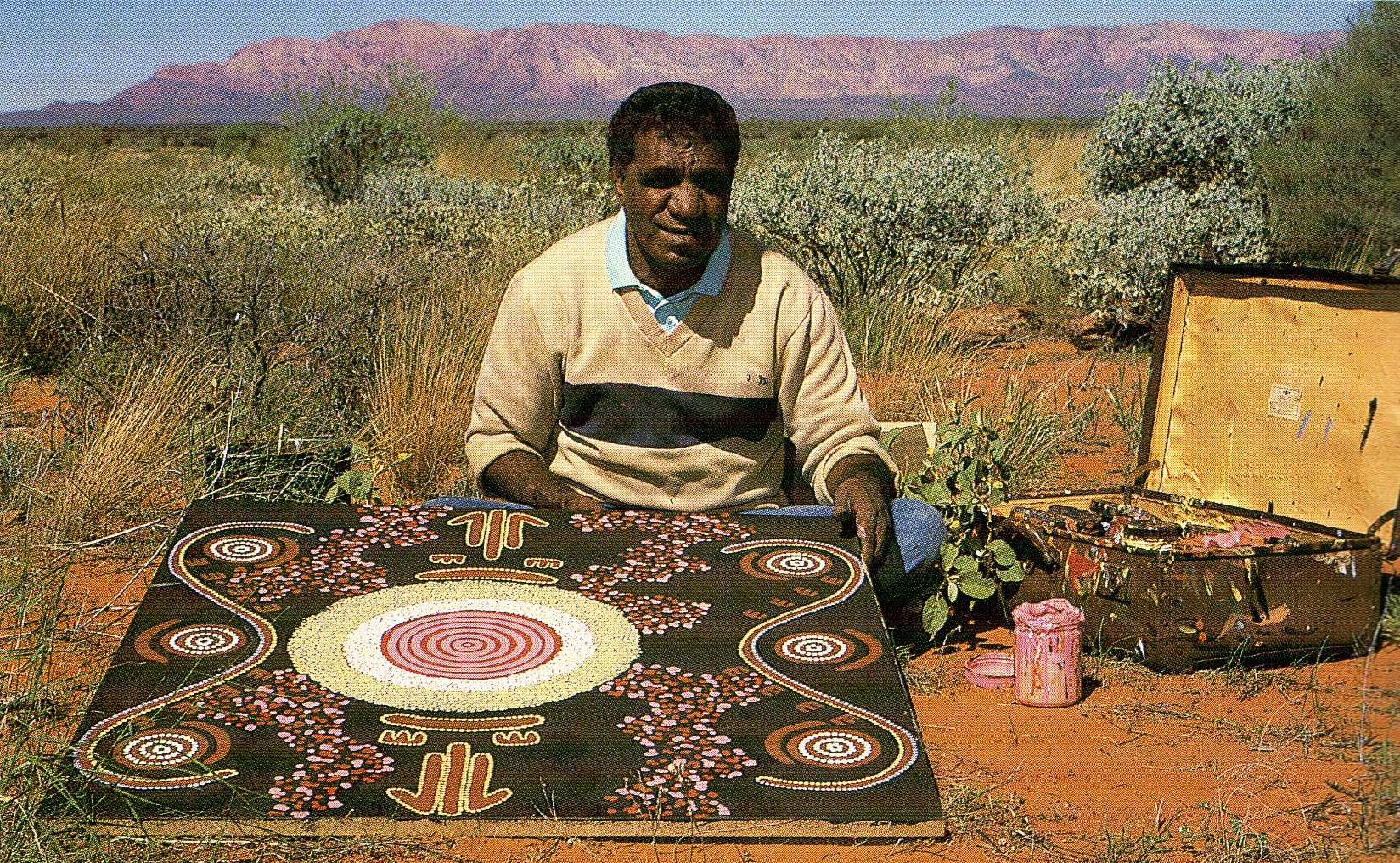
 One of the most well known Aboriginal artists is Michael Nelson Tjakamarra, here with one of his dot paintings. See how the colors reflect the landscape. Stokes pic.
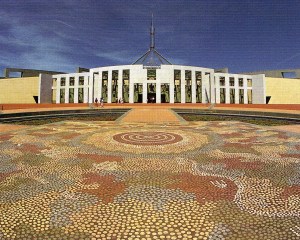 The granite mosaic pavement in the open forecourt of the new Parliament House in Canberra was designed by Michael Nelson Tjakamarra. By the way, the Aboriginal meaning of the name Canberra is „meeting place“. Meeting place predominantly for the cities of Sydney and Melbourne, which were fighting over the decision to be Australia’s capital city. Decision was made for a new capital city 1/2 way between Sydney and Melbourne. Canberra as the „Australian Capital“ was born on the 12th of March 1913. Stokes pic.
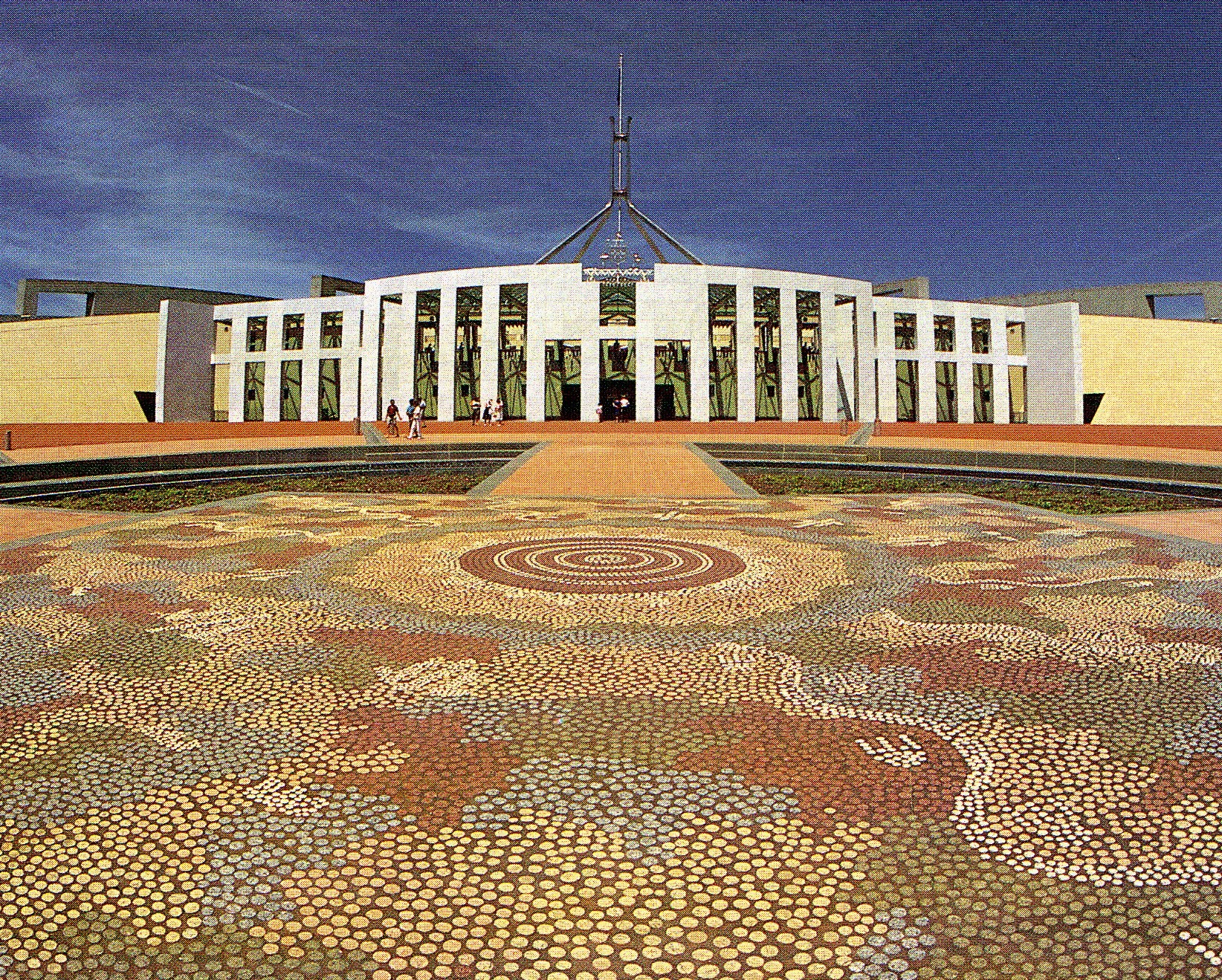
Canvas and Acrylic Paints.
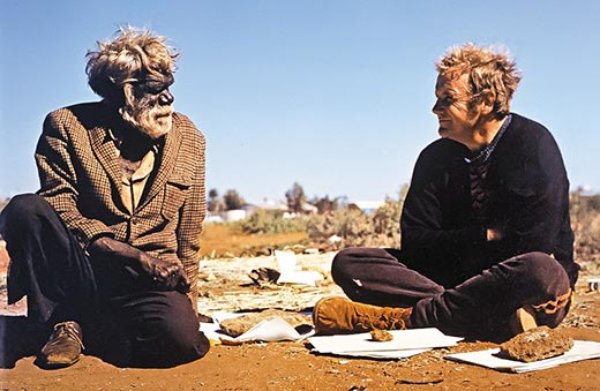
Modern Aboriginal art still uses the old styles and symbols, but when it comes to the methods, it is a mixture of the traditional Aboriginal and the modern culture. The big turn happened in the 1970s when a European artist Geoffrey Bardon helped Papunya People in central Northern Territory to develop their dot painting by painting it on canvas with acrylic paints. It developed into the famous Papunya Tula School with about 150 artists.
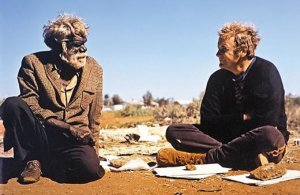 Geoffrey Bardon with Old Tom Onio, Papunja 1971.
Several other modern styles have developed like the watercolor paintings of Albert Namatjira, and the Hermannsburg School. Aboriginal people from many different parts of Australia, particularly central, northern and South Australia, Arnhem Land and Tiwi Islands have now taken up acrylic painting.
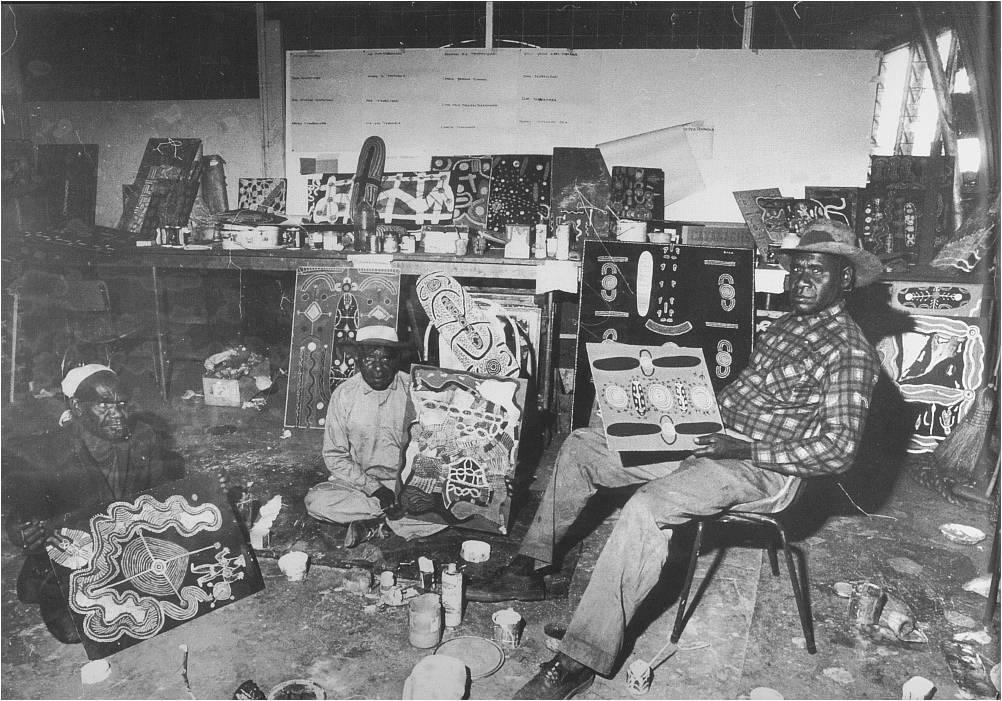
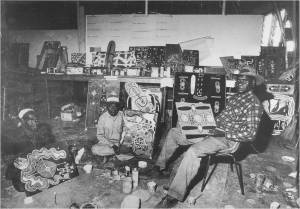 How it all began – men’s painting room in Papunja 1972, printed in: Benjamin, Roger and Weislogel, Andrew C., New York.
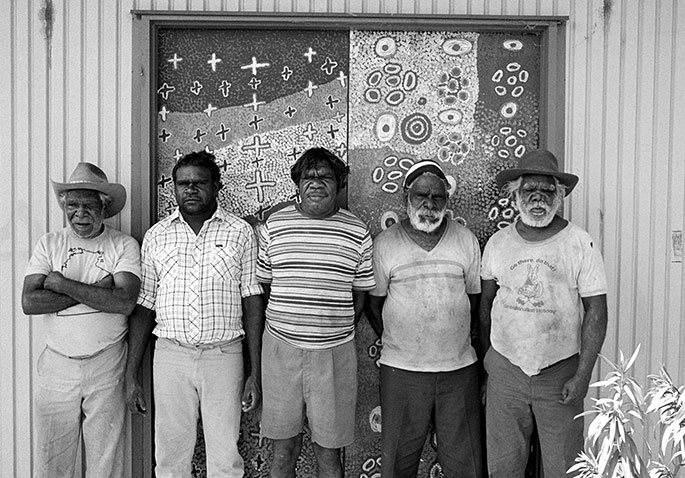
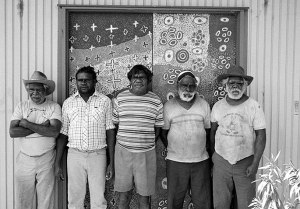 Yuendumu art school members in the early 1970’s.
Acrylic.
Doing it in the modern way has many advantages. Using acrylic colors and canvas saves them tons of time, and they can still choose to use the traditional yellowish-reddish-brownish colors if they want. And maybe most importantly – as opposed to bark and rock paintings, canvas paintings are easy to sell.
 Eunice Napangardi on a „Bush Banana Dreaming“.
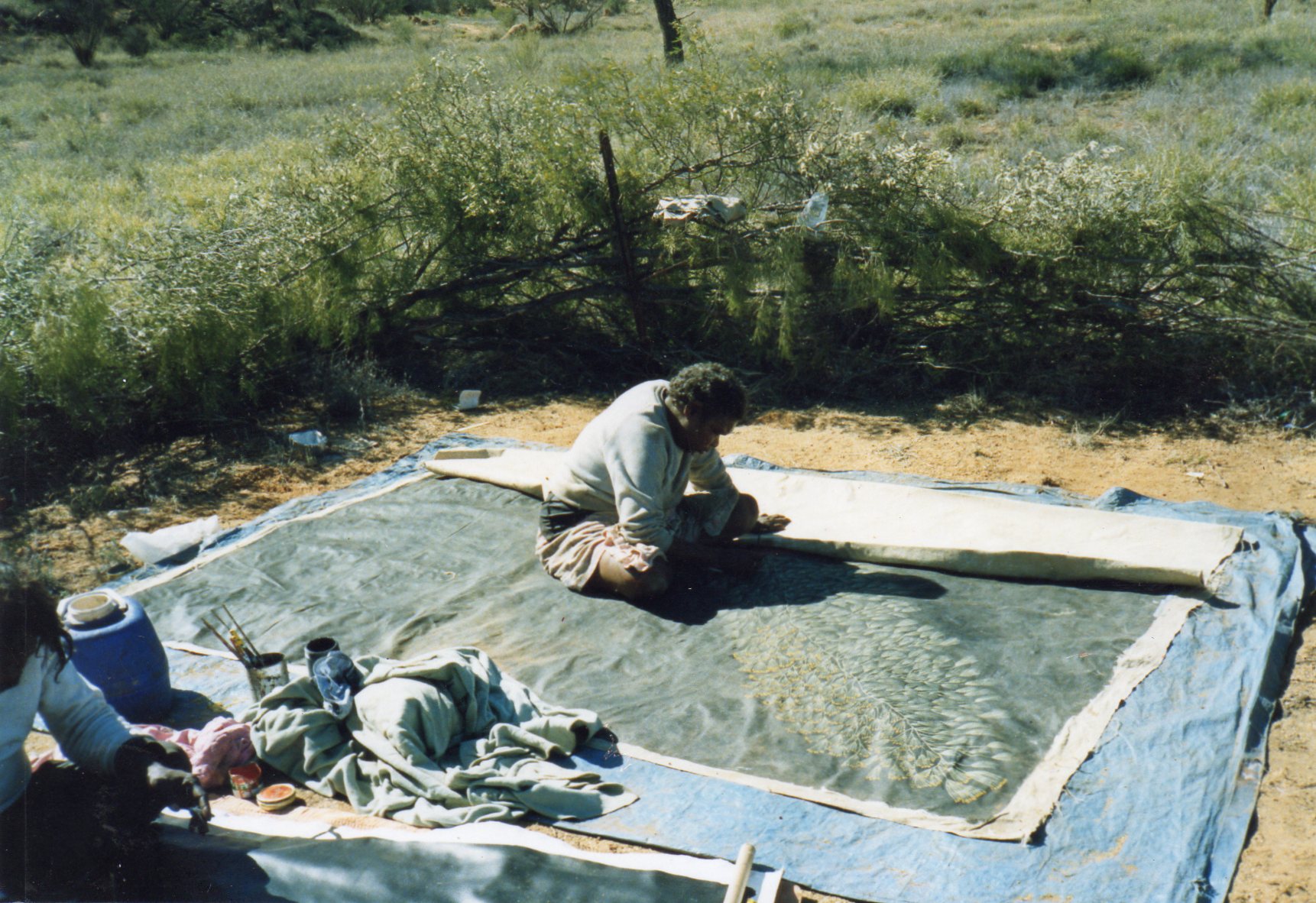
Canvas.
Using canvas to paint on has given Aboriginal People an opportunity to get their art out there, and modern Aboriginal art, particularly the famous dot painting has taken off and started selling on big scale even internationally. This gives the Aboriginal artists an opportunity to get their culture more recognized internationally, and earn an income from it while doing something they love to do. Apart from canvas paintings, they paint on pottery, and various tools and instruments like boomerangs, didgeridoos and clapping sticks – some of the most popular souvenirs to buy in Australia.
 Sonda Turner Nampitjinpa – at an artist and art show at Sydney harbor. She told me to call this upcoming painting „Bush Plum and Honey Ant Dreaming“.
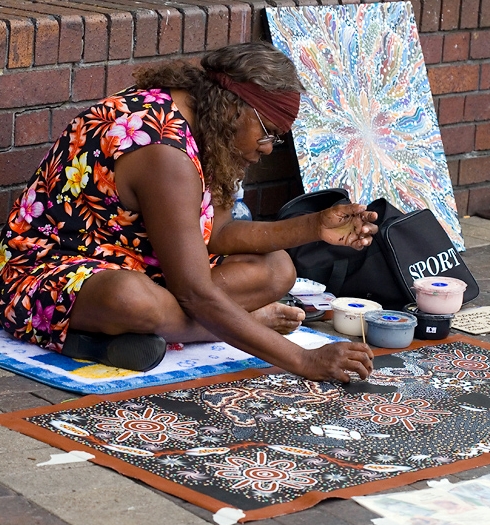
Dot painting.
Dot painting consists of various paint colors like yellow (representing the sun), brown (the soil), red (desert sand) and white (the clouds and the sky). These are traditional Aboriginal colors. Dot paintings can be painted on anything though in aboriginal times they were painted on rocks, in caves, etc. The paintings were mostly images of animals or lakes, and the Dreamtime. Stories and legends were depicted on caves and rocks to represent the artists‘ religion.
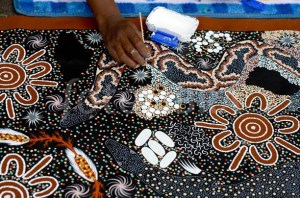 Sonda Turner detail, she always uses different technics, stick dotting, brush painting etc. But she likes to be very detailed and colorful.
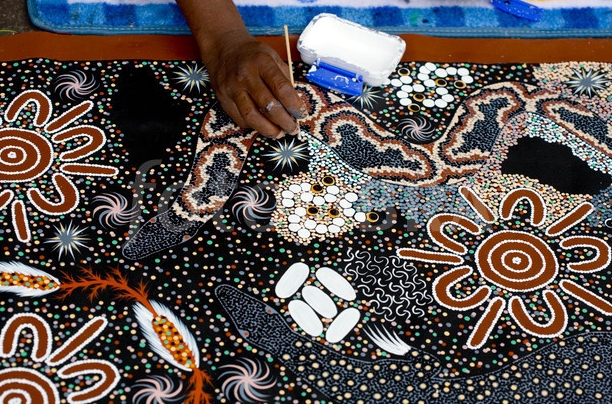
On modern artwork, dots are generally applied with one of two instruments, first – bamboo satay sticks and second – ink bottles. The larger flat end of bamboo satay sticks are more commonly used for single application of dots to paintings, but the sharp pointier end is used to create fine dots. To create superimposed dotting, artists may take a bunch of satay sticks, dip the pointy ends into the paint and then transfer it onto the canvas in quick successions of dotting.
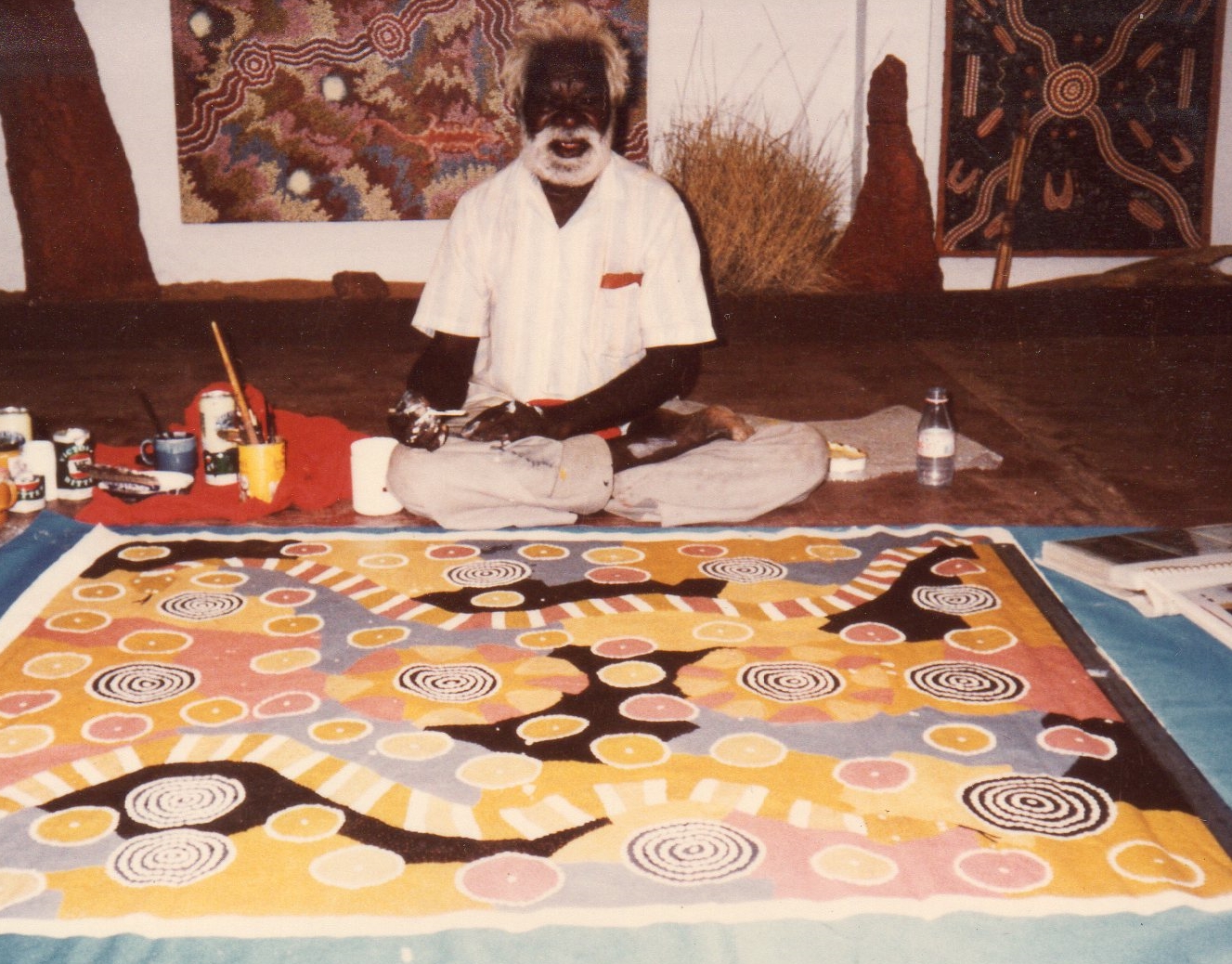
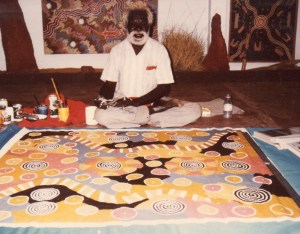 Billy Stockman finishing one of his „Snake Dreamings“.
How to read dot paintings ?
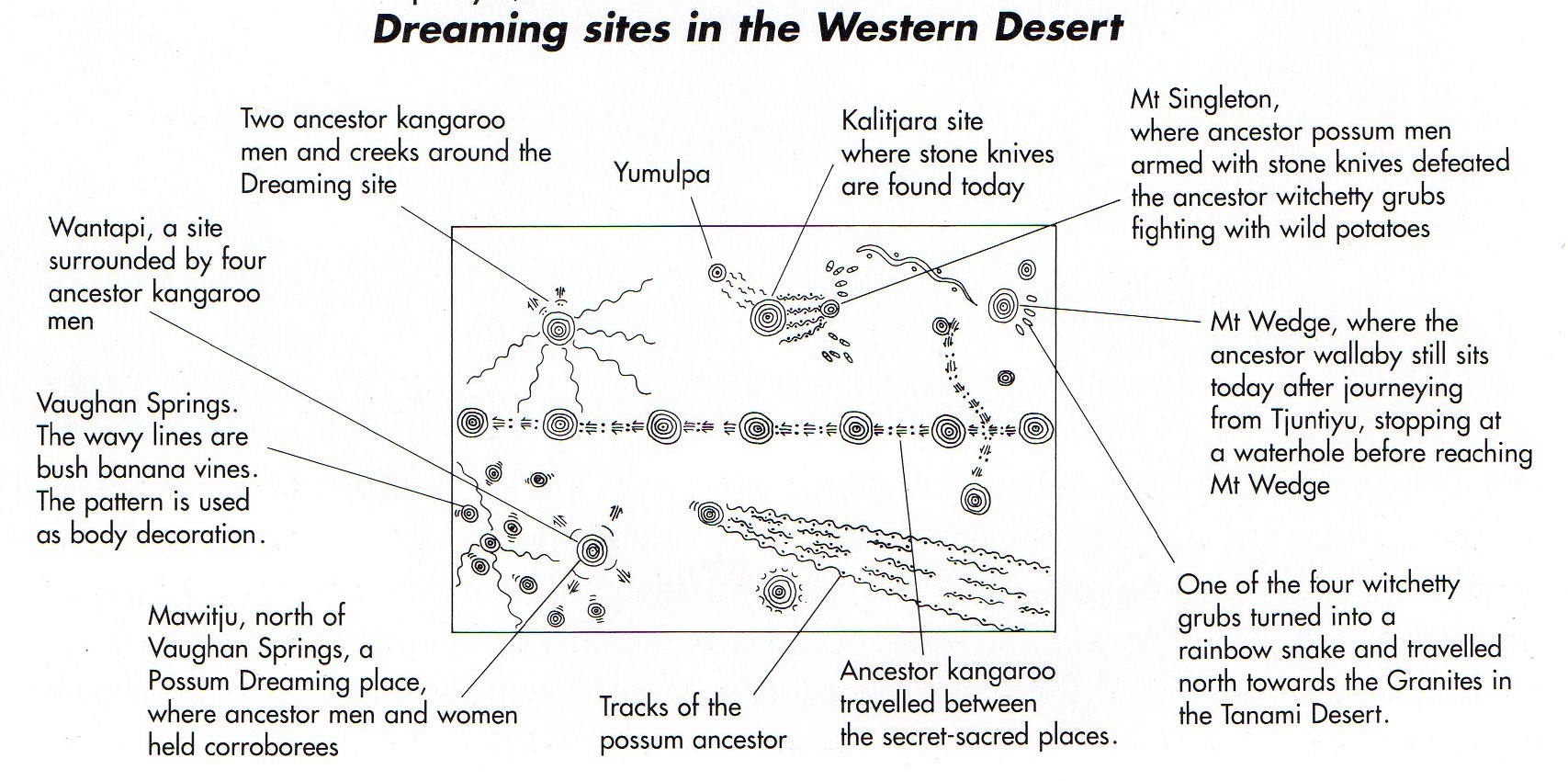
There are some different meanings. But about 80% of all desert art in Australia, no matter which artist or which tribe describes the „Dreaming“, have a similar explanation and can be interpreted by any other Aborigine. Here some samples. Just click on pics to size up.
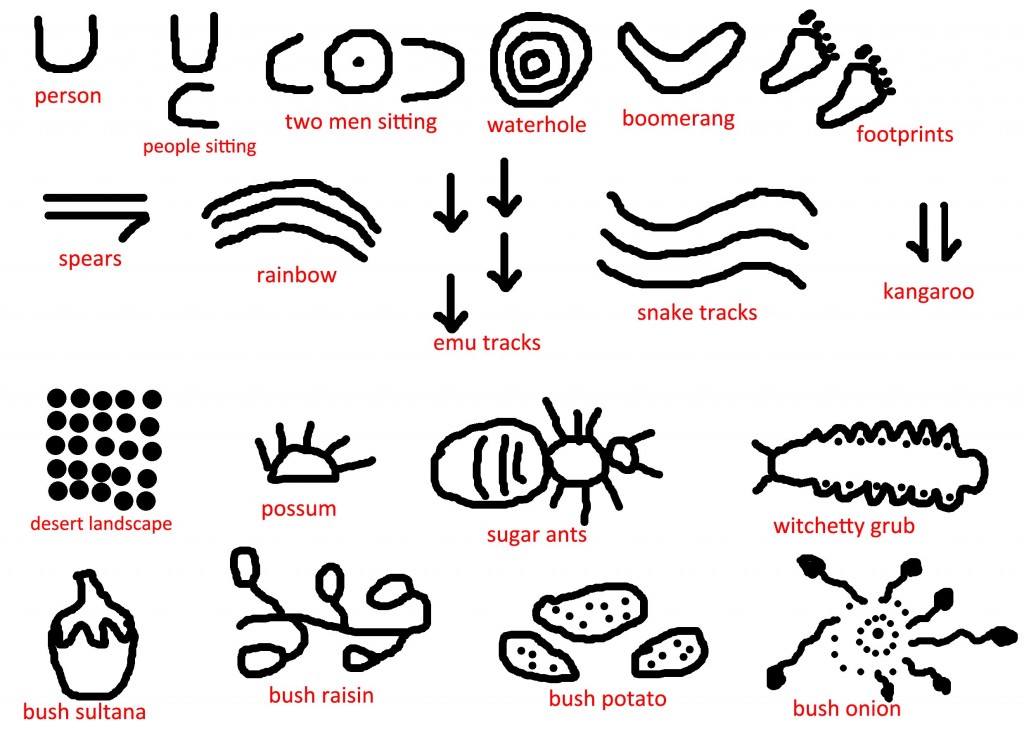
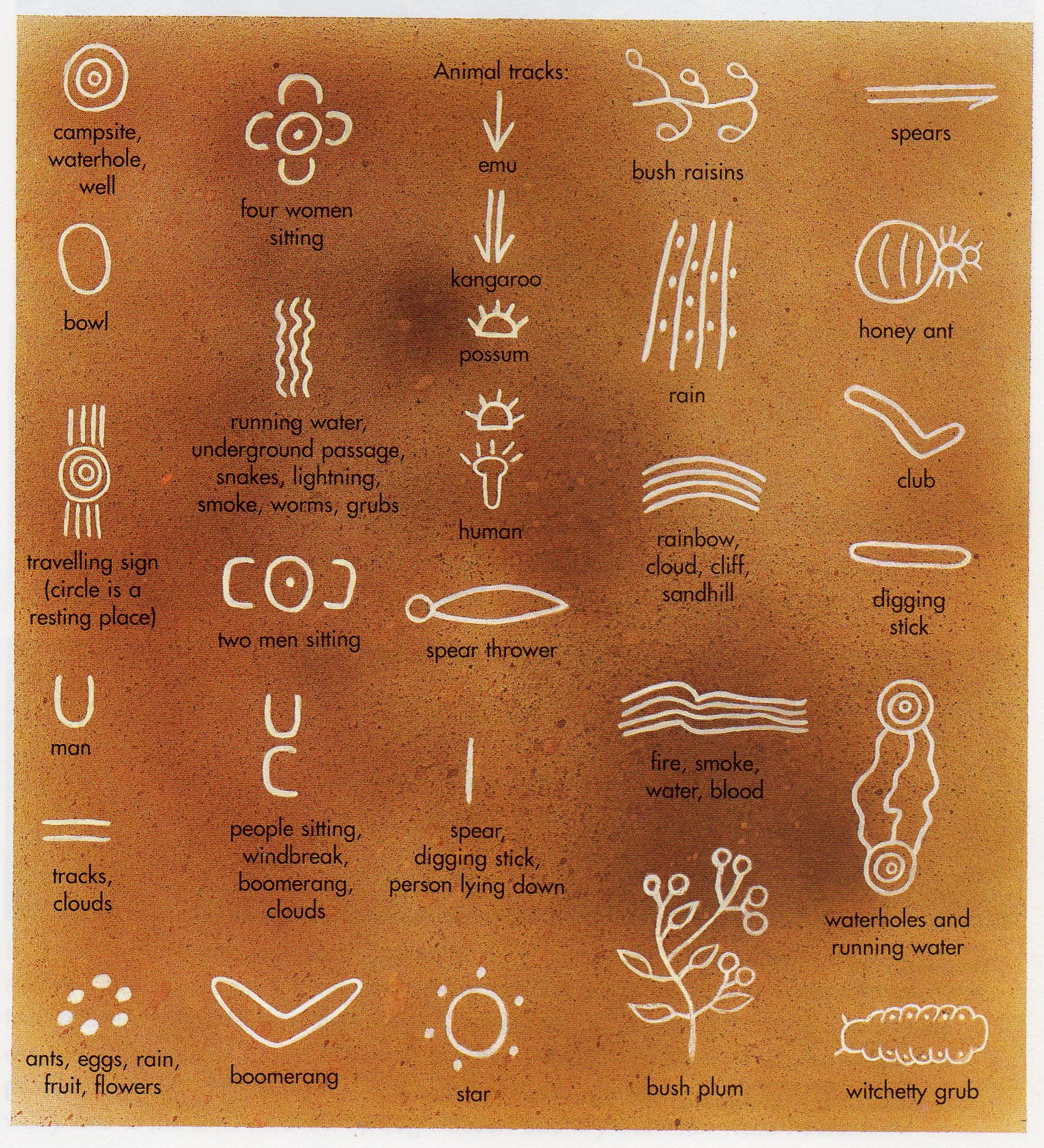
 Painting by Michael Nelson Tjakamarra.
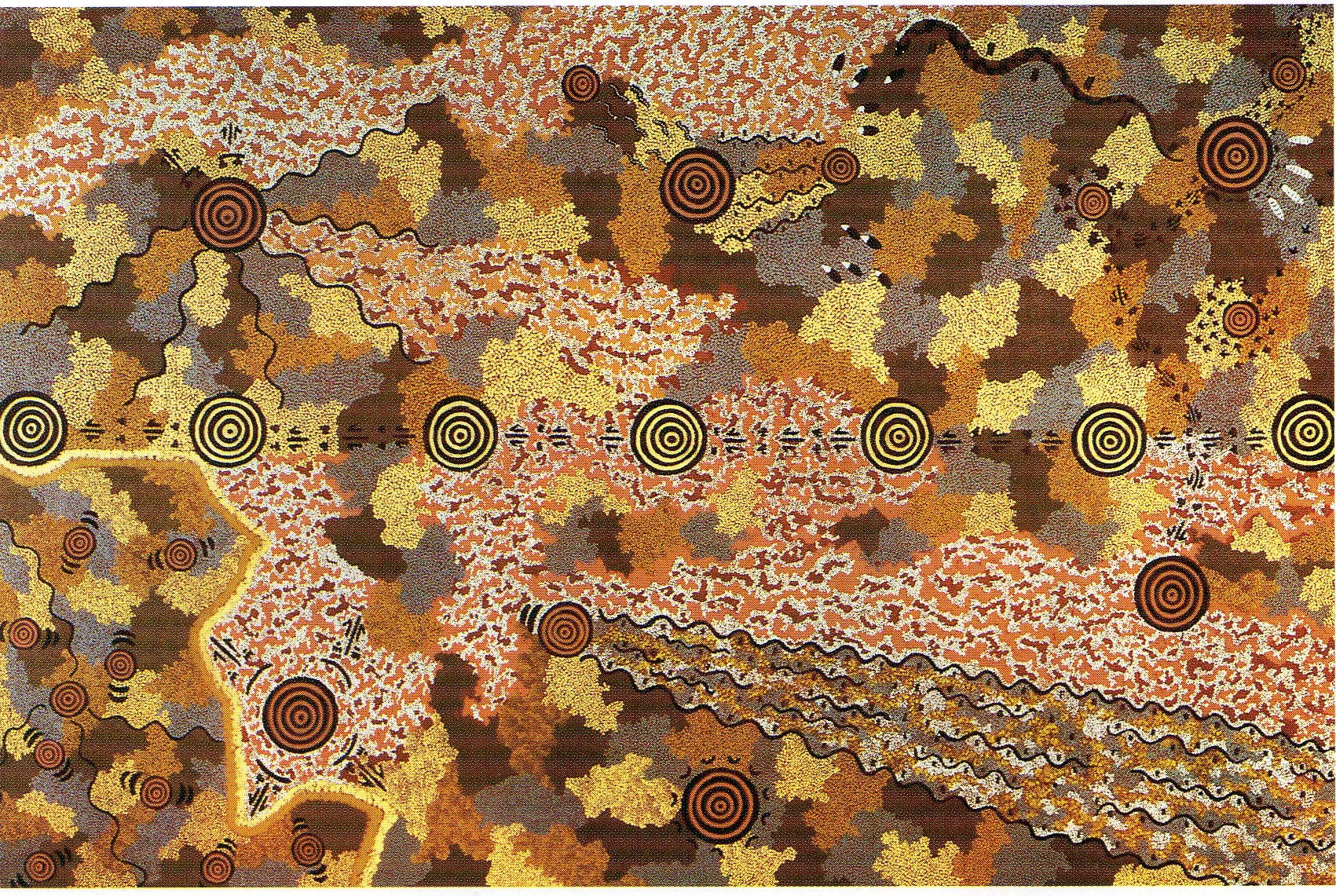
 And it’s interpretation.
Papunya Tula dot painting.
As mentioned before, in 1971–1972, the art teacher Geoffrey Robert Bardon (1940-2003) encouraged Aboriginal people in Papunya, North West of Alice Springs to put their Dreamings onto canvas. These stories had previously been drawn on the desert sand and disappeared with the next brise in a day or two. Now they were given a more permanent form.
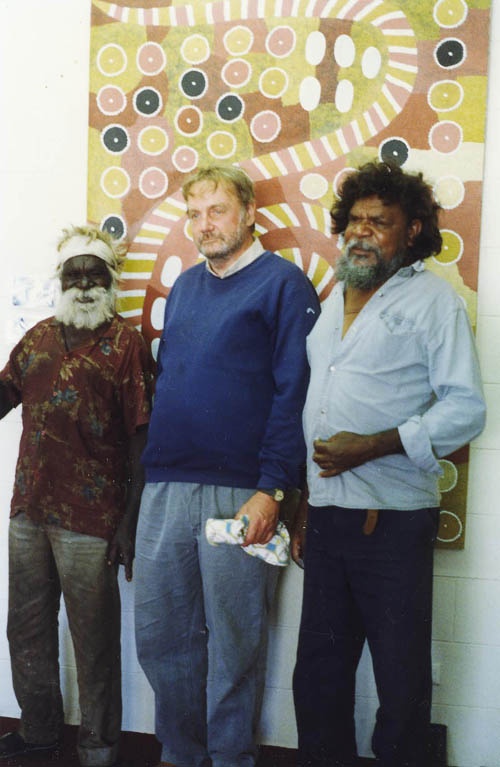
 Founders of Papunja Tula Artist PTY,. Geoffrey Bardon (center) with Billy Stockman (left) and Clifford Possum (right) infront a „Snake Dreaming“ dot painting of Billy Stockman.
The dots were used to cover secret-sacred ceremonies. Originally, the Tula artists succeeded in forming their own company with an Aboriginal Name, Papunya Tula Artists Pty Ltd, however a time of disillusionment followed as artists were criticized by their peers for having revealed too much of their sacred heritage.
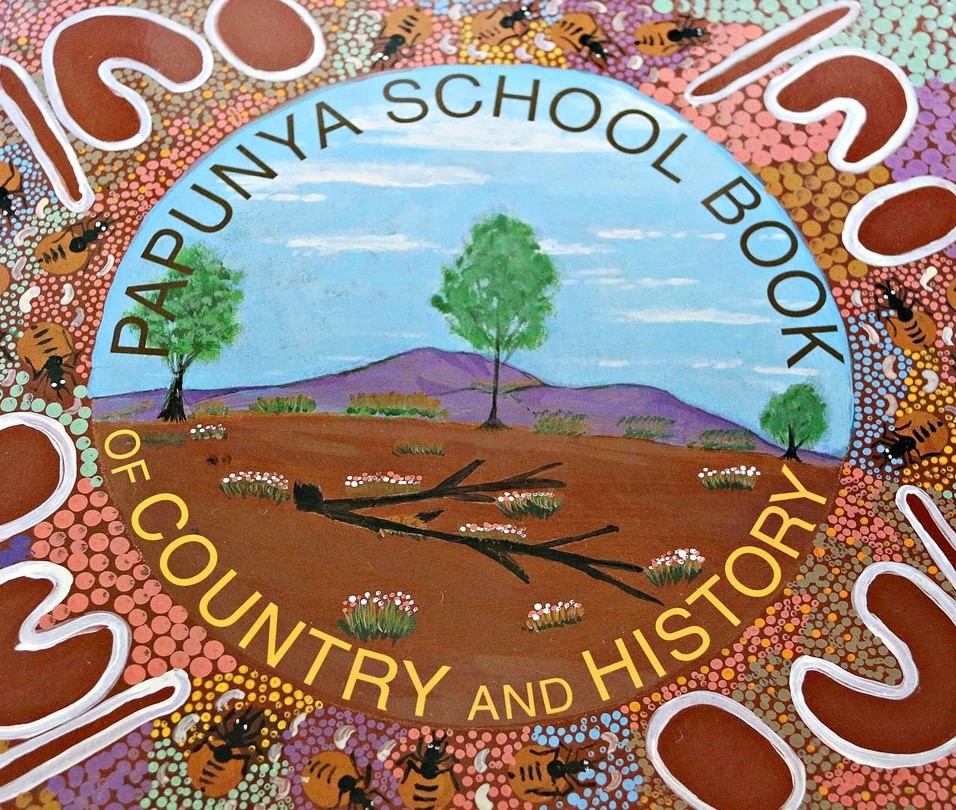
 Papunya school book created in desert art style.
Secret designs restricted to a ritual context were now in the market place, made visible to Australian Aboriginal painting. Much of the Aboriginal art on display in tourist shops traces back to this style developed at Papunya. One of the most famous artists to come from this movement was Clifford Possum Tjapaltjarri.
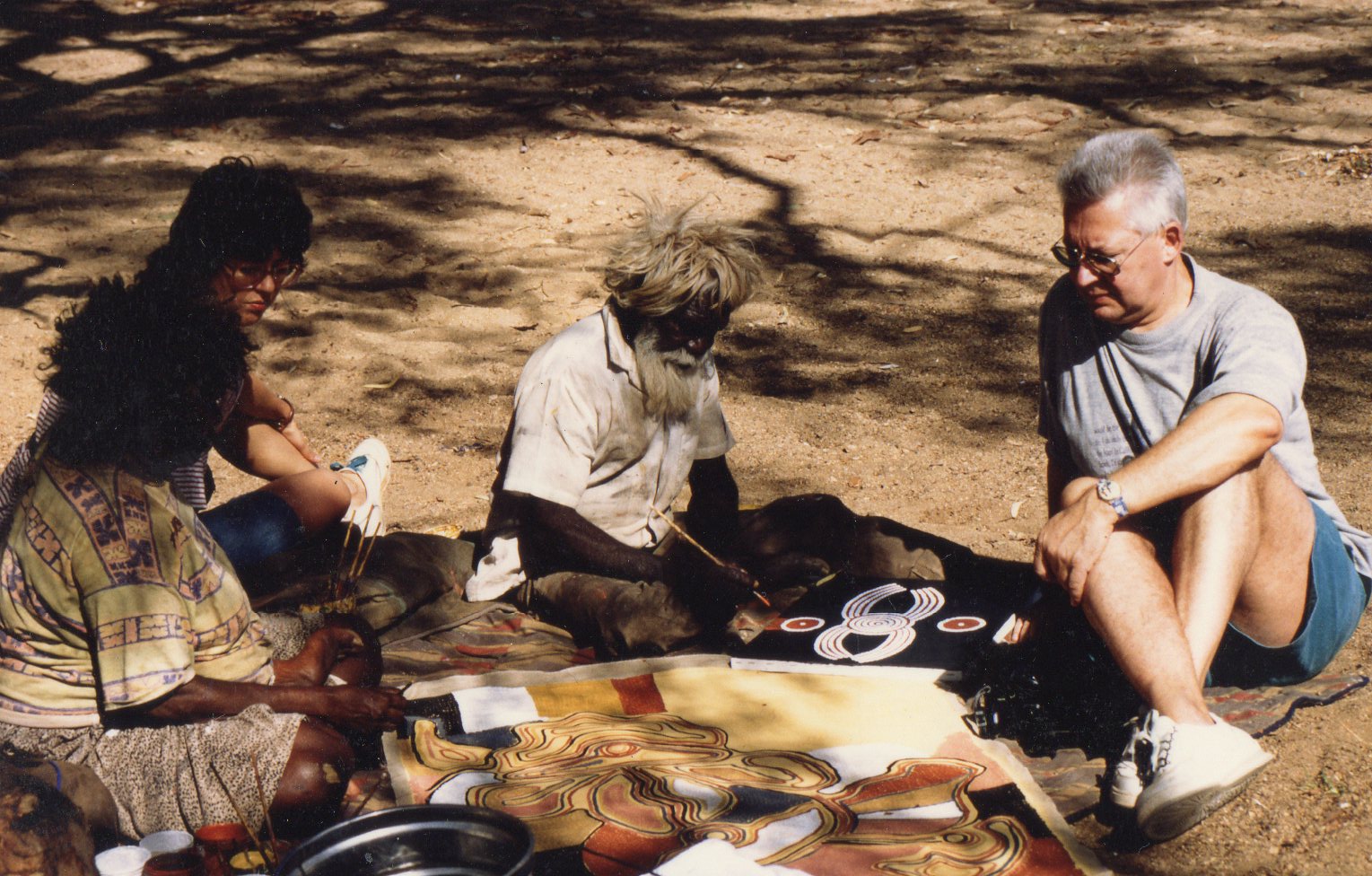
 Observing Billy Stockman and his wife. Billy, born 1927 is an extraordinary man and one who is one of the most well known and famous Western Desert artists.
To this, I would name it, first generation of dot painters (about 1972 till end 1980’s), also belong famous artists like Paddy Carroll Tjungurrayi,Big Dave Oldfield Tjupurrula, Colin Dixon Tjapanunga, Mary Dixon Nungurrayi, Dinny Nolan Tjampitjinpa, William Sandy, Eunice Napangardi, Billy Stockman Tjapaltjarri, Sonda Turner Nampitjinpa, Wenton Rubuntja, Michael Nelson Tjakamarra and many others.
 Negotiation with Wenton Rubuntja (Wenton is on the left with a hat) about purchasing this painting which he will finish for me the next few days.
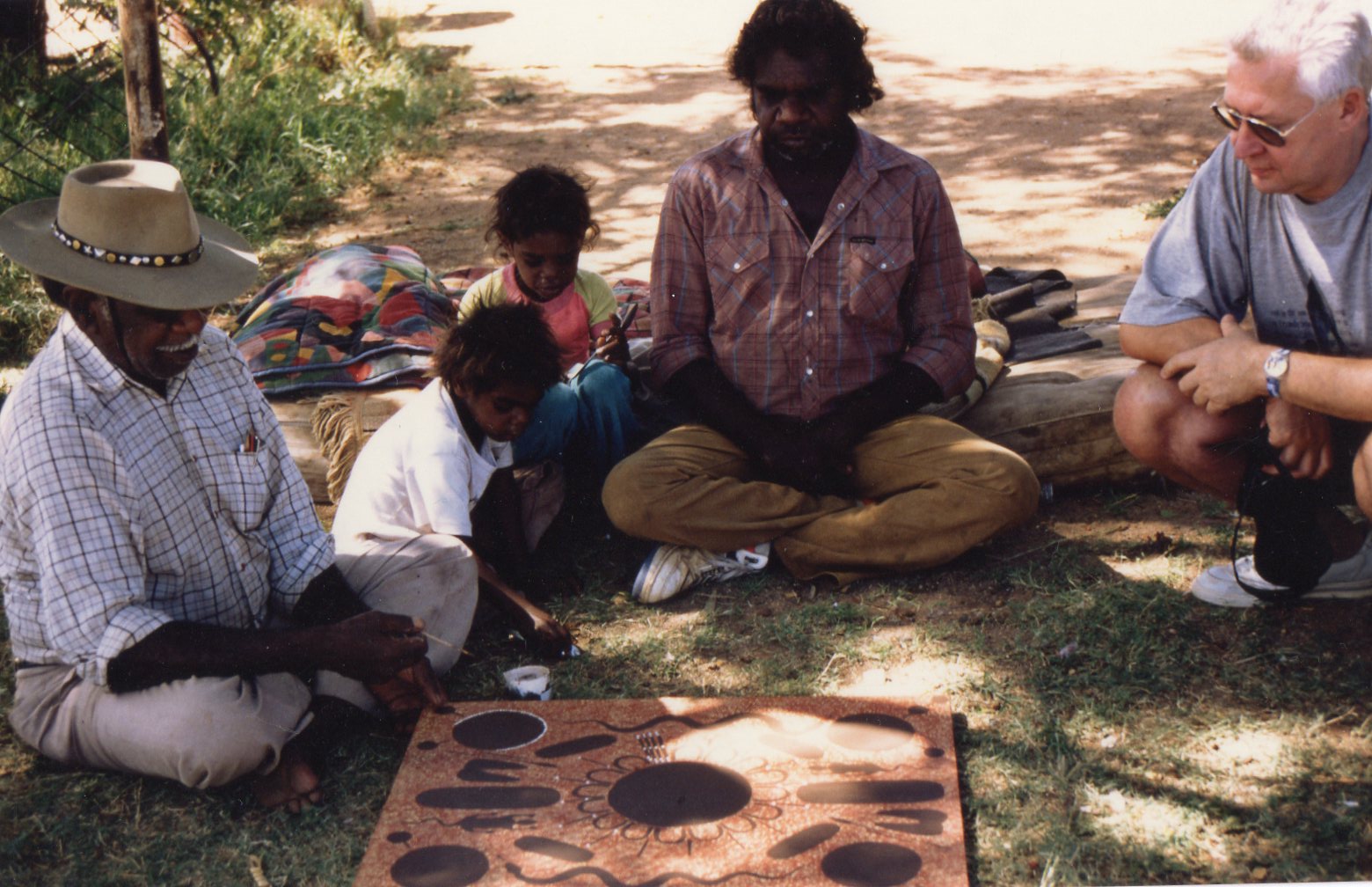
Wenton Rubuntja is a senior custodian of the Aranda Tribe and one of the traditional owners of the land around Alice Springs. He was previously Chairman of the Central Lands Council.
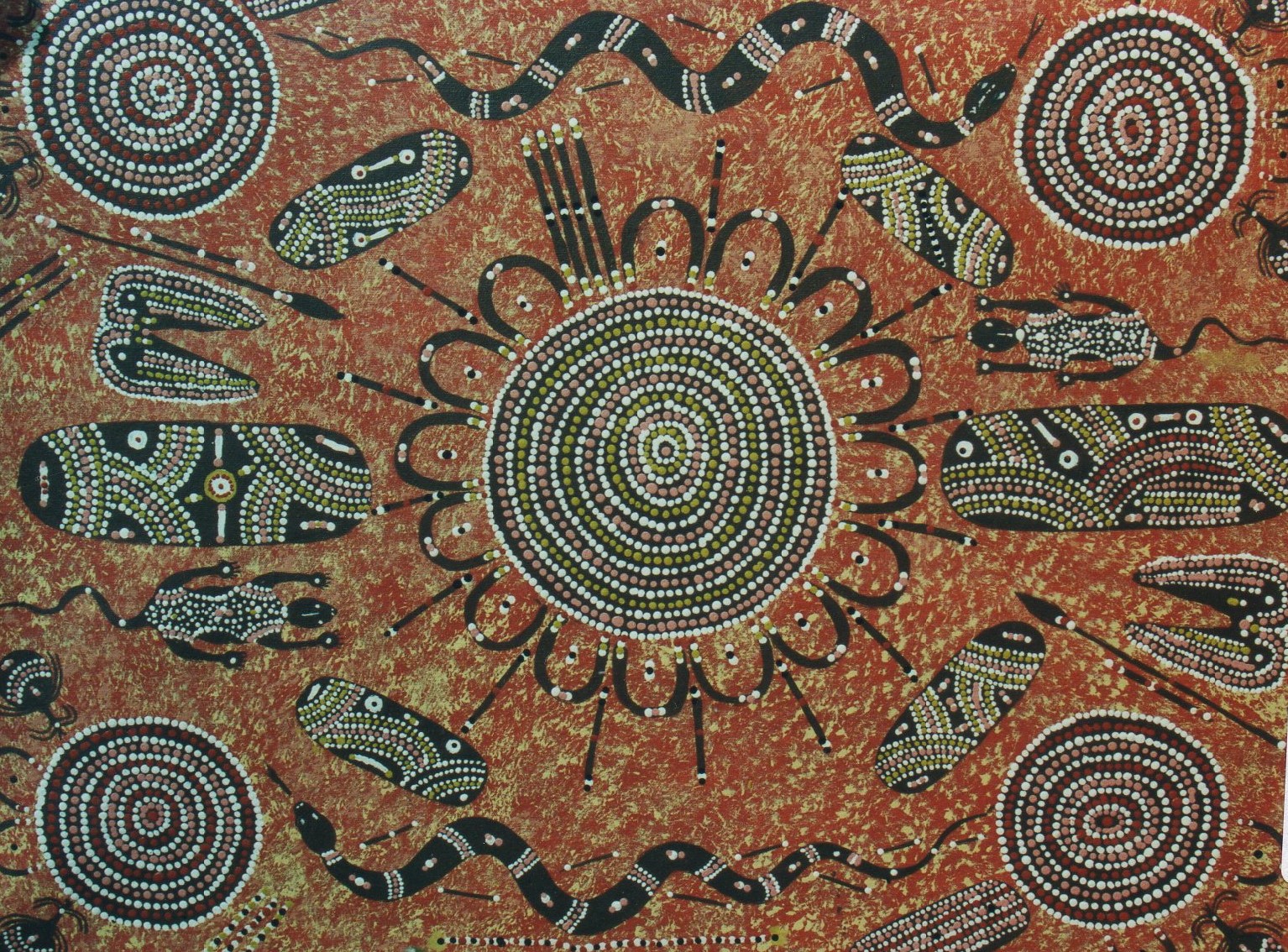
 Finally finished ! Wonderful detailed and painted in highest quality from Wenton Rubuntja. See the detailed background painting.
The only exception in style of traditional painting was from begin on Billy Stockman. Everyone used the „stick dotting method“, clear round dots made by wooden sticks.
Billy used a small brush and dotted with a short smudge, I call it „brush dotting“.
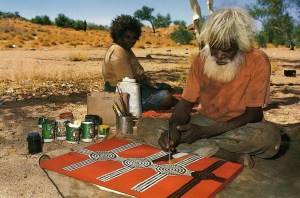
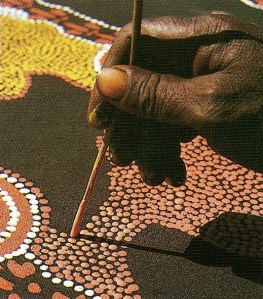 Billy Stockman with his brush dotting on left and the typical stick dotting on the right.
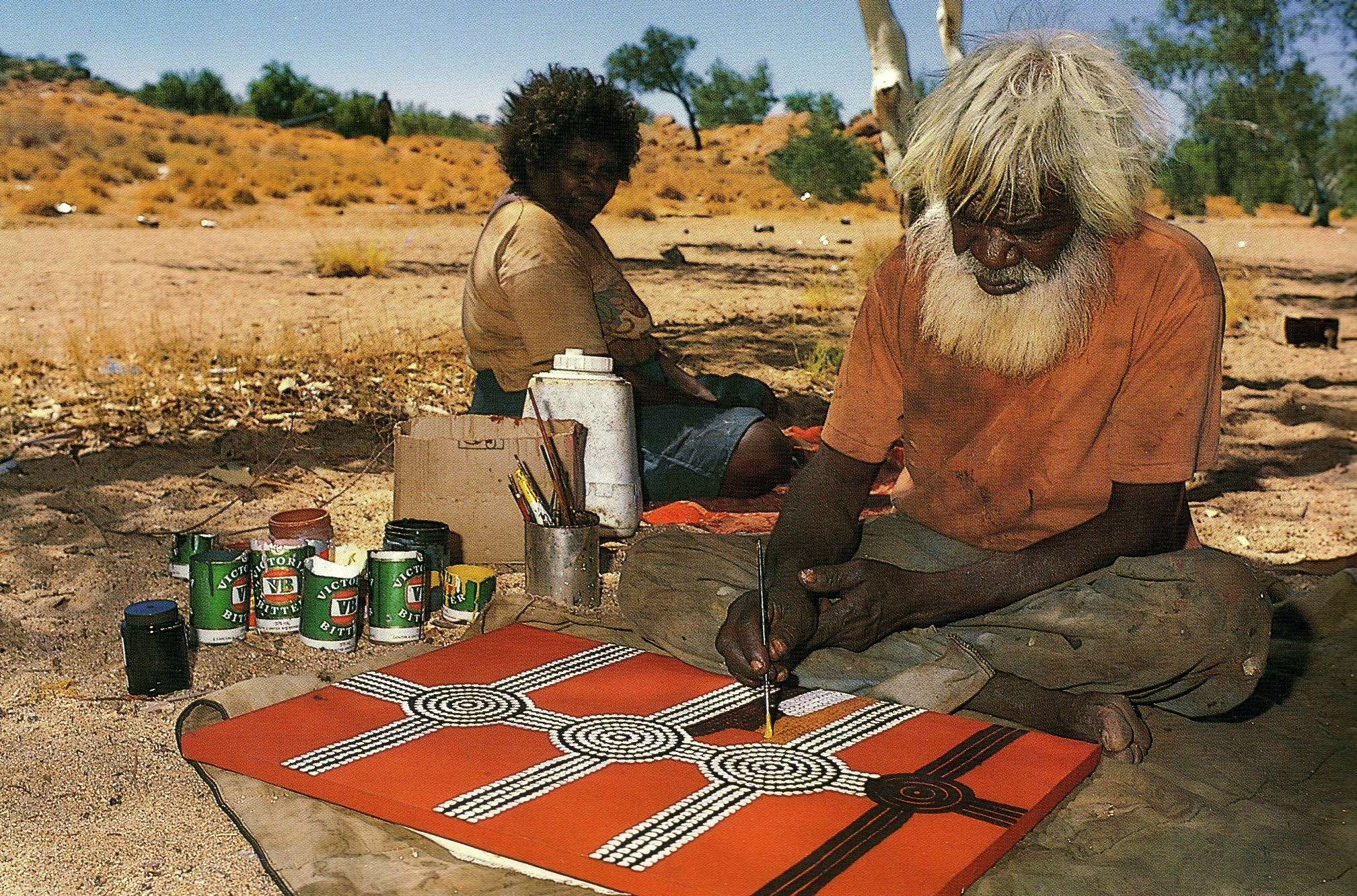
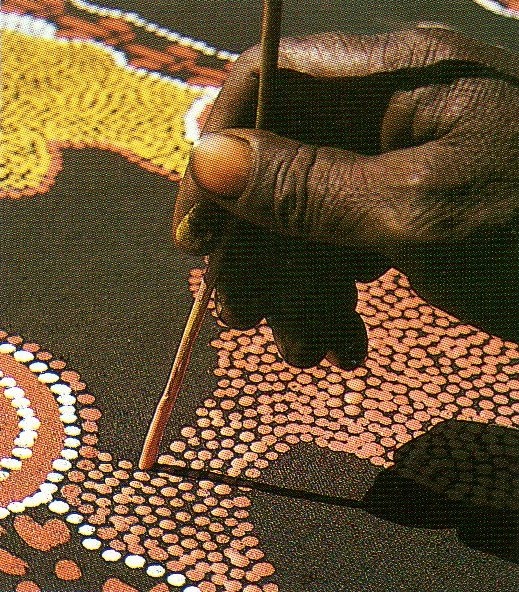
Billy’s dots look like small brush blurrings, from distance also recognizable as dot paintings. I asked Billy once, „Why are you doing it like this?“ His short answer was „Not me do, brush do !!“. What could I say?


Fascinating history of Australia and ancient art. Thanks!
LikeLike
Thank you so much Susan,
much more will come, so – stay tuned and enjoy, Mike.
LikeLike
This is great, like it very much !
LikeLike