
WARNING:
This article can contain images and/or names of and reference to both,
living and deceased Indigenous people from diverse cultural backgrounds
and communities in Australia.
This warning is written out of respect to the Aboriginal culture.
Before you read this article, please give yourself a favor and read the previous articles “Australia – Aborigine Art 1,2,3” first. Just click right on Art and you’ll find it easy.
Australia. A country which I visited very often for over 50 years and lived there permanently for about 12 years. During all those years I traveled hundreds of thousands of kilometers through Australia, seeing almost every corner of this amazing continent.
 Central desert near Finke river, just my own tracks.
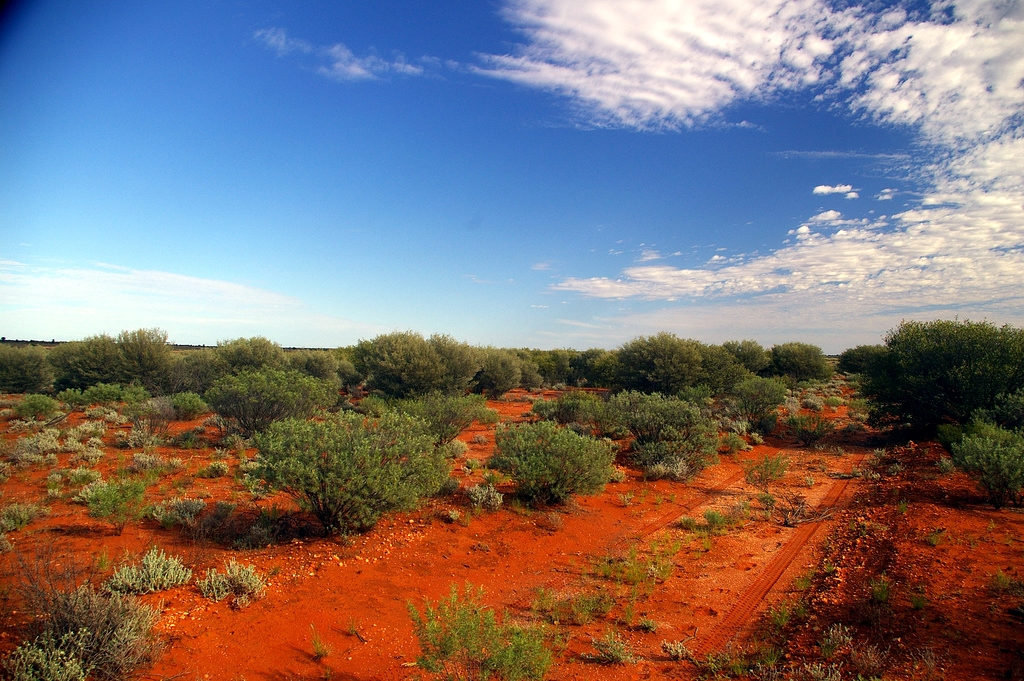
In the years mid 1980’s to early 1990’s I specialized in collecting art from the Central Desert area of Australia, met almost all artists which were important to this time and my collection. Now it is the time to separate myself from the last part of my collection.
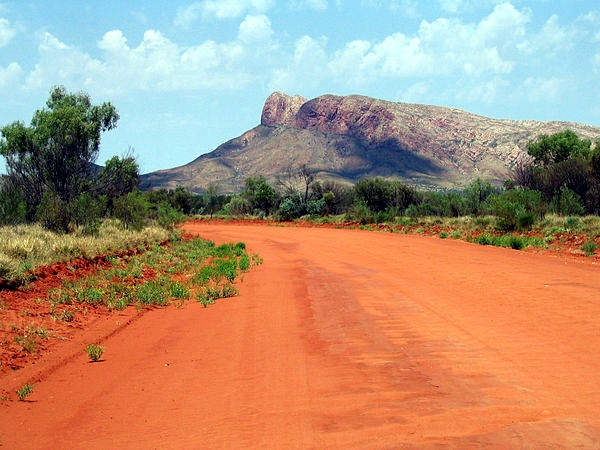
 The road to Haasts Bluff, 230km west of Alice Springs.
All of the here offered paintings are from artists of the so named “first or second generation of Central Desert artists”. I’ll take the chance to inform you about it in this blog and will also offer the opportunity to purchase the art if you like. Most of the shown art, from these here shown artists, is not available anywhere in the world.
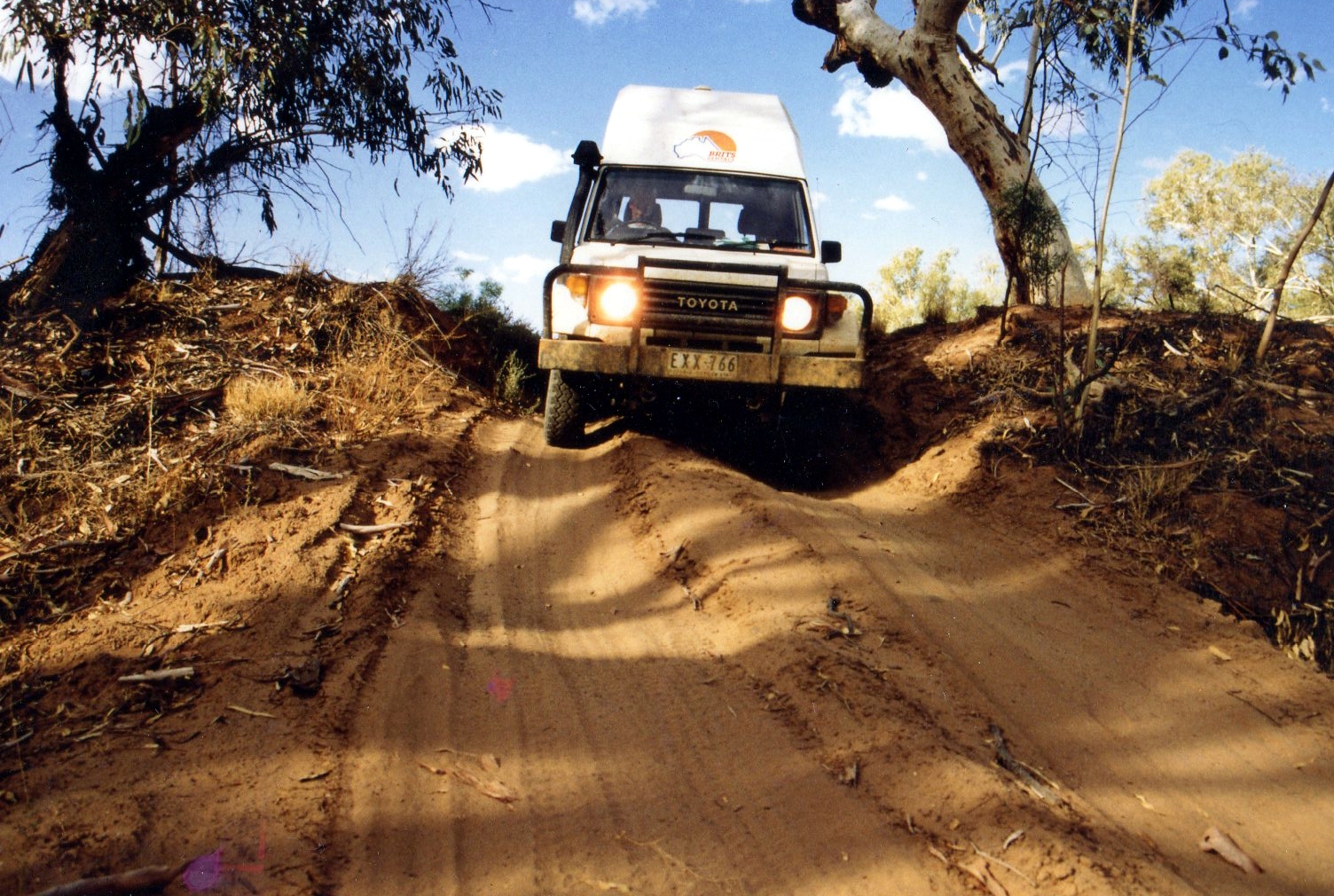
 Sometimes hard to reach the artists in their country. Here to see Billy Stockman about 30 kilometers off Papunya. Impossible without a Four Wheel Drive.
Young Timothy Dempsy.
Born at Haasts Bluff c. 1941. Passed away 2000. Young Timothy was the older brother of Barney Daniels, with whom he shared his country, which was close to their mothers country in the Papunya/Napperby area. Their father was a Walpiri speaker from the Lajamanu area, giving the brothers two widely separated heritage countries.
He was married to Epingka Nangala and they had three daughters and a son. Timothy identified his tribal affiliation as Luritja. He received some schooling at Narwietooma station and he worked as a stockman then as a mechanic on bore maintenance before settling at Papunya in the early 1960’s. He helped transfer people from Haasts Bluff to the new settlement at Papunya.
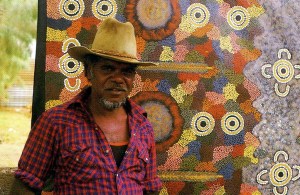 Young Timothy Dempsey.
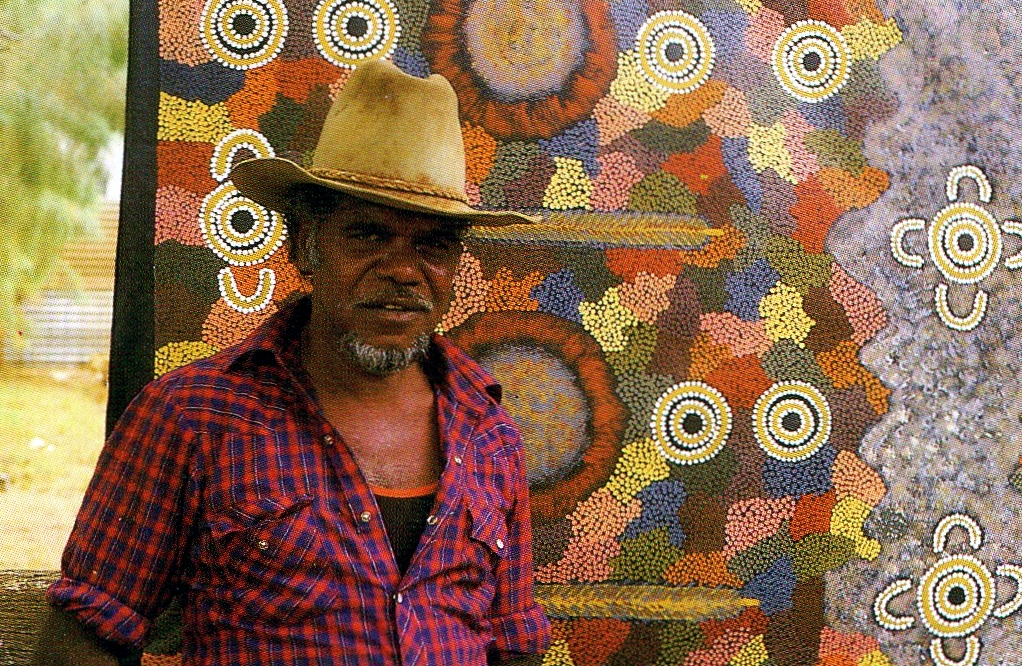
At Papunya he was introduced to painting by watching Clifford Possum with whom he shared a camp. He lived near his traditional country on the „Five Mile“ outstation near Papunya and he is related to the artist Mary Dixon. He painted centipede, spear ceremony, barking spider and hunting for kangaroo dreamings.
This magnificent painting shows Timothy’s excellent use of colours, strong symmetry and outstanding dot work and the photo does not do this large painting justice. It shows why Timothy’s paintings are in high demand and since his passing they have more than tripled in value and are becoming very difficult to get hold of.
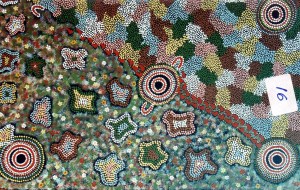
Painting 15: Tims Mother Dream.Womens Dancing Dream. 1988, 82cm x 125cm. Price on request.
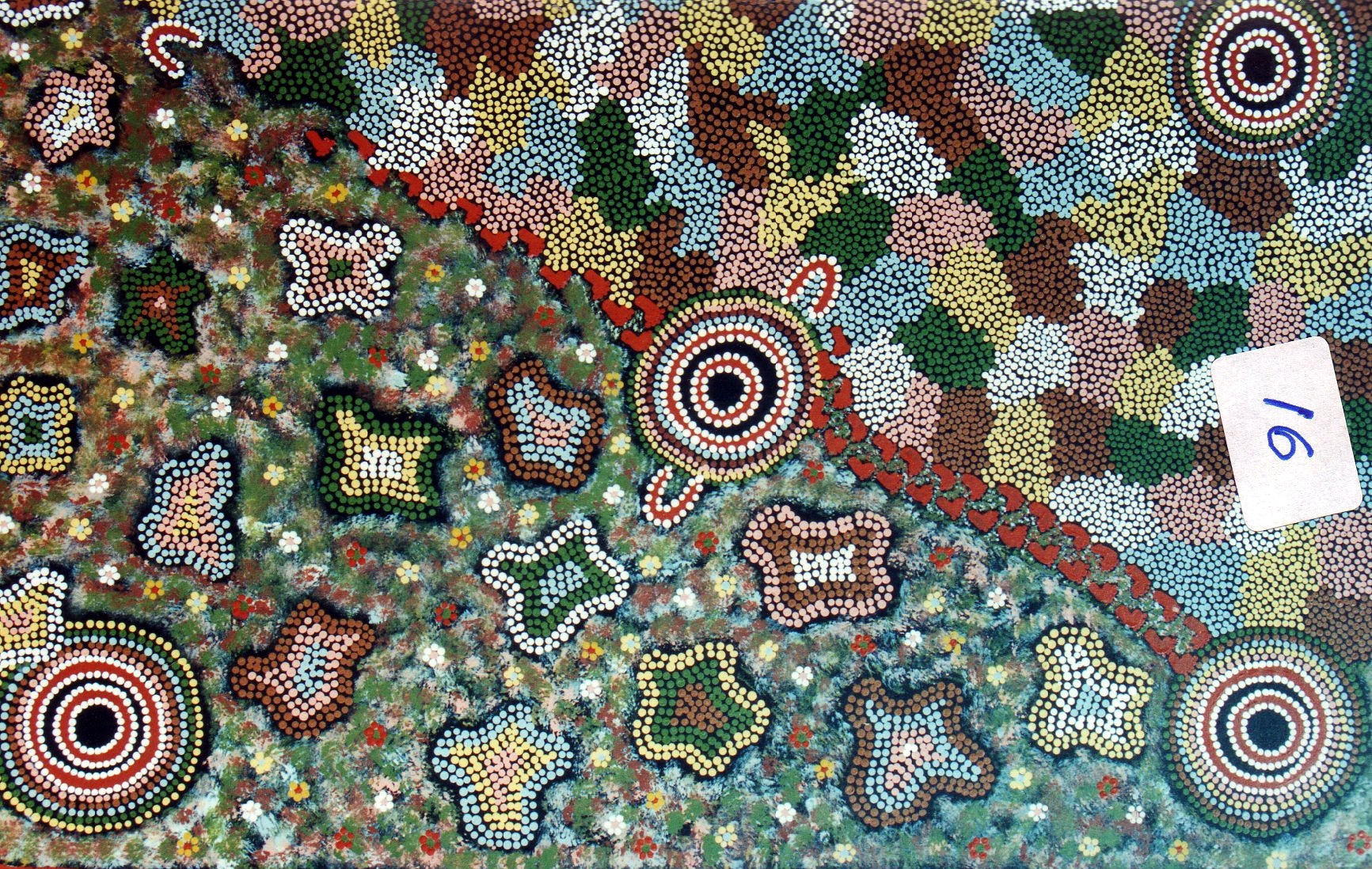
Some of the roundels are meeting places where women gather and others are where the men gather for the spear straightening ceremonies. The artist would give no further information on this story due to the sacred nature of this dreaming. The title gives us the explanation “ Tim’s Mothers Dreaming – Womens Dancing Dreaming – Private“ !!
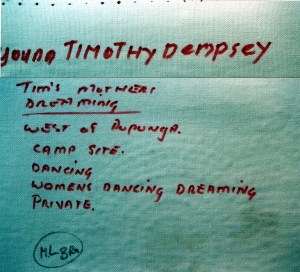 Original rear side signing of the artist T. Dempsey.
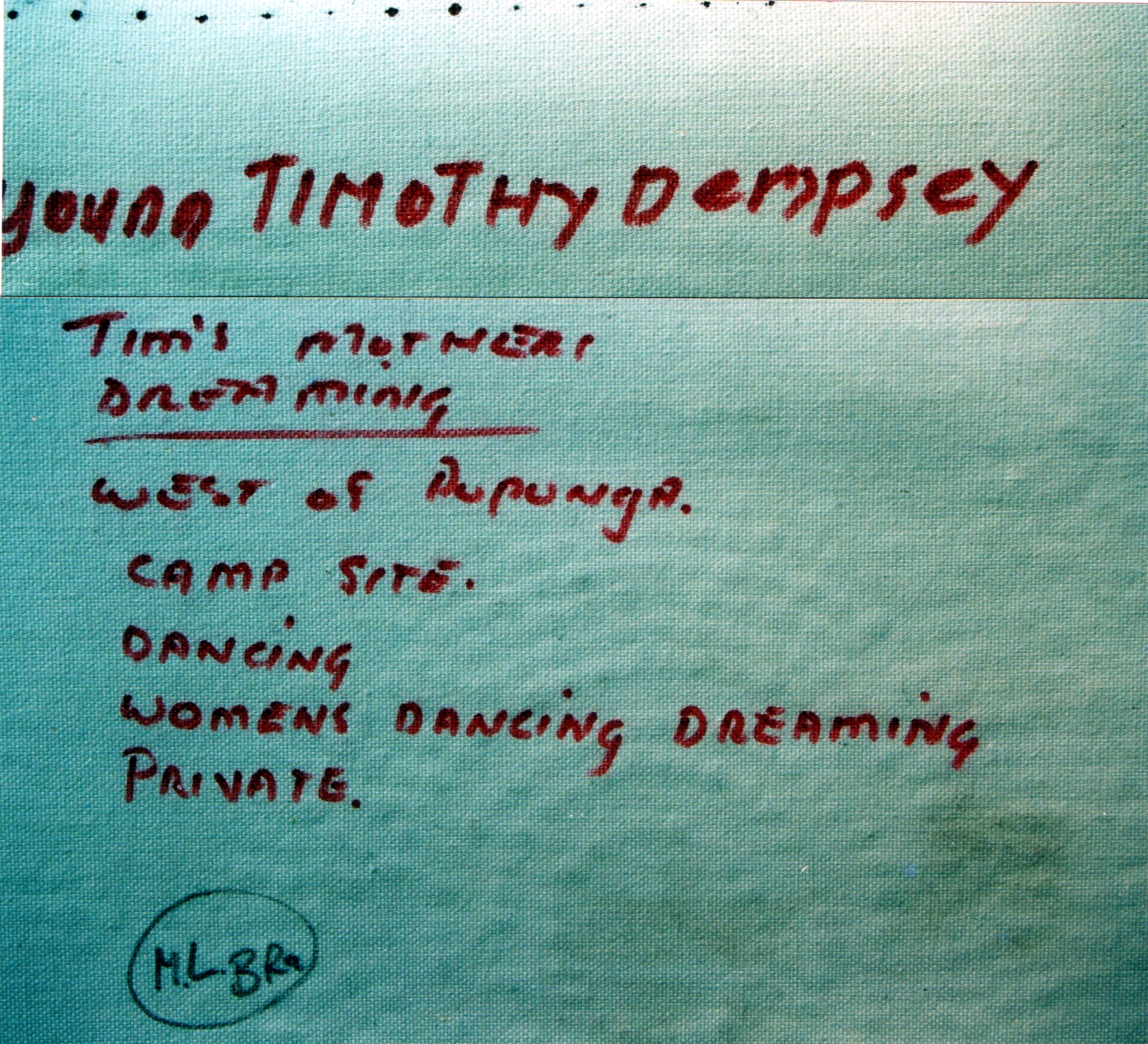
This is one example how the artists sign their paintings on verso. All paintings I offer (except No. 1,2,3 – they were purchased as student works from Yuendumu art school) are signed by the artist. This one from Young Timothy Dempsey we were able to buy out of his private collection, see his signing „private“. If one likes to see a signature just write and I am happy to send you a pic. Your questions won’t be published – if you wish !!
Billy Stockman.
Billy Stockman Tjapaltjarri is an iconic figure in Aboriginal Art. His date of birth is set in approximately 1927 at Ilpitirri near Mount Denision in Central Australia. As a young child he witnessed the Coniston massacre in 1928 in which his family were slaughtered. He survived as his mother had hidden him in some nearby bushes; the only other survivors were the men who were out hunting at the time, this included Billy’s father.
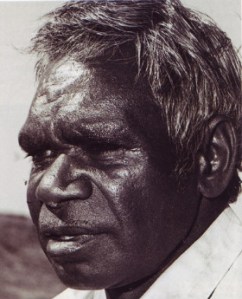
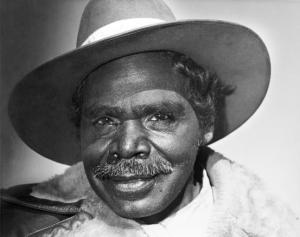 Billy Stockman in the 1950’s and 1960’s. Always a warm smile in his eyes.
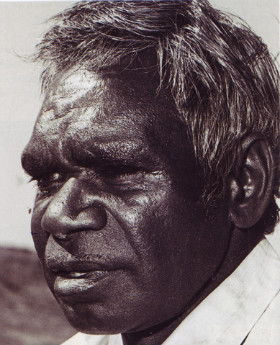
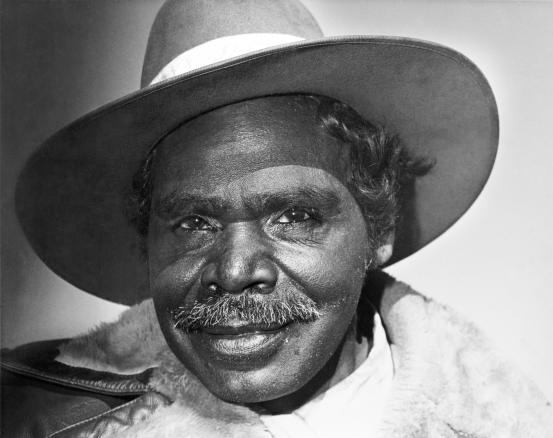
Billy was adopted and raised by Cilfford Possum Tjapaltjarri’s mother, his aunty, and he grew up on Napperby Station. As a young man he worked as a stockman and this is where his nickname “Stockman” came from. He, like many Aboriginal people at the time, was moved to Papunya as part of a government re-settlement program and began working as a cook and a yards man at the Papunya School.
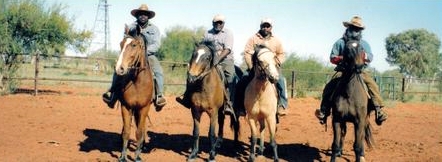
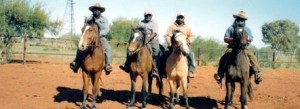 The „Four Musketeers“, stockman of Atula Station, from left to right: Billy Stockman, Kenny Williams, Andrew Reiff, Gordon Cavanagh.
In about 1955 he married Uta Uta Tjangala’s (another famous Aboriginal artist) niece Lucky. He was also known for his mechanical skills fixing cars. He, like Cilfford Possum Tjapaltjarri, also began his artistic career by carving wooden animals which were sold at the arts and crafts marketplace.
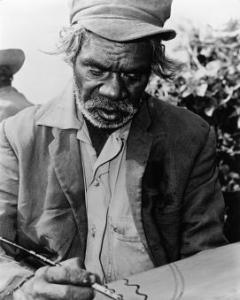 Billy Stockman in 1972, when he started his artist painting career.
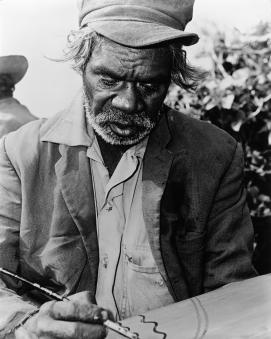
In 1971 the Papunya School arts teacher requested a mural be painted at the school, given Billy’s involvement and activities in the community at the time, he along with several other men, under the guidance of leaders, created the “Honey Ant Dreaming” mural.
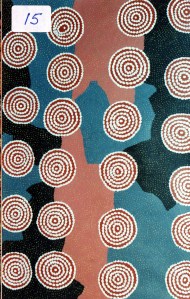
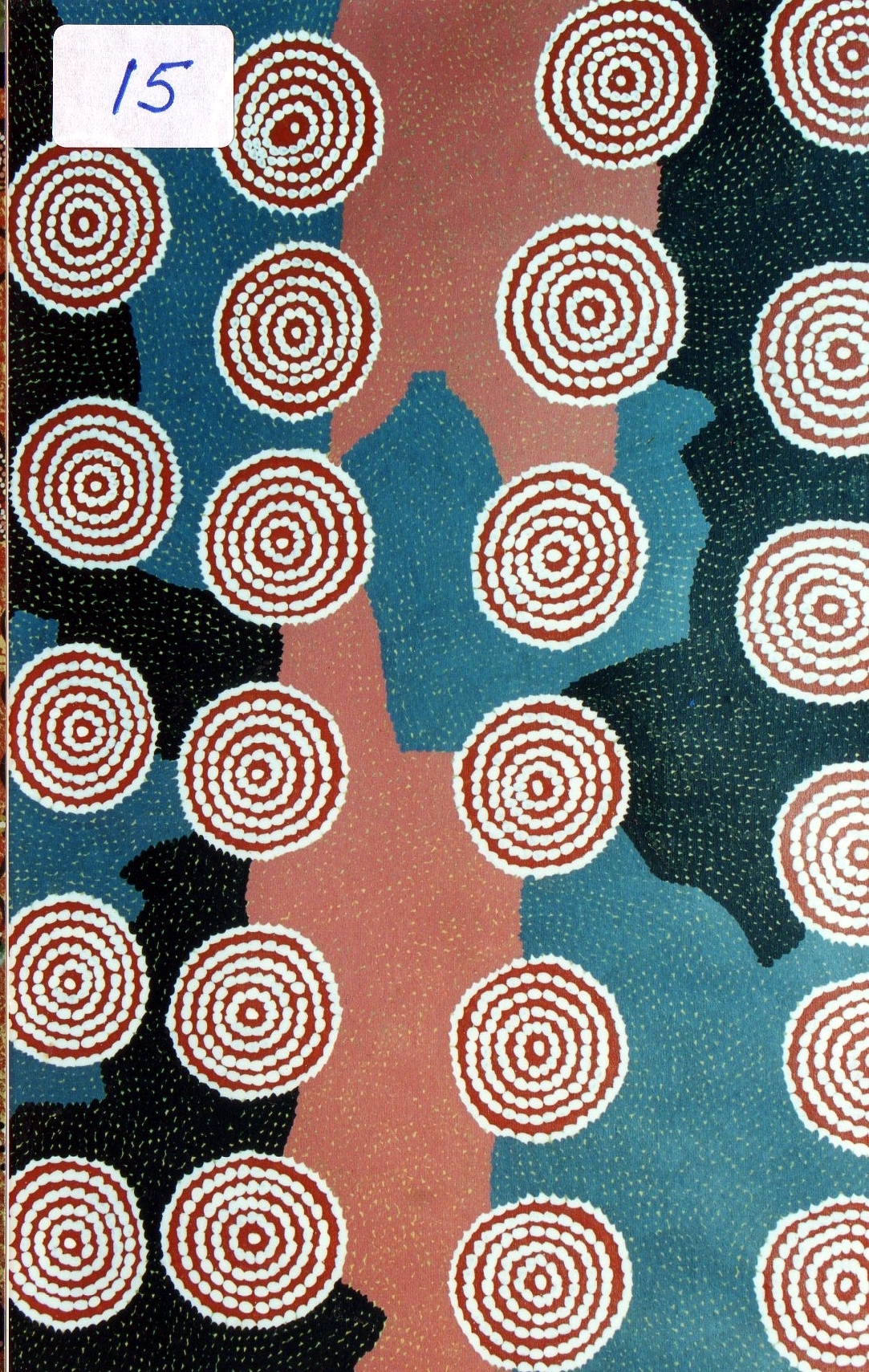
Painting 16: Budgerigar Dreaming, 1987, 90cm x 120cm. Price on request.
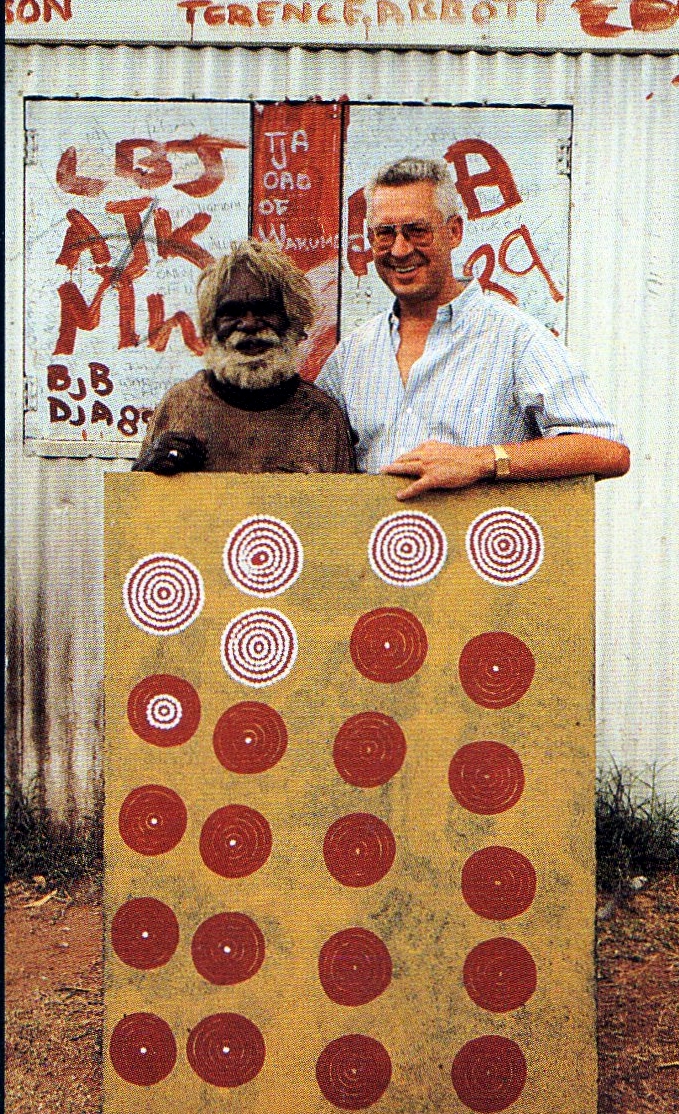
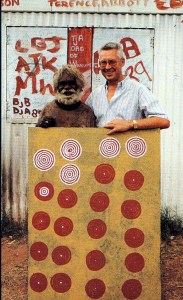 Both of us in early 1987, Billy just started with the painting.
It was the first Central Desert art to be exhibited publicly and shot Billy into the spotlight of the Aboriginal Art Movement of the time.
Throughout the 1970’s Billy was influential in bringing traditional iconography of Aboriginal people into the public forum and during this period he held many important and key positions. In the 1970’s he was a Central Australian delegate to the NAC, an Aboriginal Arts Board Members from 1975 -1979 and one of the first chairman for Papunya Tula Artists, holding the position from 1976 – 1977.
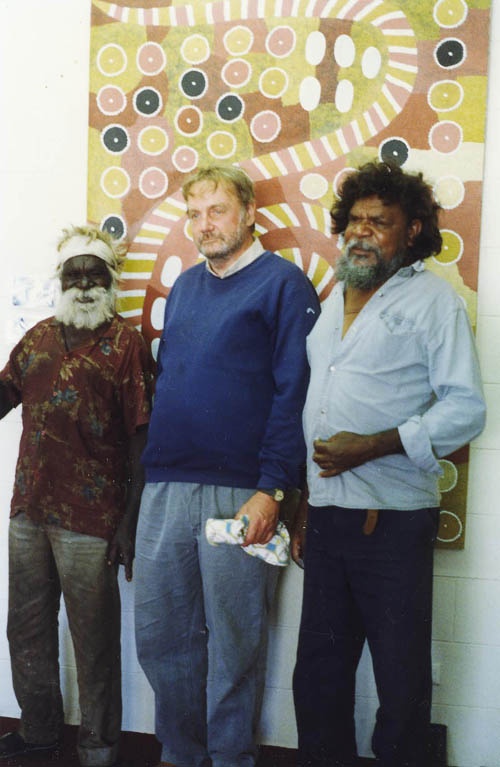
 Founders of Papunja Tula Artist PTY,. Geoffrey Bardon (center) with Billy Stockman (left) and Clifford Possum (right) in front a “Snake Dreaming” dot painting of Billy Stockman.
He had travelled both nationally and internationally for exhibitions, a key exhibition was held in 1988 in New York, USA, where he and Mick Nelson Jagamarra were commissioned to make a sand painting at the Asia Society Gallery.
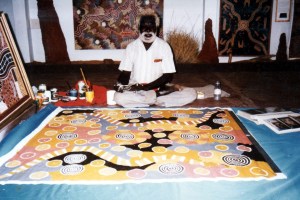 Billy Stockman just finishing one of his famous Snake Dreamings, shown in the late 1980’s in a gallery in Alice Springs.
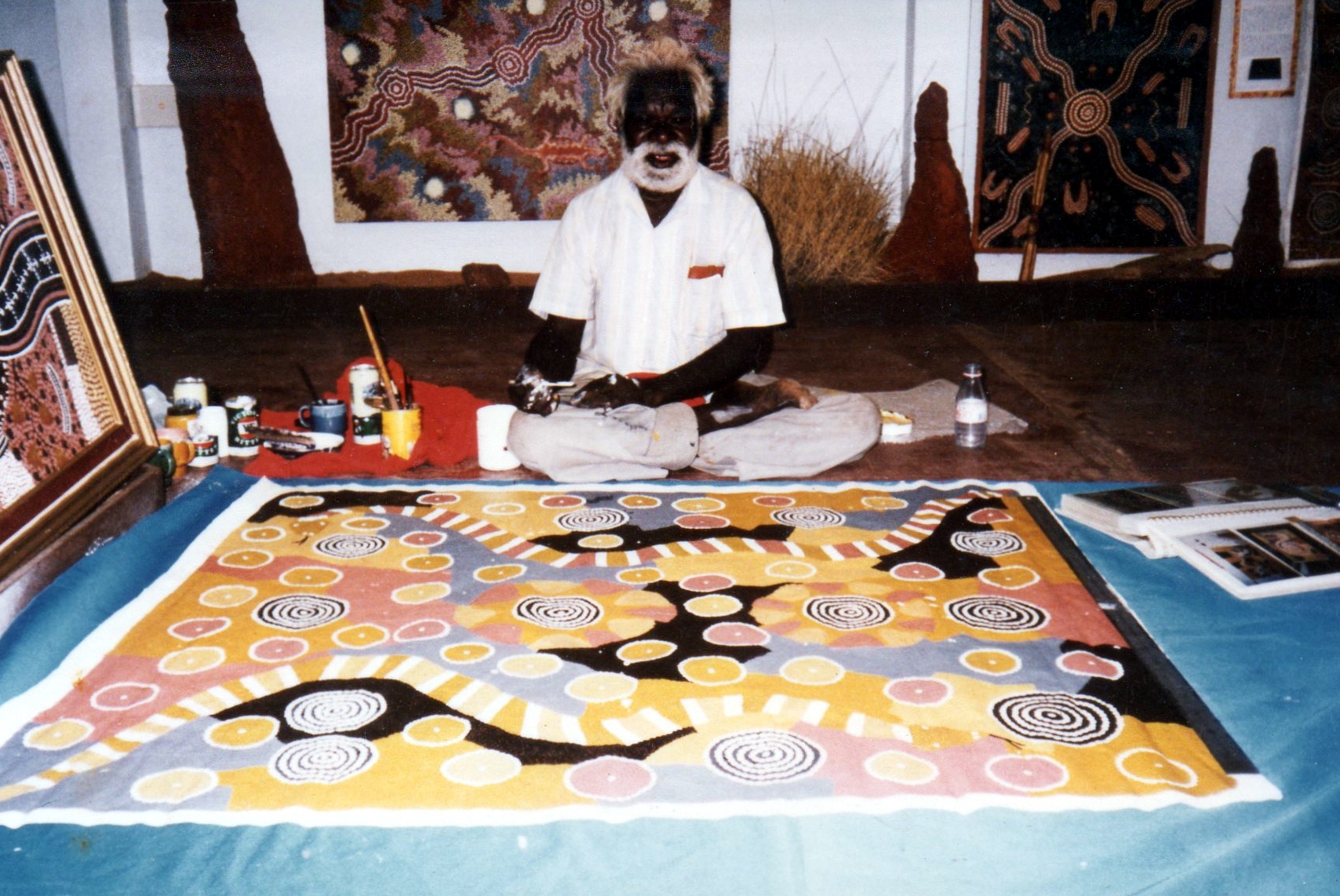
Not only was he a legendary founder of the Aboriginal Art Movement but he was also a pioneer in the country camp movement and he later moved west to his own station, called Ilili. He retired from painting in the 1990’s. In his later years he spent much of his time in Alice Springs and in his 80’s moved to Hettie Perkins Aged Care Home in Alice Springs, where he died in September 2015 at the age of 88. What a life !
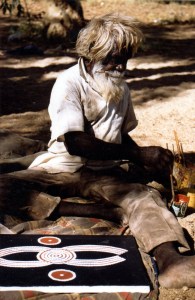 Billy full in action at the age of 65. Click on pics – most will supersize.
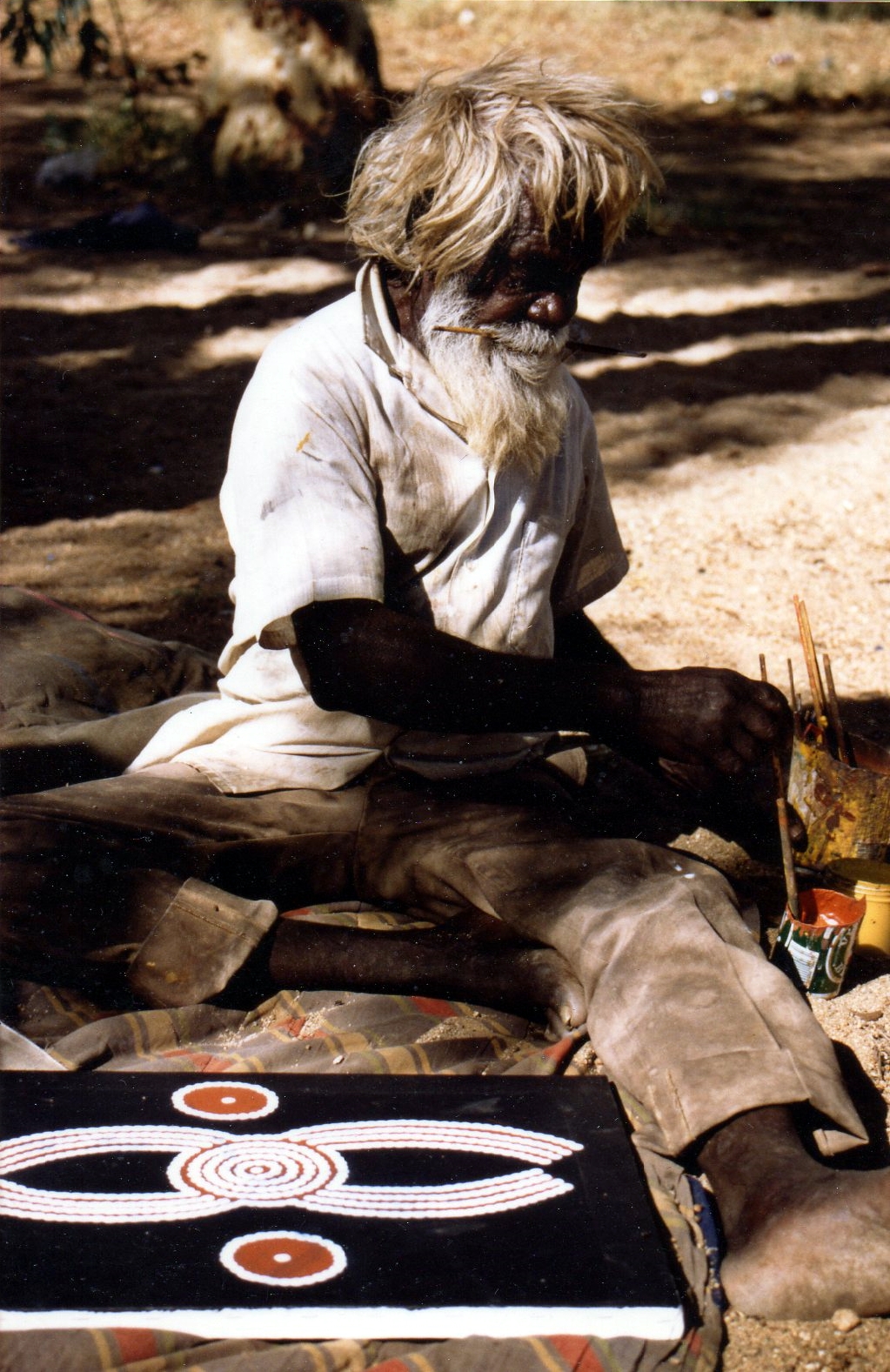
His key paintings represent Dreamings of the Budgerigar, Spider, Bush Potato, Wallaby and Snake. However he also paints Men’s Ceremonies.
His art is represented in corporate and private collections throughout the world. The National Gallery of Victoria paid $200,500 for his Yala Dreaming painting which was 54.5cm x 46cm in size. He is an extraordinary man and one who is one of the most well known and famous Western Desert artists.
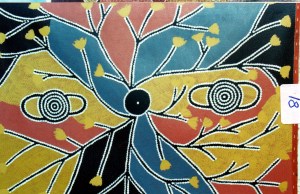
Painting 17: Bush Ceremony Dreaming, 1987, 90cm x 120cm. Price on request.
Central Art had the privilege of acquiring one of his paintings and several of his coolamon’s. In the painting Billy used traditional aboriginal iconography to represent ceremonial places associated with the Mount Denison area, which is found North West of Papunya in Central Australia.
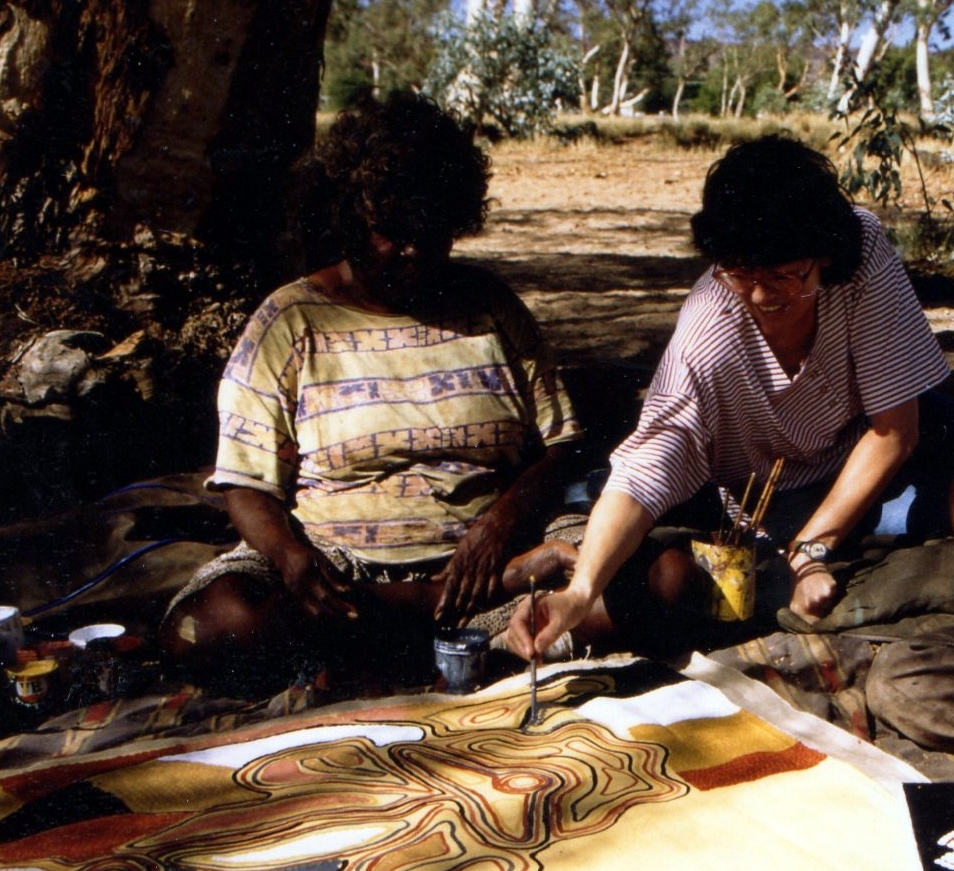
 Billy’s wife Lucky teaching how to paint.
He is a traditional custodian of this Dreaming, which is determined by his skin name (the Tjapaltjarri and Tjungurrayi skin groups hold this Dreaming). The ceremony involves the elders preparing the ceremonial ground and supervising the dancers being painted with the appropriate designs.
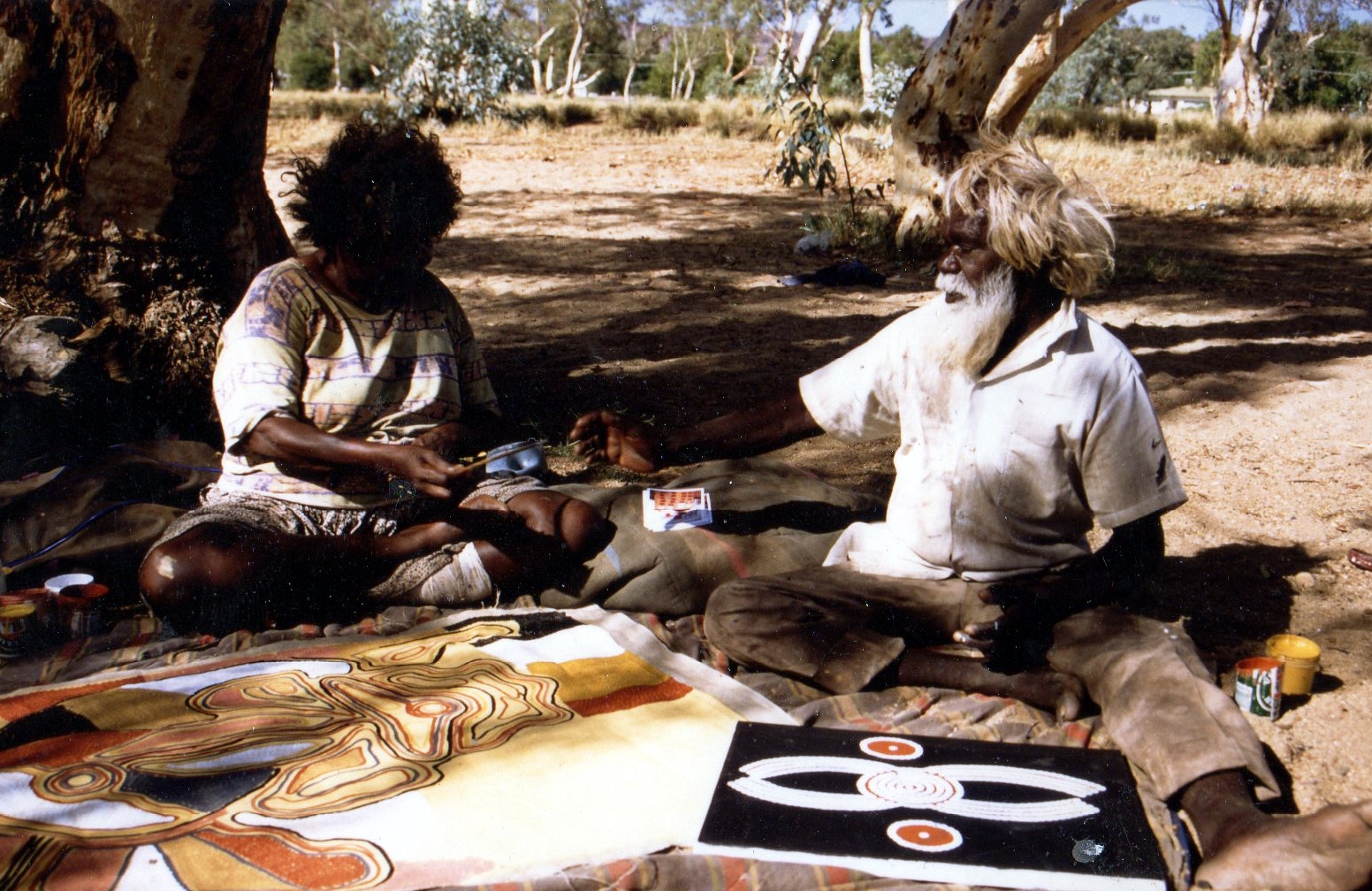
 Billy and his wife explaining to us the meaning of their Dreamings and how to transfer them into paintings.
Billy was able to bring ancient cultural knowledge, stories and lore into the modern era with his artwork providing the link. Central Art acknowledges the important role that Billy has made for Aboriginal Art and highly recommends Billy’s artworks as he is considered a highly collectable artist and his art would make a solid investment piece.
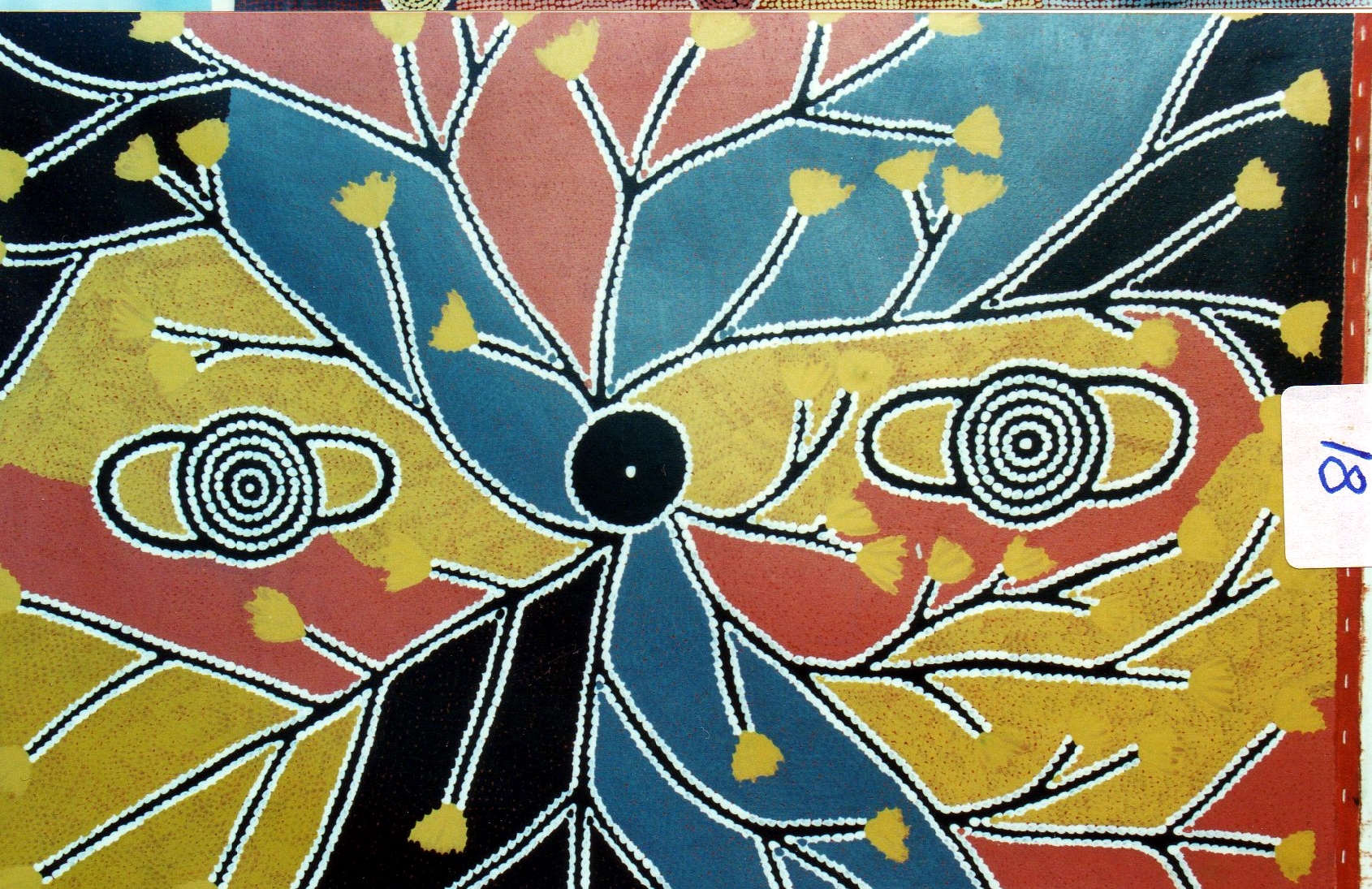
Painting 18: Kunja Snake Dreaming, 1988, 134cm x 148cm. Price on request.
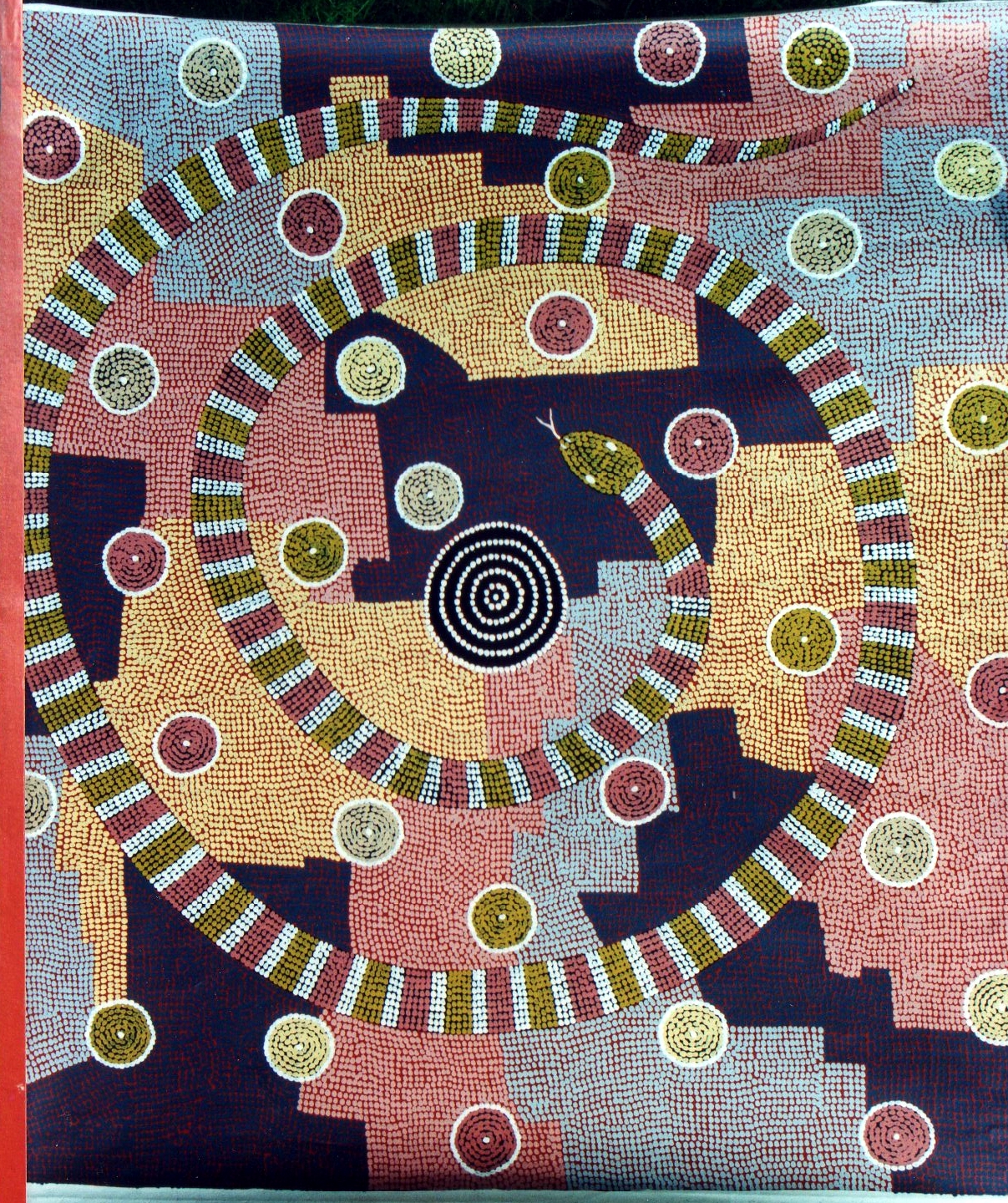
The Carpet Snake Dreaming story was passed on to Billy Stockman Tjapaltjarri. The painting depicts the carpet snake hunting in the spiky, spinifex grass which grows in abundance on the desert earth near Napperby, Mt Denison in Central Australia. The striped body paint design of the snake indicates it is painted up for ceremony.
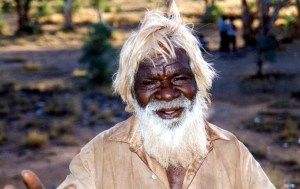 GREAT LITTLE MAN – showing always a warm smile !!
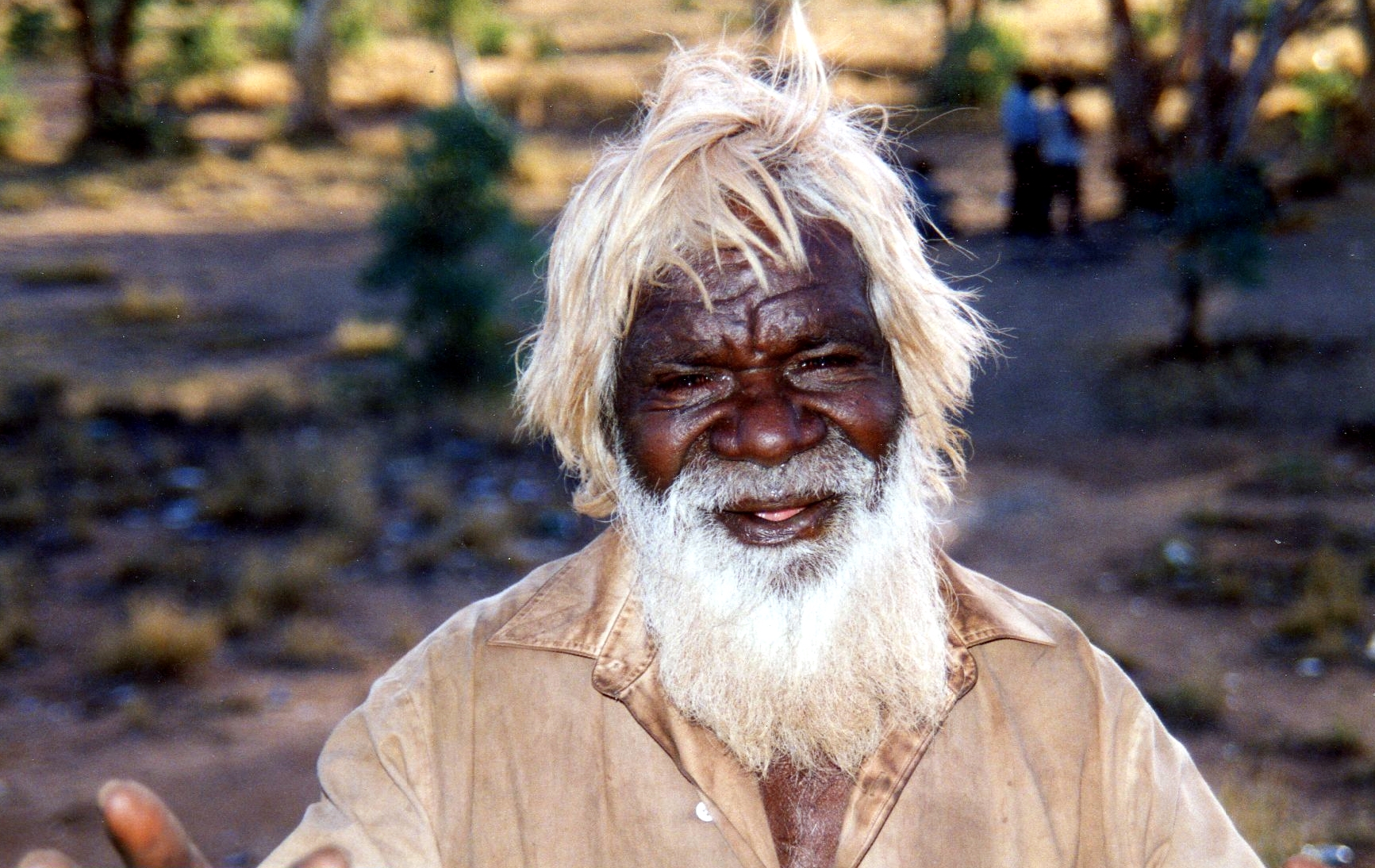
This painting 18 takes place at Mount Pennison on Napperby Station. The central roundrals depict a soakage hole, sacred to the Tjapaltjarrikinships. The Kunja Snake is seen guarding the site, the smaller outer roundrals depict tradional body colors, the background depict the colors of the desert. As custodian of the totem, Billy had cultural responsibility to look after the carpet snake to ensure its survival in the environment.
Eunice Napangardi.
Emerging from the arid spinifex country of Papunya in Central Australia, Eunice was one of the first Aboriginal woman painters.
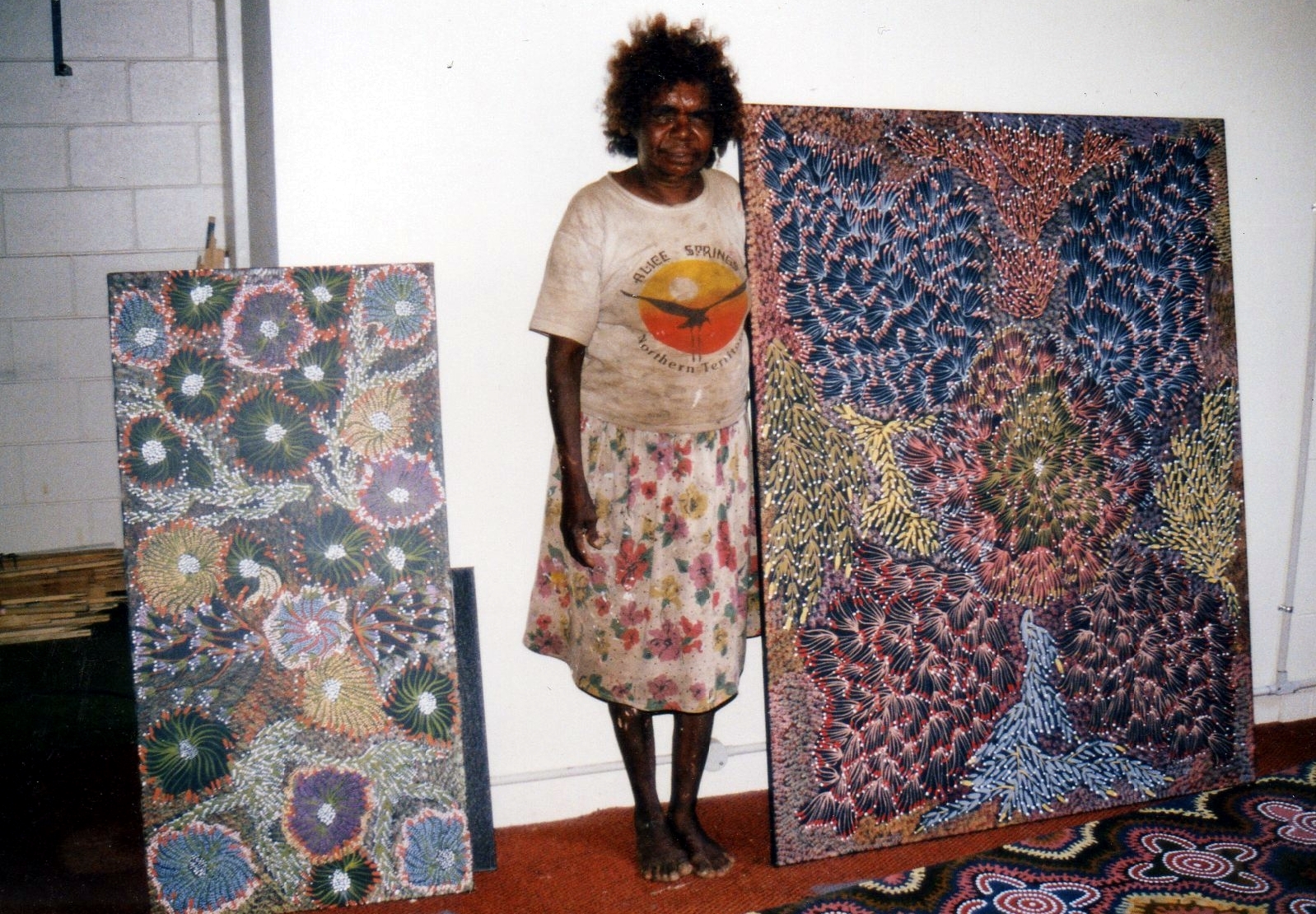
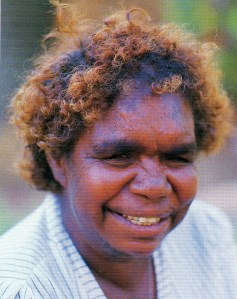 Eunice Napangardi, a wonderful warmhearted person.
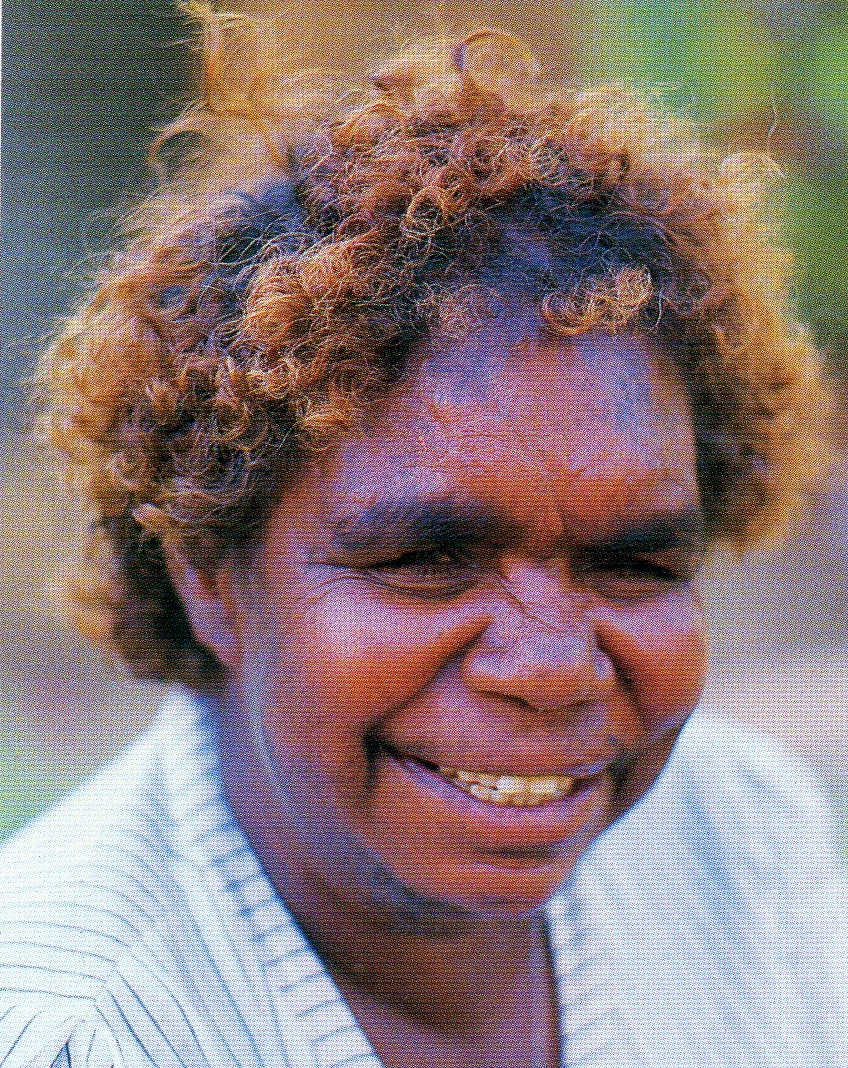
Eunice was born at Yuendumu in the early 1950s. She is of the Luritja / Warlpiri tribal groupings and has 3 sisters, Pansy Napangardi (see my post Australia – Aborigine Art 2), Alice Napangardi and Rene Robinson Napangardi with whom, she shares many of the Dreaming stories they paint. Eunice was one of the first women artists to paint.
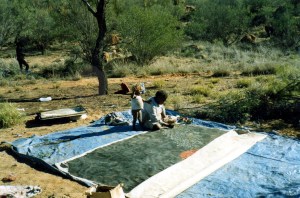
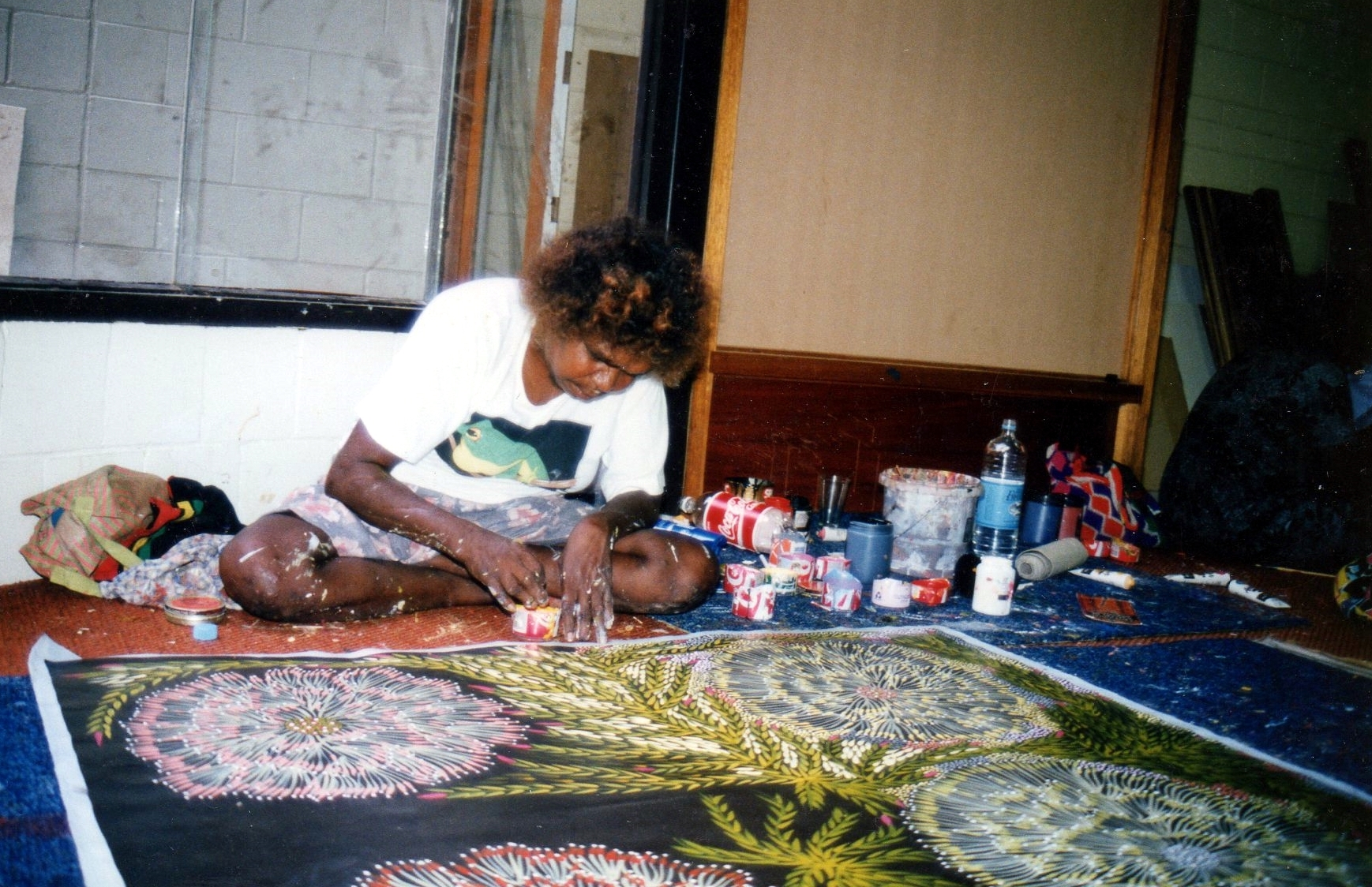
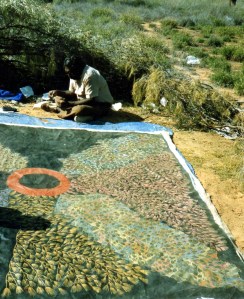 Left: Eunice is working on one of her oversized Bush Banana Dreamings. She loved to paint on canvas as big as she could get. Right: When we visited her a week later the painting made some great progress. In the background sitting Maxi, her second husband.
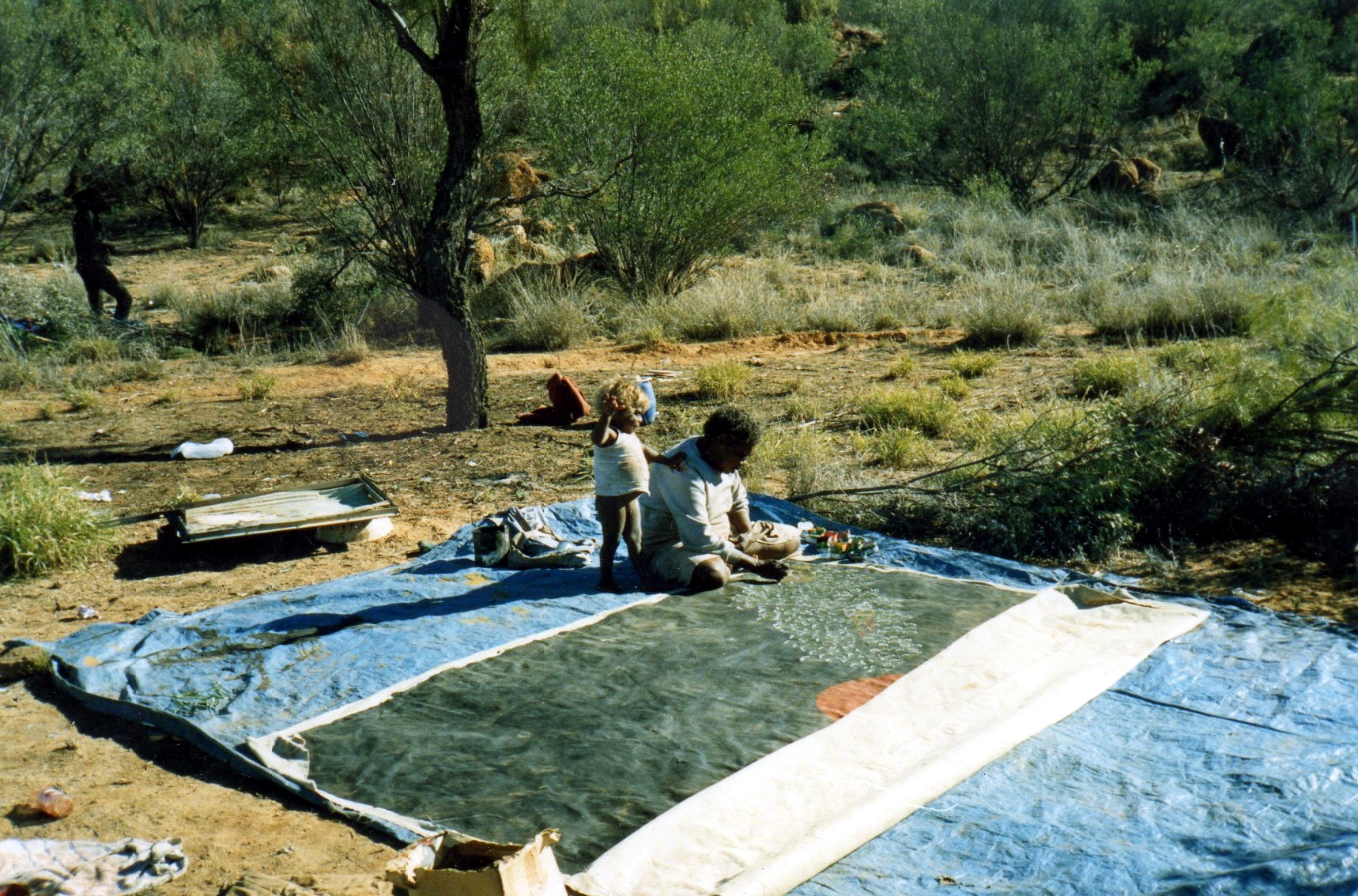
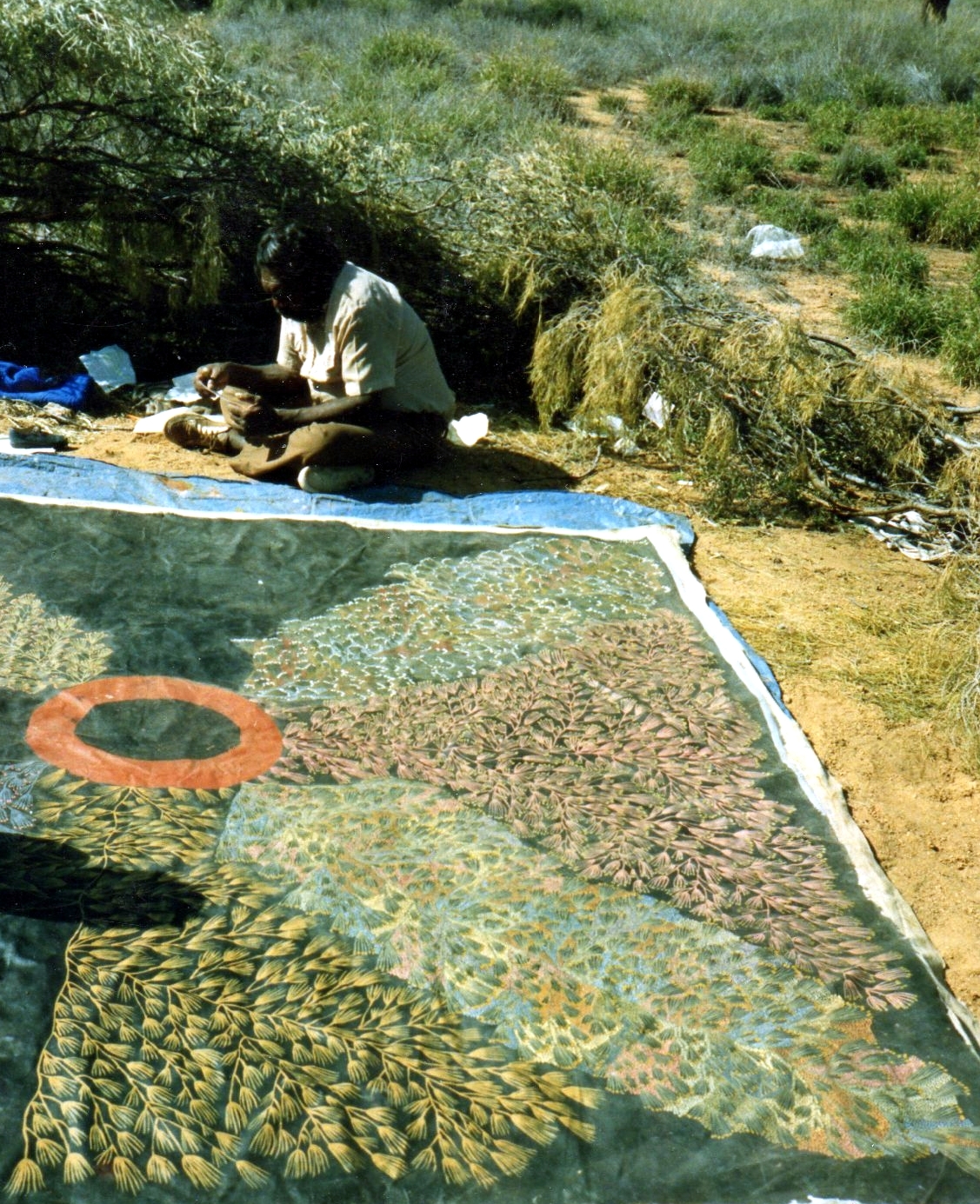
Eunice was an apprentice to her late husband, Kaapa Tjampitjimpa and helped him with his paintings for several years in the early 1980’s, when he painted for Papunya Tula Artists. Working alongside Kaapa (who died 1988). Eunice then paints with the highly acclaimed artist Maxi Jampitjinpa (then her second husband). He provided Eunice with the opportunity to become one of the most important Aboriginal women artists to emerge from the desert and has earned her own place as a master – demonstrating excellence, great technique, and artistic flair.
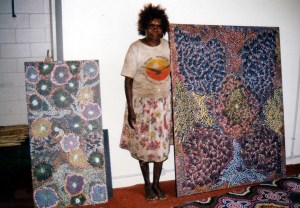 Eunice not in her best phase of life, short after husband Kaapa past away. Often artists were broke and needed money to survive, the only way was then selling some art……
 ……but galleries who could afford to pay, only paid for finished works. So – they forced the artists to paint in (most ugly) surroundings of their galleries and paid off after a finished painting. Many of these artist went through a phase like that, mostly men, after drinking and loosing everything.
Gaining experience and technique, Eunice emerged in the late 1980s as an artist in her own right, becoming one of the Central Desert’s leading Aboriginal artists. Kaapa was one of the first artists, influenced by the Geoffry Bardon movement, to paint in Papunya and was most likely responsible for the Central Desert painting movement as we see it today. Eunice’s Bush Banana paintings are worldwide renowned. She produced some of the most magnificent canvas paintings to come out of the area.
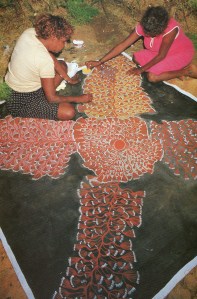 Better times, beautiful work, painted by Eunice and her sister Pansy.
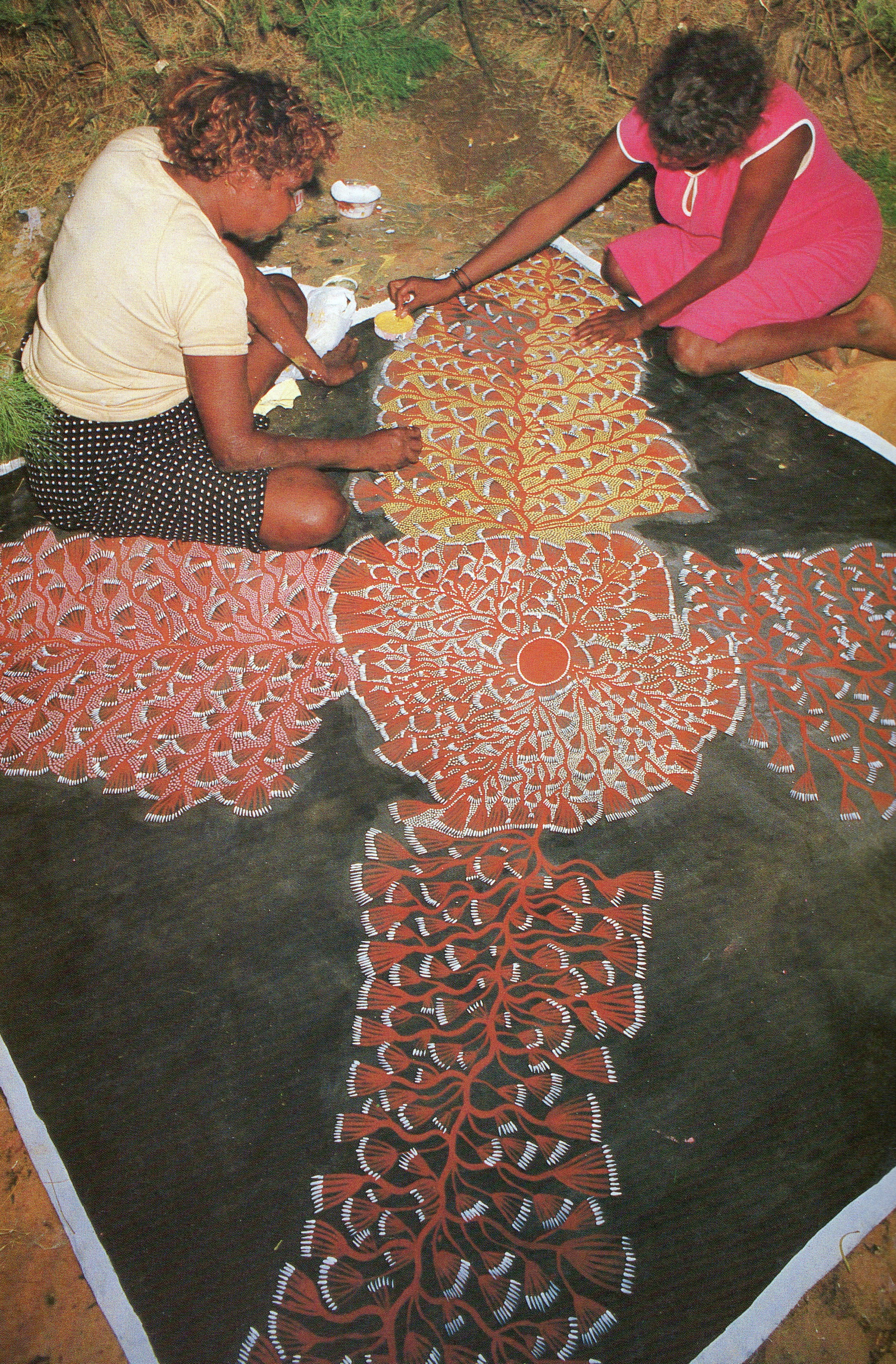
Eunice’s paintings are totally unique. The bush banana, or Uparli, grows in rock crevices close to the dry river beds in the Spinifex country. Eunice is noted for her connectedness to Yuparli – the Bush Banana – which has both nutritional and healing properties. It is of immense importance to the Aboriginal people of Central Australia. Sadly Eunice passed away suddenly in October 2005.
Painting 19: Bush Banana Dreaming, 1990, 134cm x 187cm. Price on request.
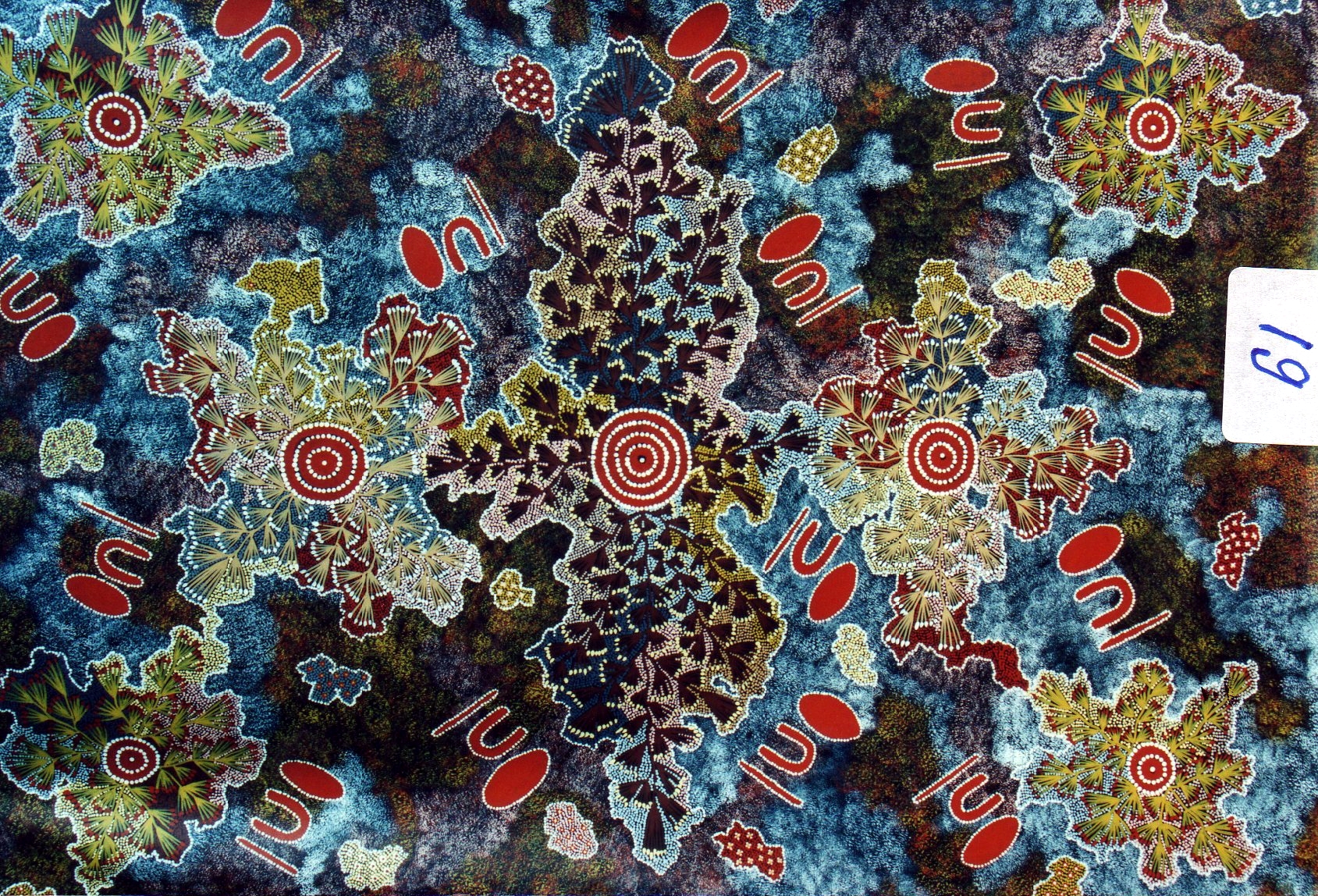
In this painting 19, Eunice depicts her grandmothers dreaming – the women of the Napanangka and Napangardi kinship. Any secret or sacred nature of this dreaming has been held back by the artist.
As the legendary Kungka Kutjura traveled the land during the dreamtime (its the creation time) era, they came upon the site of Pikilly (Vaughan Springs). Here the Uparli Dreaming was enacted and passed on. The Uparli (bush banana) plant with it’s radiating vines is found in rocky crevices alongside dry river beds. This fruit is eaten raw or cooked.
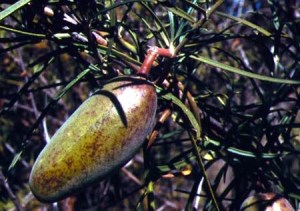
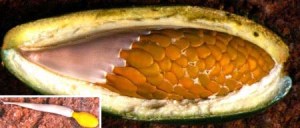
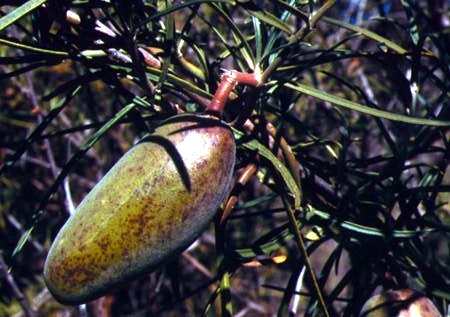
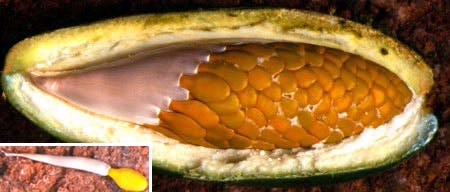
Bush Banana (Marsdenia Australis) is full of a milky sap which quench thirst in the hot desert climate. The seeds are edible and are said to resemble garden peas in taste. The plant also produces an edible underground tuber.
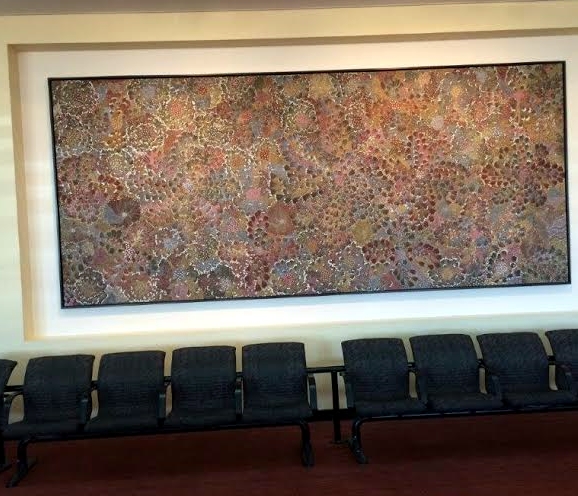
The Alice Springs Airport commissioned a large Eunice Napangardi painting for the inaugural opening of the new Airport Terminal in December 1991 and it now hangs in the QANTAS passenger lounge in Alice Springs Airport.
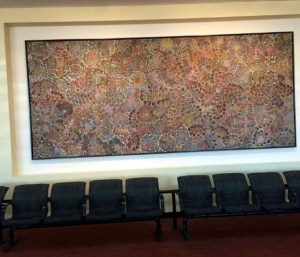
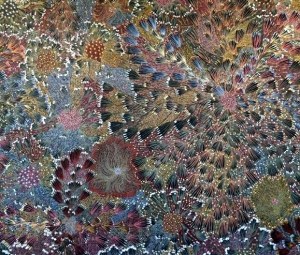
The massive painting (over 5 meters wide and 2 meters high) in the Qantas lounge of Alice Springs Airport. Right a detailed view of it. For this amazing work she earned the Caltex Art Award.
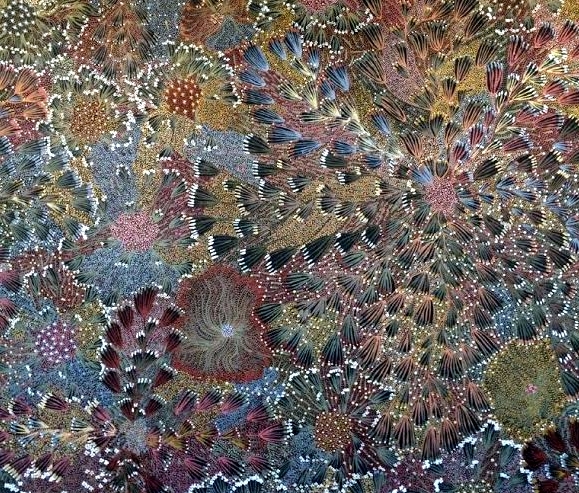
Eunice has exhibited at the Australian Embassy, Washington DC (1999), the United Nations Building, New York City (1999), and with Pansy Napangardi in Brisbane (the so named Two Women Show). In 1992, Eunice’s work was included in Modern Art-Ancient Icon, a traveling exhibition, starting in Washington DC, sponsored by The World Bank. Artworks of Eunice Napangardi are a museums worthy investment.
William Sandy.
William Sandy was born c.1944 in Pitjantjorra country around Ernabella in South Australia. William Sandy started to paint in 1975. William moved to Papunya in 1973 and two years later did his first painting for Papunya Tula Artists, after teaching himself to paint by watching the older artists. At Papunya he married Violet Nakamarra, the sister of Michael Nelson Jagamarra, who is also a well know Aboriginal artist.
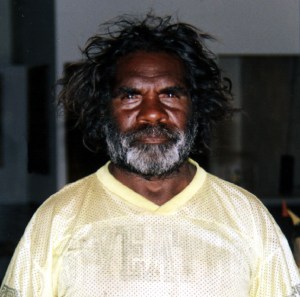 William Sandy in the late 1980’s.
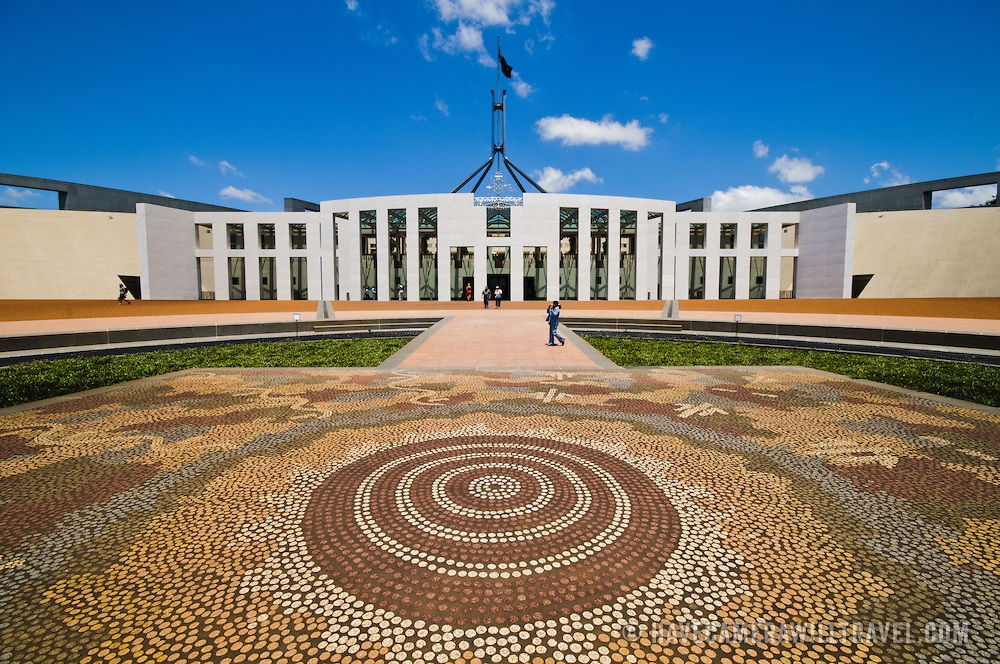
Michael became a noted award winning artist and designer of the forecourt of the new Australian Parliament building in Canberra ACT. See post „Australia – Aborigine Art 1“.
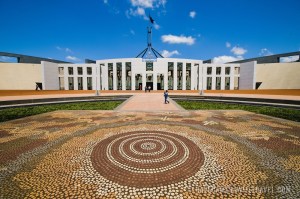 Forecourt New Parliament House Canberra.
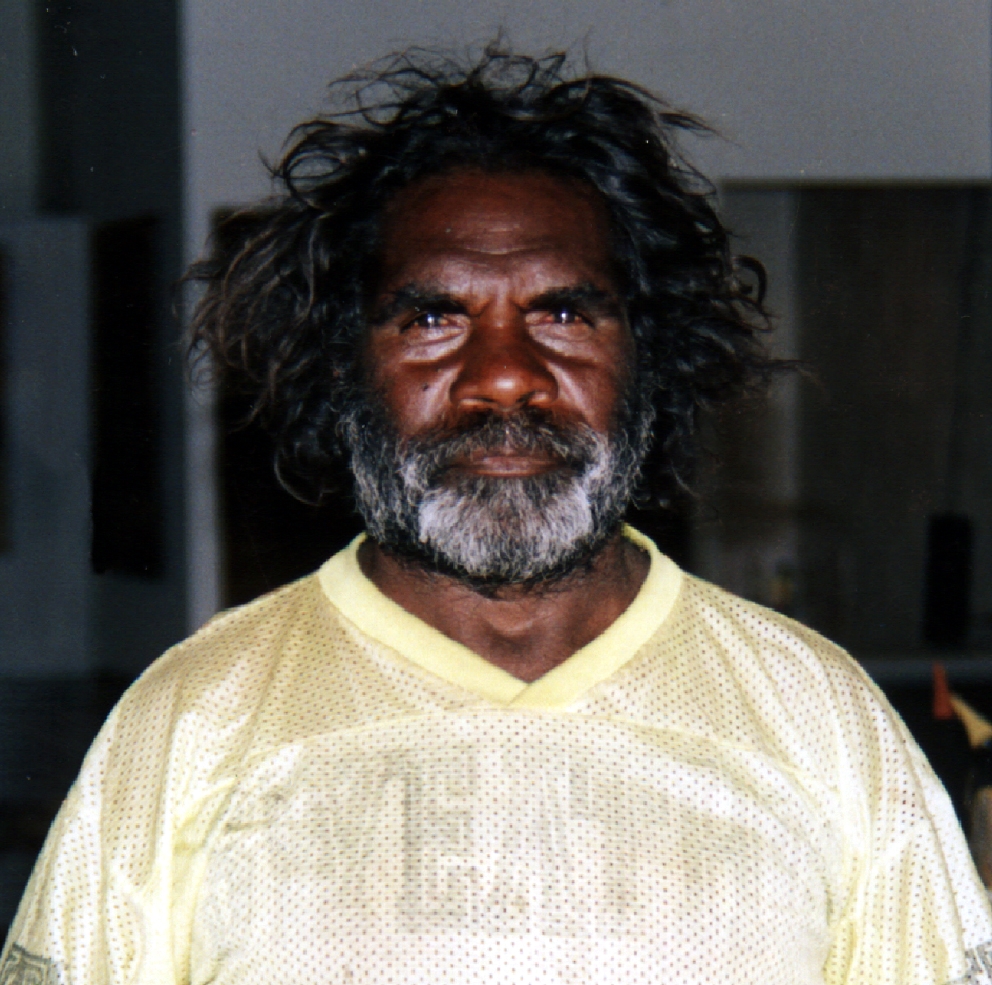
William Sandy has lived in Areyonga and Haasts Bluff and since 1973 at Papunya in central Australia. William Sandy was the first of the Pitjantjatjara involved in the contemporary art movement. William Sandy is also a very knowledgeable, traditional medicine man.
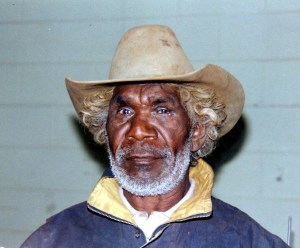 William Sandy as we met him in Ernabella.
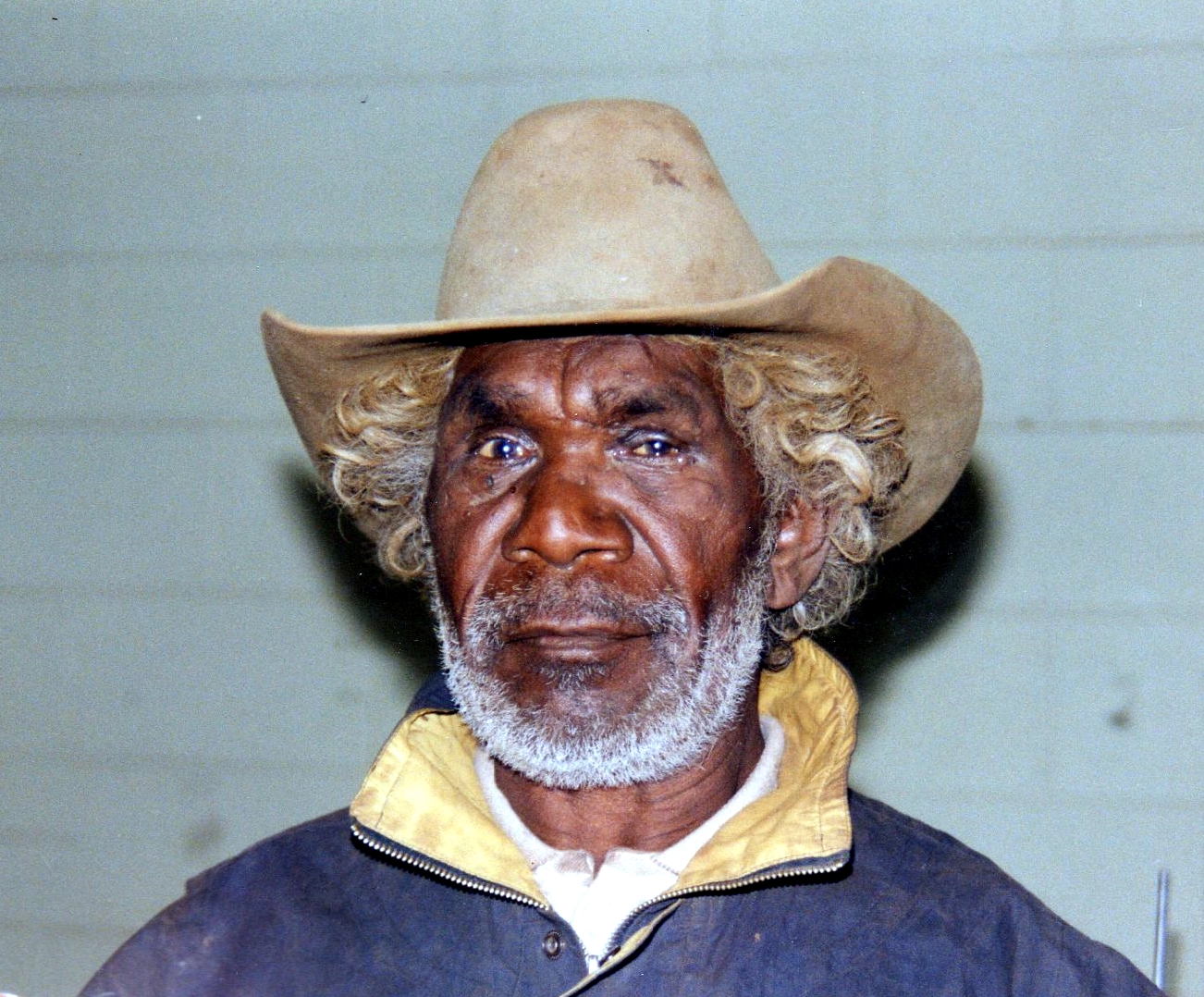
William paints Dingo, Emu, Women and other dreamtime stories for this country in the traditional dot painting style mainly using earth tones. One of his main dreaming is always the Bush Bean Dreaming. In 1985 he won the Northern Territory Art Award. Also he won the Alice Springs Caltex Award. His work is very powerful and centers around his grandmothers dreamings of the wild bush bean.
Painting 20: Bush Bean Dreaming, 1991, 129cm x 241cm. Price on request.
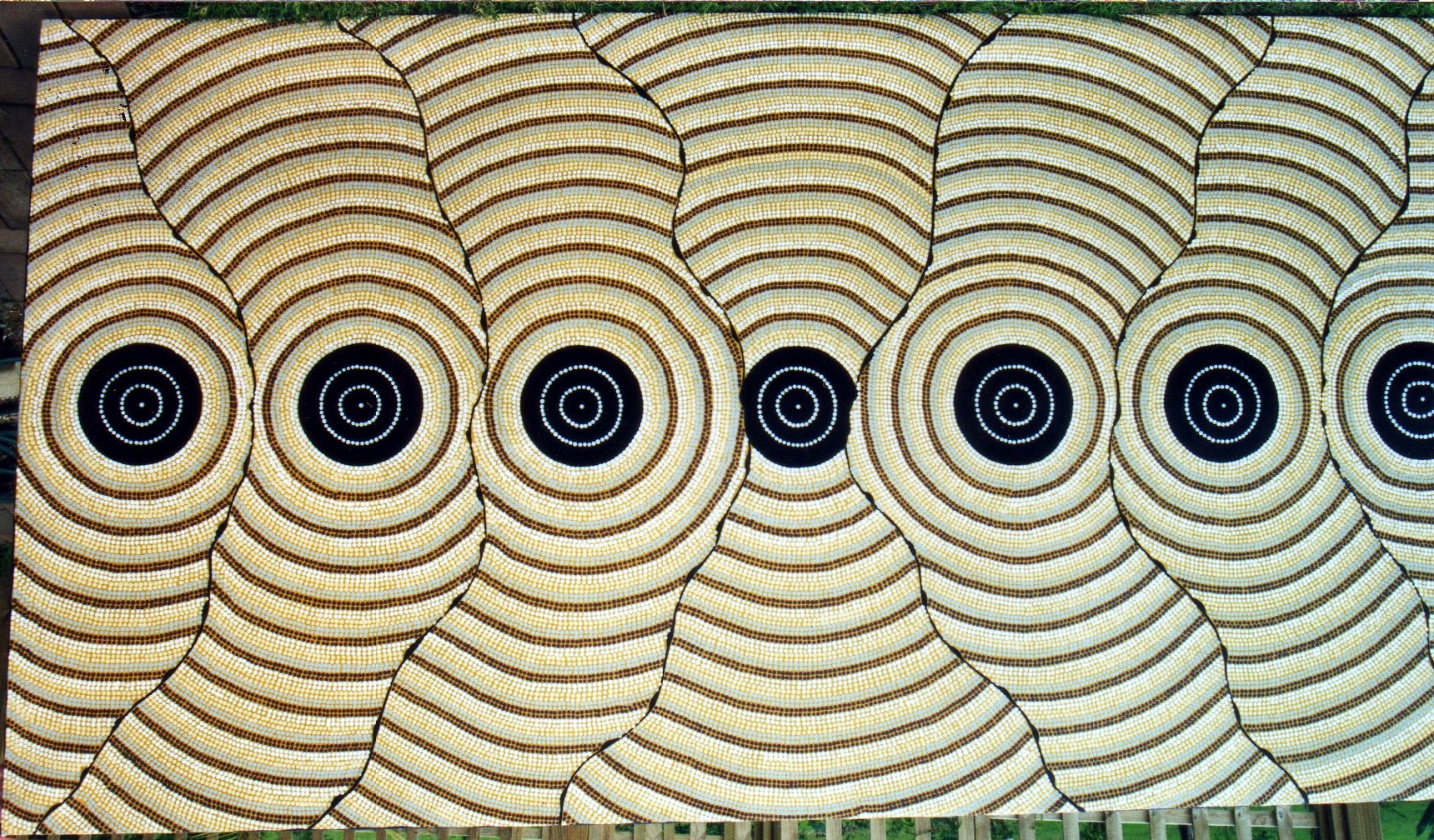
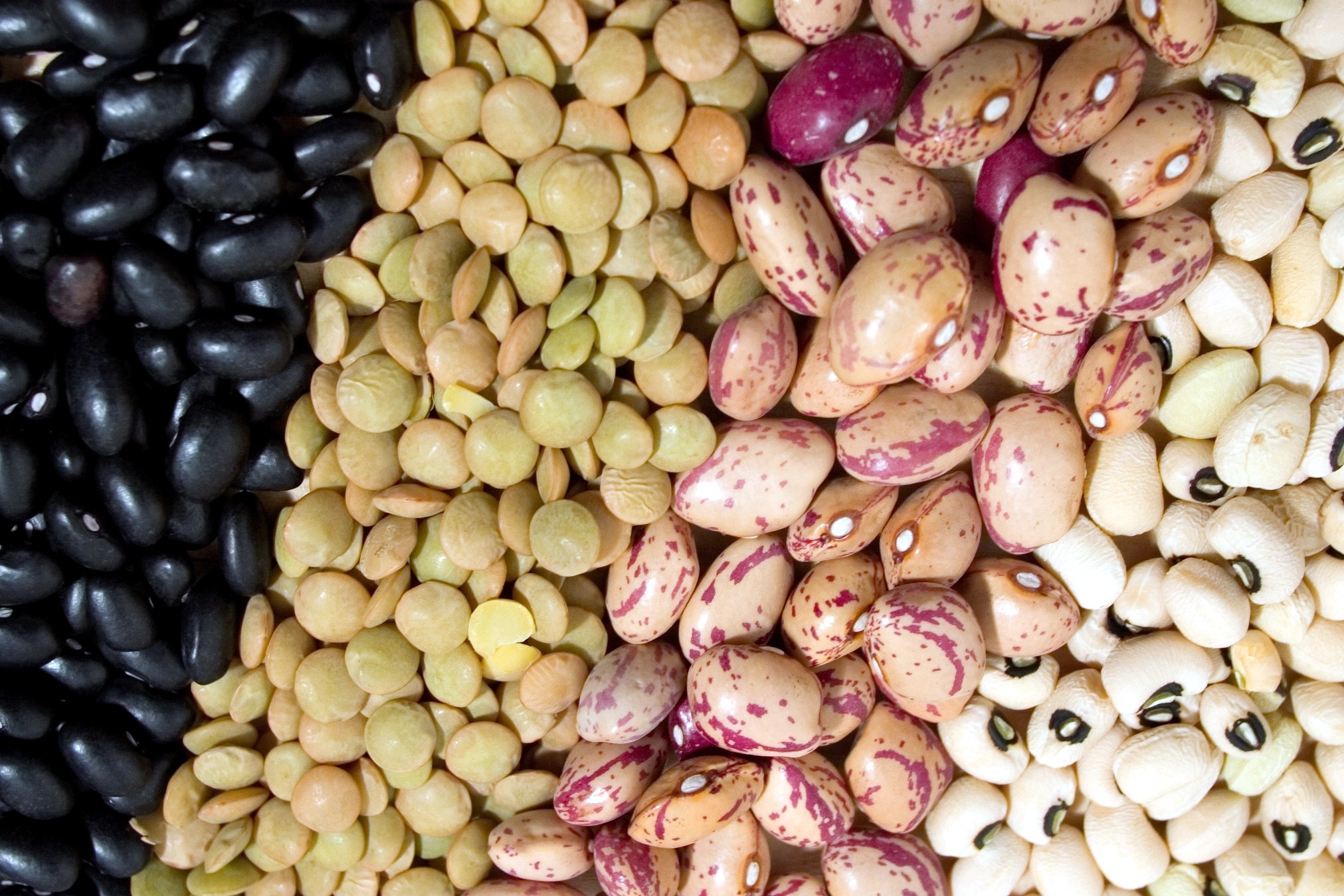
The above painting depicts Williams grandmothers dreaming. The Bush Bean is said to possess fertility powers and is used in young womens initiation ceremonies. They are also used in the producing of ceremonial necklaces, wristbands and headbands. The painting depicts the sites (roundrals) and the black bean radiating out.
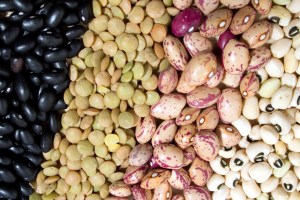
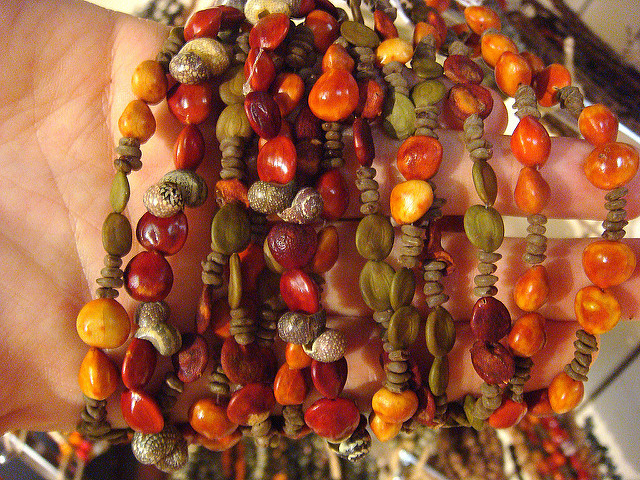
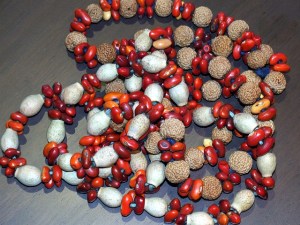 Australian wild bush beans. No wonder that women use these colorful beans and other seeds to make jewellery.
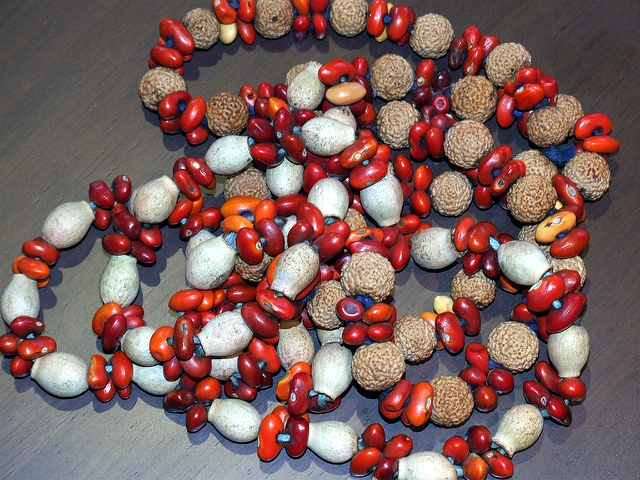
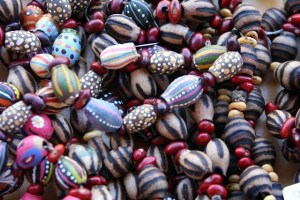
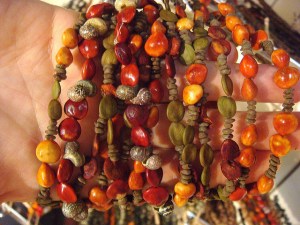 Central Australian Aboriginal Art. Painted and burnt seed pods and red bush beans make the best jewellery.
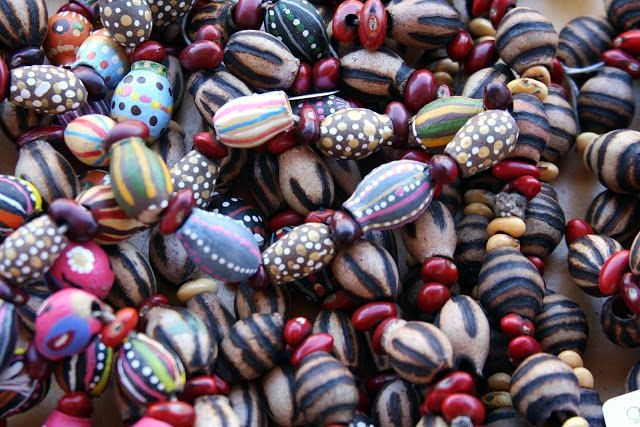
The Master artists are old, some passed away, and the younger generation is learning western customs. Today Aboriginal Australians live and work around the world, from Papunya to London, from Arnhem Land to New York. It is the last opportunity that anyone on this planet can purchase and own an authentic painting with impeccable provenance, by William Sandy, a Master artist and one of the important Australian artists.
Clifford Possum and Michelle Possum.
An Anmatyerre man, Clifford Possum was born around 1932 about 300km west of Alice Springs at Napperby Station. As a child he was saved from malnutrition by the pastor at Hermannsburg Mission, based there and working as a stockman and part time wood carver until moving to Papunya in the mid 1960s. He died in Alice Springs on 21 June 2002 at the age of around 70.
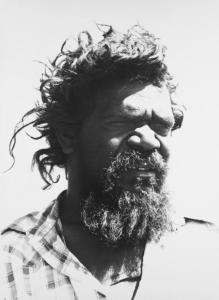 Wild Clifford in his younger years.
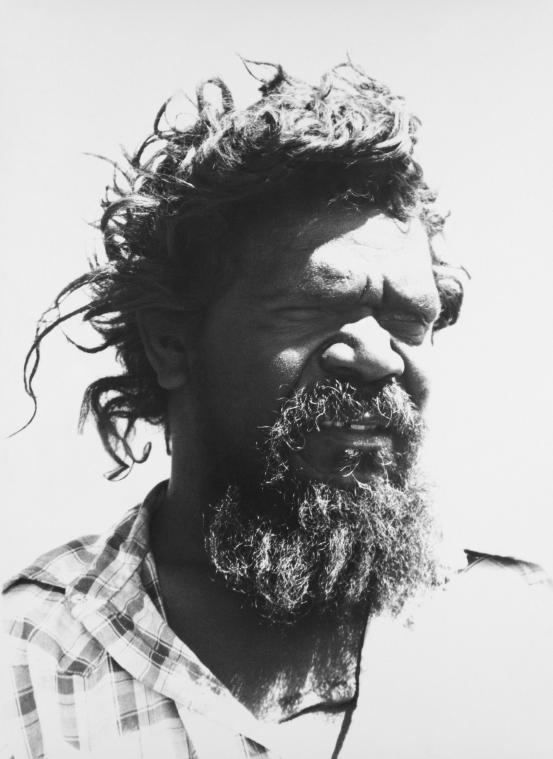
After an artistic career spanning six decades Clifford Possum Tjapaltjarri’s legacy may outlast that of all the Central Desert painters. Incorporating naturalism with dots and lines is not common in classic Papunya-school paintings post the early 1970s yet it was a theme to which Possum would return in many different forms over his entire painting career.
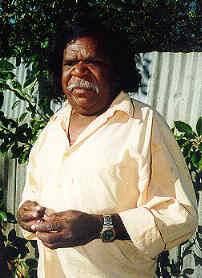 Clifford Possum on the height of his success.
Clifford Possum’s artistic journey had started in the mid 1940s when as a young man he carved animals and artefacts for the tourist trade. In the mid 60s he became a woodwork teacher at the Papunya community. Here in the 1970s he was the youngest of the painting men to join teacher Geoffrey Bardon in painting indigenous images in the then new medium of acrylics.
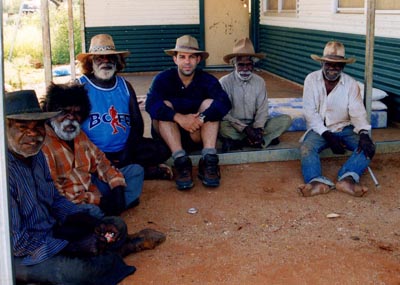
 Papunya elders meeting, first left Michael Nelson, second from left Clifford Possum, third from left Billy Stockman. The others are unknown to me.
By the end of 1972 however Possum was moving, as were his fellow contemporaries, away from the figurative into the more linear and dotted style. The small highly individual 1972 Love Story shows this well. He confidently used oranges, yellows, blacks and browns giving this and works of a similar era an intense luminosity. Others are softer with more restrained colors built from layers of subtly hued dots.
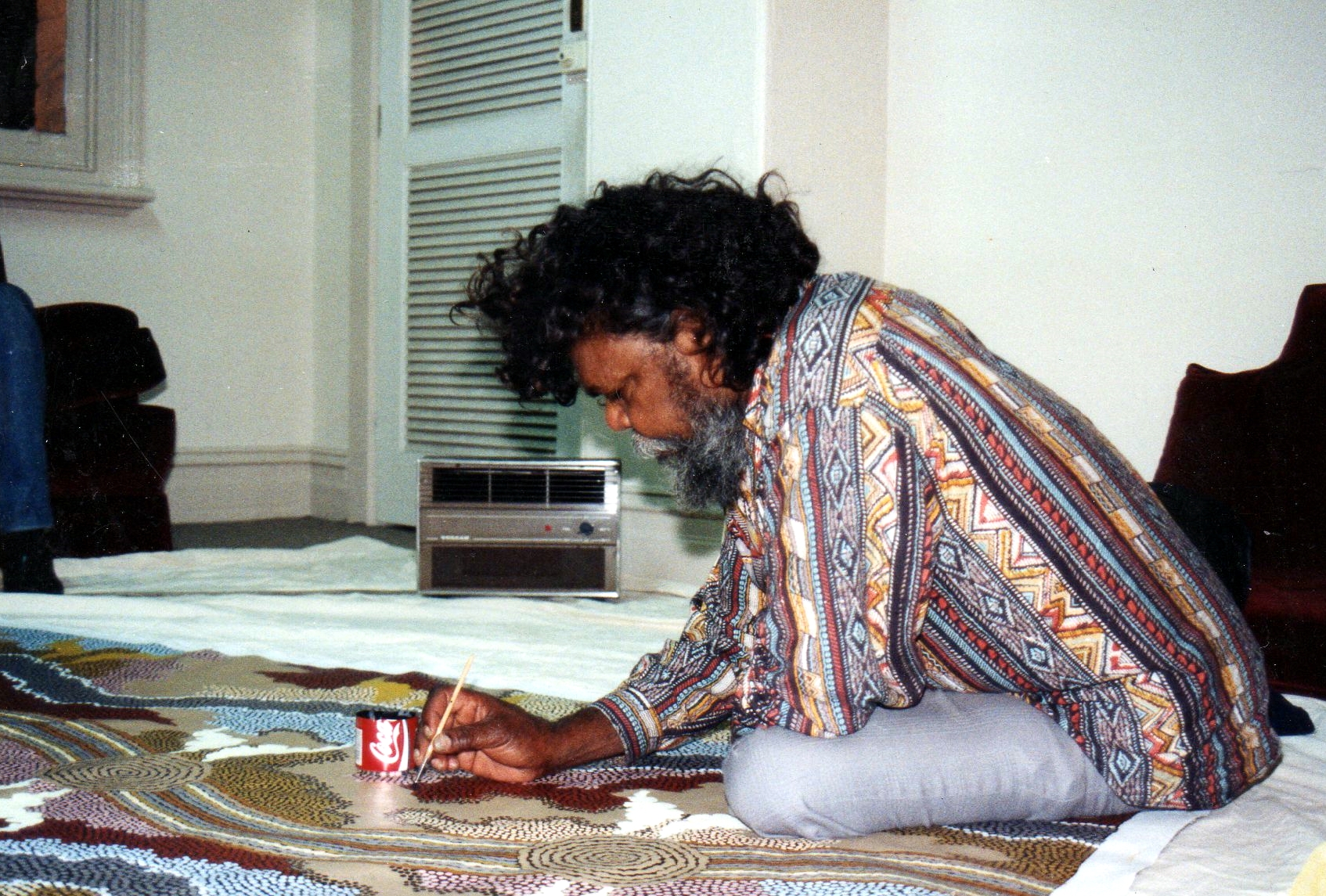
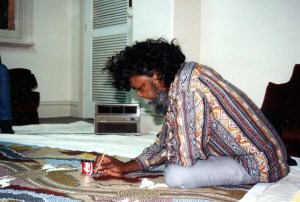 Clifford working tirelessly for a huge London exhibition.
Possum was a great storyteller, personally and through his paintings which he was proud to explain to a receptive audience. As Melbourne dealer and friend Peter Los (who knew Possum from the mid 1980s until his death) says, a day with Possum was never predictable or dull.
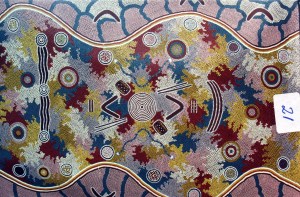
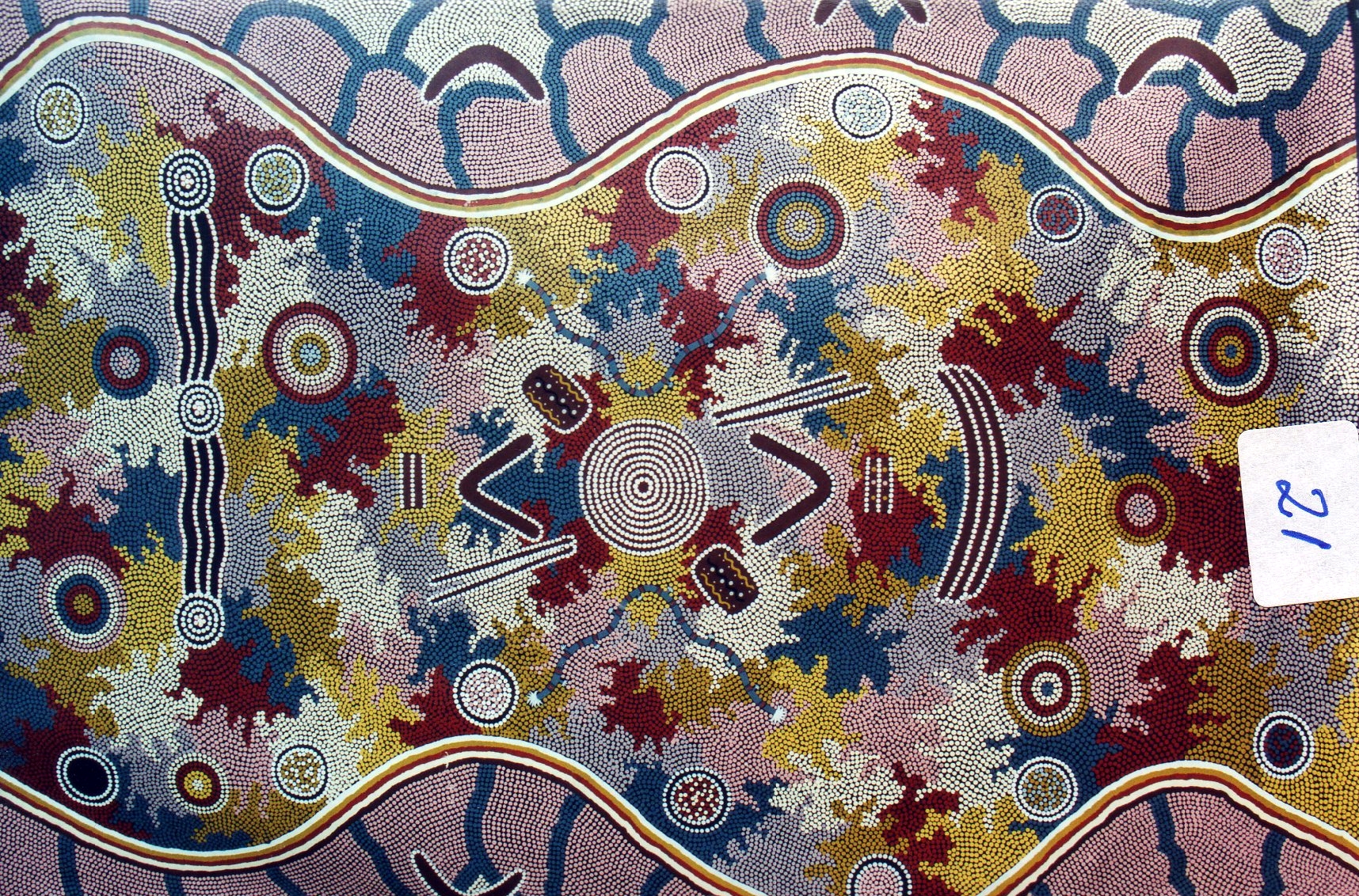
Painting 21: Mens Ceremony-Four Dreamings, 1989, 145cm x 177cm. Price on request.
As Possum’s fame spread, his personal life broadened. Since the mid 1980s he had managed the sale of his own paintings, rather than working entirely through the artists co-operative Papunya Tula Ltd, which he had helped establish. Over his life he dealt with hundreds of different dealers and individuals throughout the world.
London.
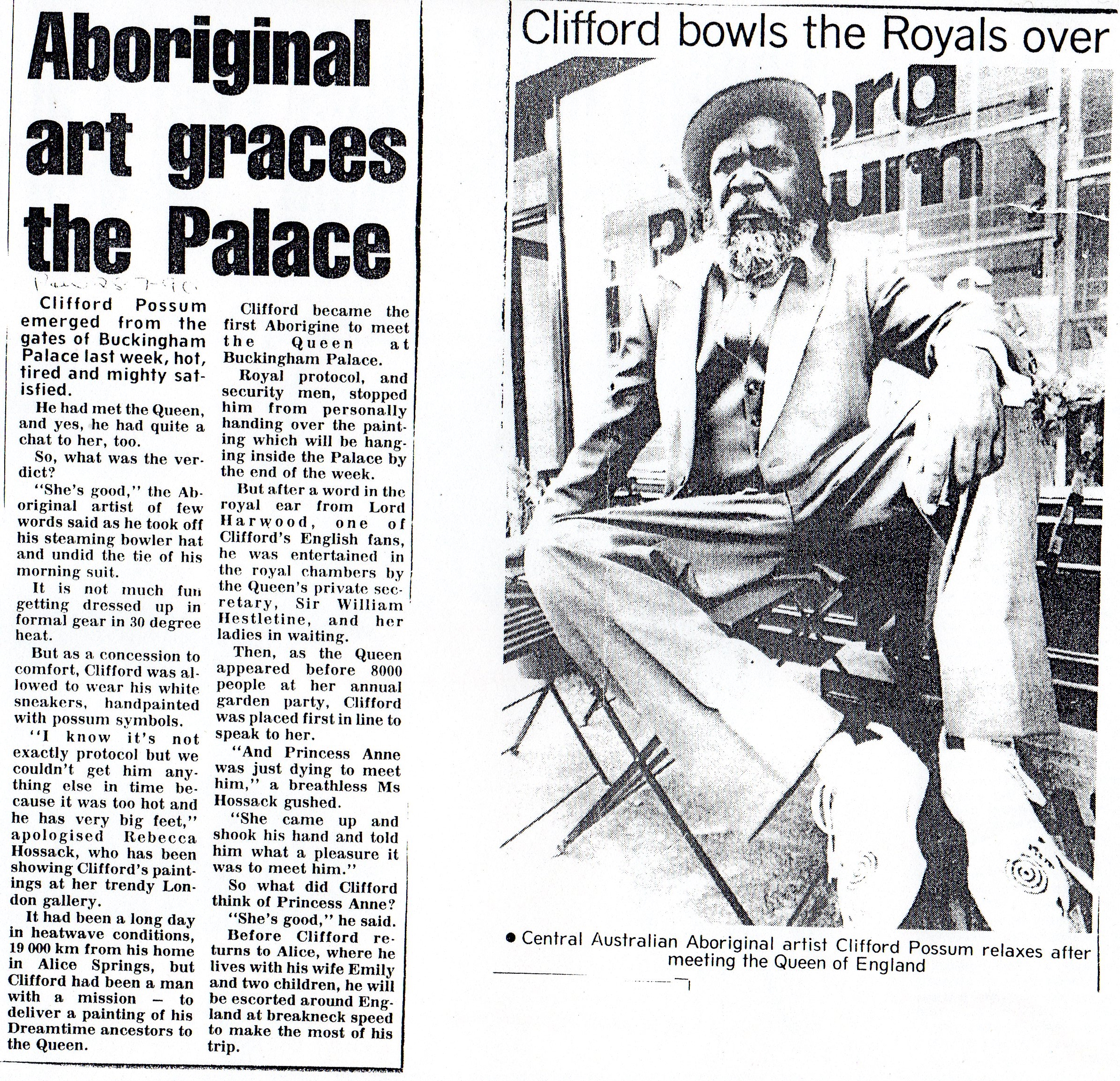
In 1989 Clifford Possum and the Alice Springs gallery owner (The Gallery of Desert Dreamings) John O‘ Laughlin organized a huge exhibition and trip to London, UK.
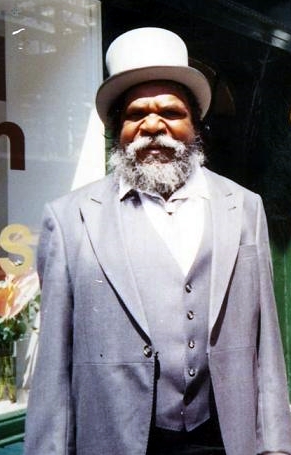
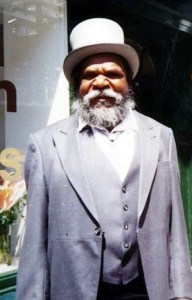 Yes, Clifford Possum in his „official outfit“ to visit the Queen.
A long story short: Clifford painted (in late 1989 and early 1990) 29 artworks as preparation for the London exhibition in July 1990. It was a tireless hard work done in the lounge room of John’s home in Alice Springs. Both his daughters, Gabriella and Michelle, helped as co-painters to finish some artworks. Nobody should see the artwork before exhibition. As John told me, they went several times to the country , that Clifford could walk his land and gained his dreaming’s. The whole story comes with the painting.
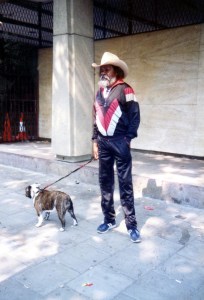
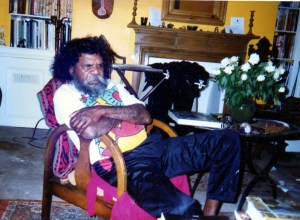
Both pics are taken in London. More important to Clifford, then the grey tuxedo, was his new tracksuit.
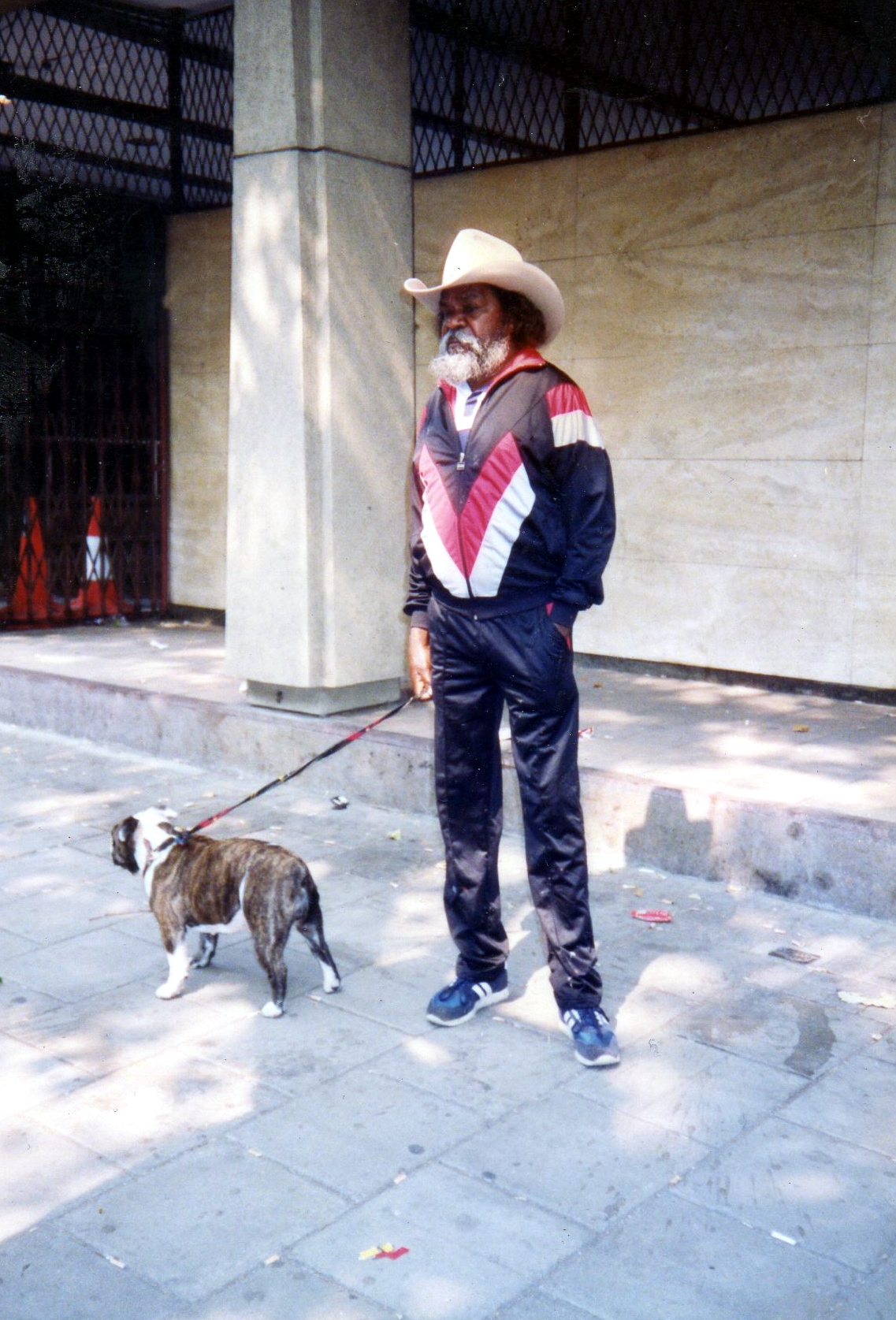
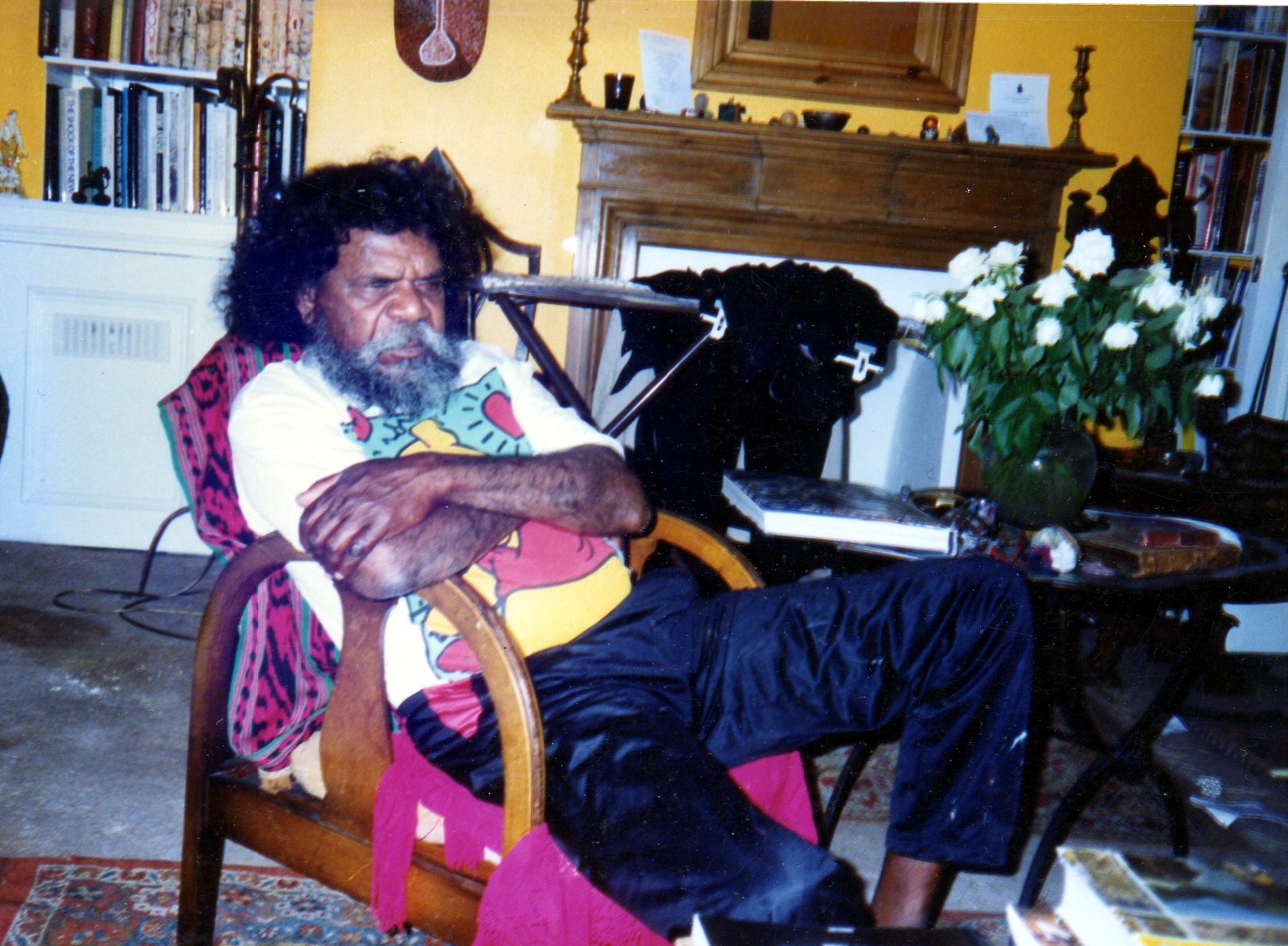
They took 25 paintings to London exhibition in a price range from A$ 10.000,– to A$ 50.000,–. The exhibition was a huge success and had a complete sellout. The highlight in this time was, that Clifford was beeing invited to meet the Queen in Buckingham Palace. That took place on The 26th of July 1990.
Left: The press in London went crazy about it all. Right: Clifford signing a „Thank You“ letter to the Queen.
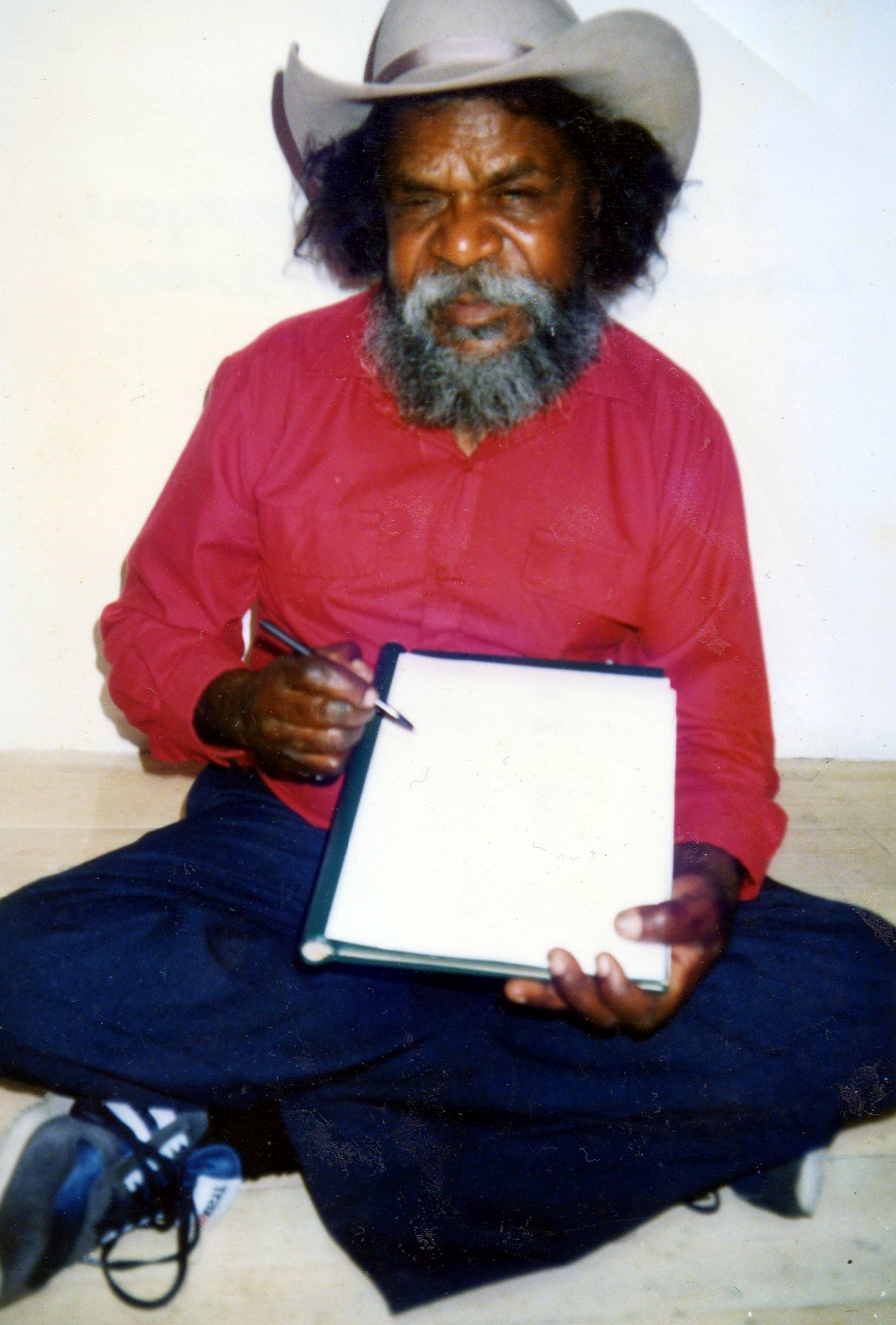
In 1991, during my visit in Alice Springs, I met again Clifford Possum (and of course many other artists), so as John’O Laughlin (which I knew since 1987) and Michael Hollow, (the owner of Aboriginal Desert Art Gallery). We organized together a large exhibition in Germany (in 1992) and therefore we choose the 4 Clifford „leftover“ paintings from 1989 (read above). Out of the 4, I bought the here offered one, for my private collection.
 With Clifford in Alice Springs.
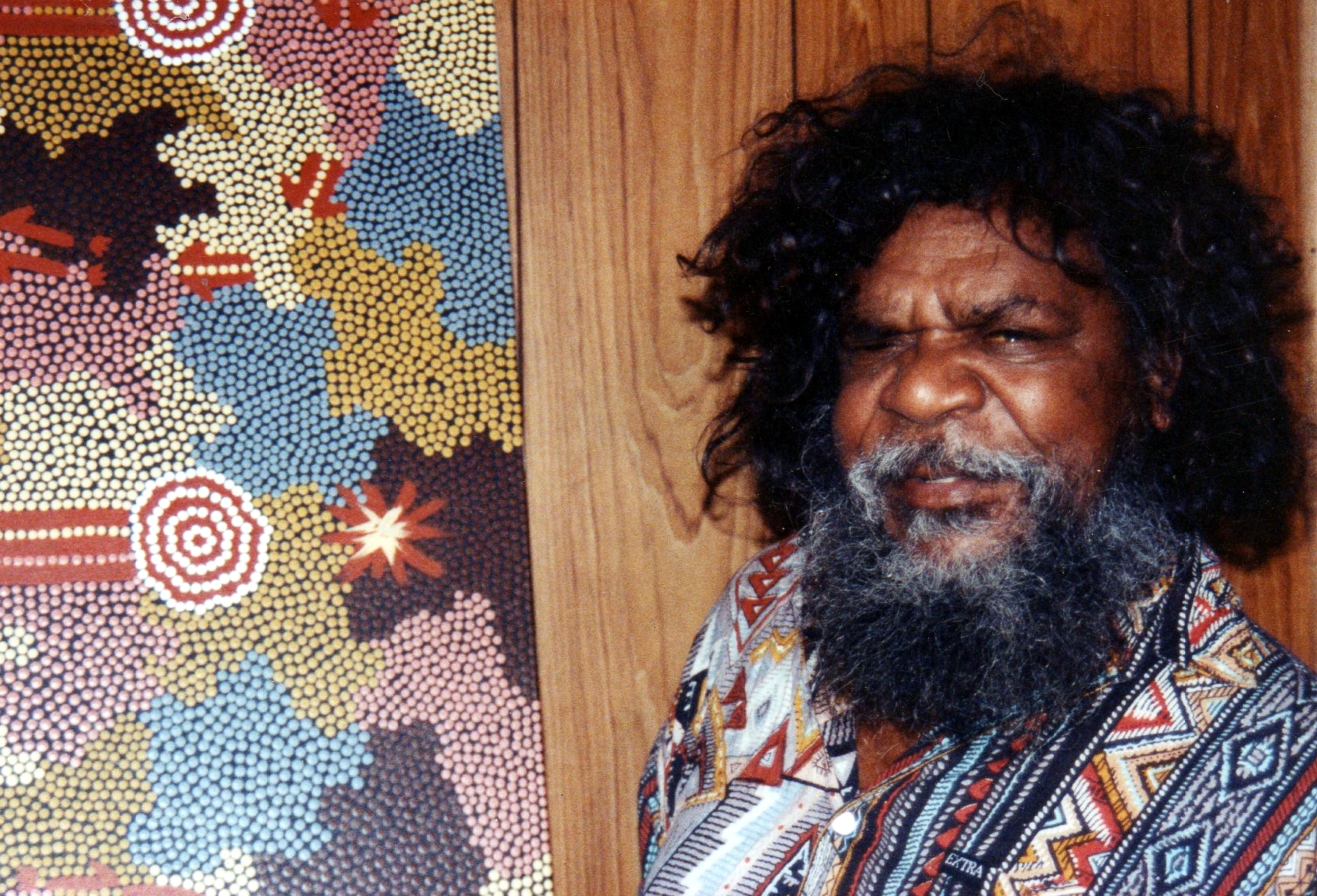
Most expensive Aborigine Painting.
Demand for his work became huge. And with such success came the problems of both the artist’s own over production for ready money and fake paintings – some done by relations or Aboriginal friends, others by white copyists. Two dealers I knew in the late 80’s and early 90’s got their problems 10 years later for faking auction results and painting fakes. Heavy fines, court hearings and even jail followed – and that was RIGHT !!! Clifford Possum often described the personal shame and anger at what was done in his name, but his resilience, humor, generosity and larger than life personality kept him painting.
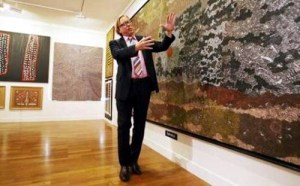 The most expensive Aborigine painting ever sold.
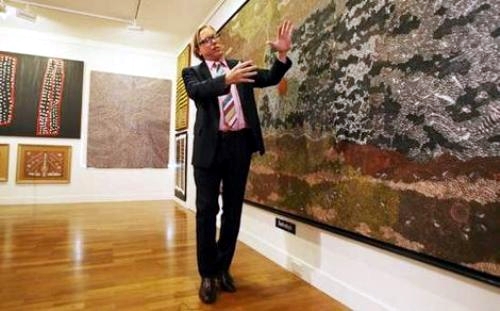
Clifford Possum is not a new name in the art world. He was famous as an aboriginal painter. His previous painting with the title Man’s Love Story 1993-1994 was sold in the price of £170,000 in 2005 at Sotheby’s. This painting is considered as the most expensive painting by Possum. With the fabulous Tjapaltjarri’s Warlugulong 1977 people hope that it can break the previous record of Possum.
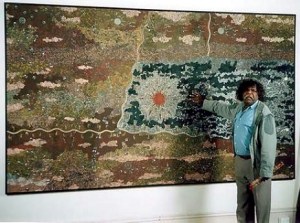 Clifford and his painting from 1977, 202cm x 337cm.
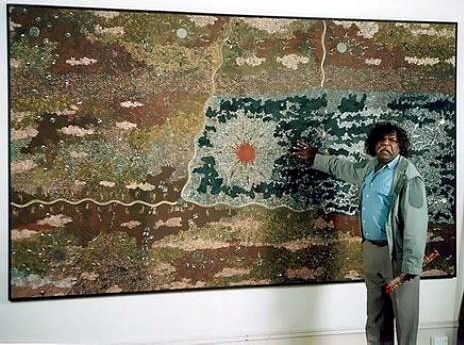
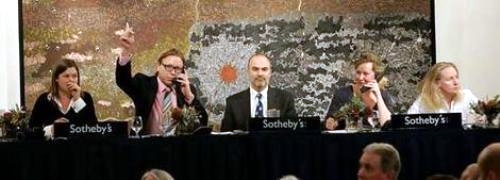
Moreover, people want to see whether Tjapaltjarri’s Warlugulong 1977 can break the most expensive work of aboriginal painting ever sold in the world, Emily Kame Kngwarreye’s Earth Creation. It was sold in the price of £438,000. As we know now, dozens of Cliffords paintings went for many hundreds of thousands dollars . A TRUE investment. The estimated price for View Clifford Possum, Tjapaltjarri’s Warlugulong 1977 was £755,000-1,050,000. After heavy fighting (at Sotheby’s Melbourne in 2007) the hammer went down by A$ 2.400.000,– ( 2 million and 4 hundred thousand Australian Dollars ) !
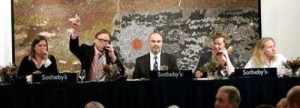 Sotheby’s Melbourne, sold for A$ 2.400.000,–.
Even Possum’s death in 2002 increased his notoriety with his burial wishes as stated in his will being challenged by members of his family. A Northern Territory court upheld the family’s wishes and Possum was buried different to that he had specified in his will.
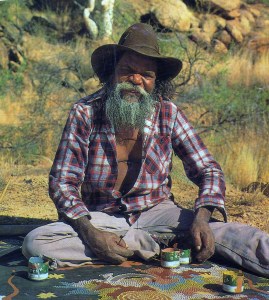 Clifford Possum will always be remembered as one of the most valuable Aborigine Artists of all time. His works are an amazing investment – they won’t be back.
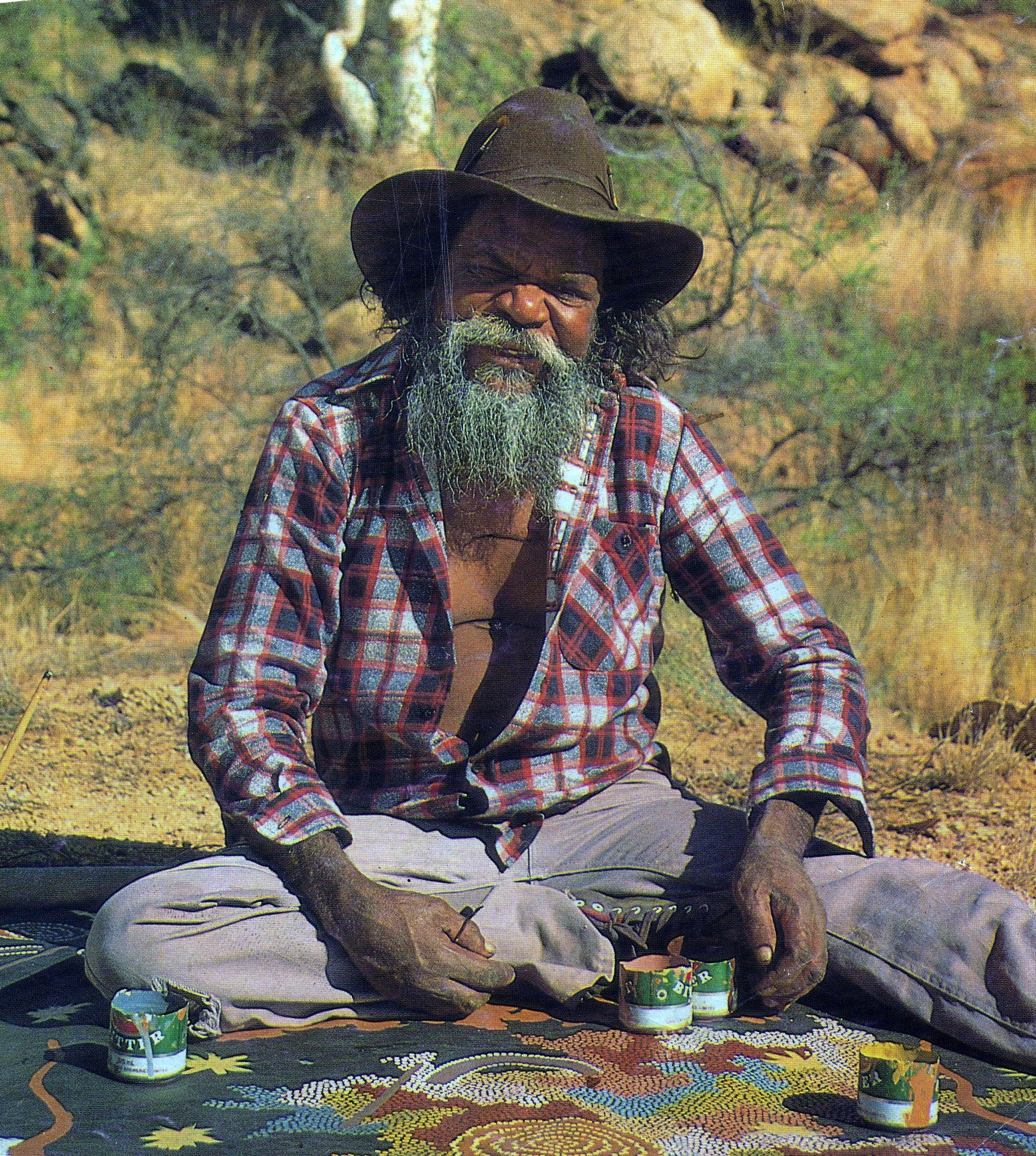
The legacy he left however is vast. “He hardly had time to live his own history before he became a legend and now is well into a mythological status,” says Peter Los. “Of all the central desert painters to be remembered in 100 years time, it will be Clifford Possum Tjapaltjarri.” Great opportunity to buy a piece of art from his early phase.
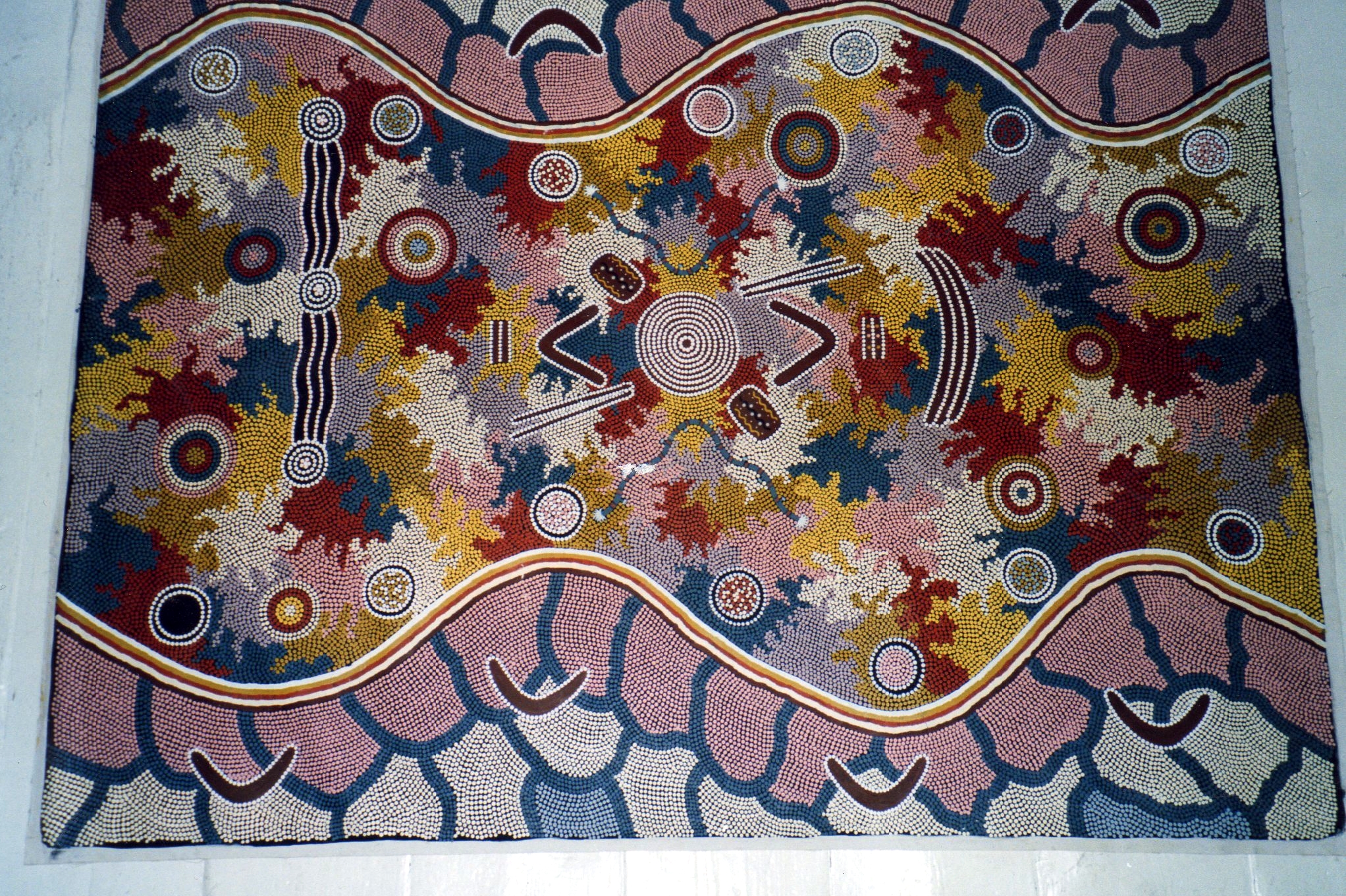
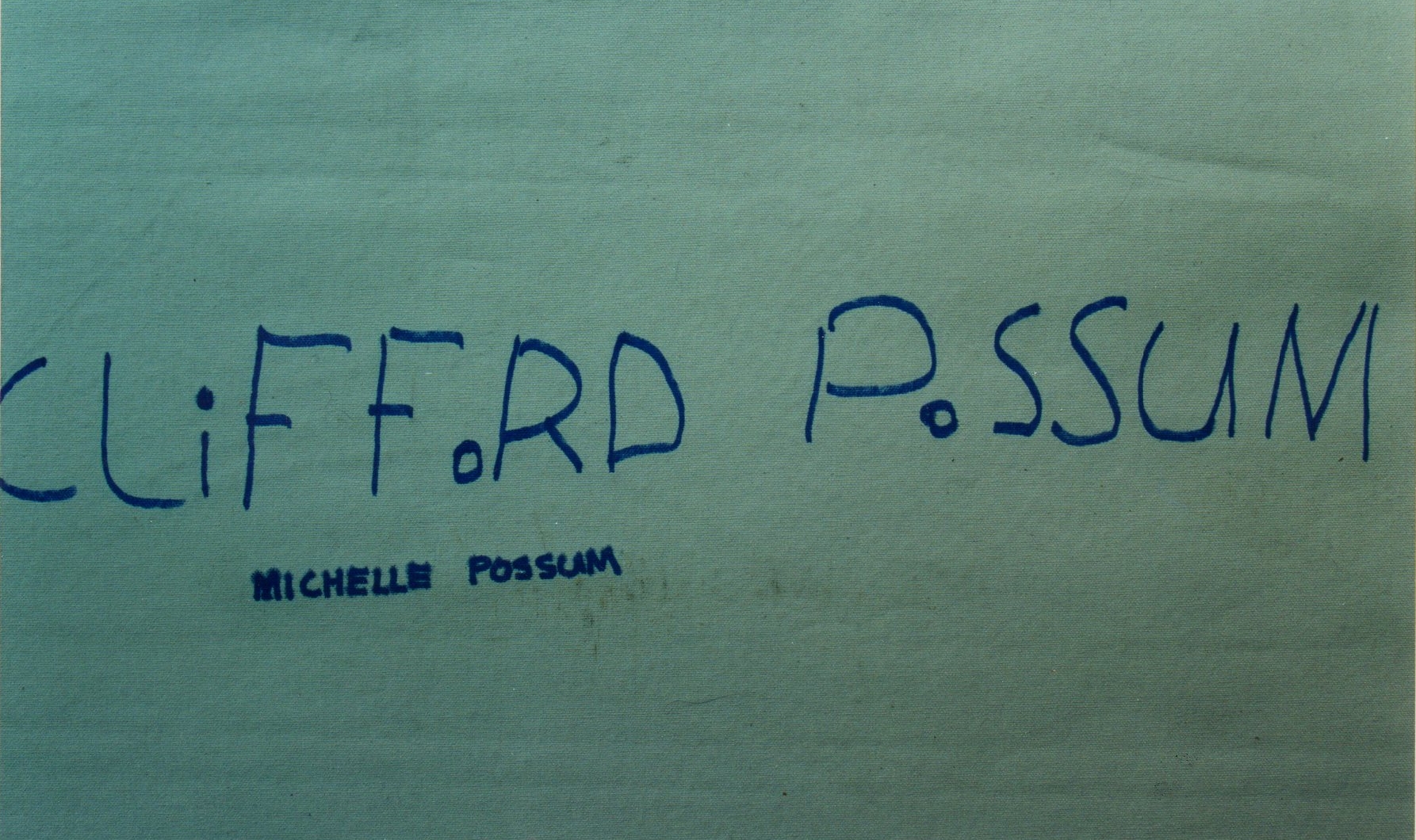
Since Cliffords daughter Michelle Possum helped to paint this work and also co-signed it, see two pictures above, here a few words about her. Price for this painting on request.
 Michelle Possum with one of her own paintings.
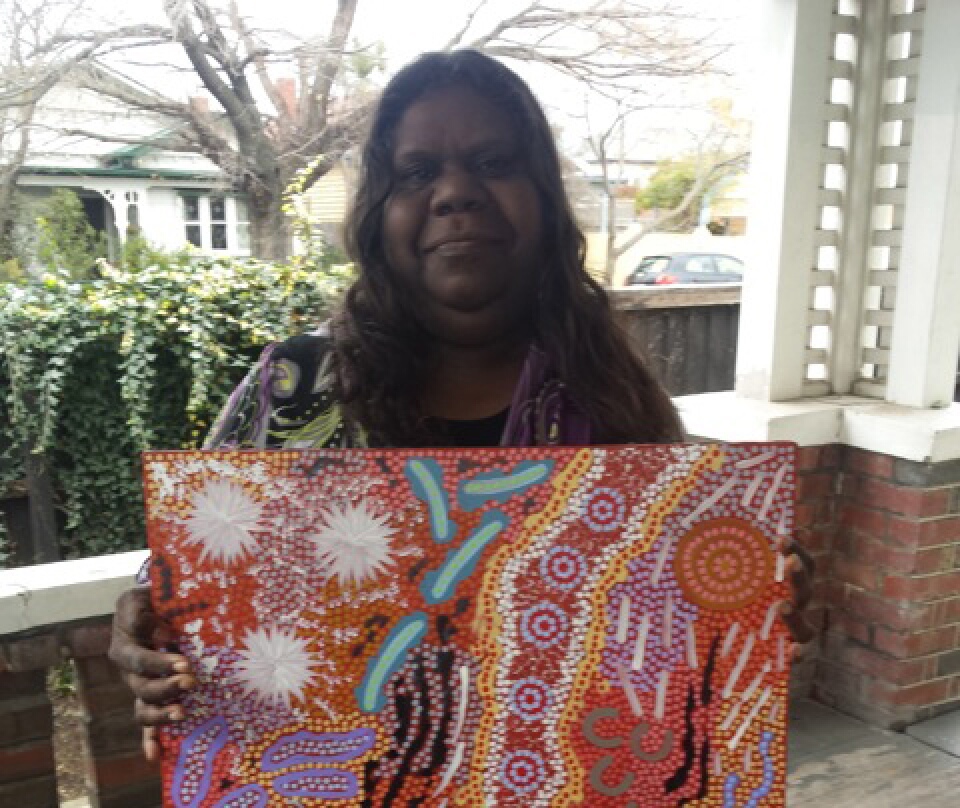
Michelle Possum Nungurrayi born 8th September 1969 at Alice Springs. Her homelands are Mt Allan & Naperby , Michelle is a talented Aboriginal artist from the Anmatyerre Language Group, Mbunghara Central Desert. The second daughter of the renowned Clifford Possum Tjapaltjarri, Michelle began painting at an early age alongside her father.
 Michelle painting in her own studio near Melbourne. Michelle first exhibited with her father and sister Gabrielle Possum in Brisbane in 1987.
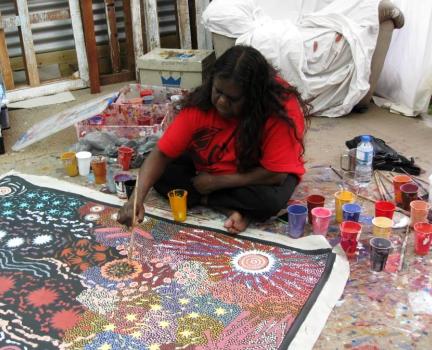
Michelle, her sister Gabriella and brother Lionel, were taught to paint by their highly talented father. She began painting at a young age in the mid 1980’s and to this day, carries on the traditional stories, style and much of the iconography of Clifford Possum.
Colin Dixon.
Born around 1954 in Warlpiri Country at Mt Doreen station, Colin Dixon Tjapananga spent his early years both on Mt Doreen station and at Yuendumu, receiving some schooling in both places. He and his wife Mary Dixon began painting for Papunya Tula Artists in the mid 80’s when the company began making regular trips to Mt Liebig, about 50km north-west of Papunya, where the couple had been living for many years.
 Colin working at Papunya art center.
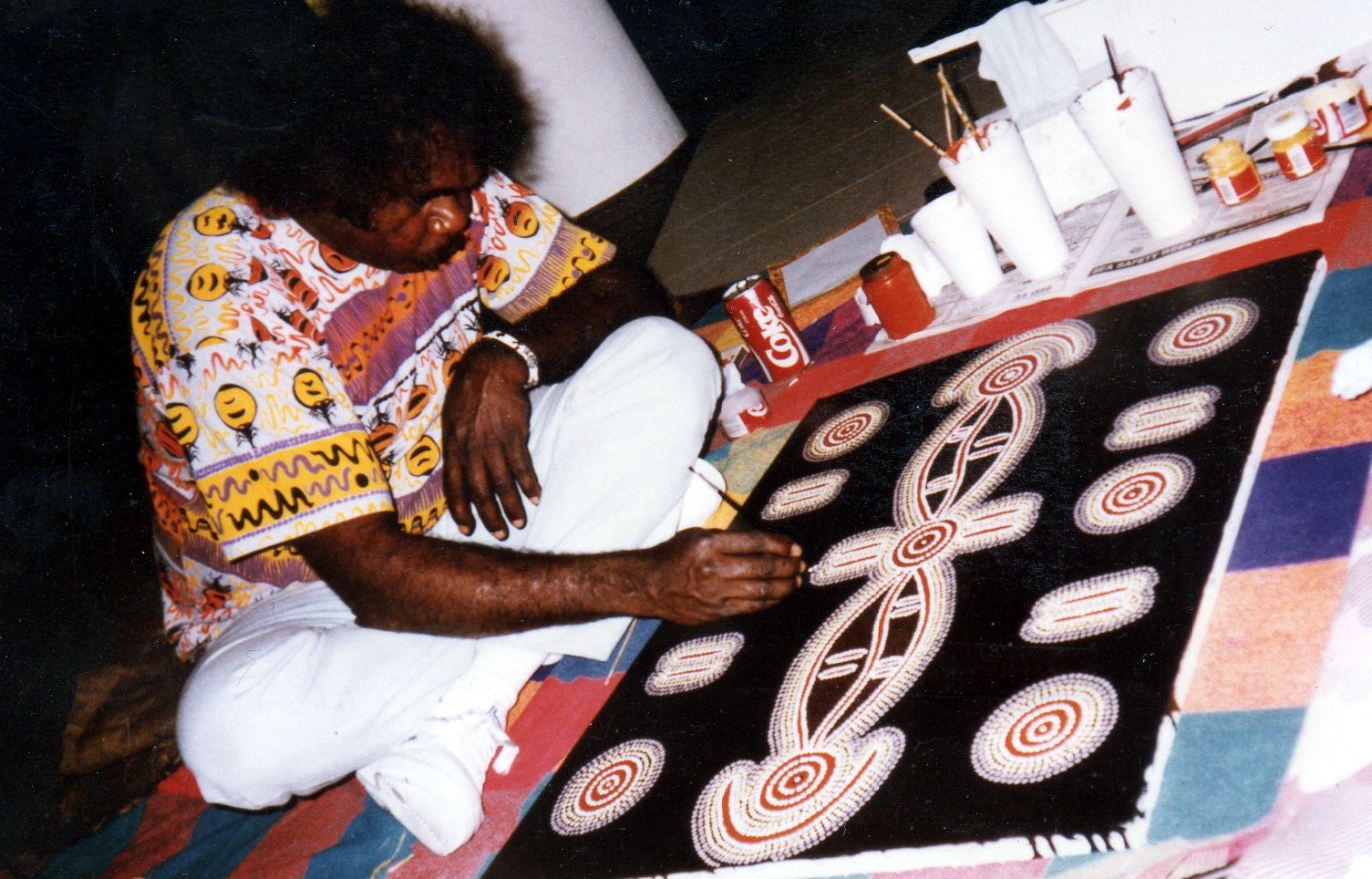
The artist’s country from his fathers side lies around Tjanyinki. His principal stories are Women Dreaming, Man Dreaming, Honey Ant Dreaming and Two Young Men. His mother’s country is from Pilinyanu, also west of Mt Doreen and also Warlpiri territory.
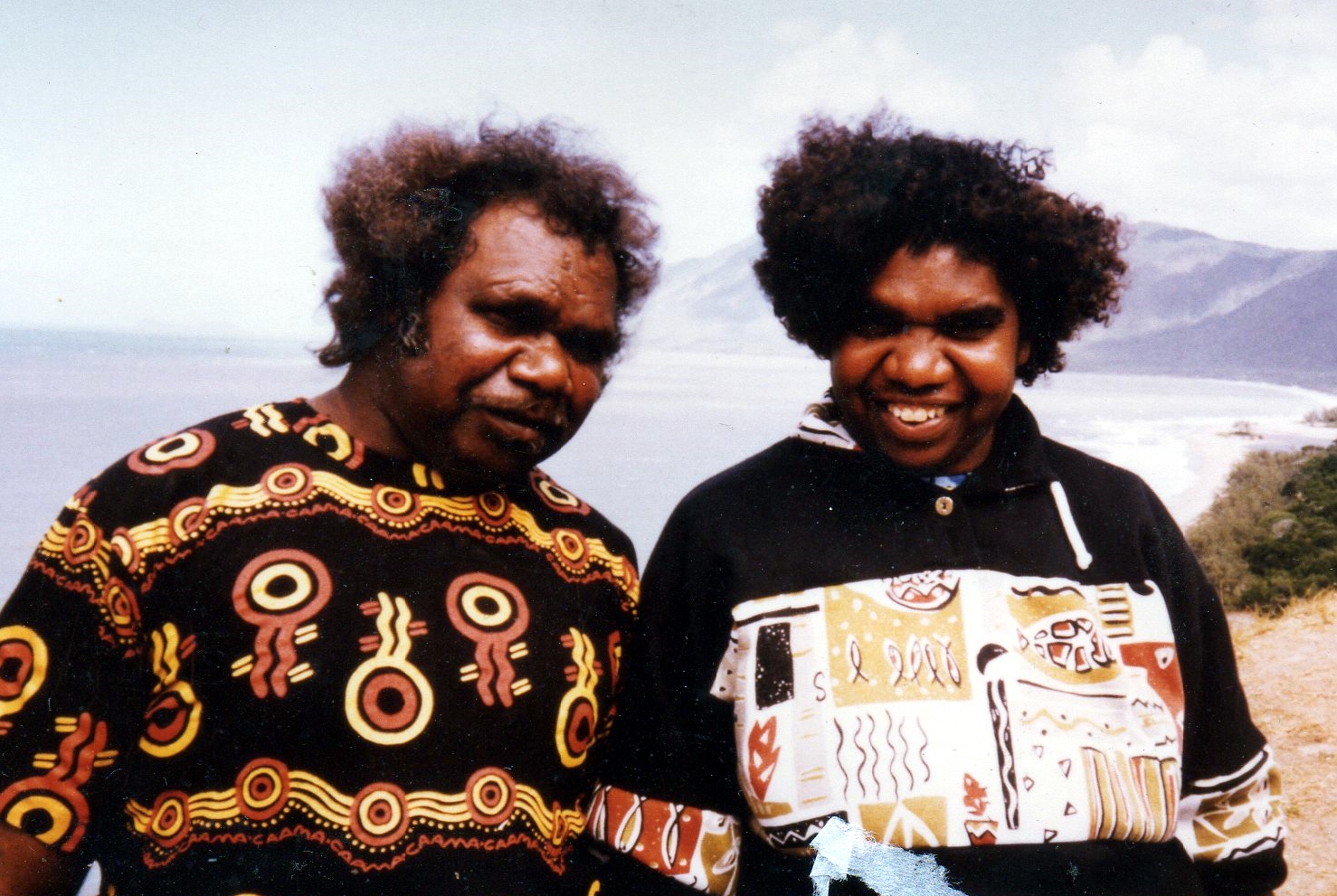
 Colin and his wife Mary Dixon when we met them in Yuendumu on a trip from Papunya to Alice Springs, selling art works.
Although Colin is not a regular painter his artworks are strong and masculine, traditional of Aboriginal men from the area. He uses a traditional style with symbols to depict his Dreamings. Alway he came back to paint water, storm and waterhole dreamings.
Painting 22: Storm – Running Water Dreaming, 1989, 120cm x 122cm. Price on request.
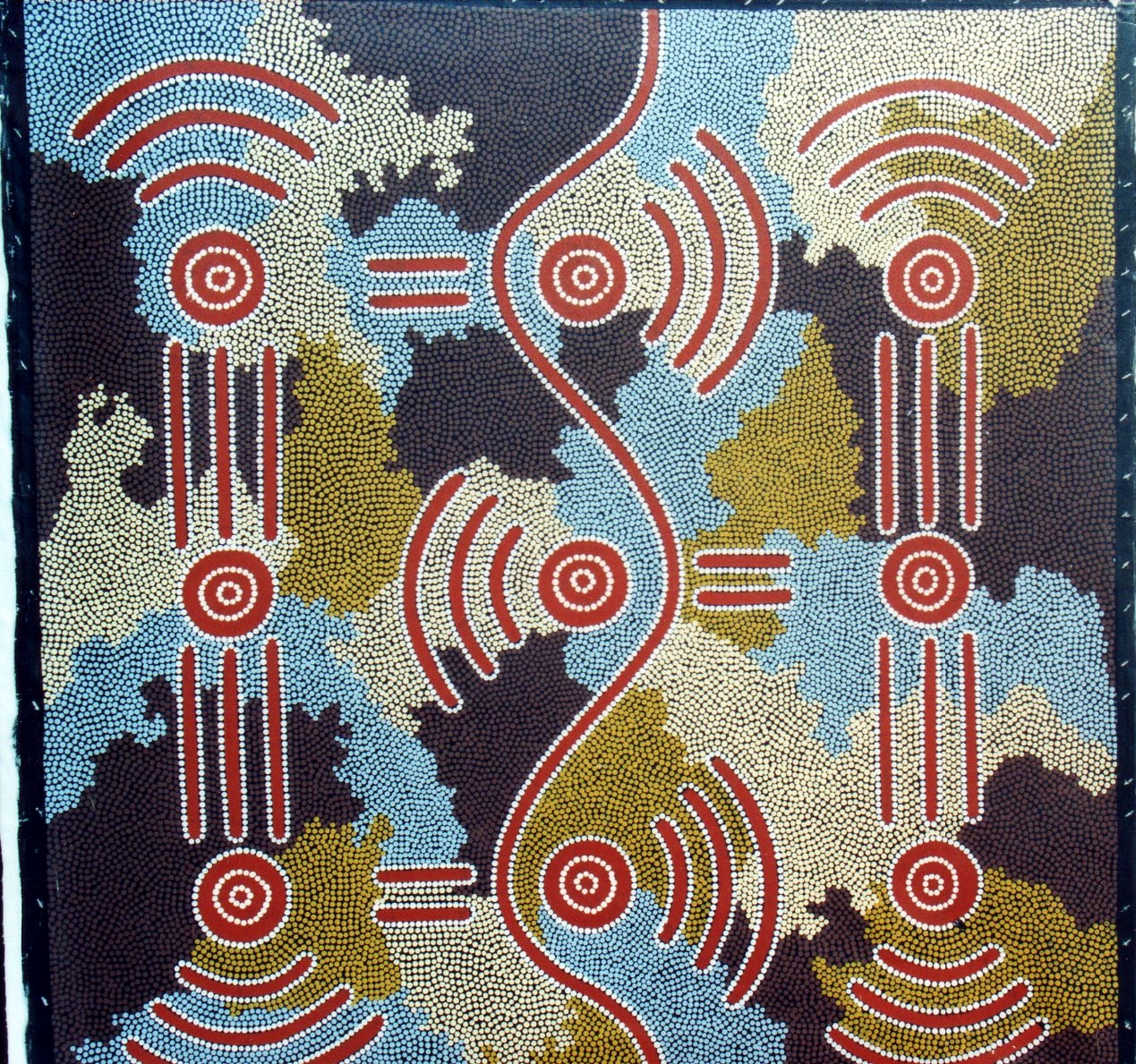
The above painting 22 depicts Colin’s grandfathers dreaming country far west of Yuendumu. This is an important site associated with the life giving water. The ancestor Tjungula and his people stayed in this area. The grey on dark the white dots indicate storm clouds, between some blue sky. The red circles with white dots indicate water holes. The oval shapes and straight lines running water into waterholes, all is centerd by a river (oval line through the middle of the painting. All remaining dots depict the rain.
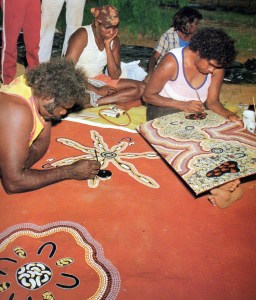 Working in the outback, Colin started a new project. On the right his wife Mary and both are surrounded by family and friends. Painting is a social thing and they love painting and chatting, drinking beer and having fun.
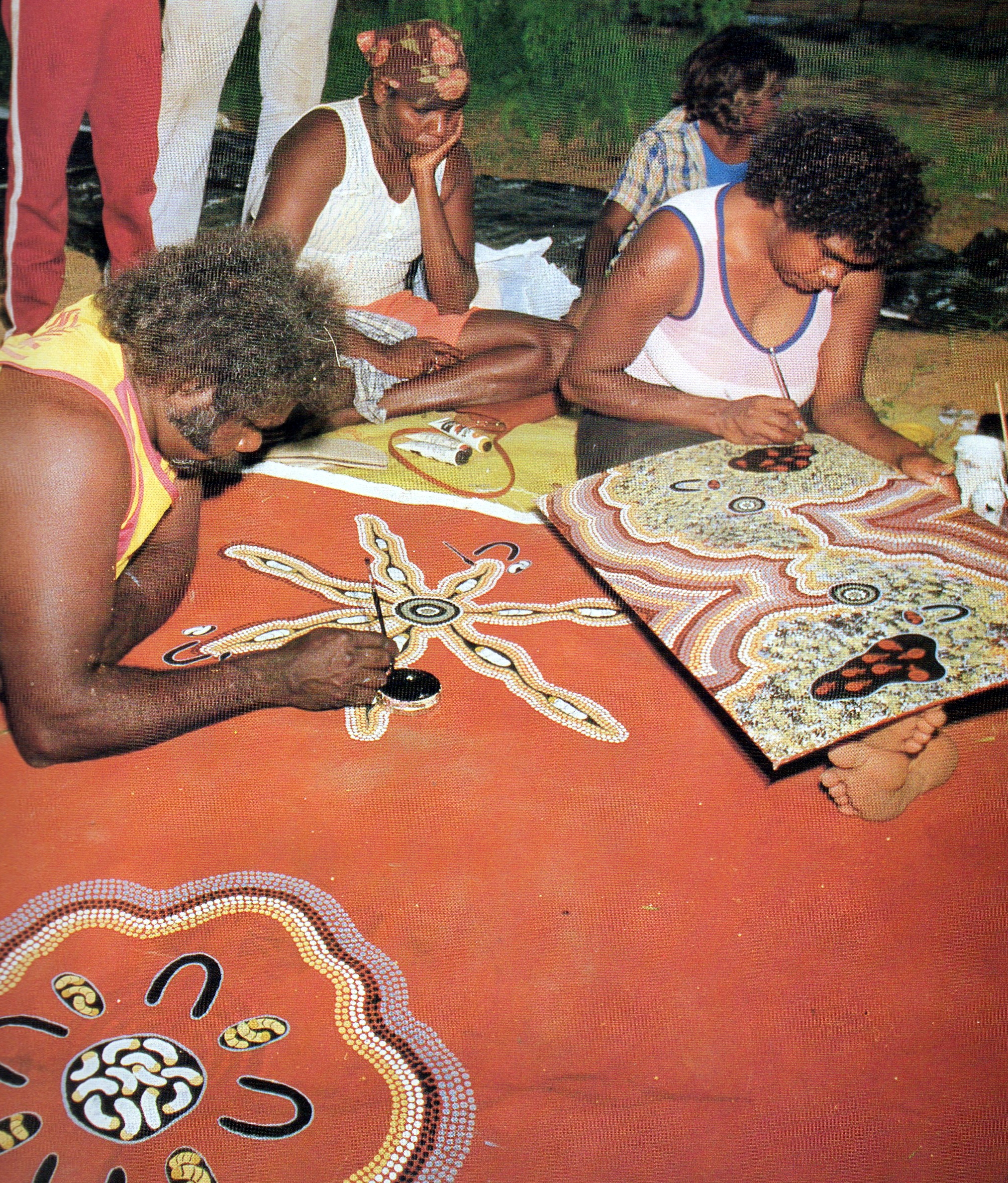
Colin is a cheerful family man and I have enjoyed watching his family grow and get older. His works are reasonably priced and traditional with the use of Aboriginal iconography and symbolism. His works stick to more traditional colours which are found naturally in the area through the use of ochre rocks. The rocks are collected and ground down to a powder; add some water and you have a thick paste which is used for painting the body, face and rocks. Ochre comes in a variety of different colours such as white, fawn, brown and orange hues. See Ochre description in my post „Australia – Aborigine Art 1“.
 Same painting already developing. One will find Colins work always very precise, very accurate, very symmetric and mostly made with earthy colors.
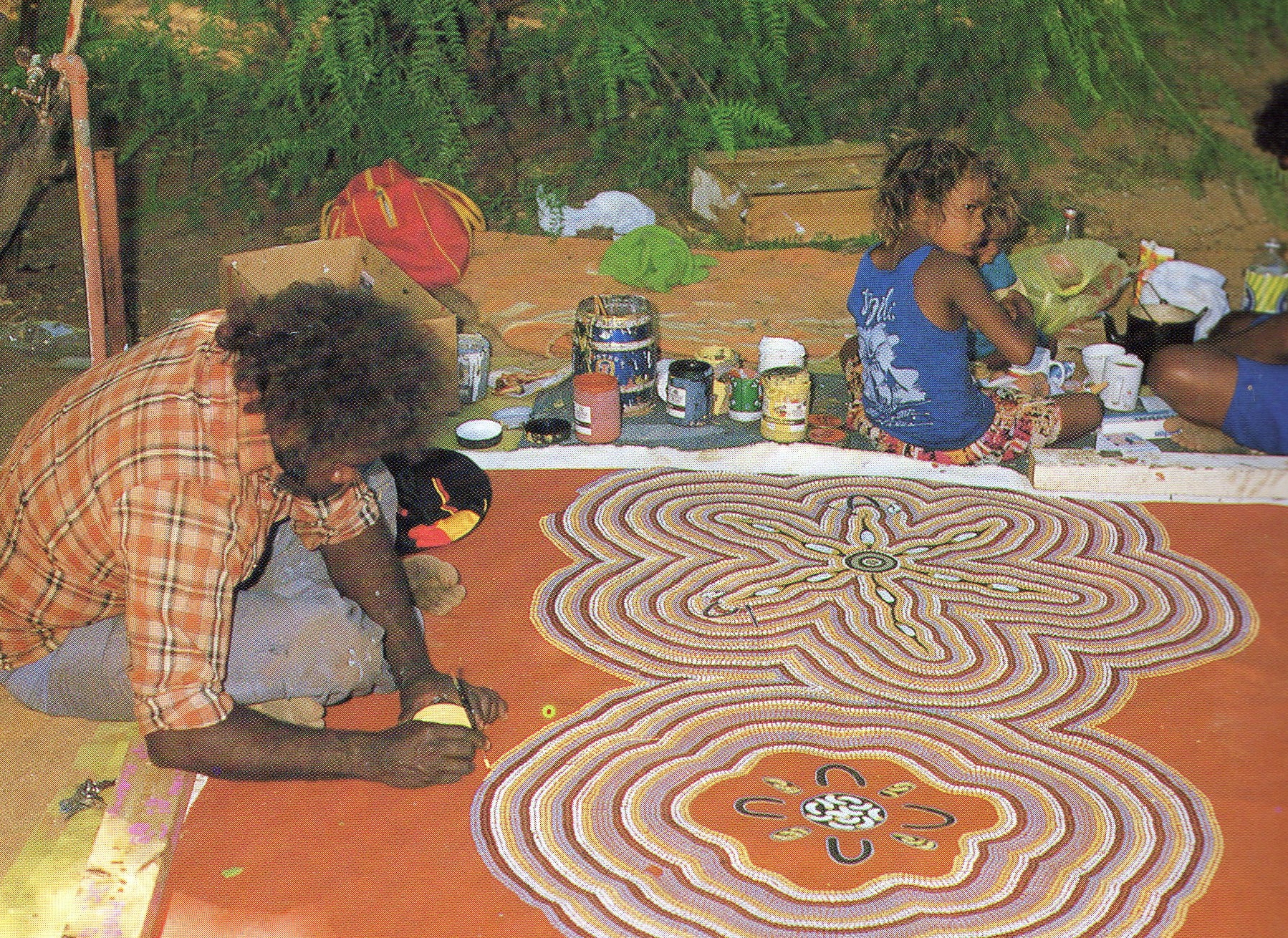
A stockman and cowboy at heart, Colin is most at peace living on the traditional lands. He has an intimate knowledge of the land and the sacred Dreamings associated with it. It is very important to have these traditional paintings for learning and teaching about the sacred and important stories, laws and morals of Aboriginal culture.
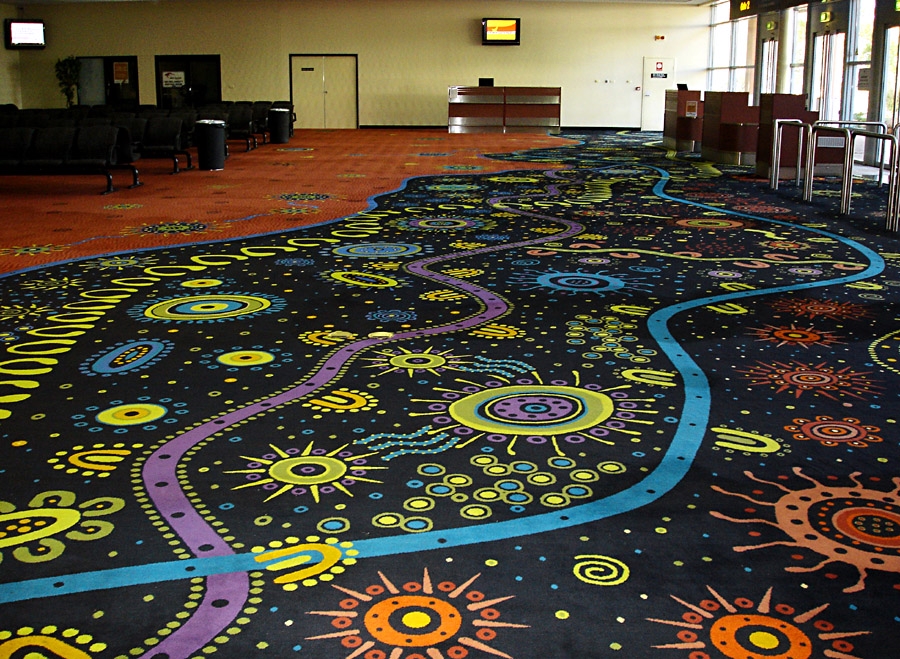
 Qantas lounge in Alice Springs airport. What a carpet !
Nearly all of the here shown artists have a long list of exhibitions, participation’s in international shows. Many won art prices and other rewards. All artists have their works in many known museums around the world and important private collections as well. As well as fetched prices for their works, I will not list all this information, it would extend the borders of my blog !!
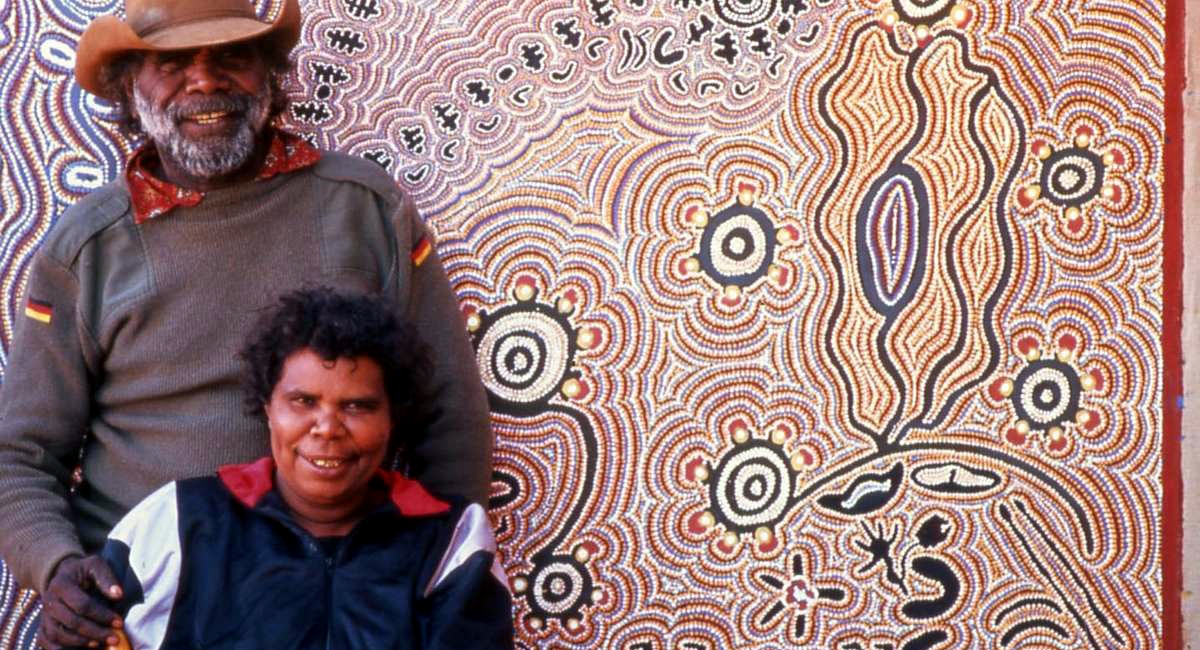
 Happy artists with our „German jumper“. The Aborigine people in Downunder love our gifts with „German Flag“, because it has the same colors as the Aborigine Flag – black, red and yellow !
If you are interested to ask about purchase or other questions or you want more information or whatever, do not hesitate to write. If you wish, your contacts won’t be published. With every sold artwork I will deliver an ample information package, with Photographs, maps, extended story’s and more, whatever I have you will get also.
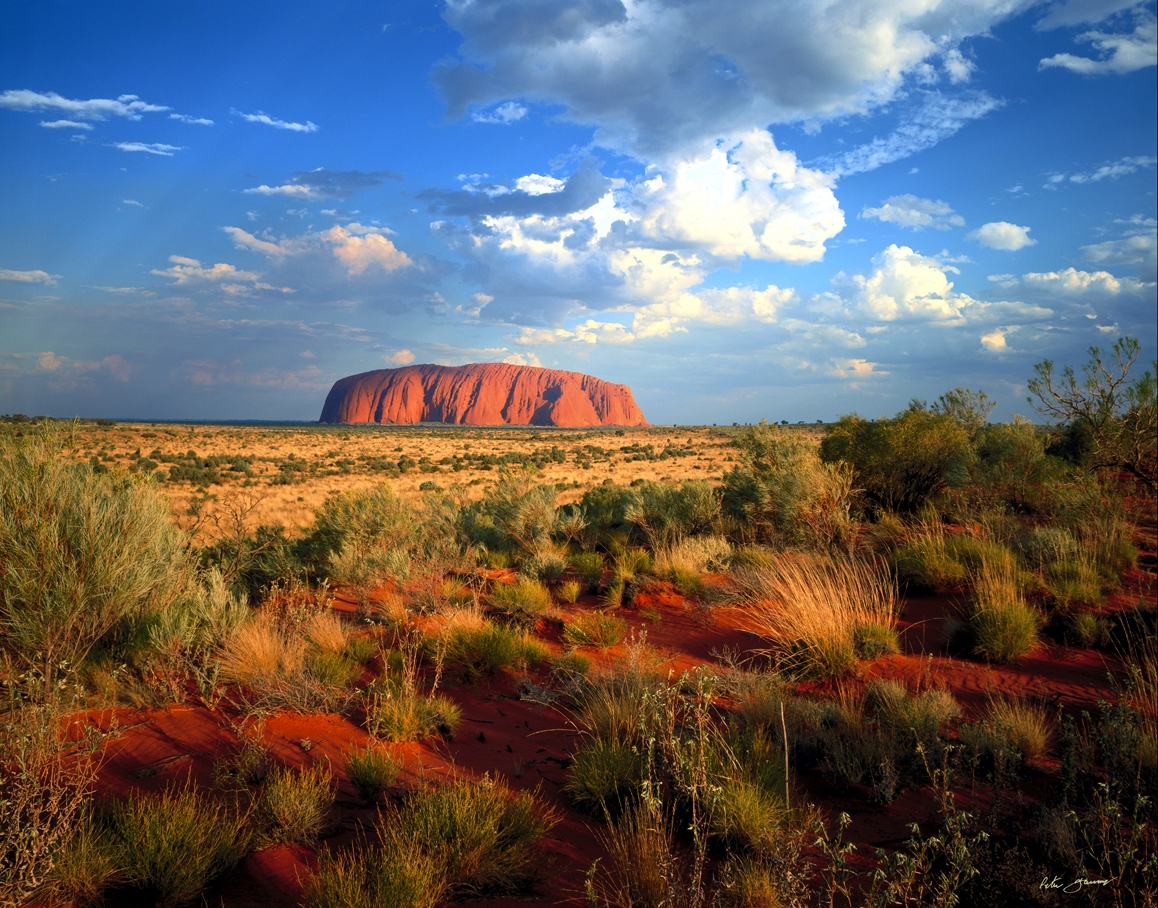 Australia – a BIG country, amazing nature, unbelievable distances, tens of thousands of years history and culture and one of the most unusual ancient population with a more then 50.000 year old art and lifestyle. I deeply hope that you enjoyed my small part of introduction and the pics I provided.


S U P E R , like it very much !
LikeLike