
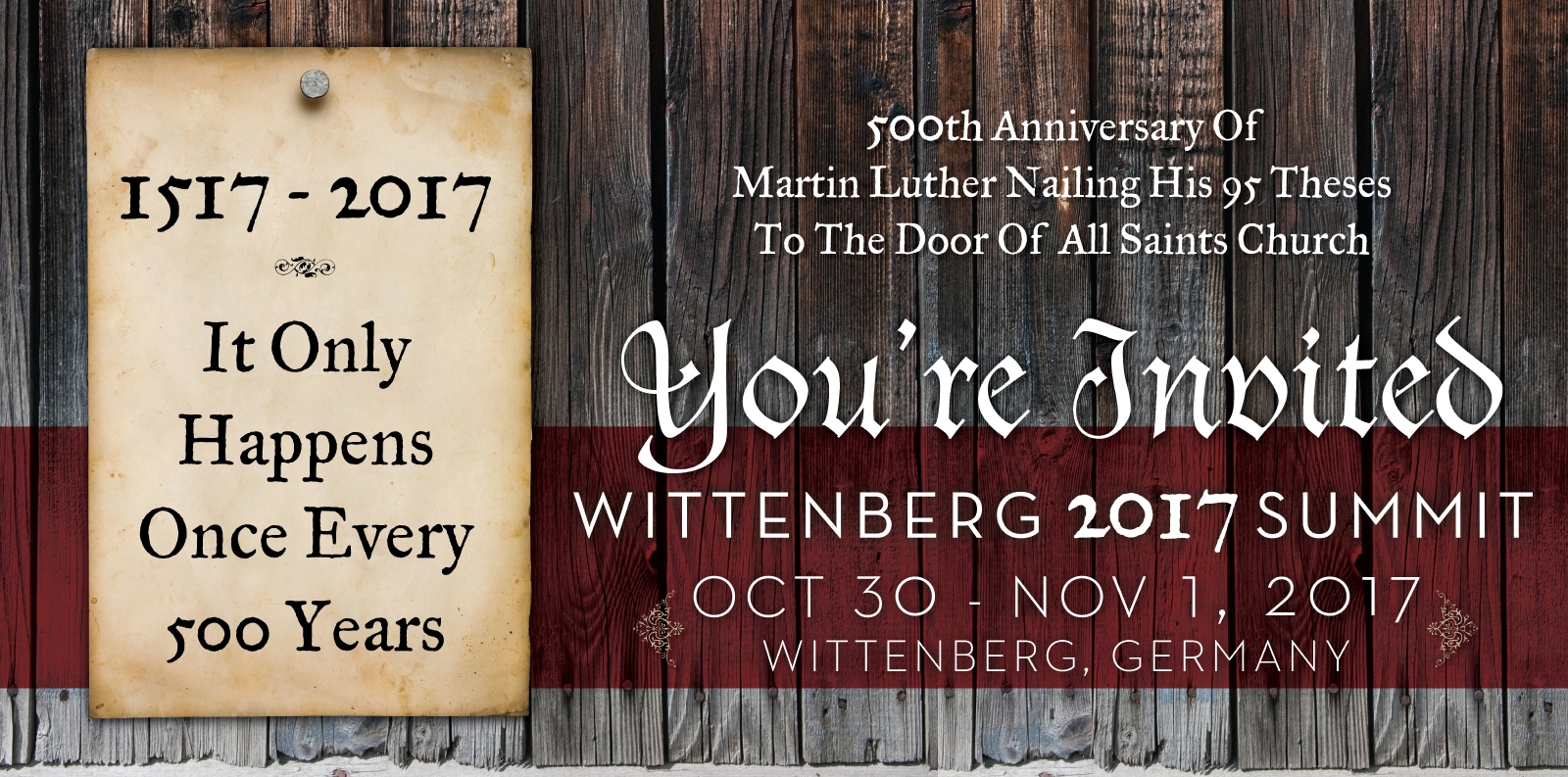
 You are invited !!!
Martin Luther.
Wittenberg is inseparable connected with Martin Luther. Luther has many places in Germany where he left history. But only two city’s are officially aloud to use the name „Lutherstadt“ (Luther city), this is Eisleben where he was born and died and of course Wittenberg where he spent most of his life and established the church reformation.
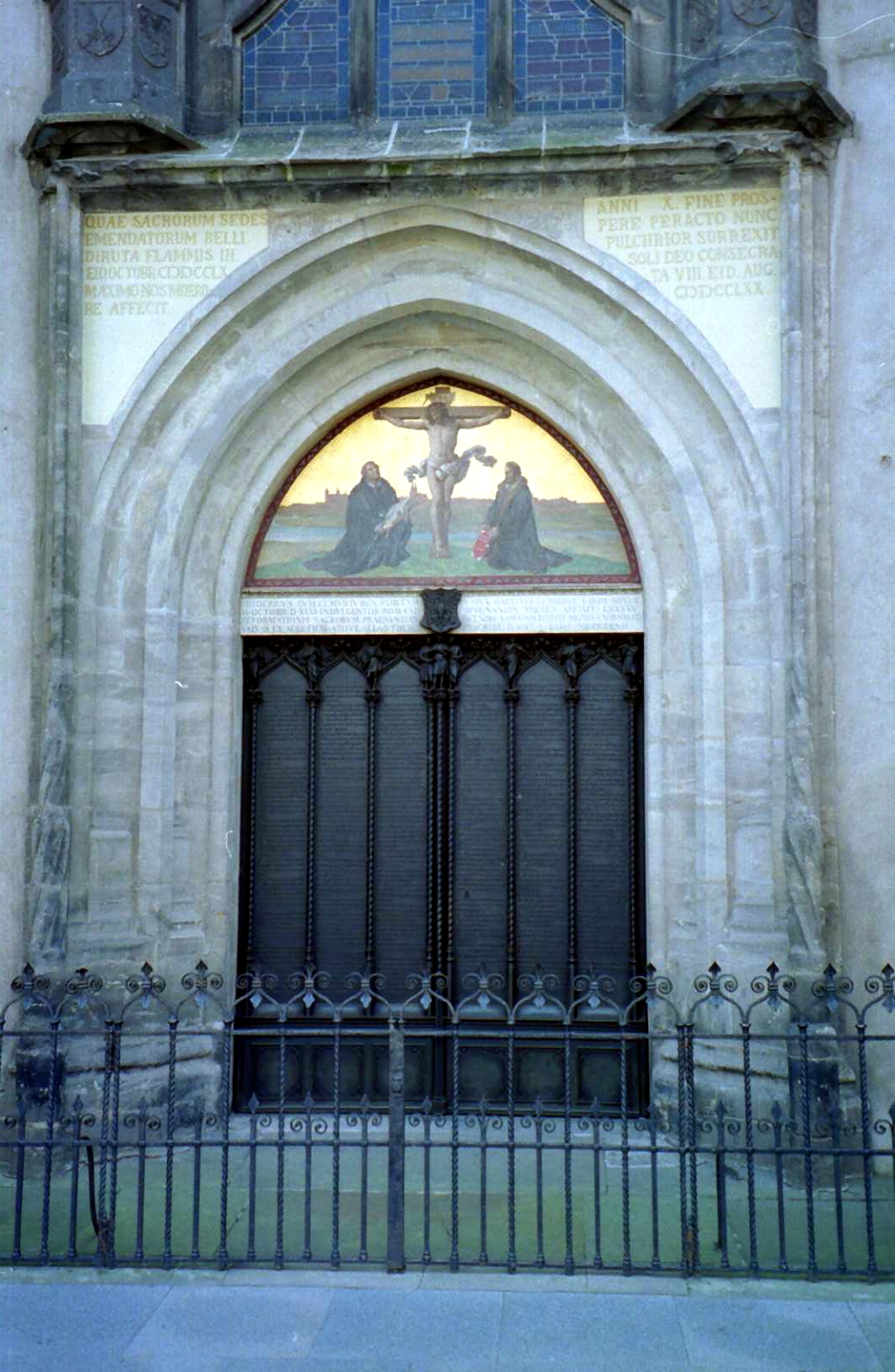
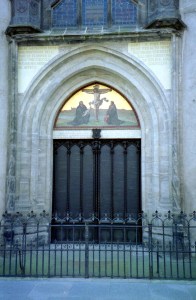 World famous, the 95 theses of Martin Luther at the door of the castle church in Wittenberg, Germany. Today the door and theses are made from heavy bronze.
It is unbelievable how much is to say and write about Martin Luther. In this post I can summarize only a short overview of his life and achievements and some facts which are not so well known.
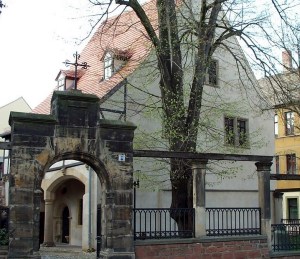 Luther’s birthplace in Eisleben, now a museum.
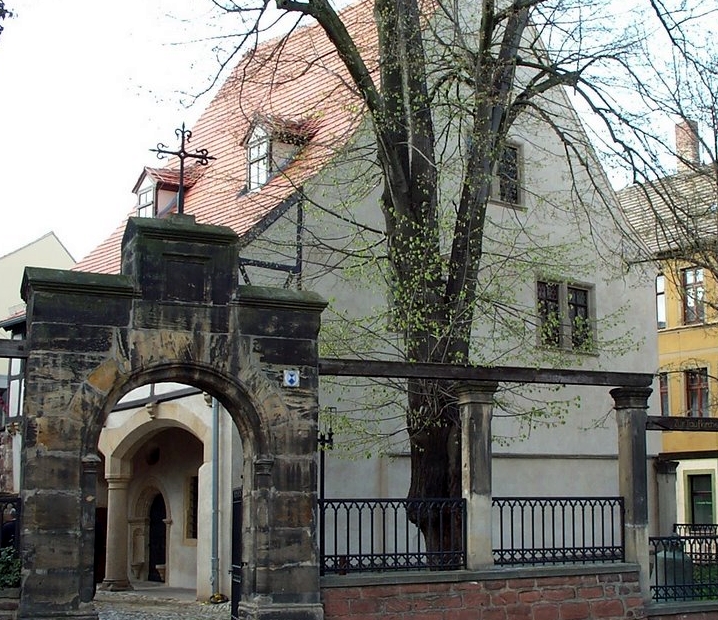
Born in Eisleben, Germany in 1483, Martin Luther became one of the most influential figures in Christian history when he began the Protestant Reformation in the 16th century. He called into question some of the basic tenets of Roman Catholicism, and his followers soon split from the Roman Catholic Church to begin the Protestant tradition.
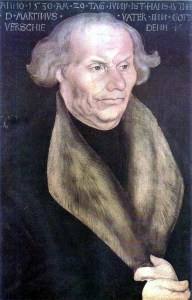
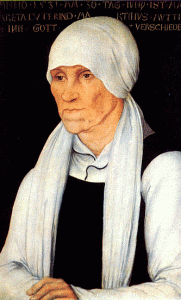 Martin Luthers parents, painted by Lukas Cranach the Elder in 1550.
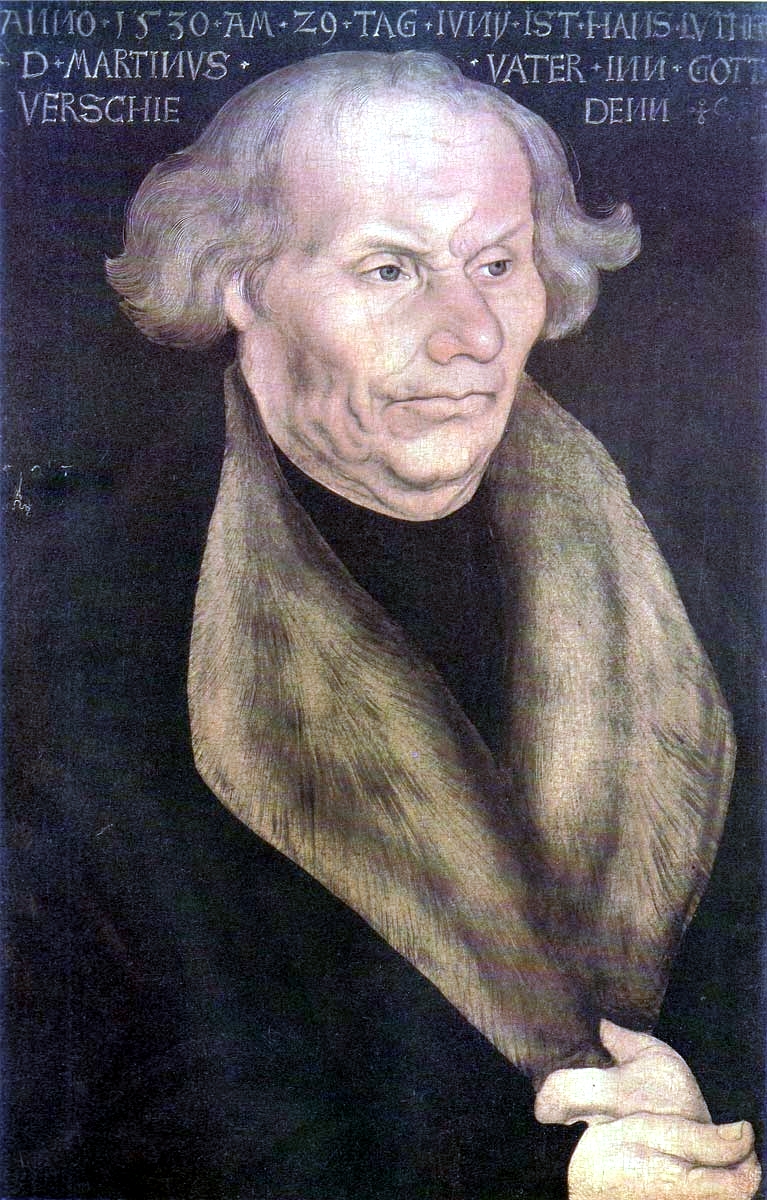
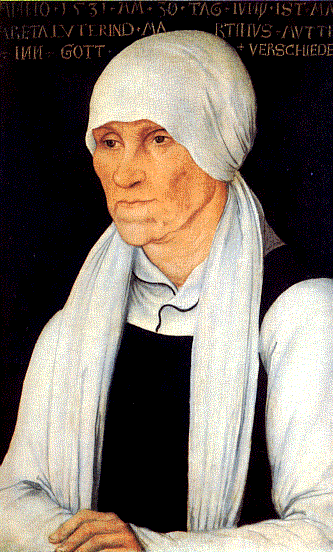
His father, Hans Luther, the farmer, miner, mine owner and later council member, allowed his son to study at the University of Erfurt, with the aim to become a lawyer. When the young Martin Luther in 1505 fell into a devastating storm, he vowed in dread to become a monk and joined a little later in the Order of Augustinian Hermits in Erfurt.
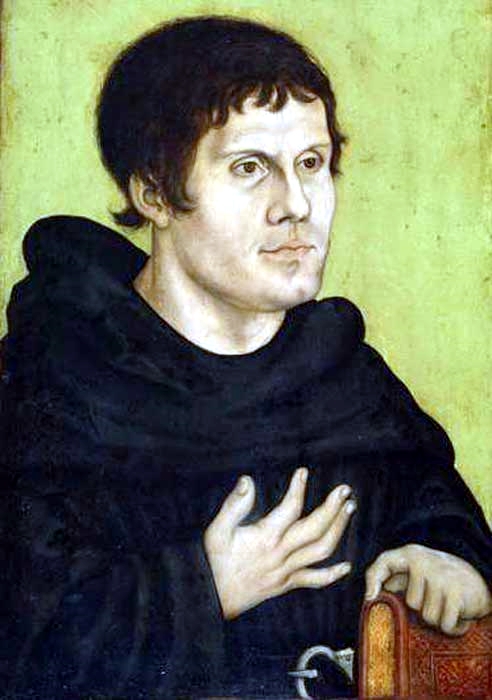
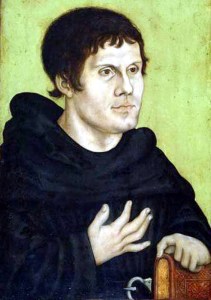 Martin Luther as Augustinian monk.
Luther began studying theology, was ordained a priest in 1507 and 1512 doctorate. Since then he has worked as a professor of theology in Wittenberg. In the same year he traveled to Rome.
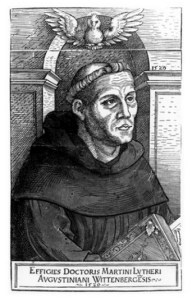 Luther as professor of theology at the Augustinianum Wittenberg 1520.
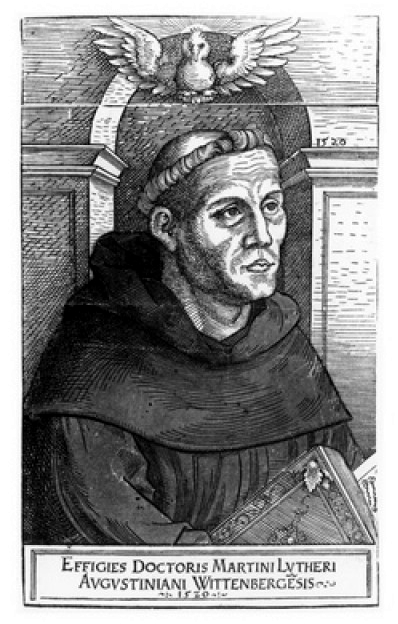
In the following years falls, the exact date is disputed, the key for his knowledge that man justice only gets by God’s grace, not by good work. As Luther himself reported, he learned that enlightenment in his study of his Wittenberg monastery tower, which is why this crucial experience is called „tower experience“.
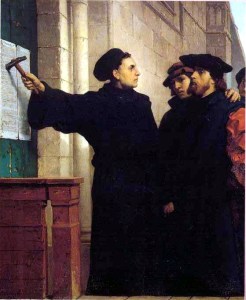
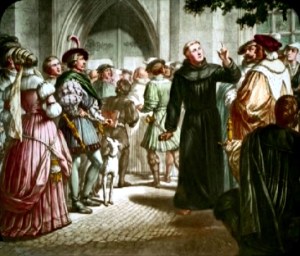 Luther nailed the 95 theses on the castle church door and then had to fight heavy discussions.
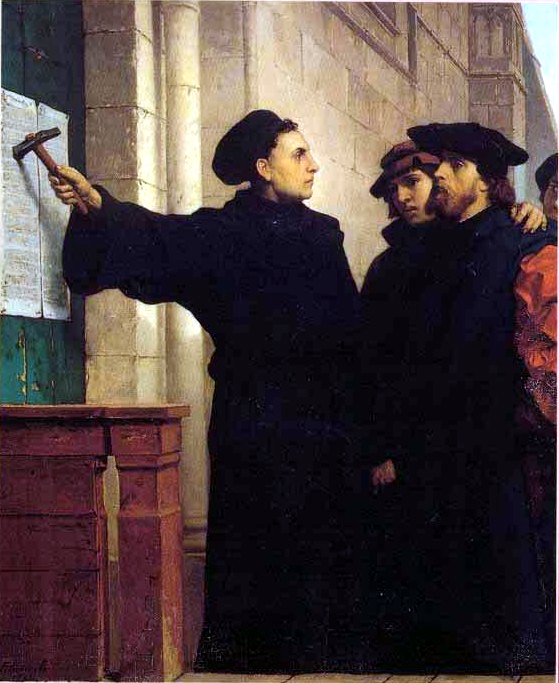
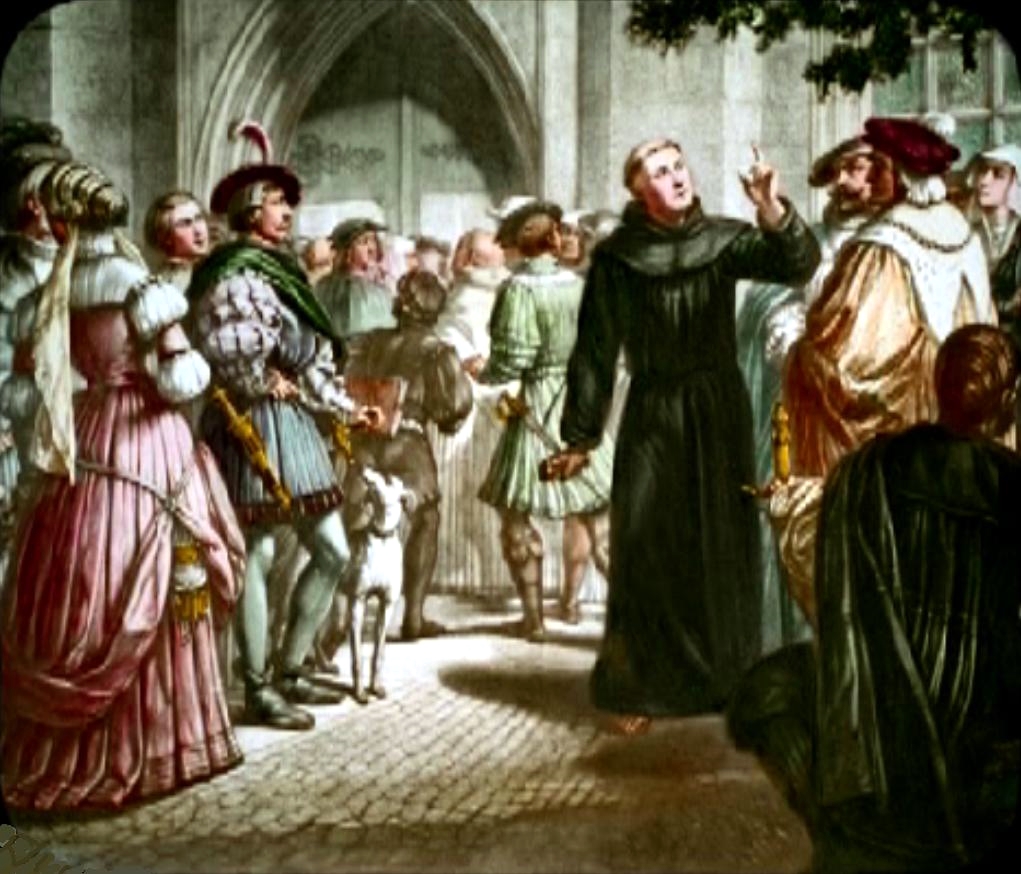
In 1517, Pope Leo X announced a new round of indulgences to help build St. Peter’s Basilica. On 31 October 1517, Martin Luther nailed a sheet of paper with 95 theses on the castle church door in Wittenberg. Though he intended these to be discussion points, the Ninety-Five Theses laid out a devastating critique of the indulgences as corrupting people’s faith.

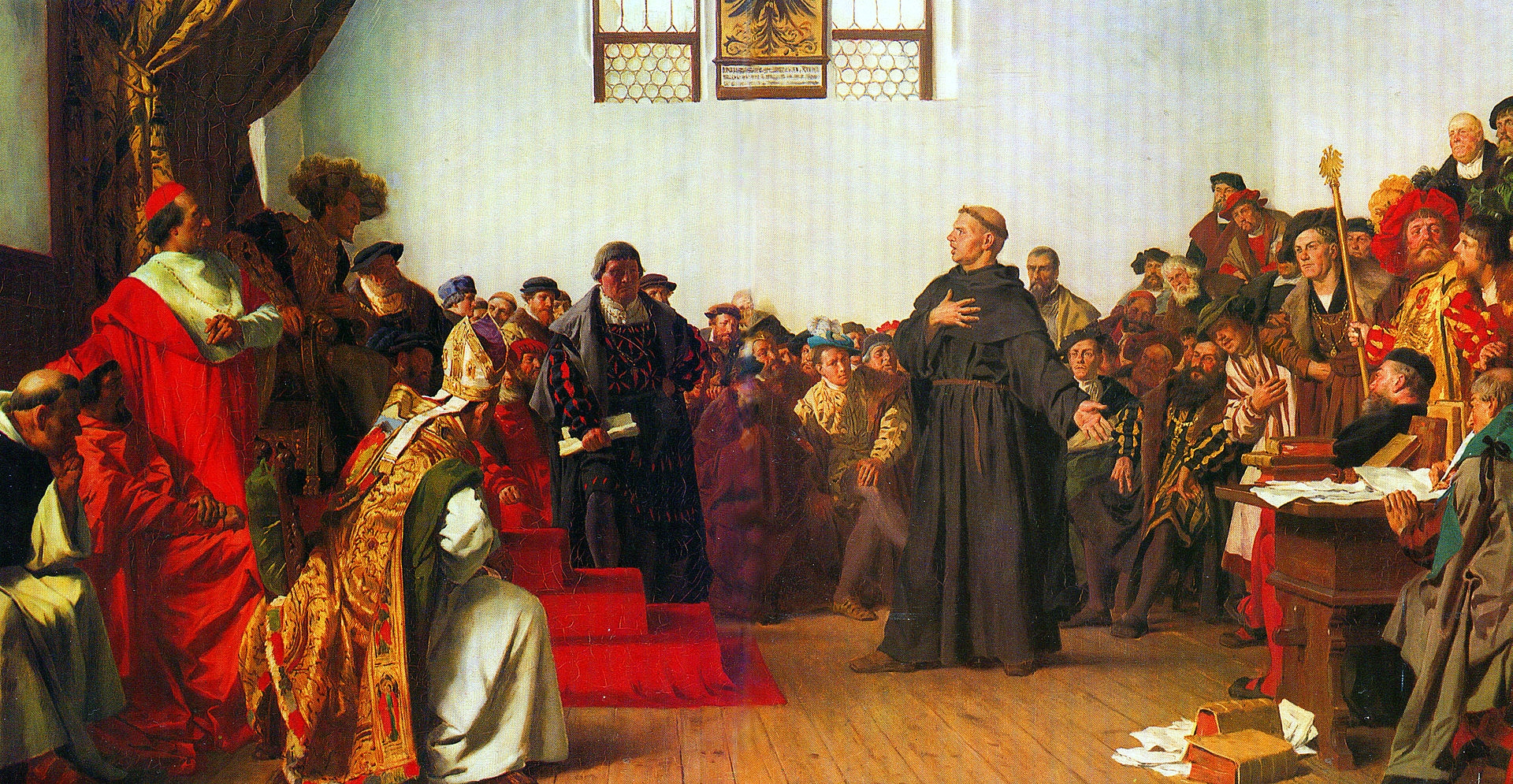
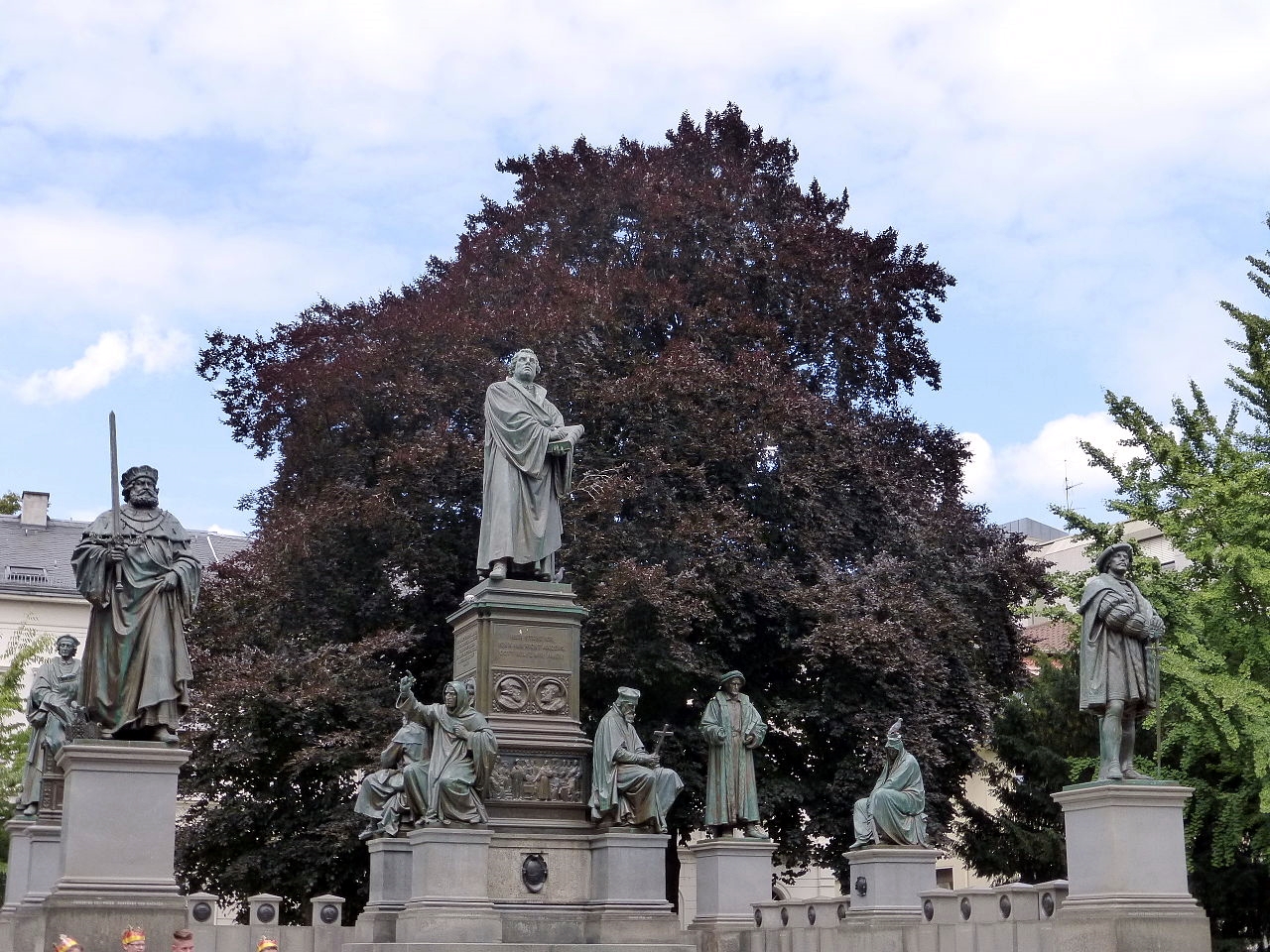
 The Diet of Worms relating to Luther took place from 16 to 18 April 1521. Left Luther infront of Johann Eck, defeating his theses. Right todays Martin Luther Memorial in Worms. His statue is surrounded by the figures of his lay protectors and earlier Church reformers including John Wycliffe, Jan Hus and Girolamo Savonarola.
Luther also sent a copy to Archbishop Albert Albrecht of Mainz, calling on him to end the sale of indulgences. Aided by the printing press, copies of the Ninety-Five Theses spread throughout Germany within two weeks and throughout Europe within two months.
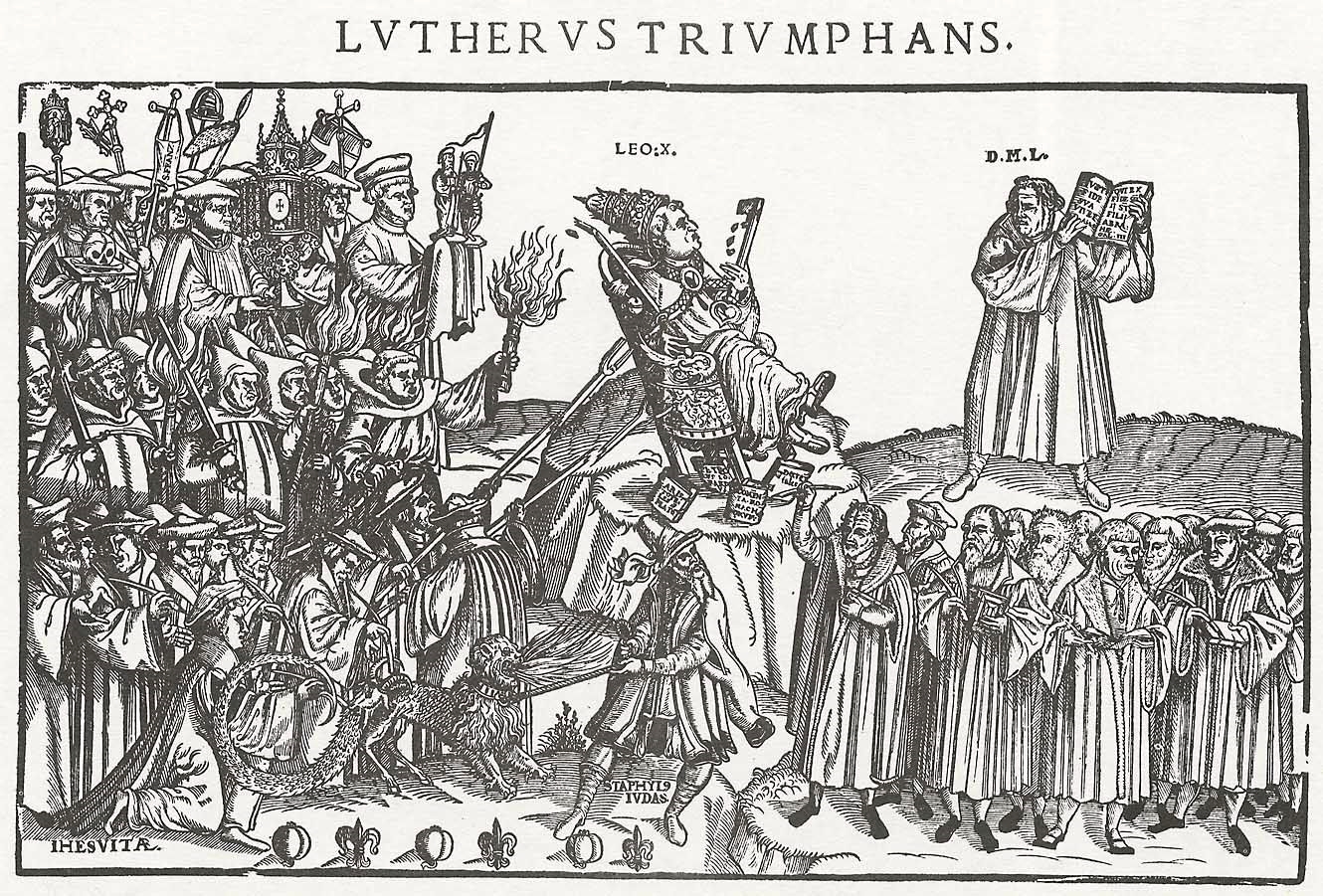
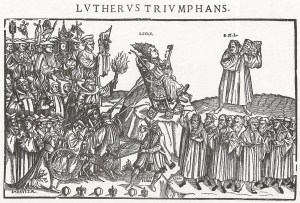 Contemporary woodcut titled „Luthers Triumph“ over Pope Leo X. Notice the Pope holding a crumbling bible.
1518 by the Roman Catholic Church initiated a preliminary investigation for heresy against Luther, who refused to recant his writings and only a little later publicly questioned the infallibility of the Pope and the Councils.
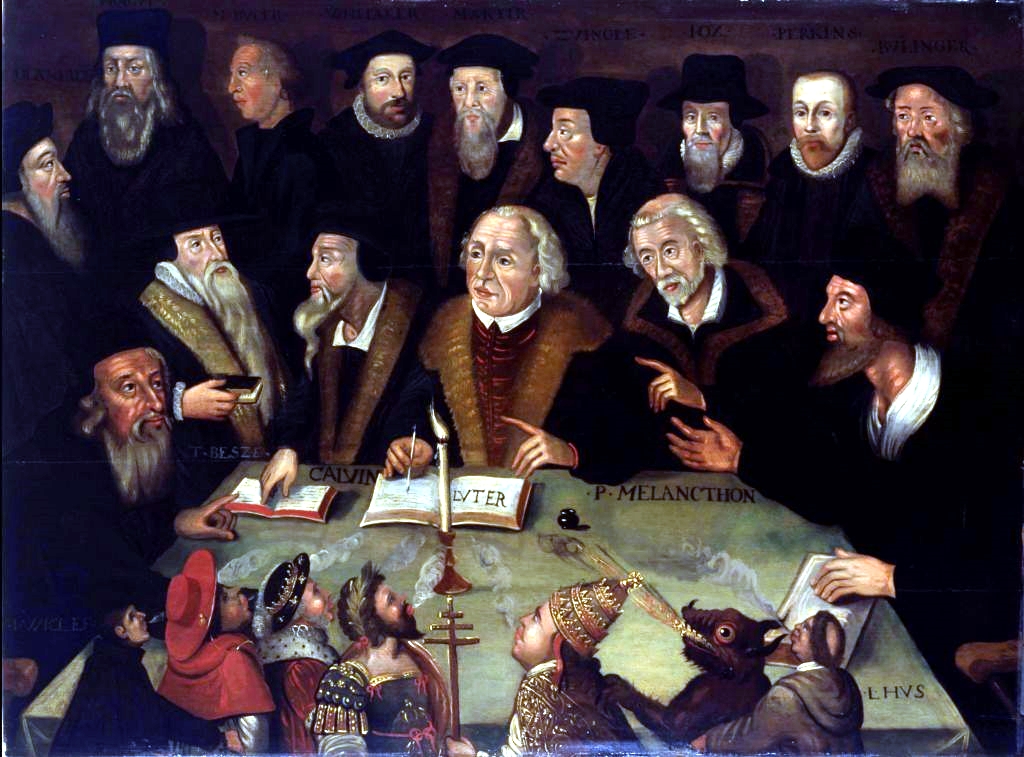
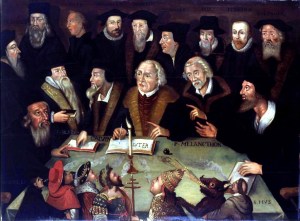 Discussion about the reformation. Notice how „small“ the Catholic delegation (no names) is painted against the „big“ persons of Calvin, Luther, Melanchton and their fellows (all of them are named). Don’t know who painted this excellent piece of art.
1520 Martin Luther published over 30 journals, including the four major Reformation writings „Sermon on Good Works“, „To the Christian Nobility of the German Nation of the Christian Estate,“ „On the Babylonian Captivity of the Church“ and „On the Freedom of a Christian „.
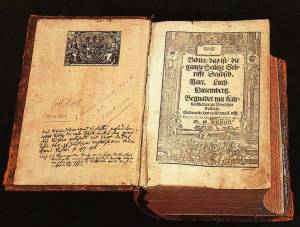
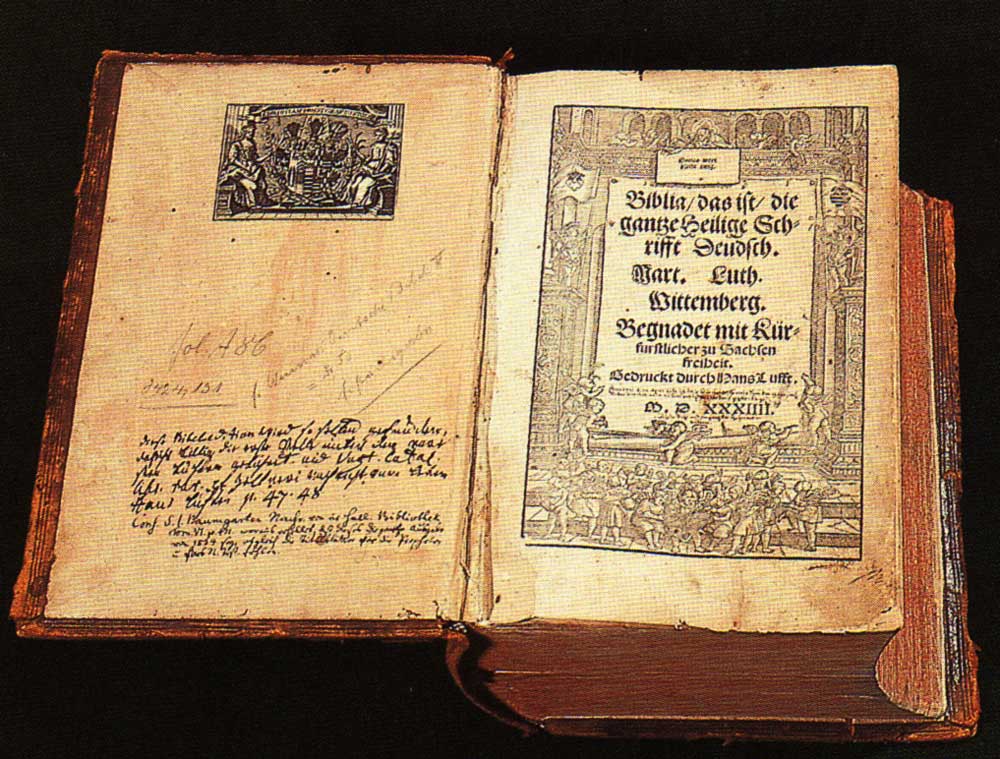
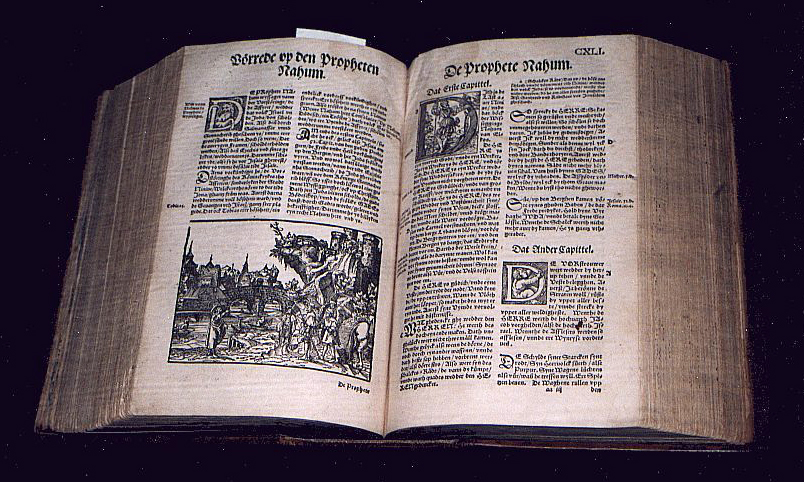
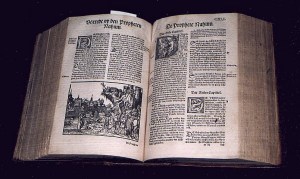 On the left the first edition of the German Luther Bible and right a later print, with wonderful woodcuts, from 1545. Both exhibited in the Luther Museum, Wittenberg.
In January 1521, Martin Luther was officially excommunicated from the Roman Catholic Church. In March, he was summoned before the Diet of Worms, a general assembly of secular authorities. Again, Luther refused to recant his statements, demanding he be shown any scripture that would refute his position. There was none. But – the Catholic church fought by any means against Luther and the reform movement.
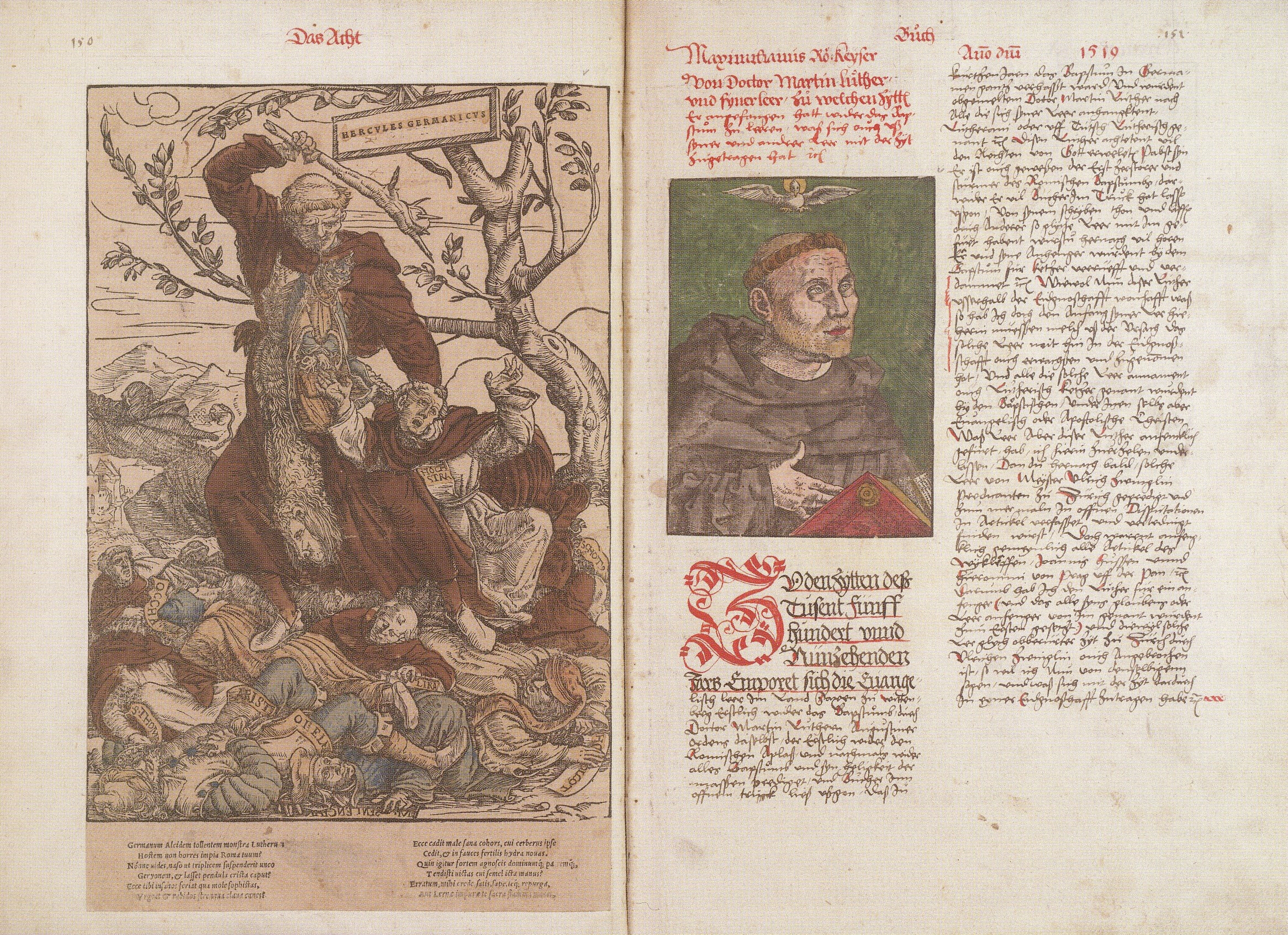
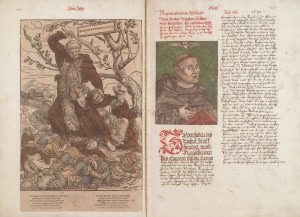 Book page, showing Luther as „Hercules Germanicus“, everything striking dead what was valid til then, by example „Homer“ and „Aristoteles“. This page is included in the „sibend, acht vnd neunt buch“, Euclidis Megarensis, printed in Augsburg 1555.
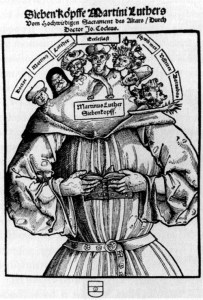
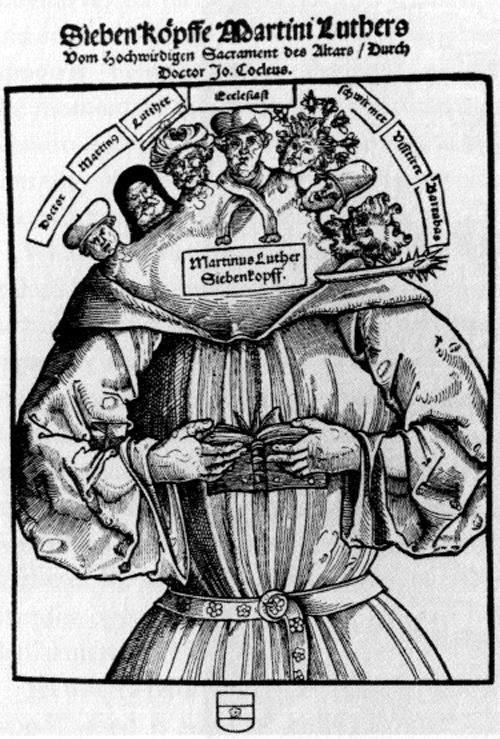
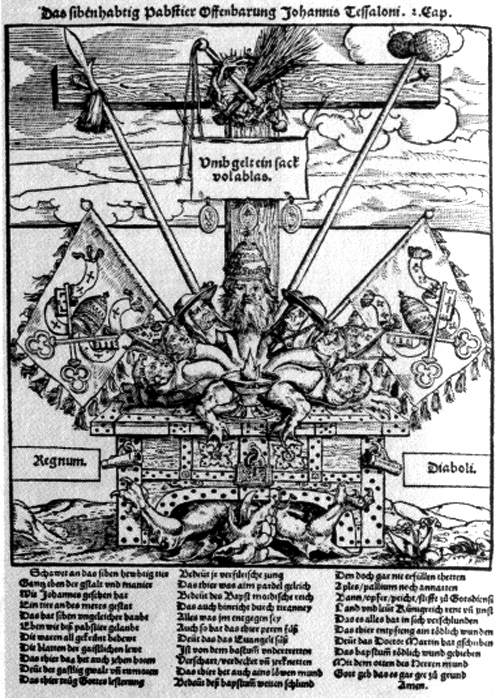
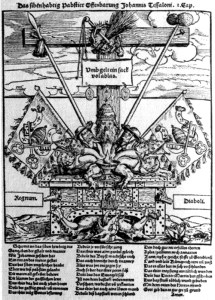 The Catholic church published this (left) engraving : „Hans Brosamer, Seven-headed Martin Luther – 1529“. A year later the reformation (later Lutheran church) answered with this (right) woodcut: „Anonymous, The seven-headed papal beast – 1530“. Those above three examples show how hard in public the „reformation“ was fought.
On May 8, 1521, the council released the Edict of Worms, banning Luther’s writings and declaring him a “convicted heretic.” This made him a condemned and wanted man.
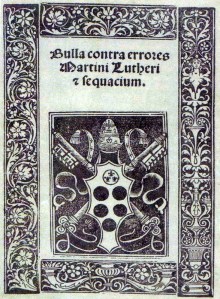
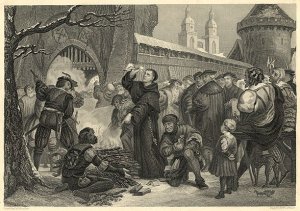 The Pope’s banning „bulla“ against Luther (left) and the burning of this bulla through Martin Luther (right).
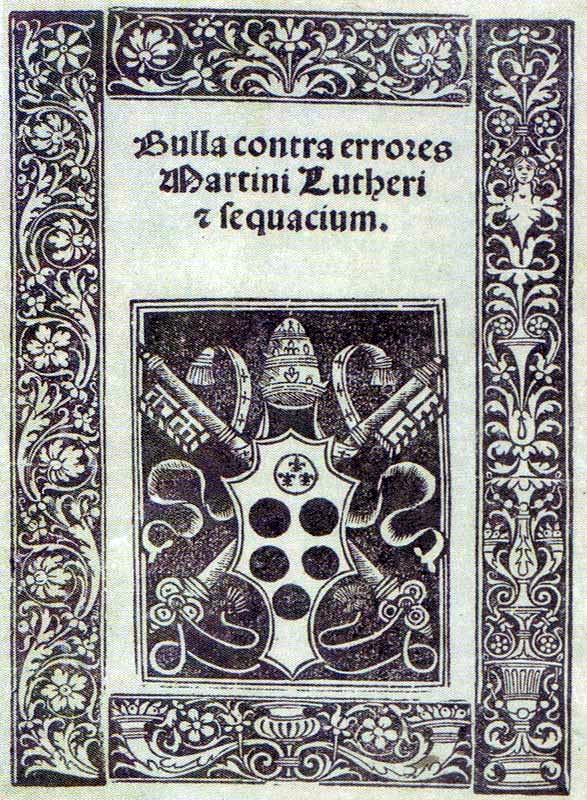
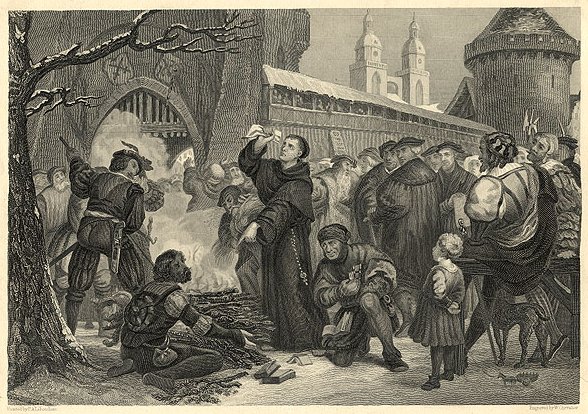
1521 came to excommunication and subsequently lead to the outlawry. Under the protection of the Saxon Elector Frederick the Wise, Luther was abducted to the Wartburg near Eisenach, where he in the following 10 months was hiding and living under the name of „Junker Jörg“.
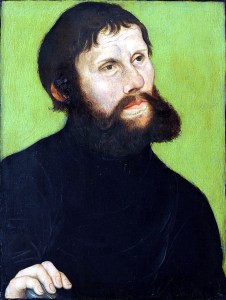 Martin Luther, as Junker Joerg on Warthburg, painted by Lukas Cranach the Elder 1521. Notice Luther with a beard to cover his real identity.
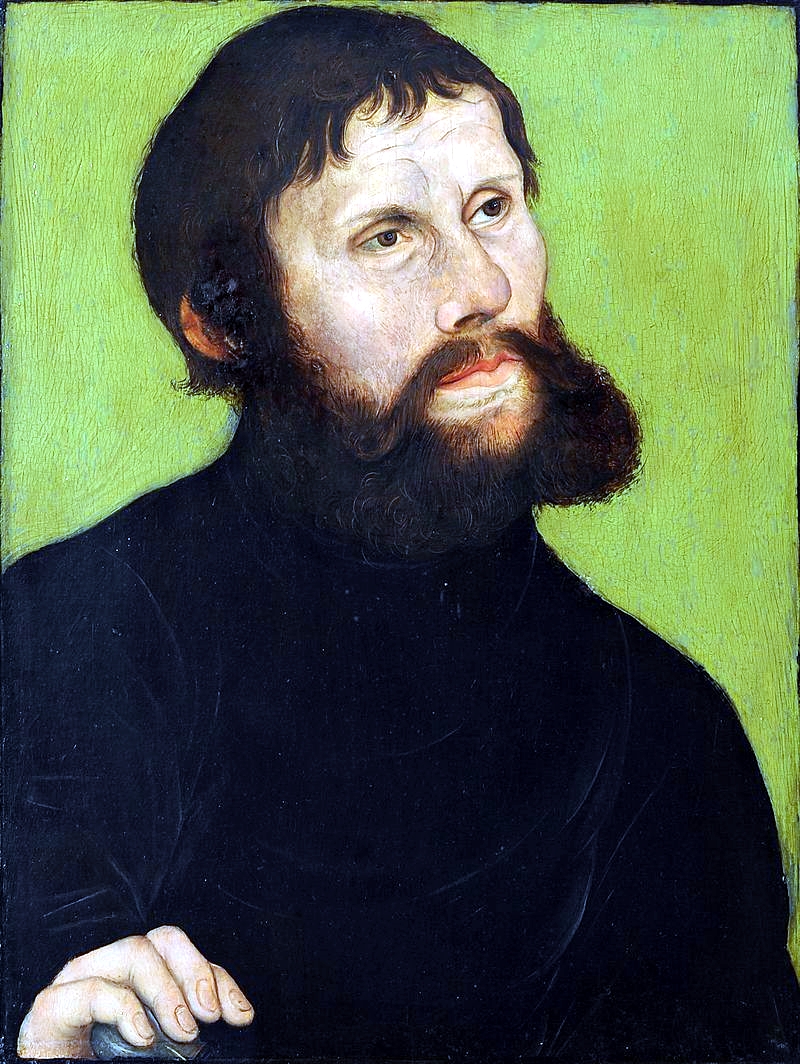
While there on the Wartburg Luther created the first German translation of the Bible, meantime the Reformation walked further and further away.
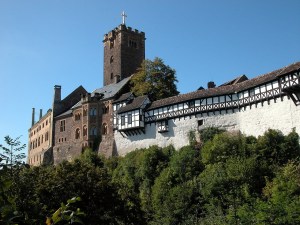
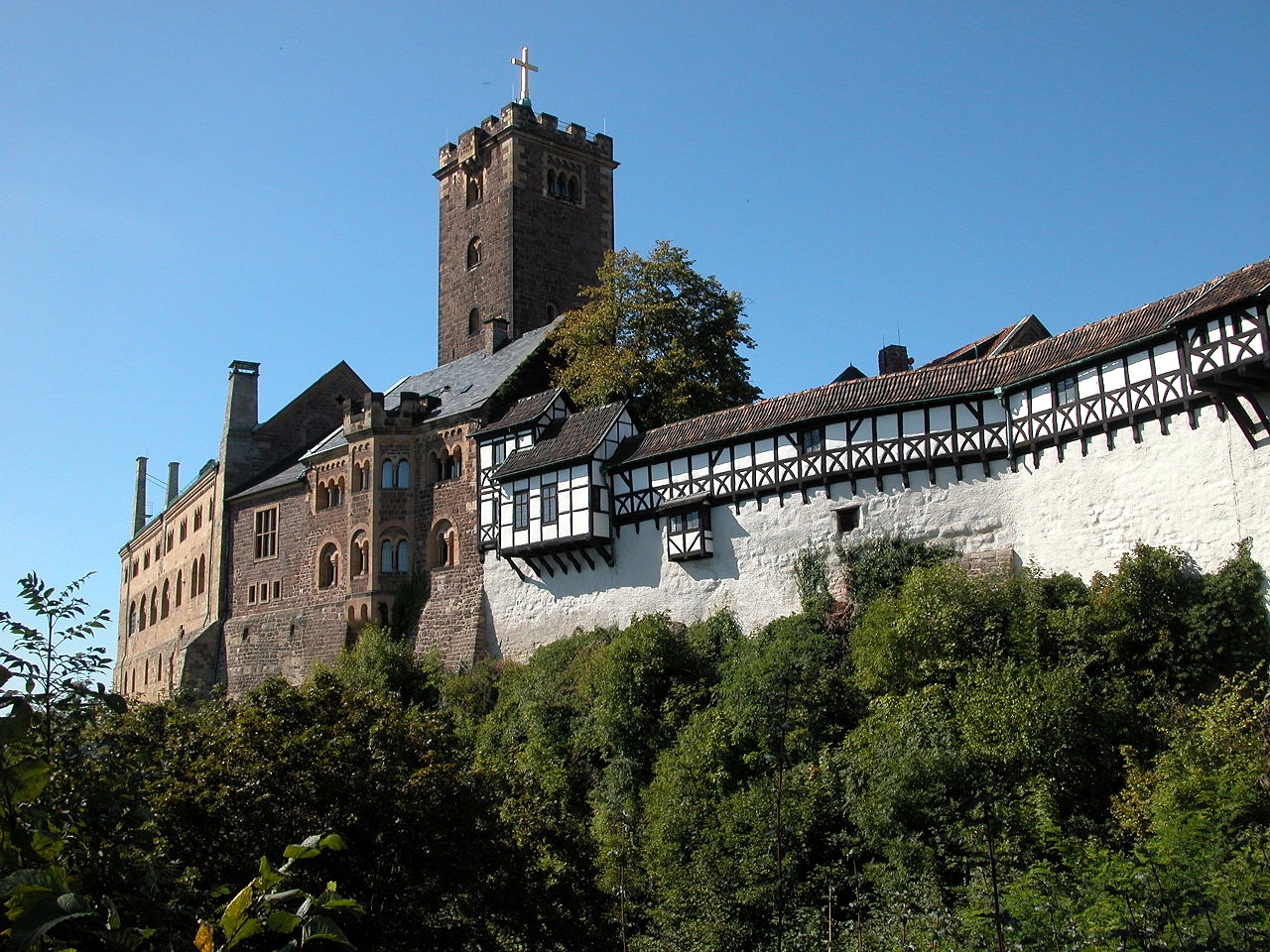
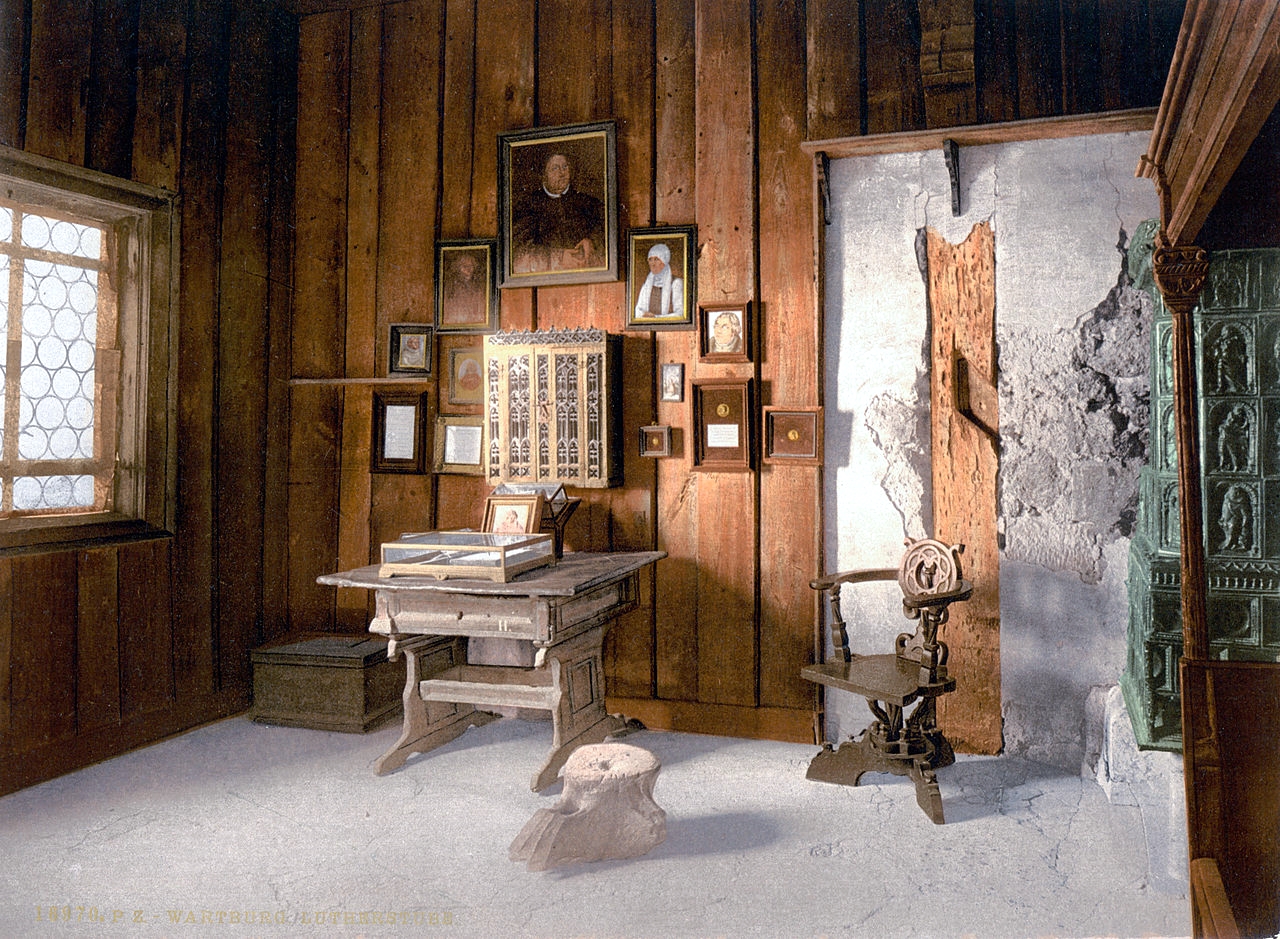
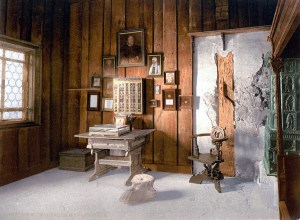 The Warthburg, near Eisenach, on the left and Luthers study room in original state from 1521 inside the castle, right. On the small table, locked under glas, a first edition of Luther’s German bible translation. Click on pics to supersize.
In March 1522 Luther returned to Wittenberg and worked mainly as a professor of theology in Wittenberg, pastor and writer. 1525 he married the former nun Katharina von Bora, with whom he had six children. From 1533 to 1546, Martin Luther served as the dean of theology at University of Wittenberg.
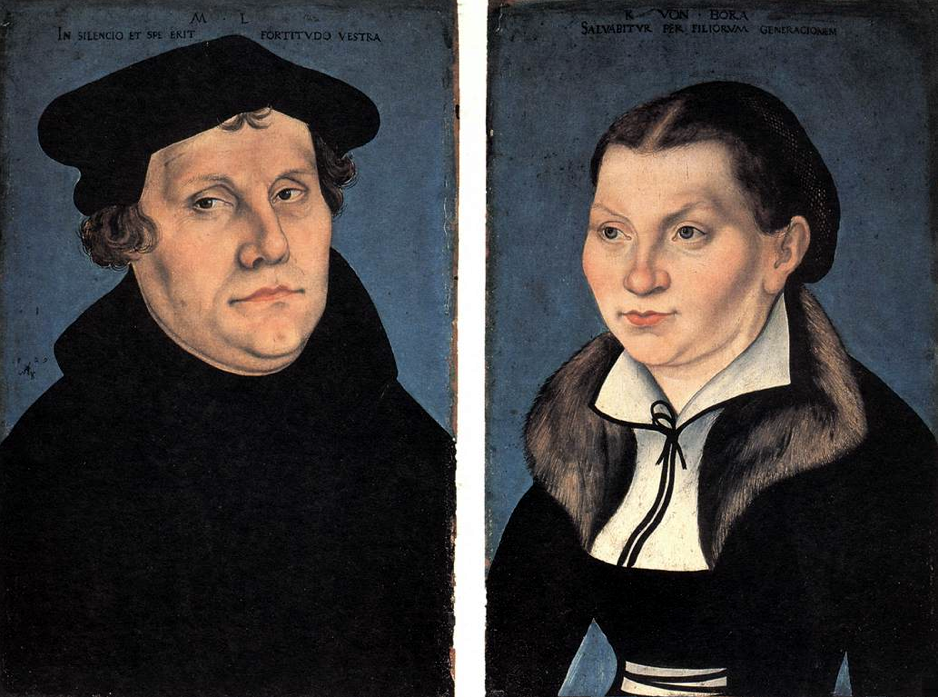
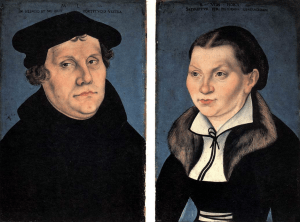 Luther and wife Katharina von Bora, Cranach the Elder.
On his last journey, which took him to his birthplace Eisleben, to settle inheritance disputes. Luther, for some time suffering from a heart condition, died at his birthplace in Eisleben at the age of 62 and was buried three days later in the Castle Church in Wittenberg. See his tombstone inside the church further down.
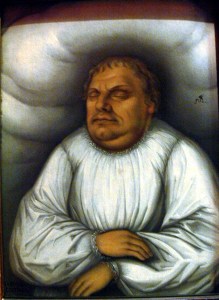
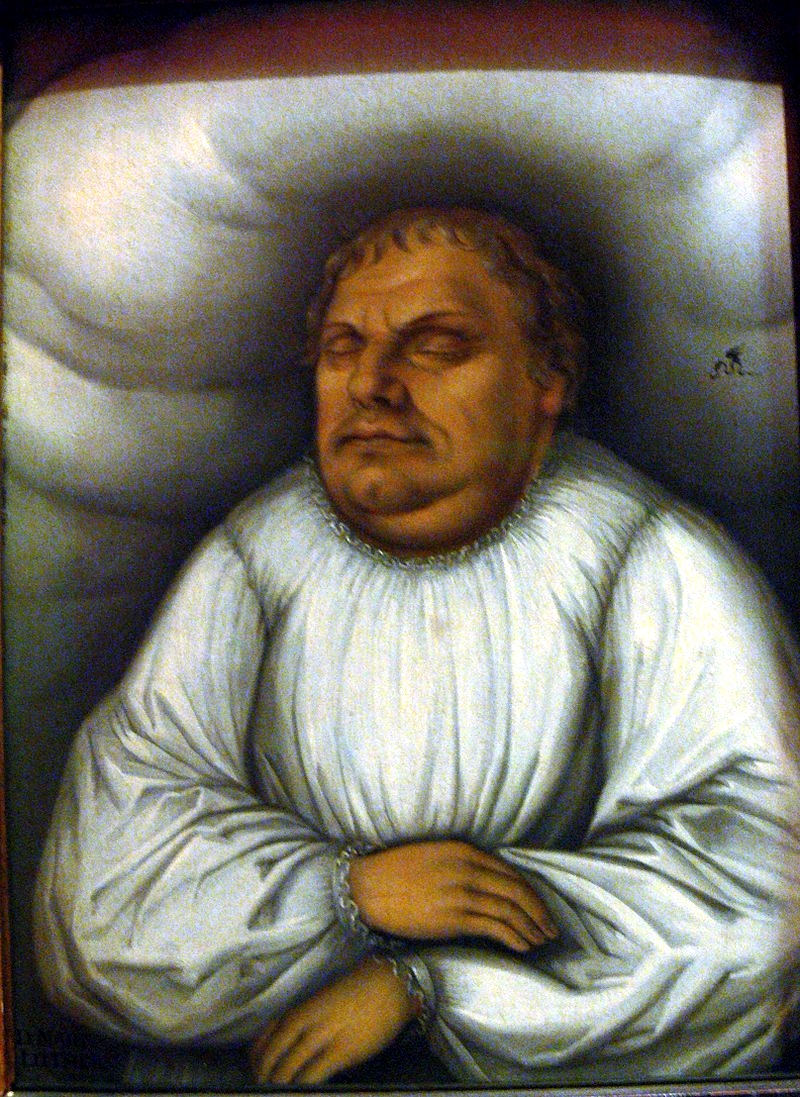
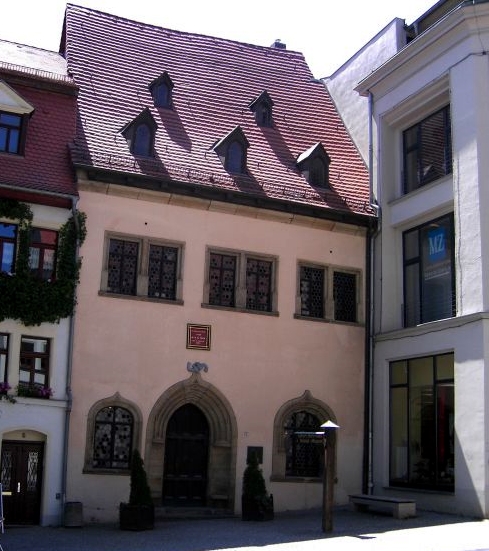
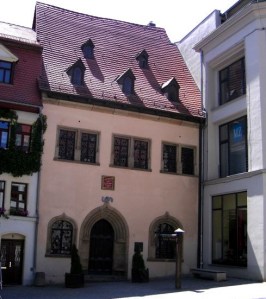 Martin Luther on his deathbed (again painted by Lukas Cranach the Elder 1546) and next to it the house in Eisleben where Luther died.
Martin Luther is one of the most influential and controversial figures in the Reformation movement. His actions fractured the Roman Catholic Church into new sects of Christianity and set in motion reform within the Church. A prominent theologian, his desire for people to feel closer to God led him to translate the Bible into the language of the people, radically changing the relationship between church leaders and their followers.
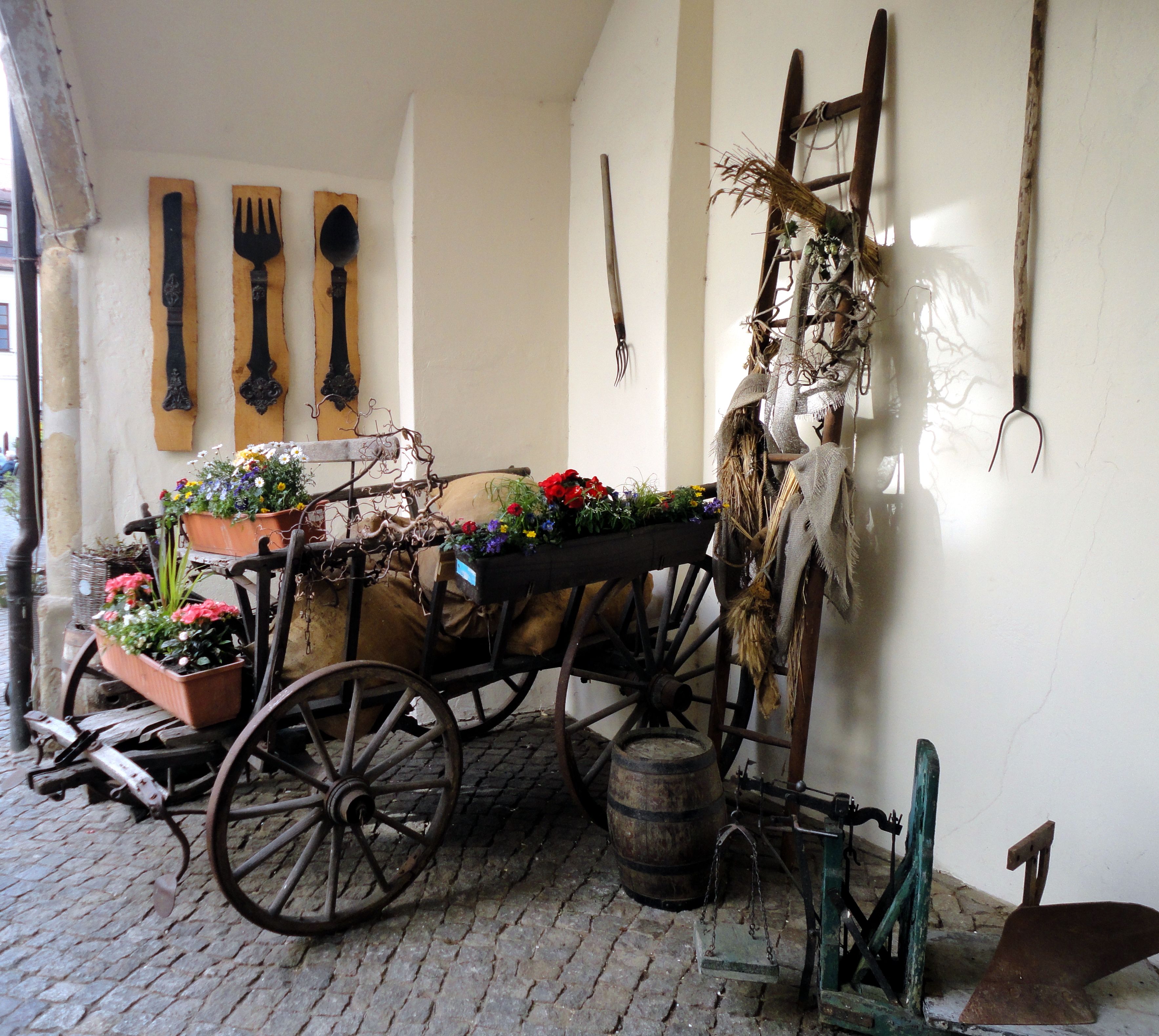
 So much to see in Lutherstadt Wittenberg, Just look behind the houses or into courtyards. A lovely renovated city after the „East German Times“.
Castle Church
The lovely Late Gothic Schlosskirche, built in 1500 as All Saints Church, is now better known as the Reformation Memorial Church due to its ties with Martin Luther. It was to the church’s original wooden doors that Luther nailed his famous Theses in 1517. Although the original doors were destroyed during the Seven Years War, the present bronze replacements, installed in 1858, bear their Latin text.
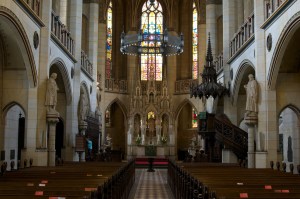 Inside the Castle Church with the alabaster statues on the left and right of the Electors of Saxony as well as Martin Luther and Phillip Melanchton. Click on pic.
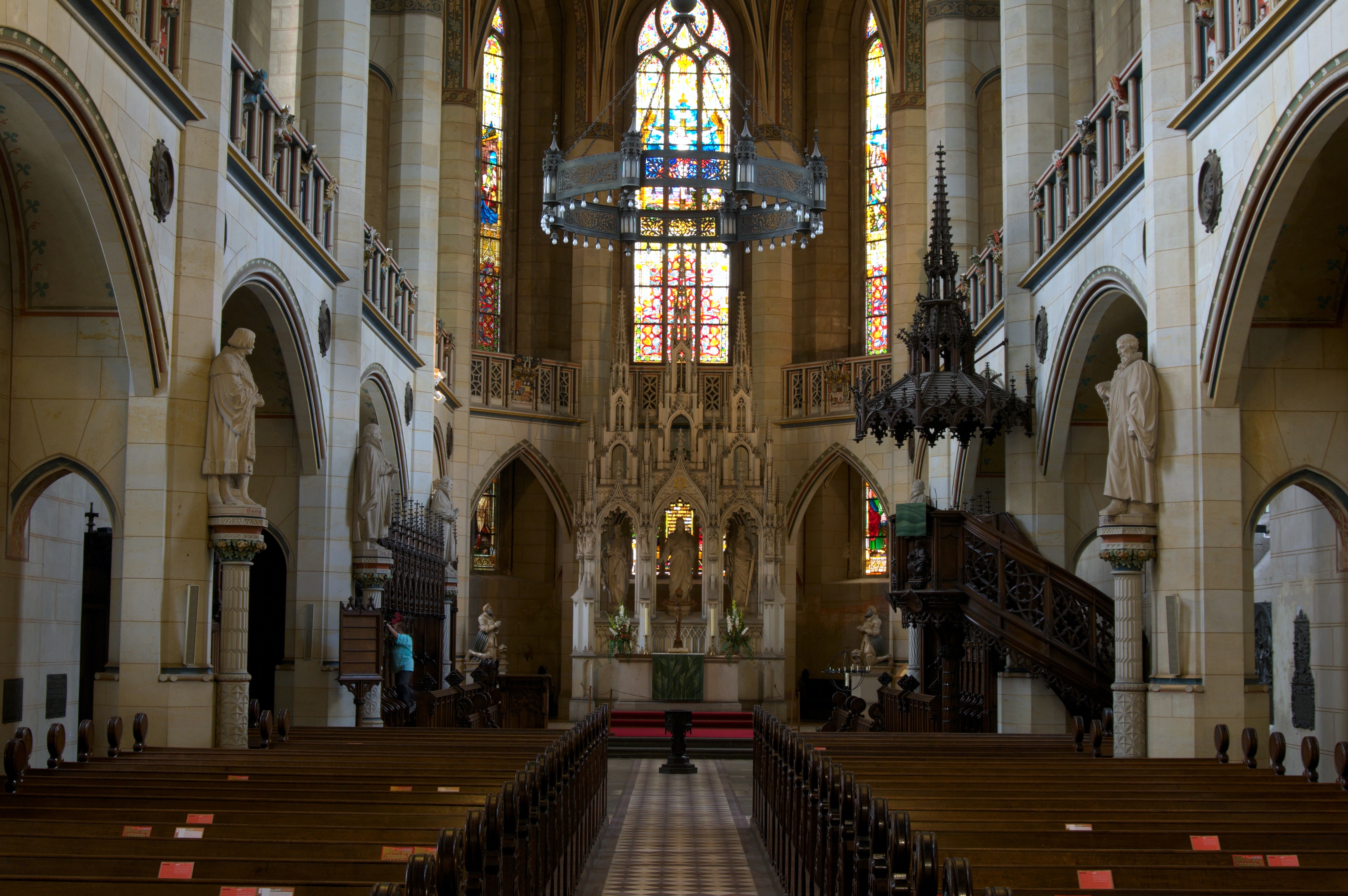
Luther gave some of his sermons in this church and now is buried just under the pulpit. The church was severely damaged twice during wars in the centuries following the Reformation, but it was rebuilt each time.
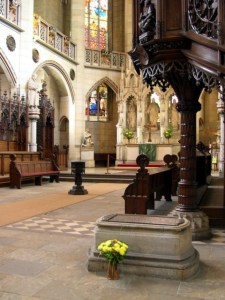
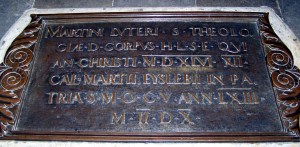
Martin Luther’s tomb is under the pulpit in the Castle Church. The inscription translates to: „Here lies the body of Martin Luther, Doctor of Divinity, who died at Eisleben, his birthplace, on the 12th of the Calends of March, in the year 1546, when he had lived 63 years, 3 months, and 10 days.“
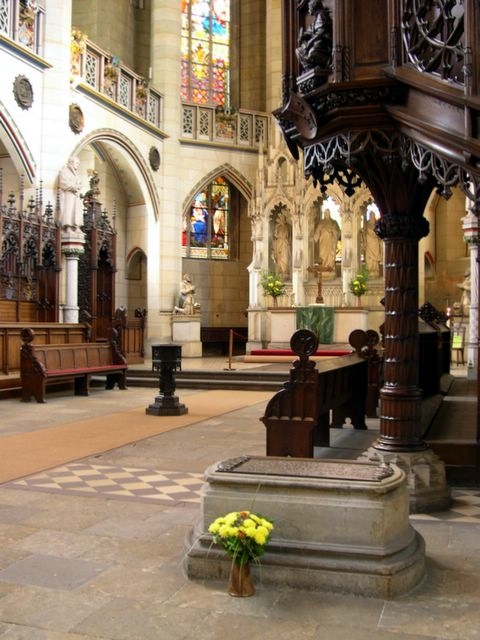
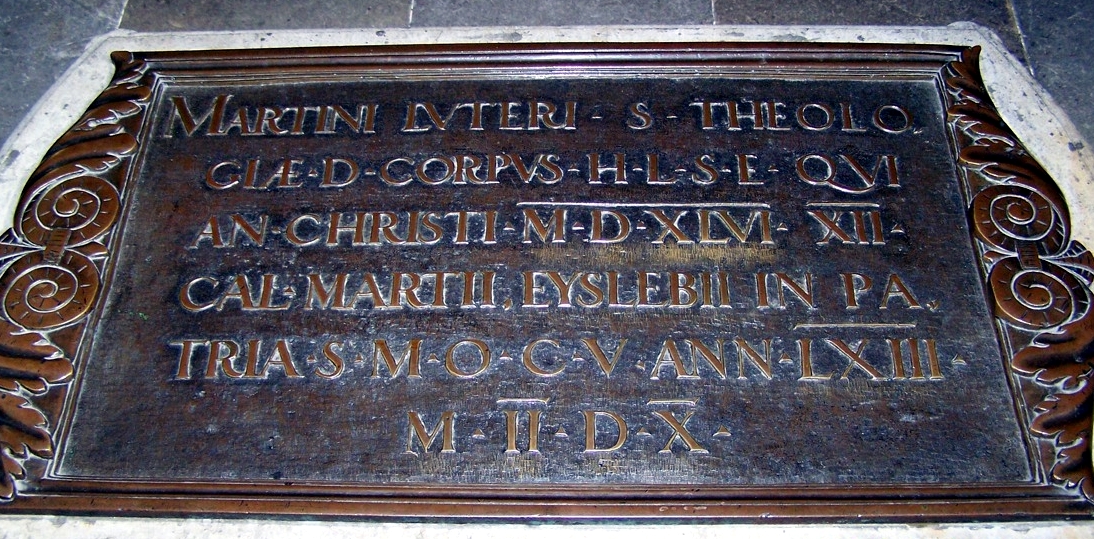
Inside are life-size alabaster statues of Electors Frederick the Wise and John the Constant of Saxony-Wittenberg, the tombs of Luther and Melanchthon, and the Early Renaissance monument of Elector Frederick III from 1527. On the columns of the nave are life-size figures of Luther, Melanchthon, and other Reformers.
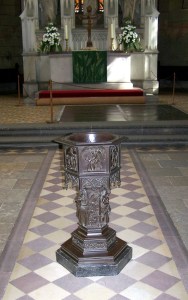
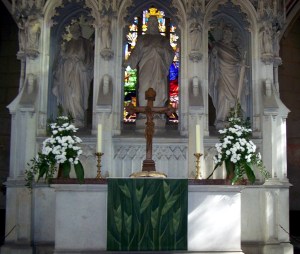 Beautiful antic font on the left and the altar of the Castle Church on the right.
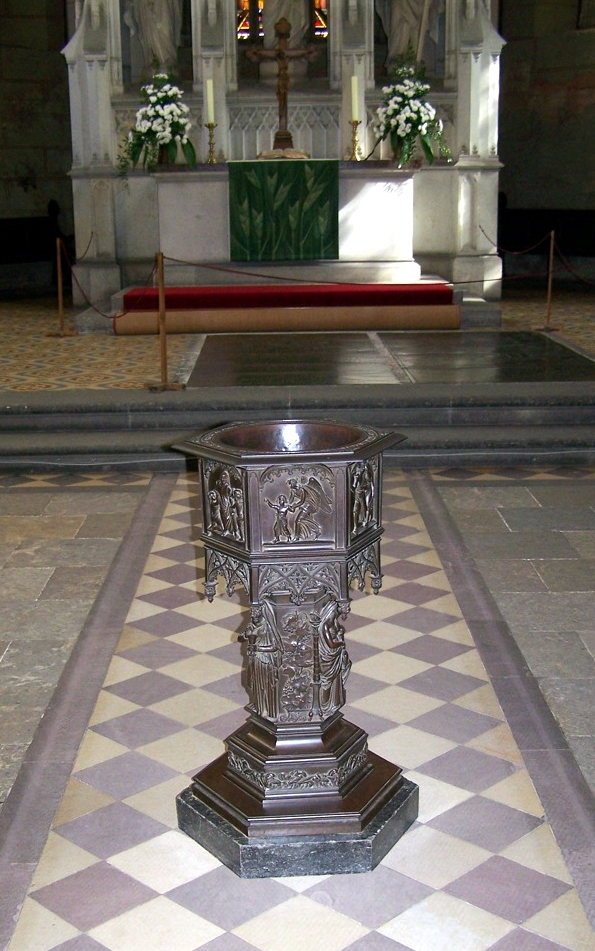
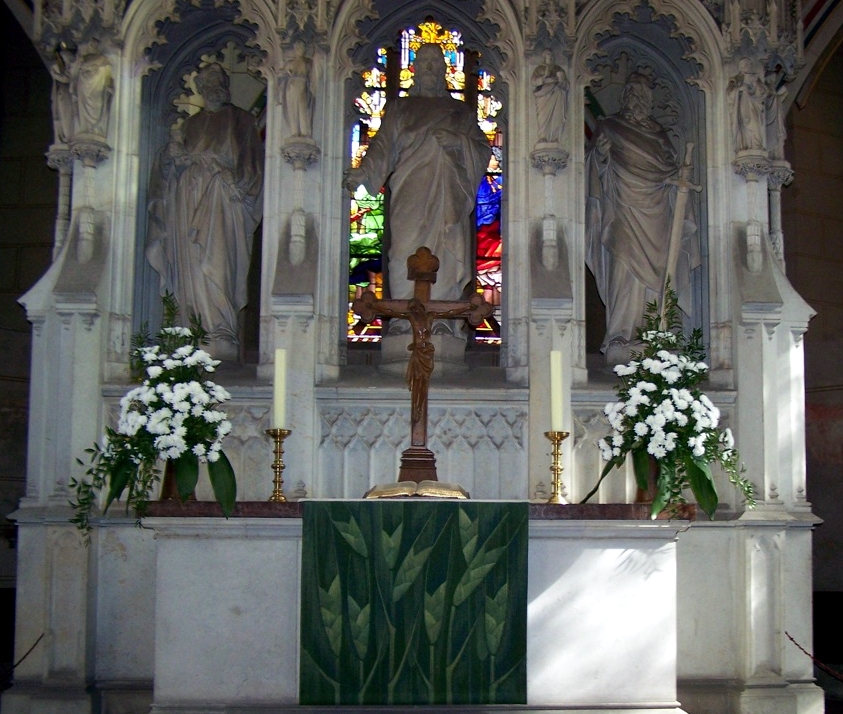
It is called the Castle Church because it is part of a church-castle complex. The castle unusual rounded tower rises high above Wittenberg and you can climb the winding stone stairs for a great view of the town.
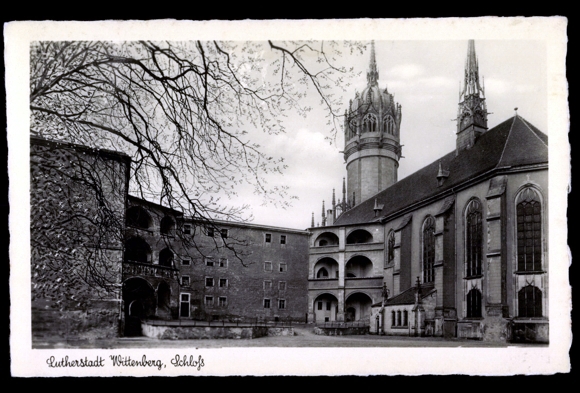
 Castle Church (right) connected to the Castle itself (left), old postcard from the 1950’s.
A mighty fortress. Ein feste Burg.
During church opening hours, they will sing few times a day with and for tourists the famous Martin Luther hymn „Ein feste Burg ist unser Gott „. You can sing along the same hymn at the same place Martin Luther did. Following just the first verse of Luther’s hymn.
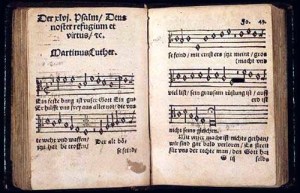 Martin Luther’s famous chorale, „Ein‘ feste Burg ist unser Gott“ (a mighty fortress is our God), as published in 1529.
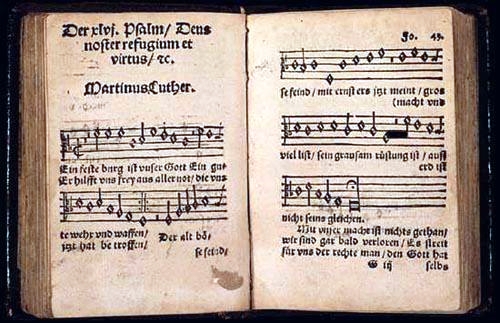
Ein’ feste Burg ist unser Gott,
Ein gute Wehr und Waffen;
Er hilft uns frei aus aller Not,
Die uns jetzt hat betroffen.
Der alt’ böse Feind,
Mit Ernst er’s jetzt meint,
Gross’ Macht und viel List
Sein’ grausam’ Ruestung ist,
Auf Erd’ ist nicht seingleichen. Text und Musik 1529.
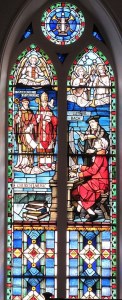
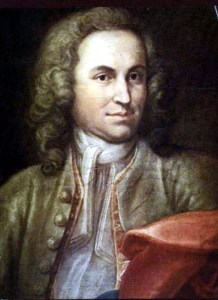 The music to this choral was composed by Johann Sebastian Bach (31 March 1685 – 28 July 1750), picture on the right. The left one shows a church window where Bach receives inspiration through Martin Luther. Click on pic as usual to get a closer view.
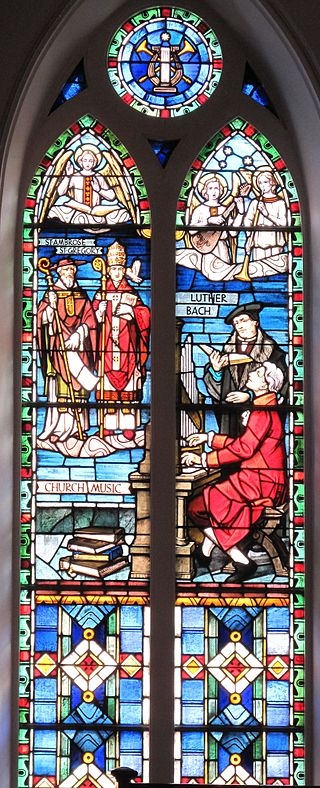
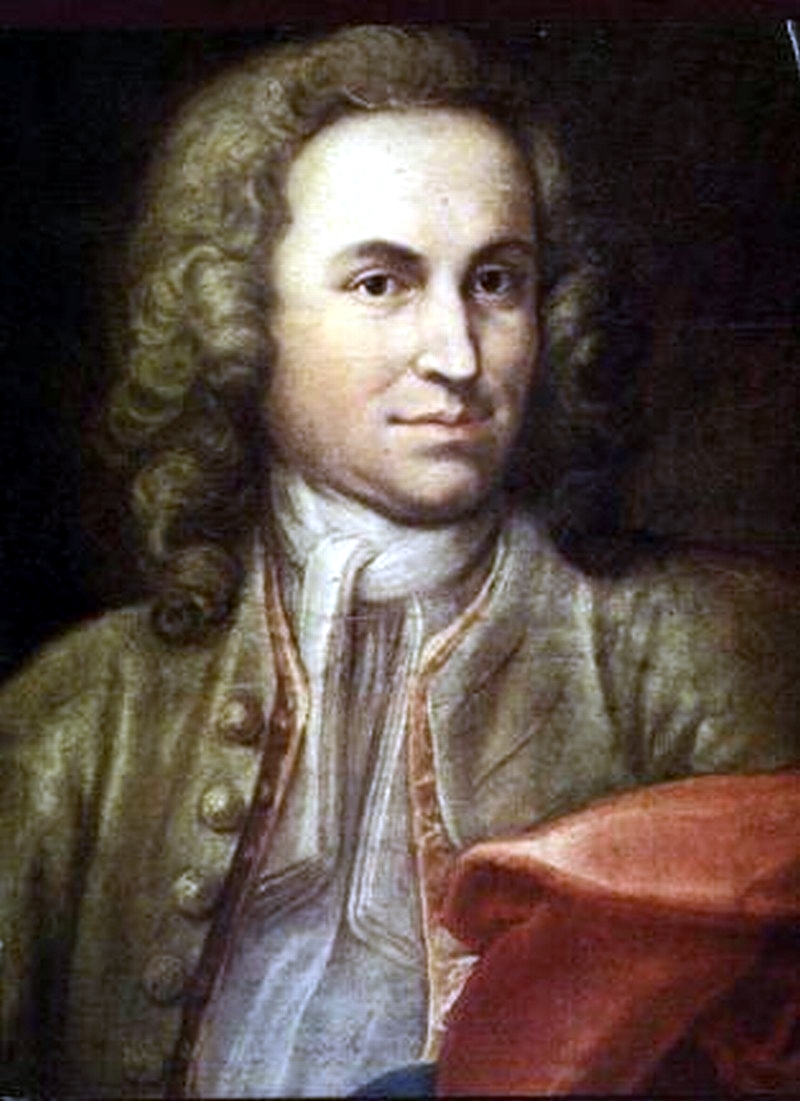
Ein feste Burg ist unser Gott (A mighty fortress is our God), is a church cantata by Johann Sebastian Bach. He composed the chorale cantata in Leipzig for Reformation Day, 31 October, first performed between 1727 and 1731. It is based on Martin Luther’s hymn „Ein feste Burg ist unser Gott“.
 Contemporary hymn singing in the „Luther House“.
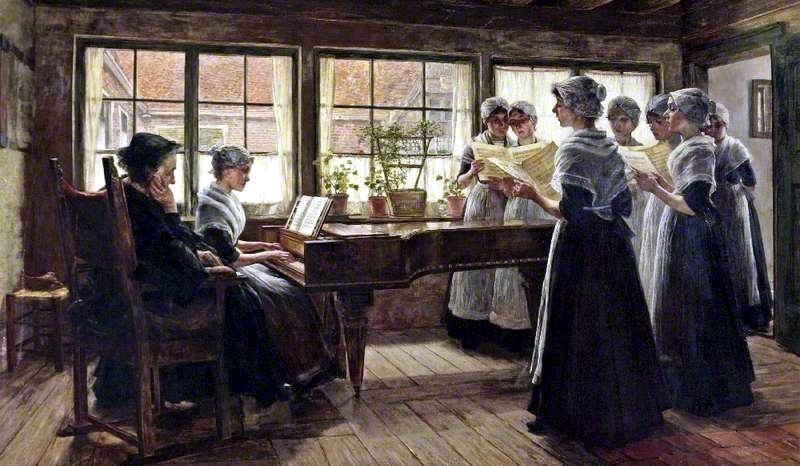
Something cool: English services are conducted on Saturday evenings at 6 p.m., at either the Castle Church or the Town Church. You can sing Luther’s most famous hymn, A Mighty Fortress is Our God in English, in the church where he sang it.
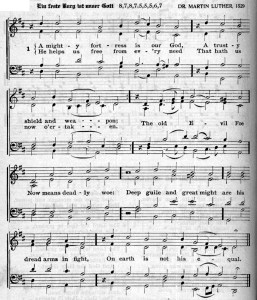 A very early English translation of Luther’s hymn.
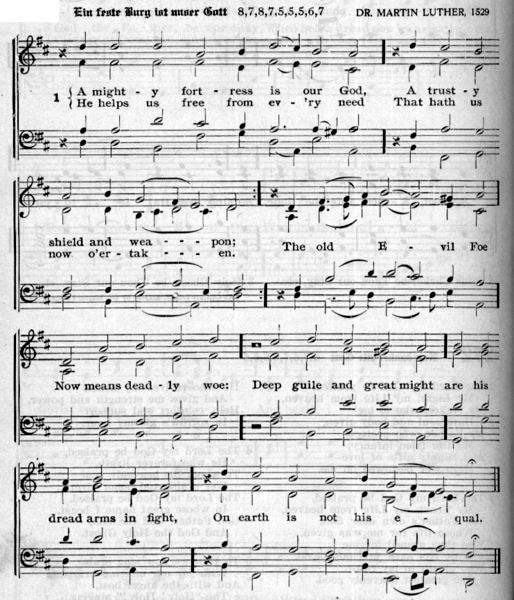
A mighty fortress is our God,
a bulwark never failing;
our helper he, amid the flood
of mortal ills prevailing.
For still our ancient foe
does seek to work us woe;
his craft and power are great,
and armed with cruel hate,
on earth is not his equal. Text and Music 1529.
 Wittenberg castle with the museum inside. The round tower on the right is a separate building, belonging to the castle and is not a typical church tower, even if it looks like one.
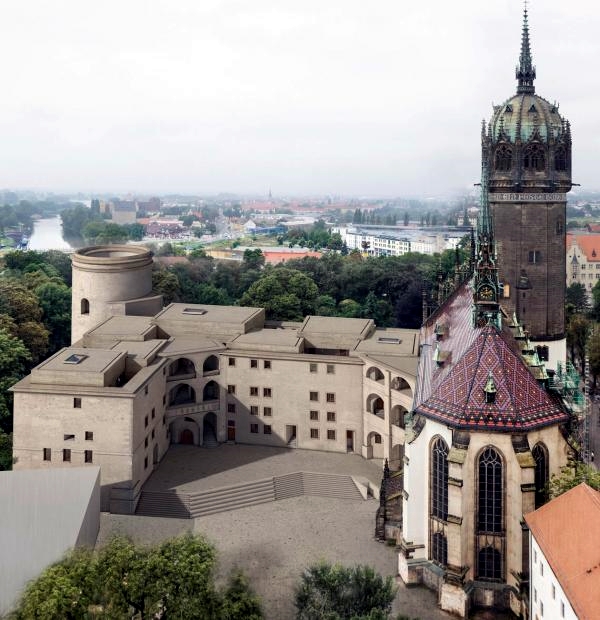
Castle Museum.
To the south of the Schlosskirche stands the Schloss (castle), the old electoral residence dating from 1525 and now home to the Museum of Town History. Highlights include exhibits detailing the development of the town, as well as historical archives and an impressive collection of natural history and ethnographic artifacts from prehistoric times to the middle ages. Worth to visit if you have the time.
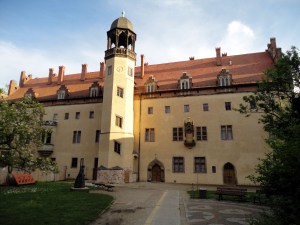 The Luther House, Martin Luther’s residence.
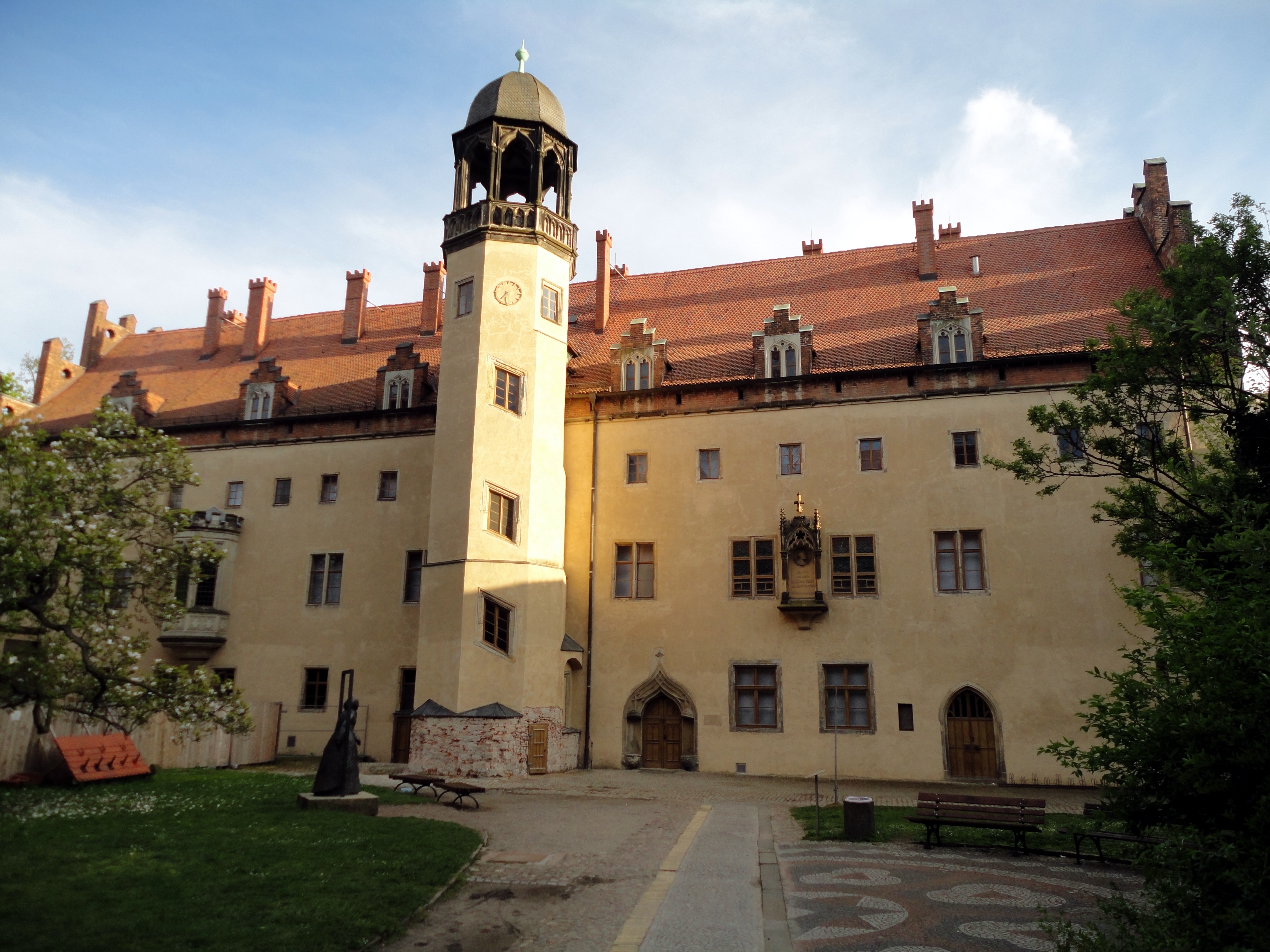
Martin Luther’s Residence
One of the first buildings on the left on Collegienstrasse as you enter the old town is the large cloister that Martin Luther used as a home, the „Luther Haus“. The Luther Haus, where Martin Luther lived from 1508 to 1546, was built in 1504 as a house of Augustinian Hermits and soon after became the Reformer’s home. It was altered between 1844 and 1900 when it was converted into a museum dedicated to the Reformation.
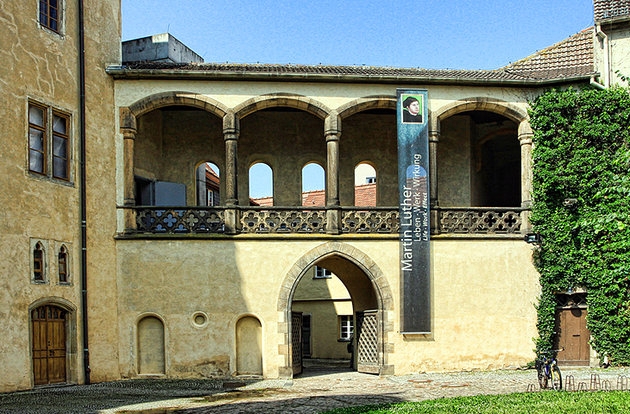
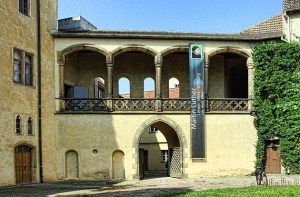 Todays entry to the Luther Haus and museum. The gallery is connecting Luthers residence on the left with the old Wittenberg University on the right.
The Luther family, wife and six children, and various students and visitors lived in the central part of the building. He was given the building by one of the aristocrats supporting his movement.
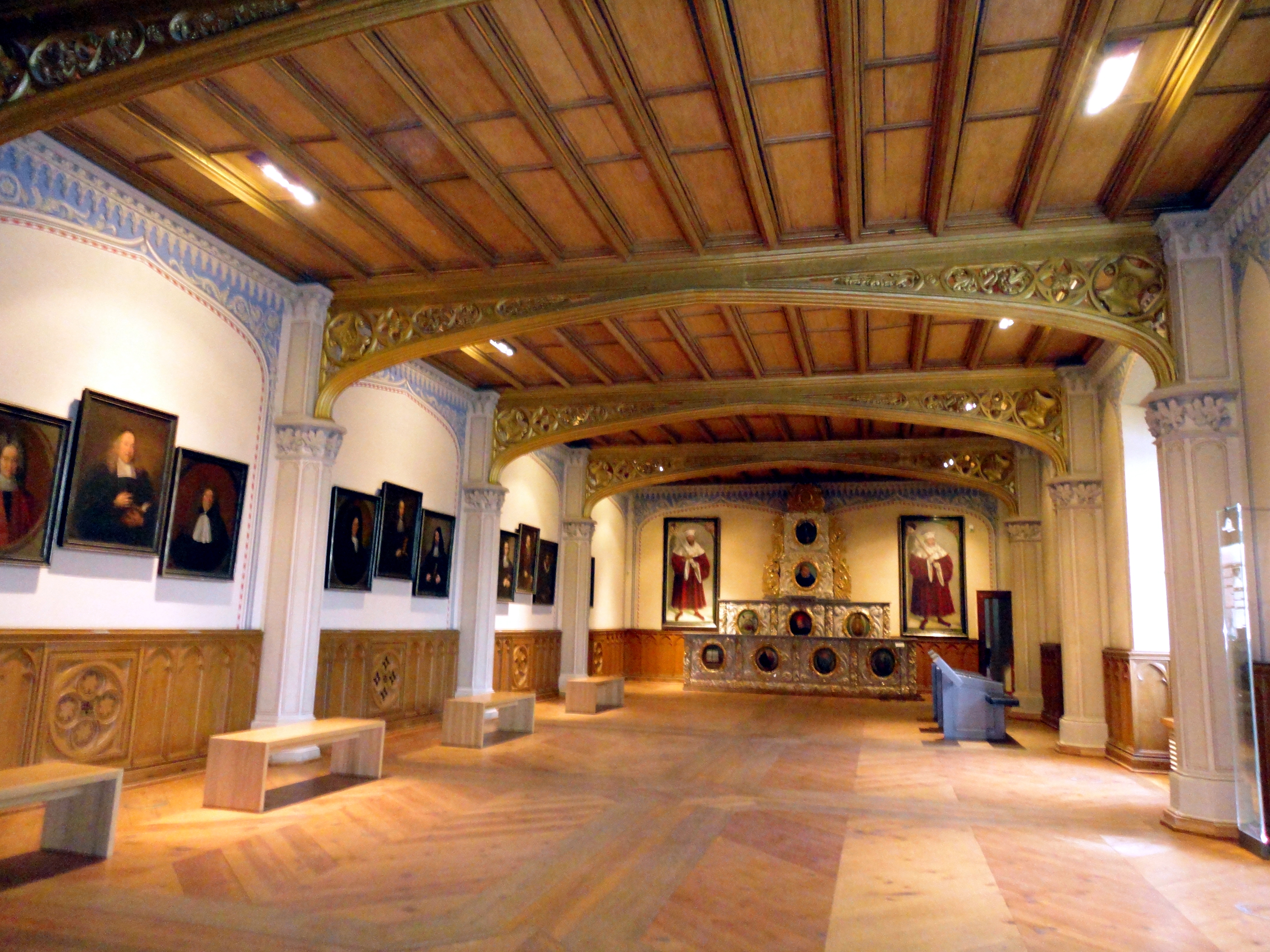
 The banquet hall or school hall in the residence.
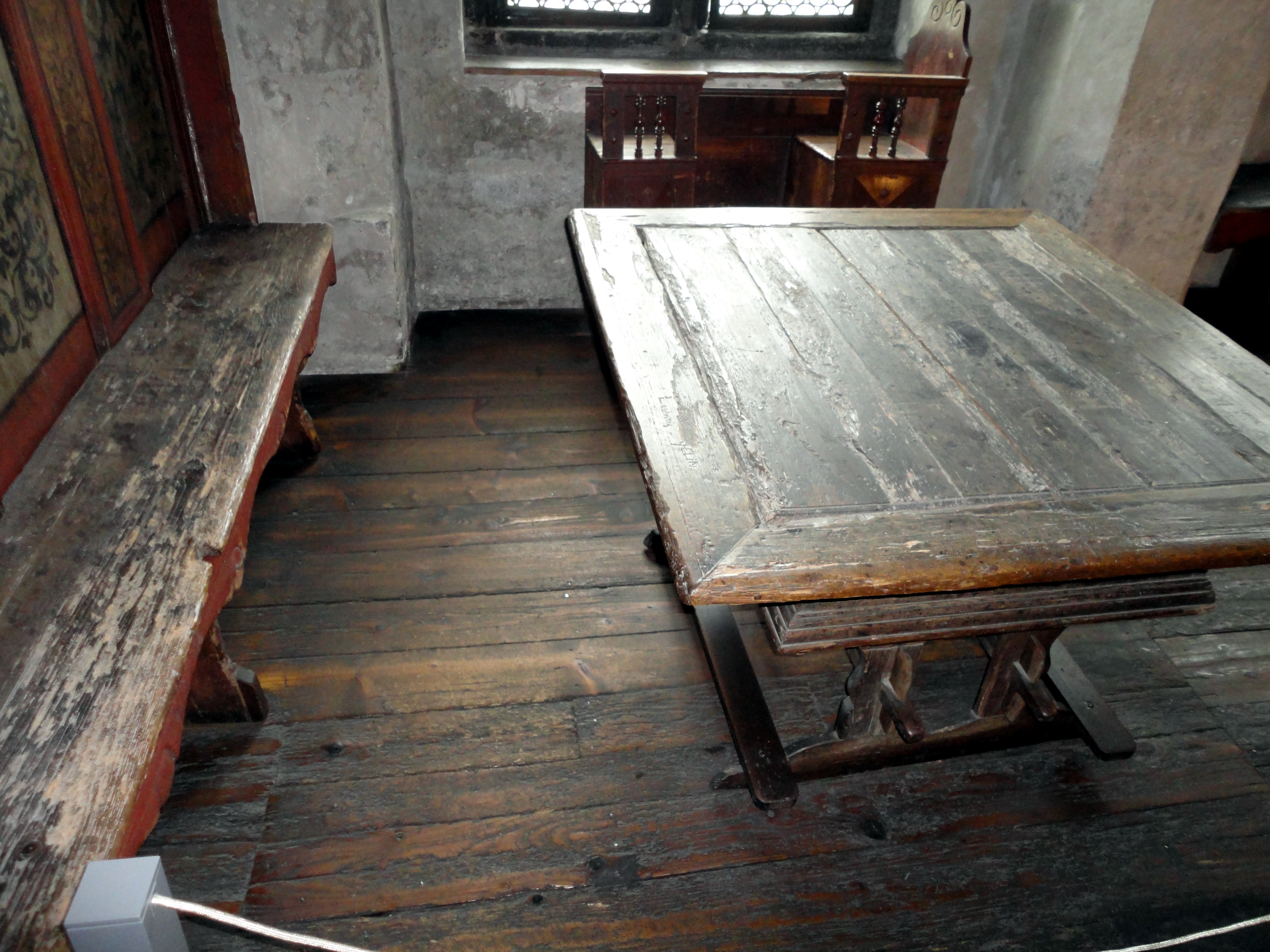
The museum, maintains Luther’s living rooms in their original state. This is where Luther sat with his family and friends in the evenings, discussing a wide range of subjects from the sublime to the earthy (yes, earthy, not earthly!).
 Luthers private study room, all original from the 1500’s.
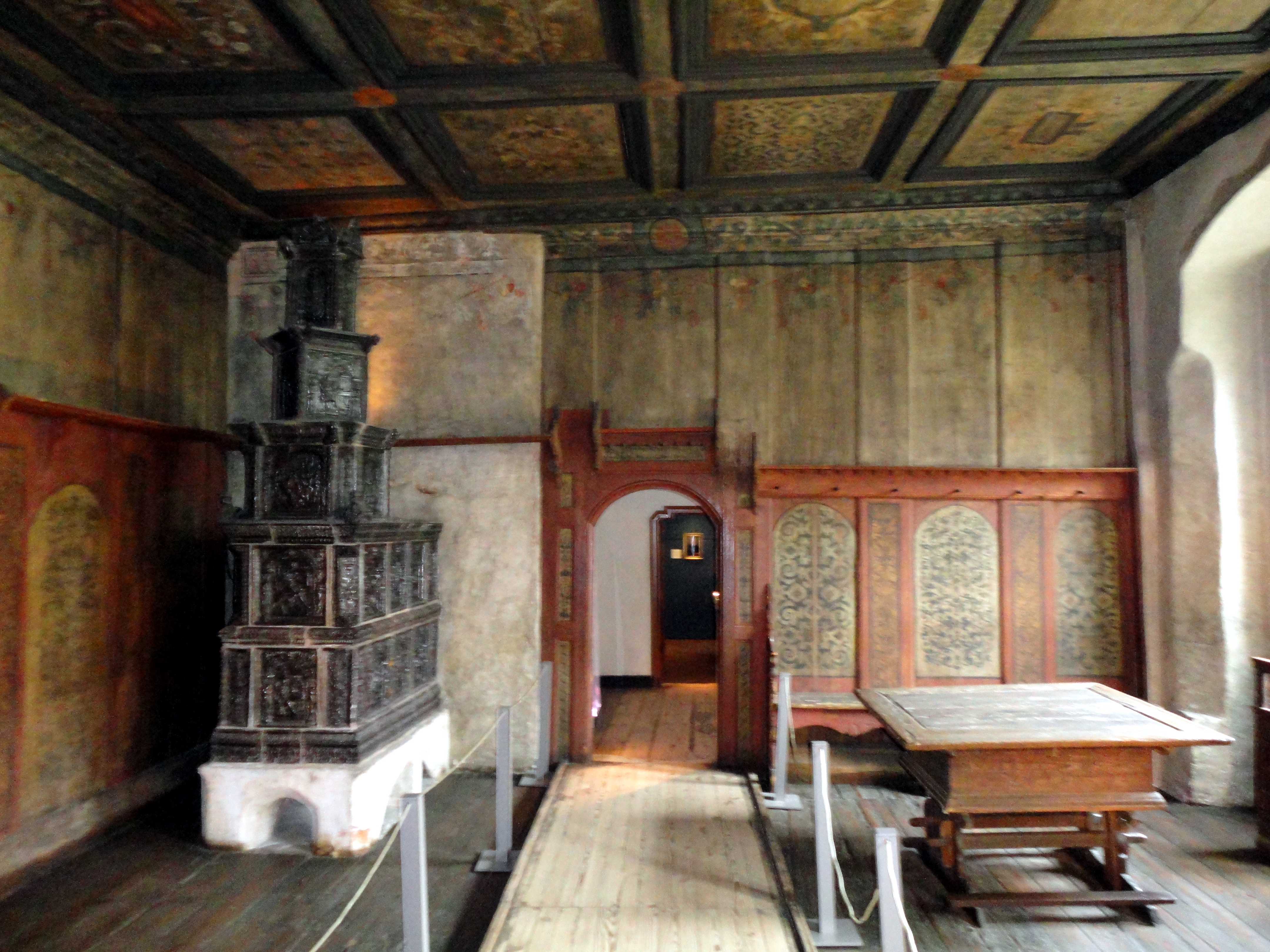
Martin Luther was known for his rather blunt way of speaking as well as for his eloquence. Students were allowed to be present during these evening discussions; they took notes and later published thousands of his comments in a book called „Table Talk“.
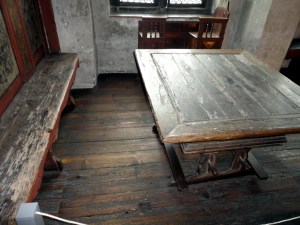 On this table they had their „table talks“.
Inside the museum are some interesting artifacts from that period, including one of chests used for collecting money for indulgences, an „indulgence“ letter itself, and the pulpit that Martin Luther used for preaching.
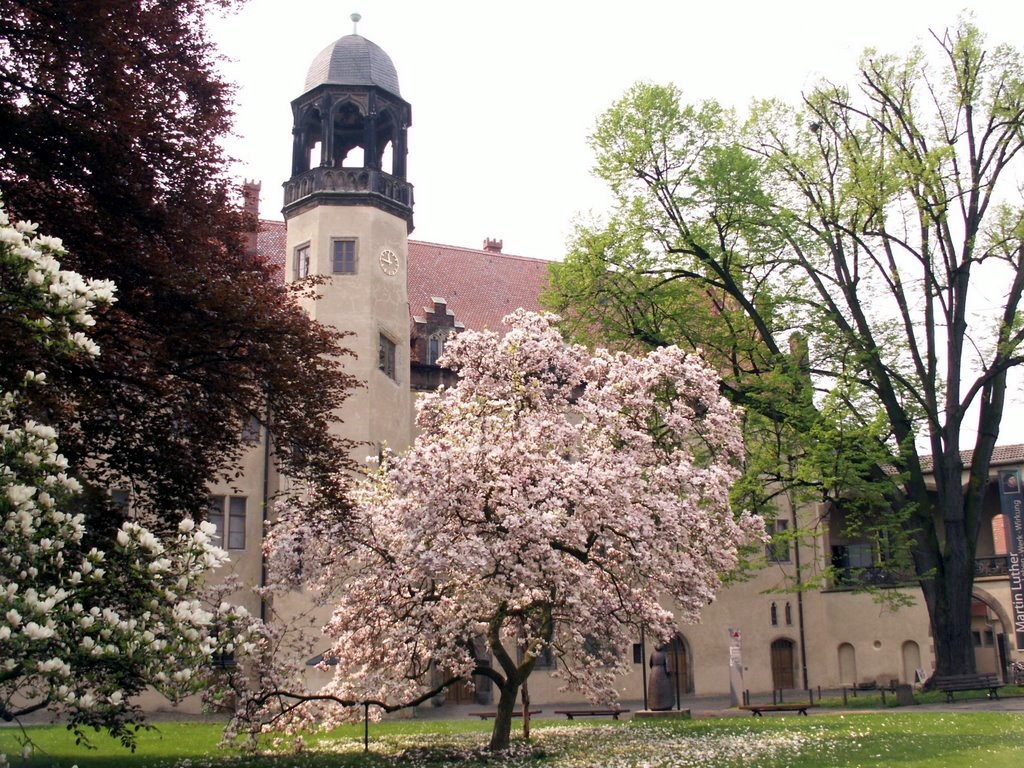
 Springtime in Luthers residence garden.
Lucas Cranach’s fascinating painting of the Ten Commandments is located on wood panels in the refectory of Martin Luther’s home. The Wicked Deeds are presented quasi-cartoon style for the faithful to ponder.
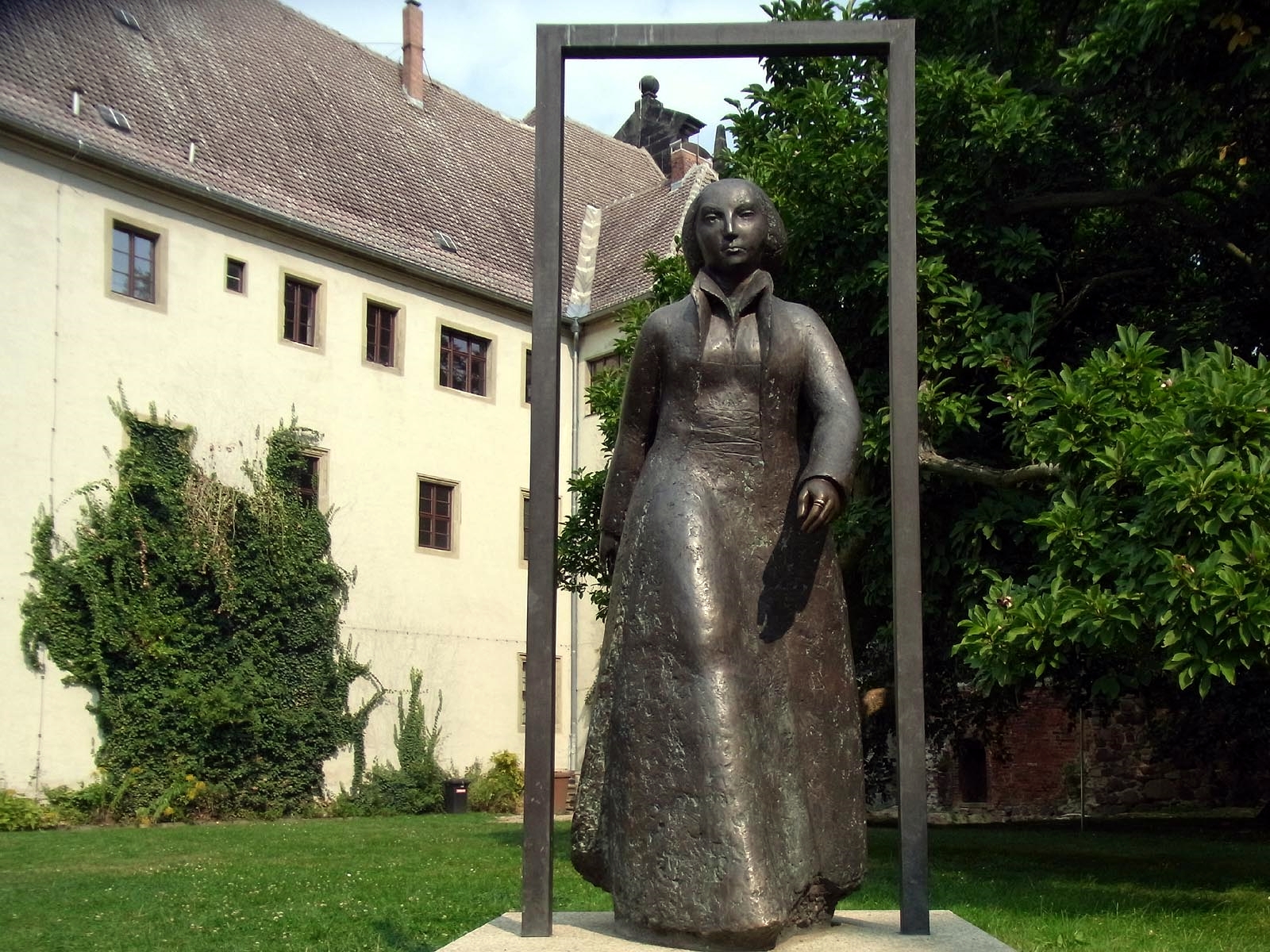
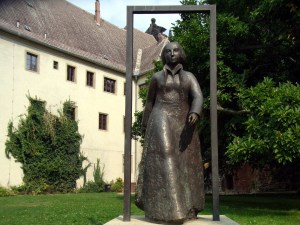 A bronce statue is seen in the courtyard infront of Luthers residence. It shows his wife Katharina von Bora. The building seen in the above picture is part of the university where Luther taught. University and Luther Residence are building a big square complex, all connected to eachother.
Luther’s Oak
In 1520, Martin Luther’s supporters piled up a stack of writings of Church doctrine and set them on fire. Luther threw in the Papal Bull, the document threatening him with excommunication unless he recanted his writings.
 Martin Luther Oak.
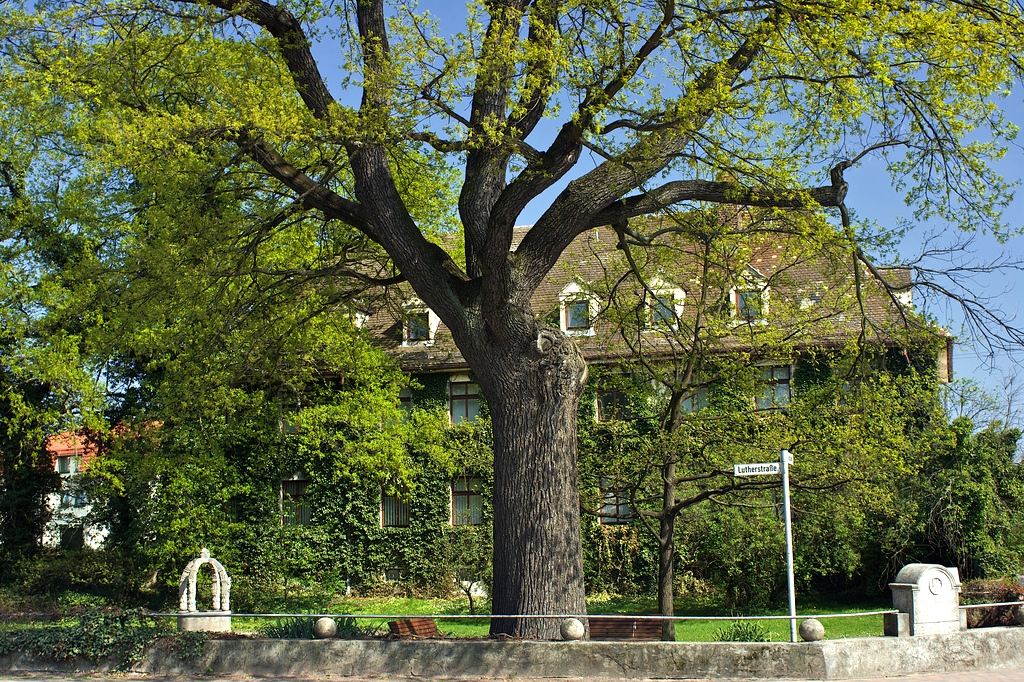
The oak tree was planted on the spot where all this allegedly took place. The tree is at the corner of Am Lutherstrasse and Collegienstrasse on the way in from the train station, just before you enter the old town.
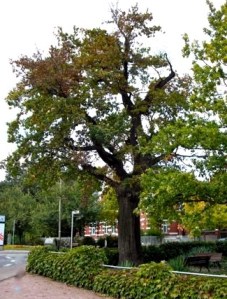 Wittenberg’s Luther Oak is dying.
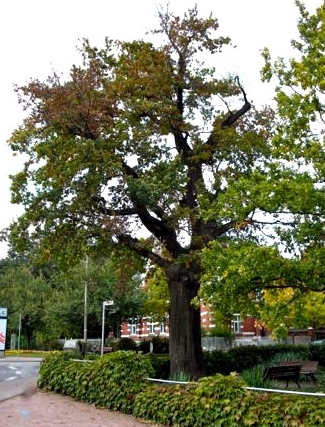
In 1813, during the Napoleonic Wars, the oak was cut down because fuel was needed. The Luther Oak that stands in Wittenberg today, was planted in 1830. On Christmas Eve 1904, an unknown person tried in vain to cut it down. Today, it is a dying tree.
Wittenberg University.
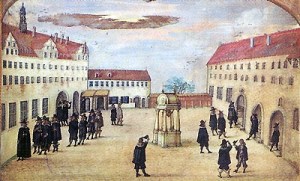 Wittenberg University in the late 1600’s.
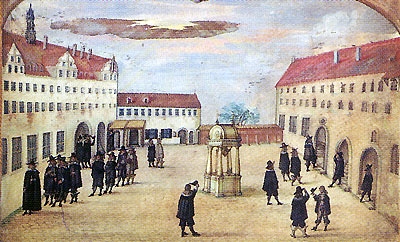
There has been a university here since Martin Luther’s time, located on Collegienstrasse. Parts of the structure date back to that period, and Luther himself worked within these walls. Quotations of his are displayed on the walls in the entrance hall.
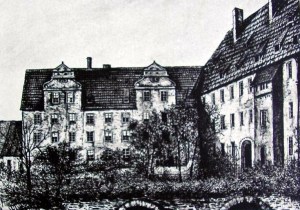
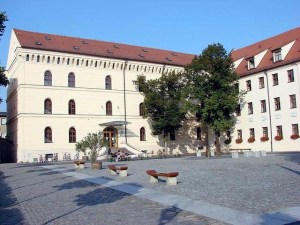 Wittenbergs University buildings then and now. On the left will be the Lutherhaus.
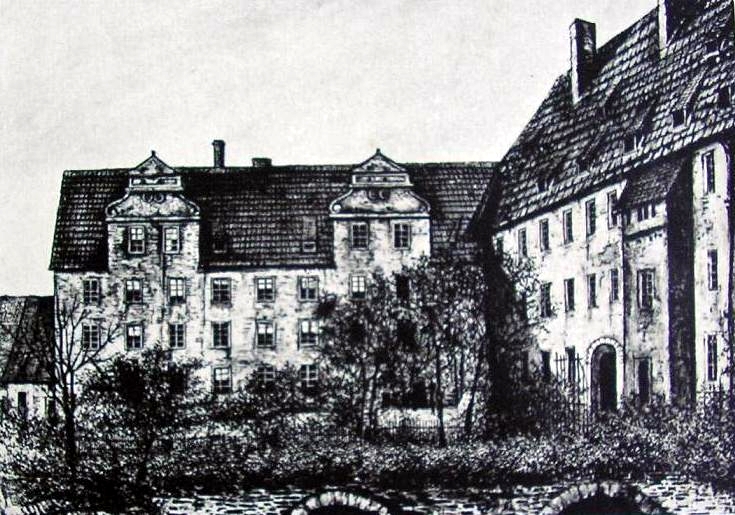
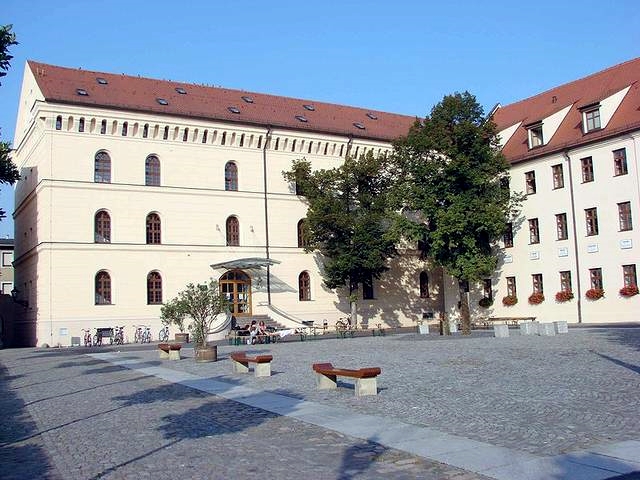
At the beginning of the 16th century Wittenberg had developed into a strong fortification on the middle Elbe. Nevertheless, it remained a modest central town of about 2,000 inhabitants. 1502 Friedrich der Weise decided the way to build the University of Wittenberg in his newly built residence. This university was the first of a country gentlemen and not founded by the Church University in the kingdom. The Fridericianum (Old College 1503) was the first building of the University and in 1504 the „Black Cloister“ was build.
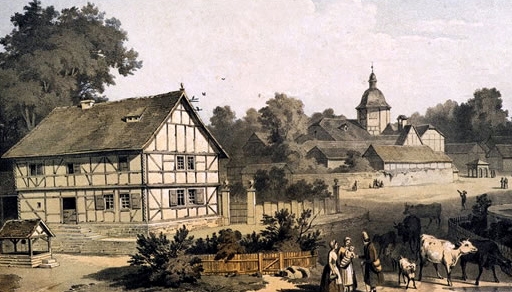
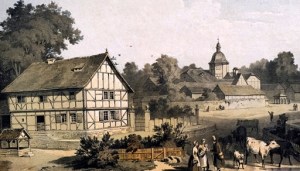 The Black Cloister in Wittenberg.
Under the influence of Philipp Melanchthon, building on the works of Martin Luther, the university became a centre of the Protestant Reformation, even incorporating, at one point in time, Luther’s house in Wittenberg, the Lutherhaus, as part of the campus.
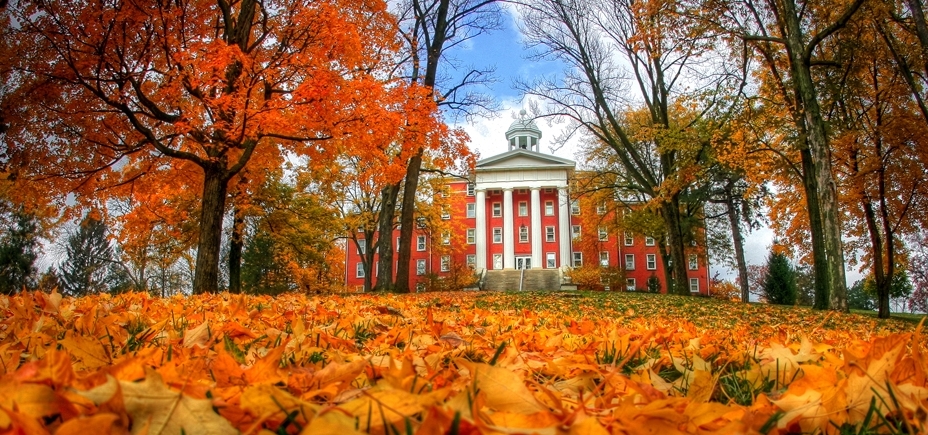
 One of the newer (around 1850’s) outbuildings of the University of Wittenberg ( now called University Halle – Wittenberg ).
Besides Lucas Cranach the Elder, who had come to the city in 1505, was in 1508 also attracted Martin Luther of the developing city. The art of printing has been established, and the city itself experienced a stormy economic and intellectual growth. was reinforced this trend, as 1517 Luther on October 31 made known his 95 theses to the public. This exerted a great attraction for many scholars and students, so that the Wittenberg university became one of the most important of the 16th century. It was a modern, humanism Open University, taught at the 1518 Philipp Melanchthon and which was attended by eminent scholars and senior princes.
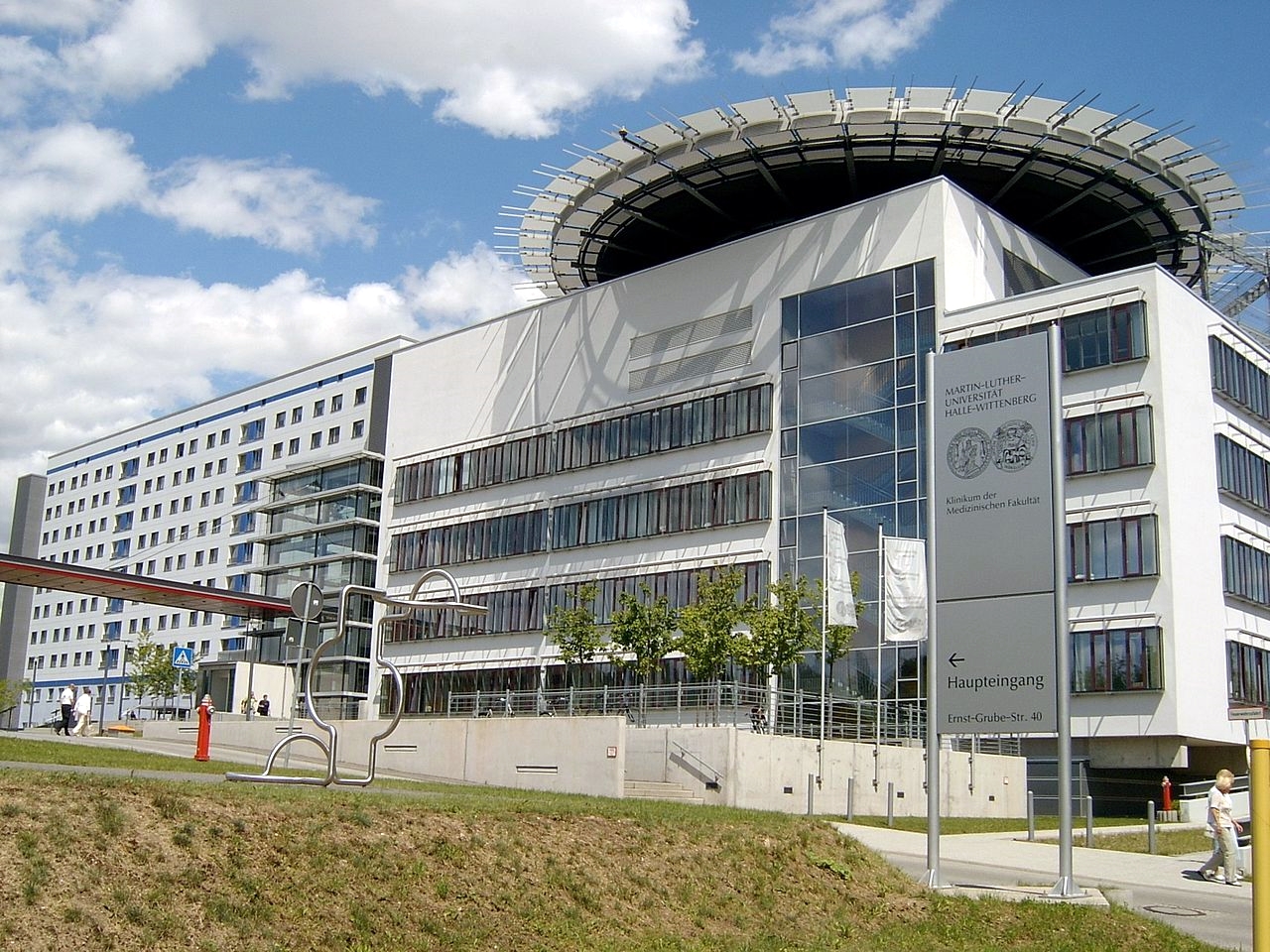
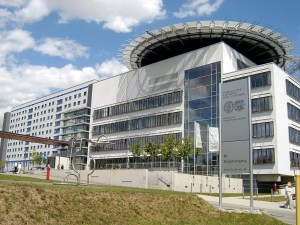 The new Klinikum (hospital) of the University Halle-Wittenberg. One of the most modern in Germany.
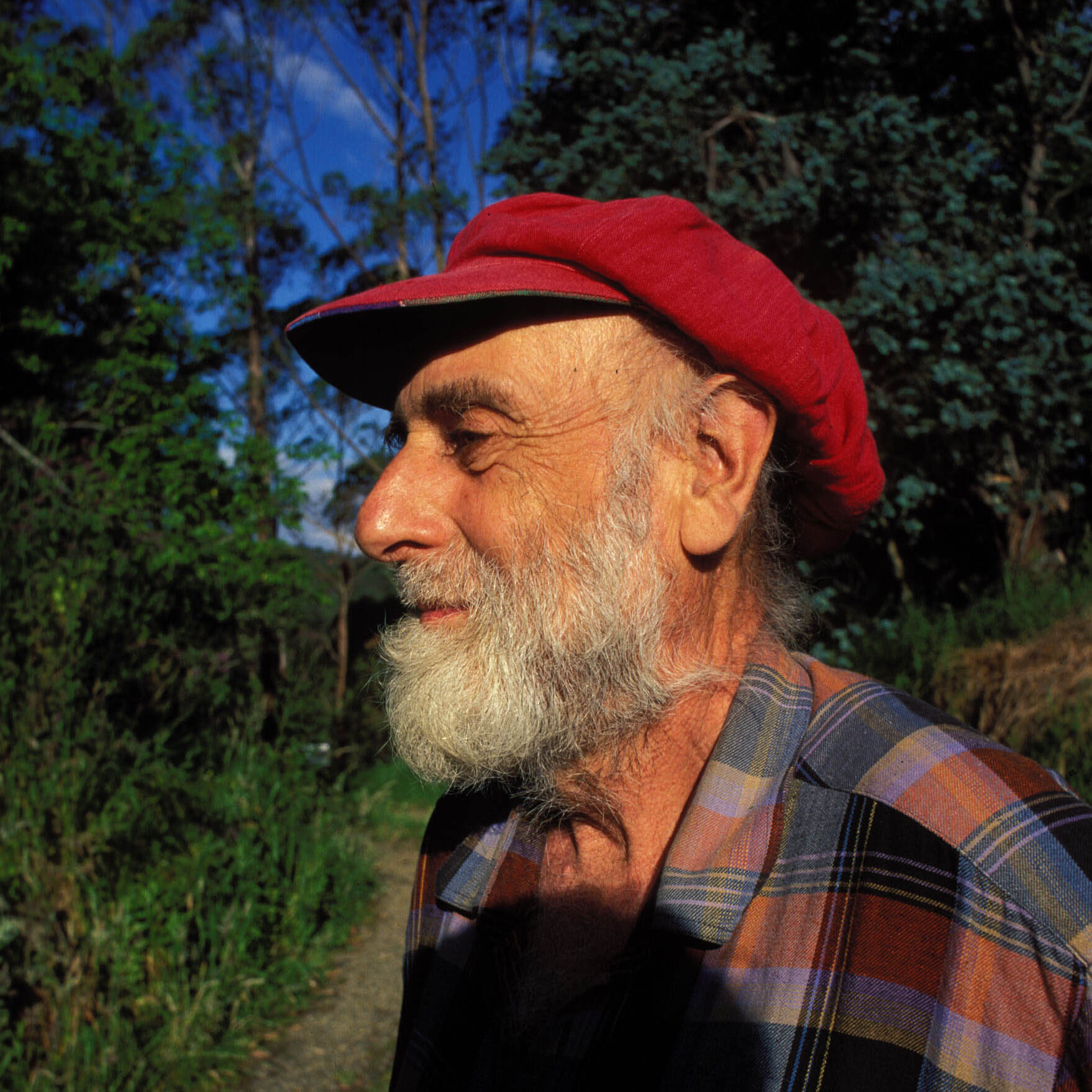
Friedensreich Hundertwasser.
„“Nimm deine schönsten Farben und mach dich auf die Reise in die Welt deiner Fantasie““ „“ Take your best colors and prepare for the journey into the world of your imagination „“ (Friedensreich Hundertwasser).
 Hundertwasser at the age of 70 (1998).
Friedensreich Hundertwasser was born on 12.15.1928 under the name Friedrich Stowasser. With the age of seven he came to a Montessori school in Vienna. His local art teacher said that he has an „extraordinary form and color sense.“ Later, his mother sent him to a state Viennese School.
After matriculation examination in 1948, he attended the winter semester 1948/49 for three months the Vienna Academy of Fine Arts. There he began his work with the pseudonym (pun: Sto = hundred in Slavic languages) to sign.
 A collection of typical Hundertwasser paintings.
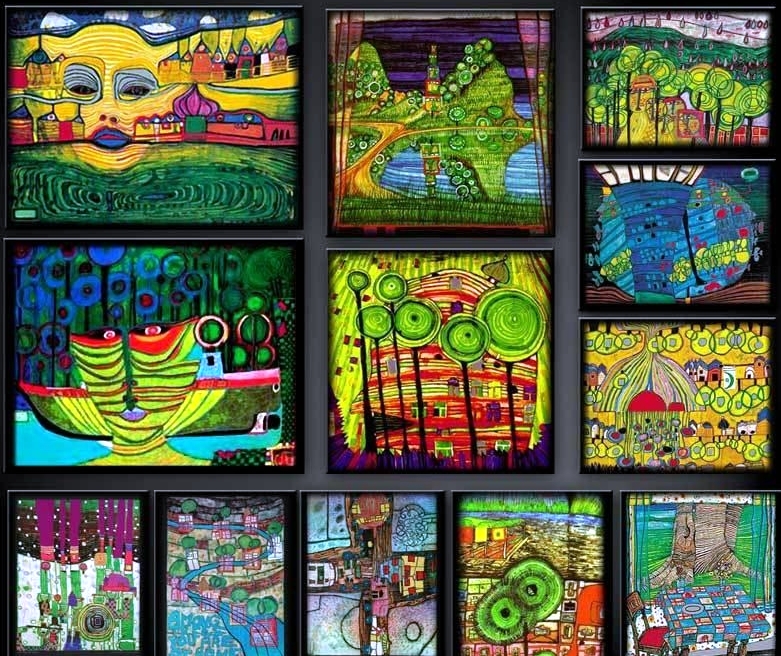
After he stopped his studies, he made numerous trips with the artist Rene Bro, whom he had met on his first trips to Italy. In his travels, he always had a miniature paint box with him, to always painting right away. His first exhibition was Hundertwasser 1952 and 1953 in his hometown Vienna.
On February 19, 2000 Friedensreich Hundertwasser died on the return journey from New Zealand to Europe aboard the Queen Elizabeth 2 caused by a heart failure.
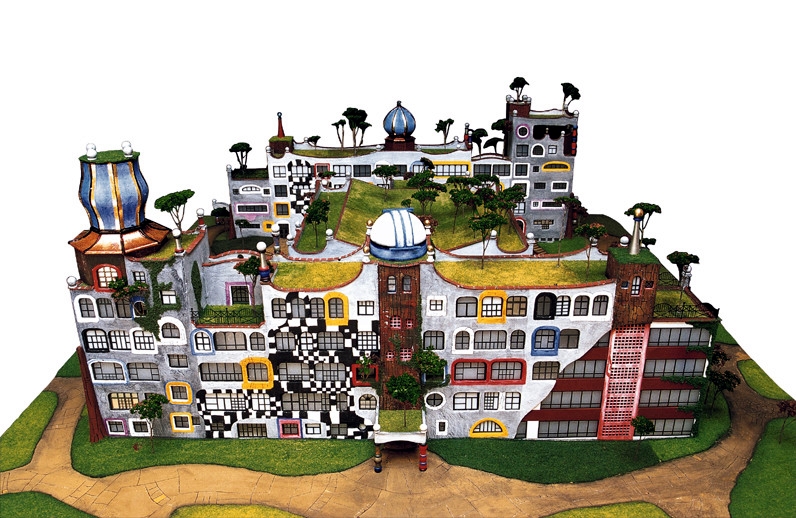
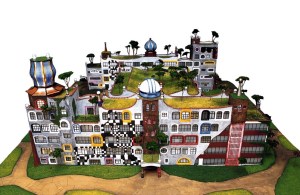 Model of the Hundertwasser School in Wittenberg.
The Hundertwasser Schule.
„“Two values are better and diviner than everything which is part of the human personality: truth and justice““ (Philipp Melanchthon).
The official name is „The Luther – Melanchton Gymnasium“. The school has the task of exploring and developing both, truth and justice.
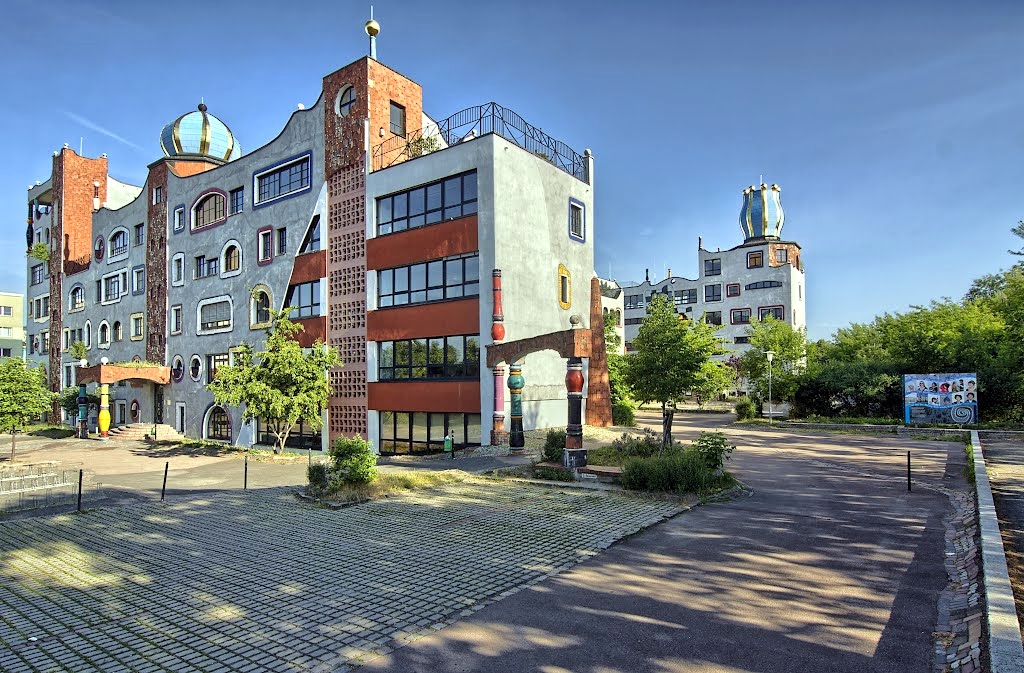
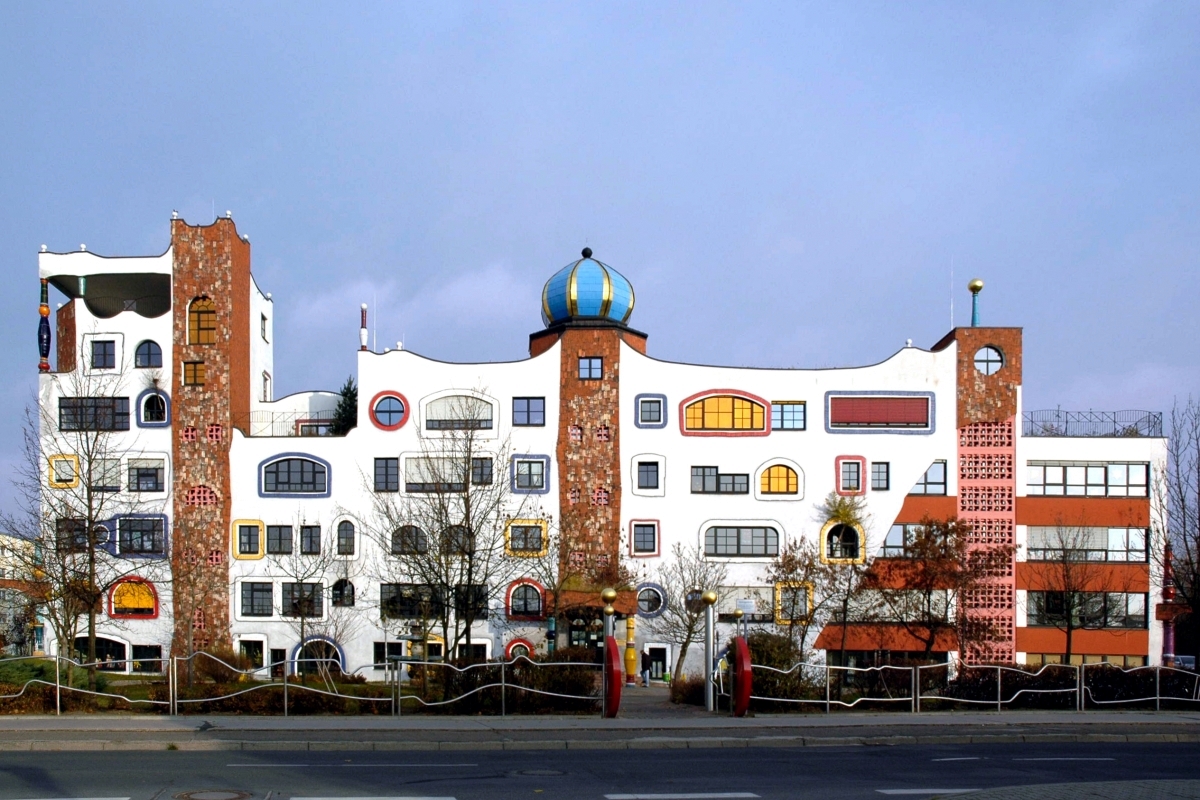
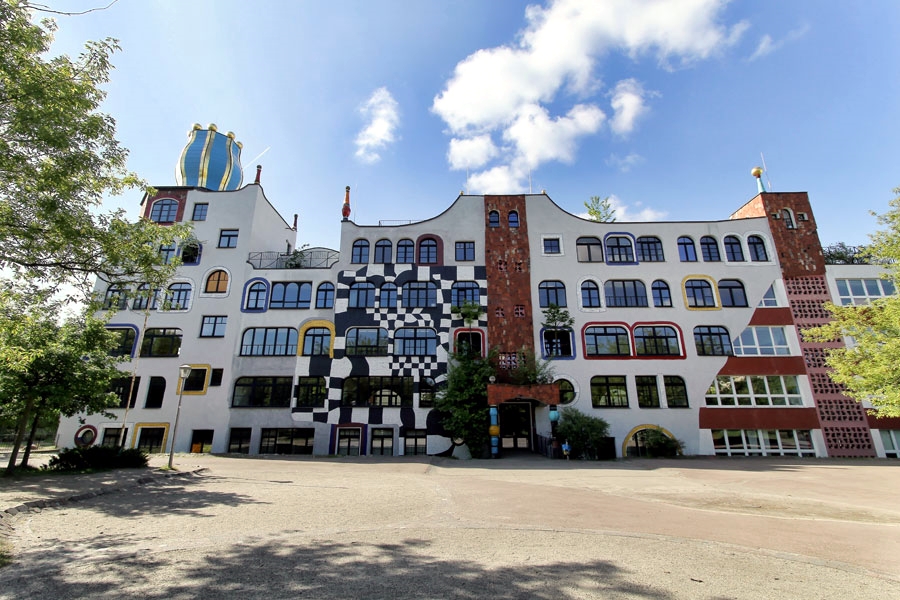
The school consists of two different buildings since the beginning of August 2006: „The Hundertwasser House“ and „The Melanchthon House“.
The Hundertwasser House.
The Hundertwasser building of Luther-Melanchton-Gymnasium was built as a plain new building and has been a boring monstrosity since then. But at the beginning of the nineties several students thought in their art lessons about how to improve its outward appearance. Consequently a lot of ideas came into being which were oriented to the type of construction of Friedensreich Hundertwasser (well-known for Hundertwasserhaus in the capital of Austria). A letter was written and sent to Vienna. Therefore Hundertwasser decided to participate in the project.
Since 29th May 1999 the (according to Hundertwasser’s plans) restaurated building is complete and is admired by numerous tourists from all over the world.
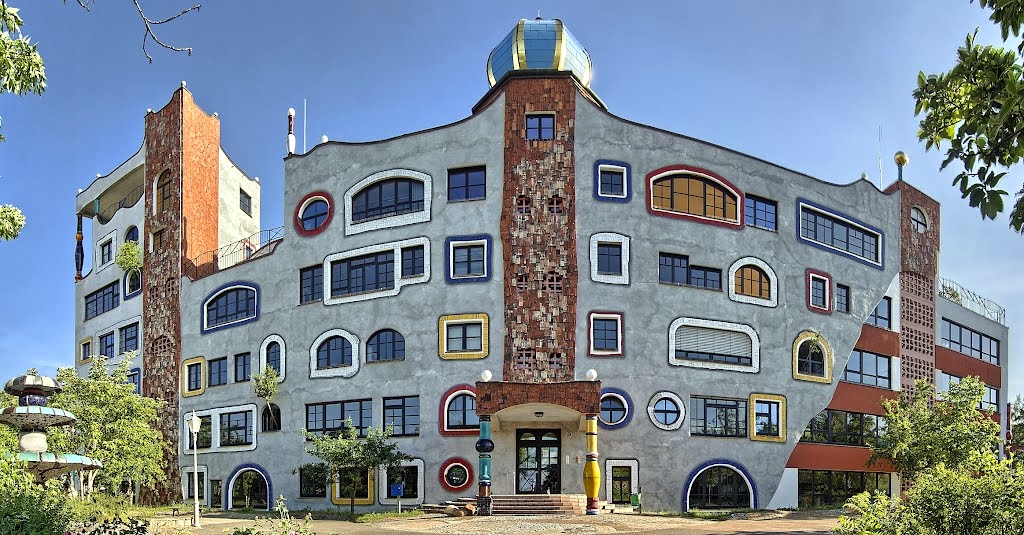
The Melanchthon House.
1371 A first “rector scholarum“ (principal) in the building between the chapel and the road to church is mentioned.
1502 Founding of a university by the Elector Friedrich the Wise; upswing of the education
1564-1565 Moving of the Latin School in a new building (instead of the adjacent building) in the street Jüdenstraße; three floors with four classrooms and a teacher’s apartment.
1827 Rebuilding and enlargement into the current appearance of the building; title “Königliches Gymnasium“.
1888 The official opening of the new building, three floors, gym; area 1 ha.
15.02.1897 (the evening before Philipp Melanchthon’s 410th birthday) The title “Melanchthon-Gymnasium” is conferred.
1919 Title “Staatliches Gymnasium Melanchthon”
1945-1990 After the war (the years of the GDR (German Democratic Republic) the school was also an institution preparing students for university. Many citizens have passed their final exams and proved themselves in different fields of work until today: school, economy, research, politics, health, administration and much more.
2006 Luther-Gymnasium and Melanchthon-Gymnasium go together to the Luther-Melanchthon-Gymnasium.
According to Luther and Melanchthon
education has to serve the following tasks:
On the one hand, one has to receive the logic, poetry and rhetoric of Aristoteles.
Otherwise the knowledge of foreign languages like Latin, Greek or Hebrew and the subjects mathematics, history and art have a great importance.
According to Luther and Melanchthon the Greeks were „astonishing intelligent and bright people“ listening to languages, learning history and playing music with the help of mathematics.
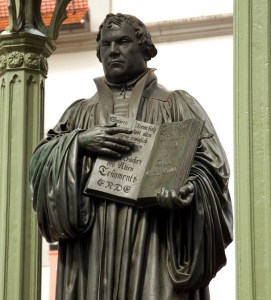 Martin Luther.
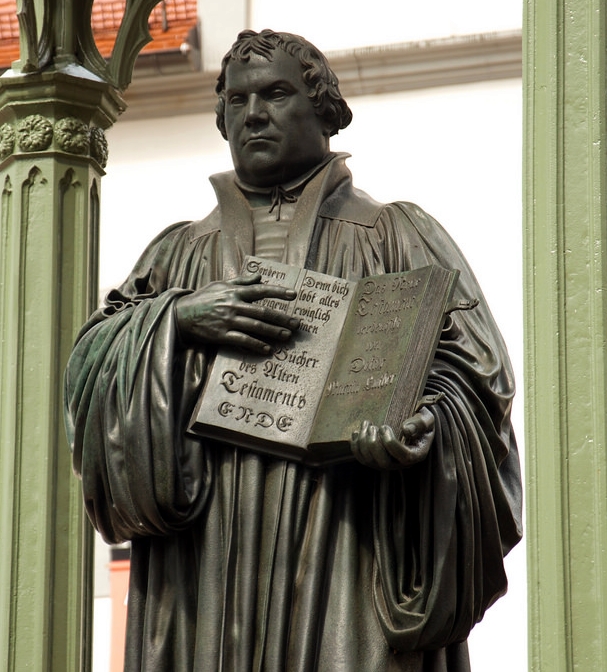
You do not need „only highly educated teachers“. The people have to become wise.
Luther was proud of the teachers: „Anybody is able to pay their worthful work as they deserve.
Luther and Melanchthon wanted every child „to be forced by the authorities to go to school.“ Still a valid rule in our time and modern country’s.
Luther claimed – apart from the knowledge of words and facts – the comprehensibility of all lessons, a thorough scientific education and respect of teachers. He demanded that the State has to build German schools for boys and girls. In 1530 the council of Lutherstadt Wittenberg decided to found the first school for girls.
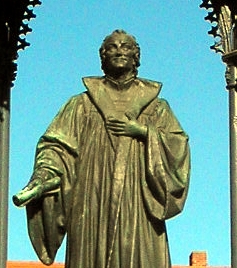 Phillip Melanchton.
„One is not capable to fulfill a function“ without a good education.
At first, Luther founded a private school in his house: the „schola privata“. The students were allowed to attend school for free, they should observe a planned structure of life and get used to a systematic way of working. They hold the view:
„A person wanting to teach other people must be highly skilled and very capable.“
Isn’t this a truly task for our modern education systems ??
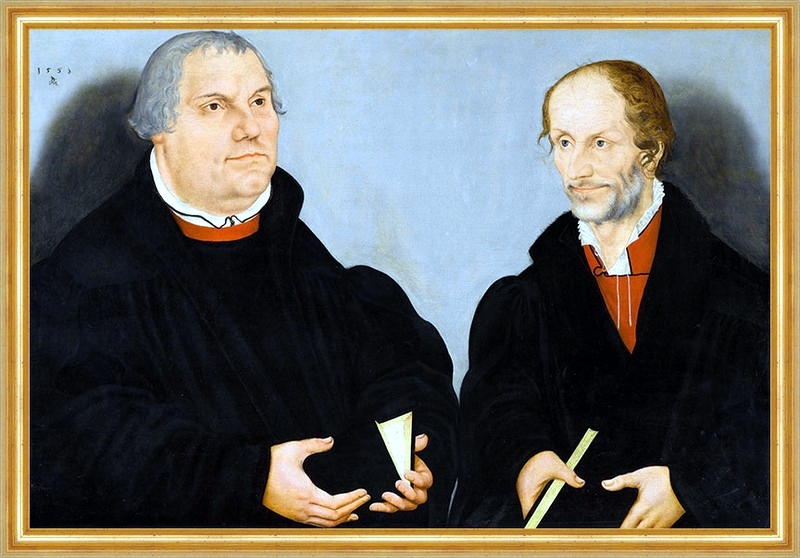
 Luther and Melanchton, by Cranach the Younger, 1553.
Finally – the excellent food in Wittenberg.
If you are around Wittenberg a few days and discover so much history and walk around hours and hours, like I did, then you want a good night sleep and some real good food. The hotel situation in Wittenberg is excellent, but I won’t spend my time to write about, that’s everybody’s personal choice. Good food is interesting for most visitors, so – here are a few recommendations.
 The Brauhaus Wittenberg housing the Beyerhof.
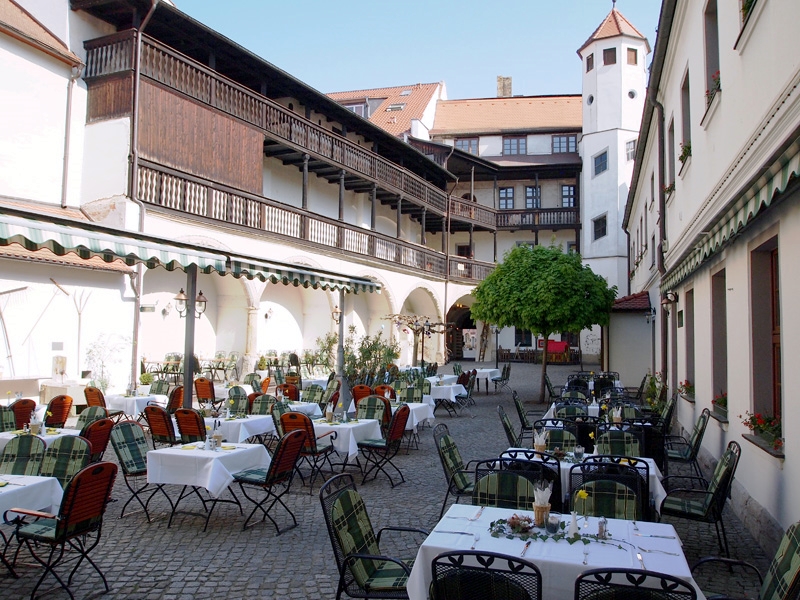
Brauhaus Wittenberg.
„A beautiful, old yard“. Martin Luther reportedly liked his beer, and his wife, Katharina von Bora, is said to have brewed a tasty barley pop. Today, the Lutherstadt Wittenberg brewing tradition is being carried on at the Brauhaus-Hotel Wittenberg, where you can have a drink, enjoy a meal, or spend the night amid the vats.
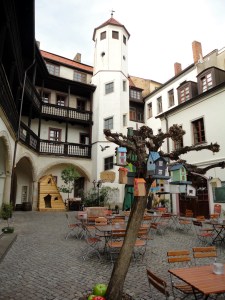
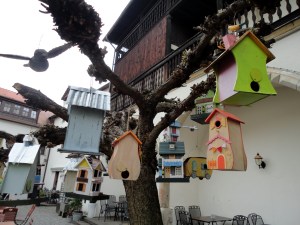 Nice decoration inside the Beyerhof. Lots of little colorful birds houses, before the spring-summer colors are back on trees. I really liked this idea. You know already my recommendation, click on pics to supersize.
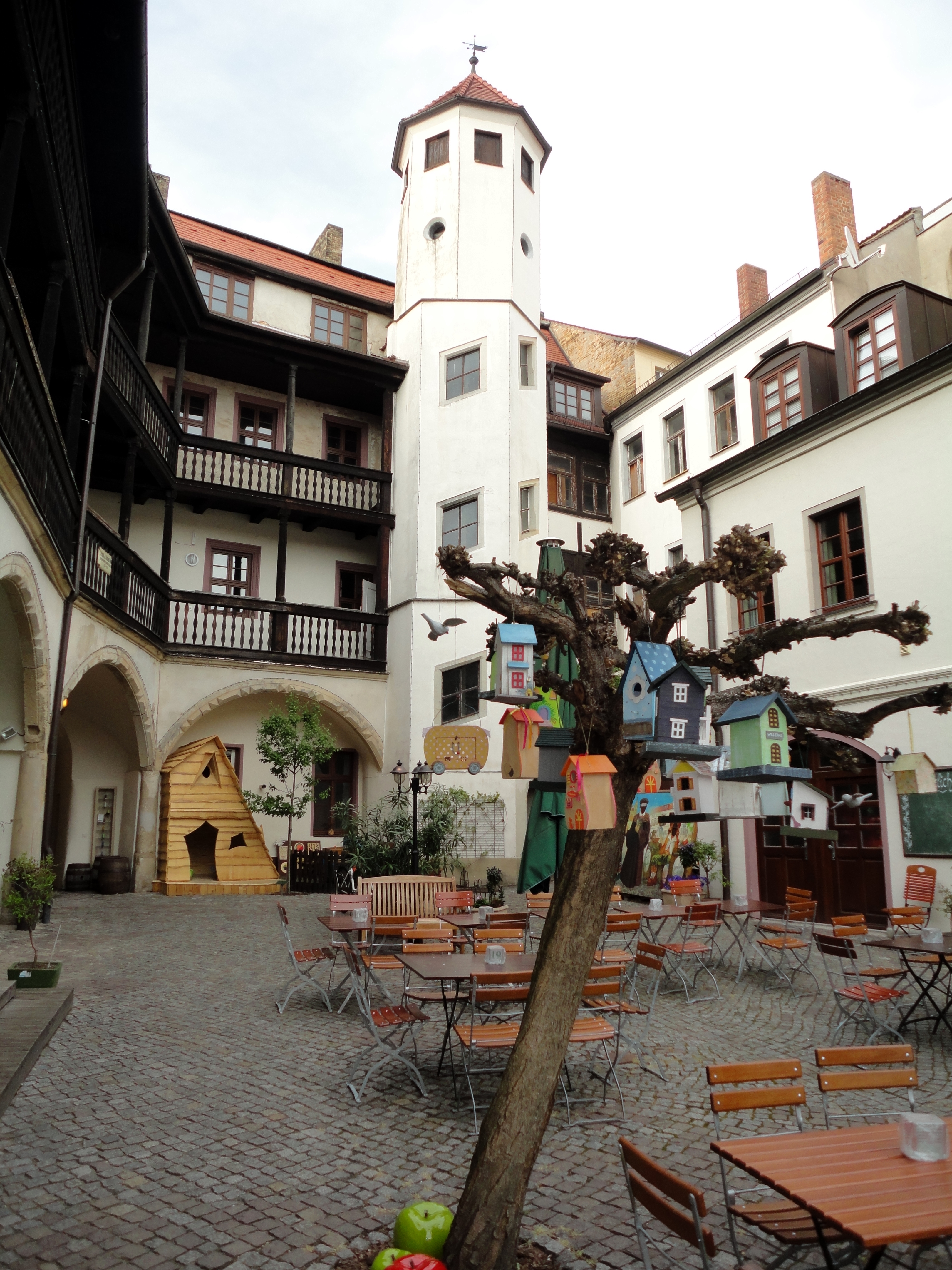
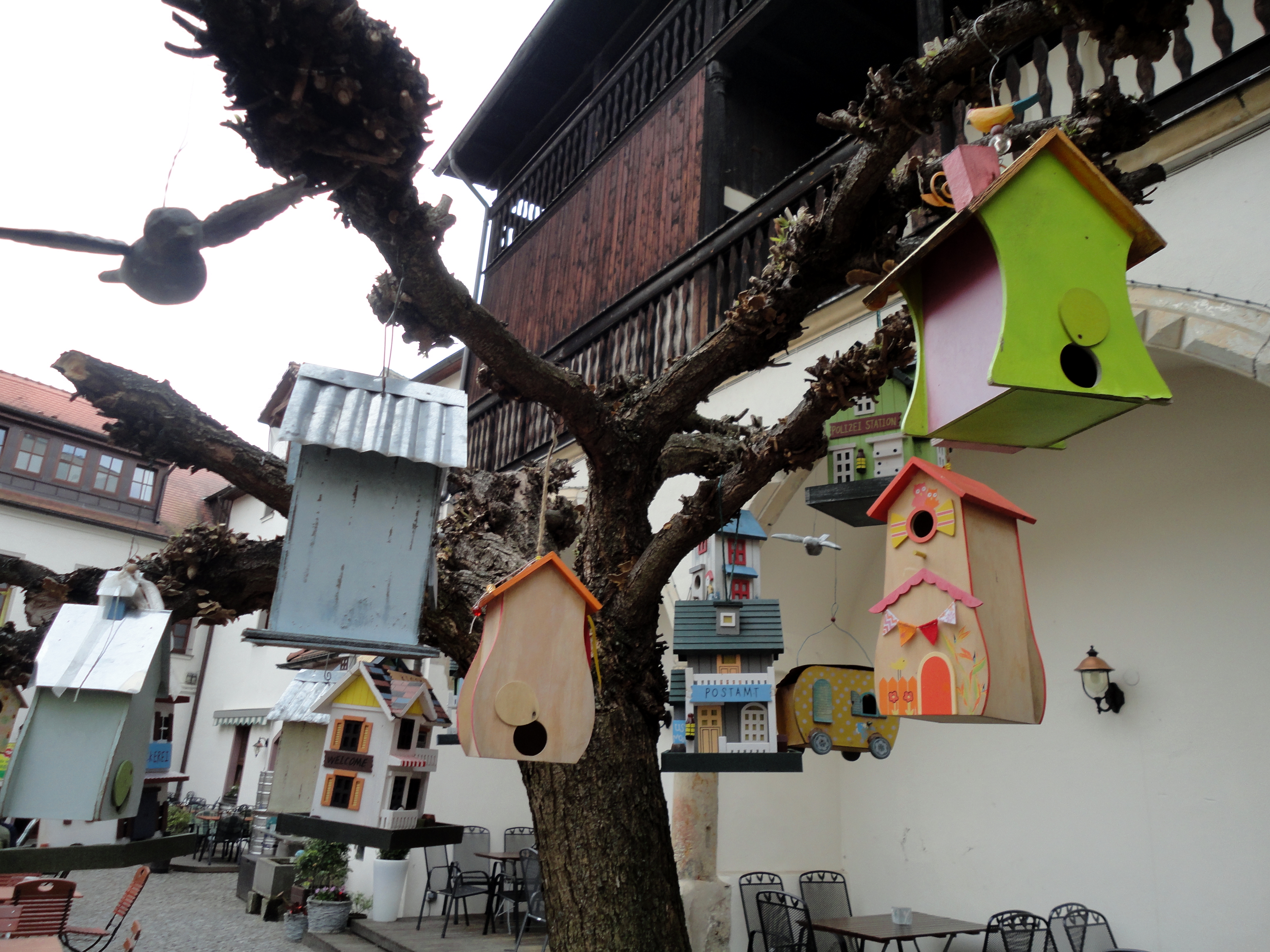
The Brauhaus occupies the Beyerhof, a restored house on the Markt in Wittenberg’s Old Town, that was built by Christian Beyer (then mayor of Wittenberg) in 1512. The three-story building houses the brewing apparatus, a 140-seat dining room, a number of guest rooms, and (in nice weather, which I luckily had) a courtyard beer garden.
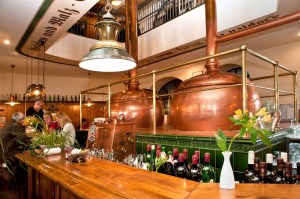
 Watch the beer brewing, or have a taste from the diverse tabs inside. Of course you can take a beer souvenir home with you.
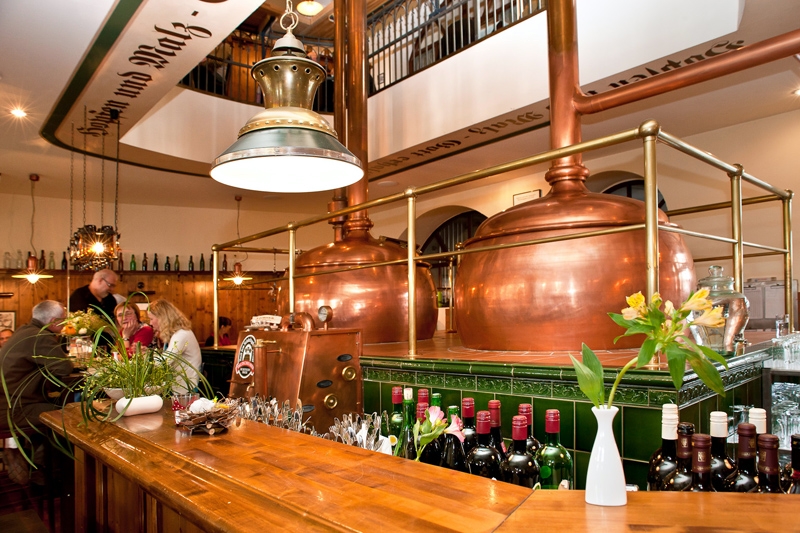
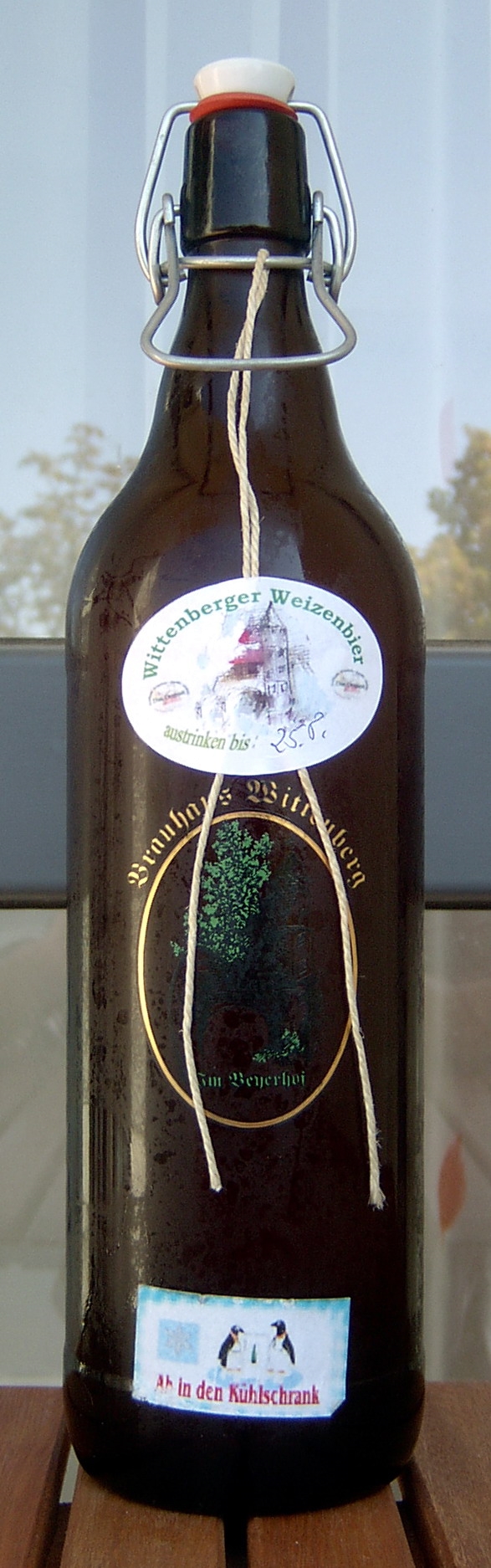
Wittenberg’s brewhouse, with its cobbled courtyard, indoor brewery and shiny copper vats, thrums with the noise of people having a good time. The menu is hearty, but also features smaller dishes for waist-watchers. Oh, and there’s beer also. Lots of fun.
 The „Galerie Keller“ (gallery cellar), occupied as usual.
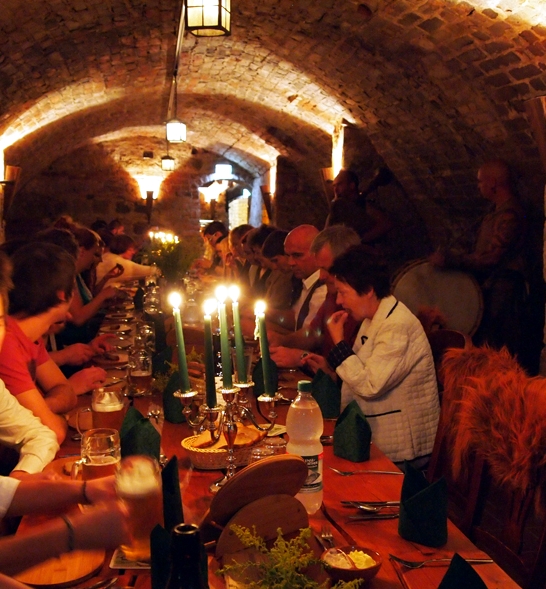
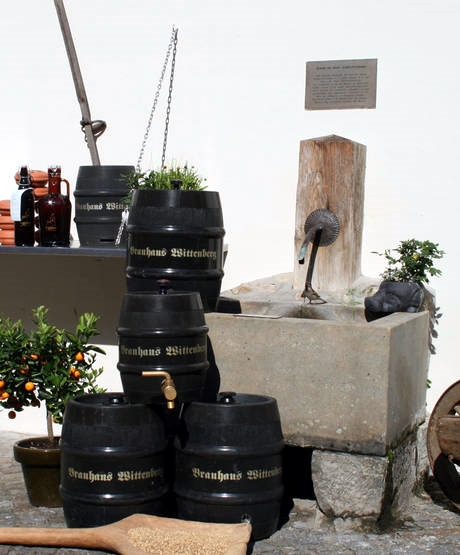
The Brewery House Wittenberg is the only brewery in and around Wittenberg.The Brewery House extends over three floors. On two of them you can watch the process of beer- brewing live while sitting in the restaurant. In the courtyard you also come across a technical monument from the 16th century, called the “Virgin pipe Water”. Built in 1556 to supply fresh water. It is fed by a spring in the north of Wittenberg.
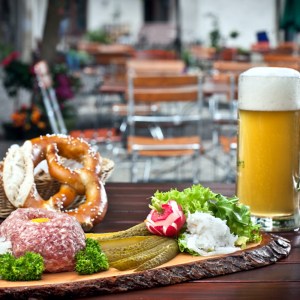
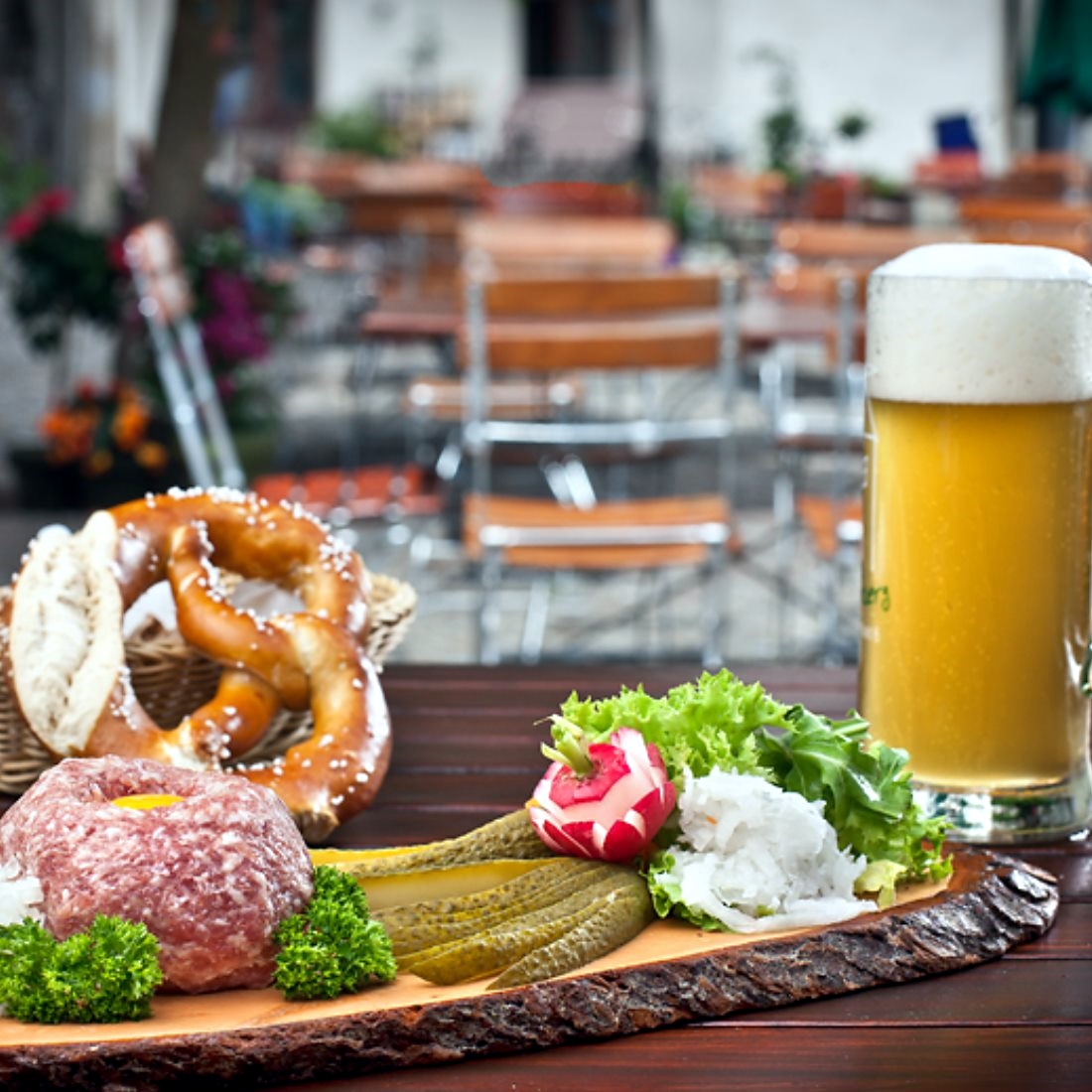
 I couldn’t resist and went twice for lunch, had both times a very good meal in the courtyard, springtime warm weather and lovely covered against the elements, plus a beer of course, freshly pored from the tab. Makes you mouthwatering too I hope: Left, a fresh made „tartar a la Brauhaus“ (not for everyone, but I like it) nicely spiced! And right a „BrauhausPfanne“ with „Schaeufele on Sauerkraut“ and baked potatoes on greens. Had some delicious black beers with it. Wish I could have spent more time there, it’s the right place to hang out with friends, day or night.

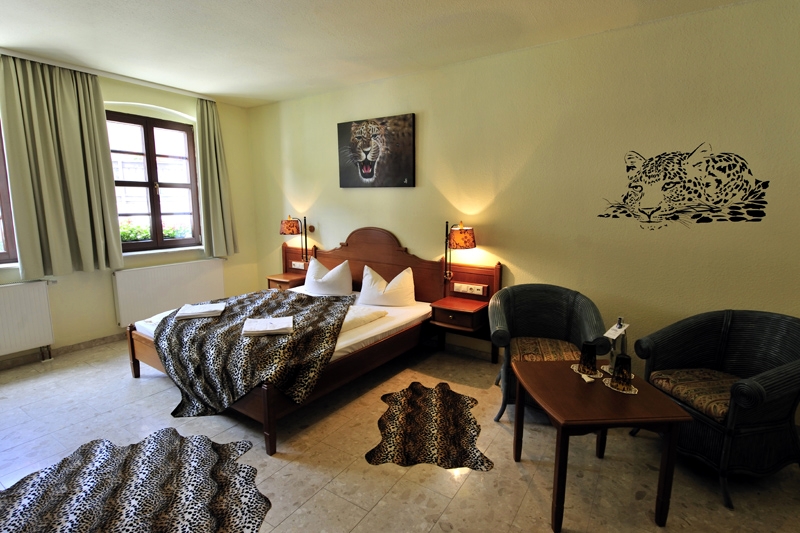
 Not too bad the accommodation at the Brauhaus.
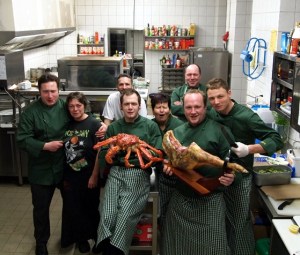
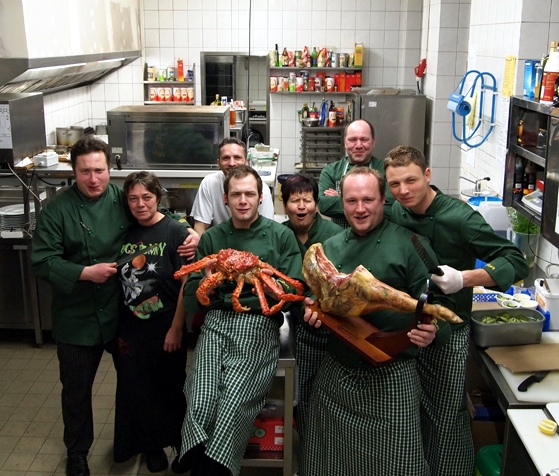
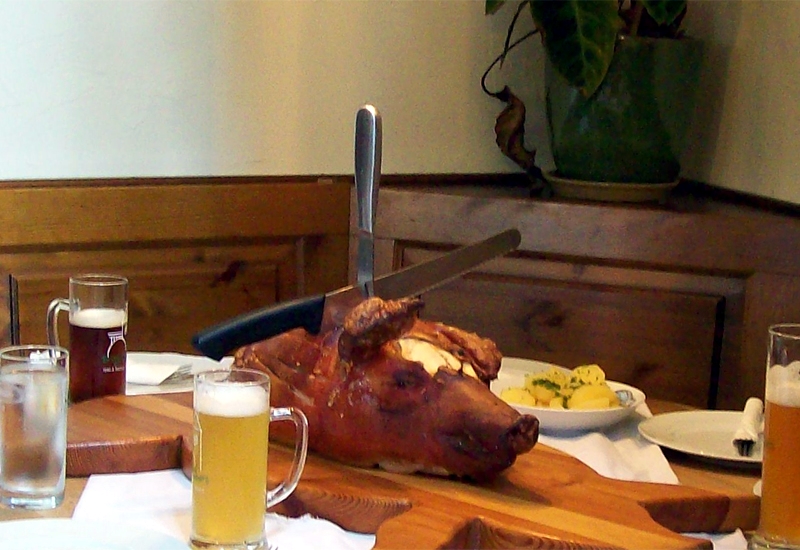
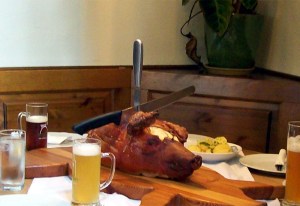 And not too bad either the food offering they have. Parma ham or giant crab, if you like it, or a roasted piglet (at the right you’ll see the portion for 4). For all I had to miss out this time, but I definitely will be back.
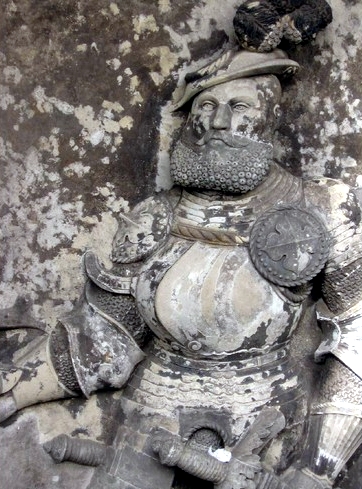
On one of the walls you can see a statue of Prince Elector Johann Frederic the Generous. It is thought to have been sculpted by someone from the Cranach workshop, not necessarily by the master himself.
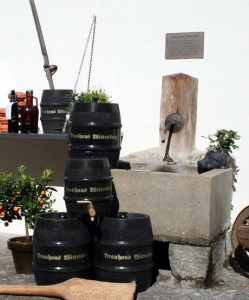
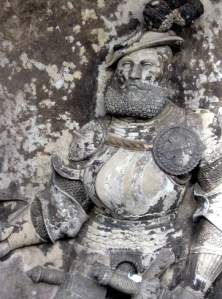 The „Virgin Pipe“, left. And the relief of „Prince Elector Johann Frederic the Generous“, right.
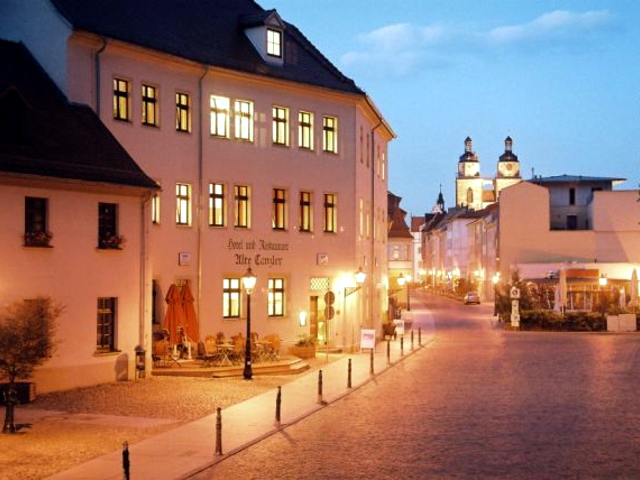
Alte Canzley.
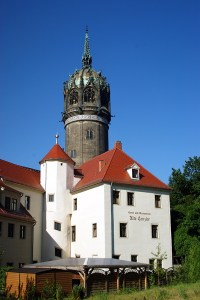
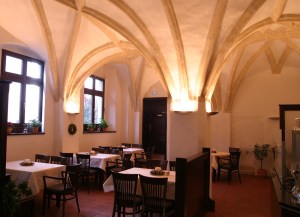 Alte Canzley.
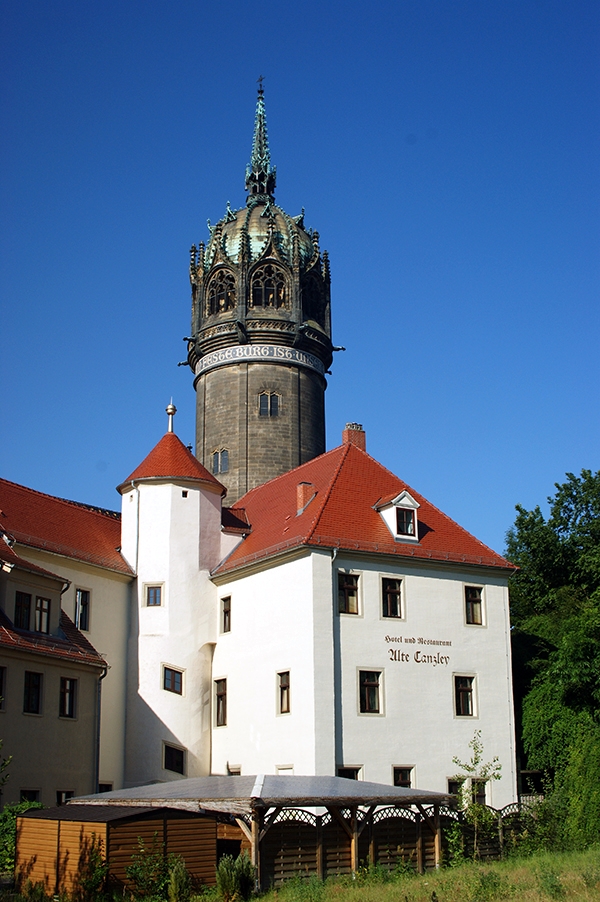
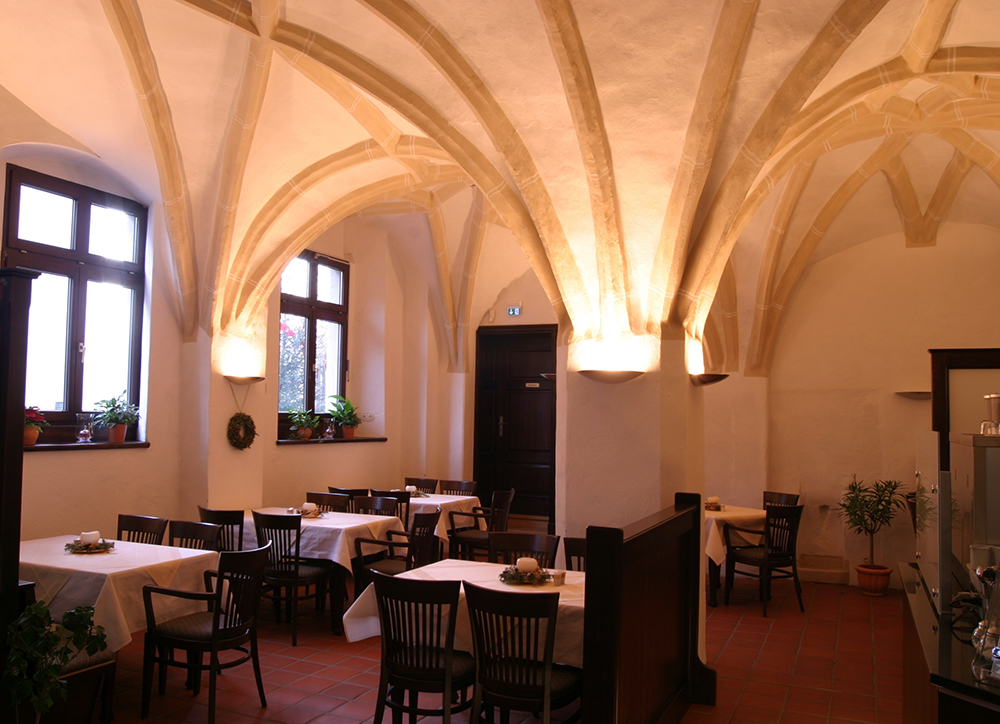
„Excellent organic food“. In Wittenberg one will find one of the best restaurants, the Alte Canzley. The building is very old, from 1391, so the name Alte – Old is justified. It’s a certified organic restaurant and the food is just wonderful.
 I had an extraordinary dinner at Alte Canzley.
Dinner there by example, beef in a black-beer crust, spinach rolls with pasta, orange-ginger soup to name just a few dishes. They served a very interesting dessert, asparagus ice-cream. I had never had that before in my life. Not sweet, but very refreshing and really tasted of asparagus.
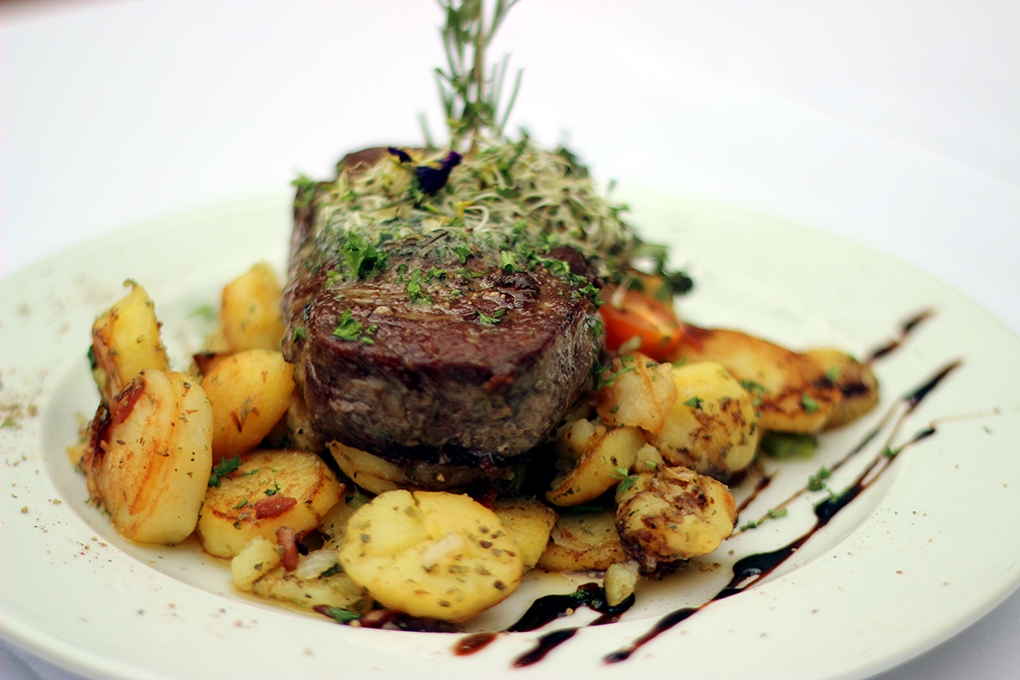
 My meal at the Alte Canzley was the ginger-orange soup, an excellent rump-steak on baked potatoes, wonderful red wine and the asparagus ice cream with coffee. Indulgent ? YES !!! Life is to short for a bad meal or a bad wine !!
Tante Emma’s.
 Tante Emma restaurant (behind the yellow umbrellas) on the market square in Wittenberg.
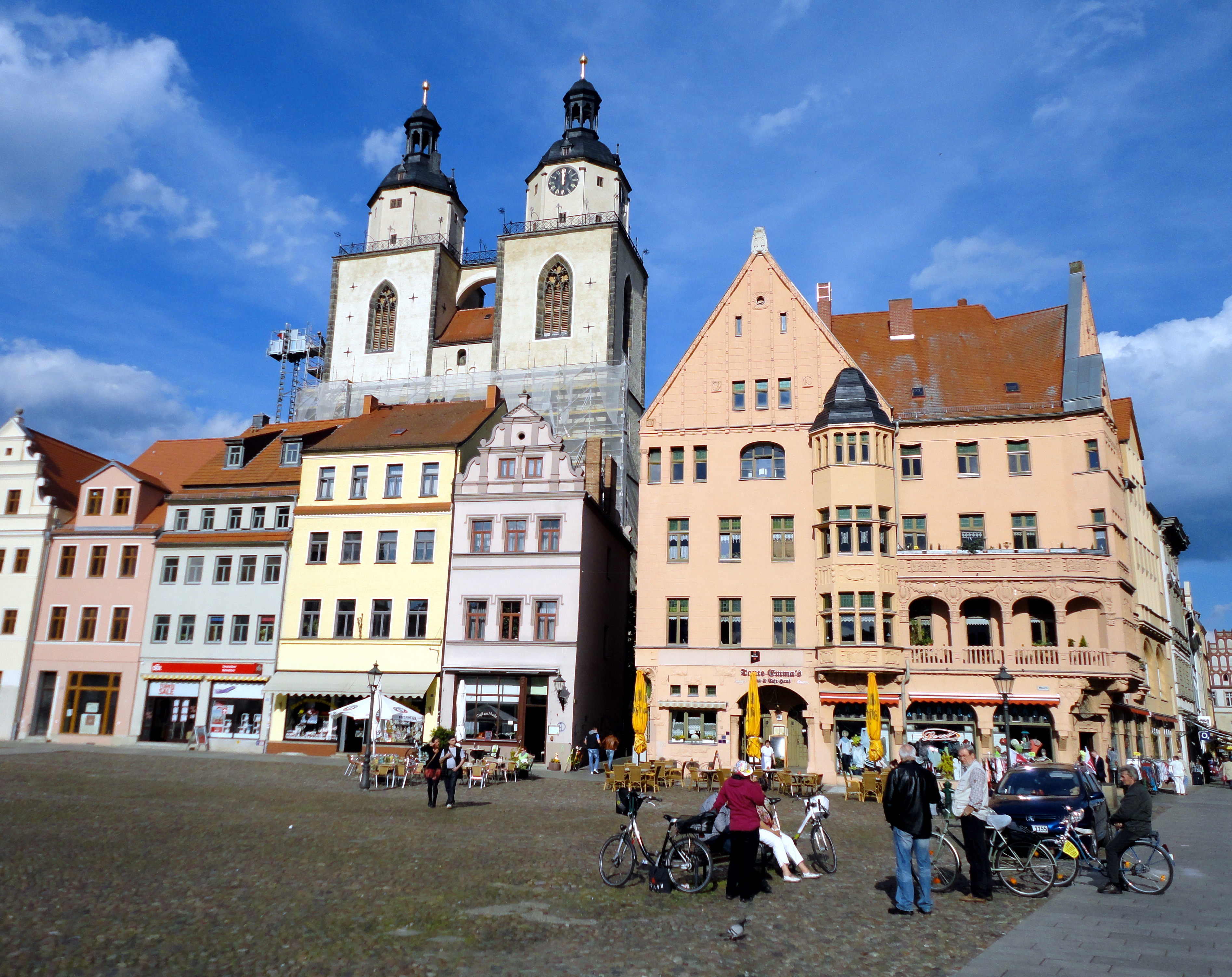
Tante Emma’s (Ant Emma) Bier und Café Haus. Cosy, old-worldly German restaurant.
Take a step back to the ‘good old times’ in this German country kitchen, where servers wear frilly white aprons and the room is chock-full of bric-a-brac – from dolls and books to irons and a gramophone.
 Tante Emma’s leaflet doesn’t show who she is.
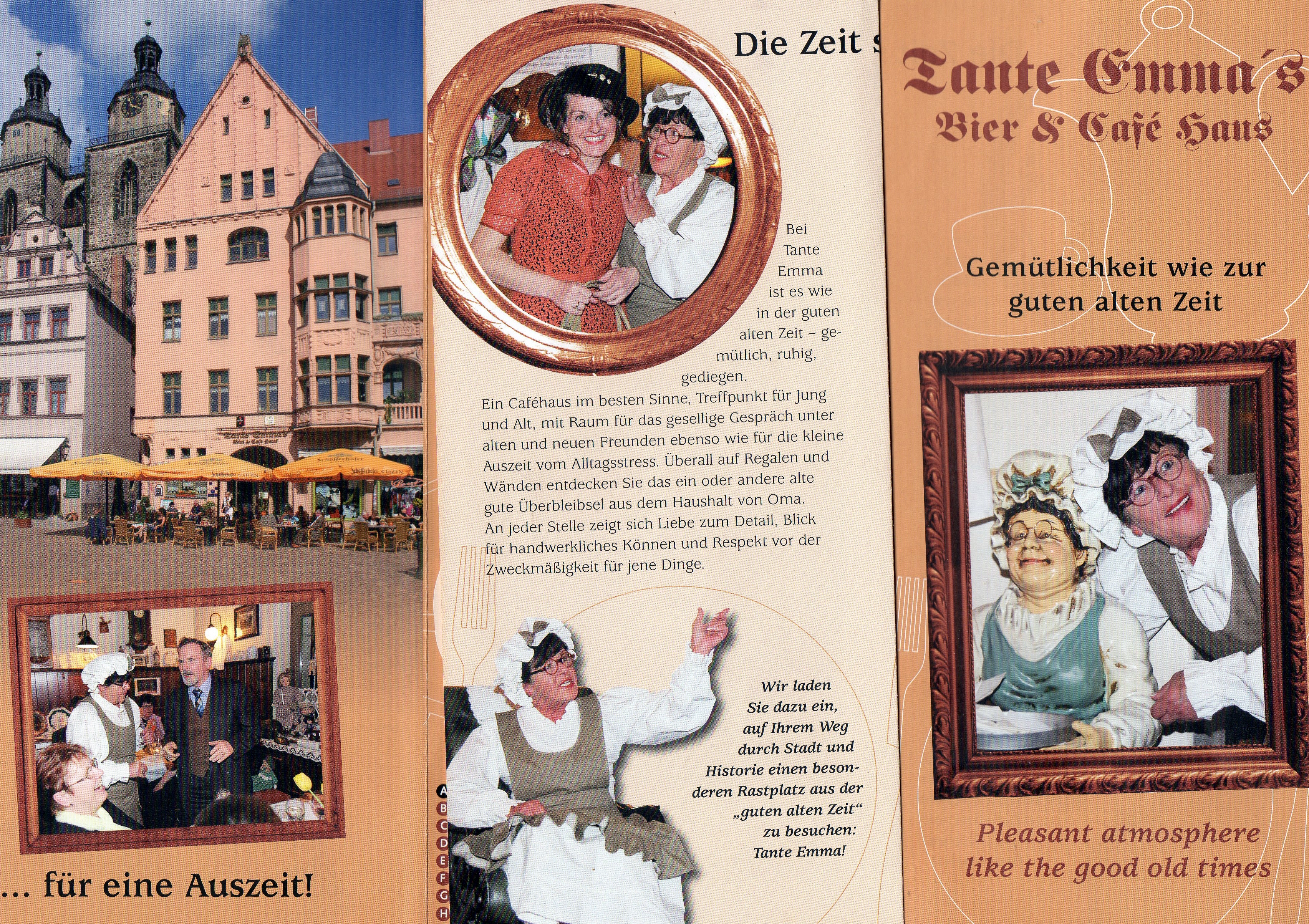
No idea who „Aunt Emma“ was, whom they named the place after. But the whole atmosphere is like a visit with relatives – Auntie is cooking the traditional family dishes for you. Many dishes have personal names as „Uncle August’s pork roast“ and such. The place is very popular with locals, too.
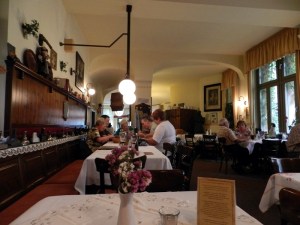
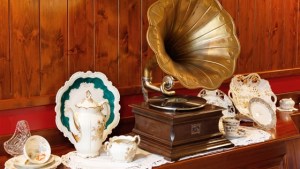 Tante Emma’s interior is just different, but very cosy. Best restaurant on a rainy day, which I haven’t – lucky.
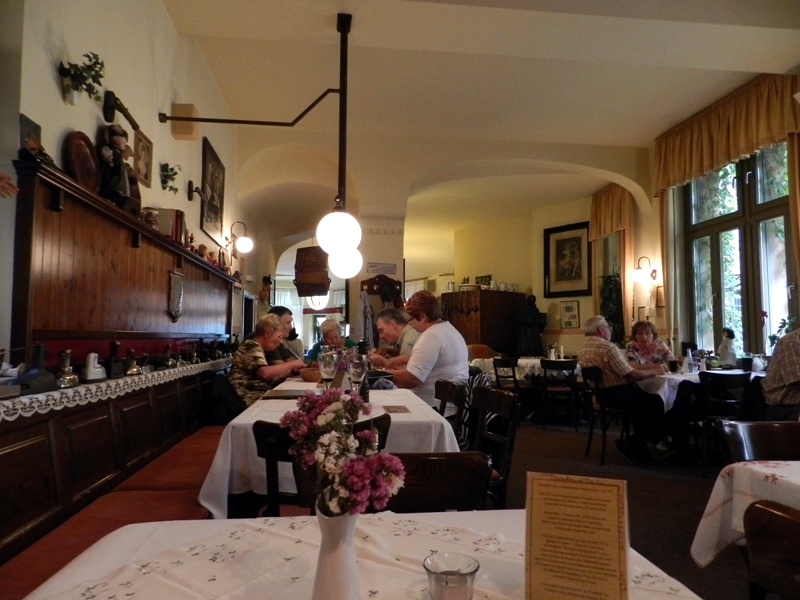
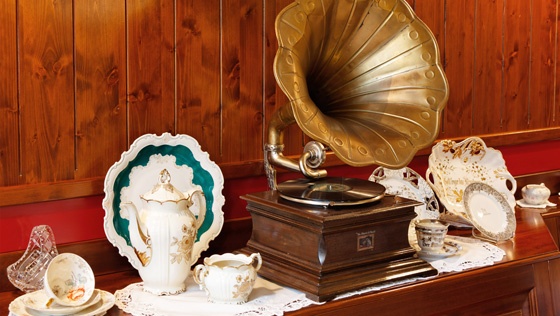
You are greeted by a life size puppet of „Aunt Emma“. The interior is cosy, a bit old-fashioned on purpose with oak furniture and embroidered tablecloths, and decorated all over with old knickknack, dolls, household items… a cute and pleasant place. In case you choose to sit outside in the square, at least have a look inside.
 Tante Emma’s „Gemuesepfanne“. Real „Lecker“.

That night I was not too hungry, because I had a heavy lunch at the Brauhaus and a good nap on my hotel bed afterwards (why not, it’s holiday), so I did not want a big meat dish. I ordered a vegetable and potato pan, baked in the oven with cheese. Very tasty. Together with a couple beers it was a fine dinner. As a desert I just had a glass of „Kraeuterlikoer“.
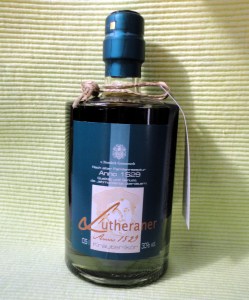
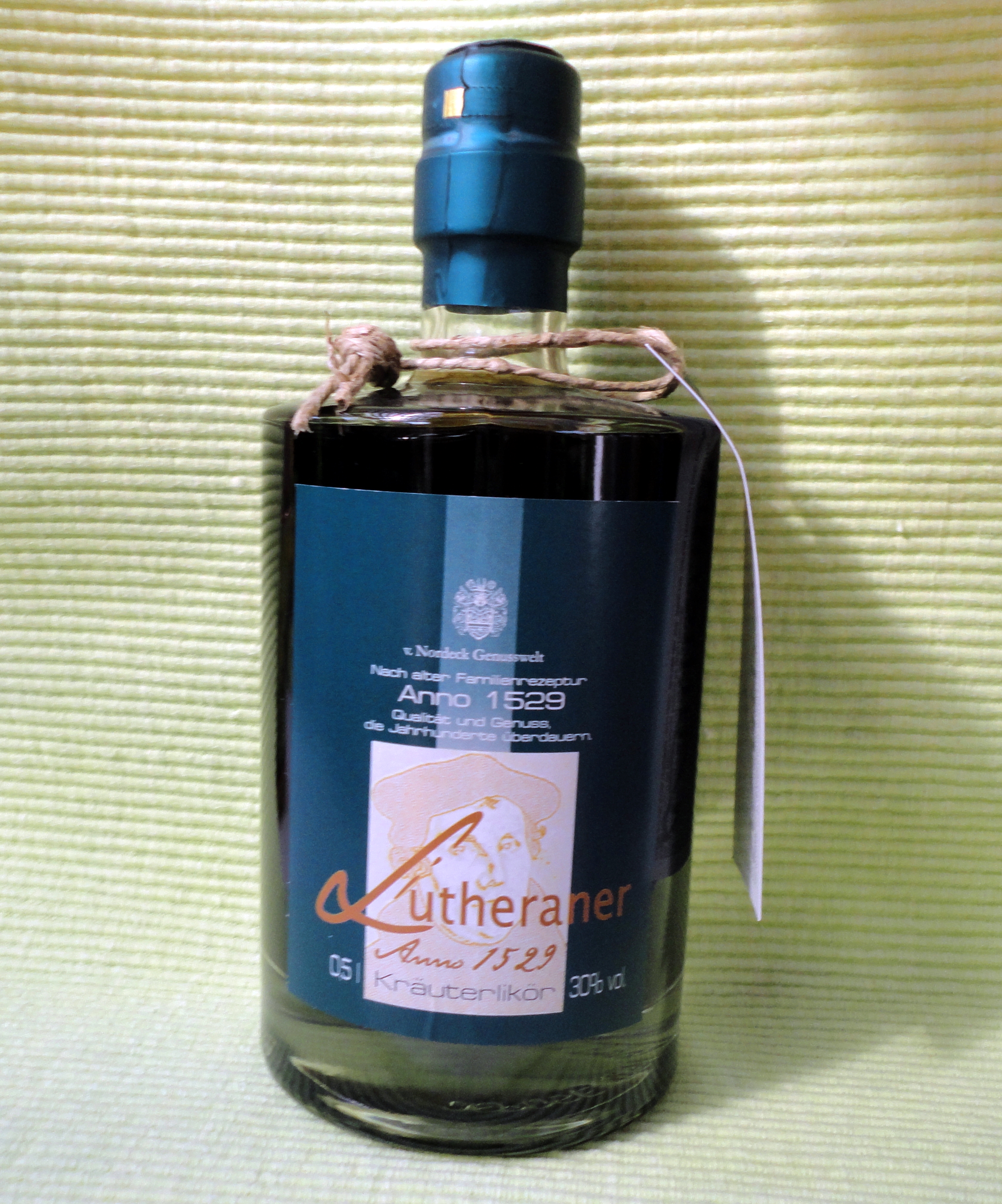
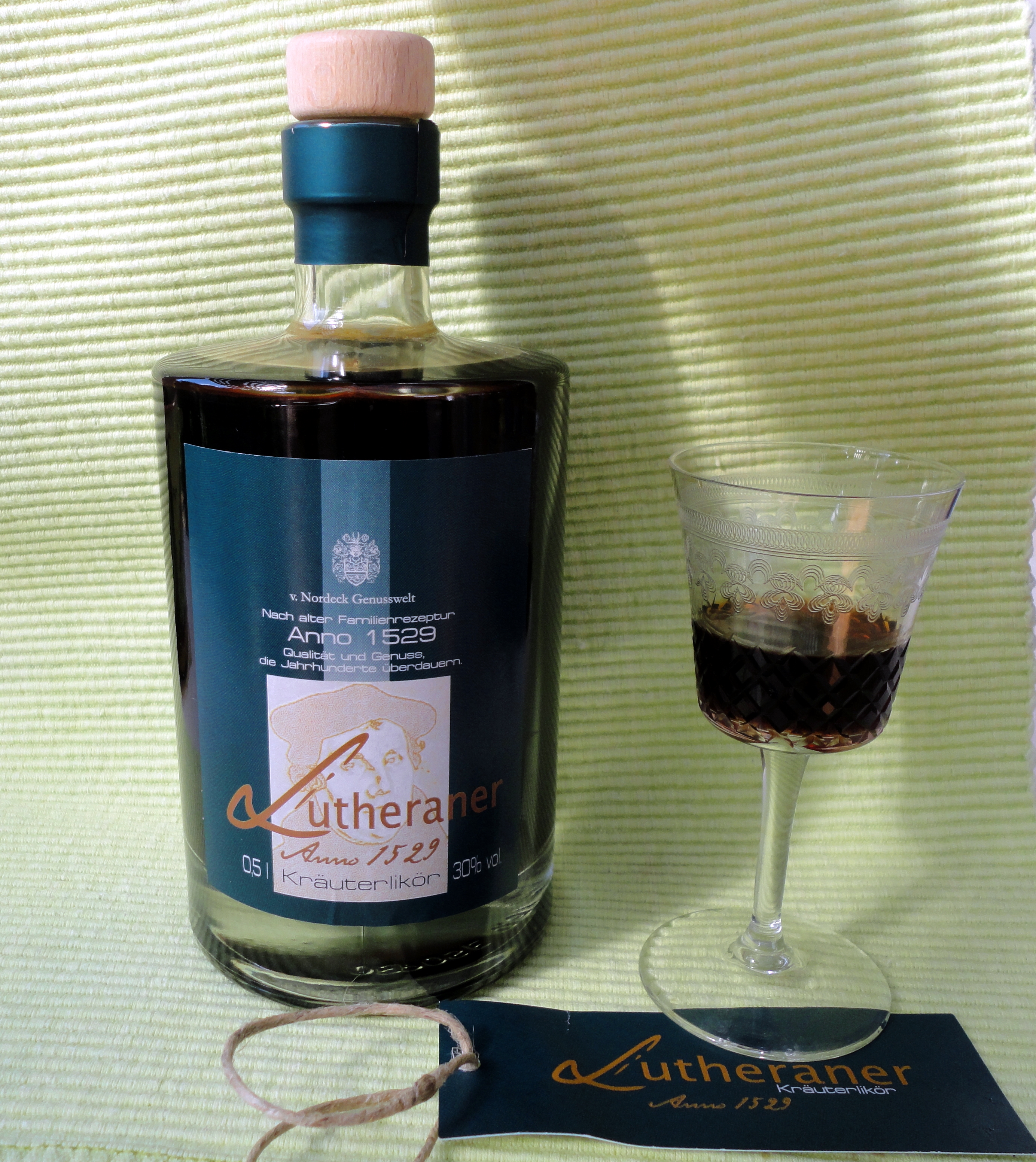
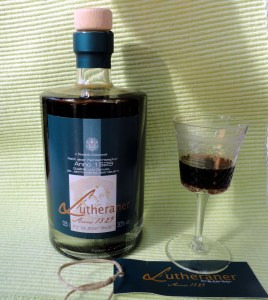 Half a liter of Kraeuterlikoer (herb liqueur) in a heavy bottle (about 1kg weight in my suitcase), expensive – huhhh !! That was my souvenir from Wittenberg. Its recipe, they say, is the same as Martin Luther used in 1529, a very rare drink. True, I never had a more delicious herb liqueur before.
Dolce Vita.
 Little Italy in Wittenberg, Eis-Cafe Dolce Vita.
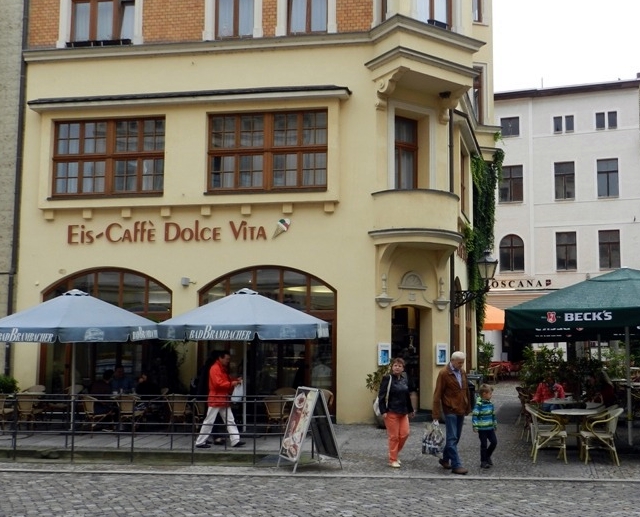
Eis-Cafe Dolce Vita is a pit stop for ice cream, very pleasant place and I needed some rest for a while, so I stopped at this Italian gelateria. It seems to be popular with both locals and tourists, the place was quite well occupied.
 What a delicious treat after hours of sightseeing.
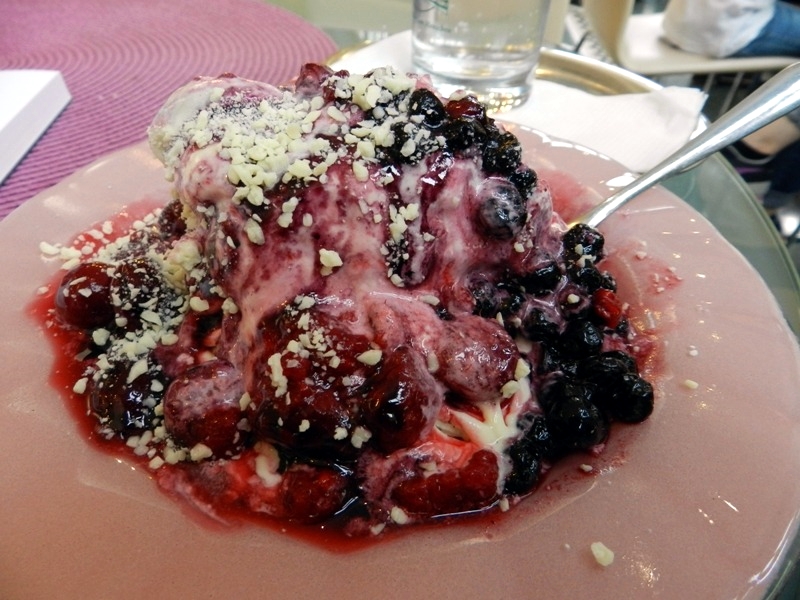
It is hard to go wrong with original Italian ice cream and cafe. Their menu has an abundant assortment of various sundaes, the clients are spoilt for choice. My choice was the spaghetti ice with berries. The fruit sauce turned out to be a compote like Rote Grütze which was very tasty with the vanilla ice cream. I enjoyed Wittenberg very very much.

